American Bar Association is ‘greatly concerned’ about low percentage of female and minority US attorney candidates

Consistent with the lack of diversity among Cabinet and other appointees:

ABA President Hilarie Bass has sent a letter to Attorney General Jeff Sessions that asks him to urge senators proposing U.S. attorney candidates to take diversity into account.

The letter (PDF) is dated Nov. 30, nearly two weeks after President Donald Trump announced a ninth wave of U.S. attorney nominations. Of the 57 U.S. attorney candidates announced so far by the Trump administration, one was black and three were women, Newsweek reported.

The letter acknowledges that senators representing states in which U.S. attorneys are to serve have long had the prerogative to make recommendations for appointments. But the attorney general who will oversee the U.S. attorneys “also has influence over the process,” the letter says.

“We are greatly concerned that a lower percentage of women and people of color have been appointed to these positions in the past year than in previous administrations—both Democrat and Republican,” the letter says. “That is why I am writing you to ask that you take an active role to help ensure that the cadre of U.S. attorneys appointed in this administration is more reflective of the legal profession and our society.”

The letter says equal numbers of men and women are graduating from law school, but the profession is 65 percent male and 85 percent white. Progress in achieving diversity “has been uneven, slow, and concentrated in low- and mid-level legal jobs,” Bass writes. “Racial and ethnic groups, sexual and gender minorities, and lawyers with disabilities continue to be underrepresented and face hurdles to advancement throughout the profession.”

“Our failure to achieve a diverse justice system despite the ever-increasing multiculturalism of our nation invites a crisis in public confidence,” the letter says. “A justice system that is not representative of the diverse community it serves risks losing its legitimacy in the eyes of those who come before it.”

via ABA is ‘greatly concerned’ about low percentage of female and minority US attorney candidates

Why Ottawa needs to nudge Canada’s boards toward greater diversity: Senators Massicotte and Omidvar

Agree – sensible amendments that provide latitude for companies to set their objectives with accountability and transparency provided through regular company and overall reporting:

This week, the Senate will vote on Bill C-25. The bill proposes to reform the process for electing directors of distributing corporations and co-operatives and modernize communications between corporations and their shareholders. It also requires distributing corporations to provide shareholders, at annual general meetings, information about diversity among directors and senior management.

The goal of the legislation is to increase diversity among corporate boards and among their executive ranks. The intent of the legislation is right. We need more diversity. But the measures proposed are not enough.

Three years ago, the Canadian Securities Administrators adopted a “comply or explain” model that is specific to the representation of women on boards and applies to most publicly traded companies in Canada. Bill C-25 emulates this approach.

Results have been disappointing: Only 14 per cent of board seats are now occupied by women, a meagre three-percentage-point progress from 11 per cent in 2015. Regarding senior management, only 15 per cent of positions are filled by women, a proportion that has not progressed at all since 2015.

Women are better represented on boards and in senior executive positions at larger firms. But even in FP500 companies, other groups are unacceptably underrepresented. Only 1.1 per cent of board members are Indigenous, 3.2 per cent are persons with a disability and 4.3 per cent are members of a visible minority.

Why would an approach that has yielded so few advances in recent years work better in the future? The government is asking Canadians to be patient, but shouldn’t we request an improved approach? We strongly believe we should.

This week, we will table an amendment in order to ensure we do more than what is timidly proposed in Bill C-25. This amendment puts forward an approach that is both progressive and respectful of corporations’ choices and strategies.

The term “diversity” is not defined in Bill C-25. When diversity is left undefined, even on the most basic level, as we saw in the United States, it loses its emphasis. It becomes experiential rather than identity-based. Given the myriad interpretations possible, the term risks being diluted beyond recognition, with very little accountability in place.

Our amendment would require publicly traded corporations to set self-determined numerical goals, such as percentages and timetables, to bolster the representation of at least four underrepresented groups within boards and senior management. It would specifically target the designated groups identified in the 1995 Employment Equity Act: women, Indigenous peoples, persons with disabilities and visible minorities.

To be clear: Companies would be allowed to establish numerical goals for these four groups, considering industry and company-specific factors and also include other forms of diversity if they so wish.

We know this approach works. According to the Canadian Securities Administrators, issuers that set themselves targets for the representation of women on boards do more than twice as well (reaching a 26-per-cent female composition of their boards) than companies that do not set such goals (12 per cent being their proportion).

So, by requiring corporations to report policies and goals to their shareholders, this amendment is designed to nudge them to accelerate change.

But if we are to know whether real progress is made, we need a periodical, complete, up-to-date picture of the situation in the upper echelons of the corporate world. That is why the amendment would require that corporations also send diversity and numerical goals information to the government. As well, each year, the minister would be required to prepare and publish a report presenting the aggregate data received.

The approach that we propose seeks better representation for women and other underrepresented groups, while leaving corporations free to take into account their particular circumstances. It is not a one-size-fits-all approach and it is a much better alternative than the wait-and-see approach proposed by the government.

This is an important piece of legislation. Diversity is our strength but inclusion is our choice. We need to make these changes to improve the bill and accelerate progress.

via Why Ottawa needs to nudge Canada’s boards toward greater diversity – The Globe and Mail

EU chiefs ‘IGNORE’ ethnic minority staff ‘despite promoting diversity’ | Express.co.uk

The numbers are telling:

Statistics published by the Politico website show minorities make up just one per cent of EU institutions.

Part of the reason for the EU’s deliberate colour blindness stems from countries like France where there is huge opposition to compiling statistics on race.

But critics say that has led the bloc to become a “bubble” for rich white people and no longer reflects the continent it purports to represent.

Is the EU too white?

British Conservative MEP Syed Kamall said there was a clear divide between those high up in Brussels and the staff performing low-level jobs.He told the site: “If you want to see diversity in the European institutions, look at the faces of the cleaners leaving the building early in the morning and contrast that with the white MEPs and officials entering.”

One MEP’s assistant, Rachael Moore, even accused politicians at the European Parliament of ignoring her as one of the few “black faces” andclaimed she was subjected to security checks for no good reason.

She said: “It’s like I am not even there — they just look straight at my boss.

“They don’t look or reply to me when I ask a question. I get looks like ‘you’re not supposed to be here’.”

She went on: “I don’t sound like anything in particular on the surface.

“There is shock, a blank stare when they see me for the first time. It plays on my daily life.”

There is a lack of diversity at EU institutions

British Conservative MEP Syed Kamall said there was a clear divide between those high up in Brussels and the staff performing low-level jobs.

And Sarah Chander from the European Network Against Racism (ENAR) told Politico there was an “audacity” in Brussels where “every single one” of those promoting multiculturalism were white.

She said: “Many working in the Brussels bubble feel that working on progressive issues gives them a sense of immunity for the overwhelming whiteness of their institutions and organisations.”

It is not the first time concerns have been raised about a lack of representation in the EU corridors of power.

The ENAR penned a letter to Jean Claude-Junker earlier this year calling for changes to its diversity strategy.

It came after the Commission published a new policy on boosting the number of women, people with disabilities and LGBT staff working at its buildings, but ignored their race.

The letter said: “The European Commission has been widely criticised for under-representation of racial, ethnic and religious minorities within its workforce.

“Many commentators have argued that the European Commission must better reflect the diversity of the European society.

“Particularly at senior levels, the issue of under-representation is acute.

“This points to a trend of structural discrimination within the European Commission and jeopardises the equal inclusion of racial, ethnic and religious minority staff.”

But last year Alexander Winterstein, deputy chief spokesman for the Commission, defended its policies.

He claimed: “If you walk through our corridors you will see people from all walks of life, from all over Europe.”

via EU chiefs ‘IGNORE’ ethnic minority staff ‘despite promoting diversity’ | World | News | Express.co.uk

Can white male CEOs bring diversity to corporate Canada? Interview with Frank Vettese, CEO Deloitte Canada

Worth reading:

Q: How long have you been Deloitte’s “chief inclusion officer”? 

A: Almost two years. I’ve been CEO since 2012, prior to that going back to 2006 I co-founded our “women’s initiative.” I have been heavily involved in all things diversity-related at Deloitte. I was executing the CEO role and at same time looking to make deliberate shifts in the organization—from an emphasis on diversity to an emphasis on inclusion. Inclusion really is about creating the conditions for success within the organization within the widest scale. I needed to be the individual setting the tone and the execution plan and linking it to our strategy. Hence, it was an incremental role I took on.

Q: For decades we’ve been hearing white men in powerful positions discuss the value of diversity—and more recently “inclusion.” And yet business remains dominated by white men. The link to Deloitte Canada’s leadership team on your website is broken. But from what I can see, the top three positions are held by white men and only one of six regional managers is a woman. What has Deloitte done, or is it doing, to establish greater diversity/inclusion?

A: In terms of looking at those rolesCEO or chairyou’re correct, they’re men. We’ve got between 20 and 30 per cent of our leadership team as women and 30 and 40 per cent of board as women; I would concur with your point that what we’ve been dealing with, certainly in our organization, and it’s no different than corporate Canada, is a significant under-representation of women and visible minorities and other forms of diversity. We’ve recently appointed our CFO, which you could argue is the third most significant position in the organization, as a female. And when you look at broader leadership team, our vice-chairgroup, we have a number of women within that group.

We’ve had a long track record of hiring at the Canadian representation of our population at the entry levelwomen, visible minorities, all forms of diverse communities. The challenge has been at the most senior levels and one step back, entry into partnership. To me, this has been the real telling tale of whether the firm is getting this right. In the first few years we were struggling with getting representation  in partnership ranks at Canadian population levels. I’m proud of the last two admission years have approximated the Canadian populationlast year 45 percent of new partners were women. We’re still not where we need to be.

Q: Deloitte’s report talks in terms of the need for revolutionary change. Yet as Thomas Kuhn wrote in in The Structure of Scientific Revolutions, paradigm shifts rarely happens from within. You are ensconced in corporate Canada. What makes you confident you can create radical change from within?

A: The thing that gives me great confidence is that there is a clear mandate for this. The whole notion about inclusion for our firm is entirely embedded in the strategy of the firm….Go back less than 10 years, and we’d talk about the most significant issue, the topic of inclusion was something that might have come up episodically. Today it is very rare when I go and exchange at the external marketplace that this isn’t at the forefront at least around awareness and recognition of the business case and the moral imperative. I subscribe that there’s a big difference between that and the “how” and “What do we do to get it done?” As we’ve transformed, we’ve engaged our people, our Millennials, Gen X, they have informed what it is we’re doing. We’ve removed hierarchy…They are the ones telling us this is needed for success. I’m confident this has moved from conversation into real action.

Q: On the point of removing hierarchy, you’ve talked about having no formal offices at Deloitte.  So you don’t have an office?

A: I have no office whatsoever; today I’ve probably operated on six or seven floors.

Q: Yet hierarchy is measured in lots of ways in a corporation, mostly by compensation. What are you doing to flatten that out? 

A: A few things. We used to put more of an emphasis on roles, management jobs that had a value assigned to them. Today the measure is very simple: contribution and impact. It’s determined one person at a time; there’s goal-setting. I think that has dramatically changed the way we share the financial rewards and benefits of the firm. We’re working hard at reviewing our compensation policies and approaches to make sure that we’re removing bias, certainly around gender parity but it goes beyond that to ensuring that what people do, functions they perform, impact they drive is being measured in as an objective way as possible. We’re even looking at introducing things like artificial intelligence into our processes to remove bias.

Q: In  your Globe and Mail op-ed you admitted you were guilty in the past of hiring people who looked like you. The report refers to “deep underlying cultural sources of exclusion.” Is that one of them?

A: At time I was launching women’s initiative in 2006, I put in place measures to address the concern, “How do we assure having top talent female managers invited into our partnership?” We saw good progress I stood back after a couple of years and looked at the overall numbers and they moved, but didn’t move as much as I thought. When I went to assess the root cause, we were providing support and tailored development to the people we had. But looking to build the business and fill gaps, I was disproportionately hiring people who had similar attributes to me. It was an unconscious bias I did not identify at the time. And once we  identified it, we could put measures in place. So instead of going to the usual suspects and going to the regular places, how do we change practices to widen the aperture to ensure we look at all qualified candidates?

Q: The report refers to the “diversity industry” which began in the 1960s, noting that diversity training in corporations doesn’t improve diversity. Why not?

A: A lot of the training I made reference to was diversity training—it was awareness of differences, it was spotlighting and putting an emphasis on differences. To some extent, a lot of that training was around representation; the measure of success was the numbers, the fact we were looking at measures of diversity as the outcome. And although diversity is important, and I would say that inclusion without diversity is hollow, the flip is true: diversity in itself does not mean the organization is inclusive. If we’re having certain numbers you’re counting doesn’t mean you are creating a workplace where people can bring their whole selves to work; where there is that flexibility, tailoring to how people operate to thrive and succeed on their own basis. A lot of diversity training has failed because it’s still focused on the need to hit certain targets, as opposed to that underlying culture.

Q: The last of the report’s five “action” recommendations is “Own inclusion inside and outside the office”—meaning to call out inequalities and bias when you see them.  You sit on the Dean’s Advisory Council at the Schulich School of Business, which is 56 men and 15 women. And you sit on the advisory board of Catalyst Canada [a non-profit that promotes advancement of women in the workplace];  it’s composed of 11 men and seven women. Last September, CIBC chief executive Victor Dodig, a white man, replaced Bill Downe, a white man, as the board chair at Catalyst. Don’t you have a responsibility to speak out about inequities on corporate boards? Or do you agree that the board of an organization devoted to promotion of women in business should be headed by white guys?

A: First of all, the CEO of Catalyst is a woman. Victor is someone who at the core represents the ideals and what we’re trying to accomplish. I look at it as “Who is in the best position and most qualified at that time to advance what is core to the strategic objectives of the organization?” I do believe it’s important that we don’t get caught up in the notion that in any way starts to approach tokenismrather that we look at each unique person and how they align against the needs of the role. Having said that, I’m not trying to dispel the underlying point that you’re making which is, “Are there some things we have to deliberately do and deliberately make to ensure our boards represent the broader constituent group and actually execute against the ideals we espouse?” So our Deloitte Canadian board, for example, when we first set up, it was making sure we could sign up for 30 per cent representation by this year. We’re past that number.

Q: Why a 30 per cent target? Why not 50 per cent?

A: There’s no question that what we hope to achieve in our organization is that we get to the [statistical equivalent of female representation in the] Canadian population in the partner group and in our most senior roles. But in a board situation we don’t simply get, with the stroke of a pen, to construct a board. With our bylaws, we have to have partners who vote. We work through a deliberate process to determine we could achieve 30 per cent. We’re continuing to push boundaries. In our global [Deloitte] board, we had a real deficit in female representation and some of the larger countries had two board seats, one for their sitting chair and one for the CEO. So myself and four other stepped out of our seats years ago and put a top female leaders. Where we have the latitude we’re looking for creative ways to do that. The discourse and effectiveness of our global board has moved up a clear notch.

via Can white male CEOs bring diversity to corporate Canada? – Macleans.ca

Diverse workforce expected by new recruits, drives performance | Business Insurance

Insurance industry perspective:

Insurance industry companies seeking to attract young professionals to the sector need to create work environments that welcome diversity or risk losing talent to competitors, a panel of experts said.

In addition, companies that actively promote diversity may perform better financially, they said.

There is a “dawning reality” that corporate culture has fundamentally changed, said Dominic Christian, CEO of Aon U.K. Ltd., a unit of Aon P.L.C. in London.

Young people entering the workforce assume that multiculturalism and gender equality are part of corporate culture, he said, and most executives’ approach to management encourages diversity, he said during a panel session at Business Insurance’s 2017 Women to Watch EMEA Awards and Leadership Conference in London last week.

“The leaders of companies today in corporate life, for the most part, are intensely consensual, they are very open, and openness and receptivity are at the heart of diversity,” Mr. Christian said.

Those companies that don’t promote diversity will lose coveted young employees to rivals, said Harsha V. Agadi, president and CEO of Crawford & Co. in Atlanta.

“These young executives will learn to jump, and there will always be a net,” he said.

To improve diversity in senior positions, companies should focus on their talent “pipelines” to ensure that diversity efforts are sustainable, said Romaney O’Malley, head of U.K. regions and industrials and commercials in Europe for American International Group Inc. in London, and one of Business Insurance’s 2017 Women to Watch.

AIG in Europe has committed to having a pipeline that is composed of 50% women within the next two years, she said.

“That’s really getting at succession planning — and succession planning at all levels,” she said.

FM Global is seeking to increase gender diversity in its talent pipeline, which targets graduate engineers, but in the U.K. only 15% of graduates with degrees in engineering are women, said Angela Kelly, vice president of diversity and international human resources for FM Global in Windsor, England.

To try to improve gender diversity, the insurer established a program with 20 women around the globe appointed as “engineering ambassadors,” with responsibility for working with their business leaders to address the challenge of attracting and developing women engineers. The program, which included networking, mentoring and presenting to senior management, has been in place for two years, and 50% of the women have been promoted into higher-level positions, Ms. Kelly said.

In addition, while historically only 20% to 25% of FM Global’s engineering recruits have been women, last year 50% of the recruits were women, she said.

“I’ve got to think that by putting these formal programs in place, putting some rigor behind it, getting that executive support and buy-in, that’s got to have contributed,” Ms. Kelly said.

As they promote more women to senior positions, companies may need to look outside of their own organizations for mentors for women executives, said Mr. Agadi of Crawford.

“You can promote women, you can have them on the executive committee, but guess what — when they get to the top, you might not be the best mentor for them,” he said.

At another company, Mr. Agadi said he asked the female CEO of another company to mentor an Iranian female executive who was promoted to a senior position based in the southern United States rather than one of her six male colleagues in the U.S.

“If I had her being mentored internally, it would have been a big, big miss,” he said.

Swiss Re Ltd. has a structured program for increasing diversity within the organization, including an active female sponsorship program, with every line manager held accountable for meeting diversity targets, said Frank O’Neill, CEO of U.K. and Ireland for Swiss Re in London.

The benefits of diversity initiatives can sometimes be seen in financial results, he said.

Prior to his current position, Mr. O’Neill ran Swiss Re’s Africa and Middle East business and was based in Cape Town, South Africa. When he took the job in 2012, the executive team was made up exclusively of white males and the business was performing badly. In the next year and a half, he rebuilt the team so it was 60% female, and 60% of those women were women of color, he said. When he left the position last year, revenue had increased 100% and earnings had increased 120%.

“If you build the right team with great talent, you can really drive the business forward,” Mr. O’Neill said.
via Diverse workforce expected by new recruits, drives performance | Business Insurance

Differences of Opinion: How Canadian and US business leaders think about gender diversity

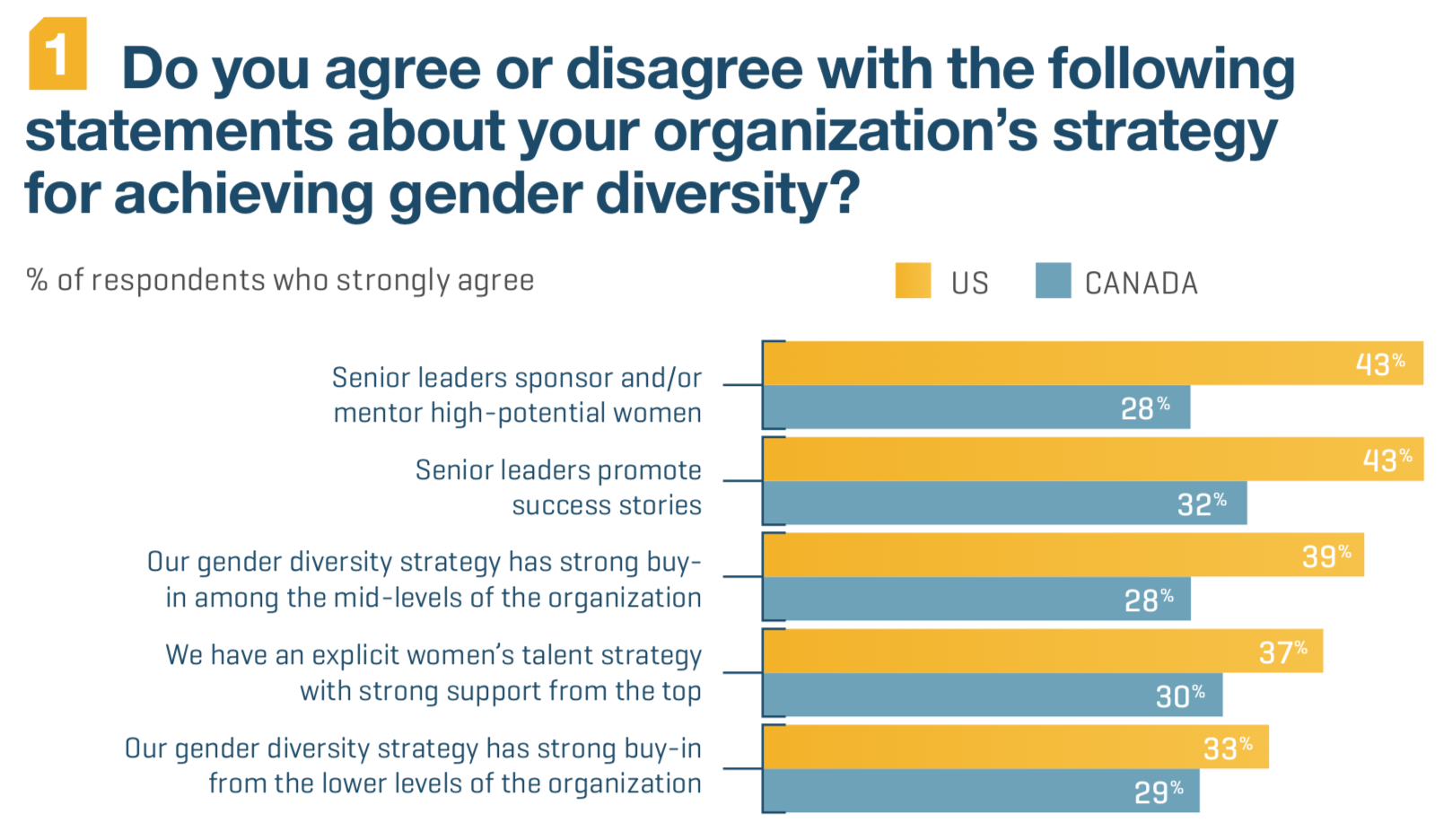
RBC continues to do interesting research and reports on diversity issues. This Canada-United States comparison being the most recent example (and it challenges Canadian smugness about our diversity policies in the corporate sector). These two charts are particularly revealing, report recommendations follow:

1. Be aware that diversity mandates can backfire.

Surprisingly, mandatory diversity training can often have the opposite effect, increasing bias rather than eliminating it. Research over several decades has shown that corporate leaders and managers are less motivated to increase diversity if they are forced to do so. In one study, Harvard Business Review researchers who analyzed data from hundreds of US firms found that “companies get better results when they ease up on the control tactics.”

Similarly, national policies that promote gender parity, diversity, and gay rights may be viewed as controlling or policing people’s personal opinions and actions. Equal opportunity or pro-diversity legislation may make organizations “check the boxes” to advertise their compliance with the requirements, but may also make them less likely to make practical efforts to reduce gender or other types of discrimination. Rather, engaging leaders and managers to become advocates for change is more effective. Voluntary training to raise awareness, along with mentoring and coaching efforts, participation in task forces or councils, or leadership of affinity groups, works best.

2. Try more innovative solutions.

The most appropriate measures vary across industries and firms, and a decision not to adopt any specific approach cannot be interpreted as a failure. Still, our study shows that companies in both the US and Canada are using only a subset of all the potential strategies. Canadian companies tend to take fewer risks and are less likely to try innovative solutions than their US counterparts. Solutions that have been adopted less frequently in Canada than in the US may provide ideas for further action by Canadian firms. They include:

  • Job auctions or trial hiring (37% vs 43%)
  • On-the-job development activities that provide opportunities to generate business impacts (38% vs 44%)
  • Support for working parents (34% vs 43%)
  • Flex time (48% vs 52%), part-time (31% vs 35%) and childcare subsidies (27% vs 31%)
  • Assessing performance relative to gender diversity targets (37% vs 44%)

3. Build a strong business case for women in senior management.

“Fundamentally, having a workforce and a senior management team that represents the clients and communities an organization serves is both an asset and a competitive advantage,” says Jennifer Tory, Chief Administrative Officer at RBC. “Diversity of gender, thought, and background creates inclusive teams that generate better ideas and solutions. Inclusive teams are strong teams, and strong teams make better business decisions.”

4. Invest in retraining and reintegrating women into the workplace.

One of the biggest challenges in both the US and Canada is the issue of parental leave and how it affects women’s careers. The two countries differ markedly with respect to national policies. In the US, women who take maternity leave do not receive guaranteed payments from the federal government. The Family and Medical Leave Act protects their job for up to 12 weeks; some individual companies and states may offer more generous policies or a short-term disability policy that pays women during their leave of absence. By contrast, Canada is far more generous; its mandated 12-month parental leave is expected to stretch to 18 months in 2018.

In a way, that could “create unintended consequences” for women’s advancement in Canada, says the University of Toronto’s Dart. She notes that although both parents can share the leave, men are often reluctant to take time off. “In many Scandinavian countries paternity and maternity leave are mandatory. Both men and women leave the workplace for a time when they have children, so there is less of an opportunity for gender bias. It has to be mandatory. You have to make it an equal playing field.”

In Canada and other countries where equal parental leave is not mandated, being away from the job for so long could be detrimental to women’s careers, she adds. “Women step out, often because of family pressure, and find it very difficult if they want to come back later on. They have lost their professional networks and they don’t know if their skills are up-to-date. Many companies don’t actively work on bringing women back to work; it is easier to advance the women who have stuck it out.”

5. Make a concerted effort to change societal perceptions.

Here’s where male role models, influencers, pressure groups, and governments play a big part. “With regard to progressing in their career, women are working really hard, but they need networks and sponsorship much earlier in their career,” says Jennifer Reynolds, CEO of the Toronto Financial Services Alliance (TFSA), a public-private partnership that supports the financial services industry. “We need to actively challenge senior management on that, and we have to have men in this dialogue.”

Dart advocates going even further. “There is a very large gap in the middle part of the pipeline,” she says. “There’s always more commitment that we need to see in senior leaders. We need more CEOs and board chairs to advance their support of women. But this battle is not lost at the corporate front. This battle is lost at the home front. The expectations of women, the roles they are supposed to play, are different in different cultures. That’s where we need to start: changing role expectations.”

Source: Download Here

Big Oil Has A Diversity Problem : NPR

Good profile of US oil patch and diversity. Assume similar in Canada but I welcome Canadian oil patch reader comment and insight:

Oil industry leaders say they want be more welcoming to women and minorities. Both groups are underrepresented across much of the oil industry, compared with the U.S. workforce as a whole.

One example is the category “oil and gas extraction,” where Bureau of Labor Statistics numbers show only 20.2 percent of workers are women, compared with 46.8 percent in the overall workforce. African-Americans make up only 6.2 percent in the same category, compared with 11.9 percent overall.

At oil companies, “for both women and for African-Americans, they tend to be among the worst performing in terms of both pay gaps and employment representation,” says sociologist Don Tomaskovic-Devey. He directs the Center for Employment Equity at the University of Massachusetts, Amherst and wrote a report about these federal labor statistics.

Tomaskovic-Devey says some firms probably do a better job than others. He says it’s difficult to know because those numbers aren’t available. “The key thing to understand is when diversity is a managerial priority, it happens,” he says.

The great crew change

A few people at the top of the oil business do want to make diversity a priority. One reason is something the industry calls “The Great Crew Change.” After the oil bust in the 1980s, a lot of companies stopped hiring. That has left the industry with an aging workforce that includes many who are headed toward retirement.

Winkel co-authored a 2016 American Petroleum Institute research report detailing how many women and minorities work in the oil and gas business now and how that could change in the future. It projects the industry needs to attract 1.9 million new workers by 2035 to make up for retirements and growth in the oil business.

“We know from the Census Bureau that we will be a majority-minority country by 2044 … Those changing demographics demand that we pay more attention to diversity than, perhaps, we have in the past,” says Winkel.

You can see evidence of the industry’s desire to at least appear as if it’s changing in advertisements for big oil companies. One from ExxonMobil shows a string of mostly women and minority workers wearing hard hats and holding signs that tout the benefits of the industry.

This ExxonMobil advertisement features a string of female and minority workers that are much more diverse than the oil industry’s actual workforce.
ExxonMobil YouTube
Chevron’s Twitter posts highlight the company’s commitment to diversity in its suppliers.

The company has made diversity and inclusion one of the core principles highlighted in its mission statement called “The Chevron Way.”

“Staffing our workforce for the future is a priority and we actually start focusing on our talent pipeline with kids as young as 5 years old,” says Rhonda Morris, vice president of human resources at Chevron.

Big oil companies like Chevron and ExxonMobil spend millions promoting science and math to children around the world — in part hoping that it will lead to a more diverse workforce. At colleges, those companies recruit women and minorities and then offer them mentors. And for existing employees, there are programs such as unconscious bias training.

Ray Dempsey, the chief diversity officer at BP America, says this is good for business. “There’s data that you can find from many, many sources that talk about how much difference a more diverse and a more inclusive workforce can make on your fundamental business outcomes.”

Dempsey says executives already embrace diversity. The focus these days is on middle managers where the hiring and firing happens.

But he says there are other things about the oil industry that are difficult to change, like where the oil or gas is located. Dempsey says it’s often in remote places, “versus the urban centers where minorities — communities of color — tend to be and, frankly, where people from those communities tend to want to live and to work.”

Dempsey says the industry needs to do more to make rural places welcoming to women and minorities.

via Big Oil Has A Diversity Problem : NPR

Liberals’ judge selection has new bias, lawyers association says

Some valid concerns regarding diversity of experience and practice – in meeting the needs for  “identity” aspects of diversity, necessary to think also about these other aspects:

After appointing five women and no men to the bench in the Maritimes, the Liberal government is being told its commitment to diversity has a large blind spot – but not over the gender issue.

The Liberal government stressed diversity in launching a new process for appointing judges in October, 2016. For the first time, applicants are being asked about their race, gender identity, Indigenous status, sexual orientation and physical disability. Members of the committees that screen candidates are receiving training in “unconscious bias.”

Three of the five appointees in the Maritimes since then specialized in insurance law when they were lawyers, the Atlantic Provinces Trial Lawyers Association said in an open letter to federal Justice Minister Jody Wilson-Raybould on Wednesday. And all three worked for the same regional law firm, Stewart McKelvey.

“Their background is representing insurance companies in personal injury claims against the average Joe,” said Brian Hebert, president of the Atlantic lawyers association. “We’re hoping this isn’t a trend.”

In Prince Edward Island, six of the eight sitting judges on the Supreme Court and the Court of Appeal are from Stewart McKelvey. The Globe and Mail attempted to reach the managing partner of the firm’s Charlottetown office, and other managing partners, without success.

The Atlantic lawyers’ group represents plaintiffs in personal-injury cases – that is, individuals who in many cases sue insurance companies. “We represent the average person who has to fight insurance companies,” Mr. Hebert said.

“It’s a concern when we see judges being appointed from the same practice background, because we believe that as lawyers, we’re human, we’re influenced by our clients that we serve day-in, day-out, the culture of the firm that we’re in, the type of law that we practice.”

A spokesman for the Justice Minister said that only two of 12 judges appointed in Atlantic Canada since the Liberals took office in 2015 – a slightly different time-frame from the one referred to in the lawyers’ group letter – were, at the time of their appointment, with Stewart McKelvey.

“Minister Wilson-Raybould’s appointments in Atlantic Canada and throughout the country are based entirely on merit,” the spokesman, Dave Taylor, said in an e-mail.

“They respond to the needs of the courts, as identified through close consultation with Chief Justices. … The minister has been proud to appoint such outstanding candidates to the bench, as our government works toward building a judiciary that fully reflects the country it serves.”

Mr. Hebert said the appointees are highly qualified and he is not critical of the quality of appointments. Nor is his group critical of the lack of men appointed under the new process.

Christa Brothers, a former partner at Stewart McKelvey, was appointed to the Supreme Court of Nova Scotia in July; Tracey Clements, a partner at the same firm in Charlottetown, was named to the PEI Supreme Court in March; and Chantal Daigle, who chaired the recruitment office for the Saint John office of Stewart McKelvey from 2013-15, and who became a partner in 2004, was appointed last week to the Family Division of the New Brunswick Court of Queen’s Bench, after a year as case management master of that same court.

The other two appointees were not from law firms. One was a long-time provincial court judge promoted to the appeal court in Nova Scotia and the other was a lawyer from the Antigonish Legal Aid Office named to Nova Scotia’s Supreme Court.

“The reason we want women on the bench,” Mr. Hebert said, “is so that when women’s issues are before the court, or when women appear in court, there is a balancing of views. Same thing with race or other areas where we would want diversity. What we’re saying is the same considerations apply when you’re talking about the professional background of lawyers that are on the bench. There has to be a balance between the large-firm, insurance defence lawyers and other lawyers who are fighting for the rights of plaintiffs.”

In its letter, the association said a more diverse judiciary will bring “varied perspectives to the development of the law and the concept of justice itself.” 

Source: Liberals’ judge selection has new bias, lawyers association says – The Globe and Mail

‘Sunshine’ approach to diversity in federal public service working, [Policy Options] study says

Toronto Star article (excerpt) based on my Policy Options article, Diversity in the public service’s executive ranks:

An employment equity regimen that relies on public disclosure rather than a mandatory quota system seems to have improved representation from women, visible minorities and Indigenous people in the public service, according to a new study.

Women now make up 54.4 per cent of federal government employees while visible minorities and Indigenous people account for 14.5 per cent and 5.2 per cent of the workforce, respectively, according to the report by the Institute for Research on Public Policy.

The latest government statistics say 50.4 per cent of Canada’s population are women, 20 per cent are visible minorities, and 4 per cent are Indigenous. The Canadian government defines visible minorities as non-white people other than Indigenous people.

Under the Employment Equity Act, the federal government is obligated to report annually on diversity within the government and in the federally regulated private sector.

The growth has been steady for both women and Indigenous people, who started at 46.1 per cent and 2 per cent respectively in 1993 when data became available, said report author Andrew Griffith.

And the almost quadrupling of representation for visible minorities from a mere 3.8 per cent in 1993 was remarkable, he noted.

“The transparency, sunshine-law approach and the politics of shame has shifted the representation of public services by a remarkable extent,” said Griffith, a retired director-general with the Immigration Department and now an independent policy analyst specializing multiculturalism and diversity.

“The organic and uncontroversial approach may have worked better than a quota system that would have created more resistance and tension.” 

Source: ‘Sunshine’ approach to diversity in federal public service working, study says | Toronto Star

Square and Pinterest’s newly released employment data reveals a lack of diversity in top ranks – Recode

More tech industry numbers:

Square, a rising payments company, had only one person of color — an Asian man — in its 11-member executive ranks as of last year, according to newly available data.

Founded and run by Jack Dorsey, the company has a market value of $12.5 billion and had a total net revenue of $1.7 billion last year.

At another end of Silicon Valley, four of the eight executives at social media company Pinterest were people of color — two Asian males and a man and woman each of two or more races.

23andMe, a DNA testing company, was the only firm of approximately 20 top tech companies that have recently released such data that had an executive lineup near gender parity. Eight of its 17 top employees were women. Even so, only one of the 17 was a minority.

The lack of diversity among the upper ranks of these companies is consistent with other tech companies, and highlights the ongoing issue within Silicon Valley of bringing in leadership that isn’t white and male.

This new data comes from an ongoing project by the nonprofit Reveal from The Center for Investigative Reporting. The project aims to create transparency about gender and race among Silicon Valley companies

The study shows for the first time the diversity stats for seven Bay Area tech companies: Square, Pinterest, 23andMe, Clover Health, MobileIron, Nvidia and View.

Using the data collected by Reveal, Recode looked at the top ranks of tech companies that have made their government diversity data public. We analyzed the racial and gender composition of executives or senior level managers, defined as people who “direct and formulate policies, set strategy and provide the overall direction,” according to the Equal Employment Opportunity Commission. (Note: The Reveal data and analysis doesn’t include the Seattle-based Amazon, but we’ve added it in. We left out Clover Health from our analysis due to a possible mistake in their data.)

The data from these companies reflect the lack of racial and gender diversity elsewhere in Silicon Valley.

Twitter, for example, had no blacks or Latinos among its 47 executives. Of Amazon’s 105 executives in 2016, just one was Latino and none were black.

Facebook’s 496 executives were some of the most diverse, with 7 percent, or 35 people from underrepresented minorities, specifically executives who are not white or Asian.

Companies with more than 100 employees are required by the federal Equal Employment Opportunity Commission to fill out an annual survey that identifies the race and gender of their employees in 10 different employment categories, from laborers to chief executives.

Source: Square and Pinterest’s newly released employment data reveals a lack of diversity in top ranks – Recode