Cuts will impact women and racialized public servants disproportionately, new analysis says

Likely but excessive growth in public service had to be curbed. Uses a departmental frame rather than an age frame. Annual EE reports will indicate extent of change:

Prime Minister Mark Carney’s coming cuts to the federal public service are expected to disproportionately impact female, Indigenous, racialized and disabled workers, according to a new analysis.

The analysis, published by the left-leaning Canadian Centre for Policy Alternatives on Oct. 20, estimated that 59 per cent of the employees whose jobs will be cut will be women, 5.5 per cent will be Indigenous people, 26 per cent will likely be racialized and 8.3 per cent will have a disability.

The analysis found that this outsized impact on these groups would largely be due to the fact that the departments and agencies facing the deepest reductions have some of the most diverse workforces in the federal government. And the organizations expected to see smaller cuts have less diverse employees.

“Depending on how the cuts play out, we can expect wider employment gaps, wider pay gaps and the erosion of access to critical employment benefits,” economists David Macdonald and Katherine Scott wrote in the analysis.

Early in July, Carney’s government announced a spending review asking most departments and agencies to cut 15 per cent of their operational budgets over three years.

The total job losses across the federal government from the spending review could amount to around 57,000 job losses, according to a previous analysis from the Canadian Centre for Policy Alternatives.

As Carney has promised to boost spending on defence and beefing up with border with the United States, the Department of National Defence (DND), Canada Border Services Agency (CBSA) and the RCMP will only see a cut of 2 per cent cut to their operational budgets over those three years. The analysis characterized these organizations as  “equity laggards.”x

Forty-three per cent of the civilian arm of DND are women and CBSA is staffed by around 47 per cent women.

In contrast, the workforce of Employment and Social Development Canada (ESDC) is around 67 per cent women. Macdonald and Scott estimate around 3,915 women could lose their jobs at that department in the coming spending review.

Indigenous Services Canada (ISC), the Department of Justice and Public Health Agency of Canada (PHAC) are all around 70 per cent women, and could see estimated 918, 604 and 935 women lose their jobs respectively.

In the federal public sector, Scott said women often don’t have to settle for lower paying jobs and are “not questioned if they’re leaving the office at five o’clock to pick up the kids from childcare.”

“You see massive wage gaps in the private sector,” Scott said.

When it comes to Indigenous workers, Scott and Macdonald estimated that around 5.5 per cent of jobs lost will be those of Indigenous workers, outpacing their current share in the public service at 5.3 per cent.

ISC (with a 27 per cent Indigenous workforce), Crown-Indigenous Relations (18 per cent Indigenous) and Correctional Service Canada (11 per cent Indigenous) will lose the most Indigenous jobs, according to Macdonald and Scott. These organizations could see an estimated 359, 84 and 318 Indigenous workers losing their jobs respectively.

Racialized workers make up 31 per cent of ESDC’s workforce and 41 per cent of Immigration, Refugees and Citizenship Canada, two departments expected to see high job loss as the spending review launches.

Source: Cuts will impact women and racialized public servants disproportionately, new analysis says

The diversity of candidates and MPs stalled for some groups in this election

My latest collaboration with Jerome Black on the diversity of candidates and MPs. Stall for women and visible minorities, ongoing increase for visible minorities.

In summary, differences in political-party representation reflect dissimilarities in demographic trends (such as higher growth rates of visible minorities), overall election dynamics, political-party recruitment efforts, and the extent to which groups feel their concerns are reflected in political platforms and messaging.

Source: The diversity of candidates and MPs stalled for some groups in this election

These Words Are Disappearing in the New Trump Administration

Quite a list, including many I would classify as descriptive and objective, and some that merely correct silly language (e.g., breastfeed + people, breastfeed + person, chestfeed + people, chestfeed + person, pregnant people, pregnant person):

As President Trump seeks to purge the federal government of “woke” initiatives, agencies have flagged hundreds of words to limit or avoid, according to a compilation of government documents.

  • accessible
  • activism
  • activists
  • advocacy
  • advocate
  • advocates
  • affirming care
  • all-inclusive
  • allyship
  • anti-racism
  • antiracist
  • assigned at birth
  • assigned female at birth
  • assigned male at birth
  • at risk
  • barrier
  • barriers
  • belong
  • bias
  • biased
  • biased toward
  • biases
  • biases towards
  • biologically female
  • biologically male
  • BIPOC
  • Black
  • breastfeed + people
  • breastfeed + person
  • chestfeed + people
  • chestfeed + person
  • clean energy
  • climate crisis
  • climate science
  • commercial sex worker
  • community diversity
  • community equity
  • confirmation bias
  • cultural competence
  • cultural differences
  • cultural heritage
  • cultural sensitivity
  • culturally appropriate
  • culturally responsive
  • DEI
  • DEIA
  • DEIAB
  • DEIJ
  • disabilities
  • disability
  • discriminated
  • discrimination
  • discriminatory
  • disparity
  • diverse
  • diverse backgrounds
  • diverse communities
  • diverse community
  • diverse group
  • diverse groups
  • diversified
  • diversify
  • diversifying
  • diversity
  • enhance the diversity
  • enhancing diversity
  • environmental quality
  • equal opportunity
  • equality
  • equitable
  • equitableness
  • equity
  • ethnicity
  • excluded
  • exclusion
  • expression
  • female
  • females
  • feminism
  • fostering inclusivity
  • GBV
  • gender
  • gender based
  • gender based violence
  • gender diversity
  • gender identity
  • gender ideology
  • gender-affirming care
  • genders
  • Gulf of Mexico
  • hate speech
  • health disparity
  • health equity
  • hispanic minority
  • historically
  • identity
  • immigrants
  • implicit bias
  • implicit biases
  • inclusion
  • inclusive
  • inclusive leadership
  • inclusiveness
  • inclusivity
  • increase diversity
  • increase the diversity
  • indigenous community
  • inequalities
  • inequality
  • inequitable
  • inequities
  • inequity
  • injustice
  • institutional
  • intersectional
  • intersectionality
  • key groups
  • key people
  • key populations
  • Latinx
  • LGBT
  • LGBTQ
  • marginalize
  • marginalized
  • men who have sex with men
  • mental health
  • minorities
  • minority
  • most risk
  • MSM
  • multicultural
  • Mx
  • Native American
  • non-binary
  • nonbinary
  • oppression
  • oppressive
  • orientation
  • people + uterus
  • people-centered care
  • person-centered
  • person-centered care
  • polarization
  • political
  • pollution
  • pregnant people
  • pregnant person
  • pregnant persons
  • prejudice
  • privilege
  • privileges
  • promote diversity
  • promoting diversity
  • pronoun
  • pronouns
  • prostitute
  • race
  • race and ethnicity
  • racial
  • racial diversity
  • racial identity
  • racial inequality
  • racial justice
  • racially
  • racism
  • segregation
  • sense of belonging
  • sex
  • sexual preferences
  • sexuality
  • social justice
  • sociocultural
  • socioeconomic
  • status
  • stereotype
  • stereotypes
  • systemic
  • systemically
  • they/them
  • trans
  • transgender
  • transsexual
  • trauma
  • traumatic
  • tribal
  • unconscious bias
  • underappreciated
  • underprivileged
  • underrepresentation
  • underrepresented
  • underserved
  • undervalued
  • victim
  • victims
  • vulnerable populations
  • women
  • women and underrepresented

Source: These Words Are Disappearing in the New Trump Administration

A new generation of judges is redefining what Canada’s top courts look like 

Really good and thorough analysis of judicial appointments under the Liberal government. My 2016 analysis of the Harper government appointments referenced. Legacy achievement of the Liberals and their first minister of justice, Wilson-Raybould. The next needed analysis would be to assess their impact on jurisprudence and decisions, a much harder task.

Likely that there will be a contrary shift under the likely Poilievre government in terms of process, appointments and transparency (i.e. FCJAC reports):

…A decade ago, and forever before that, a clear majority of judges on Canada’s most important courts were white men. That began to change after the federal government’s 2016 reshaping of the judicial hiring process, which in part focused on increasing diversity.

Now, among 1,180 federally appointed judges, 47 per cent are women, 6 per cent are racialized and 2 per cent are Indigenous, according to data compiled by the Office of the Commissioner of Federal Judicial Affairs in 2024. It is the first time the agency has compiled statistics on the varied backgrounds of all judges who decide the biggest cases.

Underrepresentation remains an issue, especially among Indigenous and racialized people, but recent gains are significant. In unofficial data from 2016, compiled by a former senior federal civil servant [me!] in Policy Options magazine, 30 per cent of judges at the time on federally appointed benches were women, 2 per cent were racialized and 1 per cent were Indigenous…

Up until 2016, the top judicial ranks were dominated by white men, chosen by Liberal and Conservative governments alike. From 2007 through 2015, when Stephen Harper was prime minister, two-thirds of 701 appointments were men, according to earlier data on gender from Federal Judicial Affairs. For several years, almost all new judges appointed by Mr. Harper’s government were white, a 2012 Globe story reported.

The federal Conservative Party did not respond to requests for comment.

In the new data compiled by Federal Judicial Affairs, with numbers as of February, 2024, the shift under Prime Minister Justin Trudeau is distinct….

Source: A new generation of judges is redefining what Canada’s top courts look like 


Representation, strategy or both? Sask. election sees increase in racialized immigrant candidates

Of note:

Saskatchewan’s 2024 provincial election features an increase of racialized immigrant candidates, which an expert says makes strategic sense.

In the 2020 provincial elections, the NDP ran many racialized immigrant candidates in Saskatoon and Regina.

This time the Sask. Party has 13 such candidates to the NDP’s three. Those numbers don’t include Indigenous candidates on either side; only candidates who immigrated to Canada at some point in their life.

Why so few for the NDP?

Daniel Westlake, assistant professor in the department of political studies at University of Saskatchewan, said as Saskatchewan becomes more diverse, there’s more pressure on the parties to nominate a more diverse slate of candidates.

“Sask. Party doesn’t surprise me, but I am surprised not to see the NDP with more ethnic, racialized minority candidates,” he said. “In large part because the NDP has been quite proactive in a lot of other provinces at ensuring they’ve recruited a diverse slate.”

Source: Representation, strategy or both? Sask. election sees increase in racialized immigrant candidates

Anita Anand first aimed to transform Canada’s military culture. The public service is next

A bit of a puff piece. And equating the military with the public service is misleading, as the public service is miles ahead of the military in improving representation at all levels for all groups.

Corporate boardrooms. Military barracks. Federal government offices.

They’re not locales with a reputation for fostering diversity.

Anita Anand has been trying to change that.

Ensuring people of all backgrounds feel accepted and heard no matter the venue is a mission that has followed her at every stage in her life and career, she said in a recent interview.

“This is a very personal issue for me,” said Anand, who is the first person of colour to hold the federal government’s purse strings as Treasury Board president.

“I still walk into rooms and look at tables that are not diverse.”

Case in point: in February, Anand walked into a briefing regarding mental-health counselling for Black public-service workers.

There were no Black employees in the room, she said.

“I said to the individuals briefing me: ’Why aren’t there any Black individuals facing me?’ This is not acceptable.”

Part of her mandate is to dismantle systemic barriers in the federal public service that allow workplace harassment, bullying, racism and other forms of discrimination and violence to fester.

It needs to happen at all levels, she said.

“We actually want to ensure we see diversity in briefing rooms for the minister, at the deputy minister level, at the assistant deputy minister level.”

Anand is no stranger to what racial discrimination can feel like.

Before she became the member of Parliament for Oakville, Ont., in 2019, she worked as a lawyer and law professor.

At one workplace, she said, people would often ask if she was in the accounting department.

“That struck me because there were more South Asians in the accounting department than there were in the school of lawyers,” she said.

“Often I would get confused with other Indian women that were working in the same work environment that I was.”

Rather than focusing on such events, she said she has put far more energy toward understanding how to improve the situation.

That included working at the United Nations, writing a thesis on racial discrimination in Canada, and researching the number of racialized individuals on boards of directors when she was a professor.

“At every stage of my life, I have tried to incorporate my views about diversity and inclusivity in everything I am doing,” Anand said.

“It’s not that I have to try to do it. It is a natural part of the way I think.”

Anand said it’s difficult to pick out a point in time when she became aware of her own racial identity.

“I’ll just say that was very stark for me growing up.”

Her Indian parents met in Ireland in the 1950s as physicians, got married in England, then lived in India and Nigeria before immigrating to Canada.

“They raised their three daughters in a predominantly white province with very few South Asians when they moved,” she said.

“We had a wonderful upbringing in Kentville, Nova Scotia, but the fact that I was racialized never left my consciousness. There weren’t very many people who looked like me and my sisters at my school.”

Part of her goal now is to make sure racialized children can see themselves in all manner of jobs, including in high-ranking government and military roles.

As defence minister, Anand said she told her team that cultural change was a file that “should not leave the centre of my desk.”

In the months before she took the file in fall 2021, a string of senior military leaders were accused of sexual misconduct.

And just over half a year into her tenure, Supreme Court Justice Louise Arbour released the results of an external review, saying the culture within the Canadian Armed Forces was “deeply deficient.”

Anand accepted Arbour’s recommendations for change, admitting in a statement upon its anniversary in May 2023 that “change does not happen overnight, and it will not continue without effort.”

She was assigned to oversee the public service last July.

About 80,000 people are in the Canadian Forces, Anand said, but the number is closer to 275,000 for the entire public service.

The problems of that larger group seem to have flown under the radar, Anand said.

“Maybe it’s the (sexual misconduct) cases, maybe that it’s more stark because of the hierarchy that is so evident in uniforms and badges in the Canadian Armed Forces, compared to the public service, where we’re not wearing uniforms,” she said.

“But the issues are palpable.”

A panel of experts the Treasury Board tapped to help with workplace culture has recommended major changes, including instituting mandatory racism, discrimination and harassment training.

The panel also said employees must have mental-health counselling supports, and managers need to be trained in trauma-informed leadership.

As she reviews the recommendations, Anand said she will develop a path forward, with an action plan ready to go before the summer.

It won’t leave the centre of her desk, she said.

“This is not something that I have to worry about whether I will remember,” Anand said.

“It is as a function of who I am.”

Source: Anita Anand first aimed to transform Canada’s military culture. The public service is next

Dave Snow: The federal government is spending millions on equity, diversity, and inclusion research

Informative data-based analysis of SSHRC funding for its Race, Diversity and Gender Initiative, revealing an overtly ideological and activist social justice and equity agenda:

…A year before, SSHRC awarded $19.2 million in funding for 46 grants of up to $450,000 for its Race, Diversity, and Gender Initiative to create partnerships to study disadvantaged groups. The program description encouraged projects that seek to “achieve greater justice and equity,” and its list of “possible research topics” included questions such as “How can cisgender and straight masculinity be reinvented for a gender-equitable world?” and “Which mechanisms perpetuate White privilege and how can such privilege best be challenged?” The language used in these new grants denotes the clearest shift yet towards more activist priorities in federal research grant funding.

SSHRC data on EDI

To determine whether the “hard” EDI of social justice activism has had a real effect on the types of projects that received funding for SSHRC grants, I conducted a content analysis of the titles of 680 grants awarded under four programs between 2022-23, the latter two of which are explicitly EDI-focused: 

  1. Insight Grants announced in 2023, which “support research excellence in the social sciences and humanities,” valued between $7,000 and $400,000 over five years. (504 total)
  2. Partnership Engage Grants announced in 2023, which provide short-term support for a partnership with a “single partner organization from the public, private or not-for-profit sector,” valued between $7,000 and $25,000 for one year. (100 total)
  3. Knowledge Synthesis Grants to study “Shifting Dynamics of Privilege and Marginalization” announced in 2023, valued at $30,000 for one year. (30 total)
  4. Race, Gender, and Diversity Initiative grants announced in 2022, which support partnerships “on issues relating to systemic racism and discrimination of underrepresented and disadvantaged groups,” valued at “up to $450,000” over three years. (46 total)

First, I categorized each grant recipient according to whether their project title was clearly adopting a critical activist perspective (if there was any uncertainty, it was categorized as “no”). 

I then categorized each grant according to which EDI identity markers the projects covered—Indigenous Peoples, women/gender, LGBTQ+, race, and disability (including mental health). 

As Table 1 shows, the contrast between the two “traditional” grants and the two new EDI-focused grants was striking. Fully one-third of grants in the Race, Gender, and Diversity initiative focused on Indigenous Peoples, and 30 percent mentioned race or racism (compared with 3 percent and 1 percent of the Insight Grants). 

The disparity is especially pronounced when you compare the Race, Gender, and Diversity grants to the Insight Grants, where there was an 11-1 ratio in the proportion of grants awarded on the topic of Indigenous peoples (33 percent versus 3 percent). There was also a 30-1 ratio in the proportion of grants awarded on the topic of race (30 percent versus 1 percent).

Graphic credit: Janice Nelson

It might seem obvious that the two EDI-focused grants produced so many recipients with explicitly activist titles (63 percent compared with 9 percent of traditional grants). Yet it didn’t need to be this way. Examples of non-activist titles of Race, Gender, and Diversity Initiative recipients included “Understanding Race and Racism in Immigration Detention” and “Open-Access Education Resources in Deaf Education Electronic Books as Pedagogy and Curriculum.” One can study marginalized communities without engaging in social justice activism. 

However, most of the EDI-focused grants awarded left no doubt as to the type of research that would be undertaken. Choice titles included:

  • “‘So what do we do now?’: Moving intersectionality from academic theory to recreation-based praxis” ($450,000 grant awarded)
  • “Queering Leadership, Indigenizing Governance: Building Intersectional Pathways for Two Spirit, Trans, and Queer Communities to Lead Social and Institutional Change” ($446,000 grant awarded)
  • “Carceral Intersections of Gender Identity, Sexual Orientation and Trans Experience in Confronting Anti-Black Racism and Structural Violence in the Prisoner Reentry Industrial Complex” ($400,075 grant awarded)

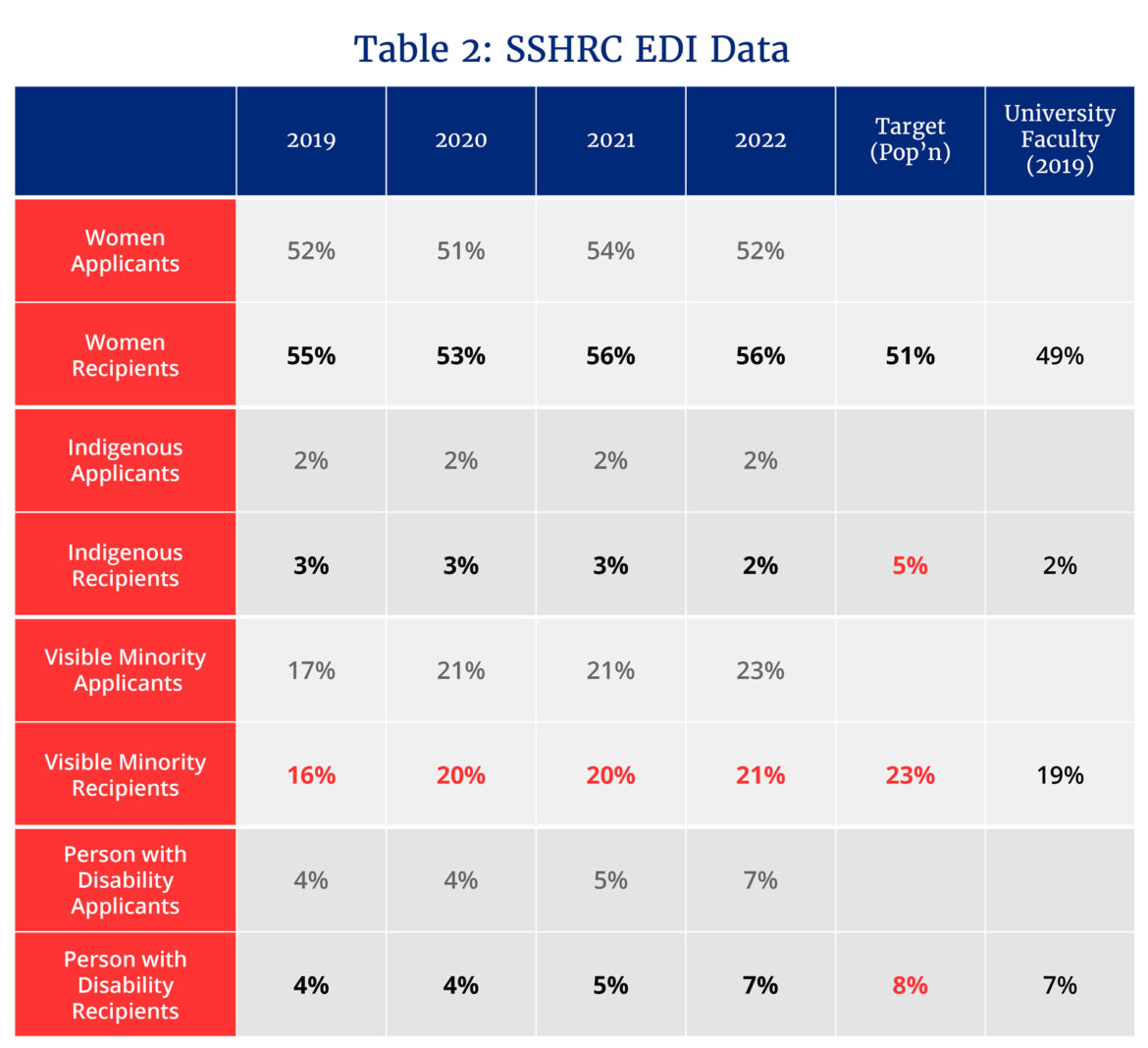
In addition to grant titles, I also examined SSHRC’s diversity data on grant recipients from “underrepresented groups” for all major grants in SSHRC’s own EDI dashboard. This included Insight Grants, Insight Development Grants, Partnership Grants, and Connection Grants contained in SSHRCs (diversity data for the two new EDI-focused grants described above were not available). 

Table 2 provides these numbers alongside SSHRC’s equity targets for 2024/2025 and the groups’ proportion of Canadian university faculty as of 2019. Numbers in red show “under-performance” in the applicant-recipient ratio and SSHRC’s own targets.

Graphic credit: Janice Nelson

Four things are notable. First, only one of SSHRC’s four target groups (visible minority applicants) has been underrepresented in terms of the applicant-recipient ratio. Second, while women are the only group who have exceeded SSHRC’s equity target, the percentage of recipients has been growing rapidly for visible minority applicants and persons with a disability. Third, no target group is underrepresented relative to its proportion of university faculty members, with women (56 percent of recipients) especially outperforming their faculty proportion (49 percent). Finally, Indigenous grant recipients (2 percent) are underrepresented relative to their proportion of the overall population (5 percent), but not relative to their proportion of university faculty members.

Damaging the pursuit of truth

The above analysis leads me to three broad conclusions. First, while the language of EDI has permeated SSHRC, the federal agency oscillates between the “soft” EDI of affirmative action and the “hard” EDI of critical social justice activism. Most of the time, SSHRC focuses on achieving “equity targets” and frames EDI as complementary to research excellence. However, SSHRC’s new EDI-themed grants explicitly adopt activist language, and it is little wonder that those awards have been dominated by activist projects.  

Second, when it comes to the “soft” EDI of affirmative action, SSHRC’s policies are clearly having their intended effect for all groups except Indigenous Peoples. The number of grants awarded to women, visible minority applicants, and persons with a disability is rising. Grants are being awarded to members of these three groups at a proportion equal to or greater than their share of university faculty, and in the case of women, well above their share of the overall population. At this rate, it will soon be inaccurate for SSHRC to refer to “underrepresented groups” when it comes to prestigious national grants.

Finally, the “hard” EDI of critical social justice activism poses the biggest threat to SSHRC’s commitment to research excellence. While there are important critiques of the effects of “soft” EDI of affirmative action, it does not necessarily pose the same existential threat to research excellence. But the “hard” EDI of critical social justice activism is utterly incompatible with the objective pursuit of truth. One need only skim the titles of grants awarded under SSHRC’s two new EDI-focused initiatives to see how far they have strayed from the objective, empirical knowledge creation that we expect our national granting agencies to fund. Ironically, the more an award is pitched in terms of “diversity,” the less intellectually diverse the recipients seem to be. Thankfully, such activist research remains primarily confined to the new (and for now temporary) EDI-focused grants. 

If the federal government wants universities to keep the public’s trust, it should avoid any future activist-themed grants and ensure that granting agencies eschew social justice priorities. Federal granting agencies using taxpayer dollars should be explicit that their primary commitment is to promote excellence via the creation and dissemination of objective, falsifiable research knowledge. The university is supposed to function as a system of knowledge production. Policies that openly tie research to activist political ends threaten to undermine that very system.

Source: Dave Snow: The federal government is spending millions on equity, diversity, and inclusion research

Ethnic diversity is still a serious issue at the top level in accounting firms

Of note. In general, when I looked at this some years ago, accounting firms have had a stronger diversity record than other regulated professions. Methodology of Canadian situation only focuses on recruitment photos not hard numbers so hard to assess (hopefully, Singer will add this to his research agenda):

In recent years, there has been a growing concern about the lack of diversity in workplaces, particularly in terms of ethnic and gender diversity. To address this, many companies have taken action by adjusting their recruiting policies and setting targets for achieving minimum diversity levels.

The accounting profession has suffered from the under-representation of women and marginalized people for many years. It has long been considered a white, male-dominant profession.

Accounting firms, especially the Big Four — Deloitte, Ernst & Young, PricewaterhouseCoopers and Klynveld Peat Marwick Goerdeler — have taken various measures to improve the diversity of their workforce by recruiting and retaining employees of various backgrounds. 

Each of the Big Four audit firms, for example, have created the equivalent position of chief diversity officer — a position that develops and implements diversity, equity and inclusion initiatives in the organization.

Despite these efforts, diversity at more senior ranks in accounting firms is still very much lagging, especially with regard to ethnic representation. 

Under-representation in accounting

2019 survey from the Association of International Certified Professional Accountants found that only nine per cent of accounting firm partners identify as non-white.

Another study from the Association of Accountants and Financial Professionals in Business found that only 8.9 per cent of accountants and auditors identified as Hispanic or Latino, 8.5 per cent identified as Black or African American and 12 per cent identified as Asian. In total, these group represent almost 30 per cent of The professional accountants, but their proportion in partner levels are much lower than that.

A similar report from the United Kingdom found only 11 out of almost 3,000 (or 0.4 per cent) of equity partners in the Big Four firms in the U.K. are Black, compared with their population representation of 3.3 per cent.

Although we still don’t have robust enough data about accounting firms in Canada yet, there is research that suggests women and minorities are under-represented at senior positionsin Canadian firms as well.

Recognizing the under-representation of ethnic minority accountants at the partner level, my colleagues and I aimed to gain insights into the work environment of ethnic minority accountants who made it to the top of the ladder in U.S. firms. 

New insights from research

My co-researchers and I used the term ethnic minority in our study to refer to those who are Asian, Black non-Latino, Hispanic Latino and white non-Latino as per the U.S. Census’ taxonomy. We collected data on audit partners in the U.S. from 2016 to 2020 and conducted a comprehensive analysis of various aspects of their work. 

We found that ethnic minority auditors were less likely to become partners at accounting firms. The ones that did were more likely to become partners at less notable accounting offices. They were more likely to become partners in firms other than the Big Four firms, in offices that did not have prestigious clients, in smaller offices and in offices that earned less fees.

This is despite the fact that, as our research found, they performed better than non-ethnic minority partners. Using various performance measures common in accounting research, we found ethnic minority partners performed better than their white counterparts. It is, therefore, unlikely that the under-representation of ethnic minorities at the partner level is due to their inability to perform well.

Our study also found that ethnic minority partners were more likely to be in charge of audit engagements if a client’s senior leadership also included ethnic minorities. 

It also showed that, once an error occurred, white audit partners were more likely to be absolved of audit failures than ethnic minority audit partners. The likelihood of an audit partner being replaced after a material error was discovered in a financial statement was higher for ethnic minority partners (39 per cent) versus white partners (24 per cent). 

Improving ethnic representation

One of the consequences of ineffective diversity, equity and inclusion practices in the accounting profession is talent drain. Up to 55 per cent of accountants from under-represented groups leave their employers, and up to 18 per cent leave the profession altogether. This raises concerns about the long-term sustainability of the profession’s talent pipeline. 

Our study points to some major gaps in terms of promotion and treatment of ethnic audit partners in the accounting profession. Diversity at higher levels in the corporate hierarchy appears to be lacking. 

Our study also suggests two major benefits of closing these gaps. First, because ethnic audit partners appear to outperform their white counterparts, more ethnic representation at senior positions will translate to higher-quality audits. Second, improving the ethnic diversity in senior accounting positions will help combat talent drainage.

There must be greater efforts to recruit, nurture and promote talented accountants from under-represented backgrounds, including fast-tracking promising audit managers to partnership. Individuals from under-represented groups should receive opportunities equal to those of their white peers when it comes to career advancement and the choice of work environment.

We believe more ethnically diverse accounting leadership will strengthen the profession by attracting and retaining talented ethnic accounting professionals and will position it to deal better with the challenges of the future.

Source: Ethnic diversity is still a serious issue at the top level in accounting firms

Report: Audiences demand diversity in films, Hollywood can do more

The regular annual report, just ahead of the Oscars:

Ahead of Hollywood’s biggest night, UCLA published a new study Thursday looking at diversity within the film industry.

It found people of color making gains in the major categories in 2023 — film leads, total actors, directors and writers. However, women suffered losses in the acting and writing categories. Both groups remain underrepresented in all major employment categories, according to the study.

Hollywood was in a tough spot in 2023, still recovering from the pandemic and undergoing strikes by the Writers Guild of America and the Screen Actors Guild. But movies such as Barbie and The Hunger Games: The Ballad of Songbirds and Snakes helped bolster box offices, according to the study, which examined global and domestic earnings of theatrically released movies.

The study found that in 2023, films with casts that were 31 to 40 percent people of color earned the highest median global box office receipts, while films with casts that were 11 percent people of color were the poorest performers. The study also found that female moviegoers bought the majority of opening weekend domestic tickets for three of the top 10 movies in 2023.

The study noted that franchise films posted the highest earnings of their film series when they embraced more diversity. The examples included movies such as Creed 3, Scream 6, and John Wick: Chapter 4, which featured lead actors of color and casts with 50 percent or more actors of color.

“Films that embrace diversity are more likely to resonate with audiences, leading to box-office success and ultimately long-term sustainability for the industry,” wrote Darnell Hunt in a statement. Hunt is the UCLA executive vice chancellor and provost, and co-founder of the report.

Behind the scenes, representation for lead actors, total actors, directors, and writers of color hit 11-year highs. Also, top films featuring more than 50 percent cast diversity outnumbered less diverse films. But the study cautions that these numbers are likely a reflection of decisions made in 2020, following the murder of George Floyd. “The question is if this upward trend of diversity will continue,” Hunt wrote.

Women did not make any gains in the top Hollywood jobs in 2023, according to the study. The only category where they remained stagnant was in directing, where 1.5 out of 10 theatrical film directors were women. Films directed by white women were found most likely to have the smallest budgets, despite the huge success of Barbie, which made over $1.4 billion globally.

While this study only examined theatrical releases, a separate study looking at the streaming industry is set to come out later this year.

Source: Report: Audiences demand diversity in films, Hollywood can do more

ICYMI: A Major Hollywood Diversity Report Shows Little Change—Except for One Promising Stat

Of note:

Over the last 16 years, Hollywood has certainly discussed the need for better representation in onscreen. Movements like #OscarsSoWhite and #MeToo dominated red-carpet conversation and social media. And there has been some change: The Academy of Motion Picture Arts and Sciences grew and diversified its voting body in hopes of nominating a wider array of movies and performances—and the nominees and winners have in fact been more diverse in recent years. [time-brightcove not-tgx=”true”]

But a new study from the University of Southern California’s Annenberg Inclusion Initiative suggests that, despite the talk of progress, not much has actually changed onscreen. Stacy L. Smith, a professor of communications and head of the initiative, led a review of 1,600 top-grossing films from 2007 to 2022. The largest study of its kind, it examines a whopping 69,858 speaking roles across those movies to see whether Hollywood has generated a significant shift in representation in terms of gender, race and ethnicity, LGBTQ+ identity, or disabilities. 

“It’s all talk and little action,” says Smith. “Many of these numbers did not move or went backwards. That shows us that the industry does not know how to change without the intervention of experts to work with them to change the systemic processes that lead to inequality and discrimination.”

But the study did identify one major exception: In the last 16 years, the percentage of Asian characters with speaking roles onscreen skyrocketed from 3.4% to 15.9%. In that same time period, Black characters saw little change, from 13.0% to 13.4%, and the proportion of Latino characters grew from just 3.3% to just 5.2%. “My initial reaction is I’m very happy but very guilty,” says Bing Chen, the CEO and Co-Founder of Gold House, an organization that champions and invests in Asian Pacific creators and companies. “We need to support all multicultural communities.” But he finds the data encouraging: change is achievable across demographics.

Chen identifies three major milestones for Asian characters onscreen in the last several years. In 2018, Crazy Rich Asians, the first film by a major Hollywood studio to feature a majority Asian cast in 25 years since The Joy Luck Club premiered in 1993, became a genuine blockbuster. The next year, The Farewell and Parasite—movies partially or completely featuring non-English dialogueperformed well at the box office against their budgets and won awards. Parasite won four Oscars, including Best Picture, Best Director, Best Original Screenplay, and Best International Feature Film. “The year former President Trump was spitting all sorts of really anti-Asian xenophobic commentary, talking about ‘kung flu’ and all that nonsense,” says Chen. “So when Parasitewon, that was a really big affirming moment of, we’re actually creatively excellent, even if we don’t speak your language.” 

And last year, Everything Everywhere All at Once became a surprise box office smash and the most-awarded film of all time.

And that’s just in film. On TV, shows like Fresh Off the BoatSquid Game, and Kim’s Convenience have had a major cultural impact. And cultural exports from Asian countries have gone mainstream in the U.S. “There’s no question that the rise of K-Pop as a institution has directly and indirectly contributed to the acculturation of the masses to K-content, writ-large,” says Chen. Smith agrees that while the U.S. dominated the global pop culture space for decades, much of that power has shifted to Asian countries that are exporting music, television, film, and even social media content to the U.S. at high rates, and K-Pop paved the way for mass cultural events like the Korean show Squid Game.

Here’s why experts think we’ve seen a shift onscreen—and why there’s still work to do.

Most underrepresented groups have seen little progress

Movies remain very white, very straight, very cis, and very male. 

The few highlights in the data come with major caveats. As Barbie‘s massive box office numbers demonstrate, female-led pictures can succeed when studios actually make them. Executives are finally starting to learn that lesson: 44% of leading or co-leading roles went to women and girls in 2022, a 16-year-peak and more than double the number in 2007. But, on the whole, casts are still dominated by men. The percentage of female characters with speaking roles ticked up just 4.7 percentage points from 29.9% in 2007 to 34.6% last year. 

And while women of color made major strides in representation onscreen—19% of movies in 2022 featured a woman of color in a leading role, up from an abysmal 1% in 2007—there has been little progress throughout the late 2010s and 2020s. The percentage of women of color in leading roles has remained flat for years. And 70 of the top 100 films of 2022 featured no women of color in any role. 

“We now have 16 years of evidence that shows that activism failed particularly with girls and women since it’s almost a flatline from 2007 to 2022,” says Smith. The advocacy arm of Time’s Up, the celebrity-filled organization that sprung up in the wake of #MeToo and promised to fight for gender equity in film, imploded last year. Whispers that after all the talk of change in 2017 the pendulum is swinging back to a more regressive approach to business have spread through Hollywood.

Other data points proved even more bleak. Only 2.1% of speaking characters in the top films of 2022 identified as LGBTQ+, a percentage which has not changed meaningfully since 2014 when the Annenberg Inclusion Initiative began measuring. There were 5 transgender characters in the top 100 films of 2022, a 9-year high point, but 4 of these 5 characters appeared in a single film: Bros.

And the number of speaking characters with a disability in a major film was just 1.9% in 2022, a drop from 2.4% in 2015 when Annenberg started recording stats.

In light of these data, the success of Asian characters onscreen stands out even more. Chen argues that those successes have come only after years of advocacy.

There’s been a renaissance of Asian stories onscreen

Chen attributes the rise of Asian representation in film to several factors. One is simply the proliferation of content largely thanks to streamers’ constant quest for new programming to court more subscribers: More storytelling has translated to more diverse storytelling. The rallying cry around #StopAsianHate tied to acts of violence against Asian Americans during the COVID-19 pandemic helped motivate activists to push for greater representation of Asian stories onscreen in hopes that movies could evoke empathy and relatability. But Chen says the efforts to tell Asian stories stretch beyond that one movement. “I would say within the community, the way we think about it is of course we still care about #StopAsianHate and ensuring that the safety and belonging of our community, but our community cares even more about creative excellence, as opposed to just sort of representation.”

And then there’s the surge in adaptations of bestselling books written by Asian authors, like Min Jin Lee’s Pachinko, Jenny Han’s To All the Boys I’ve Loved Before series, and the forthcoming Interior Chinatown show, based on the book by Charles Yu. “You see a rise in both the number of Asian authors writing books and making the bestseller list but also, equally important, the quick adaptation of those works by Asian producers,” Chen says. “This has been a very concentrated effort in the community over the last three to four years.” 

In terms of original content, Chen points to writer-directors with newfound creative control over their projects. Beef’s Lee Sung JinTurning Red’s Domee ShiMinari’s Lee Isaac ChungJoy Ride’s Adele LimNever Have I Ever’s Mindy Kaling have gotten to tell stories “that reflect their real lived experience,” he says. There have, of course, long been Asian creators in Hollywood, but finally these particular movies and shows in all their specificity and detail have been greenlit. In a previous op-ed for TIME, Chen and his co-founder Jeremy Tran argued that diversity in studio leadership can trickle down to the content itself, pointing to the power of studio big wigs like Bela Bajaria and Marian Lee Dicus at Netflix, Albert Cheng at Amazon Prime Video, and Asad Ayaz and Nancy Lee at Disney.

Smith casts some skepticism on the notion that Hollywood has altered what stories it brings to the big screen—even in the face of massive box office takes. Yes, the ticket sales for Crazy Rich Asians afforded director Jon M. Chu the opportunity to direct other films with notably diverse casts, like In the Heights and the forthcoming Wicked adaptation. And the success of that same film boosted the career of Michelle Yeoh, who went on to win an Oscar for another film with a predominantly Asian cast, Everything Everywhere All at Once. But to Smith, those exceptions can obfuscate the work that still needs to be done.

“If you can think of a few instances, what that does is cause you to overestimate a particular event,” she says. “So if you call up someone like Jon Chu or the Daniels [directors of Everything Everywhere All At Once], you’re going to think, ‘Oh things are actually getting better.’ I would challenge the studios to look at the data.” The data, she says, suggests that shifts in Asian representation in film can largely be attributed to increased audience appetite for foreign films, not efforts by American studios to diversity Hollywood. “It’s a function of the box office changing,” she argues, “not the decisions of legacy studios.”

An influx of international content

What we watch has fundamentally shifted in the last few years. Back in 2020, when he won the Golden Globe for Best Foreign Language Film for Parasite, Korean director Bong Joon Ho said in his acceptance speech, “Once you overcome the one-inch tall barrier of subtitles, you will be introduced to so many more amazing films.” He could not have known then how quickly Americans would heed his advice. Parasite went on to win Best Picture at the Oscars and proved to be a box office phenomenon in the U.S.

Around the time of Parasite’s history-making Oscars win, streaming services, particularly Netflix, were taking a more international approach to producing and acquiring content. Audiences seemed decreasingly deterred by those pesky subtitles. Crossover hits like the Korean show Squid Game and the Indian film RRR have become some of the streamer’s biggest hits. (Squid Game set a record for the most watched show on Netflix ever and ranked No. 1 in more than 90 countries across the world.

“Netflix is spending literally billions of dollars in K-content and Indian content,” says Chen. “Korea and India, in particular, are becoming the dominant successful exporters of pop content.” The studio has invested in massive production infrastructure in Korea and is increasingly focused on doing the same thing in India in addition to acquiring original content in those countries.

Netflix is certainly the most globally minded of the American studios. “Bela Bajaria is way out in front as the Chief Content Officer at Netflix,” says Smith. “As a woman who comes from an underrepresented background, she’s hitting it out of the park in terms of curating global talent. The entire industry is following her league.” The Annenberg Inclusion Initiative has previously found that Netflix performs better than traditional Hollywood studios on representation metrics, both in the U.S. and globally.

Beyond streaming, content from Asian countries has become increasingly dominant on TikTok and YouTube, platforms where Gen Z especially consumes most of its content. Younger viewers who hail from multicultural homes and are increasingly connected to people across the globe through social media don’t have the same bias toward a single language that past generations do.

In film, Katherine Pieper, program director at the Annenberg Inclusion Initiative, says the pandemic helped accelerate the shift toward international content as viewers sought out new content while stuck on our couches at home rather than relying on whatever Hollywood was putting in movie theaters for entertainment. “With the change in the box office from 2020 to 2022, we saw a couple of types of broad categories of films in the top 100 that had been relatively minimal in previous years,” she says, “namely anime films, Bollywood films, and international films set primarily in South Asia or in Japan with primarily Asian characters.”

Pieper and Smith attribute the influx in Asian representation largely to those foreign films suddenly overtaking their American counterparts at the domestic box office rather than any major change in how the traditional studios make decisions. “Each year there’s between five and eight films that meet those descriptions that we hadn’t seen before 2021, in addition to a couple of films from the U.S. that might have played the role, like Raya and the Last DragonShang-Chi and the Legend of the Ten Rings, and The Eternals.” 

But of course, those few North American releases can have an impact as well. The Canadian show Kim’s Convenience found a significant American audience on Netflix and launched the career of Simu Liu, who became the first Asian man to lead a major American superhero film in Marvel’s Shang-Chi. That movie, in turn, afforded him opportunities in other mainstream movies, like Barbie. The impetus shouldn’t be only on creators of color to write for and cast non-white actors. 

“If an Asian writer-producer is producing a piece, there are probably going to be some Asian characters. But if a non-Asian one is, what is their propensity to write an Asian character and why?” asks Chen. “My best inference is that writers’ rooms have become more diverse in general—though there’s still a long way to go obviously.” 

That progress, of course, ties directly to issues being raised by the actors and writers on strike in Hollywood. The WGA has revealed that while the proportion of underrepresented writers has grown in the last several years, they largely occupy lower-level positions and are the first to be put in financial straits when studios decide to forgo writers’ rooms or make major cuts. “Creators of color are the first people to be penalized in these strikes for all sorts of systemic reasons,” says Chen. Both Smith and Chen are eagerly watching the strikes to see how changes to writers’ rooms might impact long-term trends. The ultimate goal, they say, is to empower writers and actors of color to continue to tell their own stories—and pressure studios to back their visions.

Source: A Major Hollywood Diversity Report Shows Little Change—Except for One Promising Stat