There’s a good reason the immigration debate in Canada is calmer than in the U.S.

Pretty weak argument on its own. I think the large number of irregular or illegal immigrants in the USA, given its southern border, is a much larger factor in popular discourse, along with our selection system which priories more highly skilled immigrants:

In recent years the world has been rocked by the movement of tens of millions of people fleeing war, disaster and other forms of conflict. Canada has helped relieve some of the pressures that come from such large movements of people by accepting refugees, asylum-seekers and also ordinary immigrants. Far from conflict zones, surrounded by oceans, and sharing its only border with a country that is not usually a significant source of refugees, Canada has been able to be very deliberate in its calculation of how many people it chooses to admit as citizens. In general, the choices made have served the Canadian economy well by reversing what would otherwise have been a steady decline in our population and our prospects for economic growth.

So far at least, and unlike the U.S. experience, Canadian immigration policy has not become very political. One reason the two countries’ politics on this issue have differed may be their differing national fertility rates. The figure shows the fertility rate in Canada and the United States for each year from 1920 to 2018. The fertility rate measures the average number of children that would be born to each woman over her child-bearing years given prevailing age-specific fertility rates. Also shown, as the horizontal dashed line, is the population replacement rate — the fertility rate required for the population to replace itself. The replacement rate varies over time and by country due to changes and differences in mortality rates. It probably has fallen in both countries since 1920 but it is currently judged to be roughly 2.1 children per woman.

The large swings in fertility rates between 1920 and 1960 strongly suggest economic conditions affect the decision to have children. The onset of the Great Depression in 1930 coincided with a significant drop in the fertility rate in Canada, a drop that started much earlier in the U.S. The post-war baby boom saw fertility rates in both countries increase by nearly 1.5 children. Peaking in 1960, the fertility rate plummeted across North America for the next 15 years before levelling off — by the mid-1970s in the U.S. and the mid-1980s in Canada. U.S. fertility rates have since risen and now hover near the replacement rate. In this country, however, they remain well below the replacement rate.

That U.S. fertility rates are higher than ours may surprise many Canadians. Families here have greater access to supports and benefits in the form of parental leave provisions, extended employment insurance benefits, and full health-care coverage. Continuing low fertility rates in Canada suggest other influences must also be important.

But whatever the reason for it, our low fertility rate highlights the need for high levels of immigration to maintain and grow the population. After the dramatic fall in fertility rates in the 1960s, the federal government introduced a number of reforms to immigration policy, beginning in the mid to late 1970s. Since the early 1990s, Canada has settled between 200,000 and 300,000 immigrants each year. The government recently announced annual targets over the next three years that average 340,000 new immigrants per year. This level of immigration will enable Canada’s population to grow despite our low fertility rate.

The data presented in the figure may help explain why in recent years the debate over immigration hasn’t been as sharp or divisive here as in the United States. For Canada, maintaining a significant level of immigration and also a high level of trust in the process by which we invite foreigners to apply for citizenship is crucial for maintaining our economic growth.

Source: There’s a good reason the immigration debate in Canada is calmer than in the U.S.
As Quebec cuts immigration, statistics foreshadow demographic crunch

Good overview of the numbers:

As Premier François Legault prepares to cut immigrationby about 20 per cent, new statistics indicate Quebec has the oldest inhabitants in Canada and its overall population is growing at a slower pace than most other provinces.

The figures may lend credence to critics of the Coalition Avenir Québec plan, including the Chamber of Commerce of Metropolitan Montreal and Quebec’s largest employer group, who say cutting immigration could exacerbate a demographic and labour crunch.

Quebec will cut the number of new arrivals by more than 10,000 a year — from 53,300 in 2018 to between 38,000 and 42,000 in 2019. There is no indication when or if the number will be raised in the future.

On Thursday, the Institut de la statistique du Québec published its annual demographic update — a snapshot of Quebec as of Jan. 1, 2018. Here’s some of what it revealed:

8.3 million

Quebec’s population in 2017. It grew by 85,700, or one per cent. That’s a growth rate of 10.3 per 1,000 people, which is lower than the provincial average (13 per 1,000). Only New Brunswick, Newfoundland and Labrador, and Nova Scotia had lower growth rates than Quebec. Ontario registered the biggest increase: 15.6 per 1,000.


22.6

Percentage of Canadians who live in Quebec. That figure has remained steady in recent years. But since the early 1970s, Quebec’s proportion of Canada’s population has fallen by more than five percentage points (from 27.9 per cent in 1971). Meanwhile, Alberta’s has increased by four points and Ontario’s has jumped by three points. The Chamber of Commerce of Metropolitan Montreal has urged Quebec to increase immigration to 60,000 per year in part to maintain the province’s demographic weight. A further drop in Quebec’s weight could mean less political clout within Canada when new seats are added to the House of Commons.


18.5

Percentage of Quebec’s population 65 or older. Across Canada, the average is lower – 17 per cent. In addition to having more older inhabitants, Quebec also has fewer residents 20 or younger (20.6 per cent, compared to 21.6 per cent across Canada).


83,900

Number of babies born in Quebec in 2017. That’s 2,400 fewer than in 2016. Quebec’s fertility rate was 1.54 children per woman, slightly more than the Canadian average of 1.49. Quebec was in the middle of the pack — five provinces had lower rates and four have higher rates.


32

Percentage of babies born in Quebec last year who have at least one parent born outside Canada. In most of these cases, both parents were born elsewhere. This trend has grown steadily in recent years. In 1980, 13 per cent of babies had at least one foreign-born parent. By 2000, the figure had jumped to 21 per cent.


52,407

Number of immigrants who arrived in Quebec in 2017. That’s a decrease of 850 compared to the previous year. Quebec welcomed 18 per cent of the immigrants who came to Canada, less than its demographic weight (it has just under 23 per cent of Canada’s population). Quebec took in 6.3 immigrants for every 1,000 current residents. That’s lower than the Canadian average (8.3 per 1,000) but higher than the United States (3.5 per 1,000). Almost 60 per cent of Quebec’s new immigrants were in the 20-to-44 age group. Seventy-three per cent of immigrants who arrived in Quebec in 2015 still lived in the province in 2017.


5,108

Number of immigrants who came to Quebec from China, the single biggest source of newcomers in 2017. They represented 10 per cent of new immigrants. In second and third spot: France (8.6 per cent) and Syria (seven per cent). The previous year, the order was: Syria, France, China.


22,232

Number of Canadians from other provinces who moved to Quebec. That’s the highest number in more than a decade. The surge helped reduce the net outflow of residents to other provinces. In total, 6,500 more people left Quebec for other parts of Canada last year than arrived in Quebec from other provinces. That’s the smallest interprovincial population loss since 2011. Most between-province moves involve the 401. In 2017, 12,500 Ontario residents moved to Quebec, while almost 19,000 Quebecers relocated to Ontario.

Source: As Quebec cuts immigration, statistics foreshadow demographic crunch

Japan’s New Foray into Immigration Policy

Interesting overview on the degree of change:

Japan has traditionally imposed one of the most stringent immigration policies among developed nations. But with aging demographics, its increasingly critical labor shortage is prompting more radical approaches, including relaxing a virtual ban on unskilled workers.

Of the world’s developed economies, Japan has shown the most resistance to accepting immigrants into its labor force. The number of working foreigners in Japan has more than doubled in the past decade to 1.3 million, but that remains below 2 percent of the labor force, compared with 13 percent in Britain and 39 percent in Singapore.

Japan long ago adopted a policy to accept just high-skilled foreign workers, and only as non-immigrants. But chronic labor shortages, especially in construction, shipbuilding, agriculture, healthcare, hospitality, and manufacturing, have caused the Japanese government to liberalize its immigration policy.

In June, the Cabinet announced plans to create a new, five-year permit system, based on the proposal of the Council on Economic and Fiscal Policy, chaired by Prime Minister Shinzo Abe. It is reported that this system would accept 500,000 low-skilled non-Japanese laborers by 2025.

The era of “Abenomics” – referring to the economic policies enacted since 2012 under Abe’s second prime ministership –has seen remarkable developments regarding Japan’s immigration policy. These have occurred against a background of falling birth rates and an aging population, as well as globalization. Japan’s points-based system has been newly revised by the government; and the discussion on immigration has, for the first time, embraced the possibility of accepting unskilled workers, such as foreign domestic helpers and agricultural laborers.

New to the Notion of Immigration

Generally, national immigration policy determines how many foreign workers a country admits, and under what conditions, while labor policies determine what protections are provided after foreigners are admitted. The two aspects influence each other, as well as realize the ideas of “selection,” in terms of immigration, and “integration,” whereby foreign workers are absorbed into the host country’s domestic labor market.

Japan is a relative newcomer to the global debate on migration. One important but as yet unresolved issue is whether the country should accept immigrants who are given open-ended permission to stay (i.e., permanent residency) or accept foreigners only as non-immigrant guest workers who are allowed to stay temporarily.

Until recently, Japan had not taken the policy to accept foreign workers as immigrants. Nowadays, however, it is becoming easier for a foreigner who once entered Japan as a non-immigrant to acquire permanent resident status after a certain period of time.

A second issue for Japan is the qualitative assessment of foreign workers: should it accept only workers with special talents in professional fields, or include unskilled workers as well, to address labor shortages? Japan has tended to promote acceptance of foreign workers in skilled or professional fields, and reject acceptance of non-skilled workers. However, the program that the government is reportedly introducing would open a door for substantial numbers of unskilled workers.

Changes for Skilled and Unskilled Workers

In May 2012, a points-based system for highly skilled professional (HSP) workers was introduced in three fields: advanced academic research, advanced specialty/technology, and advanced business management. Points are assigned according to various criteria, such as education, work history, annual income, age, and research record. A foreigner who earns 70 points or more is recognized as an HSP and thus receives preferential treatment for entrance into and residence in Japan.

In subsequent years, the government has eased HSP requirements. The most significant change has been resetting the annual income minimum requirement at ¥3 million (US$26,773). This requirement is even waived for advanced academic research professionals. One downside to this is that this loosening of requirements may negatively impact HSPs’ work prospects.

Building upon this, the government introduced a faster-track points-based application process in April 2017. Under this system, HSPs who earn 70 points or more can apply for   apply after only one year. Although the government says that this is not a policy to accept immigrants, there is not much difference between giving permanent resident status at the time of entry and giving such status soon after entrance.

The situation is similarly changing for foreigners who are not recognized as skilled or professional workers. Given a rapidly aging workforce, several sectors are experiencing labor shortages. A third of Japan’s construction workers are at least 55 years old and the demand for construction workers is intensifying before the 2020 Tokyo Olympic and Paralympic Games. The increasing number of Japanese citizens over 65 years of age has intensified the need for caregivers for the elderly. Foreign caregiver qualifications are not recognized in Japan and migrant nursing workers must pass a certification course.

Furthermore, foreign domestic helpers are being admitted under the National Strategic Special Zones Act, covering Tokyo, Kanagawa prefecture, Osaka prefecture, and Hyogo prefecture. Revisions to that act in 2017 are likely to open the doors to foreign agricultural workers being allowed to work in Kyoto prefecture, the city of Niigata, Aichi prefecture, and Okinawa prefecture.

There has been much recent debate on the Technical Intern Training Program, which was originally established to transfer skills acquired at Japanese companies to developing countries. But it has been criticized as a backdoor route for Japanese entities to acquire cheap labor from poorer countries. In order to improve the program, the 2016 Technical Intern Training Act was enacted to ensure the proper implementation of the program as was intended.

The Future of Immigration in Japan

The Japanese government is currently moving toward amending the Immigration Control and Refugee Recognition Act. This could lead to major changes in immigration policy; specifically, wider acceptance of unskilled workers. While some stakeholders see unskilled foreign workers as a source of cheap labor, others worry about the cost of educating and managing them, citing cultural and language barriers. Further concerns include “integration” factors, such as welfare costs, as well as public safety and social stability.

The Japanese government is moving toward wider acceptance of unskilled workers.

Although Japan has toughened some aspects of its immigration policy—such as the rules of the Technical Intern Training Program—this will be offset by the possibility of more relaxed requirements for HSPs and greater immigration by unskilled workers. At the same time, it is becoming easier for foreigners who have entered Japan as non-immigrants to acquire permanent resident status.

Recent pushback from the domestic labor market indicates that the government might need to conduct more extensive consultations. It might become necessary to introduce certain labor market tests, such as requiring employers who plan to hire foreign workers to show they have attempted to recruit domestic workers beforehand. In addition, the idea of “integration,” which should be considered within the framework of labor and employment policy, is not being given enough thought currently. In order to avoid negative impacts on the domestic labor market and problems regarding working conditions and foreign worker unemployment, it is necessary to integrate and adjust these policies with a long-term perspective.

Chizuko Hayakawa is a researcher at Saga University. Her research focuses on Japan’s foreign worker policies.  This article was written for AsiaGlobal Online, the website of the Asia Global Institute at Hong Kong University.

Source: Japan’s New Foray into Immigration Policy – Asia Sentinel

Immigration alone can’t keep Canada young

Reminder that the demographic argument for large increases in immigration to address an aging population will not by itself reverse the demographic trends:

Canada is getting older. Not just us Canadians as individuals, but our population as a whole.

Our fertility rate dropped below the replacement rate of 2.1 required for population stability way back in 1971. Life expectancy at birth has increased by more than nine years since then.

One consequence of low fertility and increased longevity is that the number of people past what we traditionally consider working age is rising relative to the people of working age. The ratio of Canadians age 65 and older to Canadians age 18-64 rose by more than 10 percentage points over the past 40 years, and will rise by more than 10 percentage points again over the next 40.

An aging population puts pressure on living standards, dampens growth of government revenue and presents fiscal challenges – notably to public pensions and health care. Since immigration has become a major contributor to population growth, and immigrants are, on average, younger than already-resident Canadians, immigration can look like an antidote to aging – a kind of national elixir of youth.

This hope does not survive an encounter with real numbers, as we show in a recent publication.

Running the federal government’s recent targets, and the recommendation for an increase to 450,000 immigrants annually from the government’s Advisory Council on Economic Growth, through a demographic model reveals that higher immigration, by itself, does little to alleviate the pressure of aging.

Raising immigration, whether to an unchanging level of 450,000 a year, or to a permanently higher rate of 1.2 per cent of the already-resident population, does not stop the ratio of retirees to workers rising further, and has negligible impacts on living standards.

An immigration policy designed to stabilize the ratio of retirees to workers would require massive inflows – 1.5 million annually over the next decade alone – that are outside the realm of economic or political reality.

By contrast, projections involving later retirement – an increase in the age at which we typically consider people too old to work – present a markedly brighter picture. A projection in which the average age of retirement rises from 65 to 70 over 20 years produces a stable ratio of retirees to workers over the next decade and a half, and a decline after that. More workers per retiree means faster growth in living standards.

Encouragingly, combining later retirement with a permanently higher rate of immigration produces a bonus.

Not only does that mix lower the ratio of retirees to workers and boost living standards throughout the projection, but it demonstrates some happy timing.

In the next decade or so, when the pressure of aging on living standards will be most intense, later retirement improves the outlook – and as that boost begins to fade, the slower-acting impact of higher immigration gives us a second wind.

The later-retirement example highlights a more general point. Canada needs policies to complement higher immigration targets.

Slower growth and higher taxes will make us less attractive to potential immigrants than faster growth and lower taxes.

If living standards are growing relatively quickly in countries that are potential sources of immigrants, and in countries that compete with us as destinations for immigrants, we will have a tougher time attracting the quantity and quality of people envisioned by advocates for higher immigration – a vicious circle.

If longer work life and other responses to aging makes us more prosperous, however, we will more easily attract immigrants and retain workers who can contribute to our prosperity – a virtuous circle.

Higher immigration may be good for many reasons, but it cannot keep Canada young. Other policies to ease the demographic transition, notably encouraging people to work longer, hold out at least as much promise for boosting living standards.

And those changes would complement higher immigration targets, by improving Canada’s attractiveness to people willing and able to contribute to the Canadian economy.

via Immigration alone can’t keep Canada young – The Globe and Mail

Canada’s demographic gap can’t be filled with immigrants

Jason Kirby on the limits on immigration to address the aging population and the economic integration challenges immigrants face:

This isn’t to say immigrants can’t mitigate the effects of Canada’s aging population. This country’s ability to absorb people from diverse cultures is an advantage remarkably few other nations enjoy.

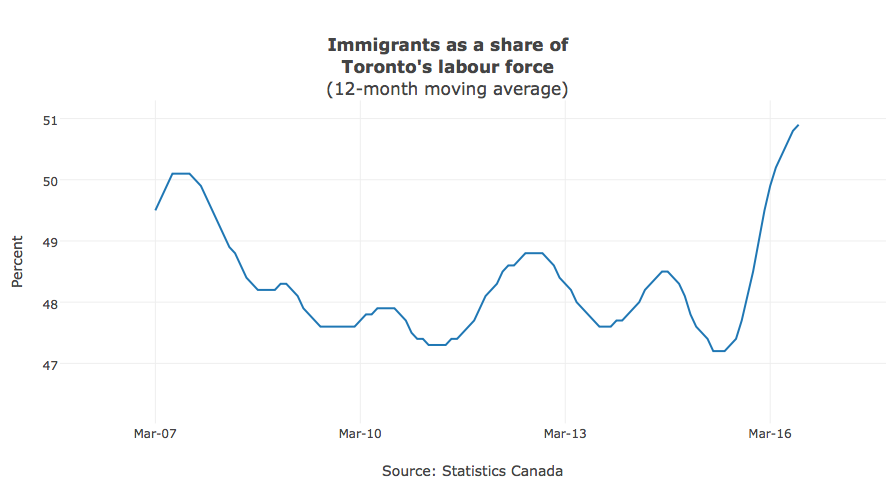
As it is, immigrants are already a major driver of Canada’s labour force. In Toronto, for instance immigrants now account for nearly 51 per cent of the city’s labour force. It’s slightly less in Vancouver (41 per cent) and lower still in Montreal (26 per cent) but all three cities have seen immigrants grow as a share of the labour force over the past few years.

kirby-article

There’s a problem here too, though. New immigrants don’t fare well in Canada’s job market. The unemployment rate among immigrants who landed in Canada within the last five years has, on average, been more than double that of Canadian-born workers over the last decade. Those who came between five and 10 years ago are a bit better off—their unemployment rate is about 1.5 times higher. It’s only among immigrants who’ve been in the country for more than a decade that the gap with Canadian-born workers is erased. It shows that even if Canada ramps up the number of newcomers it accepts, their performance in the labour market will surely lag for years.

The experience over the last year with the influx of more than 30,000 Syrian refugees, who are included in this year’s higher immigration count, has shown how challenging it is to quickly integrate large numbers of people. So too has the backlash in Vancouver against homebuyers from mainland China (and the murky question of who is a foreign buyer and who is a genuine immigrant) even as Canada works to double the number of visa offices in that country. Meanwhile, Canada may pride itself on being more open and tolerant of immigrants, especially in contrast to the ugliness going on in the U.S. and Europe, yet internal polling carried out by Immigration Canada shows one quarter of Canadians feel immigration levels are too high as it is. The news of this year’s immigration boom does not sit well with them.

Which is silly, really, because despite that headline-grabbing number of new immigrants, their number works out to just 0.8 per cent of Canada’s population, or 0.1 percentage points higher than the average of the last 20 years. Some boom.

Source: Canada’s demographic gap can’t be filled with immigrants – Macleans.ca

This Chart Shows the Future of America | TIME

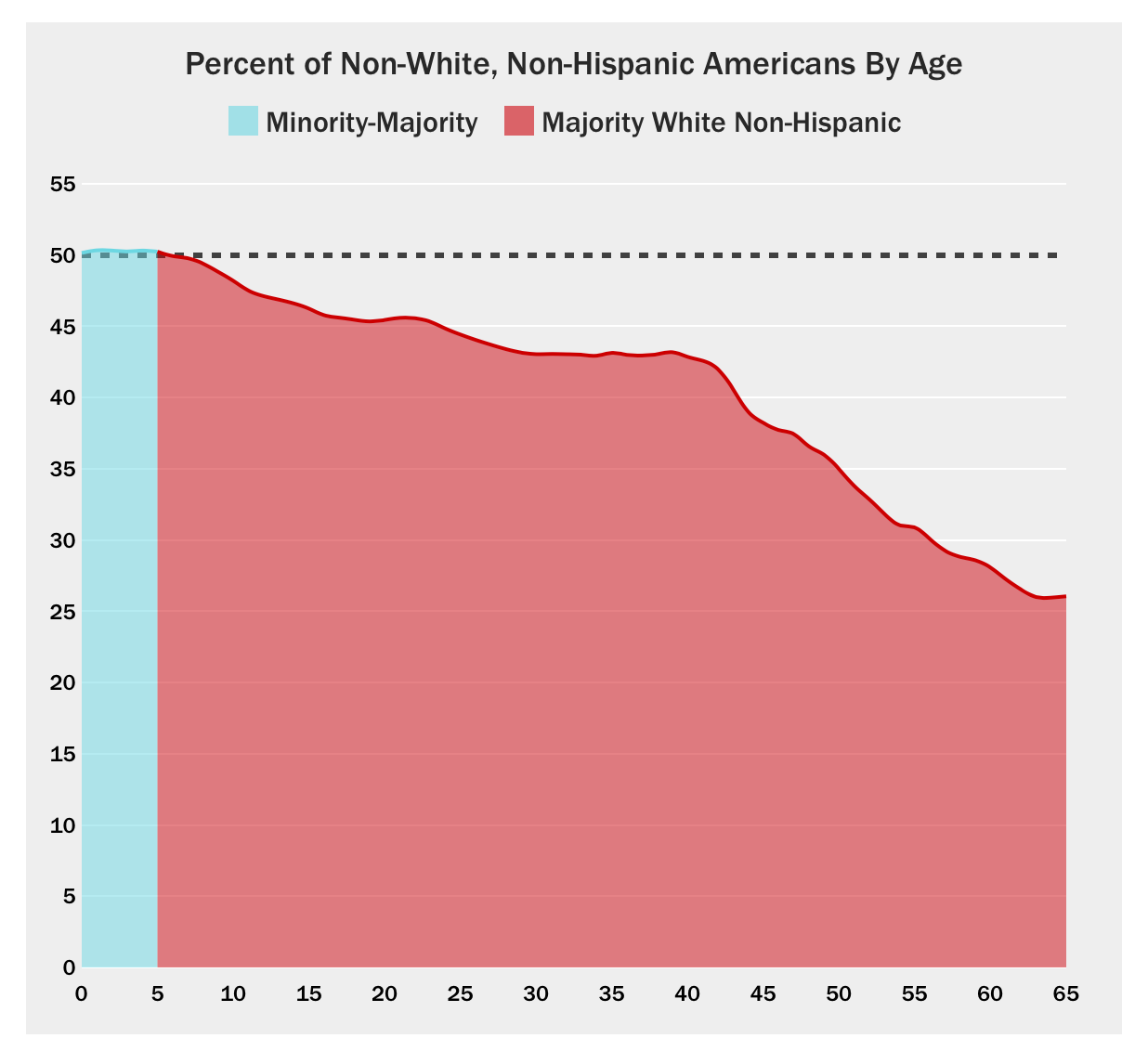
White Non-White USAPretty compelling chart and analysis of the changing nature of the USA:

For the sixth straight year, babies born in 2015 belong to a mini-generation that is “minority-majority,” meaning fewer than half of them are white and non-Hispanic, according to new figures released this week by the Census Bureau.

The nation as a whole is not expected to reach this distinction until 2044. But we can see the future by looking at the youngest Americans, who are naturally ahead of the curve.

It’s important to note that this data shows the diversity of Americans by their current age, not the historical data about the diversity of their cohort when they were born. Since data clearly shows that minorities still have shorter life expectancies, we would expect the figures for older Americans to be slightly exaggerated in the form of higher percentages for white, non-Hispanics.

Source: This Chart Shows the Future of America | TIME

Recent changes in demographic trends in Canada

Interesting overview of Canadian demographic changes, shifting the balance between Canada’s regions:

Canada’s population growth masks some very different trends from one region to another. Using various data sources, including Statistics Canada’s most recent projections on population and diversity, this article provides a general overview of these trends and discusses how recent demographic changes could impact the age structure, diversity and population share of the various regions of Canada over the next decades.

  • Over the period from 2011 to 2014, the three Prairie provinces (Alberta, Saskatchewan and Manitoba) all had faster population growth on average than the national growth, and the highest population growth among the provinces. This is a first since 1971.
  • Conversely, population growth in the Atlantic provinces has remained close to zero in recent years. For the first time in the country’s history, more deaths than births were recently recorded in three of the four Atlantic provinces.
  • In the mid-2030s, the percentage of seniors aged 65 and over could exceed 31% in Newfoundland and Labrador and reach 18% in Alberta. This difference would then be larger than the one observed in 2014 between Nova Scotia and New Brunswick (18%) and Alberta (11%).
  • In 2031, the percentage of individuals belonging to a visible minority could exceed 40% in Ontario, compared with 3% in Newfoundland and Labrador. This difference would then be larger than the one observed in 2011 between British Columbia (27%) and Newfoundland and Labrador (1%).
  • If recent demographic trends continue, the population share of the Prairie provinces could surpass Quebec’s in less than 50 years. Moreover, the population share of the four Atlantic provinces could decrease to less than 5% of Canada’s population.

Source: Recent changes in demographic trends in Canada