Silverstein: The blind spots in diversity and inclusion

From Pizza Pizza, some interesting broader ways of looking at diversity in terms of use of health and wellness plans:

When Pizza Pizza decided in 2021 to form a diversity and inclusion council, one of the first things we did was send out a survey designed to give us a foundational snapshot of our workforce.

The results told us about 60 per cent of corporate employees who participated were from racialized groups and more than 40 per cent were women. Almost 80 per cent said they viewed Pizza Pizza as a diverse organization.

Despite the inherent limitations of survey data, our results were a good starting point for building our initial slate of diversity and inclusion policies and programs. But we knew it wasn’t enough.

A key challenge with diversity and inclusion efforts is they tend to address only the diversity that’s visible and known, and organizations often have limited insight into the full range of interests and needs within their ranks. This limited perspective is caused by a number of reasons, including companies’ reliance on employees’ self-disclosure as well as the widespread use of tick-box questionnaires that leave little room for anything that falls outside pre-defined diversity groupings.

Consequently, many organizations must navigate forward with blind spots in their strategy, potentially missing opportunities to strengthen their culture and corporate brand. But how do you address blind spots you don’t know exist?

You need to think – and look – outside the box.

At Pizza Pizza we’ve started to use data analytics to find hidden patterns of inequality as well as unexplored areas of opportunity to strengthen our diversity and inclusion strategy. One example of how we’re doing this is through analysis of aggregated, anonymized data pertaining to use of company-sponsored health and wellness benefits. Do data patterns show, for example, more frequent use of our family resources? Are there increased claims for particular drug categories or health services, such as mental health or physiotherapy?

We undertake this and other types of data analyses with the goal of identifying unmet needs we could potentially address with new programs. For example, we might learn from our analysis that we need to expand our focus on wellness. This insight could also lead to actions that ensure stronger awareness of the resources available to employees, and that our leaders are trained to handle conversations around physical and health wellness challenges.

This data-driven approach doesn’t apply to all blind spots. Some instances of “unconscious bias” and inequity are hard to substantiate, but we know that when they happen, they erode an organization’s culture of inclusion. Consider, for instance, a department’s habit of automatically assigning overtime work to employees with no spouses or children. Or think about the manager who answers emails during meetings while lower-level team members sit and wait quietly. Would that manager behave that way in the presence of a peer or a more senior leader?

Ultimately, building a solid strategy – one with minimal blind spots – is about instilling and nurturing the right values within the organization. We do this by training leaders and team members and by having ongoing conversations about diversity. We also do this by asking questions.

Since we launched our first employee engagement survey in 2021, we’ve continued to ask what and how we can do better to make our employees feel like they belong. Through one survey we learned that our team members felt there was a need for more inclusive language. That prompted us to work with our partners at Pride Toronto to organize lunch-and-learns focused on inclusive language along with allyship.

These sessions proved to be relevant beyond the 2SLGBTQI+ context. Inclusive language and allyship, we all learned, are useful in virtually any dialogue or circumstance.

We know that as the country’s demographic makeup evolves, our diversity and inclusion strategy will inevitably run into more blind spots. Our increasingly multigenerational, racialized and gender-diverse workforce continues to be vulnerable to all manner of unconscious bias, which is why we also continue to fortify the strong culture we’ve built so far.

We know there are emerging needs among our team members that are likely to grow in urgency in the coming years, as many start families or, as we’re seeing with our more experienced workers, become caregivers to aging parents. We’ll need to adjust our programs accordingly.

As it is today, an evidence-based approach will be critical going forward, along with an ongoing commitment to a truly diverse and inclusive culture.

Amy Silverstein is the senior director of People for Pizza Pizza Ltd.

Source: The blind spots in diversity and inclusion

Jamie Sarkonak: Zealous DEI commissars threaten integrity of Canada’s medical profession

Captures the perspective and views of what a possible Conservative government thinks about DEI and what they might do with respect to employment equity:

…The next place DEI intends to colonize is the foundational set of themes that underpin physician training in Canada, the CanMEDS framework. Last revised in 2015, CanMEDS is up for renewal in 2025. The most radical change? DEI.

Doctors involved in the revision are proposing to make progressive-left values standard in physician training, including anti-racism, social justice, cultural humility, decolonization and intersectionality — all concepts coined by progressive, redistributive racialists who tend to despise western culture.

Health equity experts are all-in on this stuff, so expect the “experts say” coverage to be overwhelmingly positive. A preview is offered by Kannin Osei-Tutu, a medical professor at U of C, who recently hailed the upcoming CanMEDS revision as an “unprecedented opportunity” for transformation.

“Transformative change in medical education and practice demands explicit integration of anti-oppressive competencies,” he wrote in last month’s issue of the Canadian Medical Journal of Health (which only ever seems to publish one side of this great debate).

“Progress hinges on cultivating a critical mass of physicians committed to this change, thus paving the way for more equitable and just health care.”

Wondering where all this goes? Look to New Zealand, a fellow British colony that has taken to reconciling with extreme self-flagellatory policies. In 2023, some of the island nation’s hospitals began prioritizing Indigenous Māori and Pacific patients on elective surgery wait lists on the basis of race.

“It’s ethically challenging to treat anyone based on race, it’s their medical condition that must establish the urgency of the treatment,” one anonymous doctor told the New Zealand Herald.

Plenty more like-minded doctors exist in Canada, but they are drowned out by heavy-handed administrations that insist on turning their profession into another stage of ideological performance. Their best recourse? Their provincial ministers of health and post-secondary education, who are uniquely empowered to turn things around.

Source: Jamie Sarkonak: Zealous DEI commissars threaten integrity of Canada’s medical profession

Armstrong: A Likely Story: The “Diversity” Myth Consumes the Canadian Literary Scene

Of note:

….I am not calling for contracts, publicity and awards to be given out on a demographically proportional basis. Women buy more books than men, so it’s no surprise if more women want to write and there’s no injustice in the industry catering to women’s interests when it comes to signing and promoting authors. The experience of being in a racial or cultural minority might be more likely to inspire people to become writers – witness the flowering of American Jewish literature in the 20th century. The desire to write and the talent to do it very well make for a rare combination and we can’t expect that combination to show up by quota. Maybe the “disproportionate” results I see are purely innocent, based on the merit of authors and the demands of the marketplace.

Except that they are accompanied by countless indicators of a literary culture that is working to create much more disproportionate results in the future, once all those current beneficiaries of race-based emerging writer awards and mentorships are ready to move into positions of literary leadership. If literary gatekeepers – the publishers, editors, conference organizers and the like behind those exclusionary measures I referred to above – are going to use race-based criteria to bar the majority of the nation’s population from many of their programs and publications, there had better be compelling evidence to justify those measures.

But the success of BIPOC writers over the last two or three decades, and especially in the last five years, suggests that these extraordinary measures are not justified. Remember, books promoted between 2018 and 2020 were written and landed publishing deals before the affirmative action initiatives I listed above, and yet BIPOC writers already managed to be moderately over-represented in Canadian literary circles. (And that some of these measures target women generally because they’ve been excluded from Canadian literature is so preposterous as to be laughable.)

If you look up Canadian writers online, increasingly you find that they define themselves immediately in racial terms, whether they are black or white, Asian or Indigenous or any combination. Often, the writer will include a health diagnosis of some sort, especially in cases where there’s no other potential affirmative action hook.

But far from easing off the affirmative action, the people piloting the good ship CanLit are pushing the throttle harder. Jesse Wente, “chairperson” of the Canada Council, in an interview with the Toronto Star called the institution he headed a “colonial” organization and described his mission as reducing the harm it causes to Indigenous, black and other communities. Given that this is the man who campaigned to destroy the career of author Hal Niedzviecki over an awkwardly worded call for writers to bridge cultures (the so-called Appropriation Prize kerfuffle of 2017), we can guess what this might mean.

In my own province of Manitoba, the government-funded arts council recently announced a new set of “strategic priorities” focused on equity, diversity, reconciliation and projects that “build communities.” The money quote in this document: “Refine program assessment criteria that favour a Eurocentric concept of excellence to instead focus on impact.”

What could possibly be done when so many publishers, agents, editors, academics, prominent authors and funding bodies are pushing harder than ever for identity-based affirmative action? A change in the federal government, which seems likely, might bring in new leadership at Canadian Heritage and the Canada Council that is less sympathetic to race-based program criteria. So the next federal election may put the brakes on some of these measures.

Perhaps more significantly, though, we may be able to count on boredom and frustration among readers and writers who are tiring of literature becoming a mere subsidiary branch of the greater social justice movement. How many Canadian Percival Everetts are there who are just as tired of trauma narratives as the protagonist of American Fiction? And how many book buyers have grown tired of being told again and again that equity and diversity are good and racism is bad?

It will be, admittedly, a steep and long mountain to climb. If you look up Canadian writers online, increasingly you find that they define themselves immediately in racial terms, whether they are black or white, Asian or Indigenous or any combination. Often, the writer will include a health diagnosis of some sort, especially in cases where there’s no other potential affirmative action hook: “Jane Smith is a settler of mixed Finnish and Irish ancestry living with long Covid and bipolar disorder on the unceded lands of the Anishinaabe.” Perhaps a culture that encourages writers to view themselves as individuals first and group members second would be more likely to produce the kind of exciting, unpredictable literature that encourages readers to shell out cash and turn the page.

Bob Armstrong is a Winnipeg-based novelist. His last novel, Prodigies, was published in the United States by Five Star/Gale after Canadian publishers and agents turned it down, going on to win the 2021 Margaret Laurence Award for Fiction. Armstrong previously wrote a weekly book news column for the Winnipeg Free Press for 12 years.

Source: A Likely Story: The “Diversity” Myth Consumes the Canadian Literary Scene

Why a Montreal video game consulting studio is at the centre of an online anti-diversity storm

Of note:

Kim Belair says she wasn’t surprised at the harassing and threatening messages that she and her team have been receiving since last fall. Still, their details have been enough to shake them.

That included threats of violence, suggesting they should kill themselves or each other, and even graphic photos, said Belair, CEO and co-founder of Montreal-based Sweet Baby Inc., a video game consulting company.

“It’s not something that’s entirely new to us, especially to our marginalized team members who have existed in this industry … for quite some time.”

Belair’s 16-person team has become the centre of a new storm of online arguments, conspiracy theories and harassment, as self-described gamers accuse them of pushing a “radical leftist” agenda into games they claim players — and even developers themselves — want no part of.

“They said they want to take over the games industry. They hate white, straight, male gamers,” said commentator Ryan Kinel, in a video on YouTube, where he has over 300,000 followers.

Some have likened the backlash to Gamergate, a harassment campaign mostly targeting women in the video game industry that began in 2014.

The online storm even caught the attention of X owner Elon Musk.

“Sweet Baby Inc is an evil blight on the gaming industry. All they do is make games terrible and try to cancel people,” Musk posted on X, formerly known as Twitter, on March 16. “They cannot go broke soon enough!”

The past several months have seen a rise in “organized harassment against anyone who has been associated with the company,” Alyssa Mercante, senior editor at the video games site Kotaku, told The Current‘s Matt Galloway.

The Sweet Baby ‘detected’ group

Sweet Baby was founded in 2018 and works with video game companies on projects ranging from small independent titles to AAA blockbusters like Assassin’s Creed Valhalla and Suicide Squad: Kill the Justice League.

Belair says its services include writing feedback, narrative direction and helping “punch up” scripts — but also “consultations around perspective and identity.”

That last element started to gain attention in October 2023, after users on message boards noticed the studio was credited on two big-budget newly released games: Marvel’s Spider-Man 2 and Alan Wake 2.

Though both games were critically acclaimed, some said Sweet Baby made unwanted changes during development, including changing Alan Wake 2 protagonist Saga Anderson from a white woman to a Black woman, which the game’s director has denied.

Others blamed the studio’s work on Suicide Squad for that game’s middling reviews and lagging sales. Warner Bros. Discovery said the game fell short of expectations, but did not give specifics.

The discourse intensified in January, when a user created a tracking page on the online games store Steam called “Sweet Baby Inc detected.”

The page, which currently has over 355,000 followers, tracks games with which Sweet Baby has been involved — and marks them all as “not recommended.” The label does not affect any games’ visibility on the store.

Its creator, who uses the online name Kabrutus, said Sweet Baby “forces political agendas and DEI [diversity, equity and inclusion] into their games,” in an interview with the site Geeks + Gamers on March 7.

“I started noticing patterns in some games, like ugly women, and male characters being weakened to make female ones look stronger.”

Kabrutus declined to comment to CBC News for this story.

Several Sweet Baby staff members posted on X about their displeasure with the tracker; one staff member called for users to report the Steam page and its creator. Some have argued that only gave the detractors more attention.

Kabrutus and his supporters accused Sweet Baby of censorship.

Belair denied that claim, saying the studio chose not to reach out Steam’s parent company, Valve….

Source: Why a Montreal video game consulting studio is at the centre of an online anti-diversity storm

Dave Snow: The federal government is spending millions on equity, diversity, and inclusion research

Informative data-based analysis of SSHRC funding for its Race, Diversity and Gender Initiative, revealing an overtly ideological and activist social justice and equity agenda:

…A year before, SSHRC awarded $19.2 million in funding for 46 grants of up to $450,000 for its Race, Diversity, and Gender Initiative to create partnerships to study disadvantaged groups. The program description encouraged projects that seek to “achieve greater justice and equity,” and its list of “possible research topics” included questions such as “How can cisgender and straight masculinity be reinvented for a gender-equitable world?” and “Which mechanisms perpetuate White privilege and how can such privilege best be challenged?” The language used in these new grants denotes the clearest shift yet towards more activist priorities in federal research grant funding.

SSHRC data on EDI

To determine whether the “hard” EDI of social justice activism has had a real effect on the types of projects that received funding for SSHRC grants, I conducted a content analysis of the titles of 680 grants awarded under four programs between 2022-23, the latter two of which are explicitly EDI-focused: 

  1. Insight Grants announced in 2023, which “support research excellence in the social sciences and humanities,” valued between $7,000 and $400,000 over five years. (504 total)
  2. Partnership Engage Grants announced in 2023, which provide short-term support for a partnership with a “single partner organization from the public, private or not-for-profit sector,” valued between $7,000 and $25,000 for one year. (100 total)
  3. Knowledge Synthesis Grants to study “Shifting Dynamics of Privilege and Marginalization” announced in 2023, valued at $30,000 for one year. (30 total)
  4. Race, Gender, and Diversity Initiative grants announced in 2022, which support partnerships “on issues relating to systemic racism and discrimination of underrepresented and disadvantaged groups,” valued at “up to $450,000” over three years. (46 total)

First, I categorized each grant recipient according to whether their project title was clearly adopting a critical activist perspective (if there was any uncertainty, it was categorized as “no”). 

I then categorized each grant according to which EDI identity markers the projects covered—Indigenous Peoples, women/gender, LGBTQ+, race, and disability (including mental health). 

As Table 1 shows, the contrast between the two “traditional” grants and the two new EDI-focused grants was striking. Fully one-third of grants in the Race, Gender, and Diversity initiative focused on Indigenous Peoples, and 30 percent mentioned race or racism (compared with 3 percent and 1 percent of the Insight Grants). 

The disparity is especially pronounced when you compare the Race, Gender, and Diversity grants to the Insight Grants, where there was an 11-1 ratio in the proportion of grants awarded on the topic of Indigenous peoples (33 percent versus 3 percent). There was also a 30-1 ratio in the proportion of grants awarded on the topic of race (30 percent versus 1 percent).

Graphic credit: Janice Nelson

It might seem obvious that the two EDI-focused grants produced so many recipients with explicitly activist titles (63 percent compared with 9 percent of traditional grants). Yet it didn’t need to be this way. Examples of non-activist titles of Race, Gender, and Diversity Initiative recipients included “Understanding Race and Racism in Immigration Detention” and “Open-Access Education Resources in Deaf Education Electronic Books as Pedagogy and Curriculum.” One can study marginalized communities without engaging in social justice activism. 

However, most of the EDI-focused grants awarded left no doubt as to the type of research that would be undertaken. Choice titles included:

  • “‘So what do we do now?’: Moving intersectionality from academic theory to recreation-based praxis” ($450,000 grant awarded)
  • “Queering Leadership, Indigenizing Governance: Building Intersectional Pathways for Two Spirit, Trans, and Queer Communities to Lead Social and Institutional Change” ($446,000 grant awarded)
  • “Carceral Intersections of Gender Identity, Sexual Orientation and Trans Experience in Confronting Anti-Black Racism and Structural Violence in the Prisoner Reentry Industrial Complex” ($400,075 grant awarded)

In addition to grant titles, I also examined SSHRC’s diversity data on grant recipients from “underrepresented groups” for all major grants in SSHRC’s own EDI dashboard. This included Insight Grants, Insight Development Grants, Partnership Grants, and Connection Grants contained in SSHRCs (diversity data for the two new EDI-focused grants described above were not available). 

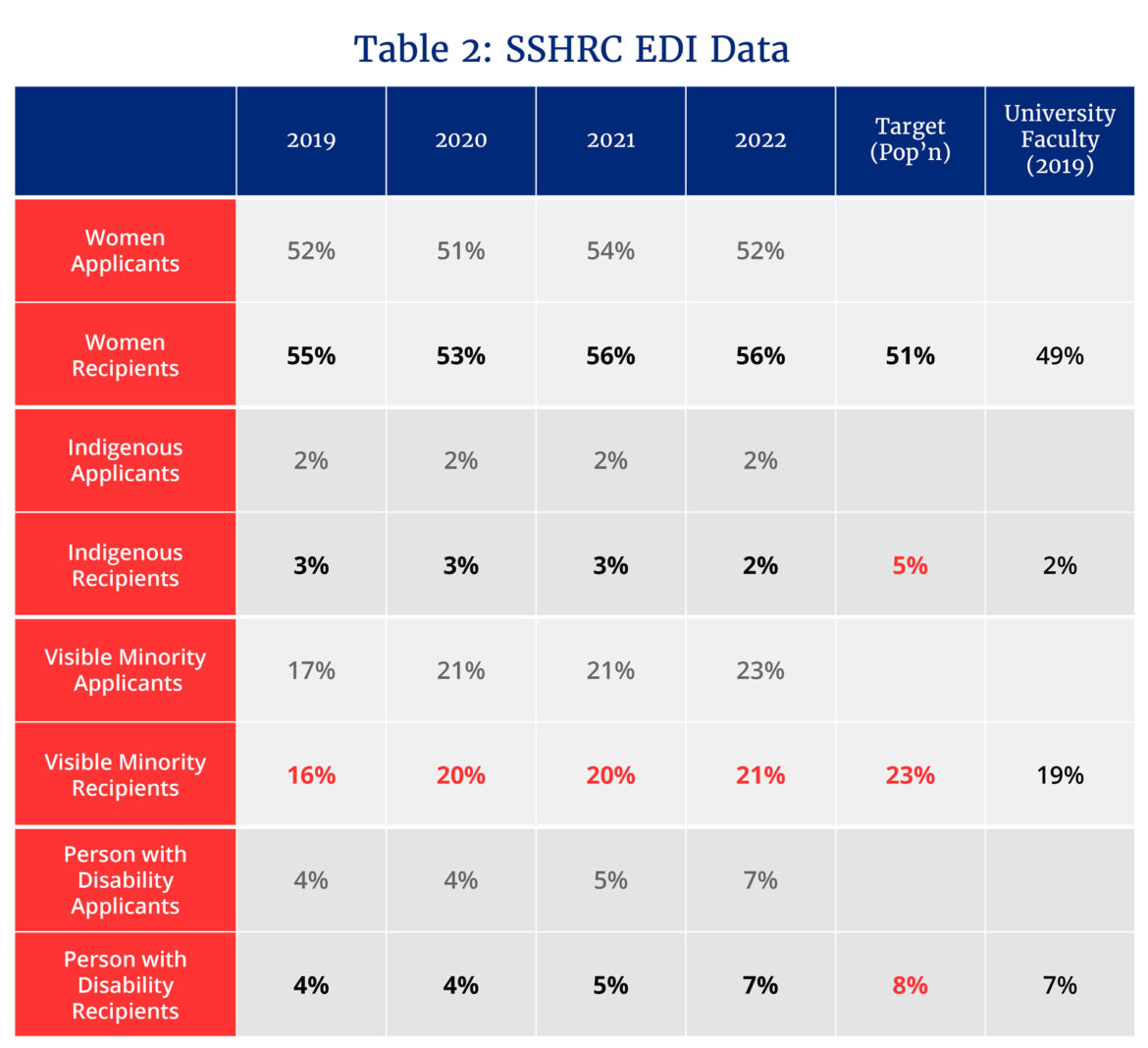
Table 2 provides these numbers alongside SSHRC’s equity targets for 2024/2025 and the groups’ proportion of Canadian university faculty as of 2019. Numbers in red show “under-performance” in the applicant-recipient ratio and SSHRC’s own targets.

Graphic credit: Janice Nelson

Four things are notable. First, only one of SSHRC’s four target groups (visible minority applicants) has been underrepresented in terms of the applicant-recipient ratio. Second, while women are the only group who have exceeded SSHRC’s equity target, the percentage of recipients has been growing rapidly for visible minority applicants and persons with a disability. Third, no target group is underrepresented relative to its proportion of university faculty members, with women (56 percent of recipients) especially outperforming their faculty proportion (49 percent). Finally, Indigenous grant recipients (2 percent) are underrepresented relative to their proportion of the overall population (5 percent), but not relative to their proportion of university faculty members.

Damaging the pursuit of truth

The above analysis leads me to three broad conclusions. First, while the language of EDI has permeated SSHRC, the federal agency oscillates between the “soft” EDI of affirmative action and the “hard” EDI of critical social justice activism. Most of the time, SSHRC focuses on achieving “equity targets” and frames EDI as complementary to research excellence. However, SSHRC’s new EDI-themed grants explicitly adopt activist language, and it is little wonder that those awards have been dominated by activist projects.  

Second, when it comes to the “soft” EDI of affirmative action, SSHRC’s policies are clearly having their intended effect for all groups except Indigenous Peoples. The number of grants awarded to women, visible minority applicants, and persons with a disability is rising. Grants are being awarded to members of these three groups at a proportion equal to or greater than their share of university faculty, and in the case of women, well above their share of the overall population. At this rate, it will soon be inaccurate for SSHRC to refer to “underrepresented groups” when it comes to prestigious national grants.

Finally, the “hard” EDI of critical social justice activism poses the biggest threat to SSHRC’s commitment to research excellence. While there are important critiques of the effects of “soft” EDI of affirmative action, it does not necessarily pose the same existential threat to research excellence. But the “hard” EDI of critical social justice activism is utterly incompatible with the objective pursuit of truth. One need only skim the titles of grants awarded under SSHRC’s two new EDI-focused initiatives to see how far they have strayed from the objective, empirical knowledge creation that we expect our national granting agencies to fund. Ironically, the more an award is pitched in terms of “diversity,” the less intellectually diverse the recipients seem to be. Thankfully, such activist research remains primarily confined to the new (and for now temporary) EDI-focused grants. 

If the federal government wants universities to keep the public’s trust, it should avoid any future activist-themed grants and ensure that granting agencies eschew social justice priorities. Federal granting agencies using taxpayer dollars should be explicit that their primary commitment is to promote excellence via the creation and dissemination of objective, falsifiable research knowledge. The university is supposed to function as a system of knowledge production. Policies that openly tie research to activist political ends threaten to undermine that very system.

Source: Dave Snow: The federal government is spending millions on equity, diversity, and inclusion research

‘A Constant Drumbeat’ of Racial Essentialism‘

Similar to the case of Toronto principal Richard Bilkszto and DEI training of the Kojo Institute:

That surviving claim concerns whether De Piero was subject to a hostile work environment. Penn State’s approaches to race and DEI, as described in his complaint, “plausibly amount to ‘pervasive’ harassment,” Beetlestone ruled. She qualified her ruling, noting that “discussing in an educational environment the influence of racism on our society does not necessarily violate federal law.” In fact, a workplace “dogmatically committed to race-blindness at all costs” would “blink at history and reality,” she wrote, adding that training on concepts such as white privilege, white fragility, and critical race theory “can contribute positively to nuanced, important conversations.”

She is clearly not an “anti-woke” ideologue. Still, the ruling declared, “the way these conversations are carried out in the workplace matters: When employers talk about race—any race––with a constant drumbeat of essentialist, deterministic, and negative language, they risk liability under federal law.”

What did De Piero describe that struck the judge as plausibly constituting that “constant drumbeat”?

After the murder of George Floyd in 2020, all Penn State faculty and staff were told to attend a “Conversation on Racial Climate” on Zoom. During the session, Alina Wong, an assistant vice provost for educational equity, “led the faculty in a breathing exercise,” De Piero’s complaint states, “in which she instructed the ‘White and non-Black people of color to hold it just a little longer—to feel the pain.’”

On at least four other occasions in 2020 and 2021, the judge wrote, De Piero “was obligated to attend conferences or trainings that discussed racial issues in essentialist and deterministic terms—ascribing negative traits to white people or white teachers without exception and as flowing inevitably from their race.” One session involved a presentation about “White Language Supremacy.” Another included examples of ostensibly racist comments “where every hypothetical perpetrator was white,” the judge continued.

The ruling noted De Piero’s claim that he was subject to “race-based theories condemning white people for no other reason than they spoke or were simply present while being ‘white,’” and that his supervisor “spoke of race conscious grading” and accused white faculty of unwittingly reproducing “racist discourses and practices” in the classroom. Once, faculty members even had to watch a training video titled “White Teachers Are a Problem.” In 2021, De Piero told an administrator that he felt harassed and singled out because of his race and asked that anti-racism training sessions be stopped. He filed a report with the Pennsylvania Human Relations Commission. He also filed a bias report with Penn State’s affirmative-action office. A staffer there allegedly told him, “There is a problem with the white race,” and urged him to keep attending anti-racism workshops.

In ruling that these and other allegations “plausibly amount to ‘pervasive’ harassment,” Judge Beetlestone did not necessarily conclude that everything happened just as De Piero claims. But if events did happen that way, she reasoned, then Penn State is “plausibly” guilty of creating a hostile climate. When I asked Penn State for comment on the factual accuracy of De Piero’s complaint, a spokesperson replied that the university does not comment on ongoing litigation.

Whether or not De Piero prevails at trial, Beetlestone’s ruling could have an effect on how schools approach DEI. The kind of DEI programming described in De Piero’s complaint is widespread on college campuses; I’ve encountered many examples of similar programming through my reporting. Now lawyers may scrutinize that programming partly with Beetlestone’s ruling in mind. And colleges hoping to avoid liability or costly lawsuits may study the fact pattern that Beetlestone saw as plausibly unlawful. If they’re doing anything similar, they may reconsider.

That’s why people who see DEI initiatives as racist or regressive are excited by this lawsuit—which was filed with financial support from the Foundation Against Intolerance and Racism, a civil-liberties group—while supporters of DEI initiatives are lamenting it. As the writers of the open letter criticizing the case put it, “We understand the stakes of this lawsuit, which regardless of its outcome will have a chilling effect on [DEI] and antiracist initiatives throughout systems of higher education.”

College administrators should facilitate the free speech of professors (including vocal supporters and opponents of progressive DEI initiatives) regardless of race, not train or compel faculty to adopt essentialist or discriminatory views. Aside from all of the legal questions about what constitutes a hostile workplace or a discriminatory DEI initiative, institutions involved in these disputes ought to ask themselves: Is diversity, equity, or inclusion really advanced by an administrator saying the white race has a problem, or by white professors being asked to hold their breath in order to feel pain? Legal or not, that sounds like prejudiced, alienating nonsense.

Source: ‘A Constant Drumbeat’ of Racial Essentialism‘

Right-Wing Influencers Are Going Full Racist in Anti-DEI Rants – The Daily Beast

Of note:

Boeing has had its fair share of negative news coverage lately, as the company’s decades of corner-cutting, outsourcing, and neglect led to some recent terrifyingmishaps.

You might wonder what this has to do with Diversity, Equity, and Inclusion (DEI). Well, it seems that efforts to create more just and equitable workplaces are the scariest thing imaginable to certain right-wing influencers. So terrifying, in fact, that they could lead to aviation disasters.

Elon Musk, the CEO of a car company whose vehicles have a tendency to catch fire, tweeted, “It will take an airplane crashing and killing hundreds of people for them to change this crazy policy of DIE.” The obvious innuendo is that Black people are responsible for Boeing’s failures. Musk has also referred to DEI as “just another word for racism.”

But Musk didn’t stop there. He amplified a tweet that suggested Black students have lower IQs, attacked HBCUs, and argued Blacks have “borderline intellectual impairment.” This is eugenics, plain and simple. It’s pseudo-science used to dehumanize Blacks, not dissimilar to when pro-slavery white people argued that Blacks were more suited for field work because they couldn’t learn and had smaller brains.

Not to be outdone, Turning Point USA founder Charlie Kirk—a vocal Donald Trump sycophant—used Boeing’s issues to argue against the employment of Black pilots. During a podcast, Kirk said, “If I see a Black pilot, I’m going to be like, ‘Boy, I hope he’s qualified.’” Other MAGA celebrities expressed similarly racist concerns.

Just 3.4 percent of U.S. airline pilots are Black. White men have flown the friendly skies almost exclusively since the Wright brothers’ first flight in 1903. Even with mitigation efforts to make air navigation more reflective of the society it serves, training programs, recruitment strategies, and airlines have fallen short.

United Airlines and Delta Airlines, specifically, have advanced diversity in hiring, but even there the needle hasn’t moved much in diversifying the pilot class—it’s still overwhelmingly majority white male.

So why are the likes of Elon Musk, Charlie Kirk, and others using the pilot workforce situation as the target of their DEI takedown?

The simple answer is… because they can. There is a shortage of airline pilots, a growing number of pilots are of retirement age, and the pipeline must be expanded to keep up with consumer demand. These realities scare certain white men who are hellbent on believing they are the master race, and that all others are inherently inferior.

And the attacks on DEI are coordinated and relentless.

As of this week, Florida’s 28 public colleges are prohibited from using government funds for diversity, equity and inclusion efforts. And because everything’s bigger in the Lone Star State, Texas boasts 30 new anti-DEI laws. Thirteen states’ attorneys general signed a public letter in July 2023 after the fall of affirmative action in college admissions. The letter had nothing to do with college admissions, but the Republican AGs used the Supreme Court decision as a platform to directly voice their collective opposition to DEI in the workforce.

These efforts don’t even scratch the surface of the anti-DEI architects’ ultimate goal—stratifying the American workforce and reducing access to the C-suite, STEM careers, small businesses, and opportunities previously afforded almost solely to white men. America is more diverse today than it has ever been—and the fix is in to ensure diversity isn’t reflected in high-paying jobs, the highest levels of government, or leadership in America’s top educational institutions.

To be Black in America is to live in a constant threat of attack on your civil rights and humanity, the questioning of your abilities, and a belief that you are unworthy solely because of the color of your skin. Regardless of how often Nikki Haley says, “America isn’t a racist country,” the red, white, and blue time and again finds itself painfully erecting barriers to Black achievement, health access, and any marker of equity.

Source: Right-Wing Influencers Are Going Full Racist in Anti-DEI Rants – The Daily Beast

Critics of D.E.I. Forget That It Works

Contrary to other studies highlighting the limited effectiveness, these HBS academics share their experience with preparing students for a more diverse workforce:

As Harvard-based educators and advisers with decades of collective experience, we have worked with organizations failing to meet this objective and taught M.B.A. students how to negotiate difference, preparing them for a work force more diverse than ever. In our experience, many organizations working on D.E.I. goals are getting stuck at the diversity stage — recruiting difference without managing it effectively — and generating frustration and cynicism about their efforts along the way. They are now at risk of stopping in the middle of a complex change journey, declaring failure prematurely.

Inclusion, as we define it, creates the conditions where everyone can thrive and where our differences as varied, multidimensional people are not only tolerated but also valued. A willingness to pursue the benefits of D.E.I. — the full participation and fair treatment of all team members — renders organizational wholes greater than the sum of their parts.

At a time when some organizations, feeling the politicized ripple effects of affirmative action’s repeal, are at risk of abandoning the objectives of D.E.I., our experiences suggest that to do so is bad for individuals, organizations and American society writ large. Persuasive scholarship has identified the ways in which we become more effective leaders when we collaborate skillfully with people who don’t already think like us — people with different perspectives, assumptions and experiences of moving through the world.

Erik Larson’s firm, Cloverpop, helps companies make and learn from decisions. When Mr. Larson and his research team compared the decision quality of individuals versus teams, they found thatall-male teams outperformed individuals nearly 60 percent of the time, but gender diverse teams outperformed individuals almost 75 percent of the time. Teams that were gender and geographically diverse, and had at least one age gap of 20 years or more, made better decisions than individuals 87 percent of the time. If you’ve ever called a grandparent for advice or tested an idea with a skeptical teenager, you get what this research was trying to quantify. We often learn the most from people who think most differently from us.

Getting people to share what they know that other people don’t know is essential to collective performance. Our Harvard Business School colleague Amy Edmondson and her research collaborator, Mike Roberto, designed a simulation where five-person teams must figure out how to climb Mount Everest. Teams reporting higher feelings of group belonging repeatedly outperform other teams because their members share more of their unique information about summiting Everest.

These findings are consistent with Ms. Edmondson’s research on the performance advantages of “psychological safety,” the cultural underpinning of inclusion. Individuals, she finds, are more likely to share their views in an environment that does not belittle, or worse, punish those who offer differing opinions, particularly to more powerful colleagues. In a recent study of 62 drug development teams, Ms. Edmondson and Henrik Bresman found that diverse teams, when assessed by senior leaders, outperform their more homogenous peers only in the presence of psychological safety. More diversity is not always better – from a performance standpoint, diversity without the inclusion can actually make things worse.

Inclusion work, done well, seeks to scale these kinds of results. Among other payoffs, organizations that get inclusion right at scale seem to be smarter, more innovative and more stable. One explanation is that they can see their competitive landscape — threats, risks, opportunities — more clearly and have greater access to the full knowledge base of their people.

But achieving gains like this can feel elusive when the will to participate in D.E.I. is waning. It can be tempting to put in place superficial fixes to achieve the optics of inclusion — a primary concern of D.E.I. critics — such as reserving roles for specific demographics. This is often illegal and rarely helpful, and it provides at least one area of broad agreement in this polarized debate: a distaste for hiring and promotion schemes based on an individual’s identity. A way to correct for these concerns is inclusive recruitment processes and rigorous, transparent selection criteria that everyone understands. It is not to scale back investments in inclusion, which would restrict our ability to build healthy, dynamic organizations.

Inclusion work is a way to create the conditions where people you don’t already know — those who are separated from you by more than one or two degrees — can succeed. For example, many U.S. tech companies have successfully created workplaces where young, straight, white men they know can thrive, but have a harder time recruiting, developing, promoting and retaining women, people of color, people from the L.G.B.T.Q.+ community, people over the age of 35 and the young, straight, white men they don’tknow. Organizations with these outcomes are typically relying too much on familiar networks — the people they know — and when they find someone good enough in those networks, they stop looking.

That is one reason we end up with all-male boards. Senior teams with no people of color. Professorial ranks with no conservatives. If the demographics of your team don’t bear much resemblance to the demographics of the broader population, then you’ve likely put artificial barriers on your talent pools and undermined your ability to reap the rewards of inclusion.

Everyone must be better off for inclusion initiatives to work. An example from Harvard Business School illustrates that point. It has always been an important part of our school’s mission to recruit military leaders and ensure that they can thrive, not in spite of their nontraditional training and experience, but precisely because of it. Over a decade ago, the school was succeeding at recruiting military veterans, but once in the classroom, they were less likely to excel academically. The military student group began providing specialized review sessions that focused on where its constituents were collectively getting stuck, making explicit the links between the M.B.A. curriculum and their military technical training.

Within a few years, gaps in performance closed. The performance of nonmilitary students did not decline because those students got extra attention. In fact, the rest of the student body benefited because military veterans became more active and confident in classroom discussions, offering unique insights into the high stakes of leadership decisions. The school’s experience with the value of customized review sessions also helped close performance gaps with other groups, including women and international students.

What does this work look like inside organizations? Sometimes it means more actively recruiting in unfamiliar places. Sometimes it means becoming more systematic about development opportunities. It can mean improving the ways you assess people for promotion, which can be riddled with bias and pitfalls, relying instead on more objective and self-evident advancement criteria. Indeed, what we hear most often from underrepresented leaders — X’s in organizations filled with Y’s — is the desire for a fair chance to compete, in workplaces where the rules of the game are clear and applied equally to all.

We know that historical change is like sleep. It happens gradually, sometimes fitfully, then all at once. We are in the fitful stage of our evolution toward truly inclusive organizations. But let us not get confused: Inclusion is an end goal that channels universal hopes for meritocracy, reflects America at its best and creates the foundation for an even more competitive future.

Caroline Elkins and Frances Frei are professors at Harvard Business School. Anne Morriss is the co-author, with Professor Frei, of “Move Fast and Fix Things: The Trusted Leader’s Guide to Solving Hard Problems.”

Source: Critics of D.E.I. Forget That It Works

Keller:The day DEI World entered Canadian politics

Keller has shifted from valid critiques of current immigration policies to critiques of DEI, given the blinders by some to anti-semitism, with one of the more blatant examples. Another one might be the KOJO Institute as their website does not mention anti-semitism based upon a word search:

….But today’s anti-racism training often isn’t at all like that. Which is how you end up with Laith Marouf. He worked for an organization that received federal funding to deliver anti-racism education, and whose contract was terminated after it came to light that he was posting antisemitic content online.

In Liberal World, claiming to be against racism, while discriminating on the basis of race, is not only wrong, it’s a philosophical contradiction. But DEI World’s anti-racism doesn’t work that way. It starts by putting groups of people into either the good racial box or the bad one, so that one can decide who is oppressed and oppressor, and who is entitled to what sort of treatment.

That’s how you end up with people posting things online that, in Liberal World, are clearly racist – and yet these same people, their minds in DEI World, sincerely believe themselves to be anti-racists.

Source: The day DEI World entered Canadian politics

McWhorter: Claudine Gay Was Not Driven Out Because She Is Black

Of note:

Since Claudine Gay’s resignation as president of Harvard University on Tuesday, it has become an article of faith among some of her supporters and other observers that she was targeted, criticized and essentially driven from the job largely because of her race. The idea is that the people who questioned her abilities and academic integrity — be they Harvard donors who found fault with her leadership after Oct. 7 or conservative activists who led an inquiry into plagiarism in her scholarly work — were marked and even motivated by animus toward a Black woman attaining such a degree of power and influence.

The Rev. Al Sharpton denounced Gay’s resignation as “an attack on every Black woman in this country who’s put a crack in the glass ceiling.” Janai Nelson, president of the NAACP Legal Defense Fund, wrote that the attacks against Gay “have been unrelenting & the biases unmasked.” Harvard’s Corporation, or governing board, noted the “repugnant and in some cases racist vitriol.” And Gay herself, writing in The Times last week, referred to “tired racial stereotypes about Black talent,” and described herself as an “ideal canvas for projecting every anxiety” due to her status as “a Black woman selected to lead a storied institution.”

But I don’t think the notion that racism was substantially to blame for Claudine Gay’s trouble holds up.

As both Gay and Harvard note, she received openly racist hate mail. This is repulsive. But however awful it must have been for Gay to endure their abuse, those people did not force her resignation.

Nor does it seem that Gay was ousted on the basis of her race in the aftermath of her Dec. 5 testimony before Congress on the topic of antisemitism on campus. Of three university presidents who attended, only one resigned under duress shortly after the hearing, and she — Liz Magill of Penn — was white.

No, the charge that ultimately led to Gay’s resignation was plagiarism, of which more than 40 alleged examples were ultimately unearthed. And plagiarism and related academic charges have of course also brought down white people at universities many times. Ward Churchill was fired from the University of Colorado for academic misconduct, including plagiarism, in 2007 in the wake of his controversially assailing people working in the World Trade Center towers on 9/11 as “little Eichmanns.” The president of the University of South Carolina, Robert Caslen, resigned thanks to a plagiarism episode in 2021. And the president of Stanford, Marc Tessier-Lavigne, resigned due to questions of data manipulation just last July.

For many, the central issue seems to be that Gay’s plagiarism would not have been uncovered at all were it not for the efforts of conservative activists, which is true. The question then is whether the people who led the charge to oust Gay from her job — principal among them the right-wing anti-critical race theory crusader Christopher Rufo and the billionaire financier and Harvard donor Bill Ackman — were acting out of racial animus, or even an opposition to Black advancement.

And here things get slightly more complicated. Rufo and Ackman are unabashedly opposed to what both perceive as an ongoing leftward drift at elite universities such as Harvard. And both are opposed to the D.E.I. — or “diversity, equity and inclusion” — programs that are increasingly prominent on campuses, within corporations, and elsewhere. According to Ackman, D.E.I. is “not about diversity” but rather is “a political advocacy movement on behalf of certain groups that are deemed oppressed.” Rufo and Ackman both believed that, in accordance with the precepts of D.E.I., Gay had been appointed as Harvard president more for her skin color than for her professional qualifications.

To analyze this position as mere racism, though, is hasty. No one is trading in “stereotypes” of Black talent by asking why Gay was elevated to the presidency of Harvard given her relatively modest academic dossier and administrative experience. It was reasonable to wonder whether Gay was appointed more because she is a Black woman than because of what she had accomplished, and whether this approach truly fosters social justice. There was a time when the word for this was tokenism, and there is a risk that it only fuels the stereotypes D.E.I. advocates so revile.

To put it succinctly: Opposing D.E.I., in part or in whole, does not make one racist. We can agree that the legacy of racism requires addressing and yet disagree about how best to do it. Of course in the pure sense, to be opposed to “diversity,” opposed to “equity” and opposed to “inclusion” would fairly be called racism. But it is coy to pretend these dictionary meanings are what D.E.I. refers to in modern practice, which is a more specific philosophy.

D.E.I. programs today often insist that we alter traditional conceptions of merit, “decenter” whiteness to the point of elevating nonwhiteness as a qualification in itself, conceive of people as groups in balkanized opposition, demand that all faculty members declare fealty to this modus operandi regardless of their field or personal opinions, and harbor a rigidly intolerant attitude toward dissent. The experience last year of Tabia Lee, a Black woman who was fired from supervising the D.E.I. program at De Anza College in California for refusing to adhere to such tenets, is sadly illustrative of the new climate. (Like Ackman, she believes that what he calls the “oppressor/oppressed framework” of D.E.I. contributes to campus antisemitism by defining Jews as “oppressors.”)

D.E.I. advocates may see their worldview and modus operandi as so wise and just that opposition can only come from racists and the otherwise morally compromised. But this is shortsighted. One can be very committed to the advancement of Black people while also seeing a certain ominous and prosecutorial groupthink in much of what has come to operate under the D.E.I. label. Not to mention an unwitting condescension to Black people.

Try this thought experiment: Harvard appoints “White Fragility” author Robin DiAngelo to become the new president of Harvard. She comes equipped with the strongest D.E.I. credentials imaginable, but with a very slender academic record. Do you imagine that conservative activists would sit back contentedly, merely because she’s white?

Or take a non-hypothetical example: After a successful tenure as the president of Smith College, Ruth Simmons became the first Black woman president of an Ivy League School when she took over Brown in 2001. Yet I am aware of no conservative crusade against her during her decade-plus in that office — despite the fact that she led a yearslong campuswide examination of the school’s role in the slave trade.

The idea that a menacing right-wing mob sits ever in wait to take down a Black woman who achieves a position of power is a gripping narrative. But its connection to reality is — blissfully — approximate at best. It is facile to dismiss opposition to modern D.E.I. as old-school bigotry in a new guise. The lessons from what happened to Professor Gay are many. But cops-and-robbers thinking about racial victims and perpetrators will help answer few of them.

Source: Claudine Gay Was Not Driven Out Because She Is Black