Hiebert: Canada’s Future Depends on Where Immigrants Settle, Not Just How Many Are Welcomed

 Good analysis by my friend Dan Hiebert noting the needed linkages between immigration and other policies:

Immigration alone cannot solve Canada’s regional and demographic challenges, according to a new report from the C.D. Howe Institute. Immigration must be paired with regional development; otherwise, Canada risks exacerbating the divide between fast- and slow-growth regions while placing even greater strain on already pressured large urban centres.

In “Fast vs. Slow: How Different Immigration Rates Can Impact Canada’s Economic Challenges and Regional Disparities,” Daniel Hiebert finds that regardless of the number of immigrants Canada welcomes, settlement patterns result in only modest population growth in slower-growth regions.

“Regionalization policies like Provincial Nominee Programs have helped newcomers to settle beyond the big three cities,” said Hiebert. “But the real test is whether they stay – secondary migration is pulling people right back into fast-growing areas.”

Hiebert argues that a multi-stage immigration process – such as beginning with temporary status – can help slower-growth regions retain newcomers by giving them time to build social and economic ties before settling permanently.

“If we’re judging the system by how well it supports all parts of the country, it’s coming up short,” Hiebert added. “Immigration can certainly help address Canada’s demographic challenges, but it’s not the only tool – we need broader regional development to make it work.”

The report emphasizes the need for Canada to pair immigration initiatives with broader efforts to strengthen local economic opportunities, access to services, and overall community attractiveness. It also outlines several policy recommendations to help slow-growth regions thrive, including investing in infrastructure, fast-tracking credentials, and supporting the growth of promising mid-sized cities that can absorb growth and ease pressure on major urban centres.

“With housing costs, productivity issues, and an ageing population dominating the national conversation, building growth and resilience across all regions has to be a top priority,” said Hiebert. “It’s not just about the number of newcomers we bring in – it’s about making sure they have the support and opportunities to thrive wherever they settle.”

Read the Full Report

Canada Case Study Explores the Limits of Immigration to Ease Demographic Decline

Good and relevant study by Dan Hiebert on the need for realism and a shift towards population policy framework:

High-income countries globally face a stark demographic transition as their populations age and fertility rates decline, with key implications for productivity and the maintenance of retiree benefits if tax bases decline as workforces shrink. Questions remain about how and to what extent immigration can help slow this transition and soften the impact on labor markets. 

Canada offers a unique vantage point on the role that immigration can play in easing demographic decline—and the potential drawbacks. Over the past decade, rising permanent and temporary migration accounted for the entirety of Canada’s labor force growth. But the rapid pace of change has come with challenges. By 2024, Canada’s historic embrace of immigration had cooled amid public concerns about its impact on housing costs and public services. 

In a new report out today for the Migration Policy Institute’s Transatlantic Council on Migration, respected Canadian researcher Daniel Hiebert investigates the efficacy of immigration in addressing population change and the old-age dependency ratio. The report examines Canada’s demographic challenges (its total fertility rate of 1.26 children per woman is among the lowest rates globally) and recent changes in migration policymaking before exploring the consequences of setting immigration rates at different levels. The report uses six scenarios for admissions and population projections over the next half-century that were commissioned from Statistics Canada. 

The report finds that while the six scenarios, which range from high- to near net-zero immigration, would produce very different overall population sizes by 2046 and 2071, the old-age dependency ratio would rise even under the highest immigration rate. “These scenarios point to an important lesson: Immigration can grow the population and slow the effects of falling fertility, but it is less efficient at changing the age composition of the population,” writes Hiebert, emeritus professor of geography at the University of British Columbia. That is because immigrants themselves age and eventually retire alongside their native-born peers. 

To tackle the rising old-age dependency ratio and the prospect of shrinking workforces, policymakers would need to also consider other interventions, such as raising the retirement age, Hiebert writes. 

The report, Understanding the Impact of Immigration on Demography: A Canadian Case Study, argues that for immigration policy to effectively tackle Canada’s challenges, policymakers will need to frame a long-term strategy that considers a number of intertwining realities, including: 

  • Calibrating immigrant admissions together with decisions about social spending and investment in housing stock and infrastructure. 
  • Taking a longer lens than the standard three-year population plan, given the consequences of changing immigration targets play out over decades. This also means recognizing the need for different policy interventions as “fast” regions such as large cities face pressures on housing and infrastructure from above-average population growth, while “slow” regions such as rural areas will need help navigating depopulation and rising old-age dependency ratios. 
  • Effectively communicating with the public to set appropriate expectations for immigration. 

“Canada is frequently seen as an exceptional case, globally, with a population that has been willing—enthusiastic, even—to accommodate a relatively high rate of immigration. This consensus has become frail and the Canadian government (like others around the world) has changed its tone on immigration, acknowledging that there are costs to immigration-led population growth,” Hiebert writes. “Nevertheless, demographic challenges are resolute and ignoring them will, eventually, also carry economic and political consequences.” 

While few governments globally have clearly and forcefully articulated the unprecedented levels of old-age dependency that are looming, and the resulting painful economic adjustments ahead, embarking on a national conversation around demography, engaging with the tough policy trade-offs involved and building a population strategy could help raise Canadian public awareness, the author concludes.

Read the report here: www.migrationpolicy.org/research/immigration-demography-canada

Source: Canada Case Study Explores the Limits of Immigration to Ease Demographic Decline

How diverse is your neighbourhood? A new website shows how immigration to Canada has transformed our cities

Good coverage of the super diversity website and the work by Dan Hiebert and Steven Vertovec:

Have you ever wondered how your local community stacks up when it comes to diversity in ethnicities, income levels, language spoken or education attainments?

Residents of Canada’s six largest metropolitan areas can now check that out through a website launched on Monday that tracks the transformation of the country by immigration down to the neighbourhood level.

Coined “Superdiversity,” the project crunches immigration and census data into interactive graphics and maps that showcase Canada’s changing landscapes and how socioeconomic indicators such as wealth, income, employment status and education play out across ethnic groups, generations of newcomers and neighbourhoods.

“We’re hoping to just help anyone come to a better understanding of the society that surrounds them that they’re part of,” said University of British Columbia professor emeritus Daniel Hiebert, a co-founder of the project.

“This is really about social change and the ability to show it based on data.”

Since Ottawa changed its immigration rules in the 1960s that favoured immigrants from the U.K., continental Europe and the U.S., Canada’s population has become increasingly diverse. The proportion of newcomers from the “traditional” source countries has dwindled to about 15 per cent from nearly 90 per cent.

The Superdiversity website shows how the annual admissions of permanent residents — broken down into economic, family and humanitarian classes — evolved from under 150,000 in 1980 to over 450,000 in 2023, as well as how the nationalities of each subgroup of newcomers changed over time to now being dominated by those from India, China and the Philippines.

It also documents how the annual inflow of temporary residents — divided into asylum seekers, international students and different types of work permit holders — skyrocketed in just a few years from under 200,000 to more than 1.6 million today, and how the source countries shifted under each category.

“When you see people who came from a particular country with a particular migration stream, with a particular age group and with a different gender pattern, you can see how these fit together to produce certain social outcomes,” said project co-founder Steven Vertovec, director of the Max Planck Institute for the Study of Religious and Ethnic Diversity in Germany.

“By treating groups only as ethnic communities, we didn’t see the complexities and diversity within groups. You just treated all Indians as the same, all Italians and all Asians as the same.”…

Source: How diverse is your neighbourhood? A new website shows how immigration to Canada has transformed our cities

Link: https://superdiv.mmg.mpg.de/#vancouver-intro?bubble;filter:Total%20population?map;variables:0,0;mode:traditional?tree;year:2012;category:Humanitarian?sankey;year:1991?dashboard;filters:99,99,99,99,99

Steven Vertovec in conversation with Dan Hiebert

Nice short and informative interview:

Our Founding Director Prof. Steven Vertovec in conversation with Dan Hiebert, Professor Emeritus of Geography at the University of British Columbia, on the world of migration from a policy perspective.

Source: Steven Vertovec in conversation with Dan Hiebert

Douglas Todd: Ottawa insider warns about immigrant-investor schemes – Vancouver Sun

Wise warning (disclosure: I am friends of some of those quoted):

An adviser within Canada’s immigration department is warning about the dangers of entry programs that favour entrepreneurs, given the failure of earlier initiatives.

The internal cautions come at the same time the immigration department, which has been under fire from top bank economists for damaging the economy by bringing in a record 1.25 million permanent and temporary residents in a year, is expanding another program that gives preference to would-be entrepreneurs.

The internal government memo, obtained by Vancouver lawyer Richard Kurland under an access-to-information request, reveals how an adviser to Immigration, Refugees and Citizenship Canada (IRCC) warned that a variety of earlier immigrant-business programs suffered widespread abuse — resulting in a trivial number of new businesses being opened in Canada, and other problems.

The defunct schemes that targeted wealthy foreign nationals, which the correspondents generally refer to as “business-class programs,” opened the gates to a flood of foreign capital moving into Canadian housing, says the adviser. That raised prices, especially in cities such as Vancouver and Toronto. In addition, the internal email thread alerts decision makers to the way many entrepreneur immigrants ended up paying low amounts of income tax.

The in-house memo comes to light in the same month the Canadian Press reported the IRCC was internally warned two years ago that increasing immigration levels would harm housing affordability and services. A Nanos poll also finds support for migration has in less than a year plunged 20 percentage points, with 53 per cent now wanting fewer immigrants.

The group email shared by top immigration department officials, titled “The strange story of Vancouver,” reveals just how badly things went with the earlier schemes, specifically the longstanding immigrant-investor and entrepreneur programs, which were poorly monitored.

The email thread shows that senior officials in March of last year were working “under the radar” to expand similar business-class schemes, particularly the so-called Start-Up Visa (SUV) program, to welcome more would-be entrepreneurs into the country who have the “potential” to start a new business.

However, when the directors sought advice from Daniel Hiebert, a former UBC geography professor who is now working in the department’s strategic planning section, he said the earlier programs led to only 15 per cent of business-class immigrants actually starting a business.

“Ouch,” Hiebert says in the email, explaining how most of the business-class newcomers failed to start a new company even though their status as permanent residents was supposedly contingent on it.

The Conservatives disbanded the immigrant investor and entrepreneur programs in 2014, openly saying the people who came in through them were generally not having a long-term positive impact on the country, not bringing in significant investment capital for business, had low ability in Canada’s official languages, were tending not to stay in the country, and were paying far lower taxes than the average skilled worker.

Even many of those entrepreneurs who did begin a business through the old program dropped it after two years, said Hiebert. “They started businesses to meet requirements and then later let them go.”

Hiebert said, as far as he knows, not one of those entrepreneur-class immigrants ever had their permanent resident status revoked.

Furthermore, Hiebert explained how many of those business-class immigrants who bought expensive houses in the city tended to pay low mortgages and low income taxes.

“This is still the case,” Hiebert wrote. “The story is that many of the residents of these areas came through business-class programs with the intent to retire and live a comfortable lifestyle.”

After initially transferring their money out of their country of origin, typically somewhere in East Asia, Hiebert wrote, most purchased a house “along with a Mercedes, Audi or whatever. And then life is lived quite simply, on a small budget and with little owing in terms of income tax. The kids get to go to UBC or SFU while paying domestic fees, which is a big bonus.”

Hiebert concludes his March, 2023, memo by saying, “I think it’s time to review the economic outcomes of the Start-Up Visa program and I suspect they will show more of the same.”

At one point in the email thread, Umit Kiziltan, director general of the IRCC, said the “burning questions” that Hiebert raised required the “outmost (sic) attention” while the department evaluates whether to expand the Start-Up Visa program and others aimed at wealthy immigrants.

Also included in the thread are Maggie Pastorek, director of policy, and James McNamee, senior director in the economic immigration branch.

The group email includes a discussion of a study covered in a Postmedia article from 2022, which shows how UBC business professor Thomas Davidoff and others discovered the owners of Greater Vancouver homes with a median value of $3.7 million pay income taxes of just $15,800 — which is exceedingly low for North American cities.

“Most luxury homes in Greater Vancouver appear to be purchased with wealth derived from sources other than earnings taxed in Canada,” said Davidoff’s study, which confirmed earlier research by Statistics Canada and Hiebert himself.

Several years ago, StatCan and Hiebert found the average value of a detached house bought by more than 4,400 millionaire immigrants who came to Metro Vancouver under the investor program was $3.2 million. That compared to an average of $1.5 million for a Canadian-born owner.

While working at UBC, Hiebert’s studies also found a correlation between neighbourhoods with large foreign-born populations and neighbourhoods that appear to have unusually low taxable incomes, despite their inflated housing prices, such as Richmond and Vancouver’s west side.

Based on the documents provided in response to an access-to-information request by Vancouver immigration lawyer Richard Kurland, it is not clear how the internal discussion affected later decisions the Liberal government made about its Start-Up Visa program

Last year, however, Ottawa scaled up the annual intake of the Start-Up Visa program from 2022, when it offered 1,000 spots. The program’s intake rose to 3,500 last year and is set to bring in 5,000 this year and 6,000 in 2025.

Immigration department officials did not respond by deadline.

Source: Douglas Todd: Ottawa insider warns about immigrant-investor schemes

Douglas Todd: B.C. desperately needs Ottawa to tie immigration levels to housing

More on housing and immigration levels:

Last week, hundreds of B.C. mayors and municipal councillors heard exactly why Ottawa’s failure to do so is causing them grief when it comes to providing adequate infrastructure, particularly affordable housing, but also schools, health-care facilities and daycares.

Delegates to the Union of B.C. Municipalities convention heard the country’s record population growth last year of one million was 96 per cent from offshore arrivals. Forty per cent of those newcomers were permanent residents and 60 per cent were temporary residents, especially foreign students.

The flood of foreign nationals is creating unprecedented demand for homes, which is pushing up rents and housing prices, which are among the highest in the world in cities like Vancouver and Toronto.

While people in Canada who already own homes, or serve as landlords, are benefiting, the rest are having to struggle with price-to-household income ratios that have soared since 2005 to among the worst in the Western world.

Chris Friesen, a national leader in providing settlement services for immigrants and refugees, told delegates it’s taking far too long for Ottawa to do the obvious and co-ordinate its migration policy with housing and other taxpayer-funded services.

Last year, British Columbia, which has almost no control over migration, took in 60,000 new permanent residents and 140,000 temporary residents, said Friesen, the longtime CEO of the Immigrant Services Society of B.C.

“And at the end of the day everybody is looking for a home,” said Friesen. Despite Kahlon’s recent efforts, Friesen criticized the way the NDP government in 2018 launched a 30-point housing strategy “and nowhere in that plan is there mention of immigrants, temporary residents or refugees.”

Friesen said service providers are increasingly talking about how the country’s “absorptive capacity” for newcomers is stretched. It’s not only affecting newcomers, he said, but Canadian-born residents, too.

A Statistics Canada report by Annik Gougeon and Oualid Moussouni showed immigrants bought 78 per cent of the homes purchased in Richmond in 2018, and more than 65 per cent of the dwellings bought in Surrey and Burnaby. Newcomers bought more than 40 per cent of homes in Vancouver, North Vancouver and New Westminster in 2018.

Dan Hiebert, professor emeritus of geography at the University of B.C., told the delegates that Canada would have to immediately build 1.36 million more houses and apartments just to reach the average homes-to-population ratios of the OECD, a club of well-off nations.

And to achieve “affordability” in the housing market, the Canada Mortgage and Housing Corporation has estimated the country would need to build 3.5 million extra housing units in the next seven years. Currently, only about 280,000 units are built each year.

The proportion of Metro Vancouver housing owned or rented by recent newcomers has doubled since 2016, according to census data. Growth rates are rocketing.

Permanent and non-permanent residents who arrived in the past five years alone now account for 14 per cent of Metro Vancouver’s population, eight per cent of all homeowners and 25 per cent of all renters.

Canada has not seen such high immigration rates since 1912, when 400,000 newcomers arrived, said Hiebert. Ottawa is now aiming for 500,000 new permanent residents each year. And that does not include hundreds of thousands of guest workers, plus the record 800,000 foreign nationals in the country on study visas.

Years ago, Hiebert referred to how Canada’s immigration policy is, in effect, Canada’s housing policy. Without knowing its origins, many UBCM attendees repeated the phrase frequently.

Hiebert suggested Canada’s dilemma is that arguably there might not be enough people to fill the country’s labour market, but there are too many for Canada’s housing market.

The vice-president of the Vancouver Board of Trade, David van Hemmen, said B.C. businesses are having difficulty attracting talent because of the alarming cost of housing. Some businesses, he said, are moving operations to Alberta or Washington state, to avoid B.C.’s daunting land costs.

While panelists and delegates consistently said the country should welcome newcomers, some civic officials who went to the microphones remarked on how Ottawa’s migration targets are “aggressive.”

Carling Helander, a provincial government immigration policy specialist who sat on the panel in lieu of Municipal Affairs Minister Anne Kang, acknowledged B.C.’s quest for new workers to address labour shortages creates a “circular loop” that tends to hike housing costs.=

A recent Gallup poll revealed 75 million people around the world want to move to Canada, the delegates heard. In addition, an Angus Reid Institute poll found newcomers are enthusiastic about getting into the housing market.

While 59 per cent of Canadian-born residents said “it’s important to own a home to feel like a real Canadian,” that figure jumps to 75 per cent among recent immigrants. While the individual earnings of recent immigrants are below average, Hiebert said household incomes are higher than most because more people tend to inhabit the same dwelling.

Friesen cited how the Liberal government’s humanitarian approach to asylum seekers from war-ravaged Ukraine exemplifies the absence of co-ordination between federal migration policy and local housing needs.

More than 175,000 asylum seekers from Ukraine have already landed in Canada, said Friesen. But 850,000 more have applied for refugee status. It’s just been announced they will have to forfeit their refugee application if they don’t get to Canada by March, 2024. All this, Friesen said, is being done without housing co-ordination.

The ISS of B.C. already has 13 full-time staff devoted to finding houses for asylum seekers and other newcomers, said Friesen. “Over 60 per cent of them land in Surrey in basement suites.”

Similar to B.C.’s housing minister, Friesen said this country badly needs a 10-year population growth strategy that matches arrivals with housing.

Source: Douglas Todd: B.C. desperately needs Ottawa to tie immigration levels to housing

Douglas Todd: Slow vaccine rollout threatens Trudeau’s lofty immigration target

Of note:

Canada’s vaccine rollout, which is slower than 41 other countries, threatens Prime Minister Justin Trudeau’s chances of reaching his record target for immigration this year. But that could benefit young Canadians and recent migrants struggling to find work during the pandemic.

University of B.C. geographer Daniel Hiebert has found COVID-19 has elevated the number of “underutilized” workers in Canada to almost four million — many of whom will compete with the 401,000 immigrants Ottawa is welcoming in 2021, in addition to temporary workers.

Saying Canada is only about “halfway” through resolving the pandemic through vaccinations, Hiebert told the influential Affiliation of Multicultural Societies and Service Agencies of B.C. (AMSSA) it will be a “really significant challenge” to “economically integrate 400,000 newcomers into a labour market with nearly four million looking for work — or more work. It’s completely unprecedented.”

Source: Douglas Todd: Slow vaccine rollout threatens Trudeau’s lofty immigration target

Canada kept doors open to temporary foreign workers during 2020’s pandemic lockdown, new numbers reveal

The project that Dan Hiebert, Howard Ramos and I have been working on:

Despite its pandemic lockdown, Canada managed to keep its doors open to temporary foreign workers last year, new numbers reveal.

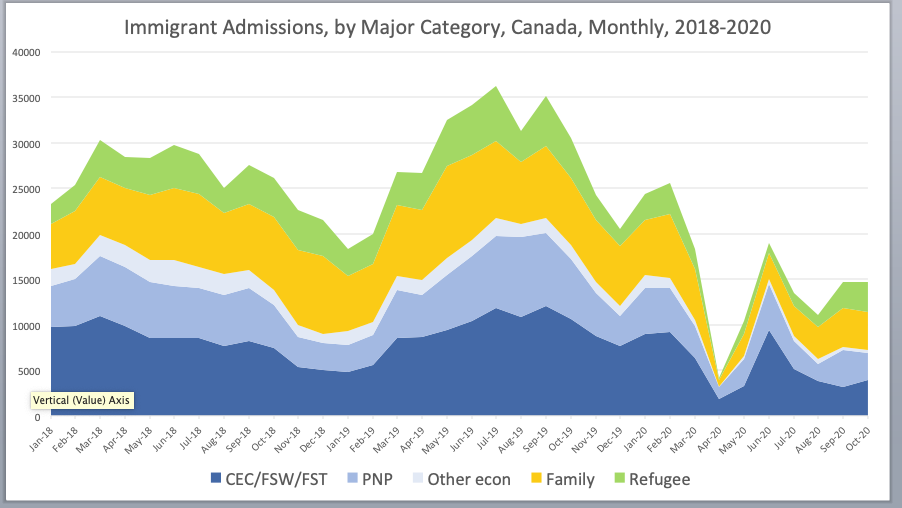
Amid travel restrictions and vastly reduced immigration, 322,815 people were issued a work permit under various temporary foreign worker programs, according to a joint project that tracks the pandemic’s impacts on Canadian immigration

Although that represents a drop of 10 per cent from the year before, temporary foreign workers appear to have been substantially less interrupted by COVID-19 than those in other streams of immigration to this country.

Here are some of the highlights:

  • The number of permanent residents admitted to Canada last year nosedived by 45.7 per cent, to just 185,130, from 2019;
  • The number of study permit holders also dropped by 33 per cent to 277,720, with the enrolment in primary and secondary schools down 32.3 per cent and in post-secondary education down almost 32 per cent. Those in language programs fell by 54 per cent; and
  • A total of 23,845 people sought asylum in Canada, compared to 64,045 in 2019. Claims made at airports and land borders dropped by 77 per cent and 72 per cent, respectively, due primarily to border closures. 

“Canada has been pretty dedicated to bringing in the people that it needs on a temporary work side,” said University of British Columbia professor Daniel Hiebert, a co-founder of the COVID research project. “There’s a Canadian interest story to be told.”

According to the immigration data, 215,080 work permit holders were admitted under “Canadian interests,” which include athletes, scholars, those in culture and entertainment, youth in international exchange programs and international students who graduated from a designated Canadian college or university. The group fell by just eight per cent from 233,430.

Migrant farm workers made up the second largest group, accounting for 54,145 of the work permit holders, representing a 6.1 per cent decline from 2019.

Those temporary foreign workers who required a labour market assessment to prove they’re not taking a job from a Canadian dropped by almost 13 per cent to 30,890 from 35,365 in 2019.

The biggest losers were foreign caregivers and foreign workers under trades agreements such as intra-company transferees, down by 49 per cent and 31 per cent respectively.

Andrew Griffith, another co-founder of the COVID and Immigration research project, said it makes sense for Ottawa to prioritize processing temporary residents such as migrant workers and international students, who are of Canada’s short-term economic interest and a crucial group in the country’s permanent resident pipeline.

Just in February, with the border still closed to prospective immigrants overseas, Ottawa invited a record 27,332 people to apply for permanent residence, and 90 per cent of the invitees are already living in Canada, with at least one year of Canadian work experience. 

With the immigration shortfall in 2020, Ottawa plans to welcome more than 1.2 million permanent residents over the next three years.

“I’m worried about the impact of COVID on those already in Canada,” said Griffith, a former director general at the immigration department. “Is it fair and ethical to encourage a large number of immigrants at a time when their economic prospects are not that great?” 

The immigration data also showed the number of permanent resident applications plummeted in 2020 by a whopping 54.6 per cent to 186,000 from 409,500 in 2019.

Applications from the Americas fell by 64 per cent, followed by those from Europe (57 per cent), Asia (56 per cent), Africa and Oceania (both at 46 per cent).

“Everywhere around the world people are hunkering down a little bit more, just thinking, ‘Why do I want to move thousands of kilometres away during a crisis?’ What’s on people’s minds is, ‘Who’s going to let me in as an immigrant now anyway?’” said Hiebert.

“There’s a sense that this isn’t the right time to try to get into another country. People are just being realistic.”

While it’s hard to predict how global migration will transform as the world digs itself out of the pandemic, Western University professor Howard Ramos said the notion of emigration out of the traditional source countries such as China, India and the Philippines in 2021 and going forward is different than before COVID-19.

“In any of those countries, they are now wrestling for the first time an aging population and potentially shrinking populations as a result of lower child births. The level of development is higher and people are more urban and have more education and affluence at home. The appeal to going abroad is not as it once was,” said Ramos, who works with Hiebert and Griffith on the COVID immigration tracking project.

“North America and Europe look very different than what they once did before the pandemic, as you see some of the chaos experienced with the rollout of the vaccines or when you look at public attitudes. We’ve seen an ugly turn in Canada with anti-Asian hate crime that certainly gives a different lens of Canada as a welcoming country.”

Permanent residents eager to become Canadian citizens were another group that suffered during the pandemic. Only 108,159 immigrants were granted citizenship in 2020, down by 56.8 per cent from 250,083 the year before as officials struggled to transition to offer virtual citizenship tests and oath-taking ceremonies.

While the research project has so far been operating more in a record-keeping mode, Griffith said the data will provide a better sense of the Canadian government’s immigration policy responses to the pandemic and their impact down the road.

“In the end, the interesting question is not just what happened, but why it happened. Did the policy responses have an impact? Was it good impact, bad impact? Was there something that needs to be done differently with hindsight?” Griffith asked.

“Those are the deeper questions, but it’s too early to answer them. This has been the year that the world has gone to hell. Hopefully, starting sometime in late summer we’re getting out of that hole.”

Source: https://www.thestar.com/news/canada/2021/03/03/canada-kept-doors-open-to-temporary-foreign-workers-during-2020s-pandemic-lockdown-new-numbers-reveal.html

New tool could point immigrants to spot in Canada where they’re most likely to succeed

A neat example of algorithms to assist immigrants assess their prospects although human factors such as presence of family members and community-specific food shopping and the like may be more determinate. But good that IRCC is exploring this approach. More sophisticated that the work I was involved in to develop the Canadian Index for Measuring Integration. Some good comments by Harald Bauder and Dan Hiebert:

Where should a newcomer with a background in banking settle in Canada?

What about an immigrant who’s an oil-production engineer?

Or a filmmaker?

Most newcomers flock to major Canadian cities. In doing so, some could be missing out better opportunities elsewhere.

A two-year-old research project between the federal government and Stanford University’s Immigration Policy Lab is offering hope for a tool that might someday point skilled immigrants toward the community in which they’d most likely flourish and enjoy the greatest economic success.

Immigration, Refugees and Citizenship Canada is eyeing a pilot program to test a matching algorithm that would make recommendations as to where a new immigrant might settle, department spokesperson Remi Lariviere told the Star.

“This type of pilot would allow researchers to see if use of these tools results in real-world benefits for economic immigrants. Testing these expected gains would also allow us to better understand the factors that help immigrants succeed,” he said in an email.

“This research furthers our commitment to evidence-based decision making and enhanced client service — an opportunity to leverage technology and data to benefit newcomers, communities and the country as a whole.”

Dubbed the GeoMatch project, researchers used Canada’s comprehensive historical datasets on immigrants’ background characteristics, economic outcomes and geographic locations to project where an individual skilled immigrant might start a new life.

Machine learning methods were employed to figure out how immigrants’ backgrounds, qualifications and skillsets were related to taxable earnings in different cities, while accounting for local trends, such as population and unemployment over time.

The models were then used to predict how newcomers with similar profiles would fare across possible destinations and what their expected earnings would be. The locations would be ranked based on the person’s unique profile.

“An immigrant’s initial arrival location plays a key role in shaping their economic success. Yet immigrants currently lack access to personalized information that would help them identify optimal destinations,” says a report about the pilot that was recently obtained by the Star.

“Instead, they often rely on availability heuristics, which can lead to the selection of suboptimal landing locations, lower earnings, elevated out-migration rates and concentration in the most well-known locations,” added the study completed last summer after two years of number crunching and sophisticated modelling.

About a quarter of economic immigrants settle in one of Canada’s four largest cities, with 31 per cent of all newcomers alone destined for Toronto.

“If initial settlement patterns concentrate immigrants in a few prominent landing regions, many areas of the country may not experience the economic growth associated with immigration,” the report pointed out. “Undue concentration may impose costs in the form of congestion in local services, housing, and labour markets.”

Researchers sifted through Canada’s longitudinal immigration database and income tax records to identify 203,290 principal applicants who arrived in the country between 2012 and 2017 under the federal skilled worker program, federal skilled trades program and the Canadian Experience Class.

They tracked the individuals’ annual incomes at the end of their first full year in Canada and predicated the modelling of their economic outcomes at a particular location on a long list of predictors: age at arrival, continent of birth, education, family status, gender, intended occupation, skill level, language ability, having studied or worked in Canada, arrival year and immigration category.

Researchers found that many economic immigrants were in what might be considered the wrong place.

For instance, the report says, among economic immigrants who chose to settle in Toronto, the city only ranked around 20th on average out of the 52 selected regions across Canada in terms of maximizing expected income in the year after arrival.

“In other words, the data suggest that for the average economic immigrant who settled in Toronto, there were 19 other (places) where that immigrant had a higher expected income than in Toronto,” it explains, adding that the same trend appeared from coast to coast.

Assuming only 10 per cent of immigrants would follow a recommendation, the models suggested an average gain of $1,100 in expected annual employment income for the 2015 and 2016 skilled immigrant cohort just by settling in a better suited place. That amounted to a gain of $55 million in total income, the report says.

However, researchers also warned against the “compositional effects” such as the concentration of immigrants with a similar profile in one location, which could lower the expected incomes due to saturation. Other issues, such as an individual’s personal abilities or motivation, were also not taken into account.

The use of artificial intelligence to assist immigrant settlement is an interesting idea as it puts expected income and geography as key considerations for settlement, said Ryerson University professor Harald Bauder

“It’s not revolutionizing the immigration system. It’s another tool in our tool box to better match local market conditions with what immigrants can bring to Canada,” says Bauder, director of Ryerson’s graduate program in immigration and settlement studies.

“This mechanism is probably too complex for immigrants themselves to see how a particular location is identified. It just spits out the ranking of locations, then the person wonders how I got this ranking. Is it because of my particular education? My particular country of origin? The information doesn’t seem to be clear or accessible to the end-users.”

New immigrants often gravitate toward a destination where they have family or friends or based on the perceived availability of jobs and personal preferences regarding climate, city size and cultural diversity.

“This tool will help those who are sufficiently detached, do not have family here and are willing to go anywhere,” says Daniel Hiebert, a University of British Columbia professor who specializes in immigration policy.

“People who exercise that kind of rational detachment will simply take that advice and lead to beneficial outcomes.”

But Hiebert has reservations as to how well the modelling can predict the future success of new immigrants when they are basing the advice and recommendations on the data of the past.

“This kind of future thinking is really difficult for these models to predict. There’s too much unknown to have a good sense about the future,” he says. “These models can predict yesterday and maybe sort of today, but they cannot predict tomorrow.”

Source: New tool could point immigrants to spot in Canada where they’re most likely to succeed

Douglas Todd: Canada’s foreign-student policy needs public review, say experts

Noteworthy from who the call is coming from, the generally pro-immigration experts. Royal commissions appear to have fallen out of  favour given the time involved but nevertheless Canada benefits from those more in-depth reviews:

The public is in the dark about how Canadian immigration policy has been changed to give preference to international students, say experts.

Ottawa should set up a royal commission to look into issues such as whether Canadians agree that foreign students, who tend to come from the “cream of the crop” in their homelands, should go to the front of the line for permanent residence status, says Chris Friesen, who chairs the umbrella body overseeing settlement services in Canada.

Most Canadians have no idea that roughly one in three people approved each year as immigrants — especially during COVID-19-battered 2020 — were already living in the country as either foreign students or temporary workers, says Friesen, who also directs the Immigrant Services Society of B.C., which has provided support to tens of thousands of newcomers.

Source: Douglas Todd: Canada’s foreign-student policy needs public review, say experts