Of interest, cultural appropriation dispute and the complexities of history and identities.
I remember I once made the mistake of telling an Egyptian diplomat that I found Egypt and Iran both the most sophisticated societies in the Mid-East, intending it as a compliment (I have lived in both) and she was horrified by the comparison:
A new Dutch museum exhibit declares, “Egypt is a part of Africa,” which might strike most people who have seen a map of the world as an uncontroversial statement.
But the show at the National Museum of Antiquities in Leiden goes beyond geography. It explores the tradition of Black musicians — Beyoncé, Tina Turner, Nas and others — drawing inspiration and pride from the idea that ancient Egypt was an African culture. The exhibit is framed as a useful corrective to centuries of cultural erasure of Africans.
What might sound empowering in the United States and thought-provoking in the Netherlands, however, is anathema to Egypt’s government and many of its people, who have flooded the museum’s Facebook and Google pages with complaints — occasionally racist ones — about what they see as Western appropriation of their history.
Many Egyptians do not see themselves as African at all, identifying much more closely with the predominantly Arab and Muslim nations of the Middle East and North Africa, and many look down on darker-skinned Egyptians and sub-Saharan Africans. And some feel that it is their culture and history that are being erased in the Western quest to correct historical racism.
The exhibit “attacks Egyptians’ civilization and heritage” and “distorts Egyptian identity,” a member of Parliament, Ahmed Belal, said in a speech on May 2, soon after the exhibit opened and around the time similar fireworks erupted over a Netflix docudrama portraying the ancient Greek-Egyptian queen Cleopatra as Black.
Within weeks, perhaps aware of the appeal to its nationalist supporters, Egypt’s government acted. The authority that oversees all things ancient Egypt informed the Leiden museum’s team of archaeologists, including the show’s half-Egyptian curator, that they could no longer excavate in Egypt. Until then, Dutch Egyptologists had been working in the ancient tombs of Sakkara since 1975.
“If you don’t respect our culture or our heritage, then we will not cooperate with you until you do,” said Abdul Rahim Rihan, an Egyptian archaeologist who leads a group called the Campaign to Defend Egyptian Civilization.
Suggestions that ancient Egypt is a cultural ancestor of modern-day Black people are central to some forms of Afrocentrism, a cultural and political movement that arose to push back against often racist, colonialist ideas about supposed inferiority of African civilizations to European ones. Black people, in this telling, could be proud of their roots in the ancient kingdom that built some of the world’s greatest splendors.
But for Egyptians, it all adds up to a wounded sense that, just as Westerners plundered antiquities like the Rosetta Stone from Egypt and hogged the credit for discovering them in centuries past, they are once again seizing control of ancient Egypt from Egyptians themselves.
The museum exhibit, “Kemet: Egypt in Hip-Hop, Jazz, Soul & Funk,” looks at how Afrocentrism has played out in music. Beyoncé and Rihanna have adorned themselves as Nefertiti, the ancient queen of Egypt; Nina Simone said she believed she was Nefertiti reincarnate; and Ms. Turner once sang about being Queen Hatshepsut — an ancient Egyptian pharaoh — in a past life.
The cover art for Nas’s 1999 album “I Am …” sculpts his features into King Tutankhamen’s famous golden mask. Miles Davis, Prince and Erykah Badu have all borrowed inspiration from the pharaohs for lyrics, jewelry and more.
“Kemet,” the ancient Egyptians’ word for their country, even commissioned an audio tour in Dutch, English and Arabic narrated by Typhoon, a Dutch rapper, as well as a new song by the Dutch rapper Nnelg about his connection to ancient Egypt.
Typhoon acknowledges on the tour that the musicians’ perspectives are “not the only way to think about ancient Egypt,” but he goes on to present the exhibit nonetheless as a correction of history.
“Although television programs and films in the Netherlands and in the U.S. often project only a certain image of Egypt to the public, dark-skinned people lived there as well, both in the past and the present,” he says.
The show, whose curator, Daniel Soliman, is half-Egyptian, appended a statement to the exhibit’s description online in response to the “commotion” on social media. It said it was seeking to explain “why ancient Egypt is important to these artists and musicians and from which cultural and intellectual movements the music emerged.”
Representatives for the museum declined to comment beyond the statement. But those defending the show have pointed out that most of the critics have not visited it.
For Egyptians, just how touchy this subject is became clear during the controversy over Netflix’s “Queen Cleopatra” series, when an Egyptian lawyer called for banning the streaming service in Egypt and the government dismissed the show as a “falsification of Egyptian history.”
Part of their anger may also stem from colorism: Some Egyptians tend to identify light skin with the elite, perhaps the result of age-old beauty standards that prize light skin and of centuries of rule by lighter-skinned conquerors from Europe and Turkey.
Egyptians’ fury centers in part on one Afrocentrist idea, by no means embraced by all who subscribe to Afrocentrism, that the Arabs who invaded Egypt in the seventh century displaced the true African Egyptians.
“This is an attack on the Egyptian identity,” said Dr. Rihan, the Egyptian archaeologist. “It’s not about skin color,” he added. “When you say things like that,” he said, “you’re taking the Egyptians out of their own history, against all evidence.”
Dr. Soliman began working on excavations in Egypt as a student before joining the museum. He is one of the leaders of the museum-affiliated team that normally spends weeks each year in the village of Sakkara, just south of Cairo, excavating tombs of the ancient Egyptian city of Memphis.
Unlike European- or American-led archaeological digs of the past — witness the photographs of Howard Carter’s famous discovery of King Tut’s tomb — the Leiden archaeological team is careful to highlight the contributions of Egyptian workers, featuring them prominently in photographs and online diaries about each season’s excavations. Those efforts are in keeping with a growing trend in Egyptology toward giving Egyptians, once overlooked in the study of their own country’s history, more prominence in the field.
But that mattered little after word of Dr. Soliman’s exhibit spread.
The Dutch museum appeared slightly stunned by the tone of the social media criticism, noting that, while it welcomed “respectful dialogue,” racist or offensive comments would be removed.
Scholars tend to study ancient Egypt as a part of the Mediterranean world, with cultural and political links to Greece and Rome, as well as with Nubia, which roughly coincides with modern-day Sudan.
Though there is no scientific consensus on ancient Egyptians’ appearance or ethnic ancestry, many classicists say it is inappropriate to talk about race in that era at all, given that the ancients did not classify people as we do now.
Modern-day Egyptians, like the dialect they speak, descend from a family tree of many branches. Greeks, Romans, Arabs, Turks and Albanians all conquered Egypt centuries ago. Circassians arrived as slaves, Levantine Arabs and Western Europeans as businesspeople. Nubians still live in southern Egypt.
But it is Islam and the Arabic language that predominate now, uniting Egypt with the mostly Arab and Muslim Middle East and North Africa rather than with the rest of the continent it sits on.
“Egypt is in a category of its own,” said David Abulafia, a Cambridge University historian who studies the ancient world. “With the lumping of everyone together, nuance has often been lost in the way African history is presented, as a bloc.”
But for Typhoon, the Dutch rapper, Egyptian exceptionalism feeds on discredited European theories that were “used to determine which ancient cultures were deemed important and thus couldn’t belong to Africa,” he says in the audio tour.
Such theories, he says, “separated ancient Egypt from its African context.”
Its conclusion was that despite our supposed “multiculturalism”, Japan has a substantially more diverse society than Singapore does. The outcry over DSI’s proposed Chingay performance illustrates this phenomenon.
In decrying it as an “insult” to Chinese culture, we effectively make Chinese culture exclusive.
This is opposed to an inclusive culture which considers various ideas based on their merits.
Perhaps this is a result of pigeonholing our cultures according to the Chinese-Malay-Indian-Others (CMIO) framework.
Unfortunately, in categorising cultures so linearly, we defeat the very diversity our nation was founded upon.
Moreover, these voices of condemnation have a negative impact on artistic licence.
They strike fear in artists, silencing them and thereby depriving our arts scene of its much-needed vibrancy. A polity may survive on its economy and laws alone, but a nation cannot.
Going back to the conversation in Tokyo, Japan’s social diversity is seen in its willingness to accept new ideas into its culture.
To quote a recent example, it is not uncommon to find kimchi in many Japanese dishes nowadays.
Even ramen, which is known as Japanese food worldwide, found its roots in Chinese noodles. Should ramen be labelled as an insult to Chinese culture too?
In many online conversations, I have seen analogies being drawn to black face in the United States.
This analogy is fundamentally flawed. One is clearly offensive due to the historical exclusion of African-Americans from show business.
Can DSI’s proposed rendition be said to be of such a repulsive form or magnitude?
I believe it is high time we stopped pigeonholing our cultures, and hence ourselves.
Not everything has to be demarcated according to the CMIO framework.
Let us not forget the pluralism our nation was founded upon.
On cultural appropriation and the excesses of “cultural protectionism:”
Like most of my generation, I was introduced to Leonard Cohen’s hymn to heartbreak, ‘Hallelujah,’ via its perfected version by Jeff Buckley. Buckley’s incredible voice echoed and shone through the haunting atmospherics of his sparse guitar, like a lonely angel fallen from the heavenly choir. It was the kind of song that would stop a conversation, stop your train of thought—something sacred. Its meditation on the beautiful melancholy of human life was only accentuated by Buckley’s untimely death, and passing into legend, soon after its release.
Like Buckley, the song sat in the subcultural collective consciousness, something those of us at the tail end of Generation X would add to mix-tapes for our crushes, or learn to sing around the fire. Perhaps it was one of us who, having grown up and gone into film, suggested Rufus Wainwright’s version of the song for the soundtrack to Shrek. But however it happened, the song soon exploded into mainstream millennial consciousness. It became a fixture of talent shows and reality TV—not to mention the buskers. Oh, the buskers. Even today (or at least, before the lockdowns), it seems as though every second busker has a version, to the point where even the most talented singer’s first notes are enough to raise groans of contemptuous familiarity. But for those of us who remember Jeff, the sin isn’t merely that it’s overplayed. It feels more like something akin to blasphemy. Buckley’s version was so beautiful, and the soundtrack to so many key moments in our coming-of-age, that the populist’s pale, earnest attempts are like crossing uninvited into sacred space.
I started thinking about Buckley and ‘Hallelujah’ in an attempt to empathise with people who get upset about cultural appropriation. Of course, I recognise the imperfectness of this comparison, not to mention the irony—that Buckley’s version was itself a cover. And—to the extent that a Canadian Jew, a grungy New Yorker, and an international assortment of buskers can—everyone in this story shares the same general culture. Can there be such a thing as sub-cultural appropriation? And in that case, were any die-hard Cohen fans upset when they heard Buckley’s version? (I suspect not.) But reflecting on these questions has brought out some greater nuances in the debates over cultural appropriation that continue to arise with regularity. The mutation of ‘Hallelujah’ from Cohen through Buckley to the X-Factor offers a microcosm of the way that cultures shift, and an important distinction between two types of cultural appropriation—an organic, artistic kind, and a more commercialised kind. This distinction raises important questions over the nature of what a culture actually is, and how meaningful practices get packaged into something that can be bought and sold. By focusing on their discomforts with the second kind, opponents of cultural appropriation risk falling into a narrative of exclusivity and rigid divisions that close us off from creative and cultural development—the very essence of the diversity they claim to protect.
Owning symbols, owning styles
The problem begins when we take a cultural trait or signifier—like a hairstyle or a style of music—and try to restrict it to an abstract group. Because while cultures are continuous, the elements that comprise them are extremely fluid. Cultures are always evolving. Like human individuals, they are processes in constant flux, in dynamic dialogue and interchange with others. Except for the tiniest pockets, there have never been isolated cultures. The history of humanity is the history of the transmission of designs, art, technologies, and especially of ideas and stories. Chaucer’s poetry ultimately owes its structure to the Sanskrit epic, the Mahabharata. The modern song, like ‘Hallelujah’—together with its subject of romantic love—was developed in the Middle Ages by Provençal troubadours, who took inspiration from Sufi poets, who themselves combined Semitic concepts of God with ancient Persian aesthetics.
A common example in contemporary debates is dreadlocks, with the assertion that white Westerners are unfairly appropriating a black or African hairstyle. Yet dreads aren’t a pan-African hairstyle, even if many of that continent’s diverse communities do sport versions of braids or matted hair. But even within the black Jamaican communities most associated with them—and from which they derive their name—their adoption is a recent event, arising with the birth of Rastafarianism in the 1930s. And of course, Rastafarianism—including the dreadlocks—is an appropriation and reinterpretation of ancient Hebrew scripture to fit the needs of an impoverished and long-exploited community. Finding solace in the stories of the ancient Judean ruling caste’s exile from Zion to Babylon, Rastafarians built a spiritual black liberation movement, taking the Ethiopian emperor as its symbolic messiah. Ras Tafari—or Haile Selassie, as he became—represented a self-ruling black community who had never been enslaved, although ironically, he thereby represented perhaps the only black African culture with no connection to the New World (an irony enriched by the fact that Selassie’s half-hearted attempts to abolish Ethiopia’s own ancient institution of slavery were only completed after his overthrow by the colonising Italian fascists).
Nevertheless, Rastafarian ideas and images resonated with many black people around the world, particularly those in touch with the Jamaican diaspora in Britain and the United States, and many adopted dreadlocks along with the religion. But many others adopted them more as an aesthetic, at first associated with the Rasta and reggae-music subculture, but soon spreading beyond. A few white people also came to adopt the style. Some, no doubt, were attracted simply by the look, but many had a sympathy with Rastafarian ideals. Although the Rasta religion was devised by and for black people, in Britain the punk community in particular shared its distrust of the establishment, and there was a lot of overlap in reggae and punk venues, sounds, and aesthetics. As members of different communities came to associate, they naturally adopted elements of each other’s styles.
Similar cultural and aesthetic overlaps marked other cross-pollinations, such as the evolution of sound system into rave culture, both examples of a do-it-yourself attitude that defied the corporatised mainstream of the ’70s and ’80s. One strong current of rave culture was the Goa scene, which in the ’90s began to recreate (often illegally) the outdoor psychedelic dance parties that had developed in the hippy communities of Goa, in India. Dreadlocks also became common in the mostly-white Goa scene, though it’s debatable whether these were imitated from their black compatriots, or from the Shaivite sadhus of India, who had been wearing dreadlocks (and ceremonially using hashish) for thousands of years (indeed, dreadlocks and matted hair have long been symbols of asceticism—and by extension, purity—in many cultures).
It’s a rather blinkered position, then, to say—as many activists do—that people of African descent have a monopoly on dreadlocks, regardless of whether they are practicing Rastafarians or not. The example of dreadlocks, therefore, already throws some uneasy questions in the way of who owns a cultural signifier. But it also shows the short-sightedness of a restrictive attitude. Reggae and punk, jungle and Goa, are just a few of the progressive cultural movements that emerged in the late 20th century, and which flourished through the coming-together of different peoples in a cultural melting pot. Not only were whites who adopted dreadlocks, for example, signalling an appreciation and admiration of black culture, they were also showing their own communities that the new styles were worthy of respect and embrace. Far from exploitation, they marked the beginnings of a cultural fusion—one that established inclusiveness as a core value. Since such inclusiveness was—and is—resisted by a vocal proportion of the mainstream, it seems odd that those most ostensibly committed to challenging that mainstream ask their allies to keep their distance. But asking people to stay strictly within their inherited cultural bounds doesn’t just threaten creative diversity, it’s socially and politically dangerous: that way lies apartheid. And like apartheid, it grows out of a very simplistic view of what race or culture is.
Beyond black and white
Apartheid—“separateness”—between blacks and whites has only ever been a codified, national policy in one country—South Africa—although many, perhaps most, states have practised some form of ethnic segregation over their history. South Africa was and is an incredibly diverse country, comprising dozens of indigenously African tribes alongside immigrants from different parts of Europe, as well as the Indian subcontinent, who have been settling there for over 500 years. But the Apartheid laws brushed over such diversity, creating two broad categories of Black and White, based on whether one’s ancestors were African or European respectively (with smaller categories for people from Asian backgrounds, as well “Coloureds,” which included anyone who didn’t fit into a specific group, such as people of mixed heritage).
A similar simplification of race and culture underwrote the American South’s Jim Crow laws, which also segregated the population into black and white (using the “one-drop” rule to dispense with the need for any third category). Race was viewed as something essential, something physical that (almost always) was obvious from one’s appearance. While there were some cultural differences—such as in dialect, dress, and cuisine—both within and across racial categories, these didn’t form the same basis for discrimination, and in any case were somewhat mutable; both blacks and whites code-switched from context to context, and differences in fashion tended to reflect social class rather than race per se.
This binary division between black and white permeates American consciousness even today. For years, I’ve noted a subtle racism in even the most liberal Americans, a simplistic racism cast in literally black-and-white terms. Americans who consider themselves actively anti-racist throw about phrases like “she dresses like she’s black”—implying that there’s a way for blacks, and only blacks, to dress. While the overt argument is against appropriation by whites, the judgemental tone also seems to imply not only that blacks should only act in their “own” way, but that they couldn’t possibly accept a white person into their scene.
I often encountered this type of white liberal American when I lived in the UK, where, on visiting my little town, they would announce just how open and cosmopolitan they were by asking (loudly): “where are all the brown people?” As well as ignoring the prominent Indian and Pakistani communities, they also overlooked the less obvious but equally real cultural and linguistic diversity. Walking down my street on any given day, I might hear Spanish and Italian, Polish and Lithuanian, Urdu and Punjabi, Greek and Turkish, not to mention several English dialects. And although the outward differences of some of these groups often blur, the cultural differences between them nevertheless result in very different everyday lived experiences, including both positive and negative discrimination.
I sometimes wonder if the American tendency to oversimplification comes not only from its history of segregation, but also from its having an exceptionally uniform dominant linguistic culture. Although the US hosts hundreds of languages, American public life is extremely monolingual for a country of its size, and—with the possible exception of Southern and African-American Vernacular English—even its dialects and accents are in decline. Aside from Spanish, most speakers of a second-language restrict its use to home life or Chinatown-like ghettoes, since there is little expectation or incentive for English-speakers to broaden their linguistic horizons.
But strangely, some woke activists seem to imply it should stay that way. In one of Conor Friedersdorf’s columns, he notes a case where a Hispanic woman accused a white man of cultural appropriation for using the word fútbol in casual conversation. But in true multilingual communities, interspersing one’s speech with foreign words is the way that—in the short term—one learns a new tongue, and—in the longer term—how new languages are born. Meanwhile, languages themselves are undergoing a constant evolution that is nearly impossible to arrest (just ask the Académie Française). The primary driver of such evolution is the naturalisation of loanwords; for example, “football” becomes fútbol.
Much of the fight against cultural appropriation, it seems to me, is an attempt to arrest the absorption or assimilation of a minority culture into a larger one. There are legitimate reasons for this, including the very survival of beliefs and practices that a group deems valuable. Jewish and Sikh communities are two prime examples, combining internal discipline and a focus on tradition to maintain vibrant enclaves in the midst of more populous cultures. Carried to an extreme, this same tendency amounts to an Amish or Hasidic attempt to pause time. These may be no less legitimate forms of life for all that, but—we must ask—is this what critics of cultural appropriation are calling for?
Culture, ownership, and profit
However, the really pressing issue for most critics is when a minority has its culture borrowed—even sympathetically—but its members find they remain segregated, unable to integrate even while their cultural signifiers are mainstreamed. Most enraging, of course, is when the appropriators use those styles or signifiers to make profits that are unachievable by their originators. Some activists have therefore asked whites who “consume black culture” by dancing to blues or R’n’B music to make a donation to funds for “reparations.” And this probably relates to why Buckley and all those X-Factorites would never be accused of appropriating Leonard Cohen—because Cohen got royalties.
So the question becomes, who owns the music? But there’s a crucial difference between ownership of a song and ownership of a style of music. It already becomes problematic if we try to assert that, for example, a proto-hip-hop artist like Gil Scott-Heron has a claim to everything that came after—because what about the funk and blues that influenced him? Someone might counter that all of these styles arose out of black communities, but that takes us back to an essentialist concept of race. Does hip-hop belong to all—and only—black Americans, even those who don’t enact that heritage? What of an artist like Eminem, who came of age in the Detroit hip-hop scene, and was then mentored by Dr. Dre? Does he have less claim to hip-hop than a 60-something black jazz purist in Harlem who detests rap? By falling onto an essentialist understanding of race, we not only erect unnecessary barriers, but overlook how culture is actually lived and created.
Until fairly recently, folks didn’t consume culture so much as make it. People would gather to play the “standards,” adapting them as they went along. Imitation was flattery, and no one owned the songs. To the extent that one had to be initiated into a community in order to learn and therefore perform the music, then to that extent particular tunes and styles were inseparable from linguistic/social/racial groups. But the development of jazz and samba, to name just two, show the positive side of what happens when different groups combine, share, and grow together.
The current mindset, on the other hand, has developed alongside the idea of intellectual property, which brought about the possibility of profit, and therefore, of exploitation. In essence, critics of cultural appropriation are trying to rectify such exploitation by claiming collective ownership of the “intellectual property” associated with a particular community. But if that sounds like a quixotic task in its own right, it makes even less sense in the 21st century, where new technologies of creation and distribution are changing the very way we think about intellectual property, and how creators can collaborate in the arts, as much as in software, business, and more.
Rather than being progressive, critics of cultural appropriation are trapped in a regressive essentialism that commodifies the activities and products of human culture. This is symptomatic of what the German philosopher Martin Heidegger called modernity’s “levelling down” of the world’s richness into a homogeneity of objects. In previous eras, he believed, the world was comprised of lived relationships. A song was not a “thing” that could be bought or sold, but something we did, and that in so doing, not only invoked its history, but created it—and thereby created ourselves. All culture—all arts, crafts, technologies—is like this. By making and sharing it in a specific time and place, we form ourselves and the world around us. But in the present age, we have become mere consumers. Everything—music, hairstyles, clothing patterns—is for sale. Nothing requires an initiation; an Amazon account will do the trick. And as we change our fashions like we change our clothes, we become disconnected from our connection to our time, our place, our community—ourselves.
This much could be an argument against cultural appropriation, and it is—that is, against an unthinking, commodified form. It’s a punch to the gut to see something you grew with and through—be that your dreadlocks, hip-hop, or even ‘Hallelujah’—packaged up and sold back to you. To see something that you came to through a process of initiation or (self-)discovery adopted as a fad and discarded just as quickly. To see people motivated solely by money profiting off something that you freely shared with those you love the most.
But we can’t let this close us off to authentic sharing and cross-pollination. For those upset by the commodification of culture, the answer is not to retreat into rigid categories. We are living in a time where the old models are changing, where the access to new styles and ideas is greater than ever. The demands of so-called progressives for protectionism and segregation misunderstand how culture actually works. To insist on who can and who can’t find a symbol meaningful, or connect to an idea or an aesthetic, is both ignorant and arrogant—and builds dams across the streams that nourish diversity.
Leo Nicolletto is a poet and philosopher, based in the Italian Alps.
Good discussion of different perceptions and understandings regarding the controversy over cultural appropriation in SLAV, Robert Lepage’s latest production. I found Brault’s comments particularly interesting:
Les houleux débats entourant le spectacle SLĀV, élaboré autour de chants d’esclaves afro-américains par Betty Bonifassi et Robert Lepage, ont fait de l’appropriation culturelle un sujet chaud dans les grands médias québécois ces derniers jours. Les discussions, très polarisées, semblent émerger de points de vue fort différents chez les francophones et les anglophones. Est-ce une résurgence des deux solitudes ? Y a-t-il deux façons de percevoir les questions d’appropriation culturelle au Québec ?
« Les préoccupations relatives à la représentation de la différence constituent un élément récurrent de la recherche et de la critique entourant le travail de [Robert] Lepage ; ces préoccupations ont toutefois été exprimées quasi exclusivement par des auteurs anglophones. » Cette réflexion n’est pas née des commentaires sur SLĀV, mais d’une étude de 2008 sur les Problèmes de représentation dans Zulu Time, signée par Karen Fricker, alors professeure à l’Université de Londres et désormais critique au Toronto Star.
Il y a dix ans, ce cabaret technologique mettant en scène un monde d’aéroports où, forcément, de nombreuses cultures se croisent portait des représentations de personnages de différentes origines – représentations qui avaient suscité des réactions fort différentes selon les milieux.
Plusieurs anglophones et membres de communautés immigrantes avaient réagi négativement à ce qu’ils considéraient comme des visions stéréotypées et réductrices. De leur côté, « les commentateurs [francophones] traitent fréquemment le spectacle en termes d’universalisme ». Une variété de réactions qui, selon Fricker, souligne à quel point il est dur d’établir un consensus sur une valeur universelle, un universel qui ne peut prendre forme que dans un contexte local. « Le fait que des observateurs provenant de contextes autres que le contexte francophone québécois trouvent certaines de ces représentations de la différence problématiques, tandis que ce n’est pratiquement jamais le cas des critiques québécois francophones, souligne la présence de codes et d’attentes spécifiques à la culture québécoise quant à la représentation de la différence. »
Jour de la marmotte ? Dans les protestations entourant SLĀV, surgies durant la dernière quinzaine, certains ont cru voir un fossé entre francophones et anglophones ; entre les chroniques de La Presseet celles de The Gazette ; entre le « Wake Up Quebec, and listen » émis sur Twitter par Win Butler, chanteur d’Arcade Fire, et la lecture de censure qu’a adoptée Robert Lepage lui-même.
Multiculturalisme
Pour le sociologue Joseph Yvon Thériault, le mouvement postcolonial, en raison de son origine même (voir encadré), est marqué par le milieu anglophone. « On peut dire ça aussi de la politique de la reconnaissance du multiculturalisme. Ce sont les pays anglophones qui l’ont inscrit dans leur politique », estime le professeur à l’UQAM.
Simon Brault, directeur général du Conseil des arts du Canada (CAC), admet avoir remarqué une intégration différente de questions d’appropriation culturelle chez les anglophones et les francophones. « J’ai un point de vue personnel, qui n’engage pas le CAC, issu de mes 32 ans [comme directeur] à l’École nationale de théâtre. Au Québec, dans les années 1960, on a développé avec Michel Tremblay et consorts l’idée que l’affirmation identitaire francophone passait par l’art. Et particulièrement par le théâtre. Ça s’est développé dans les années 1970 et 1980, jusqu’à penser que cette vision était universaliste et humaniste ; que la culture québécoise en est une d’affirmation, qui a permis à une nation de surmonter son statut d’opprimée. Ça s’est peut-être fait aux dépens d’enjeux des autres minorités — les autochtones, par exemple. »
Comme s’il était difficile de se voir comme colonisé et colonisateur en même temps, opprimé et oppresseur. Pour M. Brault, il y a un « choc aussi parce que M. Lepage est un immense artiste, et qu’on croit alors qu’il est inconcevable qu’on puisse questionner son travail du point de vue de l’identité. »
Au contraire, Philip S. S. Howard, professeur à l’Université McGill, ne voit pas la pertinence de considérer la différence linguistique, un angle qu’il estime même être un piège. « Ça omet le fait que les manifestants, dans le cas de SLĀV, étaient autant anglophones que francophones, et des Québécois de longue date, et que certains leaders de ce mouvement étaient des francophones — Marilou Craft, Émilie Nicolas, Ali Ndiaye, etc. À moins qu’on ne considère comme francophones québécois seulement des Blancs ? »
Le Québec, minorité francophone, a développé une relation particulière avec les concepts de minorité, de majorité et de pouvoir. Sean Michaels, auteur de Corps conducteurs (Alto) et journaliste musical, croit qu’on s’empêtre souvent dans « l’intention » quand on pense l’appropriation culturelle ou le racisme. « L’idée semble pouvoir s’activer seulement autour d’une intention de cruauté ou de supériorité. Mais il devient clair que le racisme, comme le sexisme, perdure quelles que soient les intentions, car certaines structures de pouvoir sont équivalentes ou plus fortes même que les intentions et volontés individuelles. Même quelqu’un qui veut bien faire, ou “rendre hommage”, il peut en blesser un autre en posant son geste. »
« Si l’intention est d’honorer l’histoire de l’autre, de rendre hommage, poursuit M. Howard précisément à propos de SLĀV, et que l’autre te dit “Non, ça n’honore pas mon histoire”, c’est le signal, il me semble, qu’il faut écouter. Pas s’ancrer dans sa position. »
To mark this latest appropriation [Victoria Secret] , I felt it was time to recirculate a guide that was developed by the Intellectual Property Issues in Cultural Heritage (IPinCH) project, a project I led that explores and facilitates fair and equitable exchanges of knowledge relating to heritage.
Taking a practical and pragmatic approach by posing a series of questions to consider, this guide unpacks important questions about cultural appropriation. It provides advice to designers and marketers on why and how to avoid misappropriation and underlines the mutual benefits of responsible collaborations with Indigenous artists and communities.
The lead developer on the guide was Dr. Solen Roth, with illustrations by Eric Simons. Roth has done extensive research on Indigenous cultural heritage and commercial products, especially in Canada’s Northwest Coast.
The guide has much broader applications than just fashion. To note just two instances, it’s been used by one book author to help him decide whether to contact First Nations groups to discuss using their mythology in a children’s book, and by a potter who manufactured Japanese-inspired ceramics.
As my colleagues and I have found, many First Nations and Native Americans are willing to share their culture, and are open to conversations with product developers. Reaching out and consulting can lead to fruitful collaborations and mutually beneficial results.
Here are some excerpts from the guide:
The costs and risks of misappropriation:
For you and your company:
Discrepancies between your practices, on the one hand, and the values you want to be associated with, on the other
Negative campaigns and calls to boycott your business
Costs of removing or modifying a line of products, both online and in stores
Lawsuits and other legal challenges
For Indigenous artists and communities:
Reinforcement of stereotypes that are the source of discrimination
Misrepresentation of Indigenous peoples and their cultural expressions, undermining efforts to educate the public about their histories and culture
Heightened competition for artists and artisans who have been developing these cultural expressions, generation after generation
The benefits of a responsible collaboration:
To you and your company:
Less risk of your products causing offence or harm to Indigenous artists and communities, and less risk to your personal or company credibility
Cultural richness and relevance from higher-quality renditions and more culturally informed interpretations of that cultural heritage
Opening your business to the market of the artists’ networks and communities
Brand association with progressive efforts to counter stereotypes about Indigenous peoples
To Indigenous artists and communities:
Opportunities to counter stereotypes to a broad audience and consumer base
Opportunities for public education about history and culture at a wider scale
Heightened public recognition of community heritage
Artist exposure to a wider audience
Increased economic resources to support individual livelihoods, as well as community efforts to ensure cultural perpetuation
Before designing your product or garment ask:
Does my project truly require the use of Indigenous cultural heritage?
Am I basing my work on accurate knowledge and representations of Indigenous peoples and their cultural heritage?
Am I sure that my work in no way reproduces stereotypes about Indigenous peoples?
Am I sure that my work does not show disrespect for the beliefs and world views of the Indigenous peoples whose cultural heritage inspires me?
Does my work reflect a deep and original reinterpretation of elements from various sources of inspiration, or does it rely on the copying or imitation of existing Indigenous works or styles?
If I embark on a project that is inspired by Indigenous cultural heritage, what steps will I take to ensure that it leads me to a respectful and responsible collaboration?
Hard to see this being that being a priority issue for most Indigenous peoples given other more pressing concerns but interesting nevertheless to see how legitimate concerns over representation trickle down:
Halloween costume stores seem to be getting the message about cultural appropriation, but some are still stocking offensive costumes, says an Indigenous social media activist.
Chippewa woman Alicia BigCanoe’s social media campaign, #IAmNotACostume, has been spreading awareness for several years about how costumes depicting Indigenous stereotypes during Halloween negatively affect First Nations, Métis and Inuit people.
“[I feel] a little bit of anxiety around [Halloween], especially knowing that children see these images and First Nations, Inuit and Métis children still see themselves being romanticized in these costumes,” she said.
However, this year is little different, she said.
“The intensity is not as strong as it has been in previous years. I think that’s because of the amount of spotlight that has been put on this issue. It seems that as each year passes more and more folks are starting to ask questions,” said BigCanoe, who posts a picture of herself yearly in traditional Indigenous garb, along with her #IAmNotACostume hashtag.
Beginnings of change
Some costume stores say they’re doing their best to make sure their costumes are inclusive and don’t appropriate from Indigenous and other cultures.
“People want Pocahontas costumes, people want Mexican ponchos, people want stuff that really isn’t appropriate,” said Alana Sambey, manager of Malabar Limited in downtown Toronto.
In the two years Sambey has been stocking Malabar for Halloween, she said she has actively put a hold on purchasing products that appropriate other cultures.
“People need to recognize that it is in fact culture, not costume,” Sambey said.
“I think it’s really important that people do not wear for costume or for fun something that is from a culture that is not their own because it dehumanizes that culture,” she added.
The manager from the LaSalle, Que., location of Halloween Depot, a corporate chain, told CBC he is not stocking his shelves with costumes that appropriate Indigenous cultures this year.
Across the country in Kelowna, B.C., Deborah Lawless, store manager of Halloween Alley — another line of franchised stores — said her location is also not stocking Indigenous costumes this year, although she noted they have in the past.
“We have a lot of respect for different cultures and this should be a fun time of year for everyone,” said Lawless.
Not all stores agree
In Peterborough, Ont., a staff member from the local costume shop K&C Costumes confirmed by phone the shop carries “Native American” costumes for men, women and children.
CBC called another store in Vancouver to inquire whether it was stocking Indigenous costumes.
“We sell everything. We’re a costume store,” said the manager of the Vancouver Costume Store.
A staff member from a local costume store in Guelph, Ont., said it carries Indigenous costume items, including tomahawks, spears, and bows and arrows.
Algonquin teen Maddie Resmer said she and her friends went to a Spirit Halloween store in Kitchener, Ont., in September.
There, the 17-year-old found six full costumes based on Indigenous stereotypes that left her both enraged and heartbroken.
The costumes were labelled with the names “Native American Princess,” “Indian Warrior” and “Noble Warrior,” but Resmer said the worst offender, “Reservation Royalty,” left a particularly bad impression on her.
“No Native child wishes to spend their life on the reservation that imprisoned their ancestors, and yet they have no choice. They boil their drinking water, they walk 35 kilometres to get to school, they watch their friends, family, community members fade away into alcoholism, abuse, and suicide — this is the way of the Canadian reservation,” said Resmer.
“There is no ‘reservation royalty.'”
Franchisee’s choice
A pop-up location for a different Spirit Halloween location in downtown Toronto displayed no Indigenous costumes on the walls.
The store manager, who said she has been told by her head office not to identify herself to media, confirmed to CBC the store would not be stocking its shelves with Indigenous-based costumes this season.
Another staff member told CBC the store had trouble in the past with displays of Indigenous-based costumes being repeatedly torn down.
Spirit Halloween’s head office was not available for comment by phone and did not respond to email requests by CBC about the costumes found in the Kitchener location.
However, it did send CBC a statement in 2016 about the Indigenous costumes they carry.
“Since 1983, at Spirit Halloween, we have offered a wide and balanced range of Halloween costumes that are inspired by, celebrate and appreciate numerous cultures, make-believe themes and literary figures,” a spokesperson from the company said in a statement.
“We have not directed any of our Spirit Halloween stores to remove Indigenous-themed costumes from our shelves, nor do we plan to have these costumes removed.”
Good piece by Kenan Malik, particularly this point:
“The accusation of cultural appropriation is a secular version of the charge of blasphemy. It’s the insistence that certain beliefs and images are so important to particular cultures that they may not appropriated by others.”:
Critics of cultural appropriation insist that they are opposed not to cultural engagement, but to racism. They want to protect marginalized cultures and ensure that such cultures speak for themselves, not simply be seen through the eyes of more privileged groups.
Certainly, cultural engagement does not take place on a level playing field. Racism and inequality shape the ways in which people imagine others. Yet it is difficult to see how creating gated cultures helps promote social justice.
There are few figures more important to the development of rock ’n’ roll than Chuck Berry (who died in March). In the 1950s, white radio stations refused to play his songs, categorizing them as “race music.” Then came Elvis Presley. A white boy playing the same tunes was cool. Elvis was feted, Mr. Berry and other black pioneers largely ignored. Racism defined who became the cultural icon.
But imagine that Elvis had been prevented from appropriating so-called black music. Would that have challenged racism, or eradicated Jim Crow laws? Clearly not. It took a social struggle — the civil rights movement — to bring about change. That struggle was built not on cultural separation, but on the demand for equal rights and universal values.
Campaigns against cultural appropriation reveal the changing meaning of what it is to challenge racism. Once, it was a demand for equal treatment for all. Now it calls for cultures to be walled off and boundaries to be policed.
But who does the policing? Every society has its gatekeepers, whose role is to protect certain institutions, maintain the privileges of particular groups and cordon off some beliefs from challenge. Such gatekeepers protect not the marginalized but the powerful. Racism itself is a form of gatekeeping, a means of denying racialized groups equal rights, access and opportunities.
In minority communities, the gatekeepers are usually self-appointed guardians whose power rests on their ability to define what is acceptable and what is beyond the bounds. They appropriate for themselves the authority to license certain forms of cultural engagement, and in doing so, entrench their power.
The most potent form of gatekeeping is religion. When certain beliefs are deemed sacred, they are put beyond questioning. To challenge such beliefs is to commit blasphemy.
The accusation of cultural appropriation is a secular version of the charge of blasphemy. It’s the insistence that certain beliefs and images are so important to particular cultures that they may not appropriated by others. This is most clearly seen in the debate about Ms. Schutz’s painting “Open Casket.”
In 1955, Emmett Till’s mother urged the publication of photographs of her son’s mutilated body as it lay in its coffin. Till’s murder, and the photographs, played a major role in shaping the civil rights movement and have acquired an almost sacred quality. It was from those photos that Ms. Schutz began her painting.
To suggest that she, as a white painter, should not depict images of black suffering is as troubling as the demand by some Muslims that Salman Rushdie’s novel “The Satanic Verses” should be censored because of supposed blasphemies in its depiction of Islam. In fact, it’s more troubling because, as the critic Adam Shatz has observed, the campaign against Ms. Schutz’s work contains an “implicit disavowal that acts of radical sympathy, and imaginative identification, are possible across racial lines.”
Seventy years ago, racist radio stations refused to play “race music” for a white audience. Today, antiracist activists insist that white painters should not portray black subjects. To appropriate a phrase from a culture not my own: Plus ça change, plus c’est la même chose.
The pace of global negotiations is always slow but surprised that Canadian Indigenous peoples do not appear to have been consulted and are not in attendance:
Indigenous advocates from around the world are calling on a UN committee to ban the appropriation of Indigenous cultures — and to do it quickly.
Delegates from 189 countries, including Canada, are in Geneva this week as part of a specialized international committee within the World Intellectual Property Organization (WIPO), a United Nations agency.
Since it began in 2001, the committee has been working on creating and finishing three pieces of international law that would expand intellectual-property regulations to protect things like Indigenous designs, dances, words and traditional medicines.
The meeting takes place as concern grows worldwide about the rights of cultures to control their own materials. In the U.S. this week, designer Tory Burch agreed to change the description of one of her coats for women after Romanians protested that it had been described as African-inspired when it actually appropriated a traditional Romanian garment.
Speaking to the committee Monday, James Anaya, dean of law at the University of Colorado, said the UN’s negotiated document should “obligate states to create effective criminal and civil enforcement procedures to recognize and prevent the non-consensual taking and illegitimate possession, sale and export of traditional cultural expressions.”
Anaya said the document should also look at products that are falsely advertised as Indigenous-made or endorsed by Indigenous groups.
That would mean products like those in U.S.-based retailer Urban Outfitters “Navajo” line, Anaya said, including “Navajo hipster panties,” a “peace treaty feather necklace” and a “Navajo print flask.”
The Navajo Nation launched a legal battle against the company for trademark infringement in 2012. The case was settled out of court late last year.
Anaya is one of several Indigenous leaders at this round of negotiations who are questioning just how seriously some member states are taking the negotiations.
The committee has been working on three draft documents for 16 years, and member states are now going through them line by line.
It is a painstaking, slow process, and some Indigenous leaders say they are frustrated and disenchanted about the committee’s future.
“We are only halfway through 2017 and yet the number of occurrences of misappropriation happening to Indigenous Peoples in all regions of the world seems relentless with no relief in sight,” said Aroha Te Pareake Mead, a member of the Ngati Awa and Ngati Porou tribes in Wellington, New Zealand.
“We asked the international community to help deal with a problem that traverses international boundaries and are still waiting.”
Low participation
Mead said part of the problem is that Indigenous groups around the world have no idea about the committee’s work and often aren’t being consulted by member states.
“People at a national level don’t know what’s going on, and there aren’t many processes where you can get information about this or contribute to the positions that are being taken here.”
Mead also noted that WIPO has what she called “one of the lowest” rates of Indigenous participation.
“The issues being discussed at the [Intergovernmental Committee] are also being discussed in Indigenous organizations and communities all around the world on a regular basis. So why are there not more Indigenous representatives here?”
Indigenous participation ‘crucial’
There are Indigenous groups from around the world taking part in this round of negotiations, including groups from New Zealand, Kenya, Mexico, Colombia and the United States.
There is no Indigenous representation in the Canadian delegation.
Officials with Global Affairs Canada, Innovation, Science and Economic Development Canada and Canadian Heritage are taking part in this round of negotiations, but the lack of Canadian Indigenous representatives is drawing criticism from the Assembly of First Nations.
“The elders and knowledge keepers are the authorities who should oversee the creation of guidelines and a process for utilizing Indigenous knowledge in any activities,” Assembly of First Nations National Chief Perry Bellegarde told CBC in a written statement.
“We welcome the investigation of such topics on an international stage like the United Nations, but it’s crucial that Indigenous knowledge keepers are part of the dialogue.”
Interesting article about intellectual property and indigenous culture, from both a domestic and international perspective:
“The problem is that Indigenous heritage is often seen as a public domain, free for the taking,” said George Nicholas, a professor at Simon Fraser University who led an eight-year international research project on cultural appropriation.
“That’s not the case. [For] many First Nations, many Inuit and other Indigenous peoples, their heritage is still vibrant…. When it is threatened, when it is used by others in ways that are inappropriate or unwelcome, this can cause a variety of harms, not just economic but spiritual.”
There are a host of barriers Indigenous groups face when trying to use intellectual-property laws to protect their cultural heritage.
Intellectual-property law began to take form in the 19th century in western Europe to protect individual ideas and creations, mainly for economic reasons.
“It wasn’t really designed for Indigenous innovation, which is marked by collective processes, collective custodianship and a very strong spiritual dimension,” said Wend Wendland, director of the Traditional Knowledge Division at the World Intellectual Property Organization in Geneva.
“Some refer to it as a square peg in a round hole.”
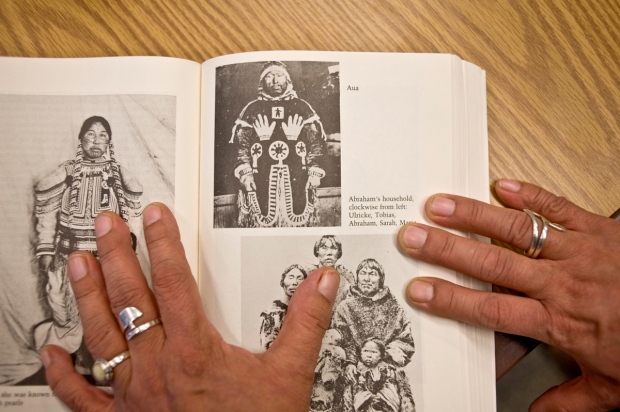
An illustration featured in the book Northern Voices: Inuit Writing in English depicts a traditional design similar to that used by a fashion designer in 2015. (Kieran Oudshoorn/CBC)
The main problem facing Indigenous groups looking to use intellectual-property law is that in order for something like a traditional parka design or carving style to be patented, it has to be unique or original, Wendland said.
But many Indigenous customs and designs have been passed down from generation to generation since time immemorial. They have been replicated hundreds if not thousands of times, often making them unable to be patented.
Wendland also says the current system generally requires some sort of hard copy of what the copyright or patent is supposed to protect. But many forms of Indigenous knowledge or stories are often passed down orally.
Exceptions exist, but model may be fundamentally flawed
Some Canadian Indigenous groups have had success using trademarks. The Cowichan Band Council in British Columbia registered the certification “Genuine Cowichan Approved”. It was created to help differentiate between the traditional Indigenous hand-knitted sweaters crafted by Coast Salish people and non-Indigenous designers selling counterfeits.
Dianne Hinkley shows off a genuine Cowichan Tribes sweater. ((CBC))
There is work being done to help create a broader system to protect Indigenous intellectual property. One hundred and eighty-nine states have joined a special committee within the World Intellectual Property Organization. The organization is working toward an international treaty that would expand intellectual-property laws to protect Indigenous culture. It will meet in Geneva next month to continue negotiations.
Whitehorse lawyer Claire Anderson says using the Canadian legal system is counterintuitive when protecting Indigenous culture.
“If we choose that forum, essentially we would be going to the colonial forum that has taken away Indigenous rights, and we would be asking the non-Indigenous judges to make determinations about Indigenous law,” Anderson said.
Indigenous law has its own remedies
Anderson said groups should look to their own form of Indigenous law to protect their history and knowledge.
“Listening to our First Nation elders or listening to people that understand Indigenous laws and seeking redress through those Indigenous legal forums is a very good starting point because it provides legitimacy to those Indigenous legal forums.”
Anderson says that in Tlingit culture, if someone exploits someone else’s design or steals property, they must apologize in front of the community at a public forum, like a potlatch. She says some sort of compensation is given — whether it’s monetary or the gifting of a song.
Thoughtful exploration of cultural appropriation issues with respect to Indigenous peoples.
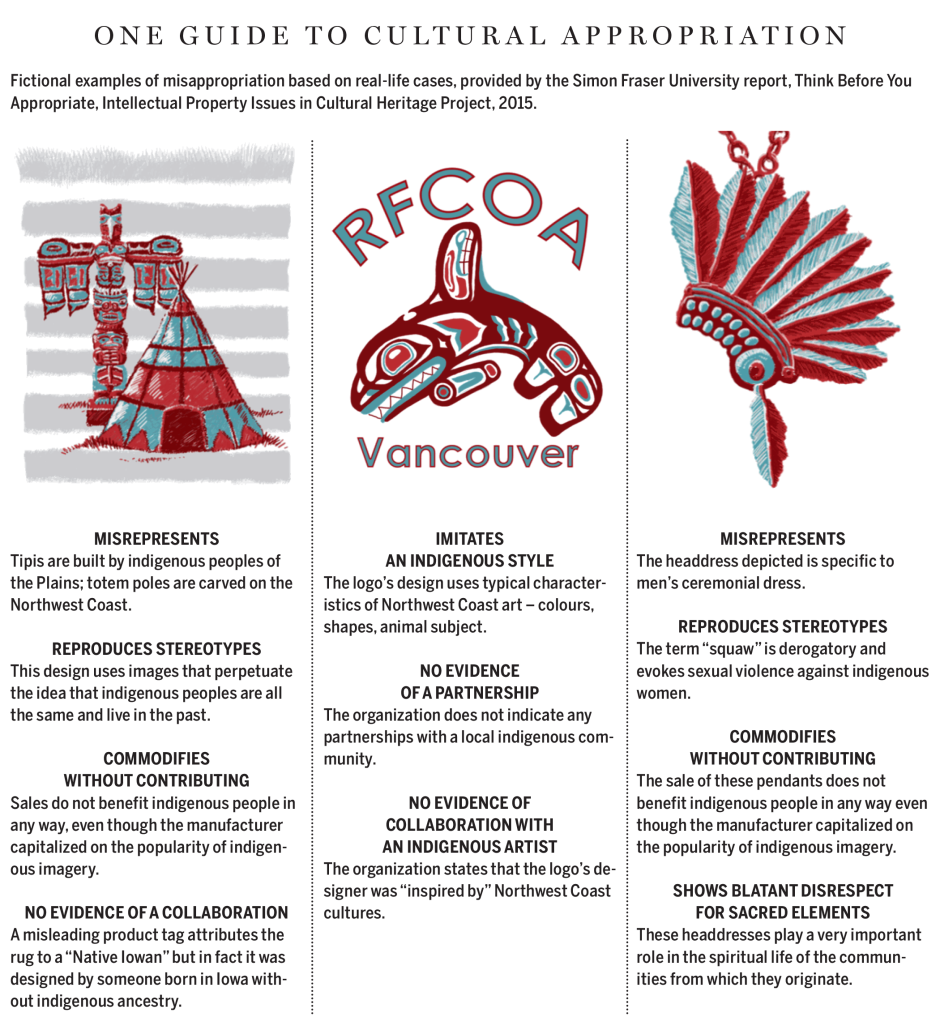
The graphic is particularly helpful in that it provides greater clarity to what can be considered cultural appropriation and what not, particularly the left and right columns. The middle column is where much of the current debate occurs:
George Nicholas, an archeology professor at Simon Fraser University and director of the Intellectual Property Issues in Cultural Heritage research project, argues that borrowing between cultures has shaped societies around the world, and there is nothing wrong with that.
HandoutOjibwa broadcaster Jesse Wente: “We’re asking now for change, and we’re not going to stop asking.”
But just as trademarks, patents and copyrights protect intellectual property, he said, there should be protection for elements of indigenous heritage. The historical power imbalance between mainstream society and indigenous peoples has meant that little thought was given to the impact of appropriation, whether it is mass-produced gift-shop totem poles or high-end fashion copied from an Inuit parka.
“If I am taking something that is important to someone’s heritage, whether it’s a particular design or a particular set of stories or songs, my using those, my sharing those, my including those in some sort of commercial product, can result in cultural, or spiritual, or economic harm to the people whose heritage it is,” he said.
Kulchyski’s idea of “loving Indians to death” reflects the fact that often appropriation stems from good intentions. But he said it turns heritage into a commodity.
“By simply saying, ‘Oh we love your culture. We’ll have you dance during our Olympic ceremony. We’ll have you say a prayer before our meetings, but we haven’t actually substantively changed the fact that the economy is based on extraction from your lands, and we’re going to continue doing that,’ basically it becomes, at best, a hollow gesture and, at worst … your culture becomes something for sale.”
Keeshig-Tobias has watched the resurgence of the cultural appropriation debate with interest. The abuse she took for her stand in 1990 still stings.
“I was vilified, by just about everybody … big names in the Canadian writing community,” she said in an interview. “The complaint was that I was shackling the imagination.”
Her response then and today: “Your imagination comes right up to my nose, and if it goes any further, then I push back.”
She said it is discouraging to hear the “same old arguments” resurfacing but heartening to see a new generation pushing back.
“Hopefully they’ll listen now. Like I said, we’re in a new era,” she said. “So many things have happened between then and now, and there are so many more wonderfully articulate indigenous people.”



 Multicultural Meanderings