Pew: The Changing Political Geography of COVID-19 Over the Last Two Years

Interesting trends regarding how COVID has progressed in different counties with the general correlation between higher COVID rates and support for Trump:

Over the past two years, the official count of coronavirus deaths in the United States has risen and is now approaching 1 million lives. Large majorities of Americans say they personally know someone who has been hospitalized or died of the coronavirus, and it has impacted – in varying degrees – nearly every aspect of life.

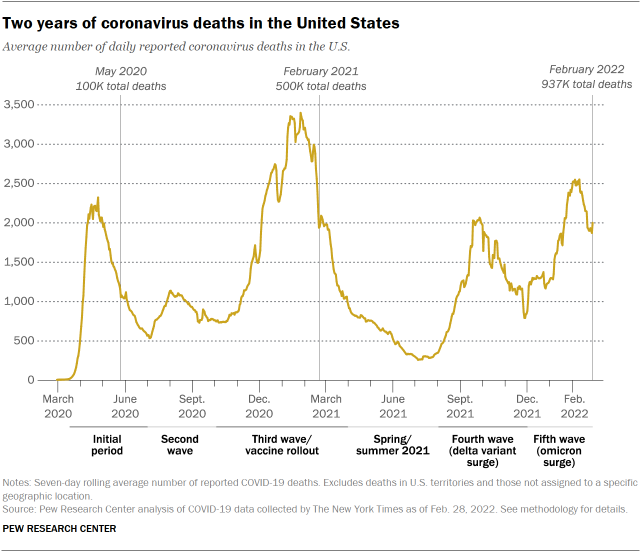
Chart shows two years of coronavirus deaths in the United States

A new Pew Research Center analysis of official reports of COVID-19-related deaths across the country, based on mortality data collected by The New York Times, shows how the dynamics of the pandemic have shifted over the past two years.

A timeline of the shifting geography of the pandemic

The pandemic has rolled across the U.S. unevenly and in waves. Today, the death toll of the pandemic looks very different from how it looked in the early part of 2020. The first wave (roughly the first 125,000 deaths from March 2020 through June 2020) was largely geographically concentrated in the Northeast and in particular the New York City region. During the summer of 2020, the largest share of the roughly 80,000 deaths that occurred during the pandemic’s second wave were in the southern parts of the country.

The fall and winter months of 2020 and early 2021 were the deadliest of the pandemic to date. More than 370,000 Americans died of COVID-19 between October 2020 and April 2021; the geographic distinctions that characterized the earlier waves became much less pronounced.

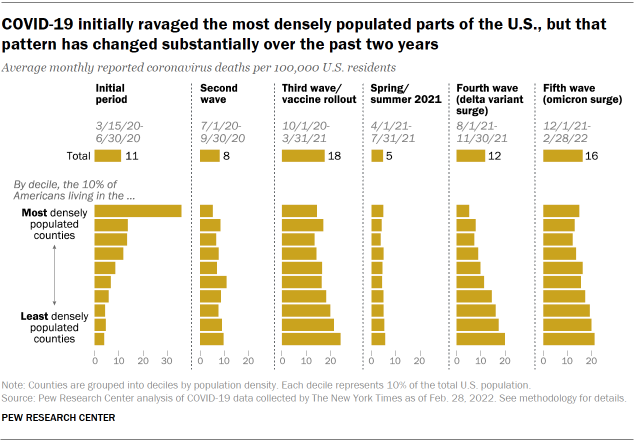
Chart shows COVID-19 initially ravaged the most densely populated parts of the U.S., but that pattern has changed substantially over the past two years

By the spring and summer of 2021, the nationwide death rate had slowed significantly, and vaccines were widely available to all adults who wanted them. But starting at the end of the summer, the fourth and fifth waves (marked by new variants of the virus, delta and then omicron) came in quick succession and claimed more than 300,000 lives.

In many cases, the characteristics of communities that were associated with higher death rates at the beginning of the pandemic are now associated with lower death rates (and vice versa). Early in the pandemic, urban areas were disproportionately impacted. During the first wave, the coronavirus death rate in the 10% of the country that lives in the most densely populated counties was more than nine times that of the death rate among the 10% of the population living in the least densely populated counties. In each subsequent wave, however, the nation’s least dense counties have registered higher death rates than the most densely populated places.

Despite the staggering death toll in densely populated urban areas during the first months of the pandemic (an average 36 monthly deaths per 100,000 residents), the overall death rate over the course of the pandemic is slightly higher in the least populated parts of the country (an average monthly 15 deaths per 100,000 among the 10% living in the least densely populated counties vs. 13 per 100,000 among the 10% in the most densely populated counties).

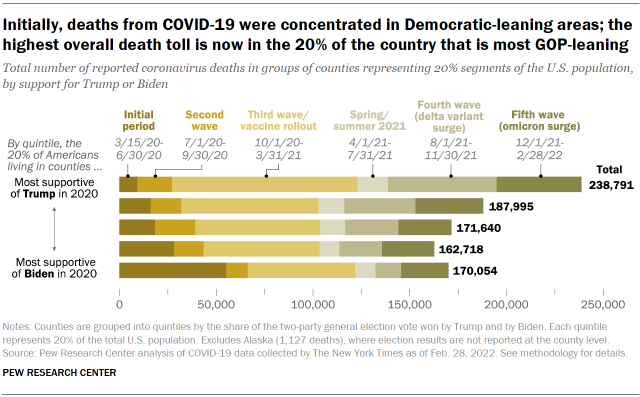
Chart shows initially, deaths from COVID-19 were concentrated in Democratic-leaning areas; the highest overall death toll is now in the 20% of the country that is most GOP-leaning

As the relationship between population density and coronavirus death rates has changed over the course of the pandemic, so too has the relationship between counties’ voting patterns and their death rates from COVID-19.

In the spring of 2020, the areas recording the greatest numbers of deaths were much more likely to vote Democratic than Republican. But by the third wave of the pandemic, which began in fall 2020, the pattern had reversed: Counties that voted for Donald Trump over Joe Biden were suffering substantially more deaths from the coronavirus pandemic than those that voted for Biden over Trump. This reversal is likely a result of several factors including differences in mitigation efforts and vaccine uptake, demographic differences, and other differences that are correlated with partisanship at the county level.

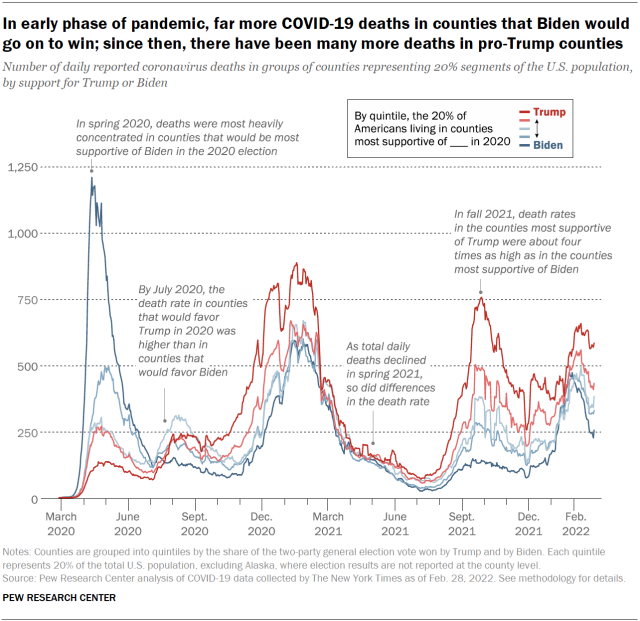
Chart shows in early phase of pandemic, far more COVID-19 deaths in counties that Biden would go on to win; since then, there have been many more deaths in pro-Trump counties

During this third wave – which continued into early 2021 – the coronavirus death rate among the 20% of Americans living in counties that supported Trump by the highest margins in 2020 was about 170% of the death rate among the one-in-five Americans living in counties that supported Biden by the largest margins.

As vaccines became more widely available, this discrepancy between “blue” and “red” counties became even larger as the virulent delta strain of the pandemic spread across the country during the summer and fall of 2021, even as the totalnumber of deaths fell somewhat from its third wave peak.

During the fourth wave of the pandemic, death rates in the most pro-Trump counties were about four times what they were in the most pro-Biden counties. When the highly transmissible omicron variant began to spread in the U.S. in late 2021, these differences narrowed substantially. However, death rates in the most pro-Trump counties were still about 180% of what they were in the most pro-Biden counties throughout late 2021 and early 2022.

The cumulative impact of these divergent death rates is a wide difference in total deaths from COVID-19 between the most pro-Trump and most pro-Biden parts of the country. Since the pandemic began, counties representing the 20% of the population where Trump ran up his highest margins in 2020 have experienced nearly 70,000 more deaths from COVID-19 than have the counties representing the 20% of population where Biden performed best. Overall, the COVID-19 death rate in all counties Trump won in 2020 is substantially higher than it is in counties Biden won (as of the end of February 2022, 326 per 100,000 in Trump counties and 258 per 100,000 in Biden counties).

Partisan divide in COVID-19 deaths widened as more vaccines became available

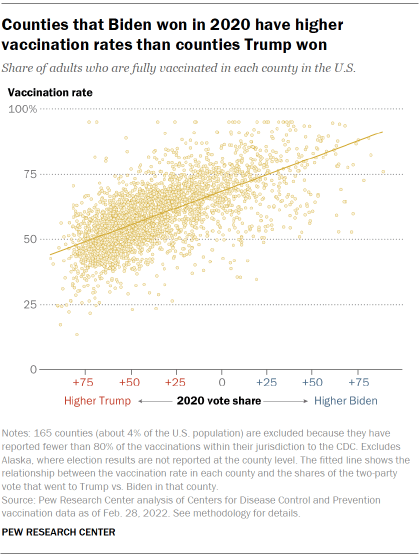
Partisan differences in COVID-19 death rates expanded dramatically after the availability of vaccines increased. Unvaccinated people are at far higher risk of death and hospitalization from COVID-19, according to the Centers for Disease Control and Prevention, and vaccination decisions are strongly associated with partisanship. Among the large majority of counties for which reliable vaccination data exists, counties that supported Trump at higher margins have substantially lower vaccination rates than those that supported Biden at higher margins.

Counties with lower rates of vaccination registered substantially greater death rates during each wave in which vaccines were widely available.

Chart shows counties that Biden won in 2020 have higher vaccination rates than counties Trump won

During the fall of 2021 (roughly corresponding to the delta wave), about 10% of Americans lived in counties with adult vaccination rates lower than 40% as of July 2021. Death rates in these low-vaccination counties were about six times as high as death rates in counties where 70% or more of the adult population was vaccinated.

More Americans were vaccinated heading into the winter of 2021 and 2022 (roughly corresponding to the omicron wave), but nearly 10% of the country lived in areas where less than half of the adult population was vaccinated as of November 2021. Death rates in these low-vaccination counties were roughly twice what they were in counties that had 80% or more of their population vaccinated. (Note: The statistics here reflect the death rates in the county as a whole, not rates for vaccinated and unvaccinated individuals, though individual-level data finds that death rates among unvaccinated people are far higher than among vaccinated people.)

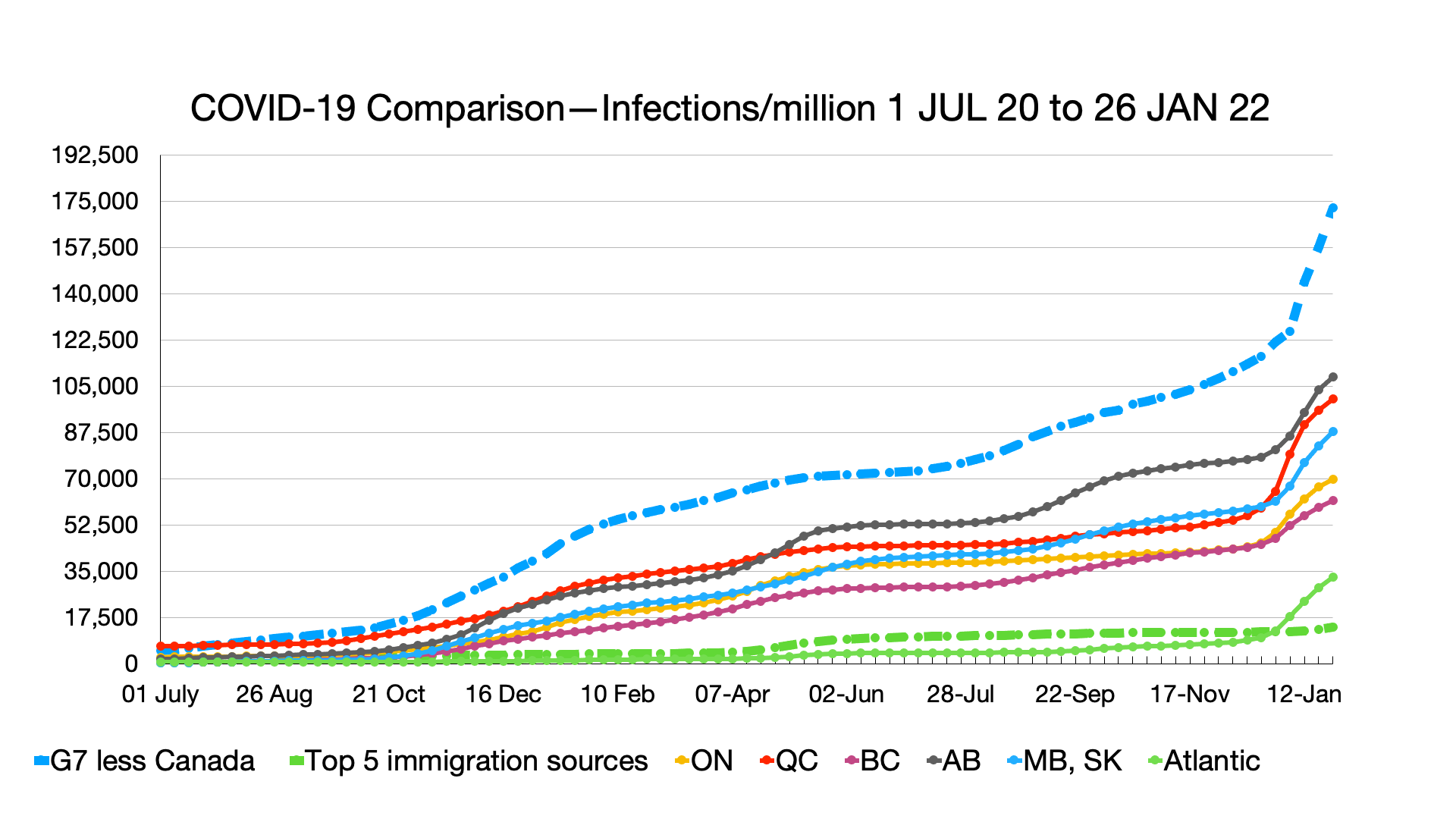
Source: The Changing Political Geography of COVID-19 Over the Last Two Years

China seeing new surge in cases despite ‘zero tolerance’

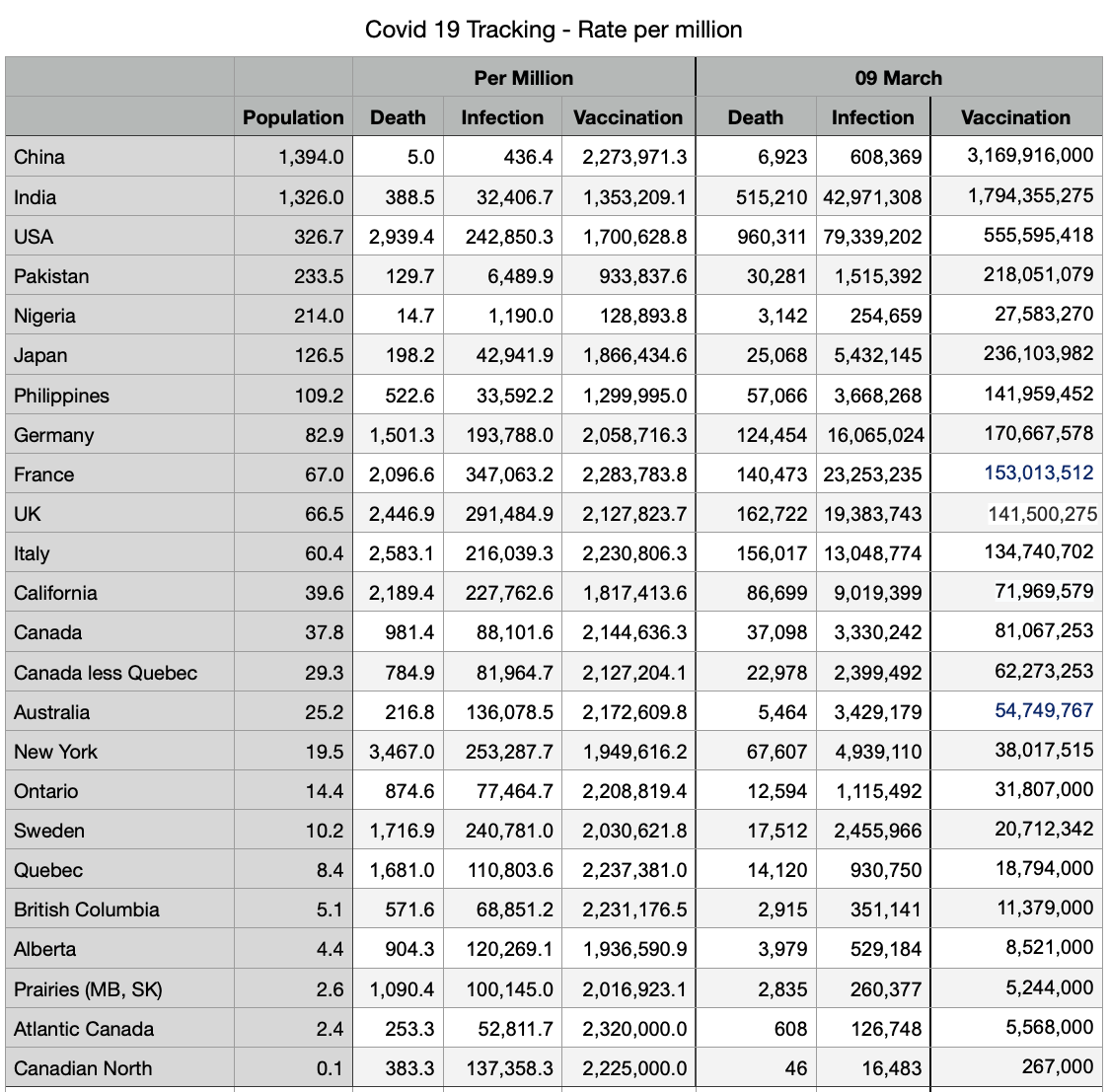
Of note (assuming numbers are reported correctly). According to John Hopkins, actual numbers are close to 600,000 infections and 7,000 deaths:

China is seeing a new surge in COVID-19 cases across the vast country, despite its draconian “zero tolerance” approach to dealing with outbreaks. 
The mainland on Monday reported 214 new cases of infection over the previous 24 hours, with the most, 69, in the southern province of Guangdong bordering on Hong Kong, which has been recording tens of thousands of cases per day
Another 54 cases were reported in the Jilin province, more than 2,000 kilometers (1,200 miles) to the north, and 46 in the eastern province Shandong. 
In his annual report to the national legislature Saturday, Premier Li Keqiang said China needs to “constantly refine epidemic containment” but gave no indication Beijing might ease the highly touted “zero tolerance” strategy.

Li called for accelerating vaccine development and “strengthening epidemic controls” in cities where travelers and goods arrive from abroad. 

“Zero tolerance” requires quarantines and lockdowns on entire communities and sometimes even cities when as few as a handful of cases have been detected. Chinese officials credit the approach — along with a vaccination rate of more than 80% — with helping prevent a major nationwide outbreak, but critics say it is taking a major toll on the economy and preventing the population from building up natural immunity. 
No new cases were reported in Beijing and the city was largely back to normal, although masks continue to be worn in public places indoors. 
One area that continues to feel the effects of tight COVID-19 control is the religious sector. Three of Beijing’s most famous Catholic churches, Buddhist temples and mosques stated Sunday they had been ordered closed in January with no date given on reopening. 

Even before the pandemic, such institutions were under heavy pressure from the Communist authorities to follow through on demands from leader Xi Jinping that all religious centers be purged of outside influence, including the physical appearance of places of worship. 

The latest daily case numbers mark some of the highest since the initial outbreak in the central city of Wuhan in late 2019 that is believed to have sparked the pandemic. 

They bring China’s total to 111,195 with 4,636 deaths, according to the National Health Commission. At present, 3,837 people are receiving treatment for COVID-19, many of them infected with the omicron strain. 

Source: China seeing new surge in cases despite ‘zero tolerance’

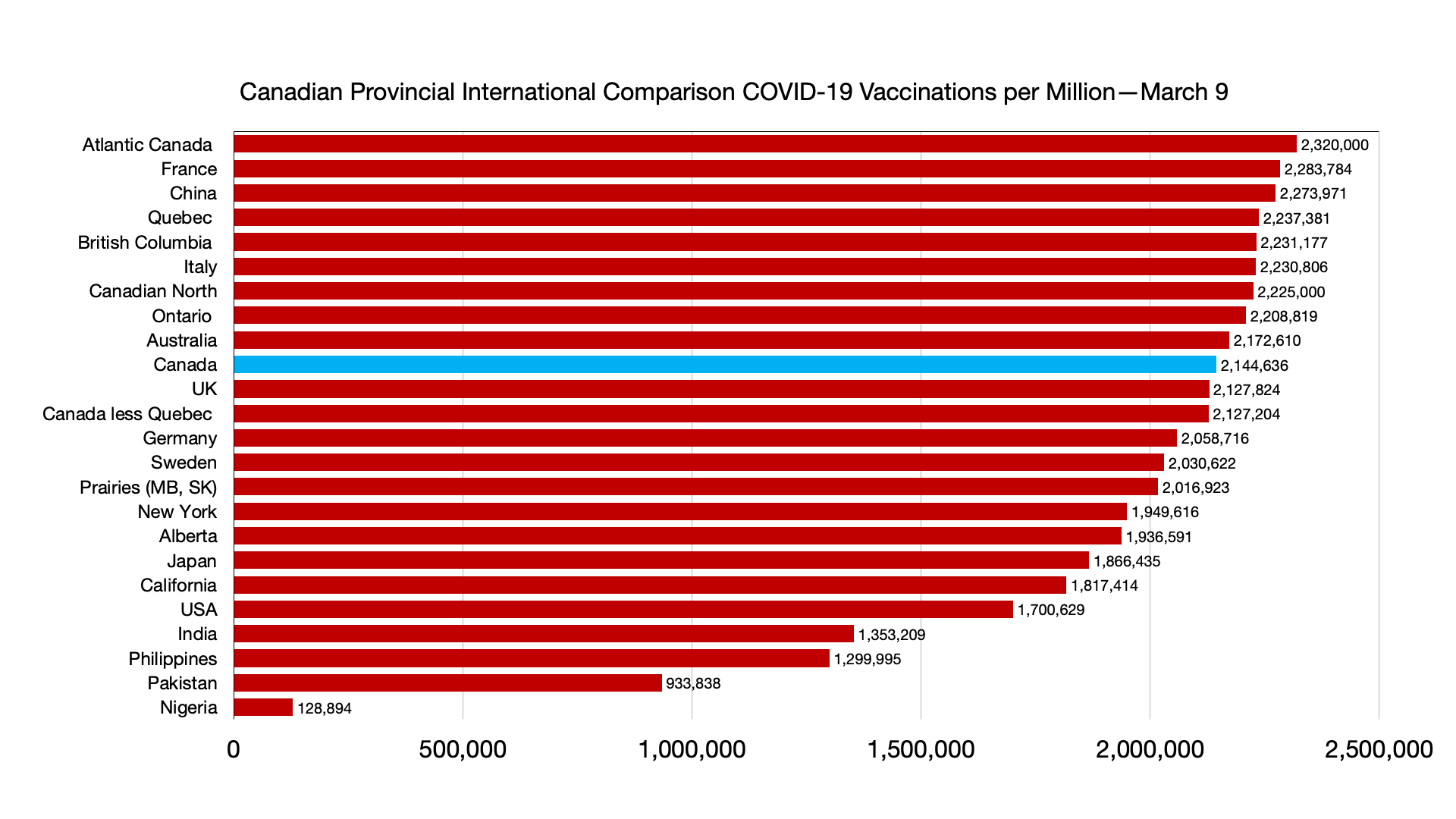
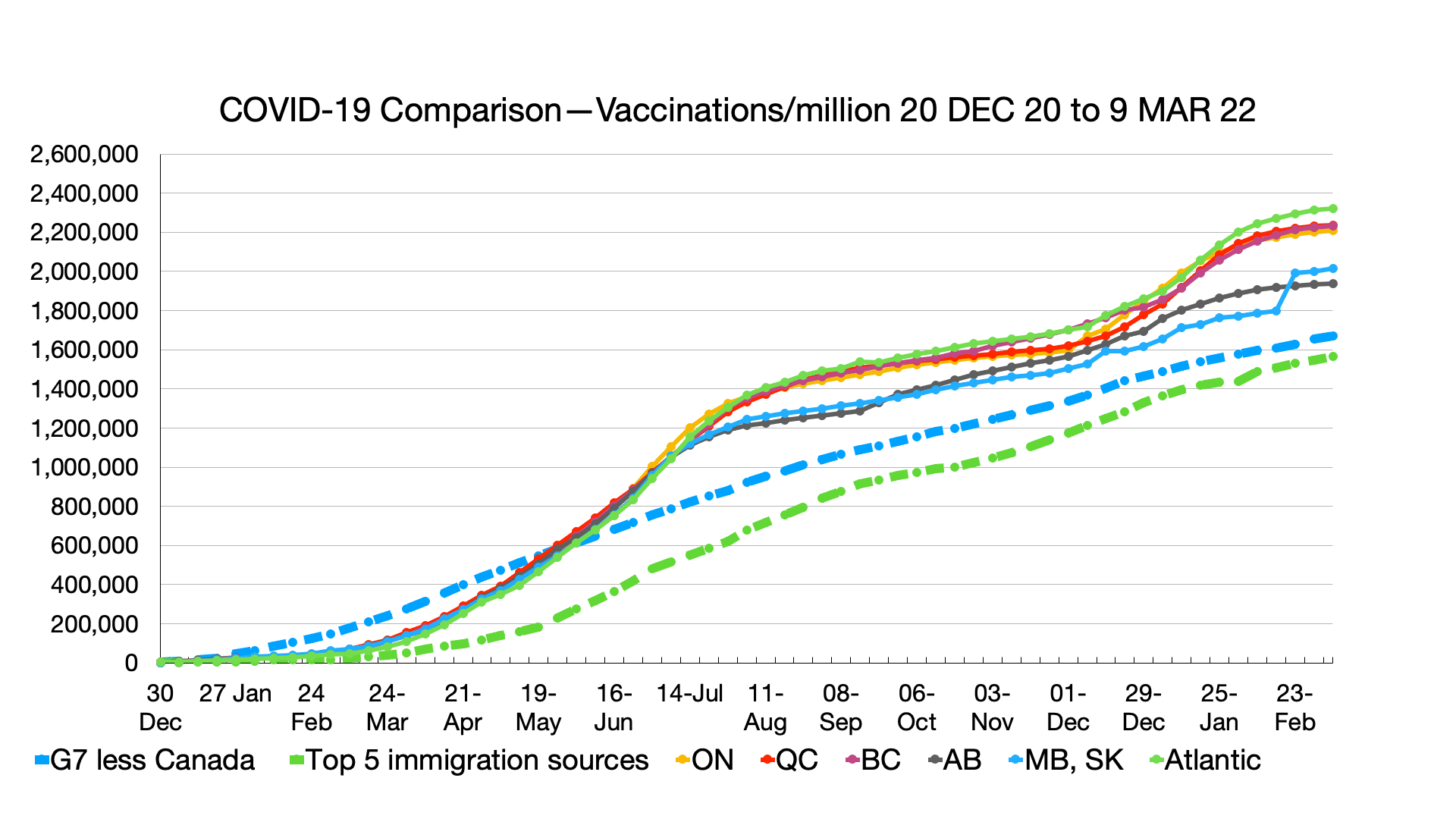
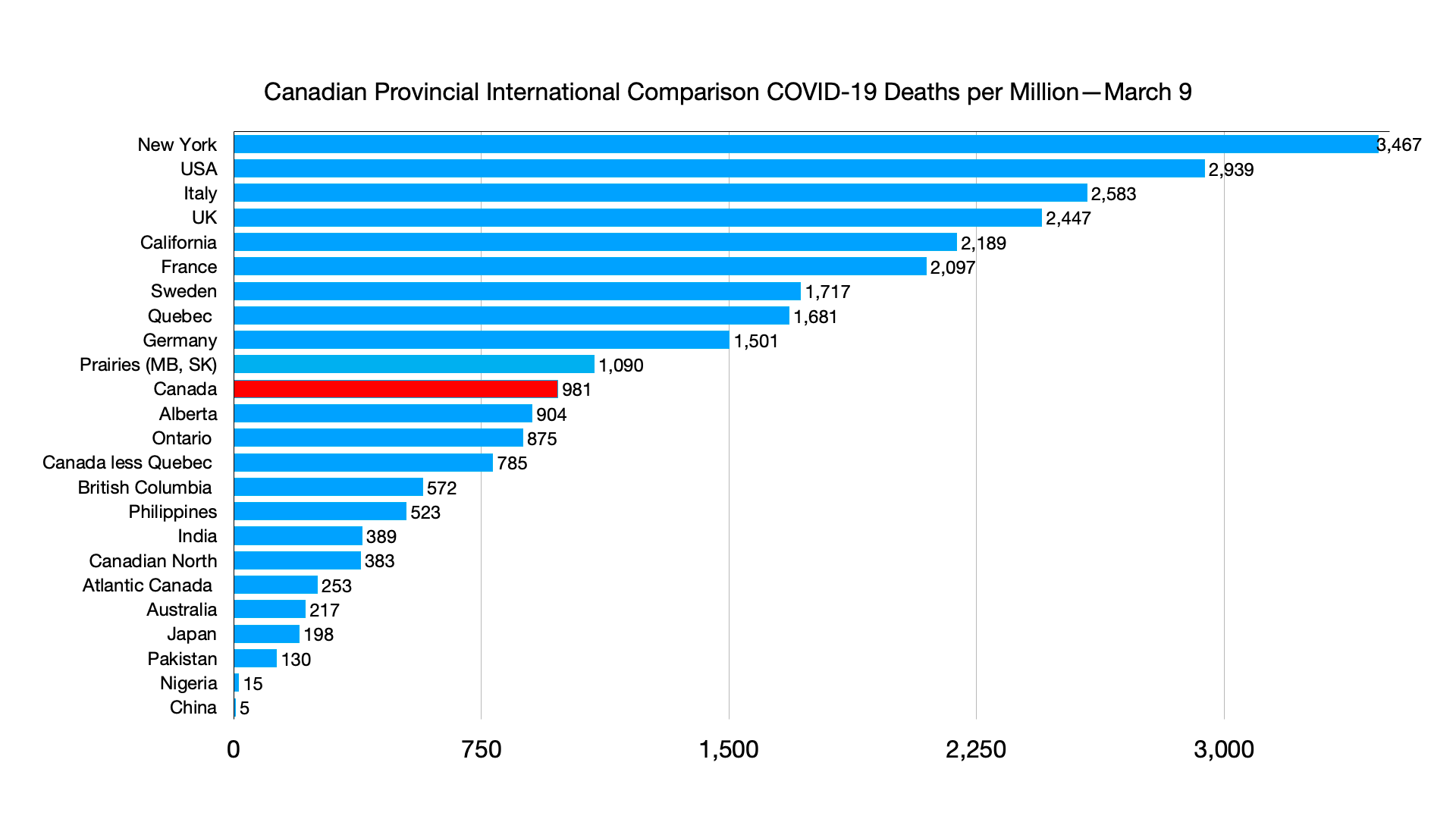
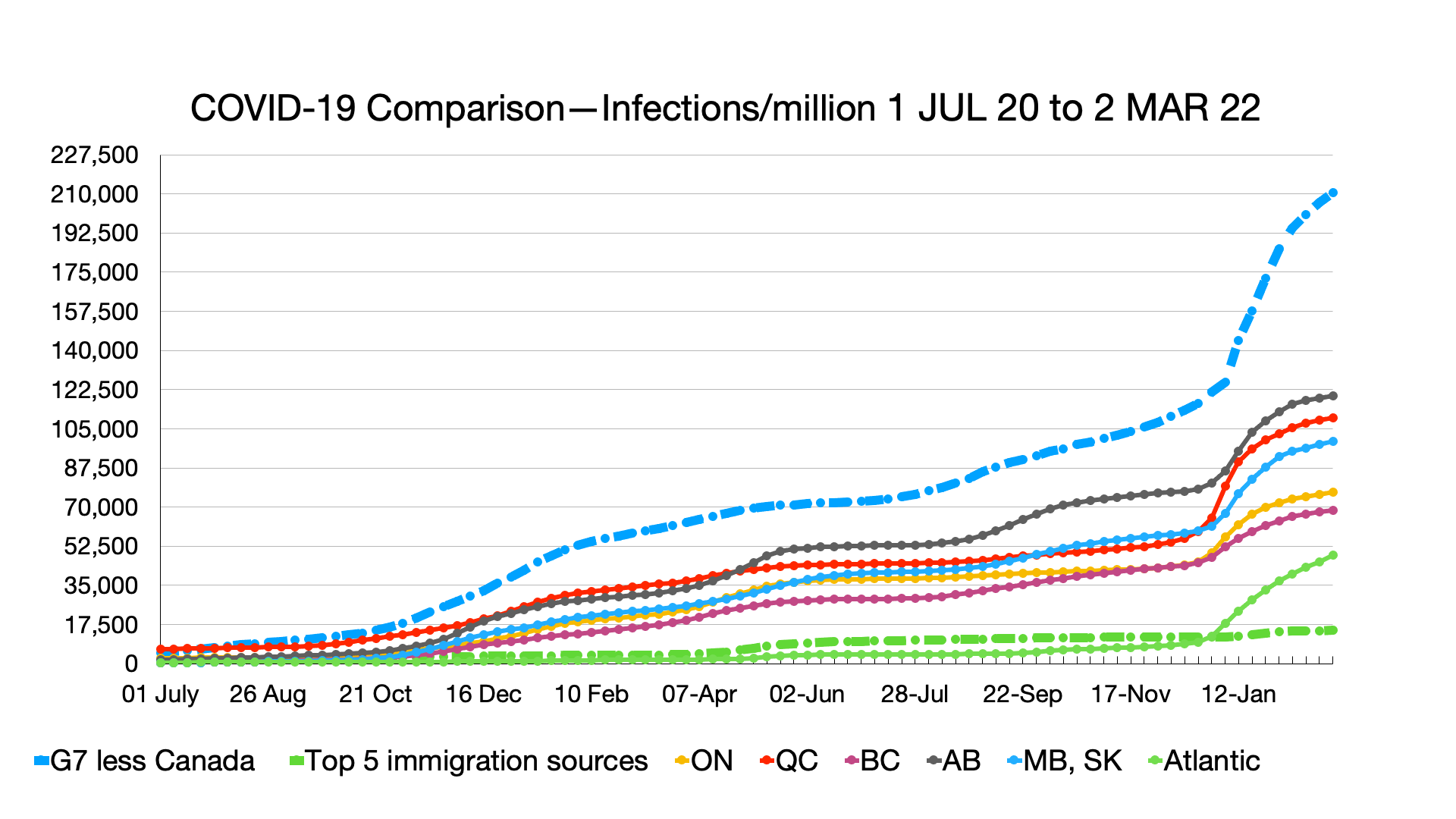
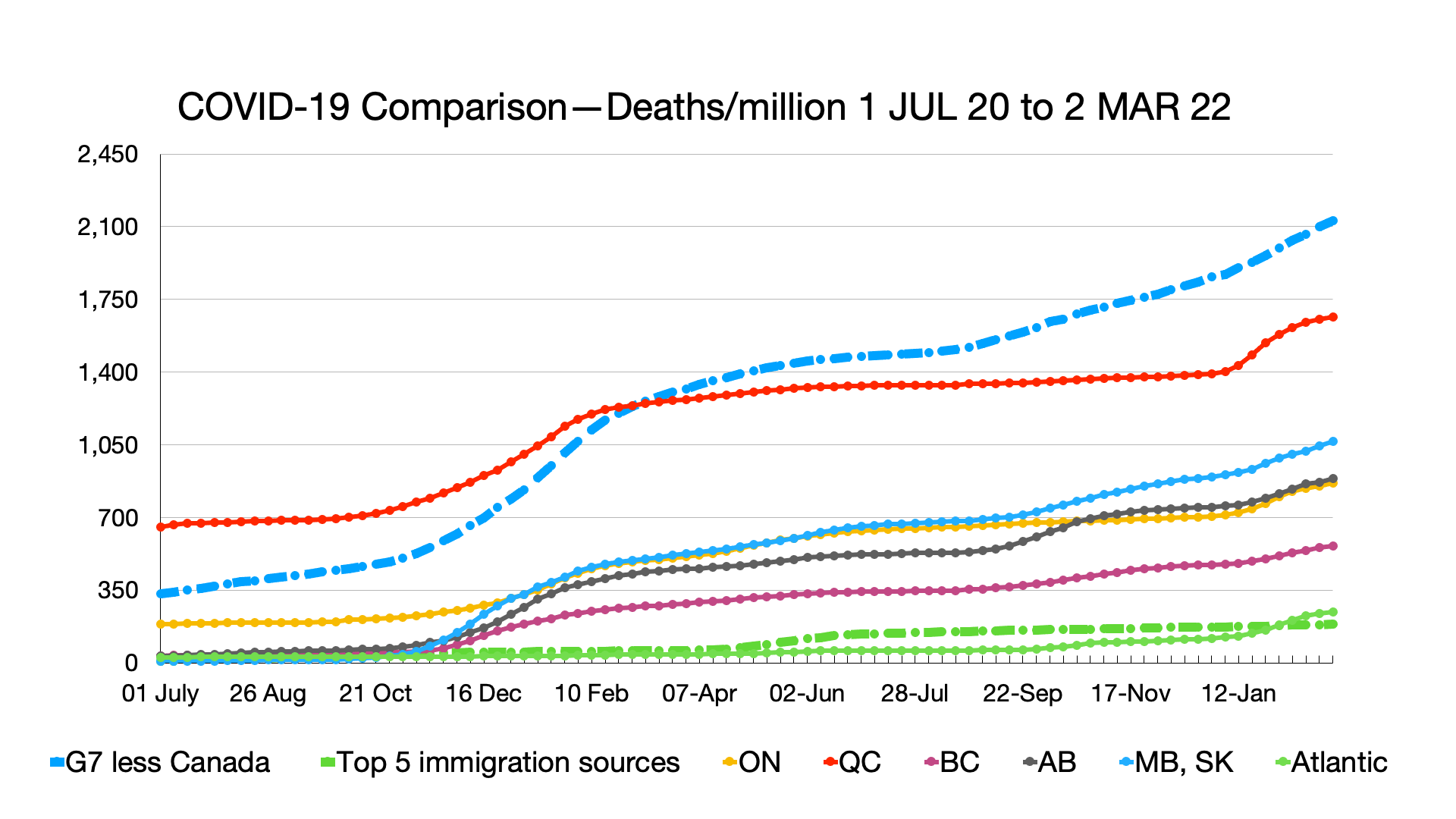
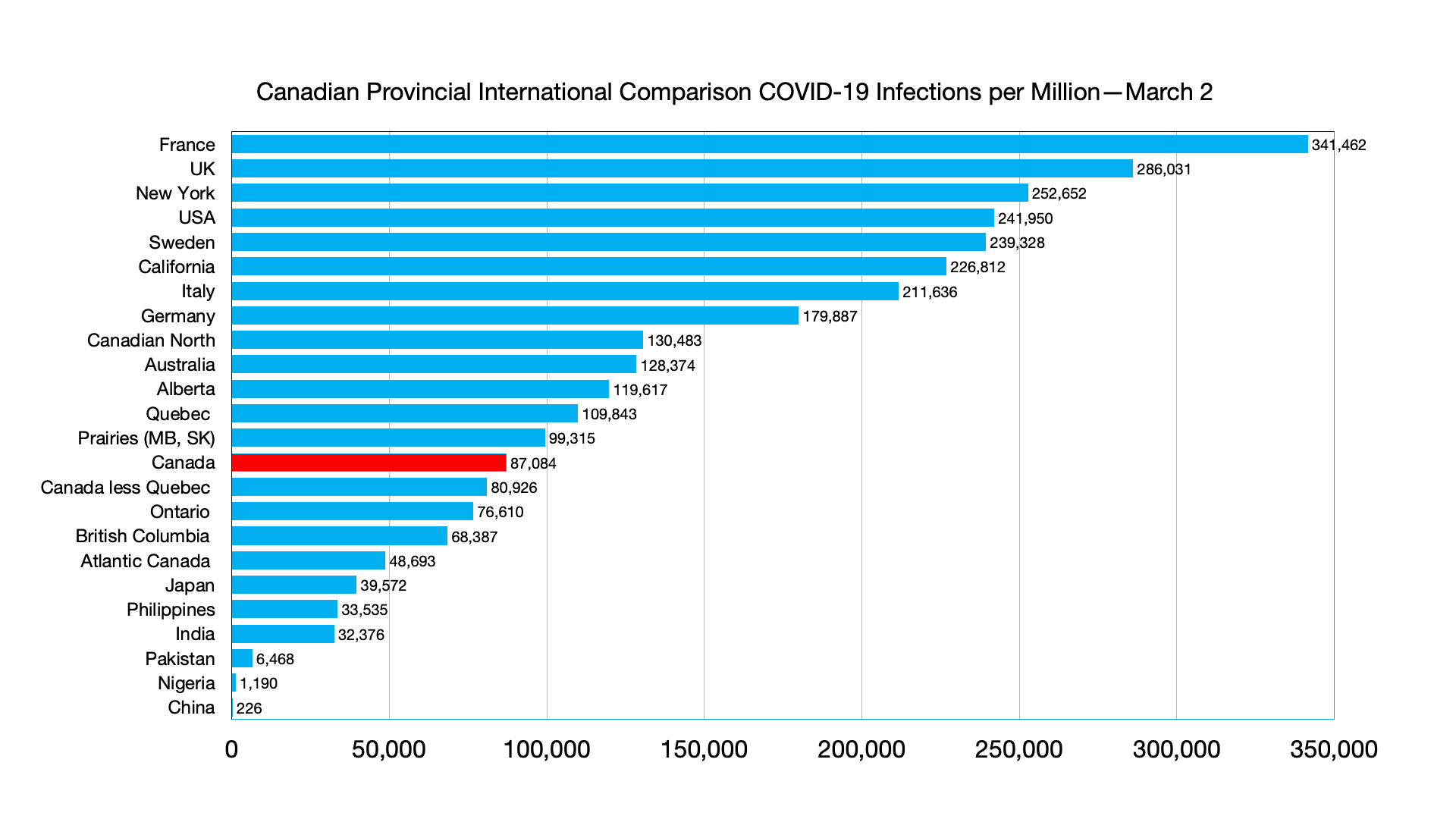
#COVID-19: Comparing provinces with other countries 2 March Update; Japan impact and policy changes

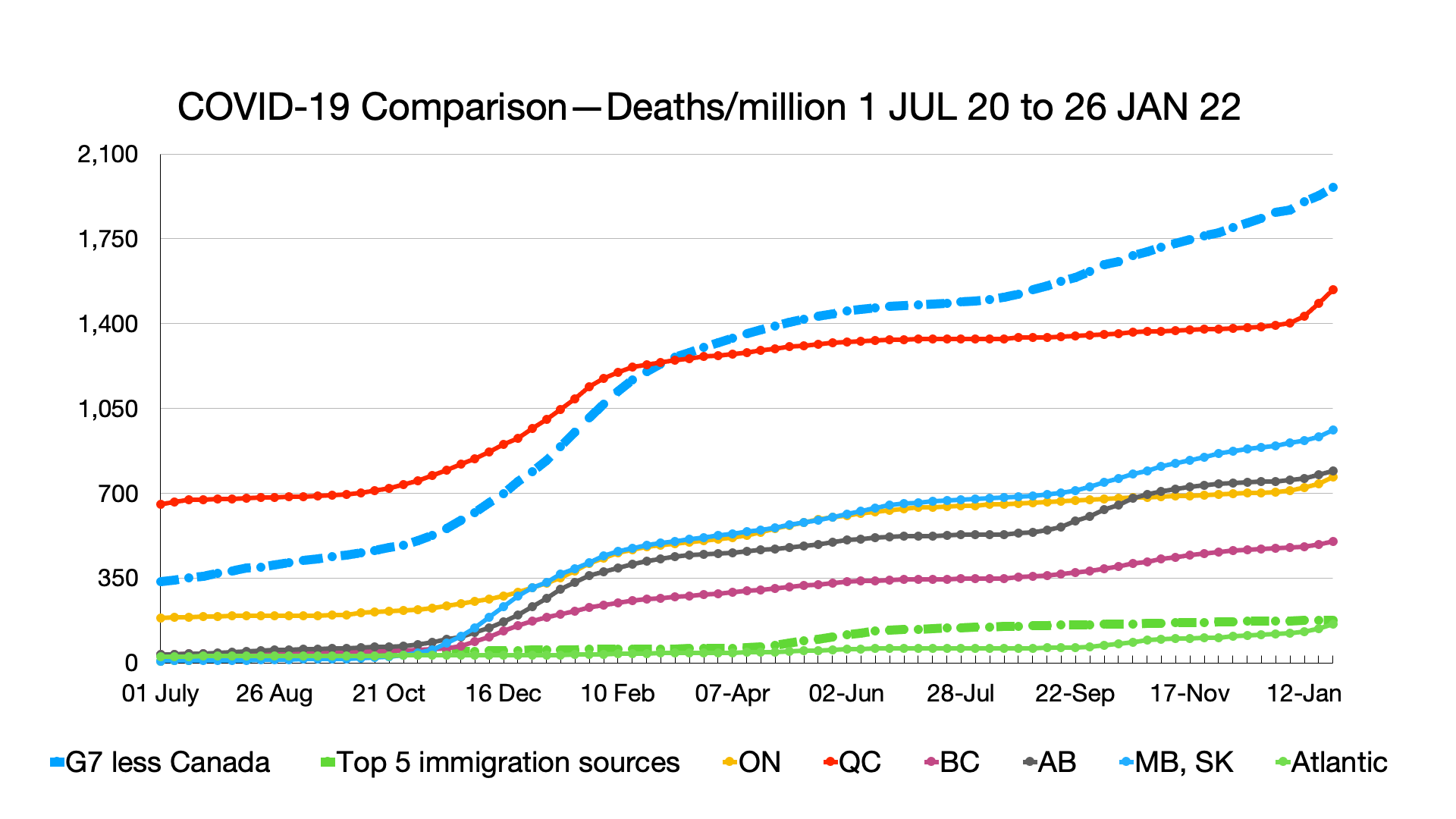
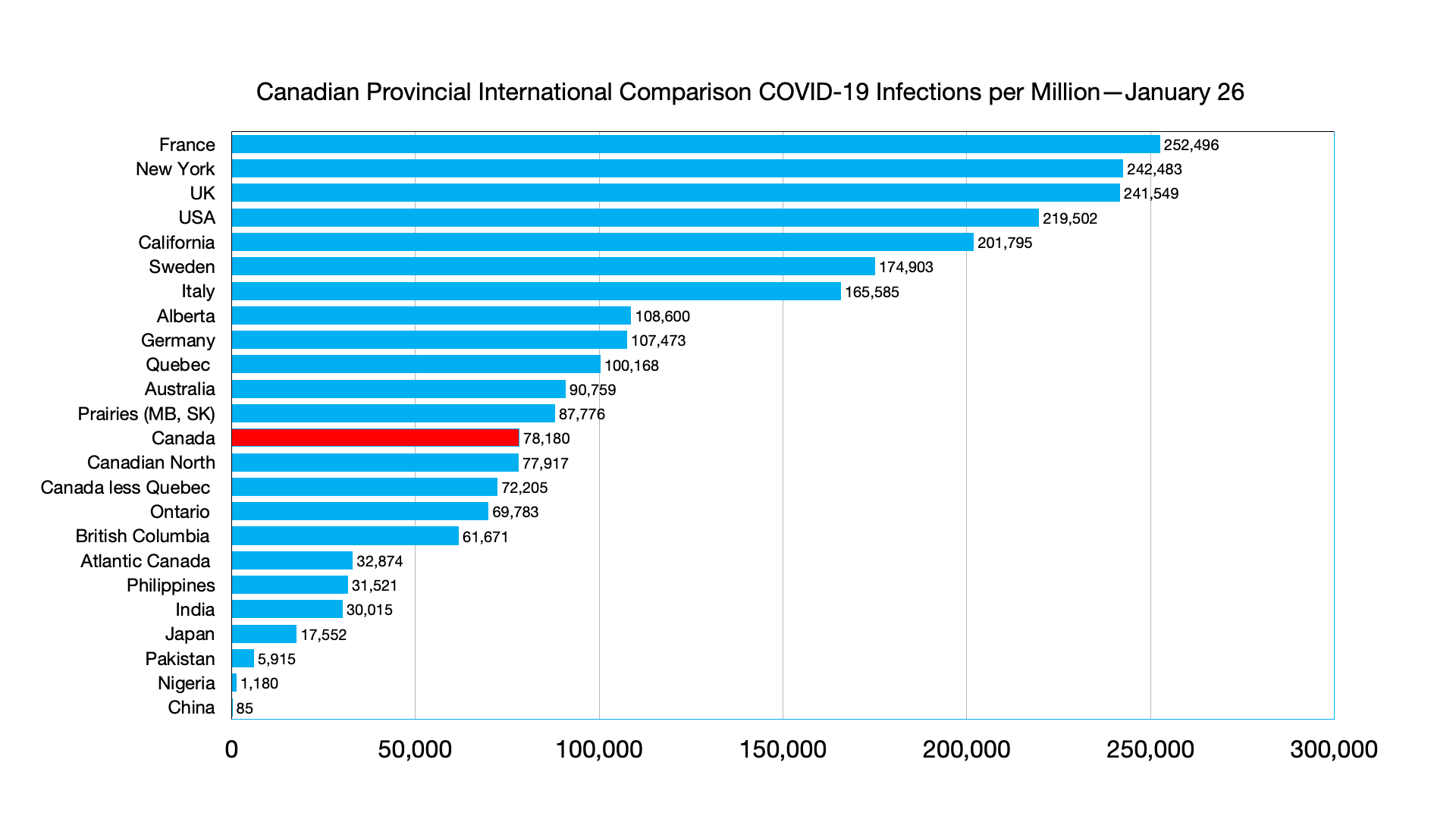
Overall decline in infections and deaths as omicron wave passes. The big news is that numbers from China have shown a significant increase in the past week, from 134,000 to 315,000 infections and from 4,936 to 5,380 deaths, perhaps reflecting suppression of numbers pre-and post-Olympics.

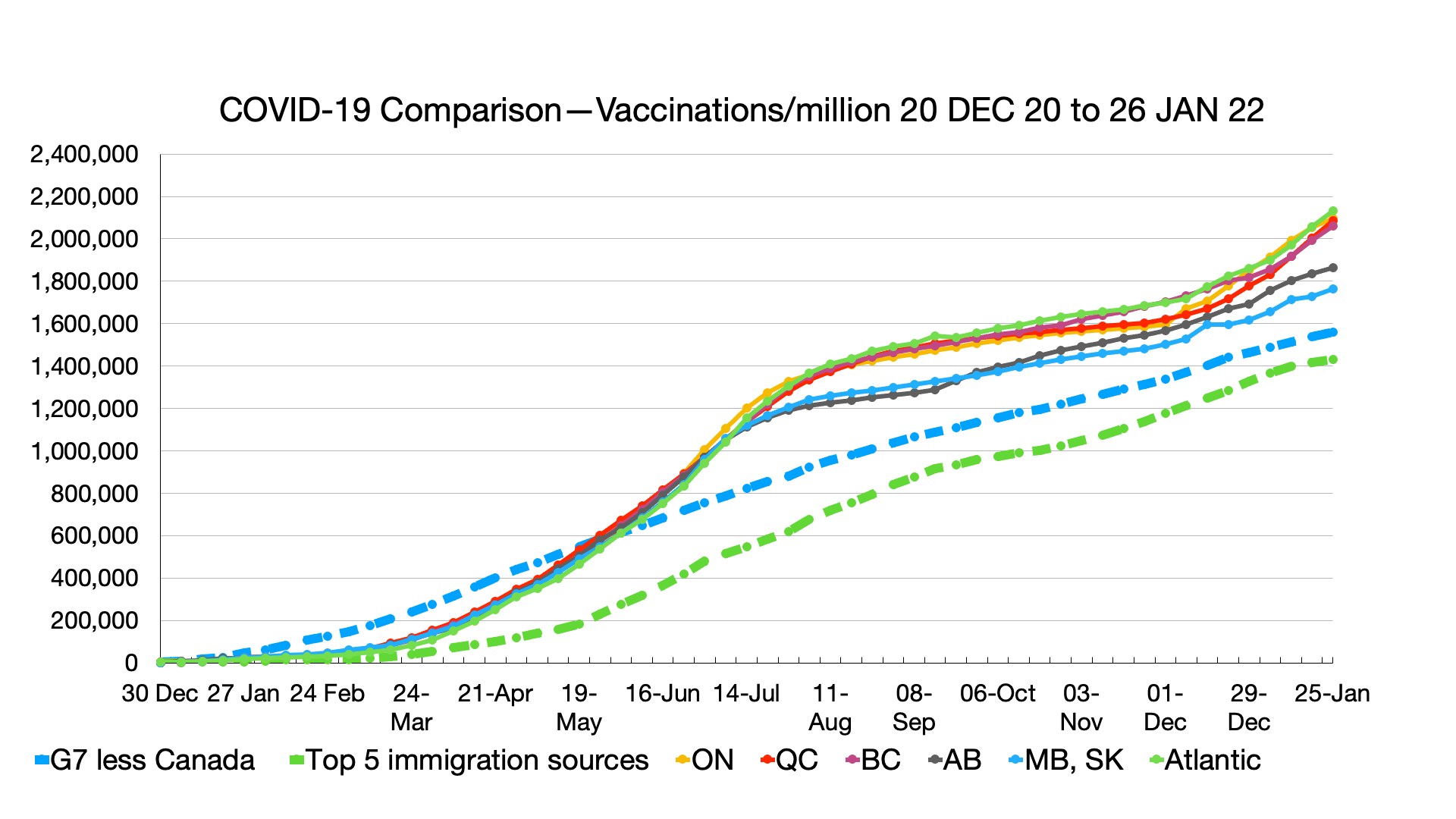
Vaccinations: Some minor shifts but convergence among provinces and countries. Canadians fully vaccinated 82.2 percent, compared to Japan 79.4 percent, UK 73.3 percent and USA 65.7 percent.

Immigration source countries are also converging: China fully vaccinated 88.3 percent (numbers have not budged over past four weeks), India 57.9 percent, Nigeria 4 percent, Pakistan 45.7 percent, Philippines 58.4 percent.

Trendline Charts:

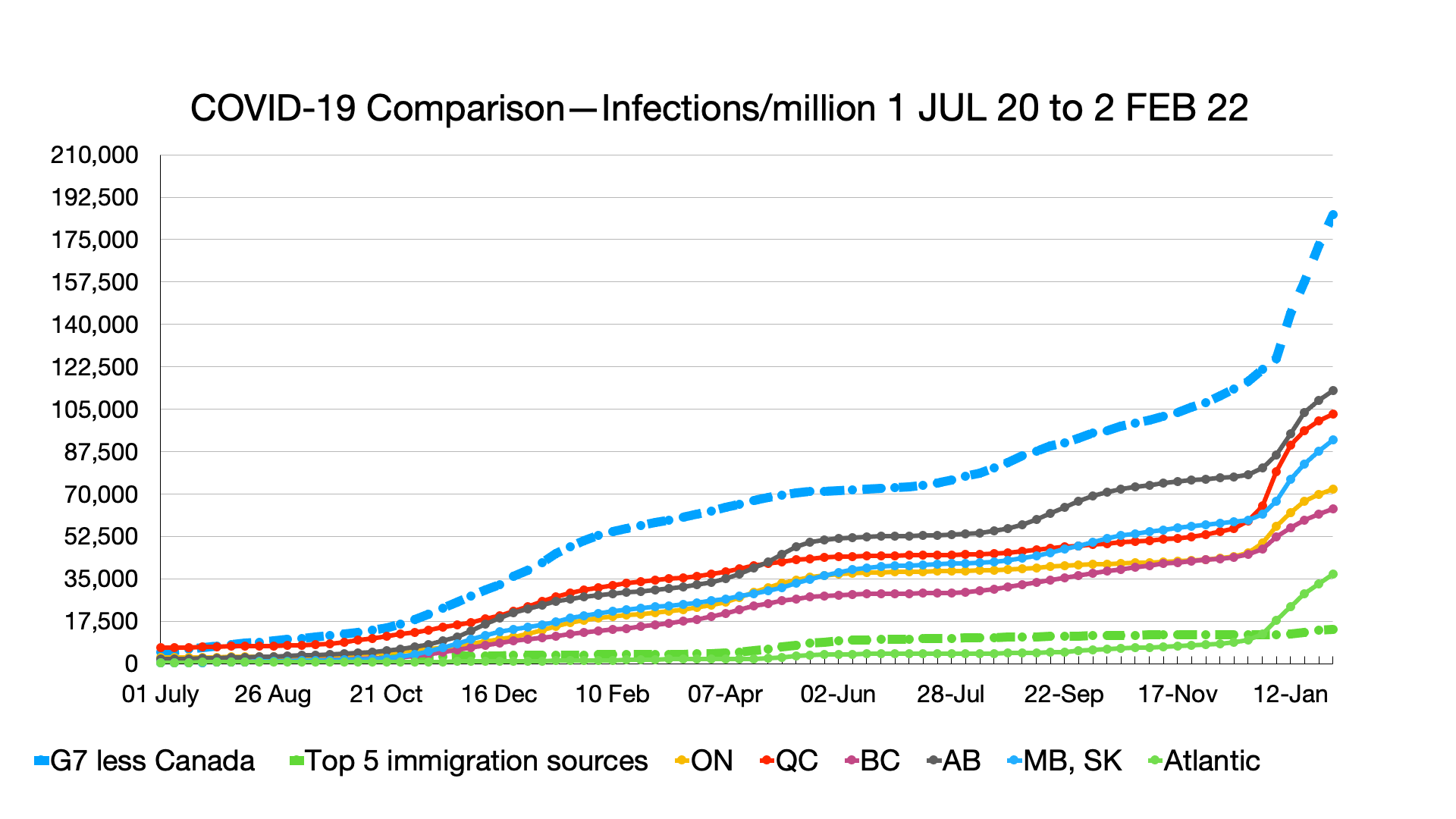
Infections: Ongoing signs of omicron and other variants plateauing.

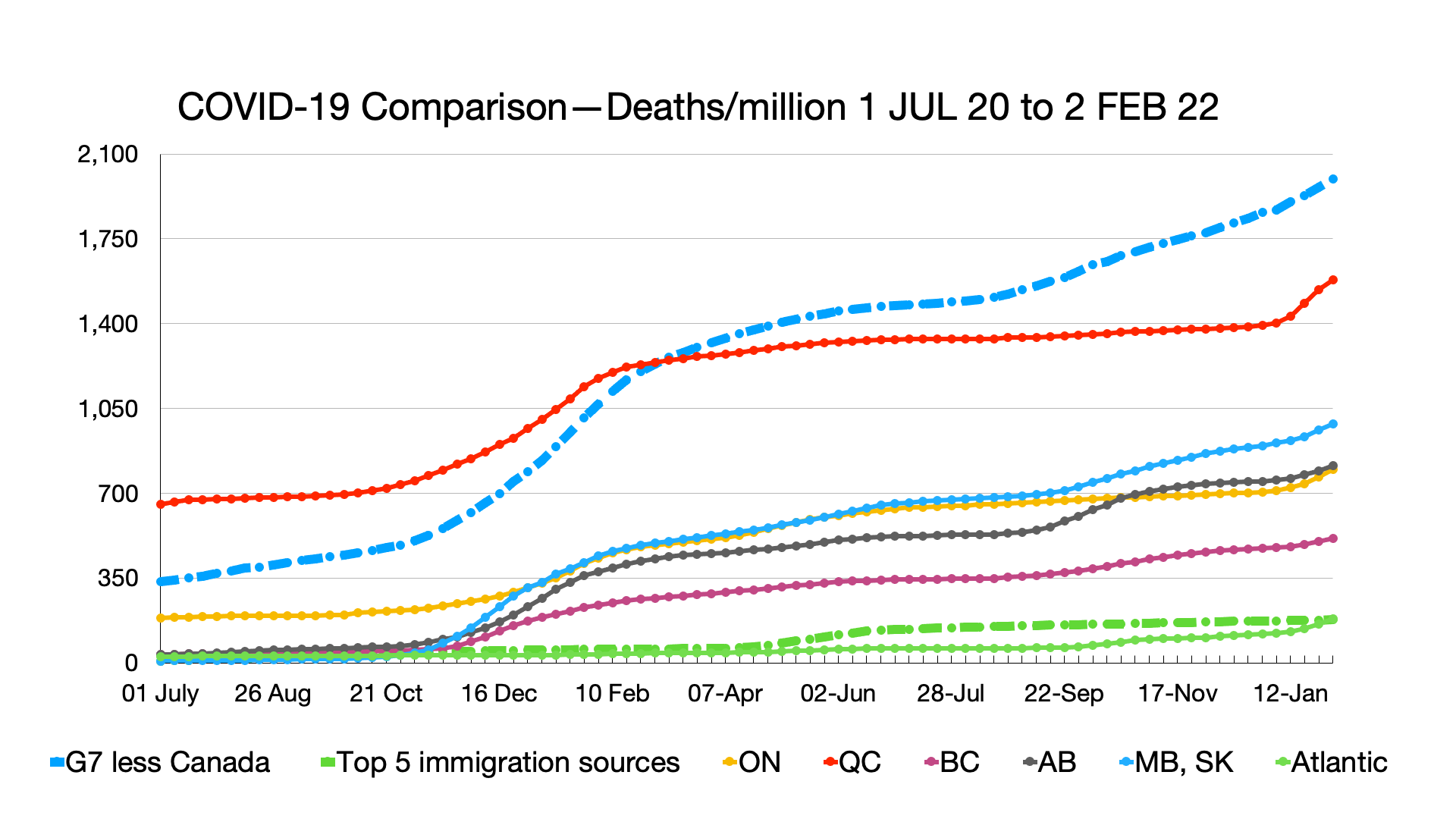
Deaths: Quebec continues to plateau with moderate increases in other provinces but G7 still not plateauing.

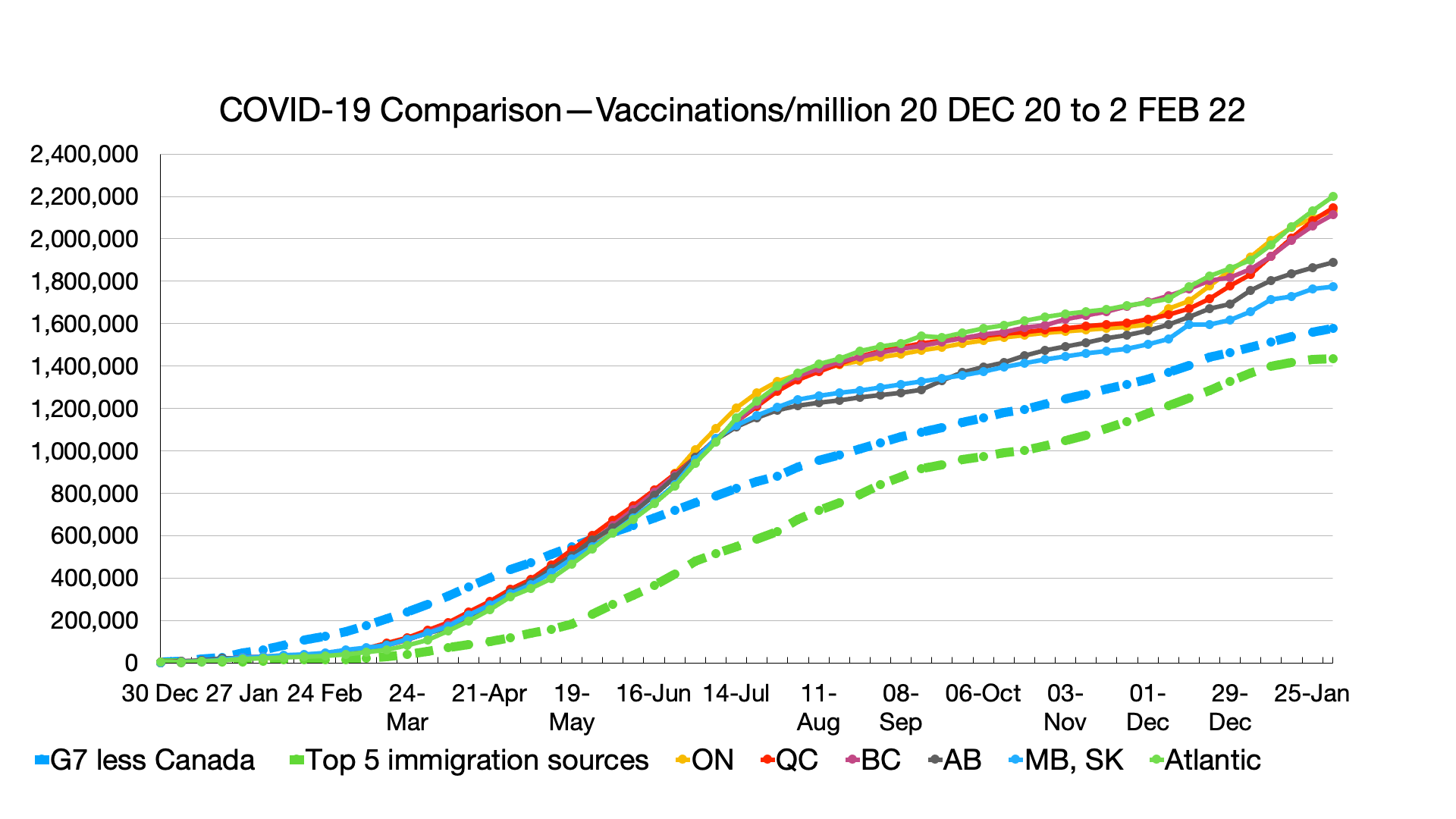
Vaccinations: No major relative changes.

Weekly

Infections: No relative changes. Infections per million in China have increased from 96 to 226 per million after relatively flat for over six months

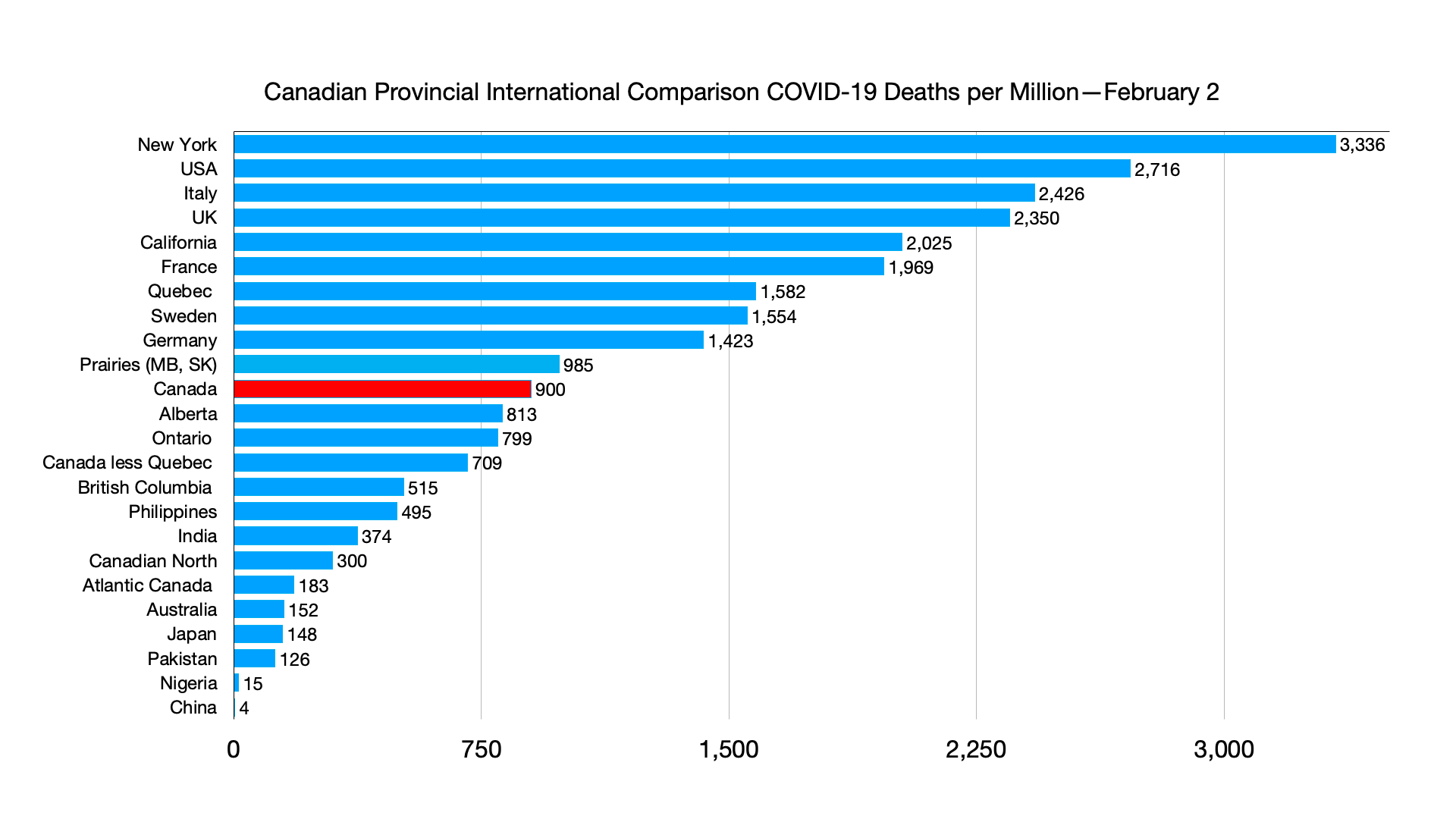
Deaths: Major change again is with respect to China with deaths per million increasing from 3.5 to 3.9. Sweden is now ahead of Quebec.

COVID-19: New Immigration Rules Crack Open Japan’s Closed Door

In early December 2021, when the highly contagious Omicron variant started spreading globally, Japan slammed its border shut. In fact, except for the first months of the pandemic, it adopted a harsher border policy than during previous infection waves.

The country would essentially remain closed to all non-Japanese citizens other than existing residents.

Among the many stranded travelers were an estimated 150,000 international students who had enrolled in Japanese universities, but never made it into Japan after the borders closed in March 2020. Also affected were business people, foreign specialists and technical interns, the term used for foreign nationals who work on farms, in fishing, food processing, hotels, nursing homes or other industries faced with a serious labor shortage.

Japan’s isolationist approach was in tune with only a few other countries, such as China and Hong Kong. Australia and New Zealand  ーwhich previously had some of the strictest border rules, stopping even their own citizens from returning homeー have recently reversed their two year long isolation.

The Japanese government has been a lot more cautious. In the wake of criticism by industry leaders and academics it has now relaxed some of the entry rules. However, its general policy to ban most new entries has not changed. Tourists still remain shut out.

Nevertheless, there is some welcome positive news going into effect from March 2022.

Raised Cap on Daily Entries

In a first sign of hope, the current limit on arrivals at the Japanese border, capped to 3,500 (roughly the passenger load of 17 airplanes), has been raised to 5,000 from March 1.

Vaccination Status Matters

One of the biggest changes is that starting on March 1, Japan will distinguish between vaccinated and non-vaccinated travelers. This is a significant step for a country that was previously disinterested in vaccination status upon entry and has not adopted any kind of vaccination passport to use domestically.

Fully vaccinated travelers coming from high risk countries can isolate at home for seven days. This period can be shortened to three full days with a negative covid-test on day three.

Fully vaccinated arrivals from low risk countries have no quarantine obligation whatsoever.

Fully Vaccinated Means Three Shots

An arriving person only qualifies as vaccinated with proof of three shots. And the vaccines used need to have been approved by Japan.

Currently, there are only four approved shots: The COVID-19 vaccine from Pfizer, Moderna, Astra-Zeneca and Johnson & Johnson. Plus, the only recognized third shots are for Moderna and Pfizer.

…. New Visa Applications

Last not least among the big changes, schools and businesses can now apply for new visas on behalf of business partners, workers and students, if they pledge to monitor that the incoming person will follow any necessary quarantine rules and other measures imposed.

A new website has been set up by the Ministry of Health to facilitate applications, named ERFS or “Entrants, Returnees Follow-up System”. Once the application is approved foreign entrants will get a Certificate of Eligibility (COE), a necessary step to get a visa stamped into the passport at a Japanese embassy or consulate abroad.

Only organizations, not individuals can apply through this website. If you have a COE that has recently expired or is about to do so, a new policy on the period of validity for a certificate of eligibility may be of help as some COE holders may be eligible for an extension.

It is not clear if people who currently have an unexpired COE have to apply.

It also remains to be seen how quickly new visas will be issued and what kind of priorities will be given to whom. After two years of closed borders there is a significant backlog of old cases.

As a cap of daily arrivals remains in place, even though it has now been lifted to 5,000 persons daily, many people will still be in for a long wait.

Source: COVID-19: New Immigration Rules Crack Open Japan’s Closed Door

#COVID-19 Immigration Effects: December Update with 2018 baseline comparison

Key trends from December IRCC operational data, which reflect in part a normal seasonal decline:

Overall, comparing 2021 with 2018 data, most immigration programs have largely recovered from the steep impact of COVID travel and other restrictions, with the exceptions of the Provincial Nominee Program, asylum claimants, citizenship and visitor visas.

As trumpeted by the Minister, the number of permanent resident admissions slightly exceeded the 2021 target: 403,540, compared to 401,000. Compared to 2018, admissions have increased by 26 percent.

As seen throughout the year, this is largely due to two-step immigration by temporary residents, largely from the International Mobility Program and the Post-Graduate Work Program. The percentage of the economic class increased to 63 percent, up from 58 percent. 

While on a monthly basis, permanent residency applications increased, compared to 2018, applications declined by 43 percent. This likely reflects recognition by potential applicants of large backlogs and two-step immigration.

Temporary Residents – IMP: While on a monthly basis, IMP declined in December, compared to 2018, numbers increased by 35 percent. 

Temporary Residents – TFWP: While December numbers remained stable, compared to 2018, numbers increased by 24 percent, with the greatest increase in LMIA.

Students: Study permit applications increased slightly in December while study permits issued almost tripled. Compared to 2018, applications increased by 64 percent, and permits issued by 27 percent. 

Asylum Claimants: The number of asylum claimants continued to increase in December, mainly due to the reopening of Roxham Road. Compared to 2018, the number of claimants decreased by 55 percent. 

Citizenship: The citizenship program continues to recover with traditional numbers of new citizens on a monthly basis. Compared to 2018, the number of new citizens declined by 38 percent..

Visitor Visas: While on a monthly basis, the number of visitor visas issued continues to approach traditional levels. However, compared 2018, the number of visas has decreased by 82 percent.

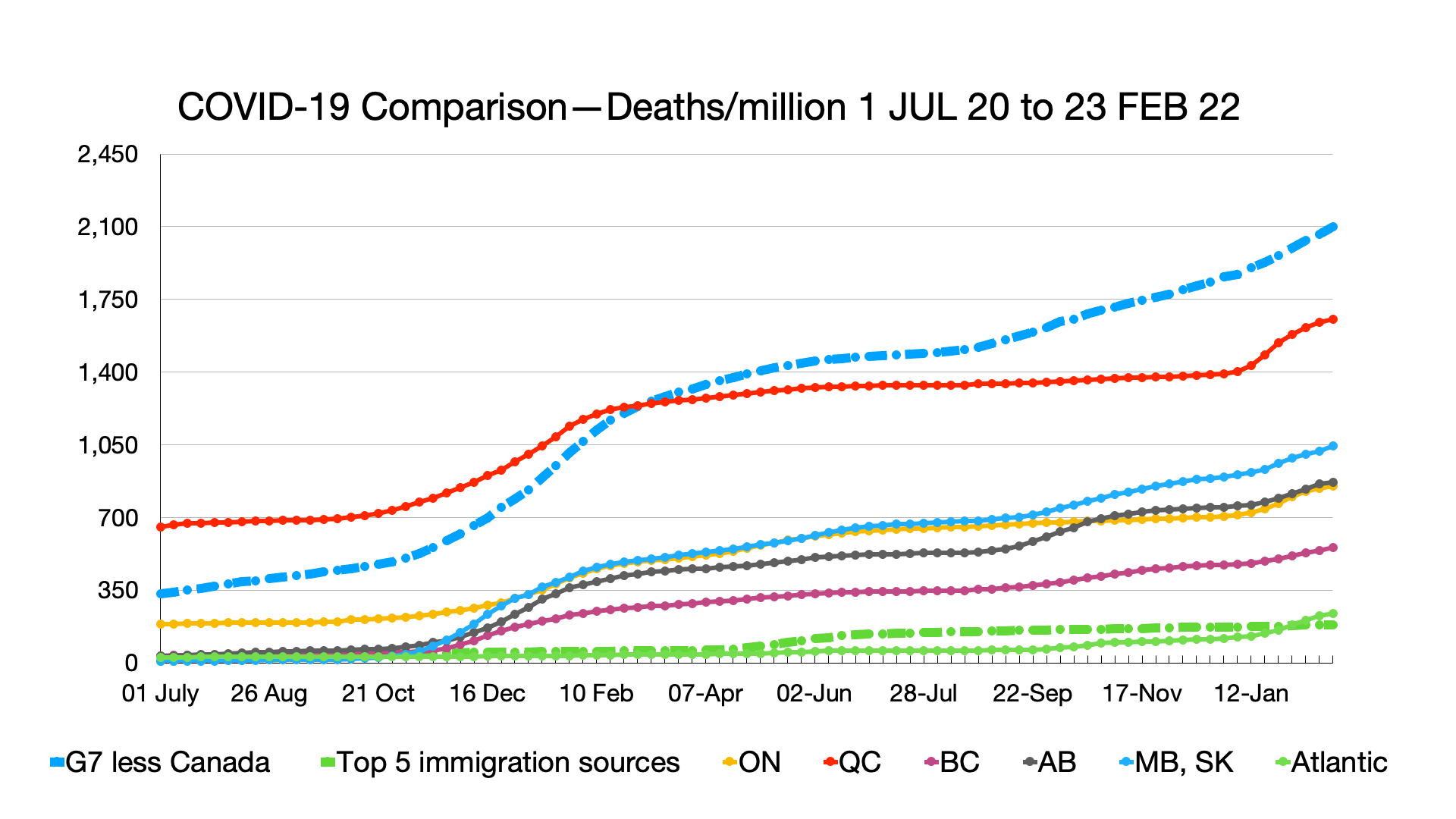
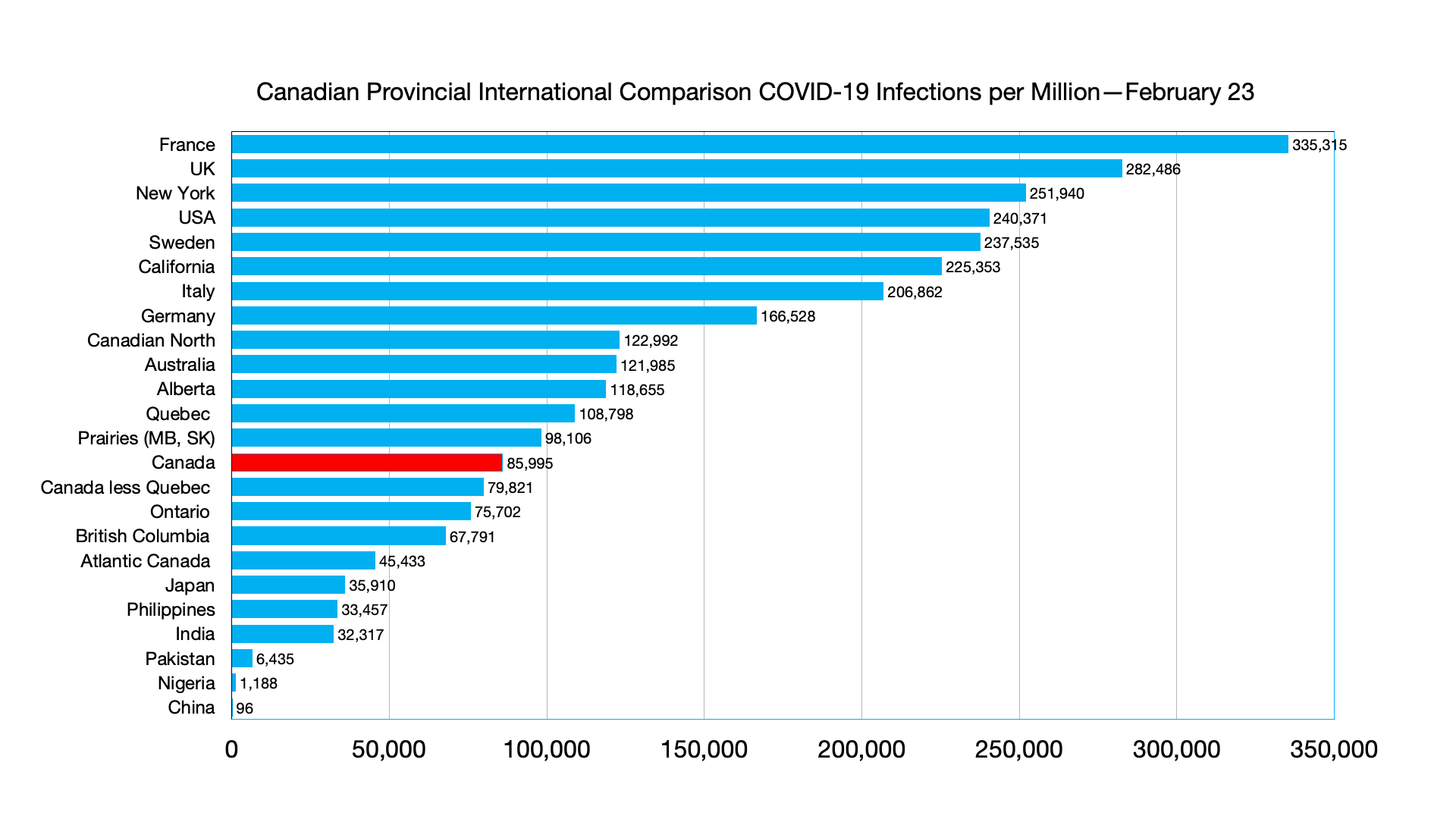
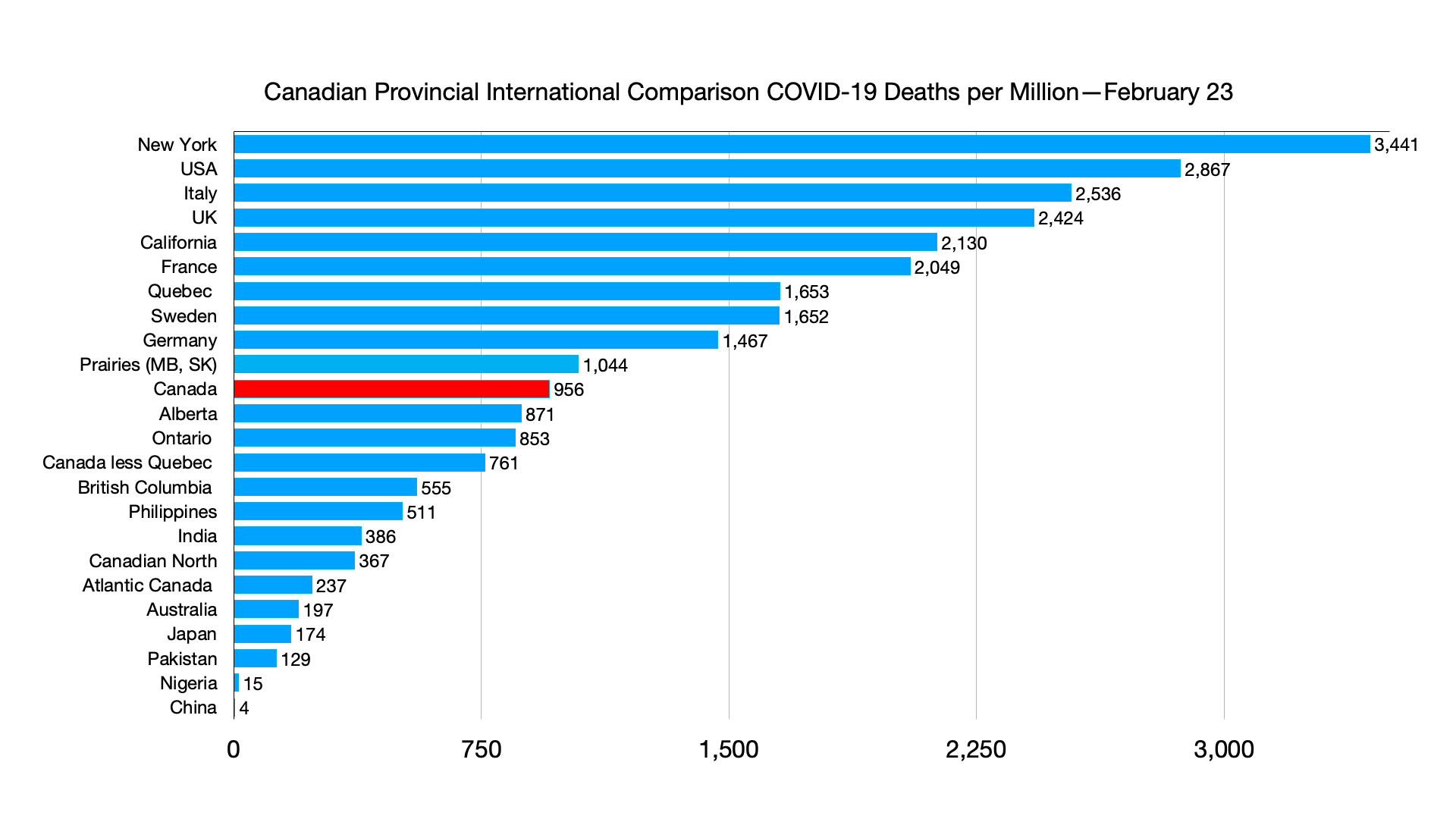
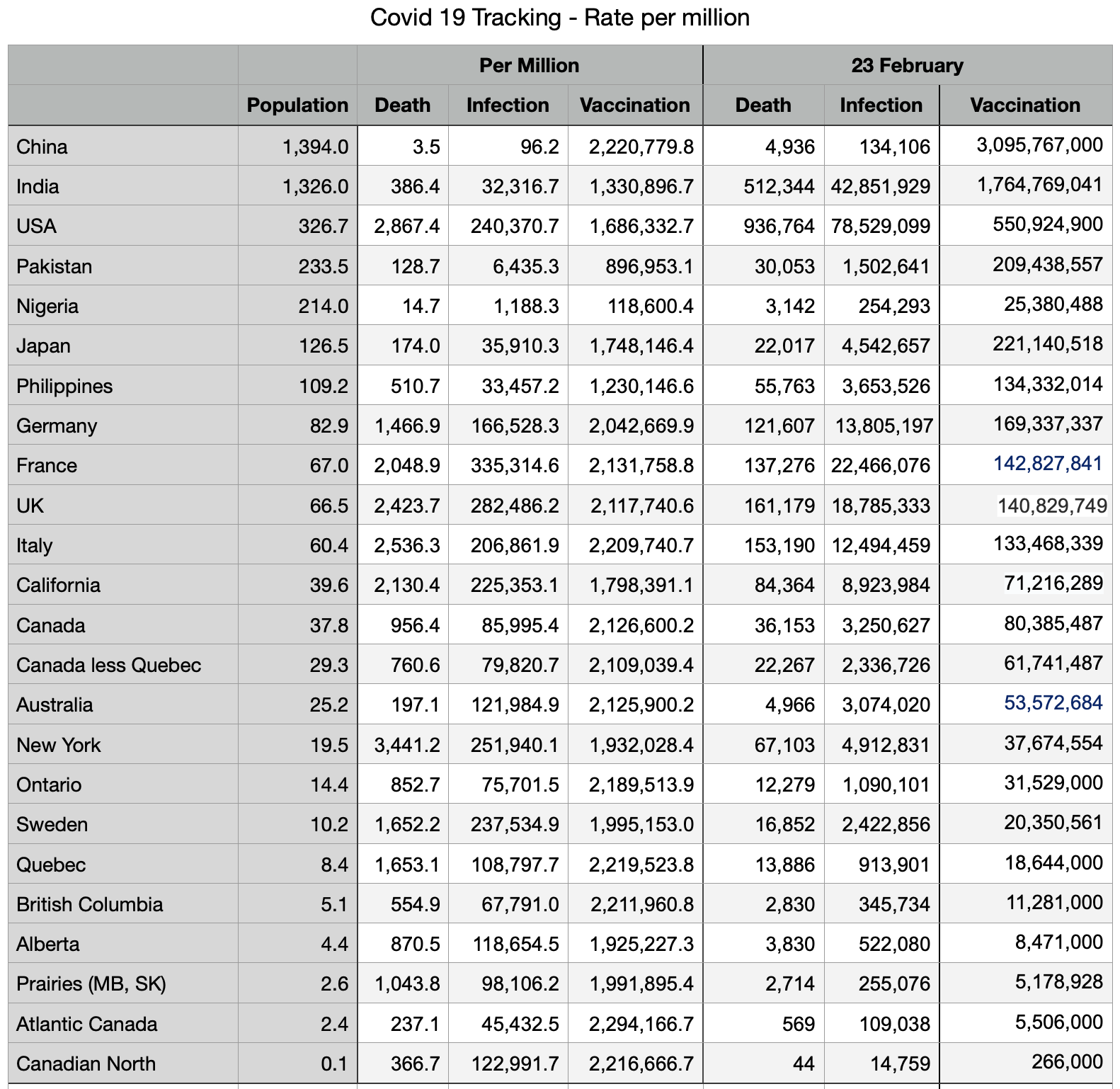
#COVID-19: Comparing provinces with other countries 23 February Update

Overall decline in infections and deaths as omicron wave passes.

Vaccinations: Some minor shifts but convergence among provinces and countries. Canadians fully vaccinated 81.9 percent, compared to Japan 79.3 percent, UK 73.2 percent and USA 65.5 percent.

Immigration source countries are also converging: China fully vaccinated 87.9 percent (numbers have not budged over past four weeks), India 55.9 percent, Nigeria 3.8 percent (significant increase from very low base), Pakistan 44.4 percent, Philippines 57.9 percent.

Trendline Charts:

Infections: Ongoing signs of omicron and other variants plateauing.

Deaths: Quebec continues to plateau.

Vaccinations: No major change but Alberta and Prairies continue to be laggards compared to other provinces given resistance among residents and political considerations. Jump in Prairies reflects delayed Saskatchewan reporting (weekly, rather than daily, and Globe updates less frequently).

Weekly

Infections: Canadian North and Australia ahead of Alberta, Japan ahead of Philippines and India.

Deaths: No relative change. Of note, Chinese deaths were unchanged from September 22, 2021 until 9 February, 2022, unique among all countries and, frankly, hard to believe (infections were also relatively flat, from 107,789 to 121,629 during the same period).

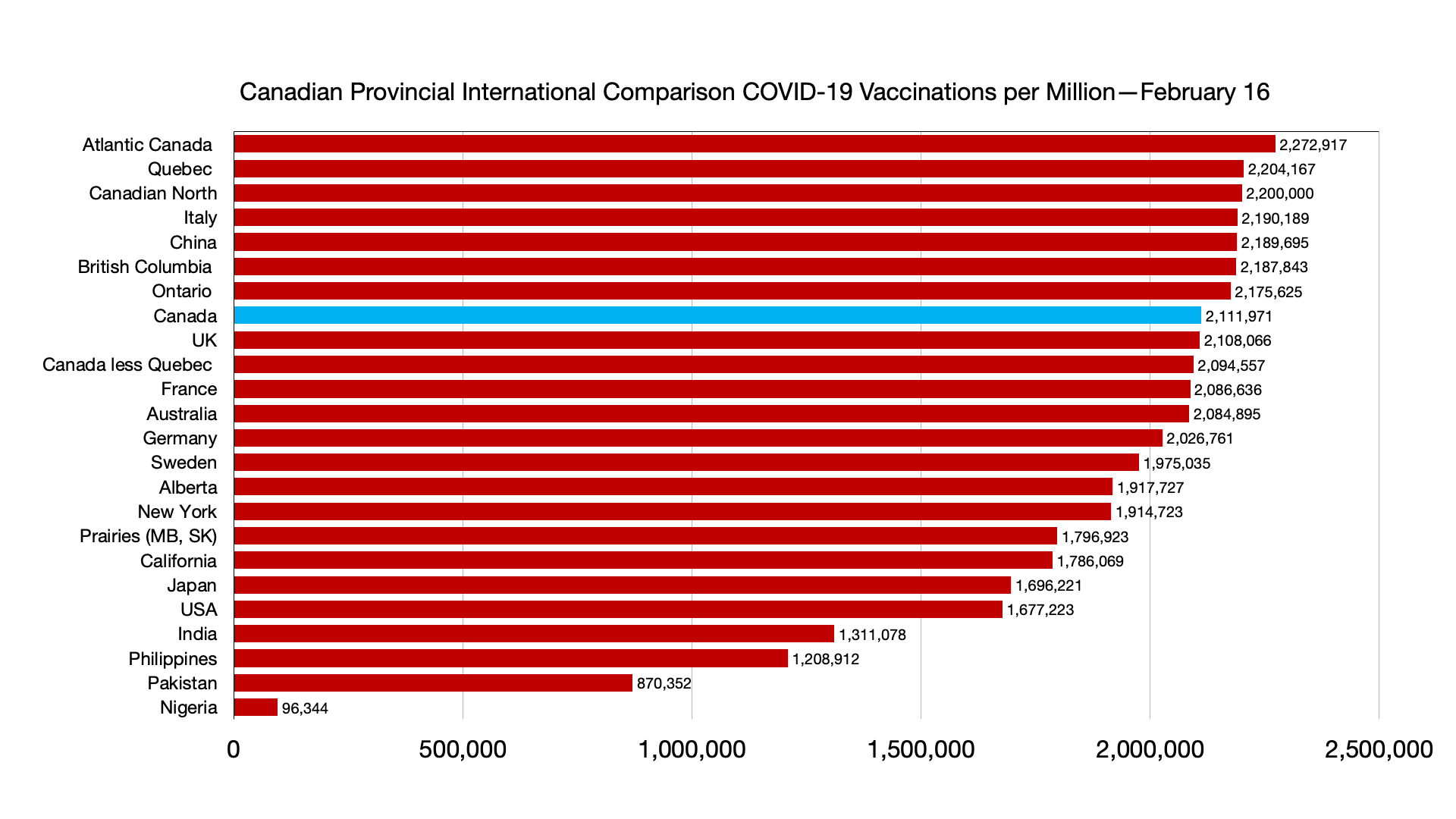
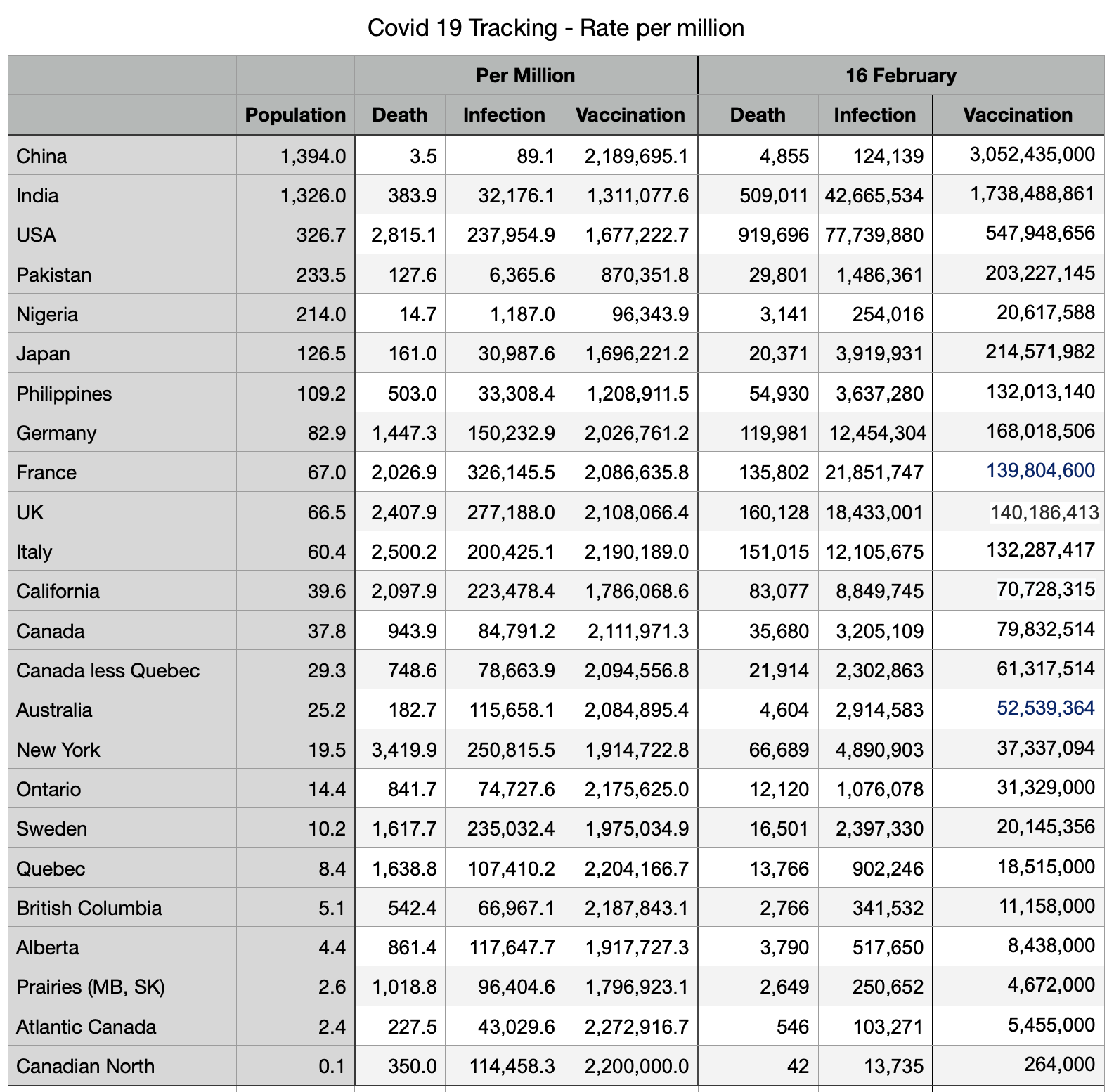
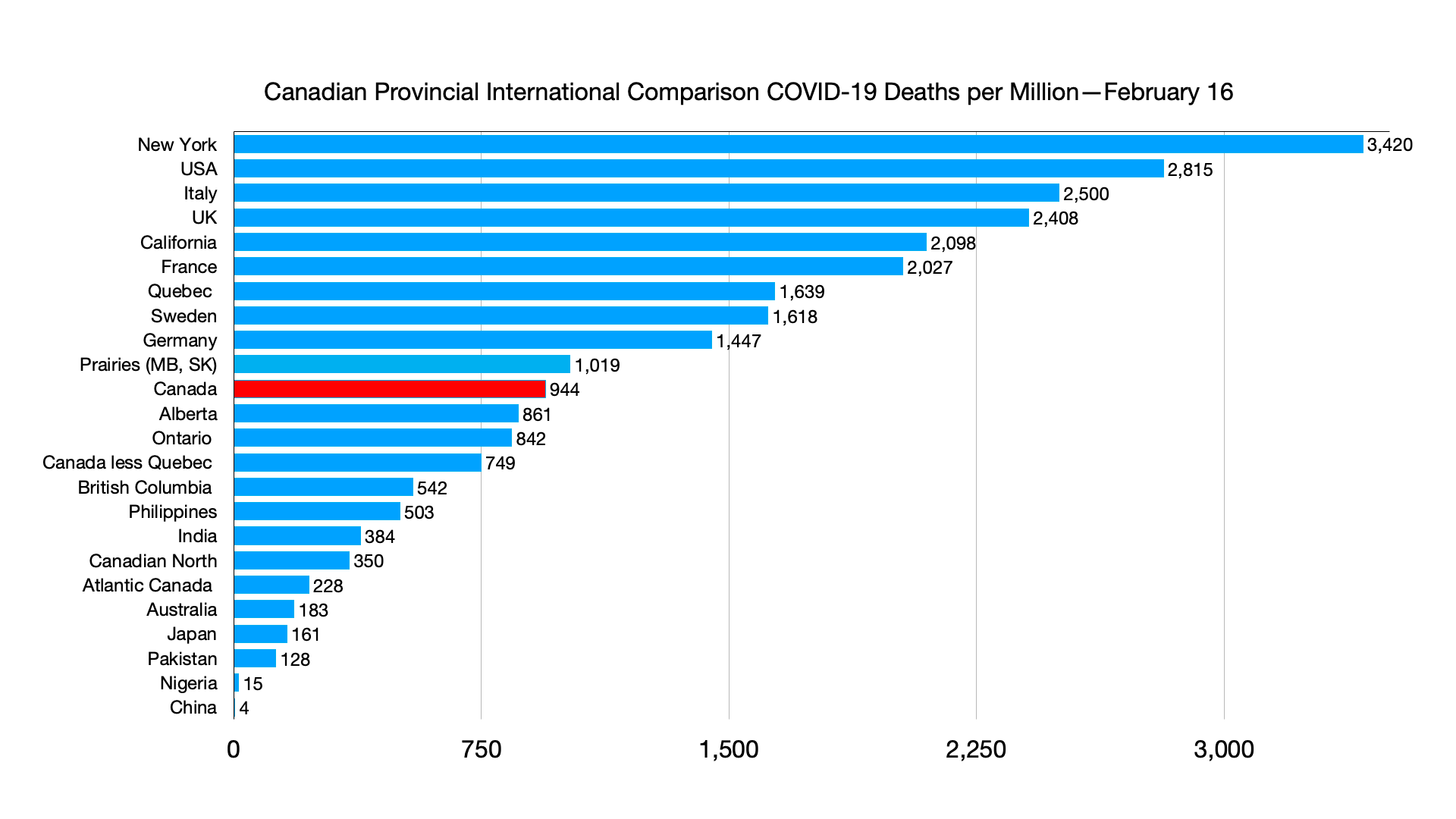
#COVID-19: Comparing provinces with other countries 16 February Update

Overall decline in infections and deaths as omicron wave passes. Note Saskatchewan data is from previous Thursday given the government’s “see no evil” strategy of no longer publishing daily statistics.

Vaccinations: Some minor shifts but general convergence among provinces and countries. Canadians fully vaccinated 81.6 percent, compared to Japan 79.2 percent, UK 72.7 percent and USA 64.9 percent.

Immigration source countries are also converging: China fully vaccinated 87.9 percent (numbers have not budged over past three weeks), India 55.6 percent, Nigeria 2.7 percent (the outlier, unchanged), Pakistan 43.2 percent, Philippines 56.7 percent.

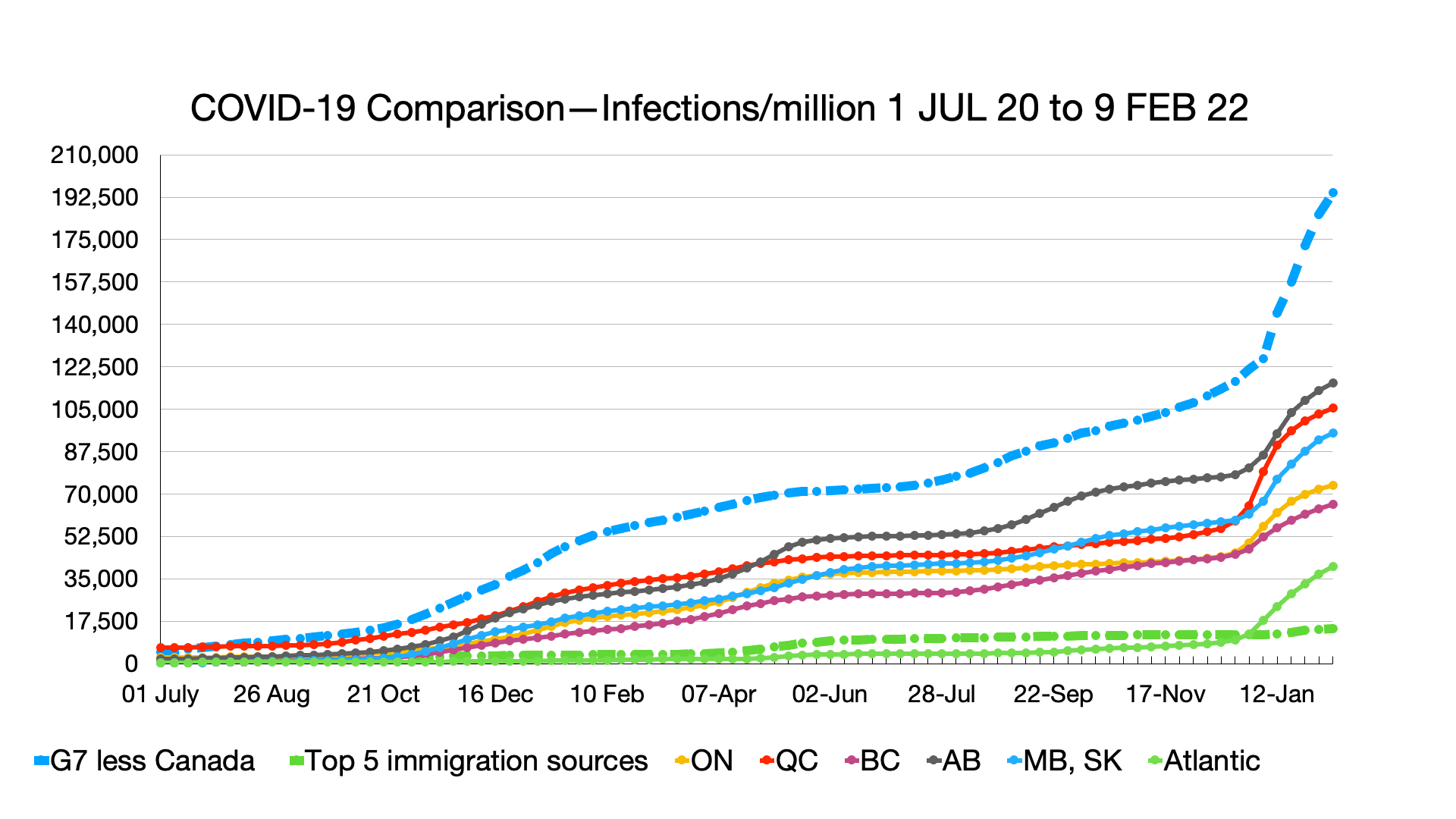
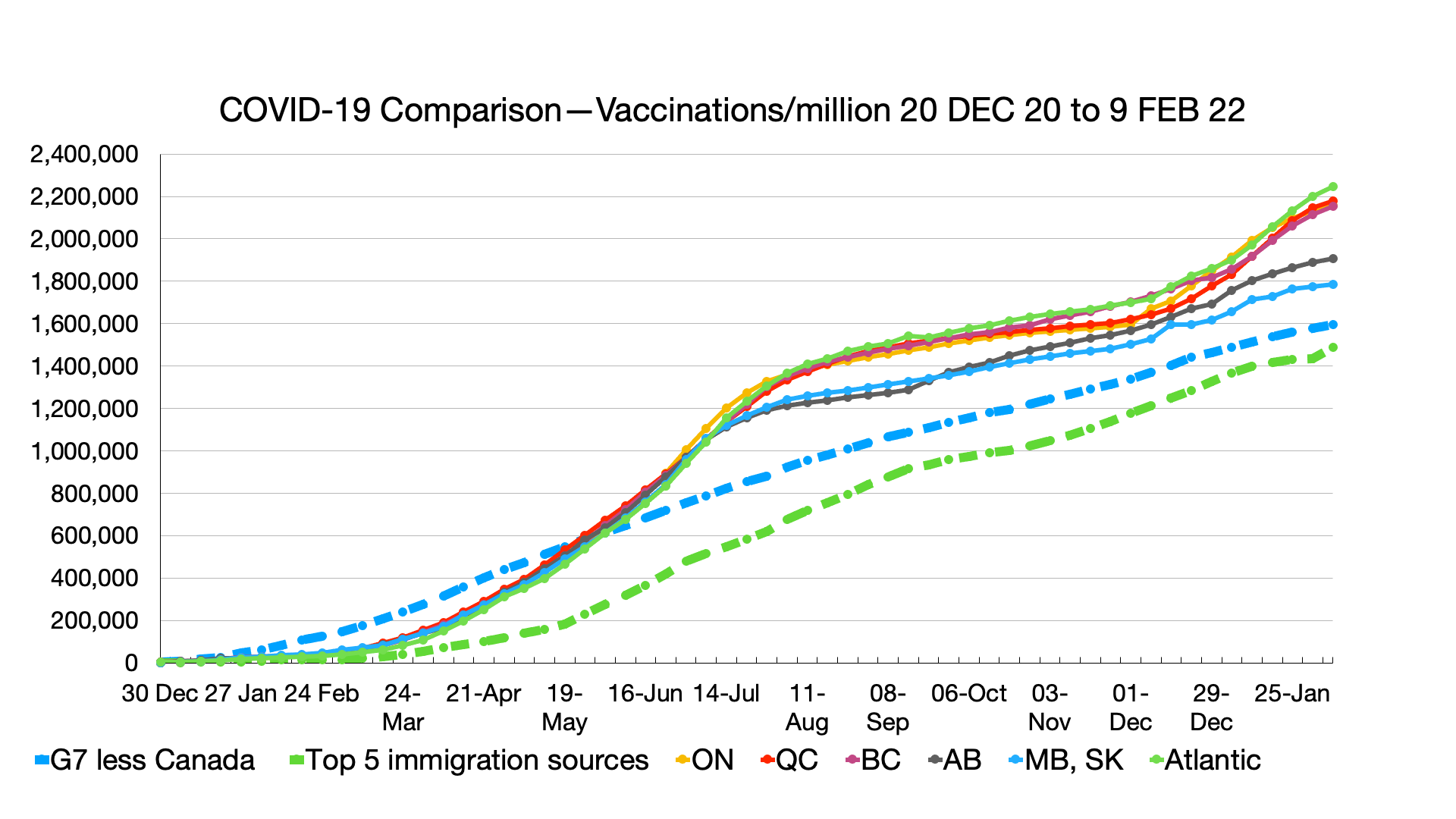
Trendline Charts:

Infections: Further signs of omicron and other variants plateauing.

Deaths: Quebec plateauing.

Vaccinations: No major change but Alberta and Prairies continue to be laggards compared to other provinces given resistance among residents and political considerations.

Weekly

Infections: No significant relative changes.

Deaths: No relative change.

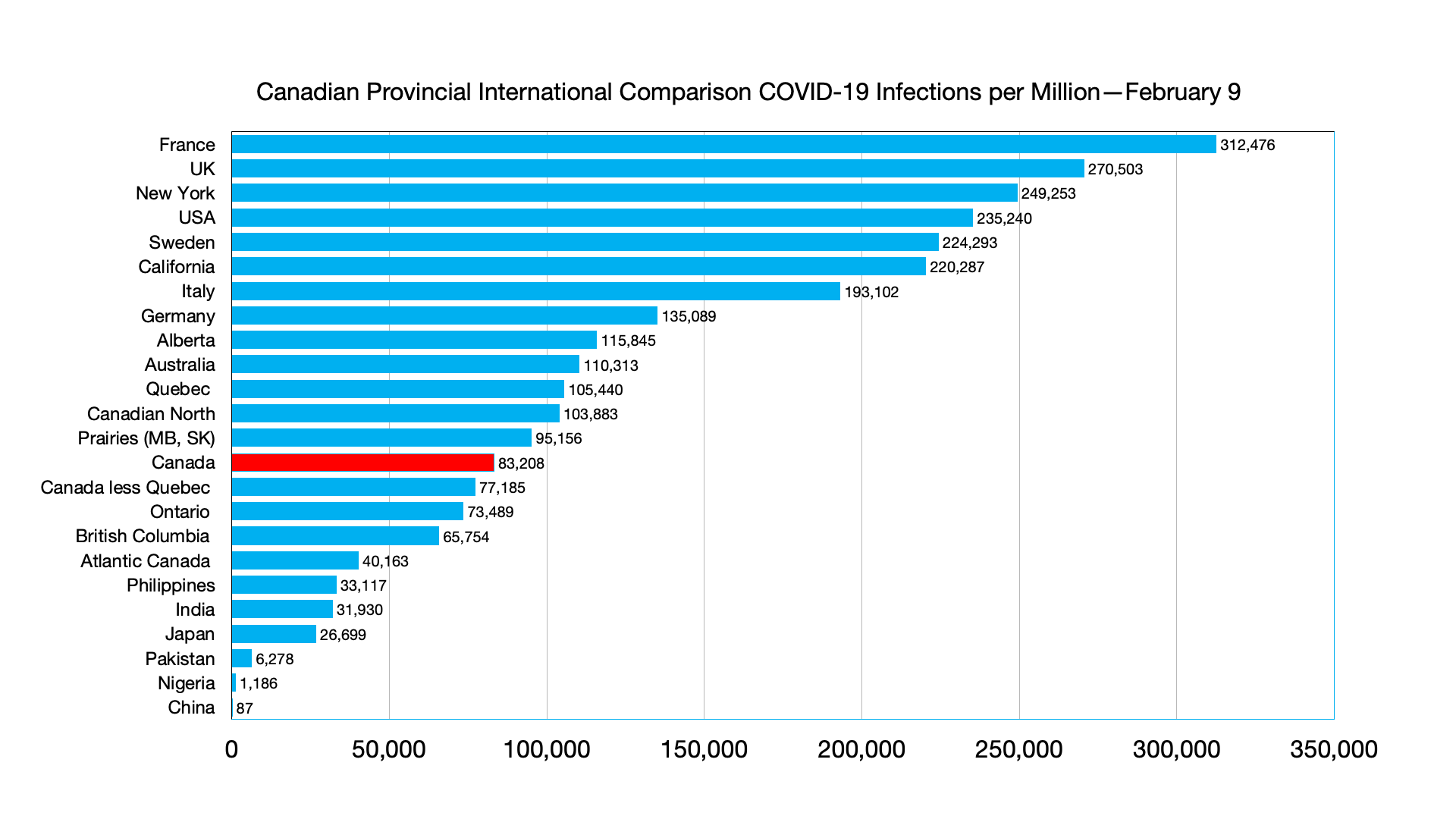
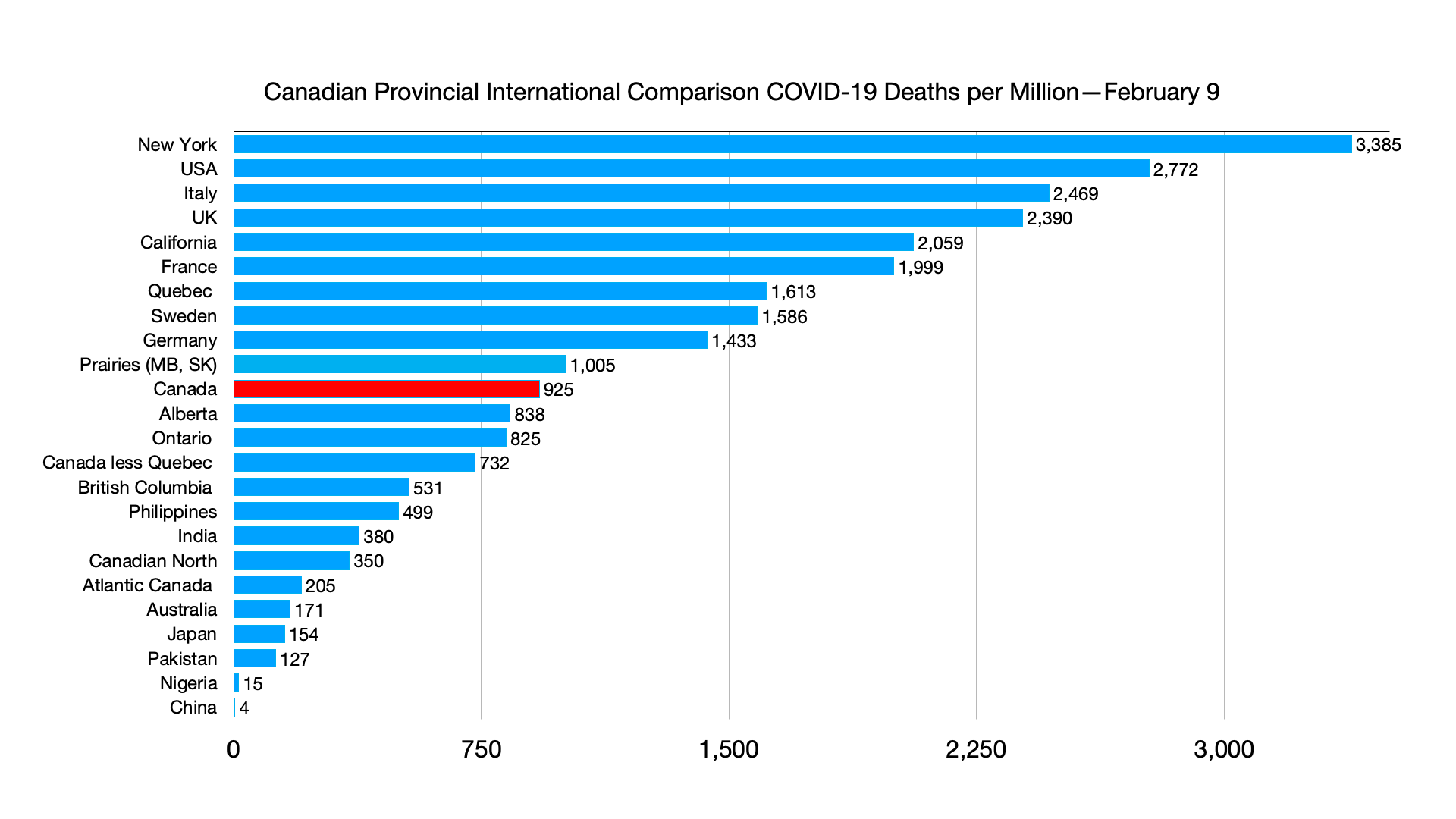
#COVID-19: Comparing provinces with other countries 9 February Update

It will be interesting to see the effects of the decisions by Alberta and Saskatchewan to relax or end restrictions over the next few weeks will in terms of infections, deaths and hospitalizations. Probably not as disastrous as “best summer ever” but likely not with consequences.

Vaccinations: Some minor shifts but general convergence among provinces and countries. Canadians fully vaccinated 81 percent, compared to Japan 79.1 percent, UK 72.7 percent and USA 64.9 percent.

Immigration source countries are also converging: China fully vaccinated 87.9 percent (numbers have not budged over past two weeks), India 53.9 percent, Nigeria 2.7 percent (the outlier, unchanged), Pakistan 40.6 percent, Philippines 55.6 percent.

Trendline Charts:

Infections: Signs of omicron and other variants plateauing.

Deaths: Quebec uptick appears to be plateauing.

Vaccinations: No major change but Alberta and Prairies continue to be laggards compared to other provinces. Ironic given they are among the first to relax and end restrictions.

Weekly

Infections: Sweden ahead of California, Australia ahead of Quebec, Canadian North ahead of Prairies.

Deaths: No relative change.

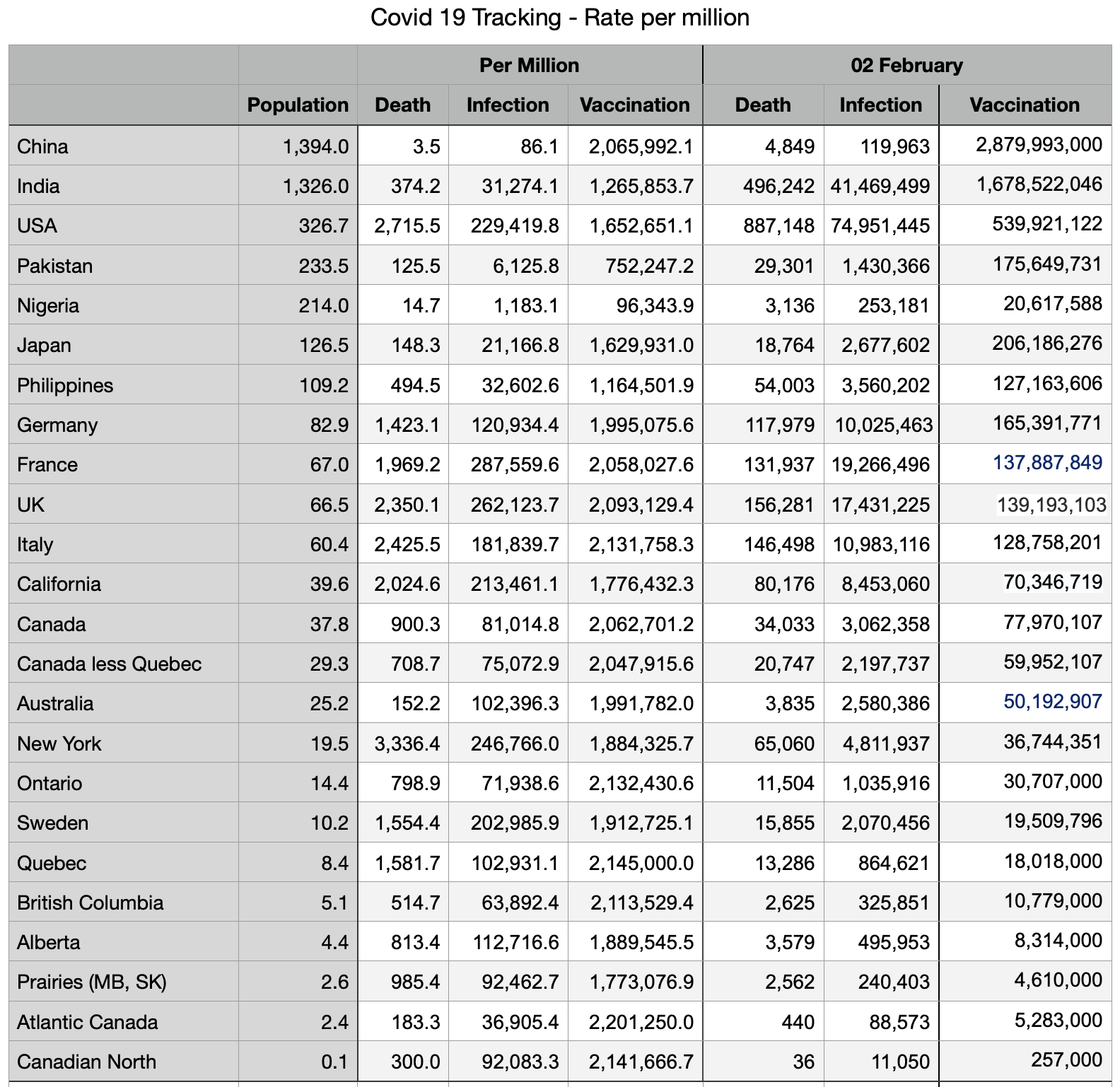
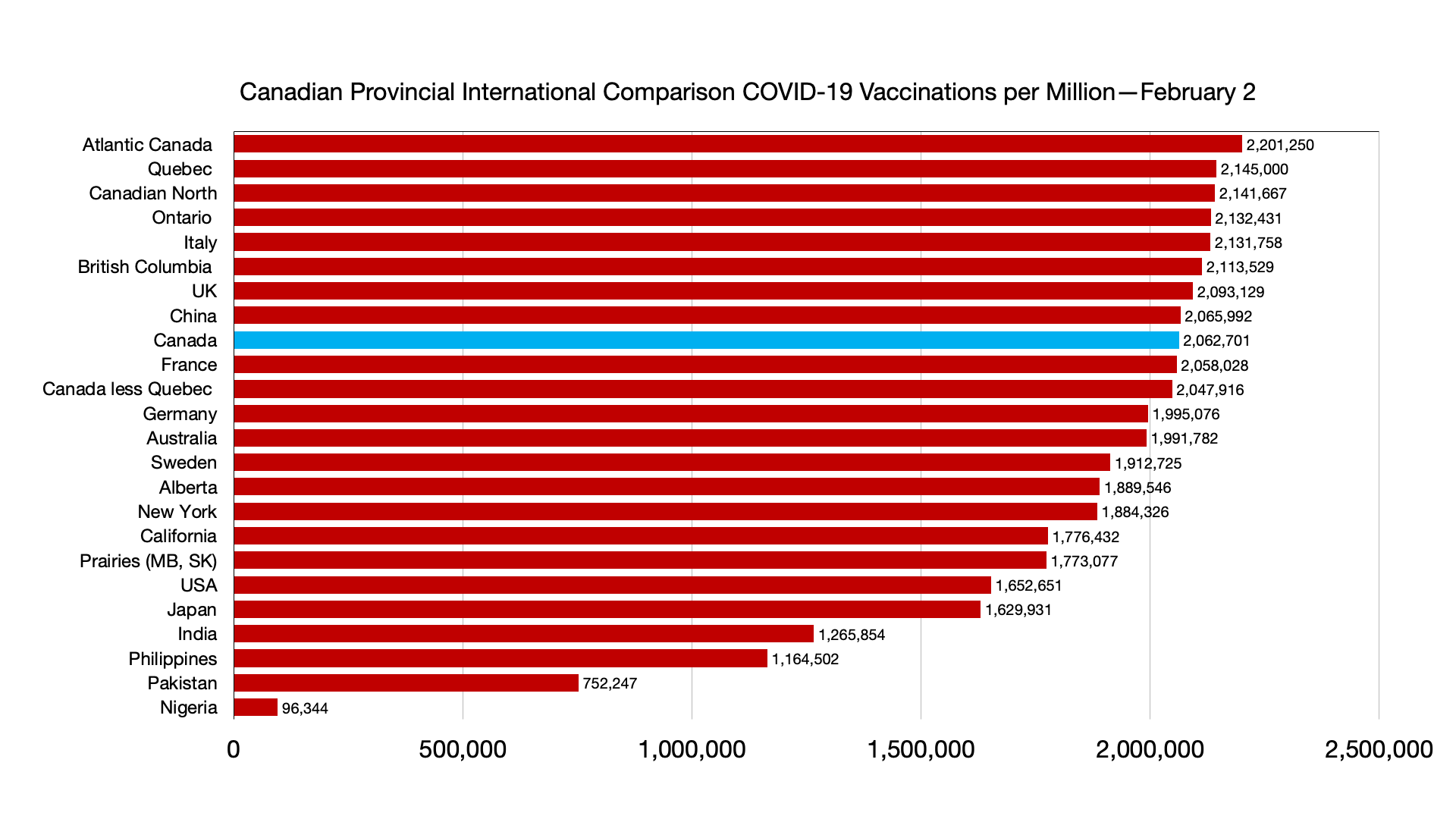
#COVID-19: Comparing provinces with other countries 2 February Update

While infections appear to have plateaued, lagging indicators such as hospitalizations, ICU use, and deaths have not for the most part.

Vaccinations: Some minor shifts but general convergence among provinces and countries. Canadians fully vaccinated 80.3 percent, compared to Japan 79 percent, UK 72.5 percent and USA 64.6 percent.

Immigration source countries are also converging: China fully vaccinated 87.8 percent (numbers have not budged over past two weeks), India 52.3 percent, Nigeria 2.7 percent (the outlier), Pakistan 38.1 percent, Philippines 54.7 percent.

Trendline Charts:

Infections: Moving towards a possible plateauing in most Canadian provinces, G7 less Canada still rising more steeply than Canada.

Deaths: No relative changes but Quebec uptick remains highly visible.

Vaccinations: No major change but Alberta and Prairies continue to be laggards compared to other provinces.

Weekly

Infections: UK ahead of USA, New York and California, Germany ahead of Alberta, Canadian North ahead of Canada.

Deaths: Australia ahead of Japan.

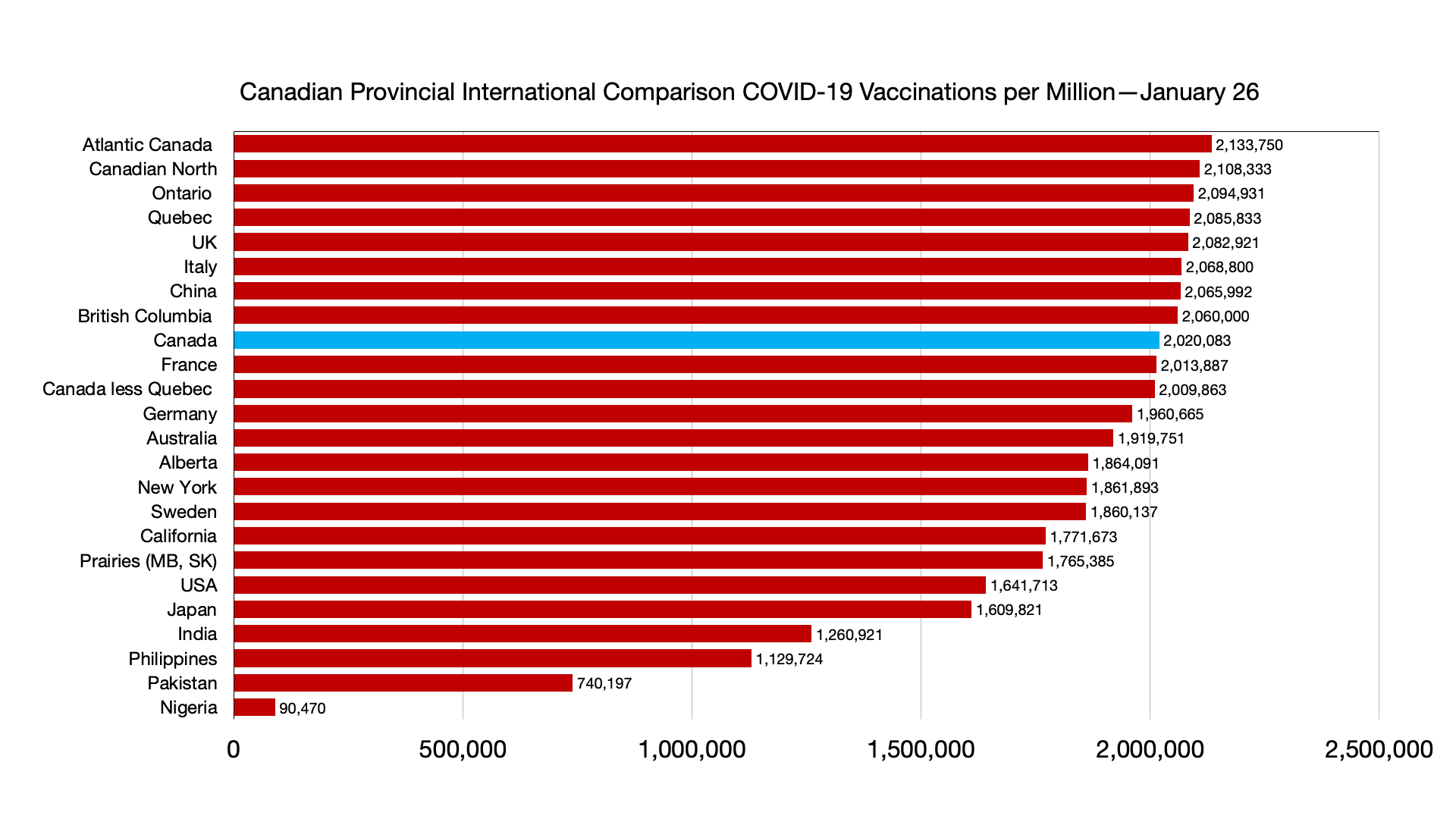
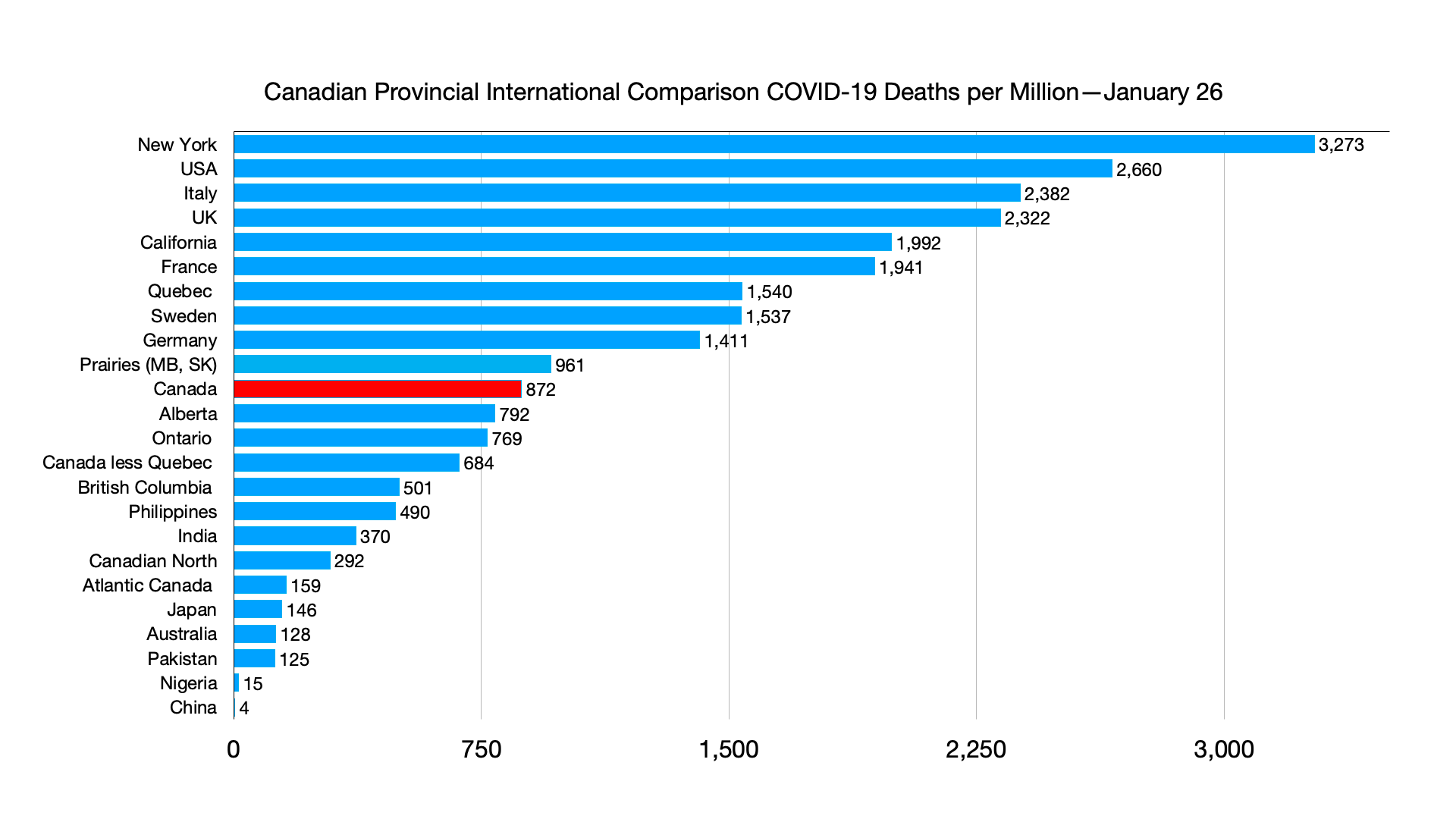
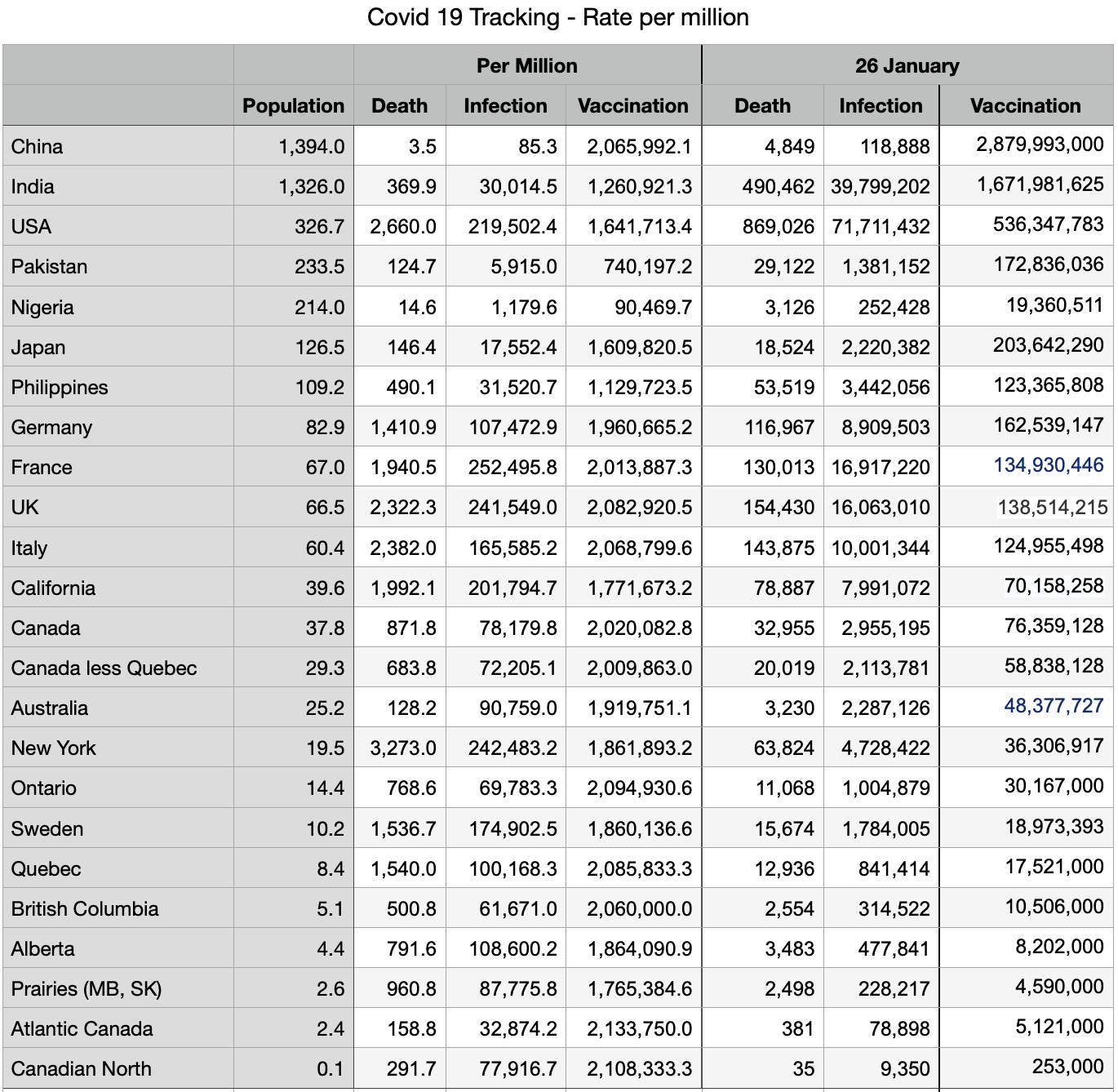
#COVID-19: Comparing provinces with other countries 26 January Update

Steep rise of infections remains the main story, along with resulting increases in hospitalizations and ICUs.

Vaccinations: Some minor shifts but general convergence among provinces and countries. Canadians fully vaccinated 79.5 percent, compared to Japan 78.9 percent, UK 72.2 percent and USA 64.2 percent.

Immigration source countries are also converging: China fully vaccinated 87.6 percent, India 50.4 percent, Nigeria 2.6 percent (the outlier), Pakistan 37 percent, Philippines 53 percent.

Trendline Charts:

Infections: Effects of Omicron seen in steep curve in all G7 countries and provinces. No such effect in immigration source countries.

Deaths: No relative changes but Quebec uptick highly visible.

Vaccinations: Ongoing convergence among most provinces. Gap between G7 less Canada continues to grow despite overall convergence, with narrowing gap with immigration source countries save for Nigeria.

Weekly

Infections: France ahead of New York and UK, Australia ahead of Prairies, Atlantic Canada ahead of Philippines. 

Deaths: Quebec ahead of Sweden, Atlantic Canada ahead of Japan, Australia ahead of Pakistan.

Speer: Let’s not prolong this pandemic for the sake of the expert class

An uncomfortable insight and a reminder how we all need to be aware of the incentives and motivations that affect our behaviour and positions:

I saw a fascinating tweet last week that reflected something that I’ve been thinking about a lot lately. University of Waterloo labour economist Mikal Skuterud wondered aloud whether the experts whose influence and profile have risen over the past twenty-four months or so may be consciously or subconsciously inclined to prolong the pandemic. 

Skuterud’s question doesn’t attribute malice or ill-intent. He’s not questioning whether academics or public servants would purposefully manipulate data or intentionally provide misleading advice. He’s making a far more subtle yet important point.  

He’s asking if our pandemic-induced emphasis on expertise may inadvertently create a powerful set of incentives in which these same experts may eventually find it challenging to surrender the sense of power and purpose that they’ve been given over the past two years. It’s a question worth asking.

As he rightly notes, the pandemic has necessarily elevated certain experts in our society. We’ve seen doctors, epidemiologists, and other public health experts come to have unprecedented influence over government policymaking and uncharacteristic prominence in the mainstream media and on social media. 

That’s somewhat natural in light of the circumstances. It’s to be expected that policymakers, the media, and the general population would come to value infectious disease experts in the face of a novel coronavirus. 

The result though is that a number of hitherto obscure academics and bureaucrats have never mattered this much before and probably never will again. It’s not normal for them to appear on television each day or increase their Twitter followings tenfold. 

Such a surge of influence and profile can bring with it a powerful set of incentives. It can contribute to a loss of perspective and an inflation of one’s ego. It can encourage individuals who may usually be scholarly and taciturn to be more quarrelsome and vehement. It can preference 280 characters over nuance. It can turn little-known academics into political actors. 

Skuterud’s question is therefore a good and honest one. How might this extraordinary yet temporary increase in the role of certain experts influence how they think about the pandemic and advise on pandemic-related policies including the continuation of public-health restrictions?   

The answer may lie in Public Choice theory, which the Nobel Prize-winning economist James Buchanan famously defined as “politics without romance.” Public Choice came about in the second half of the twentieth century under the intellectual influence of Buchanan, his regular collaborator, Gordon Tullock, political economist Mancur Olson, and various others. 

The basic idea is that our understanding of one’s motivations in the private economy ought to extend to his or her involvement in government, politics, and public policy. As economist Pierre Lemieux has succinctly put it: “He does not metamorphose into an altruist angel.” 

Most economic analysis starts with a basic premise: the market is comprised of rational actors pursuing their own self-interest. Yet these same assumptions about human behaviour aren’t always applied in the political sphere. The underlying presumption can be that activists, bureaucrats, and politicians are somehow beyond self-interest and are instead capable of making judgments about government policy without accounting for their own personal interests. 

Public Choice theory challenges this notion. It uses modern economics to analyse politics and political decision-making. It starts from the premise that different actors in the political process are self-interested agents who will seek to maximize their own utility function just like individuals do in the marketplace. 

In practice, it means that politicians may offer voters popular measures to get elected, public servants might conceive of new programs to obtain more funding and greater resources for their departments, and special interest groups—including unions and corporations—invariably lobby government to obtain new benefits such as tariffs to protect their businesses or laws or regulations that advance their own interests. 

This hardly seems like a revolutionary idea now. Public Choice theory has become a well-respected school of economic thought with a number of prolific exponents and a wide range of applications. But, at its infancy, it was seen as a radical proposition that brought into question the capacity of government to make collective decisions in the public interest.  

The consequence of Public Choice isn’t to challenge government’s basic legitimacy or reject it altogether. It’s instead a call for a clear-eyed assessment of the impulses and motivations behind different actors involved in politics and public administration. This extends to the experts and journalists who form part of the overall system and must be similarly understood as influenced by a broadly defined notion of self-interest. It’s not narrowly about monetary reward either—though financial gain may be a factor for some. It can extend to other rewards including influence, profile, or the sense of meaning and purpose that the pandemic’s emphasis on expertise has granted. 

It’s important to emphasize that this isn’t a description of moral failing. Recognizing the pull of self-interest isn’t a judgement of particular people in positions of authority. It’s an observation about human nature and the fact that government and politics are fundamentally comprised of humans and their inherent fallibilities. 

Which brings us back to Skuterud’s question. There’s no reason to think that most experts haven’t acted in good faith during the pandemic and sought to make a positive contribution to solving the extraordinary public health crisis. But, as Public Choice tells us, it’s also quite possible that at some level these incentives are shaping the questions that they’re asking, the data that they’re collecting, the analysis that they’re bringing to bear, or how they’re engaging in the public sphere.

The risk, of course, is that these forces come to obtrude collective decision-making and in turn prolong the pandemic. It’s hard to know the magnitude of the risk. But it’s presumably not zero. It must be something that we are cognizant of—especially as the policy choices become more complex and the subject of greater debate. 

The ultimate solution to the COVID-19 pandemic is imperfect: it will require a combination of critical thinking and judgement calls without any altruistic angels. This pandemic’s end will necessarily involve a series of trade-offs, calculated choices, and second-best options. It must in short be an exercise in a politics without romance. 

Source: https://thehub.ca/2022-01-20/lets-not-prolong-this-pandemic-for-the-sake-of-the-expert-class/?utm_source=The%20Hub&utm_campaign=dd5b5eb714-EMAIL_CAMPAIGN_2022_01_19_06_47&utm_medium=email&utm_term=0_429d51ea5d-dd5b5eb714-475403886&mc_cid=dd5b5eb714&mc_eid=7832dd2817