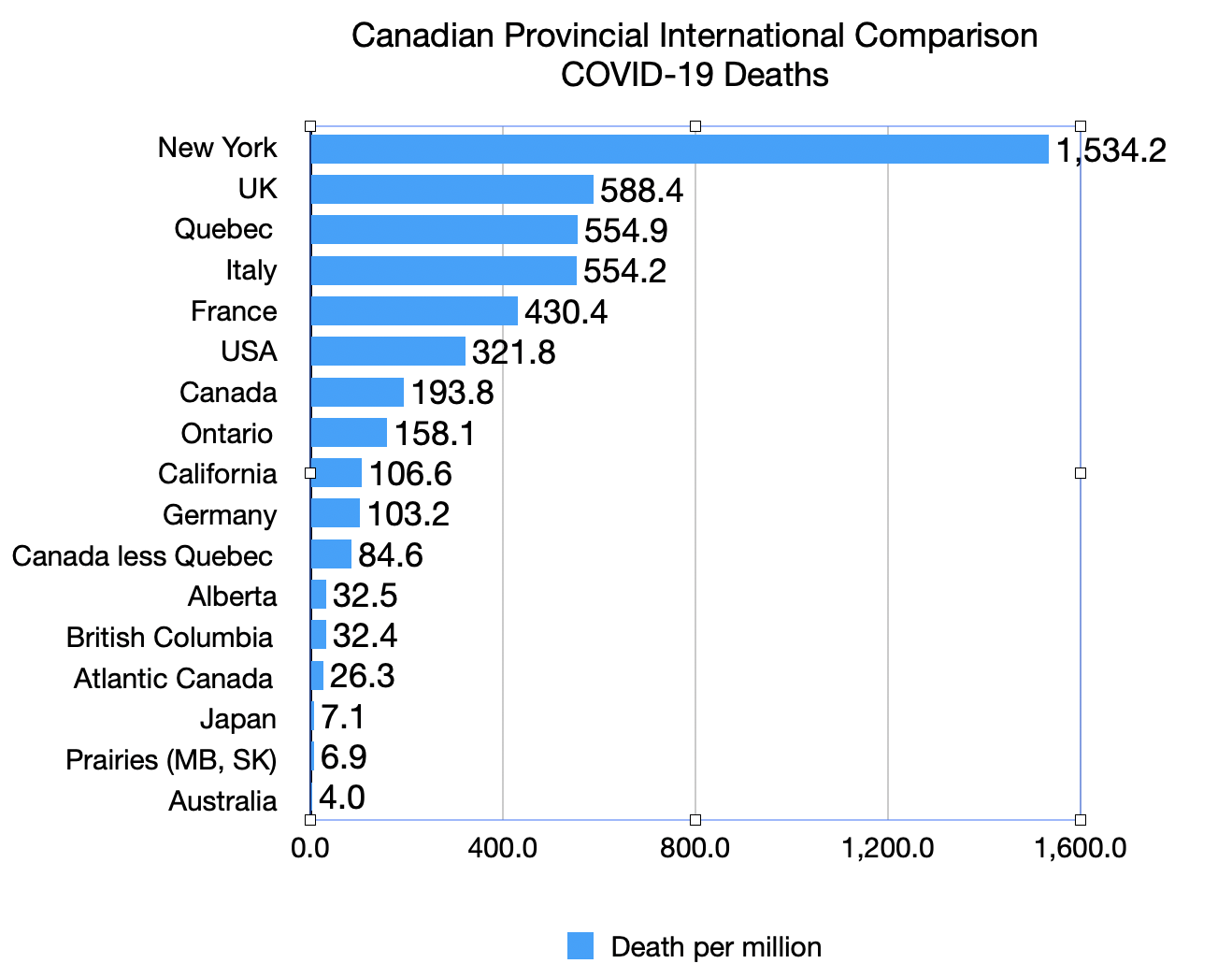
#COVID-19: Comparing provinces with other countries, Quebec death rate per million now greater than Italy: June 10 Update
2020/06/11 Leave a comment
Latest update:


Working site on citizenship and multiculturalism issues.
2020/06/10 Leave a comment
Agree. Starts, of course, with better and more comprehensive data:
In the COVID-19 era, Canada needs to better understand the relationship between identity and health. To do that, we need to use intersectional analysis, the study of the way identity categories such as gender, race and ability interconnect to create discriminatory systems that impact individuals in different ways. Fortunately, we have a policy tool in our policy toolbox for precisely this purpose, and it can and should be deployed by provincial ministries of health across this country: Gender-Based Analysis plus (or GBA+). Our federal government has been using GBA+ for years across many departments, though it is not mandatory for all federal departments. But it is in use at the Privy Council Office, Finance, the Department of National Defence and Health Canada. There is therefore a wealth of Canadian policy experience with this tool, and we need GBA+ now more than ever.
The GBA+ tool was developed by the federal Department of Women and Gender Equality (WAGE), formerly Status of Women Canada. It is an approach to understanding sex and gender alongside other identity factors such as race, ability and age, to assess how various groups experience policies, programs and initiatives. The aim of GBA+ is the creation of equitable policies, programs and initiatives — equitable from inception to execution. Awareness of the differential impacts that government policies and actions have on different identity groups is central to that goal.
There are no hard and fast rules on how GBA+ should be done; in fact, it is perhaps best thought of as a competency rather than a methodology. In other words, there is no set formula to achieve equity in all situations; rather, progressing toward equitable change requires the continued cultivation of knowledge about various groups, the challenges they face and potential avenues for change. Nevertheless, GBA+ consistently relies on the use of disaggregated data, in addition to other forms of research, to gain insights into policy. Reliable data are essential to effect change, especially with identity-based issues. Showing patterns of discrimination is more compelling than anecdotal accounts in documenting a need for policy change. GBA+ also requires the monitoring and evaluation of the effects of policies on Canadians. It is not enough to enact change; change must be equitable.
Properly applied to the government’s COVID-19 response, GBA+ would have directed policy-makers to draw on fine-grained differentiated data to evaluate equity considerations. In asking whether policies are equitable, GBA+ analysts ask whether policy outcomes track a range of identity factors, including race, ethnicity and socio-economic background. Thus, if GBA+ had been applied to provinces’ public health response to COVID-19 from the start, requisite data would have been collected from the outset. These data, as the trickle of international evidence is making increasingly apparent, are key to targeting necessary medical supplies, policies and programs to those most affected, and hence helping to curb the spread of the virus.
GBA+ directs policy-makers to include identity-based considerations in the formulation, deployment and evaluation of their policies. Of course, GBA+ is not perfect: critics sometimes charge that it is too abstract, offering little actionable guidance to policy-makers. While its goals may be commendable, it is not always readily apparent how GBA+ should influence decisions within a specific portfolio or policy. This is why proponents of GBA+ argue it is a competency rather than a methodology. Policy-makers need to develop the ability and experience needed to make equitable decisions. Whether or not this response satisfies critics, it is true that GBA+ has clear implications in the context of COVID-19. If it had been employed in the appropriate offices before the pandemic, it would have helped policy-makers see and act upon considerations of identity in the making of health policy, including in their collection of data. Even at this later stage, the deployment of GBA+ would significantly improve our understanding of the virus and our response to it.
Several Western countries have discovered that factors linked to social determinants of health, most notably race, ethnicity and socio-economic status, are closely related to infection, hospitalization and death rates In Canada, however, we are flying blind, as COVID-19 data collection has been limited so far to age and sex.
Our obliviousness to the potential relationship between race, ethnicity and socio-economic status and infection, hospitalization and death rates will negatively impact our ability to control the spread of the virus in the short term and impair our understanding of how this virus impacts societies’ well-being in the long term. In response to criticism about this gap in data collection, Ontario’s chief medical officer of health, Dr. David Williams, for example, has said that statistics based on race aren’t collected in Canada unless certain groups are found to have risk factors.
Frankly, this position just does not align with mounting international evidence that race, ethnicity and socio-economic status have an impact on health outcomes related to COVID-19. A recent study released by a United Kingdom think tank, the Institute for Fiscal Studies, finds that minority groups are overrepresented in hospitalizations and deaths from the virus, with Black Britons nearly twice as likely to die from COVID-19 as the white British majority. Similar patterns have emerged in the United States, where the Centers for Disease Control confirmed that current data suggest a disproportionate burden of illness and death among racial and ethnic minority groups. New York City, for example, has recorded a disproportionate death rate among African-Americans (33.2 percent) and Hispanics (28.2 percent), and a Washington Post analysis shows that American counties that are majority-black have three times the rate of infections and almost six times the rate of deaths as counties where white residents are in the majority
There is further reason to apply a GBA+ lens to race, ethnicity and socio-economic data of those infected, hospitalized or succumbing to COVID-19. Academic studies have noted that racial discrimination, specifically when directed against Canada’s Black and Indigenous people, may itself be a determinant of chronic diseases and their underlying risk factors. Clearly, racial and ethnic inequalities in health outcomes are found throughout Canada, but the severity of these inequalities varies across racial and ethnic groups, further illustrating the importance of intersectional analysis. Moreover, academic evidence notes that a failure to distinguish between Canadian-born visible minorities and visible minorities who are immigrants to Canada is a key gap in Canadian health data of racialized individuals. This further indicates the importance of taking intersectionality into account when collecting health data.
When policy-makers truly embrace GBA+ as a lens for equitable policy-making, we can then better assess the toll of the pandemic. Only with an intersectional lens on the impact of COVID-19 on society will we see the differentiated impact of this virus on individuals and communities. Thus far, we have been flying blind, but it may not be too late to make a course correction in our COVID-19 policies.
Source: A GBA+ case for understanding the impact of COVID-19
2020/06/10 Leave a comment
No surprise. Broadly consistent with other countries:
On 21st May 2020, the government released its ‘Immigration statistics, year ending March 2020’, and it confirmed what those in the world of academia already knew; that there was a sharp drop in the number of international students when the lockdown took hold at the end of March. While the publication was not intended to provide a full analysis of the impact of Coronavirus on the immigration system, it did find a significant fall in applications for study visas in March 2020; it states, “in March 2020, Tier 4 visa applications fell significantly when compared to March 2019, in particular for Chinese nationals, and likely related to COVID-19. At the same time, the number of Tier 4 (sponsored study) visas issued in the first quarter of 2020 increased by 84&#x c;ompared with the same quarter in 2019, although there were falls towards the end of March 2020”.
The fall in student numbers follows record increases in 2019
The clear reduction in student numbers is all the more jarring given that the sector has seen a boom in international students in recent years, helped in large part by the reversal of Theresa May’s student immigration policy which required students to depart only four months after completing their studies. According to Government data, in the year ending September 2019, sponsored study visas increased by a not inconsiderable 13&#x (;258,787 students), of which 86&#x w;ere for university education.
UK universities planning for a return of students
There is no doubt that UK academic institutions have been hit hard by COVID-19, not least because of the large black hole which now exists in place of the regular supply of domestic and international student fee revenue. According to a recent analysis by London Economics for the University and College Union, it is expected that UK universities will see a £2.6 billion shortfall in the next academic year due to the ongoing impacts of COVID-19. Of this £2.6 billion is from domestic students and the remainder from international students. It is clear; therefore, how important overseas students are to UK universities and positive and reassuring that plans are now in place to allow some students to return to campus-based learning.
Some UK universities are planning to reopen from June 2020 with a range of essential measures to ensure the safety of staff and students being put place. Smaller class sizes and an increase in the number of online lectures will become normal from the middle of this year. While not all universities have a plan to reopen yet and are instead waiting for clarity from the government before reopening, some have mature plans almost ready to go. The University of Wolverhampton, for example, will be offering a “full digital suite of course material”, and will prioritise the opening of building openings over time. The university’s vice-chancellor Geoff Layer stated, “We will be looking at a gradual return to certain buildings being open and we will develop a plan which prioritises which parts can open first. It won’t be ‘we’re all back’. Social distancing has to be part of what we do, so I’d imagine we would be opening selected spaces over time”.
At Birmingham City University some, but not all, of the 2019-20 cohort of students will be returning for lessons from June 2020. The 2020-21 intake will start their courses in September 2020 with a new set of COVID-19 safety measures designed to protect the wellbeing of students and teachers in place. The university’s vice-chancellor, Professor Philip Plowden, says that students will be returning to the campus “on a limited basis”, and that changes are being made to the way in which buildings are utilised to ensure adherence with social distancing. Professor Plowdon believes that this partial reopening is essential to allow students who are reliant on-campus facilities to complete their courses; “Our priority for this year is to ensure that every student gets the qualifications for which they are working, or are able to make progress towards getting those qualifications. Our absolute priority is the safety of our staff and students and all of our decisions continue to be made with the safety of our community in mind.”
Even if academic institutions won’t be back to where they were before the COVID-19 pandemic, the confidence and boost to sentiment, not to say, cash flow, will be warmly welcomed by the sector.
Those universities which are not reopening in June 2020 will no doubt be watching those that do with considerable interest, not only to see whether it can be done but also to understand the measures which they too will need to put in place in the near future. It is also likely that international students will be watching to see how safe UK universities are over the next few weeks in anticipation of resuming their own studies in September 2020. As such, UK learning institutions can do much to inspire confidence in prospective overseas students by responding effectively now.
Returning students will be required to self-isolate
Anyone arriving in the UK from the 8th June 2020, including those holding a Tier 4 study visa, will be required by law to self-isolate. They will be asked to provide an address for where they will be in quarantine and will face fines of up to £1,000 and random spot checks. Unfortunately, there is no guarantee these additional measures put in place by the government will be lifted by September 2020 for the start of the new academic year, hence it is best to plan for an earlier arrival.
Wrapping up
The impact of COVID-19 on the UK’s education sector will be remembered for many years, but hopefully, with time, students from overseas will be able to continue their studies in earnest. Global events such as this allow us to truly appreciate the wonderful opportunities provided by the overseas study. As we start to see the light at the end of the tunnel, our immigration specialists look forward to helping international student clients and their families over the coming months to return to the UK to resume their studies.
Source: COVID-19: Reduction in Overseas Students Revealed in Immigration Statistics
2020/06/10 Leave a comment
Wonder whether any of these types of targeted initiatives are taking place in Montreal and Toronto?
When COVID-19 first hit the United States, it spread through communities of color at alarmingly disproportionate rates.
This was especially true in Chicago. More than 70% of the city’s first coronavirus deaths were African-American. Those numbers have declined, but black residents continue to die at a rate two- to three-times higher than the city’s white residents. Researchers believe underlying health conditions that are prevalent in Latinx and black communities, such as hypertension and diabetes, make residents there more vulnerable to the disease.
While blacks suffer the most deaths, the number of people who have contracted the disease is the highest now in the city’s Latinx communities. Chicago Mayor Lori Lightfoot calls it a public health “red alarm.” She’s worked with community groups to create a Racial Equity Rapid Response Team or RERRT. They are tackling long-standing needs for residents in African-American and Latinx neighborhoods — everything from adequate nutrition to jobs to healthcare.
One of those Chicago neighborhoods is Auburn-Gresham. It’s a predominantly African-American and working class area on the city’s South side. It’s seen its share of troubles — 30% unemployment, gang warfare. Then came the wrath of COVID-19.
The first to die was Patricia Frieson, 61, a retired nurse who lived in the neighborhood. Her older sister, Wanda Bailey, 63, also died from the coronavirus days later.
Recently, a drive-in test site opened up on 79th street, one of the main commercial strips that’s seen better times.
“Oh, this is critical. We’ve been screaming for weeks to get testing in Auburn Gresham,” says Carlos Nelson, CEO of the Greater Auburn-Gresham Development Corporation. He says it’s been dire with more than 1,000 confirmed coronavirus cases and “we are dying, because we don’t have the same resources or access to information.”
Mayor Lightfoot says the racial gap is unacceptable and is the result of a racist system that for generations left black neighborhoods with little access to health care, jobs, education and healthy food. Conditions she adds that aren’t unique to Chicago.
“We’re seeing this manifest in large urban areas with large black populations,” says Lightfoot. “All over the United States — Cleveland, Detroit, Milwaukee and other places are experiencing the same thing, but we are going to step up and do something about it.”
Distributing free masks, hundreds of door hangers and thousands of postcards about COVID-19 are part of the effort by the rapid response team.
Recently, hundreds of people on foot and in cars lined the blocks for a pop-up food pantry run by Carlos Nelson’s group and the Greater Chicago Food Depository. Volunteers helped Carolyn Bowers load boxes of canned goods, meat and produce into a cart. Bowers works part time caring for seniors and says COVID-19 has caused lots of financial havoc.
“I’m not been able to service as many people as I have been because a lot of people are afraid to let people in their home,” Bowers says.
She’s been working 8 hours a week instead of her typical 30 to 35 hours. But Bowers considers herself lucky since since she and her adult children live with her mother. She says everyone chips in but Bowers says, “the food pantry is a real help to the family because I am not able to buy food.”
In Chicago’s Latinx neighborhoods, there’s the same push by RERRT to educate people about the pandemic with bilingual messaging. There’s also a focus on workplaces where there’s been a cluster of coronavirus cases. Unions are part of the outreach effort.
Efrain Elias is vice president and residential division director of SEIU Local 1. The union represents janitors, security officers and others.
“These are workers who are heading to the front line of this crisis to keep the public clean, safe and healthy every day and our workers are not able to stay at home,” Elias says.
In a neighborhood near Chicago’s downtown, the sound of a vacuum cleaner dies down as Javier Flores goes over the day’s cleaning schedule with his maintenance crew at a nearly 200-unit residential building.
“Thank God, we haven’t had any cases here or any type of incidents what so ever,” Flores says. Both he and his wife are considered essential employees. She is a cook for the Chicago Public Schools and prepares free breakfast and lunch for students that families pick up.
The couple live with their two young daughters in Chicago’s Belmont-Cragin area. With nearly 3,000 confirmed cases, it’s one of the Latinx communities with the most coronvirus cases in the state. It also makes Flores anxious.
“My youngest daughter started coughing, telling me her throat hurt,” Flores says, “and I can’t avoid just thinking about, man, COVID-19?”
His daughter turned out to be fine. Flores says he hopes the city’s racial equity work will help make that true for so many others in communities of color hard hit by the COVID-19 pandemic.
Source: Chicago Tackles COVID-19 Disparities In Hard Hit Black And Latino Neighborhoods
2020/06/08 Leave a comment
Good column by Saunders:
My pandemic emergency began on March 2, when my daughter’s school in Berlin was abruptly evacuated, the students sent to the safety of their homes. Two weeks later, I was told to work from home, because it would be healthier and less infectious. The next eight weeks were mildly inconvenient. We took long walks, did online homework and felt reassured as we watched the local police wander through the parks and politely ask crowds to sit a bit further apart.
George Floyd’s pandemic emergency began on March 13, when the governor of Minnesota ordered non-essential businesses to shut down and employed people to work from home. That meant losing his income from restaurant work and apparently resorting to a mishmash of temp jobs and hustles to get by. Staying home, for low-income people of colour in his inner-ring Minneapolis suburb, was neither healthier nor safer – it typically meant sharing a poorly ventilated apartment building and getting around on a city bus crowded with essential workers. Likely as a result, he contracted COVID-19. And police were not a source of reassurance, but of fear – as the world now knows, they targeted Mr. Floyd, who was picked up on a petty crime charge and then slowly suffocated to death beneath a police officer’s knee, a death provoked by his race and likely hastened by his coronavirus infection.
“Stay at home” seemed like sound public health advice – but it implies a notion of “home” confined to middle-class, mainly white neighbourhoods, an assumption that your house and street are a less infectious, more isolated and less dangerous place than school or work. For kids in these vulnerable suburbs, being at home, with many children to a bedroom and no computer and a shared ventilation system, is more dangerous than staying at school or crowding into a park. For Mr. Floyd, staying at home meant becoming exposed to the pandemic, being thrust into economic marginality and spending his days in far more danger.
George Floyd was not just typical of most victims of police violence in the United States. He was also very typical of most victims of COVID-19, not just in the United States but across the Western world. In most countries, including Canada, the disease is disproportionately targeting people from racial and ethnic minority communities and those with lower incomes. This is not a result of some biological proclivity – it’s because of the places where people live and work, by choice or by force of housing markets.
In Toronto and Montreal, and in most European cities, the disease has largely skipped majority-white neighbourhoods, and is highly concentrated in places, mainly suburban, where immigration settlement occurs or where housing-market discrimination forces people to live. In Toronto, COVID-19 is overwhelmingly present in parts of Scarborough, North York and northern Etobicoke that have the largest populations of Canadians of African and Caribbean descent. Black Canadians say they feel doubly victimized by the disease and by a police and justice system that discriminates based on colour – and on both counts, the data show they’re right.
According to a Yale School of Medicine study released in May, Black Americans are 3.5 times more likely to die of COVID-19 than white Americans – and again, this appears to be because their neighbourhoods and workplaces are much more vulnerable (lower-income minorities are far more likely to work in jobs deemed “essential services”). They are also, according to the Economic Policy Institute, likelier to live in crowded housing, and often in multigenerational households where younger members can easily infect older ones. This is also true of many racial-minority communities in Canada and Europe – the ones COVID-19 has hit hardest.
Toronto urbanist Jay Pitter notes that poor and racially marginalized people in Canadian cities tend to live in neighbourhoods that feature “ageing infrastructure, over-policing, predatory enterprises like cheque-cashing businesses and liquor stores, inadequate transportation options, and sick buildings.” As she writes, the inner-suburban identity of these neighbourhoods and their overall low population density contrast with crowding within buildings and on transit routes to create a toxic combination.
“The true underlying root is white supremacy, not geography,” says George Galster, a Detroit scholar who’s been analyzing the economic effects of neighbourhood segregation for six decades. “But it helps to have somebody live separately from you if you are going to psychologically brand them as different and other… The bottom of the segregated housing market is quite unsafe in terms of vermin infestation, lead-paint contamination, poor air conditioning and ventilation systems, basic sanitary facilities that don’t work – and that’s if you’re lucky enough to have a physical dwelling.”
“Stay home” must have seemed like sound, safe advice. But for too many of our fellow citizens, home is where the danger is.
2020/06/06 Leave a comment
Canada should follow suit (Canada should have led):
All laboratories will now be required to include detailed demographic data when they report the results of coronavirus tests to the federal government, including the age, sex, race and ethnicity of the person tested, the Trump administration announced Thursday.
The new requirement, which will go into effect Aug. 1, is designed to help provide long-sought, crucial information needed to monitor and fight the pandemic nationally.
“The requirement to include demographic data like race, ethnicity, age, and sex will enable us to ensure that all groups have equitable access to testing, and allow us to accurately determine the burden of infection on vulnerable groups,” said Adm. Brett Giroir, assistant secretary for health in the Department of Health and Human Services.
The U.S. government has faced intense criticism for failing to gather such data on a timely basis. Many public health experts consider this information necessary to blunt the impact of virus, which has claimed the lives of more than 107,000 Americans.
During a congressional hearing Thursday, Robert Redfield, director of the Centers for Disease Control and Prevention, apologized for the agency’s slowness in gathering better data.
“I personally want to apologize for the inadequacy of our response,” Redfield said. “We didn’t have the data that we needed.”
Public health experts say what’s been needed are detailed breakdowns on how the virus is affecting African American and other minority communities. These groups appear to have been hit especially hard, suffering higher rates of infection, serious illness and death.
“One problem that epidemiologists in particular have seen with all of this new lab testing sites data (pharmacies, drive-throughs, non-traditional lab settings) is incomplete data,” Scott Becker of the Association of Public Health Laboratories wrote in an email to NPR. “The data guidance issued today will aid state and local public health officials to better do their job.”
Better testing data should help identify groups that are being hit hard by the virus and who require priority access to better testing and treatment. In addition, improved data will help health departments more quickly track down people who might have been exposed to the virus, to try to prevent new outbreaks.
“I am particularly encouraged that they plan to included demographic data, which will be important for helping us to better understand observed racial/ethnic and other disparities in case numbers,” Jennifer Nuzzo, an epidemiologist at the Johns Hopkins Bloomberg School of Public Health, told NPR via email.
Some state and local health officials, as well as some hospital and commercial labs, have complained that the federal government has issued confusing, contradictory and counter-productive guidance and requirements for testing.
The Centers for Disease Control and Prevention has also been criticized for combining the results of different kinds of testing in its tallies of testing, providing an inaccurate picture of the pandemic.
The new requirement comes as civil unrest has erupted in many places around the U.S. in response to police brutality and the killings of black people.
In announcing the new guidelines, Giroir singled out hospital laboratories and commercial labs for failing to routinely provide detailed demographic information with testing results.
Julie Khani, president of the American Clinical Laboratory Association, which represents commercial laboratories, defended the group’s members.
“Our members have faced obstacles tracking down missing information that is not collected or reported by the provider when the specimen is collected,” Khani wrote in an email to NPR, “and that’s why we’ve been engaged with providers, the CDC, public health agencies and others since the beginning of this public health emergency to ensure we’re doing all we can to collect this information.”
Source: Race, Ethnicity Data To Be Required With Coronavirus Tests In U.S.
2020/06/04 Leave a comment
Quebec now has the third highest death rate per million:
|
Per Million |
Jun 3 |
||||
|
Population |
Death |
Infection |
Death |
Infection |
|
| New York | 19.5 | 1,534.2 | 19,062.1 |
29,917 |
371,711 |
| UK | 66.5 | 588.4 | 4,176.5 |
39,127 |
277,738 |
| Quebec | 8.4 | 554.9 | 6,113.6 |
4,661 |
51,354 |
| Italy | 60.4 | 554.2 | 3,860.9 |
33,475 |
233,197 |
| France | 67.0 | 430.4 | 2,826.1 |
28,836 |
189,348 |
| USA | 326.7 | 321.8 | 5,544.2 |
105,147 |
1,811,277 |
| Canada | 37.8 | 193.8 | 2,426.1 |
7,326 |
91,705 |
| Ontario | 14.4 | 158.1 | 1,962.7 |
2,276 |
28,263 |
| California | 39.6 | 106.6 | 2,903.9 |
4,220 |
114,993 |
| Germany | 82.9 | 103.2 | 2,214.6 |
8,555 |
183,594 |
| Canada less Quebec | 29.3 | 84.6 | 1,288.7 |
2,665 |
40,351 |
| Alberta | 4.4 | 32.5 | 1,600.9 |
143 |
7,044 |
| British Columbia | 5.1 | 32.4 | 509.2 |
165 |
2,597 |
| Atlantic Canada | 2.4 | 26.3 | 612.9 |
63 |
1,471 |
| Japan | 126.5 | 7.1 | 133.1 |
900 |
16,834 |
| Prairies (MB, SK) | 2.6 | 6.9 | 361.9 |
18 |
941 |
| Australia | 25.2 | 4.0 | 286.5 |
102 |
7,221 |
2020/06/01 Leave a comment
More on race-based data:
In April, New Orleans health officials realized their drive-through testing strategy for the coronavirus wasn’t working. The reason? Census tract data revealed hot spots for the virus were located in predominantly low-income African-American neighborhoods where many residents lacked cars.
In response, officials have changed their strategy, sending mobile testing vans to some of those areas, says Thomas LaVeist, dean of Tulane University’s School of Public Health and Tropical Medicine and co-chair of Louisiana’s COVID-19 Health Equity Task Force.
“Data is the only way that we can see the virus,” LaVeist says. “We only have indicators. We can’t actually look at a person and tell who’s been infected. So what we have is data right now.”
Until a few weeks ago, racial data for COVID-19 was sparse. It’s still incomplete, but now 48 states plus Washington D.C., report at least some data; in total, race or ethnicity is known for around half of all cases and 90% of deaths. And though gaps remain, the pattern is clear: Communities of color are being hit disproportionately hard by COVID-19.
Public health experts say focusing on these disparities is crucial for helping communities respond to the virus effectively — so everyone is safer.
“I think it’s incumbent on all of us to realize that the health of all of us depends on the health of each of us,” says Dr. Alicia Fernandez, a professor of medicine at the University of California San Francisco, whose research focuses on health care disparities.
NPR analyzed COVID-19 demographic data collected by the COVID Racial Tracker, a joint project of the Antiracist Research & Policy Center and the COVID Tracking Project. This analysis compares each racial or ethnic group’s share of infections or deaths — where race and ethnicity is known — with their share of population. Here’s what it shows:
- Nationally, African-American deaths from COVID-19 are nearly two times greater than would be expected based on their share of the population. In four states, the rate is three or more times greater.
- In 42 states plus Washington D.C., Hispanics/Latinos make up a greater share of confirmed cases than their share of the population. In eight states, it’s more than four times greater.
- White deaths from COVID-19 are lower than their share of the population in 37 states and the District of Columbia.
Major holes in the data remain: 48% of cases and 9% of deaths still have no race tied to them. And that can hamper response to the crisis across the U.S., now and in the future, says Dr. Utibe Essien, a health equity researcher at the University of Pittsburgh who has studied COVID-19 racial and ethnic disparities.
“If we don’t know who is sick, we’re not going to know in six months, 12 months, 18, however long it takes, who should be getting the vaccination. We’re not going to know where we should be directing our personal protective equipment to make sure that health care workers are protected,” he says.
A heavy toll of African-American deaths
NPR’s analysis finds that in 32 states plus Washington D.C., blacks are dying at rates higher than their proportion of the population. In 21 states, it’s substantially higher, more than 50% above what would be expected. For example, in Wisconsin, at least 141 African Americans have died, representing 27% of all deaths in a state where just 6% of the state’s population is black.
“I’ve been at health equity research for a couple of decades now. Those of us in the field, sadly, expected this,” says Dr. Marcella Nunez-Smith, director of the Equity Research and Innovation Center at Yale School of Medicine.
“We know that these racial ethnic disparities in COVID-19 are the result of pre-pandemic realities. It’s a legacy of structural discrimination that has limited access to health and wealth for people of color,” she says.
African-Americans have higher rates of underlying conditions, including diabetes, heart disease, and lung disease, that are linked to more severe cases of COVID-19, Nunez-Smith notes. They also often have less access to quality health care, and are disproportionately represented in essential frontline jobs that can’t be done from home, increasing their exposure to the virus.
Data from a recently published paper in the Annals of Epidemiology reinforces the finding that African-Americans are harder hit in this pandemic. The study from researchers at amfAR, the Foundation for AIDS Research, looks at county-level health outcomes, comparing counties with disproportionately black populations to all other counties.
Their analysis shows that while disproportionately black counties account for only 30% of the U.S. population, they were the location of 56% of COVID-19 deaths. And even disproportionately black counties with above-average wealth and health care coverage bore an unequal share of deaths.
“There’s a structural issue that’s taking place here, it’s not a genetic issue for all non-white individuals in the U.S.,” says Greg Millett, director of public policy at amfAR and lead researcher on the paper.
Hispanics bear a disproportionate share of infections
Latinos and Hispanics test positive for the coronavirus at rates higher than would be expected for their share of the population in all but one of the 44 jurisdictions that report Hispanic ethnicity data (42 states plus Washington D.C.). The rates are two times higher in 30 states, and over four times higher in eight states. For example, in Virginia more than 12,000 cases — 49% of all cases with known ethnicity — come from the Hispanic and Latino community, which makes up only 10% of the population.
Fernandez has seen these disparities first-hand as an internist at Zuckerberg San Francisco General Hospital. While Latinos made up about 35% of patients there before the pandemic, she says they now make up over 80% of COVID-19 cases at the hospital.
“In the early stages, when we were noticing increased Latino hospitalization at our own hospital and we felt that no one was paying attention and that people were just happy that San Francisco was crushing the curve,” she says. “It felt horrendous. It felt as if people were dismissing those lives. … It took people longer to realize what was going on.”
Like African-Americans, Latinos are over-represented in essential jobs that increase their exposure to the virus, says Fernandez. Regardless of their occupation, high rates of poverty and low wages mean that many Latinos feel compelled to leave home to seek work. Dense, multi-generational housing conditions make it easier for the virus to spread, she says.
The disproportionate share of deaths isn’t as stark for Latinos as it is for African-Americans. Fernandez says that’s likely because the U.S. Latino population overall is younger — nearly three-quarters are millennials or younger, according to data from the Pew Research Center. But in California, “when you look at it by age groups, [older] Latinos are just as likely to die as African-Americans,” she says.
Other racial groups
While data for smaller minority populations is harder to come by, where it exists, it also shows glaring disparities. In New Mexico, Native American communities have accounted for 60% of cases but only 9% of the population. Similarly, in Arizona, at least 136 Native American have died from COVID-19, a striking 21% of deaths in a state where just 4% of the population are Native American.
In several states Asian Americans have seen a disproportionate share of cases. In South Dakota, for example, they account for only 2% of the population but 12% of cases. But beyond these places, data can be spotty. In Iowa, Maine, Michigan, Oklahoma and Wisconsin, Asian Americans and Hawaiian and Pacific Islanders are counted together, making comparison to census data difficult.
Fernandez points out that if COVID-19 demographic reporting included language, public health officials might see differences among different Asian groups, such as Vietnamese or Filipino Americans. “That’s what’s going to allow public health officials to really target different communities,” she says. “We need that kind of information.”
Understanding the unknowns
Months into the pandemic, painting a national picture of how minorities are being affected remains a fraught proposition, because in many states, large gaps remain in the data.
For instance, in New York state — until recently the epicenter of the the U.S outbreak — race and ethnicity data are available for deaths but not for cases. In Texas, which has a large minority population and a sizable outbreak, less than 25% of cases and deaths have race or ethnicity data associated with them.
There are also still concerns about how some states are collecting data, says Christopher Petrella, director of engagement for the Antiracist Research and Policy Center at American University. For example, he says West Virginia, which claims to have race data for 100% of positive cases and 82% of deaths only reports three categories: white, black and “other.”
Also some states appear to be listing Hispanics under the white category, says Samantha Artiga, director of the Disparities Policy Project at Kaiser Family Foundation,
“There’s a lot of variation across states in terms of how they report the data that makes comparing the data across states hard, as well as getting a full national picture,” Artiga says.
But experts fear that the available data actually undercounts the disparity observed in communities of color.
“I think we have the undercount anyway, because we know that minority communities are less likely to be tested for COVID-19,” says Millett. NPR’s own analysis found that in four out of six cities in Texas, testing sites were disproportionately located in whiter communities. Millet points to a recent study, released pre-peer review, that found that when testing levels went up in disadvantaged neighborhoods in Philadelphia, Chicago and New York City, so too did the evidence of the disproportionate impact of COVID-19 on these communities.
Lawmakers have raised concern about the way the Centers for Disease Control and Prevention reports racial and ethnic data; the agency didn’t report on demographics early on in the crisis, and even now it updates it weekly but with a one- to two-week lag. Democratic senators Patty Murray of Washington and Democratic Rep. Frank Pallone, Jr., of New Jersey called a recent report on demographics the CDC submitted to Congress “woefully inadequate.”
“The U.S. response to COVID-19 has been plagued by insufficient data on the impact of the virus, as well as the federal government’s response to it,” Murray and Pallone wrote in a letter sent May 22 to Health and Human Services Secretary Alex Azar. They called on the Trump administration to provide more comprehensive demographic data.
A tailored public health response
Essien says he’s heard concerns from colleagues that by focusing on race and ethnicity in the disease, “some of the empathy for managing and treating is going to go away.”
“If people feel like, ‘Well, this is a them problem and not a me problem… then that may potentially affect the way that people think about the opening up of the country,” he says.
But unless testing and other resources are directed now to communities that need them most, the pandemic will go on for everyone, says Nunez-Smith.
“This is important for everyone’s health and safety,” she says.
Nunez-Smith says race and ethnicity data is necessary for officials to craft tailored public health responses.
For many people, physical distancing is a privilege,” she says. “If you live in a crowded neighborhood or you share a household with many other people, we need to give messaging specific to those conditions. If you need to leave work every day or leave home for work every day, if you need to take public transportation to get to an essential front line job, how can you keep safe?”
A tailored public health response is already happening in Louisiana, where LaVeist says his task force has recently recruited celebrities like Big Freedia, a pioneer of the New Orleans hip-hop subgenre called bounce, to counter misinformation and spread public health messages about COVID-19 to the African-American community.
Given the pandemic’s disparate toll on communities of color, in particular low-income ones, Fernandez and Nunez-Smith say the public health response should include helping to meet basic needs like providing food, wage supports and even temporary housing for people who get sick or exposed to the virus.
“We have to guarantee that if we recommend to someone that they should be in quarantine or they should be in isolation, that they can do so safely and effectively,” Nunez-Smith says.
Nunez-Smith says if you don’t direct resources now to minority communities that need them most, there’s a danger they might be less likely to trust and buy into public health messaging needed to stem the pandemic. Already, polls show widespread distrust of President Trump among African-Americans, and that a majority of them believe the Trump administration’s push to reopen states came only after it became clear that people of color were bearing the brunt of the pandemic.
Fernandez notes that among Latinos, distrust could also hamper efforts to conduct effective contact tracing, because people who are undocumented or in mixed-status families may be reluctant to disclose who they’ve been in contact with.
“This is a terrible time for all of us who do health equity work,” says Fernandez, “partly because this is so predictable and partly because we’re standing here waving our arms saying, ‘Wait, wait. We need help.’ “
Source: What Do Coronavirus Racial Disparities Look Like State By State?
2020/06/01 Leave a comment
RBC report is getting some well-deserved attention. Will have better sense of likely numbers once we have a few months data but estimates appear reasonable, as well as regions and programs more affected:
Canada’s annual immigration intake is expected to decline in 2020 by half from last year’s levels as a result of the global pandemic, raising concerns over the impact on the country’s newcomer-fuelled economy.
Canada welcomed 341,000 permanent residents in 2019 and was set to usher in another 370,000 this year, but that number is forecast to be down by as many as 170,000, according to a RBC report released Friday.
First-quarter immigration data on arrivals all indicated drastic decreases in the number of permanent residents, migrant workers and international students.
“The disruption will reverberate across the economy, given our reliance on immigration for labour-force growth and to offset Canada’s aging demographic,” warned the analysis by RBC senior economist Andrew Agopsowicz.
“Among the potential casualties: industries with labour shortages, urban rental and housing markets, and university budgets. Canada will need a younger and growing population to maintain growth and support the unprecedented expansion of the fiscal deficit that came in response to the crisis.”
In March, Ottawa had set a target to bring in 370,000 new permanent residents this year, up from 341,000 in 2019. Just days after the announcement, concerns about the spread of COVID-19 prompted the federal government to impose travel restrictions.
Although these health and safety measures only started in Canada in mid-March, the impacts of the pandemic on immigration had already been felt in other parts of the world, resulting in the disruption of visa services and travels.
These early immigration numbers may be an indication of what is to come as the global pandemic is expected to last through at least this fall, if not longer:
- Permanent resident entries were down 30 per cent in March versus a year earlier.
- Temporary foreign worker admission in the agricultural sector fell 45 per cent in March from a year earlier.
- The number of students entering on study visas fell 45 per cent in March from a year earlier.
“If these restrictions last all summer, we expect to see 170,000 fewer permanent residents entering the country in 2020 than planned — all in a year in which Canada was supposed to welcome a record number of newcomers,” said the report.
“While temporary foreign workers are exempt from entry restrictions, fewer are coming. The overall number of TFWs entering Canada in March was down 35 per cent versus the same month last year. In the agriculture sector — where they represent a key source of labour — the drop was an even sharper 45 per cent.”
Agopsowicz cautioned that Canada’s international education sector is also taking a huge hit, with fall enrolments expected to be down sharply amid travel restrictions and a broad, possibly permanent shift to remote learning.
In 2018 alone, international students pumped $21.6 billion into schools, communities and the broader Canadian economy.
At University of Toronto, for instance, international enrolments has doubled since 2010 to 25 per cent of the student body. If just one-fifth of its foreign students opt not to study in Canada this year, said the report, it could mean a shortfall of around $200 million on a $3 billion budget.
“That reduction could also hurt the small businesses and landlords who depend on these students for revenue,” it said. “A decline in foreign students could also affect what’s been an important source of new permanent residents.”
Canada’s immigration selection system has increasingly favoured international students, with their Canadian academic credentials and work experience. In 2019, some 11,000 new permanent residents had previously studied in Canada.
Last year, Canada’s population grew by 1.6 per cent or 580,000 people, with immigrants accounting for more than 80 per cent of the growth, said the report. While 30 per cent of the overall population is at least 55, only 8 per cent of immigrants are.
“Even before the pandemic, Canada relied on immigration to offset the fiscal challenge posed by an aging population,” the report noted. “With the tab of fighting COVID-19 already nearing $160 billion, Canada needs a growing labour force more than ever.”
Source: Canada immigration intake expected to fall by half due to COVID-19
2020/05/29 Leave a comment
Good analysis and series of charts (go to article link for charts) by Mikal Skuterud showing the different groups most affected:
The COVID-19 lockdown is proving to be a “highly unequal economic shock,” hitting not only low-wage hourly workers the hardest, but also women in non-unionized jobs, according to an analysis of Statistics Canada labour force data by Waterloo professor of economics Mikal Skuterud.
The data also shows women with small children are losing more hours of work, compared to those with older kids, and that self-employed workers, who include small business owners, are feeling the pinch much more than employees in the private or public sector.
Skuterud says many of those jobs may be lost forever and the impact of those losses will widen the gap between the “haves” and the “have nots.”
This recession “has hit lower income people and families, more than people like me,” says Skuterud, who continues to work from home. “It’s been very unequal. And that’s a concern.
“The question is what’s this going to do to inequality.”
By his estimates, three to five million workers in Canada have been affected and Skuterud believes many of those people will not go back to the jobs they once did.
“People are going to have to move and find jobs in other sectors, and maybe these are sectors where they don’t have the skills they need,” says Skuterud. “All of this is going to become a big issue coming forward.”
Skuterud’s analysis is based on Statistics Canada’s labour force survey from April. The survey, of up to 60,000 people, is done each month online or by phone. Like the census, participation is mandatory under the Statistics Act.
Not your traditional recession
Typically, recessions come from the demand side of the market, says Skuterud. Consumers stop buying goods, companies don’t need to produce as much and, when production slows down, they lay off workers.
In the COVID-19 crisis, workers were told to stay home practically overnight.
And instead of the typical job losses in manufacturing and construction, the initial economic shock is happening in jobs where people have human interactions, says Skuterud.
A lot of those jobs are in the lower-wage service and retail industry, with lower hourly wages, where the workforce is predominantly female, he says.
“The financial crisis of 2008 didn’t happen overnight. It just wasn’t nearly the same magnitude, not nearly as many workers were affected as this.”
Non-unionized women hit hardest
The biggest job losses are in areas with human interaction, such as cashiers or any kind of retail. “It’s the type of jobs that women are concentrated in and lower wage workers are concentrated in,” says Skuterud.
Job losses among non-unionized women paid by the hour have been three times larger than among unionized women paid by the hour, such as nurses, says Skuterud.
As a result of the lockdown, women with young children have experienced the biggest loss in total working hours.
“We know from lots of research that caregiving falls on women,” says Skuterud. “For sure that’s what’s happening.”
Women in science have complained of not being able to work as much as their male counterparts during the pandemic and, in the university environment, Skuterud has noticed a bigger decrease in the number of academic papers from women compared to men.
He says it’s critical to address child care when we begin to turn the corner.
How families are faring
In general, recessions hurt families more than individuals, often because spouses work in the same sector and layoffs affect both spouses.
Skuterud says that’s not happening this time around, although the percentage of couples who’ve both lost their jobs went up from February to April this year.
In “this recession, the effect at the individual level has been massive,” he says.
Self-employed workers
Hours on the job for self-employed workers dropped by nearly 50 per cent between mid-February and mid-April, and private sector workers experienced a higher proportion of job losses.
“There are a lot of self-employed people: marginal business owners, workers in the gig economy, people driving Ubers,” says Skuterud. “These people have really been hit hard.”
“Going forward it will be interesting to see how many people move into self-employment,” he says. “And not because there’s good opportunity, but because of survival.
“There’s going to be more and more people looking for those jobs just to survive.”
Impact biggest in people who rent
From February to April 2020, a larger proportion of people who rent lost their jobs compared to people who owned their own homes.
It’s another indicator “that the recession has really hit lower income people harder,” says Skuterud. “That’s the bottom line in all of these charts.”