For Vaccine Passports, Less Tech Is Best

Of interest given that discussion has already started in the Canadian context:

I have been reluctant to write about whether and how Americans might provide proof of vaccination against the coronavirus. It’s a political, cultural, ethical and legal minefield. Technology is not the point at all.

But if some workplacesschoolspublic gathering spots and travel companies start requiring a “vaccine passport,” it makes sense for them to do so in ways that preserve people’s privacy, are simple to use, win people’s trust and don’t cost a fortune.

Let me tell you about an intriguing proposal from PathCheck Foundation, a health technology nonprofit. The central premise is that technology related to our health should be as minimal as possible. That philosophy should be our North Star.

Here is one problem with some early technology approaches to digital vaccine credential systems: They create too many middlemen that tap into your health records, said Ramesh Raskar, an associate professor at the M.I.T. Media Lab who also founded PathCheck.

In the United States, states are mostly the ones maintaining records of which residents are vaccinated. Early efforts to create vaccine credentials, like the Excelsior Pass in New York, essentially create a replica of those state databases with information including your name, date of birth, address, the batch numbers of your shots and so on. And that’s what businesses and others access when they check whether people walking in the door are vaccinated, Dr. Raskar said.

When you add multiple layers of technology into any system, it increases the possibility of your sensitive data leaking out. It’s also expensive and complicated for everyone involved. “It’s completely unnecessary,” Dr. Raskar told me.YOUR CORONAVIRUS TRACKER: We’ll send you the latest data for places you care about each day.Sign Up

PathCheck’s idea is to create simple software code that anyone — workplaces, schools or airlines — can incorporate into apps, without the need to replicate health records.

When you need to show a vaccination credential, a one-time code would transmit two pieces of information: your identity, and that you’re vaccinated. Yes, there’s still a middleman, but the difference is that the apps would do as little as possible to access your sensitive information. The relevant data is communicated more directly between your phone and the state health records. You might have to show your ID, too.

He compared this proposal to paying for a sandwich with cash instead of a credit card. There is no need for a complicated paper trail to buy lunch. The metaphor isn’t perfect, but it’s useful.

Some of the organizations pitching vaccination credential technology, including IBM and the airport screening company Clear, are making a similar pitch that their technologies are as minimal as possible.

Dr. Raskar says that they’re often not, because tech companies, states and others have tried to throw a lot of smarts at the problem. If you hear the word “blockchain” with vaccine credentials, know that something has gone off the rails. The risk is that we get complicated, potentially incompatible technology for people to provide proof of vaccination.

What we really need is dumb technology that does as little as possible and knows as little about us as possible. “How can we make it simple, simple, simple as opposed to what technology companies are doing, which is to add more?” Dr. Raskar said.

PathCheck is just one of multiple companies and nonprofit groupsthat are developing fraud-proof vaccination credentials. It’s going to be confusing for awhile as these technologies are evaluated and tested.

But PathCheck deserves credit for turning the approach to vaccination credentials on its head. Less and dumber technology is usually the best.

Source: https://www.nytimes.com/2021/04/20/technology/covid-passports-vaccine-technology.html

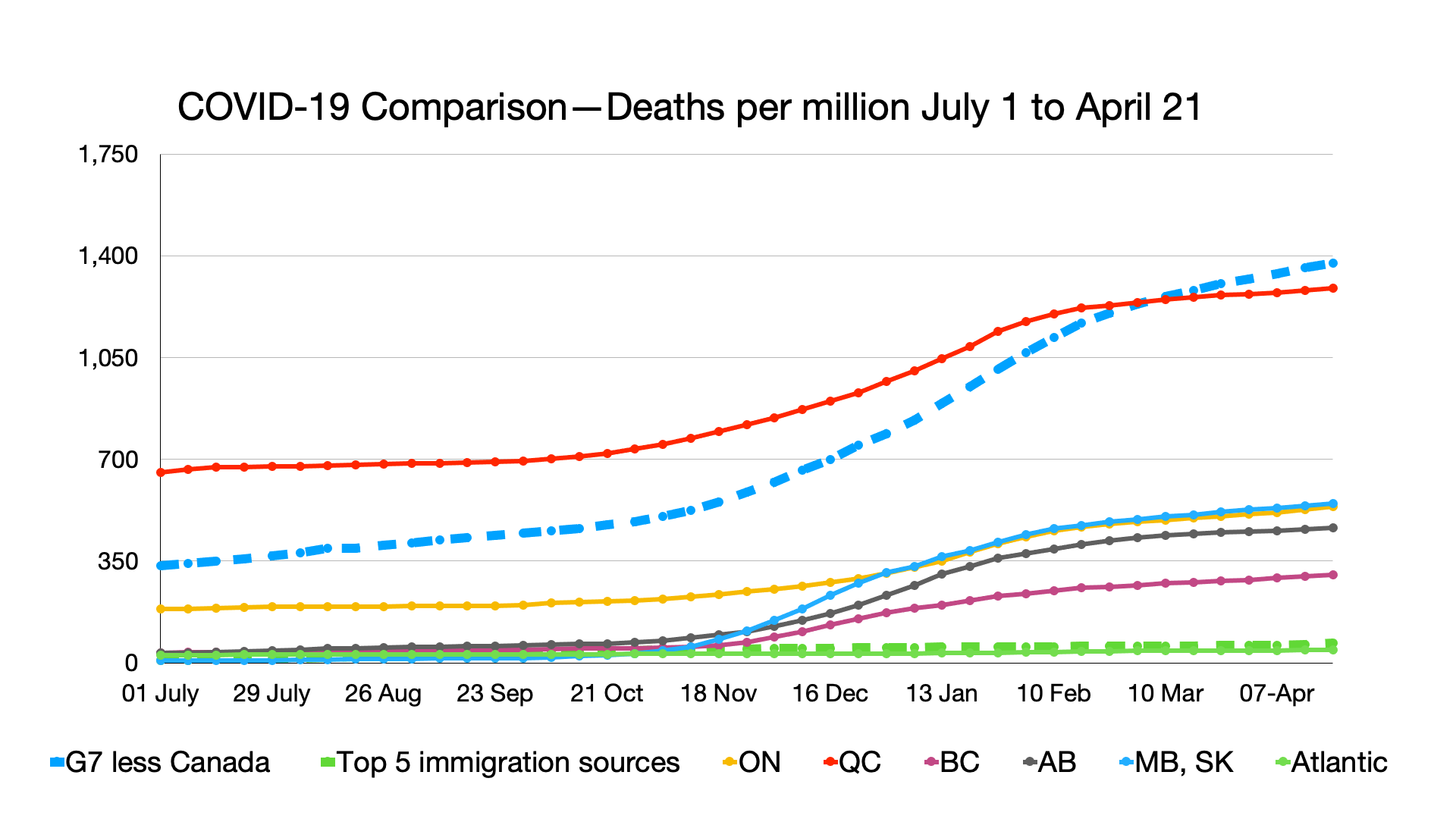
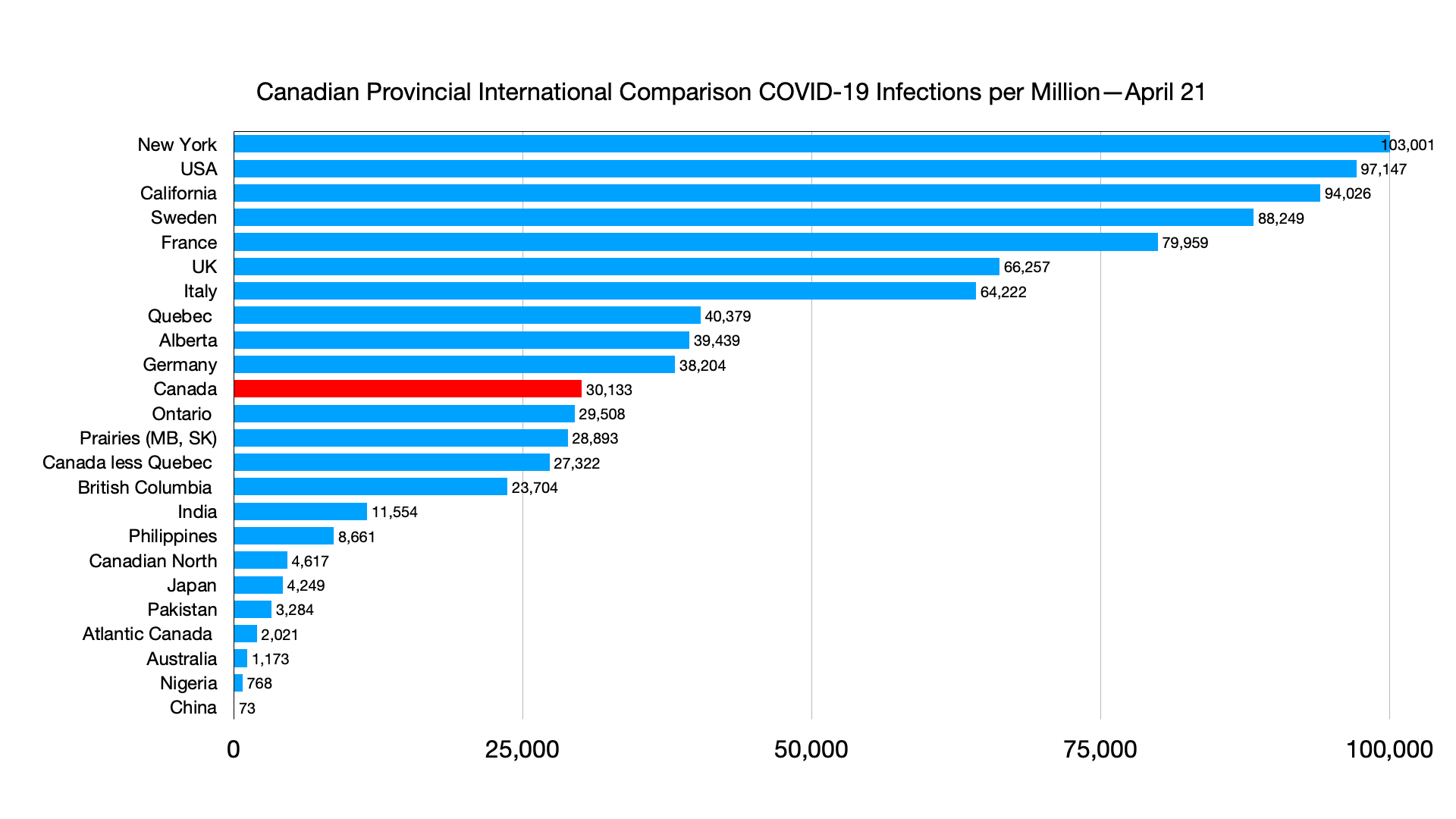
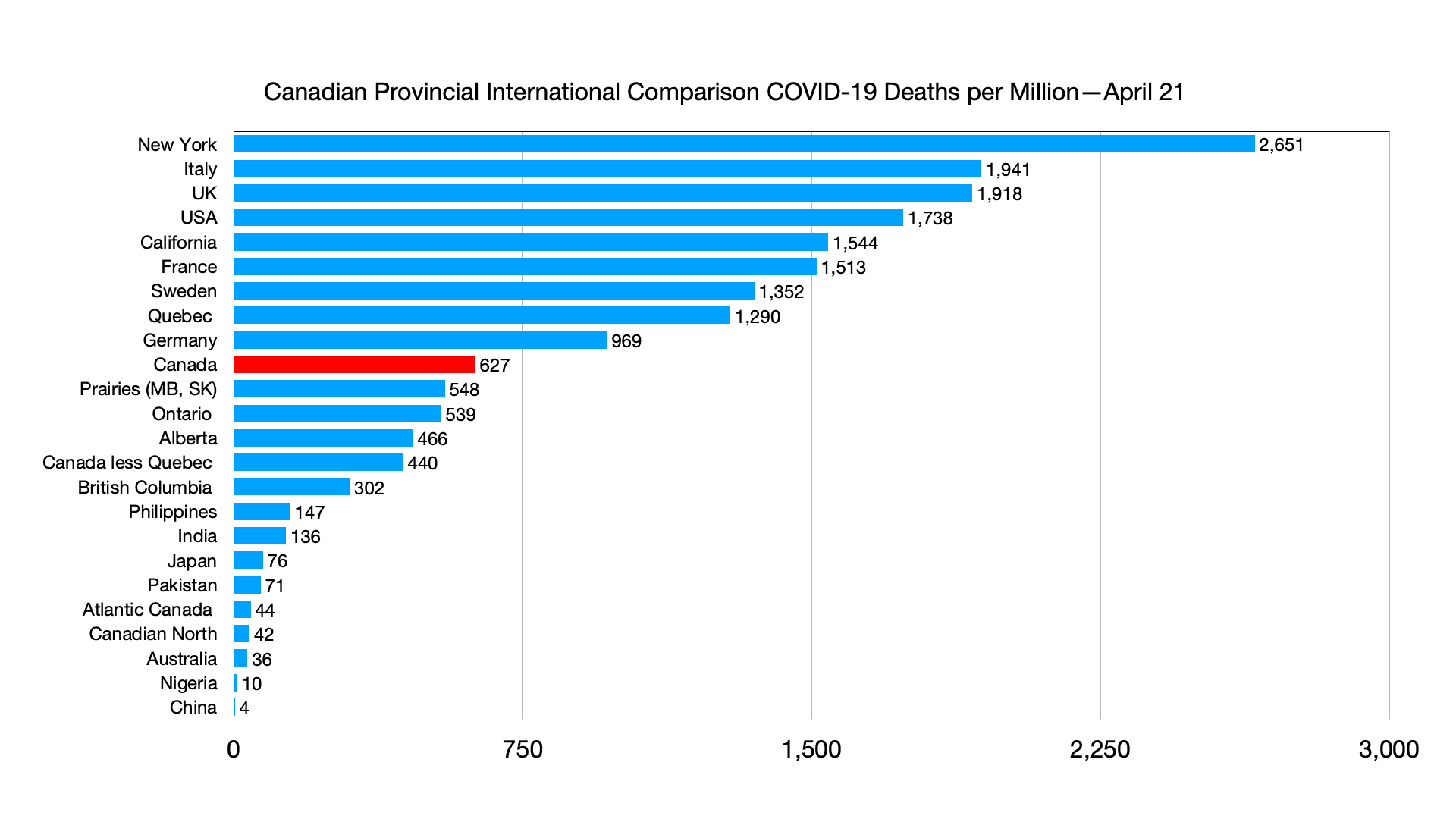
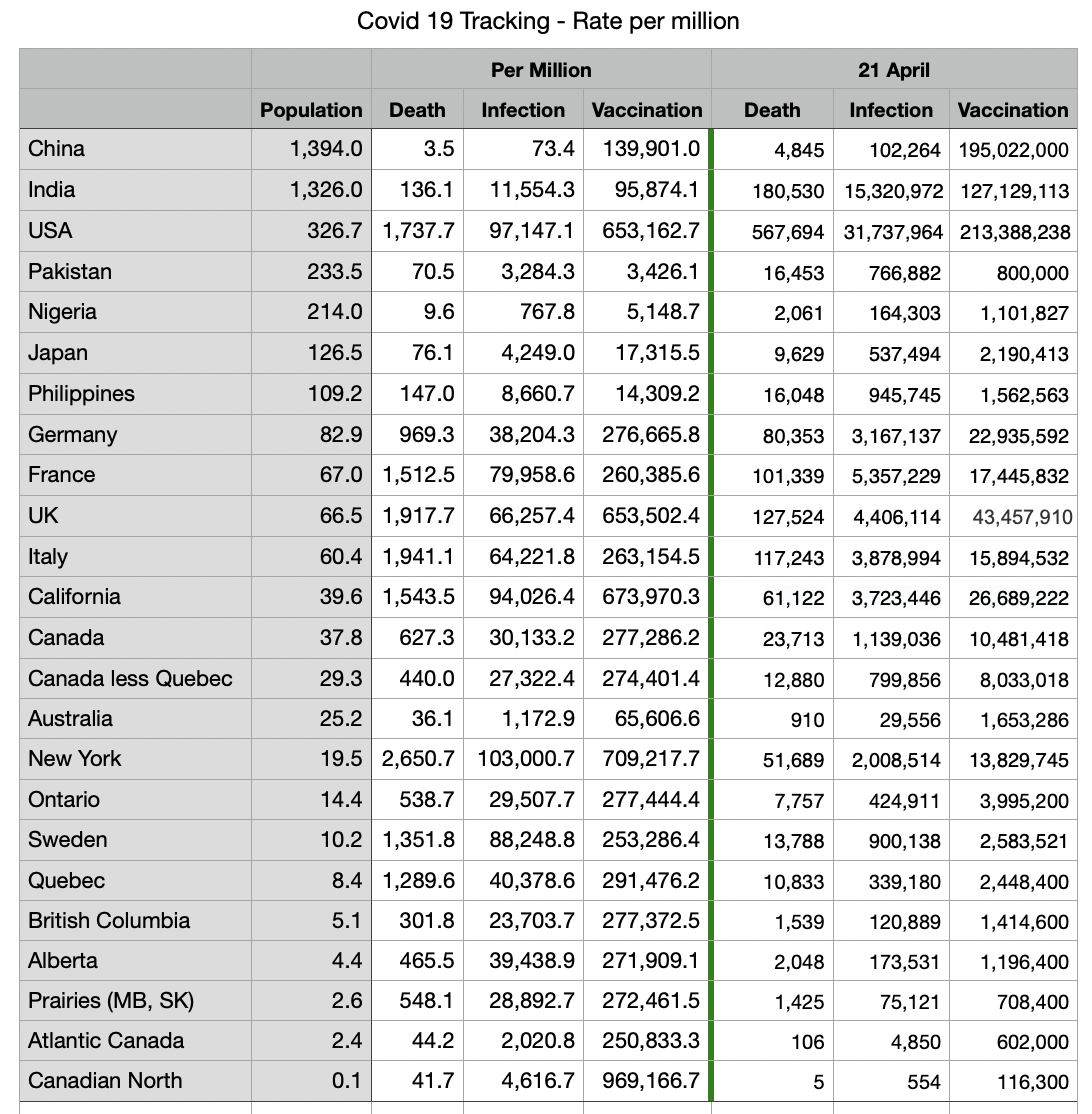
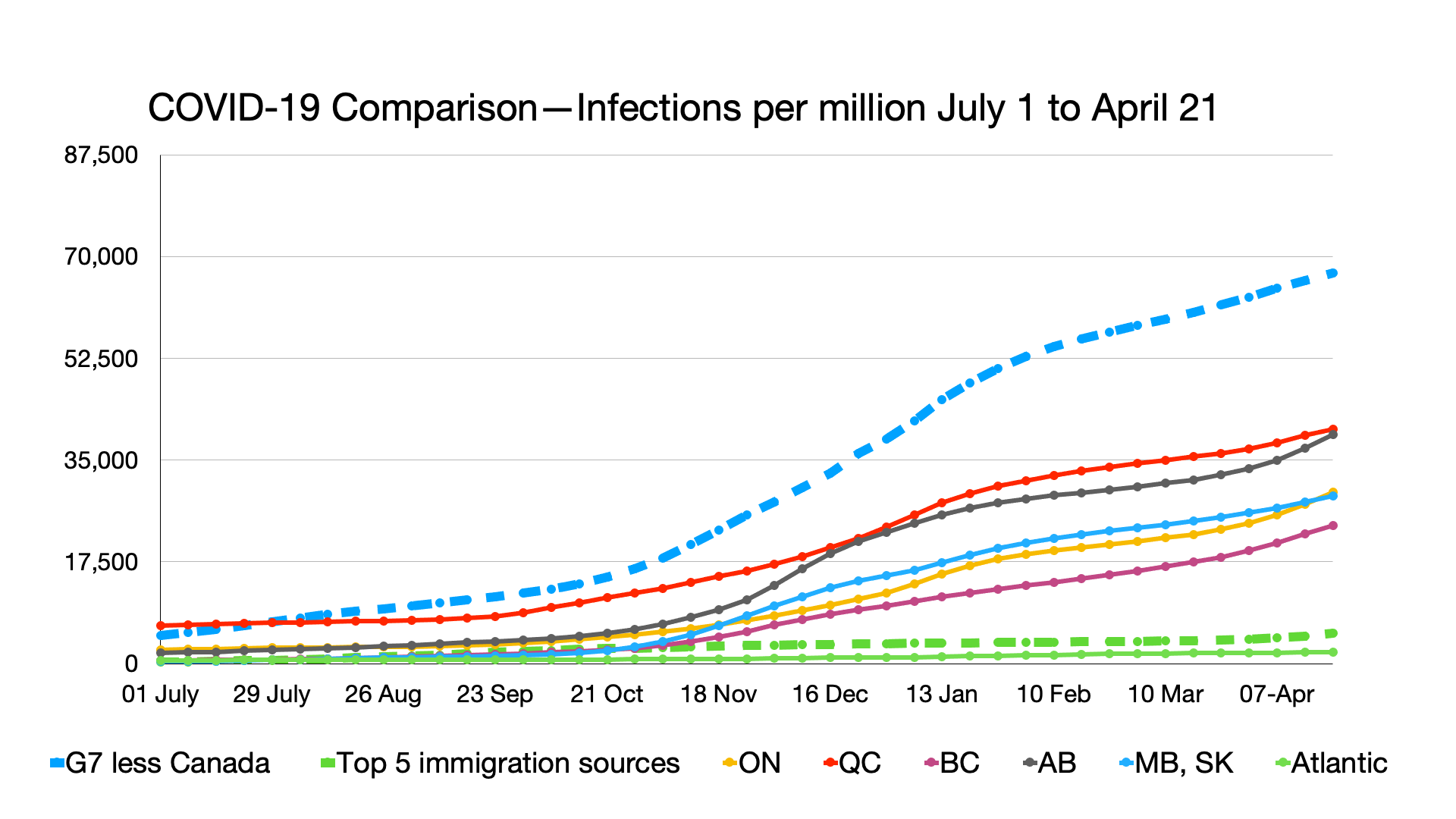
#COVID-19: Comparing provinces with other countries 21 April Update

The latest charts, compiled 21 April as the third wave has started.

Vaccinations: Overall, Canada and most provinces continue to be comparable to EU countries.

Trendline charts

Infections per million: Recent spikes in Ontario and Alberta are more apparent.

Deaths per million: No major changes save for Italy now ahead of UK.

Vaccinations per million: Vaccination rates in Canadian provinces increasing more quickly than overall G7 less Canada countries. Increases among immigration source country reflect China and India mass vaccination roll-out.

Weekly

Infections per million: Surge in Ontario means province has more infections than Prairies.

Deaths per million: Italy ahead of UK.

India is grappling with rapid increase in cases which will likely show-up in their relative ranking over the next few weeks:

Authorities said hospitals in the Indian capital of Delhi would start running out of medical oxygen by Wednesday as Prime Minister Narendra Modi said the country faced a coronavirus “storm” overwhelming its health system.

Major government hospitals in the city of 20 million people had between eight and 24 hours’ worth of oxygen while some private ones had enough for just four to five hours, said Delhi’s deputy chief minister, Manish Sisodia.

“If we don’t get enough supplies by tomorrow morning, it will be a disaster,” he said, calling for urgent help from the federal government.

Mr. Modi said the federal government was working with local authorities nationwide to ensure adequate supplies of hospital beds, oxygen and antiviral drugs to combat a huge second wave of the COVID-19 pandemic.

“The situation was manageable until a few weeks ago. The second wave of infections has come like a storm,” he said in a televised address to the country, urging citizens to stay indoors and not panic amid India’s worst health emergency in memory.

“The central and state governments as well as the private sector are together trying to ensure oxygen supplies to those in need. We are trying to increase oxygen production and supply across the country,” he said.

Mr. Modi faces criticism that his administration lowered its guard when coronavirus infections fell to a multimonth low in February and allowed religious festivals and political rallies that he himself addressed to go ahead.

India, the world’s second-most populous country and currently the hardest hit by COVID-19, reported its worst daily death toll on Tuesday, with large parts of the country now under lockdown amid a fast-rising second surge of contagion.

The health ministry said 1,761 people had died in the past day, raising India’s toll to 180,530 – still well below the 567,538 reported in the United States, though experts believe India’s actual toll far exceeds the official count.

“While we are making all efforts to save lives, we are also trying to ensure minimal impact on livelihoods and economic activity,” Mr. Modi said, urging state governments to use lockdowns only as a last resort.

One local hospital with more than 500 COVID-19 patients on oxygen has enough supplies for only four hours, Delhi’s Health Minister Satyendar Jain said late on Tuesday.

Tata Group, one of India’s biggest business conglomerates, said it was importing 24 cryogenic containers to transport liquid oxygen and help ease the shortage in the country.

The U.S. Centers for Disease Control and Protection has said all travel should be avoided to India, while British Prime Minister Boris Johnson cancelled a visit to New Delhi that had been scheduled for next week, and his government said it will add India to its travel “red list.”

Several major cities are already reporting far larger numbers of cremations and burials under coronavirus protocols than those in official COVID-19 death tolls, according to crematorium and cemetery workers, the media and a review of government data.

Delhi reported more than 28,000 fresh infections on Tuesday, the highest daily rise ever, with one in three people tested returning a positive result.

“The huge pressure on hospitals and the health system right now will mean that a good number who would have recovered, had they been able to access hospital services, may die,” said Gautam I. Menon, a professor at Ashoka University.

On Tuesday, the health ministry reported 259,170 new infections nationwide – a sixth day over 200,000 and getting closer to the peak of nearly 300,000 seen in the U.S. in January.

Total coronavirus cases in India are now at 15.32 million, second only to the U.S., with epidemiologists saying many more infectious new variants of the virus were one of the main factors behind the latest surge in cases.

Source: https://www.theglobeandmail.com/world/article-new-delhi-running-out-of-medical-oxygen-as-india-grapples-with/

Justin Ling: How Ontario’s health advisors handled the ‘darkest day’ of the pandemic

Case study of speaking truth to power:

There are plenty of tough jobs in Ontario right now: From those moving parcels at Amazon warehouses to those guiding i-beams at a condo construction site, workers are facing the grim of reality of the pandemic.

Workers are going to the job site everyday without the guarantee of sick pay if they fall ill, need to get tested or snag a much-coveted vaccination spot.

There is one particular job that might not carry the same risks, but which still isn’t inspiring much envy these days: Being a member of the Ontario COVID-19 Science Table.

The Table, composed of some 100 doctors, researchers and specialists, is the independent body that furnishes advice to Premier Doug Ford and his cabinet on how best to beat back the deadly pandemic. It is their modelling that shows Ontario careening towards 30,000 news cases per day.

But it was their advice—to shut truly non-essential workplaces, pause construction where possible, and prioritize more vaccines for front-line workers—that was summarily ignored.

Instead, they dispatched officers to police a pandemic: As a pre-teen in Gravenhurst recently found out. They promised more inspectors, but that means very little if the provincial regulations allow employees to remove their masks on the job—a recent outbreak at a provincial testing laboratory shows that nowhere is truly safe from the virus.

The whole Table is in an impossibly awkward spot. Ford continues to tout their work, insisting it has informed his own approach to the pandemic. But, in practise, his actions have consistently been directly at odds with the advice from the Table.

Last week, as the divergence between advice and action grew wider, talk around the Table turned to mass resignation. A protest, in essence, of being used by a government that appears to have little interest in a science-based approach to fighting the pandemic.

But the majority of the Table opted, instead, for a softer approach: One that retains cautious optimism that the Ford government may yet see the light, and pursue measures that may actually avert a worst-case scenario in the province.

To underscore their position, the Science Table drafted a letter to the government with pointed advice on what to do next. It’s a letter that lays out the choice the Ford government faces. Whether or not he will make the right decision is, ultimately, up to him.

***

On Friday afternoon Dr. Adalsteinn Brown, the co-chair of the Science Table, appeared alongside Dr. David Williams, the province’s Chief Medical Officer of Health to present new modelling on the risks facing the province.

“Without stronger system-level measures and immediate support for essential workers and high-risk communities, high case rates will persist through the summer,” the presentation warned.

Brown said financial support for workers and strict measures for workplaces were desperately needed: “We need to stop infection coming into our central workplaces,” he said.

Vaccines, he added, were a central part of the strategy but wouldn’t solve this problem on their own.

The lines on the graph were three colours: Green, which rose slightly, then bent towards the X-axis. Yellow, which wobbled upwards so slightly—hovering right above 10,000 cases per day. And, finally, the red line: A line that sloped menacingly upwards, past the 30,000 marker.

Ontario is currently trending along the yellow line.

Red, yellow, and green dotted lines shadowed each of the solid lines: They represented what case counts would look like if Ontario managed to ramp up from the status quo, 100,000 vaccines administered per day, to an arbitrary number of 300,000 shots per day.

“Under every scenario, more vaccines mean a faster resolution in the long-run,” the presentation explained.

The Table communicated the crisis looming, and provided clear advice on how to avert disaster—both publicly and privately.

Hours later, after prolonged cabinet discussions, Ford appeared in front of television cameras to announce his decision: Playgrounds and outdoor sports would be banned. Outdoor gatherings forbidden, for members outside our household. Police would be dispatched to enforce the orders, with nearly-limitless authority to stop and question anyone in public. More inspectors would be dispatched to workplaces, but there would be no meaningful change to what constituted an ‘essential’ workplace. The number of vaccines reserved for frontline workers in hotspot zones would be set at 25 per cent.

The premier waved a sheet from Brown’s presentation: The chart showing the case projections. He seized on the idea that 300,000 vaccines could blunt this punishing third wave. “Would we be in this position if we were getting 300,000 doses a day back in February? Like the rest of the world? The answer is absolutely not,” Ford said.

The province looked on in alarm. The premier was, effectively, announcing a police state. Meanwhile, he was ranting at the federal government for not sending enough vaccines. When asked directly why he couldn’t shut more businesses, Ford explained how “deep” the supply chains were—light switches wouldn’t be made, he explained.

Reaction from the public was swift, and horrified. But the members of the Science Table, in particular, were beside themselves. Brown and fellow co-chair Brian Schwartz sent an email to dozens of his colleagues on the Science Table.

“We know that many of you are frustrated and angry after today’s announcements,” Brown and Schwartz wrote.

“We did the right thing,” they wrote of their early afternoon briefing, which set the stakes for Ford’s 4 pm announcement. The research and data, furnished by members of the table, they wrote: “Made it possible for us to be firm in saying what we know should be done to fight the pandemic.”

Several members of the Table took to Twitter to blast the decision. One member, Dr. Andrew Morris—who is a University of Toronto professor of medicine, a medical director in the Sinai Health System, and who co-chairs the Table’s working group on drugs and biologics—called the decision “criminal.

Many of their blistering repudiations of the government’s decision were splashed on the frontpage of the Toronto Star on Saturday morning.

Brown and Schwartz didn’t discourage the comments. “The only thing we would ask is that you speak truth to power in the same way you would conduct any other discussion,” they wrote.

They summed up, in bullet points, the recommendations and analysis they had been providing for weeks: More vaccines for high-risk communities, close businesses that are not absolutely necessary, do more to protect workplaces that must remain open, create dedicated sick leave benefits, reduce mobility within the province, and encourage people to meet outside safely.

“Unfortunately, our advice does not align with what the cabinet announced this afternoon,” they wrote. “That requires serious discussion.”

Brown and Schwartz signed off the email, recognizing that many of the members were actually on the front-lines of this deadly fight. For those still on clinical duty, they wrote, “we wish you and your patients the very best through this exceptionally challenging weekend, and that you get a few moments of rest too.”

They arranged a 10 am Sunday morning meeting to discuss next steps.

In the outside world, pressure was mounting. Registered Nurses Association of Ontario CEO Doris Grinspun called for the Science Table to “resign en-masse.”

***

On Saturday afternoon, the Ford government appeared to walk back its enforcement measures, which would have given police nearly unfettered power to stop and interrogate people out for a walk, or driving, and ask their home address and purpose for being out in public.

The retreat came after nearly every police force in the province said they would refuse to conduct the arbitrary stops—journalist Andrew Lawton found that only the Ontario Provincial Police said they would enforce the measures.

Yet the supposedly walked-back regulations still allow police to stop anyone on the suspicion that “an individual may be participating in a gathering that is prohibited.” Of course, provincial regulations now ban any outdoor gathering, except for those in the same household. The new regulations allow police to demand the individual provide “information for the purpose of determining whether they are in compliance with that clause.”

Lawyers pointed out that the new, supposedly “refocused,” measures actually gave police more power to interrogate Ontarians on flimsy grounds. A group of young skateboarders in Gravenhurst would learn that reality pretty quickly on Sunday morning. Leanne Bonnekamp’s 12 year old son was out skateboarding with friends—in a park near the YMCA, as the skate parks were closed by provincial order. That’s when a cop approached.

“Two officers showed up, yelled at these kids—that they weren’t wearing masks, and weren’t socially distanced,” the boy’s mother, Bonnekamp, told me. One of the Ontario Provincial Police officers demanded the kids’ ID, and was running it in his cruiser as his partner stayed with the other youth.

Bonnekamp’s son was giving the officers attitude for the arbitrary stop—though no profanity, she says—as the cop gripped his scooter. In the video, the officer can be seen reaching over the scooter and shoving the pre-teen, who falls on the ground. When another youth asks just what in the hell the officers are doing, the cop yells “he’s failing to identify.”

The OPP says they are investigating the officer’s actions.

The same weekend, an outbreak in Toronto put into sharp focus the inadequacy of the government’s workplace measures. An outbreak of cases in a Toronto lab, run by Public Health Ontario to analyze COVID-19 tests, infected 16 employees.

The agency’s president Colleen Geiger sent an email to staff, which was forwarded to Maclean’s, indicating an investigation into the outbreak was ongoing and that they would identify “areas that require improvement.” Close contacts of those who tested positive, Geiger wrote, were already isolating. Other staff would be tested onsite.

One employee, who contacted Maclean’s with details of the outbreak but asked to remain anonymous because they were not authorized to speak to media, said the outbreak was just waiting to happen. Social distancing in the lab is nearly impossible and good public health measures aren’t being enforced, they wrote. Masks are often worn improperly and limits posted by the lunch tables and elevators aren’t respected.

This outbreak isn’t even the first. Previous instances where employees of the lab caught COVID-19 are “posted on bulletin boards that are tucked away in corners of hallways.”

The employee, quite correctly, argued that “Public Health of Ontario should hold a higher standard than the rest of Ontario residents and I find it shameful that this outbreak could have been avoided.”

Public Health Ontario confirmed to Maclean’s that 16 staff fell ill. “Diagnostic testing for COVID-19 as well as other infectious diseases are continuing as normal and there is no impact on laboratory services at this time,” they wrote.

If the provincial lab responsible for processing COVID-19 tests can’t even keep safe, how much trust can we put in other workplaces?

***

Sunday morning, Dr. David Fisman—professor of epidemiology at the Dalla Lana School of Public Health at the University of Toronto, and a member of the Science Table—wrote to the other members: “My concern is that the science and modeling tables are being used as cover.”

“What we saw on Friday was exactly the sort of thing I’ve been concerned about: Meaningful guidance from this group was disregarded,” he continued. “But the premier took the time to hold up a graph in which a hypothetical 300,000 vaccines per day scenario was plotted, and indicated that this would be the way forward.”

“As I have said at our meetings, at some point this starts to feel like aiding and abetting a government that has prosecuted a pandemic response that frankly feels negligent, or even criminal,” Fisman wrote.

“I don’t think I am on the same team as this government.”

That intense frustration was shared by many of his colleagues.

In an interview with Maclean’s, Morris said he was “dumbfounded” by the Friday announcement. At the same time, he called it an “apex” of a trend that has been growing over the course of the pandemic.

“When we get to Friday, they come out with these measures that are absolutely antithetical to the beliefs and advice of the Science Table — en masse, and individual members,” Morris says. “I don’t think there’s a single member who would have recommended those things.”

He phrases it as a consistent and repeated “gaslighting” by the government.

“Friday, for me, was probably my darkest day in my professional career,” says Dr. Peter Jüni, the scientific director for the Science Table—who is also a world-renowned researcher and a professor at the University of Toronto.

Jüni told me he found himself asking: “Were we not clear enough?”

“It’s pretty clear that there is a gulf between what the Science Table has recommended and what the policy announced in the province was. That’s clear,” says Dr. Isaac Bogoch who sits on the Table’s modelling working group, teaches at the University of Toronto, and who consults on infectious disease outbreaks at the Toronto General Hospital.

When the entire Table joined a Zoom call on Sunday morning, there were divergent views on what to do. Some wanted them all to resign, as a show of force that the government couldn’t use their modelling but ignore their advice.

But, as Bogoch notes, the public outcry about the measures actually prompted a retreat. The Ford government, perhaps more than the average government, is intensely sensitive to criticism. The Table’s advice—enabled by their independence, both from government and from any kind of particular hierarchy—no doubt enabled that public backlash.

There was also some pessimism about whether resigning would have much impact.

“I’m not sure, personally, what resignation would do,” Morris confesses. Bogoch agrees: They still have a job to do, he says. Being ignored “doesn’t mean you fold up your tent.”

Jüni, who publicly mused about resigning, came to a similar conclusion. “I could make a point, not a difference,” he says.

One feeling is particularly stark: The Science Table fears what, if anything, will replace their advice and modelling if they leave.

“There’s no question there are times, it has felt to many people, like we’ve been played,” Morris says. With resignation off the table, his mind turned to: “How can we avoid being played like that?”

***

What, exactly, the Ford government is going to do next is an open question. On Monday, after a brutal weekend for the Ford government, I got on the phone with someone in the Premier’s office. We agreed on anonymity so they could speak freely.

They certainly acknowledged the blowback that came from Friday’s announcement, and recognized more action would be necessary to stem the transmission of the virus. And they were quick to highlight the areas where they did, general speaking, follow the Science Table’s advice. Chiefly, Ford announced his government would dedicate 25 per cent of the vaccine supply for frontline workers in hotspot neighbourhoods.

The Science Table, I pointed out, recommended allocating 50 per cent of the vaccine supply. The government source said: Well, if we had done 50 per cent, they would have called for 75 per cent.

At another point, I noted that the Science Table was apoplectic about how virtually nothing was being done to shut truly not crucial construction projects. Yes, the source said, but the construction industry was furious.

(Indeed, the Ontario Construction Consortium attacked the government’s order barring non-essential construction, bizarrely insisting that “a recent snapshot of 10,000 Workplace Safety and Insurance Board (WSIB) claims related to COVID-19 since the pandemic began showed that fewer than 200 of those cases originated in the construction industry.” Provincial data shows that, since the start of the pandemic, some 10,000 cases were a direct result of outbreaks at offices, warehouses, and construction sites.)

But the balancing act this government is striving for is exactly the problem: Splitting the difference, or trying to strike a balance between rigorous scientific advice and the construction lobby is not a wise or successful move.

“How does a cabinet—that has even a rudimentary understanding of what’s going on—how do they deliberate over numerous hours over two days and come up with this?” Morris asked me.

“If you do half measures, you hurt everybody,” Jüni says. “Including the economy.”

The province has dedicated more inspectors for these workplaces, but its own advice is faulty: The Government of Ontario’s official policy on masks in the workplace holds that “you do not need to wear a face covering when you are working in an area that allows you to maintain a distance of at least 2 metres from anyone else while you are indoors.” (The provincial regulations state that workers may be maskless if they can maintain social distancing and are in an area inaccessible to the public—a construction site, for example.)

That is a fundamentally backwards policy that ignores the strong likelihood of airborne transmission. If workplace inspectors are continuing to enforce that standard, the inspections are going to be largely ineffective.

Things that the science table believes are going to be helpful is more support for workers, essential workers, to access support—primarily financial support so that they can get vaccinated, tested or stay away from work if they’re unwell.

When asked directly whether the government would finally retreat, and ensure sick leave for workers in the province, the government source said they were waiting to see whether Monday’s federal budget would do the job for them. Even though labour law, including sick leave, is explicitly provincial domain, they said, they wanted Ottawa to act.

The federal budget did, in fact, expand the Employment Insurance sickness benefit—but that support is claims-based, meaning it isn’t automatic nor does it mean much for an employee who suddenly falls ill. Those employees, clearly, need sick leave: Something many employers still refuse to provide, but which the provincial government can mandate.

The government source said, despite the Ford government’s dogmatic opposition to date, the government would give “serious consideration” to sick leave. But it would be unlikely any decision would be made anytime in the near future.

Part of the Ford government’s commitment to the status quo seems to stem from their belief that things are heading in the right direction. The government source said that, while things may change fast—and new ICU admissions could force their hand—they do not anticipate announcing new measures this week.

Asked where this optimism was coming from, the source pointed to the mobility data found in the Science Table’s modelling showing that, in recent weeks, fewer people have been travelling outside their home. If mobility trends downward, they think, case counts will flatten.

But that, too, runs contrary to the advice from the Science Table. “Mobility is a surrogate for contact,” Jüni says. “It’s a marker. It isn’t causal.”

As Jüni points out, declining mobility could be a sign that, through general anxiety or enforcement measures, people are staying indoors—a good sign, if social gatherings are driving transmission.

Provincial data shows that a significant number, likely the majority, of COVID-19 cases in the province are coming from workplaces and schools. I asked for data to prove that private gatherings were driving significant caseloads, but have yet to receive it.

On the flipside, however, mobility trends might not mean much if Ontarians are leaving home to engage in low-risk activity, like meeting friends in a park, or going for a walk.

The more I cited the Science Table’s work, the more the government source suggested the advice was at odds with itself. Or unclear. Or, for example, that the Table couldn’t agree on advice about the safety of gathering outdoors.

The Table doesn’t see it that way. Jüni himself presented before cabinet. “Outdoors is safe,” he told them. It can be made more safe, he added, but he says he was abundantly clear. “I do not know what more I could do,” he says.

Morris echoes the sentiment: He says it is “essential” that the province provide clear advice, encouraging outdoor activity.

***

On Tuesday afternoon, the Science Table issued a letter to the Ford government, entitled: The Way Forward.

“Ontario is now facing the most challenging health crisis of our time,” the Table wrote. “Our case counts are at an all-time high. Our hospitals are buckling. Younger people are getting sicker. The disease is ripping through whole families. The Variants of Concern that now dominate COVID in Ontario are, in many ways, a new pandemic. And Ontario needs stronger measures to control the pandemic.”

The letter put to paper, publicly, what the Table has been telling the Ford government emphatically since the third wave began swelling.

It proposed clear strategies—things the Ford government is pointedly not doing:

  • Reducing the list of essential workplaces allowed to remain open to be “as short as possible,” and ensuring that those workers wear masks on the job.
  • “Paying essential workers to stay home when they are sick.” And not, they note, the federal Employment Insurance benefit, which is “cumbersome” and inadequate.
  • Allocating as many vaccine doses as possible to hotspot communities and essential workers—and ensuring “on-the-ground community outreach” to connect doses to those workers.
  • Providing “public health guidance that works.” That means communicating a simple message: Indoor gatherings should be strictly forbidden, while underlining that “Ontarians can spend time with each other outdoors” while social distancing. That means allowing small gatherings of people from different households, while also encouraging masks and two metres distance.

The letter warns that “inconsistent policies, with no clear link to scientific evidence, are ineffective in fighting COVID.” That includes, they wrote, policies that “discourage safe outdoor activity.”

The premier isn’t mentioned by name in the letter, but the closing lines offer a stark warning for the government:

“There is no trade-off between economic, social and health priorities in the midst of a pandemic that is out of control.”

Source: How Ontario’s health advisors handled the ‘darkest day’ of the pandemic

@Justin_Ling #COVID19: How did it come to this?

One of the best overviews I have seen:

After a year of struggling with this pandemic, science has developed a relatively good grasp of COVID-19.

We know that it is difficult to catch the virus from surfaces: Sanitizing your groceries and obsessively covering your hands in hand sanitizer is probably unnecessary.

We know community spread is driven, in large part, by large outbreaks and super-spreader events: Big gatherings lead to explosions of cases.

We know that indoor transmission is particularly dicey because the virus is easily aerosolized: Many people can get sick very quickly if they congregate indoors.

We know that outdoor transmission is possible, but unlikely: A combination of air flow and UV light means the virus can’t get very far.

We know vaccines are incredibly effective and safe, but that herd immunity will be needed to stop community spread: They can protect the elderly but won’t stop community spread until the vast majority of people are vaccinated.

While there’s clearly room for smart people to disagree on the details of those conclusions, they have been born out by an emerging body of science. New variants have changed the math a bit, but haven’t fundamentally altered those facts. Early in the pandemic, when these truths and solutions were murkier and less clear, absolute lockdowns, stay-at-home orders and border closures were the safe and prudent choices. Advice on washing your hands and not touching your face were reasonable, cautious, suggestions.

It’s a year later. Those five facts are now incredibly well documented in the scientific literature.

Understanding more about the virus has allowed more effective strategies to come into focus: Avoid indoor gatherings whenever possible. When they can’t be avoided, have as few people indoors as possible, keep people apart from each other, make sure they mask up, and circulate air with good HEPA filters. Where possible, move people outside—and actively encourage the outdoors as an alternative for people who may ignore good public health advice.

Those solutions, of course, are easy to write and hard to implement. Warehouses, prisons, meat processing plants, greenhouses, schools: Even when these places follow the rules most of the time, religious adherence around the clock can be hard to maintain.

So that’s why mass, randomized, testing and aggressive contact tracing is necessary to catch outbreaks before the virus moves down the chains of contact and creates new outbreaks. Shutting down those locations where the outbreaks occur is necessary. When things slip through the cracks and community spread begins, short-term circuit-breaker lockdowns should be a last resort to get cases under control.

There’s no real debate about this. These strategies work: As Atlantic Canada, New Zealand, Australia, Singapore, and a host of other states have proved them effective.

And yet, most of Canada is in the midst of a punishing third wave. Public health officials continue to insist washing our hands will get us out of this mess. Politicians warn us to stay indoors, avoid the outside.

Ontario’s health-care system is hanging on by a thread. Other provinces could be in a similar spot soon.

We are here, in large part, because many of our politicians have ignored the core facts of the COVID-19 virus and the main strategies that will clearly fight the pandemic.

Heading into the spring, off the back of the second wave, the premiers of these provinces have insisted that they were special. That they could reopen the economy—and brag to their voter base about their rosy jobs numbers—without consequence. The leaders of every province west of New Brunswick have laboured under the belief that their gyms, places of worship, and workplaces could open, even amid uncontrolled community transmission, and nobody would get sick. These governments have been sure that they have grown more clever, more agile, more adept than the virus.

Those governments have been wrong, and people have died because of it.

And when things have gone wrong, all the things governments promised us they had done turned to sand. In most of the country, mass testing was promised and not delivered—Ontario and Quebec require appointments, and have not expanded their testing capacity in any significant way since last year. Contact tracing has been essentially abandoned on a provincial basis. Circuit-breaker lockdowns didn’t touch the industries most responsible for spreading the virus.

Governments have begged us to stay at home—except if you need to go to work in an Amazon warehouse (600 cases); the Cargill chicken processing plant (82 cases); the Saskatchewan Penitentiary (more than 260 cases); St. Michael’s Ukrainian Catholic Parish, where congregants could gather without masks (10 cases); Mega Gym, which the Quebec government permitted to re-open (400 cases), and so on.

It is infuriating to find ourselves in the third wave, only to learn that we haven’t learned a damn thing.

Governments have pointed to the variants as some terrifying change in the equation. And, yet, look at Ontario’s data: This is just a ramped-up version of the same virus we’ve been fighting since March, 2020.

In late February of this year, in the lull between waves, nearly 60 per cent of cases could be attributed to a specific outbreak and/or a close contact of someone who tested positive. (A bit more than a third of cases had no known epidemiological link, a failure in and of itself.) In late March, as the third wave was in full swing, that proportion remained unchanged.

Where those outbreaks have occurred haven’t changed much, either.

Around 30 per cent were in congregate living or care spaces: Hospitals, prisons, shelters. Around 30 per cent were in schools. The remainder, about four-in-10 outbreaks, were workplaces.

Recently, Ontario has provided more visibility on the types of workplaces experiencing outbreaks: Hairdressers, restaurants and retail stores are responsible for vanishingly few superspreader events—between the three, they caused just eight per cent of overall outbreaks.

Even as case counts were climbing, and outbreaks were being reported across the province, people congregated on patios at bars and restaurants. In mid-March, before that naughty behaviour was banned, bars and restaurants reported eight outbreaks across the province: 37 cases in total. (This proportion hasn’t changed since last summer, when case counts were low and bars and restaurants were open.) That same week, there were 66 outbreaks in warehouses, food processing plants, and farms: 479 cases.

Dig into the data, as the Globe & Mail has done, and the absurdity becomes more acute: these outbreaks are happening in facilities that manufacture sporting goods. A retail marketing firm. An Amazon warehouse.

Many outbreaks also occurred in settings run by governments. There has been widespread transmission of the virus inside prisons and jails—which governments have been criminally inept at preventing. Shelters, too: Ontario’s data shows there are 32 ongoing outbreaks in shelters across the province.

This story is about the same from one province to the next. The data speaks for itself: Workplaces and schools are driving transmission of this virus. Were the whole country to lock themselves in their closets, except for those students and “essential” workers, the crisis would continue.

An emerging body of research explains what’s happening here. From the start of the pandemic, leaders have told us that the concern is about the transmission of droplets—and, rightly so, because the early science suggested that saliva particles from speaking, coughing or sneezing was the main driver of transmission. Good science is increasingly telling us that the virus is aeresolized.

That means we ought to be less fearful of tiny blobs of the virus covering everything—our hands, our faces, our picnic blankets—and more worried about the air around us. If you think about the virus that way, it becomes immediately obvious how much less risky it is to sit with some friends for a picnic, or on a restaurant patio. Conversely, how risky it is to run a warehouse with hundreds of workers, exerting themselves.

Have governments addressed this? No. Instead, governments have proffered curfews, as though the virus hunts at night. Parks have been closed. Camping has been banned. Outdoor mask mandates have been implemented. Outdoor gatherings limited. Police patrols to harass people out for walks.

Even as projections have shown Ontario teetering on the brink of a deadly crisis, Premier Doug Ford’s solution was to limit outdoor gatherings and to shut outdoor recreation sites.

But here’s the rub: Provinces know outbreaks aren’t happening in parks, or on patios. Quebec public health officials have acknowledged that they have no evidence to prove transmission is happening outdoors. Peer-reviewed studies have said that, on the high end, some eight per cent of global COVID-19 cases were linked to transmission outdoors. On the other end, Ireland studied its own data and found 0.1 per cent of cases occurred outside. Air quality monitoring done in Italy in the height of the second wave found the prevalence of the virus in the open air waseither negligible or not high enough to lead to transmission. (Though researchers admitted that dynamics could change in very crowded areas.)

Scaremongering about outdoor transmission, and instituting curfews is a feat of social engineering. This an effort to ignore the data, withhold information, and twist the facts to scare us.

The conspiracy-minded will see that as an exercise in population control: Politicians getting their jollies off by playing dictator.

The reality is more mundane—governments are doing this because they are frozen with indecision. Actually acknowledging the reality of the data means acknowledging this catastrophe was caused by governments’ idiotic reopening plans: Plans that were warned against by public officials at the time. Doing that means taking action that will hurt employment numbers, which could hurt our politicians fragile egos. Confronting this data and science also means admitting that all of our advice about washing your hands and not touching your face has been useless. And accepting that reality means provinces requiring sick leave, so people can go home if they’re ill.

Governments are loath to do any of that. They would rather shower us in meaningless pablum about how we, as citizens, need to do our part. The implication, of course, is that we are to blame for this crisis. That it’s us wayward youth who are driving this pandemic. Our lack of personal responsibility means they have to ground us to our rooms. Stay home, for god’s sake!

If our politicians stop blaming us for outbreaks, we may start blaming them.

And for good reason.

We need to stop talking to people like they are infants to be controlled. Especially when the politicians issuing these stay-at-home orders have zero credibility with which to be lecturing anyone. Any bit of trust people have in Doug Ford, Francois Legault, Scott Moe, Brian Pallister, and John Horgan has been shredded, and lit on fire.

In Atlantic Canada, the territories, and in Indigenous communities across the country, politicians of various political stripe show what real leadership looks like. How effective management means trusting the public while also accepting responsibility.

The rest of our provincial politicians need to act immediately to undo the damage they have enabled. Businesses need to be shut, unless they are absolutely essential. Those that need to remain open need stringent measures to deal with air quality. Given the pressure it puts on parents and students, schools should probably remain open: But, again, actual measures need to be taken to reduce the risk of that aerosolized transmission.

And we need to provide clear, coherent advice to people on what to do. Advice that follows the science.

We need to avoid indoor gatherings as much as possible. We should wear masks whenever possible. We should give each other two metres of distance. We should stay home when we have any symptoms, check our temperatures daily, and get tested if we feel sick.

But we also need to tell people what is safe. And it is very safe to go outside—it is extraordinarily safe, in particular, if you give people a little extra space and avoid crowded areas.

Have a picnic. Hold a barbecue in your backyard. Go for a walk. Play tennis. Go camping.

People need hope. Lying to them won’t engineer a solution. Politicians need to do their job.

Source: How did it come to this?

Remaking the public service: After a year of COVID, what has the federal government learned about how it operates?

Useful and informative overview:

Not since the Second World War has the federal government loomed so large over the affairs of Canadians. During the first ten months of the pandemic — from April 1, 2020 to January 31, 2021 — the government shelled out half a trillion dollars compared to $287 billion during the same period in 2019.

The vast majority of the increase was courtesy of emergency spending on an extraordinary range of anti-virus measures.

About $78 billion was taken up by programs to help individuals directly affected by COVID-19. Another $66 billion went towards subsidizing wages of employees who would otherwise be laid off. Billions more were directed at shoring up the weakening balance sheets of small business, and to secure vaccines, testing equipment and personal protective gear.

At times, it seems scarcely a segment of the economy has been left untouched by Liberal government largesse, which by the end of January had pushed the federal net debt to $1.1 trillion. This represented more than half the country’s gross domestic product, not a record by any means, but up from less than one-third practically overnight. This does not include the rapidly deteriorating balance sheets maintained by the provinces.

While the potential risks associated with this level of debt have been put off until the virus has been tamed, the impact of the sudden spending spree on government operations has been profound.

In the year of COVID, dozens of federal agencies and departments have been forced to behave in starkly uncharacteristic ways.

Deep-rooted policies were re-crafted on the fly, procurement moved at warp speed and multiple departments were tasked with building a health products industry nearly from scratch.

On top of this, key ministries are about to be tasked with managing an ambitious program, to be outlined in the April 19 federal budget, to refurbish the country’s infrastructure and help jumpstart the post-COVID economy.

Behind the scenes, government executives are ramping up plans for modernizing operations. They are also asking themselves what permanent lessons they should draw from the tumult of 2020.

These range from the profound: how to prepare for a new pandemic, to the practical: how should government better organize itself for the digital world?

The first lesson involves drilling into the overarching weakness of Canada’s response to the coronavirus — not just the egregious intelligence failure of the Public Health Agency of Canada, but also the relaxed oversight of a cabinet that could not bring itself to accept a worst-case scenario.

PHAC had assured Canadians the health risk to them was low early last year even as the coronavirus was circulating widely.

At heart, this was a failure of leadership culture, not a lack of early warning. The infection that became known as COVID-19 was in plain sight from the start. What PHAC missed, or at least declined to act upon, was the fact that COVID-19 was spreading asymptomatically, despite evidence that had been brought to its attention.

The result was a sharp, early rise in the number of infections, followed by a sub-par rollout of COVID-19 vaccines, which reflected a general lack of preparedness.

For other departments and agencies, the lessons of COVID are more straightforward.

The rapid spread of the coronavirus has demonstrated clearly the importance of the digital world. While the federal government has built one of the country’s largest communications networks, much of it is in need of refreshing and very little is easy to use.

The technology gaps were particularly shocking when it came to tracking stockpiles of personal protective equipment, conducting tests for the coronavirus and tracking the networks of people affected. This was both a provincial and federal government failure.

Anxious to avoid a repeat, federal departments in the past few weeks have developed ambitious plans for upgrading their infrastructure, and expediting new online services for Canadians. Whether these actually succeed will depend heavily on the government’s willingness to reverse its traditional antipathy for investing in operations. Encouraging executives to bear direct responsibility for projects will help.

“The path set out during the early days of the pandemic points to a new way of doing business,” the Canada Revenue Agency declared in its priorities report for the fiscal year ending March 31, 2022.

The agency, which spends half a billion dollars annually on information technology and was a key player in the delivery of the Canadian Emergency Response Benefit, is making permanent adjustments to its networks to give it more flexibility in the event of future crises. It is also developing a series of software applications to simplify tax returns, permit more tax verification information to go online and automate more of the tax filing process.

Employment and Social Development Canada is managing a massive, multi-billion dollar upgrade of the systems that deliver Canada Pension Plan, Old Age Security and other payments. While that was in train before the pandemic, the urgency has increased.

“Past decisions to defer maintenance and updates have increased the risk of systems failure,” the department noted bluntly in its most recent plan, “Modern applications need up-to-date technology.”

During the first few days of the economic lockdown a year ago, ESDC’s system for delivering employment insurance claims very nearly crashed. The department now has in place a program for accelerating its investments in information technology until 2026 to try to make up the gap in its capacity.

ESDC is hardly alone in playing catch-up.

Federal departments across government currently maintain some 14,000 software applications, ranging from weather forecasting to applications for business loans. Many are built on technology so old the original providers have simply stopped supporting it. In order to keep the entire apparatus humming, the government relies on thousands of software jocks familiar with products now past their prime. Many are employed by private sector specialist firms.

“We have to deal with the legacy stuff we inherited, fix it, replace it, modernize it,” Shared Services president Paul Glover acknowledged last fall before a House of Commons committee.

One way to look at it: older software programs need to be upgraded or replaced before they can be shifted from legacy locations to one of the pristine data centres now up and running. To date, just five per cent of the workloads associated with the software have migrated from old data centres to new ones, with another 40 per cent in various stages of planning.

What’s needed, in other words, is a concerted effort to modernize government faster than it’s aging. Departments and agencies will have to stretch.

Thanks to the experience of COVID-19 they now understood just how quickly they can move. Some of the more inspiring examples include:

  • Canada Revenue Agency and ESDC developed generous financial assistance programs for millions of Canadians in a matter of days.
  • Shared Services Canada boosted by 50 per cent the capacity of its networks serving Canadians online, and doubled to nearly 300,000 the number of secure connections used by government employees working from home.
  • Global Affairs seconded more than 600 employees to an emergency response centre at Lester B. Pearson headquarters. There they organized the repatriation of more than 60,000 Canadians from 100 plus countries in the largest post World War II exercise of its kind.
  • Public Services and Procurement Canada — the government’s contracting arm — arranged for the flights for repatriated nationals, and negotiated billions of dollars’ worth of medical supplies, testing equipment and other gear on behalf of the Public Health Agency of Canada. PSPC managed all this with a 3 per cent bump in the size of its procurement group.

So it was, across government. While Canadians in other parts of the country were suspicious that thousands of federal employees had simply booked time off for a COVID holiday, things actually got done.

Yes it was messy. Mistakes were inevitable in this environment, the prime minister acknowledged, but these would be corrected later, he promised. Indeed Canada Revenue Agency and ESDC are conducting audits of the billions of dollars of emergency payments, an exercise that will rely to some extent on artificial intelligence software.

Dealing quickly with the vast knock-on effects of COVID-19 was considered more important last year than upfront due diligence — an assessment with which Auditor General Karen Hogan agreed.

In some ways the government was lucky. Had COVID-19 struck a few years earlier, the response might have been an unholy mess. As recently as 2018, Shared Services Canada, the core supplier of data centres, Internet service and telephone networks, was working itself out of a deep hole created when Stephen Harper’s Conservatives cut its budget just as the department was launched.

The government only recently put in place a cloud services program with third parties, allowing departments to quickly expand network capacity in emergencies. It’s what saved the CERB program.

Just as fortunate, federal departments have been experimenting with pilot projects — such as work-from-home arrangements and automatic bank deposits — that allowed near instant responses to COVID developments.

These signs of flexibility and speed were the fruit of an extraordinary exercise in workplace consultation.

In June 2013, Wayne Wouters, the government’s top mandarin and clerk of the Privy Council asked federal workers what they thought of Blueprint 2020 — an analysis of global trends in technology and management. The document set out a series of principles that would govern how employees would do their jobs in light of these new realities.

The gist was that in order to properly serve Canadians by 2020, government workers would be equipped with state-of-the-art technology, and encouraged to be flexible, to experiment with ideas, and collaborate with other departments. They would also be given freedom to make mistakes and to learn from them.

More than 100,000 offered their views, most of them keen on the idea of making a difference. Others viewed the exercise with scepticism. They knew that as long as politicians felt they had to answer for errors in their departments, the business of running government would default to avoiding risk. Top-down management would prevail. In many ways, it still does.

Yet, fitfully, and somewhat improbably, the work culture began to shift. Here and there, departments and agencies set up those pilot projects. Government planners lost their enthusiasm for huge, all-encompassing programs following the botched rollouts of Phoenix Pay and email systems for federal employees. Both of these had been launched prior to the publication of Blueprint 2020.

Instead, the government has encouraged minimalism — the idea that new online services for Canadians or government employees should be developed in more manageable stages, with each one tested before moving to the next.

When responding to COVID, of course, there was little time for testing. But even there, the lessons of Phoenix Pay had been absorbed. In developing the Canadian Emergency Response Benefit for millions of people affected by the virus, the Canada Revenue Agency aimed for what it called a “minimum viable product” — a software application stripped to absolute essentials.

Along with making changes to the government’s electronic backbone, departments are wrestling with how to deploy their workers, post-COVID.

The Canada Revenue Agency — with 45,000 employees, including some 12,000 in the capital region — is also taking the lead on creating a permanently distributed workforce. In response to queries by this newspaper, the agency said it is looking to shift towards “a hybrid model” that will see a certain core work full-time from the office, while giving other employees the flexibility to work from home.

The collective decisions will have a profound effect locally. Not only do federal government employees make up more than 20 per cent of the Ottawa region’s total workforce, they work in buildings that account for nearly 30 per cent of the capital’s commercial real estate.

Managers and workers alike have learned much of their work can be done from anywhere, leading some to query why 42 per cent of the government’s 300,000 civilian employees need to be based in the national capital region. Departments with more than 80 per cent of their workforce located in Ottawa or Gatineau include: Finance, Statistics Canada, Treasury Board, Innovation and Global Affairs.

Real estate planners suggest the government’s future workforce will likely be split into three groups: small minorities who choose to work permanently from home or the office, and a majority who will work remotely for part of the week.

With thousands of work rules at play across dozens of union bargaining units, none of this will be easy to sort out.

“The work office will have to be re-thought,” says Stéphane Aubry, national vice-president of the Professional Institute of the Public Service of Canada, which represents 60,000 government workers. “Some of our members will prefer to keep working at home,” he adds. “We will not be going back to what was before.”

Before the pandemic struck, the government had been nearing the end of a multi-year program to reduce the amount of office space available for each employee. Almost certainly this strategy will be reversed to accommodate workers still concerned about working in close proximity with colleagues. This means fewer workers for the same amount of office space.

This won’t necessarily be a problem, at least in terms of logistics, assuming sufficient numbers of employees work from home. But it will likely increase overhead costs for government workers overall.

In coming years, as the government starts winding down its spending, the nearly $50 billion it spends annually on payroll for permanent staff will likely come under increasing scrutiny, not to mention the $11 billion it spends each year on professional services.

A strong counter-argument would be to point to a sprawling organization that, prompted by COVID, learned to serve Canadians with dispatch and efficiency. Will it actually happen?

Put it this way: the federal government over the past decade wasted billions of dollars of taxpayers’ money on failed information technology projects — and both government and private firms were at fault.

Departments now have another opportunity to get things right and rehabilitate their reputations. Many of the pieces are in in place but the big unknown is whether the flexible culture foreseen by Blueprint 2020 will actually be permitted to flourish.

Source: https://ottawacitizen.com/news/postpandemic/remaking-the-public-service-after-a-year-of-covid-what-has-the-federal-government-learned-about-how-it-operates

Doug Ford’s ‘stay home’ message is absurd. Workers in the hardest-hit areas can’t stay home — they’re essential

Seeing more of these kinds of articles, making the needed comparisons:

A retiree in Rosedale is vaccinated against a virus she’s highly unlikely to catch. Meanwhile, the 35-year-old warehouse worker from North Toronto who is boxing up the retiree’s water resistant throw pillows just in time for patio season is still awaiting his shot. 

Maybe the warehouse worker (who is far more likely than the retiree to catch COVID-19) isn’t eligible for a vaccine yet, or maybe he is eligible but he isn’t sure where or when to get jabbed because everything is so goddamned confusing.

He checked the provincial website but no luck. 

He heard something about vaccine pop-up clinics emerging in his area, but the details are vague. He lives in a so-called “hot spot” but he isn’t involved in community groups; he doesn’t belong to a church or a mosque that would advertise such a clinic. If one pops up, unless he’s lucky, he may miss it. 

The good news is that the Rosedale retiree’s pillows will arrive at her house ahead of schedule. Saturday’s physically distanced backyard tea party will be lovely. 

The above is not an excerpt from the “Hunger Games,” or some Toronto-themed dystopia novel. It’s the reality of the COVID-19 vaccine rollout in Canada’s most populous city, one that despite city officials’ efforts has produced the following uneven result: those least likely to get the virus are vaccinated in large numbers while those most likely to get it are not. 

According to recent reporting by Olivia Bowden and May Warren, affluent Moore Park is “the most vaccinated neighbourhood in Toronto” (22 per cent of residents have received one shot), while Jane and Finch “where more than half the residents do not speak English as a first language, and where thousands of essential workers live, had the lowest vaccination rate” (5.5 per cent of residents have received one shot).

But this disparity isn’t just glaring in terms of vaccination rates. It’s glaring in terms of mobility too: how much time Torontonians are spending at home vs. out of the house. 

According to data presented at a Toronto Board of Health meeting Monday morning, Torontonians who live in the city’s northwest end — where essential workers tend to live — are leaving their homes more often than those in neighbourhoods where infection rates are lower. 

What’s more, between late March and early April when Premier Doug Ford pulled the “emergency brake,” time spent at home for Torontonians who live in some essential worker enclaves appears to have actually decreased slightly.

Toronto’s top doctor, Dr. Eileen de Villa, presented a map highlighting the disparity at Monday’s meeting. “What we have seen recently is a reduced mobility overall in the city but not equally experienced in all parts of the city,” she said. “We’re seeing more mobility in the northwest of the city which we know has had disproportionate impact of COVID-19.” 

This isn’t a coincidence says Toronto Board of Health chair Joe Cressy. “What’s critical to understand here is that as the people who aren’t staying home, they’re not going out partying — they’re going to their essential jobs. Since the stay-at-home order was issued, people are staying home more often, but not in those hard-hit neighbourhoods.” 

People are staying home more often, but not in those hard-hit neighbourhoods.

If ever there was a statement that defined the urgency of vaccinating essential workers immediately, this is it. If ever there was a statement that defined the urgency of easy to access paid sick leave, this is it. And if ever there was a statement that defined the absurdity of politicians’ repeated directives to “stay home” this is it. 

“Stay-at-home orders only work for people who can stay at home,” says Cressy. And yet, leaders like Ford continue to hammer home the “stay home” message to people who are already complying, or who can’t comply because they have essential jobs. 

On April 7, Ford tweeted the following: “Stay home. Stay safe. Save lives.” On April 10 he tweeted: “Gardening is a great way to enjoy the outdoors while staying at home.” Earlier this year, the premier butchered about a dozen languages asking Ontarians to stay home. 

The problem is that when people have to go to work it doesn’t matter if you ask them nicely in their native tongue not to. 

It doesn’t matter how many empty directives our leaders give. Until vaccines pick up dramatically in Toronto’s inner suburbs and essential workers get paid sick leave that is effective immediately, the cycle will continue. 

The vaccinated will sit safe at home awaiting the contactless delivery of throw pillows. The people who make that life possible will get sick. Contactless delivery is not contactless for everyone. 

Source: https://www.thestar.com/opinion/star-columnists/2021/04/12/doug-fords-stay-home-message-is-absurd-workers-in-the-hardest-hit-areas-cant-stay-home-theyre-essential.html?li_source=LI&li_medium=thestar_recommended_for_you

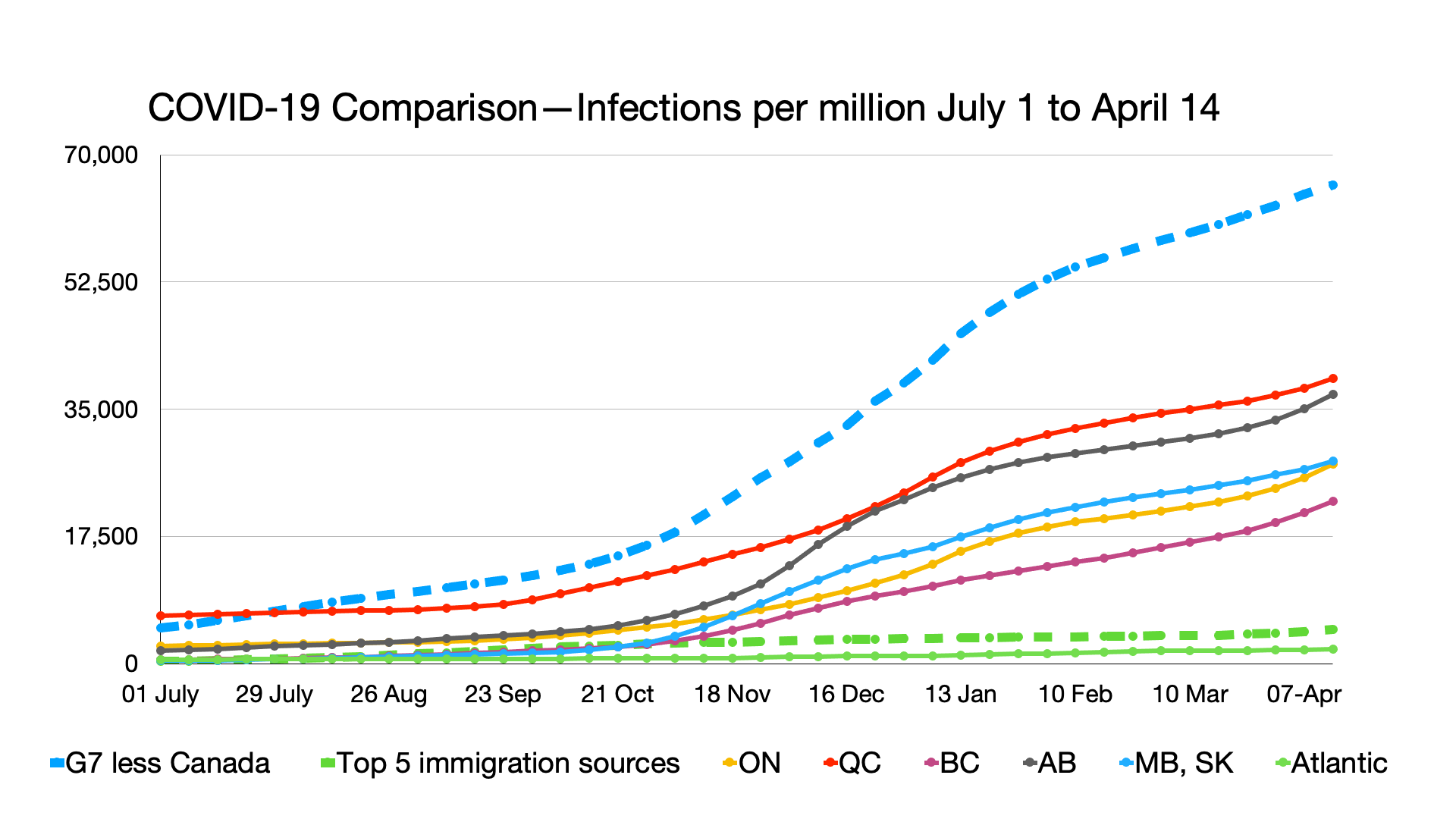
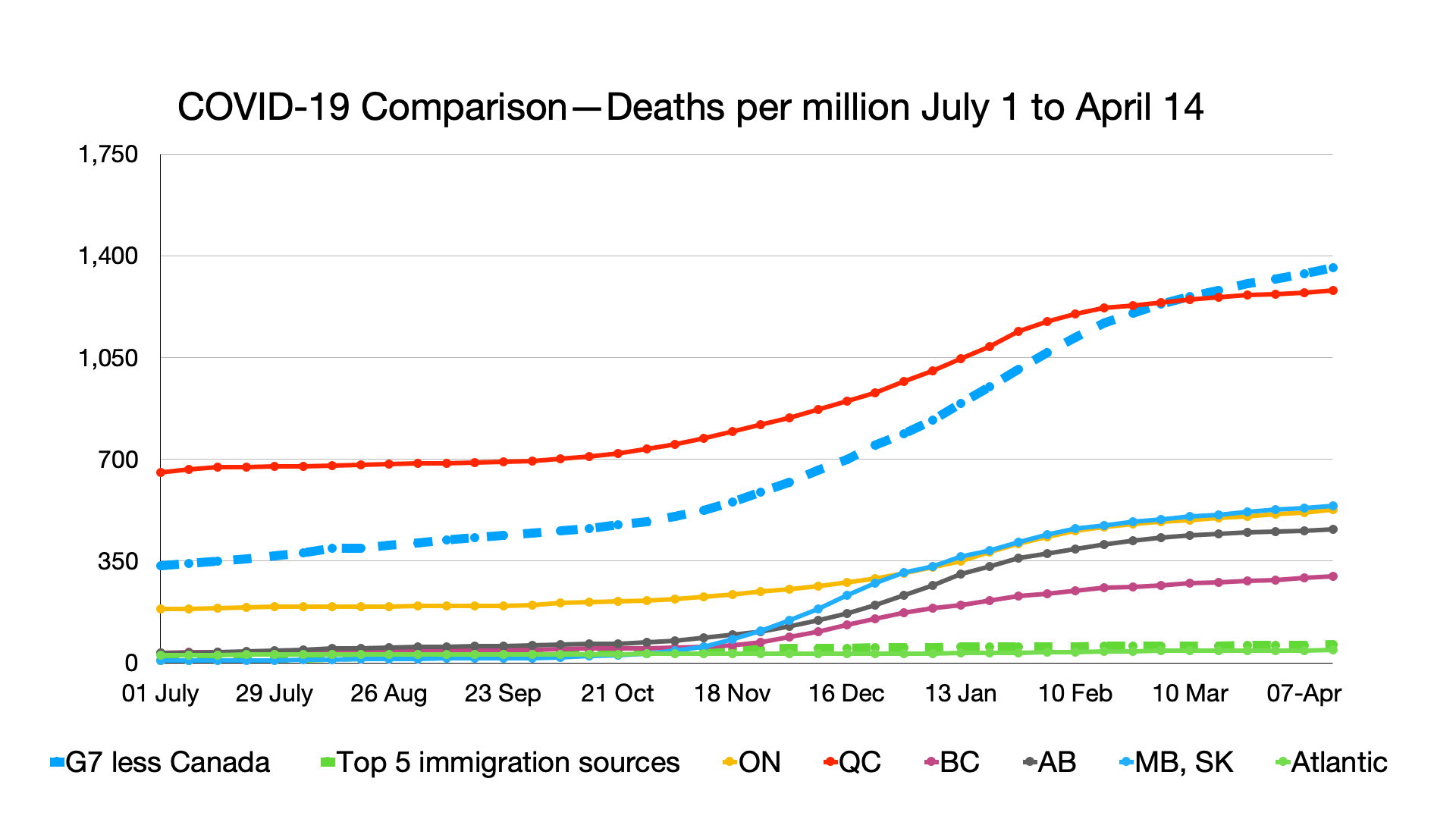
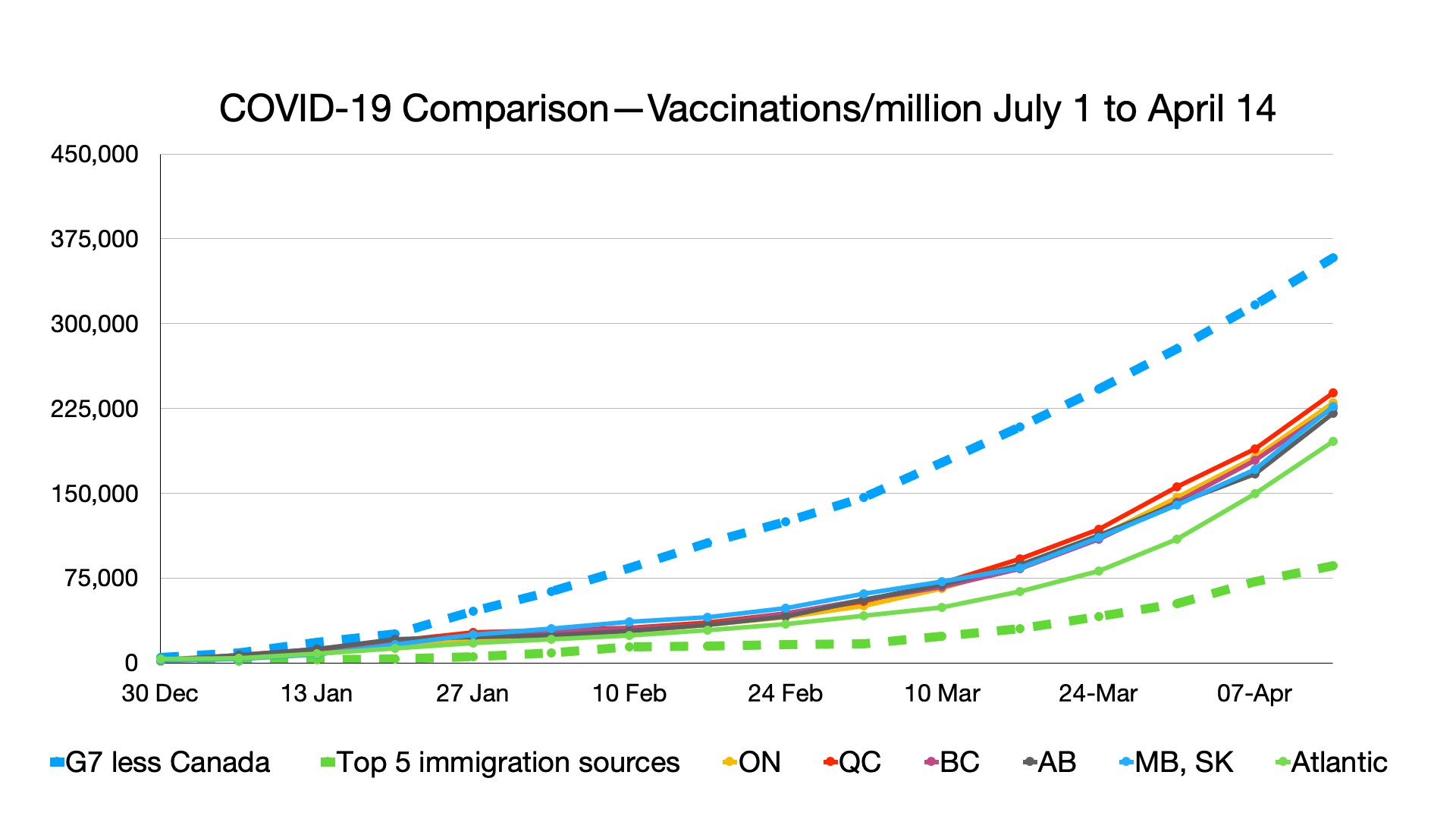
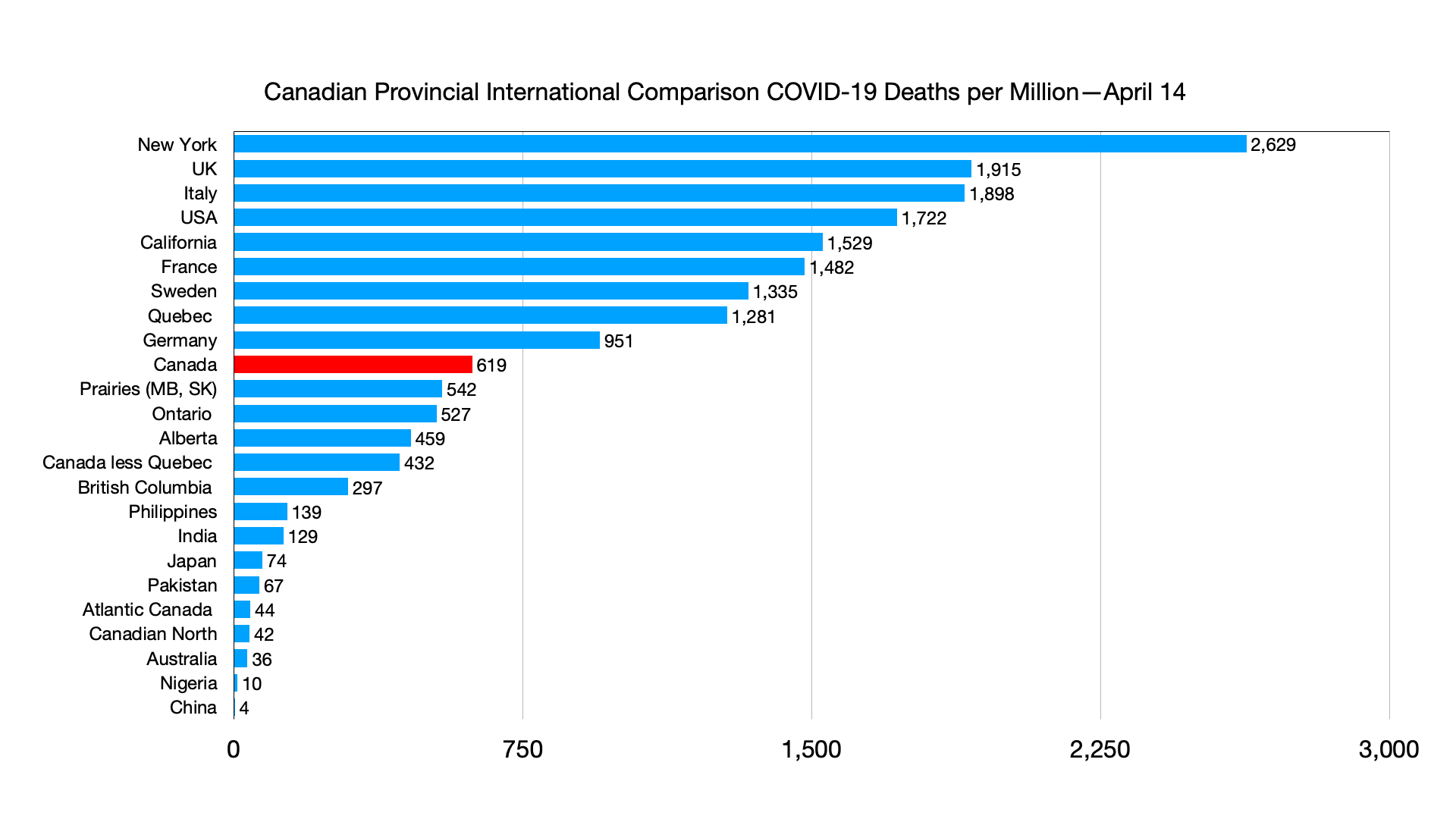
#COVID-19: Comparing provinces with other countries 14 April Update

The latest charts, compiled 14 April as the third wave has started.

Vaccinations: Overall, Canada and most provinces ahead of or comparable to EU countries.

Trendline charts

Infections per million: Overall steady increase of infections in most provinces with Alberta and Ontario showing steeper increases but still much better than G7 less Canada.

Deaths per million: No major changes.

Vaccinations per million: Significant shift with most Canadian provinces being slightly better than most EU countries.

Weekly

Infections per million: No relative changes.

Deaths per million: Philippines slightly ahead of India

Working from home is here to stay — and for some Canadians, that’s a big problem

Good highlighting of the inequalities between those able to work from home and those not, mainly younger, visible minority or immigrant workers with lower income. Working from home appears to be a good overall proxy for privilege and class:

Working from home has a bright side for a lot of us, and we really hope it will outlast the pandemic.

No morning commute, no mad scramble out the door with packed lunches and wet laundry left in the machine to grow mildew all day, no race at the end of the day to tie up all the loose ends before rushing home to make dinner.

But that’s not the case for everyone, and new research shows working from home over the long term is often far less than ideal for young workers, immigrants, racialized workers and people living with disabilities.

In other words, the very same people who have been at the sharp end of the stick during the pandemic now risk being thrust into a precarious situation yet again in a post-pandemic world where working from home becomes a norm.

We can decide right now not to do that.

The Environics Institute teamed up with the Future Skills Centre and Ryerson University’s Diversity Institute to figure out what the workforce of the future looks like and how COVID-19 has disrupted so much. They surveyed almost 5,400 people across the country on what their work-from-home experience has been like, and they also dug down into how age, race, immigrant history and income make a difference. 

And they do make a difference — both during the pandemic and, if the survey is a good indication, afterwards too.

Generally, those of us who are working from home are content with the way things are going, and hope to be able to continue spending at least a couple of days a week in our home offices when the pandemic winds down.

“There’s no going back,” says Andrew Parkin, executive director of the Environics Institute.

The stigma of working from home from time to time has dissipated now that so many people have shown it can be done without compromising quality, he added, and employers will need to figure out how to incorporate work-from-home arrangements over the long term.

Of course, not everyone has shared in that experience during the pandemic. As we know, it’s been mainly white-collar workers who have been able to set up shop at their kitchen tables. About half of us have been going into the workplace regularly throughout the pandemic, while 36 per cent of us have been able to work from home full time, according to a report published last week by the Canadian Chamber of Commerce and Abacus Data. 

Low-income workers, people of colour and young people have been more likely to have to keep going into their traditional workplaces. They’ve also been most likely to lose their jobs during the pandemic, according to employment data over the past few months. They’ve had a harder time getting back into the workforce. And they’ve also been more likely to be on the front lines of contagion, holding down essential jobs in taking care of the rest of us.

And now, because their jobs are more precarious, they face more uncertainty about how a work-from-home culture that outlasts the pandemic will benefit them. Doing without frequent face time with colleagues, bosses and networks does not sit well with those who have a fragile connection to their workplaces.

“While it’s reassuring to confirm that many workers in Canada have altered their work arrangement in order to minimize the risk of contracting and spreading COVID-19, these survey results serve as an important reminder that the ability to do so is closely tied to one’s socio-economic situation,” states the Environics report obtained by the Star.

Young people, for example, say they like working from home and can maintain the quality of their work there. But they’re also more worried than others that working from home will hurt their career prospects — which are already hurting because the pandemic has knocked their employment levels severely.

The same fear is expressed by first- or second-generation immigrants as well as racialized workers, and they, too, have seen more of their jobs disappear during the pandemic.

On top of that, immigrants and racialized workers also say, more than others, that they aren’t properly equipped to work from home, and they’re worried the quality of their work has deteriorated.

Workers with disabilities are also far more likely to say they don’t have the right equipment to work from home.

The implications for post-pandemic work are far-reaching. Business groups have emphasized the need to make sure workplaces are safe to return to, with whatever personal protective equipment and health measures are needed to assure employees aren’t going to get sick.

But the new research shows it’s a lot more complex than that. Some people won’t want to come back, but at the same time, a full embrace of a work-from-home culture will penalize those who are already facing intimidating barriers to their careers and futures.

“The key word is flexibility,” says Parkin, pointing to a need to rethink office space and work flow to make sure a range of needs are accommodated.

We have a few months left of lockdown, constraint and forced work-from-home conditions before we have more options open to us in the world of work. Let’s use them to ensure the reopening is done carefully, giving a fair opportunity to those workers who have already paid such a steep price.

Source: https://www.thestar.com/politics/political-opinion/2021/04/12/working-from-home-is-here-to-stay-and-for-some-canadians-thats-a-big-problem.html

Germany Is Expected To Centralize Its COVID-19 Response. Some Fear It May Be Too Late

Uncomfortable parallels with Canada? That being said, unclear whether stronger federal role would have avoided some of the provincial mistakes and/or denial about the risks of a third wave:

This week, German Chancellor Angela Merkel is making good on a veiled threat she issued two weeks ago to centralize pandemic management. Amid growing calls for Merkel to take control of the situation and bypass the country’s 16 state leaders, Germany’s parliament is expected to pass a measure this month that will allow her finally to take charge of the country’s COVID-19 response.

As the third wave of infection rages, some worry it may already be too late. Hospitals in Germany warn they’re about to run out of intensive care beds, even as state leaders continue to relax coronavirus restrictions.

Germany, with a population of 83 million, has lost nearly 79,000 lives to the pandemic. With the more contagious B.1.1.7 variant now dominant, the national seven-day incidence rate has risen in recent weeks from below 100 to 136.4 cases per 100,000 people. The country’s total number of infections has surpassed 3 million.

A year ago, Germany was weathering the pandemic relatively well and Merkel’s coronavirus response — attributed to her scientific understanding of the virus and a robust test, track and trace system — was praised far and wide. But exponential growth has long since overwhelmed virus trackers, and the slow start to vaccine rollout, combined with an increasingly confusing patchwork of regional lockdown regulations, has left the country in epidemiological disarray and sent Merkel’s party plummeting in the polls, losing 10 points in recent weeks.

“It’s been a bit of a rude awakening for us Germans to realize that we’re not the masters of organization,” says Melanie Amann, who heads the Berlin bureau of Der Spiegel.

While the pandemic has debunked the myth about German efficiency, the same cannot be said of another cliché — the nation’s love of red tape.

“Our ability to create complex systems and bureaucracy have pretty much stopped us from effectively fighting the pandemic,” Amann says. Nonfunctioning websites, unstaffed hotlines, excessive paperwork and authorizations are among the issues she cites — amid regulations that differ from state to state.

Severin Opel, a 23-year-old Berlin resident, had to wait several days to get an appointment for a recent rapid coronavirus test.

“Paperwork is getting in the way of this pandemic,” he laments. “There’s so much focus on minutiae and documenting every step to the nth degree, guidelines end up contradicting each other and nothing makes sense.”

Merkel is known for her careful, measured responses to crises, but even she admits there’s sometimes too much devil in the details.

Speaking in a rare television interview last month, Merkel conceded: “Perhaps we Germans are overly perfectionist sometimes. We always want to do everything right because whoever makes a mistake gets it in the neck publicly.” But “in a pandemic,” she went on to say, “there needs to be more flexibility. We Germans need to learn to let go.”

Janosch Dahmen, a front-line doctor and health spokesperson for the Green Party — which is close to rivaling Merkel’s conservatives in the polls — believes the government’s cautious approach is actually reckless.

“A strategy or intervention without risks doesn’t exist,” Dahmen says. “Waiting for the perfect, flawless game plan is a recipe for failure, especially in the face of this virus, which is mutating insanely fast.”

And yet Merkel’s crisis management style is only one factor. Germany’s system of federalism means she has little say in the country’s vaccination and lockdown strategies, of which there are no fewer than 16 — one for each German state.

Amann argues, though, it’s high time that Merkel — who leaves office this fall — used her considerable political capital to take charge, rather than simply advising and negotiating pandemic guidelines with the 16 state premiers.

“Because her term is ending, she theoretically has all the freedom and all the independence she wants to take bold steps in the corona management,” Amann says. “Nobody could run her out of office. And she’s not using this. She’s just working as if she were at the beginning of her first term.”

State leaders agreed in March on an “emergency brake” strategy to impose more rigorous measures as infections rose, but the agreement was only in principle, and few states have implemented the measures strictly.

After weeks of frustration, political commentators have observed, Merkel looks the way many Germans feel — namely mütend, a pandemic-era mashup that means both tired (müde) and angry (wütend).

And while there’s concern that parliament might take too long to pass a bill allowing Merkel to streamline and centralize pandemic crisis management, the chancellor and most of the state premiers agree the current situation is untenable.

Source: Germany Is Expected To Centralize Its COVID-19 Response. Some Fear It May Be Too Late

[CDC] Studies Confirm Racial, Ethnic Disparities In COVID-19 Hospitalizations And Visits

More evidence:

Days after declaring racism a serious public health threat, the Centers for Disease Control and Prevention released a pair of studies further quantifying the disproportionate impact of COVID-19 on communities of color.

The studies, published Monday in Morbidity and Mortality Weekly Report, examine trends in racial and ethnic disparities in hospitalizations and emergency room visits associated with COVID-19 in 2020.

CDC Director Rochelle Walensky said at a regular White House COVID-19 Response Team briefing that the new literature underscores the need to prioritize health equity, including in the country’s accelerating vaccine rollout.

“These disparities were not caused by the pandemic, but they were certainly exacerbated by [it],” Walensky said. “The COVID-19 pandemic and its disproportional impact on communities of color is just the most recent and glaring example of health inequities that threaten the health of our nation.”

After assessing administrative discharge data from March to December 2020, the CDC found that the proportion of hospitalized patients with COVID-19 was highest for Hispanic and Latino patients in all four census regions of the U.S.

Racial and ethnic disparities were most pronounced between May and July, it said, and declined over the course of the pandemic as hospitalizations increased among non-Hispanic white people. But such disparities persisted across the country as of December, most notably among Hispanic patients in the West.

The findings build on earlier studies about racial and ethnic disparities in COVID-19 hospitalizations by showing how they shifted over time and between regions.

Researchers point to two driving factors for the disproportionate hospitalizations among these minority groups: a higher risk of exposure to the virus and a higher risk for severe disease. They said differences in exposure risk associated with occupational and housing conditions, as well as socioeconomic status, are likely behind the demographic patterns they observed.

“Identification of the specific social determinants of health (e.g., access to health care, occupation and job conditions, housing instability, and transportation challenges) that contribute to geographic and temporal differences in racial and ethnic disparities in COVID-19 infection and poor health outcomes is critical,” they said, adding that a better understanding of these factors at the local level can help tailor strategies to prevent illness and allocate resources.

The second study examined COVID-19-related emergency department visits in 13 states between October and December, and found similar disparities between racial and ethnic groups.

During that period, Hispanic and American Indian or Alaska Native people were 1.7 times more likely to seek care than white people, and Black individuals 1.4 times more likely.

Researchers noted that these racial and ethnic groups are also impacted by long-standing and systemic inequities that affect their health, such as limited access to quality health care and disproportionate representation in “essential” jobs with less flexibility to take leave or work remotely.

“Racism and discrimination shape these factors that influence health risks; racism, rather than a person’s race or ethnicity, is a key driver of these health inequities,” they explained.

Such inequities can increase the risk of exposure and delayed medical attention, further heightening the risks for severe disease outcomes and the need to seek emergency care.

Looking ahead, researchers said their findings could be used to prioritize vaccines and other resources for disproportionately affected communities in an effort to reduce the need for emergency care. Walensky also emphasized the implications of the new studies on and beyond the country’s pandemic response.

“This information and the ongoing surveillance data we see daily from states across the country underscore the critical need and an important opportunity to address health equity as a core element in all of our public health efforts,” she said.

A renewed push to address such inequity is now underway at the CDC, which late last week declared racism a “serious public health threat that directly affects the well-being of millions of Americans.”

Walensky has directed the agency’s departments to develop interventions and measure health outcomes in the next year. It’s also provided $3 billion to support efforts to expand equity and access to vaccines, in addition to $2.25 billion previously allocated for COVID-19 testing in high-risk and underserved communities. The CDC has also launched a Racism and Health web portal to promote education and dialogue on the subject.

One area of particular focus is making sure the distribution of COVID-19 vaccines across the U.S. reaches the communities that have been hit hardest.

Data so far indicate that Black individuals make up roughly 12% of the country’s population but just 8.4% of those who have received at least one dose, Walensky said. And while 18% of the country identifies as Hispanic or Latino, she said, they make up only 10.7% of those who have been vaccinated.

Officials at Monday’s briefing highlighted further progress in the race to get shots into arms, noting that 120 million Americans have been vaccinated — 46% of adults have had at least one dose and 28% are fully vaccinated. And in exactly one week, all adults will be eligible to sign up for an appointment.

“This means that there has never been a better time than now for seniors and those eligible to get their shots,” said Andy Slavitt, senior advisor on the White House COVID-19 Response Team. “Make an appointment today. And if you have someone in your life, particularly a senior, who has not gotten a shot yet, reach out and see what help they need.”

Source: Studies Confirm Racial, Ethnic Disparities In COVID-19 Hospitalizations And Visits