Federally appointed courts grow restive as Ottawa slow to fill vacancies

Judicial Diversity 2016 - DRAFT.001Good piece by Sean Fine of the Globe on the questions around new processes of judicial appointments.

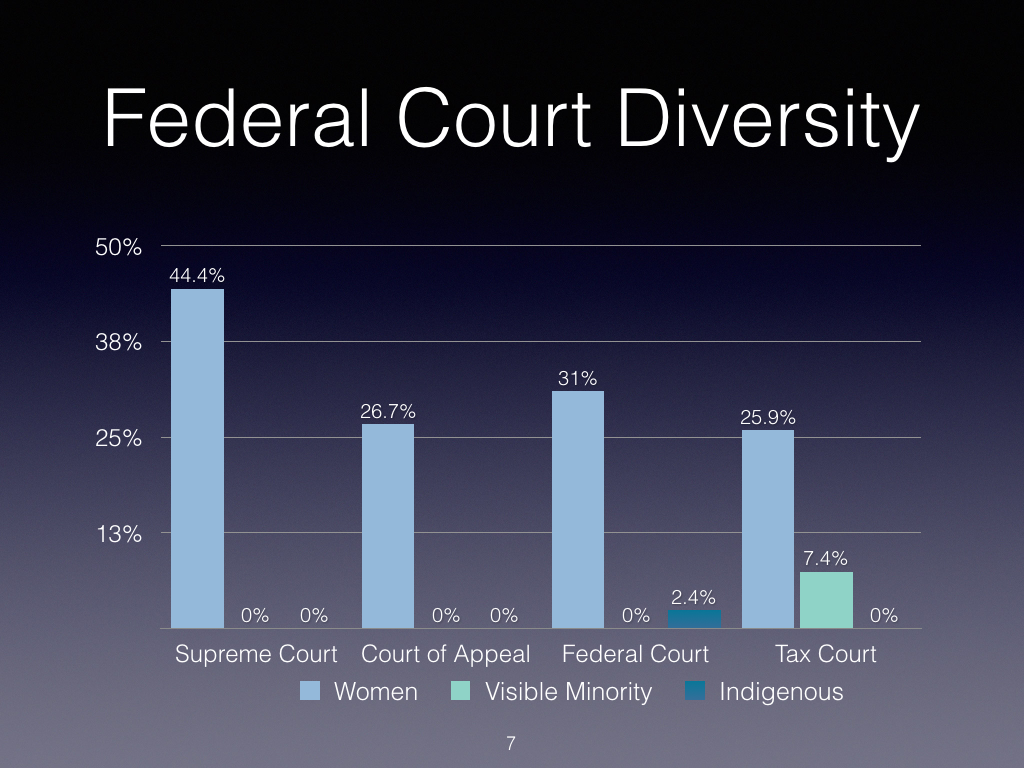
I am currently in the process of analyzing the diversity of current federally and provincially appointed judges (preliminary federal court numbers in above chart) and hope that as part of the process review, the Government will commit to diversity statistics for visible minorities and Indigenous Canadians (some provinces already do this with respect to provincial court judges):

Ms. Wilson-Raybould would not commit to a starting date for appointments when she spoke to the judicial council, said an Alberta lawyer with knowledge of the meeting. “The government is considering the full scope of the appointments process, including the composition and operations of the Judicial Advisory Committees,” a spokeswoman for the minister said in an e-mail to The Globe.

“Any potential changes will be examined in light of the government’s objectives to achieve transparency, accountability and diversity in the appointments process and they will be carefully considering how best to achieve this goal, taking into account views of key stakeholders and interested Canadians in this regard.”

The appointments process is not up and running yet. And Ms. Wilson-Raybould has made little progress toward putting a new process in place – having not even begun consultations with the legal community and leaving a critical position unfilled.

At the system’s foundation are 17 judicial advisory committees – eight-member groups that screen candidates for federally appointed courts such as provincial appeal and superior courts, the Federal Court and the Tax Court. Several of these committees have no members at all – two of Ontario’s three committees, both of Quebec’s, plus all four committees in Atlantic Canada.

The Alberta committee, however, has all eight of its members, and met as recently as mid-March to recommend candidates for the bench, Chief Justice Wittmann said.

“Nobody is against reform if it betters the system,” he said, “but you can’t change locomotives and stop the train; the train’s got to keep running while you’re doing it.”

Criminal and civil trials that need more than five days are being scheduled for “well into 2017,” Chief Justice Wittmann said. “If the public through their elected representatives say that’s fine, well, I guess it’s fine. But there seems to be an expectation that it’s not fine.”

For the court’s judges, “it increases their stress and their sense of helplessness, because they can’t handle everything they’re asked to do. The public thinks they’re not getting the access they’ve come to expect. We cannot sacrifice quality to increase the quantity of cases that we process. It just can’t work that way.”

Ms. Wilson-Raybould has yet to discuss the system’s pressing questions with the legal community: what to do about the changes to the process that the former Conservative government put in place, whether to commit to gender parity in judicial appointments, and whether to begin tracking the numbers of visible minority and aboriginal applicants.

Source: Federally appointed courts grow restive as Ottawa slow to fill vacancies – The Globe and Mail

Helmut Oberlander, Ex-Nazi Death Squad Member, Still Keeping His Canadian Citizenship

This case drags on and on, legal ragging the puck (as is his right):

The federal government has hit another roadblock in its decades-long effort to strip Canadian citizenship from a now 92-year-old man who was once a member of a brutal Nazi death squad.

In its decision, the Federal Court of Appeal set aside a ruling against Helmut Oberlander and ordered the government to take another look at the case.

Oberlander, an ethnic German born in Ukraine, has argued he had no choice when German forces conscripted him at age 17 in 1941 to serve as an interpreter in Einsatzkommando 10a. The unit was part of a force responsible for killing more than two million people. Most were civilians, and most were Jewish.

“The appellant was entitled to a determination of the extent to which he made a significant and knowing contribution to the crime or criminal purpose of the Ek 10a,” the Federal Court of Appeal said in its recent decision.

“Only then could a reasonable determination be made as to whether whatever harm he faced was more serious than the harm inflicted on others through his complicity.”

In making its decision, the court noted the Supreme Court in 2013 ruled that individuals cannot be held liable for a group’s crimes only because they associated with the group or passively acquiesced to its criminal purpose.

Source: Helmut Oberlander, Ex-Nazi Death Squad Member, Still Keeping His Canadian Citizenship

Contracts trump culture — Iranian woman doesn’t have to return dowry after leaving marriage: Ontario court

Rule of law prevails, appropriately without accommodation:

Reliance on cultural norms is no substitute for explicit contract language when giving a gift or transferring property, Ontario’s top court ruled Wednesday.

The decision comes in the case of a young Iranian couple in Ottawa whose marriage fell apart after the bride received a dowry — also known as a mahr — from the groom’s family.

“A wide variety of cultures and their norms and traditions form an integral part of the Canadian mosaic,” the Appeal Court ruled.

“They cannot simply be imported into a transaction involving the transfer of real property by reference to a concept such as ‘dowry,’ which forms a part of a particular culture or tradition.”

A wide variety of cultures and their norms and traditions form an integral part of the Canadian mosaic

Ahmad (Reza) Abdollahpour and Shakiba Sadat Banifatemi married in Ottawa in March 2012. According to Iranian custom, his family gave the bride a dowry that included a 50 per cent stake in a house they owned. They transferred the ownership by way of a deed of gift.

After they separated in December 2013, Abdollahpour and his family wanted the property back. Banifatemi refused and the Abdollahpours sued.

The groom’s family argued the transfer was part of the dowry and that Iranian culture and tradition dictated that Banifatemi would have to return the gift if she left the marriage.

A year ago, Ontario Superior Court Justice Robert Smith sided with the former bride, prompting the former groom and family to appeal. They argued Smith was wrong to find the gift was given unconditionally.

In upholding the ruling, the Appeal Court noted the two families had negotiated the property transfer before the marriage — after receiving independent legal advice — — and that the lawyer for the groom’s family described the transfer as a “wedding gift to both kids.” In addition, the deed of gift, which was formally registered, stated that the groom’s family was transferring “irrevocably” the property to the bride.

As such, the Ontario Court of Appeal concluded, everything pointed to an intention by both sides that the transfer was both irrevocable and unconditional, and that there was no indication of any expectation of a return if the marriage broke down.

It simply isn’t good enough, the Appeal Court concluded, to insist after the fact that cultural expectations formed part of an agreement unless explicitly noted, or that merely listing a gift as part of a dowry is sufficient to create an implied set of conditions related to traditional norms.

Source: Contracts trump culture — Iranian woman doesn’t have to return dowry after leaving marriage: Ontario court

Restoration of the Court Challenges Program

Another one of the mandate letter commitments of interest, noted by Jeff Sallot writing on the challenges the Liberal government has in reversing the previous government’s approach to the courts (it used to be administered by the Human Rights program at Canadian Heritage, part of the then Multiculturalism and Human Rights Directorate when I was there):

Trudeau’s mandate letter to Wilson-Raybould suggests that shameful foot-dragging by government lawyers will no longer be part of the federal government’s litigation strategy.

The minister’s mandate goes even further. She’s been told to work with Heritage Minister Mélanie Joly on restoring a “modern Court Challenges Program.” The last version of this program was killed by the Harper government in 2006. It provided financial assistance to people and groups who had what looked like legitimate beefs with the government involving equality rights.

Program officials were independent and worked at arms’-length from the government. They looked for cases that raised important questions about rights and public policies so that the courts could render judgment and provide guidance on how the Charter should be interpreted in similar circumstances down the road.

Many of the earliest rights cases, including gender equality cases, might never have made it through the courts without the financial assistance of the Court Challenges Program. And we would all be the poorer for it.

How Harper tied the courts in knots — and what Trudeau should do about it

‘You are not suitably dressed’: Quebec judge refused to hear single mother’s case because of hijab | National Post

Outrageous. Has she made the same ruling for men wearing a kippa or turban? Does she not understand what religious freedom means?

A Quebec Court judge refused to hear the case this week of a single mother trying to retrieve her car because the woman would not remove her Muslim head scarf.

“In my opinion, you are not suitably dressed,” Judge Eliana Marengo told Rania El-Alloul Tuesday, according to a courtroom recording obtained by the Canadian Broadcasting Corp.

“Decorum is important. Hats and sunglasses, for example, are not allowed, and I don’t see why scarves on the head would be. The same rules need to be applied to everyone.”

Ms. El-Alloul testified she was on welfare and the mother of three sons. She was trying to get back her car, which had been seized by the provincial automobile insurance board after one of her sons was caught driving it with a suspended licence.

She told the judge she needed the car to provide for her family. “I’m facing money problems,” she said.

But Judge Marengo refused to hear the merits of the case, citing a regulation governing court decorum that states simply, “Any person appearing before the court must be suitably dressed.”

She noted Ms. El-Alloul had said her hijab was a religious requirement. “In my opinion, the courtroom is a secular place and a secular space,” she said. “There are no religious symbols in this room, not on the walls and not on the persons.”

It seems given the outcry, many feel the same way.

‘You are not suitably dressed’: Quebec judge refused to hear single mother’s case because of hijab | National Post.

Coyne: Conservatives’ incoherence really shows with Charter of Rights discontent

Good column by Coyne on the Courts, the Conservatives and recent cases:

“Judges don’t always get it right,” colleague Ivison observes. No, they don’t — neither do politicians, if you’ve noticed. But governments have lots of options in the face of an inclement ruling. They can redraft the law, for starters: It’s usually possible to preserve its purpose while removing the offending provisions. Beyond that? Amend the constitution. Appoint better judges. Make the case for a more restrained theory of jurisprudence. Change how the law is taught. Conservatives used to pride themselves on taking the long view of things.

Meantime, if Conservative MPs are so concerned about the powers of Parliament being usurped, I suggest they look closer to home. As defenders of Parliament, they’d be a lot more convincing had they not spent the past many years meekly surrendering one ancient Parliamentary prerogative after another, not to the courts, but to a far more voracious usurper: the executive.

Or if it’s the courts they’re worried about, there’s a simple way to remove them from the equation: Stop passing laws that are so clearly and flagrantly in violation of the Constitution see, for example, the prostitution bill. Insist, as the political scientist Emmett Macfarlane has suggested, that ministers screen bills for charter compatibility before introducing them in the House. Better yet, have committees of Parliament do the same.

As things stand, MPs seem content to abdicate this responsibility to the courts, so they can pick fights with them later. “Why elect people and pay them to do something the courts are doing,” Miller grumbles. Why, indeed.

Coyne: Conservatives’ incoherence really shows with Charter of Rights discontent.

La Charte des valeurs passerait-elle le test des tribunaux? | Le Devoir

A few pieces asking the obvious question as to whether the proposed Quebec Charter will be given a pass by the courts. As the Supreme Court of Canada has a broader understanding of religious accommodation issues, backed up by the Canadian Charter of Rights and Freedoms, the overall consensus, mentioned in earlier articles, is that the Quebec Charter will not ruled compatible with religious freedom:

La Charte des valeurs passerait-elle le test des tribunaux? | Le Devoir.

Why experts think Quebec’s secular charter won’t survive in court