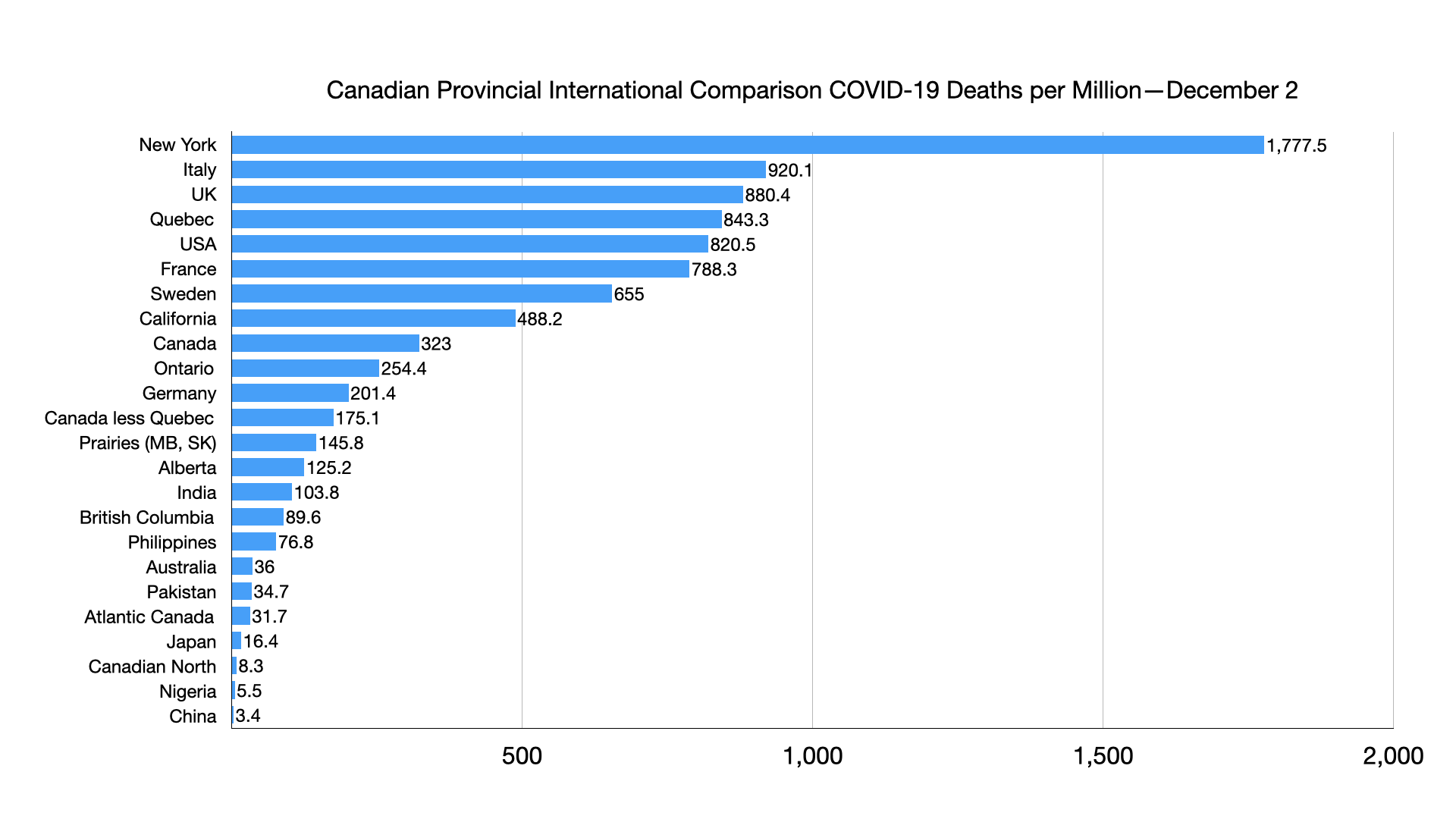
#COVID-19: Comparing provinces with other countries 2 December Update

Main news continues to be with respect ongoing sharp spike in infections along with death rate increases:
 
Weekly:
 
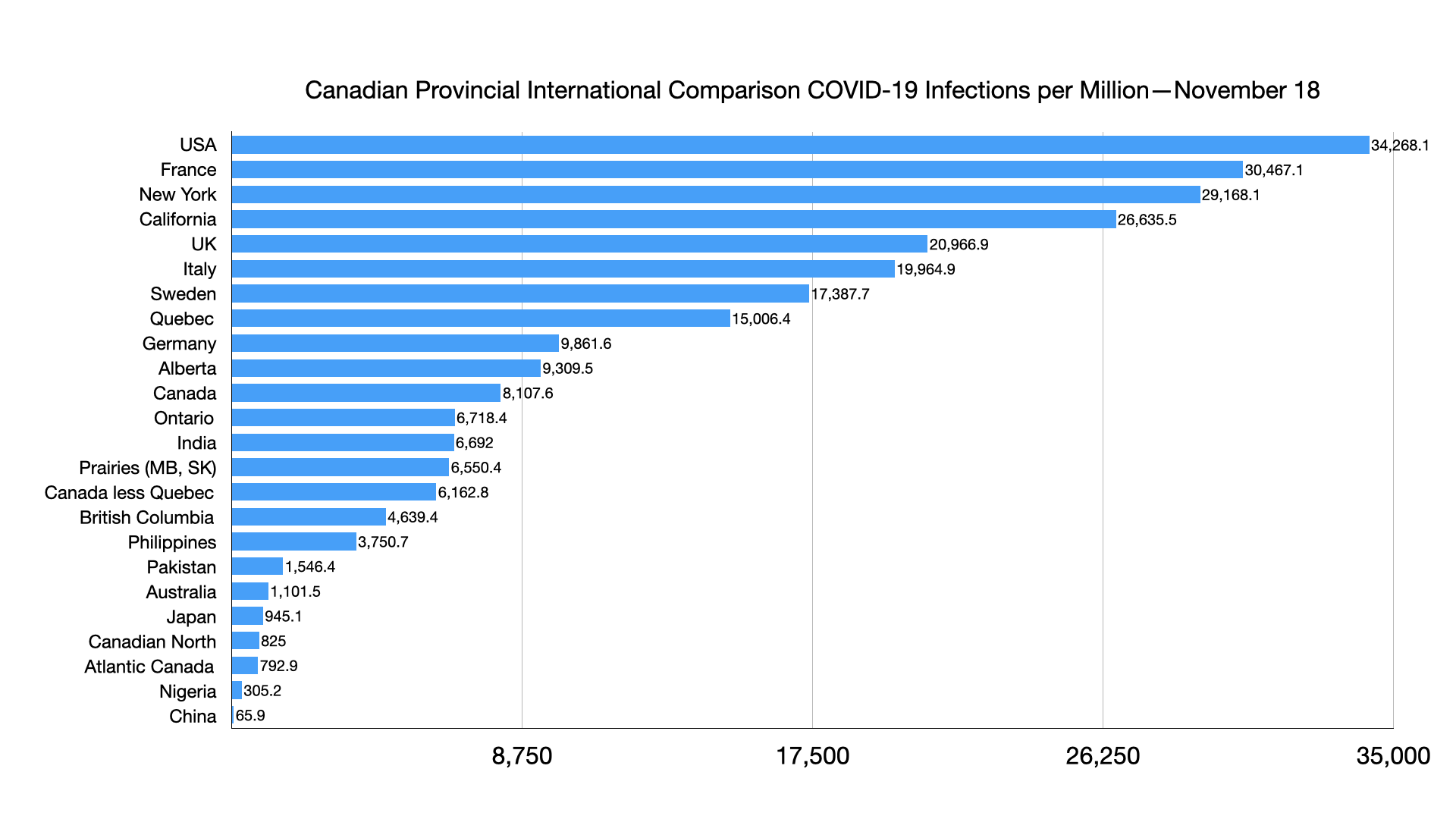
Infections per million: Alberta ahead of Germany, Japan ahead of Australia
 
Deaths per million: British Columbia ahead of Philippines, Canadian North ahead of Japan
 
COVID Comparison Chart.002COVID Comparison Chart.003
 

#COVID-19: Comparing provinces with other countries 25 November Update, Picard on Alberta

Main news continues to be with respect ongoing sharp spike in infections along with death rate increases:
 
Weekly:
 
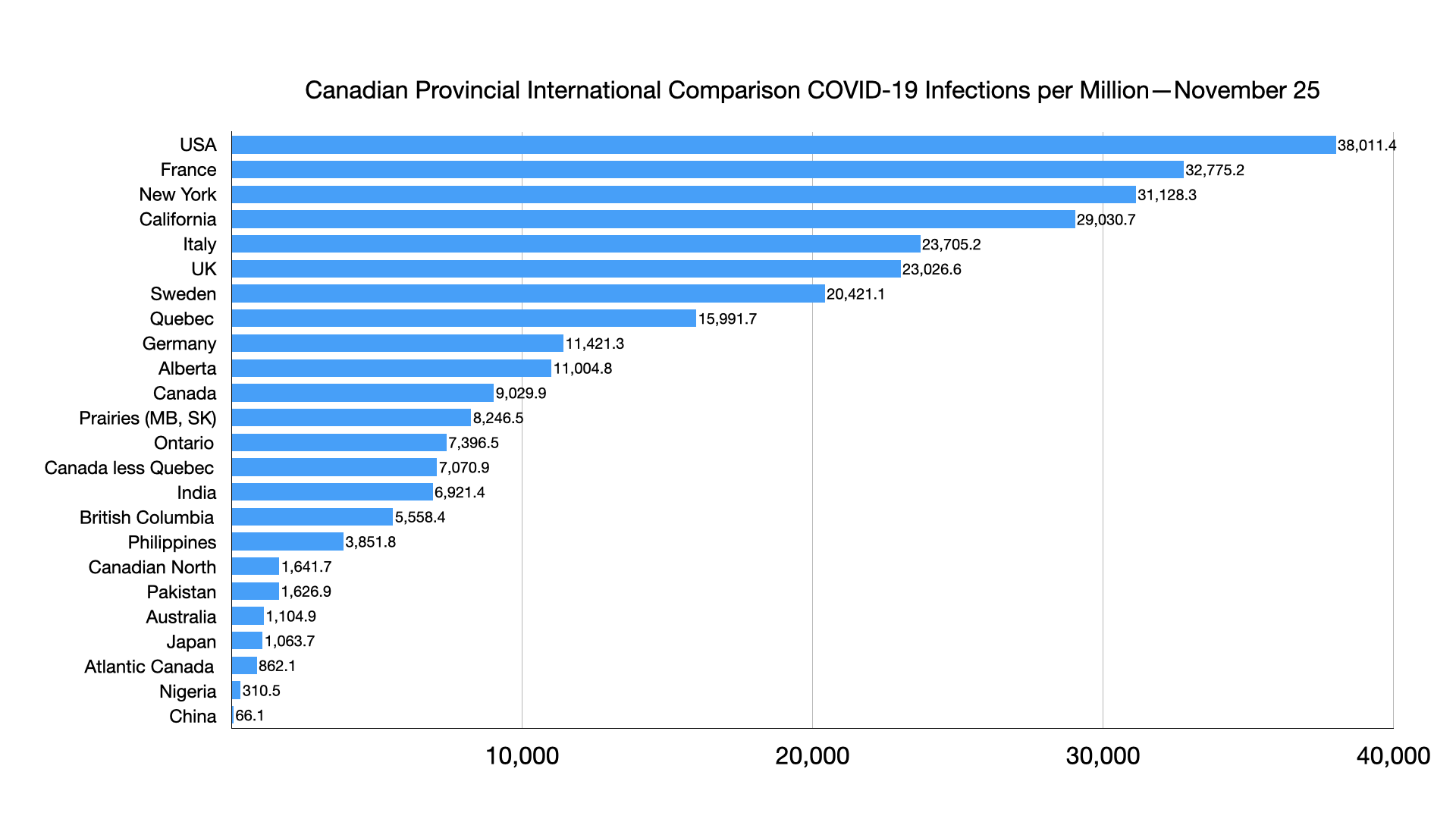
Infections per million: Italy ahead of UK, Prairies ahead of Ontario, Canada less Quebec ahead of India, Canadian North ahead of Pakistan
 
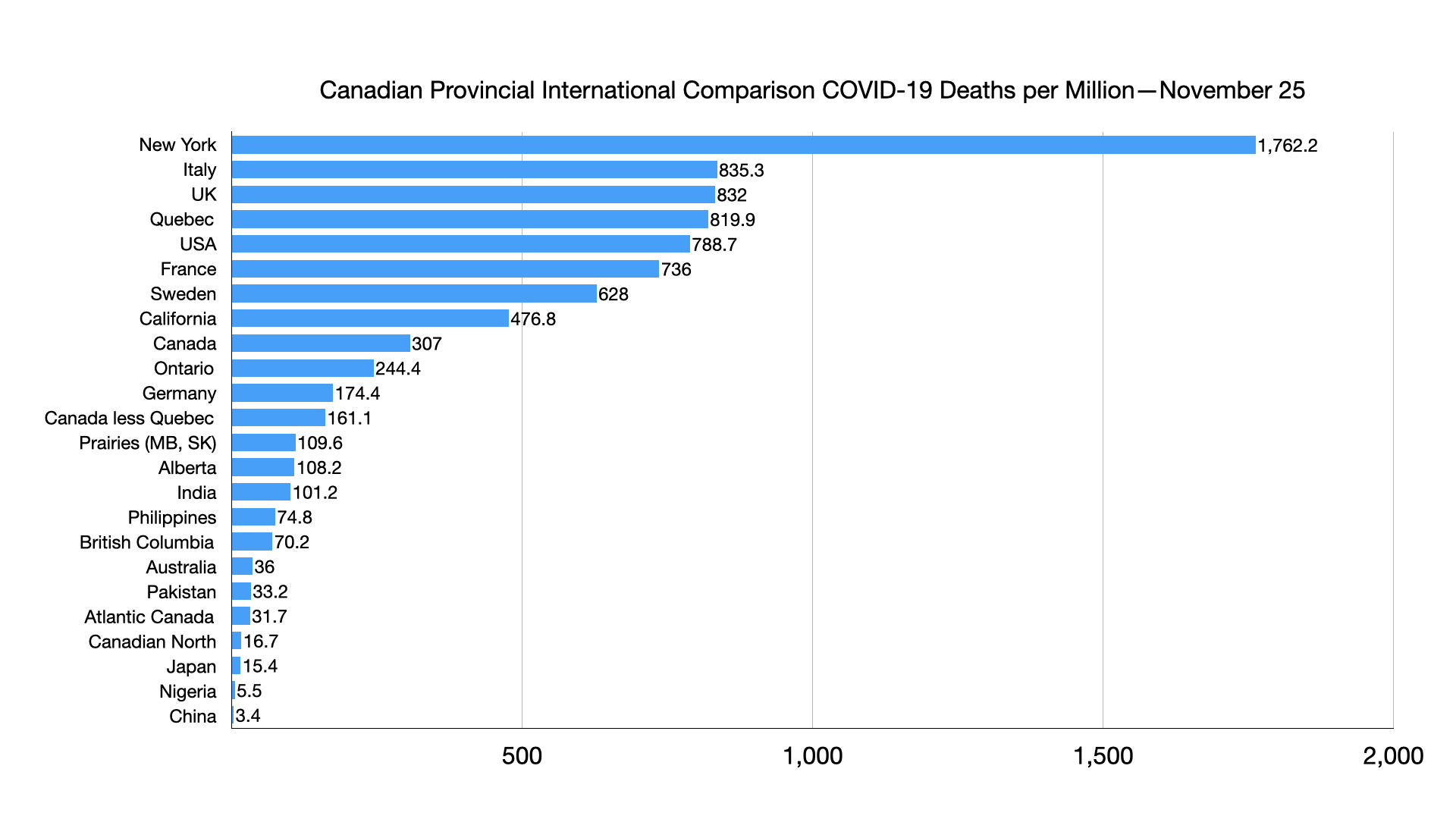
Deaths per million: Italy and UK now ahead of Quebec, Prairies and Alberta ahead of India, Pakistan ahead of Atlantic Canada, Canadian North ahead of Japan
 
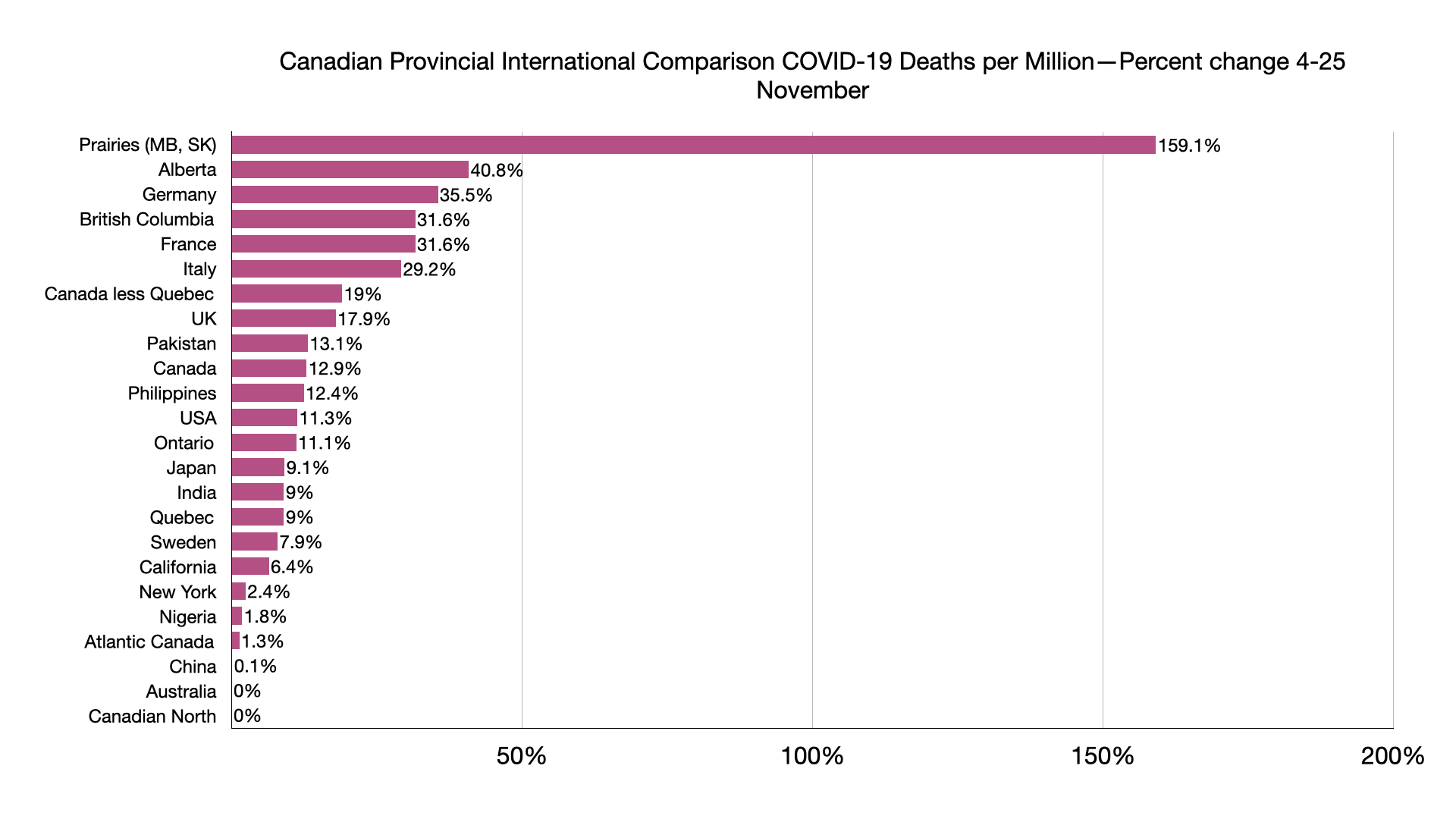
November 4-25 increase:
 
Infections per million: Greatest increase in Canadian North and Western provinces, moving ahead of many European countries
 
Deaths per million: Similar pattern with respect to deaths


André Picard’s critique of Premier Kenney and his government’s response to the pandemic:

Feckless.

That’s the only way to describe Alberta’s “tough” new measures.

In response to the soaring number of COVID-19 cases in the province, Premier Jason Kenney declared a “state of public health emergency” on Tuesday.

He started out with a little muscle flex, saying “no indoor social gatherings will be permitted, period.” Outdoor gatherings will be limited to 10 people.

But then we learned that restaurants will be open for in-person dining, bars will remain open, and so will casinos, gyms, stores, primary schools (Grades 7-12 are going to remote learning).

Heck you would be hard-pressed to find anything that will be closed.

Places of worship are allowed to hold services with one-third of capacity, just as they are now but “we are moving from recommendations to rules.”

Mr. Kenney also earnestly announced that masks would now be mandatory in the province’s two big cities, Calgary and Edmonton. But they already are mandatory because municipal governments have been a lot more pro-active and sensible than the province.

What we saw Tuesday was inaction posing as action, a quasi-libertarian Premier bending over backward to do nothing while pretending otherwise.

But Mr. Kenney’s true nature was revealed when he began prattling on about how he has resisted a lockdown because it would be an “unprecedented violation of constitutional rights.” He once again heralded the importance of “personal responsibility” while, at the same time, announcing rules that clearly suggest people don’t have to be very responsible.

Acting forcefully to protect citizens from the ravages of a global pandemic is not a violation of their rights. Quite the opposite.

Just hours before Mr. Kenney spoke, Nova Scotia Premier Stephen McNeil announced the closing of all restaurants, fitness and recreational facilities, libraries, museums, casinos and more for at least two weeks.

Why? Because the province had a “surge” of 37 cases. Thirty-seven. Business owners actually demanded the lockdown, saying severe rules are the only way to retain consumer confidence.

Alberta recorded 1,115 coronavirus cases on Tuesday, along with 16 deaths. And that was the lowest rate in a while, because testing is way down. In recent days, Alberta has had more cases than Ontario, which has more than three times the population.

The testing system is overwhelmed. The contact tracing system has collapsed. Hospital beds, and all-important intensive care beds in particular, are filling up fast. There are dozens of outbreaks in hospitals and care homes and schools.

Alberta’s pandemic response was great for many months – the Premier was right to underline that fact. But the harsh reality today is that public health and hospitals alike are dangerously close to losing control of the situation.

Mr. Kenney said it himself: “If we don’t slow the ER and ICU admissions, it will threaten our health system.”

But then, in the next breath, he was back to talking about how it’s essential to keep businesses open.

Who knows what the public will make of this Jekyll and Hyde discourse? The between-the-line message seems to be: It’s business as usual.

Yes, the pandemic is a blow to the economy; yes, it’s taking a toll on our mental health; yes, there is a lot of collateral damage.

But if there’s one thing we have learned – or should have learned – is that all that will continue, along with the harm of COVID-19, unless you go all-in to slow the spread of the virus.

Mr. Kenney said the “balanced approach” he has chosen will ensure that the spread of the coronavirus is interrupted while allowing businesses to remain open. But you can’t have it both ways.

The evidence from around the world is crystal clear: This approach is a fast-track to failure. Not only will the virus continue to spread, but the economy won’t flourish because people will still be scared.

Quebec has been in lockdown for more than two months – with rules that are way more strict that what Alberta is imposing – and it’s barely able to keep its COVID-19 numbers static, never mind lower them.

Does anyone seriously believe Alberta will be able to do better by essentially doing nothing?

Albertans should brace themselves because they’re in for a world of hurt in the coming weeks.

Source: https://www.theglobeandmail.com/canada/article-jason-kenneys-balanced-approach-is-a-fast-track-to-failure/

#COVID-19: Comparing provinces with other countries 11 November Update

Overall, infection rates continue to skyrocket with some increase in death rates. Prairies and North numbers particularly noteworthy.
 
Weekly:
 
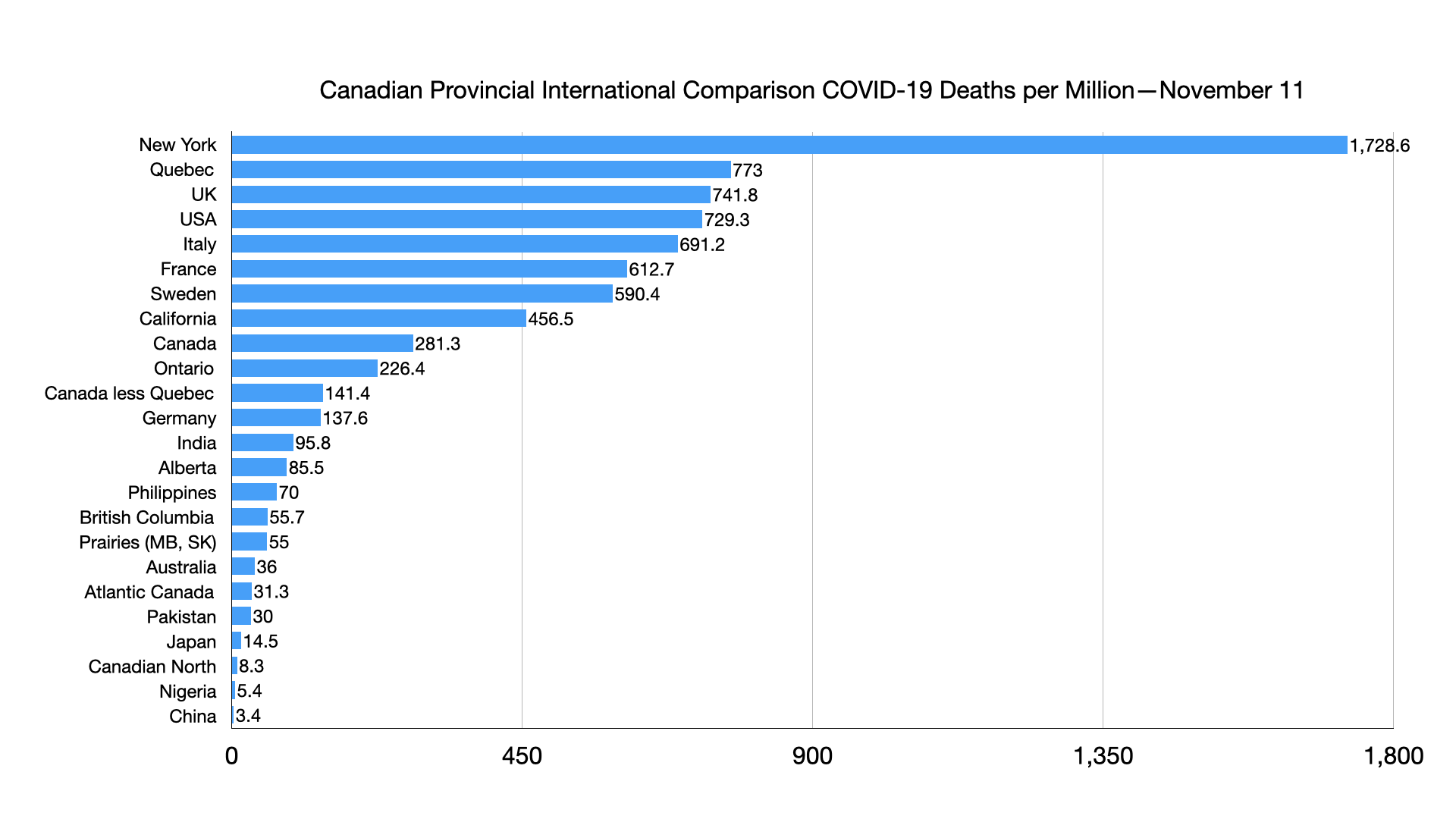
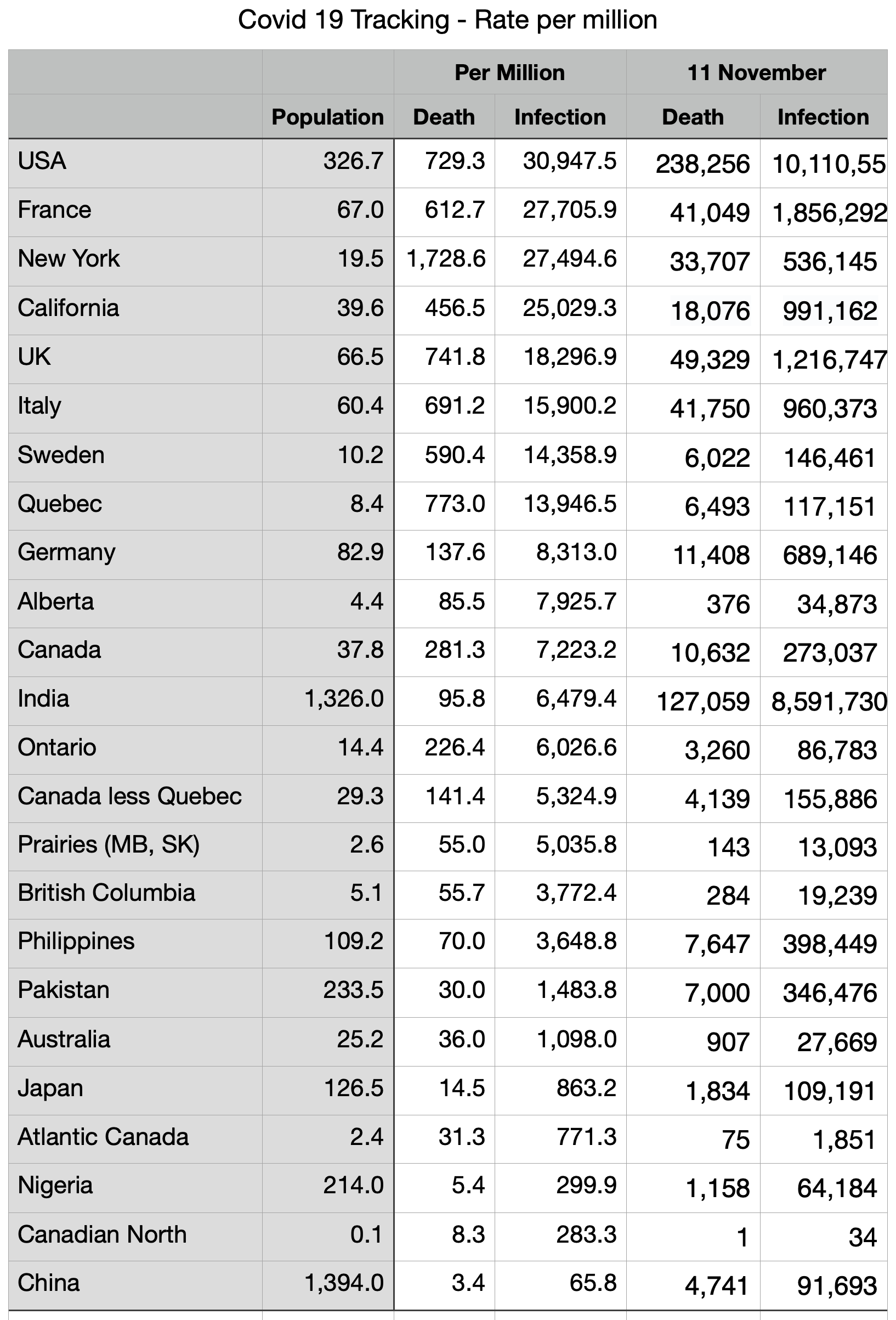
Infections per million: Ontario ahead of India, Prairies ahead of Canada less Quebec, Canadian North ahead of Atlantic Canada 
 
Deaths per million: Italy ahead of USA, Germany ahead of Canada less Quebec, Prairies ahead of Philippine


#COVID-19: Comparing provinces with other countries 11 November Update

Main news continues to be with respect to rapid increase in infections in most countries and provinces:
 
Weekly:
 
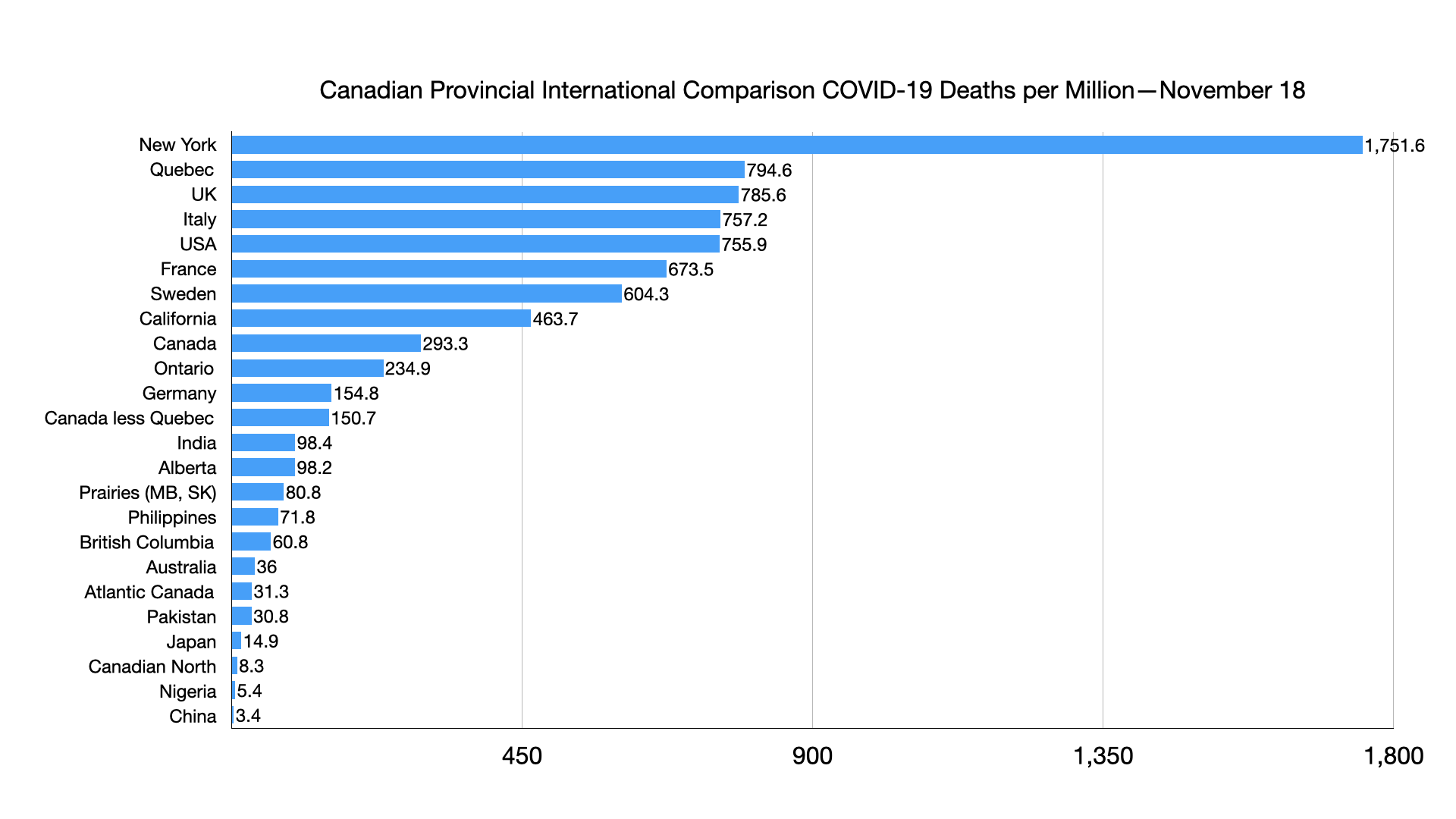
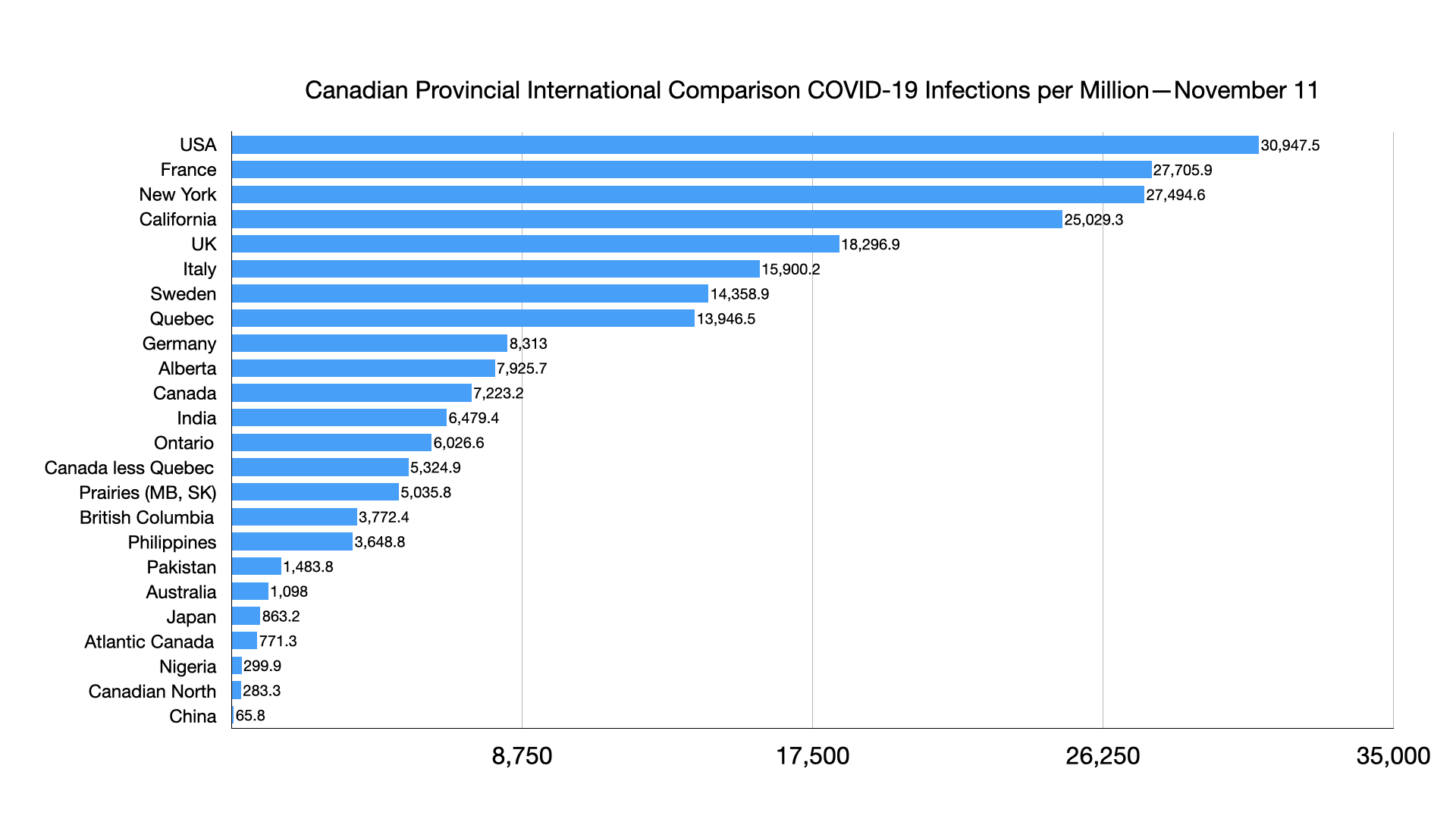
Infections per million: France ahead of New York, Italy and Sweden ahead of Quebec, British Columbia ahead of Philippines
 
Deaths per millionUK ahead of USA, France ahead of Sweden, Canadian North ahead of Nigeria


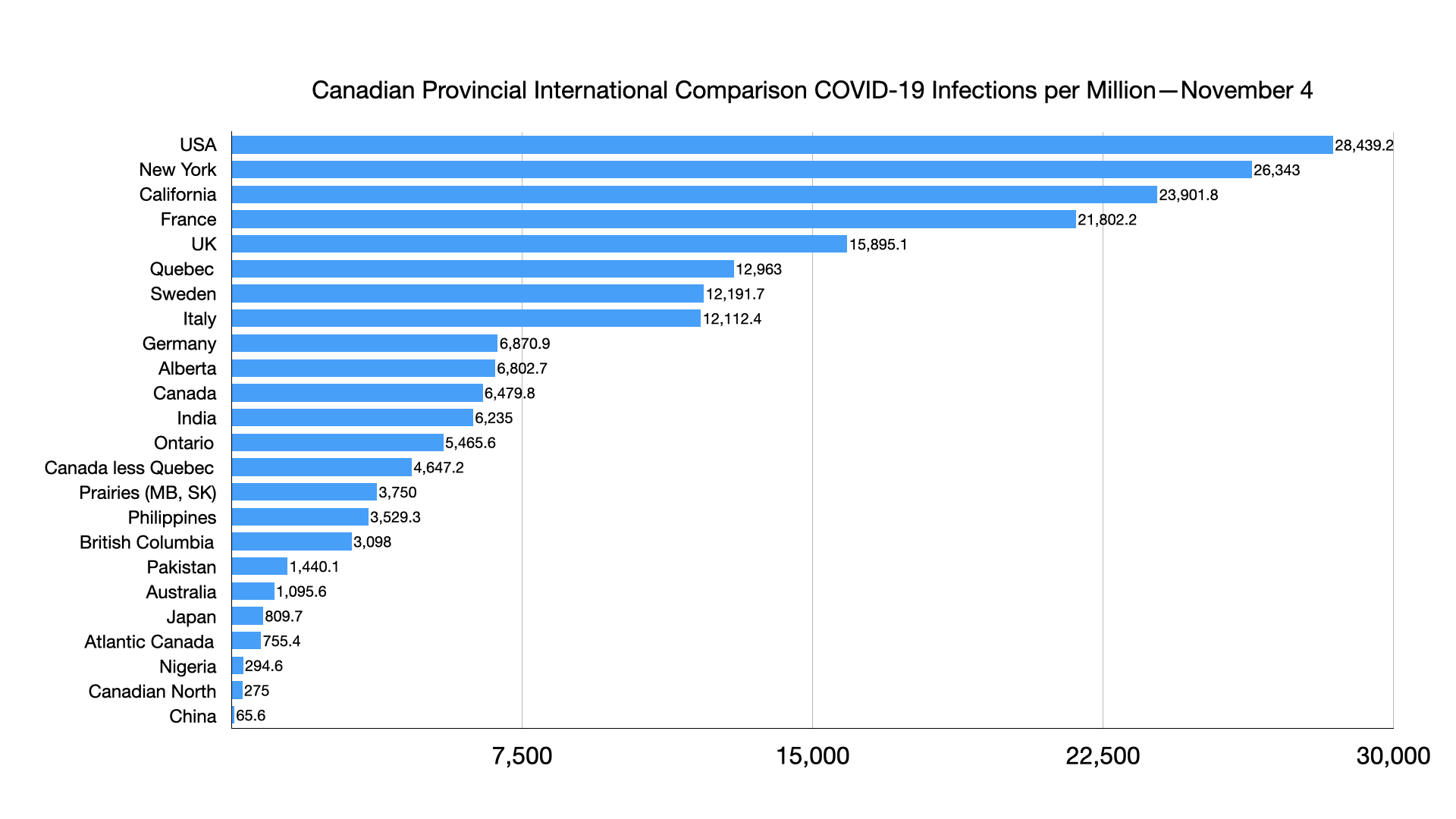
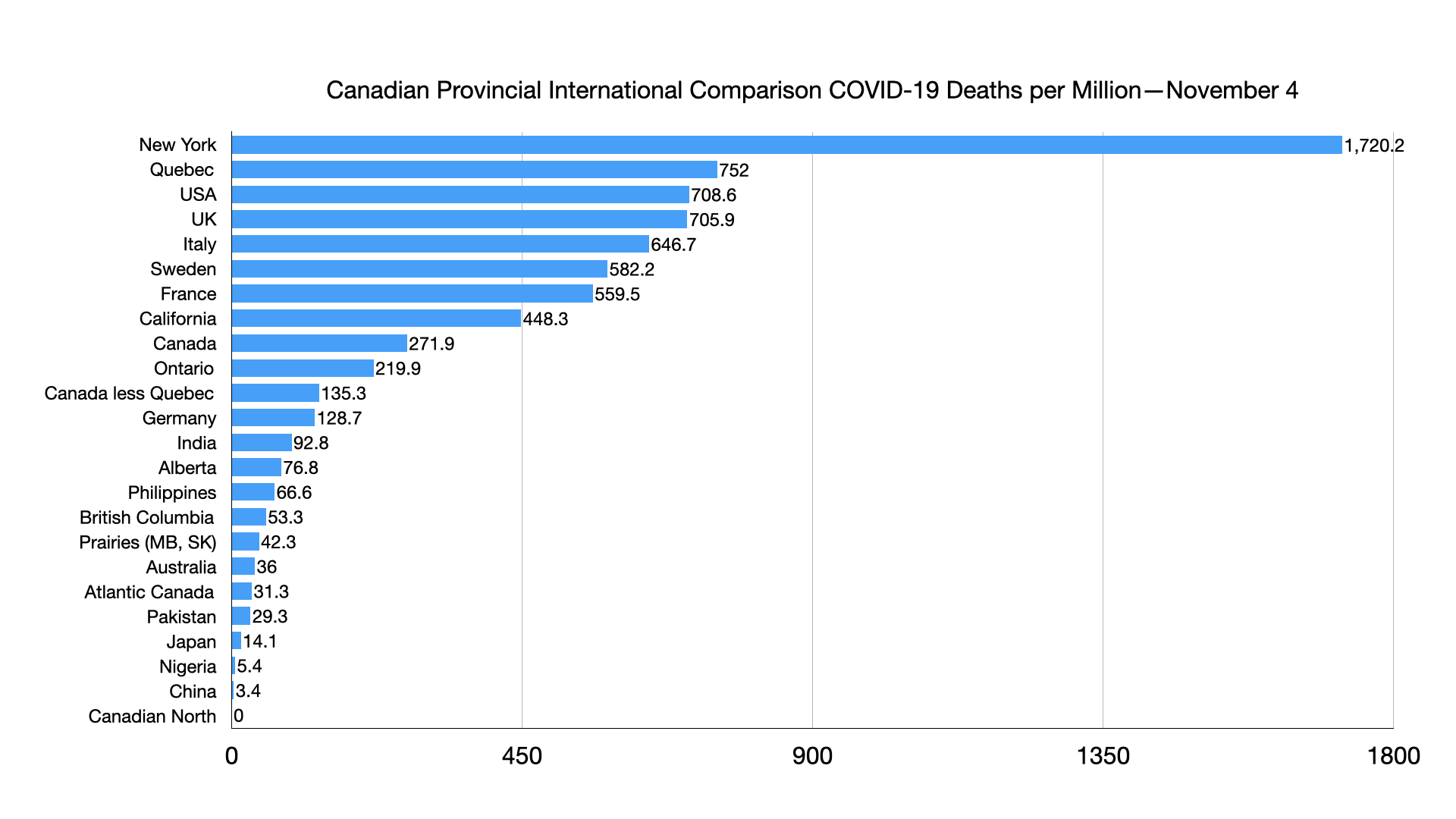
#COVID-19: Comparing provinces with other countries 4 November Update

Main news continues to be with respect to infections and relative increase of COVID cases and deaths in Prairie provinces:
 
Weekly:
 
Infections per million: Germany now ahead of Alberta, Canada, India, Prairies now ahead of Philippines
 
Deaths per million:nPrairies now ahead of Australia


Outcomes of STEM immigrants in Canada and the U.S.

Good overview of this study, showing that overall STEM immigrants do worse in Canada than the USA, with Statistics Canada providing possible explanations:

Immigrants make up a large share of university-educated workers in STEM fields in both Canada and the U.S., and a recent study looked into which country sees better outcomes for immigrants in these sectors.

The Statistics Canada study looked at the economic outcomes of immigrants age 25 to 64 who had at least a bachelor’s degree in a STEM— science, technology, engineering, mathematics—field. In Canada, the data is from 2016, while U.S. data is from 2015 to 2017.

In general, U.S. immigrants saw better outcomes.

In both countries, immigrants with at least a bachelor’s degree were twice as likely as the native-born population to have studied in a STEM field. They were also three times as likely to have studied engineering, computer science, and math.

In terms of occupational outcomes, more than half of STEM-educated immigrant workers in both countries held non-STEM jobs. The study said this was, generally, not a big issue because STEM skills are valued in many other occupations. However, it becomes an issue when STEM-educated immigrants in Canada end up  working at jobs that do not require a university education. In Canada, only 20 per cent of STEM educated immigrants working outside of the field are actually working a job that requires a university degree. In the U.S., it is 48 per cent.

Among all STEM-educated workers, immigrants earned 25 per cent less than their Canadian-born counterparts. There was no earnings gap between immigrants and U.S.-born workers.

Even within the Canadian STEM field, immigrants who found work earned 17 per cent less than Canadian-born individuals. In the U.S., immigrants earned about 4 per cent more than their native-born counterparts.

STEM-educated immigrants who did not find a job in the field earned about 34 per cent less than Canadians with the same education. The wage gap was narrower in the States, with immigrants earning about 7 per cent less.

Why are outcomes better in the U.S.?

Statistics Canada offers five possible explanations, though little research has been done on this question.

U.S. is first choice for many high-skilled immigrants

It may be that the skills of STEM-educated immigrants entering the U.S. are higher on overage than those entering Canada.

The study referenced a paper that examined the wage gap between immigrants and native-born workers in Australia, Canada and the U.S. It found significant earning gaps in Australia and Canada compared to the U.S. The authors said the tendency for highly-skilled immigrants to choose the U.S. over other countries was a primary factor in their better relative earnings outcomes in the U.S.

More STEM-educated immigrants in Canada

A higher percentage of Canada’s STEM-educated workforce are immigrants compared to the U.S. The number of STEM-educated immigrants who entered Canada rose significantly in the 1990s in response to the high-tech boom, and has remained at high levels since. Canada does not face a general shortage of STEM workers, the study says.

When there’s an abundance of workers, employers may tend to hire STEM graduates from universities that they are familiar with, and who have experience from countries with similar economies to Canada.

Different immigrant selection processes

In order to immigrate to the U.S. as a skilled worker, immigrants typically already have a job offer when they arrive, or they are international students who can be interviewed by prospective employers in the country. Immigrants who entered the U.S. contingent on job offers were more likely to get skilled jobs. Those who entered on a student, trainee, or temporary work visa, had a significant advantage over the native-born population in wages, patenting and publishing. Much of this advantage was due to their comparatively higher levels of education.

Canada’s points-based immigration system, which has been in use since the 1960s, selects economic immigrants based on their human capital. These days, the Express Entry system ranks candidates based on factors like education, work experience, age, and language ability. The highest-scoring candidates get invited to apply for permanent immigration. Though candidates can get extra points for having a job offer, in some cases, it is not required in order to immigrate to Canada.

Canadian employers play a larger role in immigrant selection in the Canadian Experience Class (CEC) federal immigration program, as well as many Provincial Nominee Programs (PNP), than compared to the Federal Skilled Worker Program.

The study found that STEM-educated immigrants that immigrate through the CEC do relatively well compared to others, and those who go through the PNP typically have the poorest outcomes. One major difference is that the CEC requires immigrants to have at least one year of skilled work experience in Canada, whereas the PNP is more varied, and includes pathways for low-skilled and medium-skilled workers to become permanent residents.

Differences in country of education

Country of education is one of the most important determinants of immigrant earnings, along with language and race or visible minority status, the study says.

Country of education may differ significantly among STEM-educated immigrants in Canada and the U.S. STEM immigrants educated in non-Western countries do not do as well, economically, as others. The study suggest this is for a number of reasons, for example, the quality of education may be lower, or perceived to be lower. In the absence of a shortage of STEM workers, employers may prefer to hire those educated in Western counties. Also, some credentials are not recognized by professional associations in the host country, either for valid or invalid reasons, and this may prevent immigrants from developing countries from getting STEM jobs. Language or cultural issues may also prevent immigrants from being able to use their STEM education. Discrimination may also be a factor.

Other factors unrelated to immigration policy

Factors unrelated to immigration policies may also contribute to better outcomes of STEM-educated immigrants in the U.S., for example, the U.S. industrial structure may result in a higher demand for STEM-educated workers in comparison to other countries.

Source: Outcomes of STEM immigrants in Canada and the U.S.

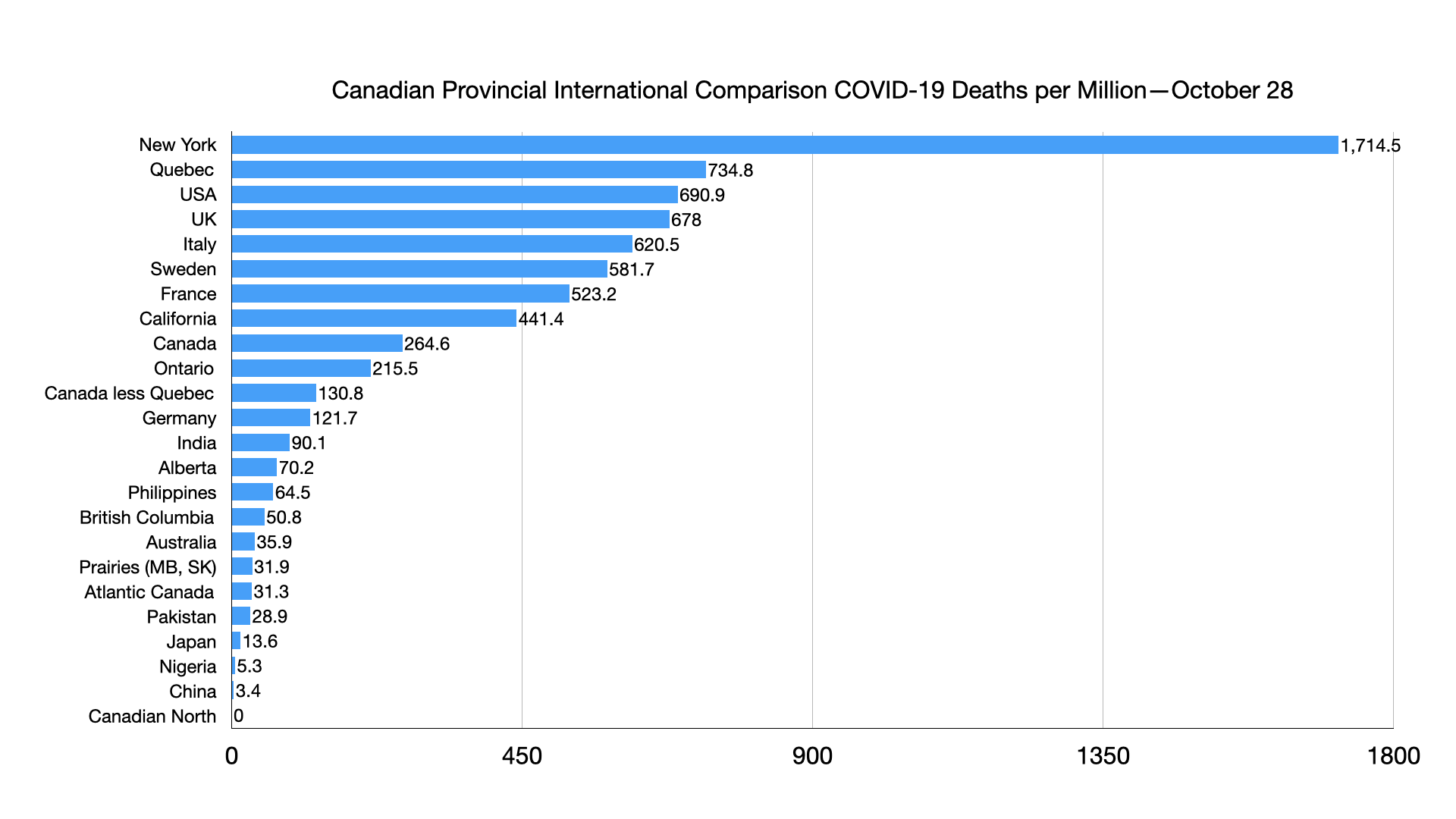
#COVID-19: Comparing provinces with other countries 28 October Update

Main news continues to be with respect to infections:
 
Weekly:
 
Infections per million: UK higher than Quebec, Alberta higher than Canada, Germany higher than Ontario, Prairies higher than British Columbia 
 
Deaths per million: Prairies higher than Atlantic Canada, both higher than Pakistan
 
October 7-28 increase:
 
Infections per million: Prairies (Manitoba, Saskatchewan) join European countries in highest percentage increase
 
Deaths per million: Highest increase in Prairies, particularly Manitoba and Saskatchewan 


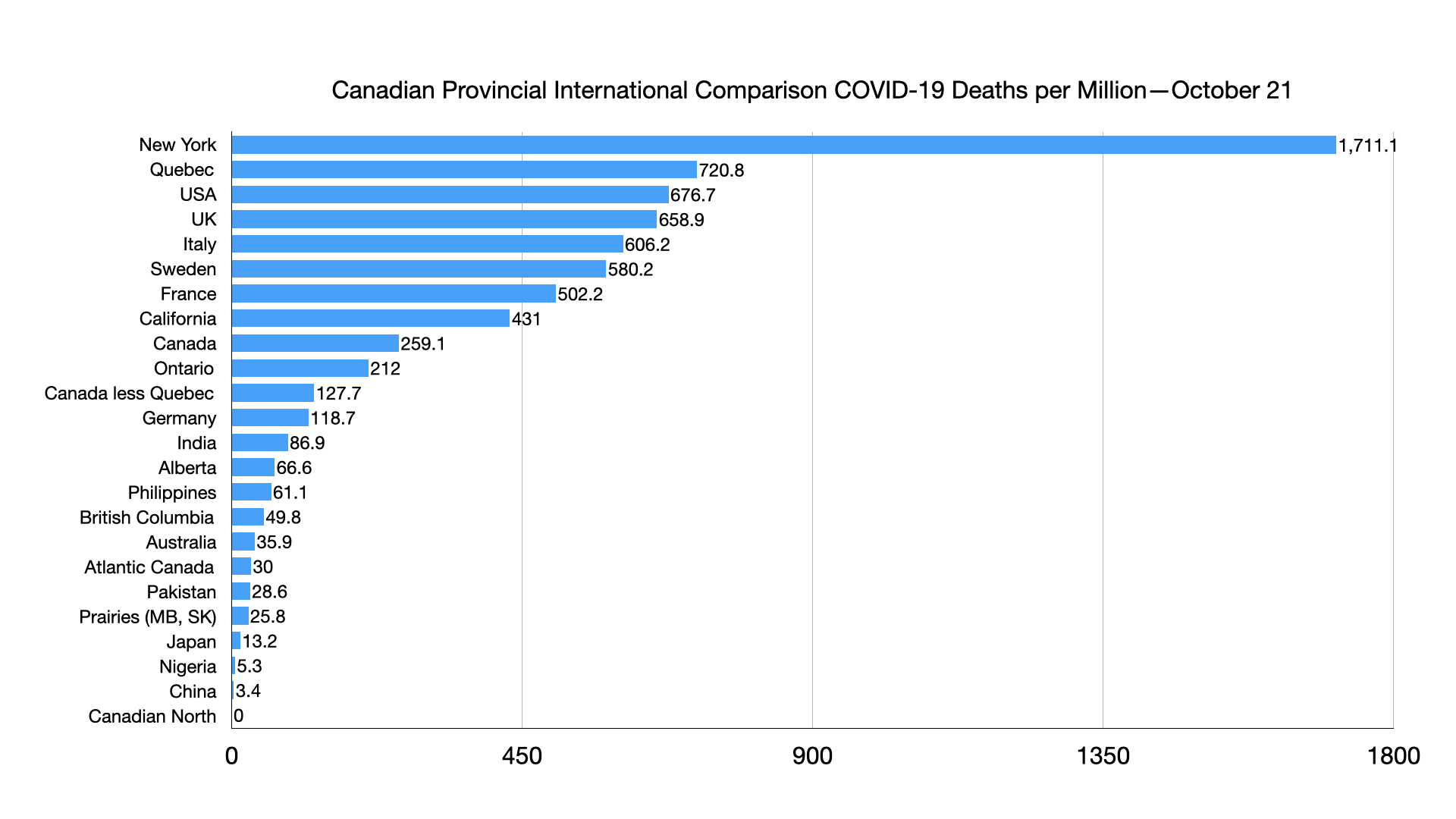
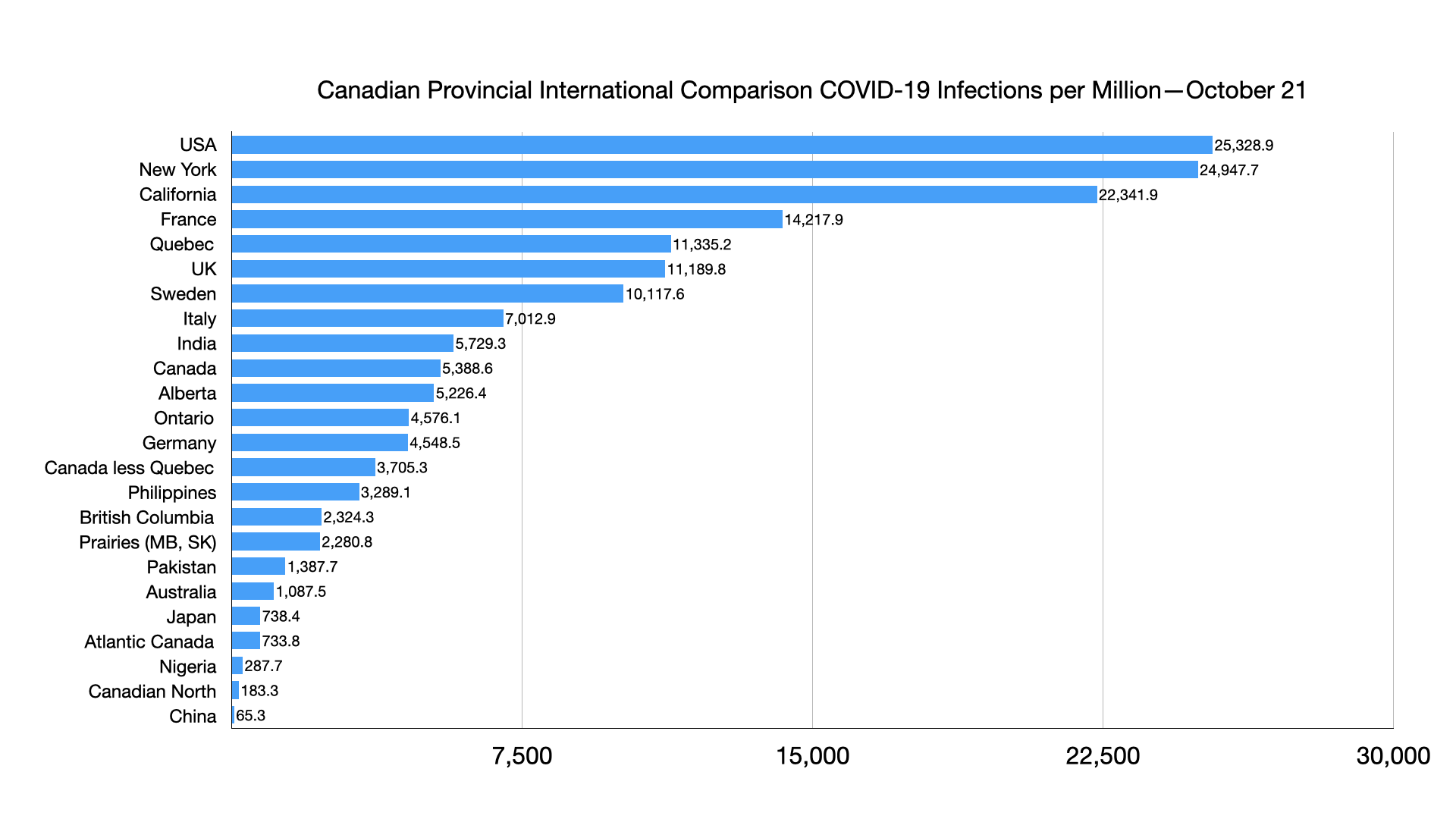
#COVID-19: Comparing provinces with other countries 21 October Update

Apart from overall large increases in infections in most jurisdictions, and corresponding increases in death rates in some, overall country and jurisdiction ranking largely unchanged.

Deaths per million: no change
 
Infections per million: Sweden now higher than UK (so much for herd immunity), Japan ahead of Atlantic Canada
 
Weekly:


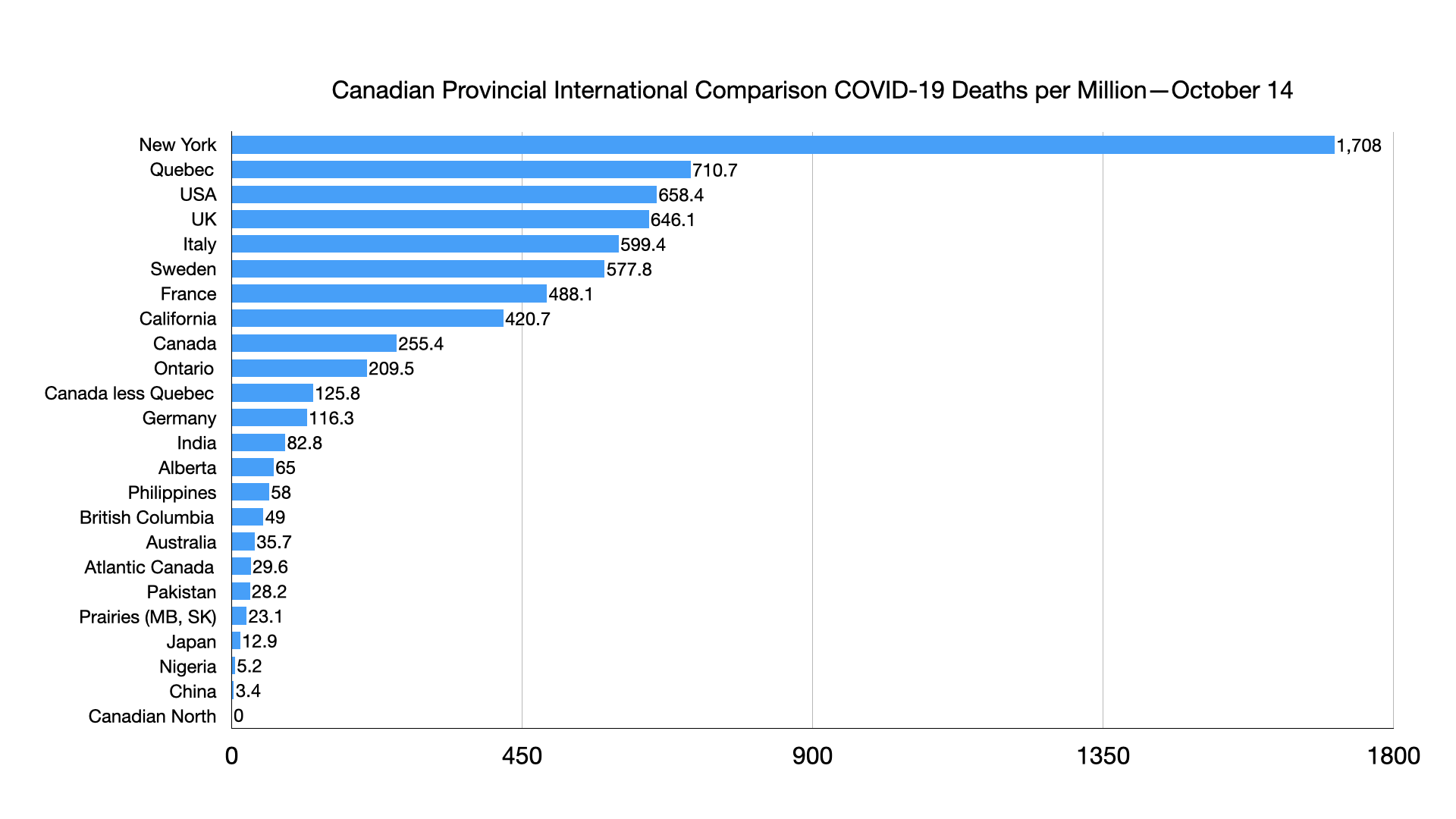
#COVID-19: Comparing provinces with other countries 14 October Update

No changes in relative ranking as overall rate of infections climbs in most jurisdictions:

Weekly:


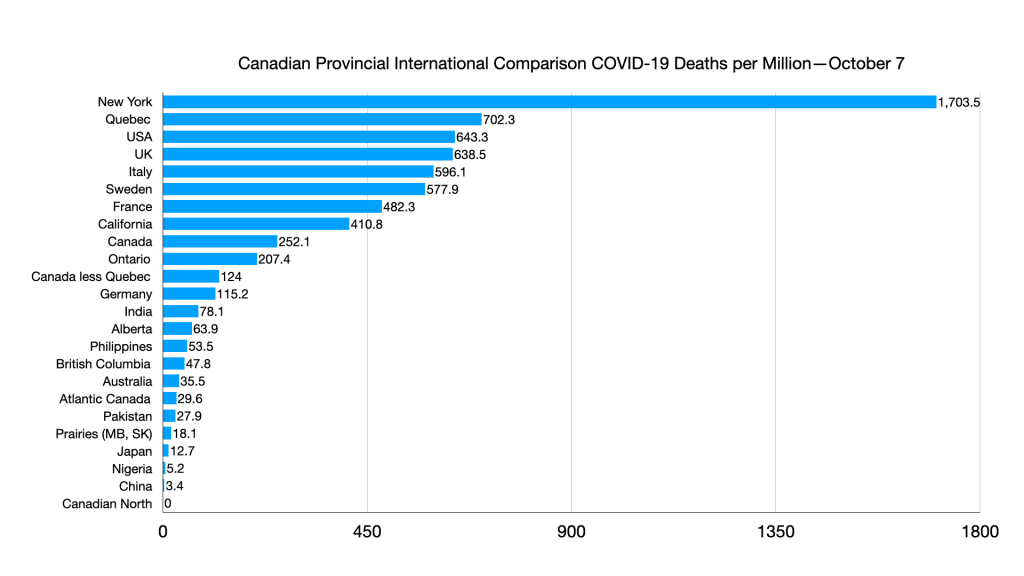
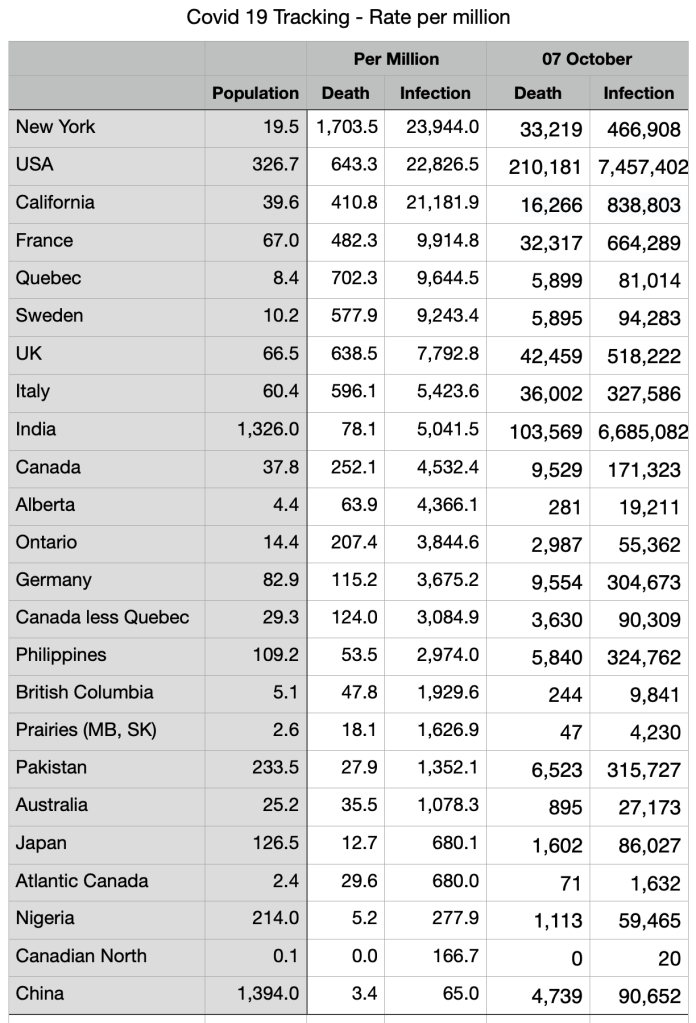
#COVID-19: Comparing provinces with other countries 7 October Update

Highlights:

Deaths per million: USA now ahead of UK

Infections per million: France and Quebec ahead of Sweden, Japan ahead of Atlantic Canada

Weekly: