What Was Revealed When British Officials Calculated How Much a Colonial Subject’s Life Was Worth

A reminder:

One hundred and five years ago, in April 1919, Mani Ram, a middle-aged dental surgeon, frantically ran to one of his son’s favorite play areas. His son, Madan Mohan, enjoyed playing at Jallianwalla Bagh, an empty plot of land in the center of Amritsar, Punjab, but had not come home. Mani Ram was worried because British officer General Reginald Dyer had just ordered his troops to cordon off Jallianwalla Bagh and open fire on all Indian subjects without warning. His officers fired 1,650 bullets at Indians, killing and injuring hundreds, including children at play.

Mani Ram found his son’s lifeless body, among hundreds of others at Jallianwalla Bagh, and carried it home.

Two years later, Mani Ram filed a claim with the imperial government for compensation for the loss of his son. The colonial government had long provided compensation payments to European families when their property was destroyed, or family members were injured or killed. For example, the British government compensated British Loyalists after the American Revolution, British enslavers after the abolition of slavery, and British subjects in India after a large wave of rebellions in 1857.

But 1921 was likely the first and only large-scale compensation for Indian families under British imperial control. British officials were adamant that the payments did not set a precedent and were eager to make them discreetly, burying the procedure, at times, in misclassified files in the archive. These files across London, Delhi, and Chandigarh show a deep racialized and gendered disparity in the value attributed to Indian and European lives, as well as the care distributed to their surviving family members or maimed subjects making such claims. Today, practices of compensation and reparations are still sorted through similar legal structures that echo those very racial disparities.

Dyer’s instruction to shoot Indians at Jallianwalla Bagh was not the only form of imperial violence Indian subjects experienced in 1919. In the early months of 1919, Indians had assembled to protest draconian British policies such as the Rowlatt Act, which granted British officials emergency powers to detain Indian subjects indefinitely without any opportunity for judicial review. In protest, some Indians resorted to attacking the colonial government’s infrastructure, such as railway lines, telegraph wires, and local banks.

British officials responded with great force. They caned, flogged, and detained Indian men and male children without warrant. British officials also declared martial law and opened fire on protesting Indians in Delhi, Bombay, Lahore, Amritsar, Kasur, and Gujrat. British pilots also air bombed parts of Gujranwala.

In the aftermath of the violence, local district magistrates utilized their discretion to allocate ₹523,571 to widows and children of five Europeans who lost their lives in Amritsar and Kasur, as well as to Europeans who were injured, shocked, or attacked during the protests. The compensation funds came from taxes and indemnities leveraged on Indians rather than British funds.

In stark contrast, state officials “distribut[ed] quietly” a sum of ₹14,050 to a handful of Indian subjects “through confidential enquiries,” fearing they should offer at least some reprieve for Indian subjects. Imperial officials hoped that this covert distribution of payments would discourage new requests and limit any precedents for compensation for state violence in the future. Most Indian families who suffered death or injury received no compensation. Those few families who did receive payment received low sums, far less than their European counterparts, and had to rebuild their lives with few resources.

The racial disparity in payments reflected the significant difference in the value placed on a European life compared to that of an Indian, with the former being valued at almost 200 times higher.

Facing global criticism for the violence in 1919, British officials in London instructed the central government in Delhi to investigate the actions of its British officers against Indians while simultaneously guaranteeing amnesty for all imperial officers. In 1920, a committee, mandated by the India Office and Government of India, delivered its final report on the wide array of violence used against Indian subjects. The committee’s four European members justified the widespread violence and brutal tactics employed by British officers in Punjab, while its three Indian members fervently disagreed.

The Government of India argued that its officers were legally permitted to use violence in all situations, including whipping, caning, forced crawling, and indefinite detainment, with only two exceptions. The first exception was Jallianwalla Bagh, where Dyer had ordered troops to fire on the gathering of Indians. The second exception was Gujranwala, a Punjabi locality where British pilots dropped bombs on colonial subjects from planes without warning.

Over the following months, Indian legislators became aware of the significant difference in compensation payments between Indians and Europeans in 1919. They demanded equal compensation for Indian families, political reforms, and an official statement of regret from the British government.

While British officials refused to issue a statement or implement substantial political reforms, they reluctantly approved limited compensation for Indians. However, they restricted the scope and amount of these payments. The decision was driven more by concerns for political stability in colonial India and Punjab than by any commitment to racial equality or justice.

Over the next two years, the Government of India and Punjab worked together to establish a compensation process for Punjabi families who had lost family members or were maimed at Jallianwalla Bagh and Gujranwala. Although the government encouraged families to come forward and file claims, many hesitated due to fears that the compensation process was merely a ploy by the imperial government to target the family members of Indians who were involved in the protests during the early months of 1919.

To determine the value of a person’s life, the Compensation Committee was instructed to utilize a method similar to actuarial science. This involved considering the individual’s annual income or projected income, as well as their life expectancy. After deducting one share for the deceased individual, the remaining payment was divided among his dependents. This process was much more limited in its scope compared to the compensation claims of European subjects in 1919.

The colonial government initially failed to include provisions for Indian women and children, believing their lives had little to no economic impact or worth to the livelihoods of families. Officials eventually agreed to assign a fixed nominal amount to account for their lives. In contrast, calculations for European women in 1919 not only considered life expectancy and annual income, but also took into account nearly all injuries and trauma they experienced.

The formal process of compensation implemented by the imperial government sometimes exacerbated the trauma experienced by Indian subjects. The Compensation Committee asked Mani Ram what the value of his 10-year-old son was. Mani Ram testified that his son was an intelligent student with ambitions that could have led him to achieve any position within the government, even that of a governor. The details of the subsequent conversation between colonial officials and Mani Ram are unknown, but we know that Mani Ram pleaded with the government not to “add insult to injury.”

The allocation given to Indians reflected the significant racial inequality that the imperial government placed on the value of its subjects’ lives. After completing their work, the Viceroy’s Council provided ₹226,000 to over 700 Indian individuals as compensation for the excessive violence inflicted by the colonial government in 1919. This sum, supported through funds collected from indemnities, fines, and taxes imposed on Indians, was less than half of what was distributed among almost a dozen European subjects.

This history, carefully uncovered from governmental records, provides us with a deeper understanding of the past, particularly how legal procedures and bureaucratic systems supported British imperial rule and marginalized the value of Indian claims and lives. But this history is also significant in our present time, as it sheds light on modern practices of compensation as demands for restitution, reparations, and reparative justice, continue.

Hardeep Dhillon is an educator and historian at the University of Pennsylvania. She recently authored “Imperial Violence, Law, and Compensation in the Age of Empire, 1919–1922,” which is open access to all readers through The Historical Journal.

Source: What Was Revealed When British Officials Calculated How Much a Colonial Subject’s Life Was Worth
Nicolas | Compétitions traumatiques

Good arguments on the risks of avoiding blind spots (which we all have to varying degrees) and the risks of leaving such debates to political partisans or single interest groups with little to no curiosity for other perspectives and experiences:

Je suis d’accord avec Paul St-Pierre Plamondon sur au moins une chose : il est indéniable que le colonialisme britannique et sa violence ont profondément marqué, voire forgé, l’histoire du Canada.

Il y aurait beaucoup de choses à dire sur la maladresse avec laquelle le chef du Parti québécois a fait rejaillir cette question dans l’espace public, appel du pied (dog-whistle) en prime. On y reviendra.

Mais plusieurs observateurs lui ont aussi reproché le simple fait de parler du passé. « Il ressasse de vieilles histoires », « le Québec est rendu ailleurs », lui a-t-on rétorqué. Je comprends et respecte le réflexe. Cette chronique s’adresse à ceux que l’héritage du colonialisme britannique intéresse.

Ma vie professionnelle me donne l’occasion de sillonner le pays. Partout, je cherche à comprendre comment les gens voient le Canada ou leur province, leur histoire familiale, les liens qu’ils font entre leur récit personnel et les récits nationalistes. Et partout, dès qu’on gratte un peu, la question du colonialisme britannique ressort, explicitement ou implicitement, dans les rapports que les gens entretiennent les uns aux autres, avec le territoire et l’État.

Ce que je constate toutefois, c’est que la compréhension qu’on a de l’histoire canadienne est souvent prise dans des angles morts qui suivent à peu près les trous dans les curriculums d’histoire de nos provinces respectives.

Je vais me souvenir toute ma vie d’une conversation surréelle avec une personnalité politique pourtant sénior de l’Ouest canadien qui associait systématiquement le français au Québec — seulement le Québec. Je lui avais demandé si l’agacement des Prairies à l’endroit de la différence québécoise pouvait être un héritage de la violence d’État envers les Métis, les Premières Nations et les francophones de l’Ouest à la suite de la pendaison de Louis Riel. Comme si, après avoir « travaillé » si fort à stigmatiser la différence locale, on s’étonnait qu’une autre partie du pays ose la revendiquer. Elle n’y avait jamais réfléchi.

C’est aussi là une démonstration de la manière dont on peut atteindre les plus hauts postes politiques dans l’Ouest et parler de « l’aliénation » des gens de l’Ouest (en vertu de l’exigence de bilinguisme à Ottawa) sans jamais s’être demandé pourquoi l’Ouest n’est-il pas plus bilingue, ou multilingue, et comment cela est-il advenu 

L’absence de réflexion témoignait d’un important angle mort. En associant la francophonie canadienne exclusivement au Québec, on s’était privé d’une clé de compréhension centrale pour sa propre région. Parce que les gens, fondamentalement, cherchent à se comprendre eux-mêmes, mes questions ne pouvaient être reçues autrement qu’avec beaucoup d’ouverture.

De la même manière, j’espère qu’on a assez de recul pour sourire de la façon dont la génération de leaders qui a mené la saga constitutionnelle des années 1980 et 1990 s’est étonnée de voir la perspective autochtone surgir, un peu comme un cheveu sur la soupe, dans son bras de fer entre « peuples fondateurs ». Quel ne fut pas l’émoi collectif lorsqu’Elijah Harper, leader cri et député de l’Assemblée législative du Manitoba, a bloqué l’adoption de l’Accord du lac Meech, qui n’incluait aucune reconnaissance constitutionnelle pour les Premiers Peuples. On avait cru pouvoir régler la place du Québec dans le Canada sans qu’aucun Autochtone ne lève le doigt pour dire : et nous ?

C’est incroyable, quand même, avec le recul. L’épisode reste un symbole du trou béant dans l’éducation politique et historique de nos dirigeants de l’époque.

Je pourrais donner encore beaucoup d’exemples. Les perspectives autochtones, celles des communautés immigrantes provenant d’autres ex-colonies britanniques, celles des communautés noires et asiatiques qui ont encaissé de plein fouet le racisme de l’Empire, celles immigrant du sud ou de l’est de l’Europe qui ont essuyé le chauvinisme protestant, des familles irlandaises et écossaises qui avaient déjà une longue histoire avec Londres avant de débarquer au Canada viennent compléter les récits familiaux qui continuent de circuler dans bien des familles francophones et acadiennes.

Mais il est rare que l’on considère ces mémoires et ces perspectives comme des éléments qui se complètent. J’ai souvent l’impression que chacun tient à son bout de casse-tête régional, linguistique ou culturel et tente de démontrer aux autres l’importance du morceau qu’il a en main. Très rares sont ceux qui cherchent à développer une vue d’ensemble du casse-tête.

Ainsi, les mémoires traumatiques entrent en compétition : chacune tire la couverture, personne ne s’écoute véritablement. Et on normalise une vision de la politique où la seule manière d’être respecté, c’est de faire la démonstration de sa force, quitte à écraser plus petit que soi comme on craint soi-même de se faire écraser.

Je ne sais pas si on comprend que chaque fois qu’on dit que la seule manière d’être respecté, c’est de redessiner les cartes pour se créer un espace majoritaire, on avoue implicitement ne pas croire qu’il puisse exister un pays où chaque groupe est respecté, peu importe son nombre. Il y a bien sûr plusieurs raisons de vouloir fonder un pays. Mais lorsque l’on justifie son désir par une aspiration à jouir à son tour de la force du majoritaire, le message est bien entendu par les gens qui resteront minoritaires. J’avais dit que j’allais revenir à l’appel du pied.

Je pense qu’un exercice de dialogue sur les cicatrices laissées un peu partout par l’histoire de ce pays est nécessaire pour que chacun puisse mieux se comprendre et mieux se respecter. Il se fait d’ailleurs déjà tranquillement, au fil de rencontres portées par la société civile — souvent loin des parlements, des caméras et des réseaux sociaux. Vous me permettrez toutefois d’avoir peu confiance en la réussite d’un exercice aussi délicat lorsqu’il est accaparé par la politique partisane ou par des gens qui démontrent peu de curiosité pour l’ensemble du casse-tête.

Source: Chronique | Compétitions traumatiques

Cohen: Britain’s National Trust must finally confront its colonial past

Of note:

In this old, storied kingdom, the Ark of the Covenant of history is the National Trust. Since 1895, it has been the custodian, interpreter and advocate of the past — lord and lady of a vast realm of lands, buildings and treasures.

With some six million members, it is the largest such organization in the world. Under its care are Tudor houses, thatched cottages and Norman castles, as well as churches, abbeys, monuments, mills, moors, woods and wetlands. The National Trust manages some 500 historic sites and 780 miles of coastline.

The affection of its loyalists reflects another of those characteristics — eccentricity, curiosity, restraint, humility — that define a people. The British cherish their past and its natural and physical representation. A visit to a great house such as Ickworth in East Anglia captures the experience of these places: a sprawling, well-preserved interior staffed by informed volunteers offering discourses on a Chippendale table or a stern family portrait. They stand cheerfully for hours in dim, drafty rooms.

Beyond are the grounds: a welter of paths and a variety of gardens, walled and Italianate. Broad lawns and ancient trees. Picnic spots. A statutory café offering simple, tasty fare. A giftshop selling handicrafts by local artisans.

In a crowded country, a day out at a great house or a parkland is one of life’s simple pleasures. Walkers in wellies and Barbour jacket roam everywhere, families sprawl on the grass by heaping hampers. A lone visitor sips a flask of tea under an oak, reading a well-thumbed Penguin classic. It is genteel and civilized, far from the economic and political disorder.

Now, though, the magical dominion of the National Trust is caught up in its own little drama, divided into camps with different views of history. The cultural wars over history, national identity and social change raging in Canada and the United States have crossed the Atlantic.

The trouble began two years ago when the Trust commissioned a report examining the association between 93 of its properties and slavery and colonialism. It pointed fingers and proposed measures, such as unconscious-bias training for staff. In response, critics founded an organization called Restore Trust, challenging the charity to return to its founding aims, which, to them, is maintaining and restoring properties rather than embracing “wokeness.”

Political correctness has never seemed as prominent here as in urban Canada, where it is a high art, and coastal America, where it is a religion. In fact, the British upper class has long trafficked in casual prejudice.

Thirty years ago, an esteemed scholar could occasionally drop the “n” word in impolite conversation in the common room at a college in Cambridge. So could a senior British diplomat at dinner, offering salty observations about Jews even when talking to one.

What we see among traditionalists here is the reaction to a legitimate questioning of fortunes built on the spoils of the slave trade. Identifying and decrying these wrongs in historic properties is right. It’s the spirit behind the movement in the U.S. to remove statues of Robert E. Lee and other Confederates from streets and drop their names from military bases.

But it is a matter of balance. Lee’s statues should be taken down, offensive as they are, but they should go to a museum, where they can be explained.

Here, places cry out for a reckoning. Cliveden, for example, the sprawling estate of Lady Astor near London frequented by Edward VIII and George Bernard Shaw, became a notorious nest of appeasers and pro-Nazis in the 1930s. Shaw, like Edward, embraced a spirited anti-Semitism. If the National Trust has not addressed this — there is no mention in the booklet published by Cliveden House, the hotel on the property — it should.

Mature societies find a way to tell their whole story. Germany has done this admirably. The challenge is not to deny or ignore the truth, but to put it in context.

As chief steward of the nation’s past, this is the future of the National Trust.

Source: Cohen: Britain’s National Trust must finally confront its colonial past

Belgian King Conveys ‘Deepest Regrets’ For Brutal Colonial Past In Congo

Long overdue:

The policies of Belgian King Leopold II left millions of people dead more than a century ago in the region that is now the Democratic Republic of the Congo. Now, in a first for the Belgian monarchy, King Philippe has expressed his “deepest regrets” for a colonization campaign that remains notorious for its brutality.

“Our history is made of common achievements but also of painful episodes,” Philippe wrote in a letter to Congolese President Félix Tshisekedi that was published Tuesday in Belgian media. The note commemorated the 60th anniversary of the Central African state gaining its independence from Belgium.

Philippe acknowledged “acts of violence and cruelty” under the colonial administration spearheaded by his ancestor.

The decades straddling the turn of the 20th century saw vast swaths of the region’s population die of disease, famine or violence under Leopold’s rule. He plundered rubber, ivory and other raw materials.

In Philippe’s letter, which did not explicitly name Leopold, he wrote that the regime’s violent practices sowed “suffering and humiliation” among the people of Congo.

“I would like to express my deepest regrets for those wounds of the past,” the king added, “the pain of which is today revived by the discrimination that is still all too present in our societies. I will continue to fight all forms of racism.”

Tshisekedi did not offer an immediate public response to the letter on what has been a relatively subdued holiday for the country as it battles the coronavirus.

The country’s colonial past has been thrust into headlines in recent weeks with protests seething worldwide over racial injustice.

Catalyzed by a string of police killings of Black people in the U.S., protests have erupted beyond American borders as well. Across the Atlantic — in the U.K. and Belgium, in particular — statues with racist, colonial legacies have been vandalized and have seen widespread calls for removal.

And statues of King Leopold II have attracted particular vitriol.

The long-reigning monarch claimed the region as his own private property, calling it — unironically — the Congo Free State. Shortly before his death, he was forced to cede the territory to the Belgian state, which maintained formal ownership of the colony until 1960.

Leopold, his successors and the Belgian government drew riches from a system that featured the widespread abduction, mutilation and forced labor of natives.

Several statues of Leopold across Belgium have been the targets of arson and dashes of paint recently, and at least one has been removed by authorities. A petition demanding that Brussels, the Belgian capital, remove all of its Leopold statues has also garnered tens of thousands of signatures.

Meanwhile, a commission approved earlier this month in the Belgian parliament has pledged to investigate and more broadly acknowledge the country’s colonial past. It’s an effort that Belgian Prime Minister Sophie Wilmès heralded in a speech Tuesday marking Congo’s independence day.

“The point is not to rewrite history, but to better understand it,” she said in Ixelles, where she dedicated a commemorative plaque for the Belgian city’s Congolese residents. “After all, we cannot start a new chapter without knowing all the previous ones. This is necessary to build the future.”

Source: Belgian King Conveys ‘Deepest Regrets’ For Brutal Colonial Past In Congo

Belgium begins long-overdue discussion on racism by looking to its ‘brutal’ past

Recognition and acknowledgement of the shameful parts of history are essential, however painful:

There is perhaps no greater symbol of Belgium’s failure to address the dark chapters of its colonial past than the Royal Museum for Central Africa. This weekend, it reopens after a five-year process to revamp the story it tells — a story many Belgians have never been taught.

The Royal Museum for Central Africa just outside Brussels has long been accused of complicity in perpetuating that distorted history.

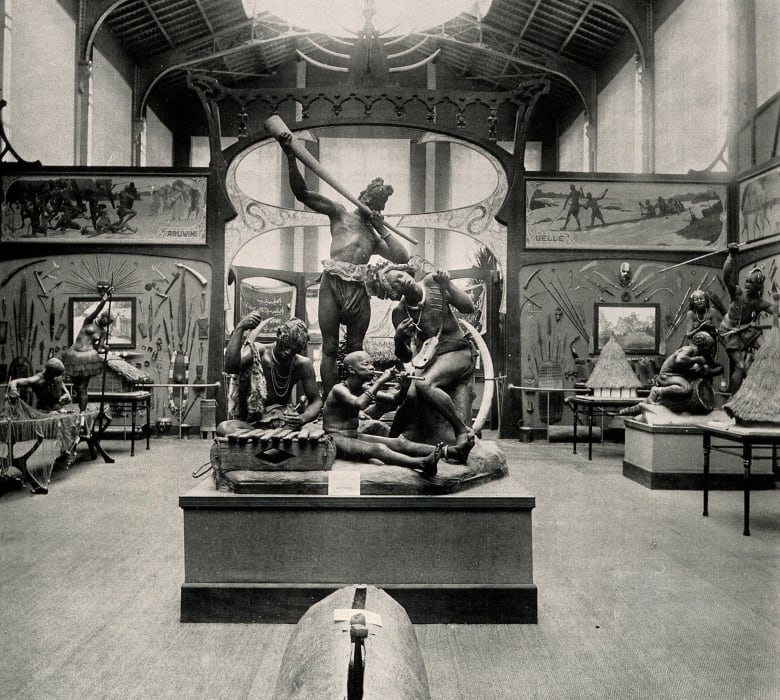
Now housed in one of Leopold’s Versailles-like palaces, its roots date back to 1897, when the king built a special tramline so people visiting the World Fair in Brussels could also visit his own exhibition showcasing his colonial exploits.

He even built a “human zoo” of grass huts inhabited by 267 Congolese brought over to be a part of the display.

This is a look at King Leopold II’s original exhibit at the colonial museum. (Wellcome Collection)

There is perhaps no greater symbol of Belgium’s failure to address the dark chapters of its past than the museum, which has maintained its colonialist perspective for all these decades.

“We have one gallery, for example, with the names of the 1,600 Belgians that died between 1876 and early 20th century in the Congo Free State,” director Guido Gryseels said. “There’s not a single mention about the many Congolese victims of colonization.”

Until now.

Gryseels is the man behind a five-year renovation that he insists will “decolonize” the museum in form and message, delivering a more honest narrative when it reopens its doors to the public this weekend.

“That the Congo was not the story of bringing civilization, that it was not a story of eliminating the slave trade, that it was a story of brutal capitalism, looking for resources, looking for profits.”

Leopold’s private agents were given free rein in his African empire. They used slave labour to satisfy Belgium’s hunger for rubber and other natural resources. Those who fell behind in delivering their quotas could be punished with the loss of a limb, or worse.

That these horrors still feel somehow veiled from ordinary Belgians seems extraordinary.

Gryseels says it is an emotional issue for many Belgians, who will have had relatives who worked in Congo in one form or another over the years, in particular after the Belgian government took over from the king in 1908.

“Many people are very nostalgic about the past,” he said. “For many Belgians, our museum is a symbol of the times when Belgium was still a major power, in 1961, one of the richest countries in the world thanks to colonialism. And, of course, now it’s gone down.”

Immigration from Belgium’s former colonies, which also included Rwanda and Burundi, was not actively encouraged before or after Congo gained its independence in 1960.

But the Central African community here numbers well over 100,000 people. Whether to engage with the museum as it tries to reform and rebrand itself has been a difficult question for many.

Artist Aimé​ Mpane won a competition to design an installation for the main rotunda of the new museum.

It will serve as a contrast to statues still in place from the old era, portraying colonizers as civilizers, including a golden piece depicting African children cowering at the feet of a cross-bearing missionary.

A statue of a missionary and a young boy at the museum. (Lily Martin/CBC)

Mpane’s piece, titled New Breath, is a giant latticework head sculpted from wood and placed over a crown etched on the floor of the rotunda.

“I [wanted] to create one big piece that will take the place of King Leopold II,” he said. “That will replace this story, which links us all, with the good and the bad.”

The work also features a plant that seems to grow from the top of the head, in place of a crown, and draws the eye upward.

“There’s always a link between what’s on the ground and what’s in the sky,” he said. “And that’s to show the idea of genesis, of rebirth. We can rise above our past and reach something that’s ours.”

Mpane’s work, New Breath, in the museum’s rotunda. (Lily Martin/CBC)

Mpane says he initially had doubts about taking part, despite reassurances that proper context would be provided for the colonial statues.

“But when I started to dig a bit deeper into it, I realized we’re really talking about our history and we must try to make sense of it. If we don’t take part in it, who is going to do it?”

Return the artifacts

Others say true contrition for the wrongs of the past would require returning all the cultural artifacts taken from colonial Africa now lining the museum’s shelves, from ritual masks and sculptures to tribal drums and a wooden canoe carved out of a single log.

The debate in Belgium comes in the wake of a report commissioned by French President Emmanuel Macron that recommended the return of thousands of items taken from former French colonies without consent.

The report, which was penned by the French historian Bénédicte Savoy and Senegalese writer Felwine Sarr, has sparked debate in other European countries including Germany and Belgium.

The current Belgian king, Philippe, changed his mind and decided not to attend the Royal Museum’s reopening this weekend in the wake of the controversy.

“I think that giving back these works of art is a question of law and justice,” said activist Mireille-Tsheusi Robert, who came to Brussels at the age of three with her Belgian father and Congolese mother.

“The original owners whose objects were stolen are villagers, chieftains, whole villages — in short, a country.”

Keeping the works of art sends the message: “We vanquished them,” she said.

For now, returning the artifacts is a step too far for Gryseels, although he acknowledges the role of the museum in Belgium’s failure to see itself as a multicultural society and to reflect the diversity of its population in its public institutions.

“For the most Belgians, their first encounter with Africa is through a visit of our museum. If then, in this museum, you get the impression that Africans don’t have a culture of their own, that the European view is superior, then you can’t be surprised that that has an impact. So we take our responsibility.”

‘Only ignorance’

To really change though, the country as a whole must take on that responsibility, many Belgians say. To carry it out of the museum and into mainstream society.

Pierre Kompany says he believes his election is a sign Belgium is headed in the right direction.

But he also says the country must work much harder to acknowledge the past if it wants to free itself from it.

“When it comes to history, there is no compromise,” he said. “Only ignorance.”

Source: Belgium begins long-overdue discussion on racism by looking to its ‘brutal’ past

How an article defending colonialism was ever published is a mystery roiling academia: Paradkar

One can only wonder:

If a social debate is based on fuzzy ideas accumulated from something read somewhere, sometime, an academically published view is the antithesis of it, based on rigorous research, citations and knowledge. Before being published, it is peer-reviewed, or tested for accuracy and integrity by someone with subject matter expertise.

This process is at the heart of a controversy roiling the academic community after the Third World Quarterly, a reputable British journal on global politics, published a piece earlier this month titled “The case for colonialism” by Bruce Gilley, a Princeton University Ph.D and Portland State University professor.

(Although “third world” is now considered a derogatory term, the 40-year-old journal’s name derived from the non-aligned movement of countries who did not want to support either side of the Cold War.)

In his article, Gilley says colonialism has been unjustly vilified, that it was legitimate and its “civilizing mission” was in fact beneficial. He also writes that it is time to re-colonize parts of the world and create “new Western colonies from scratch” because developing countries are failing at self-governance and anti-colonial ideology was harmful to native populations.

The reaction was explosive, targeted at both the article and the journal’s decision to publish it. A petition calling for the article’s retraction gathered more than 10,000 signatures. On Tuesday, roughly half of the journal’s 34 editorial board members resigned in protest.

Two researchers writing for a London School of Economics blog called the piece “a travesty, the academic equivalent of a Trump tweet, clickbait with footnotes.”

That it appeared in a respected journal devoted to anti-colonial politics, made it “the equivalent of a journal devoted to Holocaust studies publishing that the Holocaust didn’t happen,” according to Ilan Kapoor, a York University professor at the Faculty of Environmental Studies, who was one of the board members who quit.

The primary problem, though, revolved around whether the piece published under the label “Viewpoint” passed the scholarship test for publication.

“As with all articles in the journal, this Viewpoint did undergo double-blind peer review and was subsequently published,” said Shahid Qadir, editor-in-chief of the quarterly in a statement.

In a double-blind review, the author’s and reviewer’s identities are withheld from each other.

The editorial board members say they asked for but didn’t get copies of the review. They also say the article was not passed, but rejected by three reviewers. (Qadir did not respond to my requests for comment on this.)

“The piece in question was rejected by two peers who were editors of a special issue on ‘Whatever happened to the idea of imperialism?’ and then it was further rejected by another peer,” said Lisa Ann Richey, a scholar from Denmark currently at Duke University in the U.S.

“There was a remedy available last week — to retract the piece and apologize for the gross error — and this remedy was not implemented by the editor. After this disappointing outcome, the only option available for anyone sitting on the Board who wanted to stand for academic integrity was to resign.”

Kapoor said, “This discrepancy between what the editor has told us and what we have found is highly problematic.”.

Meanwhile, the piece is being torn apart by academics on factual grounds.

“Gilley says he is simply asking for an unbiased assessment of the facts, that he just wants us to take off our ideological blinders and examine colonialism from an empirical perspective,” writes Nathan Robinson in a scathing piece in Current Affairs.

“But this is not what he has done. Instead … (he has concealed) evidence of gross crimes against humanity.”

For instance, he omits any mention of the first 300 years of Western colonization because it’s “impossible to spin it,” as beneficial to native populations, says Robinson. Or he quotes a Congolese man saying, “Maybe the Belgians should come back” and entirely bypasses Belgian King Leopold’s reign of terror in the Congo that scandalized the world.

In the think tank Cato Institute’s blog, Sahar Khan gives five examples of how the piece is “empirically and historically inaccurate.”

For instance, “Gilley attributes the abolition of slave-trading to colonialism, which in addition to being ridiculous, is factually incorrect … Systematic decolonization and subsequent wars of independence eventually ended the slave trade.”

The unexplained publication of a piece that does not meet academic standards of quality should sound alarm bells for those of us outside the ivory towers, too.

The desire to appear even-handed under pressure from faux free-speech defenders has created a damaging false equivalency model in mainstream media, where the compulsion to get “the other side” means unfounded ideas are given the same weight as sound reasoning.

Despite the imperfections of academia, academically credited facts established with rigour, empirical evidence and scholarship remain a credible tool to fight climate change deniers, racism deniers, anti-vaxxers or any one floating in the universe of “alternative facts.”

Not condemning this attempt to Breitbart-ize academia will effectively wipe out the role of accountability in fact-gathering and remove any barriers to revisiting lasting atrocities of our past.

Source: How an article defending colonialism was ever published is a mystery roiling academia: Paradkar | Toronto Star

Do ‘British values’ favour colonial comeback over multiculturalism? | Middle East Eye

Myriam Francois’s view on removal of colonial symbols. Some valid points, but there are also risks associated with effacing and forgetting the past (‘those who forget history …’):

And yet, the campaigns have been largely met with consternation. For all the talk of the positive value of diversity within our society, such campaigns remain a struggle on the margins, not entirely dismissed, but requiring quiet co-optation through piecemeal concessions designed to quell the disruptive uprisings of those now too close to power to be metaphorically put down.

Indeed, an admission of racism following a decision to use an image of black hands in chains to advertise a drinks poster is surely a meagre victory for a movement of such ambition. And although a similar campaign at Cambridge succeeded in convincing Jesus College to take down and consider the repatriation of a bronze cockerel looted in the 19th century, such critical demands are yet to become audible to a broader audience.

It is not sufficient to eventually recognise the validity of the cries for freedom among oppressed peoples when the tools which served to uphold that domination continue to permeate popular culture and in many cases, justify new variants on imperial exploitation. In the case of Rhodes, to maintain as a central part of our social vocabulary a man who stands as the cultural equivalent of the “N” word, is to fail to recognise that just as language evolves to reflect changing social norms, so must our concrete edifices.

Critics of the decolonial movement have compared the call for the removal of Rhodes to a form of cultural censorship – where would the movement stop exactly, ask those who, in so doing, unwittingly concede the pervasiveness of imperial ideals within our contemporary culture.

If we might term white supremacy a culture which justifies the encroachment of European powers into other continents and lands under the guise of conferring civility upon peoples assumed to be lagging on the developmental scale, then the edifices of that supremacy must be dismantled.

In their place, society must make way for a consensual cultural construction, in which all voices are not a mere addition to a slightly reformed rotten core – the term “people” expanded to include women and ethnic minorities and quotas to guarantee a token visibility of the “other” – but rather serve to forge a new cultural project away from the racially skewed underpinning of the culture of empire. In this, the decolonial movement is the avant-garde of our generation.

Source: Do ‘British values’ favour colonial comeback over multiculturalism? | Middle East Eye