Black and racialized Canadians lacking on boards, new study finds

Of note:

A new study from Ryerson University’s Diversity Institute says Black and racialized people are under-represented and sometimes non-existent on boards in eight major cities across Canada.

The institute found few members of those groups on the boards of large companies, agencies, hospitals, educational institutions and in the voluntary sector in cities including Toronto, Montreal, Vancouver, Calgary, Halifax, Hamilton, London and Ottawa.

The study of almost 9,500 people found Black Canadians occupy just 2 per cent of board positions, despite making up 5.6 per cent of the population of those cities.

Racialized people, defined in the study as all non-Caucasians were found to have only one in 10 board positions, though they represent 28.4 per cent of the population.

The institute’s methodology included analyzing photographs of boards and interviewing members of underrepresented communities.

The study also found women are under-represented boards, but fare much better because they hold 40.8 per cent of board positions.

Source: Black and racialized Canadians lacking on boards, new study finds

Full report: Diverse Representation in Leadership: A Review of Eight Canadian Cities

‘They’re addicted to me’: How immigrants keep U.S. heartland cities afloat

Interesting counter to anti-immigration positions in “heartland” states:

One evening last fall, Jawad Rahimi held forth in his downtown bodega as a steady stream of hockey fans en route to a St. Louis Blues game mingled with his neighborhood regulars.

A native of Afghanistan who arrived 16 years ago as a refugee from Azerbaijan, Rahimi has become a fixture in a city center beset with vacant homes and abandoned buildings. A typical day brings a steady flow of customers who come for beer, snacks or just to banter in his St. Louis corner store.

“I think they’re addicted to me,” he said, nodding to the patrons who traded friendly banter with him as they bought snacks and drinks and lottery tickets.

Indeed, St. Louis – and more than a dozen other cities in heartland states which were as often as not carried by Donald Trump in 2016 when curbing immigration was a central plank of his campaign – is hooked on Rahimi and those like him who are serving as economic props for sometimes troubled urban areas.

A dentist by training, the 46-year-old worked in an embroidery shop as he learned English before opening his store. He is now raising two daughters here.

“St. Louis was a good place to start,” he said.

Between 2010 and 2018, if not for the influx of 15,000 foreign-born residents who arrived here, St. Louis’s chronic population shrinkage would have been more than double the 10,000 recorded in that span.

Moreover, a Reuters analysis of census data covering that period shows immigration reversed what would have been outright population declines in 18 cities, including Detroit, Milwaukee and Akron, Ohio, rust belt manufacturing towns in swing states where the 2020 presidential election will be decided.

In St. Louis and elsewhere, immigrants are helping arrest population decline in urban areas caught on the losing end of an internal U.S. trend. Increasingly, people and jobs are concentrating in a few dozen high-performing metropolitan areas, leaving others struggling to maintain population, economic growth rates, or both.

Nationally, the United States recorded its lowest immigration level since the great financial crisis in 2018 as Trump made slowing immigration a top priority – at one point declaring the country “full.” At 202,000, the increase in foreign-born residents in 2018 was about a third of the average since 2010.

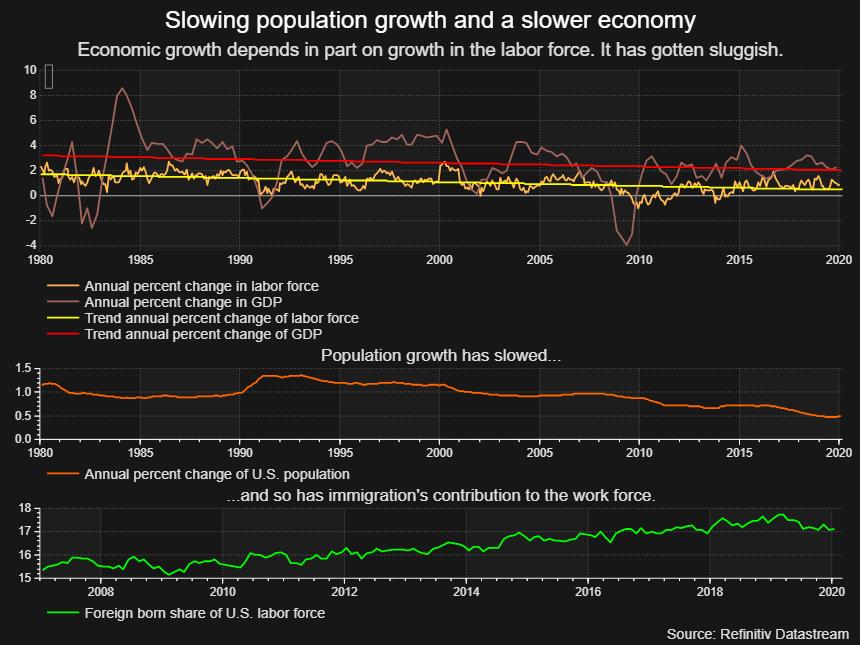
(GRAPHIC: Slowing population growth and a slower economy – here)

Reuters Graphic

To officials in this Midwestern town, that poses a challenge: where to find the bodies needed to fill those empty homes, start businesses and keep the population from shrinking even faster?

For Betsy Cohen, the answer is simple: More Jawad Rahimis.

“When those numbers fall, it is hard to have the growth in the region we want,” said Cohen, executive director of the St. Louis Mosaic Project, whose aim is to make St. Louis’s immigrant population the fastest growing in the country.

“Every person counts,” Cohen said. “All skill lines. All families. We need people.”

PUSHING BACK

If the immigration debate nationally focuses on visceral issues like border security and family separation, cities like St. Louis are pursuing a different narrative – of immigration as needed to stabilize often struggling local economies and downtowns.

After Trump gave governors the right to reject refugees, only one state, Texas, did so. The issue is tied up in court, but many Republican state leaders have rendered it moot by saying they would still welcome refugees.

In a January letter to the State Department, Missouri Governor Mike Parson said the new arrivals would inevitably become “patriotic and productive fellow Americans.”

Pittsburgh, Buffalo and a host of other places, largely in the northeast and industrial Midwest, have also relied on immigrants to ease their overall population loss, and the economic drag that goes with it.

At its root, annual expansion in an area’s gross domestic product is based on the number of people working and how productive they are. Productivity growth has been disappointing since the 1990s.

Though the U.S. unemployment rate is low and many previously sidelined adults have started working again, underlying growth in the labor force has averaged below 1% annually since the 2007 to 2009 financial crisis. It is being pinched at both ends, with the population aging, and overall fertility rates well below the replacement level.

At the same time, the country’s economic geography features a widening divide between places that are adding disproportionate numbers of people and jobs, and those that see their college graduates and mid-career professionals leave town.

It can become self-reinforcing, economists Adam Ozimek, Kenan Fikri, and John Lettieri wrote in a report last year for the Economic Innovation Group. Smaller populations leave a smaller tax base, leading to a decline in services and real estate values, fewer business starts – and fewer reasons to stay.

The one factor that’s somewhat controllable is immigration, the organization noted, suggesting that like Australia and Canada the United States could expand immigration with visas targeted “to places confronting chronic population stagnation or loss as a means of boosting economic dynamism and fiscal stability.”

BETTER AT THEIR STORY

There has been a push in the Midwest in particular to acknowledge regional population decline as relevant to the national immigration debate.

In a 2017 report, the Chicago Council on Global Affairs noted the “extreme native population loss” in Midwestern cities of people aged 35-44, a group entering their prime earning years. The 1.4 million person decline in that group between 2000 and 2015 represented a fall of 24%, eased at least somewhat by the arrival of 313,000 foreign-born residents of that age.

The 12-state region from the Dakotas to Missouri and Ohio, “is home to dozens of metropolitan areas that have come to be increasingly defined by immigration and rely on immigration as a source of population stability… The foreign-born now play a critical role in offsetting regional workforce gaps.”

In Chicago’s Pilsen neighborhood, the dynamic is on display. Initially the home of Czech and other eastern European immigrants whose churches still spire over local homes and shops, the area was in decline during the 1970s and 80s. The people who stayed were the Latino immigrants who have anchored a neighborhood revival.

Marcos Carbajal, 36, left a career with Northern Trust Bank to put his MBA from Northwestern University’s Kellogg School of Management to what he feels will be better use – building his dad’s Michoacan-style barbecue stand, Carnitas Uruapan, from a 45-year-old neighborhood staple into a recognizable citywide brand, and possibly beyond.

“The first generation struggles to move up and traditionally the second generation has better access to education, a better job… better positioning,” he said.

The family has kept the building on Chicago’s W. 18th Street occupied and on the tax rolls since the 1970s, and with 38 employees, a second location now open, and a third “in our sights,” Carbajal said their footprint and economic impact, is expanding. “The food has not changed, the recipe has not changed but we are getting better at telling our story.”

Source: ‘They’re addicted to me’: How immigrants keep U.S. heartland cities afloat

Canada’s 10 worst cities for hate crime

More details from the latest police reported hate crimes report:

Four out of the 10 Canadian urban areas with the highest hate crime rates are in the Greater Toronto Area or Greater Golden Horseshoe, Statistics Canada data supplied to Maclean’s shows.

Police services covering Hamilton, Peterborough, the York region and Guelph all recorded hate crime rates per 100,000 that put their cities among the top 10 highest in the country in 2017, the most recent year with statistics available. Hamilton, Ont. saw the highest rate of any jurisdiction in the region and the third highest in the country, at 16 incidents per 100,000 people.  

Several GTA/Golden Horseshoe cities were also among the country’s urban areas with the fastest-growing hate crime rates. In 2016, only one GTA/Greater Golden Horseshoe city—Hamilton—made the top 10 for hate-crime rates.

Barbara Perry, director of the Centre on Hate, Bias and Extremism at the University of Ontario Institute of Technology, said she wasn’t surprised.

“These are very active areas for the organized far right movement,” Perry said. “Their very visibility and blatancy, I think, over the past couple of years, has contributed to that normalization of hate, that normalization of negative sentiment directed at targeted communities.”

Maclean’s analyzed numbers from police services covering a population of 50,000 people or more in order to avoid large fluctuations in the hate crime rate caused by one or two additional incidents in small towns. The analysis is based on a more detailed version of the annual hate crime data posted publicly by Statistics Canada in late November.

The increases are part of a drastic nation-wide rise in hate crime, with Statistics Canada reporting 47 per cent more incidents from 2016 to 2017. The data captures only hate incidents that were reported to the police.

Statistics Canada did not release data showing the type of incidents or motivations broken down at the police service level. Nation-wide, the government agency reported 38 per cent of hate crimes were violent, with criminals most likely to target Jews, Muslims, Black people and people with marginalized sexual and gender identities.


Police services in the GTA/Greater Golden Horseshoe region contacted by Maclean’sconfirmed that national trends in hate crime motivations were mirrored in their communities. Superintendent Ricky Veerappan, who oversees the York Regional Police’s diversity, equity and inclusion bureau, said the force launched an anti-hate campaign in 2016 in response to rising negative sentiment towards Syrian refugees.

Veerappan said some of the large increase in police-reported hate crimes in the York region might be because of those outreach campaigns, in addition to an increase in the incidents themselves. “People are maybe a little bit more comfortable in connecting with the police, knowing the resources that are available, knowing the numbers to call and knowing members of our diversity unit are very accessible,” he said.

Josh Fraser, public information officer with the Guelph Police Service, said his force also participates in anti-hate public education campaigns. He noted that while Guelph’s hate crime rate of 11.8 incidents per 100,000 people is the eighth highest for any police service covering a population of 50,000 or more, 12 of the city’s 16 incidents were graffiti-related and seven took place on the University of Guelph’s campus.

“The year before it was 10 [incidents],” Fraser said. “I’m not trying to downplay it, but it’s six more. It’s not like it jumped from 50 to 100.”

Perry, the hate crime expert, said it’s important to remember that a handful of additional spray-painted swastikas reported to the police in a city like Guelph likely represents a much larger increase. She said her research and studies conducted by anti-hate groups suggest the true total number of hate crimes in Canada may be five to seven times greater than the official police-reported figure.

“It’s the tip of the iceberg,” she said. “There’s something real going on there.”

Source: Canada’s 10 worst cities for hate crime

Australia Has a Plan to Keep Immigrants Out of Its Largest Cities

The Provincial Nominee Program in Canada certainly led to a diversification of where immigrants settle even if most went to our largest cities:

Immigrants to Australia will soon find themselves excluded from Sydney and Melbourne, the country’s two largest cities. Instead, new arrivals will be confined to rural, low-growth parts of the country—or so the government intends.

The proposal is part of “a decentralization agenda” announced by the country’s population and urban infrastructure minister on Tuesday. “Nearly all of the growth in Australia is into the three population centers of Melbourne, Sydney and Southeast Queensland. And that’s putting enormous pressure on Melbourne and Sydney particularly, and we see that in the congestion on the roads every day,” Alan Tudge told an Australian TV program.

Australia has been widely criticized for its treatment of asylum seekers and refugees, but it settled the second most refugees per capita in 2017, after Canada and Norway. Now the government wants to use migration policy to limit population growth in Sydney and Melbourne, each of which counts more than 4.5 million residents and has grown by more than 10 percent over the past five years. Three in four new arrivals in Australia settle in one of the three areas that would be off-limits to new migrants not sponsored by employers or reuniting with family.

These issues—bursting cities, uneven migration patterns—are not unique to Australia. China has sought to restrict domestic migration to Beijing and Shanghai, citing “big city diseases” like pollution, traffic, and competition for schools, apartments and medical services. In Canada, where immigrants have long clustered in just a couple of cities, province-based visas, meant to draw arrivals to lesser populated places like New Brunswick, now account for one in five immigrants.

In the U.S., virtually none of the country’s largest cities would have added population in the last few decades without immigrants. But the impact of new arrivals is felt in rural areas too: the majority of non-metropolitan population growth between 1990 and 2010 came from Hispanic migrants. The connection between immigrants and economic growth is complicated, but various politicians have floated the idea of revitalizing depopulated areas through immigration. Why not let Syrians settle Detroit? Or Fremont, Nebraska?

In the U.S., at least, where unfettered interstate travel is sacred, plans like Australia’s can provoke unease—even when they are framed, as they usually are, as bonus lotteries to offer green cards to those who wouldn’t otherwise have them. Shouldn’t new Americans be entitled to the same rights as everyone else, including the freedom to move? Why wouldn’t immigrants want to move to the same opportunities sought by native-born Americans? Then again, others point out, employer-sponsored visas like HB-1s already essentially constitute place-based immigration.

Some economists argue confining migrants to low-growth areas doesn’t make sense: Immigrants (and natives) should move to fast-growing regions with high-paying jobs, and those places should provide enough housing and transportation to accommodate them. (Even high-cost cities like New York continue to draw newcomers.) Cities, the thinking goes, function best at scale, strengthened by the increasing potential interactions between people and jobs. That’s little consolation for regions with little population growth, some of whom will pay you to move there.

In the same way that the U.S. helps settle refugees but doesn’t restrict their movement, Canada doesn’t actually make regionally-sponsored visa recipients stay put. In Australia, Roman Quaedvlieg, the former head of the country’s border police, argued that enforcing the new provision would be nearly impossible.

The Australian government hasn’t announced yet how to make sure new immigrants don’t do what immigrants have done for centuries the world over: Move to the big city.

Source: Australia Has a Plan to Keep Immigrants Out of Its Largest Cities

Let’s Give Cities A Greater Role In Managing Migration | Harald Bauder

Worth reflecting upon:

National migration policies play an important part in ordering our society based on origin and status. Canadian temporary foreign workers and international mobility programs have resulted in more than 350,000 foreign workers living in Canada in 2014, often without the same economic rights and entitlements that Canadian citizens take for granted — including the right to stay.

Cities have a different approach to migration. They are not in the business of controlling who crosses and settles within their boundaries, or ordering their communities based on where residents are coming from. Rather, their role is to be inclusive and provide access to resources and services for all residents.

Granted, some city administrations are eager to enforce national migration policies and actively participate in the border regime. Research by my colleague at York University, Liette Gilbert, shows how smaller towns such as Hérouxville, Quebec, and Hazleton, Pennsylvania, have introduced measures that erode the rights of migrants and control their presence.

Many other cities, however, resist exclusionary national policies and border regimes. For example, by declaring themselves sanctuary cities, Toronto and Hamilton have recognized that the residents who are denied status by national policies are nevertheless members of their communities. In this way, dozens of sanctuary cities throughout North America are seeking to build inclusive urban communities in which all residents can equally participate — independent of the order which border regimes impose.

In a globalized world, nation states are increasingly failing to cope with the human need for security and desire to migrate.

Urban communities are also highly responsive to global developments and the need for people to migrate for work and opportunity, and to escape from war and oppression. Take Lifeline Syria as an example: this initiative was spearheaded by civic leaders of Greater Toronto to mobilize fellow residents to sponsor Syrian refugee families and help these families settle in their communities. While the federal government is an important partner in this initiative, it is the urban community that has demonstrated leadership.

Cities are demanding a greater role in managing migration and are asserting their independence from national migration policies that disenfranchise large portions of their residents.

In a globalized world, nation states are increasingly failing to cope with the human need for security and desire to migrate. As cities fill this void, they must maintain their inclusive approach and resist being absorbed into the deadly border regime.

Source: Let’s Give Cities A Greater Role In Managing Migration | Harald Bauder

ICYMI: Why Cities Should Invest in Citizenship: Helping Immigrants Achieve Citizenship Yields Major Returns | Bob Annibale

Likely more correlation than causation, although citizenship both reflects and promotes integration:

It is widely recognized that gaining citizenship is a transformative social experience for immigrants and our nation. Naturalization ceremonies are often emotional events, and the integration of immigrants has shaped the face of America.

Less widely appreciated is the fact that citizenship is a powerful source of economic empowerment and strength both for the individuals who gain citizenship, as well as the cities in which they live.

In the past month the New York City Mayor’s Office of Immigrant Affairs (MOIA) and Citi Community Development unveiled new research conducted by the Urban Institute on the economic effects of naturalization on immigrants and their local economies. “The Economic Impact of Naturalization on Immigrants and Cities” shows that naturalization may lead to an average increase in individual earnings of 8.9%, or $3,200, in the first year after becoming a U.S. citizen. If all eligible immigrants were to naturalize, employment and homeownership rates among eligible immigrants may also rise.

Cities also reap economic benefits from naturalization. If all of the eligible immigrants across the 21 U.S. cities studied were to become citizens, their increased employment rate and earnings would generate millions in new tax revenues – $2 million per year in cities with smaller immigrant populations, like Chattanooga, Tennessee, and Reading, Pennsylvania, and up to $152 million per year in Chicago, $364 million in Los Angeles, and a whopping $789 million in New York City.

Source: Why Cities Should Invest in Citizenship: Helping Immigrants Achieve Citizenship Yields Major Returns — and It’s the Right Thing to Do | Bob Annibale

Cities to weigh loss of long-form census for community planning

Yet another group weighing in on the ongoing implications and costs associated with replacing the Census with the National Household Survey:

Across the country, cities are feeling the impact of the census changes, said Brad Woodside, president of the Federation of Canadian Municipalities and mayor of Fredericton.

“We’ve heard from our members that the change to the new National Household Survey is impacting their ability to effectively plan and monitor the changing needs of their communities,” he said in an e-mailed statement to The Globe. “We support all efforts to increase the reliability of the data from the census.”

Local governments rely on this information to understand the changing needs of communities, and make a range of decisions, “from where to establish new bus routes, build affordable housing and provide programs for new Canadians, he said. “We continue to call on Statistics Canada to work with municipalities to provide communities of all sizes the most reliable information from the available data.”

Mr. Tory said he will raise the issue with the mayors of the country’s largest cities when they meet in Toronto later this week. The topic is not on the agenda for the gathering, which begins Wednesday evening, but he said he can bring it up in informal discussions.

“I believe you really should try to have the best possible evidence in front of you when you are making important decisions,” he said Tuesday. “I can ask if this is a problem they are facing.”

Cities to weigh loss of long-form census for community planning – The Globe and Mail.

Globe editorial makes the same point but equally unlikely to have much effect:

There is now incontrovertible evidence the Conservative government’s 2010 decision to scrap the mandatory census questionnaire, which quantified everything from family income to ethnicity to regional demographics, was an unalloyed catastrophe.

Opposition has come from think-tanks of every political persuasion, business leaders, charities, public administrators and basically anyone with a PhD. Thanks to a deliberately sabotaged census, we know less about Canada in 2011 than we did about Canada in 2006. Who thinks that’s a good idea?

What’s more, conducting a halfwitted census turned out to be more expensive. The 2011 voluntary household survey increased errors, reduced accuracy, chopped the response rate by 30 per cent – and cost an extra $22-million. Congratulations: The Harper government figured out how to spend more for less.

The decision to kneecap the census was transparently ideological, a rash exercise in partisan narrow-casting, and was quickly exposed as such.

Dozens of experts predicted the damage that would be wrought. It’s time for the Conservative government to finally acknowledge how right they were.

The next opportunity for the House to revisit the Census Act will come next month via another private member’s bill – this one tabled by Conservative backbencher Joe Preston.

It would remove two aspects that are problematic to some Conservatives: jail for refusal to complete the form, and automatic public disclosure after 92 years.

There is still resistance in Mr. Preston’s party to bringing back the mandatory long form. We hope that removing the central justifications for killing it represents an evolving mindset.

Some mistakes are easy to reverse. It may be too late to restore a proper census in 2016, but a return in 2021 should be inevitable.

The census: Little knowledge is a dangerous thing – The Globe and Mail