The secret Covid-19 rate in Richmond, Canada’s most Chinese city, isn’t what racists might expect. It’s dwarfed by the rest of the nation

Worth noting with the results likely reflecting greater awareness among Chinese Canadians and their networks:

Amid a spike in anti-Asian incidents in British Columbia during the coronavirus pandemic – from slurs to the assault of a 92-year-old man – Canada’s most Chinese city is defying racist stereotypes conflating ethnicity with the illness.

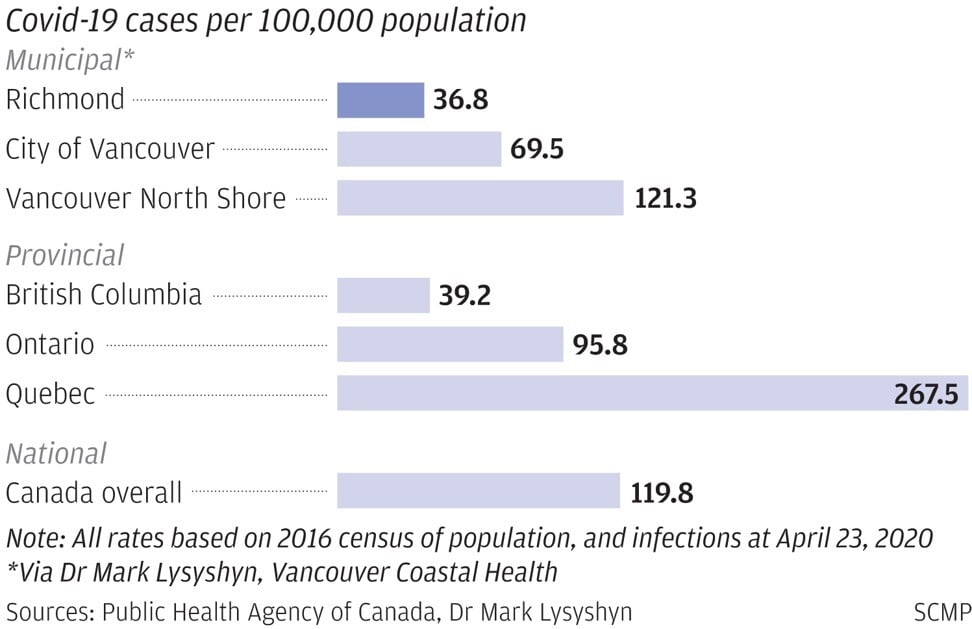
In Richmond, where 54 per cent of the population claims Chinese heritage, the rate of confirmed Covid-19 cases appears to be less than one-third the rate in the rest of Canada, and only about half that in neighbouring Vancouver.

BC health officials have tried to keep secret the Covid-19 prevalence in municipalities, citing the risk of stigmatisation in hard-hit places, or a false sense of security in others.

But in a Facebook Live appearance last Thursday, Dr Mark Lysyshyn of the Vancouver Coastal Health (VCH) authority revealed a partial breakdown of cases, saying that about 10 per cent of the 755 cases in the VCH catchment at that time had occurred in Richmond.

“The greatest number of cases are in the Vancouver area,” said Lysyshyn, deputy chief medical health officer with VCH, responding to a question from a viewer. “About 60 per cent of our cases are there. We’ve also seen a high number of cases on the North Shore, about 30 per cent of our cases there. And then about 10 per cent of our cases in Richmond.”

Photo: SCMP Graphics

He said a small number – about 3 per cent – were in rural locations outside the greater Vancouver area, although he did not explain this pushing the total above 100 per cent.

On a population basis, and taking that disparity into account, Lysyshyn’s assessment translates into a confirmed Covid-19 prevalence of about 37 per 100,000 people in Richmond (with a population of 198,000 according to the 2016 census).

By comparison, the city of Vancouver’s confirmed prevalence is about 70 per 100,000, while the Vancouver North Shore is by far the hardest hit area in the VCH catchment, with an estimated prevalence of 121 cases per 100,000. The North Shore, made up of three municipalities, has suffered the deadliest outbreak in BC, at the Lynn Valley Care Centre where at least 20 people died.

All of Canada, meanwhile, had a rate of 120 per 100,000, based on the 42,110 confirmed cases last Thursday. That rate has since risen to about 143, as of Wednesday.

British Columbia’s provincial health officer, Dr Bonnie Henry, has refused to give municipal figures for Covid-19 cases, instead providing breakdowns for BC’s large health regions.

The 2.5 million strong metro Vancouver area – which includes the city of Vancouver, Richmond and 21 other municipalities – is divided between two health regions, Vancouver Coastal Health and Fraser Health. Both health regions also encompass rural communities beyond Metro Vancouver.

Vancouver Coastal Health declined to elaborate on Lysyshyn’s assessment.

“Dr Lysyshyn was providing approximate numbers during his Q&A. To date, we have only provided case numbers for VCH as a whole, or in relation to specific declared outbreaks and have not released detailed statistics on a more local level, so we’re not able to clarify any further,” said Matt Kieltyka a public affairs officer with Vancouver Coastal Health.

Henry responded to persistent calls that she release municipal data on Covid-19 cases in an April 6 statement.

“Simply put, the risk is everywhere,” she said. “It would be irresponsible to mention only a few communities and give people outside those areas a false sense that they are not susceptible or at lower risk. Every health region in British Columbia has people with Covid-19. Every community and hometown – no matter how large or small – is at risk.

“As we notify the public about Covid-19 cases, we have been careful about how much we disclose [about] the specific location of confirmed cases … there is still very much of a stigma associated with infection.”

Richmond’s medical health officer Dr Meena Dawar has similarly declined to provide case counts since March 19, when she told city officials there were only 10 confirmed cases in the city, the Richmond News reported.

There were early fears that Richmond – the most ethnically Chinese city in the world outside Asia – could have been a potential hotspot for the disease because of a large population of frequent travellers to and from China. The city is also home to Vancouver International Airport.

But Richmond residents were also early to take Covid-19 seriously and adopted social distancing measures long before being advised by authorities to do so.

By late January, many residents were wearing face masks and many of Richmond’s Chinese shopping malls and restaurants were largely deserted, which even prompted a short-lived government campaign encouraging people to return. Some Lunar New Year events were cancelled and by February 11, Richmond’s Lingyen Mountain Buddhist Temple had closed its doors, citing coronavirus concerns.

It would not be until mid-March that BC authorities ordered residents to stay at home and socially distance themselves from others.

Virologist Dr Jason Kindrachuk, Canada research chair in new and re-emerging viruses at the University of Manitoba, said he “absolutely” believed the early adoption of social distancing by BC’s Chinese community could have helped suppress the disease in the province.

Such behaviour was “fantastic, it needs to be applauded and recognised”, he said.

About 27 per cent of people in the city of Vancouver have Chinese heritage, compared with about 11 per cent in BC and 4.6 per cent in all of Canada.

BC currently has 2,053 confirmed Covid-19 cases, at a rate of 44 per 100,000. That rate is far lower than the larger provinces of Ontario (117) and Quebec (315), while BC’s similar-sized neighbour Alberta has a rate of 119 per 100,000.

Vancouver police last week warned that a spate of hate crimes had been reported, including five anti-Asian incidents in March. In the only one involving violence, a 92-year-old man with dementia surnamed Kwong was thrown out of a convenience store by a much larger man shouting anti-Asian statements about Covid-19 on March 13.

“Xenophobia is on the rise and we hope that as a community we can stand together to help protect the next person this may happen to,” the Kwong family said in a statement. A suspect has been identified but no charges filed; police said they were still investigating.

Other incidents conflating Covid-19 with people of Asian appearance have involved abusive language, although the Vancouver Police Department declined to elaborate.

On Wednesday, Vancouver Mayor Kennedy Stewart said that “hate of any kind has no place in our city”.

According to a survey conducted on April 24 by Corbett Communications for a group called the Chinese Canadian National Council for Social Justice, 12 per cent of respondents in Vancouver agreed (4 per cent) or said they did not know (8 per cent) when asked whether “all Chinese or Asian people carry the Covid-19 virus”.

Canada’s chief public health officer Dr Theresa Tam said on Twitter on January 29 that she was “concerned about the growing number of reports of racism and stigmatising comments on social media directed to people of Chinese and Asian descent related to #2019nCOV #coronavirus.”

BC’s Bonnie Henry said on April 6 that the key to avoiding Covid-19 was not staying away from areas with high rates of infection but adopting personal practices like social distancing and good hand hygiene.

“So, while I understand the desire to know and understand what the Covid-19 situation is in your community, I need to emphasise that knowing where the positive cases are does not protect you, your family or your community,” said Henry. “The actions you take will do that.”

And the National Post analysis where travel-related COVID-19 cases came from: Canada’s early COVID-19 cases came from the U.S. not China

Worries grow that discrimination against Chinese Canadians is getting worse as pandemic continues

Despite efforts by political leaders and others. Unfortunately, there will always be some who will use the pandemic for racism and discrimation against Chinese Canadians (concern over the behaviour of the Chinese government is, of course, legitimate and warranted):

Avvy Go knew things were going to get bad in January.

The Toronto lawyer who works with the Chinese and Southeast Asian Legal Clinic said once China was identified as the epicentre of COVID-19, she was concerned about anti-Asian discrimination growing in Canada.

“Since then we’ve been hearing more and more stories about Chinese Canadians experiencing discrimination in the workplace, or just being called names while they’re just on the street out shopping,” Go said.

“Yes, it has gotten worse. More and more people are talking about what they’ve experienced.”

Go said much of what she’s hearing wouldn’t rise to the Criminal Code definition of a hate crime.But the RCMP is encouraging anyone to report discriminatory acts even if they seem minor.

Reporting racist or hate-motivated incidents can still help police identify trends and potentially stop escalation, said RCMP spokesperson Cpl. Caroline Duval

“Investigating hate-motivated crimes and incidents falls under the mandate of the local police of the jurisdiction where the criminal activity takes place,” Duval said Tuesday.

“Reporting hate-motivated incidents, no matter how minor they may seem, can help police better target crime prevention efforts in the communities. It can also identify trends and prevent a possible escalation towards violence.”

In a recent intelligence report, the FBI warned local police across the U.S. that hate crimes against Asian American communities could “surge” during the pandemic. It didn’t help that President Donald Trump has taken to referring to COVID-19 as the “China virus.”

“The FBI assesses hate crime incidents against Asian Americans likely will surge across the United States, due to the spread of coronavirus disease,” read the report, written by the FBI’s Houston office and obtained by ABC News.

“The FBI makes this assessment based on the assumption that a portion of the U.S. public will associate COVID-19 with China and Asian American populations.”

ABC reported that the assessment noted an increase in hate crimes across the U.S.

The RCMP has not issued any warnings about a potential rise in hate crimes targeting Asian Canadian communities. A spokesperson for the Toronto Police Service said there has been no increase in reported hate crimes targeting Canadians of Asian.

“(But) hate-related occurrences often go unreported to police so I’m not sure our numbers would accurately reflect the possible lived experiences for some members of the community,” said police spokesperson Meaghan Gray.

Evan Balgord, the executive director of the Canadian Anti-Hate Network, told the Star Thursday that most of the chatter in white nationalist and far-right extremist online circles has focused on baseless theories, like COVID-19 being a bioweapon or a plot by the United Nations.

But Balgord said the conversations have strayed into racist tropes or racially-charged statements, like the desire for more Chinese to die from the virus.

“We have seen members of far-right movements in Canada brag about harassing Chinese people in real life,” Balgord said.

The Chinese Canadian National Council’s Toronto Chapter has created an online forum where people can chronicle any racially-motivated abuse. Justin Kong, the chapter’s executive director, said there have been reports of “intensifying anti-Asian racism, this renewed Sinophobia.”

Kong said there are segments of the community who no longer feeling safe going to public places.

“We wanted to make sure people had a place to share their experiences, and we wanted to collect those experiences …and make sure the voices of communities who are discriminated against, East Asian Canadians, Chinese Canadians, are heard,” Kong said.

Kong is calling on authorities to do more to support Chinese Canadians during the pandemic.

“We’re hoping the government … takes a stance on this and speaks out against racism, and also puts in real policies to fight that racism,” Kong said.

“Especially in this heightened moment.”

Source: Federal PoliticsWorries grow that discrimination against Chinese Canadians is getting worse as pandemic continues

Chinese Canadians collect personal protective equipment for donation to front-line medical staff

Of note:

Members of Canada’s Chinese community have been gathering medical supplies to donate to health-care workers battling the novel coronavirus, saying they are responding to requests from front-line workers looking for personal protective equipment.

They say they are being asked for equipment such as surgical masks, N95 masks, face shields and gowns.

British Columbia’s Public Health Officer Bonnie Henry said Monday that she was not aware of shortages of such supplies, but two days later, she acknowledged the province is currently at a “tenuous level” of personal protective equipment.

“It’s a challenge that we have nine long-term care facility outbreaks where additional protections are needed in those facilities,” Dr. Henry said Wednesday in her daily media briefing. “And then we now have an increasing number of people in hospital and [we are] going through way more personal protective equipment than we expected.”

She added the province is now looking to increase stockpiles, including considering alternative supplies from around the world.

The shortage of gear pushed health-care workers, through social media, to call on dentists and members of the public to make donations. “To our dental colleagues: Do you have surpluses of face masks or other PPE? … Us front-line health-care workers are in desperate need of them,” one post says.

Vancouver dentist Patrick Wu began donating medical supplies after receiving calls and messages from physicians and nurses. “They feel unsafe at their workplace,” he said.

As dental offices have suspended non-essential services, Dr. Wu collected items such as masks, gloves, surgical gowns and shoe covers from his and his colleagues’ clinics. He then delivered them to hospitals in Vancouver and area last week.

After an article about his efforts was published in a Chinese-language newspaper over the weekend, more health-care workers reached out to him, he said, prompting him to establish a group to collect more resources.

“It is unbelievable; it’s overwhelming – the number of nurses and doctors [who] have asked us for donations. … I only have so little to give so that urged me to quickly form this group.”

Dr. Wu said in the past few days many people had approached him and wanted to contribute, including a Vancouver dental laboratory.

Businesswoman Caryn Zhang has been mobilizing members in the Chinese community to give away medical supplies.

Within a week, Ms. Zhang said they have donated hundreds of protective suits, goggles, face shields and masks to St. Paul’s Hospital, Vancouver General Hospital and Surrey Memorial Hospital.

The equipment has come from local residents and Chinese Canadians who had gathered it to donate to health-care workers in Wuhan, China, when the crisis first became public in January. Those supplies are no longer needed as urgently overseas, as China begins to emerge from the worst of the outbreak.

Ms. Zhang said her group has also asked Canadian citizens and permanent residents who are returning to Canada from China to bring with them as much as they can. As well, she said the group also has connections with factories in China that produce medical masks.

“We just want the doctors to be safe,” she said. “If [health workers] around us collapse, then this country will be devastated.”

One emergency doctor working in a hospital within Fraser Health Authority said he had to buy himself masks from a hardware store to ensure his safety.

The Globe and Mail has granted the doctor anonymity because of his concerns he would face repercussions from his employer for speaking out. He said he isn’t sure whether his hospital has sufficient supplies in stock but said the essential equipment is not in the hands of front-line health workers.

Dr. Henry said this week that donations of medical supplies from groups could also be a challenge for a health-care setting.

“The challenge we have is that the equipment, the personal protective equipment, may not be the right thing for a health-care setting, and that has happened in a couple of cases where people have been well-meaning, but have delivered things that were inappropriate,” she stated.

“So we are working through our federal counterparts to make sure that everything that is needed is asked for and is co-ordinated, is done through our federal counterparts to make sure that we are not spending a lot of time and energy and ending up with something that is not appropriate or is unsafe.”

Source: Chinese Canadians collect personal protective equipment for donation to front-line medical staff

Can we talk? Bridging campus divides over Hong Kong

Interesting UBC initiative:

Canada-China relations are bleak, to put it mildly. The diplomatic tensions have extended to Chinese communities in Vancouver, but is there hope on the horizon?

Our research shows promising solutions are already emerging.

Global power dynamics are said to be shifting towards the east.

But domestically, the People’s Republic of China, or PRC, has been confronting mass civil unrest in Hong Kong while facing international scrutiny for the government’s “re-education” centres for Muslims in Xinjiang province.

Meanwhile, Canadian media has been criticized for propagating Western-centric rhetoric, often misleading the public and unfairly polarizing contentious issues.

Some news outlets have reported a rise in anti-immigrant sentiment in the wake of escalating bilateral tensions. These concerns have been heightened in the face of the ongoing COVID-19 pandemic.

These challenges continue to affect people living in Canada, including students at the University of British Columbia.

Divisive politics and polarized ideologies are fuelling an atmosphere of reproachful disengagement and stereotyping within the diverse ethnic Chinese communities on this particular campus and in the region.

Similar news reports coming out of Canadian universities suggest this issue is not isolated to UBC’s campus.

Student voices: The Hong Kong conflict

To understand this issue more completely, we interviewed UBC students and alumni. As researchers, we engaged with students from Hong Kong, Taiwan and mainland China. Our findingshighlight the diverse range of perspectives within the diasporic community on UBC’s campus, and draws attention to a student-led initiative facilitating dialogue in times of political tension and increasing polarization.

“I love my country, but I don’t agree with being extremely patriotic,” said Jessica, a UBC alumnus. “[Chinese students are] disagreeing with Hong Kong students, but that doesn’t mean they’re any more Chinese for it.”

Jessica explained how the conflict has affected her life here in Canada. Originally from mainland China, she moved to Vancouver close to 10 years ago to study at UBC. She’s always held liberal views, and yet, regardless of her beliefs and opinions, she feels targeted in Canadian society as an ethnically Chinese individual while scrutinized by some Chinese nationals for holding more liberal views.

“Someone basically told me, if you don’t come, you’re not Chinese,” said Jessica, referring to a pro-China protest held on UBC’s campus during the 2014 umbrella movement.

Zhang Wei, a graduate student at UBC, can relate; he said his identity as a Chinese citizen makes his pro-democracy ideology problematic within his social circle.

“Talking about Hong Kong is complex for me because I genuinely support the pro-democracy movement. I don’t agree with the way the Chinese government has been abusing human rights, especially in the last six years since [Chinese President] Xi Jingping took power.”

Peter, an undergraduate student and Hong Kong native, added:

“We can have different aspects to our identity, but I don’t think we should tie ourselves to government ideology. Is it Hong Kong rejecting China, or is it Hong Kong rejecting the government and the PRC style of policy and rhetoric?”

Meanwhile, Hong Kong native and undergraduate student Danielle said it’s not about political disagreement, it’s about a complete lack of rights.

“It’s so frustrating, I am standing up for a basic fundamental right, but people think I am somehow destroying the society. Yes, I am radical in a way. I stand up for what I believe in, for my rights in society, but that doesn’t mean I hate mainlanders. I recognize where their thoughts and values come from. It’s really hard because it’s not about the facts and the communication, it’s the value system and the structural system that has defined our identities from a very young age.”

Calvin, another undergraduate student at UBC, believes rejecting China and rejecting the government are one and the same, suggesting the Hong Kong government has failed to educate its constituents on the history and cultural values of China:

“There’s definitely a lot of tension between mainlanders and Hong Kongers. Most people just take what the western media says about protests, which is mostly negative towards China. China isn’t as bad as its portrayed. I’ve lived most of my life in China, and I don’t feel like my free speech has been challenged.”

Hua Dialogue: Tackling difficult conversations

The Hong Kong protests illustrate how such a divisive movement abroad can sow tensions among communities here in Canada. Easing those tensions isn’t easy. However, learning how to effectively engage in difficult conversations might be a good place to start.

The student-led Hua Dialogue at UBC provides a platform for people from different communities to exchange ideas, increase awareness and discuss contentious issues. Moderators facilitate dialogue by indirectly discussing controversial subject matter through a neutral lens. One of their most recent conversationsdebated the role of media as an influential tool in polarizing opinions.

“Hua Dialogue is a way to challenge stereotypes,” a member of the Hua Executive team said in an interview. “You start to understand where people are coming from and what their viewpoints mean to them.”

Improving the China-Canada diplomatic relationship is fraught with hurdles, but it’s not impossible. At a minimum, we must understand the root cause of the problem from multiple vantage points if there is any chance of repair, both within Canadian communities and internationally.

It is a process that begins by learning how to question our biases and assumptions, while learning how to be comfortable with disagreement and ambiguity; a goal the Hua Dialogue team aims to achieve in every meeting and with every disagreement.

“It was heartbreaking to see growing segregation within Chinese communities, so we wanted to contribute to a space that provides room for growth for people from all types of backgrounds,” added another member of the Hua Executive team.

“Learning about individual experiences, and how they might influence an individual’s thoughts and values, is essential to understanding ourselves and processing our own experiences.”

Source: Can we talk? Bridging campus divides over Hong Kong

The line between us: For Chinese-Canadians like me, coronavirus is just the latest strain of infectious fear we’ve faced

One of the most thoughtful reflections and commentary that I have seen:

I was sick last week.

It was nothing serious – just a nagging cough and clogged-up head. And it was over before it really began: Aggressive doses of extra-strength medicine knocked it out of me after a couple of nights. I was nothing more than one of the thousands of Canadians who, at any given time, are battling a little sniffle or scratchy throat.

Except I wasn’t.

Last weekend brought the announcement of the first case of a novel coronavirus (2019-nCoV) in Ontario, where a 17-year-old epidemic of severe acute respiratory syndrome (SARS) remains only lightly buried in the graveyard of our collective memory. On Tuesday, British Columbia reported its first positive test for 2019-nCoV. On Thursday, the World Health Organization designated the coronavirus outbreak as a global health emergency. And early cases have been linked to the city of Wuhan, where about a third of the world’s cases are located, in central China – a country that is increasingly being inescapably writ onto the skin of the two million Chinese-Canadians like me.

The memory that affirmed that reality for me is lightly buried, too. In 2003, I – an eighth-grade nerd just looking to commute from the suburb of Richmond Hill, Ont., where nearly one-third of residents now identify as Chinese, to my downtown Toronto high school – was among the Chinese-Canadians who were treated like an alien because of SARS fears.

I remember the weight of the textbook-laden backpack I was trucking that morning. I remember the gratitude I felt when I saw a seat open up on the subway car. And I remember that I’d barely settled into it when the person next to me bolted up, put a mask on his face, and backed away. I remember how he stared at me with disgust.

In that instant, in that man’s eyes, a random kid – a boy born in Toronto’s now-shuttered Wellesley Hospital to remarkable parents who immigrated here from Hong Kong for school; a boy who had visited the former British colony just twice and grudgingly, given my pubescent dismissiveness toward my Chinese culture in pursuit of half-baked notions of Western “cool”; a boy who was (embarrassingly, I can now say) repulsed by overt markers of his background, from “Chinglish” stumbles to smelly lunches – was boiled down into his essential parts. That is to say: he saw me as Chinese by both of the word’s definitions. I was ethnicallyChinese – Han, to be precise, as 92 per cent of China’s population is. I was therefore, in his panic-blinded eyes, from China, and because of my body’s presumed geographic proximity, I was an inherent health risk, even though I was born and forged in Canada.

In that moment, and in all the others before and since, I was trying to just be what I was and am: a Chinese-Canadian. But that was the first time in which someone had denied me that second part of that identity. To that man, there was a hard dividing line in the hyphen between “Chinese” and “Canadian,” as if “Canadian” was an ethnicity. I couldn’t really be the second because of the fluctuating freight of the first.

For centuries, Chinese-Canadians have faced ethnic stereotyping. But when SARS struck, I couldn’t escape the brand-new clichés that were being inaccurately projected onto the visible colour of my skin: broad ideas and sometimes-thin opinions about China, the country. So this past week, even as others coughed and sniffled around me on buses and subways, I stifled any hint of my slight sickness. I didn’t want people to notice the Chinese person who was sick, because I knew – from my own experience – that this could make me suddenly and painfully foreign. I know I wasn’t alone.

Just as was the case when SARS struck, some Canadians seem to be steering clear of people who appear ethnically Chinese.

Tonny Louie, the chair of the Toronto Chinatown Business Improvement Area, told The Globe and Mail he noticed a downturn this week, invoking memories of empty dim sum restaurants and plummeting sales in places like Pacific Mall, North America’s largest Chinese indoor shopping centre.

Stories from Chinese-Canadians about being avoided in public spaces have flashed through social media, amid some clamour for panicked, over-broad quarantines, echoing an Ipsos poll early into the 2003 epidemic that found that two-thirds of Canadians wanted individuals arriving from SARS-affected areas to lose their freedom of movement or not be allowed into the country.

And with preposterous conspiracies flying – including baseless ethno-nationalist accusations that the coronavirus was developed as a bioweapon by the Chinese state or was stolen by Chinese scientists from a Winnipeg lab – a woman eating bat soup has quickly become the defining image with which some ignorant online hecklers have responded to the outbreak.

That’s despite the fact that the woman in question, a blogger from China, ate the bat three years ago; the fact that bat soup is not a widespread delicacy in China, but more so in places like Palau, where the video was shot; the fact that there is not yet a direct scientific link between the coronavirus and bats specifically, but rather more broadly to the exotic wildlife sold illegally in a Wuhan seafood market; the fact that polling suggests Chinese citizens are keenly aware of the national problem of food-safety standards; and the fact that Chinese cuisine hardly owns the monopoly on unusual foods – as if the West does not savour, say, the livers of force-fattened geese.

These reversions to our basest racial clichés – that being Chinese is the same as being unclean – did not happen by accident. There is a long legacy of this here, and the speed with which these fears have spread just reveals how close to the surface irrational racism sits, and how easily it can be channelled by well-intentioned but poisonous panic.

But the coronavirus backlash is just part of the current toxic stew of fear, suspicion, and resentment of Chinese-Canadians. And as a result, the line that halves the definition of the term “Chinese-Canadian” threatens to become even thicker – erasing the identities and histories of those who, regardless of their individual opinions on the matter, have nothing to do with the People’s Republic of China or the Chinese Communist Party (CCP).

Chinese-Canadians are Chinese, yes, but we are Canadian. The distinction needs to be made. Otherwise, the complicated reality of individuals in the diaspora could be lost, and both hoary, centuries-old racial fears as well as any equally irrational and unfair suspicions of the geographic, political and national-security threats that an ascendant nation of China represents to some, could be imposed on anyone who looks Chinese.

“There’s this thinking of, ‘You’re all Chinese – Hong-Kong Chinese, third-generation born here, doesn’t matter – you’re all visually the same,’ ” said Henry Yu, a professor of history at the University of British Columbia.

“It’s, ‘we’re ascribing to you, the Chinese, all the things we don’t like about China too.’ ”

And if this is left unaddressed – as has largely happened, over the course of two centuries – broad Sinophobia can fester, potentially setting the foundation for irrational fear to turn into discrimination and for that to harden into social fact.

History has long told Chinese-Canadians that our identity is whatever Canadians allow it to be. The red line was thick when Canada’s federal government banned ethnic Chinese migrants, regardless of nationality, for more than two decades, or when it imposed a head tax to discourage their arrival, or when Chinese immigrants were ghettoized in cheaper, dangerous shanty communities, later glorified as Chinatowns.

From the 19th century and into the 20th, the bright red line made the idea that we could be Canadian impossible. We were merely and, to many, despicably Chinese, prevented from joining up with the nationality we sought; even after we became citizens by law, we were denied the franchise as recently as 1947. The Yellow Peril – the idea that we represent an existential threat to white labourers and societies because of some kind of inherent work ethic, or that we are dirty dealers in iniquity and therefore unworthy of the West – was a fear that, even in its name, chained itself to the colour they used to describe our skin.

As the decades passed, that began to change. Chinese families represent the largest ethnic group of Asian Canadians, who in turn comprise more than a fifth of Canada’s population. We are Olympic medallists, members of Parliament and veterans, and like any diaspora here we have worked to weave our way into the knotty national fabric.

But increasingly, Chinese-Canadians’ ethnicity is becoming bound up with the actions of a state that is being seen as a threat to the Western world.

The narrative of an ascendant China has loomed since the late 1980s – and as Beijing becomes more emboldened, the view of the Chinese as a people has become pitched, too. According to a Nanos poll from 2012 – well before the heights of the geopolitical rivalry we see today – a plurality of respondents said that China posed the greatest threat to Canada’s national security.

A looming decision on whether Ottawa will allow major Chinese telecom-equipment maker Huawei to build part of Canada’s 5G wireless-network infrastructure has cast a spotlight on the rising perception that Chinese investment is nefarious. Huawei insists that it does not act on behalf of the Chinese government, but as a private company it’s difficult to accept this on purely good faith, particularly given the warnings from intelligence agencies. That has affected views at large: In December, an Angus-Reid poll found that 69 per cent of respondents were against Ottawa allowing the firm’s contributions, but also that 66 per cent of respondents had a negative view of China.

Then add in the case of Meng Wanzhou, the Huawei executive who faces extradition to the U.S. on criminal charges after her arrest in Vancouver. Canadians of Chinese descent – who, regardless of our decidedly non-monolithic array of individual and hard-won opinions about the Chinese state, might be uninterested in being automatically bundled up into something most of us have no personal stake in – have been caught firmly in the middle.

Beijing’s response has only made things worse. After Ms. Meng’s arrest, China detained Canadian diplomat Michael Kovrig and businessman Michael Spavor on charges of espionage, and banned imports of vital Canadian canola. These cruel actions are the Chinese state’s to bear, but it can be easier to confuse ethnicity and nationality every day the high-profile case absorbs front-page headlines.

This isn’t all that surprising, since the Chinese Communist Party has a habit of complicating things for and hooking itself to the whole cloth of the Chinese-Canadian diaspora, whether we like it or not. Last August, the CCP’s Central Committee publicly urged people of Chinese background in nations like Canada – what Beijing calls “overseas Chinese” – to “remember the call from the Party and the people” and “spread China’s voice.” And an April report from the National Security and Intelligence Committee of Parliamentarians specifically flagged the ways Beijing mobilizes the diaspora to help their efforts. “China is known globally for its efforts to influence Chinese communities and the politics of other countries,” it said. “The Chinese government has a number of official organizations that try to influence Chinese communities and politicians to adopt pro-China positions.”

Even though some experts and a parliamentary panel have stated that the diaspora has proven largely immune to pressure, the suspicions being engendered certainly make it harder to distinguish between the ethnicity and nationality of Chinese-Canadians. In fact, that slippery slope makes it all the easier for some opposition to the Chinese government to potentially veer toward racial criticisms, the way conspiratorial anti-Semitism can occasionally be smuggled under the flimsy scrim of criticism of Israel.

To some degree, suspicion of foreigners is a natural consequence of national-security apparatuses identifying states as threats. But Richard Fadden, the head of the Canadian Security Intelligence Service from 2009 to 2013, says the agency was hyper-aware of avoiding any messaging that conflated bad actors in a community with the broader group itself.

Still, the idea that active Sinophobia could eventually take root in Canada is “worrisome,” Mr. Fadden said in an interview. “Not because tomorrow there will be violence, but that, as with anti-Semitism, this could grow under the radar.”

But while politicians and security organizations must tread carefully, that’s not where the real work will have to be done. That’s on us Canadians. “CSIS can manage the message,” he said. “But they can’t control how Canadians think.”

And then there’s the growing resentment against the Chinese, perhaps best expressed by Vancouver’s housing crisis. Multiple reports have laid the blame for the city’s unaffordable housing market on foreign ownership, mostly from China. In response, the government imposed a 2016 tax on foreign buyers, and later, a speculation tax.

The evidence behind these measures, however, is murky. In the 14 months after the foreign-buyers tax came into force, the percentage of home purchasers in Metro Vancouver who weren’t Canadian citizens, permanent residents or who didn’t have work permits plunged from 14.8 per cent to an average of 3.23 per cent; affordability remains an issue. And so when there are headlines like “Vancouver’s hot housing market just got tougher for wealthy Chinese” or Vancouver has been transformed by Chinese immigrants”, it’s little wonder that the word “Chinese” has begun to lose all sense of meaning.

The construction of the bogeymen of greedy, uber-wealthy Chinese and the over-stated prevalence of their tax-dodging “satellite families” are animated by a similar fear as the one that spurred Yellow Peril: the idea that “these people” are coming here to out-compete Canadians and take what isn’t theirs. And it has neatly folded into the existing archetypes people can reach for in times of panic – much as the image of “bat soup” has.

The expression of racism I’ve experienced most has happened to me no fewer than seven times, in three different Canadian cities: someone passing me by, in a car or a bike or on a streetcar, yells that I should “go back to China.”

Every time, it’s blunt-force and baffling, a thunderbolt from the blue that leaves me feeling powerless; one of the first times it happened, I tried to chase the offending car up a hill, until my rational brain kicked back in: what exactly did I plan on doing, if I somehow caught up? Sometimes, the cruelty is even delivered in its bare-bones shorthand – just “China!” – but the signal being sent is clear regardless: my status as a visible minority, which beams out from my skin, my face, and how I look, suggests that this is not my nation.

It’s that line, again. A line I don’t get to control, erasing the contours of the person I am.

We all have to talk about it – and that includes Chinese-Canadians. If we don’t discuss the line that imperils Chinese-Canadians of all provenances – those whose families and perspectives are rooted in Hong Kong, or mainland China, or Taiwan – we risk creating factions within our own group. “In high school, my Canadian-born-Chinese friends and I would joke about the Chinese international students – even though most of us were friends – in order to dissociate ourselves from them,” wrote UBC student Rose Wu in The Tyee last year. “I felt guilty for reinforcing the stigma, but feared that if I didn’t openly renounce my culture, I’d be targeted as well.”

And the line can also cause Chinese-Canadians to ignore what we’ve lost of our own ethnic culture in pursuit of some idea of a flawless integration into Canadian society. We risk accepting the kind of assimilation that requires us to discard the habits, perspectives and traditions of our culture, or – as I did, as a grade-eight kid embarrassed by my parents’ accents and what seemed like strange customs – to quarantine parts of ourselves to fit in.

“One of the tragedies of the line is that often, Chinese-Canadians begin to police it themselves,” says Mr. Yu, the UBC historian. “They become the shock troops of integration and assimilation, which is part of the history of Chinese-Canadians: ‘I stopped speaking Chinese, I’m fluent in English’. You can see people who don’t do that as a threat.”

But it all starts when we look at, not away from, the lines that societies build. After all, what will linger well after the coronavirus crisis has passed and the housing market has cooled and Ms. Meng’s trial is over are the psychic scars and the memories of how people treated each other. We can’t necessarily control what happens, but those legacies we’ll leave behind will build our Canada in the decades to come.
Source: The line between us: For Chinese-Canadians like me, coronavirus is just the latest strain of infectious fear we’ve faced

Fear over coronavirus prompts school board in Ontario to warn parents about racism against Chinese community

Not unexpected and always the challenge in communicating the origins of a specific risk and the impact on the community, irrespective whether historical tropes are involved or not. And I assume that some of these fears are shared by many Chinese Canadians:

The message York District School Board staff had been sending to parents on the coronavirus was pretty standard: Wash your hands; stay home if you’re sick; cover your mouth and nose when you sneeze. Then they saw the petition.

More than 8,000 people were calling for school boards in the region north of Toronto – a region in which the top reported ethnic origin is Chinese – to not allow students whose family members had travelled to China within 17 days to come to school.

On Monday, the York board released a note to parents to address another virus: anti-Chinese xenophobia.

“We are aware of an escalated level of concern and anxiety among families of Chinese heritage,” wrote Juanita Nathan, the board’s chair, and Louise Sirisko, its education director. “Individuals who make assumptions, even with positive intentions of safety, about the risk of others, request or demand quarantine can be seen as demonstrating bias and racism.”

Though public-health officials across the country have urged Canadians to take a measured response to the coronavirus, a panic akin to the one from 2003’s SARS outbreak has already taken hold. To date, there is one confirmed and one presumptive case of the new virus in Canada.

Avvy Go felt a tickle in her throat on the subway ride to work Monday, but willed herself to suppress the cough. She feared coughing on public transit as a Chinese woman might make her a pariah as it did for so many other Asian-Canadians during the SARS outbreak.

In Yellow Peril Revisited, a 2004 report about the impact of SARS (severe acute respiratory syndrome) on Canada’s Chinese community, Ms. Go, the director of the Metro Toronto Chinese & Southeast Asian Legal Clinic, detailed the myriad ways SARS affected her clients: Many suffered job losses after Chinese restaurants saw a steep drop in business; Asian claimants who appeared before the Immigration and Refugee Board faced staff wearing masks; and tenants reported being threatened with eviction by their landlords because they were Chinese.

Ms. Go shared much of this when she testified at Ontario’s public hearings on the SARS crisis but she was disappointed to find nothing about racism in the inquiry’s 2007 report. Recommendations on how to respond to racist rhetoric would have been helpful for future outbreaks such as this one, she said.

“As they prepare for the virus, they [should] also prepare for the virus of racism and have everything in place at the same time,” she said.

When Toronto Chinatown Business Improvement Area chair Tonny Louie addressed the crowd at Saturday’s Lunar New Year parade, he felt the need to explain his sore throat.

“I reminded everybody there that I do not have the virus. I just happen to have a cold,” he said.

The next day, he noticed a drop in business throughout downtown Toronto’s Chinatown and its dozens of restaurants – something he blames on fears about the virus. He repeated the message that the district was safe, as was the food, and called on politicians to have meals in Chinese restaurants as then-prime minister Jean Chrétien did during the 2003 SARS outbreak to signal to Canadians that doing so was safe.

But that sort of PR move might not be enough to counter racist messaging, given the power of social media.

In the past few days, video of a woman eating a bat with chopsticks in a restaurant has gone viral, with many suggesting, in posts heavy with racist rhetoric, that Chinese people eating foods seen as unusual to a Western palate has contributed to the outbreak.

The way in which the video has been shared has vilified and othered Chinese people, says Kevin Huang, executive director of the Hua Foundation, a Vancouver-based non-profit that promotes racial equity.

Rather than thinking of the coronavirus as an us-versus-them situation, Mr. Huang suggests using a global lens.

“Removing our Western exceptionalism and … humanizing [Chinese people] allows us to think about a more global concerted effort to try and contain this virus,” he said.

Why people would share misinformation like that while ignoring facts from public-health agencies speaks to how racist content “feeds into already pre-existing underlying biases or prejudices,” York University sociologist Harris Ali said.

In a research paper about SARS and the stigmatization of the Chinese population in Canada, he found that racist sentiments that had previously been internalized or only shared during private conversations “found explicit expression during the outbreak.”

Mr. Huang says the way some have drawn a connection between the virus and Chinese food is part of a long history of “yellow peril” or anti-Chinese sentiment.

Government policy that disenfranchised Chinese people, such as the head tax (an immigration tax imposed on Chinese arrivals), “fed into these tropes of this disgusting, uncivilized cultural grouping,” he said.

He has seen rampant misinformation and panic spread among Chinese-Canadians, too, some of whom are reacting to alarmist Chinese media reports. Last weekend, two Lunar New Year events in Vancouver were cancelled because of fear of the virus’s spread.

Ms. Go feels confident the Canadian health-care system is much better equipped to deal with containing coronavirus than it was with SARS, but she has little optimism about how it will contain the public’s fears.

“Unfortunately, because of the underlying racist attitudes that exist in Canadian society, it doesn’t matter what scientific evidence is there of how the disease has been contained, people will still believe what they believe,” she said.

Source: Fear over coronavirus prompts school board in Ontario to warn parents about racism against Chinese community Though public-health officials have urged Canadians to take a measured response, a panic akin to the one during 2003′s SARS outbreak has already taken hold
Fear, fear, fear.

The word appears repeatedly in the headlines and stories about the new coronavirus.

But what is fear? What causes us to be fearful? How can we assuage the public’s distress?

The dictionary definition of fear, the noun, is “an unpleasant emotion caused by the belief that someone or something is dangerous, likely to cause pain, or a threat;” and the verb, “to be afraid of (someone or something) as likely to be dangerous, painful, or threatening.”

In public health terms, “fear” is our perception of risk, of danger.

We tend to be more fearful of new threats to our health, such as coronavirus, than of well-established ones, such as influenza, no matter how irrational that is.

To date, there have been about 4,500 recorded cases of Wuhan coronavirus and 106 deaths. By comparison, three to five million people contract serious flu cases requiring hospitalization annually and somewhere between 290,000 and 650,000 die. Yet, both are respiratory illnesses spread in a similar fashion.

When it comes to being fearful, better the devil we know than the one we don’t, apparently.

If the unknown fuels fear – and it does – then our best weapon against coronavirus is knowledge.

The good news is that the science is advancing at breakneck speed and with an unprecedented level of co-operation.

The coronavirus genome was decoded in fewer than 10 days and the results shared publicly. As a result, researchers are already working on novel treatments and potential vaccine targets.

Scientific journals, normally highly protective of their papers, have agreed to share them with public-health officials prior to publication and lifted their paywalls for articles about coronavirus.

That means we already have a sense of how infectious coronavirus is (moderate) and a sense of who is being infected (a broad range of people) and who is dying (largely patients with underlying chronic conditions).

But, of course, good science alone cannot assuage fear.

The way public-health officials and the media communicate information is key to shaping perceptions. Increasingly, there is a wild card in this equation – social media.

The mainstream media fearmongers, however inadvertently, by using exaggerated language like “killer virus” and by fixating on body counts. When you constantly update the number of cases and deaths, you wildly amplify incremental change. Of course people will be scared. Imagine if we sent out push alerts for every tuberculosis death (1.5 million a year) and every measles death (140,000 annually).

Finding the balance between providing up-to-date information on a new threat and putting that threat into context is not easy.

On social media, there is too often little attempt to do so. From WeChat to Twitter, wild rumours and outright falsehoods fly routinely, as do unhinged demands such as shutting down all air traffic from China, quarantining all travellers and so on, with many of these purported measures driven by thinly veiled racism and xenophobia rather than science. (For the record, there is little evidence that massive quarantines or thermal screening of passengers has any benefit in stemming transmission of diseases like coronavirus.)

The most difficult communications challenge, however, lies with public-health officials who have to simultaneously track the shifting science, ratchet up preparedness and calm public fears.

Peter Sandman, a former professor of journalism at Rutgers University and a risk-communications guru, says the one thing public officials (or the media) should never do is tell people not to panic. That’s because, in crisis situations, people rarely do panic.

Prof. Sandman actually has a brilliant list of tips for those who need to calm people’s fears about unknown threats such as the coronavirus:

  • Don’t over reassure; talk about most likely scenarios rather than worst case ones;
  • Acknowledge uncertainty; paradoxically, saying “I don’t know” reassures the public;
  • Deliver clear, consistent messages;
  • Don’t be dispassionate; when experts speak of their personal fears, it makes them more relatable;
  • Give people things to do to protect themselves, such as urging handwashing; what fuels fear is powerlessness;
  • Don’t worry about panic, as was already mentioned.

What each of these elements has in common is that they are about building trust. What calms people’s fears is not just having information, but trusting the source of that information.

Risk communication is fraught with peril – and more often than not, we won’t get it quite right – but it is also essential.

As Franklin D. Roosevelt famously said, “The only thing we have to fear is … fear itself – nameless, unreasoning, unjustified terror which paralyzes needed efforts to convert retreat into advance.”

Source: What should we fear more: Coronavirus or fear itself? During an outbreak such as the coronavirus, building trust through communication is key: André Picard

House-hunting as an Asian immigrant in Vancouver means navigating racism

Account how some of the general narratives about Chinese and Chinese Canadians play out at the individual level. Although stating that her car is a Porsche (no shame, she works hard, and a good reporter) perhaps a detail that reduces empathy:

When my mother graduated from high school in Hong Kong in the 1970s, she and her friends did not have the luxury of going straight to college or spending a “gap year” travelling the world.

At age 18, she worked as a secretary all day and attended class in the evenings to earn a degree in business administration, while also studying English and shorthand.

She made 500 HKD a month, which was roughly equivalent to $80 Canadian at the time. Adjusted for inflation, that would still be less than $500 Canadian a month. My dad was working long hours, meanwhile, as a salesman for commission.

In my parents’ first home as a married couple, they lived in a flimsy shack on the rooftop of a high-rise building, which they jokingly referred to as their penthouse. It was better than when they bunked with their parents and siblings, with both families stuffed into 200-square-feet studios.

They saved fastidiously. My mom socked away half her salary each month and invested the money. Since she was constantly upgrading her skills at night, she also jumped jobs to double and triple her salary. By the time I was born, she had a fairly comfortable government job and my dad had moved up the ranks to general sales manager.

Yet they gave it all up to start over again in their early 30s. After selling their apartment, my parents moved to Canada, in hopes of giving their children a more secure future in a democratic country.

I’m now the same age they were when they settled in Vancouver. Even though I haven’t been quite as disciplined, because I followed their example of jumping jobs and working multiple gigs at once, I’ve saved enough and I’m looking for a home of my own.

Searching for a condo in Vancouver as an Asian immigrant is a fraught and emotional experience. Why? Because there is a class struggle centred around housing affordability happening in the Lower Mainland — and it’s led to outright racism, ageism, classism and xenophobia.

If you chat with any Asian person in Vancouver, they’re likely to say they’ve noticed an uptick in racism, of people who voice their assumptions that they are recent migrants with bucketloads of cash and are driving up the real estate prices for “locals” and “real Canadians.”

Earlier this year, a stranger confronted and raged at me that my Porsche had almost struck her. I was dumbfounded. I commute an hour to work on public transit every day. Other times, people have simply shouted: “Chink!” at me, as I walked down the street.

At an apartment pre-sale event in Burnaby, I saw a one-bedroom that cost less than $450,000, and I couldn’t help blurting out, “Wow, that’s pretty cheap!”

It was a very crowded exhibition hall and immediately, everyone around shot dagger eyes at me and one white lady made a furious sound that sounded like “Eeuarrrckk!” then hissed under her breath, “Go back to China, bitch.”

And that’s just what I get as a young person. My parents are both boomers and immigrants, and even though they are so law-abiding they wouldn’t jaywalk, let alone engage in seedy real-estate fraud, they represent the most popular scapegoats for soaring real-estate prices in this city.

At best, it’s an unhealthy “us” versus “them” dynamic — at worst, it’s bigotry.

“I would never sell to a ‘housewife’ from China,” someone wrote to me in response to my first house-hunting story. The insinuation was that these people are undeserving of homes in Vancouver.

It makes me sad to see valid frustration about rising unaffordability lead to ugly attitudes toward people who are eager to become Canadians. My first job as a teenager was working as an English tutor, where I was mostly employed by “astronaut families.” Usually, it is the father who stays and works in the home country, planning to make money and join his family later, while his wife and children move abroad. The astronaut mothers that I knew were devoted to their kids’ educations, hiring multiple tutors and music teachers in ardent hope of helping them build bright futures in a new land.

Source: House-hunting as an Asian immigrant in Vancouver means navigating racism

Daphne Bramham: Misleading Conservative ads fan fears in Chinese community

Chinese Canadians were among the most opposed to cannabis legalization which continues to be covered in Chinese language media. This fake news exploits this opposition:

The close-up image of lines of white powder, a razor blade and thick, white fingers is startling enough for most Facebook users. But it’s the words in the Conservative Party of Canada’s Facebook ad — in Chinese characters — that are more attention grabbing.

“(Liberal Leader Justin) Trudeau has already legalized marijuana, he now plans to legalize hard drugs! If you want to get the latest in Chinese, please press Like in our Facebook page.”

Alarming? Yes, it is. It’s also not true.

The message is repeated in a bilingual (Chinese/English) post dated Oct. 5 on the Conservative Party’s Chinese-language Facebook page. “Do you want Justin Trudeau to legalize hard drugs in your community?” reads the headline. “Justin Trudeau has a plan to legalize hard drugs!”

No similar posting was made on the party’s main English-language Facebook page.

The Conservatives base the fake claim on an exchange between Conservative leader Andrew Scheer and Trudeau during a recent leaders’ debate. In French, Scheer accuses the Liberals of having a “secret agenda to legalize or decriminalize hard drugs.”

But Liberal spokesman Guy Gallant said Wednesday, “That (legalization) is not in our plans.”

What the Liberals’ platform says is that the “default option for first-time, non-violent offenders” would require going to drug court where they would get “quick access to treatment,” which in turn would “prevent more serious crimes.”

To make it work, the Liberals promise more community-based services, more residential treatment beds as well as a scaling up of the most effective harm-reduction services such as supervised consumption sites.

Although it lacks many details, it sounds similar to what Portugal did in 2001 in response to its opioid addiction crisis.

There, all street drugs (including marijuana) are illegal. But anyone found with drugs within the set limits for personal use is sent to the Commission for the Dissuasion of Drug Addiction, where counsellors and therapists come up with a plan to direct the user to whatever services are needed to help them quit taking drugs.

Anyone found with larger amounts is charged with trafficking, goes through the criminal justice system, and can be sent to jail for up to 12 years.

Drug use in Portugal, once the highest in Europe, is now amongst the lowest, especially among youth, according to the European Monitoring Centre for Drugs and Drug Addiction’s 2019 report.

While Portugal had only 30 overdose deaths in 2016, the year quoted in the report, 4,588 Canadians died from overdoses in 2018, and another 1,082 died in the first three months this year.

“If Justin Trudeau tells us precisely when he is going to legalize dangerous drugs, we will amend our ads to reflect the new information,” Conservative spokesman Simon Jefferies said Wednesday in an email.

All but one of the links provided by Conservatives to “prove” that Liberals would legalize illicit drugs — the French-language debate clip, a Trudeau interview with Global TV, news stories about individual Liberal candidates, and a YouTube videofrom the 2018 Liberal convention — all refer not to legalization, but to decriminalization. Some even include specific references to the Portuguese model.

The exception was a 2014 tweet from Michael Den Tandt, the Liberal candidate in the Ontario riding of Bruce-Grey-Owen Sound. At the time, he was a National Post reporter and his tweet urged legalization and control of recreational drugs and prostitution, along with an end to supply management and lower taxes. None of those are Liberal party policies.

Conservatives deny a deliberate attempt to confuse voters by using “decriminalization” and “legalization” interchangeably.

The Conservatives have yet to release their full platform, but last week Scheer promised to “tackle drug addiction” in an announcement that focused on guns, gangs and sentencing.

A background paper released at the same time said Conservatives would invest in treatment and recovery centres, including recovery high schools, have a national campaign warning children and youth about the dangers of drug use, and partner with municipalities and schools to clean up used needles.

Illicit drugs are anathema for many new Canadians from Asia and for those who recall China’s opium wars. In Hong Kong, for example, penalties for possession of illicit drugs can be up to seven years in jail and a fine of C$170,000. In China, drug trafficking can bring the death penalty, as two Canadians found out earlier this year. Vietnam, Malaysia, Singapore and Thailand also have a death penalty for trafficking.

As was apparent when Trudeau’s government legalized marijuana, changing drug laws is much less acceptable to many Asian voters than to other Canadians. And it just so happens that Chinese-speaking voters account for a significant percentage in some of the most heavily contested ridings — including Richmond Centre, Steveston-Richmond East, and Vancouver Kingsway.

Deliberately creating confusion and misunderstanding has, unfortunately, proven to be a far too effective strategy south of the border, and it seems to have made its way north.

Bad at any time, it’s worse when it targets voters whose first language isn’t English, and especially confuses an issue that affects thousands of Canadians with addictions whose lives are at stake every day.

Yet, that’s what Conservatives are willing to risk in this ugly, too-close-to-call election.

Source: Daphne Bramham: Misleading Conservative ads fan fears in Chinese community

Glavin: Beijing casts shadow of fear across Canada

Terry Glavin and Ian Young have valid points along with a good thought experiment to underline them. The distinction between “Canada’s Chinese community” and Chinese Canadians is an important one:

Serving mainly the city’s ethnic Chinese community, Vancouver’s Tenth Church, in the Mount Pleasant neighbourhood, has been a venerable Vancouver institution, a refuge for the poor and the marginalized, since the 1930s. During a prayer service on Sunday, Aug. 19, a braying, flag-waving mob gathered outside. It took 20 officers from the Vancouver Police Department to guard the church doors, block passing traffic, and escort the frightened parishioners, at the conclusion of the service, through a gathered crowd of more than 100 people.

That same weekend, in Montreal, another crowd of shouting flag-wavers crashed the Pride parade after bullying organizers into barring a group of LGBTQ Chinese-Canadians from participating in the parade. Leading up to the event, on social media, the bullies had talked about following members of the ethnic Chinese group after the parade, to beat them up. The bullies went on to march alongside the annual Montreal parade in their own column, belting out a fiercely nationalistic song in a disruption of the conventional moment of silence honouring the gay community’s dead from homophobic murders, and from the time of the AIDS crisis.

In the case of the Vancouver incident, the mob was made up of people who had showed up earlier in the day, waving Chinese flags, to disrupt a rally in support of Hong Kong’s pro-democracy movement that had assembled outside the Vancouver consulate of the People’s Republic of China. The flag wavers heard about the prayer service, which was devoted to Hong Kong’s protesters, and followed the church-goers from the rally.

At the time, a thought occurred to me. Why wasn’t this a Canada-wide, above-the-fold national news story? That little puzzle is easily solved. Most of the churchgoers were not white people, and neither was the mob. They were all mostly ethnic Chinese. If the mob had been made up of preposterously nationalistic, flag-waving white people, it would have been a shocking story about a horrible, racist incident in Vancouver. But if the Christians had been mostly white people, and the mob mostly ethnic Chinese, the incident would have been lurid grist for racist teeth-grinding mills and radio hotline shouters from coast to coast.

In the case of the Montreal Pride incident, a similar thought occurred to the South China Morning Post’s Ian Young, who has developed a habit of breaking big stories overlooked by Canada’s mainstream news media. Based in Vancouver, Young ended up reporting the most complete story about what had happened in Montreal, and his thought experiment went like this: What if a mob of flag-waving American right-wingers had threatened violence and bullied the Pride organizers into expelling an ethnic Chinese group that wanted to honour Hong Kong’s LGBT community? What if the right-wingers had then crashed the parade with their own marchers, and the song they belted out during the solemn moment of silence was the Star-Spangled Banner?

You can probably imagine how widely and thoroughly a story like that would have been reported, and the sorts of stirring speeches our politicians would have made about it. But the bullies in Montreal were from the same pro-Beijing cohort as the bullies in Vancouver, and the song they sang was March of the Volunteers, the anthem of the People’s Republic of China.

You can’t say that the event in Montreal was racist, or even necessarily homophobic, exactly, just as it can’t be said that what happened in Vancouver was categorically racist, or even a straightforward case of religious bigotry. But it is exceedingly difficult to argue that something kindred to racism is not at least involved to some degree, in the way the news media fails to pay attention to the phenomenon of Beijing’s bullying and influence-peddling in Canada. And in the way our politicians, from all the political parties, if only most egregiously the Liberal Party, pander and placate in these matters.

It may not be exactly racist to resort to the term “Canada’s Chinese community,” but it will get you off on the wrong foot, and if you’re not careful, whatever your intentions, you may end up at least serving a fundamentally racist purpose.

There at nearly 2 million people of Chinese descent in Canada, but until very recently, owing to migration facilitated mainly by the scandal-plagued and now-shuttered federal Immigrant Investor Program, Canada’s ethnic Chinese came almost exclusively from the five Cantonese-speaking communities at the mouth of the Pearl River and adjacent areas around Hong Kong. Among Canada’s immigrants classified as ethnic Chinese, there are at least hundreds of thousands of people that Beijing describes in the argot of Communist Party propaganda as the “five poisons”: Taiwanese, Tibetan and Uighur nationalists, followers of Falun Gong religious practices, and democrats.

Increasingly, these Canadians are living in fear. If they aren’t careful about what they say, their family members back in China will end up being badgered, blacklisted, or worse. This fear is particularly acute among Canada’s Uighurs, whose fellow Muslims in Xinjiang have been interned, as many as 2 million of them, in re-education camps.

The fear is spreading in Canada, now that Hong Kong is in turmoil. It is restraining Canadians from exercising their rights to free speech and freedom of assembly in the Chinese-language news media — now controlled almost entirely by wealthy pro-Beijing interests — and in their decisions about whether to risk raising their voices or attending rallies in support of pro-democracy Hongkongers. It is spreading on university campuses — Beijing closely monitors the activities of Canada’s nearly 80,000 Chinese student-visa holders — and Beijing’s United Front Works Department now effectively controls hundreds of Chinese community and business associations, big and small, across Canada.

In these ways, Beijing is asserting its international reach to undermine the inviolable human rights of hundreds of thousands of Canadian citizens, and by the reckoning of the Geneva-based Human Rights Watch organization, the problem is getting worse. Earlier this year, Amnesty International and a coalition of diaspora groups presented the Canadian Security Intelligence Service with an exhaustive study that describes in detail the threats and harassment Beijing and its operatives in Canada are spreading.

“Definitely, people are afraid to speak out,” Ivy Li of the Canadian Friends of Hong Kong told me. “But it is a dilemma. People are also afraid of backlash, that Canadians in the mainstream will think all Chinese Canadians are involved in infiltration, or are working for Beijing, and will be suspect.”

Li, who emigrated from Hong Kong decades ago, said she has personally experienced hostility owing to perfectly well-justified concerns about Chinese money-laundering and the gross distortions created by Chinese capital investment in the real estate market. “But Canadians are very considerate, and we want our society to be more fair and just, and so this fear of being accused of racism, it is part of why mainstream society, especially the media, allows the pro-Beijing supporters to play the racism card.”

The role racism plays in these necessary debates is obviously complex, but even the most virtuous Canadian politicians have been happy to see Chinese immigrants as cash cows, and to regard Chinese Canadians as voting blocs, Li tells me, “and as Chinese diaspora first, rather than as Canadian citizens first.

“This allows Beijing to own at least part of us in Canada, and it means we are left to fend for ourselves against the Chinese government. And that is racist.”

Source: Glavin: Beijing casts shadow of fear across Canada

Hong Kong: Split emerges in Vancouver’s Chinese-Canadian community amid protests

Ongoing:

Images of police using rubber bullets and tear gas against protesters in Hong Kong in early June spurred Joel Wan to pick up the phone and call the United Nations human rights office from his home in Vancouver.

“It was 3 a.m. and I was watching live on my computer. I can’t just sit there and watch, so I have to report this somewhere immediately,” recalled Wan, who is 18 and was born in Hong Kong.

Wan called the actions of police in Hong Kong a “trigger” for him, although he was already concerned about a proposed extradition bill that sparked the ongoing mass protests in the semi-autonomous Chinese territory.

The bill, which has since been suspended, would have allowed certain suspects to be extradited to mainland China to face charges, a move Wan and others in Canada view as a blow to Hong Kong’s legal independence.

In response, Wan helped form a group called Vancouver Hong Kong Political Activists, which aims to shed light on what he sees as the erosion of democratic freedoms in Hong Kong.

“When I’m enjoying the freedom and human rights in Canada, and myself being a part of Hong Kong identity, I have a greater responsibility to speak up for the people when they can’t,” said Wan in a recent interview.

“I decided to step up to let Canadians hear what we’re saying.”

Earlier this month, the political climate in Hong Kong spilled into the streets of Vancouver as an event organized by Wan’s group sparked a counter-rally by supporters of China’s central government and the Hong Kong police.

As many as 300,000 Canadians live in Hong Kong, according to the Asia Pacific Foundation, and more than 200,000 people living in Canada were born in Hong Kong.

Members of the Chinese-Canadian community in the Lower Mainland say the question of how tensions are playing out in the region is a complicated one.

The extradition bill has been suspended, but protesters want it off the legislative table altogether. The movement’s demands have also expanded to include universal suffrage when electing Hong Kong’s leaders, amnesty for protesters who have been arrested and an independent investigation into the use of force by Hong Kong police.

Wan supports the Hong Kong activists’ goals.

“It’s not just the amendment of the bill,” he said. “It’s because we can’t vote for a government that serves us truly.”

The United Nations has also released a statement on behalf of its high commissioner for human rights, Michelle Bachelet, indicating there was “credible evidence” of Hong Kong law enforcement officials using measures “prohibited by international norms and standards.” Bachelet condemned any form of violence, calling on protesters to “express their views in a peaceful way” and urging Hong Kong authorities to investigate police actions immediately.

It was in hopes of raising awareness about events in Hong Kong that Wan said his group planned to hand out flyers at a transit station near Vancouver’s city hall on Aug. 17.

But on that day, Wan found himself in the centre of duelling rallies, a reflection of tensions between pro-democracy protesters and those who are aligned with Beijing and law enforcement in Hong Kong.

“I didn’t expect there would be a stand-off,” said Wan, who donned a mask for the first time that day, concealing his face after becoming aware of threatening messages shared on WeChat, a Chinese social media and mobile payment app.

Wan believes many of those at the counter-rally were spurred on by the Chinese consulate, which denied any involvement in a statement.

“It is totally understandable and reasonable for local overseas Chinese to express indignation and opposition against words and deeds that attempt to separate China and smear its image,” the consulate said in an email to The Canadian Press.

“Some western media have repeatedly targeted at Chinese government and its diplomatic missions overseas by misleading implications and groundless accusations, to which we firmly oppose.”

Vancouver police say protests on Aug. 17 and 18 were of comparable size, attracting about 400 people evenly split between the two sides. Const. Steve Addison said police are aware of what is being said on social media and they are monitoring to determine risk levels, as they do for any demonstration. No other action has been taken by police, he said.

Similar protests were also held that weekend in Toronto.

At the first rally in Vancouver, those sympathetic to the Chinese government chanted “One China,” while the pro-democracy supporters chanted “two systems.”

Wan said he and his group are not calling for Hong Kong’s independence, but they do want the “one country, two systems” agreement upheld, a reference to the implementation of the governance structure that was brought in when Hong Kong was reunified with China in 1997 after more than 150 years of British rule.

“The two systems, for Hong Kongers, they feel have been eroded, step by step,” said Josephine Chiu-Duke, a professor in the department of Asian studies at the University of British Columbia and a specialist in Chinese intellectual history.

Chiu-Duke considers the latest round of demonstrations to be an extension of the ongoing struggle to defend the rights promised to Hong Kong residents when the region became semi-autonomous more than 20 years ago.

Indeed, Wan said, “They broke their promise.”

Most people in the pro-democracy camp believe the erosion is backed by the Beijing government to gradually unify the two systems, Chiu-Duke noted.

“They want the Beijing government to honour their promise to Hong Kong’s people (and) let the rule of law rule Hong Kong,” she said, adding that many people in the Lower Mainland with roots in Hong Kong want to let the pro-democracy protesters know they’re not alone.

As for the crowds near city hall earlier this month, Chiu-Duke said it’s hard to pin down why the demonstrators supporting the Chinese government showed up.

“There are rumours they were basically organized by the Chinese consulate,” said Chiu-Duke, pointing to reports that a spokesman for China’s foreign affairs ministry stated the government hopes “overseas Chinese can express their patriotism in a rational way.”

At the rally, Nicholas Wang said he helped organize the “One China” group and that he supports the police in Hong Kong.

“Our idea is just against violence, that’s the most important thing,” said Wang, who is from mainland China and attributes violent clashes in Hong Kong to the protesters.

Wang acknowledged that those who supported the protesters in Hong Kong at the rally in Vancouver were also opposed to violence.

“It’s perfect that they support the same idea with us,” Wang said in an interview.

But he believes they are only talking about one side of the story.

“I think you can find more videos of more younger people creating chaos there instead of police doing that,” said Wang, adding that if police didn’t carry out their duties, Hong Kong would degenerate into chaos.

Chinese exchange student Erika Zhao also blamed violence on the protesters and said journalists are only focusing on the actions of the police.

“It’s quite biased news,” she said.

Despite the tense face-off in Vancouver, Joel Wan said he is on good terms with friends who disagree with him.

“Most of the mainland (Chinese) people I encounter are willing to engage into our conversation,” said Wan. “One of my friends, he entirely believed we are rioters and we are messing up the city. After explanation, we still stand strong in our opinions, but we established agreement (and) understanding (on) why each other thinks like that.”

Most people Wan knows are also focused on life in Vancouver and aren’t as involved with what’s happening in Hong Kong, he said.

It’s a sentiment shared by Calvin Lam, 23, who was born in Vancouver and raised in Hong Kong before returning to B.C. as a university student.

Lam was on vacation in Hong Kong in early June when the protests began to escalate.

He said he was sympathetic to their cause until Hong Kong’s chief executive, Carrie Lam, announced the suspension of the extradition bill. At that point, Lam said the protesters achieved their objective and the rest of their demands are unrealistic.

He said he’s concerned that ongoing mass protests, altercations between protesters and police, destruction of property and disruptions in Hong Kong’s airport and transit systems are damaging Hong Kong’s economy and reputation.

But, like Wan, Lam said he approaches friends who disagree with him amicably.

“They have their stance, I understand it. I am careful in what I say to them. I never use any personal attacks,” said Lam, in reference to derogatory name-calling that has been levelled online at pro-democracy protesters.

“We just know this issue is happening in Hong Kong and then I’m psychologically or emotionally affected because I see Hong Kong as my homeland. But I don’t think any other areas of my life are affected.”

Source: Hong Kong: Split emerges in Vancouver’s Chinese-Canadian community amid protests