China’s Ministry of Public Security is to relax its immigration rules, opening the door to more highly skilled overseas workers and allowing a greater number of foreigners the opportunity to become permanent residents.
The rule changes, which will take effect from August, will also allow top talents from abroad to apply for long-term visas and make it easier for budding overseas entrepreneurs to start a business in China, the ministry announced on Wednesday.
Previously, only foreign talents who made “major and extraordinary contributions” while in China or who filled a skills gap were allowed to apply for permanent residence. From next month, those with in-demand skills and those whose annual income or taxes reached a specified threshold can apply for permanent residence, as can their spouses and underage children.
Those who have held a job in China for four years in a row and have been resident for at least six months each year, whose annual income is higher than six times the annual average worker’s wage in their city of residence, and who pay at least 20 per cent of their income in taxes, are eligible for permanent residence under the new rules.
In Beijing, the average salary last year was 94,258 yuan (US$13,706), setting the threshold for overseas candidates at 565,548 yuan (US$82,236) per annum.
The revised policy will also make it easier for people of Chinese ethnicity from overseas to apply for permanent residence. Those with a doctoral degree, or who have worked in what the ministry called “key development areas” for four years with a stay of at least six months each year are also eligible for permanent residence.
To foster a favourable business environment, those talents who come to China to study, or for business or employment, can apply for a long-term visa that lasts between two and five years, Chen Bin, head of foreign nationals management department with the State Immigration Administration, said.
Highly-skilled foreign youths, or those who graduate within two years from internationally accredited universities and start a business in China, can apply for a two-year residence permit.
Immigration is good for business, not a burden, in Hong Kong and the rest of the world
The policy shift followed a review of measures introduced in free trade pilot zones, renovation reform model areas or national-level new areas in 16 provinces and municipalities in 2015. These zones were created to test economic, financial and social reforms.
“Pilot programmes show these policies are very valuable and have clear effects,” said Chen. “The impact is wide and the demand is high. They will effectively promote opening up and social and economic development.”
More than 133,000 visas and permanent residency permits were issued to foreign entrepreneurs, investors, technology and business executives, and the “most effective ones” in the past four years, Chen said.
Attaining permanent residence in China has been difficult, but Beijing has increased its efforts to attract and retain talents whose skills are needed.
A People’s Daily report in 2017 said China approved 7,356 green cards from 2004 – when it introduced permanent residence – until 2013.
New immigration bureau set up to handle growing number of foreigners in China
To improve immigration services, a bureau was set up in April last year to deal with visa and permanent residence applications. In the two months after it opened, China approved more than 1,800 permanent residences, almost matching the entire number of approvals for 2007.
The latest measures came as China toned down the promotion of its Thousand Talents Programme, which was aimed at attracting skilled overseas workers but became a focus for accusations from the United States that it was set up to steal intellectual property from economic rival nations.
The Chinese government’s campaign of internment in the northwestern region of Xinjiang is extraordinary, by dint of its scale — but also, its contradictions.
Up to 1.5 million people from predominantly Muslim Turkic minorities — Uighurs, Kazakhs and Kyrgyz — have been arbitrarily detained in political re-education camps designed in part to make them renounce their religious beliefs.
At times, the Chinese authorities have portrayed this mass detention campaign as a “strict preventative measure” against violent extremist ideologies. At others, they have called it a benign “vocational training” initiative, comparing detainees to “boarding school students.”
But eyewitnesses — as well as the government’s own documents — reveal that these facilities are prisonlike internment camps that rely on intensive brainwashing procedures and forms of psychological torture. (There also have been reports of physical torture and rape.) Beyond the camps, the state’s social re-engineering efforts involve systematically separating childrenfrom their parents and enlisting more and more adults in forms of forced labor.
Although China has occasionally faced violent resistance from some Uighur groups, notably terrorist attacks in Beijing in 2013and Kunming in 2014, the re-education campaign in Xinjiang isn’t really about combating extremism. (The United States’ antiterrorism czar, Nathan Sales, said as much earlier this month.) Those detained aren’t just young men — the group most vulnerable to radicalization, it is thought — but also the elderly and pregnant women, as well as atheists and converts to Christianity. One can be interned for putting too much gas in one’s car, refusing to smoke in public (abstention is taken to be a sign of piety) or receiving phone calls from relatives overseas. Members of ethnic minorities who said that they had tried everything to become “model Chinese citizens” have reported that those efforts didn’t save them from internment.
Why not? And why is the Chinese government repressing entire ethnic groups when such heavy-handed tactics are likely to only promote resistance and radicalization? And why is it willing to risk alienating Muslim governments in Central Asia and beyond even as President Xi Jinping has made the grand Belt and Road Initiative his flagship international project?
Because the Chinese Communist Party cannot not try to coerce assimilation. Its ultimate goal in Xinjiang — as elsewhere in China — is to exercise complete ideological supremacy, and that also entails trying to transform the very identity of the country’s minorities. The C.C.P. lives in perennial fear that, short of having a complete grip on Chinese society, its long-term survival is in danger.
And so the C.C.P. is doubling down today on a campaign of forced assimilation in Xinjiang that has failed elsewhere in the past.
The party’s current re-education drive is an upgraded version of the Cultural Revolution. This campaign, too, seeks to achieve ideological control by eradicating alternative ideological and belief systems. But it does so in a much more sophisticated and high-tech way. In Xinjiang, reams of personal information about Uighurs and other minorities are entered into police databases after being collected at checkpoints, through feeds from surveillance systems or during house visits.
Only this effort seems to ignore that one effect of the Cultural Revolution was to create a spiritual vacuum and that in the decades since China has experienced various spiritual revivals. Many Uighurs and Tibetans, as well as members of the Han majority, have ardently embraced both traditional and new beliefs.
The number of Christians in China is thought to have increased from 3.4 million in 1950 to about 100 million today — or more than the C.C.P.’s entire membership. Even C.C.P. members have either openly embraced a major religion or have anonymously admittedthat they attend religious services, seek divination, burn incense or keep idols in their homes. Many of the devout see no contradiction between their faith and their patriotism or respect for the party.
Still, the C.C.P.’s campaign of assimilation today continues to target religion, because, in the party’s eyes, religion, which tends to represent a person’s deepest allegiance, competes with loyalty to the state and undercuts the party’s ideological foundation: materialism.
China’s spiritual revival has thoroughly confounded the core Marxist assumption that economic development would naturally extinguish religious beliefs; in fact, it has occurred even as the country has been lifted out of poverty. Increasing wealth also seems to have fueled corruption, including within the C.C.P. — undermining the party’s legitimacy and moral standing. The C.C.P. is now doubly on the ideological defensive.
The government, beyond targeting religion, has also tried to promote ethno-linguistic assimilation — again, through material incentives. Some minorities have pursued a Chinese language education in order to achieve upward social mobility. But many more have only become more entrenched in their distinct ethnic and religious identity.
Earlier this year, Tibetan nomads were told they could obtain state subsidies only if they replaced their altars devoted to Buddhist deities with images of Chinese political leaders. Likewise, Christian villagers in southeast China had previously been told to replace depictions of Jesus with portraits of President Xi if they wanted to continue to receive poverty-alleviation subsidies. Local officials then reportedly claimed, according to social media, that the initiative had successfully “melted the hard ice” in Christians’ “hearts” and “transformed them from believing in religion to believing in the party.”
Valid argument. The test, however, will be how many municipal politicians will raise their concerns and how forcefully or not they do so. And dialogue requires a willingness on the Chinese side, not very much in evidence these days:
I read with amazement about the debate over whether municipal politicians should attend the reception to be hosted by the Consulate of the People’s Republic of China at the 2019 Union of B.C. Municipalities Convention, to be held Sept. 23-27 at the Vancouver Convention Centre.
The central arguments against attending can be summed up in two points.
The first is that as a result of China acting in a hostile way toward our country, we should not have any contacts with its officials. The second is that if our politicians attend the reception, they will end up under the influence of the Chinese officials.
There is no doubt that China is acting in a heavy-handed way toward Canada. But this is precisely the time that more dialogue between our two countries is needed. Even Prime Minister Justin Trudeau tried to talk to Chinese President Xi Jinping at the recent G20 meeting in Japan. The reception at the upcoming UBCM will give our municipal politicians the opportunity to talk to Chinese officials.
As to the second point about being afraid that our municipal politicians would be influenced, as a former Vancouver city councillor and former president of the Non-Partisan Association, I have full confidence that our elected mayors and councillors would not be so easily influenced by a cocktail or two. To suggest otherwise is an insult to their intelligence and integrity.
If we truly believe that our politicians can so easily become “under the general influence” of the cocktail host and then “all of a sudden, decisions aren’t taken on the basis of the public good, but on the basis of” the preoccupations of the cocktail party’s host (to paraphrase a statement by Richard Fadden, former head of CSIS), then we should, on principle, also ban commercial sponsorship at all gatherings of our politicians. Otherwise they will all be making decisions on the basis of those commercial enterprises and not on the basis of the public good.
The fact is influence can go both ways. Why is it that those who suggest boycotting the reception have so little confidence in themselves or other politicians who want to participate of their own power of influence? Why won’t they consider using the interaction to impress, to the extent possible, to the hosts of the reception in question that Canada is acting the way we are because we are a country that believes in the rule of law?
The points of view of the Chinese consular officials may not be changed but at least there would be constructive dialogue and our local politicians would reinforce the message of our prime minister and the foreign affairs minister.
I believe, with the best interest of our country in heart, we need to open up more channels of dialogue between Canada and China.
Common sense tells us that problems can only be solved through dialogue, not through avoiding contact. It is time for our local politicians to join in the effort to tell China via the Chinese consuls face-to-face the feelings of the people they represent about the actions of the Chinese government. Our local politicians cannot leave that job to our prime minister and the minister of foreign affairs alone.
Tung Chan is a former Vancouver city councillor and former president of the Non-Partisan Association.
Expect we will see more of these debates emerge, some legitimate, some bots, some home-grown, some planted:
As protesters in Hong Kong continue to rally against Beijing’s tightening grip on the city, dozens of Chinese-Canadian groups have delivered a different message, voicing support for the enclave’s China-backed government and singling out violent “extremists” among the demonstrators.
The open letter published recently in Vancouver and Toronto Chinese-language newspapers is raising questions about who was behind the statement, with some fingers pointing at the Chinese government and its influence machine.
The authors of the message deny any outside involvement.
The advertisement, signed by over 200 organizations across the country, complained about radicals causing violence, defended China’s “inalienable” right to control Hong Kong, and appealed to Chinese Canadians’ ethnic identity.
“We support the rule of law and stability in Hong Kong, oppose the violent acts of a small number of extremists, oppose any Hong Kong independence movement … and support the Hong Kong government maintaining law and order,” the letter in Ming Pao newspaper said. “Hong Kong is China’s inalienable sovereign territory; Hong Kong’s affairs are China’s internal affairs; and we oppose any foreign interference.”
The ad marks a contrast to what happened on the streets of Hong Kong itself, where hundreds of thousands of people demonstrated against a law that would have allowed extradition of alleged criminals to mainland China. Critics feared the legislation could be used to dispatch enemies of Beijing to a legal system controlled by the Communist Party. Some observers view the mass protests also as a general pushback against China’s growing control of the city since the U.K. gave up control of it in 1997.
The movement shows little sign of ending soon. Even as Carry Lam, the Beijing-backed chief executive of the Hong Kong government, announced Tuesday the extradition law is now is dead and work on it was a “total failure,” critics expressed skepticism about the government’s intentions.
Why would groups purporting to represent the Chinese diaspora in democratic Canada take sides against such demonstrators?
Many of those signatories are shell groups beholden to Beijing, and the message was likely dictated by China’s representatives here, charges Cheuk Kwan of the Toronto Association for Democracy in China.
“These are basically fake organizations … They are what I call the mouthpieces of the Chinese consulate,” he said. “This is a very clearly United Front effort by the Chinese government … If it’s not instituted directly, then indirectly.”
Kwan was referring to the United Front Work Department, the Chinese Communist Party offshoot that works to influence ethnic Chinese and political and economic elites in other countries. Its role has expanded greatly under current Chinese leader Xi Jinping.
Still, he admitted that Chinese Canadians are divided on the Hong Kong protests, with some supporting the demonstrators, and others wishing for a return to civil order.
Fenella Sung, spokesman for Vancouver’s Friends of Hong Kong, agreed that the “linguistic craftiness” of the letter seems typical of the United Front. She pointed especially to its appeal to ethnic nationalism, with statements that Chinese Canadians are “all sons of China and members of the Chinese people,” and “blood is thicker than water.”
There is “not a word about being Canadians, as if they have nothing to do with Canada,” said Sung. “The text of the ad could be used anywhere in the world.”
She also said it blatantly distorted the facts, suggesting protesters caused scores of injuries one day early in the event, when independent human rights groups blamed police action.
Yu Zhuowen of the Chinese Freemasons group in Toronto and one of the organizers of the statement, denied any government was involved, calling the letter a heartfelt appeal to restore peace in Hong Kong, his own hometown.
Yu said protesters misunderstand the extradition legislation — which he argued would protect the city from mainland-based criminals — and faced the same kind of police response they would have in Canada.
“We don’t want to see Hong Kong like this. I have my family in Hong Kong, too, I don’t want them to get hurt,” he said about the demonstrations. “In Canada or America, when the protesters come out, the police get them away right away, they use a lot of violence, too.”
Ironic but perhaps not surprising that criticism of China’s repression of the Chinese Muslims is not from Muslim countries but more from the West. Hard to take the OIC and Muslim countries seriously when they complain about anti-Muslim discrimination in the West when they are largely silent on the Uighurs:
Turkey — which bills itself as a leader of the Islamic world — is the latest country to retreat into silence.
Turkish President Recep Tayyip Erdogan has spoken out against China’s oppression of the Uighurs on numerous past occasions, but this week he gave his implicit support to China’s policies in Xinjiang during a state visit to the country.
“It is a fact that the people of all ethnicities in Xinjiang are leading a happy life amid China’s development and prosperity,” Erdogan said on Tuesday, the state-run China Daily newspaper reported, paraphrasing the Turkish president.
He added that some people were seeking to “abuse” the Xinjiang crisis to jeopardize Turkey and China’s economic relationship, saying according to Agence France-Presse.
“This abuse is having a negative impact on Turkish-Chinese relations. It is necessary that we do not give opportunity to such abuse.”
China has installed a modern surveillance state in Xinjiang. Uighurs in the region are forced to download malware that sweeps their phones for content unsavory to the Chinese regime, and authorities have detained up to 1.5 million of them in prison-like camps where people are reportedly tortured.
Though major Muslim countries like Pakistan, Indonesia, and Saudi Arabia have also been silent about China’s Uighur crisis, Turkey’s apparent capitulation is perhaps most threatening to Uighurs.
Until now, Turkey had been the only Islamic country that dared speak up for the Uighurs.
It has also offered a safe haven to the community. Many members of the Uighur diaspora have moved there in recent decades, enticed by the similarities between the Turkish and Uighur languages and cultures.
Turkey is currently home to some 35,000 Uighurs, Reuters reported this March, citing the Istanbul-based East Turkestan National Center.
That number includes many former detainees in China’s prison-like camps, where guards reportedly force Uighur inmates to sing patriotic hymns in order to get food, and subject them to physical and mental torture.
Many Uighurs in Turkey still have relatives living in Xinjiang, and regularly stage large-scale protests calling for the release of their loved ones.
Erdogan himself has previously been a prominent voice for the Uighurs. Here’s his record:
In 2009, then-Prime Minister Erdogan described ethnic violence in Xinjiang as “a kind of genocide.”
In 2015, President Erdogan’s government openly offered to offer shelter to Uighur refugees.
In February 2019, Turkey’s foreign ministry condemned China’s “reintroduction of internment camps in the 21st century.” It went on to describe China’s “policy of systematic assimilation against the Uighur Turks” as “a great shame for humanity.”
February’s statement came in response to widespread protests in Turkey over the reported death of Abdurehim Heyit, a Chinese Uighur poet and musician well known among Turks.
Beijing also temporarily closed a consulate in Izmir, western Turkey, with Chinese ambassador to Turkey Deng Li telling Reuters: “Criticizing your friend publicly … will be reflected in commercial and economic relations.”
Ankara has been trying to join President Xi Jinping’s Belt and Road Initiative, which aims to link China to dozens of countries through infrastructure. The project has seen Chinese investment flow into developing countries, and critics have described the initiative as “debt-trap diplomacy.”
Erdogan heaped praise on the Belt and Road during his China visit, with both Turkish and Chinese media reporting his eagerness to work alongside China on new projects in the region.
Turkey may also want to become closer to China militarily, having bristled with the US over its arms programs and foreign policy.
The Organization of Islamic Cooperation — a 57-country consortium that calls itself “the collective voice of the Muslim world” — followed a similar pattern of speaking up, then rowing back their comments about Xinjiang.
Adrian Zenz, an independent researcher into the Xinjiang surveillance state, tweeted after Erdogan’s visit to Beijing: “I guess the Muslim world’s actual care for their spiritual brothers is essentially zero.”
Uighurs in Turkey left in limbo
Many Uighurs in Turkey either had their Chinese passports revoked on their way out, or are unable to renew them at Beijing’s embassy in Turkey, Deutsche Welle and Reuters reported earlier this year.
Without those Chinese passports, they cannot file for work permits or legal residency in Turkey. This effectively renders them stateless, which precludes them from finding work, both outlets reported.
For this reason many Uighurs in the country are unemployed. Those who find jobs are forced to take informal, cash-based work, Deutsche Welle noted.
Erdogan’s conspicuous silence in Beijing is making Uighurs even more uncertain about their future.
Alip Erkin, an activist who runs the Uyghur Bulletin network, told Business Insider: “Wary of growing Chinese economic influence in Turkey and its increasingly cozy relations with China, Uighurs fear for even more restrictions on political activities and media coverage of what is going on in East Turkestan.”
Many Uighurs refer to Xinjiang as East Turkestan. Uyghur is an alternative spelling.
“Lasting uncertainty of legal status is forcing them to seek permanent resettlement elsewhere through various official and unofficial means,” Erkin said.
‘A delicate balancing act’
The fate of Uighurs in Turkey remains unclear, but they haven’t lost all hope yet.
Ankara has sent mixed messages to the Uighur diaspora in recent weeks, with the government granting over 146,000 residence permits to Uighurs from China, Iraq, Uzbekistan, and Turkmenistan in a gesture of support just five weeks ago.
“You don’t need to worry,” Turkish Interior Minister Süleyman Soylu told an audience on the day, referring to Uighurs, according to Hurriyet Daily News. He went on to say that the country will do all it can to ensure Uighurs “reach tomorrow as citizens of the Republic of Turkey.”
Erkin called this “a reassuring message to Uighurs living” in Turkey. He added that the contrast between Soylu’s support and Erdogan’s apparent kowtowing to Beijing is “a delicate balancing act on the part of Turkey.”
Business Insider has contacted Turkey’s foreign ministry for comment on whether Turkey would change its policies toward Uighurs’ path to Turkish citizenship.
Important to note the contrast. While I agree, of course, that photos with local consular officials are normal, the silence appears to reflect an emerging pattern of Chinese involvement in Canadian institutions, as some of the incidents in universities indicate:
Three decades ago, days after the Chinese government’s brutal crackdown on pro-democracy protesters at Tiananmen Square, Vancouver-based immigrant-services organization SUCCESS issued a joint statement with other community groups condemning the violence. It called on China to follow the Universal Declaration of Human Rights and engage in peaceful negotiation.
Recently, on the 30th anniversary of the massacre, the non-profit — which has a $50 million budget and become one of the largest social-service agencies in Canada, providing help with settlement, language training, employment, seniors care and housing — did nothing to mark the occasion.
Its silence did not go unnoticed.
Kenneth Tung, a former chair of SUCCESS and member of the Vancouver Society in Support of Democratic Movement, said he would like to have seen the organization tap into its roots and put out a “simple” statement urging China to allow its citizens to enjoy the freedoms we enjoy in Canada.
“In the last few years, there’s been more (human rights) violations — going backwards,” he said. “I wish the board of SUCCESS sees that too.”
Some in the community wonder if the reluctance to speak out may, at least in part, be influenced by the region’s shifting demographics and insertion of Chinese government representatives in local affairs. More than 40 per cent of the organization’s 61,000 clients are from mainland China, as opposed to Hong Kong when SUCCESS was founded in the 1970s.
The organization opened a satellite office in Beijing a few years ago and its leaders are often photographed in the company of Chinese consular officials or members of community groups that are seen as friendly to Beijing. During the annual Chinese New Year parade this year, Queenie Choo, SUCCESS’s CEO, stood alongside Chinese consul-general Tong Xiaoling.
“It has been my observation that a lot of board members of SUCCESS may be reluctant to have the organization be involved in publicly controversial political issues, especially when it relates to China,” said Tommy Tao, a retired lawyer and activist who served on the SUCCESS board in the mid-1990s.
Tao added: “It is important to be aware and vigilant that the PRC (People’s Republic of China) consulate is very skilful exerting its influence — sometimes it’s not in the best interest of the local community and sometimes it’s not in the best interest of Canada.”
Choo told the National Post there’s no question more needs to be done to stand up for global democracy. But SUCCESS is not in the business of trying to antagonize other countries, she said. “We’re here to provide services and advocate for immigrants, new Canadians, seniors and affordable housing.” When it does take a stand on an issue, it is done in a “thoughtful” manner.
Just because she and other leaders at SUCCESS are seen in the company of certain people or groups doesn’t necessarily mean they endorse their views, she said. “Am I under undue influence of PRC? I don’t think so.”
At a time when countless stories about money laundering and skyrocketing real-estate prices have raised concerns about anti-Chinese sentiment, the National Post’s exploration of China’s so-called “soft-power” influence activities overseas similarly brought up fears of stoking xenophobia.
Peter Guo, another former SUCCESS board member, said the Post’s line of inquiry could end up demonizing one cultural group and perpetuate racial dog whistles.
“The subtext is very dangerous,” he said.
But China watchers say the Chinese government’s efforts to expand its foreign influence and suppress criticism, in part by cultivating relationships with community organizations serving the Chinese diaspora, is real and those organizations need to be vigilant.
“The Chinese Communist Party sees its overseas population of Chinese emigrants and foreign residents, generally reckoned to total about 50 million people, as an asset to be marshalled in the promotion of China’s political interests,” veteran Canadian journalist Jonathan Manthorpe wrote in his book Claws of the Panda: Beijing’s Campaign of Influence and Intimidation in Canada.
A report posted on the website of Canada’s spy agency, CSIS, in May 2018 stated that “[Chinese President] Xi Jinping has increased the reach of the CCP (Chinese Communist Party) over the lives of citizens, and is targeting the Chinese diaspora as a means of increasing international influence.”
The report cited a paper released the year before by Anne-Marie Brady, a professor at the University of Canterbury in New Zealand and global fellow at the Wilson Center in Washington, D.C. She wrote that China’s foreign influence activities had accelerated under Xi Jinping and was being carried out by the Chinese government’s Overseas Chinese Affairs Office of the State Council and the CCP’s United Front Work Department.
The goal of successful overseas Chinese work, she wrote, is to get the overseas community to “proactively and even better, spontaneously, engage in activities which enhance China’s foreign policy agenda.”
Chinese consulates and embassies might relay instructions to Chinese community groups and the Chinese language media or bring in high-level CCP delegations to meet with them.
But the CCP prefers to be seen to be guiding the overseas Chinese community as opposed to leading them. “Overseas Chinese leaders who co-operate in this guidance are encouraged to see their participation as a form of service, serving the Chinese Motherland, the Chinese race, and the ethnic Chinese population within the countries where they live.”
How does this play out in real life? Some say: look to Australia.
In 2017, the Chinese Australian Services Society, a Sydney-based immigrant-service agency similar to SUCCESS, raised eyebrows when it released a foreign policy paper that said Australia should reconsider its “unquestioning strategic alignment with the U.S.” and “understand Australia is capable of many important and positive roles besides ‘America’s deputy sheriff.’”
It’s inevitable, the paper went on to say, that “every nation in the region needs to pursue an effective relationship with China for sustainable prosperity in the next couple of decades.”
After the media got wind of the policy paper, the society put out a statement rejecting the implication that it had fallen under China’s influence and said the paper was a summary of the views of its constituents. The statement went on to say that the organization had been transparent in its annual operations report about its dealings with the Chinese government.
However, China expert Nick Bisley told The Australian newspaper there was a “clear effort by forces in the PRC to shape opinion in Australia to promote a more positive view of the PRC and to distance Australia from the U.S.”
The Chinese Australian Services Society had received official designation a couple years earlier as an “Overseas Chinese Service Centre” by the Chinese government’s Overseas Chinese Affairs Office, according to the office’s website. Qiu Yuanping, the office’s director, announced in 2014 a goal of establishing 60 such centres around the world.
For the most part, it appears the Chinese government has chosen pre-existing immigrant-service organizations to designate in these roles, says Matt Schrader, a China expert based in Washington, D.C.
Doing so, he said, gives the “party-state visibility into what’s happening in overseas Chinese communities. Through that visibility, (it gives) them a way to monitor and — where they’re able and it’s appropriate — to control what’s happening in those communities in a way that serves their interests.”
In a column earlier this year, Schrader wrote that “the United Front’s cultivation of these organizations appears to have paid dividends, if judged by their leaders’ willingness to associate themselves with CCP political slogans.”
Schrader cited the establishment of the Hua Zhu Overseas Chinese Service Centre near Toronto in 2015. It shares the same address as The Cross-Cultural Community Services Association (TCCSA), an immigrant services agency that has been around since 1973.
“The Toronto center issued a Chinese New Year’s greeting this year on behalf of PRC Toronto consul-general He Wei that listed the CCP’s 19th Party Congress as one of the PRC’s greatest accomplishments of the past year, and echoed Xi Jinping’s declaration that ‘socialism with Chinese characteristics has entered a new era,’” he wrote.
Emily Fung, Hua Zhu’s board secretary, told the Post in an email that the centre posted the consul-general’s greeting on its website to accommodate clients who “wish to keep in touch with the Chinese community.”
“Hua Zhu does not have any political preference to anybody or countries,” she added.
Peter Chiu, acting executive director of the TCCSA, said his organization acts as a mentor to Hua Zhu, “assisting them to plan and deliver legal and apolitical social and recreational programs for the community,” but Hua Zhu is otherwise fully independent.
SUCCESS is another community organization that received an OCSC designation in 2015, according to a Chinese government website. Pictures show that in February 2014, Qiu Yuanping met with Choo and Liu Fei, China’s then-consul-general in Vancouver, for breakfast at the Shangri-La Hotel.
But Choo says SUCCESS was only ever a “token” recipient of the OCSC designation as she felt her organization couldn’t meet the expectations that came with it. “We needed to host a lot of functions when the government delegation comes,” she said.
In an email, the Chinese consulate in Vancouver did not specifically address its relationship with SUCCESS but did note that “Chinese expatriates and emigrants living overseas are an important bridge for local peoples to better understand China.”
In order to show the country’s care towards expatriates and to promote their economic and cultural ties with China, the Chinese government has “founded various organizations and offices to manage the affairs of expatriates,” the email said. It went on to praise the community organizations built by Chinese emigrants for “enriching the social power of Canada’s multicultural society.”
Top representatives of SUCCESS have attended many functions in the company of Tong, the current Chinese consul-general, and members of pro-Beijing organizations.
In February 2018, Tong met with the SUCCESS board. She and Choo then went to a seniors’ care home managed by SUCCESS to hand out red envelopes.
Tong and Choo crossed paths again that same month at a lunar new year event sponsored by the Canadian Alliance of Chinese Associations, an umbrella organization of dozens of community groups and whose website lists among its activities meetings with the Chinese government’s Overseas Chinese Affairs Office.
Also that month, Tong and Terry Yung, chair of the SUCCESS board, donned red scarves at the 18th anniversary celebration of the Canada-Wenzhou Friendship Society, one of the organizations under the alliance. The society was accused later in the fall of vote-tampering after it sent out social media messages to members encouraging them to vote for certain ethnic-Chinese candidates during municipal elections and offering a $20 transportation allowance. Police later said they found no evidence of wrongdoing.
In March 2018, Tong attended the annual fundraising gala organized by the SUCCESS Foundation, the society’s fundraising arm. She was the only foreign dignitary mentioned in a foundation press release.
In May 2018, Yung, who is a police officer, formed part of an honour guard at the conference of the World Guangdong Community Federation in Vancouver that was attended by Tong, as well as Su Bo, a senior official with the United Front Work Department. B.C. Premier John Horgan and other dignitaries from all levels of government, also attended.
In November 2017, shortly after exiting his role as chair of the SUCCESS Foundation, Sing Lim Yeo joined Chinese consular officials and others at a hotel conference room to discuss ways to resolve the issue of the reunification of mainland China and Taiwan. A video wall in the background was emblazoned with the words: “Overseas Chinese leaders work to unite the motherland in the new era.”
Choo and Yung told the Post that the events cited are a fraction of the countless functions they attend each year, which include events sponsored by Taiwanese, Filipino, Jewish and other cultural groups.
“It’s almost equal opportunity,” Yung said. “I don’t seek out a political group to go and celebrate a cause.”
“As a non-partisan organization, I do not want to exclude anyone in photo opportunities. That does not mean I support or reject their positions/views,” Choo said.
She later added: “If such endeavours create a perception problem, we will be very mindful of (it) in the future.”
Sing Lim Yeo did not respond to a phone message. But Yung said the society can’t prevent ex-board members from expressing their opinions, as long as it’s not on behalf of the society.
Tung Chan, a former SUCCESS CEO, cautioned that it is difficult to ascribe motives to individuals based on the people they are pictured with.
“Those of us who understand the Chinese cultural concept of ‘face’ will know it is almost impossible to turn down an invitation without causing some damage to a relationship,” he said.
On the question of the organization’s silence on Tiananmen, Chan said he didn’t see how that was relevant to the society’s core mission of helping Canadians integrate in a nonpartisan manner.
But Eleanor Yuen, past president of the Vancouver Hong Kong Forum Society who would like to have seen the organization mark the anniversary, says there’s nothing partisan about promoting Canadian values.
“Historical facts remain historical facts and it should not be compromised or dressed up or dressed down as a matter of convenience.”
Moment in history, important to remember in the current context of China’s behaviour domestically and internationally and how politicians choose to act. If any reader has a Canadian angle to share, that would be welcome as I didn’t recall seeing a comparable piece during the coverage of the Tienanmen “anniversary”:
On Friday, Australians will honour beloved former leader Bob Hawke in a memorial service at the Sydney Opera House. Among them will be many Chinese Australians – including my parents – whose lives changed forever when Mr Hawke offered them asylum after the Tiananmen Square massacre.
In June 1989, Chinese troops used guns and tanks to suppress protesters calling for democracy in Beijing, killing an unknown number of people.
Half a world away in Australia, my father Cong Hui Mao watched in horror as the crackdown unfolded on his television set.
He had recently moved from China to Sydney, aged 30, on a one-year student visa. In Australia he found a vast nation with the kind of political freedoms that protesters in China had been calling for. The Tiananmen demonstrations had given him hope, and for weeks he closely followed the “promising flickers” of a new China.
“It was an exciting time – we felt that we were at a crossroads where we could bring up new ideas,” he says.
“So when Tiananmen happened, it was like a great fire had been quashed.”
In the days following, he joined crowds of Chinese students in Sydney who poured on to the streets to march for their peers at home. “We were grieving but also angry,” he says. “So angry at our government who had attacked its own people.”
The images from Beijing horrified the world, including then-Prime Minister Bob Hawke. At a national vigil in Canberra, he cried openly while reading out graphic details from a diplomatic cable: “When all those who had not managed to get away were either dead or wounded, foot soldiers went through the square, bayonetting or shooting anybody who was still alive.
“Tanks then ran backwards and forwards over the bodies of the slain, until they were reduced to pulp.”
Immediately afterwards, Mr Hawke granted visa extensions to all Chinese students in Australia.
Mr Hawke later confirmed that he did not consult his cabinet before announcing the decision. He told The Guardian in 2015: “I have a deep love for the Chinese people… when I walked off the dais I was told: ‘You cannot do that, prime minister.’ I said to them: ‘I just did. It is done.'”
‘Everyone felt grateful’
Ultimately, about 42,000 Chinese people took up the offer and forged new lives in Australia. They were given working rights and social support, and later their temporary visas were made permanent.
“Everyone felt so grateful to Hawke for his decision to allow us to stay,” says my father, who met Mr Hawke on numerous occasions at Chinese community functions held in the politician’s honour. “If he hadn’t said that, many of us would have returned to China where we feared it was unsafe, and where we feared China would go backwards.”
My mother, Ying Zhu Wang, flew to Australia in 1990 on a student visa. In Sydney, my parents met and married, set up a home and had their first two children. They didn’t return to visit China until five years after the massacre.
When Mr Hawke died on 15 May, my parents – like many Chinese Australians – contacted their friends and reminisced. Many will join other Australians at Friday’s state memorial service.
There is also much gratitude towards Mr Hawke for his attitude towards China after the Tiananmen Square protests. “He had good relations with China and its development. He understood us,” my mother says.
Jia Lu, a Chinese interpreter and researcher at the University of New South Wales, agrees: “Of course, we are thankful to him for his action after Tiananmen and the visas that allowed us to bring our families over. But people forget too that he was an Australian politician – a rare politician who kept a positive view of China’s development.”
She estimates that he attended more than 100 events held by community groups over the years.
“He was a real friend to the Chinese. For me and so many of my friends, we will really miss him.”
Transforming Australia
Mr Hawke felt the disappointment of Tiananmen deeply because he had been engaging directly with a newly West-looking China, says historian Prof Frank Bongiorno of the Australian National University.
“It’s almost beyond inconceivable today for a prime minister to make a unilateral and radical decision like Hawke did,” he says. “And he wanted to show Australia as a generous and compassionate society.”
The decision drew resistance from some officials and ministers who feared it could overwhelm Australia’s migration programme, or lead to resentment among other communities.
But it ended up “transforming the face of Australian multiculturalism”, says Dr Christina Ho, a migration expert at the University of Technology.
“They were a particular group – young, students who then went on to be educated, professional people who have made a huge contribution to Australian society.”
Not that it was an easy integration. During the 1980s and 1990s, there was ongoing political debate about the rate of Asian immigration and social cohesion. Many migrants were highly educated but had a poor grasp of English and struggled to find well-paying jobs, says Prof Ho.
“A lot of de-skilling happened in that generation,” she says. “But still, they worked hard, integrated into Australian society and raised their own families. Now they’re part of the vibrant multicultural society that is Australia today.”
This diaspora also became a cultural asset as Australia expanded its trade relationship with China in the 1990s, says Prof Bongiorno.
“You had a significant group of Chinese Australians who were a real resource,” he says. “They had the linguistic skills and native sense of the cultural dynamism of Chinese society.”
He cites the post-Tiananmen Square intake and Vietnamese migration in the 1970s as two critical points in steering Australia more towards Asia as a society.
Those Chinese students provided support for the next stream of Chinese migrants – largely middle class and from the mainland – who have moved to Australia in the past decade. Asia now accounts for more than half of Australia’s migration intake.
“Back in 1989, after Tiananmen, we were all scared – China was a closed door,” says my father.
“Bob Hawke – he showed kindness to us students. He gave us opportunity. Although he’s died, we still think of him in our hearts and remember him.”
Valid critique (and understatement of their human rights record):
The US envoy on religious liberty has said he is “disappointed” at the response of governments in the Islamic world to China’s mass incarceration of Uighur Muslims, suggesting they had been threatened by Beijing.
Sam Brownback, ambassador at large for international religious freedom, said some majority-Muslim states did not want to draw attention to their own human rights record. He was hopeful that the more Muslim populations around the world heard about the imprisonment of an estimated more than 1 million Uighurs, the more they will put pressure on their governments to speak out.
The Trump administration has severely criticised Beijing for its campaign against Islam in Xinjiang province, western China, where more than two dozen mosques and Islamic shrines have been razed since 2016. But Washington, in the midst of a tense trade dispute with China, has yet to impose sanctions, and Brownback said he could not say whether any punitive measures were pending.
Meanwhile, Washington’s closest allies in the Islamic world – Saudi Arabia, the United Arab Emirates and Egypt – have been silent in the face of the mass incarceration of Muslims in Xinjiang.
At the beginning of March, the Organisation of Islamic Cooperation passed a resolution which praised China for “providing care to its Muslim citizens”.
The Saudi crown prince, Mohammed bin Salman, has also defended China’s “right to carry out anti-terrorism and counter extremism work for its national security”.
In an interview with the Guardian, Brownback said that the US has been “in discussion” with Riyadh about its response to China, but did not single out the Saudis for criticism, arguing it was an issue for the whole Islamic world.
He applauded Turkey for taking a outspoken approach, and “a number of western countries that have spoken out aggressively on this”.
But Brownback, a former Kansas governor, added: “I have been disappointed that more Islamic countries have not spoken out. I know the Chinese have been threatening them and but you don’t back down to somebody that does that. That just encourages more actions.
“If China is not stopped from doing this they’re going to replicate and push this system out in their own country and to other authoritarian regimes,” he said.
Brownback did not specify what kind of threats China is alleged to have made, but after the Turkish foreign ministry called the incarceration of Uighurs a “great shame for humanity”, China scaled down diplomatic ties and warned of damaged economic relations.
Brownback suggested another reason for reticence of some governments in the Islamic world was they felt vulnerable on their own record on religious rights.
“I think a number of who are concerned about their own human rights record and then they’re saying look: we don’t want people criticizing us [so] we’re not going to criticize somebody else,” he said.
But Brownback said he was hopeful that governments would increasingly come under pressure from their own people to take a stand on the abuses in China.
“I think as more information gets out and particularly as it gets out to the population in some of these places that you’ll see more of their governments act and react,” he said.
Around this time of the year, the edge of the Taklamakan desert in far western China should be overflowing with people. For decades, every spring thousands of Uighur Muslims would converge on the Imam Asim shrine, a group of buildings and fences surrounding a small mud tomb believed to contain the remains of a holy warrior from the eighth century.
Pilgrims from across the Hotan oasis would come seeking healing, fertility, and absolution, trekking through the sand in the footsteps of those ahead of them. It was one of the largest shrine festivals in the region. People left offerings and tied pieces of cloth to branches, markers of their prayers.
Visiting a sacred shrine three times, it was believed, was as good as completing the hajj, a journey many in underdeveloped southern Xinjiang could not afford.
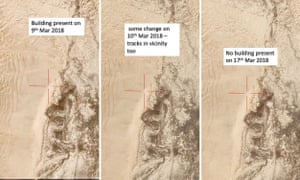
Before and after images of the Imam Asim Shrine. Credit: Digital Globe/ Planet Labs
But this year, the Imam Asim shrine is empty. Its mosque, khaniqah, a place for Sufi rituals, and other buildings have been torn down, leaving only the tomb. The offerings and flags have disappeared. Pilgrims no longer visit.
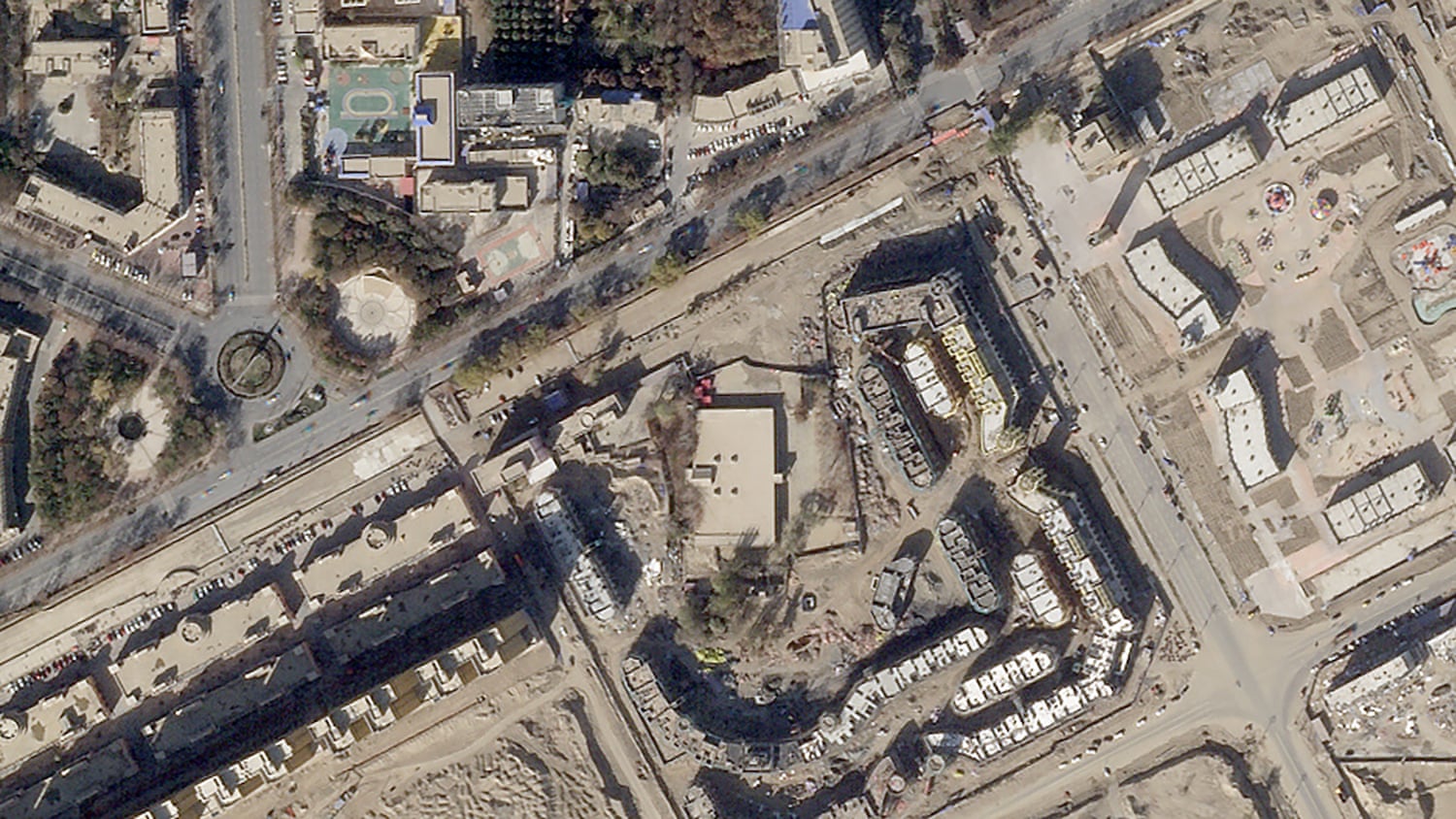
It is one of more than two dozen Islamic religious sites that have been partly or completely demolished in Xinjiang since 2016, according to an investigation by the Guardian and open-source journalism site Bellingcat that offers new evidence of large-scale mosque razing in the Chinese territory where rights groups say Muslim minorities suffer severe religious repression.
Using satellite imagery, the Guardian and Bellingcat open-source analyst Nick Waters checked the locations of 100 mosques and shrines identified by former residents, researchers, and crowdsourced mapping tools.
Out of 91 sites analysed, 31 mosques and two major shrines, including the Imam Asim complex and another site, suffered significant structural damage between 2016 and 2018.
Of those, 15 mosques and both shrines appear to have been completely or almost completely razed. The rest of the damaged mosques had gatehouses, domes, and minarets removed.
A further nine locations identified by former Xinjiang residents as mosques, but where buildings did not have obvious indicators of being a mosque such as minarets or domes, also appeared to have been destroyed.
Uprooted, broken, desecrated
In the name of containing religious extremism, China has overseen an intensifying state campaign of mass surveillance and policing of Muslim minorities — many of them Uighurs, a Turkic-speaking group that often have more in common with their Central Asian neighbours than their Han Chinese compatriots. Researchers say as many as 1.5 million Uighurs and other Muslims have been involuntarily sent to internment or re-education camps, claims that Beijing rejects.
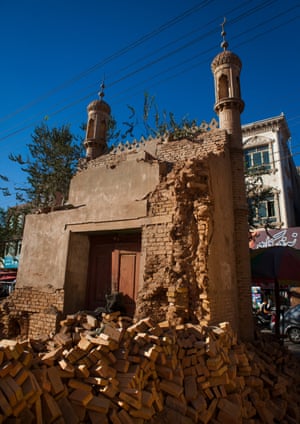
Campaigners and researchers believe authorities have bulldozed hundreds, possibly thousands of mosques as part of the campaign. But a lack of records of these sites — many are small village mosques and shrines — difficulties police give journalists and researchers traveling independently in Xinjiang, and widespread surveillance of residents have made it difficult to confirm reports of their destruction.
The locations found by the Guardian and Bellingcat corroborate previous reports as well as signal a new escalation in the current security clampdown: the razing of shrines. While closed years ago, major shrines have not been previously reported as demolished. Researchers say the destruction of shrines that were once sites of mass pilgrimages, a key practice for Uighur Muslims, represent a new form of assault on their culture.
Three-way composite of Jafari Sadiq shrine. Photograph: Planet Labs
“The images of Imam Asim in ruins are quite shocking. For the more devoted pilgrims, they would be heartbreaking,” said Rian Thum, a historian of Islamat the University of Nottingham.
Before the crackdown, pilgrims also trekked 70km into the desert to reach the Jafari Sadiq shrine, honouring Jafari Sadiq, a holy warrior whose spirit was believed to have travelled to Xinjiang to help bring Islam to the region. The tomb, on a precipice in the desert, appears to have been torn down in March 2018. Buildings for housing the pilgrims in a nearby complex are also gone, according to satellite imagery captured this month.
Before and after imagery of the Jafari Sadiq shrine. L-R Dec 10 2013, April 20, 2019. Photograph: Google Earth/ Planet Labs
“Nothing could say more clearly to the Uighurs that the Chinese state wants to uproot their culture and break their connection to the land than the desecration of their ancestors’ graves, the sacred shrines that are the landmarks of Uighur history,” said Thum.
‘When they grow up, this will be foreign to them’
The Kargilik mosque, at the centre of the old town of Kargilik in southern Xinjiang, was the largest mosque in the area. People from various villages gathered there every week. Visitors remember its tall towers, impressive entryway, and flowers and trees that formed an indoor garden.
The mosque, previously identified by online activist Shawn Zhang, appears to have been almost completely razed at some point in 2018, with its gatehouse and other buildings removed, according to satellite images analysed by the Guardian and Bellingcat.
Three locals, staff at nearby restaurants and a hotel, told the Guardian that the mosque had been torn down within the last half year. “It is gone. It was the biggest in Kargilik,” one restaurant worker said.
Another major community mosque, the Yutian Aitika mosque near Hotan, appears to have been removed in March of last year. As the largest in its district, locals would gather here on Islamic festivals. The mosque’s history dates back to 1200.
Despite being included on a list of national historical and cultural sites, its gatehouse and other buildings were removed in late 2018, according to satellite images analysed by Zhang and confirmed by Waters. The demolished buildings were likely structures that had been renovated in the 1990s.
Two local residents who worked near the mosque, the owner of a hotel and a restaurant employee, told the Guardian the mosque had been torn down. One resident said she had heard the mosque would be rebuilt but smaller, to make room for new shops.
“Many mosques are gone. In the past, in every village like in Yutian county would have had one,” said a Han Chinese restaurant owner in Yutian, who estimated that as much as 80% had been torn down.
“Before, mosques were places for Muslims to pray, have social gatherings. In recent years, they were all cancelled. It’s not only in Yutian, but the whole Hotan area, It’s all the same … it’s all been corrected,” he said.
Activists say the destruction of these historical sites is a way to assimilate the next generation of Uighurs. According to former residents, most Uighurs in Xinjiang had already stopped going to mosques, which are often equipped with surveillance systems. Most require visitors to register their IDs. Mass shrine festivals like the one at Imam Asim had been stopped for years.
Removing the structures, critics said, would make it harder for young Uighurs growing up in China to remember their distinctive background.
“If the current generation, you take away their parents and on the other hand you destroy the cultural heritage that reminds them of their origin … when they grow up, this will be foreign to them,” said a former resident of Hotan, referring to the number of Uighurs believed detained in camps, many of them separated from their families for months, sometimes years.
“Mosques being torn down is one of the few things we can see physically. What other things are happening that are hidden, that we don’t know about? That is what is scary,” he said.
The ‘sinicisation’ of Islam
China denies allegations it targets Muslim minorities, constrains their religious and cultural practices, or sends them to re-education camps. In response to questions about razed mosques, foreign ministry spokesman Geng Shuang said he was “not aware of the situation mentioned”.
“China practices freedom of religion and firmly opposes and combats religious extremist thought… There are more than 20 million Muslims and more than 35,000 mosques in China. The vast majority of believers can freely engage in religious activities according to the law,” he said in a faxed statement to the Guardian.
A demolished mosque in the old town of Kashgar, Xinjiang Uyghur autonomous region, China. Photograph: Eric Lafforgue/Art in All of Us/Corbis via Getty Images
But Beijing is open about its goal of “sinicising” religions like Islam and Christianity to better fit China’s “national conditions”. In January, China passed a five-year plan to “guide Islam to be compatible with socialism”. In a speech in late March, party secretary Chen Quanguo who has overseen the crackdown since 2016 said the government in Xinjiang must “improve the conditions of religious places to guide “religion and socialism to adapt to each other”.
Removing Islamic buildings or features is one way of doing that, according to researchers.
“The Islamic architecture of Xinjiang, closely related to Indian and Central Asian styles, puts on public display the region’s links to the wider Islamic world,” said David Brophy, a historian of Xinjiang at the University of Sydney. “Destroying this architecture serves to smooth the path for efforts to shape a new ‘sinicised’ Uighur Islam.”
Experts say the razing of religious sites marks a return to extreme practices not seen since the Cultural Revolution when mosques and shrines were burned, or in the 1950s when major shrines were turned into museums as a way to desacralise them.
Today, officials describe any changes to mosques as an effort to “improve” them. In Xinjiang, various policies to update the mosques include adding electricity, roads, news broadcasts, radios and televisions, “cultural bookstores,” and toilets. Another includes equipping mosques with computers, air conditioning units, and lockers.
“That is code to allow them to demolish places that they deem to be in the way of progress or unsafe, to progressively yet steadily try to eradicate many of the places of worship for Uighurs and Muslim minorities,” said James Leibold, an associate professor at La Trobe University focusing on ethnic relations.
Critics say authorities are trying to remove even the history of the shrines. Rahile Dawut, a prominent Uighur academic who documented shrines across Xinjiang, disappeared in 2017. Her former colleagues and relatives believe she has been detained because of her work preserving Uighur traditions.
Dawut said in an interview in 2012: “If one were to remove these … shrines, the Uighur people would lose contact with earth. They would no longer have a personal, cultural, and spiritual history. After a few years we would not have a memory of why we live here or where we belong.”
Of note given the apparent extent of Chinese government efforts to influence Canadians and Canadian governments:
Standing at the counter of a coffee shop in Vancouver’s Commercial-Broadway Skytrain station, underneath a little Canadian flag, the leaders of the resistance bicker over who gets the honour of paying for their drinks.
Louis Huang ends the standoff by shoving $5 into Gao Bingchen’s pocket and walking to their seats. They have bigger conflicts to discuss.
Huang and Gao, both originally from Mainland China, are the founders of the 60-member Alliance Guard of Canadian Values. Since 2009, they’ve been trying to get Canadian governments to “be aware, really aware about the influence of the Chinese communist government in Canada,” Huang said.
Gao doesn’t speak much English, so Huang does the talking. Gao sits quietly next to him, checking his phone and waiting for brief translations of what is being said.
Huang says the Canadian political class just doesn’t get it. Instead of pushing for human rights in China, it cozies up to Beijing hoping to boost business. Rather than address the Communist Party of China’s attempts to infiltrate Canadian institutions, Canadian politicians ignore the problem.
More frustrating, he said, members of Parliament haven’t seemed interested in hearing what they have to say about it.
But this could finally be their moment.
Since December, international relations have remained in the headlines as Beijing threatens Canada over the arrest of Huawei CFO Meng Wanzhou in Vancouver. She’s awaiting extradition proceedings to face fraud and other charges in the United States.
Observers say the aftermath, including the detention of two Canadians in China and new restrictions on Canadian canola exports, has opened Canadians’ eyes to the reality of dealing with a totalitarian regime. Huang and Gao hope the sudden high-profile spat will turn the pernicious problem into an election issue.
“We came from China because we don’t like the Communist Party. We want to live in a freedom-of-speech, freedom-of-human-rights country,” said Huang, a former medical doctor and researcher who now works as an education consultant.
Gao, a journalist, has a reputation for taking on powerful and connected people. He was found guilty of defamation for articles he wrote about Vancouver developer Miaofei Pan, alleging he wasn’t paying his taxes.
Pan is the former president of the Canada Wenzhou Friendship Society and worked with the Canadian Alliance of Chinese Associations. In that capacity, he met with officials from the Overseas Chinese Affairs Committee of China’s national legislature. Pan also once hosted a Liberal fundraiser at his home, with Justin Trudeau in attendance.
Nearly 300 supporters donated $70,000 to Gao for his legal defence. In the end, the judge awarded Pan only $1 in damages.
The Alliance Guard of Canadian Values also stages protests, including one in 2016 demanding former Vancouver city councillor Kerry Jang resign after he participated in a ceremony raising China’s flag over Vancouver city hall.
“We think there’s a need to spread the values of Canada — human rights, freedom of speech — to spread these values in our Chinese community,” Huang said. “Why? Because we noticed the influence more than 10 years ago, the influence of the Chinese Communist Party in Canada.”
Last year, the Canadian Security Intelligence Service (CSIS) issued a report warning China uses influence gained through commercial ventures to push the Chinese Communist Party’s agenda abroad. In 2010, then-CSIS director Richard Fadden suggested in a television interview that numerous public officials in Canada were under the influence of the Chinese government.
Meanwhile, Canadian officials and big business continue to advocate closer trade relations with the country. A 2017 story in The Globe and Mail cited parliamentary records that show MPs and senators have accepted dozens of trips to China, paid for by Chinese business groups and arms of the Chinese government.
On Monday, Conservative Leader Andrew Scheer demanded Primer Minister Justin Trudeau pull Canada’s funds out of China’s Asian Infrastructure Investment Bank.
The Liberal Party of Canada and Conservative Party of Canada did not reveal whether they plan to introduce policies on Canada-China relations during this year’s election. The NDP told the Star it will craft policy.
Huang and Gao said Canada has wasted enough chances to bring in “proper” policy and say the issue can no longer be avoided.
Gao said he himself was a victim of China’s influence in Canada. He once had a substantial presence as a columnist in the local Chinese media but was fired from a newspaper a few year ago after a story critical of a Chinese official. He said his editor cited a complaint from the Chinese consulate in Vancouver. He’s been dropped by a number of other media outlets and suspects similar pressure is to blame.
“We talk about the Chinese government using the Chinese community in Canada to make their goals, not only in business but also on a political level,” Huang said. “Which is more of a threat to our foundation of freedom.”
Australia’s foreign interference law, which makes it a crime to covertly take action to influence policy at the behest of a foreign power, is something Huang wants to see discussed in Canada. He also wants Canada to challenge China on trade the way the United States has, citing a large imbalance between the two nations.
It isn’t just Huang who predicts Canada-China relations will be an election issue.
Nik Nanos, chair of Nanos Research, said Canada’s political parties will need “issue specific” policies on trade, Huawei and 5G development with China during this year’s election.
“Canadians have had a clear indication of what China’s really like, based on how it’s lashed out on the canola file, based on the rhetoric that is put out there related to the detaining of the Huawei executive,” Nanos said. “It’s put more of a real face on how China operates and what they think of Canada.”
Canada-China Policies will be especially important in British Columbia, he said, which is more Pacific oriented both culturally and economically.
“It shouldn’t be surprising that Canadians understand the opportunity and importance of China but at the same time are worried, as a small power negotiating with a super power, any trade deal may not work out well for us,” Nanos said.
Huang warns the push for deepened relations with China — in order to appease some big Canadian business and hopefully win votes from the Chinese community — is misguided. The Chinese community in Canada is not a monolith, and such actions by Canadian politicians do Canada no favours.
“The government, they don’t fully understand,” Huang said. “They know less — just a little bit — about our society, our culture and our political views.”
But expecting Canadian politicians to learn and adjust may not bear fruit, said a leading scholar on China’s political interference in western countries, who just wrapped up a trip to Canada to examine the situation here.
Clive Hamilton is a professor of public ethics at Charles Sturt University in Canberra, Australia, who has been a harsh critic of attempts to influence his own country’s politics.
Hamilton told Star Vancouver his recent trip to Canada left him “quite worried about the capacity of Canada to extricate itself from the unwelcome and undemocratic influence of the Chinese Communist Party.”
He said it’s clear China has been “cultivating” friends in high places and penetrating Canadian institutions for some time. He’s worried agreements could be made by Canada’s biggest political parties to avoid the topic this year.
One party breaking away and making China relations an issue could force other parties to follow suit or risk public backlash, he said.
Hamilton added it’s important parties hammer home they are concerned about the Chinese Communist Party, not China or the Chinese people, who “ought to be welcome” in Canada.
After all, they’re facing the most pressure to support Beijing’s actions.
“Chinese Canadians are the biggest victims of the Communist Party’s influence operations in Canada. They’re the ones who have the most at stake,” he said. “They’re the ones whose families are penalized or whose businesses are shut down if they displease Beijing.”


 Multicultural Meanderings