‘Afraid We Will Become The Next Xinjiang’: China’s Hui Muslims Face Crackdown

More on Chinese repression of religious minorities:

Gold-domed mosques and gleaming minarets once broke the monotony of the Ningxia region’s vast scrubland every few miles. This countryside here is home to some of China’s 10.5 million Hui Muslims, who have practiced Sunni or Sufi forms of Islam within tight-knit communities for centuries, mainly in the northwest and central plains. Concentrated in the Ningxia region, the Hui are China’s third-largest ethnic minority.

Now, though, virtually every mosque in Ningxia’s countryside has been denuded of its domes, part of a sweeping crackdown on China’s Muslim minorities that has reached Hui strongholds in Ningxia, in central China, and as far inland as Henan province in the east. (Up to now, Gansu province in central China has been able to keep most of its mosques intact.)

The crackdown on Muslims has been most extreme in the northwestern region of Xinjiang, where scholars estimate that up to 1.5 million Muslim Uighurs, a Turkic-speaking group, and other ethnic minorities have been detained since 2016, in one of the most sophisticated surveillance states in the world.

The same restrictions that preceded the Xinjiang crackdown on Uighur Muslims are now appearing in Hui-dominated regions. NPR has learned that since April 2018, Hui mosques have been forcibly renovated or shuttered, schools demolished and religious community leaders imprisoned. Hui who have traveled internationally are increasingly detained or sent to reeducation facilities in Xinjiang.

In August 2018, in Ningxia’s Tongxin county, authorities attempted to demolish the Weizhou Grand Mosque, claiming it lacked the right building permits. Hundreds of furious residents staged a sit-in, sharing videos of their protest through popular Chinese social media platforms like WeChat and Kuaishou, a live-streaming app, faster than censors could take them down.

Taken aback, officials called off the demolition. But the victory was short-lived. In November, local government work units began visiting every household in Weizhou, pressuring residents to sign letters stating their acquiescence to “renovate” the mosque by removing its main dome and domed minarets. In some cases, Weizhou officials threatened to fire state employees if they did not sign the letter, according to multiple residents.

This month, NPR drove through Weizhou, which is now guarded by checkpoints on the only road leading in and out of town. The mosque is closed, its main dome and minarets replaced with tiled Buddhist-style pagodas, and its entrances blocked by scaffolding.

“Of course we are afraid we will become the next Xinjiang,” one Hui man told NPR. He did not provide his name for fear that authorities in Xinjiang would find him. Three years ago, he abandoned his family’s property in Xinjiang in order to transfer his residency to Tongxin county. “But what can an individual do? We can only take it year by year.”

“We say what we have to say”

Descendants of Arab traders who entered China some 1,500 years ago, the Hui pride themselves on having thoroughly assimilated into Chinese society. Unlike the Uighurs, the Hui have no distinct language, speaking Mandarin and often some Arabic. Save for the occasional white cap customarily worn by Hui men or hair coverings among women, they are often visually indistinguishable from China’s ethnic majority, the Han.

Their exemption from the harshest of religious restrictions changed in April 2018, when the Chinese Communist Party’s United Front Work Department formally took control of the State Bureau of Religious Affairs — meaning that the party now directly oversees policy for religious affairs, not the government.

“The day-to-day responsibility for managing religious activities and organizations shifted to the UFWD, and its atheist party apparatchiks, whose overarching mission is the protection of party power,” James Leibold, an associate professor at Australia’s La Trobe University and an expert on China’s ethnic minority policy, tells NPR via email.

That same April, a mass dome-removal campaign began in Zhengzhou, the capital of Henan province in central China, and resumed in Ningxia as part of the official effort known as chu shahua, fan ah’hua, to “combat Saudi and Arabic influence.”

All Hui-run nursery schools, child care centers and religious schools were forcibly closed in Ningxia and across Yunnan and Henan provinces, which are also home to a large number of Hui Muslims.

The United Front’s new control over Chinese ethnic and religious policy marks a substantial change, says Leibold. While the State Bureau of Religious Affairs was sometimes restrictive, it at least “saw the protection, if not promotion, of ‘normal religious activities’ as part of their mission and mandate, and many of its officials were religious practitioners themselves,” he says in his email to NPR.

Abroad, the United Front is the party body that liaises with international nonstate individuals and organizations. Domestically, the United Front has emerged as one of the most aggressive proponents of stripping away foreign influences within religious practices and bringing them under state control — making them more Chinese, a process known as “Sinification.”

“Sinification of religion in China is an important discourse of Party General Secretary Xi Jinping on the problem of religion and religious work,” Ma Jin, a United Front official, told the Islamic Association of China, a state-backed organization, in January.

“This recent crackdown on the Muslim activities is really a part of a national campaign of China today to correct what they believe are the excesses in permitting Arab-style mosques … and influence by the Middle East. The Salafi and Wahhabi groups have been pouring money in China,” says Dru Gladney, an anthropologist at Pomona College and an expert on Hui Muslims. “These restrictions through UFWD are part and parcel of government efforts to control Islamic practices, to make them more Chinese.”

In Xinjiang, Uighur-language books and films have been expunged, Uighur intellectuals imprisoned, and Uighur children sent to state-run schools to be taughtMandarin Chinese and culture.

For the Hui across China, mosques have become the major vehicle for Sinification. In April 2018, authorities began revoking the state-issued licenses given to imams who have residency outside the province in which they practice and from those who have studied abroad. In Ningxia, smaller mosques without licensed imams have been closed outright.

Ningxia sent senior leadership delegations to visit Xinjiang’s detention camps last November and signed a counterterrorism cooperation agreement with Xinjiang a month later.

Like many mosques, the Huarenjie mosque in downtown Zhengzhou, Henan, is now monitored around the clock through a network of surveillance cameras installed last year by the local public security bureau.

Emily Feng/NPR

Imams in Henan and Ningxia must now attend monthly training sessions that can last for days. There, imams told NPR, they are taught Communist ideology and state ethnic policy and discuss Xi Jinping’s speeches. Imams must then pass an exam testing their ideological knowledge in order to renew their license each year, mirroring how the government issues licenses to imams in the Xinjiang region.

“We go along with it. We say what we have to say, because it is just words, and it lets us continue to work in the mosque,” said one of the few imams still based in Henan, requesting his name be kept anonymous because of fears of political reprisal.

Fears of Saudi influence

Mosque employees say orders to demolish mosque domes and minarets are transmitted orally from local officials citing the United Front, with no written notice. The demolitions are swiftly executed at night, to avoid protests and video documentation.

“We ourselves do not even have the documents. [The United Front] takes them back at the end of each meeting,” a local Henan official says in a recording NPR listened to of a meeting between local officials and employees at a mosque whose domes were removed after the meeting.

“Party organs like the UFWD work outside the state legal system and thus have far greater power than the state bureaucracy and are not required to report back to the State Council,” the equivalent of China’s cabinet, says Leibold.

Others say officials are looking to avoid the attention that mass mosque demolitions and detentions of Muslims in Xinjiang have attracted.

“Local officials learned from Xinjiang. They know that by aggressively restricting people in obvious ways, like constructing detention centers and leaving written evidence, they might create resistance,” Tianfang, the pen name of a prominent blogger critical of China’s religious policies, told NPR.

The crackdown on China’s Hui Muslims is in part driven by the government’s fears that fundamentalist strains of Islam like Salafism and Wahhabism are filtering into China by way of Hui students who study in Saudi Arabia and Pakistan and through private religious foundations on the Arabian Peninsula that have funded some Hui social enterprises and mosques.

Signs of Saudi influence, including Arabic script, are being removed across China. Hui women in Henan and Ningxia provinces say they are no longer allowed to wear the head-to-toe black abaya customary to Saudi women, and Hui shops say they no longer stock Saudi-style clothes for men or women.

Imams suspected of preaching Salafism are also promptly removed. One of them, Han Daoliang, was the imam at Huarenjie Mosque in Zhengzhou, Henan province’s capital, according to mosque attendees. Han raised his hands three times during prayer instead of just once, they said, marking him to Zhengzhou officials as a Salafi adherent.

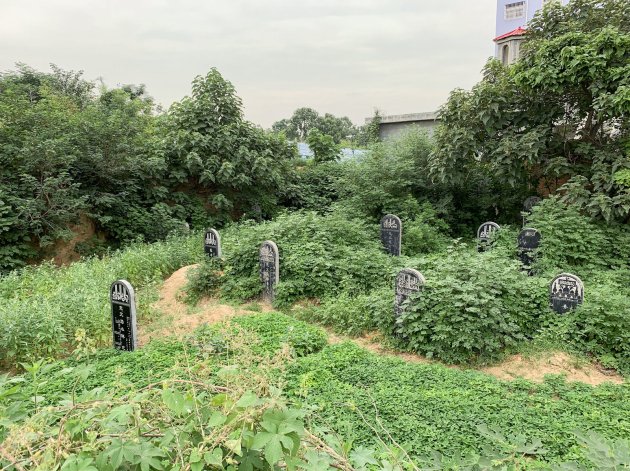
Hui tombstones inscribed in Arabic outside Xiaomagou Mosque in Zhengzhou, Henan.

Emily Feng/NPR

Forced by local officials to resign this year, Han is now living in Malaysia, according to acquaintances. His former mosque has been given a state-appointed imam. According to a new plaque and mosque employees, the house of worship is now run by a new committee appointed by the state, with a board including two non-Muslim government officials.

“Sweep away the black and root out evil”

The crackdown on Hui Muslims is backed by a national anti-corruption effort launched by the government in 2018 to “sweep away the black and root out evil.” Posters exhorting residents to “sweep away the black” are now ubiquitous in Chinese cities and such slogans have been scrawled in graffiti on village walls.

Among the crimes the campaign targets is using “religious connections at villages and townships to form mobs,” according to implementation guidelines published late last year. State media reports say 6,885 “black and evil” criminal organizations were taken down under the campaign as of January.

The “sweep away the black” campaign has also decimated power bases outside the Communist Party structure, including among religious communities. Hui communities are now told that unauthorized religious events or proselytizing are considered gatherings of “black” forces or “underworld forces.”

Those unauthorized gatherings include Islamic schools run by Hui mosques, nearly all of which have been closed across China, particularly in Henan and Ningxia, according to residents in Henan, Ningxia, Yunnan and Gansu provinces. NPR visited multiple former Islamic schools in September, several of which looked as if they had been cleared in a hurry — with dusty bedding piled on dormitory beds and chipped dishes and other kitchenware stacked haphazardly in corners.

All taught Arabic language and some Islamic doctrine, but some are run more like vocational schools or social welfare schools for students who might be otherwise ineligible or unable to afford an education.

“We barely taught any Islamic doctrine. It was about making sure these children were educated and would not become criminals or radicalized,” said a former teacher surnamed Ma, who did not want her full name used for fear of political reprisal.

She had taught at an Islamic school in China’s southwestern Yunnan province, which closed last April. The school had stayed open despite orders in 2014 to expel all non-local students, particularly those having residency status in Xinjiang.

Ma was interrogated by police about the school’s curriculum and whether the school was distributing drugs. A common stereotype about ethnic minorities in China is that they sell drugs. One of her colleagues was held incommunicado for three days and subjected to “thought work,” or ideological training, Ma says.

Rewards for reporting suspicious behavior

In Ningxia’s Tongxin county, a rare female-only Islamic school once renowned across China’s northwest is being readied for demolition after it was shut down last April to make way for residential development.

“It is the government’s policies. Who knows if they will change and when?” one of the school employees told NPR in hushed tones. She withheld her name because of the sensitivity of the matter.

Hui residents of Tongxin say local officials are now offering rewards between $700 and $2,820 to those who report suspicious religious behavior, such as proselytizing Islam or secretly teaching Islamic texts. Some male mosque attendees have begun wearing cloth masks covering the lower half of their faces when attending daily prayers to avoid identification.

Hui who have performed the Hajj, the Islamic pilgrimage to Mecca, fall under particular suspicion. Last year, a group of about 20 pilgrims was detained in Saudi Arabia for having the wrong visas before being sent back to China, according to two people with friends in the group. Two Hui pilgrims with residency in Xinjiang were promptly sent to low-security Xinjiang detention facilities, according to the two people with friends in the group.

“Unbearable” pressure

NPR found evidence of significant pushback from Hui seeking to delay or avoid implementing religious restrictions. Hui say they drag out orders to demolish mosque domes, and some students continue to secretly attend religious classes, despite shuttered schools.

In Henan, NPR came across one mosque in the process of “renovating” its dome by building a cover to shield it from view, a compromise between local officials who demanded its removal and nearby Hui residents who refused to do so. Mosque employees were also installing translucent plastic Arabic calligraphic inscriptions on the mosque walls – nearly invisible to all but true believers – to satisfy demands that they remove all Islamic symbols and Arabic script.

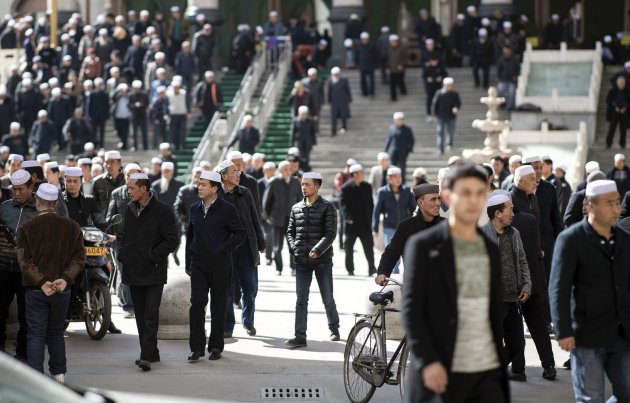
Hui Muslim men leave the Laohuasi mosque after Friday prayers in Linxia, Gansu province, in March 2018. Gansu so far has been able to keep most of its mosques intact while domes and minarets of mosques in other provinces have been altered or removed.

Johannes Eisele/AFP/Getty Images

“The Hui people have been through one storm after another, and this is a storm that will pass,” the mosque’s imam told NPR. “Who knows how the political environment may change? We do not want to spend money to tear our dome down, only to have to pay to build it up again next year.”

Fearing the worst, some younger Hui Muslims are looking to leave China and have emigrated to Malaysia and Dubai in the past few years.

“The pressure on not just one’s religious behavior, but how one lives one’s daily life, is unbearable,” said a young Hui man from Ningxia surnamed Tian, who did not want to use his full name for fear of being punished for talking to a foreign journalist. “It weighs on your chest.”

Ma Ju, a leader in a Sufi sect of Hui Muslims, left China for the United Arab Emirates in 2009 because of his outspoken criticism of religious restrictions in Xinjiang. This year, he fled to the United States, because the UAE has an extradition agreement with China.

“The oppression I saw inflicted on Tibetans 20 years ago and the Uighurs 10 years ago, has finally reached my people,” he says.

Ma Ju worries for his community back in China, especially now that technological tools like facial recognition make evading restrictions in China nearly impossible.

“You have legs, but you can’t run away,” he says. “You have money, but it’s of no use. You have a heart, but you cannot lift yourself up. This is a new kind of repression.”

Source: ‘Afraid We Will Become The Next Xinjiang’: China’s Hui Muslims Face Crackdown

Incarceration of Christians and Han Chinese in Xinjiang shows broad reach of forced indoctrination campaign

One has to wonder what the International Metropolis Conference board members were thinking by planning to hold the immigration and integrationconference in Beijing in 2020. Or not thinking:

Chinese authorities are sending Christian Uyghurs and even members of the Han Chinese majority to internment camps in China’s northwestern Xinjiang region, an indication that the regime’s indoctrination strategy is broader than previously understood.

Most of the hundreds of thousands of people – perhaps more than a million – sent to a sprawling network of centres for political indoctrination and vocational training are Muslims, members of minority groups such as Uyghurs and Kazakhs, according to former detainees and instructors. Beijing has said the centres are being used to stamp out extremism.

But six accounts from people who have recently lived in the region or have family there – three Christian Westerners, a lawyer, a Chinese petitioner and a Uyghur family living in France – reveal that others are also being incarcerated.

‘I felt like a slave:’ Inside China’s complex system of incarceration and control of minorities

Some are Uyghurs who have converted to Christianity. Others are Han Chinese – the ethnic group that comprises more than 90 per cent of China’s population – who have challenged local authorities by petitioning for official redress, as well as people considered politically unreliable.

The reports indicate that Beijing’s campaign in the region goes beyond the stated goal, published in an August white paper on Xinjiang, of countering “the breeding and spread of terrorism and religious extremism.” The strategy claimed to be focused on quelling Islamic radicalization rather than a unique cultural group inside China.

But “all signs point to cultural assimilation” as the chief goal of the Chinese campaign, said Timothy Grose, a scholar at Terre Haute, Ind.’s Rose-Hulman Institute of Technology who studies Uyghur culture and is the author of an upcoming book about Uyghurs who study elsewhere in China. What is taking place in Xinjiang is an “accelerated, comprehensive and violent program to jettison meaningful markers of Uyghur identity, such as language, Islam and tangible connections to Central Asia, and replace them with elements of a Han-centric Chinese culture.”

Indeed, “even secular, atheist and Christian Uyghurs are being targeted, I believe, because their milieu has still been largely shaped by Central Asian and Islamic norms.”

Over the past year, Uyghurs living outside China have documented the incarceration of dozens of scholars, artists, musicians and other cultural leaders who have been taken to facilities that China calls vocational skills and training centres but which foreign critics call re-education camps.

In a July white paper, Chinese authorities directly linked Islamic belief with the spread of separatist ideology by what it called “anti-China forces attempting to split China.”

But the incarceration of Christians on extremism grounds underpins an argument that Chinese authorities have used extremism as a cover to conduct a broader campaign of sinification, irrespective of religion.

“We know of at least 14 Christians” who have been taken away by authorities in Xinjiang, said Robert Paix, a Christian businessman who has lived and worked in the region, in part to share his faith. “Islam is just one of the matrix of problems the Chinese government has with Uyghur people,” he said.

In Xinjiang, “any ideology which really captures someone’s conscience that is other than the [Communist] Party is a threat,” Mr. Paix said. “So in essence, it doesn’t matter what religion it is – or even if it was a non-religious ideology.”

Xinjiang is home to an estimated 11 million Uyghurs, a people whose customs, language, architecture and art are among the most distinct of the country’s 55 official minorities.

One Westerner who lived in the regional capital, Urumqi, with his family described the case of a Christian Uyghur woman who lived with a Han Chinese roommate. The Uyghur woman spoke Mandarin and ran a business teaching English. But in December, 2017, police took her from her apartment, put her in a prison uniform and handed her clothes, glasses and national identification card back to her roommate, said the source, a Christian whose identity The Globe and Mail is not disclosing out of concern for the safety of the person’s friends in Xinjiang.

Police said they had found questionable content on her computer, according to the source.

“The sentencing basically was very quick. From what we could understand, it was just ‘You are a terrorist,’ and there was a document that she had to sign – basically like a confession.”

Christian Uyghurs likely number only in the thousands, according to foreigners who have lived in the region. Most Uyghurs are practising Muslims or maintain cultural ties to that faith.

But from what the Westerner could see, the incarceration of Uyghurs “did not seem religious in nature. It seemed just from our experience there that the religious extremist angle was being used to really just suppress the entire people group and culture.”

Another Christian, Gulbahar Haitiwaji was incarcerated for two years, her family said. “She converted to Christianity several years ago and eschews violence,” her husband, Kerim Haitiwaji, told religious liberty magazine Bitter Winter early this year. “There is no reason to imprison her. She is not a danger to China.” The family has declined further public statements since Ms. Hatiwaji was released, and she is now with her husband and daughter in France.

Any responsible government must “remove the malignant tumour of terrorism and extremism” and ensure its people “enjoy a peaceful and harmonious social environment,” the State Council Information Office wrote in an August white paper. It defended Xinjiang’s indoctrination and training apparatus as a “deradicalization” project in line with international principles, providing free education to trainees who “have fallen under the influence and control of religious extremism.”

At the same time, the construction of a system of internment centres has provided local authorities new options for punishment outside the formal legal system – even for people who are ethnic Chinese.

Authorities can send people to the centres for making statements deemed contrary to government dictates; for spreading politically unwelcome thoughts among colleagues; and for posting politically incorrect views to Chinese social-media platform WeChat, according to a lawyer who has travelled in the region and whose identity is not being disclosed because describing the camps could lead to his own incarceration.

The Globe reviewed documents collected by a Chinese human-rights activist that described the case of a Chinese man in Xinjiang who spent years fighting embezzlement charges that dated back to 2004. He disappeared last year but reappeared this spring.

“I studied for seven months,” he said in a recorded interview with an activist reviewed by The Globe. “Studying” is a common word to describe time in indoctrination facilities. “There are Han people” in such centres, he added.

Gulzira Auelhan, an ethnic Kazakh and former detainee, told The Globe this year that she had seen four ethnic Chinese people in the centre where she was held.

Political enforcement has been employed against Uyghurs, too. One Uyghur woman who recently left Xinjiang described how her father-in-law had been sentenced to eight years in prison for “distributing incorrect political views.” The charges were rooted in an incident that, authorities said, occurred more than two decades earlier, when he was working at a government office and complained that ethnic Chinese farmers were receiving a larger allocation of water than ethnic Uyghurs. He was held for 10 months before being tried and sentenced in a single day of court proceedings, the woman said.

The woman’s identity is not being revealed because she fears retribution against members of her family still in Xinjiang. The Globe verified elements of her account with a Canadian family member and with a Western embassy that helped her leave China.

She spoke out, she said, because “I want the world to know how insane it is” for Uyghurs in Xinjiang.

Source: Incarceration of Christians and Han Chinese in Xinjiang shows broad reach of forced indoctrination campaign

China Wants the World to Stay Silent on Muslim Camps. It’s Succeeding.

Those who remain silent are complicit:

When Turkey’s leader, Recep Tayyip Erdogan, visited Beijing this summer, he hailed a new Silk Road bridging Asia and Europe. He welcomed big Chinese investments for his beleaguered economy. He gushed about China’s sovereignty.

But Mr. Erdogan, who has stridently promoted Islamic values in his overwhelmingly Muslim country, was largely silent on the incarceration of more than one million Turkic Muslims in China’s western region of Xinjiang, and the forced assimilation of millions more. It was an about-face from a decade ago, when he said the Uighurs there suffered from, “simply put, genocide” at the hands of the Chinese government.

Like Mr. Erdogan, the world has been noticeably quiet about Xinjiang, where China has built a vast network of detention camps and systematic surveillance over the past two years in a state-led operation to convert Uighurs into loyal, secular supporters of the Communist Party. Even when diplomats have witnessed the problems firsthand and privately condemned them, they have been reluctant to go public, unable to garner broad support or unwilling to risk financial ties with China.

Backed by its diplomatic and economic might, China has largely succeeded in quashing criticism. Chinese officials have convinced countries to support Beijing publicly on the issue, most notably Muslim ones in Africa, Asia and the Middle East. They have played to the discord within the West over China. And they have waged an aggressive campaign to prevent discussion of Xinjiang at the United Nations.

At a special event ahead of the General Assembly this week on protecting religious freedom, President Trump, the host of the event, did not mention the Uighurs. Vice President Mike Pence gave a nod to the Uighurs, after mentioning the persecution of Christians in China.

China contends that its state-mandated detention camps, surrounded by high walls and watchtowers, are central to its fight against Islamist extremism. Beijing has called them boarding schools, explaining detainees are there voluntarily. China said recently that it has reduced the numbers in the camps, although doubts persist about the claim.

“There has not been a single case of violent terrorism in the past three years,” Wang Yi, state councilor and foreign minister of China, said at an event on the sidelines of the United Nations summit. “The education and training centers are schools that help the people free themselves from terrorism and extremism and acquire useful skills.”

As countries weigh their options over Xinjiang, China’s economic heft looms large.

Officials in the Trump administration have been among the most vocal critics. Secretary of State Mike Pompeo has denounced the treatment of the Uighurs as the “stain of the century.” One of his deputies, John Sullivan, who convened a panel Tuesday on the sidelines of the United Nations meeting with several other countries to condemn Beijing’s policies, said China has carried out a “horrific campaign of repression.”

While the National Security Council has pushed economic sanctions over the issue, the Treasury has the power to punish China in that way. So far, the trade talks have taken precedence. And Mr. Trump has largely ignored the issue, essentially giving China a pass.

The administration’s limited action probably affects the global calculus. If the United States does not take a leadership role on the issue, other countries do not feel the pressure to act, either.

Some governments tiptoe around China for economic reasons. When New Zealand’s prime minister, Jacinda Ardern, visited Beijing shortly after the massacre of 51 Muslims in Christchurch, she said she had discussed Xinjiang privately with Mr. Xi. She didn’t do much more. New Zealand sells much of its main exports, such as milk, meat and wine, to China.

Last year, China helped Turkey secure a $3.6 billion loan for energy and transportation. Since then, the Turkish economy has further faltered. And during Mr. Erdogan’s visit to Beijing in July, Mr. Xi praised him for supporting what he called China’s core interests, including Xinjiang.

“Many, many governments are looking the other way and self-censoring on the issue of Xinjiang,” said Daniel R. Russel, the Obama administration’s assistant secretary of state for East Asian and Pacific affairs. “Beijing is notoriously prickly about its self-declared ‘core interests,’ and few countries are willing to put the economic benefits of good relations with China at risk — let alone find themselves on the receiving end of Chinese retaliation.”

When countries do criticize China, they tend to do so in a group, seemingly as a way to diffuse and lessen possible retribution.

In Geneva this summer, nearly two dozen, mostly Western, countries, along with Japan, banded together at the United Nations Human Rights Council to call on China to close the camps. No one country was willing to be the organizer. Instead, the statement’s signers relied on a rarely used procedure that allowed it to be circulated without a principal leader.

Not to be outmaneuvered by the critics, China quickly prepared a counter-roster of 37 friendly nations praising its “contribution to the international human rights cause.” Among the cheerleaders were members of the Organization of Islamic Cooperation that unanimously endorsed China’s Xinjiang policies in April.

How China Turned a City Into a Prison

Children are interrogated. Neighbors become informants. Mosques are monitored. Cameras are everywhere.

China is carefully shaping its image of Xinjiang in the diplomatic world. Over the past nine months, Beijing has invited select visitors on circumscribed tours of the detention camps to garner positive publicity.

China has generally handpicked the visitors, including journalists from friendly countries. They are then often quoted in the state-run Chinese news media offering flattering comments. “I saw genuine smiles on the faces of trainees I interviewed,” Abdul Aziz Raddad A. Alrabie of the Saudi newspaper Okaz said in China Daily, a newspaper of the Communist Party.

The trips do not always go as planned. Two reports — one by a Malaysian diplomat and another by European Union officials — were highly critical after their visits.

The private account by the Malaysian diplomat, reviewed by The New York Times, contradicted China’s contention that the Uighurs were voluntarily attending the re-education centers.

“Delegates could actually sense fear and frustration from the students,” the Malaysian wrote after his December visit with a dozen other diplomats from mostly Muslim nations. “China may have legitimate reasons to implement policies intended to eliminate the threat of terrorism, especially in Xinjiang. However, judging by its approach, it is addressing the issue wrongly and illegitimately, e.g. preventing Muslim minors from learning the Quran.”

The diplomat referred to two cities in Xinjiang — once-bustling Kashgar and Hotan — as “zombie towns,” saying the streets were virtually empty and that China was probably “using the threat of terrorism as an excuse to ‘sanitize’ Uighur Muslims until they become acceptable Chinese citizens.”

The report was never made public. At the time, Malaysia was working hard to repair relations with China over a troubled infrastructure deal. It has also become increasingly dependent on China for purchases of palm oil, its biggest export.

“The $100 billion in annual bilateral trade is enough to focus the minds of Malaysian policymakers,” said Shahriman Lockman, a senior analyst at the Institute of Strategic and International Studies in Kuala Lumpur. “China is too big a market to lose.”

Three diplomats from the European Union visited Xinjiang’s capital, Urumqi, this year in what one of the participants said turned out to be a “Potemkin village tour.” The officials were shown a hastily built display of weapons that the Chinese guides said Uighurs had used in terrorist attacks; a mosque where there was no sign of religious observance; and a kindergarten where the children sang songs praising the party.

At one camp, the class sang the Communist Party anthem. As they did, one Uighur man caught the eye of a diplomat and held up his wrists as if clamped together by handcuffs.

Afterward, the European Union circulated an internal document saying that the visit “does not invalidate the E.U.’s profound concerns about human rights in Xinjiang, including in relation to mass detention, political re-education, religious freedom and Sinicization policies, as well as concerns that similar measures could be applied in other regions of China with notable Muslim minorities.”

Rifts within the European Union on how to deal with China prevent a common front. Leaders in France and Germany are publicly silent on Xinjiang, while several Eastern European countries are supporters of China.

At the United Nations, China has made Xinjiang its main cause.

The Human Rights Council in Geneva is often considered a diplomatic backwater. The United States is no longer a member, with the Trump administration withdrawing last year in protest over policies toward Israel. As authoritarian governments gain power around the world, human rights are less of a front-and-center issue, leaving the council with less sway.

But China regards the council as a serious arena where it can outmaneuver its opponents, pursue its diplomatic agenda and score points.

A long-scheduled review of China’s human rights record was on the council’s schedule last November just as the Uighurs’ incarceration was gaining attention.

China prepared meticulously. About 60 Chinese diplomats flew to Switzerland from Beijing, a delegation headed by the influential vice foreign minister, Le Yucheng.

He was backed by 40 more members of Chinese government organizations. Such a large entourage of nondiplomats was almost unheard-of at the council, according to diplomats. They acted as cheerleaders, clapping at key moments.

One goal of the performance was to limit backing for an inspection of Xinjiang by Michelle Bachelet, the United Nations’ human rights chief.

“If you’re really serious about a fact-finding mission, please go check the southern border, Guantánamo, the Mediterranean to see if there have been fact-finding missions,” one of the Chinese advocates said, according to a recording by the International Service for Human Rights.

At the end of China’s presentation, more than 120 countries gave a positive review of its human rights record. Fewer than three dozen countries expressed real concern. Ms. Bachelet has not visited Xinjiang.

At the United Nations in New York, China has assiduously worked many angles. At one Security Council meeting last year that was set to discuss human rights violations in Syria, China intervened. It was concerned that the discussion would veer into one on Xinjiang.

The United Nations’ high commissioner of human rights at the time, Zeid Ra’ad al-Hussein, traveled to New York to address the session.

Suddenly, as the diplomats were about to convene, Ivory Coast withdrew support for the discussion on Syria. Since there was no longer a quorum for the session, it was canceled.

Ivory Coast’s ambassador explained that his president had received a call from Beijing instructing him to ensure the session did not happen.

“If you can’t get a discussion on Syria after all these seven years of brutality, of course you can block a discussion on Xinjiang,” Mr. al-Hussein said.

Former Canadian ambassador suggests registry to help identify foreign agents

Hard to disagree:

A veteran of Canada’s diplomatic corps is urging the creation of a federal registry, modelled on one in Australia, to shed light on the work Canadians, including former senior public officials, are doing on behalf of foreign governments.

David Mulroney, who worked for 32 years in the Canadian foreign service, including as Canada’s ambassador to China, said there’s an increasing risk today that foreign governments are using Canadians to mould public opinion and lawmaking here.

“It is not being alarmist to suggest that foreign countries continue to seek influence in Canada and that some are even willing to interfere covertly in Canadian affairs. If anything, the threat is growing,” Mr. Mulroney said in an interview.

What he’s proposing is that Canadians paid to lobby or communicate political messages on behalf of foreign states or enterprises owned by a foreign government would be required to disclose their activities in a federal registry. He said his proposal goes far beyond the scope of the existing federal lobbyists registry, which he says has loopholes that do not capture all activity he believes should be brought to light.

Mr. Mulroney said the rise of China as an economic and geopolitical power has added urgency to the question of foreign interference and influence. “China’s Communist Party has well-developed mechanisms for influencing political opinion in foreign countries,” he said.

He said he was unwilling to comment on individual cases, but stated that, under his proposal, virtually any work undertaken by former Canadian officials for China’s state-owned corporations would need to be disclosed in a registry.

New foreign-influence transparency laws took effect recently in Australia. The rules came in response to concerns about Chinese government influence in Australian politics.

Under Mr. Mulroney’s proposal, former cabinet ministers would be required to register almost all work – not just lobbying – that they are doing for foreign governments or related entities. Mr. Mulroney argues that international work promoting Canadian values and interests – such as humanitarian work – would remain exempt, but all other employment in which a foreign state is seeking to benefit from the knowledge, experience or contacts a former minister gained while serving Canada would need to be reported. The obligation would last their lifetime.

Former senior public servants, including deputy ministers, assistant deputy ministers and ambassadors, would face the same high bar for registration, but only for 15 years.

Mr. Mulroney is publishing his proposal in a paper through the Macdonald-Laurier Institute, an Ottawa-based think tank.

Ward Elcock, a former director of the Canadian Security Intelligence Service and former deputy minister of National Defence, said he supports Mr. Mulroney’s proposed registry.

“There are foreign governments who did have an interest in influencing Canadian public policy in one way or another and, yes, I think transparency is required,” he said.

However, Mr. Elcock said a registry won’t help if former politicians or senior bureaucrats attempt to hide their affiliation with foreign governments or state-owned enterprises.

Richard Fadden, another former director of CSIS, said he broadly supports Mr. Mulroney’s proposal.

Mr. Fadden, who was also national security adviser to prime ministers Stephen Harper and Justin Trudeau, said he thinks however that China is “far from the only country for us to worry about” and would like to see the registration requirements also apply to Canadian military ranks down to the Canadian Armed Forces equivalent of an assistant deputy minister.

Mr. Mulroney is proposing two extra measures on top of what Australia has done.

Any Canadians serving on federal government boards, agencies, foundations or councils in Canada would be prohibited from working for foreign governments or related entities for the duration of their appointment. It would also require Canadians to relinquish membership in what is called the Queen’s Privy Council, which is a lifetime designation granted to prime ministers, cabinet ministers and chief justices of Canada.

Mr. Fadden doesn’t support requiring Canadians in the Queen’s Privy Council to relinquish membership if they work for a foreign government.

He said if a former senior public official is, for instance, working for Britain to help promote a bilateral trade deal with Canada they shouldn’t be forced to give up the P.C. designation.

Stockwell Day, a former Conservative cabinet minister and vice-chair of the Canada China Business Council, a lobby group, said the proposed registry is not needed given existing rules against lobbying that remain in place for half a decade after leaving office.

Mr. Day said he could see the registry becoming a “nightmarish bureaucratic overburden trying to report working arrangements of individuals 15 years after they have been in office” and predicted the law would almost certainly also be challenged in court “as an unconstitutional restriction on the right to work.”

Mr. Mulroney said however that existing lobbying registry rules do not cover the sort of disclosure he’s proposing. “Think about the possibility of a former, or even a current politician taking talking points from a foreign government. … If you are speaking or disseminating information on behalf of a foreign entity, you need to be clear about your sources. Otherwise you mislead Canadians.”

Source:   Politics Former Canadian ambassador suggests registry to help identify foreign agents Subscriber content Steven Chase September 23    

USA: Chinese woman pleads guilty in ‘birth tourism’ case

While the practice is legal, it was the fraud in visa applications that committed her.

Seems like there may be similar opportunities to examine the practices of birth tourism consultants in Richmond and elsewhere:

A Chinese woman has pleaded guilty in the US to federal charges of running a “birth tourism” scheme for Chinese nationals who paid so their children would be born American citizens.

Dongyuan Li admitted her company assisted wealthy Chinese nationals in getting to the US to give birth.

Ms Li would give clients training on how to bypass US immigration control and hide their pregnancies.

She amassed more than $3m (£2.4m) in wire transfers.

Ms Li, who is due to be sentenced in December, could face up to 15 years in jail.

What was the scheme?

Ms Li admitted that between 2013 and 2015, her company You Win USA Vacation Services would charge Chinese nationals – including government officials – between $40,000 and $80,000 for coaching in how to have a baby in the US.

With that came the benefits of American citizenship.

On its website, the company boasted more than 500 customers. It said that being American was the “most attractive nationality” and it would ensure “priority for jobs in US government”.

Ms Li told clients to initially fly from China to Hawaii due to the belief it would be easier to get past US customs. From there they could fly to Los Angeles where they would be housed in apartments.

She also admitted that the clients were coached on how to get through the US consulate interview in China, including by falsely stating that they were going to stay in the US for two weeks.

In reality, they planned to stay for up to three months to give birth.

What are the charges?

Ms Li pleaded guilty to one count of conspiracy to commit immigration fraud and one count of visa fraud.

As part of her plea deal with federal authorities, Ms Li gave up assets including $850,000, her house worth more than $500,000 and several Mercedes Benz cars.

Why was it illegal?

While it is not illegal to visit the US and give birth, making false visa claims is.

Authorities said Ms Li was promoting the benefits of having babies in the US, which would include helping to get family members immigration rights.

US President Donald Trump has talked of revoking birthright citizenship.

Source: https://www.bbc.com/news/world-us-canada-49746063

Former Ontario minister sides with Beijing, pins Hong Kong protests on ‘outside’ forces

Chan has also been writing a number of op-eds in Chinese media and his rebuttal to a National Post article on his activities in relation to pro-Hong Kong demonstrations was also published in Chinese Canadian media (Dawa Business News, 6 September):

A former Ontario cabinet minister, who held the province’s immigration and international trade portfolios under two Liberal premiers, has denounced acts of violence during the pro-democracy protests in Hong Kong as the work of foreign actors intent on undermining the state of China.

Former MPP Michael Chan, in a recent interview with Chinanews, a Chinese state-backed news site, condemned the city’s anti-government protesters and applauded Hong Kong police for showing restraint in the crisis.

His assertions echo the statements by Chinese officials as the protest movement in Hong Kong gathered steam. China has blamed “foreign forces” for manipulating the protests and interfering in Hong Kong affairs.

“I have been thinking, why are these young people so radical, so passionate [and] committed to do these things? And why so many people?” Mr. Chan said in an interview with Chinanews that was published earlier this month.

“If there is no deeply hidden organization in this, or deeply hidden push from the outside, there is no way that such large-scale turmoil would happen in Hong Kong in a few months.”

Mr. Chan served in various portfolios for the Ontario Liberals, including as immigration minister, during his tenure in office between 2007 and 2018.

Last week, in an article posted on Mr. Chan’s public WeChat social-media account, he is quoted as suggesting demonstrators have been trying to enlist the Japanese for help with their cause. The article is titled “Exclusive interview with Michael Chan: Guerrilla actions.”

He said in the article that Japanese media reported an interview with a Hong Kong protest leader who travelled to Japan and mused that “Japan could send a self-defence force on the grounds that they could protect the overseas Japanese.” Mr. Chan went on to say the report was strongly condemned by Hong Kong residents and added that the protest leader has denied ever saying such things.

The protester Mr. Chan referred to, Agnes Chow Ting, stated on her social-media accounts on Sept. 5 that she made no such claims and demanded the Japanese media delete the report.

Any reference to a Japanese military presence in Hong Kong is especially inflammatory among the Chinese community, because of Japan’s brutal treatment of Chinese citizens during the Second World War.

“That protest leader is actually taking the initiative to ask the Japanese army to occupy Hong Kong again in order to guard … ‘freedom and democracy.’ This is incomprehensible,” the article on Mr. Chan’s WeChat page said.

This article was also published under Mr. Chan’s byline at 51.ca, a prominent Chinese-language online publication in Canada.

Efforts to reach Mr. Chan through his public WeChat account were not successful.

Repeated calls and e-mails to Mr. Chan’s lawyers and workplace were not returned to The Globe and Mail. According to the Seneca College website, Mr. Chan sits on the board of governors.

In 2010, Mr. Chan was considered so close to the Chinese consulate in Toronto that Canada’s intelligence agency feared he was at risk of being unduly influenced by foreign officials. A senior intelligence official later met the province’s top bureaucrat to formally caution the province about the minister’s conduct and the risk of foreign influence.

Dalton McGuinty, who was then premier, dismissed the Canadian Security Intelligence Service’s concerns as baseless and kept Mr. Chan in cabinet. His successor, Kathleen Wynne, similarly dismissed the concerns and said the federal spy agency’s suspicions lacked substance.

CSIS’s concerns about Mr. Chan were never disclosed publicly at the time, nor was Mr. Chan named as the subject of the CSIS briefing. They were revealed in a 2015 report by The Globe.

When asked earlier this September about Mr. Chan’s interview with Chinanews, Ms. Wynne said she hadn’t spoken to Mr. Chan “for months.”

“We are no longer part of a caucus; I haven’t spoken to him for some time. He is a trusted colleague, but I have not had a conversation with him about the issues in Hong Kong, in China.”

After the Globe article appeared in 2015, Mr. Chan said CSIS’s concerns were “ludicrous” and “totally false” and he brought a legal action against The Globe.

“There is a persistent theme that there is a perceived risk that I am under undue influence and that I am an unwitting dupe of a foreign government,” he wrote in an open letter. “This is offensive and totally false.”

When he left politics last year, Mr. Chan joined the law firm Miller Thomson. A spokesperson for the firm said earlier this month that Mr. Chan no longer worked there.

In the Chinanews article, Mr. Chan said the violence in the movement in Hong Kong has been severe, and if there were similar unrest in Western countries, police would have “already fired bullets toward crowds.”

Protesters have accused Hong Kong police of excessive use of force, but Mr. Chan disagreed.

“It’s the opposite,” he stated. He said the restraint and courage of Hong Kong police should be praised, according to the article.

The months of unrest in the Chinese-governed, semi-autonomous city were prompted by a bill that would have allowed people in Hong Kong to be extradited to mainland China for trial. Many saw the extradition bill as an erosion of rights promised under a “one country, two systems” framework when the former British colony returned to Chinese rule in 1997. The bill was first suspended, but after the tensions in the city kept escalating, Hong Kong’s leader, Carrie Lam, announced on Sept. 4 that the government would withdraw the bill.

Hong Kong protesters have said the bill’s withdrawal was too little, too late.

In other remarks in the Chinanews interview, Mr. Chan noted about 300,000 Canadians are living in Hong Kong.

“If the system in Hong Kong is really that unfree, undemocratic, feeble, and bad, then why do these 300,000 (Canadians) live there?

“One country, two systems will not change. If whoever says Hong Kong wants to be independent and separated, then there is no discussion needed. Hong Kong belongs to China. This is unnegotiable.”

Some Chinese Canadians, especially those who have ties to Hong Kong, found Mr. Chan’s remarks appalling.

Gloria Fung, president of Canada-Hong Kong Link, said Mr. Chan’s remarks sound like the Chinese regime’s propaganda.

“It’s very clear that he is not using Canadian values nor the universal values of Western democracies in making all these comments. Rather, he abides by the values of the Chinese Communist Party,” Ms. Fung said. “That is troublesome.”

It was not the first time Mr. Chan publicly supported China’s stand on the Hong Kong issue. Last month, Mr. Chan spoke at a rally in Markham, Ont., expressing support for Hong Kong police, the government and Beijing.

Ms. Fung, who also lives in the Toronto area, said although Mr. Chan has stepped down from the political arena, he is still actively engaged in pro-China events.

The rally, organized by the Confederation of Toronto Chinese Canadian Organizations, attracted a few hundred attendees from the Chinese community. Online pictures and videos show leaflets resembling the Liberal Party’s old paid membership forms were distributed at the event.

Braeden Caley, spokesman for the Liberal Party of Canada, said the party had no involvement at the event. He said Mr. Chan has no formal role in the federal party.

The area that Mr. Chan once represented provincially is now held federally by Small Business Minister Mary Ng. A spokeswoman for Ms. Ng said the minister was aware of the rally, but declined to comment on whether Mr. Chan’s views are shared by many of Ms. Ng’s constituents.

Ms. Ng said in a statement that it is important that the situation in Hong Kong be de-escalated, and there is a diversity of views among Chinese Canadians as to how this can happen.

Source: Former Ontario minister sides with Beijing, pins Hong Kong protests on ‘outside’ forces

Douglas Todd: Over-reliance on students from India and China sparks Ottawa reaction

More on the government’s efforts to diversity source country of students (Trudeau government outlines five-year, $148-million plan to attract more foreign students to Canadian universities):

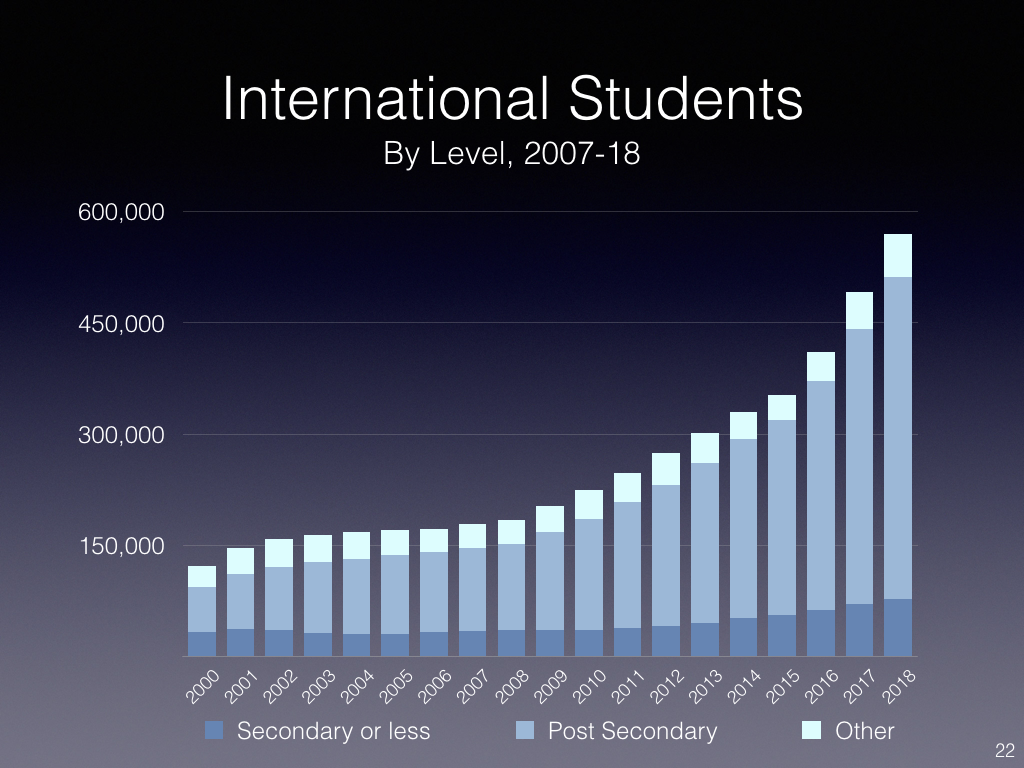
Amid warnings that universities are relying too much on the high tuition fees paid by foreign students, Justin Trudeau’s government has promised to do something about how more than half of the 572,000 international students in Canada hail from China and India.

The Liberal government has announced a new international-student strategy two months before the October election, amidst rising diplomatic tensions and opinion polls showing 90 per cent of Canadians have negative impressions of the government of the People’s Republic of China.

The federal Liberals, who have roughly doubled the number of foreign students in Canada since being elected in 2015, are pledging in carefully worded announcements they intend to adjust the current international demographic ratio, which sees more than half of offshore students coming from China (143,000) and increasingly India (173,000).

A University of Sydney, Australia, professor warned this month that post-secondary institutions in his country and elsewhere risk “catastrophic” financial shortfalls by relying so heavily on students from China, who make up about 40 per cent of the total in that country. One-fifth of the University of Sydney’s budget, for instance, depends on the cohort from China, says Salvatore Babones.

Since Canada and Australia are two of the world’s most sought-after destinations for international students from China, Babones is not surprised the Trudeau government is promising to change the foreign-student ratio by spending $30 million to recruit more young people from countries such as Mexico, Colombia, Brazil, Vietnam, the Philippines, Indonesia, Ukraine, France and Turkey.

“As in Australia, these marketing plans are part of a ‘diversification strategy’ intended to dilute the risk that an adverse event — for example, a suspension in the convertibility of the yuan or a major recession in India — that might suddenly result in a revenue shortfall at universities,” Babones said by email.

“When universities and governments think of international students as a revenue source, these kinds of perverse policies start to seem natural. The proper role of international students is to diversify and enrich campus culture, not to support universities with their tuition money.”

Babones’s report, titled The China Student Boom and the Risk it Poses to Australian Universities, does not focus on how various political tensions could also reduce the number of students from mostly well-off Chinese families who head to English-language schools.

However, an overwhelming majority of Canadians, according to recent polls by Nanos and others, increasingly don’t trust China’s leaders, who in turn, in the midst of a trade war with the U.S. and Canada, are issuing various warnings against their citizens travelling to North America. Some politicians in India, in addition, are also worrying about a student brain drain to Canada.

Stresses are also escalating on some North American campuses because of a flurry of news reports maintaining that some students from China are attempting to intimidate people with roots in either Tibet or protest-filled Hong Kong.

In B.C., Chinese nationals comprise about 40 per cent of the 153,000 foreign students at all levels in the province, most of whom are in Metro Vancouver.

University of B.C. officials confirmed Friday that students from China make up by far their largest international cohort. In the recent school year, UBC enrolled 6,281 students with Chinese citizenship, taking in $184 million from their fees, which are three to four times higher than that of domestic students.

That adds up to 44 per cent of the $414 million collected from all of the 17,200 foreign students at UBC, which has annual revenues of $2.7 billion. Asked if the number of applicants from China is declining, a UBC official said there was sharp growth up to 2019, but that “according to global forecasting trends, it’s possible this growth will slow in future years for a variety of reasons.”

Across the city at Simon Fraser University, officials provided data showing the institution’s 3,078 students from China make up 46 per cent of all international students — who in total paid $126 million in fees in the 2018-19 school year. That is 16 per cent of SFU’s annual revenues.

“We are not over-reliant on international tuition, but we do carefully monitor the situation,” said a senior director of student services at SFU, Leanne Dalton.

Despite the financial vulnerabilities associated with Canadian educational institutions leaning on offshore nationals from China, India and elsewhere, the federal Liberal government has made welcoming more foreign students a major theme in its election campaign.

In addition to saying it intends to recruit more students from beyond India and China, Liberal cabinet ministers toured the country in August to expound on a series of news announcements that foreign students pump $21.6 billion into the economy and “support almost 170,000 jobs for Canada’s middle class.”

Immigration Minister Ahmed Hussen upped the emphasis on the issue by maintaining the total number of foreign students is even higher than 572,000, the figure most often cited in government documents.

“In 2018, more than 721,000 international students studied in Canada,” Hussen claimed in August. The immigration minister’s much larger foreign-student totals surprised and perplexed educational officials contacted by Postmedia, including specialists at the Canadian Bureau for International Education.

If Hussen’s announced new total is accurate, it means that since 2014, when 330,000 international students were in the country, the number has jumped by 391,000. And he is looking beyond China and India to bring in more to boost the GDP.

Source: Douglas Todd: Over-reliance on students from India and China sparks Ottawa reaction

Vancouver broadcaster resigns after outcry over Hong Kong remarks

Public pressure in action:

An on-air columnist at Vancouver’s most-listened-to Chinese radio station has resigned after making controversial remarks about the protests in Hong Kong, suggesting pro-democracy demonstrators were partly responsible for a violent incident last month.

The remarks last week by Thomas Leung prompted an outcry from members of Vancouver’s sizeable Hong Kong expatriate community. In the opinion piece on Fairchild Radio, Mr. Leung questioned the innocence of some Hong Kong protesters, who were attacked by a mob of suspected triad gangsters.

Mr. Leung called the July 21 attack “a fight between black and white.”

He was referring to protesters, who usually wear black, and the gang of white-shirted men armed with metal rods and wooden poles who beat up anti-government protesters and others inside a subway station in the Yuen Long neighbourhood, injuring about 45 people, including journalists and a legislator.

In his commentary, which has since been removed online by Fairchild but still exists on other websites, Mr. Leung suggests some pro-democracy protesters, brought by a Democratic lawmaker, provoked those in the white shirts.

The remarks, aired through Fairchild Radio’s Cantonese channel AM 1470 last Wednesday, drew huge backlash online. Hong Kongers and Canadians who have ties to Hong Kong condemned Mr. Leung for twisting the facts and called his comments “false.”

They also encouraged each other to complain to the radio station and the Canadian Broadcast Standards Council (CBSC), a self-governing regulatory body for Canada’s private broadcasters. According to a note posted on CBSC’s website, the organization has received a large number of complaints about comments made on the News Talk program, which exceeded the CBSC’s technical processing capacities.

Two days after the incident, Fairchild radio announced Mr. Leung’s resignation through a Facebook post.

“Due to personal reasons, Dr. Thomas Leung has submitted his resignation to Fairchild Radio as of August 22, and has left the ‘News Talk’ program on AM 1470 with immediate effect.”

Travena Lee, news director at Fairchild Radio, said Tuesday the station has no further comment.

Soon after Fairchild’s announcement, Mr. Leung also posted a statement on his public Facebook page, saying what he said in the program were “comments” rather than “news.”

“In my original commentary, I first pointed out that it was wrong for the white-clad men dashing to the subway station and beat people. I also pointed out that, the confrontation between two sides eventually became fights, based upon different videos and reporting from that day,” Mr. Leung said in the post.

He added that different editing of videos from the Yuen Long attack may lead to different opinions.

However, he said, according to various videos, “[I] still saw the clips that both sides fought each other and that’s why I called it the fight between black and white.”

Hong Kong people have called for an investigation of the mob attack. And Mr. Leung stated he too welcomed the investigation, and will apologize if it can be proven that protesters didn’t do anything to provoke the violent clashes.

Mr. Leung is also the president of a non-profit organization called the Culture Regeneration Research Society. A staff member with the organization said Mr. Leung was not available for an interview on Tuesday.

Leo Shin, associate professor of history and Asian studies at University of British Columbia, said as a commentator, Mr. Leung is entitled to his views. But he noted Mr. Leung’s opinion isn’t widely shared.

“That observation on his part is not in accordance to what most people [saw] who were there, or who have viewed the footage either online or through TV.”

Prof. Shin said the Yuen Long incident was a “watershed moment” in the protests, which provoked outrage among Hong Kongers not only because of the attack, but also because of the slow response from Hong Kong police.

Source: Vancouver broadcaster resigns after outcry over Hong Kong remarks

Hong Kong: Split emerges in Vancouver’s Chinese-Canadian community amid protests

Ongoing:

Images of police using rubber bullets and tear gas against protesters in Hong Kong in early June spurred Joel Wan to pick up the phone and call the United Nations human rights office from his home in Vancouver.

“It was 3 a.m. and I was watching live on my computer. I can’t just sit there and watch, so I have to report this somewhere immediately,” recalled Wan, who is 18 and was born in Hong Kong.

Wan called the actions of police in Hong Kong a “trigger” for him, although he was already concerned about a proposed extradition bill that sparked the ongoing mass protests in the semi-autonomous Chinese territory.

The bill, which has since been suspended, would have allowed certain suspects to be extradited to mainland China to face charges, a move Wan and others in Canada view as a blow to Hong Kong’s legal independence.

In response, Wan helped form a group called Vancouver Hong Kong Political Activists, which aims to shed light on what he sees as the erosion of democratic freedoms in Hong Kong.

“When I’m enjoying the freedom and human rights in Canada, and myself being a part of Hong Kong identity, I have a greater responsibility to speak up for the people when they can’t,” said Wan in a recent interview.

“I decided to step up to let Canadians hear what we’re saying.”

Earlier this month, the political climate in Hong Kong spilled into the streets of Vancouver as an event organized by Wan’s group sparked a counter-rally by supporters of China’s central government and the Hong Kong police.

As many as 300,000 Canadians live in Hong Kong, according to the Asia Pacific Foundation, and more than 200,000 people living in Canada were born in Hong Kong.

Members of the Chinese-Canadian community in the Lower Mainland say the question of how tensions are playing out in the region is a complicated one.

The extradition bill has been suspended, but protesters want it off the legislative table altogether. The movement’s demands have also expanded to include universal suffrage when electing Hong Kong’s leaders, amnesty for protesters who have been arrested and an independent investigation into the use of force by Hong Kong police.

Wan supports the Hong Kong activists’ goals.

“It’s not just the amendment of the bill,” he said. “It’s because we can’t vote for a government that serves us truly.”

The United Nations has also released a statement on behalf of its high commissioner for human rights, Michelle Bachelet, indicating there was “credible evidence” of Hong Kong law enforcement officials using measures “prohibited by international norms and standards.” Bachelet condemned any form of violence, calling on protesters to “express their views in a peaceful way” and urging Hong Kong authorities to investigate police actions immediately.

It was in hopes of raising awareness about events in Hong Kong that Wan said his group planned to hand out flyers at a transit station near Vancouver’s city hall on Aug. 17.

But on that day, Wan found himself in the centre of duelling rallies, a reflection of tensions between pro-democracy protesters and those who are aligned with Beijing and law enforcement in Hong Kong.

“I didn’t expect there would be a stand-off,” said Wan, who donned a mask for the first time that day, concealing his face after becoming aware of threatening messages shared on WeChat, a Chinese social media and mobile payment app.

Wan believes many of those at the counter-rally were spurred on by the Chinese consulate, which denied any involvement in a statement.

“It is totally understandable and reasonable for local overseas Chinese to express indignation and opposition against words and deeds that attempt to separate China and smear its image,” the consulate said in an email to The Canadian Press.

“Some western media have repeatedly targeted at Chinese government and its diplomatic missions overseas by misleading implications and groundless accusations, to which we firmly oppose.”

Vancouver police say protests on Aug. 17 and 18 were of comparable size, attracting about 400 people evenly split between the two sides. Const. Steve Addison said police are aware of what is being said on social media and they are monitoring to determine risk levels, as they do for any demonstration. No other action has been taken by police, he said.

Similar protests were also held that weekend in Toronto.

At the first rally in Vancouver, those sympathetic to the Chinese government chanted “One China,” while the pro-democracy supporters chanted “two systems.”

Wan said he and his group are not calling for Hong Kong’s independence, but they do want the “one country, two systems” agreement upheld, a reference to the implementation of the governance structure that was brought in when Hong Kong was reunified with China in 1997 after more than 150 years of British rule.

“The two systems, for Hong Kongers, they feel have been eroded, step by step,” said Josephine Chiu-Duke, a professor in the department of Asian studies at the University of British Columbia and a specialist in Chinese intellectual history.

Chiu-Duke considers the latest round of demonstrations to be an extension of the ongoing struggle to defend the rights promised to Hong Kong residents when the region became semi-autonomous more than 20 years ago.

Indeed, Wan said, “They broke their promise.”

Most people in the pro-democracy camp believe the erosion is backed by the Beijing government to gradually unify the two systems, Chiu-Duke noted.

“They want the Beijing government to honour their promise to Hong Kong’s people (and) let the rule of law rule Hong Kong,” she said, adding that many people in the Lower Mainland with roots in Hong Kong want to let the pro-democracy protesters know they’re not alone.

As for the crowds near city hall earlier this month, Chiu-Duke said it’s hard to pin down why the demonstrators supporting the Chinese government showed up.

“There are rumours they were basically organized by the Chinese consulate,” said Chiu-Duke, pointing to reports that a spokesman for China’s foreign affairs ministry stated the government hopes “overseas Chinese can express their patriotism in a rational way.”

At the rally, Nicholas Wang said he helped organize the “One China” group and that he supports the police in Hong Kong.

“Our idea is just against violence, that’s the most important thing,” said Wang, who is from mainland China and attributes violent clashes in Hong Kong to the protesters.

Wang acknowledged that those who supported the protesters in Hong Kong at the rally in Vancouver were also opposed to violence.

“It’s perfect that they support the same idea with us,” Wang said in an interview.

But he believes they are only talking about one side of the story.

“I think you can find more videos of more younger people creating chaos there instead of police doing that,” said Wang, adding that if police didn’t carry out their duties, Hong Kong would degenerate into chaos.

Chinese exchange student Erika Zhao also blamed violence on the protesters and said journalists are only focusing on the actions of the police.

“It’s quite biased news,” she said.

Despite the tense face-off in Vancouver, Joel Wan said he is on good terms with friends who disagree with him.

“Most of the mainland (Chinese) people I encounter are willing to engage into our conversation,” said Wan. “One of my friends, he entirely believed we are rioters and we are messing up the city. After explanation, we still stand strong in our opinions, but we established agreement (and) understanding (on) why each other thinks like that.”

Most people Wan knows are also focused on life in Vancouver and aren’t as involved with what’s happening in Hong Kong, he said.

It’s a sentiment shared by Calvin Lam, 23, who was born in Vancouver and raised in Hong Kong before returning to B.C. as a university student.

Lam was on vacation in Hong Kong in early June when the protests began to escalate.

He said he was sympathetic to their cause until Hong Kong’s chief executive, Carrie Lam, announced the suspension of the extradition bill. At that point, Lam said the protesters achieved their objective and the rest of their demands are unrealistic.

He said he’s concerned that ongoing mass protests, altercations between protesters and police, destruction of property and disruptions in Hong Kong’s airport and transit systems are damaging Hong Kong’s economy and reputation.

But, like Wan, Lam said he approaches friends who disagree with him amicably.

“They have their stance, I understand it. I am careful in what I say to them. I never use any personal attacks,” said Lam, in reference to derogatory name-calling that has been levelled online at pro-democracy protesters.

“We just know this issue is happening in Hong Kong and then I’m psychologically or emotionally affected because I see Hong Kong as my homeland. But I don’t think any other areas of my life are affected.”

Source: Hong Kong: Split emerges in Vancouver’s Chinese-Canadian community amid protests

WeChat not included in government’s discussions with social media on protecting election

Seems like an oversight given the many signs of Chinese government interference with Chinese Canadians:

The office of Democratic Institutions Minister Karina Gould chose not to include a popular Chinese-language app in discussions it had with major social media platforms about protecting the upcoming federal election.

Gould unveiled her government’s plan to protect the upcoming federal election from interference at a press conference in January. One aspect of the four-pronged plan was entrusting social media platforms “to act.” In a practical sense, the government has asked platforms to ensure they’re not being exploited to spread disinformation and that they adhere to the new election laws introduced by the Liberals in Bill C-76, which pertain to them.

“As the Minister has said, we expect social media platforms to take concrete actions to help safeguard this fall’s election by promoting transparency, authenticity and integrity on their platforms,” Meg Jacques, spokesperson for Gould, told iPolitics in an email last week.

In the lead up to the election, the government has had back-and-forth dialogue with the companies that operate many of the major platforms. In letters dated June 21 and obtained by iPolitics through an access to information request, Gould wrote to companies including Snap Inc. (which owns Snapchat), Google, Microsoft, Twitter and Facebook, reiterating her expectation that they “ensure the 2019 election is free and fair.”

Gould has also previously said she had been in touch with Reddit and Pinterest. She never reached out to WeChat.

Asked for a reason why her office didn’t communicate with WeChat like it did with others, Jacques said that the minister’s office chose to work with major social media platforms that had “an established corporate presence in Canada.”

WeChat does not have company offices in Canada. Reddit does not list an office in Canada on its website, either.

In the June 21 letters, Gould requested each of the companies to affirm their commitment to the “Canada Declaration on Electoral Integrity Online.” Announced by Gould about a month earlier in the House of Commons, the declaration includes a dozen measures for platforms to follow to ensure democratic precesses like the election aren’t meddled with.

Gould also wrote to the companies asking that they respond with a description of the actions they’ll be taking during the writ and newly introduced pre-writ period. The letters also outline to the companies who in each of the government’s law enforcement bodies are their point people in cases where they may identify potential nefarious actors attempting to exploit their platforms.

WeChat

WeChat is a Chinese messaging, social media and e-commerce app. It’s widely used by Chinese speakers around the world, with approximately 1.1 billion monthly active users. By comparison, Facebook reported 2.7 billion monthly users across its apps — which include Messenger, WhatsApp, Instagram and, of course, Facebook — during the first quarter of this year.

WeChat is a popular platform for Chinese-language news, but the company has been previously criticized for censoring certain news. In December, StarMetro Vancouver reported that the app had been blocking stories about Huawei executive Meng Wanzhou’s bail hearing, before once again allowing readers access to stories once she was released on bail.

The recent 30th anniversary of the Tiananmen Square massacre was another instance when pictures and keywords related to an event were kept off WeChat.

The app was thrust into the Canadian political spotlight earlier this year because of an incident during the Burnaby South byelection. Liberal Party candidate Karen Wang was the source of a controversy for posting on the app, urging voters to support her because she was Chinese, instead of NDP Leader and byelection candidate Jagmeet Singh, who she described as being “of Indian descent.” Wang resigned as the Liberal candidate shortly after.

Earlier this year, all MPs were warned to be wary about conducting official business on WeChat because of concerns that the House of Commons cybersecurity team had with the app.

At that time, iPolitics reached out to the offices of all MPs who represented ridings where the Chinese population made up at least 30 per cent of the riding’s total community, according to data collected in the 2016 census. Three MPs, Liberal Jean Yip and Conservatives Alice Wong and Bob Saroya, said at that time they used or had used the app in the past, in their role as a federal representative. Yip and Wong both planned to continue using the app. Each of the MPs described using it similarly to how they used other social media platforms.

iPolitics attempted to contact WeChat for this story by reaching out through multiple points of contact. The company did not respond.

Jacques said government officials “continue” to communicate with social media platforms in the lead up to the election.

“(Officials) are encouraged by their efforts to date to address online disinformation,” she said.

Like the platforms that Gould’s office has maintained a dialogue with, WeChat is bound by online advertising rules introduced by the Liberals in Bill C-76, which, among other things, require it to keep political ads displayed in a registry, if they’re shown on the platform.

Election Advertising

On Tuesday, Braeden Caley, spokesperson for the Liberal Party, wouldn’t say whether or not the party would use WeChat to advertise ahead of the election. The People’s Party hadn’t yet made a decision about whether or not it will advertise on WeChat, according to its executive director Johanne Mennie. The other three parties that are expecting to run candidates in all 338 ridings did not get back to iPolitics about whether or not they plan on advertising on the app, by the time this story was published.

Source: WeChat not included in government’s discussions with social media on protecting election