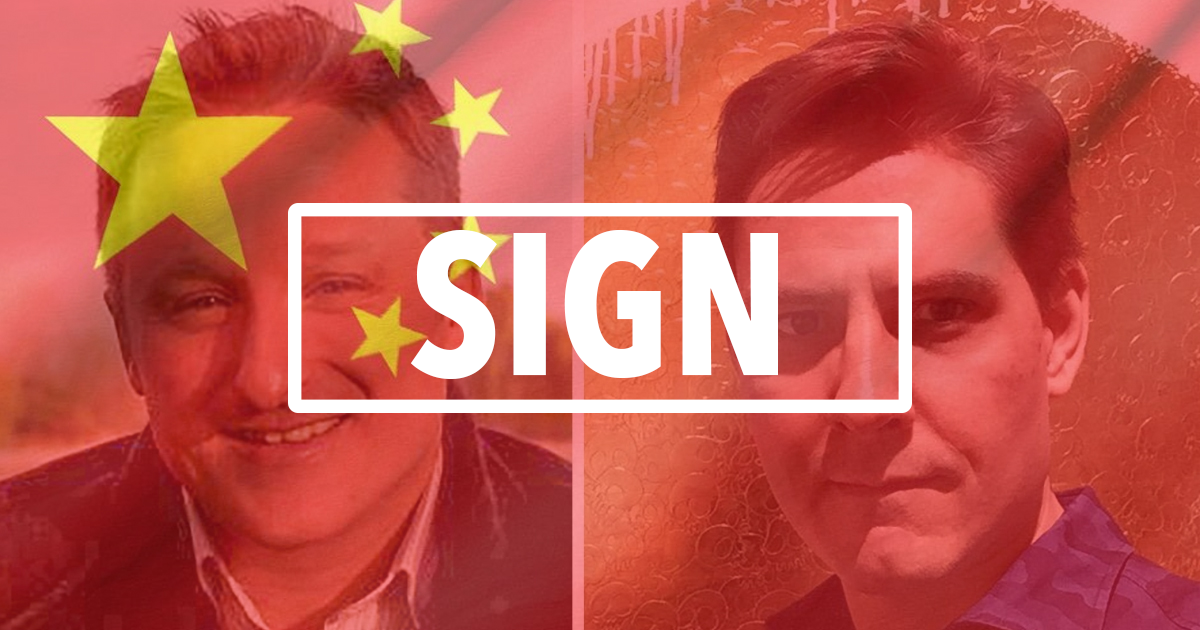
Shameful: @TrueNorthCentre using the two Michaels to raise funds
2019/12/12 Leave a comment
Speaks for itself – petition and involvement more to raise funds than substance – see highlighted text:
|
|
Working site on citizenship and multiculturalism issues.
2019/12/12 Leave a comment
Speaks for itself – petition and involvement more to raise funds than substance – see highlighted text:
|
|
2019/12/10 Leave a comment
Always somewhat amusing when a former senior minister (John Baird, shilling for Saudi Arabia) or former senior aide, in Alykhan’s case, works for a Chinese company despite having been part of a government with legitimate concerns over Chinese influence.
And good on the reporter for challenging him for his firm not making representation to free the two Michaels:
One of Huawei’s Canadian bosses says he is concerned about the “politicization” of its CFO’s case south of the border, but dodged questions on why the firm won’t speak out more strongly for the two Canadians arbitrarily detained in China.
In an interview with The West Block‘s Mercedes Stephenson, the executive and former director of issues management for Stephen Harper’s government insisted Huawei Canada respects Canadian laws but did not answer when asked whether the branch would call for the release of Michael Kovrig and Michael Spavor.
“Well, you know, we’re concerned. We’ve said that we want the two governments to work together to find a resolution that can bring them home as soon as possible,” said Alykhan Velshi, vice president of corporate affairs of the Canadian branch of the Chinese company.
“With respect to Meng Wanzhou, obviously she has access to Canadian court, she has lawyers here and we remain confident that she will be found innocent because she is innocent and we remain alarmed by the politicization of her trial down in the United States.”
He would not clearly explain why the domestic branch of the company isn’t saying the same for fellow citizens Michael Kovrig and Michael Spavor, detained by the Chinese government in apparent retaliation for Canada’s observance of its extradition treaty with the U.S.
Under that extradition treaty, Canada honours roughly nine in every 10 requests from the U.S. and it is the courts that decide on the merits of a case for extradition, with the ultimate decision lying at the very end of the process with the Minister for Immigration only in the event extradition is approved.
“If you’re alarmed by that politicization, are you not alarmed that these Canadian citizens are being held on what the Canadian government says are completely specious charges?” Stephenson asked Velshi.
“As I’ve said, we’re concerned. I think all Canadians are concerned by what’s happening over there by their treatment and we want this resolved as soon as possible,” he responded.
“But the solution can only be found by governments working together — by our government here in Ottawa, by the government in China, diplomats working together so we can bring them home as soon as possible. That’s our hope and I think that’s the hope of all Canadians.”
Kovrig, a diplomat on leave from Global Affairs Canada, and Spavor, an entrepreneur, were detained by Chinese authorities last December.
The action came just days after Canadian authorities arrested Meng on a provisional warrant from the United States. Shortly afterwards, the U.S. charged her and her company with allegedly skirting sanctions on Iran and stealing corporate secrets.
Kovrig and Spavor were held without charge until May 2019, when China formally arrested them on accusations of spying.
They have been kept in conditions described as “harsh,” with no access to lawyers and with the lights on 24 hours a day.
They have received only limited consular visits.
Meng, meanwhile, is out on bail and living in one of her Vancouver homes.
She is currently fighting extradition to the U.S., a process that could take years.
Huawei is seeking to bid on the upcoming 5G spectrum auction but faces allegations from intelligence agencies and experts around the world that it poses a national security risk because of a Chinese law that requires Chinese companies to spy for the state if requested.
Canada is currently in the midst of a review on whether to allow Huawei to bid in that auction.
Officials here are under pressure though from the Americans, who have deemed Huawei an unacceptable security risk and implemented a ban on U.S. companies using its technology. However, they have also issued repeated exemptions to that ban, most recently last month.
Source: Huawei Canada exec insists CFO Meng Wanzhou is victim of ‘politicization’ – National
2019/12/10 Leave a comment
Good commentary from our former ambassador:
I wake up every day thinking about the predicament of Michael Kovrig, a great colleague with whom I enjoyed working at the Canadian Embassy in Beijing, and hope that a miracle will happen and free him and Michael Spavor. On this sad anniversary of their first year in detention, the strategy followed by Ottawa has had limited results: Not only have they not been released on bail, but they have not even seen a lawyer!
Since China has warned us that things won’t get back to normal until we return Meng Wanzhou to China, there is no end in sight. Our farmers have lost billions of dollars in sales of canola (exports are down 50 per cent this year), soya, peas and meat. Since the United States created this problem by asking us to arrest Meng, they need to do more to help us resolve the crisis. But knowing Donald Trump’s opinion of our prime minister, can we rely on the U.S.? The message should be that we will be less forthcoming the next time around when the U.S. asks a service from us.
Is it possible to have normal relations with China? As Nicholas Kristof wrote in the New York Times on Nov. 30, it has become more difficult to remain ambivalent after the revelations about China’s campaign in the province of Xinjiang that borders on cultural genocide and its non-respect of the one-country-two-systems agreement on Hong Kong. Assuming that our compatriots would be released next year, I don’t think it is possible to restart the relationship where it was prior to the crisis. Still, we need to look at where we want to be in five or 10 years from now, as China is key to addressing common global problems such as climate change, nuclear proliferation and global pandemics.
The ongoing crisis with China shows the challenges of dealing with a superpower that ignores international rules when they are not to its liking. While Canada is not the first country to be on the receiving end of China’s displeasure and bullying tactics, this is the first time that a targeted country has rallied support from allies. I believe this has taken China by surprise as the reaction affects its image abroad. Our message should be that we are reassessing the relationship and that all official exchanges will be suspended until they release Kovrig and Spavor. After that, we will want to re-engage, but on the basis of reciprocity and mutual respect.
We should start immediately to reassess our engagement strategy with China, recognizing upfront that it has turned into a much more authoritarian state and a strategic competitor since Xi Jinping became secretary-general of the Chinese Communist Party in November 2012. Of course, our capacity to influence China is very limited — our goal is simply to ensure that basic human rights are better protected and that China stops behaving like a spoiled child.
Let’s not abdicate our values. We should react quickly and firmly when we find instances of interference in Canadian affairs, including among Canadians of Chinese origin, espionage activities, or attempts to limit debate on Canadian campuses. The government should look at Australia’s experience and the measures it has taken to deal with Chinese interference. I would also suggest that we undertake a review of ongoing collaboration in the field of high-tech, including artificial intelligence, to ensure that our expertise is not used in China for domestic controls or to limit freedom of expression.
We also have to cultivate expertise on China in all areas of the public service to ensure a well-informed and more sophisticated China policy. This requires supporting universities and think-tanks that study China, but also maintaining contacts in the People’s Republic of China to better understand its objectives and policies, with a focus on the communist party, which has taken over many tasks of the government. We also need programs to entice more young people to learn Mandarin.
As economic opportunities are still available for Canadian companies, the federal and provincial governments and agencies should continue to support Canadian companies in China. There is a need to better integrate information and provide more clarity to companies about assistance available from governments at various steps. In parallel, we also need to diversify our trade by putting more emphasis on other Asian countries to take full advantage of the Comprehensive and Progressive Agreement for Trans-Pacific Partnership and other free trade agreements we have in the region.
Clearly, Canada is not in a position by itself to criticize China much on its trade practices or human rights. Therefore, as Western countries all face similar challenges in dealing with China, the strategy going forward should be to work together on ensuring that the multilateral system is protected with the same rules for all. The message to China should be that we welcome it to play a larger role in international affairs and to join the Trans-Pacific Partnership, as long as it stops bullying countries and becomes a better global citizen.
China has been good at ragging the puck for too long: It’s time to apply reciprocity — i.e. we should allow Chinese companies to invest in Canada when a Canadian company is able to do the same in China.
One day, Michael Kovrig and Michael Spavor will be free. Let’s hope that they can resume their lives as soon as possible.
Source: Guy Saint-Jacques: No end in sight to the plight of the Two Michaels
2019/12/03 Leave a comment
The latest by former ambassador to China, David Mulroney, capping a series of articles in the Globe and elsewhere on the challenges posed by China and the arguments for a more robust response:
A year after the arrest of Huawei CFO Meng Wanzhou in Vancouver, new reporting is shedding light on what actually happened and when. But we’re still a long way from understanding the fallout from the arrest, and what it tells us about China and our future.
It appears that Vancouver was the place the Americans selected in their bid to get the well-travelled Ms. Meng arrested because they deemed Canada the country most likely to comply with their request. Given the price we’ve paid since, that’s a dubious honour. But it’s also an indication of the extent to which a bipartisan cross-section of official Washington trusts Canada. That trust was not misplaced.
It’s also clear that Canada was given advance warning of the request, although not much. Canadian officials heard from the Americans on Nov. 30, the day before Ms. Meng’s arrival in Vancouver, allowing them the minimum amount of time to act.
But it was time enough for the team that considered the American evidence. The toughest calls in Ottawa always come with the tightest deadlines. Getting them right is the essence of a senior official’s job.
That said, it’s not clear that officials anticipated how furiously China would react, or the difficulty of managing an extended crisis in Canada-China relations. Having stepped up to make the right call, Ottawa then seemed to go into responsive mode, consistently a step behind a strident and formidably vengeful China.
Once the decision to arrest Ms. Meng was made, it was entirely appropriate to advise the Prime Minister – he was, after all, at a summit that included both U.S. President Donald Trump and his Chinese counterpart, Xi Jinping.
But we should be wary of the idea that the Prime Minister could or should have weighed in to cancel the arrest because of its impact on Canada-China relations. That would set a precedent whereby all future extradition requests concerning China, and – ultimately – any other country big enough to make life difficult for us, would follow a separate, political decision-making track. This would be exploited by China and other rising powers, and risk transforming Canada into a safe haven for fraudsters, sanction evaders and human-rights violators.
We should be equally dismissive of the objection that China’s consular officials weren’t informed of the arrest in a timely manner. When I served as ambassador, China was notoriously cavalier about informing us, even months later, of the arrest of Canadian citizens, particularly those of Chinese origin. Chinese officials were notified of Ms. Meng’s arrest in a fraction of the time they typically take to inform us when a Canadian is arrested.
That said, beyond simply advising the Chinese of the arrest, we probably should have reached out quickly to more senior Chinese officials to explain what had happened and where things might go. But given that our communicator-in-chief at that point was John McCallum, our garrulous former ambassador, it probably wouldn’t have helped much.
Ultimately, it’s hard not to feel that the tight time frame for decision making was a blessing, enabling us to do the right thing before other, less-principled agendas had time to emerge. They were not long in appearing. We should not underestimate how much more difficult managing the issue became once various high-level Ottawa insiders began to talk up the idea of abandoning the extradition process. It’s no wonder the Chinese were seriously confused – so were most Canadians.
Taking stock today, what’s most discouraging is our persistent failure to learn from the painful experiences of a difficult year, despite the fact that we’ve spent that time uncharacteristically focused on China. There has been a lot to take in. Along with the cruel detentions of Michael Kovrig and Michael Spavor, we’ve witnessed almost daily examples of Chinese brutality in Xinjiang and repression in Hong Kong, and mounting evidence of Beijing’s interference around the world. Yet, Ottawa continues to treat China as an old friend with whom we’ve had a temporary falling out.
We did the right thing a year ago, and we’re still doing it when it comes to Ms. Meng, who is, unlike our detained Canadians, being treated fairly and with respect. And we’re still paying the price China now exacts from any country that values the rule of law over the rule of Beijing – a new reality whose implications, a full year later, continue to elude us.
2019/12/03 1 Comment
Good and unless I am missing it, all too rare commentary:
Between Aug. 16 and Aug. 25, I was in the Xinjiang Uighur Autonomous Region in China. Invited by the State Council Information Office of China and Xinjiang, I was part of a group of journalists who were sent to visit three major cities: Urumqi, Aksu, and Kashgar. Our visit, which was covered by the Chinese authorities, was stage-managed by Xinjiang authorities who wanted to convince us that things are fine in Xinjiang.
I arrived in Urumqi on Aug. 16. From Aug. 17 to Aug. 19, we attended several lectures by Communist Party officials regarding the history, religion and human rights practices in Xinjiang. In these sessions, Chinese officials like Xu Guixiang and Ma Pinyan delivered the white paper on Xinjiang, issued by the Chinese government.
In these lectures we were told that the Uighurs and other Turkic Muslims were migrants in this region, Islam was forcefully imposed by the Arabs and Turks, and Xinjiang has always been part of China. During our stay, we visited the Museum of Xinjiang Uighur Autonomous Region in Urumqi, the Aksu Museum and the Kashgar Museum. In these museums, the Chinese government is delivering the same message from the white paper: Xinjiang has historically been Chinese, the Uighurs and other Turkic Muslims are migrants, Islam is a foreign religion and it was imposed by force on the Uighurs.
On top of that, the Chinese were showing to the visitors that Islam was causing much trouble in Xinjiang since it was a source of extremism and terrorism. To fight that, the government of China had built some “Vocational Education and Training Centers” where the extremists were being deradicalized.
On Aug. 20, our hosts sent us to the city of Aksu to visit the Onsu County Vocational Skills Training Center. Here we were supposed to meet the “extremists and terrorists” whom China was “deradicalizing.”
However, when we interviewed the “students” of these “Vocational Training Centers” we found that they were not students but prisoners and they were not terrorists but Muslim believers who were forced to renounce their faith under duress.
Their crimes were practicing Islam, praying to Allah, watching Muslim televangelist videos on the internet, reading the Holy Quran or articles about Islam, writing about Islam, reading Uighur history, wearing hijabs, consuming halal food, burying their dead or marrying according to Islam and preaching Islam to their relatives.
The interviews which I have recorded and uploaded on my YouTube channel prove that the so-called “Vocational Training Centers” are not schools but mass detention centers. These centers are used to mass brainwash the Turkic Muslims of China, be them Uighur, Kazakh, Kirghiz, Uzbek, Tatar, etc, and force them to renounce Islam and their Turkic identity and become Han Chinese.
The claims in vain
Even though China claims that it is fighting “three evils” in Xinjiang, ethnic separatism, terrorism, and religious extremism, in fact, it is fighting the Islamic identity of the Uighurs which makes them a different nation from Han Chinese.
China is fighting against the diversity which in Xinjiang is represented by Islam. It wants to destroy any sign of Islam and totally Sinicize the province, which is a major power hub in China’s One Road, One Belt project.
The Chinese Muslims of Xinjiang, who do not present a separatist threat for China, are also suffering similar problems like the Uighurs. Under the excuse of fighting extremism, the Chinese authorities have declared Islam an extremist religion and do not want a Muslim presence to stand in the center of their Silk Road project which stretches from Beijing into Asia, Africa, and Europe.
The Chinese have banned the preaching and practice of Islam in Xinjiang and all state institutions have been ordered to fight any sign of religious practice (“The Xinjiang Regulation on De-extremification,” Chapter IV, Article 18).
The Xinjiang policy
China is treating Xinjiang as an occupied territory and its native Turkic inhabitants are considered as enemies who must be assimilated or destroyed. Xinjiang authorities are destroying mosques, graveyards and ancient Islamic buildings, and any sign of Islamic civilization that exists.
As Ma Pinyan told us during the lectures in Urumqi, the Chinese government wants to Sinicize Islam. It does not want to see any Arabic or Turkic signs among its Muslims. It does not want them to pray every day, to reject alcohol or women to wear headscarves or marry according to the Quran.
The Sinicization of Islam is legally ordered in “The Xinjiang Regulation on De-extremification,” (Article 4) and the practice of Islam is totally outlawed (“Regulation on De-extremification,” Chapter II, Article 9). Group reading of the Quran, teaching Islam to children, speaking about Islam, having or reading Islamic literature, wearing religious clothing, watching religious shows or advocating Islam in any sense is a crime that is punishable with imprisonment or a long and painful “re-education” in “The Vocational Training Centers.”
The bans on practice
Chinese authorities have prohibited the existence of minarets, the azan (call to prayer), mosques with domes and when a new mosque is ever built it must be shaped in Chinese architecture since the teleological narrative of the Chinese government claims that Islam needs to be Sinicized, and it should not have any Arabic or Turkic symbols.
To force the Sinicization of Islam, Xinjiang authorities sponsor the Islamic Institute of Xinjiang where selected imams are taught a restricted Chinese version of Islam. The campaign of terror against the Muslim population has created a climate of fear. We saw fear in the eyes of all the Muslims that we managed to meet.
The Chinese government has been mass colonizing Xinjiang with Chinese colonists since the 1950s. The Chinese, who in the 1950s counted for 5% to 9% of the population in 2010 count for 40%. The colonization is continuing very aggressively nowadays and it aims to turn the Muslims into a minority.
The Uighurs who are not being arrested and sent to concentration camps (“Vocational Training Centers”) or prisons are forced to take into their homes Chinese colonists who live and sleep in the same house with Muslim families. Many Uighur Muslim women are forced to marry Chinese men. Many Muslims are not allowed to fast during Ramadan.
Muslim restaurants are forbidden to refuse to sell alcohol. The Uighurs who show the slightest sing of Islam are separated from their families have their children taken away and raised by the Chinese. The reign of fear, religious persecution and ethnic assimilation that China is doing in East Turkistan amounts to cultural genocide.
However, while the world is witnessing the mass persecution of Turkic Muslims of China the Muslim world is ignoring it. To the shame of the Muslim world on July 8, 2019, some 22 non-Muslim states signed a letter addressed to the president of the U.N. Human Rights Council and the U.N. High Commissioner for Human Rights calling on China to end its massive detention program in Xinjiang.
While the Muslim majority states were absent from joining this letter, some 20 Muslim states joined a list of 37 countries in support of China for what it is doing in Xinjiang.
In the letter prepared by the Chinese, it was written: “We appreciate China’s commitment to openness and transparency. China has invited several diplomats, international organizations officials and journalists to Xinjiang to witness the progress of the human rights cause and the outcomes of counterterrorism and deradicalization there. What they saw and heard in Xinjiang completely contradicted what was reported in the media. We call on relevant countries to refrain from employing unfounded charges against China based on unconfirmed information before they visit Xinjiang…”
After coming back from Xinjiang, as a Muslim scholar and journalist that I am, I would like to tell the Muslim world that the “outcomes of counterterrorism and deradicalization” measures that China is doing in Xinjiang have been the total prohibition of Islam and mass persecution of Muslims.
China invited me like it has invited “several diplomats, international organizations officials and journalists to Xinjiang to witness the progress of the human rights cause and the outcomes of counterterrorism and deradicalization there.” However, my findings prove that China is persecuting the Uighurs only because they believe in Islam and are Muslims.
Through this open letter, I would like to appeal to all the Muslim countries who signed the pro-China letter to reconsider their position. I am ready to testify anywhere in the Muslim world about what China is doing with its Muslim populations.
What to do?
The Muslim countries should reconsider their position and urge China to immediately stop the persecution of Muslims and the prohibition of Islam in Xinjiang. China must close its “Vocational Training Centers,” release the religious and political prisoners from prisons and detention camps, abolish the Islamophobic and criminal “Xinjiang Uighur Autonomous Region De-extremification Regulations,” stop sending Chinese colonists to the homes of Uighurs and order all state apparatuses and organs to stop their persecution of Muslims.
China must stop its Islamophobic policies that target the Muslims, their religion, history, culture and way of life. It must stop the forced Sinicization of Turkic people (Uighur, Kazakh, Kirgiz, Uzbek, Tatar, and et cetera), the destruction of mosques and historical buildings.
It must allow the Muslims of Xinjiang to have passports, to move freely in and out of China, to call the adhan from their mosques, to have halal food, to perform Hajj in Mecca and to be able to teach Islam to their children.
Xinjiang authorities should adopt multiculturalism and accept the Uighurs and other Turkic Muslims of China as ordinary citizens equal to native Chinese, and Islam as one of the religions of China. China should revise the way it perceives its history and should accept Islam as an integral part of China and not as an enemy.
By raising these demands and reminding China that the Muslim world is a very important client, the Muslim countries must ask for the protection of their Muslim brethren who, at present, are suffering mass-persecution in the Xinjiang Uighur Autonomous Region.
Source: What can the Muslim world do to save the Uighurs and Islam in China?
2019/11/30 Leave a comment
Burton, McCuaig-Johnston, Mulroney, Glavin and others have been making these points for some time, and questioning the government’s response to date:
The new Trudeau government’s approach to China’s Communist Party regime is rife with dilemma. Support the business and political interests of the Laurentian élite, who are entwined in and conflicted by a Beijing engagement approach that eschews established norms of trade and diplomacy? Or adhere to Canadian middle-class values that make Canada the harmonious and tolerant society it is: decency, fairness, reciprocity, honesty, openness?
Canada’s policy on China was evidently too sensitive to handle during the recent election campaign; the Munk Centre’s scheduled foreign policy debate was cancelled after Justin Trudeau refused to appear.
But now it is new beginnings for a new government, time to reflect on the horrendous failures of our past engagement with China, time to do the necessary re-set in Canada’s national interest.
Against this desperate need for an open national debate, it is disappointing to see our government engaging in closed-door policy discussions led by Peter Harder (the government leader in the Senate), current and former senior officials of Global Affairs Canada, academics who favour engagement on Beijing’s terms, and business leaders with lucrative connections to Chinese Communist business networks closed to public scrutiny.
Now it is new beginnings for a new government, time to reflect on the horrendous failures of our past engagement with China, time to do the necessary re-set in Canada’s national interest.
On Nov. 19, the Public Policy Forum (lead partner: government of Canada) charged stakeholders in Canada-China relations $900 to access a one-day workshop and dinner in Ottawa, called “China and the Policy Implications of a new Cold War.” The pricey registration fee would be well beyond the budget of Canadian Tibetan, Uyghur or China human rights NGO activists, or Canadian media outlets. That would effectively mute voices who would like to know how Canada will address the cultural genocide of Turkic Muslims in China’s northwest, or the fate of the 300,000 Canadians in Hong Kong, or when Canada will take strong measures to convince China to release Michael Spavor and Michael Kovrig.
The PPF’s mandate is to “write a more sophisticated narrative for Canadians,” leading to “a more nuanced engagement” — evidently a mysterious doctrine best developed without wider participation.
The narrative that PPF is developing is that “the rise of China is bending the arc of history,” so Canada must “adjust rapidly to changing geopolitical realities arguably as profound as anything since the rise of the United States challenged the dominance of the British Empire in the late 19th century.” This rhetoric is certainly not based on sound comparative historiography, but it is in perfect harmony with that articulated by Chinese leader Xi Jinping. He demands that Canada join China’s “community of the common destiny of mankind” and support China’s rebuild of global trade infrastructure by participating in the Asian Infrastructure Investment Bank and China’s “Belt and Road Initiative,” because as the U.S. declines, China will become the new global hegemon.
In other words, Canada should get with the program, because, as former Liberal cabinet stalwart Martin Cauchon said regarding Huawei’s expansion, “if you can’t beat them, join them.” But China does not have a record of trust in upholding international agreements. Once Huawei is installed, billions of dollars later, any Chinese commitment to allow Canadian monitoring of Huawei systems to ensure they are not being used to purloin data, or threaten Canadian critical infrastructure, is likely to be revoked. And there won’t be much we can do about it.
On Nov. 20, the day after the workshop, François-Philippe Champagne was appointed minister of Global Affairs, and Mary Ng was named minister of International Trade. Both are extensively on the record saying trade should be Canada’s priority for engaging China. What about concerns over China’s espionage and covert political influence activities in Canada, and Canadians’ alarm about engaging with a régime complicit in human rights violations against its own people, violating sovereignty in the South China Sea and using economic leverage to serve Beijing’s authoritarian political and strategic purposes? Such concerns must go by the wayside, because China has made clear it will not expand trade with Canada otherwise.
So now, the same policymakers who got it so very wrong on China in the past are setting Canada’s China agenda for the future. The question begs: What more does the Chinese Communist régime have to do to convince us that our “see no evil, hear no evil, speak no evil” appeasement of China is actually disastrous to Canada’s domestic and global interests?
What we need is uncompromised, Canadian, level-headed good sense to be brought into play. Let’s hope that happens before it is too late.
Source: Burton: Trudeau government at a crossroads in its dealings with China
2019/11/30 Leave a comment
Australia has always been the cautionary tale for Canada and others, with comparable challenges:
A Chinese defector to Australia who detailed political interference by Beijing. A businessman found dead after telling the authorities about a Chinese plot to install him in Parliament. Suspicious men following critics of Beijing in major Australian cities.
For a country that just wants calm commerce with China — the propellant behind 28 years of steady growth — the revelations of the past week have delivered a jolt.
Fears of Chinese interference once seemed to hover indistinctly over Australia. Now, Beijing’s political ambitions, and the espionage operations that further them, suddenly feel local, concrete and ever-present.
“It’s become the inescapable issue,” said Hugh White, a former intelligence official who teaches strategic studies at the Australian National University. “We’ve underestimated how quickly China’s power has grown along with its ambition to use that power.”
2019/11/26 Leave a comment
No longer any opportunity to deny on the part of China and its supporters. Cultural genocide in practice and the degree of organization, the bureaucratic precision, and the attention to detail are reminiscent of the Nazi Germany’s physical genocide of Jews, Roma and others:
The watch towers, double-locked doors and video surveillance in the Chinese camps are there “to prevent escapes.” Uyghurs and other minorities held inside are scored on how well they speak the dominant Mandarin language and follow strict rules on everything down to bathing and using the toilet, scores that determine if they can leave.
“Manner education” is mandatory, but “vocational skills improvement” is offered only after a year in the camps.
Voluntary job training is the reason the Chinese government has given for detaining more than a million ethnic minorities, most of them Muslims. But a classified blueprint leaked to a consortium of news organizations shows the camps are instead precisely what former detainees have described: Forced ideological and behavioural re-education centres run in secret.
The classified documents lay out the Chinese government’s deliberate strategy to lock up ethnic minorities even before they commit a crime, to rewire their thoughts and the language they speak.
The papers also show how Beijing is pioneering a new form of social control using data and artificial intelligence. Drawing on data collected by mass surveillance technology, computers issued the names of tens of thousands of people for interrogation or detention in just one week.
Taken as a whole, the documents give the most significant description yet of high-tech mass detention in the 21st century in the words of the Chinese government itself. Experts say they spell out a vast system that targets, surveils and grades entire ethnicities to forcibly assimilate and subdue them – especially Uyghurs, a predominantly Muslim Turkic minority of more than 10 million people with their own language and culture.
“They confirm that this is a form of cultural genocide,” said Adrian Zenz, a leading security expert on the far western region of Xinjiang, the Uighur homeland. “It really shows that from the onset, the Chinese government had a plan.”
Zenz said the documents echo the aim of the camps as outlined in a 2017 report from a local branch of the Xinjiang Ministry of Justice: To “wash brains, cleanse hearts, support the right, remove the wrong.”
China has struggled for decades to control Xinjiang, where the Uyghurs have long resented Beijing’s heavy-handed rule. After the 9/11 attacks in the United States, Chinese officials began justifying harsh security measures and religious restrictions as necessary to fend off terrorism, arguing that young Uyghurs were susceptible to the influence of Islamic extremism. Hundreds have died since in terror attacks, reprisals and race riots, both Uyghurs and Han Chinese.
In 2014, Chinese President Xi Jinping launched what he called a “People’s War on Terror” when bombs set off by Uighur militants tore through a train station in Urumqi, the capital of Xinjiang, just hours after he concluded his first state visit there.
“Build steel walls and iron fortresses. Set up nets above and snares below,” state media cited Xi as saying. “Cracking down severely on violent terrorist activities must be the focus of our current struggle.”
In 2016, the crackdown intensified dramatically after Xi named Chen Quanguo, a hardline official transferred from Tibet, as Xinjiang’s new head. Most of the documents were issued in 2017, as Xinjiang’s “War on Terror” morphed into an extraordinary mass detention campaign using military-style technology.
The practices largely continue today. The Chinese government says they work.
“Since the measures have been taken, there’s no single terrorist incident in the past three years,” said a written response from the Chinese Embassy in the United Kingdom. “Xinjiang is much safer … The so-called leaked documents are fabrication and fake news.”
The statement said that religious freedom and the personal freedom of detainees was “fully respected” in Xinjiang.
The documents were given to the International Consortium of Investigative Journalists by an anonymous source. The ICIJ verified them by examining state media reports and public notices from the time, consulting experts, cross-checking signatures and confirming the contents with former camp employees and detainees.
They consist of a notice with guidelines for the camps, four bulletins on how to use technology to target people, and a court case sentencing a Uighur Communist Party member to 10 years in prison for telling colleagues not to say dirty words, watch porn or eat without praying.
The documents were issued to rank-and-file officials by the powerful Xinjiang Communist Party Political and Legal Affairs Commission, the region’s top authority overseeing police, courts and state security. They were put out under the head official at the time, Zhu Hailun, who annotated and signed some personally.
The documents confirm from the government itself what is known about the camps from the testimony of dozens of Uyghurs and Kazakhs, satellite imagery and tightly monitored visits by journalists to the region.
Erzhan Qurban, an ethnic Kazakh who moved back to Kazakhstan, was grabbed by police on a trip back to China to see his mother and accused of committing crimes abroad. He protested that he was a simple herder who had done nothing wrong. But for the authorities, his time in Kazakhstan was reason enough for detention.
Qurban told the AP he was locked in a cell with 10 others last year and told not to engage in “religious activities” like praying. They were forced to sit on plastic stools in rigid postures for hours at a time. Talk was forbidden, and two guards kept watch 24 hours a day. Inspectors checked that nails were short and faces trimmed of moustaches and beards, traditionally worn by pious Muslims.
Those who disobeyed were forced to squat or spend 24 hours in solitary confinement in a frigid room.
“It wasn’t education, it was just punishment,” said Qurban, who was held for nine months. “I was treated like an animal.”
WHO GETS ROUNDED UP AND HOW
On February 18, 2017, Zhu, the Han Chinese official who signed the documents, stood in chilly winter weather atop the front steps of the capital’s city hall, overlooking thousands of police in black brandishing rifles.
“With the powerful fist of the People’s Democratic Dictatorship, all separatist activities and all terrorists shall be smashed to pieces,” Zhu announced into a microphone.
With that began a new chapter in the state’s crackdown. Police called Uyghurs and knocked on their doors at night to take them in for questioning. Others were stopped at borders or arrested at airports.
In the years since, as Uyghurs and Kazakhs were sent to the camps in droves, the government built hundreds of schools and orphanages to house and re-educate their children. Many of those who fled into exile don’t even know where their children or loved ones are.
The documents make clear that many of those detained have not actually done anything. One document explicitly states that the purpose of the pervasive digital surveillance is “to prevent problems before they happen” – in other words, to calculate who might rebel and detain them before they have a chance.
This is done through a system called the Integrated Joint Operations Platform or IJOP, designed to screen entire populations. Built by a state-owned military contractor, the IJOP began as an intelligence-sharing tool developed after Chinese military theorists studied the U.S. army’s use of information technology in Iraq and Afghanistan.
“There’s no other place in the world where a computer can send you to an internment camp,” said Rian Thum, a Xinjiang expert at the University of Nottingham. “This is absolutely unprecedented.”
The IJOP spat out the names of people considered suspicious, such as thousands of “unauthorized” imams not registered with the Chinese government, along with their associates. Suspicious or extremist behaviour was so broadly defined that it included going abroad, asking others to pray or using cellphone apps that cannot be monitored by the government.
The IJOP zoomed in on users of “Kuai Ya,” a mobile application similar to the iPhone’s Airdrop, which had become popular in Xinjiang because it allows people to exchange videos and messages privately. One bulletin showed that officials identified more than 40,000 “Kuai Ya” users for investigation and potential detention; of those, 32 were listed as belonging to “terrorist organizations.”
“They’re scared people will spread religion through `Kuai Ya,“’ said a man detained after police accused him of using the app. He spoke to the AP on condition of anonymity to protect himself and his family. “They can’t regulate it … So they want to arrest everyone who’s used `Kuai Ya’ before.”
The system also targeted people who obtained foreign passports or visas, reflecting the government’s fear of Islamic extremist influences from abroad and deep discomfort with any connection between the Uyghurs and the outside world. Officials were asked to verify the identities even of people outside the country, showing how China is casting its dragnet for Uyghurs far beyond Xinjiang.
In recent years, Beijing has put pressure on countries to which Uyghurs have fled, such as Thailand and Afghanistan, to send them back to China. In other countries, state security has also contacted Uyghurs and pushed them to spy on each other. For example, a restaurateur now in Turkey, Qurbanjan Nurmemet, said police contacted him with videos of his son strapped to a chair and asked him for information on other Uyghurs in Turkey.
Despite the Chinese government’s insistence that the camps are vocational training centres for the poor and uneducated, the documents show that those rounded up included party officials and university students.
After the names were collected, lists of targeted people were passed to prefecture governments, who forwarded them to district heads, then local police stations, neighbour watchmen, and Communist Party cadres living with Uighur families.
Some former detainees recalled being summoned by officers and told their names were listed for detention. From there, people were funnelled into different parts of the system, from house arrest to detention centres with three levels of monitoring to, at its most extreme, prison.
Experts say the detentions are a clear violation of China’s own laws and constitution. Maggie Lewis, a professor of Chinese law at Seton Hall University, said the Communist Party is circumventing the Chinese legal system in Xinjiang.
“Once you’re stamped as an enemy, the gloves go off,” she said. “They’re not even trying to justify this legally … This is arbitrary.”
The detention campaign is sweeping. A bulletin notes that in a single week in June 2017, the IJOP identified 24,612 “suspicious persons” in southern Xinjiang, with 15,683 sent to “education and training,” 706 to prison and 2,096 to house arrest. It is unknown how typical this week might be. Local officials claim far less than a million are in “training,” but researchers estimate up to 1.8 million have been detained at one point or another.
The bulletins stress that relationships must be scrutinized closely, with those interrogated pushed to report the names of friends and relatives. Mamattursun Omar, a Uighur chef arrested after working in Egypt, was interrogated in four detention facilities over nine months in 2017. Omar told the AP that police asked him to verify the identities of other Uyghurs in Egypt.
Eventually, Omar says, they began torturing him to make him confess that Uighur students had gone to Egypt to take part in jihad. They strapped him to a contraption called a “tiger chair,” shocked him with electric batons, beat him with pipes and whipped him with computer cords.
“I couldn’t take it anymore,” Omar said. “I just told them what they wanted me to say.”
Omar gave the names of six others who worked at a restaurant with him in Egypt. All were sent to prison.
WHAT HAPPENS INSIDE THE CAMPS
The documents also detail what happens after someone is sent to an “education and training centre.”
Publicly, in a recent white paper, China’s State Council said “the personal freedom of trainees at the education and training centres is protected in accordance with the law.” But internally, the documents describe facilities with police stations at the front gates, high guard towers, one-button alarms and video surveillance with no blind spots.
Detainees are only allowed to leave if absolutely necessary, for example because of illness, and even so must have somebody “specially accompany, monitor and control” them. Bath time and toilet breaks are strictly managed and controlled “to prevent escapes.” And cellphones are strictly forbidden to stop “collusion between inside and outside.”
“Escape was impossible,” said Kazakh kingergarten administrator Sayragul Sauytbay, a Communist Party member who was abducted by police in October 2017 and forced to become a Mandarin camp instructor. “In every corner in every place there were armed police.”
Sauytbay called the detention centre a “concentration camp … much more horrifying than prison,” with rape, brainwashing and torture in a “black room” were people screamed. She and another former prisoner, Zumrat Dawut, also told the ICIJ detainees were given medication that made them listless and obedient, and every move was surveilled.
AP journalists who visited Xinjiang in December 2018 saw patrol towers and high walls lined with green barbed wire fencing around camps. One camp in Artux, just north of Kashgar, sat in the middle of a vast, empty, rocky field, and appeared to include a police station at the entrance, workshops, a hospital and dormitories, one with a sign reading “House of Workers” in Chinese.
Recent satellite imagery shows that guard towers and fencing have been removed from some facilities, suggesting the region may have been softening restrictions in response to global criticism. Shohrat Zakir, the governor of Xinjiang, said in March that those detained can now request time and go home on weekends, a claim the AP could not independently verify.
The first item listed as part of the curriculum is ideological education, a bold attempt to change how detainees think and act. It is partly rooted in the ancient Chinese belief in transformation through education – taken before to terrifying extremes during the mass thought reform campaigns of Mao Zedong.
“It’s the dark days of the Cultural Revolution, except now it’s powered by high-tech,” said Zenz, the researcher.
By showing students the error of their former ways, the centres are supposed to promote “repentance and confession,” the directive said. For example, Qurban, the Kazakh herder, was handcuffed, brought to an interview with a Han Chinese leader and forced to acknowledge that he regretted visiting abroad.
The indoctrination goes along with what is called “manner education,” where behaviour is dictated down to ensuring “timely haircuts and shaves,” “regular change of clothes” and “bathing once or twice a week.” The tone, experts say, echoes a general perception by the Han Chinese government that Uyghurs are prone to violence and need to be civilized – in much the same way white colonialists treated indigenous people in the U.S., Canada and Australia.
“It’s a similar kind of saviour mentality – that these poor Uyghurs didn’t understand that they were being led astray by extremists,” said Darren Byler, a scholar of Uighur culture at the University of Washington. “The way they think about Uyghurs in general is that they are backward, that they’re not educated … these people are unhygienic and need to be taught how to clean themselves.”
Students are to be allowed a phone conversation with relatives at least once a week, and can meet them via video at least once a month, the documents say. Trainers are told to pay attention to “the ideological problems and emotional changes that arise after family communications.”
Mandarin is mandated. Beijing has said “the customs of all ethnic groups and the right to use their spoken and written languages are fully protected at the centres.” But the documents show that in practice, lessons are taught in Mandarin, and it is the language to be used in daily communication.
A former staffer at Xinjiang TV now in Europe was also selected to become a Mandarin teacher during his month-long detention in 2017. Twice a day, detainees were lined up and inspected by police, and a few were questioned in Mandarin at random, he told the AP. Those who couldn’t respond in Mandarin were beaten or deprived of food for days. Otherwise, speaking was forbidden.
One day, the former teacher recalled, an officer asked an old farmer in Mandarin whether he liked the detention centre. The man apologized in broken Mandarin and Uighur, saying it was hard for him to understand because of his age. The officer strode over and struck the old man’s head with a baton. He crumpled to the ground, bleeding.
“They didn’t see us as humans,” said the former teacher, who declined to provide his name out of fear of retribution against his family. “They treated us like animals – like pigs, cows, sheep.”
Detainees are tested on Mandarin, ideology and discipline, with “one small test per week, one medium test per month, and one big test per season,” the documents state. These test scores feed into an elaborate point system.
Detainees who do well are to be rewarded with perks like family visits, and may be allowed to “graduate” and leave. Detainees who do poorly are to be sent to a stricter “management area” with longer detention times. Former detainees told the AP that punishments included food deprivation, handcuffing, solitary confinement, beatings and torture.
Detainees’ scores are entered in the IJOP. Students are sent to separate facilities for “intensive skills training” only after at least one year of learning ideology, law and Mandarin.
After they leave, the documents stipulate, every effort should be made to get them jobs. Some detainees describe being forced to sign job contracts, working long hours for low pay and barred from leaving factory grounds during weekdays.
Qurban, the Kazakh herder, said after nine months in the camp, a supervisor came to tell him he was “forgiven” but must never tell what he had seen. After he returned to his village, officials told him he had to work in a factory.
“If you don’t go, we’ll send you back to the centre,” an official said.
Qurban went to a garment factory, which he wasn’t allowed to leave. After 53 days stitching clothes, he was released. After another month under house arrest, he finally was allowed to return to Kazakhstan and see his children. He received his salary in cash: 300 Chinese yuan, or just under $42.
Long an ordinary herder who thought little of politics, Qurban used to count many Han Chinese among his friends. Now, he said, he’s begun to hate them.
“I’ve never committed a crime, I’ve never done anything wrong,” he said. “It was beyond comprehension why they put me there.”
Source: The directives
2019/11/25 Leave a comment
Good profile and account of her realization that she needed to speak out regarding the need for a reset of Canada-China relations, with Canada needing to take a harder line:
It was 1979 and Beijing was in the midst of its first democracy movement. Margaret McCuaig-Johnston, then a civil servant in the Ontario government opening up after decades of isolation from the outside world.
The Xidan democracy wall, part of a peaceful public outburst against the Communist Party of China, was in full swing and McCuaig-Johnston had been following the story in Canadian media.
“I had never even thought of China. It was not on my radar at all, but this sounded really interesting,” she said. “So, my husband and I went over to China.”
At the time, only group tours were allowed, so she made the trip with the University of Toronto Alumni Association and even managed a trip to see the democracy wall in Beijing, which hosted messages of hope and reform from the mainland Chinese people. From there, McCuaig-Johnston travelled the country and decided to do a master’s degree in international relations focused on China.
For the next 40 years, including working as a civil servant, she collaborated to advance the relationship between Canada and China. Part of her work meant helping China develop its science and technology programs during its reform period.
Eventually, McCuaig-Johnston would become the vice-president of the Canada-China friendship association and consider herself a “friend of China,” a common expression used for those who support partnerships and engagement with Beijing.
But everything changed last December.
That’s when Meng Wanzhou, chief financial officer of Chinese tech giant Huawei, was arrested. She had been passing through Vancouver’s airport when she was detained on a warrant request from the United States. The arrest sparked a firestorm that has torched relations between China and Canada.
McCuaig-Johnston said she’d already had concerns about the direction Beijing was taking on human rights, particularly regarding internment camps for Muslims in the Xinjiang province, as well as the country’s increasing aggression in the South China Sea.
But what galvanized those concerns was the detention without charges of two Canadian citizens, Michael Kovrig and Michael Spavor, who remain in Chinese custody months later. Another two Canadians were sentenced to death for drug convictions, which have not been carried out. Shortly after, Beijing levelled sanctions against Canadian pork and beef.
After decades spent facilitating China’s enhanced ties to Canada, McCuaig-Johnston returned to her hotel room in Shanghai the same week Kovrig and Spavor were arrested to find her locked luggage had been unlocked and rummaged through.
She said she believes it was Chinese authorities because nothing was taken. Then a local business acquaintance told her he had heard authorities had a list of 100 Canadians they could detain and interrogate at any time. McCuaig-Johnston had reached her limit.
“When I came home, I decided to speak out,” she said.
Since then, McCuaig-Johnston has written five editorials in national newspapers critical of China, given 30 interviews and recently published Dragon at the Door through the Macdonald-Laurier Institute. The paper calls for Canada to conduct a reset of relations with Beijing, insisting Ottawa to take a harder line.
“Up until January, I had never done an interview in my life,” she said. “But I feel it’s important that friends of China — former friends of China — speak out about this.”
Her paper suggests pulling out of China’s Asian Infrastructure Investment Bank, using so-called Magnitsky legislation to punish Hong Kong officials who abuse human rights, or sending pandas now living at the Calgary Zoo back to China early. Canada must also pivot to an Indo-Pacific economic strategy, she argued.
Foreign affairs critic Erin O’Toole agreed with measures laid out in the paper, but suggested the Liberal government seems unwilling to take such strong action.
“We are rolling over, we are acquiescing, at a time when Chinese aggression is on the rise,” O’Toole said. “We should be working with like-minded allies to send a real signal that such conduct is not condoned.
If keeping quiet and friendly were going to work with China, Spavor and Kovrig “would have been released months ago,” he said.
On Friday, China’s new ambassador to Canada, Cong Peiwu, urged Canada to not pass legislation similar to the United States’ sanctioning China and Hong Kong officials who abuse human rights. The bill is in support of students in the special administrative region who have been protesting for months. About 300,000 Canadians live in Hong Kong.
Cong said it could cause “very bad damage” if Canada were to use similar legislation.
The Liberal government had issued no response to those comments by press time Friday.
Observers have noted that many advisers around the Liberal government have ties and interests in China, including new ambassador to Beijing, Dominic Barton, and McCuaig-Johnston was once among the ranks of such business people, academics and bureaucrats.
But though “friends of China” may express outrage at China behind closed doors, many have told her they will not do so in public for fear of losing their privileges in the country.
In January, more than 140 academics and diplomats around the world signed a letter demanding China release Kovrig and Spavor. But just six Canadian academics signed while another six former Canadian ambassadors to China also signed.
Many of Canada’s academics, politicians and business leaders have allowed themselves to end up in positions where it’s difficult to criticize China, said a former Canadian ambassador to China, Guy Saint-Jacques. Saint-Jacques said it’s “rare” to see someone perform a 180 on the country publicly the way McCuaig-Johnston has done.
“(Beijing) are good at co-opting former government officials and politicians by offering them seats on boards and contracts,” he said. “Obviously, then it becomes very difficult for you to become critical of China.”
But McCuaig-Johnston said she believes her points are landing with the members of Canadian government to whom she has spoken.
She doesn’t want to return to China, even if relations improve, she said; the idea of trusting the country that illegally detained two of her fellow Canadians doesn’t appeal to her.
And, though just a few years ago she was a vice-president of the organization, she no longer attends events hosted by the Canada-China Friendship Association.
“I’m not feeling very friendly toward China, if you can tell,” she said.
2019/11/20 Leave a comment
Incredibly detailed reporting on the extensive and highly organized efforts by the Chinese government to repress knowledge of its repression of its Uighur muslim minority, and the chilling nature of the Chinese bureaucracy at work.
Of note to those who preach engagement at any cost and no matter the interlocutor and subject:
The students booked their tickets home at the end of the semester, hoping for a relaxing break after exams and a summer of happy reunions with family in China’s far west.
Instead, they would soon be told that their parents were gone, relatives had vanished and neighbors were missing — all of them locked up in an expanding network of detention camps built to hold Muslim ethnic minorities.
The authorities in the Xinjiang region worried the situation was a powder keg. And so they prepared.
The leadership distributed a classified directive advising local officials to corner returning students as soon as they arrived and keep them quiet. It included a chillingly bureaucratic guide for how to handle their anguished questions, beginning with the most obvious: Where is my family?
The directive was among 403 pages of internal documents that have been shared with The New York Times in one of the most significant leaks of government papers from inside China’s ruling Communist Party in decades. They provide an unprecedented inside view of the continuing clampdown in Xinjiang, in which the authorities have corralled as many as a million ethnic Uighurs, Kazakhs and others into internment camps and prisons over the past three years.
Read the Full Document: What Chinese Officials Told Children Whose Families Were Put in Camps
The party has rejected international criticism of the camps and described them as job-training centers that use mild methods to fight Islamic extremism. But the documents confirm the coercive nature of the crackdown in the words and orders of the very officials who conceived and orchestrated it.
Even as the government presented its efforts in Xinjiang to the public as benevolent and unexceptional, it discussed and organized a ruthless and extraordinary campaign in these internal communications. Senior party leaders are recorded ordering drastic and urgent action against extremist violence, including the mass detentions, and discussing the consequences with cool detachment.
Children saw their parents taken away, students wondered who would pay their tuition and crops could not be planted or harvested for lack of manpower, the reports noted. Yet officials were directed to tell people who complained to be grateful for the Communist Party’s help and stay quiet.
The leaked papers offer a striking picture of how the hidden machinery of the Chinese state carried out the country’s most far-reaching internment campaign since the Mao era. The key disclosures in the documents include:
•President Xi Jinping, the party chief, laid the groundwork for the crackdown in a series of speeches delivered in private to officials during and after a visit to Xinjiang in April 2014, just weeks after Uighur militants stabbed more than 150 people at a train station, killing 31. Mr. Xi called for an all-out “struggle against terrorism, infiltration and separatism” using the “organs of dictatorship,” and showing “absolutely no mercy.”
•Terrorist attacks abroad and the drawdown of American troops in Afghanistan heightened the leadership’s fears and helped shape the crackdown. Officials argued that attacks in Britain resulted from policies that put “human rights above security,” and Mr. Xi urged the party to emulate aspects of America’s “war on terror” after the Sept. 11 attacks.
•The internment camps in Xinjiang expanded rapidly after the appointment in August 2016 of Chen Quanguo, a zealous new party boss for the region. He distributed Mr. Xi’s speeches to justify the campaign and exhorted officials to “round up everyone who should be rounded up.”
•The crackdown encountered doubts and resistance from local officials who feared it would exacerbate ethnic tensions and stifle economic growth. Mr. Chen responded by purging officials suspected of standing in his way, including one county leader who was jailed after quietly releasing thousands of inmates from the camps.
The leaked papers consist of 24 documents, some of which contain duplicated material. They include nearly 200 pages of internal speeches by Mr. Xi and other leaders, and more than 150 pages of directives and reports on the surveillance and control of the Uighur population in Xinjiang. There are also references to plans to extend restrictions on Islam to other parts of China.
The documents include 96 pages of internal speeches by Mr. Xi, 102 pages of internal speeches by other officials, 161 pages of directives and reports on the surveillance and control of the Uighur population in Xinjiang and 44 pages of material from internal investigations into local officials.
Though it is unclear how the documents were gathered and selected, the leak suggests greater discontent inside the party apparatus over the crackdown than previously known. The papers were brought to light by a member of the Chinese political establishment who requested anonymity and expressed hope that their disclosure would prevent party leaders, including Mr. Xi, from escaping culpability for the mass detentions.
The Chinese leadership wraps policymaking in secrecy, especially when it comes to Xinjiang, a resource-rich territory located on the sensitive frontier with Pakistan, Afghanistan and Central Asia. Predominantly Muslim ethnic minority groups make up more than half the region’s population of 25 million. The largest of these groups are the Uighurs, who speak a Turkic language and have long faced discrimination and restrictions on cultural and religious activities.
Beijing has sought for decades to suppress Uighur resistance to Chinese rule in Xinjiang. The current crackdown began after a surge of antigovernment and anti-Chinese violence, including ethnic riots in 2009 in Urumqi, the regional capital, and a May 2014 attack on an outdoor market that killed 39 people just days before Mr. Xi convened a leadership conference in Beijing to set a new policy course for Xinjiang.
Since 2017, the authorities in Xinjiang have detained many hundreds of thousands of Uighurs, Kazakhs and other Muslims in internment camps. Inmates undergo months or years of indoctrination and interrogation aimed at transforming them into secular and loyal supporters of the party.
Of the 24 documents, the directive on how to handle minority students returning home to Xinjiang in the summer of 2017 offers the most detailed discussion of the indoctrination camps — and the clearest illustration of the regimented way the party told the public one story while mobilizing around a much harsher narrative internally.
Even as the document advises officials to inform students that their relatives are receiving “treatment” for exposure to radical Islam, its title refers to family members who are being “dealt with,” or chuzhi, a euphemism used in party documents to mean punishment.
Officials in Turpan, a city in eastern Xinjiang, drafted the question-and-answer script after the regional government warned local officials to prepare for the returning students. The agency coordinating efforts to “maintain stability” across Xinjiang then distributed the guide across the region and urged officials to use it as a model.
The government sends Xinjiang’s brightest young Uighurs to universities across China, with the goal of training a new generation of Uighur civil servants and teachers loyal to the party.
The crackdown has been so extensive that it affected even these elite students, the directive shows. And that made the authorities nervous.
“Returning students from other parts of China have widespread social ties across the entire country,” the directive noted. “The moment they issue incorrect opinions on WeChat, Weibo and other social media platforms, the impact is widespread and difficult to eradicate.”
The authorities anticipated, however, that this was unlikely to mollify students and provided replies to a series of other questions: When will my relatives be released? If this is for training, why can’t they come home? Can they request a leave? How will I afford school if my parents are studying and there is no one to work on the farm?
The guide recommended increasingly firm replies telling the students that their relatives had been “infected” by the “virus” of Islamic radicalism and must be quarantined and cured. Even grandparents and family members who seemed too old to carry out violence could not be spared, officials were directed to say.
“If they don’t undergo study and training, they’ll never thoroughly and fully understand the dangers of religious extremism,” one answer said, citing the civil war in Syria and the rise of the Islamic State. “No matter what age, anyone who has been infected by religious extremism must undergo study.”
Students should be grateful that the authorities had taken their relatives away, the document said.
“Treasure this chance for free education that the party and government has provided to thoroughly eradicate erroneous thinking, and also learn Chinese and job skills,” one answer said. “This offers a great foundation for a happy life for your family.”
The authorities appear to be using a scoring system to determine who can be released from the camps: The document instructed officials to tell the students that their behavior could hurt their relatives’ scores, and to assess the daily behavior of the students and record their attendance at training sessions, meetings and other activities.
Secret Speeches
The ideas driving the mass detentions can be traced back to Xi Jinping’s first and only visit to Xinjiang as China’s leader, a tour shadowed by violence.
In 2014, little more than a year after becoming president, he spent four days in the region, and on the last day of the trip, two Uighur militants staged a suicide bombing outside a train station in Urumqi that injured nearly 80 people, one fatally.
Weeks earlier, militants with knives had gone on a rampage at another railway station, in southwest China, killing 31 people and injuring more than 140. And less than a month after Mr. Xi’s visit, assailants tossed explosives into a vegetable market in Urumqi, wounding 94 people and killing at least 39.
Against this backdrop of bloodshed, Mr. Xi delivered a series of secret speeches setting the hard-line course that culminated in the security offensive now underway in Xinjiang. While state media have alluded to these speeches, none were made public.
The text of four of them, though, were among the leaked documents — and they provide a rare, unfiltered look at the origins of the crackdown and the beliefs of the man who set it in motion.
“The methods that our comrades have at hand are too primitive,” Mr. Xi said in one talk, after inspecting a counterterrorism police squad in Urumqi. “None of these weapons is any answer for their big machete blades, ax heads and cold steel weapons.”
“We must be as harsh as them,” he added, “and show absolutely no mercy.”
In free-flowing monologues in Xinjiang and at a subsequent leadership conference on Xinjiang policy in Beijing, Mr. Xi is recorded thinking through what he called a crucial national security issue and laying out his ideas for a “people’s war” in the region.
Although he did not order mass detentions in these speeches, he called on the party to unleash the tools of “dictatorship” to eradicate radical Islam in Xinjiang.
Mr. Xi displayed a fixation with the issue that seemed to go well beyond his public remarks on the subject. He likened Islamic extremism alternately to a virus-like contagion and a dangerously addictive drug, and declared that addressing it would require “a period of painful, interventionary treatment.”
“The psychological impact of extremist religious thought on people must never be underestimated,” Mr. Xi told officials in Urumqi on April 30, 2014, the final day of his trip to Xinjiang. “People who are captured by religious extremism — male or female, old or young — have their consciences destroyed, lose their humanity and murder without blinking an eye.”
In another speech, at the leadership conclave in Beijing a month later, he warned of “the toxicity of religious extremism.”
“As soon as you believe in it,” he said, “it’s like taking a drug, and you lose your sense, go crazy and will do anything.”
In several surprising passages, given the crackdown that followed, Mr. Xi also told officials to not discriminate against Uighurs and to respect their right to worship. He warned against overreacting to natural friction between Uighurs and Han Chinese, the nation’s dominant ethnic group, and rejected proposals to try to eliminate Islam entirely in China.
“In light of separatist and terrorist forces under the banner of Islam, some people have argued that Islam should be restricted or even eradicated,” he said during the Beijing conference. He called that view “biased, even wrong.”
But Mr. Xi’s main point was unmistakable: He was leading the party in a sharp turn toward greater repression in Xinjiang.
Before Mr. Xi, the party had often described attacks in Xinjiang as the work of a few fanatics inspired and orchestrated by shadowy separatist groups abroad. But Mr. Xi argued that Islamic extremism had taken root across swaths of Uighur society.
In fact, the vast majority of Uighurs adhere to moderate traditions, though some began embracing more conservative and more public religious practices in the 1990s, despite state controls on Islam. Mr. Xi’s remarks suggest he was alarmed by the revival of public piety. He blamed lax controls on religion, suggesting that his predecessors had let down their guard.
While previous Chinese leaders emphasized economic development to stifle unrest in Xinjiang, Mr. Xi said that was not enough. He demanded an ideological cure, an effort to rewire the thinking of the region’s Muslim minorities.
“The weapons of the people’s democratic dictatorship must be wielded without any hesitation or wavering,” Mr. Xi told the leadership conference on Xinjiang policy, which convened six days after the deadly attack on the vegetable market.
The Soviet Prism
Mr. Xi is the son of an early Communist Party leader who in the 1980s supported more relaxed policies toward ethnic minority groups, and some analysts had expected he might follow his father’s milder ways when he assumed leadership of the party in November 2012.
But the speeches underscore how Mr. Xi sees risks to China through the prism of the collapse of the Soviet Union, which he blamed on ideological laxity and spineless leadership.
Across China, he set about eliminating challenges to party rule; dissidents and human rights lawyers disappeared in waves of arrests. In Xinjiang, he pointed to examples from the former Soviet bloc to argue that economic growth would not immunize a society against ethnic separatism.
The Baltic republics were among the most developed in the Soviet Union but also the first to leave when the country broke up, he told the leadership conference. Yugoslavia’s relative prosperity did not prevent its disintegration either, he added.
“We say that development is the top priority and the basis for achieving lasting security, and that’s right,” Mr. Xi said. “But it would be wrong to believe that with development every problem solves itself.”
In the speeches, Mr. Xi showed a deep familiarity with the history of Uighur resistance to Chinese rule, or at least Beijing’s official version of it, and discussed episodes rarely if ever mentioned by Chinese leaders in public, including brief periods of Uighur self-rule in the first half of the 20th century.
Violence by Uighur militants has never threatened Communist control of the region. Though attacks grew deadlier after 2009, when nearly 200 people died in ethnic riots in Urumqi, they remained relatively small, scattered and unsophisticated.
Even so, Mr. Xi warned that the violence was spilling from Xinjiang into other parts of China and could taint the party’s image of strength. Unless the threat was extinguished, Mr. Xi told the leadership conference, “social stability will suffer shocks, the general unity of people of every ethnicity will be damaged, and the broad outlook for reform, development and stability will be affected.”
Setting aside diplomatic niceties, he traced the origins of Islamic extremism in Xinjiang to the Middle East, and warned that turmoil in Syria and Afghanistan would magnify the risks for China. Uighurs had traveled to both countries, he said, and could return to China as seasoned fighters seeking an independent homeland, which they called East Turkestan.
“After the United States pulls troops out of Afghanistan, terrorist organizations positioned on the frontiers of Afghanistan and Pakistan may quickly infiltrate into Central Asia,” Mr. Xi said. “East Turkestan’s terrorists who have received real-war training in Syria and Afghanistan could at any time launch terrorist attacks in Xinjiang.”
Mr. Xi’s predecessor, Hu Jintao, responded to the 2009 riots in Urumqi with a clampdown but he also stressed economic development as a cure for ethnic discontent — longstanding party policy. But Mr. Xi signaled a break with Mr. Hu’s approach in the speeches.
“In recent years, Xinjiang has grown very quickly and the standard of living has consistently risen, but even so ethnic separatism and terrorist violence have still been on the rise,” he said. “This goes to show that economic development does not automatically bring lasting order and security.”
Ensuring stability in Xinjiang would require a sweeping campaign of surveillance and intelligence gathering to root out resistance in Uighur society, Mr. Xi argued.
He said new technology must be part of the solution, foreshadowing the party’s deployment of facial recognition, genetic testing and big data in Xinjiang. But he also emphasized old-fashioned methods, such as neighborhood informants, and urged officials to study how Americans responded to the Sept. 11 attacks.
Like the United States, he said, China “must make the public an important resource in protecting national security.”
“We Communists should be naturals at fighting a people’s war,” he said. “We’re the best at organizing for a task.”
The only suggestion in these speeches that Mr. Xi envisioned the internment camps now at the heart of the crackdown was an endorsement of more intense indoctrination programs in Xinjiang’s prisons.
“There must be effective educational remolding and transformation of criminals,” he told officials in southern Xinjiang on the second day of his trip. “And even after these people are released, their education and transformation must continue.”
Within months, indoctrination sites began opening across Xinjiang — mostly small facilities at first, which held dozens or hundreds of Uighurs at a time for sessions intended to pressure them into disavowing devotion to Islam and professing gratitude for the party.
Then in August 2016, a hard-liner named Chen Quanguo was transferred from Tibet to govern Xinjiang. Within weeks, he called on local officials to “remobilize” around Mr. Xi’s goals and declared that Mr. Xi’s speeches “set the direction for making a success of Xinjiang.”
New security controls and a drastic expansion of the indoctrination camps followed.
The crackdown appears to have smothered violent unrest in Xinjiang, but many experts have warned that the extreme security measures and mass detentions are likely to breed resentment that could eventually inspire worse ethnic clashes.
The camps have been condemned in Washington and other foreign capitals. As early as the May 2014 leadership conference, though, Mr. Xi anticipated international criticism and urged officials behind closed doors to ignore it.
“Don’t be afraid if hostile forces whine, or if hostile forces malign the image of Xinjiang,” he said.
‘Round Up Everyone’
The documents show there was more resistance to the crackdown inside the party than previously known — and highlight the key role that the new party boss in Xinjiang played in overcoming it.
Mr. Chen led a campaign akin to one of Mao’s turbulent political crusades, in which top-down pressure on local officials encouraged overreach and any expression of doubt was treated as a crime.
In February 2017, he told thousands of police officers and troops standing at attention in a vast square in Urumqi to prepare for a “smashing, obliterating offensive.” In the following weeks, the documents indicate, the leadership settled on plans to detain Uighurs in large numbers.
Mr. Chen issued a sweeping order: “Round up everyone who should be rounded up.” The vague phrase appears repeatedly in internal documents from 2017.
The party had previously used the phrase — “ying shou jin shou” in Chinese — when demanding that officials be vigilant and comprehensive in collecting taxes or measuring harvests. Now it was being applied to humans in directives that ordered, with no mention of judicial procedures, the detention of anyone who displayed “symptoms” of religious radicalism or antigovernment views.
The authorities laid out dozens of such signs, including common behavior among devout Uighurs such as wearing long beards, giving up smoking or drinking, studying Arabic and praying outside mosques.
Party leaders reinforced the orders with warnings about terrorism abroad and potential copycat attacks in China.
The number of people swept into the camps remains a closely guarded secret. But one of the leaked documents offers a hint of the scale of the campaign: It instructed officials to prevent the spread of infectious diseases in crowded facilities.
‘I Broke the Rules’
The orders were especially urgent and contentious in Yarkand County, a collection of rural towns and villages in southern Xinjiang where nearly all of the 900,000 residents are Uighur.
In the 2014 speeches, Mr. Xi had singled out southern Xinjiang as the front line in his fight against religious extremism. Uighurs make up close to 90 percent of the population in the south, compared to just under half in Xinjiang over all, and Mr. Xi set a long-term goal of attracting more Han Chinese settlers.
He and other party leaders ordered a quasi-military organization, the Xinjiang Production and Construction Corps, to accelerate efforts to settle the area with more Han Chinese, the documents show.
A few months later, more than 100 Uighur militants armed with axes and knives attacked a government office and police station in Yarkand, killing 37 people, according to government reports. In the battle, the security forces shot dead 59 assailants, the reports said.
An official named Wang Yongzhi was appointed to run Yarkand soon afterward. With his glasses and crew cut, he looked the picture of a party technocrat. He had grown up and spent his career in southern Xinjiang and was seen as a deft, seasoned official who could deliver on the party’s top priorities in the area: economic development and firm control of the Uighurs.
But among the most revealing documents in the leaked papers are two that describe Mr. Wang’s downfall — an 11-page report summarizing the party’s internal investigation into his actions, and the text of a 15-page confession that he may have given under duress. Both were distributed inside the party as a warning to officials to fall in line behind the crackdown.
Han officials like Mr. Wang serve as the party’s anchors in southern Xinjiang, watching over Uighur officials in more junior positions, and he seemed to enjoy the blessing of top leaders, including Yu Zhengsheng, then China’s most senior official for ethnic issues, who visited the county in 2015.
Mr. Wang set about beefing up security in Yarkand but he also pushed economic development to address ethnic discontent. And he sought to soften the party’s religious policies, declaring that there was nothing wrong with having a Quran at home and encouraging party officials to read it to better understand Uighur traditions.
When the mass detentions began, Mr. Wang did as he was told at first and appeared to embrace the task with zeal.
He built two sprawling new detention facilities, including one as big as 50 basketball courts, and herded 20,000 people into them.
He sharply increased funding for the security forces in 2017, more than doubling spending on outlays such as checkpoints and surveillance to 1.37 billion renminbi, or about $180 million.
And he lined up party members for a rally in a public square and urged them to press the fight against terrorists. “Wipe them out completely,” he said. “Destroy them root and branch.”
But privately, Mr. Wang had misgivings, according to the confession that he later signed, which would have been carefully vetted by the party.
He was under intense pressure to prevent an outburst of violence in Yarkand, and worried the crackdown would provoke a backlash.
The authorities set numeric targets for Uighur detentions in parts of Xinjiang, and while it is unclear if they did so in Yarkand, Mr. Wang felt the orders left no room for moderation and would poison ethnic relations in the county.
He also worried that the mass detentions would make it impossible to record the economic progress he needed to earn a promotion.
The leadership had set goals to reduce poverty in Xinjiang. But with so many working-age residents being sent to the camps, Mr. Wang was afraid the targets would be out of reach, along with his hopes for a better job.
His superiors, he wrote, were “overly ambitious and unrealistic.”
“The policies and measures taken by higher levels were at gaping odds with realities on the ground and could not be implemented in full,” he added.
To help enforce the crackdown in southern Xinjiang, Mr. Chen transferred in hundreds of officials from the north. Publicly, Mr. Wang welcomed the 62 assigned to Yarkand. Privately, he seethed that they did not understand how to work with local officials and residents.
The pressure on officials in Xinjiang to detain Uighurs and prevent fresh violence was relentless, and Mr. Wang said in the confession — presumably signed under pressure — that he drank on the job. He described one episode in which he collapsed drunk during a meeting on security.
“While reporting on my work in the afternoon meeting, I rambled incoherently,” he said. “I’d just spoken a few sentences and my head collapsed on the table. It became the biggest joke across the whole prefecture.”
Thousands of officials in Xinjiang were punished for resisting or failing to carry out the crackdown with sufficient zeal. Uighur officials were accused of protecting fellow Uighurs, and Gu Wensheng, the Han leader of another southern county, was jailed for trying to slow the detentions and shield Uighur officials, according to the documents.
Secret teams of investigators traveled across the region identifying those who were not doing enough. In 2017, the party opened more than 12,000 investigations into party members in Xinjiang for infractions in the “fight against separatism,” more than 20 times the figure in the previous year, according to official statistics.
Mr. Wang may have gone further than any other official.
Quietly, he ordered the release of more than 7,000 camp inmates — an act of defiance for which he would be detained, stripped of power and prosecuted.
Brazen Defiance
Mr. Wang quietly disappeared from public view after September 2017.
About six months later, the party made an example of him, announcing that he was being investigated for “gravely disobeying the party central leadership’s strategy for governing Xinjiang.”
The internal report on the investigation was more direct. “He should have given his all to serving the party,” it said. “Instead, he ignored the party central leadership’s strategy for Xinjiang, and he went as far as brazen defiance.”
Both the report and Mr. Wang’s confession were read aloud to officials across Xinjiang. The message was plain: The party would not tolerate any hesitation in carrying out the mass detentions.
Propaganda outlets described Mr. Wang as irredeemably corrupt, and the internal report accused him of taking bribes on construction and mining deals and paying off superiors to win promotions.
The authorities also emphasized he was no friend of Uighurs. To hit poverty-reduction targets, he was said to have forced 1,500 families to move into unheated apartments in the middle of the winter. Some villagers burned wood indoors to keep warm, leading to injuries and deaths, his confession said.
But Mr. Wang’s greatest political sin was not revealed to the public. Instead, the authorities hid it in the internal report.
“He refused,” it said, “to round up everyone who should be rounded up.”

Click image for book purchase
 Multicultural Meanderings