The latest from CI, still maintaining their focus on population growth but more attentive to other issues. But arguably some of the failings of immigration policy and integration have resulted in retention issues, with churn as immigrants pursue opportunities elsewhere.
On foreign credential recognition, count me cynical but this is a perennial issue that neither the previous or current government have made significant progress on beyond consultations and process. At the provincial level, however, where professions and trades are regulated, there has been some significant progress to temper my cynicism.
And of course, like the budget itself, the belated recognition of the links between housing and immigration:
…As one example, there have been positive steps in building the Indigenous economy, including higher rates of new business creation amongIndigenous peoples compared with the population over all. We need to build on this progress with government, business and labour exploring further opportunities for partnership and Indigenous-led development.
The need to expand work-force participation and economic opportunity extends across demographics and can be addressed in three specific areas.
First, skills development. In a destabilizing year for the postsecondary institutions, work with provinces and territories to support expanded program delivery, particularly in health care, technology and skilled trades, is urgently needed. Employers, who share an interest in investing in their work force’s development, should also be given incentives for work-integrated training programs.
Second, retention. We have enormous untapped potential among Canadians who are already here. And the plain truth is the longer it goes untapped, the greater the risk that talent leaves. Indeed, 0.7 per cent of our population leaves for the United States every year, with independent research showing tech workers are paid more than 46 per cent more in the U.S.
Clearly, we need policies that encourage growth and scale for our own innovators, expanding their ability to offer competitive pay. Additionally, pathways should be created for temporary foreign workers to secure permanent positions and residency. These measures must be coupled with investments that enhance quality of life, such as affordable housing, health care and child-care capacity.
Third, fixing the credential mismatch. More than 25 per cent of immigrants with foreign degrees end up in jobs that they are overqualified for, with an RBC studysuggesting that credential inefficiencies cost the Canadian economy as high as $50-billion annually. We must do far more to ensure that immigrants find employment that matches their skills and qualifications, including exploration of mutual credential recognition agreements with prominent source countries.
Budget 2024 lays out a vision for Canadian housing, affordability and job creation, with a wide-ranging slate of new programs and investments. If we want them to succeed, they must be coupled with a vision for a skilled, resilient and adaptive work force.
A made-in-Canada pathway to prosperity begins and ends with talent – let’s ignite that talent with the vital boost it needs.
Lisa Lalande is chief executive officer of Century Initiative.
For the record as they try to respond to the dramatic shift in public opinion:
Vladimir Lenin famously characterized the slow-fast pace of human history by observing that, “there are decades where nothing happens; and there are weeks where decades happen.”
While hyperbolic, I couldn’t help but think of this pithy observation in the context of Canada’s quickly moving national conversation on immigration. Put simply, Canada has undergone one of the most significant debates about immigration in a generation, with a previously held consensus under fire from critics, journalists and politicians who are questioning the pace, volume and methodology of Canada’s immigration planning.
These questions do not come out of nowhere. Research from Century Initiative, conducted with Environics, shows that Canadians have not only become less satisfied with the direction and state of the economy, but a growing number of them believe that there is too much immigration in Canada. Having said that, this same research illustrates this waning support is not tied to nativism or xenophobia, but practical concerns about issues like housing, infrastructure, and health-care capacity. These concerns are valid.
The easy solution to any of these issues is to simply curtail population growth – but this is also the approach that would result in an aging, less-skilled work force, less foreign investment, less diversity and less influence on the global stage.
At Century Initiative, we have long argued not only for ambitious immigration targets, but for the long-term planning needed to achieve prosperity from coast to coast: immigration, infrastructure investments, economic management, support for children and families, and educational investments to name a few key pillars. The need for this planning is more pronounced than ever amidst this changing political and opinion environment. In these pivotal weeks, we haven’t been sitting on the sidelines.
Source: Century Initiative Message (email, not yet on their website)
The latest in weak arguments by the Century Initiative, conveniently neglecting their role in advocating for high immigration without consideration of the impacts on housing, healthcare and infrastructure, their scorecard notwithstanding.
No recognition of the time lags between immigration level increases and building needed infrastructure.
Hard for organizations to pivot when public commentary and opinion shifts and CI, like others, has been caught flat-footed by this change.
A more credible approach for CI would be advocating for a pause in planned increases in immigration, and caps on temporary workers (the government at last is doing so with international students).
And seriously, considering immigration and infrastructure as the “two pillars … as the lifeblood of modern economies” without technology and productivity, along with essential social and public services, is perhaps telling:
Two pillars can be characterized as the lifeblood of modern economies – immigration and infrastructure.
Ideally, they’re dance partners – one always moving attentively in response to the other. A careful, constructed harmony.
In reality, they can and dofall badly out of step.
Right now, Canadians are experiencing the pain of that reality. Homes are desperately needed; too few are being built. Hospital wings and hospital beds are called for, none can be found. Overcrowded schools, roads and transit systems require renovation, and no workers can be hired to repair them.
This challenging reality is affecting our attitudes. Research shows declining public support for Canada’s immigration levels. But, crucially, that same research also illustrates this waning support is tied to that very same pain and frustration – to crushed dreams of home ownership, interminable wait times and unpaved roads.
We have not fallen into a pit of nativism. But we are falling into an overriding sense of pessimism, and the Band-Aid solutions that sense so readily provides. And, by far, the very worst is to simply curtail population growth.
Easy answer. Bad idea in both the short term and the long. Because this is also the answer that would result in an aging, less-skilled work force, less foreign investment, less diversity and less influence on the global stage.
The more ambitious, yet critical, task is building and planning for growth. And that requires us to rethink our approach to housing and infrastructure.
I say “rethink” because, as much as anything, it’s a question of mentality. The orders of magnitude we’re talking about are monumental. Canada Mortgage and Housing Corp. says Canada needs to tripleits homebuilding output by the end of 2030 to restore affordability.
On this front, the federal government’s recent pledge to revive its wartime homebuilding strategy by adopting a catalogue of preapproved home designs to reduce the costs and approval timelines is welcome news.
A wartime effort might sound hyperbolic. It’s not. It expresses the urgency of the problem rhetorically, but it also suggests the definitive, long-term infrastructure planning needed to marshal and free up concrete action – planning that depends on immigration to succeed.
As with any wartime effort, we won’t fix the problem with one department or initiative alone. We need a sustained push from all levels of government and partners in the homebuilding industry, finance and not-for-profit sectors.
While many of the most cumbersome roadblocks to construction exist at the municipal level, the federal government must use its cheque book and political capital to eliminate barriers. Legalizing six-plexes as-of-right, lowering development costs, cutting red tape and prioritizing housing near city-led developments such as libraries, community centres and subway stations are all critical priorities. Early “strings attached” housing agreements between the federal government and municipalities including Kelowna, B.C., Calgary and Toronto are a promising start.
It also means working with the provinces on skilled trades strategies that simplify pathways into home construction, both for newcomers and long-time residents looking to contribute to the effort. And it means reviewing public land from top to bottom, with an eye toward identifying opportunities to increase affordable housing stock.
We can’t blame the problem exclusively on land speculation, but should use available tools to ensure construction permits result in quick development. This may include the adoption of “use it or lose it” levies and enhanced efforts to combat money laundering in the housing market. Governments should invest at a level that matches the urgency of this crisis with stronger commitments to subsidize affordable, non-profit and co-op housing development and operation.
Like any wartime effort, there isn’t a silver bullet that will make the problem go away. The key is using every tool at our disposal.
Such an approach is not only essential for housing supply, but for the infrastructure projects that must accompany population growth. Canada needs widespread broadband coverage, new bridges, wastewater treatment facilities, and public transit. While, on the housing front, we have the clear political will to execute a wartime strategy, we must continually reproduce the imperatives of co-operation, efficiency and determination this effort represents.
George Bernard Shaw once observed, “Reformers have the idea that change can be achieved by brute sanity.” It’s a pithy challenge to the fallacy of rationalism, that all can be set right by the seemingly logical. And the temptation toward the brutishly sane is, in this case: cut out immigration and thus cut out the problem. It’s a line of thinking all too real in recent weeks.
But, in today’s Canada, calling for an end to immigration, or a vast reduction in our targets, is like trying to fix an engineering problem by standing on the sidelines and calling it a problem of overengineering. It’s unhelpful. It’s outside the bounds of the functional. And, worst of all, it doesn’t solve the problem. It doesn’t result in a country that can compete in a highly competitive world, support its seniors, or promise a better future for the next generation.
It doesn’t result in a country that will thrive.
Recent conversations about immigration levels should be a wakeup call – not to try and cut the problem in half, parse it, or leave it for tomorrow, but to face it down with uncommon planning, investment and effort.
Lisa Lalande is chief executive officer of Century Initiative.
More coverage of declining public support for current high levels of immigration. Starting with the Toronto Star (arguably, there has been greater misinformation by the advocates of high levels of immigration than from those advocating caution):
A pair of new polls point to a continuing decline in Canadians’ support for immigration — findings one pollster describes as a “clarion call” for the federal government.
The federal government’s current immigration plan, unveiled in 2022, aimed to bring in 465,000 new permanent residents this year, 485,000 in 2024 and 500,000 in 2025. The Immigration Department is on track to meet the 2023 target.
The poll by the Environics Institute for Survey Research and Century Initiative found the number of respondents who agreed “immigration has a positive impact on the economy of Canada” has dropped 11 per cent from last year and reached its lowest level since 1998.
Lisa Lalande, CEO of Century Initiative, said the data is a “clarion call” for proactive economic planning, improved integration policies and investments in infrastructure such as housing in order to preserve the confidence of Canadians.
“Immigration makes us a more prosperous, diverse, resilient and influential country — but only if we do the work to grow well,” said Lalande, whose group advocates for responsible population growth.
The separate poll of 1,500 people by the Association for Canadian Studies and Metropolis Canada revealed similar trends. It found 57 per cent of respondents in Greater Toronto felt there are too many immigrants, compared to 41 per cent in Montreal and 49 per cent in Vancouver.
Respondents in Greater Toronto were also most likely to feel there were too many refugees admitted to Canada, with 55 per cent of them agreement with the statement, followed by 40 per cent among those from Montreal and 39 per cent of those from Vancouver.
“These surveys were indicative of a shift in sentiment around the numbers of immigrants coming to the country, a lot of which, I think, is connected to issues around housing,” said Jack Jedwab, president of the ACS and Metropolis.
Those sentiments are fuelled in part by the lack of knowledge among Canadians of the country’s immigration landscape, he said.
Thirty-seven per cent of participants in the survey thought Canada received more than 250,000 refugees a year, when only about 76,000 were accepted. They also overestimated the number of permanent residents admitted to the country, with 27 per cent of people believing that Canada had already been taking in 500,000 newcomers a year.
The misinformation speaks to the need to better educate and inform the public about Canada immigration, Jedwab said.
“Policymakers have to pay more serious attention to how we manage immigration and manage opinion around immigration,” he said. “They need to explain to people why immigration continues to be so vital to the future of our country.”
At an event on Friday, the immigration minister said discussions about the upcoming immigration plan were ongoing but hinted that reducing immigrant intake was not an option, even though he said he understood the public concerns.
“This is one of the most significant economic vehicles to our country, but we need to do it in a responsible way,” Miller told reporters. “The net entrance into the workforce is 90-plus per cent driven by immigration, so any conversation about reducing needs to entertain the reality that would be a hit to our economy.”
The Environics and Century Initiative report showed 44 per cent of Canadians said they were strongly or somewhat in agreement with the statement, “there is too much immigration to Canada,” up 17 percentage points from a year ago, the largest one-year change recorded on this question since the annual survey started in 1977.
It said those who agreed with this statement were most likely to cite concerns that newcomers may be contributing to the current housing crisis (38 per cent of this group give this reason) compared to only 15 per cent in 2022.
Respondents continued to identify inflation, cost of living, the economy and interest rates as the most important issue facing the country. Overall, just 34 per cent of people said they were happy with the way things are going in Canada, down 13 percentage points from last year.
The silver lining is that the negative public sentiments toward immigration do not appear to have translated into Canadians’ feeling about immigrants themselves, the survey said.
Forty-two per cent of respondents said immigrants make their community a better place, compared to just nine per cent who believed newcomers make it worse, with the rest saying it makes no difference. Those with a positive view cited local diversity, multiculturalism as well as the role immigrants play in economic and population growth.
Of the various admitted classes of permanent residents, the respondents also want the federal government to prioritize those with specialized skills and high education, followed by refugees fleeing persecution and overseas families of Canadians.
Temporary foreign workers in lower-skilled jobs and international students were ranked the lowest, with only about one-third of people saying those two groups should be a high priority, the report found.
The 2024-26 immigration plan is expected to be tabled in Parliament on Wednesday.
L’appui aux cibles d’immigration actuelles est en chute libre. Entre 2022 et 2023, la proportion de Canadiens susceptibles de dire qu’il y a trop d’immigrants dans le pays a bondi de 17 points de pourcentage, ce qui vient renverser radicalement une tendance qui remonte à des décennies.
Quelque 27 % des Canadiens considéraient l’an dernier que « le Canada accueille trop d’immigrants ». Cette année, ils sont 44 % à affirmer une telle chose, une croissance record de 17 points.
« On a déjà vu des périodes où l’opinion restait en mouvement, mais là, c’est un saut. On peut dire que c’est du jamais vu », explique Andrew Parkin, l’un des chercheurs de cette étude. Il faut remonter au début des années 2000 pour observer une telle frilosité à l’égard des seuils d’immigration.
Ce changement d’opinion touche autant les Canadiens les plus fortunés (+20 %) que les immigrants de première génération (+20 %). Il touche aussi les partisans libéraux (+11 %), néodémocrates (+9 %) ou encore conservateurs (+21 %).
Économie et crise du logement
Ce n’est pas le malaise culturel que peuvent susciter les néo-Canadiens qui cause cette volte-face dans l’opinion publique, souligne le rapport. C’est plutôt le contexte économique difficile et la pénurie de logements qui fondent cette nouvelle réticence.
« Ça ne veut pas dire que les immigrants sont la cause de la crise du logement ou du manque de logements abordables, soutient Andrew Parkin. C’est plus : “Est-ce que c’est le bon moment pour avoir plus d’immigration étant donné qu’il y a une crise du logement ?” C’est une nuance. […] Le contexte économique touche tout le monde également. Ça touche aussi les immigrants, qui cherchent aussi à acheter une maison. »
Malgré tout, une majorité (51 %) de Canadiens rejettent encore l’idée que les niveaux d’immigration seraient trop élevés. Et ils sont très peu nombreux à voir l’immigrant comme un problème en soi.
« Certains disent qu’on utilise la crise du logement comme excuse pour se tourner contre les immigrants. Ce n’est pas ça. Le nombre de Canadiens qui disent que l’immigration empire leur communauté, c’est juste 9 %. Au Québec, c’est 4 %. »
Le Québec plus ouvert
Le Québec suit la tendance canadienne, mais demeure le territoire où le sentiment général reste le plus ouvert aux nouveaux arrivants. Environ un tiers (37 %) des Québécois considèrent que les immigrants sont trop nombreux, contre 50 % en Ontario et 46 % dans le reste du Canada.
La vision du Québec sur cette question a grandement évolué depuis les années 1990. Pas moins de 57 % des Québécois considéraient en 1993 que les immigrants « menaçaient la culture du Québec » ; ils ne sont plus que 38 % à avoir cette opinion aujourd’hui.
Yet another poll showing a decline in support for current high levels of immigration over the past year given the impact on housing, in particular.
Public support for immigration has fallen sharply over the past year as Canadians increasingly tie affordability and housing concerns to a historic influx of newcomers, according to survey results published on Monday.
Forty-four per cent of Canadians think immigration levels are too high, up from 27 per cent last year, according to a survey conducted by the Environics Institute for Survey Research, in partnership with the Century Initiative, an organization that advocates for Canada’s population to hit 100 million by 2100. This was the largest change in sentiment between surveys that Environics has observed in four-plus decades of polling on the topic.
Just a year ago, public support for immigration was stronger than ever, Environics found. But since then, Canadians have been consumed by a number of economic worries, including high inflation, rising interest payments and a worsening housing crisis, which is pushing up resale prices and rents across the country.
At the same time, Canada is growing rapidly. Over the 12 months through June, the population expanded by around 1.2 million people, bringing the total number of residents to 40.1 million. At 3 per cent, this was the largest 12-month increase since 1957; international migration accounted for almost the entirety of the expansion.
This surge has led to a spirited debate about immigration and Canada’s ability to absorb so many people so quickly. The results from Environics are similar to other recent surveys, including a Nanos poll for The Globe and Mail that found more than half of Canadians want the country to accept fewer immigrants than Ottawa’s plan.
“We see these results as a clarion call for action,” said Lisa Lalande, the chief executive officer of the Century Initiative. “You cannot address demographic decline through immigration without having these corresponding investments” in housing and other areas.
The survey was published just before the federal government unveils its next three-year plan for immigration this week, covering 2024 to 2026. Last year, Ottawa said it was aiming to admit 500,000 permanent residents annually by 2025, part of a steady increase since the Liberal Party came to power in 2015.
As the Liberals struggle with weaker support in the polls, the Century Initiative is hoping the government doesn’t water down its immigration plans. “Now is not the time to pull back on immigration,” Ms. Lalande said.
Of late, the population increase is mostly driven by the arrival of temporary residents, such as international students and workers, many of whom wish to settle permanently in Canada. There are no limits on the issuance of temporary visas, although Prime Minister Justin Trudeau said last week that his government was considering a cap.
Under Mr. Trudeau, the Liberals have made high immigration a cornerstone of their economic agenda. They argue that not only will immigration lead to stronger growth, but it will also help fill jobs as Canada gets progressively older.
David Williams, vice-president of policy at the Business Council of British Columbia, said this is a naive view of how economies work. He pointed to a stagnation in gross domestic product per capita as a sign that average living standards were not improving, despite the high intake of newcomers. Furthermore, there is ample research that indicates immigration has little effect – positive or negative – on per-capita output or average wages.
“Canada’s immigration policy has really become disconnected from the academic evidence,” Mr. Williams said. “There seems to be a view in Ottawa that ever-increasing immigration levels is a panacea for all of the structural problems in Canada’s economy.”
Rupa Banerjee, a Canada Research Chair in immigration and economics at Toronto Metropolitan University, said the country has struggled for a long time to build homes in sufficient quantities. “People are getting this wrong impression that the immigration situation is causing the housing crisis,” she said.
The Environics survey found the largest declines in support for immigration in British Columbia and Ontario. There was a sharp divide by political party: Nearly two-thirds of Conservative Party supporters agreed with the statement that “there is too much immigration to Canada,” compared with 29 per cent of Liberals and 21 per cent of New Democratic Party backers.
Still, the results suggest that Canadians see the upsides of immigration. Around three-quarters of people agreed that immigration has a positive impact on the economy, down from 85 per cent last year.
The survey was based on telephone interviews conducted with 2,002 Canadians between Sept. 4 and 17. The results are accurate to within plus or minus 2.2 percentage points in 19 out of 20 samples.
The Century Initiative was co-founded by Mark Wiseman, chair of Alberta Investment Management Corp., and Dominic Barton, the former global managing partner of consulting giant McKinsey & Co. Mr. Barton also served as chair of the Advisory Council on Economic Growth, which recommended to the Trudeau government in 2016 that it raise its annual intake of permanent residents by 50 per cent over five years.
“We do not believe in growth at all costs,” Ms. Lalande said. “That growth must absolutely be accompanied by investments in infrastructure, both physical and social.”
Dr. Banerjee said the federal government could do a better job of communicating its plans for how these newcomers will integrate into Canada. Otherwise, she said, people are left with the impression that there is no plan.
“For several years now, I’ve been slightly concerned that we shouldn’t take this high support for immigration for granted,” she said. “It’s very precarious, to be honest.”
Interesting to contrast Canadian and foreign-born along with party. Striking that more immigrants feel levels too high compared to Canadian born. Party differences less surprising:
Overall, there is too much immigration to Canada: Canadian-born 43 percent, Foreign-born 47 percent, Liberals 29 percent, CPC 64 percent, NDP 21 percent
Many people claiming to be refugees are not real refugees: Canadian-born 33 percent, Foreign-born 45 percent, Liberals 29 percent, CPC 49 percent, NDP 21 percent
There are too many immigrants coming into this country who are not adopting Canadian values: Canadian-born 48 percent, Foreign-born 46 percent, Liberals 38 percent, CPC 65 percent, NDP 27 percent
Overall, immigration has a positive impact on the economy of Canada: Canadian-born 72 percent, Foreign-born 81 percent, Liberals 85 percent, CPC 64 percent, NDP 89 percent
The other question that is interesting to look at the breakdown between Canadian and foreign-born pertains to those immigrants considered to be high priority. Not surprisingly, immigrants place higher priority on family immigration and international students but a lower priority on refugees. Both give priority to higher skilled compared to lower skilled:
People with good education and skills who move to Canada permanently: High priority: Canadian-born: 66 percent, Foreign-born: 67 percent
Family members of current residents of Canada, including immigrants: Canadian-born: 38 percent, Foreign-born: 43 percent
Refugees who are fleeing conflict or persecution in their own countries: Canadian-born: 58 percent, Foreign-born: 47 percent
Workers with specialized skills that are in high demand in Canada: Canadian-born: 76 percent, Foreign-born: 80 percent
Students who come to study in Canadian colleges and universities: Canadian-born: 29 percent, Foreign-born: 45 percent
Lower skilled workers who are hired to come to Canada for a short time to take on hard-to-fill jobs: Canadian-born: 34 percent, Foreign-born: 33 percent
Good, long and informative read on the fallacies of the government’s immigration policies and programs. Good quotes by Mikal Skuterud, Pierre Fortin and yours truly:
On the afternoon of June 16, Canada’s population surpassed the 40-million mark.
In a country long lamented by some of its leading thinkers as a low-density also-ran stunted by a lack of bodies to fill its vast expanses and dynamize its sleepy cities, it was to be expected that hitting this milestone would be considered a big deal by some.
Tide continues to turn against the Century Initiative’s focus (fixation?) on population growth despite the efforts to frame as “growing well” as recent commentary in a variety of media attest.
Most notably, the Globe having hosted a number of CI events in the past has weekly articles (if not more frequently) criticizing the government’s focus on population growth from permanent and temporary migrants.
The specific recommendations are self-serving.
Housing and other infrastructure cannot be ensured in the short-to-medium term given time lags;
Social infrastructure also has time lags and why highlight childcare-it is healthcare where the current crunch is greatest;
I suppose meet existing targets on permanent immigration is better than arguing for further increases but…;
Given the large number of temporary residents already transitioning to permanent residency (about 50 percent of new permanent residents are former temporary residents), hard to understand its reference to improving planning for temporary residents given there is none.
Nothing in their submission refers to productivity and economic growth (per capita GDP).
While not surprising, just as the government has an opportunity (and obligation IMO) to pivot to more reasonable immigration policies and targets, CI itself needs to take stock of the realities on the ground and of political discourse and move beyond the platitude of “growing well.”
This submission fails on both counts, mirroring the government’s approach to date:
Canada’s future prosperity, quality of life, and security depend on population growth.
Century Initiative believes that the federal government should plan and invest for a growing population with a focus on growing well – ensuring that the benefits of population growth are broadly shared by all Canadians.
To this end, our written submission for the 2024 pre-budget consultation process is focused on ensuring that the federal government take action to enable Canada’s long-term economic and social prosperity by responsibly growing the population. Century Initiative recommends that the federal government adopt the following evidence-based policy measures, aligned with the findings of our 3rd annual National Scorecard on Canada’s Growth and Prosperity:
Recommendation #1: Work with provincial, territorial and municipal governments to ensure more public and private investment in housing and other physical infrastructure needed to support a growing population.
Recommendation #2: Invest in social infrastructure – particularly child care – that will support families and support a growing population.
Recommendation #3: Meet existing immigration targets as committed in the 2023-2025 Immigration Levels Plan, which would mean maintaining admissions within a target range of 1.15 per cent to 1.25 per cent of the population annually.
Recommendation #4: Improve settlement services for temporary residents, increase opportunities for temporary residents to transition to permanent residence, and improve the process of planning for temporary resident admissions.
The first two points are factual: that immigrants are older than people born in Canada (even if many come with young children or have children once in Canada), and that it tends to be more concentrated in out urban areas.
But conclusion seems deliberately opaque, suggesting a concern over composition and change of Canada’s population, that can be read as either a dog whistle or flirting with a variant of the “great replacement theory,” even if not his intent.
“A prudent position would be to recognize the benefits of large-scale immigration without assuming that it can be raised to unprecedented levels or become solely responsible for the country’s population growth free from consequence. Maximalist ends without due consideration of the consequences of maximalist means is rarely the basis of good public policy. Immigration is no exception.”
—
Last week the popular American economics blogger Noah Smith publishedan essay entitled “Maximum Canada” in which he outlined the success of Canadian immigration policy and the benefits of a bigger national population.
His observations follow similar commentary in recent months in favour of the so-called “Century Initiative” in which Canada aspires to reach 100 million residents by 2100. The basic premise is that a much larger population would boost Canada’s economic and geopolitical influence around the world, lessen its asymmetry vis-à-vis the United States, and create a bigger domestic market for trade and commerce.
These arguments are generally compelling. There’s certainly something of a correlation between population size and global influence. The exceptions are far outweighed by the rule.
The main problem with this analysis however is that it’s too focused on population growth as an end and fails to properly scrutinize the means. Globe and Mail columnist Andrew Coyne recently argued for instance that the target of 100 million Canadians by 2100 isn’t even that ambitious because it broadly tracks population growth patterns over the past several decades. As he explained:
To get to 100 million in 77 years—two and a half times our current level—implies an annual growth rate of 1.2 per cent. By comparison, over the last 77 years, our population more than tripled, from 12.3 million in 1946. That works out to 1.5 per cent annually. To be sure, birth rates were higher in the 1950s and 1960s; population growth today comes almost exclusively from immigration. Fine: let’s take 1970 as our starting point. Average annual population growth: 1.2 per cent. The Century Initiative proposal is essentially a continuation of the status quo.
Yet there’s something qualitatively different about population growth that’s driven by a combination of natural growth (births minus deaths) and immigration and growth that solely comes from immigration. Smith, Coyne, and others fail to grapple with these key differences.
It doesn’t mean that Canada shouldn’t aspire to have a larger population or even necessarily that we shouldn’t pursue an immigration policy that ultimately gets us there. But before fully signing onto “maximum Canada”, we need to account for the fact that all forms of population growth aren’t the same. (This isn’t, by the way, a normative judgement. It’s merely an observation about the practical differences between a society that draws on immigration to supplement its own natural growth and one that relies on it entirely.)
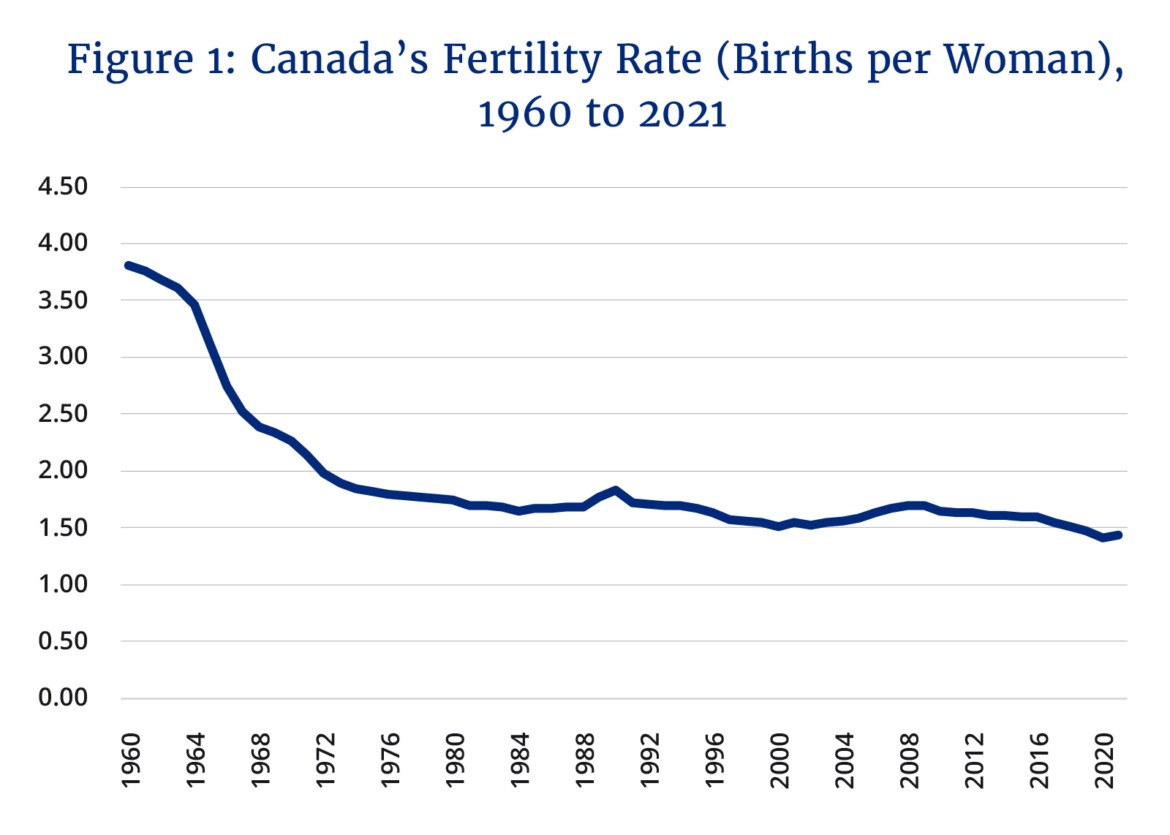
Let’s start with the data. Replacement level fertility is an average of 2.1 children per woman. As Coyne notes, Canada’s fertility rate dipped below replacement level beginning in the early 1970s. It’s now just 1.4 children per woman (see Figure 1).
Although the country’s fertility rate has been below the replacement rate for the past half century, its current rate represents an unprecedented low. As Figure 1 shows, it has steadily fallen to now below the G-7 average and is increasingly one of the lowest rates in the world.
Graphic credit: Janice Nelson
That means that immigration isn’t just doing most of the heavy lifting when it comes to population growth. It’s now nearly solely responsible. Take 2022 for instance. Canada’s population grew by more than 1 million people—the largest single-year growth since 1957—and immigration was responsible for roughly 96 percent.
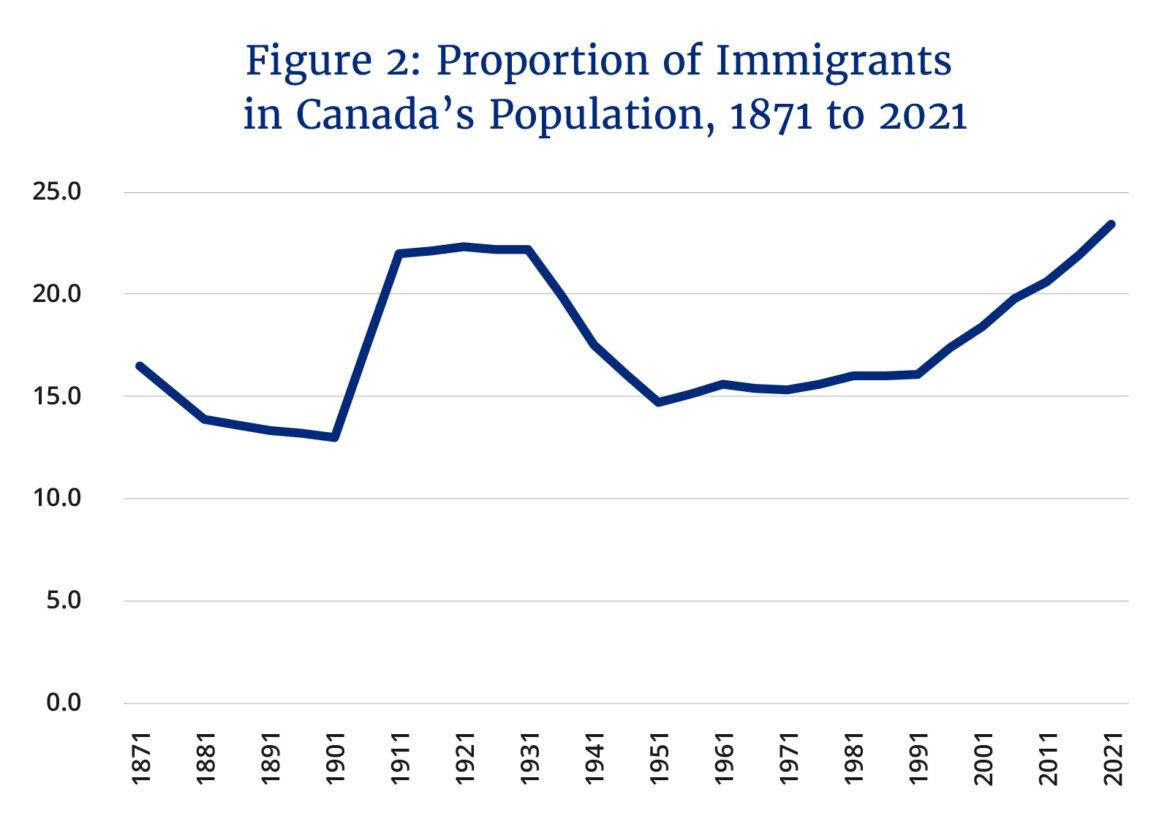
Estimates are that immigration will reach 100 percent of population growth by 2032 and will remain the main driver for the coming decades. As a result, Statistics Canada projects that the overall share of Canada’s immigrant population (which consists of landed immigrants) will rise from 23.4 percent in 2021 (see Figure 2) to as high as 34 percent in 2041.
Graphic credit: Janice Nelson
There are various ways in which immigration-driven population growth is different than natural growth. These differences will ostensibly produce outcomes that are distinct from past experiences and therefore may limit the utility of historical instruction. There’s an onus on proponents of the Century Initiative to account for them in their analysis and advocacy.
The first is that it’s older. Although the immigrant population is generally younger than the average age of non-immigrant residents, it’s still self-evidently older than babies. The majority of immigrants fall within the core working age group (25 to 54). Just over one quarter are aged 15 and younger. Immigration-driven population growth may slow the rise of (and even temporarily lower) the country’s average age but it won’t, according to leading economist David Green, “substantially alter Canada’s age structure and impending increase in the dependency ratio.”
The second is that it’s far less geographically distributed. More than half of recent immigrants settle in Montreal, Toronto, and Vancouver and nine of ten settle in a census metropolitan area. Natural growth by contrast would presumably more closely reflect the general distribution of population across the country. Immigration-driven population growth should therefore be expected to impose even greater pressure on housing and other infrastructure in our major cities and contribute to a growing urban-rural divide in our economic and political outcomes.
The third is that it will reshape the country’s culture. That may not be a bad development—particularly in the eyes of those who value diversity—but it still represents a qualitative difference relative to natural growth that requires a bit more attention.
Consider two scenarios. First, there’s a strong possibility that it erodes the place of the French language and francophone culture in our national life as Quebec’s share of the total population declines and its conception of binationalism is fully consumed by multiculturalism. Second, it’s also possible that it could at times conflict with the goal of Indigenous reconciliation to the extent that immigration-driven growth produces a growing share of the population that can plausibly argue that it has no role or responsibility for the historic injustices faced by Indigenous peoples. (There are growing calls—including from the Truth and Reconciliation Commission—to expand newcomer education about the Indigenous experience presumably to mitigate this risk.)
These considerations don’t challenge the case that immigration has been a net positive for the country or that we should maintain high immigration levels in the face of aging demographics or even that we should aspire to a bigger population. They do however dispute the idea that the source of population growth is irrelevant. Natural growth and immigration-driven growth may produce the same number but their effects are necessarily different.
What is envisioned by the Century Initiative and others is essentially without precedent. Immigration has never been solely responsible for such a run-up of Canada’s population. History cannot provide much of a guide. Only prudence can.
A prudent position would be to recognize the benefits of large-scale immigration without assuming that it can be raised to unprecedented levels or become solely responsible for the country’s population growth free from consequence. Maximalist ends without due consideration of the consequences of maximalist means is rarely the basis of good public policy. Immigration is no exception.
Needless to say, I disagree with the logic and the false parallel with the situation over a century ago.
The problem with asserting the issue is the lack of a “can do” attitude is that while the government can turn up the needle on permanent and temporary migration, housing, healthcare and infrastructure have longer timelines.
While it is helpful that the Century Initiative and others are acknowledging these challenges, the reality is that little progress is being made and thus the calls for restraint:
There is a new fashion among the commentariat of questioning whether Canada has the capacity to accommodate greater immigration, particularly in housing and health care. The underlying defeatism of this position – the belief that we’ve achieved all we can – would leave Clifford Sifton depressed and ashamed.
In 1896, prime minister Wilfrid Laurier tasked this enterprising, 35-year-old Manitoban to “populate” the Prairies with European farmers, following years of net emigration from Canada. Laurier envisioned an agricultural powerhouse to provide an abundant, reliable food supply for our nascent country while solidifying Canada’s claim to the region.
Sifton met this challenge with a radically simple plan: find immigrants with experience farming similarly harsh terrain – people made of “the toughest fibre” – and lure them to Canada with free land.
After considering various candidates, he settled on Eastern Europeans, who had farmed inhospitable steppes like ours for generations. Sifton dispatched agents across Europe circulating ads in Polish, Czech and Ukrainian, promising “160 acres of free land in Canada,” and paid them generous commissions.
We need not condone that Indigenous nations were illegally displaced from this land to appreciate the sheer audacity of Sifton’s achievement. Within five years, he doubled the Prairie population. Within 10 years, annual immigration to Canada increased 840 per cent. And 125 years later, the farms these immigrants established feed not just Canada, but much of the world.
Contrast Sifton’s can-do optimism to the despondent attitude of pundits today, who are unsure how we might handle immigration levels that, at around 1 per cent of the population, are half the rate they were in Sifton’s era.
There are growing calls to constrict immigration until the housing crisis is “resolved” – imprecise though that is. We would be wise to recall what Sifton knew. Immigrants are not the cause of Canada’s failings. Actually, they’re a big part of the answer.
Immigrants don’t simply occupy existing housing. Fact is, they built most of our current housing stock and could build even more. Each worker occupies one home (less, if they share) and builds dozens more for everyone else – an irrefutable net gain.
Yet even when we grasp this seemingly obvious fact, our response falls short. Ontario recently announced that it will almost double the number of skilled workers it welcomes each year, to 18,000 by 2025. Yet even this seemingly ambitious plan is not designed to succeed. If current trends continue, about 6,000 of those will be construction workers. Yet Ontario Labour Minister Monte McNaughton has saidthat in “construction alone we’ll need 100,000 skilled workers over the next decade.”
Six thousand is not an appropriate target; 60,000 is closer to the mark.
A recent federal plan to specifically prioritize construction workers for immigration applications is similarly enlightened yet tepid. It comes with no targets. Were we genuinely committed to solving the housing crisis, we would aggressively recruit the people who can do so, and in huge numbers.
Where would they live upon arrival? Are we really so bereft of purpose and creativity? In Sifton’s day, newcomers lived in government-operated immigration halls until they found their feet. Hardly glamorous, but sufficient. Calgary is pioneering the conversion of vacant office space to residential use. Given the severity of the housing emergency, we should also consider unconventional options, including convention centres and military facilities. It just makes sense to house those whose labour could house us all.
As with housing, newcomers are not the cause of Canada’s health care failures. But they could be an answer. For example, Ontario reportedly needs 24,000 more nurses. That’s just 5 per cent of the 465,000 permanent residents Canada will welcome in 2023. Strategic immigration could eliminate this shortage in mere months.
Some might call these proposals naive: simplistic attempts to impose a 19th-century frontier mindset onto today’s stifling, maximally bureaucratized reality.
These are the weak excuses of the undetermined. We need not inhabit Sifton’s era to honour his ethos: a confident belief that we can overcome existential threats to Canada’s viability. We cannot (and should not) give the most in-demand newcomers stolen Indigenous land, but we can offer other perks, like expanded and expedited family reunification privileges. Intransigent provinces? Withhold transfer payments. Intransigent medical guilds? Show the public who is keeping much-needed help from reaching the front lines of care. These are emergencies. We should act accordingly. Do whatever it takes.
Housing and health care failings pose existential threats to Canada. The only shortage more acute than that of skilled people to provide these vital services is the shortage of audacity to believe that we are capable of solving these problems: the confident ambition to make big dreams come true.
Irfhan Rawji is managing partner of Relay Ventures. Daniel Bernhard is CEO of the Institute for Canadian Citizenship.
Excerpt from good long and thoughtful conversation between a former senior Quebec immigration official and prominent economist, highlighting the weaknesses of the arguments used by governments, Century Initiative and the business community in favour of current levels and approach:
….
Meggs: In fact, Ottawa needs to base targets on the total number of arrivals, whatever the immigration status, to be able to welcome newcomers properly. The increased arrival numbers should not be so large that the host communities feel overburdened by inclusion and integration. Accommodation of the newcomers means ensuring that they have a roof over their heads, that they can integrate rapidly into the labour force, that they have access to language training, that they can obtain financial services, and that government services such as public transit, child care, education and health care are available and affordable for them. Canada’s recent immigration policy proposes huge increases in permanent immigration targets while refusing to set targets for the even higher levels of temporary immigrants.
This cavalier policy is in great danger of transforming immigration to Canada from a successful operation to a painful breakdown. To answer your question, nobody really knows the right target because planning in line with welcoming and settlement capacity has never been properly undertaken. Canada needs to set guidelines and targets for both permanent and temporary immigration, looking at the number and pace of arrivals rather than the type of permit. Otherwise, the newcomers will not be able to participate adequately in their new communities, and Canadians will lose confidence in immigration policy.
Fortin: I agree that optimal immigration is not maximal immigration. First, the expansive immigration policy inspired by the Century Initiative is generating chaos at Immigration, Refugees and Citizenship Canada. More than 1.7 million temporary and permanent applications are waiting in the pipeline, which doesn’t include asylum seekers and their applications for a work permit.
Second, as I said above, the increased inflow of immigrants is likely to have a zero or negative impact on the average living standard of Canadians; it will not attenuate the pace of population aging, and it will not reduce global labour shortages. It may make them worse.
Third, I add to your last observation, Anne, that overly expansive immigration targets risk not only producing some “loss of confidence” in immigration but fuelling an anti-immigration movement as has exploded in the United States and Europe. Canadians in general like to vaunt the good performance of their immigration system and their generosity toward immigrants. Unfortunately, this is a vision of the past. A recent online Environics survey (in which respondents are more likely to express their true feelings than in an interactive telephone survey) found that about half of Canadians think that there is too much immigration to Canada.¹⁰ It would not take much to metamorphose Canada’s proverbial generosity into generalized xenophobia. This has recently occurred in one of the world’s most progressive societies, Sweden. In the 2022 election, the Social Democrats there were defeated and the anti-immigration vote exploded. We must avoid slipping into this kind of political quagmire.
My bottom line is that immigration is an imperative work of civilization. It must increase over time, but going too fast is a dangerous course to follow. We should do it “allegro ma non troppo,” as in Italian classical music.


 Multicultural Meanderings