Crossing Divides: Has the UK changed its mind on immigration?

Interesting survey results and analysis of the change:

Just over a quarter of nearly 1,500 people who took the Ipsos-Mori online survey felt it had a negative impact.

The findings are in line with other surveys suggesting Britain has changed from being generally negative about immigration before the Brexit vote.

In 2011, 64% of Britons told Ipsos-Mori immigration had been bad for the UK.

The results emerged as part of an international poll of nearly 20,000 people across 27 countries, between 26 November and 7 December last year.

It was undertaken as part of the BBC’s Crossing Divides season, which is bringing people together across lines of ethnicity, class, faith, politics and generation.

Ipsos-Mori graph showing the change in respondents' perceptions of immigration

Prof Rob Ford, who researches immigration trends at the University of Manchester, said such positivity surrounding migration into the UK would have been unimaginable just a few years ago.

He said the reasons behind the trend remained unclear but that it mirrored what he had seen in other data.

“It’s at odds with what we’ve seen about [sentiment towards] migration in the past because immigration levels are still very high, so it’s not that the public is seeing more control over numbers,” he said.


A remarkable turnaround?

Analysis box by Mark Easton, home editor

It appears Britain has changed its mind about immigration and there are three important reasons why that might have happened:

  1. The Brexit vote itself may have led some to assume that the immigration issue has been dealt with and therefore it is not seen as such a risk.
  2. The national debate on immigration during elections and the Brexit referendum may have focused people’s minds on the social, practical and economic trade-offs involved in cutting migrant numbers, resulting in a more nuanced response to the issue.
  3. The millions of European migrant workers who came to the UK after 2004 initially caused something of a culture shock in neighbourhoods unaccustomed to immigration. Now many of those arrivals have integrated into society, put down roots, formed relationships and become a familiar part of the local scene. Any culture shock has probably dissipated as migrants have made friends and started families.

The polling suggests Britain is now among the most positive countries internationally when considering immigration, alongside Australia, the US and Sweden, where the numbers responding positively had also increased.

Prof Ford suggested the political environment could be a contributory factor, with opponents of Brexit and US President Donald Trump championing the benefits of inward migration.

UK statistics showed more low-skilled migrants from central and eastern Europe leaving than arriving, he said, while settled migrants such as white collar professionals, NHS staff and highly skilled workers had become more prominent in the media.

Polling results in other countries suggested attitudes to immigration were hardening.

In South Korea, the number of people telling Ipsos-Mori they felt it was beneficial had dropped to 11%, from 27% in 2011. In Japan – the least positive nation – just 3% of respondents said it had a beneficial impact, down from 17%.

Fewer than one-in-10 people told the survey immigration was beneficial in Colombia, Turkey, Russia and Hungary, although online polls are not representative in nations where significant numbers of people do not have internet access.

Source: Crossing Divides: Has the UK changed its mind on immigration?

The complete survey, including data on Canada, can be found here: Download the slides

Key immigration-related numbers for Canada:

  • Positive impact 42 %, Negative impact 27 % – slight increase from previous years
  • Percent friends same ethnic group, almost all/over half: 27/25
  • Percent friends same religious faith or beliefs, almost all/over half: 13/15
  • Percent friends have same views on immigration, almost all/over half: 15/19

What would it have looked like if the Holocaust had come to Canada?

An interesting mix of historical fact and reasoned hypotheses of what could have happened:

There were only 52 Jews in Trois-Rivieres, Que. during the Second World War, but Nazi Germany knew.

This week, Library and Archives Canada unveiled its newest acquisition: A 137-page book once owned by Adolf Hitler that seems to represent the first outlines of a Nazi plan to bring the Holocaust to Canada. “It undoubtedly breaks the myth viewed by many at the time that the Holocaust and WWII were only Europe’s problems,” said Mina Cohn, director of the Centre for Holocaust Education and Scholarship at Carleton University.

Canadian troops participated in the liberation of Nazi concentration camps, including Bergen-Belsen. Canada also became a postwar haven for tens of thousands of Holocaust survivors. But Canada of the early 1940s was also a viciously antisemitic country with one of the world’s worst records of admitting Jewish refugees.

Below, some chilling details of what the Nazis intended to do with Canadian Jewry — and how willing Canada might have been to stop them.

The Nazis were apparently planning something for North America’s Jews
“I don’t think it’s a crazy claim to say that governments and militaries, especially during wartime, don’t do research for no reason,” said Michael Kent, the Library and Archives Canada librarian who acquired the German book. Entitled Statistics, Media, and Organizations of Jewry in the United States and Canada, the book includes a detailed accounting of Jewish newspapers and organizations in Canada, as well as a census of Canada’s Jewish population and where they could be found. Cities as small as Moose Jaw, Sask., for instance, are noted to have 96 “Juden.” The book, which appears to have been commissioned for senior Nazi leadership, is similar to other censuses that Nazi authorities used to organize the deportation and murder of Jews in occupied countries. Prior to the planned invasion of Great Britain, for instance, the SS prepared a lengthy “arrest list” of British citizens, including prominent Jews such as Sigmund Freud. Of course, a Nazi conquest of Canada would have been virtually impossible. If Nazi German forces couldn’t mount an invasion across the English Channel, it’s much more unlikely they could handle one across 4,000 kilometres of ocean. Nevertheless, the book was commissioned right around the time when Germany was dispatching saboteurs to North America, and when Nazi planners were investigating the possibility of an “Amerikabomber”; an extremely long-range bomber that could lay waste to cities such as New York.

The book was likely looted by a U.S. soldier after the Allied liberation of Berchtesgaden, site of Hitler’s mountain hideout.

France, Norway and even occupied British territories all willingly participated in the Holocaust
In occupied Norway, it was Norwegian police who organized the deportation of 772 Jews and the seizure of their property. The collaborationist Vichy regime in France started cracking down on its Jewish population even without orders from Berlin. When French Jews started being shipped to Auschwitz, the French national railway took the contract to deport them east. Even in the British Channel Islands, occupied by the Germans during the war, local authorities handed over information on Jewish residents without protest. Although none of these places would have perpetrated a genocide on their own, their collaborationist governments ultimately proved remarkably willing to comply with German demands. “Why would Canada of that time be any different from all the other western civilized counties in Europe?” said Mina Cohn. Hilary Earl, a Holocaust researcher at Nipissing University, is more skeptical. Denmark rescued almost its entire Jewish population. Fascist countries such as Spain and Italy sheltered Jews. The Netherlands strongly resisted the Holocaust, but still wound up losing a higher percentage of their Jewish population than almost anyone else. “It is impossible to know for certain what would have happened and who would have pushed back,” Earl said. “Antisemitism does not automatically beget genocide, it facilitates it for certain, but it isn’t the only factor.”

Canada was much more antisemitic than we know it now 
McGill University had quotas to limit Jewish enrollment. Toronto Island and other Ontario vacation spots brazenly featured “gentiles only” signs. Alberta premier William Aberhart openly blamed Jews for the Great Depression. Newspaper editorials in mainstream publications such a Le Devoir called Europe’s Jewish population “a very serious problem.” Prime Minister Mackenzie King was deeply antisemitic, objecting to the introduction of “foreign strains of blood” and even believing that the United States was too much in the thrall of “Jews and Jewish influence.” “The vast majority of Canadians have no lived memory of a Canada in which antisemitism was widely and legally tolerated,” wrote the authors of the groundbreaking 1983 book None is Too Many. The meticulously researched book framed Canada as having the worst record among Western democracies for accepting Jewish refugees during the Holocaust. Only 5,000 Jews were admitted to Canada from 1933 to 1945, compared to 200,000 accepted by the United States and 70,000 by the U.K. Still, while Canada did not like Jews, this was far from the preconditions for participation in a genocide. “Antisemitism to a degree was universally present in the 1940s but cooperation in the Holocaust was not,” Tomaz Jardim, a Ryerson University Holocaust scholar told the National Post by email.

Canada already had a fair bit of experience with rounding up ethnic groups
During the First World War, the federal government interned 8,000 Ukrainian-Canadians and forced others to carry special identity papers. During the Second World War, more than 31,000 Italian-Canadians were forced to register as enemy aliens. West Coast authorities also forcefully rounded up Japanese-Canadians into transit centres, seized their property and then deported them to remote internment camps. Internees at the time even complained that they were being given the “same treatment the Nazi’s gave the Jews.” A French gendarme rounding up Parisian Jews for the gas chambers might have been able to take comfort in the Nazi fiction that they were simply being sent to agricultural colonies in the east. Similarly, Canadian police in the 1940s carried out mass deportation orders without full knowledge of where detainees were going. “I would hope that Canada would have proven itself to be another Denmark and resisted persecution of its Jewish population at all costs, even under extreme duress, but given the internment of Japanese-Canadians and the anti-Semitic sentiment that was widely accepted within mainstream Canadian life at the time, one can imagine a Canada engaging in anti-Jewish activity that would fill us with horror and regret today,” said Rebecca Margolis, president of the Association for Canadian Jewish Studies.

Japanese-Canadians being deported into the B.C. interior via open truck.

There were already Jews behind barbed wire on Canadian soil
During the Second World War, 2,300 Jewish men of German and Austrian origin lived in internment camps in Quebec and the Maritimes. They had come to Canada as refugees from Nazi oppression, but were detained as “enemy aliens” due to their country of origin. Had Canada fallen to Nazi occupation, these camps could have functioned as the first hubs of Canadian Final Solution. This precise scenario is what happened to the Netherlands. Shortly after the Nazi invasion of Poland, the Dutch set up Westerbork, an internment camp for the more than 400 Jewish refugees who had entered the Netherlands illegally across the German border. After Germany conquered the Netherlands in 1940, Westerbork was converted into a transit camp and its internees transferred to killing centres in occupied Poland.

Killings probably would have been carried out on Canadian soil
The Nazis prioritized efficiency above all else when it came to genocide. Initially, Jews were murdered in mass shootings conducted in open areas by German military units. Later, to assuage the psychological burden of soldiers killing hundreds of civilians per day, Nazi military scientists experimented with mobile killing vans that would asphyxiate victims with carbon monoxide. By war’s end, Nazi authorities had settled on the method of deporting Jews to centralized killing centres. The expense of moving Canadian Jews to occupied Eastern Europe would likely have been prohibitive, so German genocide planners would likely have settled on a made-in-Canada solution. “Parts of remote areas could have been turned into enormous camps where people could have been starved and left to die of the cold,” said David MacDonald, a researcher in genocide studies at the University of Guelph. At the time, the Soviet Union’s gulag system had already proven the utility of using remote northern areas to make thousands of people disappear. And Canada’s own experience of Indian Residential Schools showed that it was indeed possible for early 20th century Canadians to dig the occasional child mass grave without anybody asking all that many questions.

Source: What would it have looked like if the Holocaust had come to Canada?

Trump’s immigration policy has foreign tech talent looking north of the border

These articles keep on coming in the US press (less so in conservative medias like Fox):

Over dinner at a noodle bar, a Canadian entrepreneur pitched a table of U.S. tech executives: Your foreign workers should trade sunny California for snowy Calgary, he told them. And they listened.

Highly skilled foreign workers and the American firms that employ them are in a bit of a visa panic. President Trump has vowed to crack down on the H-1B visa program, which allows 85,000 foreigners per year to work in “specialty occupations” in the United States. But there are no new rules yet, creating climate of uncertainty and fear, particularly in Silicon Valley.

Canadian businesses sense an opportunity. The Canadian tech scene has sought for years to compete with Silicon Valley, trying to lure talent north. In the early days of the Trump administration, “moving to Canada” talk surged among Americans, but most foreign workers waited.

Now some are making the move.

Though it is hard to track how many foreign nationals have moved from the United States — the Canadian government tracks newcomers by country of citizenship, not residence — immigration lawyers and recruiters on both sides of the border say the number of inquiries from nervous H-1B holders has skyrocketed since 2017.

A small group of Canadian entrepreneurs are dropping into Silicon Valley to persuade companies that rely on foreign tech workers to move them across the border.

Irfhan Rawji, the Canadian entrepreneur trying to sell U.S. tech executives on Canada over dinner, last year founded a company called MobSquad that helps tech companies move software engineers and other highly skilled workers to Canada. He travels regularly to Silicon Valley to promote his Canadian “solution.”

“Our turnaround to bring a foreign worker to Canada is under four weeks,” he said. “It’s typically longer for them to pack up their stuff.”

For Akshaya Murali, an Indian national who spent nearly a decade in the United States working for companies such as Microsoft and Expedia, moving to Toronto meant an end to living visa to visa.

She and her family applied for permanent residence in Canada and were approved.

Her employer, Remitly, then worked with MobSquad to move her job north. MobSquad signed a contract with Remitly and then hired her to do the same job — senior product manager — for Remitly from Toronto.

MobSquad’s cut is the difference between her total compensation in pricey San Francisco and the cost of the same work in Toronto, which is lower.

Remitly’s chief product officer, Karim Meghji, said the process went so smoothly that he will probably do it again. “My next step is thinking through, ‘What else can I do in Canada?’ ” he said.

Murali landed in Toronto in October and is settling in. “It’s a nice place to bring up our son, really family-friendly,” she said. “The only thing is the weather.”

Seeking stability

Silicon Valley’s visa anxiety did not start with Trump, but his policy moves and anti-immigrant rhetoric have compounded the problem, according to tech executives, immigration lawyers and people who have moved.

Months into his presidency, Trump issued a “Buy American and Hire American” executive order that ordered the Department of Homeland Security to review the H-1B visa program with the intention of more closely vetting applicants.

In the wake of the order, there were reports of an uptick in visa denials and requests by immigration officials for additional information, turning the issue into a topic of conversation for big U.S. companies and immigrant communities alike.

In August, chief executives from top U.S. firms including Apple, Cisco and IBM sent a letter to DHS expressing concern about the changes. “Inconsistent immigration policies are unfair and discourage talented and highly skilled individuals from pursuing career options in the United States,” it said.

Asked to comment on these reported changes, United States Citizenship and Immigration Services spokesman Michael Bars said, “Increasing our confidence in who receives benefits is a hallmark of this administration.”

Bars said proposed changes now under review would make the H-1B process more efficient and ensure the best applicants get visas.

Many have found the uncertainty over the changes to the H-1B program confusing and costly.

S. “Sundi” Sundaresh, the chief executive of Cinarra Systems, a start-up that provides location analytics based on mobile data to businesses, says getting U.S. work visas is a significant challenge.

His company employs 55 people worldwide, including 15 in the United States. He has three people on H-1Bs but would hire more if the process were easier.

Recently, an employee who was working remotely and waiting on a U.S. visa quit in frustration. When a second worker reached the same point, he started looking for options and is now talking to MobSquad about Canada. “We can’t lose a second one,” he said.

Michael Tippet, a Canadian entrepreneur who founded a company that helps U.S. firms set up satellite offices in Vancouver as a buffer against uncertainty in the United States, said highly skilled, foreign-born workers feel anxious and frustrated.

“From the company’s perspective, the primary motivation is that they can continue to attract top talent,” he said. “To have those people work for you, you have to show you’ve got their back.”

If you don’t have their back, they may leave.

Amogh Phadke, an Indian citizen with a master’s degree in computer science, an MBA and work experience at FedEx and Fannie Mae, wanted to build his life in the United States.

“I was struggling for 10 years with my immigration status,” he said. His breaking point was the Trump administration’s as-yet-unrealized threat to stop granting work visas for spouses of H-1B holders.

His wife, an Indian national who was studying in Canada, no longer wanted to join him stateside. “She said, ‘It’s here, or we are going back to India.’ ”

He decamped to Edmonton, the chilly capital of Alberta, last year.

The pitch for Canada

While the debate over immigration roils the United States, Canada’s major political parties are broadly supportive of increasing the number of immigrants, as long as they are skilled.

In 2017, Prime Minister Justin Trudeau’s government launched the Global Talent Stream, a program designed to fast-track work authorization for those with job offers in high-demand realms of science and tech.

Successful applicants can get a work permit in a matter of weeks. Spouses and children are eligible for work or study permits.

More than 2,000 companies have applied to hire Talent Stream workers, the department for Immigration, Refugees and Citizenship Canada said in an emailed statement.

With the door wide open, the Canadian government’s biggest challenge may be actually making the case for Canada.

Recent arrivals said the country is not really on the radar. When Phadke told Americans he was moving to Edmonton, they were shocked. “My colleagues were like, ‘Oh, my God, nobody lives in the middle of Canada. Are there going to be roads there?’ ”

When people heard how quickly he could move, he was met with more skepticism. “They asked, ‘Is it a scam?’ ”

“Canada is really bad at marketing itself,” said Vikram Rangnekar, a former software developer for LinkedIn who recently moved from the Bay Area to Toronto.

When he landed, he was so impressed with the city that he started writing about it. He later started Mov North, a site for people thinking about moving.

The site includes information on dressing for the cold — “The adage ‘There’s no such thing as bad weather, only bad clothes’ is entirely true” — and information about benefits like paid maternity leave. It also tries to connect software engineers with Canadian companies.

Hugo O’Doherty, an editor at Moving2Canada.com, a website catering to would-be immigrants and new arrivals, said Canada can’t often compete with Silicon Valley salaries, but that tech types make good money relative to the cost of living.

They also gain peace of mind. Noncitizens in the United States “don’t know if they will able to stay, if their spouse will be able to work, if their kids will have a pathway to citizenship,” he said. In his experience, Canada appeals to people who want stability.

For MobSquad’s Rawji, it is all about seeking out the best and brightest and putting them on a path to citizenship. “Our social mission is to change the Canadian economy,” he said.

To those wondering about their status in the United States, he says: Come north.

Source: Trump’s immigration policy has foreign tech talent looking north of the border

Canada 150 research chairs draw scientists fleeing Trump, guns and Brexit – The Globe and Mail

Continues a series of anecdotes regarding the relative attractiveness of Canada:

The day after Donald Trump won the U.S. presidential election, Alan Aspuru-Guzik, a prominent professor of chemistry at Harvard University, picked up the phone and called Canada.

For Dr. Aspuru-Guzik, who specializes in developing advanced materials for energy generation, the 2016 result was a signal to close up shop. Born in the United States and raised in Mexico, Dr. Aspuru-Guzik has family roots that trace back to Spain, Poland and Ukraine. It’s the kind of varied background, he said, that instills a predisposed wariness of political authoritarianism and economic instability. And the Trump presidency has put his instincts on high alert.

“Many of my colleagues have told me that they will leave the United States if things get worse,” Dr. Aspuru-Guzik said. “The difference is that I already think it’s worse.”

On Thursday, Dr. Aspuru-Guzik is set to be named one of 20 newly hired Canada 150 research chairs at a briefing in Ottawa. He plans to leave his position at Harvard this summer to take up a new role at the University of Toronto, where he will continue his research and aim to spin off startup companies from his scientific work.

“Great science is all about great people. So being able to attract someone of Alan’s calibre is a coup for this country,” said Alan Bernstein, director of the Canadian Institute for Advanced Research in Toronto. It was Dr. Bernstein who was on the other end of the line when Dr. Aspuru-Guzik made his postelection call, setting the wheels in motion for his eventual move.

A total of 25 Canada 150 research chairs will be established at Canadian universities under the one-off program, supported with $117.6-million in federal funding. Four chairholders were already named late last year, including computer scientist Margo Seltzer who, like Dr. Aspuru-Guzik, is leaving a faculty post at Harvard to come to Canada.

“I think it speaks to what Canada is doing here in science,” federal Science Minister Kirsty Duncan said. “We’re in a global competition for talent.”

Several of the appointees who spoke to The Globe and Mail before Thursday’s announcement were enthusiastic about what they perceive to be a collaborative, pro-research culture in Canada. But many also expressed a sense of relief when speaking about what they were coming from.

The haul of prominent scientists attracted to the new chairs suggests that a predicted brain gain for Canada owing to reactionary politics in the United States and elsewhere is having an impact and that scientists are indeed voting with their feet.

For example, when asked what she would be giving up by leaving North Carolina’s Duke University to come to the University of Waterloo in Ontario, Anita Layton, a biomathematician whose work relates to kidney function, summed it up in two words: gun violence.

Dr. Layton, who did her graduate work in Canada and whose parents live in Toronto, explained that her children, ages 14 and 10, have recently been in lockdown exercises at school to practise for an armed assault.

“This is their world … It’s normal life for them and I find it really sad,” she said.

Family considerations played a role in her move, but she added that Waterloo’s strong mathematics department offers just as many professional advantages as Duke, with the added benefit of $350,000 in funding tied to her research chair which ensures years of continuing support.

Funding stability was a key factor for Judith Mank, an expert in the genomics of diversity, who will be moving her laboratory from University College London to the University of British Columbia in Vancouver.

Like that of a number of British-based researchers, Dr. Mank was thrown into turmoil by the outcome of the 2016 Brexit vote.

“I got really worried because all of our funding is from the European Union and we’re not sure if we’ll be able to access that,” she said.

At UBC, Dr. Mank will be supported by a $1-million funding tranche that goes with her top-tier Canada 150 chair.

The same amount has been allocated to the University of Saskatchewan for James Famiglietti, a hydrologist currently with NASA’s Jet Propulsion Laboratory in California who will become the director of the university’s highly regarded Global Institute for Water Security.

Dr. Famiglietti is well known for his public appearances in the United States, particularly during California’s recent, prolonged drought and testimony before Congress. A specialist in remote sensing, he has expertise in gauging water resources from space, and the impact of climate change on those resources.

He said the real advantage he anticipates in coming to Canada is in being able to access parts of the world that are undergoing water stress but where U.S. federal employees are typically prohibited from visiting.

“The goal is to begin reaching out to the hottest of the hot spots for water scarcity around the world,” Dr. Famiglietti said.

Among the newly selected chairs are several Canadian researchers, including Katherine O’Brien, a global health vaccinologist who is heading to Dalhousie University after her 30 years at premier research facilities in the United States and around the world.

“It was the right time for me to come back,” she said, avoiding any discussion of U.S. politics.

But for Dr. Aspuru-Guzik, the motivation for his move is clear: “I believe that life is short and that I should live in a place that is consistent with my values.”

via Canada 150 research chairs draw scientists fleeing Trump, guns and Brexit – The Globe and Mail

Differences of Opinion: How Canadian and US business leaders think about gender diversity

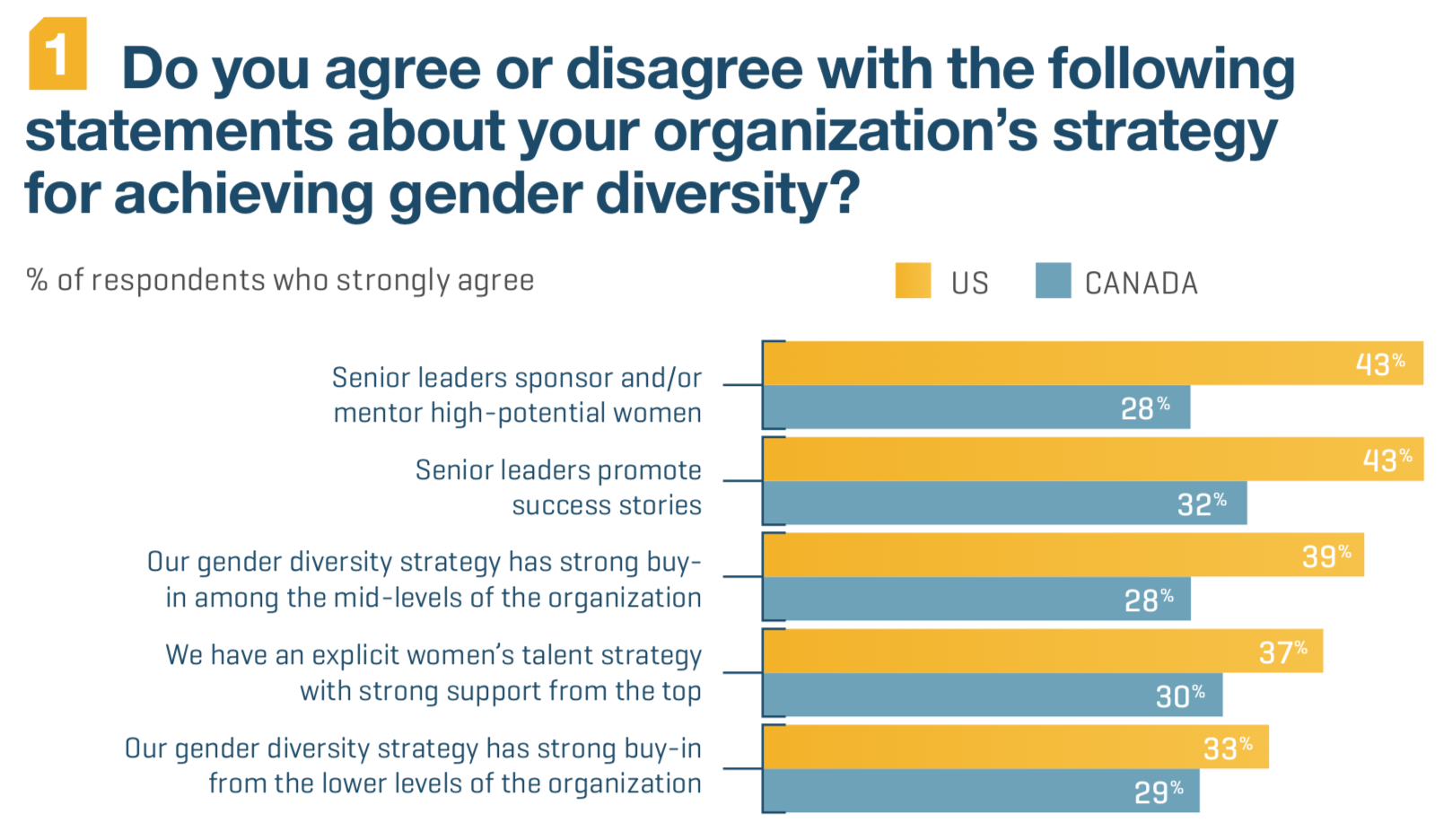
RBC continues to do interesting research and reports on diversity issues. This Canada-United States comparison being the most recent example (and it challenges Canadian smugness about our diversity policies in the corporate sector). These two charts are particularly revealing, report recommendations follow:

1. Be aware that diversity mandates can backfire.

Surprisingly, mandatory diversity training can often have the opposite effect, increasing bias rather than eliminating it. Research over several decades has shown that corporate leaders and managers are less motivated to increase diversity if they are forced to do so. In one study, Harvard Business Review researchers who analyzed data from hundreds of US firms found that “companies get better results when they ease up on the control tactics.”

Similarly, national policies that promote gender parity, diversity, and gay rights may be viewed as controlling or policing people’s personal opinions and actions. Equal opportunity or pro-diversity legislation may make organizations “check the boxes” to advertise their compliance with the requirements, but may also make them less likely to make practical efforts to reduce gender or other types of discrimination. Rather, engaging leaders and managers to become advocates for change is more effective. Voluntary training to raise awareness, along with mentoring and coaching efforts, participation in task forces or councils, or leadership of affinity groups, works best.

2. Try more innovative solutions.

The most appropriate measures vary across industries and firms, and a decision not to adopt any specific approach cannot be interpreted as a failure. Still, our study shows that companies in both the US and Canada are using only a subset of all the potential strategies. Canadian companies tend to take fewer risks and are less likely to try innovative solutions than their US counterparts. Solutions that have been adopted less frequently in Canada than in the US may provide ideas for further action by Canadian firms. They include:

  • Job auctions or trial hiring (37% vs 43%)
  • On-the-job development activities that provide opportunities to generate business impacts (38% vs 44%)
  • Support for working parents (34% vs 43%)
  • Flex time (48% vs 52%), part-time (31% vs 35%) and childcare subsidies (27% vs 31%)
  • Assessing performance relative to gender diversity targets (37% vs 44%)

3. Build a strong business case for women in senior management.

“Fundamentally, having a workforce and a senior management team that represents the clients and communities an organization serves is both an asset and a competitive advantage,” says Jennifer Tory, Chief Administrative Officer at RBC. “Diversity of gender, thought, and background creates inclusive teams that generate better ideas and solutions. Inclusive teams are strong teams, and strong teams make better business decisions.”

4. Invest in retraining and reintegrating women into the workplace.

One of the biggest challenges in both the US and Canada is the issue of parental leave and how it affects women’s careers. The two countries differ markedly with respect to national policies. In the US, women who take maternity leave do not receive guaranteed payments from the federal government. The Family and Medical Leave Act protects their job for up to 12 weeks; some individual companies and states may offer more generous policies or a short-term disability policy that pays women during their leave of absence. By contrast, Canada is far more generous; its mandated 12-month parental leave is expected to stretch to 18 months in 2018.

In a way, that could “create unintended consequences” for women’s advancement in Canada, says the University of Toronto’s Dart. She notes that although both parents can share the leave, men are often reluctant to take time off. “In many Scandinavian countries paternity and maternity leave are mandatory. Both men and women leave the workplace for a time when they have children, so there is less of an opportunity for gender bias. It has to be mandatory. You have to make it an equal playing field.”

In Canada and other countries where equal parental leave is not mandated, being away from the job for so long could be detrimental to women’s careers, she adds. “Women step out, often because of family pressure, and find it very difficult if they want to come back later on. They have lost their professional networks and they don’t know if their skills are up-to-date. Many companies don’t actively work on bringing women back to work; it is easier to advance the women who have stuck it out.”

5. Make a concerted effort to change societal perceptions.

Here’s where male role models, influencers, pressure groups, and governments play a big part. “With regard to progressing in their career, women are working really hard, but they need networks and sponsorship much earlier in their career,” says Jennifer Reynolds, CEO of the Toronto Financial Services Alliance (TFSA), a public-private partnership that supports the financial services industry. “We need to actively challenge senior management on that, and we have to have men in this dialogue.”

Dart advocates going even further. “There is a very large gap in the middle part of the pipeline,” she says. “There’s always more commitment that we need to see in senior leaders. We need more CEOs and board chairs to advance their support of women. But this battle is not lost at the corporate front. This battle is lost at the home front. The expectations of women, the roles they are supposed to play, are different in different cultures. That’s where we need to start: changing role expectations.”

Source: Download Here

Ethnic Outbidding for White People: A Story About Populism in Canada Versus the United States – NYTimes

http://www.nytimes.com/newsletters/2017/08/23/the-interpreter?nlid=5411894

Not much new but good overview and reminder to NYTimes readers that we too have our dark side:

Breitbart News, the online news site often associated with the alt-right, has grown so powerful that when its former editor, Stephen K. Bannon, lost his White House job last week, it was widely assumed that Breitbart’s influence would only grow.

As this was happening, across the border in Canada, another right-wing media organization known as Rebel Media, which is often compared to Breitbart News, was imploding so severely it was seen as potentially auguring the implosion of Canadian right-wing populism itself.

The shift in Canada reveal something important about one of the biggest stories of the last year, events initially described as a “global populist wave.” Though the wave was later qualified down to just right-wing populism and just in Western countries, it increasingly looks even narrower than that.

The decline of Rebel Media, contrasted with the success of Breitbart, exemplifies something we’ve been saying for a while. The “populist wave” is actually quite specific to individual countries. And, most important, in each Western country where it appears, right-wing populism enjoys support among only about 15 to 25 percent of the population. (Those numbers are based vaguely on a 2016 study by the political scientists Ronald Inglehart and Pippa Norris.)

Whether that fractional support becomes an isolated fringe or a major political power comes down not to anything as fuzzy as culture or values, but to nuts-and-bolts political institutions.

It’s worth running through the sordid details of Rebel Media’s bad week. Faith Goldy, a correspondent, praised Charlottesville’s white nationalist marchers in a live video from the scene. Her video referenced “white racial consciousness” and the “JQ,” shorthand for the “Jewish question.”

A national backlash eventually led the site’s founder, Ezra Levant, to fire Ms. Goldy. But something had changed, maybe for good, with Rebel Media’s place in Canadian politics.

Conservative politicians openly denounced the organization. Andrew Scheer, the leader of the Conservative party, said he wouldn’t give Rebel Media any more interviews until it changed its “editorial direction.”

High-profile staffers and contributors quit. One, Caolan Robertson, released a video accusing Rebel Media of exploiting its supporters for donations it didn’t need. Mr. Robertson also accused Mr. Levant of offering him money to keep quiet. (Mr. Levant has accused Mr. Robertson of attempted blackmail.)

But Canadian journalists see broader forces at work. Jonathan Kay, in an article for The Walrus, wrote that Rebel Media failed in its mission to become the American Fox News or Breitbart because, in Canada, “structural barriers make the creation of this kind of conservative ecosystem impossible.”

Americans generally understand that politics work a bit differently in Canada, but wrongly assume Canadians are simply predisposed to be more liberal. In fact, those “structural barriers” against right-wing populism are more technical, and less particular to Canada, than you might think.

Amanda explained those structural barriers in an in-depth article this summer. The short version: Canadian politicians and civil society groups spent two generations engineering their political system to be highly tolerant of diversity and highly intolerant of something called ethnic outbidding.

Stephen Saideman, a political scientist and friend of the column, has defined ethnic outbidding as “when politicians compete for the support of a particular ethnic group, leading to ever greater demands to protect that group at the expense of others.”

This process can turn politics into a zero-sum competition between ethnic groups who come to see one another as threats. Right-wing populism, in the West, can often function as a kind of ethnic outbidding for white people.

If you want to know how Canada did this and why so many other diverse countries have failed, read Amanda’s story. Of course, we’re not denying that racism and right-wing populist politicians exist in Canada. Rob Ford became Toronto’s mayor after running on a populist platform. But, compared to the rest of the West, the country stands out for its resistance to populism. (And even Mr. Ford cultivated a multi-ethnic voter base.)

That resistance happens through institutions, and you see them working, for example, in Mr. Scheer’s disavowal of Rebel Media. Before any liberal readers rush to award Mr. Scheer a medal of courage, you should know that he was acting within his immediate political interests.

Political norms in Canada are unusually intolerant of overt white nationalism, which has strong and increasingly open support in the United States and much of Europe. The country’s electoral and legislative systems make it very difficult for a party to win power without heavy support from racial minorities.

And Rebel Media’s power, even before this week, was waning. This spring, when some politicians embraced Rebel Media, seeking to reproduce populists’ successes elsewhere, those candidates instead found defeat.

This summer, when reporting for Amanda’s story, we visited a Rebel Media conference in Toronto. Though we had only stopped by for the day, it was clear that this was a movement on the decline.

In a long and thoughtful article on Rebel Media, Richard Warnica of The National Post wrote that Mr. Levant, intentionally or not, is “forcing people to pick a side.”“

Nothing The Rebel did this week, as Conservatives and contributors edged away, was substantially different from what it had done two months ago, or six months ago or last year,” Mr. Warnica added.

What changed is Canada’s conservative establishment, which rejected Rebel Media. That is a marked difference from the conservative establishment in Britain, which embraced populism, or the conservative establishments in the United States and France, which tried to reject populism but instead were overcome by it.

The story of Rebel Media is of course a story of personalities and what unfolded between them. But it is also, like just about every major news story from the last year, a story about institutions.

Canadian tech companies say they value diversity — but what are they doing about it? 

Good and needed reporting – particularly surprised with the lack of response of the larger companies (to be fair, Blackberry had bigger survival issues):

After U.S. President Donald Trump signed an executive order in January blocking citizens from seven predominantly Muslim countries from entering the U.S., a long list of Canadian tech companies signed a pledge opposing the ban.

Members of Canada’s tech community saw Trump’s move as a rejection of the diversity on which they felt their industry was built and decided to speak out.

“We believe that this diversity is a source of strength and opportunity,” read the open letter admonishing the ban, which was signed by executives and employees from some of the most well-known companies in the country — BlackBerry, Hootsuite, Shopify and more.

But when CBC News sought to gauge what this commitment to diversity looks like in practice, Canada’s tech community had remarkably little to say.

In May, we asked 31 Canadian technology companies if they collected data on the diversity of their employees, and if so, whether they would share this data with CBC News.

Only two companies — OTTO Motors, the commercial division of Waterloo, Ont.-based Clearpath Robotics, a maker of self-driving warehouse robots, and the Toronto-based investing app Wealthsimple — were willing to do so.

A third company, the Toronto-based online retail marketing startup Hubba, said it was preparing to conduct its first diversity survey and release the results in the coming month. It expects to publish a report on its progress every six months thereafter.

The sheer number of holdouts came as a surprise to Y-Vonne Hutchinson, founder of Oakland, Calif.-based diversity solutions firm ReadySet, in particular, given the number of U.S. companies that have published annual reports since 2014.

“It does make me question their commitment to diversity and inclusion,” said Hutchinson, who is also on the team behind Project Include, which guides tech startups toward more diverse and inclusive practices. The project’s founding members include well-known diversity advocates such as Ellen Pao and Tracy Chou.

“By publishing these numbers, you increase transparency and accountability around how the organization looks and the way in which it prioritizes diversity and inclusion,” Hutchinson said.

Mostly white, mostly male

Many companies in tech and beyond have realized the key to building successful products and services is to have a range of employees — ones who think and look differently from one another — working together to solve problems.

The idea is that employees with varying backgrounds and skills can bring unique perspectives that aren’t necessarily represented by the tech sectors white, male majority.

That’s where diversity reports can help. One way for a company to better understand the types of people it employs — and where the gaps are — is to quantify that information and use it to build more diverse teams.

But that’s not to say measuring the problem alone leads to change. As recently as 2016, we learned that just 145 of Facebook’s nearly 8,500 employees are black. We learned that 12 per cent of Apple employees are Hispanic, versus just four per cent at Google.

And we learned that Uber has an engineering department where only 15 per cent of employees are women — a telling statistic for a company still smarting from a searing indictment of its workplace culture by one of its former engineers and the sexual harassment investigations launched in its wake.

Among the industry’s biggest players, there has been little progress in recent years.

Diversity reports also don’t include as much information as some would like — for example, how long employees stay, which can tell a story of its own, or how many employees are disabled or identify as LGTBQ. In their most basic form, they typically provide a snapshot of how tech’s most-influential companies are doing across job categories in terms of gender and race.

Yet in Canada, there have been no comparable public efforts to date.

Little to say

The companies approached by CBC News ranged from some of the largest and well-known in the country — including BlackBerry, Shopify and Hootsuite — to up-and-coming players such as ecobee, Thalmic and Breather.

We sent each company the following questions:

  • Does your company collect data on the diversity of your employees?
  • ​How is this data collected?
  • Why do you collect this data?
  • Can you provide your company’s most recently collected diversity data to CBC News?
  • Can you offer any details about programs/initiatives to support diversity and inclusion at your company?

The overwhelming majority of companies declined to participate while two of the biggest names in Canadian tech, BlackBerry and Hootsuite, did not respond to multiple requests for comment.

Provided-Info.png

E-commerce company Shopify said it was still analyzing its employee data and was hoping to have more information to share by the fall “or early next year.”

Others, such as the messaging app Kik and the satellite imaging company Urthecast, said they didn’t have the resources to collect this sort of information and would not say how long it would take to do so.

Many more, including ecobee, Wave, WattPad, Vision Critical, Lightspeed, Bench, TopHat, Vidyard, Sandvine and Hopper, said they didn’t formally collect diversity information.

Source: Canadian tech companies say they value diversity — but what are they doing about it? – Technology & Science – CBC News

What should expatriates’ voting rights be? – Policy Options

My latest on expatriate voting by Canadians in IRPP’s Policy Options:

With the decision by the Supreme Court of Canada to hear the challenge to the five-year restriction on expatriates’ voting rights, it is timely to review the arguments in favour and against extending the time. In addition, we need a better idea of the number of Canadian expatriates abroad and the nature of their ongoing connection to Canada.

Starting with the number of Canadian expatriates, recent advocates have relied on the estimate from the Asia Pacific Foundation (APP) Canadians Abroad: Canada’s Global Assets of 2.8 million expatriates. This figure does not control for age or citizenship. When we do so (using the 2006 Census), the figure is just under 2 million (of whom 77 percent are aged 18 or over, and 78.1 percent of whom were immigrants had become Canadian citizens).

There is also a dearth of data on expatriates’ degree of connection to Canada, and what exists is based on anecdote rather than government data. Consular data for 2007 to 2015 show that approximately 20,000 expatriates annually accessed services for people who had been abroad for five years or more. The number of passports issued abroad was about 184,000 in 2015, and there were approximately 725,000 Canadian passport holders living abroad.

Looking at nonresident Canadians’ tax filing data, 136,310 returns were filed, which was 7 percent of the number of expatriates in 2013, the most recent year that complete data is available. While this figure may understate the proportion of nonresident Canadians filing taxes, as some may use Canadian addresses, it suggests that the vast majority of expatriates do not pay Canadian income tax. I have not seen any reliable data on nonresidents’ property taxes.

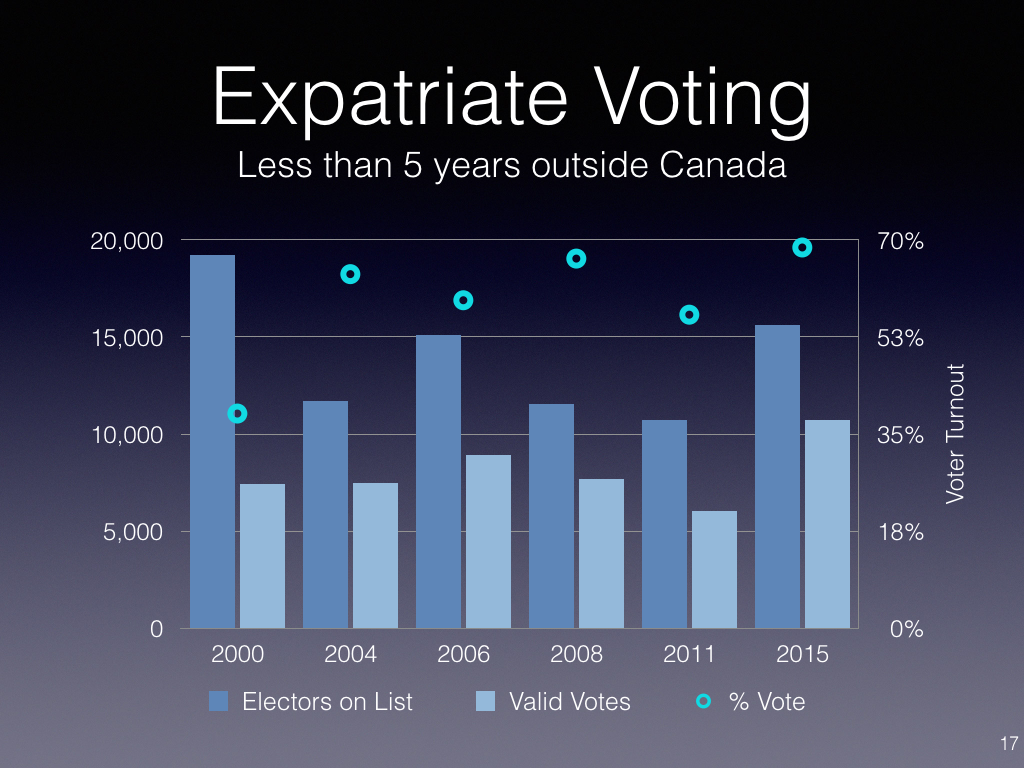
Data on voting among those who have been abroad less than five years indicates the number of expatriates who register and vote is very low. (This also applies to Canada as a whole: in 2015, out of a total of 26 million eligible voters 17.6 million voted.) Figure 1 shows the number of nonresident electors, valid votes and percentage of voter turnout for the last six elections. This data suggests that relatively few of those who have lived abroad for five years or less are politically engaged (of course, some may return to Canada to vote, but we do not have data on this).

Canadian Expatriates Data Gaps.017

Figure 1

The data we have, imperfect as it is, suggests that of the 2 million Canadian citizens living abroad aged 18 or over, the number who have ongoing active connections with Canada is likely quite low. Even advocates of expatriate voting rights, after citing the APF number of 2.8 million expatriates abroad, go on to quote the figure of “over one million” who have active connections, but they do not explain the basis for that number.

Arguments in favour of expanding the expatriates’ voting rights are based on the Charter’s protection of voting rights without qualification. The main substantive arguments, by the plaintiffs, by academics such as Semra Sevi, Peter Russell, Alison Loat and John McArther), and by former Global Affairs director general Gar Pardy, can be resumed as follows:

  • Canadians living abroad contribute to Canada and the world, and many retain an active connection with Canada, whether it is business, social, cultural, political, or academic. These Canadians’ global connections should be valued as an asset;
  • Patriotism and civic engagement are not tied to location;
  • The internet and online communities make it easier for Canadians to remain in touch with Canada and Canadian issues;
  • As Judge Laskin said in his dissenting statement in the July 2015 Ontario Court of Appeal ruling, Canadians living abroad pay “Canadian income tax on their Canadian income, and property tax on any real property they may own in Canada,” and are subject to Canadian laws and foreign policy decisions;
  • As Russell and Sevi note, the expatriate vote will not “completely change the tide of an election.
  • The five-years-or-less limitation is more restrictive than those of other Western countries; for example:
    • United States: no limitation, but expatriates are required to file US tax return;
    • United Kingdom: the limitation is fifteen years;
    • Australia: the limitation is six years, and expatriates must file an annual declaration of their intent to return at some point;
    • New Zealand: the limitation is three years, and the clock restarts when citizens visit New Zealand.
  • The Canadian five-year limitation ignores the increasing globalization and population mobility, and it sends the wrong signal to young Canadians;
  • As Jean-Pierre Kingsley, former chief electoral officer, said when he advocated eliminating the five-year limit: “The right to vote is a fundamental right of citizenship that is protected by the Charter and does not depend on place of residence.” A parliamentary committee reviewed his report in 2006 and endorsed his position.

The principle arguments against are the following:

  • The “social contract” argument, used by the Ontario Court of Appeal to uphold the policy, states that voting “would allow them [expatriates] to participate in making laws that affect Canadian residents on a daily basis, but have little to no practical consequence for their own daily lives. This would erode the social contract and undermine the legitimacy of the laws.” Examples of policies and programs that are considered part of the social contract include economic and social policies and programs, at the federal level; health care and education, at the provincial level; and policing and transit at the municipal level;
  • While some expatriates may pay Canadian taxes and may own property in Canada, the data suggests over 90 percent do not, as they pay tax where they work and live;
  • Interest in voting among expatriates appears to be low;
  • Apart from consular and passport services, most Canadian government economic and social programs are tied to residency;
  • In general, the longer the time spent abroad, the looser the bond with Canada, as family, work and local connections become more meaningful. Over time, day-to-day living — work, education, raising a family, consuming media — predominate important for expatriates, whether in the United States, Hong Kong or the Mid-East;

The Supreme Court will have to rule whether the right to vote is qualified by residence and the degree to which the social contract argument justifies certain limits.

Some of the advocates of expatriate voting, for example, Gar Pardy, argue for no limits, which Loat and McArthur also imply. Sevi and Russell imply limits, but ones that are more in line with those of other countries, but they do not indicate their preference.

To cite an extreme example of the “no limit” argument, Canadian expatriates born abroad (citizenship by descent) who have never lived in Canada would be entitled to vote, even if they had never set foot in Canada. A less extreme example is that of people born in Canada who move abroad as children and remain outside Canada. In both cases, it is hard to justify non-residents having voting rights when they have spent no time or extremely limited time living in Canada.

The “comparability” with other nations argument is more reasonable and convincing, and opens the discussion as to which option — taxation, as in the United States, extending the limitation to 15 years, as in the United Kingdom, or renewable voting rights, as in New Zealand — makes the most sense from a policy and implementation perspective. I suspect most Canadian expatriates would not welcome linking voting to filing tax returns. It would go against long-standing Canadian tax policy, and judging by US expatriates’ opposition to the over-reach of Foreign Account Tax Compliance Act, this option is likely a nonstarter.

If the Supreme Court rules against the five-year limit, my preference, would be some variant on the Australian and New Zealand approach, i.e., allowing voting rights to be renewed but requiring some action by expatriate voters to extend their right, perhaps through a written declaration or periodic visit to Canada. This does not seem to be an unreasonable obligation, and it allows for mobility but requires a concrete and a relatively easy to administer test of the expatriates’ connection to Canada.

Source: What should expatriates’ voting rights be? – Policy Options

With the Rise of Justin Trudeau, Canada Is Suddenly … Hip? – The New York Times

While this is largely a puff-piece, it reflects some of the rebranding taking place after the election. And in terms of the 17 Canadians it profiled in entertainment and fashion, 7 were women (41 percent) and 5 were visible minority (29 percent):

As Mr. Trudeau and his wife, Sophie Grégoire-Trudeau (along with their three young children, Xavier, Ella-Grace and Hadrien), create a Canadian Camelot, they are casting light on a wider eruption already in progress.

An expanse once stereotyped as the home to square-jawed Mounties and beer-swilling hosers has quietly morphed into a multicultural breeding ground that has given us the Weeknd, who can’t feel his face; the director Sarah Polley, who makes films of subtle power; and the upstart fashion designer Tanya Taylor, whose creations have been worn by Michelle Obama.

The rapper Drake, of Toronto, comes in for a little ribbing now and then, but none other than Jay Z called him the Kobe Bryant of hiphop. And even the latest albumfrom Justin Bieber, the pride of Stratford, Ontario (population 33,430), is — gulp! — pretty terrific.

It’s all very exciting, eh? But still … Canada? The land of hyperpoliteness and constant apology? The home of maple syrup, poutine, the gentle sport of curling and 10 percent of the world’s forests? The country that Spy magazine once said had “cultural Epstein-Barrness”?

As Joe Zee47, the Toronto-raised editor in chief of Yahoo Style, said: “There was always the feeling of being in the shadow of the U.S. For a treat we would take family trips to Niagara Falls, and I’d always want to cross the border and go to Buffalo, to go shopping! Buffalo, N.Y., was my rainbow growing up  it’s where the pot of gold was.”

“Even our national anthem sounds like a sigh: ‘O Canada,’” said the writer and editor Sarah Nicole Prickett, who was born in London, Ontario, and has written for T: The New York Times Style Magazine. “Drake, more than anyone, is the prophet who’s changing that, because, unlike a lot of talented Canadians before him, he accepts embarrassment as a cost of making big art.”

The niceness factor is something that may distinguish Canadian cultural producers. “The first month I lived in Manhattan, in the spring of 2012, I heard that I was ‘nice’ from seven people,” Ms. Prickett said. “That’s when I realized I was Canadian.” But like her confreres Grimes, Ms. Polley and the Weeknd, Ms. Prickett does not produce work that is meant to comfort.

True, Canada has delivered sultans of cool in the past. Amid the polite folk rock of Gordon Lightfoot and Anne Murray, there was the melancholy genius of Joni Mitchell, who was hip enough to win the blessing of Charles Mingus. And we would be foolish to forget the alternately sensitive and raucous Neil Young, who never met an expectation he did not defy. (“Obviously people are delighted with the change that has taken place,” Mr. Young, a California resident, said after Mr. Trudeau’s election. “It’s very positive news.”)

And let us not ignore the coolest cat in a hat, Leonard Cohen, still capable of multiple encores at 81.

Then there are the Canadian kings and queens of comedy like David Steinberg, Lorne Michaels, Mike Myers, Martin Short and Catherine O’Hara, who started out as foils to mainstream American pop culture and ended up shaping it.

Canadians have always been funny, according to the Toronto-born editor of Vanity Fair, Graydon Carter. “S.­J. Perelman used to think that Stephen Leacock was the funniest writer in the world,” Mr. Carter said, referring to the multifaceted author who moved to Canada from his native England at age 6. “And he was. The trouble is, the self-deprecation so regularly on display is often lost on Americans. Now Marty Short is the funniest person in the world — although he’s far too modest to admit it.”

Mr. Zee agrees that Canada has not become hip all at once, with the election of the mediagenic Mr. Trudeau. It is partly a dawning of self-recognition.

“We’ve always had Frank Gehry,” he said.

Source: With the Rise of Justin Trudeau, Canada Is Suddenly … Hip? – The New York Times

If Donald Trump were campaigning in Canada, could he be charged for hate speech?

Good comparative analysis:

On Monday Donald Trump called for a complete ban on Muslims entering the United States “until our country’s representatives can figure out what’s going on.” Despite universal outrage, the billionaire presidential candidate has only doubled down on his vow, the latest in a string of anti-minority comments ranging from the offensive to the downright absurd. Even respectable commentators have started calling him a fascist.

These comments are in bad taste at best and hateful at worst, why are there no legal repercussions for Trump making them? 

The short answer is because it’s the United States. The U.S. has extremely strong protections for free speech, which is only considered hateful if it will incite direct and immediate violence. Trump pontificating at a podium or in an interview doesn’t qualify. Until he starts an angry mob, he’s free to say whatever he likes.

So for argument’s sake, what if this were happening in Canada? Would anything be different?

Trump’s most recent comments might offend you, but they likely still couldn’t be prosecuted under Canadian law. Though hate speech laws in Canada are broader than they are south of the border, speech needs to meet some very specific requirements to be considered hateful here, too.

Section 319 (1) of the Criminal Code states that hate speech “incites hatred against any identifiable group where such incitement is likely to lead to a breach of the peace” and where the comments are made in a public place.

This would pose two problems for charges under hate speech law.

“[T]he immediacy of the breach of the peace would make it extremely difficult to convict someone for saying what Trump said,” said Faisal Kutty, a Toronto lawyer and human rights activist.

Trump also isn’t making any outright claims despite the subtext of his statements, said Richard Moon, a law professor at the University of Windsor.

“That’s the main problem with trying to fit his current statement under the hate speech law: it doesn’t have any real hateful content in the sense of making a claim about the nature of character of Muslims,” said Moon. “Of course, why should they be excluded other than, presumably, on the belief that they are somehow dangerous? But he leaves that slightly open.”

But I’ve seen and heard people call his comments hate speech. What does that mean?

That’s due to the technicality of law. While his comments might be considered hateful, the burden of proof under the law is higher. The comments must meet specific criteria to be prosecuted, and his comments likely don’t meet these standards.

What about some of his other comments? He’s said a lot more extreme things in the past.

Some of his previous remarks could more easily be prosecuted, like his remarks about Mexican immigrants during his announcement speech on June 16: “They’re bringing drugs. They’re bringing crime. They’re rapists.”

“That is the very stuff of hate speech, and a claim like that made in Canada might well constitute hate speech contrary to the Criminal Code,” Moon said.

So why are Canadian and American hate speech laws so different?

It’s probably due to a lot of factors, but part of it traces back to the founding of the country. America is old, and so are some of the laws, said David Matas, a Winnipeg-based lawyer and author of Bloody Words: Hate and Free Speech.

“In the United States you’ve got a bill of rights which is very old.  It comes from the 18thcentury. Everywhere else, the concept of rights is post-Holocaust, post-Declaration of Human Rights. Being ahead of the gun at the time has left them far behind when it comes to the 21st century.”

Source: If Donald Trump were campaigning in Canada, could he be charged for hate speech?