Court case ruling may allow Britons to keep their EU citizenship and rights | The Independent

Interesting wrinkle:

Britons might be able to keep their EU citizenship and rights to live, work and claim healthcare across Europe, even if Theresa May walks out of the negotiations with no deal.

This could depend on the outcome of a legal case brought by four plaintiffs, who are seeking a ruling from the European Court of Justice over whether Article 50 can be revoked without the permission of other EU states.

The case, brought by the Good Law Project, is an attempt to get a ruling over whether Brexit could be reversible until 29 March 2019.

But it will also be asking whether or not UK citizens would remain EU citizens post Brexit.

The argument is based on Article 20 of the Treaty of Lisbon, which states that EU citizenship is additional and separate to national citizenship.

There are no provisions for removing this citizenship and its associated rights from individuals, regardless of whether their nation leaves the EU.

The case will argue that it is unclear from current legislation whether UK citizens can be stripped of their EU citizenship.

Speaking to Buzzfeed, Jolyon Maugham QC, a lawyer helping to bring the case, said: “There seems to be an assumption – convenient both to a particular type of Brexiter and to those voices in the EU that would rather be shot of the UK – that the citizenship rights of UK nationals can be taken away from us.

“Whether that assumption is right is ultimately a question of EU law. And it’s very unclear to us that it is.

“The question is likely to be of particular importance to those – very often British pensioners – who have made their lives abroad in France or Spain.”

Source: Court case ruling may allow Britons to keep their EU citizenship and rights | The Independent

Hate Crimes Rose By 41 Percent After Brexit Vote – The Atlantic

A reminder how xenophobic political discourse has consequences:

England and Wales saw a sharp rise in hate crimes since the United Kingdom voted in a historic referendum to leave the European Union, a report by the U.K. Home Office revealed Thursday.

Police in England and Wales recorded 62,518 hate crimes between 2015 and 2016—a 19 percent increase from the previous year. Of those incidents recorded, 79 percent were classified as hate crimes based on race, 12 percent on sexual orientation, 7 percent on religion, 6 percent on disability, and 1 percent were classified as transgender hate crimes.

The most alarming rise in hate crimes, however, took place in the month after voters in England, Scotland, Wales, and Northern Ireland cast their ballots in favor of Britain leaving the EU. In July, a total of 5,468 hate crimes were reported to the police—41 percent higher than July 2015. More than 200 incidents were reported on July 1 alone.

Here’s more from the report:

“There is an increase in these offences recorded in June 2016, followed by an even sharper increase in July 2016. The number of aggravated offences recorded then declined in August, but remained at a higher level than prior to the EU Referendum. These increases fit the widely reported pattern of an increase in hate crime following the EU referendum. Whilst January to May 2016 follows a similar level of hate crime to 2015, the number of racially or religiously aggravated offences recorded by the police in July 2016 was 41% higher than in July 2015. The sharp increase in offences is not replicated in the non-racially or religiously aggravated equivalent offences.The spike in hate crimes coincided with the announcement by Amber Rudd, the Home secretary, of a government initiative urging victims to report incidents of hate crimes “so that the full scale of the challenge facing communities can be understood and tackled.” It is unclear how much of the increase is due to the heightened willingness to report hate crimes.”

“We are the sum of all our parts— a proud, diverse society,” Rudd said. “Hatred does not get a seat at the table, and we will do everything we can to stamp it out.”

A survey by The Guardian last month found that European embassies in Britain reported an increase in suspected hate crimes against their citizens in the UK after the Brexit vote; a majority of complaints came from citizens of Eastern European countries. A total of 31 hate crimes were reported to the Polish Embassy, including the high-profile death of a Polish national who was killed following an alleged attack by a group of teenagers in Harlow, England. Six people were arrested in connection with the killing.

 Source: Hate Crimes Rose By 41 Percent After Brexit Vote – The Atlantic

ICYMI: I’m being stripped of my citizenship – along with 65 million other Britons | David Shariatmadari, The Guardian

Interesting take on the impact of Brexit, precisely of those more mobile citizens:

But the issue of EU citizenship isn’t quite closed – or rather, it needn’t be.

The EU citizen was created in 1993. It is a person who, across the union, cannot be discriminated against on the basis of nationality; can move and reside freely; can vote for and stand as a candidate in European parliament and municipal elections; and is entitled to consular protection outside the EU by European diplomats. More than that, citizenship established a identity, separate from nationality, shared between individuals in the union. A common bond of the kind that Theresa May otherwise admires. In the 23 years since, cultural, political, academic and social exchange has become the norm. What might have initially seemed like a paper exercise has become durable and meaningful to millions. Eurosceptics hate it, no doubt. That doesn’t mean it isn’t real.

Neither was it an arrangement entered into lightly. It was the result of a treaty, signed, incidentally, by a Conservative government. A treaty is an international promise, and a promise to one’s own people. There was no suggestion at the time that the rights granted would be taken away again. Mass stripping of citizenship had previously only occurred when an alternative citizenship was created, and often following war: for example, when Algeria won independence from France, and Algerian nationality came into being.

As Kochenov points out, Europe has had a flexible attitude towards citizenship in the past. It has had to, as a result of the massive changes in the territories governed by EU members. That means there is some hope that something of the “spirit” of 1993 could be salvaged. Or there was, until very recently.

The only way these rights could be maintained for British people would be for the UK to agree some kind of “associate nationality” with the union of which it is no longer a member. With political will, that could be achieved. However, it would require reciprocal benefits, most likely equivalent rights for EU nationals in Britain. In apparently opting for “hard Brexit”, without freedom of movement, May has made any such deal extremely unlikely.

Many of the arguments over how to conduct Brexit are made in transactional terms. Can we swap security cooperation for financial passporting rights? The right of EU nationals to stay put for lower trade tariffs? A customs union for, I don’t know, making Boris Johnson governor of St Helena?

In the meantime, a solemn social contract made between a government and its people a quarter of a century ago is being torn up. Citizenship isn’t a game, to echo one of Theresa May’s most resonant phrases. So don’t pretend to value it while treating it like so much red tape.

Source: I’m being stripped of my citizenship – along with 65 million other Britons | David Shariatmadari | Opinion | The Guardian

Theresa May criticized the term ‘citizen of the world.’ But half the world identifies that way. – The Washington Post

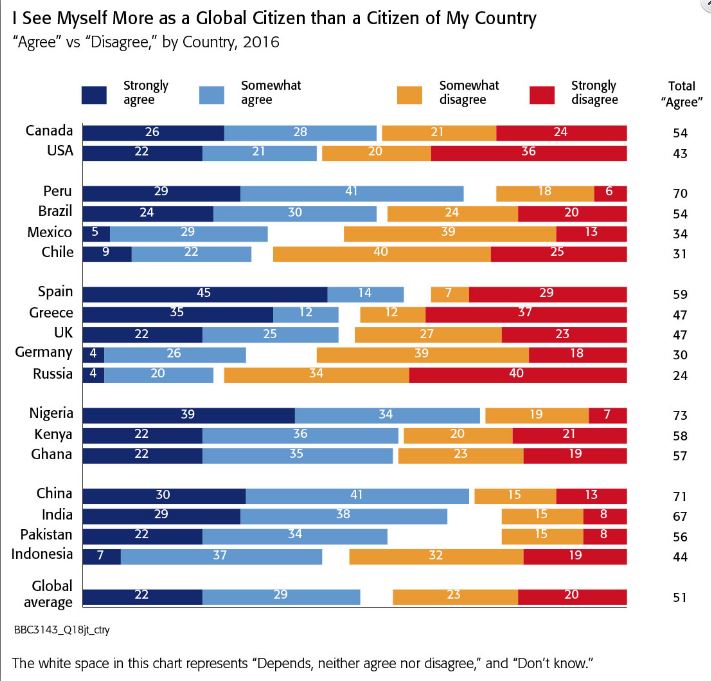
global-citizenInteresting poll showing the relative identity balance between local and global citizenship:

In defense of the Brexit decision she now must implement, British Prime Minister Theresa May said Sunday that no “divisive nationalists” would hold up the process of exiting the European Union, and she firmly asserted that all four of Britain’s constituent “nations” — England, Wales, Scotland and Northern Ireland — would Brexit together.

But the Brexit decision was fueled in many ways by nationalist sentiments, centering on perceived threats to Britain’s sovereignty and many of its citizens’ desires to prevent the supposed dilution of their national identity by immigrants crossing the European Union’s open borders.

Just three days after her comment about “divisive nationalists,” at her Conservative Party’s annual conference, May espoused her own brand of nationalism — one that seems to encompass all of Britain, but excludes those who may feel as though they have multiple nationalities, or identities.

“Today, too many people in positions of power behave as though they have more in common with international elites than with the people down the road, the people they employ, the people they pass on the street,” she said. “But if you believe you are a citizen of the world, you are a citizen of nowhere. You don’t understand what citizenship means.”

As it turns out, about half of the people “down the road” or whom one might “pass on the street” identify with the very phrase May disparaged — being a “citizen of the world” or global citizen.

In an 18-nation survey conducted by GlobeScan in conjunction with the BBC World Service that was released just over a month ago, 47 percent of Britons said they somewhat or strongly agreed that they considered themselves more as global citizens than citizens of the United Kingdom.

That number is just slightly below the 51 percent of all respondents who felt the same way. Below is a look at how respondents from each of the 18 surveyed countries responded. It is worth noting that “urban-only” samples were used in Brazil, China, Indonesia and Kenya.

Source: Theresa May criticized the term ‘citizen of the world.’ But half the world identifies that way. – The Washington Post

German MPs in heated debate over fast-track citizenship for Britons – The Guardian

Interesting debate:

The German Green party has called on the government of Angela Merkel to fast-track the applications of Britons wishing to become German citizens in the light of the UK’s vote to leave the EU.

Volker Beck, a leading member of the party, told the Bundestag that Germany should “send a signal that Britons belong to Europe and to Germany” by allowing the “swift and straightforward naturalisation” of British citizens.

The opposition Greens tabled the resolution having already written to the government over the summer requesting a reform of the citizenship law because it said that young Britons in particular who were living and working in Germany “need a clear perspective that they can stay” in the event of Britain leaving the EU.

A heated debate in the German parliament on Friday revealed the extent to which the Brexit vote and the uncertainty surrounding Britain’s future relationship with the European Union continues to vex and anger German politicians across the spectrum.

Beck said that 5,000 Britons had received German citizenship last year and there were many others who wished to apply among the more than 100,000 other UK citizens living in the country. But many were not eligible, he said, because they had not lived in the country for the eight years the current law recommended or were not earning the level of income required to prove they could support themselves.

Beck called on the German government to “change its spots” and create a “modern citizenship law” that would allow people to hold more than one citizenship. Currently, this is only possible in exceptional cases.

Once Britain leaves the EU, Britons would be unable to become German citizens without first renouncing their British citizenship, hence the Greens’ attempts to speed up the process that would allow Britons to become German and remain British.

But the proposal was met with stiff resistance by politicians from chancellor Angela Merkel’s conservatives.

Stephan Mayer of the Christian Social Union called Beck’s proposal “treasonous” and accused him of “pushing a policy of the forced Germanisation of Britons in Germany”.

He said that any discussion concerning Brexit was “premature and pointless, as long as the negotiations [regarding the conditions of exiting the EU] are still ongoing”.

“For the time being we need to view the issue with typical British dispassion,” he told parliament.

He said British citizens already “get all the rights they need here, apart from being able to vote”.

But Rüdiger Veit of the Social Democrats (SPD) hit back. “It’s not about a forced Germanisation of Britons; it’s to do with the fact they’re very welcome here and it would be a happy situation if as many of them who want to beome German citizens did,” he said.

Tim Ostermann, who is MP for Herford in North Rhine Westphalia, a base for the British forces in Germany until last year, said he had not received any complaints from British citizens who had chosen to stay in the area that they had had any difficulties in acquiring citizenship.

“I never heard from any ex-British soldiers that they had any problems,” he said, calling the Greens’ proposal “an overreaction”.

Source: German MPs in heated debate over fast-track citizenship for Britons | World news | The Guardian

ICYMI: Isolationism and the fear of the foreign: Saunders

Saunders largely nails the electoral calculations of political figures:

What caused a complete reversal of positions in 2016? It certainly wasn’t logic or ideological coherence. Rather, it was electoral calculation: In 1975, fear of economic ruin was a potent driver. In 2016, fear of outsiders was equally strong.

Arguments in favour of cutting off trade and political relations have almost always been, at root, election bids based on fear of the foreign. That doesn’t mean that every trade agreement is a good idea, or that policies to protect or bail out national industries are wrong. But exits, prohibitive tariff walls, or complete isolation are never rational or principled.

The original free-trade battles of the 1860s pitted isolationist segregationists and colonialists against movements that linked free trade with peace and anti-slavery campaigns. The 1930s isolationism was tightly linked to the exclusionary nativism of the time. A large part of the opposition to Canada-U.S. free trade in the 1980s was pure anti-Americanism. Donald Trump’s pitch to completely cut off China and Mexico has nothing to do with economic logic, or conservative values, but with a manipulated hatred of the foreign.

The fact that left and right have traded positions so many times shows isolationism for what it is: not ideology or economics, but a reflex appeal to fear.

Source: Isolationism and the fear of the foreign – The Globe and Mail

Did Britain’s E.U. Referendum Spark a Surge in Hate Crimes? | TIME

Spoiler alert – it predates it.

Last para makes appropriate warning, however, not to dismiss those who voted leave:

Matthew Collins, a researcher for the anti-racism group Hope not Hate, says he has observed virulent anti-immigrant rhetoric seeping into the mainstream for years. Part of his job involves monitoring far-right online media in the U.K. But in recent years he has found himself checking national newspapers like the Daily Mail and the Express, which have been using language and symbolism that was once considered taboo. In 2015, an editorial cartoon by the Mail was criticized as using 1930s Nazi anti-Semitic propaganda as it seemed to equate migrants fleeing wars into Europe with rats.

Traditional far-right groups have collapsed in the U.K. due to their language being “mainstreamed” and used by populists like UKIP, Collins says. “When David Cameron was elected as Prime Minister for the second time [in 2015] he promised things like being tough on immigration, he promised people a referendum on E.U. membership. That is when we really saw a real hardening of language in reporting.”

The bigotry that has emerged has different roots to the popular ethno-nationalism of the 1970s, says Collins, who was a member of far-right groups like the National Front before he “grew up” in 1989 and began helping anti-extremist organizations. The xenophobic schisms in today’s Britain, he says, have less to do with “ideas of [racial] superiority and more and more of it is just based on desperation.”

Collins suspects today’s hate crime perpetrators largely come from marginalized white communities who largely voted for Britain to leave the E.U. in the referendum. These communities exist in a constant “fight for resources” caused by years of austerity, he says, where the struggle to find jobs and get doctors’ appointments, school places and housing can seem exacerbated by migration levels.

The question now becomes how to fix the levels of distrust and fear among certain sections of the British population. The U.K.’s equality watchdog, the Equality and Human Rights Commission will look into how race policy in the U.K. must be strengthened. Speaking to TIME, its chair David Isaac says that projecting the message that diversity is a source of opportunity in the U.K. should be supported. “The referendum has created all sorts of splits and schisms, and that’s why getting the message across that diversity can enhance what the U.K. has to offer…[is] important.”

But Collins says it’s important for anti-racism campaigners not to widen the empathy gap that opened up during the referendum campaign. Dismissing the 52% of voters who elected to leave the E.U. as “fuddy duddy and racist” could exacerbate tensions even further, he says. “If you victimize someone, if you go around calling someone a racist for long enough, they will become a racist.”

Source: Did Britain’s E.U. Referendum Spark a Surge in Hate Crimes? | TIME

Why the PQ isn’t so eager to celebrate the Brexit vote: Martin Patriquin

Worth reading – some uncomfortable truths by Patriquin:

First, there’s history. Britain has long been the subject of fevered nationalist nightmares, and the antagonist in Quebec’s narrative of subjugation and suffering. There are real, live human beings in the province who believe this country remains Britain’s useful idiot in the latter’s war with France, fought nearly 260 years ago. Most Quebec nationalists have dialed back on the lingo since the days of White Niggers of America. But in the nationalist mindset, the idea that Britain might be slave to anything is absurd at best and an insult at worst.

Second, there’s demographics. Several polls foundsupport for the “Yes” side in the 2014 Scottish referendum to be highest among younger age brackets. The ruling Scottish Nationalist Party was favourable to increased immigration, and a sizeable swath of Scotland’s cultural communities supported exiting the U.K.

Scottish nationalism was young, inclusive, and above all relevant to every facet of society. For the PQ, this example was worth celebrating because it was what the Parti Québecois used to be, and what it could aspire to.

The Leave campaign was a reflection of what the Parti Québécois has become. As the Financial Times (amongothers) demonstrated, the biggest support for the Leave campaign came from older, less-educated rural voters. In the 2014 election, the PQ attempted to target this very demographic in Quebec with its so-called “Quebec values charter,” which aimed to strip religious symbols from the heads, necks and lapels of anyone receiving a government paycheque.

The PQ suffered the worst electoral drubbing in its history, and has spent much of the last two years trying to forget the failed experiment. Endorsing the successful Leave campaign would only remind people of nationalism’s darker impulses.

Lastly, there is the gong show that is post-Brexit U.K. The PQ has long suggested, as the Leave campaign did repeatedly throughout the campaign, that separation would be a painless affair. It hasn’t been. Britain’s credit rating has been downgraded, its economy sent into a tailspin; billions of dollars of capital have been wiped out.

Even if this is a temporary hiccup, there remains the social factor. During the campaign, a man shot Labour MP Jo Cox dead on the street while yelling “Britain First.” Reports of hate crimes increased by 57 per cent in the 36 hours following the Brexit vote, according to Britain’s National Police Chiefs’ Council. And while this too may be another of Britain’s temporary miseries, history suggests racial scapegoating only increases in times of economic strife.

No wonder the PQ has kept mostly quiet. Britain’s Leave campaign is a win it doesn’t need.

Source: Why the PQ isn’t so eager to celebrate the Brexit vote

Michael Den Tandt on the Brexit and Canada: Two crucial lessons for Liberals

Good commentary by Den Tandt on some of the lessons for the Liberal government, not to mention the Conservative opposition and the observations regarding Jason Kenney and Tony Clement’s support for Brexit:

Dear Prime Minister David Cameron, Jeremy Corbyn, Boris Johnson, Nigel Farage and the rest: Thank you, so very much. You’ve done the twin causes of stability and unity in your former Dominion of Canada ever so much good.

For what Canadian provincial or federal leader now, witnessing the catastrophic cock-up of your Brexit referendum, will do other than duck for cover next time there’s talk of a plebiscite here to dramatically restructure anything more important than a yard sale?

It was curious, bizarre even, to see senior federal Conservatives emerge on social media early Friday, as the “victory” for the Leave side in the Brexit vote became clear, to beat the drum for St. George. “Congratulations to the British people for choosing hope over fear,” enthused former minister-of-everything Jason Kenney, “by embracing a confident, sovereign future, open to the world!” Tony Clement, erstwhile Treasury Board president, called it a “magnificent exercise in democracy,” before slipping in a renewed call for a referendum on Canadian electoral reform.

Or, here’s another thought: The Liberals could shelve electoral reform and focus on more important stuff, this term, such as jobs.

Democracy is, indeed, magnificent. That’s why the Scots are now ramping up at breakneck speed for a do-over of their own 2014 referendum on independence from Britain, which post-Brexit surveys suggest will now swing in favour, because the Scots wish overwhelmingly to remain European.

Ireland, only recently at peace, now faces renewed turmoil at the prospect of a hard border separating Northern Ireland, still part of the United Kingdom, from the Republic of Ireland, soon to be Europe’s Westernmost outpost. Irish union, as the United Kingdom comes apart at the seams, is not out of the question. Hope over fear, indeed.

This is assuming, of course, that the UK leaves the European Union at all. Though it seems wildly improbable to imagine the referendum, 51.9 per cent for Leave, 48.1 per cent for Remain, being set aside, it is in theory possible, as long as Article 50 of the Lisbon Treaty, which governs an EU member state’s withdrawal, is not invoked.

…All of which brings us back to Canada. Brexit is xenophobic; Brexit is anti-immigrant; Brexit is nostalgic, insular, anti-international and anti-globalization; Brexit is, most of all, an expression of English ethnic nationalism.The federal Conservatives under Stephen Harper, with Kenney himself in the lead, founded their 2011 majority on openness to ethnic pluralism. They undid much of that good work in 2015 with their niqab debate and “barbaric cultural practices” tip line. That any Conservative, Kenney most of all, should have failed to connect these dots is astonishing. Perhaps that’s why Canadian Conservative Brexit cheerleaders have also gone eerily quiet since those initial outpourings of joy.

But it’s not just the Tories who can watch and learn. There are now two threads connecting populist, anti-internationalist, xenophobic movements worldwide. The first is income inequality and poverty among the rural working class, which in England voted as a block for Brexit. The second is the fear of Islamism, manifested in suspicion of immigrants and refugees, which fueled the Leave campaign.

Fixing inequality, Prime Minister Justin Trudeau’s Liberals say, is their job one. But they face a looming economic catastrophe in the resource sector, which can only be addressed through pipeline development and freer trade. Working people need decent-paying jobs. From where will these come in Canada, if ideological and mostly urban anti-pipeline advocates, together with anti-globalization tub thumpers, are left to own the debate, as they do now? The Liberals need to build the case for pipelines and for liberalized trade, while they still have an audience for such.

As for Islamism, the Syrian civil war and ISIL continue to threaten Southern Europe and by extension the West. Until ISIL is destroyed and its territory taken away, there will be no end to the northward flow of refugees, and no political stability in Europe. Canada can do more and should do more to help Europe in this fight — while there remains a Europe to help.
Source: Michael Den Tandt on the Brexit and Canada: Two crucial lessons for Liberals | National Post

Racist incidents spark worry Brexit vote emboldening extremists

Anecdotal but not surprising after such an ugly, divisive campaign:

A spate of racist incidents in the U.K. in the wake of Thursday’s vote to leave the European Union have Britons concerned the result is emboldening extremist elements in society.

Police are investigating a report of “racially-motivated” damage at the Polish Social and Cultural Association, a community centre in west London, a spokesman for the Metropolitan Police said on Sunday. Twitter users described graffiti that read “Go Home” daubed on walls and windows. In Cambridgeshire, police are investigating flyers left outside a primary school that said “Leave the EU, no more Polish vermin,” the Evening Standard reported.

After a bruising referendum campaign in which supporters of leaving the EU were accused of stoking xenophobia, these and other incidents will intensify worries about whether a generally tolerant country is becoming less so. While politicians on both sides of the vote have urged calm and said the result does not reflect prejudice toward migrants from Europe or elsewhere, some aren’t so sure.

“There is no question the U.K. is shifting to a more racist atmosphere and policies. This is a rhetoric that’s showing up in the lives of schoolchildren,” said Adam Posen, a former member of the Bank of England’s Monetary Policy Committee who now leads the Peterson Institute for International Economics.

British politics are in chaos after the vote in favour of a so-called Brexit prompted the resignation of Prime Minister David Cameron, spurred a rebellion against Labour Party leader Jeremy Corbyn, and opened the door to a second referendum on Scottish independence. On Sunday several senior Labour Party members resigned from Corbyn’s shadow cabinet to protest what they said was his lacklustre advocacy for staying in the EU.

The Leave campaign’s message was centred on reducing immigration, including by raising the spectre of Turkish EU membership — a prospect diplomats say is remote at best. A week before the referendum, U.K. Independence Party leader Nigel Farage unveiled a billboard showing a column of hundreds of refugees walking on a road, under the heading “Breaking Point.” A day later, Labour member of parliament Jo Cox, an outspoken advocate for Syrian refugees, was murdered in her Yorkshire constituency.

Some incidents are occurring in the heart of the U.K.’s cosmopolitan capital. Sebastien, a 26-year-old Frenchman, was walking in the Kensington district on Friday with a friend and her mother, who was visiting from Paris. Hearing them speaking French, a man walking his dog began shouting at them to “Leave, Leave!” said Sebastien, who declined to provide his surname for fear of retaliation.

The tone of some campaign discourse has “legitimized racist rhetoric,” said Jasvir Singh, a London lawyer and Labour Party activist. “There is now a vocal minority who feel emboldened to use the result of the referendum as a reason to spout their hatred.”

Schoolchildren were racially abused in a west London district this week, Seema Malhotra, one of Labour’s team of Treasury spokespeople, said on Saturday. “Someone shouted: ‘Why are there only 10 white faces in this class? Why aren’t we educating the English?’” she said, citing a letter from a teacher in her constituency about an incident on Wednesday. “Another went close up to the children and said: ‘You lot are taking all our jobs. You’re the problem.’ ”

Speaking to the BBC on Sunday, former Prime Minister Tony Blair said political leaders “have a big responsibility to help our country get through what’s going to be an agonizing process.” After a vote that largely pitted London, Scotland and a few other enclaves in favour of staying in the EU against the bulk of England and Wales, “we have a divided country but there is the possibility of bringing people back together if we are sensible about it.”

Britons have taken to Facebook and Twitter to report other racist incidents. One user, Fiona Anderson, described “an older woman on the 134 bus gleefully telling a young Polish woman and her baby to get off and get packing.” A professor at Coventry University, Heaven Crawley, said on Twitter on Friday that “This evening my daughter left work in Birmingham and saw group of lads corner a Muslim girl shouting ‘Get out, we voted leave’.”

Source: Racist incidents spark worry Brexit vote emboldening extremists | Toronto Star