Globe editorial – On the Brink: Ottawa has to change its old thinking about a new border

More from the Globe:

…The Trudeau government lost control of Canada’s immigration system, and yet it appears to have never occurred to it that this would be an issue for the only country with which it shares a land border.

Fixing that begins with the federal government taking control of its refugee claims crisis (more on that in our next editorial in this series), restoring the primacy of points-based immigration, and working with the U.S. to ensure neither country is a backdoor into the other.

It also calls for Ottawa to streamline the way the RCMP and the CBSA patrol the border, and to provide the manpower, drones, helicopters, sensors and other equipment needed to defend 9,000 kilometres of boundary area against human traffickers, drug and gun smugglers, and other threats.

Ottawa should do this not to appease Mr. Trump, but in the interests of Canada. If our border with the U.S. is to be a symbol of anything, it should be that of a pragmatic country that welcomes immigration but is also unsentimental about its security and defence.

Source: On the Brink: Ottawa has to change its old thinking about a new border

Clark: The return of Trump has Poilievre talking about a crackdown beyond the U.S. border

Of note:

…On Sunday, he called for a crackdown on people coming to Canada – tightening visa requirements to make it harder to visit and setting a cap on the number of asylum-seekers.

For a long time, Mr. Poilievre didn’t go there. His party wanted MPs and candidates to steer clear of anything that suggested tough talk on immigration. It’s only in the last few months that Mr. Poilievre has ramped up criticism of the Liberal government’s failure to control a surge of temporary residents.

Now, he’s talking about cracking down on “false refugees” and warning “our Canadian jobs are being taken.”

“I think it is time for a cap. And it is time to get rid of all of the abuse,” Mr. Poilievre said in his press conference on Sunday.

He added: “We need to shut off the flow of false refugee claims who are in no danger in their country of origin but are sneaking in either through our porous border or our weak visa system, and when they land here making a false claim.”

That’s the kind of lexicon Mr. Poilievre had kept from his lips for a long time, and on an issue that wasn’t in the repertoire of attacks against the government in the Commons until November….

Source: The return of Trump has Poilievre talking about a crackdown beyond the U.S. border

Watt | The border wake-up call is ringing — bring on the drones, helicopters and patrols

Just as there is a risk in understating the expected income, there is a similar risk in overstating, as some premiers and commentators have done. But the times provide an opportunity to fix some of the things that need fixing from a Canadian perspective, recognizing that some is substantive and some performative:

…Because for all the supposed people or illicit goods that might flow between our borders, America can handle our “problem,” our traffic — we, on the other hand, cannot even begin to dream of sufficiently handling a mass influx of migrants across our border and into our cities.

We don’t have the resources, space, or public appetite. Moreover, right now, we don’t have clear and focused public discourse on this issue.

We don’t need a sober “reality check” when it comes to this debate. What should be — but evidently is not — abundantly clear to our political class is that Donald Trump will say anything — fact or fiction — to improve his bargaining position and get his way. What we need is a strong plan to reinforce our border. Because that is the only way to prepare and do what we need to do — kill two birds with one stone.

First, to show Trump we’re making progress on a critical political priority for his administration: border security. Second, to prepare for the potential influx of migrants that will look to head to Canada the minute he takes office.

That plan should consist of more drones, helicopters and patrols as the RCMP and our border agency has asked for — but it also must include stricter punishments for the phoney, unauthorized immigration consultants and human traffickers that prey on people’s lives and livelihoods.

Borders are lines in the sand. Symbolic by nature. That’s precisely why they’re such fertile ground for politicians to grandstand, to deceive, to promise then, let down.

It’s also why reinforcing them with action, not words, is what the Canadian public must demand.

Source: Opinion | The border wake-up call is ringing — bring on the drones, helicopters and patrols

Although Canada’s U.S. border has one unlawful crossing for every 10 at the Mexico-U.S. border, our crossings have nearly doubled in the last two years 

Some useful data that helps understand USA concerns and provides shared incentives for better managing the border.

While Prime Minister Justin Trudeau has not yet committed to a plan for increasing Canadian border security, Quebec’s Premier François Legault has called for one.“I think now’s not the time to play at whether it’s true or not that our borders are not secure. I think it’s important that a plan be tabled,” Premier Legault told reporters.

Alberta Premier Danielle Smith said Trump’s concerns with the U.S.-Canada borders are well founded. Her government may be sending law enforcement to the province’s shared border with Montana to develop a “specialized border patrol.”“Saying we’re not as bad as [Mexico] is not going to fly in this case,” Premier Smith told CTV News.

“Saying we’re not as bad as [Mexico] is not going to fly in this case,” Premier Smith told CTV News.

Border crossings 

In fiscal year 2024 (October 2023 to September 2024), the number of U.S. Border Patrol (USBP) encounters at America’s northern border with Canada was nearly 200,000. Those at the U.S. border with Mexico, meanwhile, were 2.1 million.

There were just over 10 U.S. Border Patrol encounters along the Mexico-U.S. border for every one encounter along the Canada-U.S. border.

Encounters occur when the USBP locates individuals attempting to enter the country, either illegally between border posts or at official crossings without necessary paperwork like visas. It also includes those turned away because of public health rules, such as those put in place during the COVID-19 pandemic.

Between 2022 and 2024, USBP encounters at the U.S.-Canada border nearly doubled, increasing 81 percent. Meanwhile, those at the Mexican border declined by 10 percent.

At both borders, single adults are the vast majority of those attempting to enter the U.S. At the U.S.-Canada border in 2022, single people numbered 92,737 or 84 percent of all USBP encounters. In 2024 they numbered 155,214 or 78 percent.

Families attempting to enter the U.S. unlawfully have increased remarkably.

At the Mexico-U.S. border, between 2022 and 2024, families rose from 23 to 41 percent of USBP encounters. At the Canadian border in 2022, they were just 13 percent of all encounters. This year they rose to 21 percent.

Who’s coming?

What’s also increased is both individuals and families travelling first to Canada, with the ultimate plan of making it across our southern border to the United States.

“When you see that, increasingly, the open border policies of Justin Trudeau [are] leading to people coming to Canada as a staging area to enter into the United States, to such a point that it has caught [the United States’] attention, we need to address those issues,” said Premier Smith this week.

The increase of USBP encounters at the northern U.S. border, compared to those in the U.S. south, gives some weight to this idea that migrants are increasingly using Canada’s less defended border as a first step to illegally enter the U.S.

As U.S.-Mexico border security has become tighter, human smugglers have increasingly advised clients to travel to the U.S. through the U.S.-Canada border, according to CBC reporting. Taxis services to drive migrants to New York City have reportedly boomed in New York State border towns.

In 2023, Indians were the single largest national group for attempts to cross the Canada-U.S. border, numbering 30,000.

From 2022 to 2023, USBC encounters with Venezuelans along our border increased the most relatively, from 201 to 1,375; followed by Peruvians from 148 to 662; and Mexicans from 3,221 to 11,121. Each relative increase was remarkably higher compared to those at the Mexico-U.S. border.

Other Central and South American nationals like Nicaraguans, Colombians, and Brazilians–whose countries are said to be facing a migration crisis–top the list for 2022 to 2023’s increased USBP encounters at the Canada-U.S. border. In 2023, encounters with Mexican, Nicaraguan, and Brazilian nationals at the Mexico-U.S. border actually declined, as those at Canada’s border rose remarkably.

Trump’s border czar, Tom Homan, said Canada’s U.S. border presently represents an “extreme national security” vulnerability for his country….

Source: Although Canada’s U.S. border has one unlawful crossing for every 10 at the Mexico-U.S. border, our crossings have nearly doubled in the last two years

The undefended Canada-U.S. border gets renewed scrutiny as Trump’s win revives historic anxieties

Good long read and overview. Excerpt some of the most interesting comments:

…In the rush to find ways of taming Mr. Trump’s sudden fury about the Canadian border, experts are now calling for the revival of obscure and long-dormant bilateral bodies. Former public safety minister Marco Mendicino said one way to “send a very strong signal to the president-elect” is to immediately reconvene a meeting of the Canada-U.S. Cross-Border Crime Forum, which was revived after several years in abeyance last year.

The forum, composed of Canada’s public safety and justice ministers, and the U.S. secretary of homeland security and attorney-general, is a ready-made platform for sharing intelligence and addressing concerns about human and drug smuggling across the border.

“Being pro-active is crucial, because we want to transmit that we are in total alignment when it comes to shoring up the integrity of the border,” Mr. Mendicino said.

If Canadians often thought of their border with the U.S. as a kind of decorative ticker tape, the Trump administration appears to believe the border is more like a fishing net that is full of holes. And some of the numbers do suggest that our shared border is becoming more porous to migrants and drugs, as Mr. Trump alleged in his social media post.

Statistics from U.S. Customs and Border Protection show that roughly twice as many suspected terrorists have tried to cross from Canada into the U.S. as have from Mexico in recent years.

The data are deeply concerning for Americans in the post-9/11 era and should be taken seriously and investigated by Canadian officials, said Michael Barutciski, a York University professor of international affairs.

As recently as September, he pointed out, a Pakistani man living in the Toronto area was arrested near the border in Ormstown, Que., in September on allegations he was plotting an Islamic State-inspired mass shooting on a Jewish centre in New York. The man entered Canada on a student visa last year.

“It doesn’t look good,” said Prof. Barutciski. “It’s a very sensitive issue and they often turn to Canada as sort of a weak point and they’re paranoid about that and we can’t deny that once in a while we do give them reasons to be afraid.”

Former Conservative public safety minister Peter Van Loan thinks the fear of Canadian terror strikes in the U.S. is overblown and that the perception is worth combatting while the issue is front and centre. After all, the data on terrorists reflect those who tried to enter the country and were prevented from doing so.

“It has been a long running misunderstanding among Americans that Canada has been a source of terrorists,” he said. “None of the 9/11 terrorists came from Canada. I continually ran into American politicians who believe they did come in through Canada, and the fact is, they did not. So Canada has a bit of a public relations issue there.”

The border is certainly under growing strain from irregular migrants – although the perception that they are more likely to be criminals has been harshly scrutinized. A recent U.S. study found that undocumented immigrants in Texas, at least, had lower rates of violent crime than U.S.-born citizens….

Source: The undefended Canada-U.S. border gets renewed scrutiny as Trump’s win revives historic anxieties

U.S. border patrol reports record number of encounters with migrants at the Canadian border

Quite a shift from most coming North to many going South:

U.S. Customs and Border Protection says it recorded a record-high number of encounters with migrants between border posts on the Canada-U.S. border between October 2023 and July of this year.

It’s a pattern experts say could be a problem for Prime Minister Justin Trudeau’s government as the question of illegal immigration heats up in a close-fought U.S. election.

U.S. Customs and Border Protection (CBP) records an “encounter” in its database when it comes across someone who is inadmissable to the U.S., or when border patrol officers find someone who has illegally crossed the border into the U.S. between border posts.

CBP reported encountering 19,498 migrants between border posts on the northern border between October 2023 and July 2024 — 15,612 of them in the Swanton Sector, which runs along the Quebec’s border with New York and Vermont.

While the numbers still pale in comparison with the U.S southern border, that’s more than twice as many as the 7,630 encountered between border posts during the same time period the previous year.

The year before that, CBP reported encountering only 2,238 migrants between border posts at the northern border.

U.S. news coverage of the surge in migration over its northern border intensified over the summer. In an interview with Fox News on Aug. 22, after complaining about illegal migration over the southern border, former president Donald Trump said the U.S. now had a problem on the northern border with migrants coming in from Canada.

Kelly Sundberg of Mount Royal University said the matter could become a political hot potato for the Trudeau government, regardless of who becomes the next president of the United States.

“I hate to admit it, but I think that Donald Trump is right on this, that there is a need to focus north,” said Sundberg, who worked for many years as an enforcement officer with the Canada Border Services Agency.

“But it’s not just the Trump campaign. The [Kamala Harris] campaign has indicated also that they have acknowledged that there’s concerns on the northern border.”

RCMP Sgt. Charles Poirier said “there isn’t a day or night where there isn’t a crossing.” In Quebec alone, the RCMP intercepts an average of more than 100 people per week on the Canadian side of the border and Poirier said that’s only a portion of those headed for the U.S….

Source: U.S. border patrol reports record number of encounters with migrants at the Canadian border

Bias at the border? CBSA study finds travellers from some countries face more delays

Appears more evidence-based than only bias in the examples and countries highlighted but the CBSA review and analysis of the technology and possible bias or limitations encouraging. And the kiosks are such a vast improvement over the old paper forms that always left me scrambling for a pen:

The Canada Border Services Agency is conducting a series of tests to learn if its human agents, and its passport-reading machines, are prone to discriminating against certain kinds of travellers.

The CBSA’s research to date, obtained by CBC News through Access to Information requests, suggests that most of the discrepancies in the treatment of different nationalities and ethnicities at Canada’s international airports are driven by procedures, rather than prejudice.

But border service officers did use their discretion to order secondary inspections for travellers from the Middle East, Africa and the Caribbean at far higher rates than for travellers from the U.S. or Western Europe.

The surveys also confirmed that border officers are more likely to look twice at the customs declaration of a returning Canadian traveller than that of a U.S. visitor.

And internal CBSA communications suggest that the new Primary Inspection Kiosks (PIK) that read passports at some Canadian airports may have higher error rates when processing people with certain ethnic backgrounds.

One analysis obtained by CBC News was undertaken by the border agency in response to a CTV News report in May 2018.

“The news report implied that referrals for secondary inspection were biased with respect to travelers from certain countries and regions,” says the analysis report. “As a result of the news report, the CBSA formed a task force to analyze the accuracy of these findings.”

The Air Traveler Referral Analysis was delivered to Citizenship and Immigration Minister Ahmed Hussen in July of last year.

The results seemed to bear out the news report, says the document: “The CBSA determined that the conclusions drawn by the media could be inferred from the assessment of the information provided through the ATIP (access to information) request.”

In 2017, about 3,500,000 travellers arriving at Canadian airports were flagged for secondary inspections — for immigration purposes, for customs, to pay taxes and fees or to meet other requirements regarding health or imports.

The analysis report reveals that very few travellers are selected randomly for secondary inspection — just 70,000 out of 4.2 million in 2017, less than 2 per cent of the total.

Iranians v. Icelanders

The CBSA analysis found that the rates at which travellers were referred to secondary inspection differed wildly depending on their countries of origin.

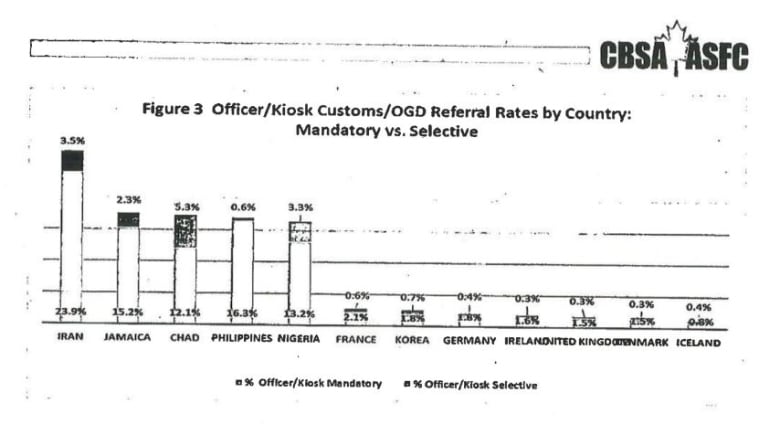
For example, Iranian travellers arriving in Canada in 2017 were on average about twenty times as likely to be referred to secondary inspections for Customs purposes — and about six times as likely to be referred for immigration purposes — as were visiting Icelanders.

A Jamaican visitor was about ten times as likely as a Dane to face a secondary inspection for Customs purposes, and almost ten times as likely to be followed up for immigration purposes.

A CBSA graph compares the rates at which air travelers of different nationalities were ordered into secondary inspection for customs purposes or to satisfy requirements of other government departments (“OGD”) such as the Canadian Food Inspection Agency. (CBSA)

Canada openly treats travellers differently depending on their passports, of course. Iranians and Jamaicans require a visa to visit Canada as tourists. Icelanders and Danes do not.

But CBSA’s analysis suggests that the discrepancies in the rates of secondary inspections are not a matter of policy.

“While Jamaican and Iranian nationals were referred more often for inspection than some other foreign nationals, looking at a macro level analysis, this report found no systematic evidence of bias,” says the CBSA analysis.

It notes that about 10 per cent of all travellers are referred and, of the 4.2 million referrals it examined, “the vast majority of referrals were for mandatory reasons, with the largest proportion having been referred by a kiosk.

“The percentage of individuals referred as a result of an ‘on the spot’ exercise of judgement by a border services officer was low in comparison.”

Many of the referrals were triggered automatically because of something in the traveller’s documents, declarations or immigration status.

A graph showing how different nationalities were referred to secondary inspection because of questions on their immigration status. (CBSA)

For example, a permanent resident arriving in his or her new country of residence for the first time is automatically referred to a secondary immigration inspection in order to confirm residency, and is also subject to a customs referral to document the personal effects they are bringing to Canada. A tourist or business traveller is not subject to either of those requirements.

Iranians travelling to Canada are more likely than Icelanders to be coming here to settle. Icelanders also are more likely to be tourists on short-term visits.

Booths flagging more people

Only about 140,000 out of two million secondary customs inspections were actually ordered by human agents acting on their own discretion. The rest were automatic, mostly ordered by machines.

The primary inspection booths flag any traveller who presents a customs declaration with irregularities — such as a person who checks the box saying they are bringing in food.

Because CBSA is aware of the tendency of kiosks to refer people to secondary inspection unnecessarily, a human officer is given the task of “referrals management”. For example, the referrals management officer might let through the passenger who checks the food box because of a candy bar, while ensuring someone bringing in raw meat is inspected.

The analysis found that those human officers overrule six out of every ten machine referrals for customs purposes.

Last spring, CBSA began adding more questions about food and plants at the automated booths — a step that the report credits with reducing by half the number of passengers being sent to secondary inspections for those reasons.

Immigration stops more ‘selective’

The 2.2 million immigration-related secondary inspections were far more likely to be ordered on a “selective” basis than customs-related cases, which were mostly “mandatory” orders for things like food inspections or payment of duties.

But even the “selective” immigration inspections were more likely to be ordered by machines (88 per cent) than by human agents (12 per cent). The main reasons booths order inspections are problems like incomplete information, stays of more than six months’ duration, or permanent resident cards close to their expiry dates.

CBSA found that an Iranian or Jamaican flagged for secondary inspection was no more likely to have been selected for a secondary inspection by a human officer exercising discretion than a French or South Korean passenger (in fact, they were more likely to have been picked by a machine).

But when looking at the total number of people arriving from each of those countries, the French and Korean travellers were much more likely to sail through the airport without being flagged — by either an automated kiosk or a CBSA officer — than their Iranian or Jamaican counterparts.

Machines bias-free?

“Officer selective referral is the only type of referral that requires ‘on the spot’ officer discretion or judgement which could potentially involve personal bias,” says the CBSA analysis.

But internal CBSA communications hint at problems that may affect kiosk machines’ even-handedness in dealing with different ethnicities.

Emails obtained by CBC News through Access to Information discuss the roll-out of electronic inspection booths at Canadian airports and early efforts to measure their accuracy.

CBC News also obtained a report entitled “Facial Matching at Primary Inspection Kiosks” that discusses ‘false match’ rates. False matches include ‘false positives’ — innocent travellers incorrectly flagged as posing problems — and ‘false negatives’ — a failure by the machine to detect such problems as fake documents or passport photos that don’t match the individual.

The documents released were heavily redacted, with entire pages blanked out. “The CBSA will not speak to details of this report out of interests of national security and integrity of the border process,” the agency’s Nicholas Dorion said.

‘I thought maybe it was just the press’

While all discussion of Canadian findings was redacted from the documents CBSA released, the documents do include some revealing emails in which the evaluation team discusses U.S. findings.

Referring to articles that suggested facial recognition technology had serious problems reading darker-skinned faces, one of the evaluation team wrote:

“I thought maybe it was just the press making a fuss and actually it’s not an issue. However … you do see that (U.S. agency) NIST has found a similar bias.

“The false match rate shows a massive increase for visa images when the imposter is from South Asia region, etc.”

“I never thought it was just press,” responds a colleague, sharing a link with another U.S. study that shows that facial recognition algorithms are wildly more inaccurate when dealing with dark-skinned travellers than with light-skinned travellers, and are also worse at assessing women.

That study found that two of the main facial recognition technologies available — from Microsoft and IBM — misidentify gender in dark-skinned individuals at 18 and seven times the error rate the two technologies experience, respectively, when assessing light-skinned individuals.

The MIT study evaluated three commercial face-scanning systems and found that while the maximum error rate for classifying the gender of light-skinned men was 0.8 per cent, the same systems produced error rates of up to 34 per cent for dark-skinned females.
Source: Bias at the border? CBSA study finds travellers from some countries face more delays

Trump Claims There Is a Crisis at the Border. What’s the Reality?

Good analysis of the numbers:

President Trump has frequently called the situation at the southern border with Mexico a crisis and insists that building his long-promised border wall will fix it. Here are some of Mr. Trump’s most common assertions of a crisis, and the reality of what we know about immigrants and the border.

“We can’t have people pouring into our country like they have over the last 10 years.”

THE REALITY Illegal border crossings have been declining for nearly two decades. In 2017, border-crossing apprehensions were at their lowest point since 1971.

Total number of arrests for illegally crossing the Mexican border

Undetected illegal border crossings have dropped at an even faster rate, from 851,000 in 2006 to approximately 62,000 in 2016, according to estimates by the Department of Homeland Security.

However, there is one group of migrants that is on the rise: families. A record number of families have tried to cross the border in recent months, overwhelming officials at the border and creating a new kind of humanitarian crisis.

Number of arrests for illegally crossing the Mexican border

Asylum claims have also jumped, with many migrant families telling officials that they fear returning to their home countries. Seeking asylum is one way to legally migrate to the United States, but only 21 percent of asylum claims were granted in 2018, and many cases can take years to be resolved.

“Every week, 300 of our citizens are killed by heroin alone, 90 percent of which floods across from our southern border.”

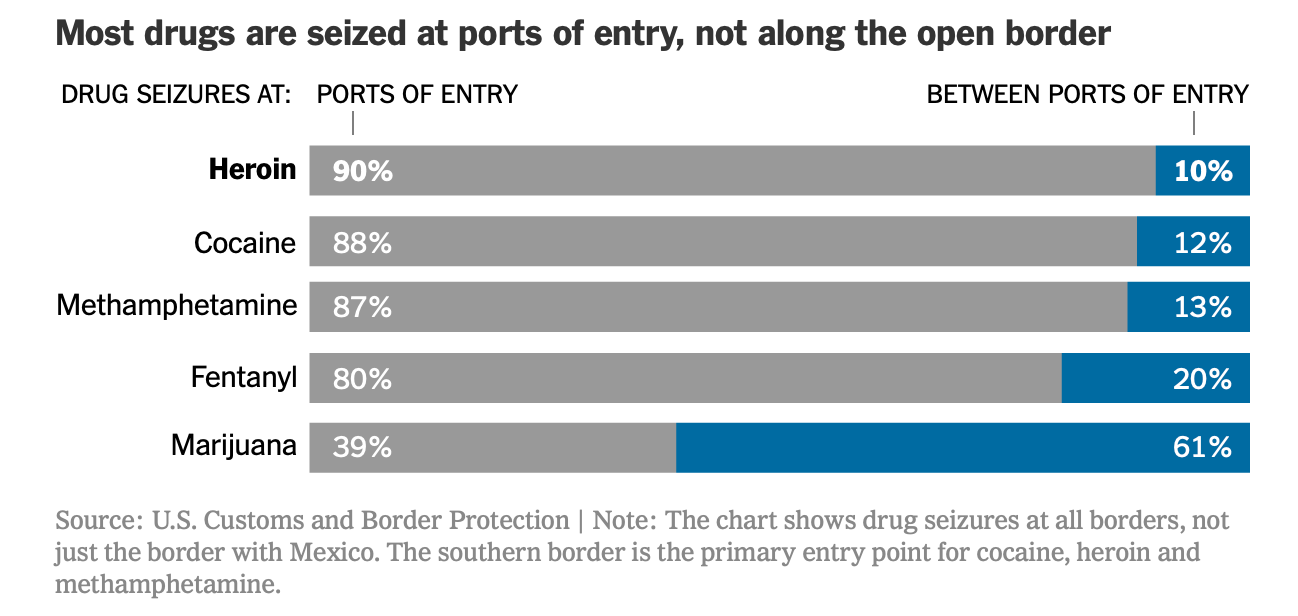
THE REALITY It is true that the majority of heroin enters the United States through the southern border, according to the Drug Enforcement Administration. But the D.E.A. also saysthat most heroin is brought into the country in vehicles entering through legal border crossings, not through the areas where walls are proposed or already exist.

Most drugs are seized at ports of entry, not along the open border

There are more than two dozen ports of entry along the southern border. Barriers are already present in Border Patrol sectors with the highest volumes of heroin seizures.

“Over the years, thousands of Americans have been brutally killed by those who illegally entered our country, and thousands more lives will be lost if we don’t act right now.”

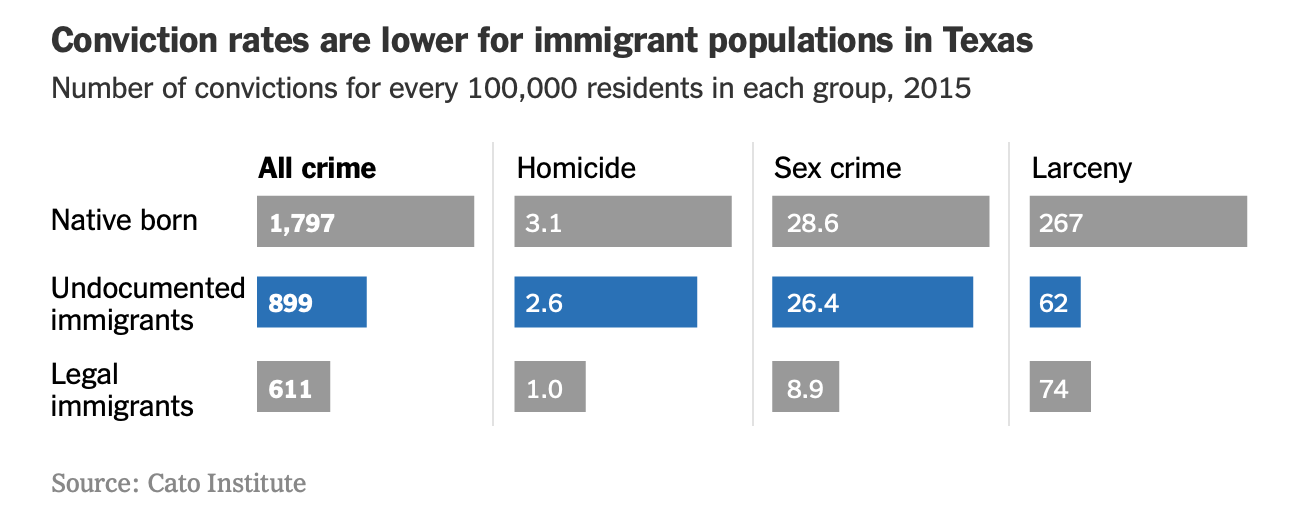
THE REALITY It is difficult to assess the president’s claims that illegal immigration leads to more crime because few law enforcement agencies release crime data that includes immigration status. However, several studies have found no link between immigration and crime, and some have found lower crime rates among immigrants.

Texas, which has the longest border with Mexico and has one of the largest populations of undocumented immigrants of any state, keeps track of immigration status as part of its crime data. The Cato Institute, a libertarian research center, analyzed the Texas data in a 2015 study and found that the rate of crime among undocumented immigrants was generally lower than among native-born Americans.

Conviction rates are lower for immigrant populations in Texas

Some critics of the study argued that the reason undocumented immigrant conviction rates were low was because immigrants were deported after they served their sentences, which prevented them from committing another crime in the United States, reducing their rate of crime relative to native-born Americans.

Alex Nowrasteh, senior immigration policy analyst at the institute, addressed the complaint by comparing first-time criminal conviction rates among undocumented immigrants in Texas and native-born Americans in Texas. He found that undocumented immigrants still committed crimes at a rate “32 percent below that of native-born Americans.”

President Trump frequently tells the stories of Americans who have been killed by undocumented immigrants as examples of criminal behavior. These terrible crimes have happened, but there is no comprehensive data that shows whether these killings are happening at crisis levels.

Fewer Canadians being refused entry at U.S. land border

Always important to have the numbers and data to inform discussion and debate, both the numbers of refusals as well as overall numbers of people crossing the border:

Fewer Canadians are being turned away at the U.S. land border in recent months despite mounting concerns that Donald Trump’s immigration policies are making it much harder to cross, The Canadian Press has learned.

Refusals of Canadians at American land crossings dropped 8.5 per cent between October and the end of February compared with the same five-month period a year earlier, according to U.S. government statistics

The total number of Canadian travellers denied entry also dropped: 6,875 out of 12,991,027 were refused entry, a refusal rate of 0.05 per cent.

Between October 2015 and February 2016, 7,619 out of 13,173,100 Canadian travellers were denied entry to the U.S., a refusal rate of 0.06 per cent.

About 180,000 fewer people attempted to cross the border in the most recent figures.

The figures, confirmed by U.S. Customs and Border Protection, contrast with recent anecdotal reports of Canadians denied entry into the U.S., with many placing the blame on the policies of the Trump administration, including its controversial attempts to ban arrivals from several predominantly Muslim countries.

A further breakdown of the border data shows a sharp drop in Canadian refusals at the U.S. border in the first two months of this year as 2,600 Canadian travellers were denied entry, compared with 3,500 for the same two-month period of 2016.

‘Much more cautious about crossing the border’

But Canadian immigration and civil liberties advocates caution the numbers don’t tell the whole story.

Immigration lawyer Lorne Waldman said he is fielding more calls than ever from people planning a trip to the U.S. and wanting to make sure they have the paperwork they need. The decreased rate of refusal could be just that people are now better prepared than they used to be, and so fewer are being turned away as a result, he said.

“People in Canada used to take it for granted that they could just go to the border . . . but that’s no longer the case,” he said.

FBI Reports Show Terror Suspects Coming From Canada While Trump Stares at Mexico – The Daily Beast

Expect this story and data to have some legs in the current political context (has in the past, and is always an ongoing challenge with our American neighbours):

Donald Trump keeps talking about the threat from the U.S.-Mexico border. But he may be looking in the wrong direction. FBI reports reviewed by The Daily Beast reveal that far more suspected terrorists try to enter the country from the northern border with Canada than from the south.

Seven FBI Terrorist Screening Center “monthly domestic encounter reports” dating from April 2014 to August 2016 detail the number, type, and location of encounters with known or suspected terrorists across the United States. The encounters are based on information in various watchlist databases. In all seven reports, the numbers of encounters at land border crossings were higher in northern states than southern.

“We are looking the wrong direction,” said a senior DHS official familiar with the data. “Not to say that Mexico isn’t a problem, but the real bad guys aren’t coming from there—at least not yet.”

On Monday, press secretary Sean Spicer told reporters he would not disclose evidence behind the President’s claims that jihadis are “pouring” into the country. “I’m not going to get into specific information that the president has,” he said.

The FBI reports obtained by The Daily Beast provide data on known or suspected terrorists attempting to enter the country, or who are already in the United States.

These reports show hundreds of watchlisted passengers encountered on domestic flights—meaning they are already in the country—and a smaller percentage crossing the border over land.

Those encounters are reported back to the FBI’s Terrorist Screening Center and used to compile the monthly domestic encounter overview reports, which are classified “Law Enforcement Sensitive.”

Newly installed Department of Homeland Security Secretary John Kelly traveled to Texas last week to survey the border in the Rio Grande Valley with local law enforcement. He is scheduled to testify Tuesday morning at a House Homeland Security Committee hearing on threats to the southern border.

But the FBI data shows concerns about terrorists crossing into the U.S. from Canada may be a more immediate concern, or is at least worthy of considerable attention, according to border and congressional officials.

Source: FBI Reports Show Terror Suspects Coming From Canada While Trump Stares at Mexico – The Daily Beast