Articles of interest: Multiculturalism

Poll not surprising given events as debates over Israel Hamas war affect diaspora communities and risk social cohesion and inclusion among other articles.

Poll finds support for deporting non-citizens supporting hatred, terror; mixed feelings over Canada’s ‘diversity’

Of note and not surprising given the events:

It was only two months ago that Canada saw large, disproportionately immigrant-led demonstrations calling for the expulsion of “gender ideology” from public school curricula. As Enns said, there is a social conservatism among immigrant communities that isn’t always sympatico with Canada’s various progressive frontiers.

Source: Poll finds support for deporting non-citizens supporting hatred, terror; mixed feelings over Canada’s ‘diversity’

Highlights of the Leger poll:

MOST CANADIANS SEE THE STRENGTH THAT DIVERSITY BRINGS TO THE COUNTRY, BUT FEEL THERE ARE PITFALLS AS WELL.

  • 56% believe that some elements of diversity can provide strength, but some elements of diversity can cause problems/conflict in Canada.
  • Three-quarters (75%) believe that an individual who has non-permanent status while in Canada and publicly expresses hatred toward a minority group or expresses support for any organization listed by the Canadian government as a terrorist group should not be allowed to stay in Canada.
  • While 69% think that Canadian universities should be places where dissenting opinions can be aired and discussed in a civil and constructive manner, 48% actually believe they are places where this happens.

Source: Diversity in Canada

Tasha Kheiriddin: Canada, the land of imported ethnic conflicts

Of note:

In other words, leaders in all strata of civil society — politicians, business, and academia — have a lot of work to do if we want to diversity to enrich Canadian society instead of tear it apart. That starts by focussing on what Canada stands for, honouring its history and achievements, and ceasing the relentless ideological takedown of our country as a colonial, oppressive state. The reality is that most newcomers came here to escape regimes that perpetrate far worse oppression than Canada ever did. It’s time our leaders stood up and said so.

Source: Tasha Kheiriddin: Canada, the land of imported ethnic conflicts

Lederman: The war in the Middle East is creating new divides in CanLit

Sound advice:

Open letters may be performative, but they are also of value. People who are justifiably angry and anguished feel compelled to do something, say something. Writers and other artists especially feel the need to voice their views. But if a letter dismisses the value of human lives on either side – or calls into question (or ignores) sexual assault, please think about what you’re signing. Or posting.

Source: The war in the Middle East is creating new divides in CanLit

Khan: The loss of the Afzaal family reminds us what happens when hate goes unchecked

Agree:

During these unsettling times of rising Islamophobia and antisemitism, the verdict is a stark reminder of what happens when hate goes unchecked. We must be vigilant against the proliferation of ideologies that seek to drive us apart, while ensuring that each member of our society is not fearful for their personal safety.

The human spirit has the resiliency to overcome evil with good. Yumna’s school mural reminds us of the virtues we all share as we strive toward a just, compassionate society. That is her legacy. What will be ours?

Source: The loss of the Afzaal family reminds us what happens when hate goes unchecked

Chris Selley: The fever to cancel Egerton Ryerson has broken

Yes indeed:

I have argued before that Ryerson makes an absolutely ideal subject for a discussion about how to treat otherwise benevolent historical figures who espoused unfortunate views — which is to say most of them. Instead we got a mad rush to rename. The HDSB’s Ryerson Public School in Burlington became Makwendam Public School. “Pronounced muck-kwen-dum,” the board explained, it “is the … word for ‘to remember’ in the Anishinaabemowin language.”…

Clearly, however, the issue has come off the boil. No one is hounding the Toronto District School Board to rename Ryerson Community School, or the City of Ottawa to rename Ryerson Avenue, or the United Church to rename Ryerson Camp in Vittoria, on Lake Erie. And that’s symptomatic of a moral panic: It goes from zero to 60 and back to zero just as quickly.

Blessed are those who who can stand firm on their principles, and on the historical record, in the face of the statue-toppling iconoclasm that overcame Ontario two years ago. Blessed and vanishingly few

Source: Chris Selley: The fever to cancel Egerton Ryerson has broken

Africans are being slaughtered, but with no Jews to blame, the left shrugs

An inconvenient truth:

But at the “civil society” level, the reason is simple: the conflict doesn’t fit the left’s anti-colonial narrative. The oppressors are not white or white-adjacent. This crisis cannot be blamed on capitalism, the United States, or Jews. There is nothing for the left to gain, politically, by calling out a community that is part of its own coalition. So just like feminists stay silent when Jewish women are raped, progressives fail to stand up for Black Africans when they are massacred.

The crisis in Sudan exposes “intersectionality” for what it is: a big, fat anti-semitic lie. The hypocrisy is beyond belief. And the Masalit are the ones to pay the price.

Source: Africans are being slaughtered, but with no Jews to blame, the left shrugs

Au-delà de l’affaire Bochra Manaï 

The dangers of appointing activists:

Quand Bochra Manaï a été nommée commissaire à la lutte au racisme et aux discriminations systémiques à la Ville de Montréal, Valérie Planteassurait les Montréalais qu’elle avait été sélectionnée au terme « d’un processus très rigoureux » qui était « garant de la qualité de la personne qui avait été choisie » et que cette dernière savait qu’elle servait désormais une « institution » et comprenait bien « son [nouveau] rôle ».

Beaucoup de Montréalais s’inquiétaient en effet du fait que la principale intéressée s’était surtout fait connaître comme porte-parole du Conseil national des musulmans canadiens et qu’à ce titre, elle avait publiquement pourfendu la loi 21 sur la laïcité de l’État et le Québec tout entier, devenu, selon elle, « une référence pour les suprémacistes et les extrémistes du monde entier ». Pouvait-on vraiment penser que quelqu’un qui tenait quelques semaines plus tôt des propos aussi provocants et aussi peu objectifs (elle était allée jusqu’à associer la loi 21 aux attentats de Québec et de Christchurch, en Nouvelle-Zélande) allait se muer instantanément, par la magie d’une nomination, en commissaire impartiale ?

Le noeud du problème est là. On recrute des militants politiques pour en faire des fonctionnaires censés être objectifs et impartiaux et on s’étonne ensuite qu’ils soient demeurés avant toute chose… des militants.

Source: Au-delà de l’affaire Bochra Manaï

As incidents of hate speech rise, when can employers legally sanction workers? 

Useful info:

Incidents of Antisemitism and Islamophobia are drastically rising in Canada in the wake of the Israel-Hamas war and the employment-related legal implications are quickly emerging as many workers openly express their personal views and attend protests or rallies. What happens when their employers, or others, take offence?

Source: As incidents of hate speech rise, when can employers legally sanction workers?

Colby Cosh: Court of Appeal rejects idea that math test is racist

Good decision even if largely on process grounds:

The Court of Appeal has taken a very dim view of almost all of this, partly because the concerns about the test turned out to be completely overblown. Aspiring teachers were always allowed to keep writing the test as often as they liked until they passed. Privatized provision of the test meant that opportunities to retake were never more than a few weeks apart. And teachers could take a crack at the MPT at any point in their course of studies; they didn’t have to wait until they were facing the immediate pressures of the job market.

The divisional court didn’t take any of this into account before hitting the Charter of Rights detonator, even though the evidence then before it was statistically slender and concerned only first attempts at the MPT. (Moreover, in voluntary field trials of the test, many candidates didn’t provide racial labels at all, creating possible — nay, virtually inevitable — bias issues in those statistics.)

Source: Colby Cosh: Court of Appeal rejects idea that math test is racist

Amira Elghawaby victime d’actes islamophobes

Threading the needle on the Israel Hamas war but clarity on Merry Christmas:

Lorsqu’elle a pris connaissance de l’offensive surprise du Hamas contre Israël, au matin du 7 octobre,  Mme Elghawaby a été « choquée » par ces événements « douloureux », raconte-t-elle.  Mais le silence qu’elle a maintenu sur la place publique dans l’immédiat a été dénoncé par plusieurs.

Il a fallu attendre une dizaine de jours avant qu’elle ne publie une déclaration, une prise de parole qui ne mentionnait pas explicitement les attaques du Hamas. « Les communautés musulmanes me mentionnent que nous ne pouvons pas laisser le conflit israélo-palestinien rouvrir un chapitre aussi douloureux. L’héritage de cette période sombre est ravivé aujourd’hui », avait-elle alors fait valoir, faisant référence au « profond traumatisme » vécu au lendemain des attentats du 11 septembre 2001 aux États-Unis par les communautés musulmanes et arabes.

Noël férié, du racisme ?
Est-ce que souhaiter « joyeux Noël » est raciste ? Sa réponse est claire : « Non, pas du tout. C’est beau d’être dans une société pluraliste. On a plusieurs religions et on veut comprendre tout le monde et leurs fêtes. » Elle mentionne en appui une chronique qu’elle a écrite dans les pages du Toronto Star en 2018, intitulée « Est-il acceptable de dire “joyeux Noël” ? Oui », où elle affirmait que dire « bonnes vacances » pour éviter toute référence religieuse n’était pas « une panacée » pour l’inclusion. 

Jeudi après-midi, le Bloc québécois a déposé aux Communes une motion condamnant la position de la Commission canadienne des droits de la personne. Elle a été adoptée à l’unanimité par les élus, à l’image de celle déposée la veille à l’Assemblée nationale du Québec.

Source: Amira Elghawaby victime d’actes islamophobes

Yakabuski: Rights commission’s humbug view of Christmas is just the gift the CAQ needed

Indeed. What were they thinking (or not):

…But hark! Out of the dark November sky, by what could only have been the grace of some higher power, this week emerged the gift of fate that Caquistes had been needing. It came in the form of a Canadian Human Rights Commission discussion paper that the CAQ seized on as a frontal attack on Christmas, allowing it to present itself as the defender of the faith against the woke zealots.

“Honestly, we’re going to continue to celebrate Christmas, and we’re not going to apologize for celebrating Christmas,” CAQ Justice Minister Simon Jolin-Barrette insisted after the National Assembly voted 109 to 0 to approve a motion denouncing the CHRC paper. The offending tract referred to statutory holidays related to Christianity as examples of the “present-day systemic religious discrimination” that is “deeply rooted in our identity as a settler colonial state.”

Source: Rights commission’s humbug view of Christmas is just the gift the CAQ needed

Douglas Todd: It’s dangerous to bring modern-day blasphemy laws to the West

Valid concern:

Canadian senators have recommended it. An Australian state has already done it. And some Danish politicians are preparing for it.

They are all pushing new laws that would, in different ways, make it a criminal offence to mock a religion. Some now call it “religious vilification” — even while it used to be known as “blasphemy.” The subject is in the air more than ever this fall because of hot-blooded enmities arising in the wake of the Hamas-Israel war.

Canadian Sen. Salma Ataullahjan this month said she wants legislation to combat “mischaracterization of religious Islamic concepts.” Chris Minns, premier of New South Wales in Australia, just brought in a fine of up to $100,000 for anyone who “severely ridicules” a religious belief. Denmark votes in December on whether to ban “improper treatment of scriptures,” particularly Quran burnings.

As much as I personally oppose the ridiculing of religious beliefs or symbols, I also believe legislators need to approach this crucial issue of free expression with extreme caution. It is dangerous for any society to forbid people from casting profane aspersions, however offensive, on that which others consider sacred.

Source: Douglas Todd: It’s dangerous to bring modern-day blasphemy laws to the West

If diversity is our strength, then why are diaspora news outlets being silenced?

There’s a dangerously naïve sentiment among some that Canada’s pluralism is immune from erosion. 

But in reality, Canadians from virtually every nation on the earth, of every political persuasion and religion, living side by side in peace is not something that magically happens. It takes constant work, strong leadership and information to understand the context of plural (e.g. cultural, regional, etc) goals and grievances and to resolve tensions peaceably.

Non-biased, smart journalism has a big role to play in this regard. But with Canadian mainstream media outlets closing regional offices and firing international bureaus en masse, there’s virtually no consistent mainstream coverage of how Canadian policies or politics are being felt by Canadian diaspora groups. Instead, the primary source of coverage many rely upon to understand factors that might impact different groups are stories found by using Google to search for minority community media outlets, often called Canadian “ethnic media” or “diaspora media.”

However, after December 19, 2023, thanks to the Canadian federal governing Liberal’s bill C-18, that capacity will be eliminated. December 19 is the day the bill comes into force, and the megalithic search engine Google said they would begin blocking search results for all Canadian news sources, including ethnic media. Google’s move will come months after Facebook’s parent company, Meta, blocked access to Canadian news sites across its platforms

Source: If diversity is our strength, then why are diaspora news outlets being silenced?

After ‘Sinicization’ of Islam in Xinjiang, China is closing and destroying mosques in other Muslim areas: report 

Telling:

“I do think it’s been quite shocking to see the lack of outrage from Muslim governments, which are quite rightly critical of what is happening now in Palestine and have also come to the defence of the Rohingya in the past,” Ms. Pearson said. “What we want to do is really open the eyes of Muslim-majority countries to what is happening in China.”
Source: After ‘Sinicization’ of Islam in Xinjiang, China is closing and destroying mosques in other Muslim areas: report

Le blasphème comme limite à la liberté d’expression?

Thoughtful discussion:

La liberté d’opinion et d’expression fait partie des droits protégés par la Déclaration universelle des droits de l’homme de 1948. Il s’agit du droit de ne pas être inquiété pour ses opinions et du droit de chercher, de recevoir et de répandre, sans considération de frontières, des informations et des idées, par quelque moyen d’expression que ce soit.

Or, cette liberté d’expression heurte les tenants de dogmes religieux, qui ont recours aux accusations de blasphème pour faire taire les personnes mettant en question leurs croyances. À preuve, la résolution non contraignante du Conseil des droits de l’homme des Nations unies, adoptée en juillet 2023, qui demande aux États de condamner tout plaidoyer et manifestation publique et préméditée de profanation du Coran.

De tout temps les religions revendiquent le droit d’être protégées contre le blasphème, soit une parole, un discours ou un geste qui outrage un ou plusieurs de leurs aspects.

Dans les sociétés de droit, cette requête s’appuie de nos jours sur trois éléments. À savoir : la liberté de religion ; la protection de la société et de l’ordre public ; la religion comme élément intrinsèque et indissociable de la personne.

Dans le premier cas, la demande d’interdiction du blasphème présume que la liberté de religion vise la protection des croyances et des sentiments religieux des expressions jugées offensantes. Il incomberait ainsi à l’État d’intervenir pour contrer les critiques de dogmes religieux, ce qui semble contradictoire avec le principe de séparation de la religion et de l’État, de la liberté d’expression et de la liberté de conscience des citoyens.

La deuxième justification concerne la protection de la société et de l’ordre public. Il s’agit là d’une question brûlante d’actualité en Suède et au Danemark, à la suite des crises diplomatiques avec les pays musulmans qu’ont provoquées les récents autodafés du Coran survenus sur leurs territoires respectifs. Sans parler d’interdiction du blasphème, en tout respect de la liberté d’expression, ces pays explorent aujourd’hui des solutions juridiques qui pourraient permettre d’interdire certaines manifestations offensantes afin de contrer une situation jugée « dangereuse pour la sécurité nationale ».

Il s’agit d’une question délicate puisqu’elle remet en question leur autonomie nationale quant au modèle de société choisi démocratiquement. D’ailleurs, n’est-ce pas cette autonomie par rapport aux accusations de blasphème de pays tiers qui a permis de protéger l’écrivain britannique Salman Rushdie d’une fatwa appelant à la mort ? Voire encore celle qui a permis au Canada d’accueillir la Pakistanaise Asia Bibi, accusée de blasphème dans la foulée d’une dispute autour d’un verre d’eau en 2019 ?

La troisième justification mise en avant pour interdire le blasphème vient de l’idée que les individus et leurs croyances forment un tout indissociable, et que le respect des uns implique obligatoirement le respect des autres. Les accusations d’islamophobie s’appuient sur ce principe en confondant critique de dogmes religieux et propos offensants à l’égard d’une personne. Cette conception d’un tout identitaire immuable soulève cependant la question de la liberté, pour les croyants, de se conformer ou non aux dogmes religieux, de la liberté de croire ou de ne pas croire, de la liberté d’association et de la liberté d’expression.

La situation au Canada

Le Canada a décriminalisé le blasphème en 2018. La liberté d’expression défendue par le Canada est cependant limitée par la criminalisation des discours qui incitent à la violence contre un groupe identifiable. Le défi consiste donc à départager un propos critique à l’égard d’une religion de ce qui relève du discours haineux visant un groupe en particulier, c’est-à-dire qui incite à détester des personnes.

En 2020, à la suite de l’assassinat de l’enseignant français Samuel Paty pour avoir montré des caricatures jugées blasphématoires par une partie de la communauté musulmane, le premier ministre canadien, Justin Trudeau, avait ainsi créé toute une polémique en associant le respect d’un dogme au respect de la personne : il avait alors affirmé qu’il ne fallait pas chercher à « blesser, de façon arbitraire ou inutile, ceux avec qui on est en train de partager une société et une planète ». Ces déclarations semblaient aller au-delà du concept de propos haineux qui limite la liberté d’expression au Canada.

Est-ce la perception de ce supposé lien indissociable entre religion et croyants qui a motivé le premier ministre à nommer, en 2023, une commissaire chargée de la lutte contre l’islamophobie ? N’y a-t-il pas là confusion entre le respect de la personne musulmane et le respect absolu des préceptes de l’islam ?

Rappelons que c’est la liberté d’expression qui a notamment permis les avancées scientifiques contraires aux dogmes religieux (on n’a qu’à penser à l’origine de la vie) ou à la reconnaissance du droit des femmes à l’égalité.

Aujourd’hui, le Canada semble errer en souscrivant au concept d’islamophobie par respect et pour éviter de blesser des sensibilités d’une certaine communauté. Comme la Cour européenne des droits de l’homme l’a rappelé en 1994 : « Ceux qui choisissent d’exercer la liberté de manifester leur religion, qu’ils le fassent en tant que membres d’une majorité ou d’une minorité religieuse, ne peuvent raisonnablement s’attendre à être exemptés de toute critique. Ils doivent tolérer et accepter le déni… Et même la propagation par d’autres de doctrines hostiles à leur foi. »

Toute critique des religions ne constitue pas en soi une incitation à la violence ou à la discrimination.

Source: Le blasphème comme limite à la liberté d’expression?

How Caste Underpins the Blasphemy Crisis in Pakistan

Interesting and revealing context for Asia Bibi and anti-Christian sentiment in general:

On June 14, 2009, Asia Bibi, a poor Christian woman, was picking fruit in the field of Itan Wali village in Pakistan, about 30 miles from the city of Lahore. On the landowner’s order, Bibi fetched drinking water for her co-workers, but three Muslim women among them accused her of contaminating the water by touching the bowl. An argument followed.

Later, the Muslim women accused Bibi of making blasphemous statements against the Prophet Muhammad — a charge punishable by death under Pakistani law. Despite little evidence, Bibi spent nine years in prison — eight in solitary confinement on death row — till she was finally acquitted by the Supreme Court of Pakistan in late October.

Pakistan’s religious right has violently protested her acquittal and Bibi is being held in an undisclosed location to keep her safe. The initial accusation against her was not about religion but caste. Her handling of a drinking vessel was seen to pollute the water inside because she belonged to an “untouchable” Hindu caste that had converted to Christianity.

When this offense turned into the charge of blasphemy, the shift signaled the simultaneous disavowal and internalization of caste discrimination by Muslims who otherwise attribute the practice to Hindus in India. Caste discrimination in Pakistan often involves its non-Muslim population and its Hindu past, and allows Muslims to minimize their own caste differences by projecting discrimination outward.

When Pakistan was created after the partition of colonial India, upper-caste Hindus and Sikhs fled or were forced to leave for India, leaving their poorer and less mobile lower-caste coreligionists behind.

In the southern province of Sindh, some upper-caste landowners stayed, while low-caste Hindus took the religion, its temples and practices into their hands in a startling departure from Hindu tradition that has no Indian counterpart. In Punjab Province, former “untouchables” accelerated their conversion to Christianity, taking given names common among their Muslim neighbors while replacing the caste surnames with appellations like “Masih,” the Urdu word for Jesus in his role as Messiah.

Discrimination and ethnic cleansing reduced the population of non-Muslims in Pakistan from about 30 percent at its creation in 1947 to less than 5 percent now. Yet the nearly absolute majority of Muslims in the country has not reduced religious conflict, but rather displaced, increased and internalized it among Muslims.

It is now Muslims, especially in Punjab, who maintain a caste hierarchy. And since Islamic beliefs don’t include a caste system, the discrimination cannot be defined in terms of caste and is labeled religious. This shift was illustrated by turning Bibi’s quarrel over sharing water into blasphemy.

Perhaps Asia Bibi mentioned to her three accusers how the Muslim prophet and religion did not permit such discrimination. But in Pakistan, neither the Christians, who are understood to have been low-caste Hindus, nor the Muslims, who have adopted the role of their high-caste coreligionists, can refer to the vanished past that mediates their relations.

The increasing refusal of Muslims to share water or food with Christians suggests an inability to come to terms with a past that defies the religious identifications meant to structure all of Pakistan’s social relations.

The debate about blasphemy is also tied to cultural issues assuming unprecedented importance with the emergence of a technologically mediated global arena after the Cold War. But such protests and violence over depictions of Islam’s prophet began during the middle of the 19th century in colonial India, where they had to do with urban politics and competition in newly capitalist societies.

These controversies are about struggles over representation in a public space. What defines Muslim outrage is never the traumatic encounter of the believers with the images of the prophet or his representation, but merely the rumor of circulation of his images and his representation beyond their control.

When controversies over insults to the Prophet Muhammad first arose in colonial India, the cases arising from them were dealt with under the Indian Penal Code written by the British politician Thomas Babington Macaulay, who criminalized the injury of religious and other sentiments in secular rather than theological terms by treating it the same way as defamation, libel and other such offenses.

In post-colonial India and Pakistan, religious offense among Hindus, Muslims, Sikhs and Christians continues to deploy the secular language of hurt sentiments rather than the theological category of blasphemy. In Pakistan, Lord Macaulay’s equal-opportunity conception of injury was done away with, and insulting the Prophet Muhammad was made into a specific crime above all others.

In the early years of Pakistan, a group called the Ahmadis, who are accused of not accepting Muhammad as the last prophet, were the first to be charged with blasphemy. But the charge of blasphemy was soon being leveled by even the most acceptable of Muslims against one another, often for petty and personal reasons. Such accusations are ways of legitimizing the individual motives of those who make them, whether these are concerned with quarrels over money, property or marriage.

But the accusations of blasphemy are also related to anxieties about the Muslim prophet’s vulnerability to insult, which have emerged from profound shifts in the life of Muslim societies.

These include efforts by Muslims to create a “modern” Islam by ridding it of “superstitions” like attributing superhuman powers to the prophet. But by becoming more human, Muhammad has also become more vulnerable to insult, and as a result requires the protection of his followers in an ironically secular way.

In contrast to these global concerns, Ms. Bibi’s case is resolutely local and has led to no Muslim agitation outside Pakistan. This is because it emerges from the Muslim disavowal of caste and refusal to acknowledge Pakistan’s ethnic cleansing of the Hindus who are seen to represent it. Just as Muslims take on the character of their vanished Hindu enemies by persecuting low-caste Christians if only in the name of religion, so do Hindu militants in India lynch Muslims by acting the part of medieval invaders who happened to be their coreligionists.

Familiar across the subcontinent, such playacting involves practices such as caste restrictions, forcible conversion and other, more grotesque forms of bodily violence in which a community takes on the role it attributes to its enemies.

Implying a relationship of perverse intimacy with one’s foes, this impersonation also distances perpetrators from their own brutality by turning it into a piece of theater. In all cases it involves the impossible and infinite desire for vengeance against an enemy who has vanished in time, like India’s Muslim invaders of a thousand years ago, or in space, like the Hindus and Sikhs who left Pakistan.

In Pakistan, both the discrimination of caste and the history of religious difference are officially proscribed and forgotten. But for this very reason they continue to haunt the present in disavowed ways that include the charge of blasphemy against Ms. Bibi. In this sense, the passionate defense of their prophet represents a kind of traumatic memory, one that only allows Muslims to obscure a reality that remains unrecognized and therefore unresolved.

Faisal Devji is a professor of Indian history at the University of Oxford.

Source: How Caste Underpins the Blasphemy Crisis in Pakistan

‘Rot at the Core’: Blasphemy Verdict in Indonesia Dismays Legal Experts – The New York Times

More on the arrest and trial of the jailed Christian governor of Jakarta:

Legal experts noted that the verdict seemed to be based more on public reaction to the governor’s comments than what he had actually said, in effect holding him accountable for the mass protests organized against him by hard-line Islamist groups.

“That’s the problem with the blasphemy law,” said Bivitri Susanti, head of the Jakarta chapter of Indonesia’s Association of Constitutional Law Lecturers. “It’s not about the speech itself and whether it’s condemning Islam itself. It’s about whether society believes it’s wrong or annoys them.”

The governor, Basuki Tjahaja Purnama, was convicted on Tuesday for comments he made in September challenging Muslim hard-liners who argued that a verse in the Quran prohibited Muslims from voting for a non-Muslim. Mr. Basuki said those who made that argument were misleading Muslims, a statement interpreted by some as insulting the Quran and Islam.

Mass rallies were organized calling for his arrest, with some zealots demanding that the governor be put to death. Many analysts said that the protests had been orchestrated by his political rivals and that they were a strong factor in his 16-point defeat in last month’s election.

The verdict by the five-judge panel hearing his case repeatedly said that Mr. Basuki, known as Ahok, had caused public unrest and offended the Muslim majority, citing an article in the decades-old blasphemy law banning “words that degrade, harass or insult a religion.”

Sidney Jones, director of the Institute for Policy Analysis of Conflict, said the decision “underscored the rot at the core of the Indonesian legal system” and would further polarize the country.

“It isn’t the first time Indonesian judges showed no concern for evidence in a high-profile case, but it could be one of the most damaging,” Ms. Jones wrote in a commentary for the Lowy Institute. “It instantly sent a signal that non-Muslims are lesser citizens.”

Photo

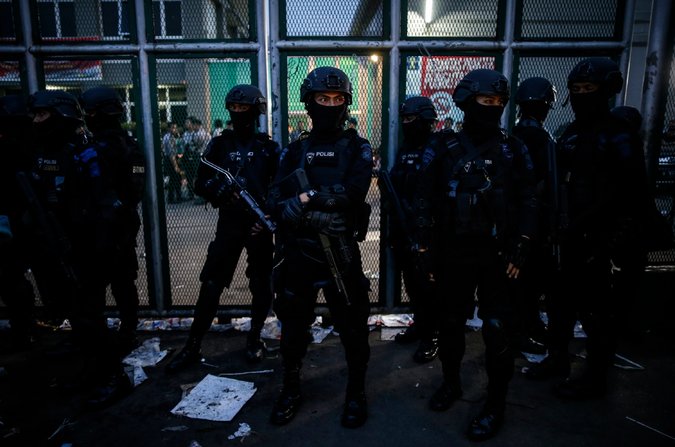
Police officers outside Cipinang Penitentiary in Jakarta, where Mr. Basuki was first taken and which houses violent criminals. He was transferred to a city police detention facility on Wednesday for security reasons. CreditMast Irham/European Pressphoto Agency

“I believe that the street protests influenced the judges’ ruling,” Ms. Bivitri said. “You can really see in the decision, that instead of using other articles, they are using one about condemning religion.”

Experts also expressed concern about the motive for the seemingly vindictive two-year prison sentence. The prosecutors had asked for two years’ probation on a lesser charge, which would have spared Mr. Basuki prison time.

In explaining the sentence, the judges said they determined that the governor “did not feel guilty” about his comments.

“The judges didn’t think Ahok apologized enough,” said Melissa Crouch, a senior law lecturer at the University of New South Wales in Sydney, Australia.

Mr. Basuki apologized publicly months ago for any offense caused, but he has steadfastly denied that he insulted the Quran or committed blasphemy.

On Wednesday, he was transferred to a city police detention facility for security reasons, officials said.

Islam’s Problem With Blasphemy

Good piece by Mustafa Akyol in the NY Times:

Before all that politically motivated expansion and toughening of Shariah, though, the Quran told early Muslims, who routinely faced the mockery of their faith by pagans: “God has told you in the Book that when you hear God’s revelations disbelieved in and mocked at, do not sit with them until they enter into some other discourse; surely then you would be like them.”

Just “do not sit with them” — that is the response the Quran suggests for mockery. Not violence. Not even censorship.

Wise Muslim religious leaders from the entire world would do Islam a great favor if they preached and reiterated such a nonviolent and non-oppressive stance in the face of insults against Islam. That sort of instruction could also help their more intolerant coreligionists understand that rage is a sign of nothing but immaturity. The power of any faith comes not from its coercion of critics and dissenters. It comes from the moral integrity and the intellectual strength of its believers.

Islam’s Problem With Blasphemy – NYTimes.com.

Afghanistan Blasphemy Charge

A reminder that of the limits of all the efforts in Afghanistan, and how deeply a traditional country it remains in Afghan newspaper’s ‘blasphemy’ causes protests after rebuking Isis and Islam.

In Kabul, a crowd of approximately 500 people, including clerics and several members of parliament, gathered in front of the Eid Gah Mosque, the city’s second largest house of worship.

“The government must stop the people who insulted the prophet, the Qur’an and Islam, and prevent them from leaving the country,” said Fazl Hadi Wazin, an Islamic scholar at Salam University who spoke from the outdoor podium.

In an opinion piece published last week in the English-language daily the Afghanistan Express, a journalist named AJ Ahwar admonished Muslims for remaining silent in the face of Isis and the Taliban.

He also criticised Islam for not accepting other religions and minorities such as homosexuals and Hazaras, a Shia minority in Afghanistan.

The article ended by concluding that human beings are more important than God, which seemed to particularly incense protesters.

“The newspaper said God can’t control people and that God is unwise,” said Mangal Bader, 38, one of the protesters. He joined others in calling for the newspaper staff to suffer the same fate as five men who were recently convicted of rape and hanged, after great public furore.

“They need to be executed so humans know that you cannot insult the religion of Allah,” said Ahmad, 22, another protester.

In pauses between speakers, protesters chanted “death to America”. According to one demonstrator, the US instils ideas of freedom of expression in the minds of Afghan journalists, then grants them asylum once they anger their compatriots.

“The international community pretend to be heroes of freedom of expression,” said Wazin after his speech. “They have to come out and say they are not behind this. If they don’t, these protests will grow.”