How activism has evolved for Black Canadians

Interesting article on the changing nature of Black Canadian activism.

While sympathetic and understanding of some of their concerns (indeed as the Ontario government’s recent data collection and related anti-racism strategy does), and that activism is needed for change, exaggerated rhetoric hardly helps the case with the broader public discussion and debate.

But of course, that is part of free speech and related rights:

At a time when so many Canadians were celebrating the end of the Harper era and, with it, an apparent return to “sunny days,” Khogali’s words eroded the image of Canada as a genteel, meritocratic, accepting nation, instead indicting its leader on the grounds of racism and discrimination. Khogali not only named whiteness—a bold act given the state of our national discourse on race—but specifically white supremacy. She also labelled the Prime Minister a terrorist, implicating Canada as a nation trafficking in fear and oppression. While there were certainly Black Canadians who did not endorse Khogali’s words, online discussions and think pieces written in the aftermath of Khogali’s statement suggest that her statement wasn’t as aberrant for young Black Canadians as for their white counterparts. But regardless of where one finds themselves in relation to Khogali’s words, one thing is clear: a vision of change that does not require the nation state or the sanction of white allyship—let’s call it disruption—has begun to gain credence among Black Canadians. It may make some uncomfortable—but it’s also starting to produce results.

This paradigm was on display during BLMTO’s disruption of Toronto’s Pride Parade last summer, an action that drew the ire of many white members of the LGBTQ community who believed that BLMTO was undermining its authority and the gains that it had made in society. It was on display at Tent City when BLMTO occupied the area outside of the Toronto Police Headquarters. It was on display when BLMTO showed up at Ontario Premier Kathleen Wynne’s private residence in protest of police. These are the new tactics of disruption: disruption of parades, disruption of privacy, disruption of comfort, disruption of permission, decorum, civility, and the various ways they have been used to obscure Black plight. Disruption is inspired by a lack of visible progress promised by the Prime Minister’s own father.

Currently, BLMTO boasts 18,000 followers on Twitter including many high-profile members of the Canadian media landscape, some of whom subscribe to the same style of activism; Desmond Cole’s recent disruption of the TPS meeting in protest of carding is a compelling example. BLMTO is also actively involved in Toronto’s Black communities, holding many discussions and events and, in March, the group achieved its goal of having police banned from Toronto’s Pride parade.

I ended up speaking out against the elder’s words at the meeting; silence felt inadequate. I told the young man that an appeal to reason could not work in a system predicated upon his dehumanization, and that to assume otherwise was dangerous. When I spoke, I found myself supported by several others in the room, including a few elders. As Foster observes of Black elders, “many of them immigrated to Canada with their heads full of dreams. They were going to do well and succeed, become an example for all those back home. Now, in the middle of the night, they find themselves scratching their heads and asking what went wrong. For they did not attain their dream, and what is even more significant, they now despair their kids will be worse off than they.”

In these dire times, when 42 per cent of Black students have been suspended at least once in the Toronto District School Board and Black Canadians constitute nearly ten per cent of federal prisoners—but only three per cent of the Canadian population—unwavering subscription to infiltration is difficult and often dangerous. Entire generations of Black Canadians have watched Black teachers in Ontario face racism in the staff rooms and barriers to promotion. We’ve seen how the establishment of the SIU, a major reform secured through the tireless efforts of the Black Action Defense Committee, did not protect Jermaine Carby or Andrew Loku. We see the hollowness of the promises made four decades ago.

For Black Canadians wedded to the idea of infiltration, it is high time to acknowledge its limitations, the many ways in which the face of the mainstream has yet to soften. It is also incumbent upon non-Black Canadians and, especially, White Canadians to examine their relationship to Canada in light of history. To label Khogali’s words violent and call for her resignation without any discussion of state-produced violence is to ignore centuries of injustice in this country. It invests in ideals of merit and civility, assuming the effectiveness of nationhood, while conveniently overlooking the violence visited upon racialized bodies and, in particular, Indigenous bodies.

As people across this country move to celebrate Canada 150, the important shifts that have occurred in Black political engagement from Trudeau to Trudeau ask all Canadians to re-evaluate the narratives that structure what it means to be “Canadian.” The politics of disruption recognizes that systemic racism may be just as Canadian as maple syrup. The barriers to full participation in Canadian society have not been removed—in fact, many have been redoubled. In contrast to the decades of Black support for Pierre Trudeau, Khogali’s indictment of Justin Trudeau reminds us that it is racialized Canadians who are often left in the shadows of these long-awaited sunny days.

Source: How activism has evolved for Black Canadians – Macleans.ca
Black students hindered by academic streaming, suspensions: Report

The data is convincing. But the interpretation may miss broader socio-economic factors that also contribute to the gap:

Black children in the GTA may start kindergarten feeling confident and excited to learn, but too many are “gradually worn down” by schools that stream them into applied courses and suspend them at much higher rates than other students, says a new report from York University.

The report found that while academic streaming was supposed to have ended in 1999, black students are twice as likely to be enrolled in applied instead of academic courses compared to their counterparts from other racial backgrounds. And they are more than twice as likely to have been suspended from school at least once during high school.

“Black students face an achievement and opportunity gap in GTA schools,” says the study led by York University professor Carl James.

“All evidence point(s) to the need for action if the decades-old problem is to be addressed.”

The findings were based on data from the Toronto District School Board — the only board to regularly collect race-based statistics, though a similar move is underway at the Peel District School Board. Consultations with 324 black parents, community members, educators, school trustees and students indicated “the same patterns exist in other GTA school boards,” said James.

Because much of the information in the 80-page report was produced by the TDSB’s research department, it comes as no surprise to director of education John Malloy.

“We aren’t running away from what the data is telling us, we’re willing to face it,” he said in an interview.

He said the board’s new equity framework plan launched last fall involves a sweeping review of everything from board policies to personal attitudes among staff and the barriers students of different backgrounds face when it comes to accessing programs and courses.

Streaming, which places students in academic or university-bound courses instead of the more hands-on applied courses based on perceived ability, is a key piece, he said.

The practice has been found to hit low-income kids and certain racial groups such as black students hardest.

Several high schools in Toronto have already launched pilot projects to end streaming in some Grade 9 and 10 courses, so that students aren’t making decisions so early that will affect their futures. And two years ago, a TDSB report called for streaming to be phased out and undertook to expand the pilots. But there are currently only about five in place.

“I think we are beginning to get a groundswell of support,” says Monday Gala, principal of C.W. Jefferys Collegiate, which was the first to begin a destreaming initiative and no longer offers applied options in Grade 9 geography, English, science or French or Grade 10 history, English and science.

But across the system, it’s one change “I wish would move faster,” added Gala. The school provides extra tutoring and lunchtime and after-school support and has seen pass rates increase across the board.

A similar result took place at Runnymede Collegiate, which this year offered only academic English to Grade 9 students and is hoping to add geography next year, said principal Paul Edwards.

Eliminating streaming is one of the many recommendations in the new York University report, which also calls for mandatory collection of race-based data by all school boards to illuminate barriers; use of alternative discipline measures, steps to diversify the teaching workforce, and ministry and board policies to address anti-black racism.

Among its other findings:

  • Between 2006 and 2011 — the latest period for which TDSB data is available — only 53 per cent of black students were in an academic stream program versus 81 per cent of white students and 80 per cent of other racial groups.
  • Forty-two per cent of black students had been suspended at least once during high school compared with 18 per cent of white students and 15 per cent of other racial groups. It also cited more recent stats showing almost half the 213 students expelled in the five-year period ending in 2015-16 were black.
  • Sixty-nine per cent of black students graduated between 2006 and 2011 versus 87 per cent of other non-white students and 84 per cent of white students. Twenty per cent — twice as many as the other groups — dropped out.
  • Fifty-eight per cent of black kids did not apply to post-secondary school versus 41 per cent in the other two groups.

Source: Black students hindered by academic streaming, suspensions: Report | Toronto Star

100 years ago today, Canada’s black battalion set sail for WWI and made history

Part of our history:

They faced racism and discrimination, and they had to fight a battle at home before they could represent Canada in the First World War.

Now families of the so-called black battalion say the soldiers’ struggles carry new relevance, given the state of the world today.

Many black men were rejected from enlisting during the First World War because of the colour of their skin.

In 1916, Canada allowed them to form the No. 2 Construction Battalion based in Pictou, N.S. It was Canada’s first and only segregated military unit. Nearly half of the battalion’s 600 members were from Nova Scotia.

“When they were told ‘This is not your war, this is a white man’s war,’ they were in effect being told ‘This is not your country,” said Douglas Ruck.

‘Wall built of bigotry’

Ruck’s father, the late Senator Calvin Ruck, is credited for bringing the battalion’s untold story to the forefront when he wrote a book about their struggles. Douglas Ruck continues to act as a public speaker, championing their accomplishments.

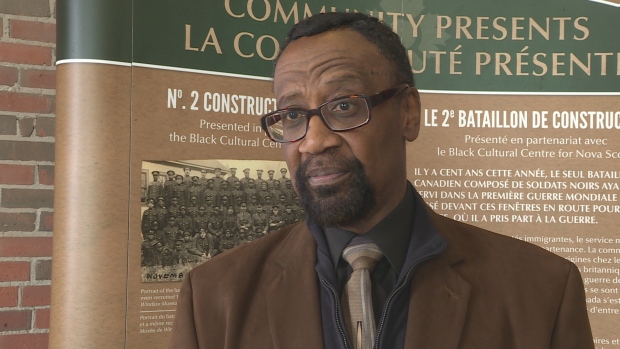
Douglas Ruck

Douglas Ruck says its unimaginable that the Construction Battalion had to fight to represent a country that didn’t want them. (Carolyn Ray/CBC)

“They were in effect separated by the rest of the forces and the rest of the country by a wall,” said Ruck, drawing parallels to race debates ongoing in the United States.

“A wall built of bigotry, a wall built of prejudice, a wall built of irrational fears, a wall built of hatred.”

Saturday marks the 100th anniversary of the battalion’s departure to Europe. Even getting on the ship was a struggle. They were blocked from getting on their scheduled vessel because they were told they couldn’t travel with white soldiers.

Cultural history

Craig Smith, president of Nova Scotia’s Black Cultural Society, agrees that the timing of this anniversary is significant, coming days after the International Day to Eliminate Racism.

“If there was a time for us to need to come together, for the need for cohesion, the need to bring organizations together, now would be the time,” he said.

“It’s an amazing piece of cultural history in Nova Scotia, not just here, but one that resonates across the country.”

Source: 100 years ago today, Canada’s black battalion set sail for WWI and made history – Nova Scotia – CBC News

Black health needs to become a priority

While I support most of Dalon Taylor’s recommendations, there is no mention of the role that the community and individuals can and do play apart from advocating government action:

Why should we need to consider Black health in particular? Consider these facts:

  • The rates of diabetes are highest among blacks and South Asians with more than 8.5 per cent affected compared to approximately 4.2 per cent among whites.
  • Close to 110,000 black individuals in Ontario alone were identified as sickle cell carriers with more than 60 newborns identified with full blown sickle cell disease annually.
  • Black communities are disproportionately affected by health-related issues such as mental health, HIV/AIDS, heart disease, sickle cell, stroke and hypertension. But they have yet to be adequately addressed effectively within the Canadian health-care system.

These all create an enormous burden on our health-care system, which can be greatly reduced with effective solutions.

The reasons why black Canadians face significantly disproportionate health prospects are complex and not fully explored. Certainly, we know that social determinants of health, which includes education, housing, employment and poverty, as well as racism and violence, are taking a toll on the health of black communities across Canada.

A vast array of research distinctly connects disparities in poor health with the experiences of prejudice and discrimination that individuals from marginalized and racialized populations encounter. Research also shows that negative interactions based on race leads to distrust in both the health-care systems and toward health-care providers.

By ignoring how these factors limit black health, we only perpetuate the racism that the heroes we celebrate during Black History Month sought to end. If Canada is serious about acknowledging the contributions that have been made by people of African and Caribbean ancestry, a good starting point would be to address the health-related issues that predominantly impact black Canadians.

For politicians and policy-makers, that would mean implementing relevant and “targeted” approaches in the health-care sector at all levels of government to address the health disparities and increase access to specific health services for blacks in Canada.

This includes creating a tool to measure equity within our current health-care system. Additionally, policy-makers need to recognize that racism and violence along with the social determinants of health play a role in the health outcomes of black communities in Canada. As such, specific measures should be developed to address these barriers to health.

It is also crucial for politicians and policy-makers to work with black communities and organizations to develop solutions that are relevant and meaningful to black communities. Part of this process must include investment in research to better understand the health issues that affect black Canadians so effective measures can be identified and acted upon.

Politicians must support the implementation of a black health strategy within the health-care system that outlines approaches to responding to the gaps within the system and commitment to take serious action.

For black communities, we need to work together to ensure decision makers are held accountable. Our votes are a significant tool to ensure our voices are heard. We need to rally communities to use our votes effectively and strategically. If politicians aren’t hearing us, we need to pool our votes and support candidates who will listen and respond.

We also need to support each other in creating clear and consistent messages on the challenges and barriers we face, and how they can be overcome. We should not stop short of anything but equitable access to health care, education, housing and all the other social determinants of health that we should have access to as human beings, regardless of our race.

It is time for all of us to take meaningful steps and concrete actions to give back to black Canadian communities. The blood, sweat and tears that our ancestors have poured into building this country, and the contributions that racialized immigrants continue to make, require acknowledgement in the present. A good starting point would be towards our health. So let’s not wait to find another month Canada; let’s start now.

Source: Black health needs to become a priority | Toronto Star

How to be Black at work: Andray Domise

Interesting series of anecdotes:

Last week, I spoke to a meeting of the Canadian Association of Urban Financial Professionals, a professional association for Black people working in the financial sector. During the talk, I discussed the importance of representation in the workplace—an all-too familiar conversation for those of us in corporate environments. But I also spoke to my experience as a former financial planner and manager at a time when Black people losing their lives to police violence was becoming the stuff of weekly headlines. After the talk was over, I was approached by several Black business professionals, some of them in senior management and C-level positions, who traded stories about Blackness in the workplace at a time of resistance. The consensus was, despite the money and resources that many companies pour into diversity training, the corporate world doesn’t appear ready for this conversation.

I reached out to other Black professionals to share their stories, and the result, while unsurprising, was disheartening. “It’s very subtle, a lot of it is unspoken stuff,” said David, a sales manager. “In a team huddle environment, you normally talk about current events, just to break the ice. But in one huddle, the subject of police brutality came up, and some members of my team were so uncomfortable with that conversation, they put their heads down.”

 He said he felt isolated. “What I got from it was that people in the room felt uncomfortable, because they didn’t feel the way I did about it. There’s nobody to talk to about it, and there’s definitely no one on my level bringing it up.” Normally, he told me, going to work the day after reading about another Black person executed by police is manageable. But when he saw the video of Philando Castile dying in the passenger seat of his vehicle in Minnesota, it took him a week to regain his focus in the workplace. “You have to protect yourself, and know who really stands with you,” he said. “So I was also trying to gauge how other people felt about it, and whether I’d be able to look at them the same way after that.”

Another woman, Melanie, talked about treading carefully around discussions of Black lives in the workplace, even as other causes are openly embraced. “We need to not feel that we’re making a career-limiting move by talking about these things that affect us. We have Breastober and Movember, but we can’t talk about bias and racism in the workplace, or in our daily lives.” It was an interesting point, given the renewed attention the psychology community is paying to the toll that racism and micro-aggressions have on the psychological health of Black people. She explained that, in a previous position, a superior heard about her Jamaican background. To break the ice, he asked her if she could score weed for him. “We have such a long way to go,” she said. “But there’s no one to talk to about it. A white, male executive might see how his daughter, or his gay son could impacted by discrimination, and say, ‘I don’t want them to go through this,’ and make some changes. But unless some benevolent actor sees how Black people are affected in the workplace, nothing will happen.”

Sometimes, the challenge in the workplace doesn’t come from superiors, but from peers, company partners, and those lower on the pay scale. When I spoke with Vivian, a white-collar manager working with mostly blue-collar employees, she told me colleagues and subordinates would often bring up the protests by the Black Lives Matter Toronto—but only to heap scorn. “There’s just no understanding of why we give a s–t,” she told me. “I’d hear it all around the workplace. ‘Why are these Black Lives Matter people demonstrating here? All of this stuff that’s happening is in the States.’ ” As the only Black woman manager in a building with over 1,400 employees, she told me that she felt walled-off in a workplace where the conversation around Black lives barely registered. “You listen to people’s stories about their cats, and their cottages. And I’m thinking, ‘Yeah? Because I spent the weekend writing articles and speaking on panels about people f–king dying. Tell me more about your cat.’”

Vivian likened the experience in the workplace to her experience as a sex abuse survivor. “For many years, I couldn’t talk about it. I couldn’t disclose. But every day that I had it in me and couldn’t talk about it, or get it out, it felt like another traumatic day.” Vivian explained that, for a long time, the trauma of the incident left her vulnerable to being triggered by seeing or hearing things that reminded her of the abuse, but she couldn’t express to her friends or family what the problem was, for fear of having to defend herself, and relive the trauma. “That’s how it feels, going to work as a Black person in this climate right now,” she said.

Though Black people working in the corporate world are not usually the ones on the front lines of protest, all of us are dealing with the movement in our own way. Some of us donate to Black Lives Matter, some attend community consultations with police and local government, and some offer mentorship and support to our youth. But the dual nature of the workplace environment, where Black people face pressures from the community to create pathways, and from the white-dominated corporate world to maintain the status quo or face career-limiting consequences, leaves many of us without a way to make meaningful change. Perhaps that’s why the central conceit of #Missing24 was so flawed. In the workplace, where we’ve had to outshine our peers in order to simply be included, we can’t afford to go missing. The only way to make our presence felt is by having more of us show up.

Source: How to be Black at work – Macleans.ca

Those who focus on police reform are asking the wrong questions: Amanda Alexander

Agree, police reform is only part of the solutions and approaches:

….Reformers are asking the wrong questions. They have turned to increased police training and altered use-of-force protocols to end this nightmare. Fortunately, some among us demand another way. Young black activists are not just asking, “How do we make cops stop shooting us?” but instead, “What do our communities need to thrive? How do we get free?” They’re not begging for scraps; they’re demanding the world they deserve. If there’s a future for any of us, it’s in asking these questions, demanding fundamental shifts in resources and organizing like hell.

So far reform has brought little outside of multimillion-dollar investments in police departments for body cameras. It remains to be seen whether they will be effective in reducing brutality and deaths. But one thing is clear: We’ve decided that doubling down on investment in the police, rather than the communities they patrol, is the best solution to ending the slaughter of black people.

Ultimately, the real beneficiaries of these reforms are not the residents of Oakland, Chicago and Ferguson, Mo., but San Francisco and Silicon Valley.

Meanwhile, cash-strapped cities continue to raise revenue from policing and fining the poor. And because of insufficient social service investment, Americans rely on police to be first responders to crises of mental health, addiction and homelessness. The results are tragic: Half of those killed by police have a disability.

It’s no wonder that mainstream discussions of police reform seem to miss the mark. Yet black movement activists remain bold. Organizers with Black Youth Project (BYP 100) and the Movement for Black Lives held more than 80 actions last week under the banner of #FreedomNow. BYP 100 renewed its demand to “fund black futures,” calling on Americans to divest from the police state and invest in communities to promote economic sustainability.

This call to fund black futures is not a call for reform. Instead, it understands the futility of our current path. It’s ultimately a call to a future where policing will never take us.

And they’re organizing to make it so. In Chicago, Fearless Leading by the Youth demanded – and won – a state-of-the-art trauma centre to serve their community. In Cleveland and Chicago, organizers removed prosecutors who failed to act on police shootings. Advocates are testing alternatives to police –gun-free zones, 911 alternatives, restorative justice – and also fighting for health care and education.

These young people are fighting to do more than breathe, more than reform. From grief and pain, they’re offering a dream of something more.

Source: Those who focus on police reform are asking the wrong questions – The Globe and Mail

Asian Canadians launch letter campaign to address racism in their own communities

A reminder that racism is not just a white/black issue but that it exists among many groups.

One of the stronger legacies of former Minister Jason Kenney was his broadening the integration focus of multiculturalism to include such tensions between and among visible minority groups, not just between the “mainstream” and visible minorities.

Good initiative:

A group that represents young Asian Canadians is taking an anti-black racism education program to their parents, grannies, uncles and aunties to help break down longstanding tensions between the two minority groups.

In light of the backlash against Black Lives Matter, the aftermath of Toronto’s Pride parade and recent police gun violence in the U.S., hundreds of Asian Canadians plan to launch a letter campaign this week reaching out to elders in their own communities.

The campaign, which follows a similar effort in the United States, aims to create a space for “open and honest conversations” about racial justice, police violence and anti-blackness in Canada’s Asian diasporas.

“The letter is meant to help Asians start having conversations within their own communities about anti-black racism, and specifically, about the anti-black racism that Asians are complicit in,” said Ren Ito, a Japanese Canadian from Toronto and one of the organizers of the Canadian campaign.

“The reality, though, is that different Asian communities are shaped by race and racism in different ways. And this means that different communities have different needs when it comes to starting conversations about anti-black racism or even about racism in general.”

A similar letter effort by Asian Americans was spurred by the recent killings of Alton Sterling in Louisiana and Philando Castile in Minnesota.

“For some of us in Canada and in Toronto in particular, the timing was also apt because we’ve had to deal with controversy and racist backlash against Black Lives Matter-Toronto for their actions during the Pride parade to hold Pride Toronto accountable for its marginalization of queer and trans people of colour,” said Ito, 28, who came here with his family from Japan at age 2 and is a PhD student at the University of Toronto.

The letters are being translated into Japanese, Korean, Tagalog, Vietnamese, Chinese, Hindi, Farsi, Punjabi, Tamil, Urdu, Spanish and Arabic to help supporters from these communities reach out to their peers and their own ethnic media, said Anita Ragunathan, another campaign organizer.

“I began the conversation about anti-black racism within our community with my parents following the murder of Trayvon Martin in Florida (in 2012). It’s an ongoing conversation, and I am hopeful that this letter will help them understand why this is so important to me and others in our generation,” said Ragunathan, 27, who was born in Toronto to Tamil immigrant parents.

“To refuse to speak against racism is to be complicit in allowing it to happen.”

Another organizer, Sun, an artist and educator who has gone by one name for about 10 years, said anti-blackness is almost a given in many Asian communities.

“Many of our communities conform and internalize these ideas in very deep and unconscious ways. This is problematic, and we need to work towards unlearning these oppressive ideas so we can build healthier communities,” said Sun, who came to Canada from Korea when she was 5.

“The media is complicit in perpetuating these biases. Our parents turn on their televisions and see images of black men as ‘thugs’ and ‘criminals.’ Victims of police brutality are not treated as such. Instead of their humanity being the focus, we hear about their records alongside photos that are meant to make them look menacing. We are brainwashed to forget that these men and women are fathers, mothers, brothers and sisters.”

Sun had first-hand exposure to her community’s anti-black sentiment when her father disowned her six years ago because she had a black partner.

Source: Asian Canadians launch letter campaign to address racism in their own communities | Toronto Star

ICYMI: Saunders – Why black Canadians are facing U.S.-style problems

Saunders on the similarities between the Black experience in Canada and the USA, and the associated risk of not addressing some of the underlying issues:

So the emergence of the Black Lives Matter campaign against police discrimination in Montreal, Toronto, Calgary and Vancouver is not some copycat echo of a far more violent U.S. crisis; it is a reflection of the lived experiences of many black Canadians, which are measurably different, on average, from those of white and other minority Canadians.

“Although there are certainly some differences in terms of broad historical contours, demographic patterns and patterns of migration, there are some really profound similarities,” between Canada and the U.S., says Barrington Walker, a legal historian at Queen’s University. “I do think that the history of anti-black racism that exists in Canada, that there is a kind of long, institutionalized state memory, the old idea that blacks do not belong as part of the Canadian landscape.”

Dr. Walker’s research has found a consistent pattern in Canadian courts of sharply different treatment of black defendants in trials, judgment and sentencing, and in likelihood of running afoul of the law.

These findings have been confirmed over and over. In 1995, a high-profile Ontario government commission (struck in the wake of the 1992 Yonge Street protests and riots against police discrimination) reported that black and white citizens were treated dramatically differently in policing, charges, court procedures, sentencing and imprisonment. For example, when faced with identical drug-crime charges in similar circumstances, 55 per cent of black defendants but only 36 per cent of white defendants were sentenced to prison – a difference that could not be accounted for fully by non-racial factors. A 2002 Toronto analysis found that black drivers were disproportionately more likely to be pulled over by police without evidence of an offence; they are 24 per cent more likely to be taken to the police station on minor charges and more than twice as likely to be held in jail while awaiting a hearing. (This was strictly a black phenomenon: the data for suspects listed as “brown” was nearly identical to that for whites.) And research in the last two years has shown that random police stops without evidence (“carding”) happens to black Canadians to a hugely disproportionate degree.

What’s the root of this discrimination, which takes place even when officials are racially diverse and liberal-minded? In part, it’s institutional path dependency: Police and judges have always responded to suspects based on traditional patterns (and on patterns learned from the U.S. media and justice system), and it’s hard to break those ugly traditions.

That’s dangerous, because black Canadians are also inordinately excluded from home ownership, neighbourhoods with good public transit and key employment markets. That’s partly due to the timing and economic circumstances of Caribbean immigration, partly due to racism.

Either way, it creates a spiral of discrimination: A group of Canadians who live in fringe rental-only neighbourhoods, with less secure employment and access to resources, who face a more hostile police and justice system, hurting their chances of advancement. It’s not too late to stop this spiral. If we want to be different from our southern neighbours, we need to stop reproducing their most infamous form of inequality.

Source: Why black Canadians are facing U.S.-style problems – The Globe and Mail

In a class of 300, they were the only two black women. Now they’re top cops

Good long-read profile of some of the pioneering Black women in police forces:

Over breakfast, senior officers Ingrid Berkeley-Brown and Sonia Thomas are chatting about a Toronto movement that has taken on the police.

Black Lives Matter came into prominence here in the spring, and both officers saw the images of the group, led primarily by black women, camped outside Toronto police headquarters for two weeks. The group’s members were furious over the decision by the Special Investigations Unit not to charge the police officer who last year shot and killed Andrew Loku, 45, while he held a hammer.

Thomas and Berkeley-Brown are black women, friends who met at Ontario Police College in the mid-1980s. They’re straddling two realities.

“Black Lives Matter makes me a little bit uncomfortable,” Thomas admits.

“Not only am I a member of the black community (who) strives for justice, but I’m also a member of the police service they’re accusing of racism. So yeah, (I’m) a little bit uncomfortable.”

But Berkeley-Brown says she doesn’t share that discomfort.

“If they have areas of concern and get together to voice those concerns, I think that’s legitimate,” she says.

Berkeley-Brown, 55, and Thomas, 52, share a bond. In 1986, they were the only two black women in their largely white, male class of about 300 recruits at the police college in Aylmer, where they met.

Now a superintendent, Berkeley-Brown is the officer in charge at 21 Division for Peel Regional Police, and Insp. Thomas is second in command at 53 Division for Toronto police. They’re among the highest-ranking black female officers in Canada, and the friends climbed steep hills to get there.

….In an interview, James, 61, who retired as a detective, says she’s pleased with her own career. But there were low points.Particularly the time she served on an undercover unit four years into her career, when a fellow officer (senior in years of service but not rank) “went out of his way to make life difficult for me.”

While on duty together — sometimes alone on stakeouts — he would make comments like “‘I’d rather go out with a hooker than a black woman,’ or ‘if a black woman ever comes to my house it’s just to clean it,’” James recalls. She eventually switched units.

Thomas says it hasn’t happened often but she has always challenged inappropriate comments and behaviour by fellow Toronto officers.

Berkeley-Brown believes that given her own past work in the black community, and with the race and ethnic relations bureau for Peel police, her colleagues have known “what to say and not say in my presence.”

On the subject of racial profiling, Berkeley-Brown says she hasn’t ever witnessed her fellow officers in Peel engaging in it. Officers with that service patrol alone.

But when she hears over the Peel police radio that a member of the public has called in about black males seen at such-and-such address, Berkeley-Brown says her ears perk up and her first question is “So what? Are they doing anything wrong?”

She believes it’s important that the public — as well as the police — be informed about bias-free law enforcement.

Thomas no longer does frontline patrol work in a cruiser in Toronto, but when she did she questioned some of the instances black people were pulled over by her fellow officers.

“I mean challenging, ‘Well, why are we stopping this car? Give me a good reason why we’re stopping this car.’

“If there was a valid explanation, we would continue (investigating). If there wasn’t, we may have disengaged,” Thomas says.

Over the years numerous voices from legal circles, academia and visible minority groups have actively pushed to stamp out racial profiling, but Thomas believes it is not a common practice by police in the province.

“The reality is police services across Ontario hire from our communities, and like communities there is going to be some discrimination, there’s going to be some racism. We’re going to have officers who are racist, who racially profile. But I can tell you those numbers are so minimal,” Thomas says.

As for their lasting friendship, Berkeley-Brown and Thomas say part of it is based on respect for each other’s rise through the ranks.

They often meet up at police-related functions, including networking and professional development events put on by the Association of Black Law Enforcers.

Berkeley-Brown attended Thomas’s wedding in 1989, and Thomas was a guest at Berkeley-Brown’s wedding in 1994.

Nearly 30 years after that meeting in police college, they’re still bound by their love for the badge.

Source: In a class of 300, they were the only two black women. Now they’re top cops | Toronto Star

The black people in the Middle of Nowhere: The lost community of Amber Valley, AB

Good piece on the history of Amber Valley and its Black community:

Of course, 1909 Canada was no beacon of racial tolerance — as evidenced by the simple fact that Ottawa didn’t allow a second Amber Valley to take root.

In the era of the Chinese Head Tax and the Komogata Maru, it was clear that the government of Prime Minister Wilfrid Laurier made no bones about keeping out non-white immigrants. The only reason nobody had bothered to explicitly keep out blacks was because nobody in Ottawa could conceive of black people wanting to live in the Siberia-like climate of Alberta.

But it only took a surprise trainload of Oklahomans to spawn a nationwide flurry of petitions and letters demanding that the borders be closed to black immigration.

“This board of trade views with very serious concerns the influx of Negro settlers into Central Alberta,” read a 1911 petition by the Calgary Board of Trade.

If left unchecked, claimed the Calgarians, the tide of American blacks would have a “disastrous influence upon the welfare and development of this fair province.”

The basic objection was fear of a black Canada. The United States at the time had 10 million black citizens, and many in white America all too willing to see them disappear over the Canadian border. At the time, a Vancouver newspaper even published an interview with a Oklahoma immigration agent who was reportedly promising to “put a nigger and a team of horses on every quarter section of land I can get my hands on.”

Ottawa feared a black takeover of the plains that could overwhelm Canada’s existing 7 million population. By 1911, Canadian diplomats had effectively kiboshed any future Amber Valleys by warning would-be U.S. pioneers that “the American Negro may be barred on the ground that he could not become adapted to the rigorous northern climate.”

Tristin Hopper

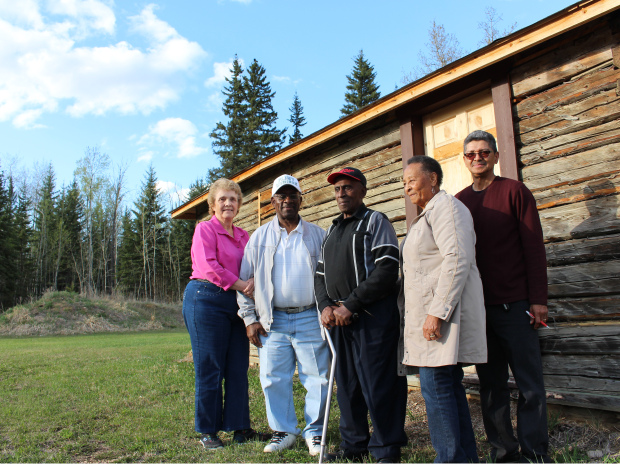
Tristin HopperThe children of Alberta’s black pioneers standing in front of the preserved Amber Valley cabin of Romeo Edwards, April 30, 2016. From left to right, Edith Edwards, brothers Elmer and Ken Edwards, Joyce Edwards and Gilbert Williams. With the exception of Edith, who grew up nearby, all four were born and raised in Amber Valley.

As with so many Western pioneer settlements, Amber Valley’s heyday was shortlived. Born-and-raised Amber Valleyans started striking out for the list of Calgary, Edmonton and Winnipeg by the 1940s, and as parents died the original homesteads were sold.

Source: The black people in the Middle of Nowhere: The lost community of Amber Valley, AB