Citizenship Act C-6 Changes: Witnesses 19 April Meeting

The second set of witnesses at CIMM C-6 hearings had all testified at the C-24 hearings two years ago, with a good cross-section of perspectives, largely focussed on the same issues of revocation, language and knowledge testing.

The most interesting exchange was with respect to Martin Collacott who accused the government of pandering to new Canadian voters in the relaxed residency and language requirements.

Details:

Bernie Farber, now heading the Mosaic Institute, shared his personal family refugee and Holocaust history as a means to personalize what it means to be Canadian citizens and the challenges of being a refugee. He cited research carried out by the Institute on imported conflicts, showing an attitudinal shift towards being more empathetic and recognizing common ground, with very high levels of attachment to Canada (94 percent, with 80 percent feeling more Canadian than anything). Ensuring full participation helps reduce imported trauma, improving both individual lives as well as Canada. He was broadly supportive of the proposed changes. See his op-ed Its Time to End the Stigma of Immigration”.

Sheryl Saperia, of the Foundation for Defence of Democracies, reiterated her past support for the revocation provisions of C-24 for those convicted of terror or treason, believing it an appropriate consequence for these crimes. She did not accept Minister McCallum’s arguments that it created two-classes of citizenship, given that naturalized Canadians chose to become Canadian, and were not forced to become dual citizens. She noted that a Canadian is not always a Canadian, citing the examples of revocation for fraud or war crimes as exceptions. She proposed an alternative approach to revocation, with Ministerial discretion to review the depth of the connection to the other country, with the less active the connection the weaker the case for revocation. Should the government proceed with repealing the revocation provisions, this should be combined with greater deradicalization efforts in Canadian prisons.

Patti Tamara Lenard of University of Ottawa noted that citizenship in democracies is a fundamental right. She went through the previous government’s arguments in favour of revocation. There was no evidence that revocation made states any safer, using Belgium as an example, and that ‘targeting’ of dual citizens undermined security, not strengthening it. Canada was not catching up with other countries, apart from the UK [and Australia], noting that France had abandoned this approach. And public support did not justify measures to curb minority rights, even the ‘most hated’ of Canadians should still have their rights protected. She noted the broader context under which Canadian Muslims felt targeted, citing security certificates and no fly lists, all of which have contributed to their distrust of the Canadian state. Prior discourse had portrayed Canadian Muslims as disloyal and that discrimination was legitimate and inclusive language was needed.

Janet Dench and Jennifer Stone of the Canadian Council for Refugees noted the importance of citizenship for mental health, particularly so for refugees. CCR supports early access to citizenship without discrimination. They supported counting time before permanent residency towards citizenship but focussed on the lengthy processing times for permanent residency for refugees and live-in-caregivers. CCR supported the reduced residency requirements but advocated a waiver if compelling reasons provided. They also supported the reversion to the previous age requirements for knowledge and language (18-54), but noted that some older applicants still struggle to meet these requirements. CCR noted the need for some form of waiver from the high citizenship fees and language assessment, citing the USA example. While pleased that C-24 dual national revocation was being repealed, they noted the need for fraud revocation to be subject to court review. CCR also noted the need for children under 18 to apply for citizenship should they have neither parent nor guardian. Lastly, they argued for repeal of the first generation limit of passing on citizenship to reduce possible future statelessness. See their detailed brief Bill C-6 Citizenship Bill concerns.

R. Reis Pagtakhan, a Winnipeg-based immigration lawyers, is one of few witnesses to date who has changed his position in the past two years. While he remains broadly supportive of revocation for treason or terror, he now believes this should only apply to those convicted in Canadian courts to ensure Charter and related protections apply. He made a forceful statement in favour of the TRC recommendation 94, changing the citizenship oath to include a reference to treaties with Indigenous Peoples. He supported repeal of the intent to reside and credit for pre-permanent residency to count towards citizenship. See his op-ed Canadian citizenship should have 2 tiers, Reis Pagtakhan says.

Martin Collacott opposed shortening the residency requirements, noting that they were among the shortest in the world, allowing some to ‘park’ their families here and work abroad. He was against repealing the intent to reside provision. He thought the change in age requirements particularly ill-considered, particularly for 55-64 year olds who were often still working. He cited the Fraser Institute report on the cost of immigrants to the Canadian economy [Note: its methodology is questionable]. He supported the previous government’s revocation for terror or treason as a reasonable measure, and that most would not be convinced by a “Canadian is a Canadian is a Canadian” in these cases. He noted that citizenship can be used for political gain, using the example of the Clinton presidential campaign in 1996 where 1 million became citizens [surprised he refrained from Canadian examples as there was a surge in new citizens in 2014 and 2015 under the Harper government]. He ended by stressing the need for a full immigration review in terms of who benefits as it was abundantly clear that the current high levels were only serving special interests, certain sectors and political parties, with congestion and higher prices being part of the costs.

Questions:

As in 2014, after the first few hearings, the questions and responses tend to reinforce earlier sessions.

Revocation for terror or treason: Not surprising, a fair amount of questions from both the Government and Conservative side, with the Government challenging Saperia and Collacott’s arguments in particular. Saperia stumbled occasionally in her responses, reverting to talking points and arguing that there was no discrimination between Canadian and dual nationals convicted of the same crime but punished differently. However, she acknowledged that the argument that revocation was exporting terrorists to other countries was the most convincing one.

Revocation for fraud: NDP raised again the question of the pre-C-24 procedural protections and that C-6 did not address these. No witness substantively address this (Audrey Macklin on April 14 did).

Language: There were considerable questions on language requirements, with the Conservatives focussing on the importance of language and the NDP concerned about the cost of language assessment and the requirement to take the knowledge test in an official language. Collacott in his replies stressed the importance of language, particularly for older 55-64 year olds, that ample research demonstrates the link between language and economic integration, noting that lack of language meant having to work in the particular immigrant community with likely poorer economic prospects.

Pagtakhan interestingly posed the question why both with language assessment anyway at the citizenship stage, this should be a requirement when immigrating to Canada, rather than fixing it post facto. CCR reemphasized its previous points on challenges for refugees, who may have additional barriers in terms of ability to learn language, find time given employment and cost. Many applications had been returned given that proof of language had not been provided. Farber noted that the language bar should not be set so high to ‘exclude’; Lenard favoured a relatively low bar as in the USA.

Knowledge: No major Q&As on knowledge requirements although CCR did mention the decline in pass rates following the changes in 2010.

Statelessness: NDP raised as before. Lenard noted that international documents cover statelessness and the right to nationality. It is generally understood that the right to nationality means either having been born or mainly lived in a country.

Pandering for votes: Collacott, in his introductory remark mention of political benefits, drew considerable fire from the government side. He initially ducked the question but then, following a second question challenging him for the evidence, replied that there was considerable evidence over the years regarding Liberal governments. The previous Conservative government had tried to gain support among new Canadians through its policies [Note: he was silent on ‘boutique’ initiatives such as the historical recognition, targeted towards Chinese, Ukrainian, Indo, Italian and Jewish Canadians  and legislation such as the Vietnam Journey to Freedom Act S-219]. He cited the Liberal government having 4 ministers from the Punjabi community and none from the Chinese community in Cabinet as more recent examples.
After Paris, we must tune out the hatred: Farber

Bernie Farber on the need for respectful and sensitive dialogue:

When it comes to these tragic and sensitive issues, there is a dire need for careful and meaningful “dialogue.” We need to create safe spaces for people from different communities and with perspectives to come together, mourn together, learn together, and act together. This cannot be superficial; it needs to be more than holding hands and playing nice. This is complex and long-term work. It does not require that we abandon our beliefs and values, but we do need to move outside of our respective comfort zones.

There will always be people who have no interest in peaceful dialogue, preferring instead to cower behind their computers waiting for the next opportunity to spew their caws of hatred. Dealing with these people can feel like playing a game of “whack-a-mole,” as they duck down and re-emerge from time to time.

The best use of our energies is to drown out these voices by creating platforms for people, communities and organizations who are interested in constructive rather than destructive dialogue. As we have seen, these positive voices are already out there. We just need more opportunities to hear them, and the discipline to tune out everyone else.

Source: After Paris, we must tune out the hatred | Toronto Star

More commentary on Syrian Refugee crisis: Impact of previous policy changes and recommendations what should Canada do?

Syrian_Refugees_MacleansStarting with the use of refugee or migrant:

For most of the Syrians we are hearing about, I would argue, the right term is “refugee.” The origins of that word also belong to the 17th century, when it referred to Protestants who fled religious oppression in a triumphantly Roman Catholic France. Over time the word’s meaning extended to include all those who were escaping war, persecution, or intolerable conditions at home. Kurdi’s family were determined to get away from a civil war that has all but destroyed Syria. They were not making a rational economic decision or a calm political choice. Just like the Vietnamese boat people in the late 1970s, they were fighting for their lives.

Are they refugees or migrants? Why what we call the people fleeing Syria matters

On the implications of the policy changes made to reduce fraud for family sponsorships with respect to Syrian refugees and the Kurdi case:

In earlier humanitarian crises, Canada went directly to the migrants and accepted large numbers quickly. That stands in stark contrast to Thursday’s response from the federal immigration department to the death of a boy found on a beach in Turkey. A group of Canadians had applied to bring in his uncle’s family and hoped to sponsor the boy’s family next. But the family had not been certified as refugees by the UN refugee agency, UNHCR, or a foreign state.

…Canada has required such certification since October, 2012 – when the Syrian crisis was developing – for “group of five” sponsorships, a reference to the minimum number of adult Canadians needed to bring over a refugee family.

…Among the other bureaucratic hurdles is the fact that the waits at visa offices for Canadian officials to review applications – a review that happens after that of the UNHCR – range from 11 months in Beirut to 19 months in Amman to 45 months in Ankara, according to Canadian government figures.

And the immigration department’s central processing office in Winnipeg – which handled the application for the boy’s extended family – takes two or three months to look at applications.

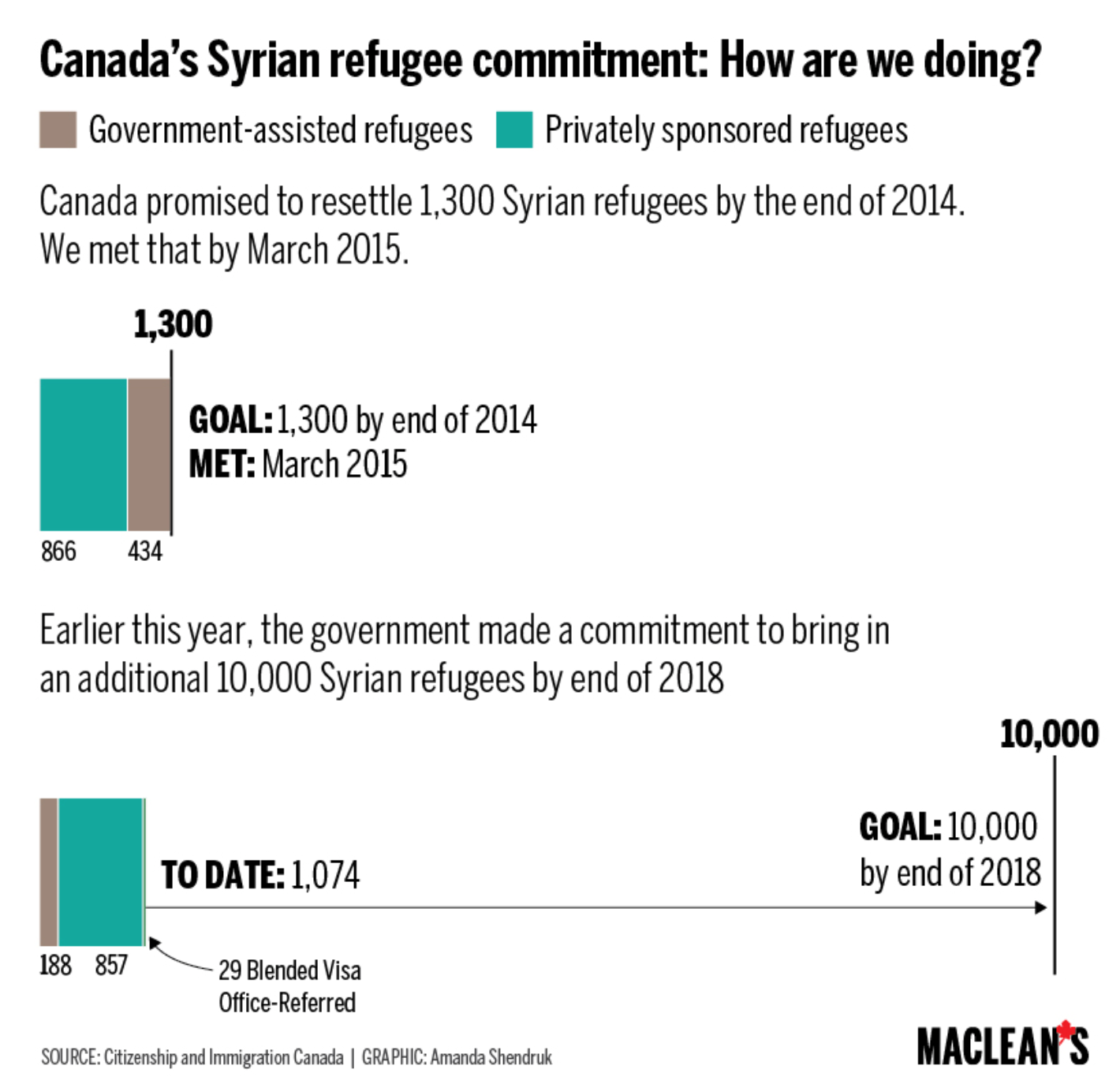
Decades before the current crisis, Canada airlifted 5,000 people from Kosovo in the late 1990s, 5,000 from Uganda in 1972, and 60,000 Vietnamese in 1979-80. From January, 2014, to late last month, Canada resettled 2,374 Syrian refugees.

Canada’s response to refugee crises today a stark contrast to past efforts

Amira Elghawaby and Bernie Farber criticize the Government for providing preference to Christian refugees:

The Canadian government’s departure from established refugee norms began in 2012 with the passage of new laws which created a two-tier system based on country of origin. Canada began to categorize refugee claimants based on group characteristics rather than using a case-by-case approach.

“Group labelling tends to exclude, not welcome. Placing individuals above categoric exclusions is the best way to ensure Canada continues granting asylum to people who need it most,” migration expert Dana Wagner wrote in a 2013 article for the Canadian International Council. It isn’t to deny the role of group identity in understanding why individuals and their families may fear persecution, or violence, in their countries of origin. It is simply to include it as one of many factors that must be examined in an individual’s claim.

While I understand the rationale for their critique, I equally appreciate the Government rationale for its focus on those communities which appear to be most at risk such as Christians and Muslim minorities such as the Yazidis.

 Forget labels when we witness such dire human need 

Ratna Omidvar’s suggests some practical actions:

First: Triple the number of visa officers processing Syrians.

Second: Relax visa requirements out of the European Union.

Third: Canada should grant prima facie refugee status to all Syrians outside their country. Full stop.

Fourth: Allow Syrians in Canada to quickly reunite with their families through a temporary resident permit.

A final requirement is political will. Without it, Canada will neither exceed nor meet its initial pledge.

Practical solutions for refugees flow from political will 

Peter Showler, former head of the Immigration and Refugee Board (IRB):

There are solutions. In addition to the 1979-80 boatlift when Canadians welcomed over 60,000 refugees, Canada has used emergency immigration programs and special teams of immigration officers to bring thousands of refugees quickly from Uganda and Kosovo. Refugees are processed efficiently and quickly and are granted temporary status in Canada. Private sponsorship groups can be enlisted to help them establish in Canada, providing financial support and helping families to integrate into their communities. Later, the refugees can apply for permanent residence from within Canada, if they so choose.

We have done it before. Canada has the expertise and capacity to do it again. Bringing 25,000 Syrian refugees to Canada does not end the war but it saves individual lives and sets an example for other nations to also open their doors. The government often invokes the historical generosity of the Canadian people but has done little to truly encourage it. In 1986, the Canadian people were awarded the Nansen Medal by the United Nations for their extraordinary generosity in welcoming the boat people. It is the only time the medal was given to an entire people.

Canada and its government once again have an opportunity to lead the world to relieve an excruciating humanitarian crisis.

Peter Showler: Canada can do more

Lawrence Hill reminds Canadians of the values at play:

We could do much, much more. We should, and we must. We should live up to the promises we have made – so far undelivered – to accept thousands of Syrian refugees. And then we should increase our quotas and meet them too. We have room for more people. We should send officials in large numbers into refugee camps to process people more expeditiously, cut through red tape, and bring them more quickly to Canada. It’s possible. We’ve done it before. We should demand greater action on the part of our politicians, not just to respond to the crises of famine, war and natural disasters but also to invest more in international development. By helping people develop stronger social and economic infrastructures in their own countries, we help them develop peaceful, organized means to cope with their own crises.

The refugee crisis that rocks the world today belongs to the world. And it belongs to Canada. For one thing, many active, engaged Canadians come from the countries most affected. For another, we have fought in wars – in Afghanistan, for example, and we are now participating in air strikes in Syria – that add to the mayhem forcing people to flee. And we have signed onto refugee conventions committing us to humanitarian principles and action with regard to accepting and assisting refugees. Most important, we owe it to ourselves to respond. To remember what it means to be human. To remember what it means to be Canadian.

 A moment to revisit our Canadian values 

Lastly, some fairly severe criticism of the the role that Gulf countries are (not) playing:

Gulf countries have funded humanitarian aid. Saudi Arabia has donated $18.4-million to the United Nations Syria response fund so far this year, while Kuwait has given more than $304-million, making it the world’s third-largest donor. The United States has given the most, $1.1-billion, and has agreed to resettle about 1,500 Syrians.

….This week, Kuwaiti commentator Fahad Alshelaimi said in a TV interview that his country was too expensive for refugees, but appropriate for laborers.

“You can’t welcome people from another environment and another place who have psychological or nervous system problems or trauma and enter them into societies,” he said.

Cartoonists have lampooned such ideas. One drew a man in traditional Gulf dress behind a door surrounded by barbed wire and pointing a refugee to another door bearing the flag of the European Union.

“Open the door to them now!” the man yells.

Another cartoon shows a Gulf sheikh shaking his finger at a boat full of refugees while flashing a thumbs-up to a rebel fighter in a burning Syria.

…Michael Stephens, the head of the Royal United Services Institute in Qatar, said the decision by the United States not to directly intervene against Assad had left many in the Gulf unsure of how to respond.

“The Gulf Arabs are used to a paradigm in which the West is continuously stepping in to solve the problem, and this time it hasn’t,” Stephens said. “This has left many people looking at the shattered vase on the floor and pointing fingers.”

 Gulf monarchies bristle at criticism over response to Syrian refugee crisis 

Asra Nomani takes a similar tack with a harder edge:

It is not politically correct to utter, but it has to be acknowledged that the arrival of millions of refugees from, yes, mostly Muslim regions raises serious long-term demographic and policing concerns for countries in the West, which will likely see the character and values of their communities completely transformed by refugees who may have values and attitudes about secularism very different from the countries they would be calling home. Already, countries like the United Kingdom struggle with issues of Islamic extremism among legal immigrants that have transformed British culture to the point that London is nicknamed “Londonistan.”

There are serious issues of ideology and identity at risk here.

Reasonable, rational, tolerant folks are saying that the refugee crisis isn’t Europe’s problem to fix, and it is, in fact, a form of reverse racism to let Muslim countries off the hook, as if they are just too backward, intolerant and incapable of finding homes for these refugees. The family of young Aylan, after all, was fleeing Turkey, a Muslim country, for the West, because the father said that the refugees weren’t treated respectfully in Turkey. That is a policy problem in Turkey that needs to be fixed, not displaced to other countries.

Last December, Amnesty International released statistics highlighting that the five Gulf countries—Qatar, United Arab Emirates, Saudi Arabia, Kuwait, and Bahrain—“have offered zero resettlement places to Syrian refugees.”

Mideast Needs To Save Its Own Refugees

Max Yalden championed human rights in Canada

Bernie Farber’s tribute to Max Yalden:

Max Yalden was the consummate civil servant with a twist: he didn’t suffer fools gladly. He played significant roles in two key areas of Canada’s growth as a nation, as Commissioner of Official Languages (1977-1984) and perhaps his most important posting, as Chief Commissioner of the Canadian Human Rights Commission (CHRC) from 1987 to 1996.

He was a studied man who preferred focused research and facts to educate and make his points. His annual reports in both of his key positions are now the stuff of legend. It was Yalden’s goal while overseeing the Official Languages Act to normalize the transition of Canada from a unilingual state to a bilingual nation and eventually as Human Rights Commissioner into a multicultural entity. While not yet perfect, Yalden’s determined work was largely successful.

And while today we essentially take human and civil rights for granted it was not always so. Hatred, bullying and discrimination were commonplace 30 years ago especially when it came to gay and lesbian rights, the status of women, people with disabilities, as well as faith and minority groups. Max Yalden created a “fence of protection” for minorities in this country by ensuring that the Canadian Human Rights Act was a force for good and a vehicle for change.

He viscerally understood that words had power and that evil words could be fraught with danger for minority groups. He was a strong defender of the now-repealed Section 13 of the Canadian Human Rights Act that gave some authority to the commission to deal with hate speech through the Internet. Yalden saw the regulation as a means to teach about the need for decency and civility as opposed to using the heavy hammer of criminal law to punish those who should know better.

…Max Yalden was a man of uncommon dignity. He understood and had compassion for those who often found themselves without a champion. He became their champion. Much of Canada’s progress in the arena of human and civil rights is a direct result of Max Yalden’s vision, courage and determination.

Today, at a time where anti-terrorism laws are being considered that may further restrict our hard-fought-for human rights, where once again Muslims, Jews and others are the subjects of hate and distrust, we could use a Maxwell Yalden to be our champion.

Max Yalden championed human rights in Canada | Toronto Star.

Holocaust memorial should be returned to its rightful home

Op-Ed by Bernie Farber and myself on the Daniel Libeskind memorial of Jewish refugees on the MS St. Louis not admitted to Canada prior to the outbreak of World War II:

The Wheel of Conscience serves as a reminder, in today’s troubled times, of the need for a more understanding and welcoming approach to refugees, whether we’re talking about the millions displaced in the Mideast or the refugee claimants fighting for health-care access here in Canada. And it serves as a reminder, too, of the terrible cost of the opposite approach.

Treating the Wheel as so much junk packed away in a dark warehouse for no one to see is a disgrace. Canadian Holocaust survivors have stated their desire to have the memorial at Pier 21 where it properly deserves to be.

It is time for the federal government under whose auspices Pier 21 operates to take action.

The Wheel of Conscience belongs at the gateway to Canada, where it can stand as a canary in the mine, a cry against inhumanity and intolerance. Let it no longer be a refugee, let it be granted its proper home.

http://t.thestar.com/#/article/opinion/commentary/2014/11/18/holocaust_memorial_should_be_returned_to_its_rightful_home.html

Whether antisemitism or ignorance — it has no place in mayoralty debate | Toronto Star

Good commentary by Bernie Farber on Doug Ford’s response to accusations of antisemitism (his brother’s drunken rant) and resorting to the usual “some of my best friends” line rather than a direct apology.

Lovely story about his father:

Sitting there beside the Mayor and listening to Doug Ford open Doug Fords policard I began to wonder if I had somehow managed to crawl into a time-warp. I recalled a conversation my late father had with a customer in his Ottawa grocery store when I was a child back in the 1960s. “You Jews” the customer said to my father without a hint of disdain “you Jews are smart, hell you’re all doctors and lawyers, how did you get so smart?” My Father looked the customer right in the eye replying in his lovely Yiddish accent “can’t tell you, I’m just a simple grocer.”

I never really believed the customer hated Jews. More so he was ignorant of the slur he had uttered. And like that customer, I don’t believe Doug Ford is an antisemite. I simply believe that he holds views which are ignorant and antiquated belonging in a Toronto of the past. Those are not the qualities we are looking for in a Mayor.

Whether antisemitism or ignorance — it has no place in mayoralty debate | Toronto Star.

Progressive Israel advocate Shira Herzog’s fine lessons | Farber

Good profile by Bernie Farber of the late Shira Herzog on both the personal and broader aspects of her character and role. A reminder of the diversity of voices within the Canadian Jewish community, and the different interpretations of “moral clarity”:

Yet personal criticism, even harsh reprimands from Jewish community leadership, never fazed her. She held her ground with the courage of her convictions. She spoke passionately of the need for peace, of the necessity to understand the folly of occupation — and she did so with a strong Zionist heart and a great love for Israel, the country of her birth.

And by doing so she gave us heart. She showed us that progressive-thinking Jews can, as we do right here in Canada, love a country and still be critical of political policies that don’t measure up to the standards of social justice. Like a good teacher she demonstrated that through reason, devoid of rhetoric but filled with fact and research, people will listen. They may not always agree but they will listen.

Indeed David Koschitzky, the National Chair of the Council for Israel and Jewish Affairs the successor agency to both CJC and CIC said it best in the recent Star obituary:

“Her major theme was fostering rapprochement between the Israelis and the Palestinians. One of her strengths was that she was able to balance her progressive views with calls to recognize the existential challenges confronting the Jewish state.”

This was Shira’s greatest gift to Canadian Jewry. Our community was her classroom and no one who came under her tutelage ever forgot the lessons she imparted.

Progressive Israel advocate Shira Herzog’s fine lessons | Toronto Star.

C-24 Citizenship Act Committee Hearing – 12 May

Committee only heard from the first three witnesses as it went in camera for the second hour (and have not seen any updates since then – will update if needed).

Starting with those supporting the Government approach.

Paul Attia of Immigrants For Canada started off by noting the broad base of his organization and the basic view that citizenship should be viewed as a privilege. If earned, it should be available to all. He supported the increased residency requirements but questioned whether 183 days in 4 years out of 6 was sufficient. All citizens should have language proficiency, as language was a key unifier. His association strongly supports revocation for terrorist activity but the process has to be consistent with Canadian values, constitutional democracy (i.e., formal judicial review required). Similarly with respect to criminal convictions outside Canada, provisions should ensure comparability to Canadian norms.

He finished with a hockey analogy (very Canadian!). If you want to where the team sweater, brandishing his Team Canada sweater, you need to meet the requirements (residency), communicate with team members (language) and not lie to or kill your team members (revocation).

Interestingly, despite the claims of his organization having a broad base of support and many members, their website appears to be largely inactive since 2011. He is also a board member of the Canadian Race Relations Foundation appointed by the government.

Those opposed to the bill.

Avvy Yao-Yao Go of the Toronto Chinese & Southeast Asian Legal Clinic largely reinforced some of the earlier concerns made by CARL and others. Given their clientele, largely refugees and the more vulnerable, her organization strongly opposed the increased residency requirements, removal of time for temporary residents (refugees, live-in caregivers, students, spouses who are conditional Permanent Residents), the intent to reside provision given concerns it could be grounds revocation for fraud, the expansion of language requirements to 55-64, and fee increases. They also oppose revocation for dual citizens, both on substantive reasons (creating differential treatment between mono and dual nationals) as well as process and comparability for foreign convictions to Canadian norms. The overall impact of the bill would be to restrict citizenship in practice, bringing Canada back to an era of discrimination.

Bernie M. Farber and Mitchell J. Goldberg spoke for the Jewish Refugee Action Network (J-RAN), starting off by noting that many refugees when treated with fairness and compassionate become productive citizens, building their lives in Canada. There should be a reasonable path for refugees to become citizens. J-RAN was deeply concerned about the impact on the fee increases (a “cash grab”), increasing language requirements affecting children (hard to see, they will have been in school) and grandparents, and removal of credit for pre-Permanent Residents time. They expressed concern over the intent to reside provision given Charter section 6 (mobility rights) as well as the practical reality that circumstances change for work, study or family reasons. While they have no sympathy for terrorists and criminals, they do not support revocation (“banishment”); such provisions are “unconstitutional and unjust” and such cases should be handled by the criminal justice system. Revocation in cases of fraud was supported.

In questioning, some nuances in positions emerged. In response to CPC/Menegakis, Attia noted need for greater clarity on the intent to reside provision. Liberal McCallum probed further, stating that the Minister had been unclear. Attia confirmed this lack of clarity, stating that the “devil was in the details” on what exactly it meant and how it would be enforced.

There was more interaction between witnesses and MPs who had different perspectives. CPC/Shory pressed J-RAN on revocation, given that terrorism struck at the “bedrock of Canadian identity.” Goldberg picked up on the hockey analogy, “if a heinous act committed against a hockey player, they are penalized, not banished.”

CPC/Shory noted that only 15 percent use pre-Permanent Residents time towards citizenship. NDP/Sitsabaiesan continued to press on this issue with J-RAN and Avvy Go who reaffirmed their positions and noted the apparent contradiction between encouraging Canadian Experience Class immigration while not providing credit for pre-Permanent Residents time.

Witnesses scheduled but not heard included:

Canadian War Brides (Melynda Jarratt,Don Chapman (Lost Canadians)

Amandeep Singh, Singh Thind & Associates

Narindarpal Singh Kang, Law Firm of Kang & Company

I have created a top-level tab for C-24 briefings for those interested (note that not all organizations post their briefs or respond to requests for same) and add a link to transcripts when available (usually about 2 weeks after meetings).

On Passover, speak out against injustice | Farber

A reminder of the historical role that the Jewish community has played in social justice in Canada and elsewhere by Bernie Farber, who is particularly active on refugee as well as a wide array of other issues:

Has this vulnerable past been forgotten? Have we lost empathy for others who continue to face discrimination and require support? A core Jewish value, the directive to leave the world a better place “Tikun olam” seems today a faraway concept.

Today’s Jewish community understandably supports any government that stands behind Israel. Sadly it seems to have done so while suspending its historical connection to issues of social justice.

We understand the existential angst faced by Jews in the Diaspora. In our lifetime there was a wholesale attempted genocide committed against Jews that almost succeeded. We get the need to be supportive of a strong Jewish state.

However, we also know that any government’s support for Israel must not weaken who we are as a community – our belief in human and civil rights and our commitment to human dignity.

Governments need to do more than visit Israel, more than commemorate the Holocaust and more than speak at events in the Jewish community. Support for Israel ought not to blind us to those issues that cry out for our attention.

Today it seems the tent within the Jewish community has little room for voices that demand social change. And make no mistake, those voices exist.

On Passover, speak out against injustice | Toronto Star.

PQ reaps the intolerance it sowed with values charter

Another bad week on identity politics in Quebec and the ugly side of the PQ election and Charter strategy, starting with Graeme Hamilton of the Post:

Following a question about France from Paul Arcand, a radio host on 98.5 FM, Mr. Fontecilla said France is “far from a model” for integrating immigrants. “I would like to point out to Mr. Drainville that the theme of secularism was appropriated by the French right and even the extreme right, [former president Nicolas] Sarkozy and [National Front leader] Marine Le Pen,” he said. He added later that he is surprised the PQ has focused on a charter of Quebec values that promotes a “closing in on ourselves” and “anti-Muslim reactions.”

The PQ’s all-out barrage against Québec Solidaire sounds like a party that doth protest too much. Consider that, in less than a week, two PQ candidates have been caught up in controversy for intolerant comments toward religious minorities.

Jean Carrière stepped down Thursday as a candidate in the Montreal riding of Lafontaine after an image he shared on Facebook declared “F— Islam,” and posts praising Ms. Le Pen, came to light.

Another PQ candidate, college philosophy professor Louise Mailloux, has been allowed to remain as the PQ candidate for Gouin despite declaring last week that she stands behind her writings declaring that kosher and halal food are part of a conspiracy to enrich rabbis and imams and fund religious wars. She also likened circumcision and baptism to rape.

Graeme Hamilton: PQ reaps the intolerance it sowed with values charter | National Post.

Bernie Farber in the Star piles on, correctly so on Marois’ refusal to dissociate herself with Mailloux:

Many in the Jewish community are stunned by these developments, even though they have heard Marois categorically state that the PQ is not an anti-Semitic party. Indeed, Marois told journalists last week that the PQ counts many friends among the Jewish community leadership. Sounds an awful lot like some of my best friends are …
This past weekend, in a dismal attempt at damage control, Mailloux offered her version of an apology. She said she never meant to “offend anyone” and apologized if she did. There was no contrition or acknowledgment that the “kosher tax” was in fact an anti-Semitic deception. Jewish groups quite rightly rejected her apology.
This latest trek down bigotry’s path, along with the discriminatory Charter of Quebec Values, is giving many in Quebec’s faith and ethnic communities a legitimate scare. It is time we hold politicians who make such absurd comments accountable. And it is more than time that we reject political leaders who embrace the path of ethnic and faith intolerance.

Parti Québécois candidate revives an anti-Semitic lie

Surprising the that blog post in question by Mailloux is still up:

Le poulet sacré