Is a waning Canadian dream fuelling reverse migration in Punjab?

Of note:

It’s hard to miss the ardour of Punjab’s migrant ambitions when driving through its fertile rural plains.

Billboards promising easy immigration to Canada, Australia, New Zealand and the UK jut out through ample mustard fields.

Off the highways, consultancies offer English language coaching to eager youth.

Single-storey brick homes double up as canvasses for hand-painted mural advertisements promising quick visas. And in the town of Bathinda, hundreds of agents jostle for space on a single narrow street, pledging to speed up the youth’s runaway dreams.

For over a century, this province in India’s northwest has seen waves of overseas migration; from the Sikh soldiers inducted into the British Indian Army travelling to Canada, through to rural Punjabis settling in England post-independence.

But some, especially from Canada, are now choosing to come back home.

One of those is 28-year-old Balkar, who returned in early 2023 after just one year in Toronto. Citizenship was his ultimate goal when he left his little hamlet of Pitho in the wake of the Covid-19 pandemic. His family mortgaged their land to fund his education.

But his Canadian dream quickly lost its allure a few months into his life there.

“Everything was so expensive. I had to work 50 hours every week after college, just to survive,” he told the BBC. “High inflation is making many students leave their studies.”

Balkar now runs an embroidery business from a small room on one side of the expansive central courtyard in his typical Punjabi home. He also helps on his family’s farm to supplement his income.

Opportunities for employment are few and far between in these rural areas, but technology has allowed entrepreneurs like him to conquer the tyranny of distance. Balkar gets the bulk of his business through Instagram.

“I have a good life here. Why should I face hardships there when I can live at home and make good money?” he asks.

The BBC spoke to at least half a dozen reverse migrants in Punjab who shared similar sentiments.

It was also a common refrain in the scores of videos on YouTube shared by Indians who had chosen to abandon their life in Canada and return home. There was a stark difference one young returnee told the BBC between the “rosy picture” immigration agents painted and the rough reality of immigrant life in Toronto and Vancouver.

Immigration services are a big business in Punjab

The “Canada craze” has let up a bit – and especially so among well-off migrants who have a fallback option at home, says Raj Karan Brar, an immigration agent in Bathinda who helps hundreds of Punjabis get permanent residencies and student visas every year.

The desire for a Canadian citizenship remains as strong as ever though among middle- and lower middle-class clients in rural communities.

But viral YouTube videos of students talking about the difficulty in finding jobs and protests over a lack of housing and work opportunities has created an air of nervousness among these students, say immigration agents.

There was a 40% decline in applications from India for Canadian study permits in the second half of 2023, according to one estimate. This was, in part, also due to the ongoing diplomatic tensions between India and Canada over allegations Indian agents were involved in the murder of Canadian Sikh separatist leader Hardeep Singh Nijjar.

There are also hints of deeper cultural factors at play, for a waning Canadian dream among an older generation of Indian migrants.

Karan Aulakh, who spent nearly 15 years in Edmonton and achieved career and financial success, left his managerial job for a comfortable rural life in Khane ki Daab, the village where he was born in 1985.

He told the BBC he was upset by LGBT-inclusive education policies in Canada and its 2018 decision to legalise recreational cannabis.

Incompatibility with the Western way of life, a struggling healthcare system, and better economic prospects in India were, he said, key reasons why many older Canadian Indians are preparing to leave the country.

“I started an online consultancy – Back to the Motherland – a month and a half ago, to help those who want to reverse migrate. I get at least two to three calls every day, mostly from people in Canada who want to know what job opportunities there are in Punjab and how they can come back,” said Mr Aulakh.

For a country that places such a high value on immigration, these trends are “concerning” and are “being received with a bit of a sting politically”, says Daniel Bernhard of the Institute of Canadian Citizenship, an immigration advocacy group.

A liberalised immigration regime has been Prime Minister Justin Trudeau’s signature policy to counter slowing economic growth and a rapidly aging population.

According to Canada’s statistics agency, immigration accounted for 90% of Canada’s labour force growth and 75% of population growth in 2021.

International students contribute to over C$20bn ($14.7bn; £11.7bn) to Canada’s economy each year, a bulk of them Indians who now make up one in five recent immigrants to the country.

India was also Canada’s leading source for immigration in 2022.

The numbers of those leaving are still small in absolute terms with immigration levels at all-time highs in Canada – the country welcomed nearly half a million new migrants each year over the past few years.

But the rate of reverse migration hit a two decade high in 2019, signalling that migrants were “losing confidence” in the country said Mr Bernhard.

Country specific statistics for such emigrants, or reverse migrants, are not available.

But official data obtained by Reuters shows between 80,000 and 90,000 immigrants left Canada in 2021 and 2022 and either went back to their countries, or onward elsewhere.

Some 42,000 people departed in the first half of 2023.

Fewer permanent residents are also going on to become Canadian citizens, according to census data cited by the Institute for Canadian Citizenship. In 2001, 75% of those eligible became citizens. Two decades later, it was 45%.

Canada needs to “restore the value of its citizenship,” said Mr Bernhard.

It comes as Canada debates its aggressive immigration targets given country’s struggle to absorb more people.

A recent report from National Bank of Canada economists cautioned that the population growth was putting pressure on its already tight housing supply and strained healthcare system.

Canada has seen a population surge – an increase of 1.2 million people in 2023 – driven mostly by newcomers.

The report argued that growth needed to be slowed to an annual increase of up to 500,000 people in order to preserve or increase the standard of living.

There appears to have been a tacit acceptance of this evaluation by policymakers.

Mr Trudeau’s Liberal government recently introduced a cap on international student permits that would result in a temporary decrease of 35% in approved study visas.

It’s a significant policy shift that some believe may end up further reducing Canada’s appeal amid a wave of reverse migrations.

Source: Is a waning Canadian dream fuelling reverse migration in Punjab?

Identity 2016: ‘Global citizenship’ rising, poll suggests – BBC News

Identity_2016___Global_citizenship__rising__poll_suggests_-_BBC_NewsWhile the term “global citizenship” likely is interpreted differently, still an interesting divide between developed and developing countries:

People are increasingly identifying themselves as global rather than national citizens, according to a BBC World Service poll.

The trend is particularly marked in emerging economies, where people see themselves as outward looking and internationally minded.

However, in Germany fewer people say they feel like global citizens now, compared with 2001.

Pollsters GlobeScan questioned more than 20,000 people in 18 countries.

More than half of those asked (56%) in emerging economies saw themselves first and foremost as global citizens rather than national citizens.

In Nigeria (73%), China (71%), Peru (70%) and India (67%) the data is particularly marked.

By contrast, the trend in the industrialised nations seems to be heading in the opposite direction.

In these richer nations, the concept of global citizenship appears to have taken a serious hit after the financial crash of 2008. In Germany, for example, only 30% of respondents see themselves as global citizens.

Source: Identity 2016: ‘Global citizenship’ rising, poll suggests – BBC News

How is Islam represented on the BBC? And in the New York Times

With respect to the BBC:

What the study showed is that the BBC news tends to reproduce dominant discourses about Islam, partly as a result of news-gathering and production processes. For example, there has been significant criticism of its use of extreme news sources, such as Anjem Choudary, on its flagship news programme Newsnight. However, due to its remit as a PSB, it is required to listen to audiences, and this is sometimes evident in its news reporting – where it has more recently included a wider range of Muslims voices and has been more careful in its use of language.

We were able to demonstrate that, when you step outside the news format, with its extensive focus on conflict and terrorism, there is evidence of more diversity. Sometimes, the BBC makes a point of including Muslims in programming unrelated to Islam such as Eastenders and The British Bake Off. Aaqil Ahmed has continued to commission series that challenge dominant tropes about Islam; Make me a Muslim (2014), Welcome to the Mosque (2015) and Britain’s Muslims Soldiers (2016).

But there is a long way to go. News images of Islam continue to dominate media coverage, and are more likely to be reproduced than the niche programming described here. The last BBC Annual Report (2015) showed a reduction in hours dedicated to religious broadcasting; given that 5% of references to religion came from within this despite only accounting for 1% of airtime, it clearly remains a significant resource for representations of religion.

Some commentators have suggested that, due to media fragmentation which has seen the BBC’s share of the audience drop in recent years, media representation no longer matters, particularly as younger people watch less and less television and consume distinct, personalised services. But the BBC has an influence beyond its television broadcasting and immediate audience. As a PSB, it has a responsibility to reflect national culture(s) and minority interests. And in an era of increased commercialisation and privatisation, it does this better than most providers.

Source: How is Islam represented on the BBC? | openDemocracy

By way of comparisons, another study looked  at the New York Times:

The New York Times portrays Islam and Muslims more negatively than cancer, cocaine and alcohol, according to a report that studied the newspaper’s headlines.

“Since 9/11, many media outlets began profiteering from the anti-Muslim climate. Though you could probably trace a similar trend back to the Iranian Revolution,” said Steven Zhou, head of Investigations and Civic Engagement and co-author of the study ‘Are Muslims Collectively Responsible? A Sentiment Analysis of the New York Times.’

“We talk a lot about media and Islamophobia, but nobody has done the math. So, we thought it is long overdue to have a quantitative investigation of an agenda-setting newspaper,” Zhou told the Middle East U.S. Policy watchdog Mondoweiss Friday.

The study, which was conducted by Toronto-based 416 Labs, looked at New York Times headlines from the period 1990-2014. Researchers found that Islam and Muslims were “consistently associated with negative terms,” at least 57 percent of the time, says the study. Only 8 percent of news headlines about Islam/Muslims was positive.

The most frequent terms associated with Islam/Muslims include “Rebels” and “Militant.” None of the 25 most frequently occurring terms were positive.

Compared to all the other benchmarked terms (such as Republican, Democrat, Cancer, Cocaine, Christianity and Alcohol), Islam/Muslims had the highest incidents of negative terms throughout the 25-year period by a long shot. The following were cocaine and cancer, with 47 and 34 percent of their coverage associated with negative terminology.

“When we went into it we didn’t think it would be surprising if Islam was one of the most negatively portrayed topics in the NYT,” says co-author Usaid Siddiqui. “What did really surprise us was that compared with something as inherently negative as cancer, Islam still tends to be more negative.”

The New York Times Presents Islam More Negatively than Cancer and Cocaine

US election 2016: What does ‘Islam’ think of America? – BBC News

Useful summary of what some of the polling data indicates:

The Pew Research Centre, which surveys global attitudes, said anti-Americanism was strong around the word around the time of the US invasion of Iraq.

However, currently there is little evidence of profound anti-American sentiment except for in a handful of countries, it says.

Bruce Stokes, director of global economic attitudes at Pew, says sentiment towards the US varies widely between Muslim-majority countries.

“We tend to see more negative sentiment among Muslims in the Middle East, such as those from Egypt and Jordan,” he says.

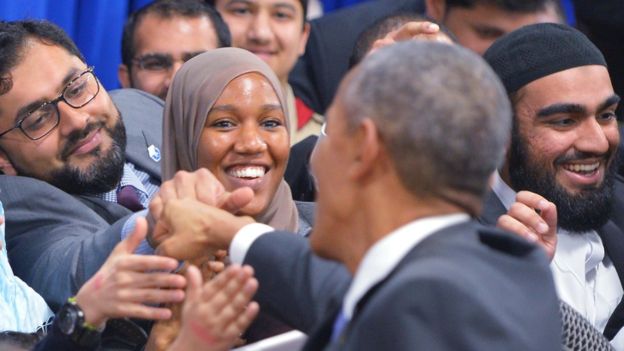
Barack Obama meeting American MuslimsImage copyrightGetty Image
“But Muslims outside the Middle East generally have a more positive outlook,” he adds.

In Indonesia, the world’s most populous Muslim country, 62% of people hold a favourable opinion of the US, Pew’s latest data suggests.

That figure rises to 80% in Senegal, a country which is over 90% Muslim. Mr Stokes points out that this is a stronger approval rate than Germany.

“Attitudes have also been changing over time. We’ve seen a gradual rise in positive sentiment since President Barack Obama came to power,” Mr Stokes says.

“Even in the Palestinian Territories, where sentiment is 70% unfavourable, that’s an improvement on 82% in Barack Obama’s first year.”

The BBC World Service commissioned its own poll of global attitudes in 24 countries in 2014.

Among other things, it asked respondents if they thought the US “had a mainly positive or mainly negative influence in the world”.

Pakistanis generally held the worst view of the US, with 61% saying the US had a negative influence.

But both China and Germany were not far behind, scoring 59% and 57% respectively.

Turkey, almost 98% Muslim, was split between 36% positive, 36% negative and 28% neutral.

Source: US election 2016: What does ‘Islam’ think of America? – BBC News