Immigration Minister says his department has shifted focus to international student visas as many await last-minute approval

Yet the latest example of management weaknesses at IRCC as it appears to lurch from one program backlog to another. The risk is, of course, that the shift in resources to address student visas will adversely impact other programs, leading to future negative headlines:

Immigration Minister Sean Fraser says his department has shifted its focus toward tackling backlogs in student visa applications, as many students who have been accepted to attend Canadian universities and colleges this semester wait nervously for their immigration approvals.

The minister made the comments Monday as part of the first news conference by the task force to improve government services. Prime Minister Justin Trudeau announced the team of cabinet ministers in June when the federal government was facing heavy public criticism for failing to provide basic services, such as timely passport delivery or efficient traveller processing at Canadian airports.

Mr. Fraser said his department recently shifted its focus away from work permits to tackle the demand for student visas.

“We had been focusing over the course of the summer on processing as many work permits as possible to help address the labour shortage. We’ve made a pivot, and through the month of August, we expect that we’re going to process a little more than 104,000 additional study permits,” he said. “There has been an absolute explosion in demand when it comes to Canada’s International Student Program in recent years.”

The student visa delays recently prompted a complaint from the Indian High Commission in Ottawa. India is the largest source country for international postsecondary students.

In addition to Mr. Fraser’s update, Monday’s news conference included assurances from Families, Children and Social Development Minister Karina Gould that passport wait times had improved and an update from Transport Minister Omar Alghabra, who said delays and cancelled flights have been dramatically reduced.

Opposition MPs said the task force is little more than a public relations exercise. They also say some of the improvements in areas such as passports and travel delays can be attributed to the fact that the summer travel season is coming to an end.

As for the Immigration Minister’s comments about student visas, Conservative and NDP MPs said this is part of a continuing pattern of shifting focus from one crisis to another, which they say ultimately creates bigger problems for the system as a whole.

Conservative MP Jasraj Singh Hallan said the students awaiting visas are expecting to start classes shortly.

“There are many students that are still left in limbo in this immigration backlog,” he said. As for the task force, he said many of the members are the same ministers who are ultimately responsible for the service issues.

“This task force really hasn’t shown or done anything yet,” he said.

NDP MP Jenny Kwan said Canada’s immigration system, including student visa applications, is in a state of chaos. She said operating in a constant state of “crisis management mode” is not sustainable.

Ms. Kwan said there should be independent reviews of the key departments to determine why services are failing.

“The task force was established as a political cover-up,” she said.

International students from outside Canada pay tuition that is often more than two or three times higher than those paid by domestic students.

Naman Gupta, a 22-year-old student in New Delhi, India, was planning to attend York University this fall to pursue a postgraduate certificate.

His study permit has not come through and he said unless something changes in a matter of days, he’ll defer coming to Canada until the start of the January term. However the $17,000 in tuition he paid won’t be returned in the meantime, he said.

“It’s going to be tough. All my plans are held up,” Mr. Gupta said. “I’m pretty stressed.”

He said he expected the visa processing would have been expedited to ensure that students could arrive in time for the start of their courses.

“I would’ve appreciated if they could apply more compassion to the situation,” Mr. Gupta said. “The response is slow.”

Pallavi Dang, who lives in New Delhi, applied for her study permit in March. She’s disappointed that more than five months later she still hasn’t heard whether she will be approved. Department guidelines said respondents can normally expect an answer in eight weeks, and that current average processing times are about 12 weeks.

She said she had made plans to hand over her business while she was away, but now she’ll need to change course.

“All that planning is on hold,” Ms. Dang said. “I’m not able to take another step.”

Paul Davidson, president of Universities Canada, an umbrella group that lobbies on behalf of nearly 100 Canadian universities, said Canada trails countries such as Britain and Australia in visa processing.

He said there has to be more federal government investment in IT capacity to speed up processing.

“I think that’s really the solution,” Mr. Davidson said. “There’s all-party support for international students, there’s a good policy climate, but it’s the operational reality that needs to improve.”

Source: Immigration Minister says his department has shifted focus to international student visas as many await last-minute approval

More than 1.3 million immigration applications still in backlog

Will see what the data shows in coming months, as well as the various media coverage of specific cases. Usual approach of throwing money and people rather than fundamental policy and program changes.

In one sense, almost the “citizenshipization” of immigration programs, as the citizenship program has a history of growing backlogs that are addressed, when too politically embarrassing, by an injection of funds (happened under Liberal Minister Volpe and Conservative Minister Alexander):

Canada’s immigration minister now projects it will only take a few months longer than originally hoped to get application wait times back on track, even though the crisis in Ukraine and other “external” events have worsened the backlogs.

In January, Immigration Minister Sean Fraser vowed to eliminate backlogs caused by the COVID-19 pandemic by the end of the year. That was before Canada launched a major response to the refugee crisis sparked by the Russian invasion of Ukraine and approved hundreds of thousands of Ukrainians and their families to come to Canada temporarily to escape the war.

Those efforts, combined with updates to the government’s aging technology, have led to longer waits for people who want to come to Canada, Fraser said.

As of the end of July, approximately 1.3 million immigration applications in the system have taken longer to process than the government’s service standards dictate they should. That’s about 54 per cent of all the pending applications in the system.

In an interview with The Canadian Press, Fraser said the department may need a few extra months before all immigration streams are back to normal processing times.

“Based on what we’re looking at right now, we shouldn’t be too, too far off the projection of getting back to service standards for work and study permits by the end of this year, and I expect that within a few months of that the visitors visas will be back to service standards,” Fraser said.

That’s barring any new international disasters, he said.

New hiring spree to address backlog

While dealing with the backlogs and humanitarian crises, the Canadian immigration system is also fielding unprecedented demand, Fraser said.

As of July 31, Immigration, Refugees and Citizenship Canada issued more than 349,000 new work permits so far this year, compared to 199,000 in all of 2021.

At a news conference Wednesday, Fraser announced the Immigration Department is in the midst of a hiring spree to bring 1,250 new employees on board by the end of the fall to tackle the massive backlogs in processing applications and the increased demand.

Fraser said the new hires have so far allowed the government to get the waits back on track for new applicants to the express entry permanent residence program, which is the main economic stream for new permanent residents to Canada.

“In the weeks and months ahead there’s going to be a series of new measures that we’re going to be releasing that’s going to help bring workers here more quickly, make it simpler for families to be reunited with their loved ones, and to hold ourselves accountable by being transparent,” Fraser said at the news conference outside of the Vancouver Convention Centre.

The backlogs have been of growing concern since shortly after the pandemic began, when health restrictions made borders more difficult to cross and immigration slowed considerably.

At the end of last year, the government dedicated $85 million to reducing wait times. Another $187.3 million was set aside for the next five years in the 2022 budget.

In June, the prime minister announced ministers would form a task force to deal with growing delays for immigration applications and other government services.

Source: More than 1.3 million immigration applications still in backlog

Feds announce four new passport service sites as backlog continues

https://www.cbc.ca/player/play/2063068227573

Good service improvement move but will have limited impact on backlog. That being said, Service Canada data indicates progress compared to earlier months, although the number of applications is still greater than the number of passports issued.

Hopefully, ESDC/Service Canada and IRCC will publish monthly passport stats (applications and issued) on opendata as per other immigration and citizenship stats:

The federal government is adding new passport service locations across Canada as a backlog in processing applications continues.

Social Development Minister Karina Gould announced Wednesday that people can now apply for and pick up passports at Service Canada centres in Red Deer, Alta., Sault Ste. Marie, Ont., Trois-Rivières, Que., and Charlottetown, P.E.I.

That’s on top of five new locations added in July, and Gould expects to bring another seven to nine locations into the program soon.

“I think this is a really important and long-overdue change,” she said in an interview. “Those of us who live in more urban areas, we don’t realize that we’re so lucky to be close to a passport office.”

The additions should make it easier for people outside large centres to access services and ease stress on offices in regional hubs, she added.

No new federal money was required to make the change, Gould said. Resources come out of a revolving fund made up of passport fees. 

Gould said the current crisis and complaints over long wait times have accelerated the work but she was already looking at bringing passport services to more locations before the backlog.

She visited Sault Ste. Marie in April, before media began reporting on complaints over wait times. The local Liberal MP, Terry Sheehan, told Gould that people in the Sault had to drive seven or eight hours to Thunder Bay or Toronto to visit a passport office in person. 

Until Wednesday, there was no passport office on Prince Edward Island.

“So I was starting to already look at who is not close, and how can we fix this,” she said. “And then it became that much more acute.” 

Nearly 1.1 million applications for new and renewed passports have been filed since April as pandemic restrictions loosen and Canadians resume travelling. 

More than one-quarter of those hadn’t yet been processed as of early August.

Government statistics show the system is starting to catch up with demand, as the gulf between the number of passport applications each month versus the number of passports issued is getting smaller. 

Call centre wait times have gone down significantly and “triage measures” were implemented at 17 passport offices to mitigate in-person headaches.

Gould said 442 new employees were hired so far this summer and 300 are already trained and working.

But a large backlog remains.

In the first week of August, the number of passports issued within 40 business days of an application fell to 72 per cent from 81 per cent the week before.

That is largely because of mailed applications.

During the first week of August, passports from in-person applications were issued within the government’s 10-day service standard 95 per cent of the time, a rate that has remained steady throughout the summer.

For mailed applications the service standard of 20 days was met only 40 per cent of the time in early August, down from 53 per cent in late July. The government also warns it can take more than 13 weeks to get your passport by mail.

The overall numbers aren’t materially better than in June, when Prime Minister Justin Trudeau was forced to respond to growing complaints and called the system’s performance “unacceptable.” 

The week of June 20, 76 per cent of passports were issued within 40 business days.

The processing times also don’t take into account the wait to get an in-person appointment and there are only a limited number of walk-ins available.

Proof of upcoming travel is required to get service within two months at offices with 10-day processing times, including those announced Wednesday.

Urgent services for people who can prove they need a passport within 48 hours are only available in bigger urban centres — Toronto, Montreal, Vancouver, Calgary, Edmonton, Gatineau, Que., and Quebec City.

As the backlash over the wait times continues, some reports suggest Canadians are making “fake” travel plans to show to passport officers, then cancelling their flights once their application is in the queue. 

Gould said she’s not aware of this being a “widespread issue” but she has heard about it anecdotally. “I strongly discourage Canadians to do that. It’s unfair, it’s unkind and it’s unnecessary,” she said. 

Gould said at the morning press conference that the government failed to predict to what extent demand would sharply spike earlier this year. She insisted an unexpected glut of mailed-in applications is the main culprit in the passport delays.

Although she wouldn’t comment on the specifics of its deliberations, she said a cabinet committee stood up earlier this year — the Task Force on Services to Canadians — is looking at how to make sure that services under federal jurisdiction are being delivered in “a timely and effective way” that takes the toll of the pandemic into account.

Source: Feds announce four new passport service sites as backlog continues

Passport delays spur some Canadians to game the system with fake travel plans

Ongoing saga. Understandable that some would feel need to game the system or engage line-up placeholders:

Canadians are getting creative trying to cut the long waits for passports that have been dragging on for close to five months after a surge in post-pandemic travel demand overwhelmed the system.

By Aug. 11, a total of 1,092,560 passport applications had been filed this year – with more than 550,000 of those applications flooding in since April.

Service Canada said it’s prioritizing the applications of people traveling imminently, increasing staff and processing sites.

Despite all this, applicants say they are spending thousands of dollars to travel to less-busy passport offices — or even faking travel plans to speed the process to beat the 340,000-application backlog.

Federal officials say they are working to fix the problem.

Fake trips impact entire system

Karina Gould, the minister responsible for passport services, said Canadians are getting their passports on time, and there’s no need to “fake” travel — booking a flight you do not plan to take — to be eligible for Passport Canada’s urgent 48-hour approval mechanism.

“That impacts the whole system. There are a lot of people who did the right thing. They sent off their passports well in advance. Their applications are impacted by anyone who books fake travel,” Gould told CBC in a phone interview on Friday.

She had heard of the practice, but doubts it is widespread.

“I would be very disappointed to hear that, because that would be putting additional pressure on a system that is already pressured,” said Gould.

Meanwhile in Toronto, a man who CBC agreed to call Robert, said he has spent the past 59 days organizing 10 staffers to hold spots in lineups for about 500 absent passport applicants.

He said he has earned up to $1,000 per day offering this service.

No passport number needed to book many online flights

“Most of my customers book fake flights just to get their passports so they can drive across [the border],” said Robert.

“You’re going through more hoops to drive across [the border] than to fly. So what they do is just book a fake flight. It’s usually Toronto to New York or Toronto to Miami, and within 24 hours, they cancel it,” he said of his customers.

Multiple travel agents and Air Canada confirmed that many flights can be booked online without a passport number, and full-fare or business class ticket is often refundable.

Other travellers head to out-of-province Service Canada offices where the lines are not so long, with some citing shorter waits in Halifax or St. John’s.

St. John’s photographer Robert Young often gets called on for passport photos.

He said lately more travellers from other parts of Canada are utilizing the passport processing services in at Newfoundland.

“We’ve always gotten people from the edges of the world — like Pangnirtung (Baffin Island) — but now they are showing up from bigger cities,” said Young.

Government promises fix is working

Gould said lineups have decreased with the hiring of 500 new staffers, extended hours and the prioritizing of applicants with imminent travel plans, within 48 hours.

Back on July 25, Service Canada expanded passport pick-up services, adding five more locations in Ontario, Quebec, Alberta and B.C. to the 29 existing passport offices.

In Ontario and Quebec, a business has popped up to deal with the long waits for passport applications. Line standers charge about $40-$60 per hour or a flat fee of about $240 to line up at dawn and hold applicant’s place so they can apply to get a Canadian passport or renewal. (Roger Thompson)

This and other measures – like transferring application files to one of the 300 Service Canada offices upon request — aimed to reduce passport processing waits.

But many who mailed in applications last spring say the turnaround remains sluggish.

It’s difficult to get anybody on the phone or get an accurate status on an application, according to many applicants, including Paula Langley, a Canadian living in the U.S. who applied for a new passport in April.

Updates difficult to get

“The biggest problem is people being unable to get an answer about where in the process their passport is. I think the issue is partially technology. They are likely using outdated software. Other countries let you check your status in an online portal,” said Langley.

“It is very difficult to even get somebody on the phone to ask questions. The 1-800 number just cuts off after the queue of callers gets too high.”

On Passport Canada’s website, delivery is promised in 46 days or six and a half weeks. But anyone needing a passport within two business days can go to specialized sites offering urgent service, if they have proof of travel.

The government’s plan was to ease backlogs, but it’s given some a chance to jump the queue by booking and then cancelling travel.

Broken system

“It’s upsetting,” said Leanne MacLeod who runs Getaways by Leanne out of Toronto and offers passport advice online. What’s not helping, she said, is booking a “fake” trip that you cancel to get travel documents.

“I’ve seen people recommend booking a refundable hotel, then cancelling,” she said. “It’s really what’s holding up the whole process right now. For every person who gets ahead, one gets bumped.”

Taylor Bachrach, the New Democratic Party’s transport critic, said the fact that people are trying to work around the system is evidence it’s not working.

“It shows how frustrated people are and the lengths they are willing to go,” said Bachrach.

“If people are having to ‘game’ the system to get their documents, that shows how broken the system is.”

People in his Skeena Bulkley Valley constituency in Northern B.C. live a 12-hour drive from the nearest passport office.

Bachrach has one staffer who has spent the past several weeks devoted to helping constituents secure passports.

Family trips at risk

“I have a constituent whose family needed to travel to the United States, and we were able to work with the federal government to arrange for the passports to be picked up. But he had to incur $2,000 in extra travel costs to get from here in Smithers, B.C., all the way to Victoria to pick up the passports. … This obviously has a big impact on people.”

Bachrach said these months of passport chaos are “unacceptable.”

“The increased demand for passports was entirely predictable. But the Liberals failed to act even though they had months to prepare for travel to return.”

That lack of foresight has left many Canadians apprehensive, with only a few weeks of summer left. Joseph Ivens of Terrace, B.C., applied to renew his two teens’ passports back on April 4.

The family of five has saved for a trip to Mexico for four years. The flight is booked for Aug. 27, but the passports have not come.

Minister promises family passports are coming

The father of three said he’s made hundreds of calls, several requests for a file transfer and appealed to his member of parliament. He may be forced to travel to Calgary or Vancouver at the last minute to try to secure the travel documents so the holiday is not lost.

“It’s causing my family massive stress with loss of sleep. It’s breaking us,” said Ivens. “I have no recourse.”

Gould, the minister responsible for passport services, told CBC on Friday that Ivens will get travel documents on time.

“He will get his passport. I understand people are stressed, but everyone is getting their passport on time,” said Gould.

Source: Passport delays spur some Canadians to game the system with fake travel plans

Hospital staff shortages: Immigration backlog leaves professionals on sidelines

Of note, appears that the bottleneck more immigration-related than credential recognition delays:

As hospitals across the country struggle under the weight of major staffing shortages, an immigration backlog described by lawyers as the worst they have ever seen is leaving qualified health professionals sitting on the sidelines.

In Februrary 2021, Sharlene Ullani applied for a permanent resident card after years spent working in Canada as a caregiver for children. Eighteen months later, the internationally trained nurse with more than seven years experience hasn’t heard anything from Immigration Canada about her application status.

Online, the government estimates the processing time for new permanent residence cards is 2.6 months, or 81 days, as of Aug. 2.

“I’ve been sending emails two times a month and the answer is always the same: ‘You have to wait, thank you for your patience. We have this pandemic’,” she told CTV National News.

Ullani currently holds a temporary work permit, but it does not allow her to switch jobs — even from a caregiver for children to a caregiver for adults — without losing status. In the months since she filled an application for permanent residency, Ullani has written exams and completed the paperwork necessary to get her foreign credentials translated into a valid licence to work in Ontario as a registered practical nurse.

“It is heartbreaking to see nurses working so hard and we are here, willing to help,” she said. “We are willing to help, but we cannot do so because of our status.”

The Registered Nurses’ Association of Ontario said there are roughly 26,000 nurses “ready and waiting” to work in Ontario, 14,000 of those are registered nurses. CEO Doris Grinspun says the great majority of those people are waiting for their international qualifications to get approved by the college, but thousands have already passed their exams and are waiting for their immigration status to change so they can work.

“The big impact of the backlog for patients is that they are either being short changed in the quality of care or they are not getting care all together,” she said. “If you look at home care, they are likely not getting care all together. If you look at ICU or ER that are closing down or shrinking, even in an emergency, it is desperation.”

Recently, Grinspun worked with the federal government to approve the immigration applications of 26 nurses. Given the health care staffing crisis across the country, Grinspun said the government should prioritize applications filed on behalf of applicants with backgrounds in health care, especially nurses.

“Having internationally trained nurses, RPN … able to join the workforce when they are ready to work in Ontario, and especially those who have already passed their exams and are just waiting on work permits by the feds, move them on. Move them on because nurses and patients need them desperately,” she said.

Speaking at a press conference in Ottawa on Thursday, NDP leader Jagmeet SIngh echoed Grinspun’s calls, saying he has called on Ottawa to implement a fast track immigration system for qualified health-care workers. Singh said he does not know why Ottawa has not yet followed through.

“There is no excuse for this,” Singh said. “I can’t understand why the government is not willing to do this… We need to respond in an urgent way because these are folks who can work here and want to work here.”

In June, the immigration department said more than 2.4 million applications were in the backlog, up from 2.1 million in June. CTV News reached out to the department multiple times for updated figures, but did not hear back at the time of publishing. The department said it usually takes five business days to process and gather statistical data.

Toronto Immigration lawyer Chantal Desloges attributes the backlog to a “perfect storm” of factors related to the early days of the COVID-19 pandemic, when many embassies and consulates closed and immigration staff started working from home.

“When everyone else was doing business online, it wasn’t that easy for the government to pivot,” she said. Desloges added that when offices were closed, applications were still being submitted, but nobody was there to process them.

“All of these things happening at the same time just made a toxic soup of circumstances.”

To speed up the process, Desloges said immigration staff who can’t do 100 per cent of their job from home should be ordered back into the office. She also suggests the government could expedite the approval process by reducing the number and frequency of applicant interviews.

“It is really hard to predict how long it is going to take to sort this mess out, if ever,” she said.

On Tuesday, Immigration, Refugees and Citizenship Canada (IRCC) introduced new measures to speed up the processing of applications for foreign nationals with expired or expiring post-graduation work permits, and for temporary resident to permanent residence pathway applicants. Under the change, individuals in either of those cases will have their current work permits extended while their applications are being processed.

Director of Policy at CanadaVisa.com Kareem El-Assal applauded the change, but said it should have been implemented back in 2020.

“This is a solution that should have been adopted since the start of the pandemic and would have saved applicants a lot of heartache and would have actually saved the canadian government a lot of time as well,” he said.

As delays drag on, applicants like post doctoral researcher Julie Ottoy are left in llimbo, unable to leave the country or attend international conferences for work.

“It is very frustrating,” she said. “It’s been close to five months now not hearing from IRCC and interestingly, last year I submitted this application around the same time and the exact same renewal was approved in two weeks.”

Source: Hospital staff shortages: Immigration backlog leaves professionals on sidelines

Noël: Quand les gouvernements trébuchent [call for policy and program modestly]

Echoes the calls by others but nevertheless important.

Money quote: “le gouvernement fédéral devrait probablement modérer ses ambitions dans ses propres sphères de compétence, en adoptant des objectifs plus réalistes en immigration par exemple, afin d’éviter les échecs récurrents de gestion.”

Je n’étais pas en avance, c’est vrai, mais au début juillet, tard en soirée, je faisais des réservations pour un séjour de camping à Terre-Neuve et en Nouvelle-Écosse. Les réservations pour le traversier entre les deux provinces, opéré par Marine Atlantique, une société d’État fédérale, se sont avérées plutôt simples, tout comme celles pour des parcs provinciaux dans chaque province. Mais pour réserver des sites au parc national du Gros-Morne et à celui des Hautes-Terres-du-Cap-Breton, c’était un peu plus stressant. Avant de pouvoir réserver, il fallait créer une « CléGC (Service de gestion des justificatifs du gouvernement du Canada) », avec un nom d’utilisateur (toutes les variantes de mon nom ont été refusées), un mot de passe, et des réponses à une panoplie de questions. Pas un obstacle majeur, mais un processus un peu lourd pour une si petite tâche. À Ottawa, les missions les plus simples semblent souvent devenir complexes.

Tout ne va pas mal au Canada. Une étude parue à la fin juin dans le Canadian Medical Association Journal montre que, pour les deux premières années de la pandémie, le pays s’est classé parmi les meilleurs pour le nombre de cas, le taux de vaccination et la mortalité excédentaire, avec un bilan économique somme toute satisfaisant. Au Canada, ce sont les provinces atlantiques et le Québec qui ont connu les plus faibles taux de mortalité excédentaire.

Mais quelque part sur l’interminable voie de sortie de la pandémie, le bilan du gouvernement fédéral s’est détérioré. Cafouillage dans l’émission des visas et des passeports, congestion dans les aéroports, délais inacceptables à l’assurance-emploi, accueil difficile des réfugiés, traitement déficient des dossiers d’immigration, les échecs semblent s’accumuler.

Tout ne va pas nécessairement mieux dans les provinces. Il y a même des domaines où les ratés sont habituels, voire pérennes. La gestion des soins de santé constitue un cas patent. Mais dans ce cas, c’est largement une question de ressources. En 2019-2020, les soins de santé représentaient 41,4 % des dépenses de portefeuilles des provinces, comparativement à 31 % en 1981-1982. La même année, la contribution fédérale, par le biais du Transfert canadien en matière de santé, était tombée à 22,4 %. Si les provinces ne font pas mieux en santé, c’est largement parce que d’une année à l’autre elles doivent faire plus avec moins.

Dans d’autres domaines, comme en environnement, il s’agit plus clairement d’un manque de volonté politique. Si le ministre de l’Environnement du Québec « avait les convictions, la volonté, le courage et l’autorité morale nécessaires pour relever le défi de l’urgence climatique », écrivait récemment le chroniqueur Michel David, François Legault ne l’aurait pas choisi pour ce poste.

Mais émettre des visas et des passeports, acheminer des prestations d’assurance-emploi, traiter des demandes à l’immigration ? Le gouvernement fédéral a sûrement les ressources pour accomplir ces tâches et il devrait même être capable de marquer des points dans des secteurs qu’il contrôle depuis toujours, qui sont visibles et significatifs pour les citoyens et ne demandent pas des ressources faramineuses. « Il ne fallait pas être un génie », déplorait récemment l’ancien greffier du Bureau du Conseil privé Paul Tellier, « pour prédire qu’il y aurait une hausse des demandes de passeport » au sortir de la pandémie.

M. Tellier attribue les difficultés du gouvernement Trudeau à la centralisation excessive de la gestion autour du premier ministre et à la méfiance qui en découle entre élus et fonctionnaires. D’autres auteurs blâment le jeu politique, qui amène les élus à négliger les conseils et les actions des fonctionnaires.

Plus plausible, à mon avis, est le constat de l’ancien haut fonctionnaire Ralph Heintzman selon lequel le gouvernement fédéral se désintéresse des services aux citoyens depuis au moins trente ans. Dans la fonction publique fédérale, le prestige est associé aux conseils et à la stratégie, pas à la gestion compétente des programmes en place. Une carrière ascendante se caractérise par des sauts rapides d’un ministère à l’autre, pour appliquer à des niveaux supérieurs des méthodes de gestion largement indifférenciées. Consacrer trop d’années à maîtriser un domaine d’intervention gouvernementale semble manifester un manque d’ambition. Les hauts fonctionnaires voient ainsi les choses de haut. Quant aux élus, ils préfèrent annoncer des programmes plutôt que de veiller à leur bon cheminement.

Mais pourquoi ces travers semblent-ils plus prononcés à Ottawa ? Pour le comprendre, il faut considérer le fonctionnement de la fédération canadienne. Un rapport récent de l’Institut sur la gouvernance rapporte les propos d’un haut fonctionnaire qui note que « nous ne sommes pas un pays cohésif. Nous sommes une grande fédération ». On pourrait interpréter ce constat comme un appel de plus à davantage de collaboration entre les ordres de gouvernement. Mais il semble plus juste d’y voir une caractéristique structurelle, une condition d’existence du Canada.

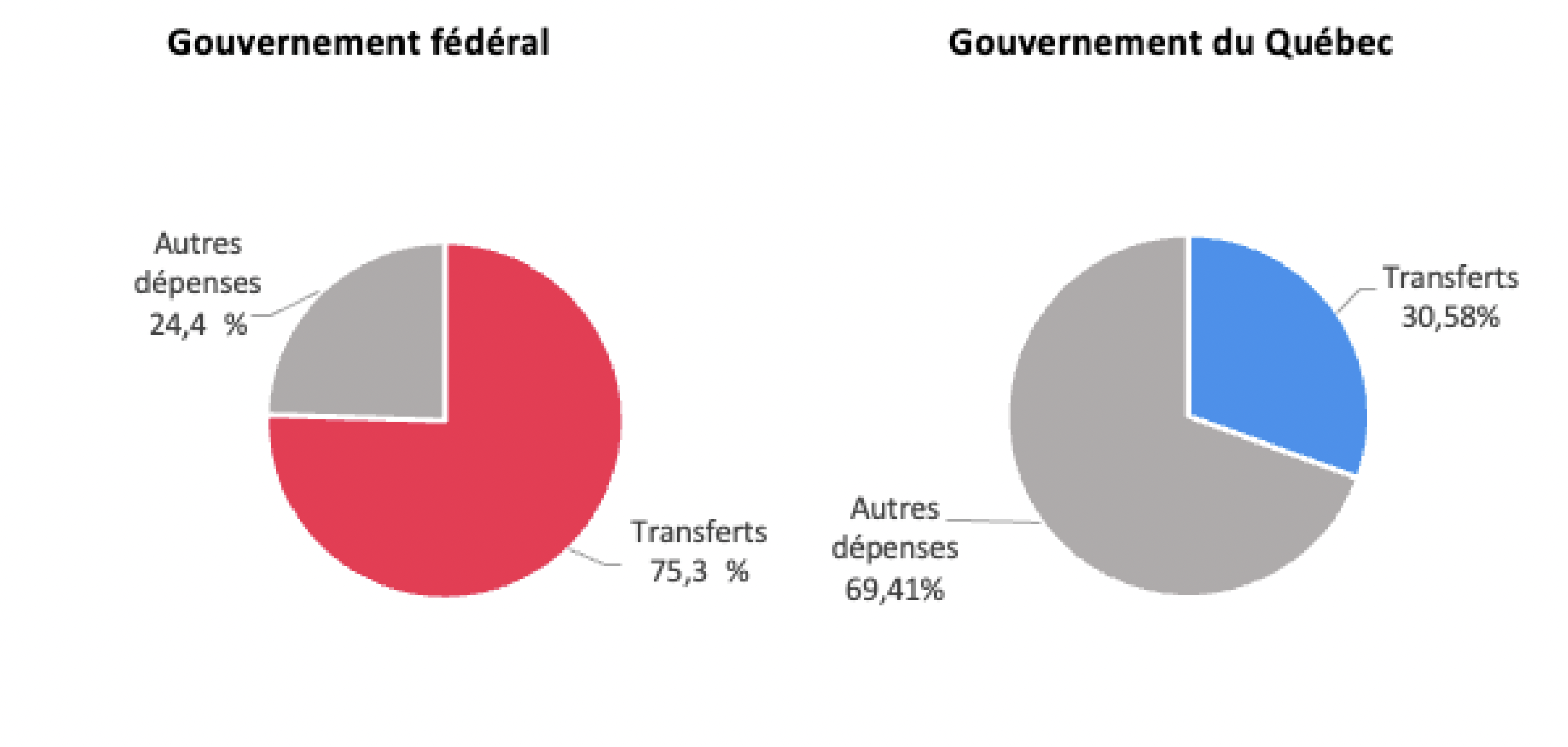
La figure 1 ci-dessous montre bien pourquoi la gestion quotidienne de services aux citoyens n’est pas le fort du gouvernement fédéral.

Figure 1 : Dépenses du gouvernement fédéral et du gouvernement du Québec, 2021Sources : Comptes publics du Canada ; Comptes publics du Québec

Le gouvernement fédéral est un animal particulier, plus habitué à émettre des transferts aux individus, aux entreprises et aux gouvernements, et à énoncer des normes associées à ces transferts, qu’à livrer des services à la population. L’année 2021 exagère un peu le trait, puisque la pandémie a engendré son lot de transferts exceptionnels. Mais la logique générale ne change pas. Il y a plus de vingt ans, le rapport de la Commission sur le déséquilibre fiscal faisait état de proportions assez semblables.

Les difficultés actuelles du gouvernement Trudeau ne sont donc pas si exceptionnelles. Le gouvernement fédéral demeure principalement une machine à récolter et à distribuer des ressources fiscales et il a tendance à se perdre quand il s’agit de gérer des programmes concrets.

La solution réside donc moins dans une réforme additionnelle de la fonction publique fédérale que dans une meilleure compréhension du fonctionnement de la fédération. En premier lieu, il faudrait améliorer l’équilibre fiscal en laissant davantage de ressources propres aux gouvernements provinciaux, dont la tâche principale consiste justement à livrer des services à la population.

Ensuite, pour des raisons évidentes, il conviendrait de prendre avec un grain de sel les volontés de leadership fédérales sur des questions de compétence provinciale. Notant dans une formulation bien à lui qu’en santé « ce n’est pas juste pitcher de l’argent vers le problème qui va le résoudre », M. Trudeau invitait récemment les provinces à des « conversations » afin de réduire les délais d’attente. Compte tenu de l’état de ses services, il devrait se garder une petite gêne.

En fait, le gouvernement fédéral devrait probablement modérer ses ambitions dans ses propres sphères de compétence, en adoptant des objectifs plus réalistes en immigration par exemple, afin d’éviter les échecs récurrents de gestion.

Mais les difficultés actuelles ne sont pas nouvelles, et elles ne se résorberont pas facilement.

Source: Quand les gouvernements trébuchent

‘Lineups still exist’: Is Ottawa’s task force on passport and service delays a ‘political stunt’? [rhetorical question]

The question answers itself. Such “virtue signalling” only further undermines trust in government:

The union representing passport officers says it hasn’t been approached by the government task force looking at passport delays, as questions swirl around the cabinet committee’s work to date.

Amid massive lineups at passport and Service Canada offices across the country, as well as major delays at airports, the Prime Minister’s Office announced on June 25 the creation of a task force made up of 10 cabinet ministers.

The cabinet committee was specifically instructed to “review service delivery, identify gaps and areas for improvement, and make recommendations to ensure Canadians from coast to coast to coast receive the highest quality of service.”

One month later, the Union of National Employees, which represents passport officers, says it hasn’t had any interaction with the task force meant to tackle the delays still affecting their members every day.

“I have not had any contact whatsoever with the task force as identified just over four weeks ago … I am not even aware if that task force has met,” said the union’s national president, Kevin King.

“There has not been any outreach at all from anyone representing a task force of 10 cabinet ministers.”

King said while there have been improvements, the delays continue at passport offices and there remains a need for more properly trained passport officers to vet applications.

“It doesn’t matter who they hire off the street, doesn’t matter who they bring in from other government departments, doesn’t matter how many other executives they bring in,” King said.

“The fact of the matter is they still don’t have enough passport officers who are fully trained to entitle a passport. It’s that simple, and that’s why lineups still exist.”

He noted that with a cabinet retreat expected in August, “the days are becoming less and less available for (the task force) to have a cohesive plan.”

King said his union and others have, however, been in talks to set up a meeting directly with Social Development Minister Karina Gould, who is responsible for the passport file, possibly in August.

The union representing Service Canada workers, including those who deal with passport intake, did have one meeting with the task force, where they were given updates similar to those given by government departments, said Crystal Warner, national executive vice-president of the Canada Employment and Immigration Union.

“They told us we would be invited to future discussions but haven’t received anything yet,” she said.

There hasn’t been much progress on delays, Warner said, with lineups still happening in some parts of the country. She said the union again had a meeting recently with government to push for more weekend office hours, and some kind of triage system.

“We’re still in a situation where there are ongoing needs at the front end,” she said, mentioning that soon international students will be coming in for SIN numbers. “So we’re waiting for the next influx at the front lines.”

The PMO release in June said the task force would also “monitor the situation” regarding delays at airports.

The National Airlines Council of Canada told the Star it reached out to the task force but never heard back. The Canadian Airports Council said it had been “in touch with PMO on the work of the task force,” but declined further comment.

The task force’s co-chair, Women and Gender Equality Minister Marci Ien, told reporters in June she’d “like to see something tangible in the next several weeks.”

Ien said the committee was first speaking with the ministers responsible for files including passports, immigration and air transportation. (Those ministers are not members of the task force.)

When asked this week about the task force’s work and who else they’ve consulted, Ien’s office provided the Star with a response similar to the PMO’s June statement, almost word for word.

“The recent service delays are unacceptable, and Minister Ien alongside the other members of the task force are working hard to resolve these issues,” the statement said.

“The committee of cabinet ministers has reviewed service delivery protocols, identified gaps and areas for improvement, and made recommendations to ensure Canadians from coast to coast to coast receive the highest quality of service.”

The statement said the actions being taken by each department are contained in regular updates provided by those departments to the public.

An update from Gould last week acknowledged that passport services “are not yet back to normal,” while announcing a new web page that includes steps being taken to improve services and statistics on delivery.

She said passport issuance has remained “relatively stable” over the last five weeks, with between 45,000 and 48,000 passports issued for each of those weeks, with the exception of the week of July 4 when 54,000 passports were issued.

“We’re doing everything we can to ramp that pace up every week,” she said, including adding more staff at Service Canada. The government also announced Monday the addition of five more passport pickup sites across the country.

The task force “is a political stunt that’s more about optics than solutions,” said Conservative social development critic Laila Goodridge, who said it’s “incumbent” on the government to be more transparent about its work.

“We were told when the task force was announced we would see change within weeks, and here we are a month out and only two days ago did we see a small change and it was providing additional pickup locations,” she said.

“If they’re working and they’re trying to find a solution here, they should be letting us know.”

NDP transport critic Taylor Bachrach said thousands of Canadians are still struggling to access basic government services, and that it’s “fair to expect” some level of transparency from the task force.

“The question is why they felt it was necessary to make so much public relations hay out of the formation of the committee. The formation of a committee is not an outcome,” he said. “And what we need here are outcomes and results.”

Source: ‘Lineups still exist’: Is Ottawa’s task force on passport and service delays a ‘political stunt’?

Australia: Home Affairs told to allocate staff to clear visa backlog

Canada not the only country to have backlogs:

The government has directed the Department of Home Affairs to devote more staff to clearing the visa backlog, naming it an ‘urgent priority’.

Minister for immigration, citizenship and multicultural affairs Andrew Giles cautioned the backlog would not be cleared overnight.

“People reallocated to dealing with the visa applications on hand need to be trained and skilled before they can go about this important work,” Giles said.

Since May 2022, 140 new department staff have been placed in visa processing roles.

The minister added the number of applications in June was 6.5% higher than in May, with a 10.6% increase in applications finalised. Since June 2022, 745,000 visa applications have been finalised.

Giles was also critical of the previous government, saying the backlog had risen to nearly one million under it.

Former immigration minister Dan Tehan — now shadow minister for immigration and citizenship — has said the visa backlog was due in part to the COVID-19 pandemic.

“One of the commitments that we had when we were in government was obviously to make sure that we got rid of that backlog and we had put extra resources to ensure that would happen,” Tehan told SBS Hindi.

The Australian National Audit Office (ANAO) is currently assessing the Department of Home Affairs’ management of family reunion and partner-related visas, due to be tabled in November. The ANAO is currently taking contributions from the public on this matter.

On student visas, Department of Education secretary Michele Bruniges is working alongside Department of Home Affairs secretary Michael Pezzullo to clear the backlog of student visas, as previously reported in The Mandarin.

Last week, education minister Jason Clare said Home Affairs had brought on more than 100 staff to deal with the backlog.

Source: Home Affairs told to allocate staff to clear visa backlog

La crise des passeports aboutira-t-elle à une action collective?

Unlikely that there will be a class action given the unlikelihood of success according to the experts cited:

Billets d’avion inutilisables, frais d’annulation d’hôtels, vacances gâchées : les voyageurs frustrés de ne pas avoir reçu leur passeport à temps pourraient-ils intenter une action collective contre le gouvernement fédéral pour se faire indemniser ? Des juristes consultés par Le Devoir estiment qu’un tel recours est possible, mais non sans embûches.

Il est évidemment possible de poursuivre en justice le fédéral, ce qui a déjà été fait à de multiples reprises, établit d’emblée le professeur de droit public de l’Université de Sherbrooke Guillaume Rousseau.

Il rappelle toutefois que, pour utiliser cette procédure spéciale qu’est l’action collective, il faut franchir une étape supplémentaire par rapport aux autres manières d’intenter une poursuite : celle de l’autorisation. Un juge se penche alors sur le dossier et vérifie s’il satisfait aux critères permettant aux personnes s’estimant lésées de procéder « en groupe ». Si oui, le magistrat donne le feu vert à la poursuite, qui peut aller de l’avant.

Le juge ainsi appelé à autoriser une action collective doit par exemple se demander si elle convient à la situation. On peut penser ici qu’elle serait préférable à des centaines ou à des milliers de poursuites individuelles, souligne le professeur Rousseau.

Mais pour avoir gain de cause, il faudra que les voyageurs qui ont subi des dommages (certains d’entre eux ont annulé leur voyage à grands frais ou ont manqué des jours de travail pour faire la file, même la nuit, afin d’obtenir le précieux document de voyage) prouvent que le fédéral a commis une faute.

En droit public, il y a faute quand une personne adopte un comportement qui s’écarte de celui de la personne raisonnable. « Ici, le gouvernement a-t-il agi comme un bon administrateur ? » demande le professeur Rousseau. En d’autres mots, est-il fautif de ne pas avoir eu assez d’employés pour traiter les nombreuses demandes de passeport déposées quand les restrictions sanitaires ont commencé à être levées ? Devait-il allouer plus de ressources au bureau des passeports ? Ou encore embaucher plus d’employés — et plus tôt — en prévision de la reprise des voyages internationaux ?

L’« argument pandémique »

Une telle action collective « n’est pas gagnée d’avance, mais ce n’est pas non plus impossible », juge Me Anne-Julie Asselin, avocate au sein du cabinet Trudel, Johnston et Lespérance, qui pilote de nombreuses actions collectives au Québec.

Selon elle, « la difficulté majeure du dossier » est de prouver la faute de l’État fédéral. Me Alexandre Brosseau-Wery, avocat associé chez Kugler Kandestin, est un peu plus optimiste : « Cela pourrait, à première vue, être un bon recours. »

Mais tous deux soulèvent la même embûche : pour justifier ses ratés et ses retards, l’État pourrait soulever comme moyen de défense la pandémie, qui a envoyé en congé de maladie bon nombre de ses employés et qui l’a forcé à affecter certains d’entre eux à d’autres tâches. Sans oublier la pénurie de personnel qui sévit un peu partout.

Cet « argument pandémique » a déjà été soulevé par plusieurs défendeurs devant les tribunaux ces derniers temps, rappelle Me Asselin. Mais deux ans plus tard, l’argument est-il toujours valable ? Les tribunaux pourraient y être moins réceptifs avec le passage du temps. Et puis, il y a quand même des choses qui auraient pu être prévues par le gouvernement, dit l’avocate.

Me Brosseau-Wery est du même avis : « On peut concevoir que, s’il avait agi diligemment et de manière proactive, il aurait pu mettre en place le nécessaire pour répondre à la demande plus élevée », et respecter ses propres normes et délais de traitement des passeports. De plus, c’est le gouvernement fédéral lui-même qui a levé certaines des restrictions de voyage, ce qui a mené à une forte demande pour ce document officiel.

Un autre argument fort pourrait être utilisé contre le fédéral, avance le professeur Rousseau : l’article 6 de la Charte canadienne des droits et libertés, qui prévoit que « tout citoyen canadien a le droit de demeurer au Canada, d’y entrer ou d’en sortir ». 

Empêcher un citoyen de voyager à l’extérieur des frontières pourrait « être constitutif de faute. » Et quand il est question de droits protégés par la Charte, les tribunaux ne sont pas très réceptifs à des excuses du type « problèmes administratifs », ajoute-t-il.

Témérité et immunité

Par contre, Me Asselin signale que des avertissements sur le site Web du gouvernement enjoignaient aux voyageurs de ne pas acheter de billets d’avion sans avoir leur passeport en main. Cela n’exonérerait peut-être pas entièrement le fédéral, mais pourrait possiblement mener à un partage de responsabilité, estime-t-elle : Ottawa pourrait plaider que l’achat de billets était téméraire. La ministre fédérale du Développement social, Karina Gould, a elle-même soulevé cet argument.

À cela, certains pourraient répliquer qu’à une certaine période, le bureau des passeports ne traitait que les demandes des voyageurs qui avaient un vol partant dans les 48 heures.

Il y a aussi une difficulté supplémentaire quand on poursuit le gouvernement : toute la question de l’immunité dont bénéficie l’État dans certaines circonstances, rappelle Me Brosseau-Wery. Le tribunal doit déterminer si la situation dommageable résulte d’une décision politique (par exemple, dans le cas d’une piste cyclable, décider ou non de la construire) ou opérationnelle (l’entretien de ladite piste afin qu’elle soit sécuritaire), illustre-t-il.

Car l’État bénéficie d’une immunité relative quant à ses décisions de nature politique, sauf en cas de mauvaise foi.

La limite entre une décision de nature politique ou opérationnelle est toutefois souvent difficile à établir, juge l’avocat. Mais cette immunité, si elle est applicable, peut jouer en faveur du gouvernement et faire échec à la poursuite, renchérit Me Asselin.

Source: La crise des passeports aboutira-t-elle à une action collective?

Canada’s immigration backlog has never been worse

The ever increasing backlogs understandably continue to attract attention. However, apart from CILA and a few individuals, haven’t seen any call for a pause in applications or heaven forbid, reduced levels, to address the backlogs:

In tandem with the increasing backlog has also been a precipitous rise in Federal Court cases from frustrated applicants demanding a reply from the IRCC.

They’re called “mandamus cases,” and it’s essentially an application for the court to order a response from IRCC. Before the pandemic there were only a few dozen mandamus cases per year. Last year, there were more than 400.

In prior statements, the federal government has largely attributed the crushing IRCC delays to the COVID-19 pandemic and the avalanche of refugee applications from Afghanistan and Ukraine. Last month, Prime Minister Justin Trudeau announced the formation of a special committee to figure out how to reduce wait times.

Amid history-making line-ups at Canadian airports and passport offices, an absolutely crushing backlog at Immigration, Refugees and Citizenship Canada is putting them all to shame.

According to numbers obtained from the IRCC by the immigration-focused publication CIC News, there are now 2.7 million people waiting for Ottawa to process their immigration application.

The backlog encompasses every application filed to IRCC, from citizenship to visas to requests for permanent residency. The backlog of citizenship applications alone stands at 444,792, while most of the list (1.7 million) is applications for temporary residence.

Not only is it the worst immigration backlog of all time, but it is growing exponentially with each passing week. This time last year, the backlog was just 1.5 million names, according to CIC News. In just the last 30 days, the list has grown by 300,000 — an increase of roughly 1,000 new applicants per day.

All told, there are now more people awaiting a reply from the IRCC than there are residents of Atlantic Canada. As of press time, the population of all four Atlantic provinces (including Newfoundland and Labrador) is roughly 2.5 million.

If the backlog continues to grow at the current rate, it will only be another four months until the number of applicants awaiting processing by the IRCC is equivalent to 10 per cent of the Canadian population of 38 million.

This has thrown immigration wait times into complete disarray at the precise time that Canada is touting itself as a haven for refugees, most notably from Afghanistan and Ukraine.

Many of those 2.7 million represent foreign nationals dwelling in a kind of awkward limbo as they spend years awaiting updates from the IRCC.

Last month, Pakistani man Kazim Ali told CTV he applied for Canada’s Express Entry program in 2020, when the estimated wait for a reply was six months. Two years later, he hasn’t heard a thing, bringing the life of he and his wife “to a screeching halt” as they delay career choices and even children until they can hear back.

An increasingly overwhelmed IRCC is also making it difficult to reliably schedule any event in Canada that involves foreign nationals. Last month, both a Montreal AIDS symposium and a major Toronto tech conference saw dozens of invitees unable to attend because of difficulties in obtaining Canadian visas.

In a recent report by the Business Council of Canada, Canadian employers cited “processing delays” as the top barrier to recruiting international talent.

“Frustrated by application processing delays, complex rules, and the cost of navigating the system, fewer than a quarter (of survey respondents) say the immigration system currently serves their business needs well,” it read.

In tandem with the increasing backlog has also been a precipitous rise in Federal Court cases from frustrated applicants demanding a reply from the IRCC.

They’re called “mandamus cases,” and it’s essentially an application for the court to order a response from IRCC. Before the pandemic there were only a few dozen mandamus cases per year. Last year, there were more than 400.

In prior statements, the federal government has largely attributed the crushing IRCC delays to the COVID-19 pandemic and the avalanche of refugee applications from Afghanistan and Ukraine. Last month, Prime Minister Justin Trudeau announced the formation of a special committee to figure out how to reduce wait times.

Source: Canada’s immigration backlog has never been worse 

Brian Lilley on Roxham Road (usual hyperbole about Trudeau’s tweet):

In the first six months of this year, more people crossed illegally into Canada at Roxham Road in Quebec than in all of 2019. The asylum seekers fast-track route may have all but shut down for much of the pandemic, but now it’s back in business with gusto.

According to the latest federal figures, 16,319 people entered Canada at “irregular” border crossings in Quebec between Jan. 1, 2022, and June 30, 2022. That includes 3,449 in May and 3,066 in June.

Those are the second- and third-highest months on record, surpassed only by August 2017.

By comparison, in 2019 a total of 16,136 people crossed at Roxham Road, and there were 18,518 illegal crossers in 2018 and 18,836 in 2017. The advent of COVID-19 saw the flow of asylum seekers at the Quebec-New York border slow to a trickle with just over 3,000 in 2020 and just over 4,000 in 2021, with most of them coming in December of that year.

This whole thing started when Justin Trudeau put out a tweet welcoming the world to Canada as then newly elected president Donald Trump threatened to deport people back to Haiti from the United States. What was lost on most is that Trump was ending a program that allowed people to stay in the U.S. if they were displaced by the earthquake or at risk following Haiti’s 2004 coup. Canada had ended a similar program years earlier under the Harper government and Trudeau had kept the policy in place and was removing people even as he criticized Trump.

With Trump threatening to do what Canada had already done, many looked north, and Trudeau welcomed them with open arms.

“To those fleeing persecution, terror & war, Canadians will welcome you, regardless of your faith. Diversity is our strength #WelcomeToCanada” Trudeau tweeted on January 28, 2017.

Days later, embassy staff from Mexico were writing to officials at Global Affairs seeking advice on how to handle people looking to declare refugee status in Canada.

“We are receiving an increasing number of enquiries from the public about requesting refugee status in Canada, and a number clearly having links with our Prime Minister’s tweet this weekend,” one email read.

It wasn’t just staff in Mexico. Word spread that Canada would take anyone as a refugee and many decided to use the illegal border crossing to skip dealing with the system.

Since then, more than 77,000 people — that’s more than the population of Belleville, Ont. or Chateauguay, Que. — have crossed at Roxham alone. The government has built special processing facilities there, establishing posts for immigration and RCMP officers to process people.

This is nothing short of the Liberals attempting to import another American political issue into Canada to wedge the Conservatives. In Canada, Conservatives support high numbers for legal immigration, something we saw throughout the Harper years.

What Conservatives don’t support is people who break the law.

This is where we get into word games. The Liberals claim no one is breaking the law, that these are asylum seekers and under Canadian — and international — law it is legal for them to seek asylum. The reality is, the government has giant signs warning people that it is illegal to cross at Roxham and the RCMP give verbal warnings that anyone doing so will be arrested for breaking the law.

They only claim asylum once arrested.

Nigeria is the biggest source of people crossing at Roxham and just 30% of the more than 16,000 who crossed there between February 2017 and March 2022 were accepted as valid refugees. For the more than 10,000 Haitians who crossed — the second-largest source country, just 23% were accepted.

Roxham Road has become a way for those looking to skip the long delays in legal, economic migration to get into Canada.

This isn’t how a properly functioning immigration and refugee system should work, but very little of what the Trudeau government is doing these days is working properly.

Source: LILLEY: Trudeau continues immigration games as Roxham Road sees record numbers