‘Almost unprecedented’ spike in number of Australians who see racism as a problem, survey finds

Of note:

Australians are increasingly aware that racism is a problem in their country, while positive sentiment about immigration and multiculturalism has also increased over the past 12 months, according to an authoritative survey on social cohesion.

The annual Mapping Social Cohesion Report from the Scanlon Foundation Research Institute, released on Tuesday, has charted a 20 percentage point increase in 12 months in response to the question “How big a problem is racism in Australia?”

Back in 2020, 40% of respondents thought racism in Australia was either a very big or fairly big problem. But in the 2021 survey of 3,572 respondents, 60% held that view.

The survey authors note “an increase of 20 percentage points in response to a general question of this nature is almost unprecedented in the Scanlon Foundation surveys”, which have been conducted annually since 2007. But they say there is no clear trigger or cultural catalyst explaining such a large shift.

The research suggests Australians were also more enthusiastic during the period of pandemic-induced international border closure about the contribution migrants make to the economy, with 86% of the sample agreeing with the proposition “immigrants are generally good for Australia’s economy” (compared with 76% in 2019, the year before Covid-19 hit).

Similarly, 86% of respondents agreed “multiculturalism has been good for Australia” compared with 80% agreeing with that proposition in 2019. A super-majority (90% – the highest affirmation in the survey) also endorsed the importance of the relationship between Aboriginal and Torres Strait Islanders and the wider Australian community.

Source: ‘Almost unprecedented’ spike in number of Australians who see racism as a problem, survey finds

Far-right groups like The Base will radicalise Australians until we confront their beliefs

Perspective of interest:

As one of the reporters who worked to uncover the operations of white power accelerationist group, The Base, I view the Australian federal government’s listing of them as a proscribed terror groupthis week as a belated but important recognition of the danger presented by white supremacist organisations.

But the national security state is a blunt instrument, and the apparatus of anti-terrorism is no substitute for making anti-racism principles central to a more inclusive democracy.

At its height, The Base was a transnational network of white nationalists who were seeking to collectively plan and prepare for what they saw as the inevitable collapse of liberal democracies they saw as decadent and corrupted by the values of feminism and multiculturalism.

In the Guardian US, I was the first reporter to identify Rinaldo Nazzaro, an American former US intelligence contractor now based in Russia, as the group’s founder and leader.

Previously he had only been known by the aliases Norman Spear and Roman Wolf.

An infiltrator gave me unprecedented access to the group’s internal communications. There I saw that although their group claimed only to be preparing for disaster, their conversations functioned to further indoctrinate members in a poisonous ideology of racial hatred, and the group’s relentlessly repeated fantasies of terroristic violence, for some of them, translated into real-world acts of destruction.

Members of the group are now facing trial for offences ranging from vandalising synagogues to assassination plots

Late last month, one member, former Canadian serviceman Patrik Mathews, was sentenced to nine years in federal prison for engaging in a terror plot with other members of the group.

Later, I showed how The Base’s efforts to recruit in Australia had led to them vetting Dean Smith in 2019, who was a federal election candidate for One Nation in Western Australia the same year. Smith ended up withdrawing his application and there is no evidence he has engaged in or planned any violence.

Source: Far-right groups like The Base will radicalise Australians until we confront their beliefs

The power of Indigenous diplomacy as a strategic asset for Australia | The Strategist

Of interest with some parallels and lessons for Canada:

International relations sometimes seems like a game that’s all about controlling and asserting simplistic national-power narratives without acknowledging the complexity of each nation’s stories.

But the key to effective public diplomacy is moving from monologue to dialogue, which means knowing when to speak and when to listen. In Australia, this begins with listening to, and reckoning with, the nation’s Indigenous history and projecting that into the international public sphere.

Indigenous diplomacy needs to be seen as an asset in Australia’s strategic toolkit.

‘International interest in Indigenous culture is very high and people see it as unique,’ says Australia’s first Indigenous ambassador, Damien Miller, in an interview with ASPI. ‘It’s a natural part of our soft power.’

Miller belongs to the Gangulu people, traditional custodians of land in Central Queensland’s Dawson and Callide valleys. His grandmother moved to Rockhampton after the 1987 Aboriginal Protection and Restriction of the Sale of Opium Act nullified the political and civil rights of Aboriginal and Torres Strait Islander people. In the 1960s his father moved to Brisbane, where Miller grew up.

This painful part of Australia’s history reverberates into the present. There are distinct challenges in reconciling these elements in the national story, and Australia has its detractors globally over its treatment of its Indigenous citizens.

Miller acknowledges, but also challenges, these views: ‘Some have very outdated views of our nation based on cherry-picking the most negative aspects of Australian history. But I would say that this bears no resemblance to the reality on the ground.’

It’s important to tell the whole complex and rich story of Australia—the parts where we succeed and the parts where we stumble, especially in relation to the Indigenous experience.

When we do this, says Miller, ‘Australia’s Indigenous diplomacy is a way of showing the world an open, mature country that can explore the light and the shade of our history.’

A world awash with disinformation has shown how important ideas are. Australia traditionally thinks of soft power as education, sport and culture. Those elements are important, but there’s a harder edge to appreciate.

In the context of the grey zone, where information warfare targeting the political culture and reputation of nations is a key tactic, having a strong narrative about national identity, values and history becomes ever more important.

In Miller’s view, having a compelling story to tell about Australia is a critical element of national power. In his work as minister-counselor for strategic communications at Australia’s Washington embassy, he talks about three distinct chapters of our national story.

The first is our unique Indigenous heritage. ‘I’m just so proud of our Indigenous culture—60,000 years of relationship and stewardship between culture and the environment—it’s an incredible story to tell the world.

‘The second chapter is our European heritage, which brought new ideas and values that eventually grew into a vibrant democratic political culture embracing the rule of law domestically and internationally.

‘The third thing I emphasise is our multiculturalism,’ says Miller. ‘Australia is one of the most successful and unified multicultural nations in history and it’s getting more so over time. It’s this story that makes us so competitive, for example, in attracting the best and brightest around the world to our skilled migration program.’

Key to this narrative is how Indigenous Australia is changing, he says. ‘I talk about Indigenous youth graduating from high school, increasing numbers going to university and forging professional paths, and those re-embracing traditional lifestyles, going into business, becoming strong members of civil society.’

This story of education and empowerment is reflected internationally, with transnational Indigenous civil-society networks on the front lines of global systemic crises from Covid-19 to climate change.

It’s important to note that indigenous peoples have ownership, use or management rightsover more than 25% of the world’s land surface and 37% of all remaining ‘natural’ lands. Australian Indigenous interests own or exercise a degree of legal control over close to 80% of the Northern Australian landmass, and considerable areas of sea country.

Indigenous expertise is crucial to building resilience to climate change and preserving the world’s remaining biodiversity. And the transnational, collaborative, non-state-bound nature of indigenous diplomatic networks demonstrates the type of diplomacy the global community will need to manage future crises more effectively.

Miller points to the Kimberley Land Council’s savannah-burning carbon projects, which embrace Indigenous grassfire techniques and have been trialled in Botswana. The program generates around $20 million worth of Australian carbon credit units annually.

Such Indigenous ecological approaches will only become more important. Degradation of indigenous land rights often goes with the catastrophic degradation of carbon sinks like the Amazon Basin. The survival of indigenous communities might be intimately linked to limiting the damage associated with worst-case climate scenarios.

Their ownership of a quarter of the world’s land means indigenous communities are crucial in more conventional geopolitical terms. They often stand at the nexus of resource exploitation, political conflict and economic competition.

On one level, indigenous peoples suffer from similar issues of dispossession, underdevelopment, unemployment, drug abuse, youth suicide and structural discrimination.

On another, international indigenous networks have grown institutionally sophisticated. They’re  embedded in multilateral politics and run media organisations, businesses and sovereign wealth funds with substantial capital and asset holdings. In the United Nations system, important forums for indigenous issues include the Expert Mechanism on the Rights of Indigenous Peoples and the UN Permanent Forum on Indigenous Issues. Indigenous groups were a big presence at the COP26 climate talks in Glasgow.

Indigenous geopolitics is also regionally significant. Of the 500 million indigenous people in 90 countries, 70% live in Asia.

The Department of Foreign Affairs and Trade’s Indigenous diplomacy agenda, launched in May 2021, is timely. It has four main pillars: shaping international norms and standards to benefit indigenous peoples, maximising opportunities for indigenous peoples in a globalised world, promoting sustainable development for all indigenous peoples, and deploying Indigenous Australian diplomats to advance Australia’s national interests.

The agenda came out of DFAT’s Indigenous peoples strategy 2015–2019, launched by departmental secretary Peter Varghese in 2015. DFAT has used elements of it for decades, says Miller, working through human rights forums in the UN, in DFAT’s human resources policies, and in its promotion of Indigenous voices overseas.

The agenda consolidates and elevates Indigenous diplomacy as a key element of our national diplomacy. Australia, says Miller, is a global leader in this area, along with Canada and New Zealand.

On various postings, Miller has spoken about Australia’s unique reconciliation movement, Indigenous policy and governance models. DFAT and the National Indigenous Australian Agency discuss Indigenous issues as part of their regular bilateral engagement with the US, Canadian and New Zealand governments. He says Australia would like to do more with the US indigenous community and scholars, particularly on economic governance.

Public health is key to supporting social and economic wellbeing, says Miller, noting that Australia has leading-edge Indigenous networks doing community health work that emphasises place-based solutions while building strong partnerships with governments, corporates and not-for-profits.

Australia’s Indigenous nations have their own traditions of relationship-building and diplomacy. Miller says northern Australian Indigenous peoples had historical relationships based on trade and culture with regional indigenous populations—for example, between Torres Strait Islanders and Papua New Guineans and between the people of Arnhem Land and Indonesia’s Macassans.

Miller says these traditions and cultural values have always informed his work as a diplomat. He uses the example of the Gangalu people, who are passionate about organising and promoting community welfare and partnering with others to find solutions.

‘The ancientness of the Indigenous story in Australia gives you a certain perspective: respect for elders, the importance of deep listening, respect for the heritage and stories of others, the importance of finding common ground, being deeply engaged in community life, giving back and showing generosity of spirit.’

Source: The power of Indigenous diplomacy as a strategic asset for Australia | The Strategist

Australian comms agencies perceive diversity as not urgent

Of note. Any views on how this compares with Canada?:

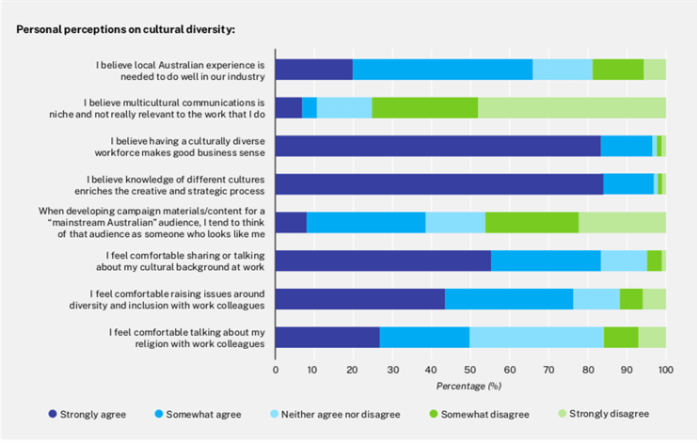
A new study by the Framework for Agency Inclusion and Representation (FAIR) and comms agency Think HQ showed that Australian comms agencies are falling behind on diversity practices. While awareness appeared to be high, qualitative findings showed that there were inconsistencies on knowledge and implementation in the workplace as well as in client work and advisory.

The survey, which used 131 responses from the country’s comms industry, found that while all respondents are quite aware of broader diversity and inclusion principles that initially focused on gender, many have limited understanding, much less a focus on cultural diversity. Most of them were aware of the cultural diversity of the Australian population, but do not see the urgency or importance of integrating it in their business operations enough to equate it with business success.

For example, one respondent suggested that they do not see integrating cultural diversity matters in their business as essential because “people are succeeding without it”. The respondent added: “We still seem to be progressing well adapting and being so people don’t see the urgency of the need.”

Another respondent said that diversity in the workplace is not a priority for them because it isn’t tied to their KPIs. Yet another respondent said that multiculturalism in comms work is ‘niche’ whether communicating to Australian-born audiences or residents with migrant backgrounds. “I don’t think it is so much about making your communication sharper for… culturally diverse audiences because they are too niche,” this person said.

In terms of hiring, the interviewees acknowledged the lack of communication practitioners with culturally diverse backgrounds. A few of them who recruited from England had the propensity to count those hires as part of the ‘culturally diverse’ cohort. A majority of respondents quoted that some 20% of their staff have a culturally diverse background but when further probed, they indicated that the number could have included British, who are not considered culturally and linguistically diverse.

One respondent said: “If I think about my career today, it’s predominantly been in agencies with privileged white people, private school-educated, tertiary education.”

While ‘positive discrimination’ was quoted as a way to recruit more culturally diverse talent, many respondents also mentioned that second- and third-generation Australians do not necessarily want to be identified based on their ethnicity or ancestry. This appears to be a conundrum that many recruiters or leaders still face in Australia.

Here are a few charts that reflect findings from the study:

Source: Australian comms agencies perceive diversity as not urgent

Canada, Australia embrace more Indians but US passport remains the most coveted

Australia highest on per capita basis:

India regained its position as the top country of origin of the newly naturalised citizens of the Organisation of Economic Cooperation and Development (OECD) countries in 2019, following a sharp increase in the number of Indians granted citizenship of Canada and Australia. India had lost that position to Mexico in 2017.

More than 1.56 lakh individuals surrendered Indian citizenship for more powerful passports of the OECD countries in the pre-pandemic year, a recent report from the 38-country economic bloc said.

The number of Indians who secured Canadian and Australian citizenship rose 61 percent, faster than the 28 percent rise in the Indians getting citizenship in any OECD country.

Yet, more Indians secured the US passport than the combined total of those who acquired the Canadian or the Australian passport that year. A total of 63,578 Indians became naturalised US citizens in 2019, the highest since 2008 when nearly 66,000 individuals did.

At 31,329, the number of Indians securing Canadian citizenship was the highest since 2006. A large number of highly skilled Indians, particularly techies, rushed to apply for residency in the vast but thinly populated country after the Justin Trudeau government that came to power first in 2015 eased migration rules.

Australia conferred citizenship to 28,470 Indians, perhaps a record number for any year, the latest edition of the International Migration Outlook, published annually by the OECD reported.

The UK was the fourth most sought after passport among Indians but at 14,680, the number of new citizens of Indian origin in Britain was the lowest since 2008.

The OECD data also shows that 40 percent of the 1.56 lakh who surrendered their Indian passports in 2019 had become US citizens, while 20 percent chose Canada, 18 percent Australia and 10 percent the UK.

Despite the large intake of Indians as citizens of the US, they were just 8 percent of all the foreigners who became American citizens that year.

In contrast, Indians were 22 percent of those who gained Australian citizenship and 13 percent of the newly naturalised Canadians.

New Zealand, Italy and Germany were also among the top countries where Indians took up citizenship. Nearly 4,800 Indians became citizens of New Zealand in 2019, the third consecutive year that more than 4,750 Indians acquired the nationality of the island nation in the Pacific Ocean.

About 4,700 became Italians that year but the numbers getting Italian citizenship had halved since 2016. Other OECD countries that granted citizenship to 500-1,000 Indians in 2019 were Sweden, the Netherlands, Portugal and Ireland.

The COVID stop 

The report also showed a sharp rise in the flow of Indian migrants, including students to the UK. About 92,000 Indians moved to the UK in 2019, nearly 50 percent more than in the previous year.

The flow of Indians into the UK has been on the rise since 2017, the year the Theresa May government formally began the country’s exit from the European Union.

In all, 3.94 lakh Indians migrated to OECD nations in 2019. Not surprisingly, the flow of Indians to Canada also gained that year, with 85,600 individuals migrating to the North American country. The US, Germany and Australia also received a large flow of Indian migrants during the year.

China continued to be the top country of origin for international migrants in the OECD, with their numbers rising from 4.30 lakh to 4.66 lakh. Romania was in the third position.

The OECD said that it expected a 30 percent drop in the flow of migrants due to the pandemic in 2020 to about 37 lakh, the lowest since 2003. The data on the flow of migrants to all OECD nations was not available when the report was published.

The impact on permanent migration was estimated to be much higher. It said that there was a sharp drop in all categories of migration—family migration, inter-company transfers, temporary labour and students.

Study permits issued by the US and Canada were estimated to have dropped 70 percent and those by the OECD EU countries by 40 percent.

Source: Canada, Australia embrace more Indians but US passport remains the most coveted

How Can Australia Rethink Its Immigration Policies?

The ongoing divergence between Canada and Australia remains, striking given how much the two countries have borrowed ideas and approaches from each other in the past:

Australia has begun having necessary public debates about its post-pandemic recovery. One of the more crucial elements of this recovery is how the country re-establishes its immigration program, which has effectively been paused for the past year and a half. In recent decades Australia’s national strategy has relied on sourcing a significant number of skilled migrants to off-set birthrates that are below the replacement level, drive economic activity, and enhance the country’s overall capabilities. That strategy proved successful.

Due to this, the Australian Chamber of Commerce and Industry has begun pushing for 200,000 skilled migrant visas to be issued annually, a return to the pre-pandemic average. However, advice provided to the new premier of New South Wales, Dominic Perrottet, indicated that Australia will require 2 million new residents over the next five years to meet labor shortages, effectively double the pre-pandemic intake. This would match Canada’s ambitious new target for its own national expansion (one it is already meeting).

In Parag Khanna’s new book, “Move,” the author argues that the post-pandemic world will see a fierce competition for young talent by migrant-accepting countries. Countries that are able to both attract and retain people will find themselves at a distinct advantage. Pre-pandemic Australia could rightly claim to be a lifestyle superpower, providing it with a serious asset for attracting these highly skilled migrants, yet the country’s highly protectionist response to the pandemic may have blunted this image.

While in recent decades Australia has offered migrants opportunities and ways of life that they otherwise may not have had, it has also not made fully accessing these opportunities particularly easy. Australia’s visa system is notoriously complex and expensive, with myriad hurdles to jump, and no clear pathway toward permanent residency. Migrants can spend a decade or more bouncing between an array of insecure short-term visas, limiting their ability to make long-term plans and subsequently limiting their ability to feel welcome and valued in the country. If Australia wishes to compete in a post-pandemic contest for skills it will need a less obstructionist visa system.

Yet there is more to this equation than just Canberra creating the administrative processes to maximize its power and potential. While states may be self-interested entities, they also face conditions that prevent them from acting perfectly in their own self-interest. Immigration can be an emotionally sensitive subject, making the politics around it difficult to navigate. There is a tension between what the country requires and what is politically achievable.

Australia, like other Western liberal democracies, is currently facing a crisis of confidence in its own ideas and values. Admittedly, Australia is not in as degraded a state as other similar countries, but a suspicion of liberalism – and its openness to the world – exists within the country and should not be ignored. This sentiment is born out of a paradox within the nation-state, where some elements within liberal societies believe that the state is undermining the nation.

The political psychologist and behavioral economist Karen Stenner has argued that liberal democracies have reached a stage of complexity that around one-third of their citizens have difficulty adjusting themselves to. These people value consistency, conformity, and homogeneity over difference and change. This disposition can tolerate changing societies under the right conditions, but it is susceptible to arousal and agitation through political demagoguery and media outlets that prey on their insecurities — leading to support for more insular and authoritarian styles of governing.

Following several decades of rapid social change, the COVID-19 pandemic could not have been a worse global-scale event for those who would like to keep this authoritarian disposition dormant. It has exacerbated the sense among some that states are acting against the interests of the public, leading to a further retreating into in-groups. The fear would be that this public sentiment now makes it far too difficult to re-establish Australia’s significant immigration program.

Yet Australia now faces not only economic conditions that require an increased labor force, but also strategic conditions that require an increase in state power. Canberra must confront the dual problem of a powerful and belligerent regional adversary in China alongside a primary security partner in the United States whose domestic instability is making it far less reliable. To negotiate this difficult terrain Australia requires more people to enhance its economic, diplomatic, defense, and cultural capabilities.

The serious question that Canberra must now ask itself is: How does it take the necessary steps to increase its capabilities without disrupting its own internal stability?

Addressing the culture of suspicion and contradictions at the heart of immigration process should be the first place to start. In recent decades Australia has asked migrants to provide the country with labor, knowledge, and taxes, but not civic engagement. Those who perceive that migrants are not “loyal” to the country have been aided in this perception by a visa system that doesn’t give migrants the opportunity to fully invest themselves in the country. There’s the potential to address both problems if handled correctly.

This would also require a change in public narrative, highlighting the courage and resilience of migrants, the honor Australia should feel at being chosen as a destination country, and the prosperity and social enhancement that flows from their contributions to society. If psychological insecurity is the political impediment to Australia’s expanded migration program, then migration as a tool to enhance national security should be emphasized.

The pandemic has offered governments the opportunity to rethink how they approach these key nation-building initiatives. It has also provided an example of what states can do when they focus their minds on a task. This should make it clear to Canberra that such necessary rethinking of immigration’s key role in Australia’s nation-building should not be deemed too difficult to pursue.

Grant Wyeth is a Melbourne-based political analyst specializing in Australia and the Pacific, India and Canada.

Source: How Can Australia Rethink Its Immigration Policies?

Australian voters rethinking immigration in wake of extended border closures, poll suggests

Interesting shifts:

Australia’s prolonged international border closure appears to have lowered the political temperature around immigration, with the number of voters believing levels are too high dropping from 56% in January 2019, and 64% the year before that, to 37% in the latest Guardian Essential survey.

While the pandemic has shifted the dynamics of the debate, the latest poll of 1,781 respondents suggests immigration remains a divisive issue. Migration is back on the political agenda because both the federal and state governments have flagged a rethink of the size and mix of Australia’s migration program once the border reopens.

In the latest Guardian Essential survey, more than half of respondents (52%) say migration levels are either too low or about right, while 37% say too high, and 11% are undecided. Just over half the sample (51%) agrees that immigration is vital for Australia’s business and economy (20% are opposed that view).

But 63% of respondents also believe that increasing immigration levels would add more pressure on the housing system and infrastructure (only 11% disagreed).

While half the Guardian Essential sample (50%) thinks boosting immigration will help businesses recover from the economic shock of the pandemic by giving them the skilled labour they need (22% disagree) – a majority of respondents are evidently not convinced that immigration helps Australia deal with skills shortages as the population ages (only 49% agree with that proposition and 22% disagreed).

Source: Australian voters rethinking immigration in wake of extended border closures, poll suggests

Australia: Immigration ‘character test’ bill to strengthen visa-cancellation powers to be reintroduced by government

Australia and Canada continue to diverge:

The federal government is again seeking greater discretionary powers to cancel or refuse immigration visas on character grounds after its initial proposal was defeated two years ago.

An amendment to strengthen the migration ‘character test’ — which would see visas cancelled or refused for people convicted of a serious crime — could be introduced in the Senate as early as today.

The Morrison government first attempted to pass the laws in 2019, but they failed to win the support of Labor or crossbench senators.

Under the proposed laws, a non-citizen who has been convicted of a ‘designated’ offence punishable by at least two years’ prison — such as violent or sexual assault crimes — could be refused a visa at the government’s discretion, regardless of the sentence they actually serve.

Currently, the power to cancel visas is only available in cases where a person was actually sentenced to serve more than 12 months’ prison.

The government also argues that people whose visas should have been cancelled have been allowed to stay thanks to technicalities, such as discounts to prison time for guilty pleas, or judges who reduced a sentence to avoid mandatory visa cancellation thresholds.

Immigration Minister Alex Hawke said the current laws leave a gap that allows for people who are a risk to the community to stay in the country.

“Holding an Australian visa is a privilege that dangerous and violent non-citizens do not deserve,” Mr Hawke said in a statement.

“Anthony Albanese needs to back these new laws this week for the safety of the community — or explain to all Australians why he will not.”

Labor is considering the proposed amendments.

However, Shadow Immigration Minister Kristina Keneally has previously expressed concern that low-level offenders could unintentionally be caught up in the changed laws and be deported unnecessarily.

The laws have caused tension with New Zealand, whose Prime Minister Jacinda Ardern has repeatedly pleaded with Australia to drop the practice of deporting its criminals.

Ms Keneally has previously called for retrospective offenders to be excluded from legislation, and for extra consideration to be given to New Zealanders.

Minister less likely to be overturned under new laws

The proposed laws would also make it harder for decisions to deport people to be defeated on appeal, the government has argued.

Currently, the immigration minister — or a delegate of the minister — have discretionary power to cancel a visa on character grounds, but the decision can be appealed.

In the past, ministerial decisions have been overturned by the courts, such as when former home affairs minister Peter Dutton attempted to deport murderer Frederick Chetcuti, who had lived in Australia since he was two years old.

Mr Dutton’s decision to cancel the 73-year-old Maltese man’s visa was overturned after he was unable to prove that he spent more than 11 minutes considering the case.

The government expects its bill to make those situations less common, as a more “objective” test of conviction, rather than time sentenced, would leave less room for appeal.

Mr Hawke said the amendments would be introduced in the Senate this week, and as early as today.

Source: Immigration ‘character test’ bill to strengthen visa-cancellation powers to be reintroduced by government

A Sea of White Faces in Australia’s ‘Party of Multiculturalism’

More on Australia:

She seemed an ideal political candidate in a country that likes to call itself the world’s “most successful multicultural nation.”

Tu Le, a young Australian lawyer who is the daughter of Vietnamese refugees, was set to become the opposition Labor Party’s candidate for Parliament in one of Sydney’s most diverse districts. She grew up nearby, works as an advocate for exploited migrant workers and had the backing of the incumbent.

Then Ms. Le was passed over. The leaders of the center-left party, which casts itself as a bastion of diversity, instead chose a white American-born senator, Kristina Keneally, from Sydney’s wealthy eastern suburbs to run for the safe Labor seat in the city’s impoverished southwest.

But Ms. Le, unlike many before her, did not go quietly. She and other young members of the political left have pushed into the open a debate over the near absence of cultural diversity in Australia’s halls of power, which has persisted even as the country has been transformed by non-European migration.

While about a quarter of the population is nonwhite, members of minority groups make up only about 6 percent of the federal Parliament, according to a 2018 study. That figure has barely budged since, leaving Australia far behind comparable democracies like Britain, Canada and the United States.

In Australia, migrant communities are often seen but not heard: courted for photo opportunities and as fund-raising bases or voting blocs, but largely shut out of electoral power, elected officials and party members said. Now, more are demanding change after global reckonings on race like the Black Lives Matter movement and a pandemic that has crystallized Australia’s class and racial inequalities.

“The Australia that I live in and the one that I work in, Parliament, are two completely different worlds,” said Mehreen Faruqi, a Greens party senator who in 2013 became Australia’s first female Muslim member of Parliament. “And we now know why they are two completely different worlds. It’s because people are not willing to step aside and actually make room for this representation.”

The backlash has reached the highest levels of the Labor Party, which is hoping to unseat Prime Minister Scott Morrison in a federal election that must be held by May.

The Labor leader, Anthony Albanese, faced criticism when he held up the white senator, Ms. Keneally, 52, as a migrant “success story” because she had been born in the United States. Some party members called the comment tone deaf, a charge they also leveled at former Prime Minister Paul Keating after he said local candidates “would take years to scramble” to Ms. Keneally’s “level of executive ability, if they can ever get there at all.”

Ms. Keneally, one of the Labor Party’s most senior members, told a radio interviewer that she had “made a deliberate decision” to seek the southwestern Sydney seat. She did so, she said, because it represents an overlooked community that had “never had a local member who sits at the highest level of government, at a senior level at the cabinet table, and I think they deserve that.”

She plans to move to the district, she said. In the Australian political system, candidates for parliamentary seats are decided either by party leaders or through an internal vote of party members from that district. Candidates do not have to live in the district they seek to represent.

When contacted for comment, Ms. Keneally’s office referred The New York Times to previous media interviews.

Chris Hayes, the veteran lawmaker who is vacating the southwestern Sydney seat, said he had endorsed Ms. Le because of her deep connections with the community.

“It would be sensational to be able to not only say that we in Labor are the party of multiculturalism, but to actually show it in our faces,” he told the Australian Broadcasting Corporation in March.

Ms. Le, 30, said she believed the party leadership sidelined her because it saw her as a “tick-the-box exercise” instead of a viable contender.

As an outsider, “the system was stacked against me,” she said. “I haven’t ‘paid my dues,’ I haven’t ‘served my time’ or been in with the faceless men or factional bosses for years.”

What she finds especially disappointing about Labor’s decision, she said, is the message it sends: that the party takes for granted the working-class and migrant communities it relies on for votes.

Australia has not experienced the same sorts of fights over political representation that have resulted in growing electoral clout for minority groups in other countries, said Tim Soutphommasane, a former national racial discrimination commissioner, in part because it introduced a “top down” policy of multiculturalism in the 1970s.

That has generated recognition of minority groups, though often in the form of “celebratory” multiculturalism, he said, that uses food and cultural festivals as stand-ins for genuine engagement.

When ethnic minorities get involved in Australian politics, they are often pushed to become their communities’ de facto representatives — expected to speak on multiculturalism issues, or relegated to recruiting party members from the same cultural background — and then are punished for supposedly not having broader appeal.

“The expectation from inside the parties as well as the community is that you’re there to represent the minority, the small portion of your community that’s from the same ethnic background as you,” said Elizabeth Lee, a Korean Australian who is the leader of the Australian Capital Territory’s Liberal Party. “It’s very hard to break through that mold.”

Many ethnically diverse candidates never make it to Parliament because their parties do not put them in winnable races, said Peter Khalil, a Labor member of Parliament.

During his own election half a decade ago, he was told to shave his goatee because it made him “look like a Muslim,” he said. (Mr. Khalil is a Coptic Christian.)

“They want to bleach you, whiten you,” he added, “because there’s a fear that you’ll scare people off.”

In the Australian political system, the displacement of a local candidate by a higher-ranking party insider is not unusual. Mr. Morrison was chosen to run for a seat in 2007 after a more popular Lebanese Australian candidate, Michael Towke, said he was forced to withdraw by leaders of the center-right Liberal Party.

Ms. Keneally moved to the safe Labor seat, with the backing of party leaders, because she was in danger of losing her current seat. Her backers also note that she has been endorsed by a handful of Vietnamese, Cambodian and Middle Eastern community leaders.

Joseph Haweil, 32, the mayor of a municipality in Melbourne and a Labor Party member, said that as a political aspirant from a refugee background, he saw in the controversy over Ms. Le a glimpse of his possible future. Mr. Haweil is Assyrian, a minority group from the Middle East.

“You can spend years and years doing the groundwork, the most important thing in politics — assisting local communities, understanding your local community with a view to help them as a public policy maker — and that’s not still enough to get you over the line,” he said.

Osmond Chiu, 34, a party member who is Chinese Australian, said “the message it sent was that culturally diverse representation is an afterthought in Labor, and it will always be sacrificed whenever it is politically inconvenient.”

Ms. Le spoke out in a way that others in the past have avoided, perhaps to preserve future political opportunities. She said that she was uncertain what she would do next, but that she hoped political parties would now think twice before making a decision like the one that shut her out.

“It’s definitely tapped into something quite uncomfortable to discuss, but I think it needs to be out in the open,” she said. “I don’t think people will stand for it anymore.”

Source: A Sea of White Faces in Australia’s ‘Party of Multiculturalism’

Australia: Why Diversity Seems Easier Said Than Done in Politics

Australia’s political representation is much worse than Canada (haven’t yet seen the final 2021 numbers for Canada which a number of researchers are working on):

Recently, I’ve been reporting on the controversy over Labor’s pick to represent Fowler, where Tu Le, a young lawyer and the daughter of Vietnamese migrants, was passed over, with the party instead choosing Kristina Keneally, a party leader and white woman. I’ve been using it as a starting point to examine why Australia’s Parliament lags behind other English-speaking countries when it comes to cultural diversity.

I’ve talked to people from across the political spectrum, including many young people of color within the Labor Party who have led the debate. For them, the controversy is just the latest example of the dissonance between a country that claims to be the most successful nation when it comes to multiculturalism and a governing elite that is reluctant to address diversity at the cost of political convenience.

What I wasn’t able to go into much in my article (coming soon) was the details that party members shared about the barriers they faced on every rung of the political ladder. It all added up to a picture of a two-tiered political system that sees people of color as fine community representatives or liaisons but not cut out for higher leadership positions, and treats immigrant communities as expandable membership bases or voting blocs.

A few caveats: they had differing views about the Fowler preselection. They had nothing against Kristina Keneally and her qualifications for office. They stressed that underrepresentation is a problem across all parties, not unique to Labor — it’s just particularly disappointing when the party that purports to champion diversity doesn’t make good on its promise.

Ethnically diverse members regularly have their worth tied to their communities, said Joseph Haweil, 30, mayor of Hume City in Melbourne. “Very often there’s a feeling if you’re someone from a multicultural background and you walk into a branch meeting without already having signed up five or 10 people from your community, you’re a nobody.”

Migrant communities are courted for fund-raising and to build a base for internal power struggles, but afforded little genuine engagement, said Tu Le. “When you go to a Cabramatta branch meeting, half the people there have no idea what you’re talking about, they’re just there because someone signed them up,” she said. “How parties engage with local communities — it’s one-sided, it’s not participatory.”

There’s a huge pool of untapped talent within the Labor party, she added, that gets overlooked because “we’re just seen or categorized in certain ways that don’t let people see our full potential.”

“There’s two different set of rules,” said Kun Huang, 30, a Cumberland councilor in Sydney. A person of color needs to simultaneously demonstrate that “you can bring along your community” and that they have appeal to those outside their own ethnicity, he said, but if you’re not a minority, “you just need to know the right set of people and you’re in.”

The system privileges party insiders who spend their time around other party members, shoring up support for internal preselections and ballots, said Charishma Kaliyanda, 33, a Liverpool councilor in Sydney. If you’re busy engaging with or volunteering for cultural or community organizations, “you have less time to do the organizational work that you need to do to build up that support.”

“There’s a really disjointed relationship between the skills you may have being from a different cultural background or being a community advocate, and how they’re valued in a political sense,” she added.Sign up for the Australia Letter Newsletter  Conversation starters about Australia and insight on the global stories that matter most, sent weekly by the Times’s Australia bureau. Plus: heaps of local recommendations. Get it sent to your inbox.

The other question I’ve been asking is: what needs to change?

It seems that the first step is acknowledging the issue. In N.S.W., party members are putting forward a platform change at the next state Labor conference to formally recognize the underrepresentation of racial minorities in leadership positions, including Parliament, and commit to improving representation in the party.

Party members also said change needs to happen at every level — from how members are recruited, to who is given staff positions, to who gets preselected.

I don’t want to see a situation where the party just randomly picks, say, a Chinese Australian so that it fulfills the diversity image,” said Mr. Huang. “I want the party to select good local candidates who have been contributing to the party and who have been active.”

If there aren’t candidates who fulfill both those criteria, he added, “our job is to recruit more culturally diverse members into the party.”

Tim Soutphommasane, Australia’s former racial discrimination commissioner, theorized that we may be starting to see two different understandings of “multiculturalism.” There’s the one celebrated by the majority of the political class that “would see things as pretty good the way they are and would understand any underrepresentation as an issue that’d be fixed with time,” he said.

Then, there’s a more political form that sees underrepresentation as a matter of urgency and asks: “If we really are the most successful multicultural country in the world, why does the leadership of our society look much like it did during the era of White Australia?”

“The lesson here should be clear,” he added. “Multicultural voices will need to be more assertive. Power is rarely shared or gifted. It needs to be contested and won. But that’s not easy, especially when there is a strong social pressure for our multiculturalism to be nice, polite, compliant — anything basically but disruptive.”

My article about why Australia’s halls of power don’t look like our population will be out in the next few days.

Source: https://www.nytimes.com/2021/10/01/world/australia/why-diversity-seems-easier-said-than-done-in-politics.html