How the Australian Constitution, and its custodians, ended up so wrong on dual citizenship

For those interested, a good analysis of how Australia ended up in this mess regarding dual citizenship and political qualifications by Hal Colebatch of University of New South Wales:

The final session of the constitutional convention was held in Melbourne early in 1898. There was no further discussion of what became the now-infamous section 44, and a drafting committee took over to prepare a final draft.

Edmund Barton – soon to become Australia’s first prime minister – was the chair and dominant figure. He insisted on working till 4 or 5am, even though the other two members of the committee had gone to bed and only Robert Garran, the secretary, was left to maintain the illusion of a committee.

After four days of drafting, Barton presented the convention, on its second-last day, with 400 amendments. He proposed a three-hour break for the delegates to study them, after which they could be put to the vote en bloc.

Barton assured the convention that there was only one amendment of substance – to section 44(ii). What he did not say was that section 44(i) had been completely rewritten, changing it from an active voice (“done any act whereby”) to a passive voice (“is a subject or citizen … or is entitled to”).

No attention was drawn to this change, there was no explanation of it, and there was no time for debate on any clause unless someone objected to it. The constitutional text that proved so significant more than a century later was a last-minute change, drafted in private and accepted out of weariness.

In his history of the convention, J.A. La Nauze points out that, by this stage, the delegates “had had enough”, but muses:

it may one day interest a curious lawyer to inquire whether judicial review has lingered with significant consequences on new words approved on trust and intended … merely ‘to put the wishes of the convention in more complete and concise form’.

As it turned out, it interested more than the curious lawyer, and created a problem which has yet to be adequately managed.

Appealing to the umpire?

The constitution was rather unclear about how these provisions would be enforced. It said both that questions about qualification could be settled by each house, but also that “any person” who believed that an elected representative was disqualified by section 44 could sue them in “any court of competent jurisdiction”.

In any case, there was little call for either until the High Court decided in 1999 that the UK was a foreign power.

Even then it refused to hear a case calling for Tony Abbott and Julia Gillard to produce evidence they had renounced their UK citizenship, on the basis that they had declared that they were qualified, and so the court should presume that they were. To do otherwise would be a vexation and an abuse of the court’s time.

But when the court did deign to interest itself in the matter, it took the traditional High Court view that it was not interested in the problem, or what the writers of the constitution were trying to do, but only with the possible meaning that a black-letter lawyer could squeeze from these words, irrespective of its impact on the governing of Australia.

Where does this leave us?

The situation now is that the qualifications for candidature for the Australian parliament are set by the parliament, but the disqualifications are largely set by foreign governments via the High Court. This diminishes the ability of electorates to choose the representative they want (though, when given the chance, electorates show what they think of the High Court’s action by returning the ousted members in the ensuing byelection).

And the High Court’s escapade in the china shop is not yet over, for it has yet to rule on the disqualification of those who are “entitled to” foreign citizenship, even if they have not applied for it. If the court applied the same logic that it has used in the cases already decided, this would disqualify not only any Jew, but also anyone with a Jewish parent, grandparent or spouse, all of whom are entitled to Israeli citizenship under the Israeli Law of Return.

The best course would be to start with recognising the problem, rather than searching for a preferred solution. In contemporary Australia, identities are often complex, and citizenship entitlements may be multiple and overlapping. How these are to be recognised in the qualifications for candidature demands a period of public discussion culminating in political action.

The only way we could get this is to take the matter out of the hands of the High Court and foreign governments and return the task of defining qualifications and disqualifications for candidature to parliament. This could be done by adding to section 44 the phrase “until the parliament otherwise provides”, which is used in section 30 on qualifications, and at a number of other points in the constitution.

This would be a logical and constitutional response to the political problem that has landed on us. If the five main parties in the parliament (all of which have had their parliamentary representation threatened by the High Court’s actions) supported a referendum to achieve this change, it would probably be carried.

The voters, too, as they showed in New England and Bennelong, have had enough. They want the political leaders to lead.

via How the Australian Constitution, and its custodians, ended up so wrong on dual citizenship

Australia: Road to citizenship gets longer for ‘demonised’ applicants

Australia generally has had a better track record than Canada in processing times with short processing times and limited backlogs:

An 18-month investigation by the Commonwealth Ombudsman, released in December, found the number of people subject to heightened identity checks and waiting more than two years on the outcome of a “citizenship by conferral” application – such as former refugees – had skyrocketed 450 per cent.

This increase – a jump from 338 cases requiring enhanced screening in November 2016 to almost 2000 by the middle of last year – was despite an overall drop in the number of complex applications awaiting a decision, the ombudsman found.

As of early January, there were 167,820 outstanding conferral applications, 5680 of which were more than two years old.

The ombudsman’s investigation focused on those subject to “enhanced screening and integrity checks” due to background factors such as country of origin, an “irregular” arrival or due to any changes made to personal information.

The oldest of these case had been “on hand” for more than four years, according to the report. This compared to the department’s “service standard” for processing most cases of just 80 days.

“In early 2016, the Commonwealth Ombudsman started to experience an increase in complaints from people awaiting decisions on their citizenship applications for more than a year, and sometimes over two years,” the December report said.

“In the past year and a half, we have received approximately 300 complaints about delays by the department.”

‘Enhanced’ identity checks

Applicants from Afghanistan topped the list of those facing delays, the ombudsman found, noting those hailing from the war-torn nation had been singled out by the department as a particular caseload with “integrity issues”.

A finding from the ‘Delays in processing of applications for Australian Citizenship by conferral’ 2017 report.
Commonwealth Ombudsman

“Although the department has made progress in reducing the overall backlog of applications, its assessment of more complex cases is still an area for improvement,” the report said.

But critics say the delay is part of a deliberate policy shift that “demonised” those from refugee backgrounds and exacerbated problems caused by inadequate staffing.

“It doesn’t make sense that the department is satisfied with someone’s identity to grant them a permanent visa so they can stay in Australia for their whole life, yet when it comes to citizenship they have no idea about their identity,” the Refugee Council of Australia’s Asher Hirsch said.

Refugee community ‘demonised’

Mr Hirsch said beyond denying many refugees a sense of belonging and security, the citizenship delay effectively halted bids by some to see their loved ones. According to a 2014 ministerial directive, boat arrivals are given the lowest processing priority for family reunification visas.

The ombudsman recommended the department work on improvements to its processes to help it meet the “various challenges” of its caseload.

A 2016 Federal Court case brought by two Afghan men that found it should have reasonably taken between six and seven months to process their cases was “important guidance” for the department, the report said.

The department denied there was a backlog or delay in processing citizenship applications, and noted that Australia has “non-discriminatory migration and citizenship programs”.

“Applicants for Australian Citizenship must meet the legislative criteria, regardless of how and when they arrive in Australia,” the department said in a statement.

“The department has a duty to thoroughly assess the genuine nature of all citizenship applications.”

The report acknowledged the department’s concerns:

“In recent years, the increased awareness of identity fraud and the increased focus on ensuring the applicant is who they say they are before they are granted citizenship, has most likely caused decision-makers to take more time with high-risk applications,” it said.

“The department is acutely conscious of the fact that after a person has been approved for citizenship, it is difficult to cancel it later if it is determined the person has lied about their identity.”

via Road to citizenship gets longer for ‘demonised’ applicants

ICYMI: Racist reporting still rife in Australian media

Haven’t seen the equivalent study of Canadian media but may have missed it (readers to advise):

Half of all race-related opinion pieces in the Australian mainstream media are likely to contravene industry codes of conduct on racism.

In research released this week, the Who Watches the Media report found that of 124 race-related opinion pieces published between January and July this year, 62 were potentially in breach of one or more industry codes of conduct, because of racist content.

Despite multiple industry codes of conduct stipulating fair race-related reporting, racist reporting is a weekly phenomenon in Australia’s mainstream media.

We define racism as unjust covert or overt behaviour towards a person or a group on the basis of their racial background. This might be perpetrated by a person, a group, an organisation, or a system.

The research, conducted by not-for-profit group All Together Now and the University of Technology Sydney, focused on opinion-based pieces in the eight Australian newspapers and current affairs programs with the largest audiences, as determined by ratings agencies.

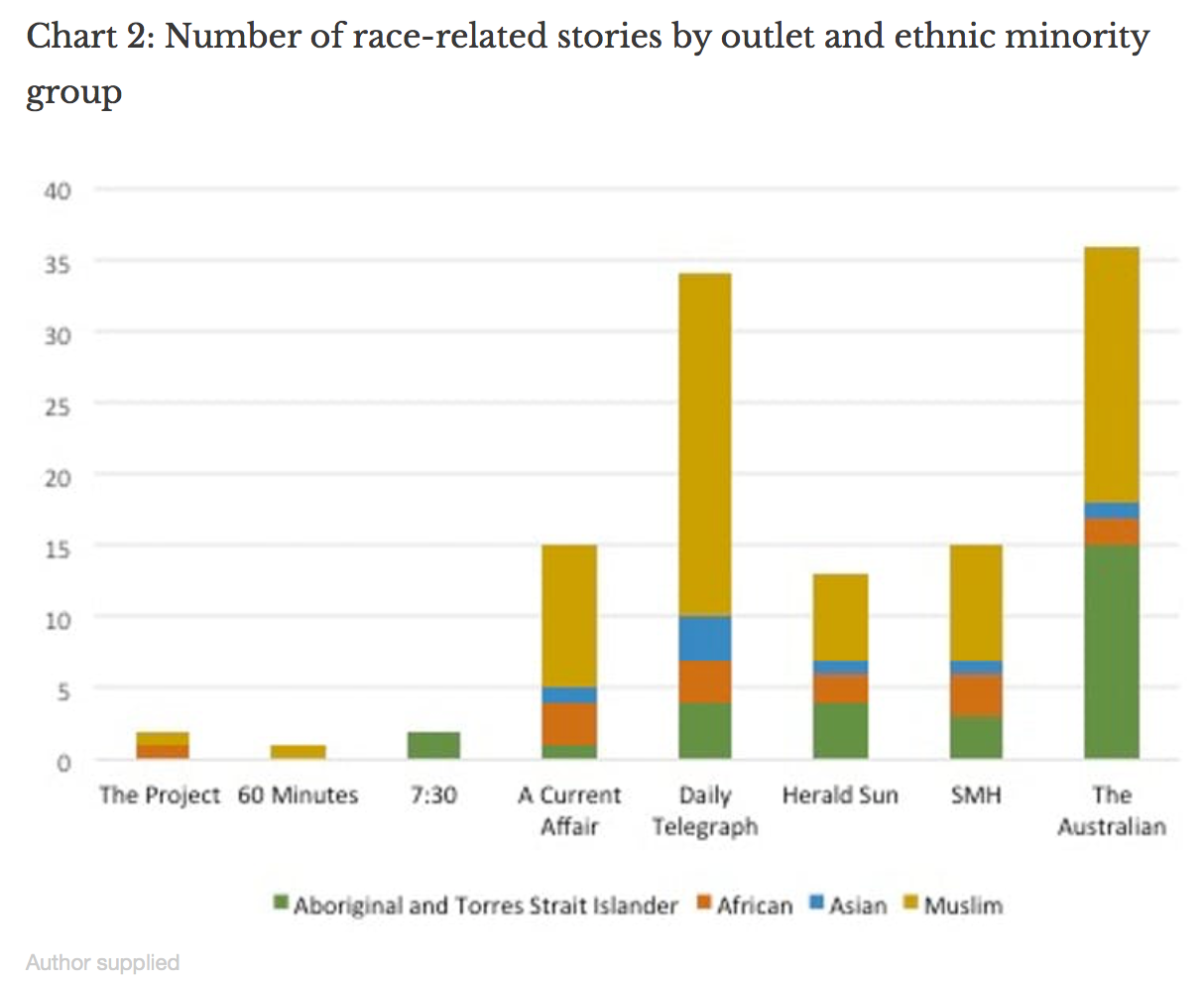
We found that negative race-related reports were most commonly published in News Corp publications. The Daily Telegraph, The Australian and Herald Sun were responsible for the most negative pieces in the press. A Current Affair was the most negative among the broadcast media.

Chart 1: Number of race-related stories by outlet and type of reporting

Muslims were mentioned in more than half of the opinion pieces, and more than twice as many times as any other single group mentioned (see chart 2).

Muslims were portrayed more negatively than the other minority groups (see chart 3), with 63% of reports about Muslims framed negatively. These pieces often conflated Muslims with terrorism. For example, reports used terrorist attacks in the UK to question accepting Muslim refugees and immigrants to Australia.

This was a recurring theme in race-based opinion pieces over the study period. In contrast, there were more positive than negative stories about Aboriginal Australians and Torres Strait Islanders.

Negative commentary about minority groups has lasting impacts in the community. An op-ed in the New York Times recently highlighted the impact that racism in the media has on individuals. It explained:

…racism doesn’t have to be experienced in person to affect our health — taking it in the form of news coverage is likely to have similar effects.
The noted effects include elevated blood pressure, long after television scenes are over. Racism is literally making us sick.

Note also that given the lack of cultural diversity among opinion-makers, particularly on television, social commentators are largely talking about groups to which they do not belong. According to the 2016-20 PwC Media Outlook report, the average media employee is 27, Caucasian and male, which does not reflect the current population diversity of Australia.

This creates a strong argument for increasing the cultural diversity of all media agencies to help minimise the number of individuals or groups being negatively depicted in race-related reports.

via Racist reporting still rife in Australian media

Australia’s citizenship saga resurfaces ‘legacy of pain’ for Indigenous MPs | The Guardian

Interesting wrinkle to Australia’s s 44 dual citizenship prohibition for parliamentarians (some Indigenous Canadians have likely also had citizenship issues given lack of documentation):

Requiring Indigenous politicians to prove their Australian citizenship has been an upsetting and anger-inducing process that resurfaced a colonial “legacy of hurt and pain”, two federal parliamentarians have said.

Some were unable to say when or where their family members were born because the Australian government never registered the births or recognised them as citizens.

Linda Burney, a Wiradjuri woman, was not considered an Australian citizen until she was 10 years old, and in her maiden speech described her experiences of “racism and exclusion”.

Being forced to justify her place in Australia again, as the federal parliament sought clarity on everyone’s citizenship status, was “gut-wrenching”, Burney told Guardian Australia.

In an attempt to end the continuing parliamentary chaos over breaches of section 44 of the constitution, all parliamentarians have been required to lodge declarations and evidence of their citizenship. The forms request the date and place of birth for parliamentarians, their parents and their grandparents, as well as any evidence required to show any citizenships to other nations were renounced.

“I have been made to feel quite angry about what I had to go through to find out about my father and his parents,” said Burney. “The only way that we could find out anything was to go to what was left of the old Aboriginal Protection Board records, and there was a document written by my grandfather to the mission manager on Brungle reserve, requesting permission to build a home.

“To go and have to do that, to go to the old Protection Board records, to realise the best they could do was a letter requesting permission to build a roof over their heads, it really stirred up a lot of deep emotions. Some of that was just disgust and an understanding of the way our people were treated.”

Burney said she understood there had to be a “circuit breaker” in the citizenship crisis and she hoped this process would achieve it. “Somehow or other this issue needs to be dealt with, intelligently and sensitivity, because I suspect there are people – not just Aboriginal people – who are going to find out some very difficult family histories.”

The NT Labor senator Malarndirri McCarthy told Guardian Australia there were “moments of outrage” as she sat in her office trying to complete the questionnaire. “Because just a simple act of filling out this document reminded me of how far our country still has to go in recognising First Nations people in our country, and the legacy of previous policies and the impact they still have today,” she said.

“It brings up a lot of hurt, the legacy of hurt and pain, because we reflect on very real circumstances on the past that impact on the present.”

McCarthy was raised on Yanyuwa country, near Borroloola in the Gulf of Carpentaria, to an Indigenous mother and a father of Irish descent. She is a traditional owner of Yanyuwa land and uniquely has declared as much on the parliamentary registry.

“The difficulty for my maternal side of the family is that we don’t know the dates of when my grandparents were born on Yanyuwa country and Garawa country, or even the dates of my mother’s birth, although we’ve always guessed it was around 1950,” she said. “My maternal grandmother we guessed around 1930.

“I don’t know [details for] my maternal grandfather and that’s largely because statistics and birth certificates were just not part of the way of Australia and the policies of the time didn’t include us.”

McCarthy said she had no concerns about an unknown second citizenship in her background, but added the Labor party’s vetting was strict.

Other parties appeared to be more lax. Among those to have been found ineligible is Jacqui Lambie. The former Tasmanian senator is Indigenous, but her father’s Scottish heritage bestowed upon her dual citizenship, overriding her place as a First Nations Australian.

Western Australian senator and Yawuru man Pat Dodson declined to be interviewed but in a speech to farewell Lambie he decried the system which “put to one side” her Indigenous heritage. “It’s an absolute tragedy that our constitution was written by all these white folks that never bothered to consider and incorporate the First Peoples in it,” he told the Senate.

McCarthy said: “This is what the non-Indigenous men of the day, when they wrote this constitution, this is what they determined for this country.

“The question is do we want to change that?”

To change it would require a referendum. Referendums are difficult to win – something Malcolm Turnbull recently cited to justify his total rejection of an Indigenous voice to parliament.

McCarthy said constitutional recognition of First Nations people must come before any changes to section 44. “If there is a genuine approach to [the concerns of First Nations people], and if First Nations people can see and will believe that, then any steps towards changing the constitution would probably follow suit,” she said.

via Australia’s citizenship saga resurfaces ‘legacy of pain’ for Indigenous MPs | Australia news | The Guardian

Australia: Minister tells principals to throw One Nation senator’s anti-Islam letters in the bin – The Guardian

While I generally favour more respectful dialogue, in some cases a more direct response is appropriate:

The New South Wales education minister, Rob Stokes, has urged school principals to throw anti-Islamic letters from One Nation in the nearest recycling bin, saying “perhaps then some good may still come from it”.

Stokes is the latest to denounce One Nation senator Brian Burston for letters he sent to NSW schools last week, warning principals their children risked becoming “terror-endorsing Islamists” whose religion required the killing of westerners.

The letters, obtained by Guardian Australia, drew immediate condemnation for their wild inaccuracies, divisiveness and tendency to incite hatred against Muslims.

Stokes condemned Burston’s letter as “hate mail”. He said it ran contrary to two hallmarks of western liberal civilisation Burston purported to protect: tolerance and inclusion.

“I strongly suggest to principals that they place all correspondence from the One Nation senator in the nearest recycling bin when it arrives,” Stokes said. “Perhaps then, some good may still come from it.”

Burston’s letter claims Islam is incompatible with the Australian way of life, and attaches a brochure titled Islam Exposed.

The security and intelligence expert John Blaxland warned the letter would simply serve to fuel the messages of Islamic State and help the terror group’s recruitment efforts.

The letter came to the attention of the NSW Greens MP Mehreen Faruqi last week. She has now written to the Australian Human Rights Commission requesting an investigation.

“The letter is divisive and offensive and has no place in our communities and schools,” Faruqi wrote.

“I am referring this letter to you and would be grateful for your advice as to whether or not the letter breaches any federal human rights laws.”

The letter used the Senate letterhead. No reference to One Nation was made.

Stokes said the letter was a waste of taxpayer funds, and would not help to deradicalise students.

“The best way to suppress the potential for extremism is not to divide us, but to promote the Australian values we all share,” he said.

“By celebrating our history and the culture of our country, we want to focus our young minds on values such as upholding democracy, the rule of law, individual liberty, equality and mutual respect and tolerance of those with different faiths and beliefs.”

via Minister tells principals to throw One Nation senator’s anti-Islam letters in the bin | Australia news | The Guardian

Australia: Citizenship drama threatens to widen as spotlight falls on MP’s marriages

The silliness of Article 44 becomes more and more apparent. Only medium-term solution is constitutional change:

Parliament’s dual citizenship drama threatens to widen further after the Turnbull government made it clear its disclosure regime will include marriage.

The original version of the disclosure regime – agreed to by the government and opposition earlier this month – focused on citizenship by birth and descent. It would have required MPs to disclose details relating to their birthplace, parents and grandparents, but not necessarily spouses.

The government and Labor Party have reached consensus over the citizenship issue to hopefully put the crisis to rest but both sides are claiming credit for making it happen.
But the government has now confirmed MPs will be required to disclose relevant details relating to marriage.

Dozens of nations grant citizenship by marriage – or have done so in the recent past – and in a number of them the conferral is automatic.

Is the Parliament in chaos? Here’s how the government’s numbers look
Chief government whip Nola Marino may be a dual citizen by marriage
Questions have been raised about at least one Coalition MP, chief government whip Nola Marino, who was considered at risk of disqualification from Parliament due to citizenship by marriage.

She married her Italian-born husband, Carmelo Marino, in Western Australia in 1972. Official Italian government advice clearly states: “Foreign women who married an Italian citizen prior to 27 April 1983 automatically acquired Italian citizenship on the date of marriage.”

But Ms Marino has now moved to clarify her status, saying her husband lost his Italian citizenship when he naturalised before they were married

The government has also sought to raise doubts about Labor senator Kim Carr, with The West Australian reporting at the weekend he may have inadvertently obtained Israeli citizenship with his marriage to Carole Fabian.

Citizenship was automatically granted to spouses under the Law of Return before 1999. But Senator Carr has denied he has dual citizenship.

Senators have until this Friday to submit their details to parliamentary authorities, with the disclosures to be published on Monday. Lower house MPs will have until Tuesday night to submit their papers.

It is widely believed the disclosures will lead to further referrals to the High Court, potentially creating more Senate vacancies and sparking further lower house byelections.

Nine MPs have already been forced from Parliament as a result of the fiasco, with two government MPs – Barnaby Joyce and John Alexander – now defending their seats in byelections. Section 44 of the constitution forbids dual citizens serving in the Australian

via Citizenship drama threatens to widen as spotlight falls on MP’s marriages

Less open, less tolerant and more nervous, but Australia remains upbeat about immigration

Best summary of the Scanlon Foundation report, the benchmark annual report on Australian public attitudes:

Australians are less tolerant, less open and more nervous about the world than 10 years ago – but not as much as our politics might suggest. That’s the take-home message from the Scanlon Foundation’s long-running social cohesion study, which for the past decade has tracked our feelings about immigration, multiculturalism and Australian society.

Over the years, our sense of belonging, worth and social justice have all taken a hit. From a benchmark of 100 points in 2007, the social cohesion index now sits at 88 – an equal record low since the survey began. But on many measures, Australia’s commitment to multiculturalism and immigration remains upbeat against the odds.

“The simple message would be yes, we’re much worse than 2007,” says Andrew Markus, the report’s lead author and a professor at Monash University. “I think it’s the contrary message – considering what’s happened over the 10 years and so on, we’re actually surprisingly resilient in terms of our attitudes. Downward trend, but not by a huge margin.”

The decline in social cohesion was spurred largely by a growing rejection of difference and sense of pessimism about the future. In 2007, just 11 per cent of Australians felt their life would get worse over the coming few years – in 2017, that figure was 19 per cent. The number of people who strongly disagree with the idea that immigration makes Australia stronger increased from 8 per cent to 13 per cent.

In the past year alone, the number of people who say immigrants need to change their behaviour rose by five percentage points, while fewer people think Australians should do more to learn about immigrants’ customs. In 2017, 20 per cent of people said they had experienced discrimination because of their ethnicity or religion in the past 12 months, compared to 9 per cent back in 2007.

On the hot-button question of Islam, the proportion of Australians who feel negatively about Muslims is stable at 25 per cent – when asked by a telephone interviewer. But when people complete the survey online by themselves, that figure increases to 41.4 per cent. Positivity toward Muslims was highest in Melbourne (34 per cent) and lowest in Brisbane (24 per cent).

But other indicators tell a different story. The number of people who think immigration is “too high” is consistent at just over a third, while 40 per cent say it’s about right. Another 16 per cent of Australians say our current intake – 190,000 people per year – is too low. For reference, we’re significantly more enthused about immigration than Britain, where 60 per cent think it is too high, but less enamoured than Canada, where it is just 23 per cent.

A huge majority (75 per cent) still agree Australia is “a land of economic opportunity where in the long run, hard work brings a better life”. Financial satisfaction remains high, as does people’s sense of individual happiness and worth. But fewer people feel an acute sense of belonging in Australia, with those saying they belong “to a great extent” declining to 67 per cent from 77 per cent.

The figures lead Professor Markus to conclude we are “much more at risk” of a political upset along the lines of Donald Trump or Brexit. The recent resurgence of One Nation is “not a surprise”, he says, given the rising disaffection with politics. But does that mean more of us are motivated by race and immigration?

graphic

“No,” says Professor Markus. “You’ve got an element in our society, and it’s probably growing, but it’s growing at the rate of three, four, five per cent, rather than 30 or 40 per cent.”

The robustness revealed by Scanlon’s annual survey of 1500 Australians is notable given our changing canvas over the past decade. The overseas-born population has grown 37 per cent, with the number of those from China rising 109 per cent, India 176 per cent and the Philippines 74 per cent.

Overall, the percentage of the Australian population that is overseas-born crept up from 25 per cent to 28 per cent. But in the same period, the number of Sydney council areas with majority overseas-born residents rose from one in eight to one in five. In Melbourne, it went from one in 30 to one in nine.

“What that is saying to me is that there’s increasing concentration of the overseas-born population,” Professor Markus says. “You’ve got immigrant communities that are not being integrated in the way that they were in the past. We’ve got a number of risk factors there that are much more significant than they were in 2007.”

Having just smashed through the world record for uninterrupted economic growth, Australia is long overdue for a recession or the type of shock that could see hate and anti-politics boil over.

“We’ve got less money in the bank in terms of the capital we have to deal with a crisis,” says Professor Markus. “In terms of resilience and robustness, and risk factors, they’re there in neon lights. If you have a system which is rudderless, which doesn’t have strong leadership … I do believe that we’re much more at risk. Australia coped quite well with the global financial crisis – could it cope again if there were another similar event?”

via Less open, less tolerant and more nervous, but Australia remains upbeat about immigration

Australia’s citizenship saga projects an insular image: Grant Wyeth

Good commentary:

The current saga concerning dual citizenship of Australian parliamentarians goes far beyond electoral politics. Australia needs a serious conversation about how it sees itself, contends with its plural nature, and how its internal character and national spirit fosters engagement with global society.

Most of the media focus has been on who will be deemed ineligible and how this will affect numbers in parliament. Prime Minister Malcolm Turnbull’s decision to abandon a sitting week appears a case in point. But the consequences of the drama for Australia’s highly plural civil society has largely been ignored. As at the core of this issue remains an attempt to define ‘national loyalty’, with a division created between those who are and are not sufficiently loyal.

Liberal democratic states such as Australia are defined by their ability to embrace, or at least absorb, pluralism. This pluralism is a recognition of humanity’s capability to adopt or tolerate more than one approach of life. For an immigrant society like Australia, it is especially important to recognise that an attachment cultural heritage and a commitment to Australia’s national interests are not necessarily mutually exclusive.

Yet ‘birth’ remains a dominant marker of identity, not matter how problematic. To assume a person is ‘loyal’ to their place of birth discounts a range of influential factors – from values absorbed during upbringing, to sub-culture, to ideology. It places too much emphasis on a random event and continues to ignore the movement of people as a fairly common occurrence in the modern world, often producing complex ancestries.

Most significantly, it removes power and respect from those who have actively sought to live in Australia. The soft power attraction of the country’s values has the potential to be far more potent than simple osmosis, and the questioning of one’s birthplace (and the birthplace of one’s parents and grandparents) demonstrates a lack of faith in this soft power attraction. Tying identity to birth also creates a loyalty test that one’s actions cannot negate. This becomes especially problematic if someone is from a minority community.

Social media made fun by nominating Barnaby Joyce for New Zealander of the year. Those from Anglo-Celtic backgrounds are better positioned to weather any great suspicion due to the ethnic dominance of the group in Australian society. But the situation became highly disturbing when the media decided to ‘weed out’ Josh Frydenberg as potential dual citizen.

The concept of ‘insufficient loyalty’ was a driver of the persecution of European Jews during the 1930s that led to Frydenberg’s family becoming stateless, and millions of others being slaughtered. This ‘body and soul’ relationship to the state subsequently became the daily test of loyalty – best illustrated by Václav Havel’s The Power of the Powerless – and the dominant feature of life within European totalitarianism. That Australia should even briefly flirt with such notions of loyalty is highly troubling.

Australia’s close political cousin Canada has approached its plural and global reality with a maturity that Australia is yet to display. Canada has no provision against dual citizens being elected to parliament embedded in their constitution. The public had few concerns about the recent stint of dual citizen Stéphane Dion as foreign minister (2015-17), and only a minimal amount of fuss was made of Thomas Mulcair’s dual citizenship when opposition leader (2012-15).

Canada has had a better understanding of the knock-on effects of economic liberalism, comprehending that open markets require open arms, hearts and minds. This includes the recognition that people who move internationally will retain cultural connections, and that a certain amount of leeway and trust needs to be given on the idea of ‘national loyalty’. Canada’s qualification to become a member of Parliament is simply tied to the right to vote. If you are entitled to vote, you are entitled to become a candidate, a concept that University of Queensland legal scholar Graeme Orr has suggested Australia should adopt.

Australia should consider how the High Court’s current interpretation of Section 44(1) could dissuade people from seeking office. It could potentially set up a two-tiered citizenship, preventing full democratic participation by a large group of citizens who have both Australia’s best interests at heart and a desire to maintain civic connections with their cultural heritage.

This should also be a practical consideration. It is in the national interest to have a population with intimate knowledge and experience within other countries. This is achievable without multiple citizenships, of course, but an extra passport remains highly advantageous tool for global opportunity. With a population of only 24 million people, Australia needs to facilitate its international links, and parliamentarians are essential as representatives of the public and the state.

Furthermore, a strict territorial nationalism limits the ability of Australia to engage in mutually beneficial, trust-building and cooperative behavior. It maintains the perspective of a world filled with ‘hostile states’ (and their subversive agents), even though the number of countries that Australia would deem hostile has significantly decreased since the end of the Cold War. A cooperative, interconnected humanity remains an aspirational idea, one Australia should strive to promote as an essential component of both its physical and economic security.

How Australia sees and projects itself is an important facet of its international relations. The current display of insularity demonstrates a continued suspicion of the world, an insecurity that is morphing a fear of abandonment into a fear of disloyalty.

via Australia’s citizenship saga projects an insular image

SERVES THEM RIGHT: Australian MPs have talked about the dual citizenship problem for nearly 40 years – and done nothing about it

Good long commentary by Simon Thomsen:

You know that old axiom about parliament being full of reports called for so the government is seen to be doing something, before the findings die on the vine as politicians end up unwilling, unable, or both, to implement the reforms required?

Welcome to Section 44 of the Australian Constitution.

It’s hard to feel sorry for anyone in Canberra resigning or at risk of losing their well-paid job right now when you look at the Parliamentary library and realise various reports have flagged this problem numerous times, back to when Malcolm Fraser was prime minister in the 1980s.

Every time, they did nothing about it.

Perhaps they thought things wouldn’t unravel the way they have in the last few months because accountability has a different meaning in Canberra to the way it’s applied to everyone else in the country. Shakespeare’s line “hoist with his own petard” springs to mind.

Yet politicians like to pretend now that they’re Goldilocks, skipping through the forest, when this issue snuck up on them like the Big Bad Wolf. Oh woe is them.

They’ve known. For decades. The alarm sounded over and over and over again.

They just chose to ignore it and now, once again, are crying out that the Constitution needs to be changed because they failed to observe a very clear law in the first place.

Don’t forget that when this whole debacle began with the sudden resignation of two Greens senators in July, Prime Minister Malcolm Turnbull gleefully declared them guilty of they were guilty of “incredible sloppiness” and “extraordinary negligence” .

“When you nominate for parliament, there is actually a question – you have got to address that section 44 question, and you’ve got to tick the box and confirm you are not a citizen of another country,” Turnbull thundered at the time.

Having now lost two government senators and two MPs – half of the eight vanquished – Turnbull now sings a different song: “People are going to have to be warned in big red flashing letters ‘Dual citizenship is an issue’.”

While it’s not in red flashing letters, the top of the Australian Electoral Commission form they signed as candidates says: “Your attention is drawn in particular to section 44 of the Constitution of the Commonwealth of Australia”.

The nomination form all MPs sign when they nominate.

It’s an example of the popular quote, wrongly attributed to Einstein, that “insanity is doing the same thing over and over again and expecting different results.”

With the government losing two lower house MPs, including deputy PM Barnaby Joyce — and six senators having fallen afoul of the rule including Tasmanian Jacqui Lambie last week — the farce continued with suggested replacements being disqualified before they could even enter parliament, and doubts emerging over some others….

Repeated warnings

So back to those calls for an urgent need for change from people highly motivated by the risk of losing their jobs.

Perhaps they’re right, but the next question is why didn’t they, or their predecessors, do something about it at any point since 1981, when this issue has emerged at regular internals and been the subject of multiple investigations and reports every few years.

Politicians are often accused of inaction and ignoring the wishes of voters. If you’re someone who feels like that, then sit back and poor yourself a cup of political schadenfreude over what’s happened.

First up, former Greens senators Scott Ludlam and Larissa Waters, along with Lambie, are among the few honourable politicians in this tawdry saga.

They copped it on the chin and left.

“This is my error, something I should have checked when I first nominated for preselection in 2006,” Ludlam said back in July.

Fellow New Zealander Barnaby Joyce stayed on a month later, then taxpayers picked up the tab for his appearance before the High Court, where he essentially pleaded ignorance. It didn’t wash with the court.

Barnaby Joyce, found to be a New Zealander. Photo: Stefan Postles/ Getty Images.

The arguments put before the court showed a stunning ignorance of history, with counsel for one government MP warning of a “genealogical witch hunt” because of citizenship by descent laws.

The government should have seen this approaching train wreck for years. Not just over dual citizenship, but Section 44 in general.

John Cameron, the barrister who brought Ludlam undone, has been campaigning on this issue for years. In 2010, he was trying to check the status of UK-born Julia Gillard and Tony Abbott with the British Home Office, then tried to take them to the High Court in 2013 to produce their documents, only to have the case thrown out as “vexatious and an abuse of process”.

There are other MPs and senators in the current parliament who’ve been under Section 44 scrutiny and featured in reports into change. But they’ve done nothing about it.

Another recent warnings came in March 2004, via a Parliamentary Library “E-Brief” after Northern Territory senator Nigel Scullion – the Turnbull government’s current Minister for Indigenous Affairs – faced a spot of bother over a potential breach of section 44(v.) of the Constitution. That section relates any “direct or indirect pecuniary interest in any agreement with the Public Service of the Commonwealth”. It’s the part that ultimately cost Family First’s Bob Day, from South Australia, his senate job in a High Court ruling earlier this year. (Although Day resigned before that anyway, after his building business collapsed.)

The Parliamentary Library wrote the 2004 paper to outline “how section 44 of the Constitution works and why cases like that of Senator Scullion seem to arise so regularly“.

Even the time it took for parliament to deal with the issue back then is telling. It makes the unraveling farce of the last five months – and the plan that all MPs and Senators disclose their status by December 1 – look like light speed action by comparison.

Scullion originally wrote to the Senate President in May 2002 about his concerns.

“The Senate however has proven reluctant to deal with the case. It took 16 months for the Senate even to decide to seek external legal advice,” then 2004 E-Brief recounts.

“It was another five months before the legal advice was tabled in the Senate, which concluded that Senator Scullion had avoided breaching section 44. As Senator Ray remarked on the day the advice was tabled, this may have been a matter of some good luck on Senator Scullion’s part.”

Trawling through the Parliamentary library, the current carnage for the government and MPs of all persuasions begins to look like the result of willful negligence.

From 25 years ago – 25 years ago! – here’s the 1992 Parliamentary Library Background Paper no. 29: Dual citizenship, foreign allegiance and s. 44(i) of the Australian Constitution.

But any MP looking for some weekend reading should drag out No. 36 in the Papers on Parliament, by John Kalokerinos.

His June 2001 work is titled “Who May Sit? An Examination of the Parliamentary Disqualification Provisions of the Commonwealth Constitution“.

If you’re John Alexander or Barnaby Joyce, busy campaigning in a by-election to get your old job back because you’d forgotten/didn’t bother checking regarding your overseas born dad, here’s the short version of what Kalokerinos had to say:

I conclude that the existing disqualifications are deficient. Indeed, s 44 was labelled ‘vestigial’ by Barwick CJ.

The provisions are anachronistic and inequitable, and should be deleted, or replaced with legislative provisions which are less rigid, and capable of being updated by the Parliament as and when appropriate.

The Barwick he refers to is the legendary High Court Chief Justice, Sir Garfield Barwick, in a 1975 case involving a Country Party (now Nationals) senator James Webster, hauled before the Court over s.44(v) – the same section that snared Day in this parliament. Incidentally, Malcolm Turnbull’s father-in-law, Tom Hughes, represented the government.

Kalokerinos notes that Barwick “exonerated Senator Webster through an adroit use of technical principles of contract, and a narrow interpretation of the Constitution. Accordingly, the decision has been subjected to significant and valid criticism.”

But his point is unwavering, the rules are anachronistic, unjust and need to be changed.

He sounds a clear warning, saying “because of the difficulty of constitutional change in Australia, the disqualifications should not be contained in the Constitution, which entrenches ‘archaic language devised in circumstances that prevailed a century ago’.”

Kalokerinos cites the 1992 case Sykes v Cleary, which came to the fore again recently, as well. That involved three candidates in one seat ruled ineligible saying it raised the question “whether this rate of disqualification is extraordinary or simply demonstrative of the pressing need for reform of s 44”.

There are other cases, including in 1999, and various earlier parliamentary reports, including 1997’s House of Representatives review into “Aspects of Section 44 of the Australian Constitution”, which concluded “Legislative protections are more ‘flexible and equitable’, and can be amended to deal with new dangers as they emerge”.

Then there’s the 1981 Senate Committee report, in which Kalokerinos highlights “in arguing the impropriety of constitutional disqualifications [Professor Geoffrey Sawer] noted that disqualifications are by their nature technical, and must be flexible to deal with social and economic change and to remain relevant.”

So 16 years ago, Kalokerinos was warning politicians to act before it was too late, saying (emphasis added):

Despite the unsuccessful record of constitutional reform in Australia, such a proposal would have real prospects of success when its bipartisan nature is recognised, and particularly if put as part of a broader program to update the Constitution.

Significant constitutional reform is needed to produce a disqualification provision more appropriate to parliamentary democracy in Australia in the 21st century.

Reading through all these reports, who can’t help wondering how many dead canaries politicians need in the coalmine before they start to believe there might be a problem.

Another warning was sounded in 1999, for example, when One Nation attempted to exploit Section 44 and senator Len Harris challenged the right of 30 MPs and senators to sit in Parliament because they were born overseas. He ended up in the Senate in September of that year because his colleague Heather Hill, elected the previous year, was tossed out because the naturalised Australian had failed to renounce her British citizenship.

History repeats.

Kalokerinos concludes his analysis saying “Section 44 goes to the heart of Australian representative democracy” and limits the choices of Australian voters to the extent that it conflicts with the notion of representative democracy.

Yes this issue will drag on for at least a few more weeks. Only today the government announced it was extending the deadline, from December 1 to 4, for when MPs have to disclose their citizenship status. It has postponed sittings in the House of Representatives next week over the issue, as well as same-sex marriage, which gives the impression that after a five-week break, there’s no more important legislation for the nation to consider than their own eligibility for parliament.

Turnbull’s handling of this matter has been embarrassing, from his initial gloating over the misfortune of the Greens to wrongly declaring Joyce would be cleared by the High Court. His resistance to an audit, like it’s too much trouble to check politicians actually complied with the legal documents they signed – at risk of criminal penalties, including jail time – adds to the sense that politicians were doing their best to avoid scrutiny.

How can the government demand compliance from banks, unions, multinational companies, taxpayers and welfare recipients, when it’s so cavalier about MPs complying with the Constitution?

As it clings to power, the government now looks like it didn’t just sit on its hands, but may have tried to keep a lid on the whole thing, especially when former senate president Stephen Parry’s reputation was sullied because he was told to keep quiet when he flagged with a senior colleague that he might be a dual citizen.

Changing the Constitution requires a referendum, but as we saw last week, Australian voters know what’s right if Parliament has the courage to ask them.

Once again it’s up to politicians to decide if they’re brave enough to allow us to make that choice.

via SERVES THEM RIGHT: Australian MPs have talked about the dual citizenship problem for nearly 40 years – and done nothing about it | Business Insider

Asian immigrants altering Aussie suburbs – The Straits Times

Similar to Canadian cities like Richmond and Markham (Chinese Canadians), Surrey and Brampton (South Asian and Sikh Canadians):

Groups of men sit in front of a branch of the Bank of China on a weekday afternoon and huddle around fast-moving games of xiangqi, or Chinese chess.

Nearby, a series of Chinese noodle houses and barbecue restaurants adjoin a large Asian supermarket selling pastes, teas and oils sourced from across the region. Most customers as well as pedestrians making their way to the nearby train station speak Mandarin or Cantonese.

But this bustling shopping strip is not in Beijing or Hong Kong, but the Australian suburb of Hurstville, which is on the cusp of setting a historic first for Australia. The suburb, just 16km from the centre of Sydney, is set to become the first in Australia where the majority of the population are of Chinese origin.

According to the 2016 census, 49.4 per cent of Hurstville’s 30,000-odd residents are of Chinese ancestry, compared with just 5 per cent who have Australian ancestry.

Forty-one per cent of the population were born in mainland China or Hong Kong, while 28 per cent were born in Australia, 7 per cent in Nepal and 2 per cent in Indonesia.

It is a remarkable change from just 15 years ago, when 22.7 per cent of Hurstville’s population were born in China or Hong Kong, about half the percentage born in Australia.

Standing beside one of the xiangqi games in progress, Mr Danny Cheng, a 66-year-old originally from the southern Chinese city of Guangzhou, said he was attracted to Hurstville by its easy access to the airport and the city centre.

Recent waves of immigration have led to remarkable changes in Australia’s cultural mix, last year’s national census showed.

Based on the survey, 26 per cent of Australians were born overseas, a proportion higher than other English-speaking nations such as the United States (14 per cent), Britain (13 per cent), and New Zealand (23 per cent).

Indian and Chinese immigrants are rapidly changing the country’s cultural mix. Of 183,608 people offered permanent immigrant visas last year, 21 per cent were from India, 15 per cent were from China, and 9 per cent were from Britain, based on federal government data.

Chinese immigrants tend to be drawn to Sydney, Australia’s largest city. The census found that the proportion of Chinese-born immigrants has overtaken those born in England and accounts for almost 5 per cent of the city’s population of five million.

Indians, meanwhile, are the largest foreign-born group in the second-largest city of Melbourne, comprising almost 4 per cent of the city’s 4.5 million people.

Professor Jock Collins, from the University of Technology Sydney, said successive Australian governments have helped to prevent social problems with an immigration programme that is non-discriminatory and “casts the net to all corners of the world”.

In addition, local, state and federal governments have made a strong effort to ensure basic services such as health, education and welfare are easily accessible to people from diverse cultural and linguistic backgrounds.

A short drive away from Hurstville, in the suburb of Harris Park, a similar story is unfolding but with a different ethnic group: Of the area’s 6,000-odd residents, 46 per cent were born in India.

The evolving characters of Hurstville and Harris Park tell the story of Australia’s changing ethnic mix, as China and India start to overtake Britain as the largest source of immigrants Down Under.

An expert on Australian immigration, Professor Jock Collins, from the University of Technology Sydney, said that Hurstville’s majority Chinese-ancestry population is a first for the nation but he pointed out that the area still has a diverse cultural mix.

He said Australia has not tended to have “ghettoes” or highly concentrated immigrant areas, unlike British suburbs with high proportions of Pakistani, Indian or Caribbean residents, or Miami, in the United States, with its concentrations of Cuban-origin residents.

“In Australia, unlike many other countries, we don’t have ghettoes where only one group dominates,” he told The Straits Times.

“Even places such as Hurstville and Harris Park are cosmopolitan rather than mono-ethnic communities. So I don’t think it is a thing to worry about – there has not been conflict or issues in those areas of high concentration.”

Analysts say that so-called “chain migration” – in which immigrants from one location follow one another to a new community – remains common for the immigrant waves from countries such as China and India, as it has for previous waves from places such as Greece and Italy. But, over time, immigrants in Australia tend to disperse across the city.

via Asian immigrants altering Aussie suburbs, Australia/NZ News & Top Stories – The Straits Times