John Ivison: Budget officer finds illegal migrants entering via a ‘loophole within a loophole’

The loophole, allowing those in the asylum process who arrived as irregular arrivals to sponsor their relatives during the determination process, should be relatively easy to close, in contrast to the provision in the Safe Third Country Agreement that it doesn’t apply to those not arriving at official border crossings, which would require highly unlikely agreement with the Trump administration:
While a politician may wish something to be true, simply saying it in the House of Commons does not make it so.

Bill Blair, the newly minted minister for border security, made a claim about the refugee system in question period Thursday that cannot be supported by the available facts.

“The system is working,” he said.

He was responding to questions about a new report by the Parliamentary Budget Officer, which pegged the cost of “irregular” — for which read “illegal” — migration at $340 million for the cohort of migrants who arrived in Canada in 2017-18 – a cost-per-migrant to the federal government of $14,321. (That does not include provincial expenses, which Ontario claims come to around $200 million. The PBO estimated a similar amount for Quebec. The federal government has reimbursed the provinces a total of $50 million.)

Technically, Blair is correct. The refugee system is working — in much the same way the Russian military’s Antonov Flying Tank worked during the Second World War.

In that case, the plane could leave the ground and drop a tank by parachute, albeit without crew, fuel or armaments. It worked. It just didn’t work well — and the project was rapidly abandoned.

A Royal Canadian Mounted Police officer in Saint-Bernard-de-Lacolle, Que., advises migrants that they are about to illegally cross the border from Champlain, N.Y., and will be arrested, on Aug. 7, 2017. Charles Krupa/AP

The federal government should adopt a similar approach and go back to the drawing board.

The PBO report is revealing, and not just for the cost estimates. In fact, it emerges in a footnote the costs are likely more than $14,321 per migrant — Immigration, Refugees and Citizenship Canada estimates the number at $19,000.

But during its investigation, the PBO team elicited some interesting responses from government departments that show how bizarre the migrant story has become.

Another footnote revealed that Canada Border Services Agency officers have identified a phenomenon where one claimant enters Canada illegally and acts as an “anchor relative” for other family members. Those family members can then enter at a port of entry and not be considered illegal migrants. (The PBO asked for data but CBSA said it is not currently being tracked).

But think about that for a minute — a practice Conservative immigration critic Michelle Rempel has called a “loophole within a loophole.”

This means a migrant can cross into Canada from the U.S. between official entry points, avoiding the Safe Third Country Agreement that would have otherwise made them ineligible. (The agreement between Canada and the U.S. states that migrants seeking refugee status must make their claim in the first “safe” country they arrive in — either Canada or the U.S.)

Once a claim has been made, the migrant can access Canada’s generous welfare system as he or she navigates the asylum claims process that gives them multiple hearings and appeals. In the meantime, they can effectively sponsor other members of their family, who can then arrive as regular migrants — also avoiding the Safe Third Country Agreement.

Blair tried to sanitize this blatant abuse of process by pointing out that 40 per cent of migrants crossing illegally are children — postulating that this is a question of humanity and human rights obligations.

But due process should work both ways, and in this case the integrity of the system is being violated.

The anchor relative provision does not just apply to nuclear families but to parents, grandparents, siblings, aunts, uncles, nephews and nieces.

The obvious solution is to close both loopholes in the Safe Third Country Agreement — amend it so it applies between official points of entry, and more tightly define who migrants can bring in.

But there appears to have been little progress in persuading the U.S. to change an agreement that sees people it clearly does not want within its borders effectively deporting themselves.

There are other reforms that could be undertaken. Experts who have looked at the system talk about the “failure of finality” — the endless appeals process that effectively gives migrants a new hearing at the Refugee Appeal Division if their claim is rejected by the Refugee Protection Division, and still another one at the Federal Court if the appeal fails.

The Liberals have done little beyond what they do best — throwing money at the problem. In response to the new arrivals, budget 2018 allocated $173.2 million over two years to “manage the border.”

But the PBO report gives lie to Blair’s claim the “system is working.”

In the 2017-18 fiscal year, the Immigration and Refugee Board had capacity to hear 24,000 claims. During that period there were 52,142 new asylum claims, of which illegal migrants represented 23,215. The system was flooded with claims beyond its capacity, creating a backlog of 64,929 cases.

More than half of the refugee claims were made by irregular migrants from Nigeria and Haiti. That is not a dog-whistle for swivel-eyed racists, or “fear-mongering,” as one senior Liberal put it. It is a fact.

They are flooding from those countries because word has got out that the Canadian system can be gamed with great ease — that an entire family can set up in the Great White North for the cost of a plane ticket from Lagos to New York City and a bus ride to the Quebec border.

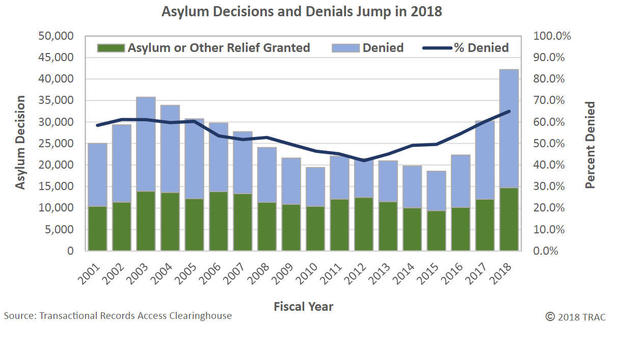
Canada has seen similar surges in refugee claims before. In 2010, the Conservatives introduced visa requirements for Mexicans and Czechs, after a flood of bogus claims. The intake of refugees fell from 25,783 in 2010 to 10,227 in 2013 and the backlog halved. For the 2017 calendar year, claims were at 47,427 and the backlog was of a similar magnitude.

If the system was working, as Blair claimed, it would be fast, fair and final.

Currently, it is the very opposite — sluggish, arbitrary and inconclusive.

Source: John Ivison: Budget officer finds illegal migrants entering via a ‘loophole within a loophole’

And John Ibbitson on the potential electoral implications of the costs:

The problem of people crossing the Canada-U.S. border illegally and then seeking asylum just became a bigger headache for the Liberals, one they emphatically do not need less than a year before the next election.

The situation at the border appeared to be improving. In 2017, more than 20,000 asylum-seekers crossed illegally into Canada from the United States. In the early months of 2018, the flow was actually increasing, compared with the year before. But then the numbers started to taper off – at least on a year-over-year basis. Ottawa seemed to have things under control.

“There is a challenge, but it is not a crisis,” Public Safety Minister Ralph Goodale insisted in July.

But if the numbers aren’t increasing, the cost sure is. In a report released Thursday, the Parliamentary Budget Officer estimated that handling the claims of asylum-seekers cost the federal government more than $14,000 a case in the last fiscal year, will cost almost $15,500 this year and will cost $16,700 next year. By that time, taxpayers will be doling out $400-million a year to handle these claims and to provide the migrants with health care.

As the Tories quickly pointed out, the accumulated costs will be more than $1-billion by the end of the next fiscal year.

“Justin Trudeau’s failure to address the crisis he has created has real consequences for Canadians,” Conservative Leader Andrew Scheer said in a statement, “and this report brings those consequences into sharp focus.”

These sums don’t include the cost of sheltering, feeding, clothing, educating and otherwise caring for the needs of these asylum-claimants, which are largely borne by provincial and municipal governments, and which has set the Ontario government back an estimated $200-million.

It gets worse. Asylum-claimants who cross the border illegally are overwhelming the tribunals established to hear refugee claims, creating a current backlog of 65,000 cases. It will take about three years to handle the claim of someone arriving this year. Next year, the backlog could stretch to four years.

Each individual claim is unique. Each person seeking asylum in Canada has a story to tell, and that story can be heartbreaking. But, on its face, most of the people crossing into Canada illegally from the United States appear to have a weak case.

Last year, many of the migrants were Haitian citizens who feared being forced to return to Haiti by the Trump administration. To be blunt, that’s not Canada’s problem.

This year, many of the claimants were Nigerians who obtained a visa to enter the United States and then headed straight for the border. These appear to be economic migrants, whose claims for protection as refugees should not be accepted.

What will happen next year? Will a fresh crop arrive at our border seeking asylum – Latinos who fear deportation from the United States, or nationals from Caribbean or African countries seeking a chance for a better life? Will the ever-lengthening wait times for hearings, which allow asylum-seekers to stay in Canada, convince more and more migrants that they have nothing to lose and everything to gain – including free health care – by crossing the border illegally? Or will the numbers drop down below 2017 levels? No one knows.

What we do know is that the problem of people crossing the border illegally corrodes confidence in Canada’s immigration and refugee system. This country’s future well-being depends on a robust intake of immigrants to compensate for a low natural birth rate. If people conclude that bogus refugee claimants are gaming the system, they could lose confidence in the entire program, which would be a disaster for Canada.

None of this is lost on the Conservatives, who will accuse the Liberals of failing to secure the border – which is, it must be said, one of the core responsibilities of any sovereign government.

Of course, the Tories have no good explanation for how they would handle things if they were in charge. But that may not matter. The opposition mantra will be: The Liberals can’t get a pipeline built. They can’t balance their budget. They can’t even secure the border.

Not a pleasant narrative for a governing party to confront in an election year.

Asylum seekers entering Canada outside legal border points cost an average of $14K each: PBO

Interesting to have the cost data. Doesn’t surprise me terribly given the nature of the determination processes and related costs:

The federal government spends an average of about $14,000 for each asylum seeker crossing into Canada outside of legal border points — a cost that’s expected to rise as the case backlog grows, says Canada’s budget watchdog.

In a report released Thursday — Costing Irregular Migration Across Canada’s Southern Border — Parliamentary Budget Officer Yves Giroux said the total cost for the asylum claims process was about $340 million in 2017-2018 and is expected to rise to $396 million in 2019-2020.

He said some of the accounting is based on average costing for all refugee claimants, because the federal government does not track separate data for “irregular” asylum claimants. Aside from some added costs for RCMP interventions, the average costs for claimants crossing illegally would be same as those for all refugee claimants.

The federal government set aside an extra $173 million over two years in this year’s budget to cover the additional costs related to asylum seekers crossing into Canada outside of legal border points. Giroux said that sum “falls short significantly.”

“Our estimates suggest that they have not budgeted enough, which will result in increased backlog at the Immigration and Refugee Board,” he said.

The $173 million was based on an annual influx of 5,000 to 8,000 individuals, rather than the actual number of 23,000 per year, Giroux said.

The costs tallied in the report are for federal organizations such as the RCMP, Canada Border Services Agency, Immigration, Refugees and Citizenship Canada and the Immigration and Refugee Board. They do not include expenses incurred by the provinces, territories or municipalities, which pick up costs related to social services.

Ontario, for example, has estimated its costs related to asylum seekers arriving outside official border points at about $200 million a year.

The report comes after the City of Toronto made a new request for an additional $64.5 million from the federal government to deal with the “unsustainable” operational and financial pressures associated with refugee and asylum claimants.

The city says that about 40 per cent of Toronto shelter users are refugees or asylum claimants — a jump from 11 per cent in early 2016 and 25 per cent in late 2017.

Toronto asks for $64.5M

Toronto is asking for $64.5 million to reimburse its costs and ongoing, stable funding of $43 million a year starting in 2019.

“The city can’t do this alone. The federal government has come forward with initial help but we need the continued assistance of our federal and provincial partners to ensure that Toronto remains a safe, welcoming and accessible place for all,” said Mayor John Tory in a statement.

In June, the federal government pledged $50 million for Ontario, Quebec and Manitoba. Ontario’s share of $11 million went directly to Toronto after the provincial government scoffed at the amount.

Doug Ford’s Progressive Conservative government has asked Ottawa for $200 million to defray the costs of social assistance, housing and education associated with asylum seekers.

The cost per asylum seeker varies from about $10,000 for a simple case — where the claim is accepted — to about $34,000 for a more complex case ending in the claimant exhausting all appeals and being deported.

Giroux said that as the number of asylum seekers rises, the cost increases because of the backlog in cases. Costs are driven up, in part, because the refugee claimants are entitled to the interim federal health benefit, which covers certain health-care costs for refugee claimants until they’re eligible for provincial or territorial health insurance.

“Increasing the backlog means individuals have to stay in limbo for a number of years, and we estimate that could rise to five or six years in some cases,” he said.

Figures ‘absolutely shocking’

Conservative immigration critic Michelle Rempel said some of the figures in the report are “absolutely shocking,” given that the total costs for a single asylum seeker could be in the range of a gross salary of a minimum wage worker in Canada.

“It just blows my mind that between 2017 through the next fiscal year this prime minister is choosing to spend $1.1 billion on essentially what amounts to the abuse of our asylum system,” she said.

Rempel said the Conservatives will make a formal request to the federal auditor general for a comprehensive audit of the broader costs of illegal border-crossers to government.

She blamed Prime Minister Justin Trudeau for driving the trend by refusing to close a “loophole” in the Safe Third Country agreement with the U.S., which requires that asylum seekers make their claim in the first ‘safe’ country they arrive in. The Conservatives have been urging the government to end an exception that allows people to sidestep that rule if they cross outside official border points.

Rempel also referenced Trudeau’s Jan. 28, 2017 tweet in which he welcomed to Canada those fleeing persecution, terror and war in response to U.S. President Donald Trump’s immigration crackdown.

It was retweeted more than 400,000 times, and liked by more than 750,000 people.

Border Security Minister Bill Blair insisted the government is giving the refugee system the resources it needs while making improvements to reduce the number of people presenting outside official border points.

He said Canada is just one of many countries hit by the surge in global migration.

“Our obligation is to ensure that we manage that in a cost effective, efficient way according to Canadian law and our international obligations, and as well in accordance with Canadian values,” he said. “I think that’s what’s expected of us.”

Tens of thousands of people have crossed into Canada outside of official border points in the last year, mostly in Quebec and Manitoba.

The costs of housing them, and the question of who should pay, have become major political issues in cities such as Toronto and Montreal, which are under pressure to shelter and support the new arrivals.

The PBO agreed to a request from Conservative MP Larry Maguire last June for a global accounting exercise to add up the costs incurred to date from these migrants, and to indicate how much the stepped-up pace of irregular migration might cost Canada in the future.

Source: Asylum seekers entering Canada outside legal border points cost an average of $14K each: PBO

Trump Suspends Some Asylum Rights, Calling Illegal Immigration ‘a Crisis’

For the Conservatives arguing for closing the loophole in the Safe Third Country Agreement that does not return asylum seekers entering outside regular border crossings (i.e., Roxham Road) to the U.S., the constraints on the U.S. government doing the same for its Southern border may be instructive:

President Trump proclaimed on Friday that the illegal entry of immigrants across the southern border of the United States was detrimental to the national interest, spurring tough changes that will deny asylum to all migrants who do not enter through official border crossings.

The proclamation, issued just moments before Mr. Trump left the White House for a weekend trip to Paris, suspends asylum rights for all immigrants who try to cross into the United States illegally, though officials said it was aimed primarily at several thousand migrants traveling north through Mexico in caravans.

“The continuing and threatened mass migration of aliens with no basis for admission into the United States through our southern border has precipitated a crisis and undermines the integrity of our borders,” Mr. Trump wrote in the proclamation.

As he left the White House for the overseas trip, Mr. Trump said, “We want people to come into our country, but they have to come into the country legally.”

The American Civil Liberties Union filed a lawsuit on Friday within hours of the president’s proclamation, urging a federal judge to prohibit Mr. Trump from moving ahead with his plans to deny asylum to thousands of migrants who may cross the border.

In a legal filing in United States District Court in San Francisco, the A.C.L.U. said that the president’s move was “in direct violation of Congress’s clear command that manner of entry cannot constitute a categorical asylum bar.” The lawsuit also alleges that the administration enacted the rule “without the required procedural steps and without good cause for immediately putting the rule into effect.”

The lawsuit could set in motion another clash between Mr. Trump and the judicial system over the power of the presidency to control the nation’s borders. Officials at the Justice Department and the Department of Homeland Security did not immediately respond to questions about the lawsuit.

Administration officials said on Friday that the suspension of asylum rights would be in effect for at least 90 days, but could end sooner if Mexico’s government would sign an agreement allowing the United States to return those who illegally cross the border from Mexico, regardless of their home country — a proposal that Mexico has long rejected.

For decades, immigration law in the United States has required that officials allow migrants who fear persecution in their home countries to seek asylum regardless of whether they entered the United States legally or illegally.

Mr. Trump’s proclamation is a radical departure from that tradition. With the exception of children arriving without parents, officials said that all migrants who cross illegally would automatically be denied asylum. Advocates for migrants condemned the policy shift as meanspirited and unconstitutional.

“Issuing a presidential proclamation effectively denying vulnerable families protection from violence is contrary to our laws and values,” said Kevin Appleby, a senior director at the Center for Migration Studies. “In the long run, it will not deter asylum seekers who are fleeing for their lives. On this one, the emperor has no clothes.”

Across the world, nations have for years agreed to consider asylum protections for those fleeing violence and persecution, even if they cross borders illegally. Human rights advocates said on Friday that the United States should be a leader in supporting that idea.

“One thing that unites a majority of Americans is a belief in the principle of asylum,” Ali Noorani, the executive director of the National Immigration Forum, said in a statement. “Eroding that principle means eroding a defining value of our nation.”

Administration officials insisted that the new rules would remain consistent with United States obligations to the rest of the world because seeking asylum is not the only way for someone fleeing persecution to receive protection.

Officials said migrants would be allowed to seek other protections if they could prove a risk of being tortured in their home countries. However, they conceded that those claims were purposely much harder to prove and that fewer people were likely to qualify to stay in the United States than would have by receiving asylum. The only way to seek asylum will be to arrive at an official border crossing.

But officials conceded that many of the crossings from Mexico into the United States — known as ports of entry — were over capacity and already had trouble processing the number of asylum claims being made by migrants there. Under the new policy, many more are expected to arrive at the crossings.

In the proclamation, Mr. Trump acknowledged the problem and directed his administration “to commit additional resources to support our ports of entry at the southern border to assist in processing those aliens.”

Mr. Trump’s proclamation drew on the same powers to control the nation’s borders that he cited when he banned travel from several predominantly Muslim nations shortly after becoming president. The Supreme Court upheld a later version of that ban after a nearly year-and-a-half legal fight.

The new proclamation is certain to ignite a similar legal battle.

For months before the midterm elections, Mr. Trump cast the group of migrants as a threat to national security, claiming — without evidence— that among them are criminals and “unknown Middle Easterners.”

Mr. Trump’s proclamation puts into effect regulatory changes announced Thursday afternoon that effectively overhaul deep-rooted asylum laws that sought to provide a safer life in America for people fleeing violence and persecution in their home countries. Officials said the changes would take effect early Saturday morning.

Most of the migrants in the caravan come from Honduras and other Central American nations, where they say they fear for their lives because of continuing violence.

Mr. Trump has been seething for months about the increase of immigrants crossing into the United States from Mexico and the caravan of several thousand migrants whose travels have drawn news media attention. The president ordered more than 5,000 active-duty troops to the border to prevent the migrants from crossing.

By early this week, that caravan still had about 4,000 or 5,000 people and had made it to Mexico City.

Government closely watching public opinion on asylum seekers, docs show

Duh!

The federal government has been closely monitoring public reaction to the influx of asylum seekers in Canada — regularly conducting national surveys and measuring discussions on social media.

Documents released to The Canadian Press under access-to-information law show department officials receive weekly internal updates on media coverage and public response to issues related to asylum seekers coming irregularly into the country across the Canada-U.S. border.

This monitoring includes internal polling conducted by the Immigration Department to track public opinion about asylum seekers.

Two mid-year surveys of 2,000 Canadians, conducted by the department in March, suggested Canadians were not overly confident about Canada’s ability to manage the border at unguarded points-of-entry and had little sense of obligation about accepting asylum seekers from the United States.

Fewer than half of respondents — 43 per cent in a telephone survey and 35 per cent in an online survey — agreed that Canada is taking appropriate steps to manage irregular border crossings.

Forty-two per cent of telephone respondents and just 18 per cent of those online indicated they felt the number of people coming to Canada and claiming asylum was at an appropriate level.

“Canadians are more receptive to refugees who have been selected by the government of Canada compared to those who come to Canada and claim asylum,” the internal document notes as one of its key takeaways from the public survey.

The documents also show the Immigration Department closely measures public comment about asylum seekers on social media. This includes a weekly average of how many times the issue is mentioned every day.

The government also measures the number of times media stories published about asylum seekers include “myths countering messaging.”

It also uses social media as a tool to disseminate information as part of its outreach efforts to discourage irregular migrants from coming to Canada.

A targeted advertising campaign using search engine marketing to reach key populations in the U.S. was launched on Dec. 18, 2017 and continued until March 17, 2018, which included “targeted messaging based on users’ search terms to users in select U.S. cities where larger temporary protected status populations are found,” the internal document states.

Canada first began experiencing an influx of “irregular” border crossers in early 2017, shortly after U.S. President Donald Trump announced he would end a program that offered temporary protected status to immigrants from several countries in the United States.

Over 36,000 asylum seekers have since arrived in Canada from the U.S., avoiding official border checkpoints where they would have been turned back to the U.S. under the Safe Third Country agreement between the two countries. Instead, they have been crossing the border along forest paths and fields, declaring their intent to seek refugee status once on Canadian soil.

The issue has sparked calls for Canada to suspend or amend the Safe Third Country Agreement as a way to stop the flow of irregular migrants.

Border Security Minister Bill Blair points to the fact that there was not a major surge in the number of irregular border crossers apprehended by RCMP this summer compared to last summer.

“Our senior officials are working hard, they are working hard and they are managing the situation quite ably,” Blair said Thursday.

However, year-over-year numbers show that overall, more people have crossed irregularly into Canada so far this year compared to the number of individuals who crossed from January to September of 2017.

Source: Government closely watching public opinion on asylum seekers, docs show

The six countries 300000 immigrants must return to with end of TPS program

Potential future waves of asylum seekers via irregular arrival border points (e.g., Roxham Road):

The Trump administration has been eliminating the Temporary Protected Status (TPS) program, which has allowed more than 300,000 people from countries hit by war and natural disasters to legally stay in the U.S. for decades.

To end TPS protections for 98 percent of those recipients, the Department of Homeland Security has claimed that conditions in those countries are now suitable for thousands of their residents to return home.

A federal judge this month ordered a temporary halt to the administration’s actions – a ruling the Justice Department is appealing – leaving TPS holders facing an uncertain future as they weigh their options.

Here’s a look at the current conditions in the six countries that have lost their TPS status, listed in order of their deadlines for immigrants to leave the U.S. All TPS populations are estimates from the Congressional Research Service.

Sudan

TPS ends: November 2, 2018

TPS first granted: 1997

Reason for TPS designation: Civil war

Estimated number of TPS recipients: 1,040

TPS was first granted to Sudan as the country was being torn apart by a decades-long civil war. When the country officially split in two in 2011, the U.S. granted TPS status to the newly-created South Sudan as well.

In the years since, deadly fighting has continued throughout South Sudan. Based on that ongoing conflict, the Trump administration announced in September that TPS status would be extended for that country.

But Sudan was cut off, with the administration arguing that armed factions are largely honoring cease-fire agreements that have been brokered in recent years. In its justification for ending TPS, the administration said armed conflict “is limited to” two southern provinces and the western province of Darfur, which rose to international prominence in the early 2000s when hundreds of thousands were killed and millions forced to flee as refugees.

The United Nations Security Council paints a more dire picture. A December report on the Darfur region found that food insecurity remains at crisis levels, human rights abuses continue, and the region is being flooded by people fleeing violence in South Sudan, with 89,000 refugees arriving in Darfur in 2017, further hindering the region’s recovery efforts.

Muna Ndulo, a law professor and director of the Institute for African Development at Cornell University, said the safety of returning Sudanese will depend on what specific corner of the country they’re from. If they go to the capital city of Khartoum or northern provinces, they should be fine.

“But if they’re from Darfur, they have nowhere to go,” Ndulo said. “The situation there is still very precarious. And my assumption would be that most of these (TPS holders) would be from that conflict area.”

Nicaragua

TPS ends: January 5, 2019

TPS first granted: 1999

Estimated number of TPS recipients: 2,550

Reason for TPS: Hurricane Mitch

The Inter-American Commission on Human Rights estimates that since April, at least 322 people have been killed in the violence, and hundreds more have been arrested. The White House even issued a round of sanctions in July against three Nicaraguan officials, accusing them of human rights abuses, and suspended the sale of any U.S. vehicles or equipment “that Ortega’s security forces might misuse.”

That nationwide dysfunction has sent the country’s economy, which was meager but had been one of the most stable in the region, into a free-fall. That combination makes Nicaragua a dangerous place for anybody to return to, according to Geoff Thale, vice president of the Washington Office on Latin America.

Thale recently spoke with a group of Nicaraguan priests who have been using churches and other buildings to hide protesters who have become targets of the regime. Thale said those are the very same priests who would help returning Nicaraguans safely reintragrate into society. But now, with the country beset by so much chaos: “They’re a little busy with other things.”

Nepal

TPS ends: June 24, 2019

TPS first granted: 2015

Estimated number of TPS recipients: 8,950

Reason for TPS: Earthquake

Sitting atop the Himalayas, Nepal was rocked in 2015 by a magnitude-7.8 earthquake that led to an avalanche on Mt. Everest and a major aftershock weeks later. The combination left nearly 9,000 dead and millions displaced.

The Nepalese government, with the help of more than $4 billion in international aid that has been pledged by donors, has taken many strides to rebuild the country, but conditions remain far from normal.

More than 270,000 homes have been rebuilt, but more than 800,000 are still listed as undergoing reconstruction from the quake, according to a May update from Nepal’s National Reconstruction Authority, a government task force created to oversee rebuilding.

The country has rebuilt more than 3,800 schools, about half of the agency’s target of 7,500. The country has only rebuilt 49% of its medical facilities, 21% of its security buildings, 18% of its drinking water systems, and 13% of its cultural heritage sites, which form the basis of much of the country’s tourism industry.

Prabha Deuja, president of the Virginia-based America Nepal Society, visited the region in January and said she saw construction efforts all around. But she said the country’s isolated location, and it’s limited government resources, has made it difficult to complete reconstruction and prepare Nepal for an influx of new residents.

“This is a third-world country. We have to get sand and supplies from different countries,” she said. If TPS holders had to return, “I can’t tell you what they will do. The job market, where they’re staying, it’s a really gray area.”

Haiti

TPS ends: July 22, 2019

TPS first granted: 2010

Estimated population: 46,000

Reason for TPS: Earthquake

Rioting in the Haitian capital of Port-au-Prince grew so intense in July that the U.S. sent in the Marines to secure U.S. interests there, according to CNN.

That unrest forced the nation’s prime minister to resign, just the latest step in a seemingly never-ending series of calamities plaguing the country.

First designated for TPS following the catastrophic earthquake in 2010 that killed more than 200,000, the country has since been hit by a cholera outbreak, an island-wide drought, and a direct hit by Hurricane Matthew in 2016 that created, in the words of the U.S. State Department, “a new humanitarian emergency.”

Frank Mora, director of the Kimberly Green Latin American and Caribbean Center at Florida International University, said all of those ensuing problems have exacerbated Haiti’s earthquake recovery and cannot be treated as separate, individual crises. “Haiti is still living with the consequences of the earthquake,” he said.

Throwing tens of thousands more Haitians back to the island right now, Mora said, will only strain the government’s limited resources and endanger the Haitians who will be returning to a country with problems at every turn. The majority live in South Florida and New York.

“They’ll have to face the constant political uncertainty, the energy crisis, the food distribution challenges that still exist,” Mora said. “If there’s any country in the Western Hemisphere where these people will be going into a near humanitarian disaster, it would be to Haiti.”

El Salvador

TPS ends: Sept. 9, 2019

TPS first granted: 1991

Estimated number of TPS recipients: 195,000

Reason for TPS: Earthquake

Using any metric, El Salvador is considered one of the most dangerous, deadly countries on the planet.

In 2016, the Central American nation was deemed the murder capital of the world with a homicide rate of 104 people per 100,000, the highest for any country in nearly 20 years, according to data from the World Bank. The homicide rate reportedly fell in 2017, but crime remains so rampant that only 12% of Salvadorans believed that drop, according to InSight Crime.

In July, the U.S. State Department issued a Level 3 Travel Warning (on a scale of 1 – 4) urging Americans to reconsider traveling to El Salvador. “Violent crime, such as murder, assault, rape, and armed robbery, is common,” the advisory read.

Yet that is where the Trump administration has decided to send the largest group of TPS recipients, nearly 200,000 of them.

Mora said the situation only becomes worse as the U.S. continues deporting gang members from the U.S. back to El Salvador, bolstering the ranks of the gangs and drug cartels that control so many aspects of day-to-day life.

“That situation is difficult for people who live in El Salvador, who’ve been living that situation day in and day out,” Mora said. “So you take someone who has lived in Miami or New York, and you’re going to throw them into that situation. No one has the tools to prepare themselves for that.”

Honduras

TPS ends: Jan. 5, 2020

TPS first granted: 1999

Estimated number of TPS recipients: 57,000

Reason for TPS: Hurricane Mitch

The homicide rate in Honduras dropped significantly in 2017, down to 42.8 per 100,000 inhabitants, the country’s lowest in a decade. But the country remains one of the most dangerous and politically unstable in the hemisphere.

The re-election of President Juan Orlando Hernandez to a second term in November led to violent protests that were met by intense government crackdowns.

Thale says the country remains in the grip of drug cartels who use kidnappings as a standard way to generate income. He said that makes any returning Honduran a “walking invitation for extortion.”

He said gangs will undoubtedly know who is returning to their neighborhoods, and will target people who are returning with cash after selling off their homes, cars, businesses and other goods before leaving the U.S. So how, Thale wondered, could anyone think that Honduras is in a position to successfully, and peacefully, welcome an influx of 57,000 people.

“No sane person thinks they can,” he said.

Source: The six countries 300000 immigrants must return to with end of TPS program

Immigration department changed ‘illegal’ to ‘irregular’ on webpage about asylum seekers as debate flared

Suspect someone finally noticed the inconsistency in language between the website and ministerial remarks:

The immigration department changed a web page about asylum seekers to swap the word “illegal” for “irregular” as a debate was erupting between the federal government and Ontario on the issue, CBC News has learned.

The change in July came 18 months after the web page, titled “Claiming asylum in Canada – what happens?,” was first published — and just one day after federal Immigration Minister Ahmed Hussen suggested the provincial Progressive Conservatives were mistaken in the way they were describing the status of people entering Canada at non-official entry points.

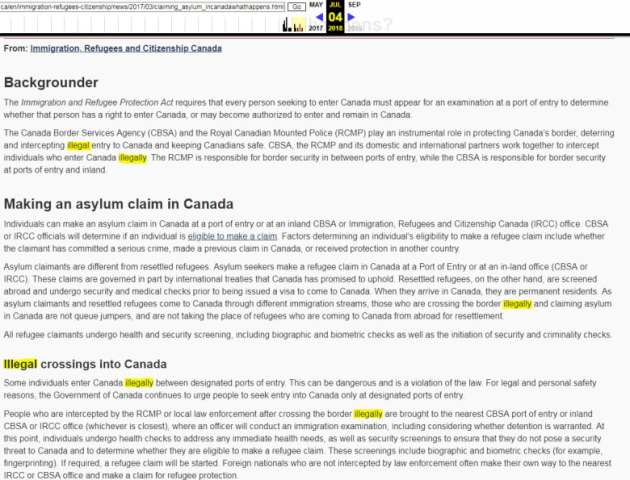
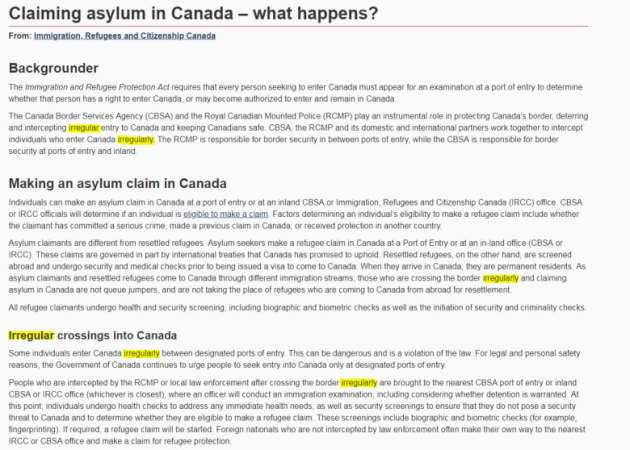
Throughout the web page, which is intended to provide information on Canada’s asylum laws, the words “illegal” and “illegally” were switched to “irregular” or “irregularly” in six separate instances on July 10, 2018.

A Wayback Machine snapshot shows that “illegal” was the word of choice on the immigration web page before it was changed 18 months later. (CBC News/Olivia Chandler)

On July 9, Hussen attacked Ontario’s newly-elected premier, Doug Ford, and provincial Social Services Minister Lisa MacLeod, who oversees the immigration file, over their use of the term “illegal border-crossers” when describing asylum seekers crossing at non-official border points.

As Hussen was telling a news conference Ford and MacLeod were wrong to call those border crossings ‘illegal’, his own department was still using that word to describe such crossings on the asylum web page. The next day, the wording was changed to “irregular.”

The change was not ordered by Hussen, said Mathieu Genest, the minister’s spokesperson.

Cached web page reveals change

The Wayback Machine website, an open online library that archives published internet pages, retains a snapshot of the immigration web page as it appeared on July 4, 2018 — when it was still using the word “illegal.” The backgrounder was published originally on March 2, 2017.

The web page lays out the process for seeking asylum or claiming refugee status after crossing the U.S.-Canada border at a designated port of entry, or after arrival at an unofficial crossing point.

Language used on the immigration department web page – “Claiming asylum in Canada – what happens?” – was modified on June 11, 2018. (CBC News/Olivia Chandler)

“The Canada Border Services Agency (CBSA) and the Royal Canadian Mounted Police (RCMP) play an instrumental role in protecting Canada’s border, deterring and intercepting irregular entry to Canada and keeping Canadians safe. CBSA, the RCMP and its domestic and international partners work together to intercept individuals who enter Canada irregularly,” the website now reads.

“Given significant confusion around the terminology, the department made incremental updates to all pages to minimize mischaracterization of asylum seekers as being in Canada illegally,” said Nancy Caron, spokesperson for Immigration, Refugees and Citizenship Canada, in an email to CBC News.

“‎Until their claim is decided, or if they are found to be a refugee, a person will not be charged with an offence based on how they entered Canada.”

However, the change does not appear to be consistent across the department’s website. Another web page that provides monthly updates on the numbers on asylum claims and interceptions still refers to “illegal entry to Canada” and to the CBSA and RCMP’s efforts to “intercept individuals who enter Canada illegally.”

Conservative immigration critic Michelle Rempel dismissed the changes and said she’s more troubled that the government has not tabled a concrete plan to deal with the problem.

“They need to be focusing on solving this problem that’s being created by tens of thousands of people illegally crossing on the border into Canada after having reached the United States, and the strains that it’s placing on Canada’s social program and, frankly, the backlog it’s creating,” she said.

NDP immigration critic Jenny Kwan — who has pushed all levels of government to stop using the word ‘illegal’ in the context of asylum-seekers — welcome the department’s changes, but noted the government’s decision to do it under the radar.

“I think it’s very significant for that change to have been made, and for it to be acknowledged publicly really through their website. I guess I should say ‘quietly’ through their website, because the government loathed to admit that they are wrong,” she said.

“When we call asylum seekers ‘illegals’ we are denigrating them as people.”

Charged debate

The language surrounding the emotionally-charged political debate over border-crossers has been a source of friction and confusion.

(The CBC’s Language Guide allows for the use of both terms to describe border-crossings outside of official border points, depending on the context. See more below.)

Last March, Hussen was asked by Conservative MP David Tilson at a committee hearing which word he prefers to use to describe the act of crossing the border to claim asylum at an irregular crossing point.

“I have used the word ‘illegal’ and I have used the word ‘irregular,’ and I think both are accurate,” Hussen replied.

Weeks later, the immigration minister had changed his tune.

On July 13, Hussen called MacLeod’s approach to the issue of asylum seekers “not Canadian.”

Federal Immigration Minister Ahmed Hussen and his provincial counterpart from Ontario, Lisa MacLeod fall out over irregular migration at minister’s meeting in Winnipeg. 1:23

“Asylum seekers are processed in a separate queue at the IRB and all the other regular immigration programs are processed by IRCC, and conflating the two knowingly is irresponsible, it’s divisive, it’s fearmongering and it’s not Canadian. And it’s very dangerous,” he said.

MacLeod fired back.

“The minister should sit down, have a nice cup of tea, calm down a little bit, and maybe phone me and apologize for calling me un-Canadian,” she said.

“There is a problem at the border. The border must be enforced.”

Caron said that the department chose to standardize its terminology on the website “to underscore that it is not illegal for someone to enter Canada for the purpose of making an asylum claim at any point along the Canada-U.S. border.”

In late July, MPs held special “emergency” committee hearings that led to heated debates between the Liberals and opposition parties over the government’s handling of border-crossers.

Kwan has made repeated requests for all parties to stop calling asylum seekers “illegal” because it generates negative public opinion.

“The immigration refugee protection act clearly states when a person crosses over to the border directly or indirectly for the purposes of seeking asylum, they are not committing a criminal offence,” she said.

According to the RCMP, authorities intercepted 14,125 border crossers at the border between Jan. 1 and Aug. 31, 2018.

CBC uses the terms “illegal crossing” or “illegal migration” when referring to the act, but does not describe the individual making the crossing as an “illegal migrant” or “illegal border crosser.”

Crossing into Canada outside a formal border point is against the law under the Customs Act.The UN Convention on Refugees acknowledges throughout its statutes that some refugees cross borders illegally and states that they should not be prosecuted for it if they are legitimately seeking asylum.


The CBC Language Guide on border crossings:

Illegal border crossing, irregular border crossing

It’s against the law to enter Canada without the proper papers, and without going through an official port of entry during designated operating hours, according to the federal Customs Act. Asylum seekers are not prosecuted for such illegal crossings, pending a review of their refugee applications, according to the Immigration and Refugee Protection Act. But this does not make the crossing, itself, lawful. The government reserves the right to pursue charges later. Applicable international law uses similar language. For example, the UN Status of Refugees Convention and Protocol specifically refers to such unauthorized border crossings as “illegal entry.” The convention goes on to state that countries “shall not impose penalties” on refugee claimants solely because of “their illegal entry” as long as they “present themselves without delay to the authorities and show good cause for their illegal entry or presence.” For this reason, it’s OK to use terms such as “illegal border crossings” and “unlawful border crossings”.

Some politicians and refugee activists prefer the term “irregular border crossings”. While the word “irregular” is becoming more common, choosing between “illegal” and “irregular” is now also seen by some as a partisan decision. CBC News strives to avoid taking sides in political debates over language. We believe the modifier “illegal” is generally preferable because it is accurate and entrenched, and so, instantly helps our audience understand the story. “Irregular” is less familiar and more bureaucratic, but there’s no ban against using the word as long as a given story’s context makes its meaning clear. Just be sure to explain or define “irregular border crossing” if you use the term (e.g., “refugee claimants entering Canada without going through official border points”). It’s worth noting that “irregular” is a statutory designation found in Section 20.1 of Canada’s 2001 Immigration and Refugee Protection Act. The once-obscure jargon started becoming more widely used by federal officials in 2017.

Illegal migration

Be aware that while the modifier illegal is an entrenched and acceptable way to describe the general act of unlawful movement across borders (e.g., illegal immigration and illegal migration), it’s viewed by many as a poor way to describe people themselves. Instead of using a term such as “illegal immigrant,” therefore, prefer specific detail (e.g., “entering or living in a country illegally”). Another option is to use a neutral modifier that applies to a given set of facts (e.g., undocumented worker). The same principle applies to asylum seekers and refugee claimants. While it’s OK to describe an act as technically unlawful (e.g., an illegal border crossing), we should not call people “illegal border crossers.” Avoid shorthand such as “an illegal” or rounding up “the illegals,” which reduces the identities of human beings to a criminal act they’re accused of

Source: Immigration department changed ‘illegal’ to ‘irregular’ on webpage about asylum seekers as debate flared

Globe editorial: Ottawa is missing the point when it comes to the border issue

Kind of revealing that after two full-page editorials, all the Globe can come up with is the need for more funding for the refugee determination process and no legal analysis of its legitimate question regarding possible streamlining of the refugee determination process for irregular arrivals and limiting appeals for those refused.

Thin gruel, highlighting the difficulties in finding solutions that address legitimate public concerns regarding numbers and perceive abuse in a manner that will withstand legal challenge.:

….That won’t be easy, since every person who makes a refugee claim in Canada is legally entitled to an oral hearing. As well, courts in Canada have repeatedly protected the rights of refugee claimants, including those coming from countries deemed to be safe.

But there must be a way to find a compromise between respecting those rights while giving the government the ability to limit abuses of the refugee system and to show determination in controlling our borders. For instance, could Ottawa pass legislation that gives it the discretion to deny appeals to people whose refugee claims are refused, and who didn’t come into the country at a legal port of entry?

At the very least, the government needs to signal that it is looking at long-term solutions. What Mr. Trudeau fails to understand, and politicians in Germany have come to rue, is that dismissing concerns about border security is unwise. The Prime Minister needs to demonstrate that he is willing to act decisively and take away the incentives that have led to this moment.

Source: Globe editorial: Ottawa is missing the point when it comes to the border issue

Federal stats show slight increase in irregular migrant claims in August

Numbers may be stabilizing but will need to see full year numbers to assess. But government must be relieved with significant drop in numbers from summer 2017:

The number of irregular border crossers seeking asylum in Canada increased slightly in August, but were far below the record spikes seen last summer.

Statistics published Tuesday by the federal government shows the Mounties apprehended 1,747 irregular migrants between official border crossings in August, a jump of 113 from July, marking the second consecutive month of increases following a downward trend that began in May.

Overall, this summer saw less than half of the just over 8,800 irregular migrants who crossed into Canada during July and August last year.

Conservative immigration critic Michelle Rempel suggested the issue of irregular migrants has not gotten better, noting that the total number of asylum seekers so far for this year — 14,125, federal data shows — is higher than during the same period in 2017 when 13,221 irregular migrants were counted.

“The problem is getting worse,” Rempel said.

Rempel has repeatedly called on the Liberals to close a loophole in the Safe Third Country agreement between Canada and the United States, which has been cited as a major factor in the ongoing stream of asylum seekers crossing the Canada-U.S. border through non-official entry points.

The agreement prevents asylum seekers from asking for refugee protection when they present themselves at an official port-of-entry, which is why thousands have crossed the border on foot so they can get into the country and claim what they would likely be denied at an official entry point.

Border Security Minister Bill Blair said he has asked to meet with U.S. Homeland Security Secretary Kirstjen Nielsen to discuss ways to modernize the agreement and continued to defend the government’s handling of the border during the daily question period.

The issue of irregular border crossers has been an ongoing topic of heated debate and one that has become divisive among federal and provincial parties.

The federal and Ontario Tories have labelled the situation at the border a “crisis” and called irregular border crossers “illegal” — two terms the federal Liberals reject. The Trudeau Liberals insist the border is being managed in an orderly way and that Canada is accommodating asylum seekers as required under human rights obligations.

Ontario has also demanded millions in federal funding to cover unanticipated costs from the influx of refugee claimants and is refusing to co-operate in Ottawa’s plan to identify individuals or families willing to relocate to areas outside Toronto while awaiting the outcome of their refugee claims.

The government said a pilot project for this triage program started last week in the southwestern Ontario municipality of Chatham-Kent that will see five families relocated to the town just east of the border with Michigan, instead of Toronto. Blair’s office said the families chosen for the pilot were willing to go to Chatham-Kent, where temporary housing may be easier to find.

Speaking to reporters, Blair said the number of asylum seekers involved in this project is small, but it will allow the community the opportunity to see how families settle there and give the federal government a chance to learn from any successes — or failures.

Blair said he would have “very much preferred” to work with Ontario’s government on the triage program, rather than with individual municipalities, but he is hopeful about resolving the tension between the two governments.

Source: Federal stats show slight increase in irregular migrant claims in August

Asylum-seeker surge at Quebec border choking Canada’s refugee system, data show

Good in-depth analysis of the numbers:

The wait time for a refugee claim hearing in Canada increased more than a third over the past two years, to 19 months, as more than 30,000 asylum seekers arriving via unauthorized border crossings placed significant pressure on the system.

Overwhelmed by the number of migrants, the Immigration and Refugee Board (IRB) has only managed to finalize 15 per cent of the 27,674 asylum claims made by people who illegally entered Quebec – where the majority of the crossings took place, mostly at a single location near St. Bernard-de-Lacolle – between February, 2017, and this June.

The resulting backlog has created a growing queue for any and all asylum seekers. Under the Supreme Court’s landmark 1985 Singh decision, all refugee claimants on Canadian soil are entitled to an oral hearing.

Asylum seekers who cross illegally at the U.S.-Canadian border eventually face the same questions as all other refugee claimants: Are they genuine refugees, fearing persecution in their home countries? Data from the IRB show that less than half of the claimants in finalized cases – 1,885 – have been accepted as legitimate refugees in Quebec, significantly lower than the proportion for all refugee cases in Canada.

Canada has only deported a small number of the nearly 30,000 asylum seekers who
illegally entered Quebec through unauthorized border crossings since last year, accord-
ing to statistics from the Canada Border Services Agency.

The majority of border crossers have entered Canada through Quebec, mostly at an
unauthorized port of entry in St. Bernard-de-Lacolle. While a breakdown of adjudicated
cases was not available for Quebec, national statistics paint a picture of a refugee deter-
mination system that has been slow to finalize asylum claims.

But a separate data set from the Canada Border Services Agency shows that only a handful of those who have been denied refugee status have been deported. The CBSA said it had removed just 157 people who entered Quebec through unofficial border crossings since April, 2017 – about one in every 200. It said another 582 are being processed for deportation.

Canada-wide, the CBSA said it has deported 398 of the 32,173 people who crossed into Canada illegally since April, 2017. Of those, 146 were sent back to the U.S., while the rest were deported to 53 other countries, including Haiti (53), Colombia (24), Turkey (19) and Iraq (15).

Refugee lawyer Lorne Waldman said the relatively low number of deportations is simply an indicator of the system.

“It doesn’t surprise me because it takes a while for cases to make their way through the system. So people who came a year ago, if the system works efficiently, they should be at the end of the system and subject to removal if their claims are rejected,” he said.

But the situation at the border has put pressure on Canada’s already-strained refugee determination system. The projected wait time for a refugee claim hearing is currently 19 months, up from 16 in September, 2017, and 14 in September, 2016 – just before the influx of asylum seekers.

Tens of thousands have flooded the Canada-U.S. border since last year. Initially, many of the border crossers were Haitians who had been living in the U.S. under a temporary protected status (TPS) they had been given after the massive 2010 earthquake in Haiti. When the Trump administration announced its intention to end the TPS for Haitians, word spread among the community there that they could apply for refugee status in Canada if they headed north and found a way into the country.

But it wasn’t as simple as showing up at the border and claiming asylum. The Safe Third Country Agreement between Canada and the U.S. requires both countries to refuse entry to asylum seekers who arrive at official border crossings, as both countries are considered safe for refugees. However, since the agreement applies only to people who arrive at official points of entry, asylum seekers can avoid being turned away by entering between official border crossings – a loophole thousands have taken advantage of.

This year brought a new wave of asylum seekers in St. Bernard-de-Lacolle: Nigerians travelling on valid U.S. visas. It’s not exactly clear why Nigerians choose to travel on U.S. visas instead of Canadian ones, but Mr. Waldman said the U.S. visa system is seen as more generous than Canada’s. Many of the Nigerian asylum seekers obtain visitor visas and use them to fly into the U.S. They then head north to the Quebec border, cross into Canada and apply for asylum.

Earlier this year, Immigration Minister Ahmed Hussen and senior government officials travelled to Nigeria to raise their visa concerns directly with U.S. officials there. Mr. Hussen said the Nigerian government also pledged to discourage its citizens from claiming asylum in Canada after crossing between official points of entry along the U.S. border.

The IRB has finalized just 4,181 asylum claims made by border crossers in Quebec between February, 2017, and June of this year (more current data were unavailable), of which only 45 per cent – 1,885 – were accepted. Another 1,614 claims were rejected, and 682 were abandoned or withdrawn.

That number of accepted claims is significantly lower than the Canada-wide acceptance rate for all refugee claims. As of June, the IRB had approved 7,831 of 13,687 – 57 per cent – of all processed asylum cases made since Dec. 15, 2012, including claims made by asylum seekers who crossed illegally into Canada. Another 55,567 claims were still pending. A small number of refugee claims made before 2012, when the refugee determination system underwent significant changes, are documented separately.

As a part of the 2018 federal budget, the government invested $72-million in the IRB, which will be used to hire 64 new decision-makers in an effort to improve processing times.

Montreal refugee lawyer Mitchell Goldberg said he is optimistic processing times will start to decrease as the government dedicates more resources to the matter.

The deportation process can take even longer, especially if an asylum seeker chooses to exhaust all their appeal options – a source of concern for the Conservative opposition.

“It’s completely unreasonable for our asylum system to be backlogged for years and then for us to not have a functioning system to remove people who don’t have a legal reason to be in Canada,” said Conservative immigration critic Michelle Rempel.

However, NDP immigration critic Jenny Kwan said the former Conservative government, in which Ms. Rempel served as a cabinet minister, is also to blame for the delays at the IRB.

“There’s been pressure on the system for many, many years, from the Conservatives to the Liberals. Successive governments have not resourced the IRB accordingly so that they can get the job done,” Ms. Kwan said.

Asylum seekers waiting for their cases to be heard have had to find accommodation, with thousands heading to Toronto, where the city has paid to house them in hotel rooms, dormitories and shelters for the homeless. Ottawa has pledged $50-million to defray the costs incurred by the provinces, with Quebec receiving $36-million, Ontario $11-million and Manitoba $3-million. But Toronto and Ontario have been pressing the federal government to pay much more, with the provincial Progressive Conservative government demanding a reimbursement of $200-million.

Mr. Waldman also said the government must do more to address the IRB delays, as the long wait times serve as a “magnet” for illegitimate asylum claimants who know they can potentially spend years in Canada while their cases linger in the system.

Source: Asylum-seeker surge at Quebec border choking Canada’s refugee system, data show

Canadian border agency has deported 398 ‘illegal migrants’ out of 32,000

The latest numbers:

Nearly 400 people who crossed the U.S. border illegally for asylum in Canada have been deported since authorities began tracking irregular migration in April of last year.

That number is a small fraction of the 32,173 so-called “irregular migrants” who came through unguarded land borders from the United States during the period ending in late August. Most are still waiting for their asylum claims to be heard.

Of the 398 failed refugee claimants Canada has deported, 146 were sent back to the U.S., where 116 of them have citizenship, according to data provided to the Star by the Canada Border Services Agency. The rest were deported to 53 countries, with most sent to Haiti (53), Colombia (24), Turkey (19) or Iraq (15).

The deportees, 48 of whom were under the age of 17, included 238 males and 160 females, said the border enforcement agency.

“What happens is people come to the U.S., establish themselves and have children while they try to regularize their immigration status,” said Ottawa immigration lawyer Betsy Kane.

“The number of deportees captures these American-born children who accompanied their parents to Canada for asylum.”

The Canadian border agency said the decision on where an individual is deported depends on from where they came into Canada, their last permanent residence, their citizenship and country of birth. All deportees have seen their asylum claims rejected by the refugee board and exhausted all legal avenues of appeal and due process.

All 32,173 irregular migrants have been declared inadmissable simply for crossing the Canadian border illegally, including six who failed the criminal checks, said border agency spokesperson Nicholas Dorion.

Queen’s University immigration law professor Sharry Aiken said she was not surprised by the low number of deportations as the majority of asylum claims by border-crossers are still to be determined by the refugee board. That board has long been underfunded and only recently got the money from Ottawa to hire additional decision-makers.

Of the 12,190 overall claims processed in the first six months of this year, 64 per cent were granted asylum.

“When removal orders become effective and are not enforced, it undermines the integrity of the system and the confidence in the system,” said Aiken. “But due process does take time with other legal remedies when a claim is refused. We shouldn’t say something must have gone awry because only 400 people have been removed.”

The latest refugee board statistics show it still had 55,567 new claims in the backlog by the end of June after 13,687 had been processed and finalized — 7,831 claims being accepted, 4,359 rejected, and the rest either abandoned or withdrawn. The backlog includes claimants from other countries who didn’t come through unguarded land borders via the U.S.

Source: Canadian border agency has deported 398 ‘illegal migrants’ out of 32,000