ICYMI: Trudeau radically overhauled the Senate — will Carney keep his reforms?

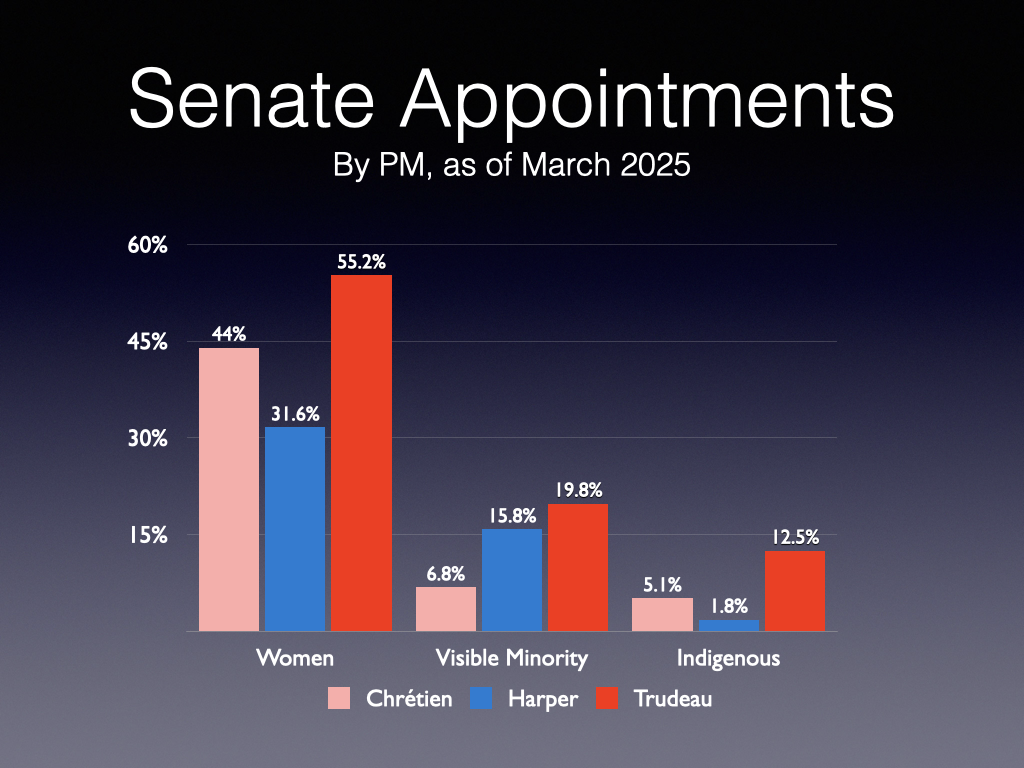
We shall see. Chart below contrasts Chrétien, Harper and Trudeau appointments:

…In an interview with CBC Radio’s The House, House leader Steve MacKinnon signalled there may indeed be more changes coming.

“I think the Senate is very much a work in progress,” he said.

“We continue to work constructively with the Senate in its current configuration and as it may evolve. I know many senators, the various groups in the Senate and others continue to offer some constructive thoughts on that.”

Asked if Carney will appoint Liberals, MacKinnon said the prime minister will name senators who are “attuned to the vagaries of public opinion, attuned to the wishes of Canadians and attuned to the agenda of the government as is reflected in the election results.”

Carney is interested in senators who “are broadly understanding of what the government’s trying to achieve,” MacKinnon said.

As to whether he’s heard about efforts to revive a Senate Liberal caucus, MacKinnon said: “I haven’t been part of any of those discussions.”

Alberta Sen. Paula Simons is a member of the Independent Senators Group, the largest in the chamber and one mostly composed of Trudeau appointees (she is one of them, appointed in 2018).

Simons said she knows the Conservatives would scrap Trudeau’s reforms at the first opportunity. What concerns her more are those Liberals who are also against the changes.

“There’s a fair bit of rumbling about standing up a Liberal caucus again. And I am unalterably opposed to that,” she said.

When the last Liberal caucus was disbanded, some of its members regrouped as the Progressive Senate Group, which now includes senators who were never Liberals.

“To unscramble that omelette, whether you’re a Liberal or a Conservative, I think would be a betrayal of everything that we’ve accomplished over the last decade,” Simons said.

“I think the Senate’s reputation has improved greatly as a result of these changes. I think the way we are able to improve legislation has also increased tenfold. It would be foolish and wasteful to reverse that.”

Still, she said there’s been pushback from some Trudeau appointees.

Senate debates are now longer, committee hearings feature more witnesses and there’s more amendments to legislation than ever before, she said.

Not to mention Independent senators can’t be whipped to vote a certain way. All of that makes the legislative process more difficult to navigate.

“Partisan Liberals don’t like the new independent Senate because they can’t control it as easily,” she said.

Marc Gold, Trudeau’s last government representative in the Senate who briefly served under Carney before retiring, said his advice to the new prime minister is to keep the Senate the way it is.

“The evolution of the Senate to a less partisan, complementary institution is a good thing. I think it’s a success, and I certainly hope that it continues,” Gold said….

Source: Trudeau radically overhauled the Senate — will Carney keep his reforms?

Ibbitson: With human rights chief debacle, the Liberals continue their string of blunders

Unfortunately accurate:

…On Monday, Mr. Dattani agreed to resign. The Trudeau government’s slipshod vetting process had once again turned what looked like an innovative choice for an important position into an embarrassment.

I say “once again” because hiring, discovering and then backtracking has become something of a pattern with this government’s appointments.

There was the unfortunate decision to ask the Community Media Advocacy Centre to conduct anti-racism seminars. Everything was going fine until reports surfaced that Laith Marouf, a senior consultant at the centre, had posted vile antisemitic comments on Twitter. The government cancelled the contract.

Then there was the famous case of Julie Payette, Prime Minister Justin Trudeau’s choice for governor-general in 2017. On paper, she looked perfect: an engineer, scientist and former astronaut. But a proper background check would have revealed past accusations of workplace harassment. After similar complaints surfaced at Rideau Hall and following an investigation ordered by the government, Ms. Payette resigned.

The Liberals’ missteps extend beyond poor hiring decisions…

Source: With human rights chief debacle, the Liberals continue their string of blunders

Hundreds of appointed positions vacant after 8 years of Trudeau’s government

Seems like another example of failure to deliver. But surprising that article makes no mention of the increased diversity of GiC appointments which is one of the successes of the current government (also seen in ambassadorial, senate and judicial appointments).

I am, however, less charitable than UoO professor Gilles Levasseur regarding excusing the government given that they have been in power for 8 years and the system should operate more smoothly:

Almost eight years after Prime Minister Justin Trudeau’s government came to power, hundreds of government-appointed positions — from boards of port authorities and advisory councils to tribunals that hear refugee claims or parole cases — are vacant or are being occupied by someone whose appointment is past its end-date.

A CBC news analysis of governor in council (GIC) appointments to 206 government bodies or institutions found that 418 of the 1,731 positions — 24.1 per cent — are either vacant or are being occupied by someone whose appointment has continued past its end date.

Of that number, 280 positions — 16.2 per cent ot the total — were vacant. Another 138 appointees — 7.9 per cent — were past their end-dates and were awaiting either replacement or renewal of their appointments.

Those figures do not include a number of positions currently occupied by someone who is in an acting or interim capacity. Some of those positions have been held by interim or acting appointments for years.

While some GIC appointments come with lucrative six-figure salaries, others provide only per diems of a few hundred dollars plus expenses when board members attend meetings.

Former Conservative prime minister Stephen Harper’s government went on an appointment spree in the weeks before it left office in 2015, leaving very few vacancies and making 49 “future appointments” of individuals whose terms weren’t due to be renewed until well after the election that brought Trudeau to power.

Some experts say leaving hundreds of positions vacant can affect wait times for services or decisions, while leaving boards staffed by people who are past their end-dates can affect an organization’s ability to make decisions.

Other experts, however, argue that the backlog is understandable given the Trudeau government’s decision in its first mandate to overhaul the appointments process to make it less political and boost diversity.

The problem isn’t confined to GIC appointments.

In the Senate, 14 of 105 seats are empty, with vacancies in nine out of 10 provinces. The Senate’s clerk, who manages the day-to-day operations of Canada’s upper house, has been acting in an interim capacity since December 2020.

There are 86 vacancies for federally-appointed judges across Canada, including one seat on the Supreme Court of Canada. All of the seats on seven of the Judicial Advisory Committees set up to assess judicial candidates — including all three committees in Ontario — are vacant.

In June, Supreme Court Chief Justice Richard Wagner warned of an “alarming” shortage of federally appointed justices.

“There are candidates in every province,” Wagner told reporters. “There’s no reason why those cannot be filled.”

Government officials say they are working on filling positions. Stéphane Shank, spokesperson for the Privy Council Office (PCO), defended the government’s appointment process.

“Governor in Council (GIC) appointments are made through an open, merit-based process on a rolling basis throughout the calendar year,” Shank said in an e-mail.

“The process takes into account current and forecasted vacancies, as well as [incumbents remaining in place], to maintain operational integrity of these institutions. Legislative provisions for appointees to continue in office can provide organizational continuity until such time as a new appointment is made.”

No timelines

Shank said the government made 780 GIC appointments in 2022 and will continue filling openings. He said he could not predict when positions such as the commissioner for conflict of interest and ethics — which has been vacant since mid-April — will be filled.

“A new Conflict of Interest and Ethics Commissioner will be appointed by the Governor in Council in due course,” Shank wrote.

Shank pointed to a website with 49 GIC “appointment opportunities” posted. But most of those appointments began the application review process months ago. Ten of the postings list dates in 2022 for application reviews to begin — one dates back as far as March 2022.

The problem isn’t spread evenly throughout the government.

An analysis by ministerial office found the highest percentage of vacant or past-due appointments at Transport Canada: 47.8 per cent of its 230 GIC positions. The boards of several port authorities across Canada consist entirely of vacant positions or board members who are past their appointment dates.

The second highest percentage was at Global Affairs — 42.1 percent of its 19 GIC positions — followed by Housing, Infrastructure and Communities, with 40.9 per cent of its 44 positions.

Nadine Ramadan, press secretary for Transport Minister Pablo Rodriguez, pointed out that the department has more GIC positions to fill than most other ministries.

“Lots of factors go into appointing the best candidates for the roles,” she said. “Due to the complexity of the files across Transport Canada, these roles are often very technical and finding the perfect candidate with the necessary technical requirements for the position takes time.”

But other ministers with large numbers of GIC appointments to make had better track records.

In his former role as minister of heritage, Rodriguez left only 13.3 per cent of 150 appointments vacant or past their appointment dates. He also made several future appointments to renew or replace positions that were near their end dates.

There are two notable exceptions to that track record, however. The board of directors for the Canadian Broadcasting Corporation (CBC) is 58.3 percent vacant or composed of individuals past their appointment dates, while three of eight positions on the National Arts Centre board are vacant.

Former employment minister Carla Qualtrough had more than 100 appointments to manage — including members of the Social Security Tribunal, which hears appeals of decisions involving things like employment insurance and pension benefits. She left that portfolio with a vacancy rate of only 5.5 per cent.

The Prime Minister’s Office plays an overall role in GIC appointments but is also directly responsible for 22 appointments. After two vacancies on the National Security and Intelligence Review Agency were filled Friday, just two PMO appointments remain vacant: the conflict of interest commissioner and the law clerk of the House of Commons 

Sen. Percy Downe, who served as director of appointments to former prime minister Jean Chrétien, said it’s important to keep GIC positions filled and a normal vacancy rate should be “three to four per cent at the most.”

These appointments “affect Canadians in many ways,” he said. “They affect their security … they affect the economy.”

Downe said positions that are occupied by people past their appointment dates make it difficult for government departments and agencies to make plans.

“For the boards and agencies, it’s important to know the status as you undertake projects and works that may be required,” he said. “Will this person actually be here in three months or six months? Should we involve them? Should we make them a head of a subcommittee?”

Gilles Levasseur, a professor in law and management at the University of Ottawa, said a higher level of vacancies isn’t surprising given the changes the Trudeau government made to the appointments process and the need to reflect Canada’s diversity.

“People can criticize but we’ve also got to make sure that we understand the system itself and the challenge we’re facing because of these new elements that we didn’t have 10, 15 years ago,” he said. “And because we want to be more open to the society, it takes more time to fill these positions.”

Levasseur said it is not a problem if people are past their appointment dates if they’re doing the job and their presence doesn’t interfere with decision-making. He added the government could do more to let Canadians know about openings.

“A lot of people don’t even know that these positions are available,” he said.

Michael Barrett, Conservative critic for ethics and accountable government, said the level of vacancies is symptomatic of a bigger problem with the current government.

“After eight years of Trudeau, this incompetent Liberal government can’t deliver basic government services like passports and there are backlogs, delays and chaos in everything they touch,” he said in a media statement.

“It has been nearly half a year without an Ethics Commissioner and widespread judicial vacancies are allowing repeat violent criminals to walk free because there are not enough judges to hear cases.”

The New Democratic Party has not yet responded to a request for comment.

Source: Hundreds of appointed positions vacant after 8 years of Trudeau’s government

More women, fewer minorities receive appointments under Liberals’ ‘merit-based’ process, documents show

Interesting. When I requested the information earlier, PCO did not provide the breakdown between applications and appointments for GiCs (in contrast to judicial appointments – see Taking stock of Ottawa’s diversity promises):

The Liberal government’s overhaul of the patronage system has led to gender parity in government appointments, but new figures show few of those women are in leadership posts and visible minorities are being left out.

Documents from the Privy Council Office, obtained under the Access to Information Act, show that as of last year, 55.5 per cent of appointees to federal agencies, boards and organizations were women, slightly above their proportion in the Canadian population.

But the Liberals’ “merit-based” process for appointments has screened out 61.8 per cent of visible-minority candidates as insufficiently qualified, compared with 37.6 per cent of applicants who are not visible minorities.

Visible-minority applicants who made it past that cut and into job competitions were less likely to be recommended or appointed.

“This is one of the reasons why we need to know what constitutes merit,” said Kathy Brock, a politics professor at Queen’s University who has studied the changes in the appointments system.

“What are the criteria that are being used to screen people, and embedded in that criteria are there certain considerations that have a negative impact on those communities?”

Despite the changes, final say still sits with the responsible minister or the Prime Minister’s Office, meaning a partisan lens remains in place on appointments, Brock said.

Months after taking power in late 2015, the Liberals changed how the government makes hundreds of appointments each year to the boards of Crown corporations and tribunals that make decisions on benefit payments and immigration claims, for example. The majority are part-time. They don’t include senators, judges or officers of Parliament, such as the ethics commissioner, who are not chosen with the same process.

Before 2015, governments simply decided who would get what position, often giving posts to party loyalists. The Liberals promised to make appointments based on merit, where applications are open to anyone and selection committees recommend names based on precise criteria.

“The government is striving for gender parity, and seeks to ensure that Indigenous peoples and minority groups are properly represented in positions of leadership,” spokesperson Stéphane Shank said in an email, calling the number of visible minority applicants “encouraging.”

As of April 30, 2019, the Liberal government has concluded 1,100 appointments under the new process, he said, noting that 13 per cent of the appointees self-identified as visible minorities. Another nine per cent identified as Indigenous.

The percentage of visible minorities currently serving in the roles nearly doubled, from 4.4 per cent in November 2015 to eight per cent in May 2019.

About 4.5 per cent of appointees identified themselves as having disabilities, below the 15.5 per cent of people with disabilities in the Canadian population.

The government documents show that eight per cent of female appointees had been placed in leadership positions. But they don’t offer the same information for male appointees, so it’s not clear how the sexes compare.

The figures were smaller for visible minorities and Indigenous people: two from each group had been put in “leadership” positions. Like visible minorities and Indigenous people, only two people with disabilities have been appointed to leadership positions.

“It’s that whole analogy of a big ship that has a big wake and you have to give it some space to move. That’s what we’re seeing here with the appointments,” said Carole Therrien, who worked on such appointments in Jean Chretien’s Prime Minister’s Office.

Although upcoming openings are supposed to be flagged a year out, and recommended candidates vetted by the Privy Council Office within four weeks, the new system has often been criticized for leaving too many positions unfilled for too long.

The documents show that at the end of 2018, the selection processes for 181 positions had yet to start, including for some openings as distant as February 2020. The documents don’t identify those positions.

A similar number of appointments — 183 — were sitting with the Prime Minister’s Office or a minister’s office awaiting approval.

Source: More women, fewer minorities receive appointments under Liberals’ ‘merit-based’ process, documents showThe Record·2 days ago

Employment Equity in the Public Service of Canada for Fiscal Year 2017 to 2018

My updated charts reflecting the latest government EE report. Most noteworthy is the small downtick in visible minority and Indigenous executive numbers.

The report does not provide an explanation for this decline. This may be due in part to the greater use of non-advertised processes (see Non-advertised appointments on the rise in the public service, PSC data show).

I am awaiting for the release of  PSC data contrasting advertised/non-advertised/unknown staffing processes for 2018-19 to ascertain whether two-year data suggesting this impact of the new appointment policy is confirmed with three years data:

Source:  Annual Report Publication

Taking stock of Ottawa’s diversity promises

My latest in Policy Options:


Each of the mandate letters given to cabinet ministers by Prime Minister Justin Trudeau over the past three years has included the following commitment: “You are expected to do your part to fulfill our government’s commitment to transparent, merit-based appointments, to help ensure gender parity and that Indigenous Canadians and minority groups are better reflected in positions of leadership.”

With three years of appointments under the Trudeau government’s belt, it’s possible to conduct an analysis of its record with respect to judicial, Governor-in-Council, deputy minister, head of mission and Senate appointments, using available data and public records.

The government has largely delivered on its commitment, but with mixed results on its promise to be more transparent on appointments…

Full article: Taking stock of Ottawa’s diversity promises

Jeff Sessions Is Quietly Transforming the Nation’s Immigration Courts

Time to set the stage for a detailed analysis comparing decisions by judges from the previous administration to see if these fears are warranted:

Dorothea Lay was on track to become a member of the Board of Immigration Appeals, part of  the Justice Department’s Executive Office for Immigration Review. Her 25-year government career had prepared her for the post, as reflected in four letters of recommendation from academics and current and former officials. In December 2016, nine months after submitting her application, she was offered the job. But administrations changed, Jeff Sessions assumed the role of attorney general, and by early 2018, the offer was withdrawn.

Why?

That’s the question at the center of a complaint filed by Lay, an Idaho native, with the Office of Special Counsel, an independent federal investigative body. In a letter to Lay, 53, the Executive Office for Immigration Review said it rescinded her offer because “the needs of the agency have evolved,” even though the agency announced around the same time that it wanted to expand the size of the appeals board. The complaint suggests that political considerations may have been taken into account in reviewing Lay’s background, citing Lay’s letters of recommendation from people who “had liberal backgrounds or were perceived as having liberal backgrounds.”

The suspicion of politically based hiring has lingered among Democrats, who raised concerns in April and again in May. In the May letter, directed to Michael E. Horowitz, Democrats urged the inspector general of the Justice Department to investigate “allegations of politicized hiring practices,” citing cases in which offers for immigration judges and Board of Immigration Appeals positions had been delayed or withdrawn. (Lay’s attorney, Zachary Henige, is also representing two other people who claim their offers were withdrawn over political differences.) Assistant Attorney General Stephen Boyd responded to the Democrats’ allegations in a letter: “As stated in every immigration judge hiring announcement, the Department of Justice does not discriminate on the basis of political affiliation.”

The investigation into Lay’s complaint is ongoing, so it’s still not clear whether there were ulterior motives behind the withdrawal of her offer. But the case speaks to how DOJ can pick and choose who fills roles and in doing so, influence who’s at the helm of deciding immigration cases.This isn’t unique to this administration. The Justice Department has considerable leeway when appointing immigration judges—the immigration courts are part of its direct purview. The attorney general therefore has unique authority to overrule decisions and hire immigration judges. To that end, Sessions appears to be shaping the court by, at the very least, hiring former law enforcement officials as immigration judges.

“The more you bring people from the same background, the same set of experiences, the same perspective, the more you expose the court to criticism,” said Ashley Tabaddor, the president of the National Association of Immigration Judges. “Those decisions will be more open to being questioned.”

Of the 140 judges hired since Donald Trump’s inauguration, more than half have past prosecutorial experience or some other government experience. The pace of hiring has also stepped up: In fiscal year 2017, the Justice Department hired 64 immigration judges, compared to 81 in fiscal year 2018—bringing the total of immigration judges to 395, according to data released by EOIR. Sessions’s hiring spree is not unusual—and it’s also not unwarranted: His predecessors brought on new immigration judges, and the immigration court backlog also continues to creep up, with the latest figure at more than 760, 000 pending cases. Of the newly hired immigration judges, at least half had received conditional offers during the Obama administration, said Kathryn Mattingly, assistant press secretary at EOIR, in an email.

It’s not just how many immigration judges are being brought on but where they’re being located. EOIR has hired immigration judges for two adjudication centers—in Falls Church, Virginia, and Fort Worth, Texas—where cases from around the country will be heard through video teleconferencing. Judges will be located at the centers, while attorneys and respondents will be in separate locations. According to Rob Barnes, a regional public information officer for EOIR, immigration judges at these centers will be evaluated like others. It’s likely then that thousands of immigration cases will be heard with respondents never seeing a judge face to face.

Across the board, there appears to be a preference for people who come from an enforcement background, according to biographies of newly hired immigration judges posted by the Justice Department. Of the 23 judges announced in August, more than half previously worked with the Department of Homeland Security, and of those remaining, most came from a law enforcement background. In September, EOIR announced 46 new immigration judges, two of which will serve in a supervisory role: 19 previously worked for ICE, 10 had served at DOJ or as a former local prosecutor, and seven had a background in military (one of whom previously served in Guantánamo). It’s not yet known how these judges will rule once they’re on the bench and whether their enforcement background will inform their decisions. But experts, attorneys, and current and former immigration judges have warned about hiring too many people from government before.

“It’s not that we’re saying [those] with law enforcement or military background are unqualified,” Tabaddor, the head of the immigration judges association, told me. “A diverse bench is what brings fairness and legitimacy to court. It’s very important for a court to be reflective of the people it serves and the community at large to gain legitimacy and respect.”

Mattingly, the EOIR spokeswoman, has provided a series of specific qualifications that all candidates for immigration judge must possess.

Previous administrations also pulled from within government, reasoning that candidates have already passed background checks and can therefore be hired more quickly. But that can present some challenges. It’s possible that having spent years fighting in court on behalf of the government, an individual might be biased, said Jeremy McKinney, an immigration lawyer in North Carolina. The American Immigration Lawyers Association, of which McKinney is a part of, and National Association of Immigration Judges, have called for the pool of immigration judges to also include people from private firms and academia.

Their concerns were backed up by Booz Allen Hamilton, which conducted a year-long study of the immigration court system at EOIR’s direction. The April 2017 study found that at least 41 percent of immigration judges previously worked in the Department of Homeland Security, and nearly 20 percent worked at other branches within the Justice Department. The report recommended broadening “hiring pools and outreach programs to increase diversity of experience among [immigration judges].” It’s not clear whether the Justice Department took the study into account in putting together its hiring plan in April 2017, the same month the study was presumably handed over.

The hiring of immigration judges has always been a contentious issue: complaints have been lodged about there not being enough career diversity; it often takes months to hire judges (though the Justice Department recently pushed the time it took down from an average of 742 days to about 266 days); and political affiliations have previously been weighed in selecting judges. In 2008, the Inspector General issued a report on the hiring practices of DOJ in selecting attorneys, immigration judges, and members of the Board of Immigration Appeals. The report concluded that hiring based on political or ideological affiliation is in violation of department policy.

The fear, as expressed by some Democrats, legal experts and immigration advocates, is that Sessions is improperly seeking out conservatives in order to to influence the tilt of the nation’s immigration courts and hire a large cadre of immigration judges who will likely far outlast his tenure.

“I think he’s trying to get a complacent judiciary: ‘Forget the title, you guys are really DOJ employees, you’re out there to carry out my policies,’” said Paul W. Schmidt, former chairman of EOIR’s Board of Immigration Appeals from 1995 to 2001 and a former immigration judge.

Beyond who the Justice Department decides to bring on board, the message Sessions sends down to judges can also heavily influence their decisions, as direct reports to the department, Schmidt and others argue.In September, for example, Sessions delivered remarks to a new class of immigration judges, the largest in history, according to the Justice Department, in which he pressed them to decide cases swiftly. “You have an obligation to decide cases efficiently and to keep our federal laws functioning effectively, fairly, and consistently,” he said. “As you take on this critically important role, I hope that you will be imaginative and inventive in order to manage a high-volume caseload. I do not apologize for expecting you to perform, at a high level, efficiently and effectively.”

The message was striking given who it’s intended for. “If he was speaking to attorneys, that’d be normal. He has the right to set prosecutorial policy,” McKinney said. “That doesn’t translate to immigration judges.” Judges—even when they are DOJ employees—are expected to be independent. By effectively telling them how to handle cases and how quickly, the Justice Department is infringing upon that independence, McKinney said.

And Sessions’s words weren’t just an expression of what he hopes judges will do either. As of October 1, the expectation to “efficiently and effectively” adjudicate cases is being enforced. Earlier this year, the Justice Department took the unprecedented step of rolling out quotas for judges. To receive a “satisfactory” performance evaluation, judges are required to clear at least 700 cases a year. According to the Justice Department, judges complete 678 cases a year on average now, meaning they will have to pick up the pace to remain in good standing.

This fall, DOJ expects to bring on at least 75 more immigration judges. Even if Sessions days as attorney general are numbered, as Trump has suggested, his selections will decide the fate of immigrants, for years to come.

Source: Jeff Sessions Is Quietly Transforming the Nation’s Immigration Courts

ICYMI: How the federal government is slowly becoming as diverse as Canada

Good overview article by Aaron Wherry of CBC on diversity in government, both public service and political appointments. Some of my analysis quoted and used:

Campaigning in 2015, Justin Trudeau’s Liberals promised to “build a government as diverse as Canada.”

That job might’ve seemed nearly done on Day One. Of the 31 ministers sworn in on Nov. 4, 2015, 15 were, famously, women. Five ministers were visible minorities and two others were Indigenous.

A cabinet ratio of 48.3 per cent women, 16.1 per cent visible minorities and 6.5 per cent Indigenous comes close to matching a Canadian population that was 50.9 per cent women, 22.3 per cent visible minorities and 4.9 per cent Indigenous.

But a prime minister and his government are responsible for far more than a few dozen cabinet positions. The cabinet oversees more than 1,500 appointments, including chairs and members of boards, tribunals and Crown corporations, deputy ministers, heads of foreign missions, judges and senators.

On that much larger scale, progress has been made, but the ideal of a government that looks like Canada is still a ways off.

A new appointment process

When the government was sworn in, just 34 per cent of federal appointees were women, 4.5 per cent were visible minorities and 3.9 per cent were Indigenous.

Two years later, according to data from the Privy Council Office, 42.8 per cent of appointees are women, 5.6 per cent are visible minorities and 5.8 per cent are Indigenous.

In February 2016, the Liberal government announced a new appointment process for boards, agencies, tribunals, officers of Parliament and Crown corporations. It specified diversity as a goal and opened applications to the public.

According to the Privy Council Office, 429 appointments were made via that process through Dec. 5, 2017. Of those, 56.6 per cent were women, 11.2 per cent were visible minorities and 9.6 per cent were Indigenous.

A total of 579 appointments — including deputy ministers, heads of mission and appointments for which requirements are specified in law — were made through existing processes. Of those, 43.7 per cent were women, 3.8 per cent were visible minorities and 5.2 per cent were Indigenous.

“Mr. Trudeau has been more intentional on these issues than his predecessors and has made great progress in opening up the process. He has also clearly made great strides on gender,” says Wendy Cukier, director of Ryerson University’s Diversity Institute.

But, says Cukier, the government’s efforts toward transparency and equal opportunity need to be accompanied by “proactive outreach and recruitment as well as retention strategies” in order to “address some of the barriers historically disadvantaged groups have faced.”

Eleanore Catenaro, press secretary for the prime minister, says, “Our aim is to identify high-quality candidates who will help to achieve gender parity and truly reflect Canada’s diversity.”

She says, “We know there is more work to do to achieve these goals, and we continue to do outreach to potential qualified and diverse candidates to encourage them to apply.”

Rigorous reporting of demographic data across federal appointments could presumably drive change — or at least give the  government something to answer for — but most of these numbers have not been made public.

“It is crucial that the government tracks, measures and reports on diversity in all areas,” says Sen. Ratna Omidvar, the founding director of Ryerson’s Global Diversity Exchange. “By doing so, we are able to see where we are making progress and where we need to improve.”

Beneath those top-line numbers, there are a few other points of reference.

According to Global Affairs Canada, the government made 87 heads-of-mission appointments — ambassadors, consul generals and official representatives — in 2016 and 2017. Forty-eight per cent were women and 13.8 per cent were visible minorities. There were no Indigenous appointees.

Senate and court appointments

Andrew Griffith, a former official at the department of citizenship and immigration who has been tracking diversity in federal appointments, has counted 18 women, six visible minorities and three Indigenous Canadians among Trudeau’s 31 Senate appointments.

As a result of an initiative to track judicial appointees, the Office of the Commissioner for Federal Judicial Affairs has published a tally of court appointments from Oct. 21, 2016 through Oct. 27, 2017. Between those dates, 74 judicial appointments were made, of whom 50 per cent were women, 12.1 per cent were visible minorities and four per cent were Indigenous.

But that data also suggested the pool of candidates was limited: of the 997 applications received, just 97 applicants identified as a visible minority and 36 were Indigenous.​

At some point, it might be charged that diversity is being inappropriately prioritized ahead of merit or competency — as Kevin O’Leary once alleged of Trudeau’s cabinet. But such suggestions assume that achieving diversity must come at the expense of merit.

Ideally, diversity would also amount to more than a numerical value.

3 benefits of diversity

Griffith, for instance, suggests three potential benefits of diversity in appointments: that it allows Canadians to see themselves represented in government institutions, that it brings a range of experience and perspectives to government policies and operations and that it reduces the risk of inappropriate policies (for example, an RCMP interview guide that asked asylum-seekers about their religious practices).

“It has been proven over and over that more diversity in the workplace leads to better outcomes,” says Omidvar, who is also pushing to tighten the standards included in a proposed government bill that would require corporate boards to report on diversity.

But the most profound impact could conceivably relate to Griffith’s first potential benefit. A nation that values diversity and pluralism might want its institutions to reflect those principles — and institutions that reflect those principles might advance the building of a multicultural society.

“It normalizes diversity,” Omidvar said of public appointments. “At this point, diversity is still sort of not the norm, which is why we focus on it.”
via How the federal government is slowly becoming as diverse as Canada – Politics – CBC News

Governor in Council Appointments – PCO data

Governor in Council Appointments 2016 Baseline

Following the skimpy information provided in both the mandate checker and PCO’s Departmental Performance Report (DPR), I had asked PCO for more details and they were reasonably quick in getting back to me.
The correspondence below indicates that this is very much a work in progress. Hopefully, future reporting will include an annual table of GiC appointments by the four employment equity groups. Hard to the logic, for a government committed to diversity and inclusion, and one that has improved dramatically the diversity of judicial, ambassadorial and senatorial appointments, not to take this next step of more comprehensive reporting:

PCO response:

“…In February 2016, the Prime Minister announced a new approach to Governor in Council—or GIC—appointments that supports open, transparent, and merit-based selection processes for GIC appointments.
 
Significant progress has been made in making appointments.  Since March of this year, the number of appointments made under the new approach has increased approximately 300%.  To date, over 19,000 applications have been received and over 400 appointments made following an open, transparent, and merit-based selection process and approximately 740 appointments made through other selection processes.
 
Of the appointments following an open, transparent, and merit-based selection process, nearly 60% were women.  Most notably, women have been appointed for the first time to a number of leadership positions, including the Chief Science Advisor, the Chief Commissioner of the Canadian Grain Commission, the Chair of Via Rail, and the Chairperson of the Infrastructure Bank.  Over 10% are visible minorities, 10% are Indigenous peoples, and persons with disabilities are well represented.  The total representation of women serving as GIC appointees has increased by over 5% and is now over 40%.”

My reply to PCO:

“I prepared this little summary table for appointments under the new approach:
Women
VisMin
Indigenous peoples
Total
Number
236
40.4
40
400
0.59
0.101
0.1
Obviously, this is approximate but provides a basis for comparison with other EE data.
In terms of the other selection processes, I assume this would include position such as judges, heads of mission and the like and would appreciate confirmation your end. [PCO later advised that it does not include judges.]
Looking at the total number of GiC appointments (1182 in the index as of today, 40 percent women would mean about 473 women or more.
I would hope that in the future PCO would be able to provide annual tables similar to the EE reports for the public service (simplified) that would essentially tell what is a good news story more effectively and consistently. And that future DPRs are more informative.
But nevertheless this information is welcome, represents progress. Thanks for getting back to me.”

Mandate Letter Tracker: Delivering results for Canadians [diversity of appointments and lack of detail]

There has been justified critical commentary regarding the government’s mandate letter tracker. I was curious to see how the commitment to increased diversity in appointments was covered.

Surprisingly, the 2016-17 PCO Departmental Performance Report does not provide any data table to substantiate that claim, merely noting:

  • Almost 12,000 applications processed and 429 Governor in Council appointments made in 2016-17”

Strikingly, the focus appears only to be with respect to women, not the other employment equity groups (visible minorities, Indigenous peoples, and persons with disabilities). PCO should be providing such data (as Justice does for judicial appointments).

That being said, given HoM and judicial appointments to date, I think this one can be said to be on track.

via Mandate Letter Tracker: Delivering results for Canadians – Canada.ca