Ottawa seeking mass visa cancellation powers to deter fraud from India: internal documents

Useful info to better understand the policy rationale:

The federal government is seeking the power to cancel applications for groups of visa holders at least in part due to concerns of fraud from India and Bangladesh, according to internal documents obtained by CBC News.

A departmental presentation to the immigration minister’s office said that Immigration, Refugees and Citizenship Canada (IRCC), the Canada Border Services Agency (CBSA) and unnamed U.S. partners are aiming to identify and cancel fraudulent visitor visa applications.

The Canadian entities and U.S. partners formed a working group looking to beef up authorities to refuse and cancel visas, according to the presentation, which singled out India and Bangladesh as “country-specific challenges.”

A section explaining how mass cancellation powers could be used listed hypothetical scenarios such as a pandemic, war and “country-specific visa holders.”

Publicly, Immigration Minister Lena Diab has listed a pandemic or war as why the government is seeking these powers, but has not mentioned country-specific visa holders. 

The presentation provides a further glimpse into Ottawa’s motivation for gaining those mass cancellation powers.

The provision was tabled in Parliament as part of Bill C-2, the government’s sweeping border legislation. That bill has since been spun off into two pieces, with mass visa cancellation folded into C-12, which the government is hoping  to quickly pass.

More than 300 civil society groups have raised concerns over the legislation. Some, such as the Migrant Rights Network, say group cancellations would give the government the ability to set up a “mass deportation machine.” 

Immigration lawyers have also wondered if the mass cancellation ability was being sought to allow the federal government to reduce its growing backlog of applications. 

Asylum claims from Indian nationals increased from fewer than 500 a month in May 2023 to about 2,000 by July 2024, the document said. 

The presentation says that verifying temporary resident visa applications from India slows down application processing.

It said processing time rose from an average of 30 days at the end of July 2023 to 54 a year later. It said approvals also started to decline in 2024 as it committed more resources to verification, from more than 63,000 in January to about 48,000 in June.

The presentation also noted a rise in “no boards” in India — passengers not allowed to board airplanes — as of the summer of 2024. By July 31 of that year 1,873 applicants had been identified for further questioning and sent procedural fairness letters outlining their rights and potential legal recourse.

No data about claims from Bangladesh was provided in the document. 

Last month, IRCC told CBC News in a statement that new powers were not being proposed “with a specific group of people or situation in mind,” and that “decisions would not be taken unilaterally.”

A separate document from October 2024, a memorandum to then immigration minister Marc Miller, urged him to push for the department to be given extra visa cancellation powers without naming any individual countries.

“The ability to cancel temporary resident documents reduces security risks and limits potential misuse of such documents,” it noted.

The memo also said that the risk of applicants seeking judicial review of the cancellations would “depend on the particular facts of each case, notably whether procedural fairness was followed.” …

Source: Ottawa seeking mass visa cancellation powers to deter fraud from India: internal documents

What citizenship applications tell us about policy implementation

My latest in The Hill Times. Password protected so here is the analysis (tables simplified in the HT):  

Analysis of citizenship applications between 2005 and 2023 reveals how the previous Conservative government’s pledge to make citizenship “harder to get and easier to lose” resulted in significant delays and reduced approval rates before political realities resulted in mitigating those impacts. The Liberal government reversion to previous residency and other requirements cemented a return to historic approval rates and processing times.

This analysis looks at four periods, roughly aligned to Census periods:

  • 2005-10: During this period, the new Discover Canada citizenship study guide was introduced in 2009 with more detailed content and more complex language, along with a more rigorous knowledge test based upon the guide and more objective language assessments. The policy intent was in part to reduce the previous approval rate of approximately 95 percent to between 80 and 85 percent (“harder to get”).
  • 2011-15: The impact of these 2009-10 operational policy changes was felt during this period. In addition, the Conservative government passed C-24 (Strengthening Canadian Citizenship Act) in 2014, expanding knowledge testing and language assessment to those between 14 and 64 years old compared to the previous 18 and 54. Fees increased from $200 to $630 per adult or over $1,400 for a family of four in 2015. The fee increases may have been a Treasury Board condition in order to obtain funding to address a processing backlog.  Revocation provisions for “treason and terror” were included.
  • 2016-20: The election of a Liberal government resulted in the reversal of knowledge and language assessment to those between 18 and 64 years old and removed the revocation provisions, among other changes. The Liberal party’s 2019 and 2021 election platforms committed to waiving citizenship fees but were not implemented. Similarly, successive ministers of immigration have noted plans for a revision to Discover Canada but the current version remains in effect.
  • 2021-24: The citizenship oath was updated with a reference to indigenous treaty rights in 2021. The pandemic resulted in the virtual shutdown of citizenship ceremonies for a number of months and a shift to the majority of ceremonies taking place on line. The proposed repeal of the first generation limit in C-71 and replacement by a time-unlimited residency requirement would result in an unknown number of additional Canadian citizens.  

 Application data by gender, immigration category or country of birth highlights the dramatic initial impact of the policy changes of the Conservative government and how these were relaxed by the Conservatives themselves before having virtually no impact after a number of years under the Liberals. The same pattern applies no matter what the variable, the 2011-15 period was the worst period in terms of delays and approval rates.

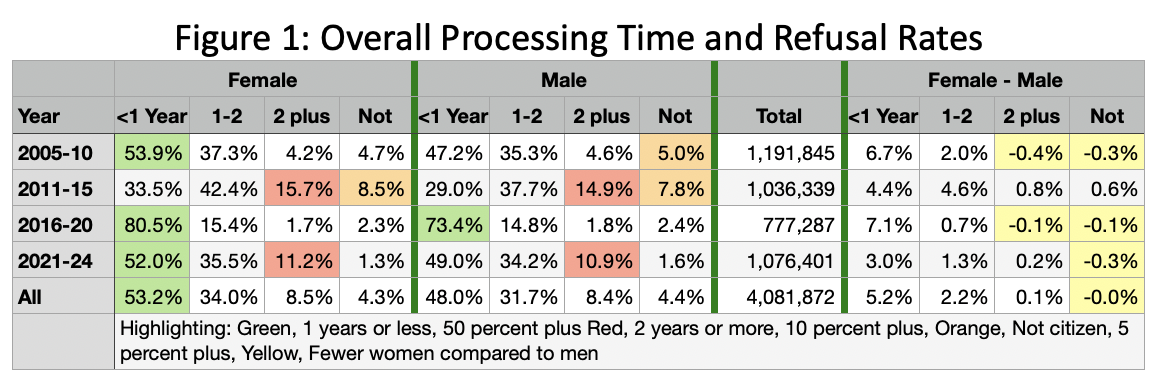
Figure 1 provides the overview by period highlighting that in general, women applicants were granted citizenship faster than men and had higher approval rages, save for the 2011-15 period. The percentage not granted citizenship rose to over ten percent in 2012 and 2013, before recovering to just over seven percent in the last years of the Conservative government. Moreover, only about 20 percent of applications were processed within the service standard of one year 2010-13. Apart from the pandemic years 2021-22, service standards were met close to 80 percent of the time.

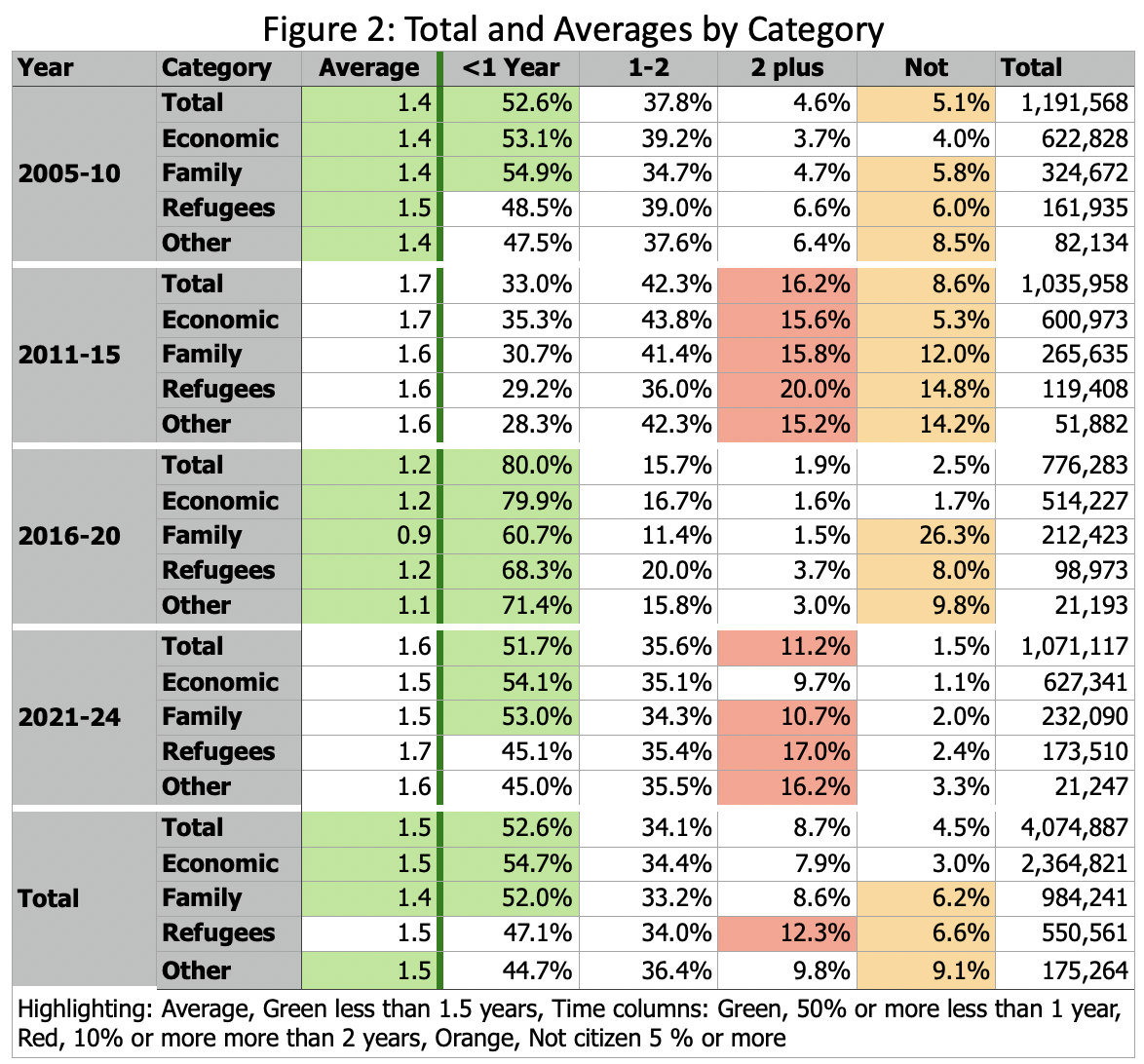
Figure 2 provides the category comparison, highlighting lower refusal rates for economic class and particularly relatively higher refusal rates immigrants for family and refugee class during the first years of the Liberal government, given that legislation reversing the Conservative age range requirement for knowledge and language assessment only came into force October 2017. But since then, refusal rates are negligible, less than three percent, or lower than 2005.

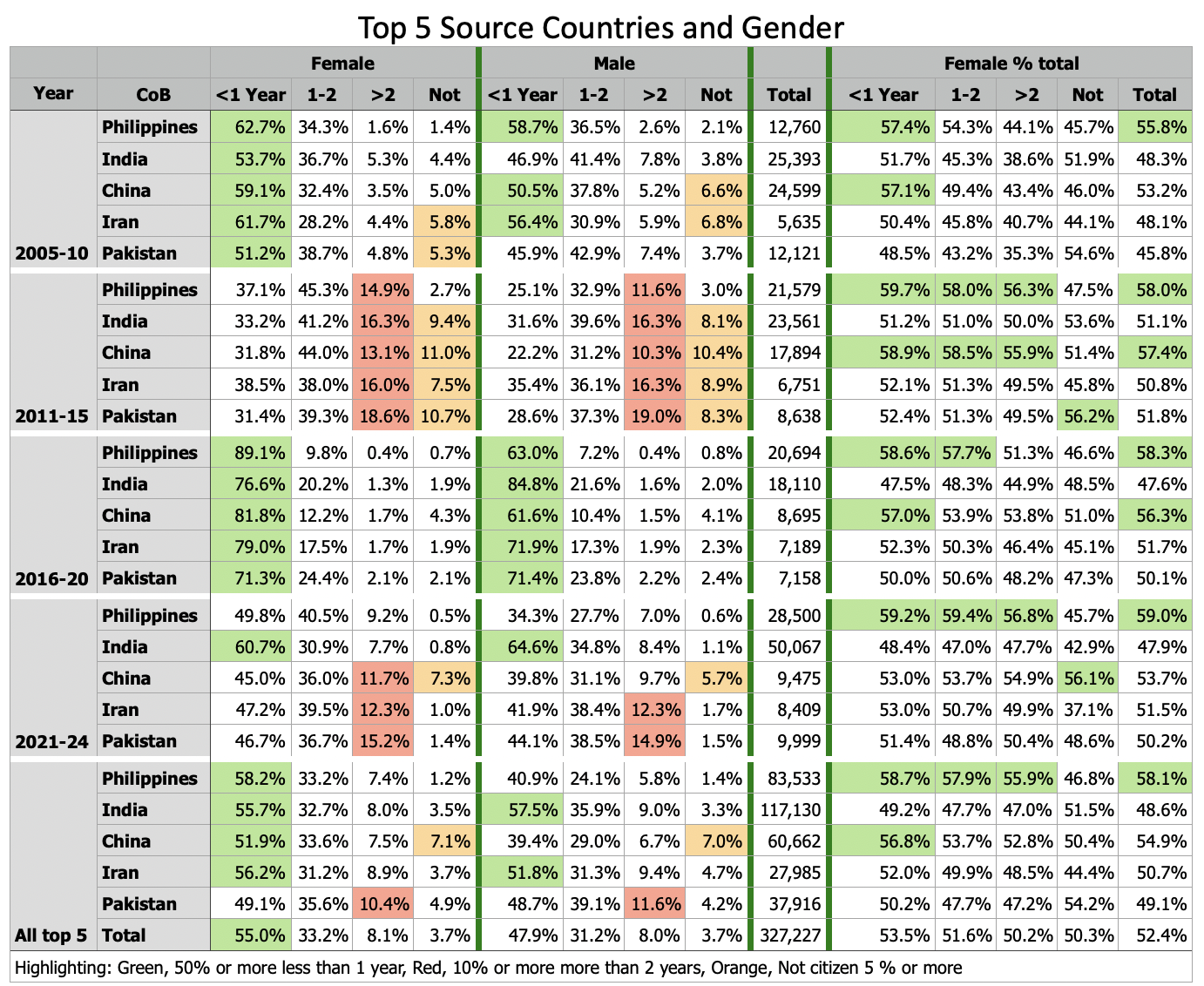
Figure 3 shows the impact on the five largest immigration source countries, showing again the same overall pattern. Of particular note is the higher rate of Chinese rejections across most periods which may reflect weaker language fluency compared to the other large source countries. 

Concluding observations

This analysis highlights the impact that operational policy changes can have on citizenship, making naturalization harder or easier, particularly for family class and refugees. The effective relaxation of knowledge and language assessment in 2014-15 reflects high refusal rates were not politically tenable, particularly in the lead up to the 2015 election.

Application data suggests that immigrants delayed submitting applications 2016-17 once the Liberal government announced it would return to the previous 18 to 54 age requirements. The data also shows a drop in applications in 2020 reflecting applicants waiting for the government to implement its 2019 election commitment to eliminate citizenship fees.

Citizenship applicants pay attention to operational and legislative policy changes and adjust their application timing accordingly. 

It is unclear whether or not citizenship changes would be a priority for an expected Conservative government and whether it would want to revert to Harper-era policies. However, citizenship changes would likely be a lessor priority than immigration changes given changing public sentiment on immigration that reflecting debates and discussion on immigration’s impact on housing and healthcare. 

Moreover, the fact that the previous government had to soften its “harder to get” approach may provide a cautionary tale in terms of what may or may not be acceptable to immigrant-origin communities. 

Methodological notes

Data provided by IRCC, 2005 to April 2024.  This partial 2024 data included in overall 2021-24 numbers.

 Source: What citizenship applications tell us about policy implementation

Dangzalan: Half-Cooked, and Under-Seasoned: IRCC’s Haste To Move to Online Applications for Permanent Residence

More on the online hopefully teething problems:

Before the pandemic, I stumbled into a pub and ordered their buttermilk fried chicken with waffles. The server happily took my order, and after about ten minutes, the order arrived. I was impressed with the speed. When I took my first bite, I suddenly spit it out – it was raw, with blood gushing through the undercooked flesh. It was not at all ready. It was clearly done in a hurry. In life, most things that are rushed do not end well. This is also true for institutions.

On September 1, 2022, IRCC came out with a news release, “Transitioning to online applications for permanent residence.” The announcement was promising until you read on: “…Starting on September 23, 2022 … IRCC will begin transitioning to 100% digital applications for most permanent residence programs.”

Twitter went into a frenzy – in just three weeks, applications for Permanent Residence will only be accepted through IRCC’s application portal. While the portal was soft-launched on March 31, 2021, the impression at the time was that IRCC would continue to iron out the problems with the online infrastructure. In the meantime, the department continued to accept paper applications for permanent residence.

We in the immigration bar understood this to be a good sign: IRCC appeared committed to ensuring that the transition to a digital application platform will have minimal technical issues at best. The backstop was there – in that people who have technical issues or are simply unsure if they trust the new platforms had the choice to submit a paper application.

We have also experienced nightmare scenarios where applicants needed to submit their applications on the same day but were not able to because of technical issues. The list of reasons is long, but it includes issues ranging from the website crashing, to the lack of space to submit complex humanitarian and compassionate applications that require heavy papering of evidence, to sudden portal outages, to files not being accepted due to ill-explained formatting issues.

Folks who have been trapped in these nightmare scenarios stand to lose a lot: they lose their status in Canada and endure long family separations. Sometimes the remedy involves filing a separate application that increases the ever-growing inventory of applications. Transitioning so recklessly to a zero-sum online intake system may have the unintended consequence of exacerbating the already politically toxic immigration backlog. Surely the Minister or the Prime Minister’s Office will not want this.

Make no mistake: this transition is a critical part of IRCC’s push for digital transformation in the department. Converting applications from paper to digital will accelerate the collection of big data that will allow IRCC to develop further its deployment of advanced analytics and machine learning in triaging an ever-growing pile of applications. Let’s also be very clear: electronic application platforms allow for a more accessible government. E-governance is generally a good thing. But this requires a proper and well-thought-out strategy for the deployment of technology. What is not good is a forcible ramming through the door of a system that has no emergency backstops.

To be sure, a lot of advocates have long pushed for online applications for Permanent Resident candidates. Yet the manner of hurried and almost cloak-and-dagger execution, with portals still riddled by technical problems, does not bode well among advocates and members of the bar.

It’s not too late. IRCC and Minister Sean Fraser can still put a pause to this. Minister Fraser should delay the compulsory implementation until a dialogue can be opened between the department and its stakeholders to hear what the issues are. As always, we at CILA are open to collaborating with the department to ensure that this project enjoys the highest possible chance of success.

Source: Half-Cooked, and Under-Seasoned: IRCC’s Haste To Move to Online Applications for Permanent Residence

Canada aiming to open online citizenship applications for multiple adults in fall 2022

Progress:

Couples and families with multiple adults will soon be able to apply for citizenship online, according to Immigration, Refugees and Citizenship Canada (IRCC).

Currently, only single adult applicants can submit their citizenship applications online. However, IRCC told CIC News in an email that adults may be able to apply together in fall 2022. After that, the online portal will open to minors and families.

“IRCC is working towards an expansion of the e-Application in order to allow Adults (i.e., 18 or older) to apply online together as a family or a group, and is currently targeting a Fall 2022 implementation,” an IRCC spokesperson said. “Planning has commenced for further e-Application expansion to minors under 18 years of age, as well as adults and minors applying together as a family or a group.”

IRCC said following the implementation of the e-application, it will begin to develop “additional functionality for representatives.” Currently, representatives can only help prepare online applications, but cannot submit on a client’s behalf. They can communicate with IRCC on the applicant’s behalf before and after the online application is submitted.

“In November of 2021, IRCC updated the system so clients can submit the IMM 5476 – Use of Representatives form, allowing them to use the services of a representative in preparing their applications. We also updated the screening questions to allow clients working with representatives to submit their application electronically,” IRCC wrote.

“Following the implementation of the e-Application expansion to minors and groups, the Department will begin development of additional functionality for representatives.”

In August 2021, IRCC claimed online citizenship applications would open to families and minors later in the year, and to representatives in 2022.

IRCC opened an online portal to proof of citizenship applicants in November 2021.

Source: Canada aiming to open online citizenship applications for multiple adults in fall 2022

Citizenship applications full-year 2021 operational data

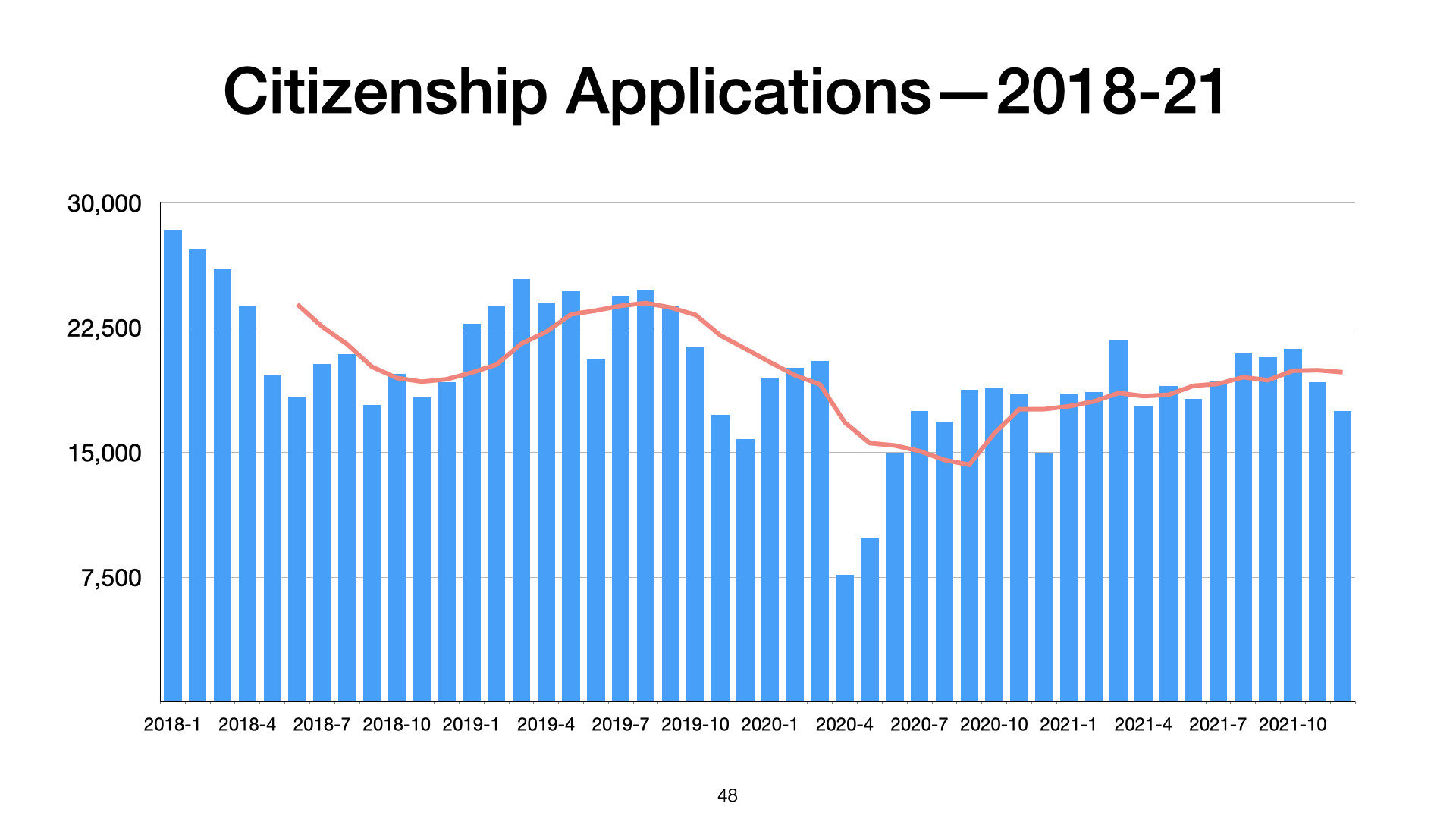
IRCC released the full 2021 data on the number of applications for citizenship. Given the delays in IRCC entering application data in GCMS (for both Permanent Residents and citizenship), this three-month old data reflects an accurate number.

The month-by-month overview:

With the full-year data, I can now update the overview chart of the impact of COVID-19 on the range of immigration-related programs 2021-18 (How the government used the pandemic to sharply increase immigration), showing that applications declined by 10.3 percent compared to new citizens, 37.6 percent.:

The average for applications in 2021 was about 19,000 monthly, with small variations.

Given current processing trends, an average of 31,000 for the first quarter, IRCC should be able to continue chipping away at the backlog of 400,000 (April 11-12) unless applications increase significantly.

Lastly, my standard chart, comparing applications, new citizens and new Permanent Residents:

CIMM Citizenship delays call for Minister to appear [before end May]

Will be interesting to see the response, and the degree to which information is forthcoming:

Given that significant delays in citizenship applications (over two years) risk disenfranchising Canadians who are waiting for their citizenship in order to vote, and this issue is particularly urgent in light of the June 2nd Ontario provincial election, the government should move quickly to address this issue so that all Canadians who are eligible for citizenship and who choose to apply are able to participate fully in our democratic life. In light of the situation, the committee requests the Minister appear before the committee for two hours by May 27, 2022 to outline actions taken and further actions intended.

Source: https://www.ourcommons.ca/DocumentViewer/en/44-1/CIMM/meeting-21/minutes

Canadian citizenship application delays causing uncertainty for Calgary immigrants; ‘There’s nothing left to do’: Soon-to-be Canadians slam long waits for citizenship oath ceremonies

Funny that on the same day, we have stories in Calgary and Montreal on the impact of delays on citizenship applications.

Significant delays in the approval process to become a Canadian citizen due to ongoing staffing shortages and widespread travel restrictions from the COVID-19 pandemic have forced some immigrants to wait nearly two years to take their oath.

The extra wait times are now impacting hopeful Canadians like Amani Kaman. who immigrated to Canada as a refugee in 2013 to escape from war. Sadly, his father was killed by rebels in the process.

Source: Canadian citizenship application delays causing uncertainty for Calgary immigrants

From Montreal:

When Rakhee Barua and her family’s permanent residency (PR) cards expired last year, she said she didn’t even consider renewing them.

After all, the Bangladesh-born family, who came to Canada in 2016, had passed their Canadian citizenship exam months earlier, and had just one last step to take before becoming full-fledged Canadian citizens: being sworn in at an oath ceremony, typically scheduled three to four months after passing the exam.

But almost a year later, Barua and her family are still waiting for an invitation to take their oath from Immigration, Refugees and Citizenship Canada (IRCC).

“We were thinking, ‘we’ll get it next month, we’ll get it next month, we’ll get it next month,'” said Barua’s husband, Jewel Debnath, of the torturous wait for the invitation.

The uncertainty weighs heavily on Barua, who can’t travel to Bangladesh to be with her mother — who has breast cancer — due to her expired PR card and the delay on her status.

“My mother is sick. I cannot wait because I don’t know what will happen.”

Barua said her mother has been pleading for a visit before undergoing more treatment.

IRCC delays in scheduling the simple ceremony, which has been moved online due to COVID-19, has left thousands of Canadian hopefuls like Barua and her family in limbo — waiting months, and even years, to become citizens.

“There’s nothing left to do,” said a frustrated Debnath of the citizenship process.

‘I’m just waiting for that oath’

Because her PR card has expired, Barua would not be allowed back into Canada after travelling overseas to visit her mother. Renewing the card costs $50 per person, and after looking into the process, she said the wait time is between five and six months due to the backlog at IRCC.

“Like us, many people are suffering,” she said.

Oleksii Verbitskyi, a software developer from Ukraine, says his family has been waiting for more than two years for their Canadian citizenship, and he’s spent 11 months of that time period waiting for a date to attend the oath ceremony.

“It’s ridiculous, I have everything completed, I’m just waiting for that oath,” said Verbitskyi, who came to Canada with his wife and daughter in 2016 and passed the citizenship exam in March 2021. His youngest son was born in Montreal.

“It’s important … but it’s [a] formality, to be honest.”

After contacting the IRCC through online forms and emails, Verbitskyi says he still only receives boilerplate responses from the department. He says the lack of communication is frustrating.

“We live in the 21st century, you have online tools and everything,” he said. “Give us something, some feedback, like some way to know.”

60,000 approved applicants awaiting ceremony

Last year, Canada announced it would spend $85 million to plow through the backlog of immigration applications caused by COVID-19. On Monday, Minister of Immigration, Refugees and Citizenship Sean Fraser said the government hopes to expand virtual citizenship ceremonies, as well as introduce an electronic oath of citizenship to help speed up the process.

Fraser said there are currently around 60,000 people approved for citizenship who are waiting for a ceremony.

“We will be having conversations to ensure that we administer the system in a way that improves efficiency, but at the same time doesn’t deny those people who want to take part in a formal ceremony and be welcomed into the Canadian family in that traditional way,” the minister said.

But the president of Quebec’s association of immigration lawyers, which goes by its French acronym, AQAADI, says there’s no reason the process should be taking this long.

“The oath is the end of the process, it’s not a question of deciding anything, it’s just to receive the documents,” said Stéphanie Valois. The process took only a few weeks before the pandemic, she said.

“[People have] been waiting a year, more than a year, a year and a half … It should definitely be addressed because there are no reasons,” she said.

A responsibility to make Canada better

Both Barua and Verbitskyi immigrated to Canada with the hope of giving their children a better life, and are eager to obtain citizen status.

“It’s a very peaceful country … It’s known as the best country in the world,” Barua said of Canada, smiling.

Verbitskyi says he loves living in the quaint suburb of Sainte-Anne-de-Bellevue in Montreal’s West Island, and he touts the expertise of doctors who he says saved the life of his youngest child.

“For eternity, I will be grateful to Canada,” he said, tearfully.

But Verbitskyi says calling out the inefficiencies in the country’s immigration system is his civic duty, and he hopes it will make the process easier for other prospective immigrants and citizens.

“It’s our responsibility as loyal citizens to make [Canada] even better.”

Source: ‘There’s nothing left to do’: Soon-to-be Canadians slam long waits for citizenship oath ceremonies
Canadian citizenship applicants with representatives can now apply online

Progress:

Canada’s online citizenship application portal is open to people who have representatives, but reps will not be able to apply on their behalf until sometime next year.

Immigration, Refugees and Citizenship Canada (IRCC) expanded its online portal to include applications from applicants who have representatives on November 30.

“These applicants will still need to complete, sign, date and submit the application themselves and must not share their account access or password with anyone, including their representative,” IRCC said in an email. “Representatives cannot yet apply online on behalf of an applicant, but they can still provide advice on completing the application and they can communicate with IRCC on the applicant’s behalf after the online application is submitted.”

This is the latest move in modernizing the citizenship application system. Single applicants have been able to apply for citizenship online since August. Recently, Canada also started accepting proof of citizenship applications online. These documents allow the foreign-born children of Canadians to prove their right to citizenship.

In 2022, IRCC says it will open the online applications to:

  • families,

  • minors,

  • representatives to apply on behalf of their clients, and

  • clients who are declaring residence outside of Canada as a crown servant or with a crown servant family member.

Source: Canadian citizenship applicants with representatives can now apply online

Canada now accepts citizenship applications online

Good. Will be interesting to see the take up once expanded to families and whether that reduces processing time along with providing more timely application statistics:

Canadian permanent residents can now submit applications for citizenship online.

Immigration, Refugees and Citizenship Canada (IRCC) has launched a new online tool that allows citizenship applications to be submitted online.

Get help applying for Canadian citizenship

As of August 11, IRCC has opened the online portal to single applicants over the age of 18. It is not open to family applications, nor representatives. Also, it is not open to those who are employed by the crown and living outside of Canada.

Later in 2020, IRCC intends to open the online application to families, and minors under age 18. In 2022, the online application will be available to representative to apply on behalf of their clients. It will also be open to crown servants declaring residence outside Canada.

Applicants who have already submitted on paper should not try to reapply online, IRCC says in a media release.

IRCC had already been developing this new tool, as part of an initiative to modernize the immigration system. In late 2020, it released the tool to test the platform’s capacity.

The new online portal allows applicants to save partially-completed applications and resume them at a later time. It also allows users to upload supporting documents, proof of payment, print a PDF and ask for a confirmation of receipt.

Modernization of the immigration system

Immigration Minister Marco Mendicino has said his vision for Canada’s immigration system to become paperless.

The pandemic forced IRCC to start modernizing to allow for immigration to continue amid public health measures. So far, Canada has made citizenship testing available online, and also started holding virtual citizenship ceremonies.

Along other lines of business, the department has also begun doing virtual landings for newly-arrived permanent residents. For immigration applicants, a number of paper-based programs are starting to go digital.

Source: Canada now accepts citizenship applications online

#Citizenship applications, new citizens and Permanent Residents: 2020 Update

IRCC kindly provided me with the 2020 citizenship application monthly data (not available on opendata), allowing me to update one of my standard charts, showing the dramatic declines in 2020:

Annual decline 2020 compared to 2019:

  • Applications: 26.5 percent
  • New Citizens: 56.8 percent
  • Permanent Residents: 45.7 percent

Surprised by the relatively small decline in applications compared to new citizens, suggesting that IRCC may be developing a backlog as has happened in the past.

As I have noted in the past, the number of applications and new citizens fluctuates widely compared to the more stable trajectory of new Permanent Residents, reflecting policy changes in terms of applications and resource and management issues in the case of new citizens.

Historically, this has been met by injections of funding to clear backlogs (often near to elections!) and I understand that the 2014-15 increase in citizenship fees (from $200 to $630 for adults) may have been a way to pay for increased funding.