Angus-Reid – Temporary Foreign Workers: Canadians support reduced program; few want workers to have path to citizenship

Although not covered in the summary, the data tables highlight that non-white are more critical than white (I would have preferred an immigrant, born in Canada comparisons):

Part One: Views of Temporary Foreign Workers program

  • Canadians say they hear more negative things than positive ones
  • Most say number of workers too high
  • Plurality say program should continue with changes

Part Two: Who benefits and loses from TFW program

  • Most see a boon for business at the cost of labour market and housing
  • Liberal supporters most positive, cross-partisan concern about impact on housing

Part Three: Concerns about treatment of workers, but little support for citizenship

  • Majority say businesses that can’t afford to pay wages Canadians will take should close
  • Many also say Canadians don’t want to do the jobs TFWs perform
  • Majority say businesses treat TFWs unfairly; half say government exploits them
  • Citizenship for TFWs not supported by many

Source: Temporary Foreign Workers: Canadians support reduced program; few want workers to have path to citizenship

Angus-Reid Federal Politics: Concern over immigration quadruples over last 48 months

Of note, again linked mainly to housing and employment concerns:

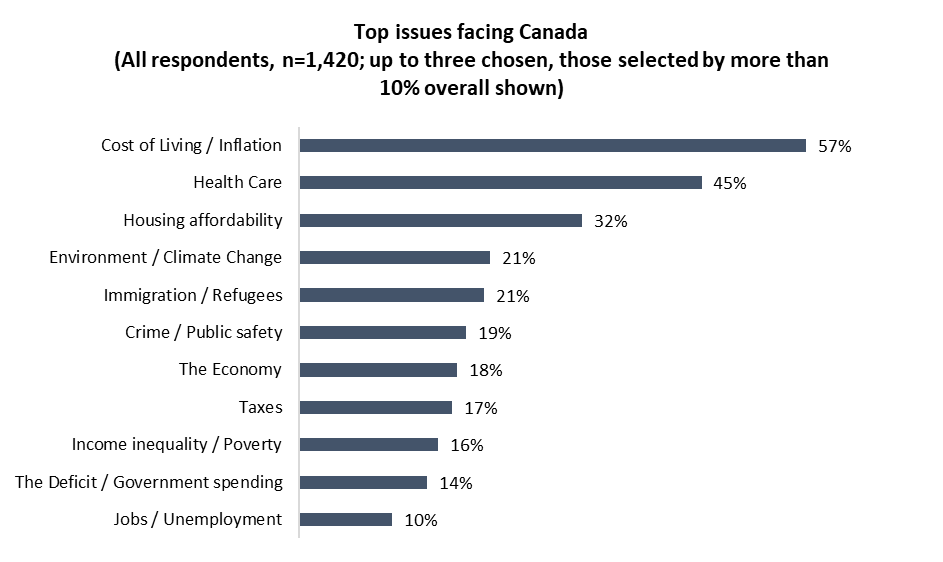
…When parliament resumes seating later this month, there will be a full docket of issues waiting to be addressed. A majority of Canadians (57%) believe the cost of living is one of the top issues facing the country at the moment, while more than two-in-five (45%) say the same of health care. Behind that, one-in-three worry over housing affordability. Other concerns trail far behind those three, but at least one-in-five say climate change (21%), immigration (21%), and crime and public safety (19%) are key challenges for Canada:


Concern over immigration nearly quadruples over past two years

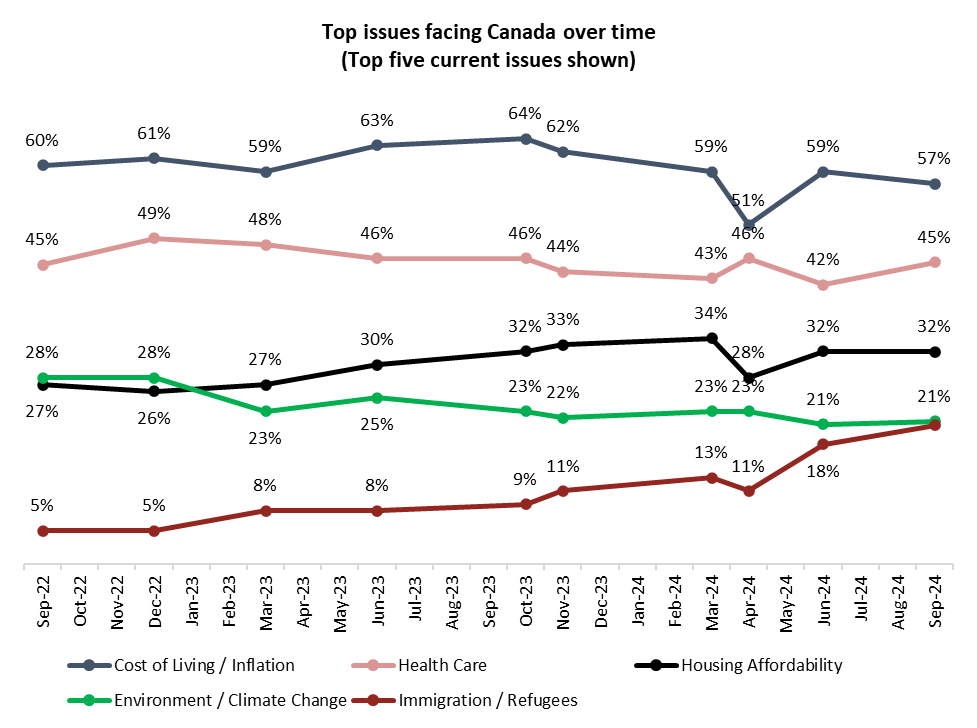
Some issues are lingering – cost of living, health care, and housing affordability have consistently been selected by Canadians as top issues over the past two years – while others have grown more pressing according to Canadians. The proportion of Canadians that select Immigration / Refugees as a top issue has nearly quadrupled over the past two years.

Perhaps at issue is growing attention over the ripple effects of the federal government’s Temporary Foreign Workers program, which had been expanded as the country dealt with a post-pandemic labour shortage. In 2023, the federal government allowed employers to hire nearly 240,000 temporary foreign workers, more than double the amount it allowed in 2018. After a cabinet retreat focused on housing and immigration, the federal Liberal government announced plans to scale back the program. There will be more to come on Canadian public opinion on the Temporary Foreign Workers program in a forthcoming report.

Those who say they will vote Conservative if the election were held today are the most likely to be concerned about immigration. It’s the second most chosen issue behind the high cost of living among those likely voters. Conservative leader Pierre Poilievre has said a government led by him would reduce immigration, keeping population growth lower than the number of new homes.

The issues concerning likely Liberal voters remain consistent from two years ago, while those who say they will vote NDP are becoming increasingly concerned with housing affordability (+9) and less so with climate change (-11)…

Source: Federal Politics: Concern over immigration quadruples over last 48 months

Articles on #Beijing2022 and the boycott question: “The Nazis used us during the 1936 Olympics. We cannot fall for the same propaganda tactics in China next year;” “Kelly: Washington’s diplomatic boycott of Beijing Olympics is worse than meaningless;” “53% of Canadians would not send diplomats to 2022 Olympic Games; two-in-five would keep athletes home”

Starting with the obvious parallel:

In a recent telephone interview with Fox News, former President Donald Trump said he is opposed to a proposed boycott of the 2022 Olympics in China because it would “hurt the athletes.”

President Joe Biden and others have raised the idea of a potential boycott of the 2022 games to protest the Chinese government’s ongoing persecution of its Muslim Uyghur citizens and other human rights abuses, such as the oppression of Tibetans and the trampling of civil liberties in Hong Kong.

America has been through this debate before — in 1936, and again in 1980. The very different outcomes of those two earlier debates offer some useful lessons for our current controversy.

The Chinese regime is engaged in “ongoing genocide” against the Uyghurs, according to the State Department. A recent report by the United States Holocaust Memorial Museum found that “the Chinese government’s attacks on the Uyghur community are alarming in scale and severity” and constitute “crimes against humanity,” including “forced sterilization, sexual violence, enslavement, torture, forcible transfer, persecution, and imprisonment or other severe deprivation of physical liberty.”

From the Chinese perspective, the Olympic Games represent a prime public relations opportunity. They make the host country seem like an accepted part of the civilized international community.

Adolf Hitler saw the 1936 Berlin Olympics the same way. Many Americans today remember the Berlin Olympics as a victory for the good guys, because African American track star Jesse Owens won four gold medals, an implicit challenge to Hitler’s claims of “Aryan” racial superiority.

But in reality, The Games were a triumph for the Nazis in the way that mattered most — improving the Hitler regime’s image abroad.

President Franklin D. Roosevelt had ample warning that the Nazis intended to use the games for propaganda purposes. The U.S. ambassador in Germany, William Dodd, reported to Washington that the Nazis intended to use the Olympics “to rehabilitate and enhance the reputation of the ‘New Germany.’”

Foreigners will “have only the usual tourist contacts,” he wrote, and are likely to come away doubting the veracity of “the Jewish persecution which they have previously read in their home papers,” he predicted. The 2,000 translators hired by the Hitler government were also being trained at “parrying embarrassing questions and insinuating praise of National Socialism in their small talk,” Dodd wrote.

Dodd’s warnings went unheeded; the Roosevelt administration rejected the boycott as undue interference in American-German relations

But he was right: The New York Times praised the German government for its “flawless hospitality.” A Los Angeles Times correspondent wrote that “Zeus, in his golden days, never witnessed a show as grand as this.” An editorial in that newspaper even predicted that the “spirit of the Olympiads” would “save the world from another purge of blood.”

Even President Roosevelt was taken in — or perhaps he was looking for a way to justify America’s participation. Meeting with American Jewish Congress leader Rabbi Stephen S. Wise shortly after the games, the president told Wise he had learned from two tourists who had attended the Olympics “that the synagogues are crowded and apparently there is nothing very wrong in the situation [of Germany’s Jews] at present.”

Rabbi Wise wrote later that he was horrified by FDR’s comment. Wise tried to “explain to him how grave conditions were….[I] told him of some recent happenings in Germany….Cited other examples of the ruthless and continuing oppression of the Jews. He listened carefully; but I could see that the tourists (whoever they were, the Lord bless them not) had made an impression upon him.”

In 1980, the U.S. government made a different calculation: the Carter administration boycotted the 1980 Moscow Olympics as a protest against the Soviet invasion and occupation of Afghanistan. In his interview, Trump claimed that this boycott “didn’t work.”

The Trump argument, apparently, is that since the boycott did not bring about a Soviet withdrawal, it was a failure. But that view misunderstands the purpose of the 1980 boycott.

President Carter obviously didn’t expect that his gesture alone would convince the Soviets to leave Afghanistan; it was a symbolic protest. A boycott of the Chinese games likewise would be symbolic.

But symbols are important. Such foreign policy gestures help shape international opinion and establish standards for how governments respond to crises around the world.

If the Biden administration does not undertake a substantial symbolic protest, such as a boycott, it would send a message to China’s leaders that their brutal human rights abuses are of no concern to the United States. That is a dangerous message to send.

The U.S. government looked away during the Holocaust, not to mention more recent genocides in Cambodia, Rwanda, and Darfur. America’s response to ethnic cleansing in the Balkans and mass atrocities in Syria was also too little, too late. It’s time for a new kind of U.S. response.

Dr. Medoff is founding director of The David S. Wyman Institute for Holocaust Studies and author of more than 20 books about Jewish history and the Holocaust.

Source: https://links.forwardcdn.com/u/click?_t=4616583590614aeb8da9a4f87d20e5fd&_m=82a91bf047e343b9b3cb4e8d87fd1c3e&_e=0scGFp23L4VNUPFHgTznqQBWAILR5A2FqcTiEsrdG7IVqKQb2JActvbSFtCYbj2tGvYeBCqyx1oflHJeTbuca7fdCFmVxuj3D9WM8XkZp2ZYDb70zbvk5oXzLpowPM1je3aHhin5r4Yxa5afvWvH6Jaus20m8FzjzeUt1cOMYYeycDyE1IWHqbWi7QhL6zA4tfnOWB6tXzXGcy4Ml5qkL_KwJk-aSmM1gSHtrZrVdbKINuDXdMKHkl8RMs4bFeEGWFPvl5lj2ogjiYQeUCr2HqwHjnnIqZNsPUAj4Z0Ewh1zb6CPzU08_xVksP5Jp4qiTt0IqkbAcgHJ9i_A2Y3Q1r6M8loA3qfMhDHv1uMoJbQp63qkciZMu0iaTg9kF43rKv8UGfCFyGzoVCRjUpC1wwPrpQxVnYBK_NAlUtKE0oMNUUdFLe17ooHJLanothdJFfRJGAMtVKzhxJPRGcQGfQ%3D%3D

Cathal Kelly of the Globe calls out the hypocrisy and weakness of “diplomatic boycotts:”

Let’s try to imagine how a diplomatic boycott might work in your own life.

You told your neighbour that you’d go over to her house for her annual New Year’s Eve party. Then you found out that she runs a dog-fighting ring or some similarly heinous activity on her property.

You are so morally repulsed that skipping the party isn’t enough. You feel the need to get on the neighbourhood group chat and announce you’ve come to a difficult decision. After a lot of soul searching, you’ve determined that no decent person should be seen to support such a person and their party. With that in mind, you will not be attending this year. Instead, you will stay home rubbing your rosary beads. You’re not going to go so far as to call anyone else who would attend such a party lower than a serpent’s belly, but it’s implied.

Also, in unrelated news, your kids will be going to the party. They’ve been looking forward to it all year and you can’t bring yourself to let them down.

Yes, there may be dog fighting and assorted other violence going on while they are in the house. Maybe they’ll be able to hear whimpering from the garage. But you don’t want to be the ogre who ruined everyone’s night out.

You heard there’s going to be a raffle at the party. What if your kids win a bunch of stuff and bring it home? Well, what can you do? You can’t stop them from winning. As much as it pains you, you’ll have to enjoy the spoils with them.

In summation, this party is wrong and you are against it.

This isn’t exactly what Washington has done in announcing an ersatz boycott of the upcoming Beijing Olympics. What it has come up with makes less sense than that.

America’s long-rumoured halfway measure – the diplomatic boycott – was officially announced on Monday. It doesn’t amount to much. It’s a more impressive sounding way of saying you are eliminating Olympic junkets. Now all the sad, second-rate pols from North Dakota and Maine won’t get flown private to Beijing so they can take a bunch of ego shots with Auston Matthews.

In the announcement, America’s rationales for taking this action were cast by White House spokesperson Jen Psaki in Second World War terms: “ongoing genocide and crimes against humanity.” It is difficult to imagine more serious charges.

Yet elsewhere in the same remarks, Psaki sounded the executive air horn on behalf of her boss: “We will be behind [America’s Olympic athletes] 100 per cent as we cheer them on from home. We will not be contributing to the fanfare of the Games.”

That. What you did right there. That is fanfare. Fanfare’s what you call it when you root publicly for athletes. Eliminating the fanfare would mean saying nothing at all.

Fanfare is what this is about, though not the usual sort. We are speaking of political fanfare – controlling and redirecting the sporting kind so that it lands on the right politicians.

This is a leadership looking to be congratulated for doing the right thing, while getting to do what they self-evidently believe to be the wrong thing.

Take earlier comments about the proposed boycott from Robert Menendez, the senator who chairs the foreign relations committee. He called it “a necessary step to demonstrate our unwavering commitment to human rights in the face of the Chinese government’s unconscionable abuses.”

I’m sure the people suffering those abuses can discern the difference between American athletes holding up the Stars and Stripes on Beijing podiums and the American VIPs who will no longer be whooping it up in the stands behind them. Perhaps “unwavering” means something different in Menendez’s district.

You can’t be said to be taking a stand unless it involves some sort of sacrifice. What has America given up here? Nothing. Less than nothing. This move saves them on airfare.

This isn’t moral leadership. It’s outrage mitigation. Washington needs to be seen doing something, but nothing so substantive that it might interfere with everyone’s fun times. Unable to boycott and just as unable to not boycott, America has chosen a boycott that isn’t a boycott. Except it has called it a boycott. Cool trick.

Playing silly buggers with language makes it possible for everyone to oppose China as party host, while still enjoying the jingoistic boost that comes from attending China’s party.

Had America said nothing about a boycott and quietly ordered officials to stay home, its position would at least be logically consistent. That would have allowed them to give the athletes, broadcasters, corporate sponsors and voters/fans what they want, without confronting the implications of what that means. It wouldn’t be very honourable, but would at least make some sense.

Putting a name to America’s semi-absence reveals it as a hypocrite. What else would you call accusing someone of mass murder, congratulating yourself on your own bold truth-telling and then helping yourself to their hospitality?

Now we’ll see what America’s allies do, and what China does in turn. Beijing has already promised “firm countermeasures.”

Would it be possible for an Olympic host to pull out of a Games a few weeks before they start? The idea would not have even occurred to me a couple of weeks ago, but it’s beginning to feel like a lot of impossible scenarios are now possible.

For those who are still Beijing or Bust, there is good news. Despite all the hot talk, we are still in the posturing stage. No one has yet done anything to put the Games in doubt.

For those who had hoped for a moral stand on this file, there is no news at all. Just more of the same nonsense meant to obscure the fact that no one wants to take any position that might force them to tell the kids they can’t go to the globe’s most lavish and beloved circus.

Source: https://www.theglobeandmail.com/sports/olympics/article-washingtons-diplomatic-boycott-of-beijing-olympics-is-worse-than/

Lastly, a useful Angus Reid survey showing that 40 percent, higher than I expected, support a full boycott (athletes) compared to 53 percent the “virtue signalling” diplomatic boycott:

Not since the 1980 Games in Moscow has Canada declined to send athletes – or officials – to the Olympics.

But as the U.S. announces a diplomatic boycott of next February’s Winter Games in Beijing – other Western nations are being asked their intentions.

While the Canadian government contemplates who – if anyone – it will send to the Olympics, a new study from the non-profit Angus Reid Institute finds just over half of Canadians (53%) supportive of their country taking the same measure as the U.S., denying any diplomatic presence in Beijing.

Two-in-five would go further, keeping athletes home from China as a protest against human rights abuses in the host country.

Overall, four-in-five (78%) support some sort of boycott. Despite this sentiment, the vast majority are resigned to the fact that Canadian protest will have little impact on China’s domestic policy. Nearly three-quarters (73%) say it is “unrealistic” to expect actions taken by this country will change China’s behaviour.

Chart, waterfall chart Description automatically generated

More Key Findings:

  • Favourability towards China has increased since Michael Spavor and Michael Kovrig were released from prison and returned to Canada, but it is the minority view. One-in-six (16%) Canadians say they hold favourable views of the country.
  • Half (48%) of Canadians who view China positively say there should be no boycott of the Games; one-in-five (17%) of those who view the country negatively say the same.
  • Men between the ages of 18 and 34 are the most supportive of officials and fans staying home at two-thirds (63%) and half (47%) respectively.

Source: https://angusreid.us12.list-manage.com/track/click?u=4adb83e0e056e657a62fc6d8a&id=8a3a870561&e=1e1ae5dd63

Diversity and Education: Half of Canadian kids witness ethnic, racial bullying at their school

Interesting and useful survey. Most interesting finding for me (apart from the extent of bullying) is the correlation between greater student diversity and knowledge of racism in Canadian history. Worth reading the full survey:

As Canada grows and changes, becoming more diverse every year, new generations of children are immersed in a reality that can look far different than that of their parents or grandparents.

And while diversity in schools is largely an accepted and comfortable fact of life for Canadian children, a new study from the non-profit Angus Reid Institute in partnership with the University of British Columbia finds some – in particular those who identify as a visible minority – struggling to fit in more than children who do not identify this way.

Indeed, this conversation with 12- to 17-year-olds in Canadian schools finds that racially motivated bullying and insults are a reality in more ethnically diverse areas of the country.

While half of kids who describe their school as made up of mostly students from similar backgrounds say that these racial issues are something they have seen, this rises to two-thirds among those who say their school is more diverse. Further, visible minority students are three times as likely as white children to say that they have faced personal abuse. Indigenous children are twice as likely to say this.

That said, most Canadian children say that they have an outlet to talk about these issues. Indeed, nine-in-ten say that they talk to their parents or other family members about it. There may, however, be more for teachers and school staff to do. Three-in-ten victims of bullying or abuse say that staff in their school were either unaware of it or just ignored it.

More Key Findings:

  • Children in more diverse schools are significantly more likely to say that they have learned about racism in Canada’s history, Indigenous treaties, residential schools, and multiculturalism, than those who say their student body is made up of kids from mostly the same background.
  • Most Canadians kids are comfortable with their peers wearing different clothes, celebrating different holidays and speaking different languages than they do. Approximately two-thirds say it’s not a big deal, while one-in-ten say they enjoy it.
  • Among those who say that they have been the target of ill treatment, 43 per cent say it is something that they carry with them after it happens. More than half (57%) say it doesn’t bother them, or that they’re able to move past it.
  • Older kids, between the ages of 15 and 17, are more likely than 12- to 14-year-olds to say they talk about racism with their friends – 73 per cent to 56 per cent respectively

Link to full survey: https://angusreid.us12.list-manage.com/track/click?u=4adb83e0e056e657a62fc6d8a&id=5493b06c34&e=1e1ae5dd63

Diversity and Racism in Canada: Competing views deeply divide country along gender, generational lines

Summary of latest Angus Reid survey, with the usual clever segmentation. Glass half full or half empty?:

These are times of deep reckoning over issues of race and identity, hatred, and violence in Canada.

Against the backdrop of the London, ON, attack that targeted and killed a Muslim family, the deep pain associated with revelations about the hundreds of children buried on the grounds of former residential schools, and ongoing reports of discrimination against Canadians of Asian origin, many are attempting to reconcile the realities of the nation’s attitudes towards diversity and equality with national mythologizing about multiculturalism.

The second report from a comprehensive research series from the non-profit Angus Reid Institute in partnership with the University of British Columbia dives deeply into the sentiments of those living in this country – to illuminate perceptions and attitudes towards diversity and racism.

For 85 per cent of the population, that Canada is home to people from different races and ethnicities betters the nation. Canadians of all regions of the country, age groups, political ideologies and ethnic backgrounds agree on this point.

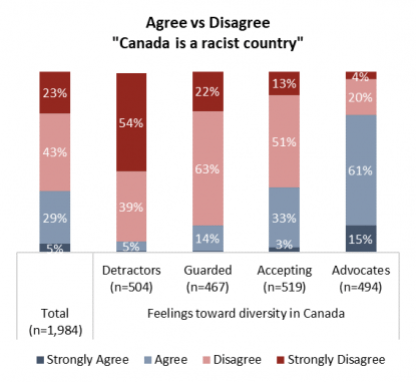
But does everyone feel it? Contradictions abound. Fully one-in-three (34%) say “Canada is a racist country.” Among those who believe this most keenly: visible minorities (42 per cent of whom say so) and women, particularly those under the age of 35, who are much more likely than men to hold this view (54%).

On the other hand, however, fewer than one-in-eight (12%) say they believe some races are superior to others. Further, 41 per cent of Canadians say that people seeing discrimination where it does not exist is a bigger problem for the country than people not being able to see where it does.

These perspectives coalesce to form four mindsets with which Canadians view diversity. This report analyzes each – the Detractors, Guarded, Accepting and Advocates – to better understand the expectations of Canadians heading into the second half century of official multiculturalism.

More Key Findings:

  • Three-quarters of Canadians over the age of 55 disagree that Canada is a racist country, while 54 per cent of women between the ages of 18 and 34 say that it is
  • One-in-five Canadians (21%) say that they feel like they are treated as an outsider in Canada. This proportion is 17 per cent among Caucasians, 30 per cent among Indigenous respondents and 29 per cent among visible minorities.
  • The Advocates, one-quarter of Canadians, are very concerned about racism and discrimination, to the point that they are twice as likely as visible minorities themselves to say that police are prejudiced or racist toward the latter demographic (83% vs 42%)
  • The Detractors, made up of older and more conservative Canadians, are also one-quarter of the population. This group is distinct in that it is more likely than others to say that immigration levels are way too high, and that racism is not a problem in Canada
  • One-quarter of Canadians feel “cold” toward Muslims, more than any other group asked about in the survey. Men over the age of 55 (42%) and Quebecers (37%) are among the most likely to say that.
  • Most Albertans (54%) and Saskatchewanians (57%) believe exaggerating racism is a bigger problem in Canada than not seeing racism where it exists.
  • Yet residents of Saskatchewan (44%) were the most likely to agree that Canada is a racist country. Residents of Quebec (24%) were the least likely.

Source: Diversity and Racism in Canada: Competing views deeply divide country along gender, generational lines

Full survey: click here

Anti-Chinese racism is Canada’s ‘shadow pandemic,’ say researchers

Disturbing that so many appear not to be able to distinguish between the Chinese regime, with all its abuses, and Chinese Canadians:

Many Chinese Canadians fear that Asian children will be bullied when they return to school due to racial tension arising from the COVID-19 pandemic.

A survey of more than 500 Canadians of Chinese ethnicity by the Angus Reid Institute and the University of Alberta has found that anti-Chinese racism is rife in our society, what the researchers call a “shadow pandemic.”

That parents are afraid to send their children to school is “heartbreaking,” said ARI executive director Shachi Kurl. “Racism is the secondary virus that has had an outbreak since the pandemic was declared.

“We have this notion of Canada as an endlessly accepting, embracing country because we are multicultural,” she said. “It’s not the case and it’s never been the case.”

“The data show that these micro-aggressions are frequent and plentiful,” said Kurl. “People say they are being treated as though they are somehow carriers of COVID-19.”

More than 60 per cent of those surveyed said they have adjusted their daily routines because of the threat of racial backlash and about half fear that Asian children will be bullied if they return to school.

Vancouver-born Gloria Leung says her daughter of mixed race has been jeered by other children for her Chinese ancestry just steps from their home.

“We have informed our daughter’s teacher without naming any names and her teacher has shared that information with school staff so they can increase awareness of racism and bullying,” she said.

Her daughter’s harassers are from just two families in an otherwise diverse and welcoming neighbourhood, but the seven-year-old has felt anxious and stressed since the incident.
“We understand that everyone is struggling and hurting in this pandemic,” Leung said. “Our hope in sharing these lived and uncomfortable experiences is not to shame people, but to provide insight into systemic racism and shed light on how we can learn from these experiences.”

The survey also found that just 13 per cent of respondents feel that people in Canada view them as fully Canadian “all the time.”

“There’s a notion that because our schools are diverse and our workplaces are diverse that racism isn’t a thing anymore,” said Kurl. “It’s one thing to hear about this anecdotally, but it’s important to ask these questions to see just how widespread this is.”

About 30 per cent of the respondents say they have been exposed to anti-Chinese sentiment in the news, on social media or through graffiti.“Just this weekend (U.S. President Donald) Trump used a pejorative term for the virus, calling it the ‘kung flu,” noted Tung Chan, a former Vancouver city councillor and former chair of the Canadian Museum of Immigration at Pier 21.

“The parents learn from the media, the children learn from the parents and you have this fear that extends into schools,” he said.

Chan was particularly discouraged to learn that 60 per cent of people surveyed changed their daily routine to avoid negative interactions and “unpleasant encounters.”

“I have always chosen my words carefully when talking about racism, because I don’t want to make people feel insecure,” said Chan. “But looking at these numbers I think that I was too mild in my remarks. This is far worse than I thought in terms of people fearing for their personal safety.”While it is important to hold the government of China to account for its belligerence and human rights abuses, news media need to distinguish between the actions of the People’s Republic of China, the Communist party of China, and the Chinese people.

“The term Chinese is too all-encompassing and it reflects the actions of the Chinese government back on the people in our community,” said Chan.

“I am proud of my Chinese heritage and I won’t walk away from that, but if you ask me who I am I always say I am Canadian,” he said.

The survey was conducted online between June 15 and 18 among a randomized representative sample of 516 adults who identify as ethnically Chinese. The margin of error is +/- 4.3 per cent, 19 times out of 20.

Source: Anti-Chinese racism is Canada’s ‘shadow pandemic,’ say researchers

Angus Reid 2019 Crisis of Faith? Even practicing Catholics say Church has done a poor job handling sexual abuse issue

Of interest given the greater shifts of net favourability with respect to Roman Catholics, Sikhs and to a lessor extent, Muslims:

There has been slightly more variation in Canadians’ views of specific religious groups between 2015 and today. Looking at “net positivity” – the percentage of Canadians saying they have a positive view of each group minus the percentage who say they have a negative one – shows Canadians feeling more warmly in 2019 than they did in 2015 toward six of the nine faith groups asked about in this survey.

There has been slightly more variation in Canadians’ views of specific religious groups between 2015 and today. Looking at “net positivity” – the percentage of Canadians saying they have a positive view of each group minus the percentage who say they have a negative one – shows Canadians feeling more warmly in 2019 than they did in 2015 toward six of the nine faith groups asked about in this survey.

The three who are viewed more negatively today are Catholics (a net +26, down from +36 in 2015), Protestants (+33, down from +36), and Buddhists (+32, down from +35). That said, it’s notable that each of these groups is consistently more likely to be viewed positively than negatively, overall.

Indeed, only one religious group – Muslims (-22, up from -29 in 2015) – has a net negative score overall. As seen in the graph that follows, net perceptions of Jews, Hindus, atheists, Evangelical Christians, and Sikhs are all more positive than negative, and have improved at least slightly since 2015.

Source: Crisis of Faith? Even practicing Catholics say Church has done a poor job handling sexual abuse issue

Birthright Citizenship: Plurality of Canadians see it as good policy, but also say some changes are needed


I was really pleased to see this detailed Angus Reid survey on attitudes towards birth tourism. Timing perfect as will be discussing birthright citizenship with Audrey Macklin next week at Metropolis (see my deck Birth Tourism – Metropolis 2019).

Appears by the efforts by activists like Kerry Starchuck, Richmond area MPs Alice Wong and Joe Peschisolido, my health financial data-based research (Hospital stats show birth tourism rising in major cities) and the related media coverage helped encourage the government to take the issue more seriously in its commitment to study the issue and, I suspect, encourage Angus Reid to conduct this study.

The poll has breakdowns for region, gender, age, income, education, and political orientation but not, curiously, for immigrant/non-immigrant.

Most of the differences of opinion reflect overall difference of opinion on immigration and citizenship issues: younger, female, more educated and those with higher tend to be more supportive, whereas the opposite is true with respect to older persons, males, less education and lower income.

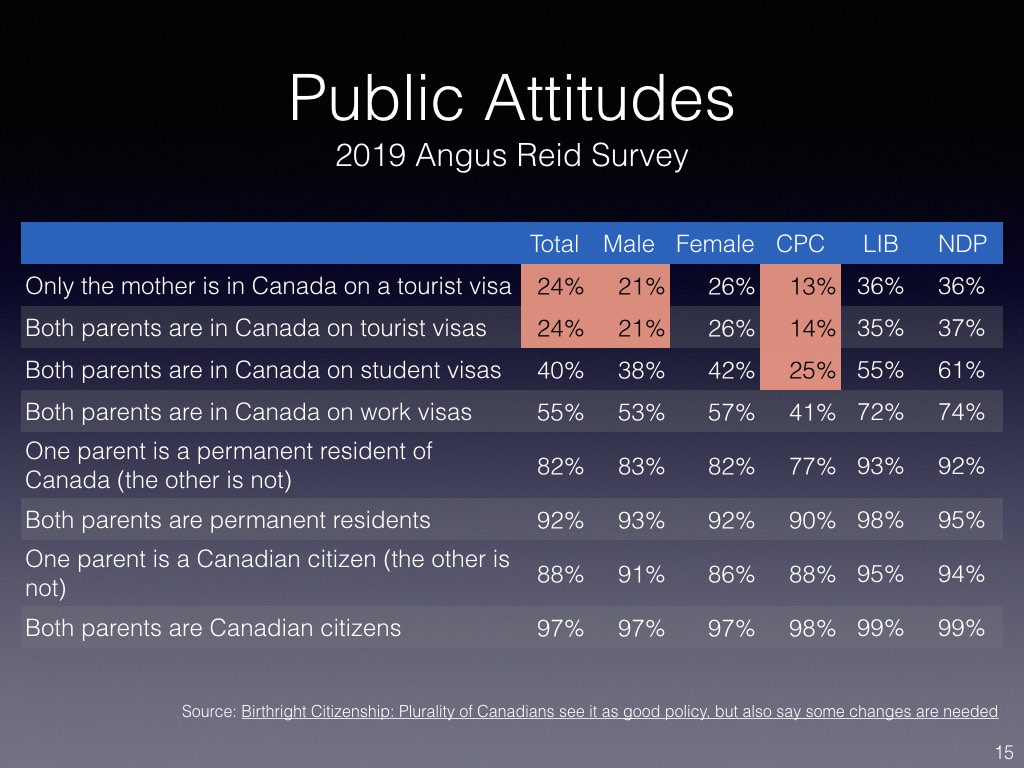
The political orientation divide is the most striking with the biggest surprise to me is the relatively high support (one-third) among Liberal and NDP leaning voters to support birthright citizenship for those on tourist visas, the classic example and practice.

Hard to explain are Conservative leaning voters who make greater distinctions between situations of both parents being citizens or permanent residents and those when only one parent is a citizen or permanent resident.

The breakdown into eight different scenarios is both helpful in its providing a more nuanced understanding of attitudes but, of course, would complicate any possible policy measures being considered beyond a citizen/permanent resident non-citizen/temporary resident distinction:

Which babies born on Canadian soil should be granted automatic citizenship?

It’s a question that has appended itself to the Canadian political and policy narrative in this election year; and one on which Canadians share some areas of consensus and others of deep division, according to a new public opinion poll from the non-profit Angus Reid Institute.

Today, most Canadians feel this concept – that anyone born in Canada is a citizen – goes a bit too far. Almost two-thirds (64%) say a child born to parents who are in this country on tourist visas should not be granted Canadian citizenship, and six-in-ten (60%) say changes to Canada’s citizenship laws are necessary to discourage birth tourism.

That said, more Canadians are inclined to believe birthright citizenship is a good policy (40%) than a bad one (33%).

More Key Findings:

  • Canadian opinions of when to grant citizenship are nuanced, changing with various scenarios offered. For example, 55 per cent say a child born to two parents in Canada on work visas should be conferred citizenship. This drops to 40 per cent if both parents are in Canada on student visas.
  • Canadians considering the Conservative Party in the coming election, as well as older residents (those ages 55-plus), are inclined to say that birth tourism is serious problem for Canada. Those considering the Liberal and New Democratic Parties – and those under 35 years of age – are more likely to say the problem is not serious.
  • In the same vein, while three-quarters of Canadians in the Conservative political sphere* say changes are birthright citizenship are necessary, majorities from the Liberal and NDP spheres disagree, and say no changes are needed

Source: Birthright Citizenship: Plurality of Canadians see it as good policy, but also say some changes are needed

Full report: Click here for the full report including tables and methodology

Supporters of public faith in Canada are young, educated, Liberal, and ‘quite dug in’: pollster

Interesting findings but note the methodology used is not random selection, and thus likely cannot be considered a reliable reflection of the population:

Proponents of religious faith in public life in Canada tend to be younger, more highly educated, and more likely to have voted Liberal, according to a new survey.

The counter-intuitive discovery puts the lie to the common impression that support for public religiosity in areas like health care, social services and education is driven by evangelical church goers and deeply observant, older, conservative “holy rollers,” said Angus Reid, chairman of Angus Reid Institute.

“What we find is exactly the opposite,” Reid said.

He said there is a “mythology” on the political left that says declining church attendance goes hand in hand with support for what he calls “uber-secularization” of society, or the “extinguishment of faith and religion from any portion of the public square.”

Not so, according to the report, Faith in the Public Square, done in partnership with Cardus, which describes itself as a non-partisan, faith-based think tank and registered charity dedicated to promoting a flourishing society.”

“The largest segment of Canadian society (at 37%), quite independent of whether they have any religious views or not, sees an important role for religious and faith groups across many dimensions of Canadian society. They strongly support religious freedom. They see religious and faith groups playing an important role in health, in social services, social justice issues. They believe that faith and religion are critical for the formation of citizenship and strong values,” Reid said in an interview. “There is a very significant segment that is alive and well and quite dug in, in many respects, on this question.”

When asked about how faith operates in their own lives, Canadians tend to break down roughly like this: 20% are atheist, 20% are religiously committed, 30% are privately faithful, and 30% are spiritually uncertain.

But the pie chart looks different when the emphasis shifts to the role faith should play in public life, this survey suggests. It found that there are more proponents of faith in the public square (at 37%) than there are opponents (32%) or those who are uncertain (32%).

The survey describes these groups using what it calls a Public Faith Index, based on responses to 17 questions.

Public faith is a topic of frequent and intense public debate, from niqabs and religious symbols in the public services in Quebec, to the funding of religious schools and the appropriateness of Christian prayers at local council meetings. In the past, it has coloured political debate on everything from abortion access to whether Canada should participate in war.

This survey sought to measure opinion on, for example, whether faith is good for citizenship, whether the tenets of various faiths should be taught in high schools, and whether politicians ought to be conversant in the basics of the various religions in Canada.

It found, for example, that 38% of Canadians thought religious and faith communities were making a positive contribution to health care, while 15% felt the contribution was negative. There were similar results for social justice causes, such as poverty and overseas development. But in social services, fully 51% thought the contribution was positive, and just 11% felt it was negative. In education, the numbers were more evenly split, 28% positive and 25% negative.

It also found deep divisions between the three segments. For example, 93% of public faith proponents agree that religious and faith communities strengthen Canadian values such as equality and human rights. But 81% of public faith opponents disagree with this proposition.

In education, a solid majority, 57%, of opponents thought the beliefs of the world’s major religions should not be taught public high schools, while 36% thought just the basics should be taught.

Another curious finding is that fully 25% of public faith proponents say they have never read a religious text.

A key caveat to the general conclusion about a strong segment of young, educated, Liberal proponents of public faith is the province of Quebec. For example, if you exclude Quebec, the percentage of Canadians who are proponents of public faith rises to 42%.

“Quebec, on any issue associated with religion or faith, is a totally distinct society,” Reid said.

The survey of 2,200 Canadians was conducted in early November, via the Angus Reid Forum, an online community in which people can participate in surveys in exchange for reward points and prizes. Because they were not randomly selected, a true margin of error cannot be calculated, but a randomized poll of similar size would have a margin of error of 2 percentage points, 19 times out of 20.

Source: Supporters of public faith in Canada are young, educated, Liberal, and ‘quite dug in’: pollster

John Ivison: Will the Canadian consensus on immigration fall victim to Liberal bungling on border-crossers?

Ivison on the Michelle Rempel’s critique of the Liberal government’s immigration policies and approach and their communications challenges.

Federal immigration minister Ahmed Hussen’s announcement last week that Canada will increase its immigration target to 350,000 by 2021 seems designed to flush out the Conservatives.

With Maxime Bernier’s fledgling party promising to cut the number of permanent residents arriving in Canada from the current target of 330,000 next year to around 250,000, there is growing pressure on the Conservatives to follow suit.

The party’s immigration critic, Michelle Rempel, admits it might be the politically expedient thing to do. “If I was taking the easy route, I’d just say ‘Cut immigration’ … But the reality is we have to reform the system. It isn’t working by any metric,” she said in an interview.

Rempel said she is desperate to avoid what she called an “Americanized” debate about immigration levels.

“What Bernier doesn’t understand is that for the people looking at his party, there is only one number that is sufficient — and that’s zero,” she said.

An August survey by the Angus Reid Institute set off alarm bells that the consensus that has characterized Canadian attitudes towards immigration for the past four decades is in danger of shattering.

The poll found that the number of respondents who felt immigration levels should stay the same or be increased, which has registered at over 50 per cent for forty years, had fallen to 37 per cent. Half of those surveyed said they would prefer to see the federal government’s 2018 immigration target of 310,000 new permanent residents be reduced.

Rempel said the consensus is under pressure because the Liberals have bungled aspects of immigration policy like the “irregular” border-crossing file.

“The consensus is not breaking down, but the public is looking at what is happening with the asylum seekers and they don’t think the social contract criteria are being met,” she said. “The debate shouldn’t be about numbers but about the process by which we set those numbers.”

It’s clear that immigration will be one of the key battlegrounds in the 2019 election. The Conservatives would seek to close the loophole in the Safe Third Country Agreement that allows people to enter Canada illegally from upstate New York, and expedite the removal process of those people whose refugee claims were rejected. Rempel admits there is also pressure coming from within her own caucus to put a number on what immigration levels would be under a Conservative government.

“But I’m not going to treat this like an auction for votes,” she said, noting that on the Syrian refugees issue, her party had pledged to admit 10,000, which persuaded the NDP to raise its commitment to 15,000 and the Liberals to trump them all with a promise to admit 25,000. Yet, as she points out, unemployment rates among Syrian refugees remain stubbornly high more than two years after most arrived.

“It’s irresponsible to set a target without ascertaining how much it will cost to adequately process the huge backlog of asylum seekers,” she said.

Unlike many other centre-right parties, the federal Conservatives have long been pro-immigration. In 2015, levels remained at a historically high rate, with 271,833 new permanent residents landing in Canada.

During the Harper government’s term of office, 2.8 million people arrived as permanent residents in Canada, mainly from countries like the Philippines, India, China and Pakistan.

The mix was heavily weighted towards those chosen for their skills and education levels— in 2015, 63 per cent were economic class migrants, 24 per cent arrived under the family reunification program, and 13 per cent were refugees.

The consensus is based on a broad recognition that Canada’s worker to retiree ratio — 4.2:1 in 2012 — is set to decline precipitously to 2:1 by 2031.

It is widely understood that a decade after they arrive the labour force participation rates for immigrants is comparable to those who were born in Canada. And it is accepted that immigrants and the children of immigrants are generally better educated that the Canadian-born population (almost half have a bachelors degree, compared to one quarter for the latter).

But the complexion of the immigration system is set to change. The mix planned by the Liberals will by 2021 see economic class migrants fall to just 51 per cent of the total of 350,000, with family reunification numbers increasing by more than one third to account for nearly 30 per cent of the total and refugee numbers rising by 44 per cent to reach 19 per cent of the total.

[Note: The levels plan shows that the percentage of economic class immigrants is essentially flat at 57-58 percent, compared to the low 60s during the Conservative government).

The increased number of family members admitted into the country is likely to play well in ridings with large immigrant populations — as it did in the 2015 election.

But irregular migration is not playing well with anybody — particularly not immigrants, who see asylum-seekers as queue-jumpers, nor Quebecers, who are bearing the brunt of the refugee tide.

The government has allocated an extra $440 million to improve processing and settlement programs, and an additional $173 million specifically to manage irregular migration levels. A further $50 million has been given to provinces to pay for temporary housing for “irregular” migrants.

But as Rempel pointed out, throwing money at the problem does not make it go away. “The issue for many people is that they see higher numbers (of illegal migrants) at Roxham Road, and the higher social costs, and say we should reduce numbers,” she said.

Rempel is trying to hold a line that is under pressure from “open borders” policy on the left and “closed borders” policy on the right.

She needs to sharpen her messaging, if she is to succeed in persuading Canadians this is not just a numbers game.

But it is a line worth holding.

The debate over immigration in Canada has not descended into bigotry and resentment because it has worked for four decades. As Stephen Harper noted in his recent book, Right Here, Right Now: “Make immigration legal, secure and, in the main, economically-driven, and it will have high levels of public confidence.”

But public support is on the decline thanks to illegal migration, porous borders and an increase in the proportion of non-economic migrants.

Rempel’s argument is that Trudeau has lost the “social license” to increase immigration levels and only the Conservatives can restore it. Whether that can be done without giving a number on entry levels remains to be seen.
Source: John Ivison: Will the Canadian consensus on immigration fall victim to Liberal bungling on border-crossers?