Court ruling OK’s Amnesty Canada intervention in Black Class Action lawsuit

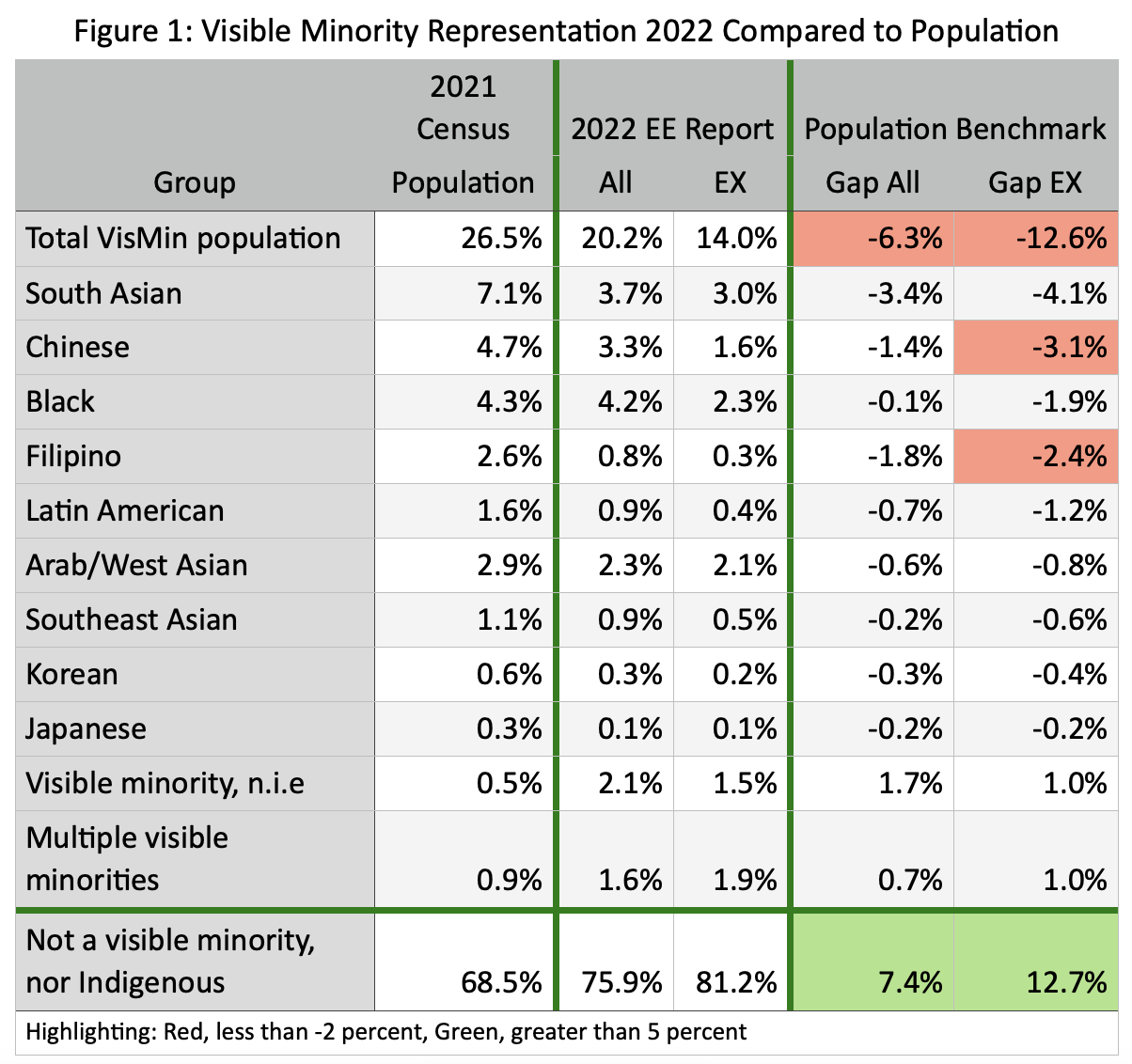
Fair enough but would have thought higher priorities, particularly given overall representation number of Black public servants compared to other visible minority groups:

….In October 2022, the federal government called for a Federal Court judge to dismiss the uncertified class action seeking $2.5 billion in compensation, arguing workers should pursue other avenues for redress, including filing complaints with the Canadian Human Rights Commission.

Amnesty Canada applied to the court to intervene last summer, with the organization’s counsel noting in a cross-examination a few months later that its participation would be “limited to making legal arguments regarding the defendant’s obligations under international law.”

“Canada’s duty to uphold federal workers’ rights goes beyond the Charter and domestic employment equity legislation,” Ketty Nivyabandi, Secretary General of Amnesty International Canada’s English-speaking section, said in a news release about the decision. “As we will stress to the court, Canada also has clear obligations under international law to promote equity, counter racism and provide an effective remedy when people are subjected to systemic discrimination.”

The court decision stated that the government was the only opponent to the motion, “largely on the basis that the proposed submissions are substantive in nature and not relevant to the procedural issues raised in the certification motion and motion to strike, and on the basis that, in any event, these issues are not governed by international law.”

In a news release, the Black Class Action Secretariat said it welcomed the court’s decision to allow Amnesty International Canada’s intervention in the lawsuit despite the government’s efforts to “vehemently oppose it.”

“This pivotal ruling underscores the necessity of incorporating international human rights perspectives in the fight against systemic discrimination within the federal public service,” a BCAS statement read. “This intervention highlights the national and international importance of our cause and the urgent need to address these injustices.”

The certification hearing is expected to take place after May 3, but BCAS said it called on the government to consent to the certification of the class action instead of “forcing workers to relive decades of trauma.”

“This step is crucial in moving forward toward a fair and just resolution for the affected Black workers,” its statement read. “We urge the government to commit to meaningful actions that address and rectify the discrimination within the public service, thereby restoring trust and integrity in Canada’s federal public service.”

Source: Court ruling OK’s Amnesty Canada intervention in Black Class Action lawsuit

Advocates in Geneva to denounce discrimination against Canada’s Black public servants

A reminder that the data they use is less solid than presented, based upon the past 6 years of disaggregated data for employee groups and EX, with Black public servants doing as well or in some cases, better than other visible minority groups:

How well is the government meeting its diversity targets? An intersectionality analysis

A delegation from Amnesty International Canada is in Geneva, Switzerland, this week to highlight the country’s human rights failings, including the systemic discrimination of Black workers in the federal public service.

The team is speaking about the issues with various countries ahead of Canada’s participation in the fourth Universal Periodic Review (UPR) on Friday. The UPR is a peer-review process where UN Member States have the opportunity to review the human rights records of others. At the UPR, Canada will be required to share the progress it has made on recommendations provided at the last UPR in 2018.

“Tomorrow, Canada will hear recommendations from all member states,” said Ketty Nivyabandi, secretary general of Amnesty International Canada’s English-speaking section on Thursday. “As of yesterday, there were 164 countries who wanted to speak and wanted to make a recommendation to Canada.”

Discrimination within the public service is an issue that has been top of mind for unions and organizations for the past several years, with a class-action lawsuit filed by thousands of Black public service workers in 2020, alleging workers faced decades of employee exclusion and discriminatory hiring practices.

The Employment Equity in the Public Service of Canada for Fiscal Year 2021 to 2022 report found that Black employees represented 20.6 per cent of the visible minority population, or 4.2 per cent of the entire core public service. Despite growing numbers of workers in equity groups, those employees were over-represented in the lowest salary levels and under-represented at the highest. Though not included as an equity group, the report found that Black employees were disproportionately earning salary ranges below $75,000.

Most recently, a report released by the office of Canada’s auditor general last month, found that government departments and agencies weren’t doing enough to measure inequalities and improve the experiences of racialized employees in the workplace. Despite having established equity, diversity, and inclusion action plans, the report found that the organizations weren’t effectively reporting on progress, sufficiently using data to identify barriers faced by staff and that, at the manager level, there was not enough accountability for behavioural and cultural change.

Nivyabandi said the issue of Black public servants is one of several issues that it’s raising, on top of the rights of Indigenous peoples, migrants and women. She said the organization is also calling for better oversight of how human rights obligations are implemented in Canada.

“We’re very concerned and very little progress has been made,” Nivyabandi said, adding that Amnesty International Canada prepared its own review titled “Canada: Human Rights in Peril” ahead of the UPR. She added that, since the last cycle, Canada has only fully implemented five of the almost 100 recommendations that were made.

“Progress is stalling and we’re here to talk to other member states to make sure that they add pressure on Canada to ensure that Canada finally takes its obligations more seriously.”

Representatives from the Indigenous Nations of Pessamit and Wet’suwet’en as well as Nicholas Marcus Thompson, executive director of the Black Class Action Secretariat (BCAS) joined Amnesty International Canada’s delegation.

Thompson said one of his main goals during the trip was to bring attention to the “egregious conduct” of the Canadian Human Rights Commission, the government agency responsible for dealing with complaints of discrimination in employment which itself was found earlier this year to have discriminated against its own employees.

“Our position is that the Canadian Human Rights Commission needs to be held accountable for its human rights violations and that it is violating the Paris Principles which it’s required to adhere to as a human rights body,” Thompson said.

During a speech on Wednesday, Thompson announced BCAS was submitting a complaint to the Global Alliance of National Human Rights Institutions, a body that has the power to decertify or downgrade human rights commissions’ ratings, looking to review the CHRC’s accreditation. Thompson said a formal complaint will soon be filed.

“We’re essentially talking to as many member states as possible, bringing to their attention Canada’s human rights track records, the Canadian Human Rights Commission violating human rights, its poor standing essentially, before the member states deliver recommendations on Friday,” Thompson said.

Action is needed now to address discrimination in the public service, said Thompson, noting the lack of representation in executive positions and little opportunity for workers to advance within the government. And while the federal government recently announced a new panel to help address discrimination in the public service, which is expected to write a public report on its findings in early 2024, a statement from BCAS said there is a need for “immediate and critical policy changes,” rather than more studies.

BCAS is also calling for Canada to release of the Employment Equity Act review, for its recommendations to be implemented, and for the appointment of a special representative to combat anti-Black racism, said Thompson.

“The case of anti-Black racism in the federal public service is very very powerful and emblematic one precisely because it’s happening within the public service where the state has the greatest possibility and opportunity to rectify it,” Nivyabandi said. “It’s very telling when you have a situation of anti-Black racism that has been raised over and over again, it’s still not being resolved.”

“We’re here to make sure that Canada finally takes action.”

After the UPR process takes place on Friday, Canada will have until March to decide what recommendations it will commit to and implement over the next five years.

Source: Advocates in Geneva to denounce discrimination against Canada’s Black public servants

Black civil servants file discrimination complaint against federal government with United Nations

More a media strategy than substantive given the court case will be definitive. As I have noted previously, overall EE numbers provide a more nuanced picture in relation to other visible minority groups.

With disaggregated data now routinely published in employment equity reports and public service employee surveys, Amnesty arguments that Blacks are “invisible” in the visible minority group no longer applies:

Black civil servants are ramping up their pressure on the federal government by filing a complaint with the United Nations alleging Ottawa violated their civil rights.

The complaint by the Black Class Action Secretariat is being sent to the UN Commission for Human Rights Special Rapporteur on racism, racial discrimination, xenophobia and related intolerance.

It follows a class action lawsuit the same group filed against the federal government accusing it of systemic racism, discrimination and employee exclusion.

“This complaint details systemic and anti-Black racism in hiring and promotions within Canada’s federal public service,” said Nicholas Marcus Thompson, executive director of the Black Class Action Secretariat.

“With this complaint, we are elevating Canada’s past failures and failure to act in the present to an international body.”

Thompson told a news conference in Ottawa Wednesday that the secretariat hopes the UN special rapporteur investigates its claims and calls on Canada to meet its international obligations to Black employees by establishing a plan to increase opportunities for Black women in the government and develop specific targets for hiring and promoting Black workers.

Current and former Black civil servants have filed a suit against the federal government alleging discrimination that led to poor treatment and being overlooked for promotion.

Amnesty International threw its weight behind the complaint, noting that 70 per cent of the 1,500 employees who have joined the class action are Black women.

“This is contrary to the feminist commitments made by the Canadian government,” said Ketty Nivyabandi, secretary general of Amnesty International Canada.

In addition to supporting the complaint, Nivyabandi also called on the government to establish a designated category under the Employment Equity Act for Black employees. Canada has launched a task force to review this legislation.

The stated purpose of the Employment Equity Act is to “correct the conditions of disadvantage in employment experienced by women, Aboriginal peoples, persons with disabilities and members of visible minorities.””

Nivyabandi said grouping all visible minorities together makes the unique forms of discrimination Black employees face “invisible.”

NDP Leader Jagmeet Singh and New Democrat MP Matthew Green were at Wednesday’s news conference on Parliament Hill to offer their support.

“On behalf of all New Democrats, as leader of the party, I want to express my full solidarity,” Singh said. “Their call for justice, in this case, their call for equity … is something that we fully support.”

Mona Fortier, president of the Treasury Board, is set to meet with Thompson this week. She said that far too many Black Canadians still face discrimination and hate.

“The government is actively working to address harms and to create a diverse and inclusive public service free from harassment and discrimination. We passed legislation, created support and development programs, and published disaggregated data — but know there is still more to do,” Fortier said in a media statement.

The lawsuit filed in Federal Court alleges that, going back to the 1970s, roughly 30,000 Black civil servants have lost out on “opportunities and benefits afforded to others based on their race.”

The statement of claim says the lawsuit is seeking damages to compensate Black public servants for their mental and economic hardships. Plaintiffs are also asking for a plan to finally diversify the federal labour force and eliminate barriers that even employment equity laws have been unable to remove.

Source: Black civil servants file discrimination complaint against federal government with United Nations

Beinart: Has the Fight Against Antisemitism Lost Its Way?

Of note:

Over the past 18 months, America’s most prominent Jewish organizations have done something extraordinary. They have accused the world’s leading human rights organizations of promoting hatred of Jews.

Last April, after Human Rights Watch issued a report accusing Israel of “the crimes of apartheid and persecution,” the American Jewish Committee claimed that the report’s arguments “sometimes border on antisemitism.” In January, after Amnesty International issued its own study alleging that Israel practiced apartheid, the Anti-Defamation League predicted that it “likely will lead to intensified antisemitism.” The A.J.C. and A.D.L. also published a statement with four other well-known American Jewish groups that didn’t just accuse the report of being biased and inaccurate, but also claimed that Amnesty’s report “fuels those antisemites around the world who seek to undermine the only Jewish country on Earth.”

Defenders of repressive governments often try to discredit the human rights groups that criticize them. A month before the A.J.C. accused Human Rights Watch of flirting with antisemitism, the Chinese Communist Party newspaper Global Times accused it of being “anti-China.” In 2019 a spokesman for Iran accused Amnesty of being “biased” against that country. In this age of rising authoritarianism, it’s not surprising that human rights watchdogs face mounting attacks. What’s surprising is that America’s most influential Jewish groups are taking part.

For most of the 20th century, leading American Jewish organizations argued that the struggle against antisemitism and the struggle for universal human rights were intertwined. In 1913, when the A.D.L. was founded to stop “the defamation of the Jewish people,” it declared that its “ultimate purpose is to secure justice and fair treatment to all citizens.” In 1956, Rabbi Israel Goldstein, the president of the American Jewish Congress, a Jewish group founded in 1918, explained his support for civil rights by saying that his organization would “act against any evil that is practiced on other men with the same conviction and vigor as if we ourselves were the victims.”

The historian Peter Novick has argued that after World War II, American Jewish organizations fought segregation because they believed that “prejudice and discrimination were all of a piece” and thus Jewish groups “could serve the cause of Jewish self-defense as well by attacking prejudice and discrimination against Blacks as by tackling antisemitism directly.”

Although supportive of Israel’s existence, America’s leading Jewish groups did not make it the center of their work in the mid-20th century. And when they did focus on Israel, they often tried to bring its behavior in line with their broader liberal democratic goals. The A.J.C. repeatedly criticized Israel for discriminating against its Palestinian Arab citizens. In 1960 the head of the group’s Israel Committee explained that it hoped to eliminate “antidemocratic practices and attitudes” in the Jewish state so the organization could more credibly “invoke principles of human rights and practices in our country and abroad.”

This began to change after the 1967 war. Israel’s conquest of the West Bank and Gaza Strip made it master over roughly a million stateless Palestinians, which fueled anger at the Jewish state from leftists in the United States and around the world. At the same time, assimilation was leading many progressive American Jews to exit organized Jewish life, which left Jewish groups with a more conservative base as they searched for a new agenda now that civil rights for Black Americans had become law.

The result was an ideological transformation. In 1974, two A.D.L. leaders wrote a book arguing that Jews were increasingly menaced by a “new antisemitism,” directed not against individual Jews but against the Jewish state. Almost a half-century later, that premise now dominates mainstream organized American Jewish life.

Largely as a result of lobbying by Jewish organizations, the American government has embraced the proposition, too. The State Department now employs a definition of antisemitism whose examples include opposing Israel’s existence as a Jewish state. This year the Senate confirmed Deborah Lipstadt — a historian best known for fighting Holocaust denial — to be the Biden administration’s special envoy to monitor and combat antisemitism. Ms. Lipstadt has said that Israel’s “continued holding of the West Bank is problematic,” but when asked at her confirmation hearing about Amnesty’s report accusing Israel of apartheid, Ms. Lipstadt claimed that the report’s language was “part of a larger effort to delegitimize the Jewish state” and thus “poisons the atmosphere, particularly for Jewish students” on college campuses. In 2018 several Palestinian members of the Knesset tried to introduce legislation that would grant Palestinians equal citizenship rather than what the Israeli human rights group B’Tselem calls “Jewish supremacy.” According to America’s most prominent Jewish organizations and the U.S. government, this kind of call for equal citizenship constituted bigotry.

Now that any challenge to Jewish statehood is met with charges of bigotry against Jews, prominent American Jewish organizations and their allies in the U.S. government have made the fight against antisemitism into a vehicle not for defending human rights but for denying them. Most Palestinians exist as second-class citizens in Israel proper or as stateless noncitizens in the territories Israel occupied in 1967 or live beyond Israel’s borders because they or their descendants were expelled or fled and were not permitted to return. But under the definition of antisemitism promoted by the Anti-Defamation League, the American Jewish Committee and the State Department, Palestinians become antisemites if they call for replacing a state that favors Jews with one that does not discriminate based on ethnicity or religion.

But the campaign against antisemitism is being deployed to justify not merely the violation of Palestinian human rights. As relations have warmed between Israel and the monarchies of the Persian Gulf, American officials have begun using the struggle against antisemitism to shield those regimes from human rights pressure, too. In June, Ms. Lipstadt met the Saudi ambassador in Washington and celebrated “our shared objectives of overcoming intolerance and hate.” From there she flew to Saudi Arabia, where she met its minister of Islamic affairs and affirmed, once again, “our shared goals of promoting tolerance and combating hate.” In the United Arab Emirates she sat down with the country’s foreign minister, whom she declared a “sincere partner in our shared goals of” — you guessed it — “promoting tolerance and fighting hate.”

This is nonsense. According to a report this year by Freedom House, a human rights think tank funded largely by the U.S. government, Saudi Arabia is more repressive than Iran. The United Arab Emirates is more repressive than Russia. And although Ms. Lipstadt declared that her visits to Riyadh and Abu Dhabi left her “heartened by changes underway in parts of the Middle East,” both countries, according to Freedom House, are more oppressive than they were in 2017. Less than two months after she lauded the Saudi monarchy’s tolerance, it sentenced a member of the country’s persecuted Shiite minority to 34 years in prison for Twitter activity critical of the government.

When it comes to their own disenfranchised populations, Saudi Arabia and the U.A.E. are as intolerant as ever. What has changed is their tolerance for Israel’s oppression of Palestinians. And because officials like Ms. Lipstadt define the fight against antisemitism largely as a fight to legitimize Israel, they legitimize its tyrannical Arab allies as well.

Ms. Lipstadt’s defenders might argue that Jews can’t afford to be picky about our friends. In a world where antisemitism remains a frightening reality, we should look out only for ourselves. In moments of extreme danger, that may be true. But many earlier American Jewish leaders recognized this must be the exception. As a rule, they believed Jews should pursue equal treatment for ourselves as part of a broader effort to secure it for others.

The current alternative — using the fight against antisemitism to defend Israel and its allies — may seem savvy. In the long run, however, it’s foolish. Palestinians do not grow more tolerant of Jews when brutalized by a Jewish state. Saudis and Emiratis do not grow more tolerant of Jews when Israel helps their governments brutalize them.

As part of the rapprochement between Jerusalem and Riyadh and Abu Dhabi, the Israeli government has apparently authorized its high-tech companies to sell the Saudi and Emirati governments spyware they have used to surveil and imprison dissidents. Which may help explain why recent polls show that more than 70 percentof Saudis and Emiratis oppose diplomatic normalization with Israel. For decades, many in the Arab world loathed the United States for bolstering their despotic rulers. It will not ultimately benefit Arab-Jewish harmony for a Jewish state to replace the United States in that unsavory role.

In a terrible irony, the campaign against “antisemitism,” as waged by influential Jewish groups and the U.S. government, has become a threat to freedom. It is wielded as a weapon against the world’s most respected human rights organizations and a shield for some of the world’s most repressive regimes. We need a different struggle against antisemitism. It should pursue Jewish equality, not Jewish supremacy, and embed the cause of Jewish rights in a movement for the human rights of all. In its effort to defend the indefensible in Israel, the American Jewish establishment has abandoned these principles. It’s time to affirm them again.
Source: Has the Fight Against Antisemitism Lost Its Way?

Rights groups take French racial profiling case to top body

Of note:

After months of government silence, leading rights organizations and grassroots groups took France’s first class-action lawsuit targeting the nation’s powerful police machine to the highest administrative authority Thursday, to fix what they contend is a culture of systemic discrimination in identity checks.

The 220-page file, chock full of examples of racial profiling by French police, was being delivered Thursday to the Council of State, the ultimate arbiter on the use of power by authorities. It was compiled by Amnesty International, Human Rights Watch, Open Society Justice Initiative and three grassroots organizations that work with youth.

The NGOs allege that French police target Black people and people of Arab descent in choosing who to stop and check. Police officers who corroborate such accounts are among people cited in the file.

The groups behind the lawsuit contend the practice is rooted in a culture of systemic discrimination within the police with far-reaching consequences for people of .

“It’s a humiliating experience. You’re in the street, you’re frisked, patted down and questioned in front of everyone,” said Issa Coulibaly, head of Pazapas, a youth association in eastern Paris involved in the suit.

Instead of money for victims, the suit seeks deep reforms within law enforcement to ensure an end to racial profiling, including a change in a penal code that currently gives officers carte blanche to check IDs — with no trace that they have done so. Among other things, they also want an independent mechanism to lodge complaints and training for police officers.

The groups took the case to the Council of State after the government failed to meet a four-month deadline to respond to the opening salvo in the class-action suit.

The prime minister’s office and the justice and interior ministries were initially served notice of the suit in late January — the first step in a two-stage process in a French class-action case. The law gave them four months to open talks with the NGOs on how to meet their demands for change within the police, before the matter could go before a court.

Those who brought the action contend it is in the interest of authorities, including law enforcement, to improve the notoriously poor relationship between police and youth in some .

Antoine Lyon-Caen, the lead lawyer in the case, said it is the first time a class-action suit against the French state is going before the Council of State. He called the government silence “humiliating” for racial profiling victims.

“Lots of people suffer from these practices and the government didn’t even feel a need to say something,” he said in an interview.

Coulibaly said the official silence is in keeping with “institutional denial” of the problem. But he said this next legal step is a new dose of hope for change.

Children as young as 10 can be checked if they are Black or perceived as of Arab descent, said Coulibaly, a 41-year-old Black man who said he was subjected to numerous undue ID checks starting at the age of 14.

“It’s a reality for all working class and a reality for the poor and where there are people of immigrant origin,” he said.

French courts have found the state guilty of racial profiling in identity checks in the past, most recently in June when a Paris appeals court ruled that discrimination was behind police ID checks on three high school students of at a train station in 2017. The court convicted the French state of a “grave fault” and ordered reparations paid.

“The ID check is really the door for lots of things that can be very destructive in the life of a person,” Coulibaly said. “It can degenerate. After a 50th check in your life, the 10th in a week or the third check in a day, especially when you’re young, you have a tendency to react, to react badly.”

The Council of State has the power to order the French state to end such practices and make the requested changes, Lyon-Caen said. The law requires a decision in a “reasonable” time, but that could be a year or more, he said, noting that the unprecedent case takes the Council of State into uncharted territory.

Source: Rights groups take French racial profiling case to top body

Class-action lawsuit claims French police discriminate often

Indeed:

In a first for France, six nongovernmental organizations launched a class-action lawsuit Wednesday against the French government for alleged systemic discrimination by police officers carrying out identity checks.

The organizations, including Human Rights Watch and Amnesty International, contend that French police use racial profiling in ID checks, targeting Black people and people of Arab descent.

They were serving Prime Minister Jean Castex and France’s interior and justice ministers with formal legal notice of demands for concrete steps and deep law enforcement reforms to ensure that racial profiling does not determine who gets stopped by police.

The organizations, which also include the Open Society Justice Initiative and three French grassroots groups, plan to spell out the legal initiative at a news conference in Paris.

The issue of racial profiling by French police has been debated for years, including but not only the practice of officers performing identity checks on young people who are often Black or of Arab descent and live in impoverished housing projects.

Serving notice is the obligatory first step in a two-stage lawsuit process. The law gives French authorities four months to talk with the NGOs about meeting their demands. If the parties behind the lawsuit are left unsatisfied after that time, the case will go to court, according to one of the lawyers, Slim Ben Achour.

It’s the first class-action discrimination lawsuit based on or supposed ethnic origins in France. The NGO’s are employing a little-used 2016 French law that allows associations to take such a legal move.

“It’s revolutionary, because we’re going to speak for hundreds of thousands, even a million people.” Ben Achour told The Associated Press in a phone interview. The NGOs are pursuing the class action on behalf of racial minorities who are mostly second- or third-generation French citizens.

“The group is brown and Black,” Ben Achour said.

The four-month period for reaching a settlement could be prolonged if the talks are making progress, but if not, the NGOs will go to court, he said.

The abuse of identity checks has served for many in France as emblematic of broader alleged racism within police ranks, with critics claiming that misconduct has been left unchecked or whitewashed by authorities.

Video of a recent incident posted online drew a response from President Emmanuel Macron, who called racial profiling “unbearable.” Police representatives say officers themselves feel under attack when they show up in suburban housing projects. During a spate of confrontational incidents, officers became trapped and had fireworks and other objects thrown at them.

The NGOs are seeking reforms rather than monetary damages, especially changes in the law governing identity checks. The organizations argue the law is too broad and allows for no police accountability because the actions of officers involved cannot be traced, while the stopped individuals are left humiliated and sometimes angry.

Among other demands, the organizations want an end to the longstanding practice of gauging police performance by numbers of tickets issued or arrests made, arguing that the benchmarks can encourage baseless identity checks.

The lawsuit features some 50 witnesses, both police officers and people subjected to abusive checks, whose accounts are excerpted in the letters of notice. The NGO’s cite one unnamed person who spoke of undergoing multiple police checks every day for years.

A police officer posted in a tough Paris suburb who is not connected with the case told the AP that he is often subjected to ID checks when he is wearing civilian clothes.

“When I’m not in uniform, I’m a person of ,” said the officer, who asked to remain anonymous in keeping with police rules and due to the sensitive nature of the topic. Police need a legal basis for their actions, “but 80% of the time they do checks (based on) heads” — meaning how a person looks.

Omer Mas Capitolin, the head of Community House for Supportive Development, a grassroots NGO taking part in the legal action, called it a “mechanical reflex” for French police to stop non-whites, a practice he said is damaging to the person being checked and ultimately to relations between officers and the members of the public they are expected to protect.

“When you’re always checked, it lowers your self-esteem,” and you become a “second-class citizen,” Mas Capitolin said. The “victims are afraid to file complaints in this country even if they know what happened isn’t normal,” he said, because they fear fallout from police.

He credited the case of George Floyd, the Black American whose died last year in Minneapolis after a white police officer pressed his knee into Floyd’s neck, with raising consciences and becoming a catalyst for change in France.

However, the NGOs make clear that they are not accusing individual police of being racist because “they act within a system that allowed these practices to spread and become installed,” the groups said in a joint document.

“It’s so much in the culture. They don’t ever think there’s a problem,” said Ben Achour, the lawyer.

Source: Class-action lawsuit claims French police discriminate often

Palantir Admits to Helping ICE Deport Immigrants While Trying to Prove It Doesn’t

Yet more on Palantir:

Surveillance company Palantir has revealed more details about how it contributes to U.S. Immigration and Customs Enforcement deportation operations in a clumsy attempt to prove that it does no such thing.

On Monday, Amnesty International released a briefing laying out how Palantir’s failure to “conduct human rights due diligence” contributed to human rights abuses by U.S. Immigration and Customs Enforcement (ICE) against migrants and asylum-seekers. The briefing followed a letter sent by Amnesty to Palantir earlier in the month that asked the company to clarify its role in aiding ICE’s operations and if it has plans to mitigate harms caused by the agencies that Palantir’s technology empowers.

“Palantir touts its ethical commitments, saying it will never work with regimes that abuse human rights abroad,” said Michael Kleinman, Director of Amnesty International’s Silicon Valley Initiative. “This is deeply ironic, given the company’s willingness stateside to work directly with ICE, which has used its technology to execute harmful policies that target migrants and asylum-seekers.”

Palantir responded to Amnesty International with a letter of its own—a master class in hair-splitting that hit familiar points, used old arguments that have been dismissed, and accidentally admitted Palantir’s technology is used for deportations.

For years, Palantir has been quick to volunteer that it has no contracts with Enforcement and Removal Operations (ERO), an ICE subdivision that “identifies and apprehends removable aliens, detains these individuals when necessary and removes illegal aliens from the United States” as its primary mission. Instead, Palantir enters contracts with the Homeland Security Investigations (HSI) subdivision of ICE. This subdivision, Palantir maintains, uses the surveillance company’s technology primarily for the purpose of “combating transnational crime such as money laundering, transnational gang activity, child exploitation, human smuggling, terrorist threats” and criminal activity in general.

While this may be true, the letter goes on to explain that HSI in fact conducts “workplace law enforcement” using Palantir’s technology. This enforcement includes compliance investigations and audits “confirming employer completion of I-9 forms documenting the legal status of its employees.” In other words, Palantir’s services are instrumental in ICE’s activities identifying undocumented people for detainment and deportation, even if, as it claims, it does not work with ERO directly.

As Palantir puts it: “…to be clear: Palantir’s software is not used as part of any deportation activities conducted by ERO as a consequence of worksite operations involving HSI.”

Even this admission, which tracks with Palantir CEO Alex Karp’s previous comments at Davos, does not describe the full scope of how Palantir contributes to ICE’s deportation operations. It has been clear since 2017 that the case management software Palantir provided to HSI has been widely available to ICE agents, including ERO officials, and deemed “mission critical” to the agency as a whole.

“HSI and ERO personnel use the information in ICM [Investigative Case Management system] to document and inform their criminal investigative activities and to support the criminal prosecutions arising from those investigations,” a 2016 Homeland Security disclosure reported on by The Intercept states. “ERO also uses ICM data to inform its civil cases.”

For years, HSI head Derek Benner has made targeting “illegal employment” a central part of the agency’s mission. In 2018, ICE made nearly ten times as many immigration arrests at workplaces than the previous year because of Benner’s belief that such targeting reduced “the continuum of crime that illegal labor facilitates, from the human smuggling networks that facilitate illegal border crossings to the associated collateral crimes, like identity theft, document and benefit fraud and worker exploitation.”

Under Trump, ICE’s workplace raids have not only quadrupled, but grown even larger as Palantir’s technology has empowered the agency to carry out operations like the series of Mississippi raids that arrested 680 people in one day—an operation confirmed last year to have used Palantir’s technology. Palantir’s technology has also been used to target, detain, and deport unaccompanied children and their families.

It is hard to understand why Palantir has continued to pretend that it doesn’t power deportation operations even in the face of a mountain of evidence, and even when it admits that HSI’s operations are part of the deportation pipeline. It may make more sense, however, in light of its S-1 filing documents, which admit that negative media coverage is a significant investment risk factor.

The hits are unlikely to stop coming, as a recent NYMag report suggests Palantir’s core value proposition—”a crystal ball you gaze into for answers”—may be a wild exaggeration using “smoke and mirrors” to obtain juicy government contracts and a dazzling $22 billion valuation ahead of its September 30 direct listing on the stock market.

As the company becomes public, the scrutiny and resistance it will face is likely to reveal a company that has branded itself as indispensable to the defense of liberalism, but in reality is busy pursuing a techno-nationalist project well-versed in the profitable art of constructing borders and policing them—and of terrorizing non-white migrants, asylum-seekers, foreigners, and citizens on either side of them.

Palantir did not immediately respond to Motherboard’s request for comment.

Source: Palantir Admits to Helping ICE Deport Immigrants While Trying to Prove It Doesn’t

UK: Government faces high court challenge over ‘utterly shameful’ £1000 child citizenship fee

As it should. Cost recovery is justifiable (administrative cost), making of government service a money-making enterprise is not:

The Home Office is set to face a High Court challenge over the £1,012 fee it charges to register a child as a British citizen, after a judicial review of the charge was brought by the Project for the Registration of Children as British Citizens.

Amnesty International UK has been supporting the litigation to challenge the profit-making element of the fee, calling for an immediate end to the Government’s “shameless profiteering” off children’s rights. Mishcon de Reya are providing pro bono support to the Project for the Registration of Children as British Citizens on the case.

With the current administrative processing cost at only £372 per application, a profit of £640 is made by the Home Office for the registration of each child.

The landmark case is being brought by two children, known as A and O, and will be heard in the High Court at a three-day hearing on 26-28 November. If successful, the final ruling could have implications for an estimated 120,000 people in the UK.

In a statement submitted as part of the proceedings, O, aged 12, says:

“I was born in England in 2007. I have never travelled to another country. I don’t want to tell my friends that I am not British like them because I’m scared. I worry that if my friends find out, they won’t understand that I really am British like them.

“I enjoy playing netball for my school team. My team have been abroad twice for netball tournaments, but I could not travel because I do not have my British passport.

“I was born here and feel all of me is British. This is my home. I’ve got nowhere else but here.”

Solange Valdez-Symonds, Director at the Project for the Registration of Children as British Citizens, said:

“Tens of thousands of children who were born in this country are being charged exorbitant fees to register their citizenship rights. The futures of these children are slowly and silently being chipped away. Such barefaced profiteering from children by the Home Office is utterly shameful.

“Children’s rights are not for sale. We hope the High Court challenge will rightly bring an end to this injustice.”

Campaigners call on UK Government to stop blocking children’s rights

Ahead of tomorrow’s hearing, campaigners from Amnesty UK’s Children Human Rights Network will hand in 30,000-strong petition to Home Office calling for immediate end to the fee.

The campaigners will be building a wall outside the Home Office with messages of support from activists across the UK [pictures available].

They will be joined by some of the children affected by the profiteering fee, including 16-year-old Daniel, who came to this country with his mother when he was three years-old and was granted his British citizenship last year, he said:

“My mother saved what she could but sometimes she didn’t eat properly so she could do this. At the time we had some support from the council but my mother was not then permitted to work except unpaid as a volunteer with a charity. It has been really difficult for my mother.”

Judicial review

The judicial review claim asks the Home Office to:

i) Set the registration fee at no more than the administrative cost;

ii) introduce a fee waiver for children who cannot afford the fee; and

iii) provide a fee exemption for children in local authority care.

Source: UK: Government faces high court challenge over ‘utterly shameful’ £1000 child citizenship fee

Canada deports people to wars, repressive regimes | Toronto Star

Does appear to be some policy incoherence in deporting people to countries with a deportation moratorium:

“The prevailing human rights situation is so grave in some of these countries, the very real possibility that deportees would be at risk would be a very high one,” said Alex Neve, the secretary general of Amnesty International Canada, after viewing the statistics.

“There are countries on this list where there is widespread insecurity and armed conflict. We’ve got Somalia on the list and Syria,” Neve said. “There are other countries on this list where there are deeply entrenched patterns of widespread repression. Eritrea would be a good example. And there are countries where people who have been outside the country and are being sent back are viewed with suspicion, like North Korea.”

Neve says Amnesty International has nothing against deportations in general and points out that international law allows deportations of refugee claimants if they’ve had a fair hearing and can safely return to their country. But some of the countries people are being deported to give reason to worry.

“The government reserves the right to carry out deportations if a person has a criminal record,” said Neve. “That doesn’t mean that those deportations are in conformity with international law because there are some human rights protections that are absolute.

”Protection from torture, enforced disappearance and extrajudicial execution are all examples of uninfringeable human rights, Neve said.

“If you’re going to be gunned down by a death squad or if you’re going to be abducted by a secret police unit and disappear into a prison system without ever going through any kind of legal process — international law includes the protection against being deported to face that risk,” he said.

Canada deports people to wars, repressive regimes | Toronto Star.

Values Charter: Sovereignists, Amnesty Intl, France

Quiet day. Reflecting the divisions among the sovereignists, those in favour of the Charter are planning their strategy, and aim a cheap shot at Gérard Bouchard:

Des souverainistes pro-Charte se rassemblent à Montréal | Hugo Pilon-Larose | Politique québécoise.

Meanwhile, back to reality with Amnesty International’s public position noting that the proposed Charter limits the fundamental rights of freedom of expression and freedom of religion:

Amnesty International slams Quebec charter for limiting ‘fundamental rights’

And lastly, a good analysis in the Globe about France’s experience with its laicisme approach, including the latest Charter of Secularism at school. The original decision to ban the veil at government schools was subject of considerable discussion and reflection; and was grounded in fears that there was a fair amount of compulsion for teenage girls to wear the hijab (not voluntary). But as these measures are imposed, people opt-out of the government schools, undermining the policy objective of inclusion.

How the French promotion of secularism offers a cautionary lesson for Quebec