McWhorter: It’s Time to Let Go of ‘African American’

Makes sense given recent immigration from Africa in contrast to descendents of the slave trade:

I’m no fan of performative identity politics, and I think racial preferences are long past their expiration date. Yet I don’t think the New York City mayoral candidate Zohran Mamdani did anything wrong when, as was reported last week, he checked off “Black or African American” on a college application. As a man of South Asian descent who spent the first part of his life living in Uganda, he was within his rights to call himself African American. The problem is that the term appeared on the application, or anywhere else. Plenty of Black people have never liked it, and ever more are joining the ranks. It’s time to let it go.

“African American” entered mainstream circulation in the late ’80s as a way to call attention to Black people’s heritage in the same way that terms like “Italian American” and “Asian American” do for members of those groups. The Rev. Jesse Jackson encouraged its usage, declaring: “Black does not describe our situation. In my household there are seven people and none of us have the same complexion. We are of African American heritage.” In 1989 the columnist and historian Roger Wilkins told Isabel Wilkerson: “Whenever I go to Africa, I feel like a person with a legitimate place to stand on this earth. This is the name for all the feelings I’ve had all these years.”

Since that time, the United States has seen an enormous change in immigration patterns. In 1980 there were about 200,000 people in America who were born in Africa; by 2023 there were 2.8 million. So today, for people who were born in Africa, any children they have after moving here and Black people whose last African ancestors lived centuries ago, the term “African American” treats them as if they are all in the same category, forcing a single designation for an inconveniently disparate range of humans.

Further complicating matters is that many Africans now living here are not Black. White people from, for example, South Africa or Tanzania might also legitimately call themselves African American. As for the community that Mamdani grew up in, it dates back to at least the late 19th century, when South Asians were brought to Uganda to work as servants for British colonizers. “Mississippi Masala,” the movie for which Mamdani’s mother, the filmmaker Mira Nair, is perhaps best known, tells the story of South Asian Ugandans expelled from the country in 1972 by the dictator Idi Amin. Feeling just as dislocated from the only home they had ever known as I would feel if expelled from the United States, they would be quite reasonable in viewing themselves as African Americans after settling here.

A term that is meant to be descriptive but that can refer to Cedric the Entertainer, Trevor Noah, Elon Musk and Zohran Mamdani is a little silly.

And not just silly but chilly. “African American” sounds like something on a form. Or something vaguely euphemistic, as if you’re trying to avoid saying something out loud. It feels less like a term for the vibrant, nuanced bustle of being a human than like seven chalky syllables bureaucratically impervious to abbreviation. Italian Americans call themselves “Italian” for short. Asian Americans are “Asian.” But for any number of reasons, it’s hard to imagine a great many Black Americans opting to call themselves simply African.

To the extent that “African American” was designed to change perceptions of what “Black” means, it hasn’t worked. The grand old euphemism treadmill has done it in. Again and again we create new terms hoping to get past negative associations with the old ones, such as “homeless” for “bum.” But after a while the negative associations settle like a cloud of gnats on the new terms as well, and then it’s time to find a further euphemism. With no hesitation I predict that “unhoused person” will need replacement in about 2030.

At an earlier point in its life cycle, “African American” could at least be argued to have an air of pride and lineage, free of any historical association with inferiority. Back in the day you could imagine it sung to the same melody as Alexander Hamilton’s name is in the opening song to the musical about him: “A-le-XANder HA-mil-ton”; “A-fri-CAN a-MER-i-can.” But these days “African American” and “Black” strike the same note.

In 2020, when a Black man in Central Park asked a white woman to leash her dog, she dialed 911, warning him, “I’m going to tell them there’s an African American man threatening my life.” There was nothing euphemistic in the way she used that term.

But all along we’ve had a perfectly good word to describe Black people: Black. We should just use that.

Black power! Yeah. But African American power? Do we imagine Lorraine Hansberry and Nina Simone explaining how it feels to be “Young, Gifted and African American”? And would we want to?

Let Mamdani and other people — of all shades — born in Africa or about a generation past it call themselves African Americans. But here, over centuries, descendants of African slaves have become something else — and proudly, I hope. In American parlance, we are Black. And proud. And (you knew it was coming) say it loud.

“Black is beautiful.” Yes. Truly, “African American” isn’t.

Source: It’s Time to Let Go of ‘African American’

Column: The California roots of Trump’s anti-immigrant pitch to Black voters

Of note, 1994 Proposition 187:

Donald Trump is nothing if not consistent, and his Dumpster fire of an interview with reporters at the National Assn. of Black Journalists convention in Chicago this week showed the Republican presidential nominee in full, foul mode.

He lied. He insulted. He whined. He was racist and misogynistic. He evaded questions and elided answers, and showed all the grace and gratitude of a kindergartner who pees in a sandbox and expects others to clean up the mess.

Above all, the Republican presidential candidate kept stabbing at the same illegal immigration scapegoat that’s the centerpiece of his 2024 presidential campaign. This time, though, he tried to further his contention that Donald J. Trump is the greatest president for Black people since Abraham Lincoln.

He unveiled the strategy during his June 28 debate with President Biden, when Trump stated that immigrants were a “big kill on the Black people” and were “taking Black jobs.” In Georgia, which he narrowly lost in 2020, his campaign has aired radio and television commercials insisting Biden cares more about illegal immigrants than the Black community.

At the NABJ convention, Trump blamed open borders for endangering the job security of Black workers — never mind that unemployment rates for them have reached historic lows under both the Trump and Biden administrations, a time when illegal immigration has grown to numbers not seen in a generation. When a moderator asked what was his message to all the Black reporters gathered before him and people watching online, Trump responded it was “to stop people from invading our country … who happen to be taking Black jobs.” When asked what he would do on Day 1 of a new term, he blurted out, “Close the border.”

Trump’s gambit is yet another legacy of Proposition 187, the 1994 California ballot initiative that sought to make life miserable for undocumented immigrants. Then and now, GOP politicians figure that the best way to court Black voters — a longtime bedrock of the Democratic Party — is to argue that immigrants in the country illegally are a burden that hits their community harder than others by taking away social services and bleeding jobs away.

Here’s the thing: There is a historical basis for these concerns, even if Trump has pushed the Illegal Immigrant Bogeyman dial to 11.

When South L.A. began to turn from the heart of the city’s Black community to a Latino-majority enclave during the 1980s and 1990s, the subsequent tensions were real. In the wake of the L.A. riots, groups protested outside work sites and blasted contractors for giving jobs to Latinos instead of Black workers because the former group would work for cheaper than the latter. The assumption by Latino political leaders during the fight against Prop. 187 that Black people would join them without question offended leaders and community activists.

Incidents like that led to 47% of Black voters favoring Prop. 187, a margin that helped the resolution pass comfortably.

Some of the most prominent Black voices in the anti-immigrant movement over the past 25 years — homeless activist Ted Hayes, the late radio show host Terry Anderson, the Rev. Jesse Lee Peterson, former gubernatorial candidate Larry Elder — came from that era. One of the loudest anti-immigrant voices in Southern California today is Fontana Mayor Acquanetta Warren, a Compton native who has scolded immigrants from the dais for not speaking English and has waged an aggressive campaign against street vendors. Throw in deep-rooted anti-Black sentiments among Latinos that got a prominent showcase during the 2022 L.A. City Hall racist tape leak scandal, and no wonder Trump thinks banking on getting Black voters angry enough against a supposed south-of-the-border invasion is a winner.

The reality is that Black people aren’t as receptive to an anti-immigrant message as Trump and the GOP would like to think.

A 2006 Pew Research Center study showed that 47% of Black people thought immigrants in the U.S. without legal documents should be allowed to stay, compared with 33% of whites. But by 2013, a similar Pew report showed 82% of Black peoplefelt there should be a path toward legalization for those immigrants, compared with 67% of whites. The figure dropped in a Pew survey released this year to 73%, but it’s still far higher than the 53% of whites who feel the same, and just two percentage points behind Latinos, who have increasingly turned to the right against illegal immigration since the Prop. 187 days.

This general acceptance doesn’t surprise L.A. Councilmember Marqueece Harris-Dawson. He campaigned against Prop. 187 in 1994, going door-to-door in his native South L.A. to argue that the initiative was a wedge issue being used by Republicans to divide Black and Latino neighbors against each other and make them forget their shared working-class status.

“One line I would tell people is, ‘Do you hear them [Prop. 187 supporters] talk about people from Canada? From Germany?” Harris-Dawson said. “Black and Latino people I talked to understood it clearly.”

Harris-Dawson didn’t have to make the same argument recently in Atlanta, where the subject of illegal immigration came up in conversation.

“They said, ‘We support immigration reform, because we don’t want working-class people who can’t play defense,’” he said. In other words, it was better for the Black community for immigrants to have full rights instead of keeping them without papers and thus easier to use to undercut Black workers. “The sophistication of that! They get that workers don’t take jobs; employers give jobs.”

He can see Trump peeling off Black voters from the Democrats by continuing to hammer on the illegal immigration issue — but “he’ll also lose them” because of Trump’s long history of racist dog whistles. Besides, the councilmember argued, “people have seen it play out. … You see new neighbors come in and think, ‘Oh, there’s a good family.’ And they are. And then 10 years later, the parents still don’t have papers and the kids can’t go to college.

“Black folks can sympathize,” Harris-Dawson concluded, with “people who deal with systems that are ostensibly there to help you, but in fact do the opposite.”

Source: Column: The California roots of Trump’s anti-immigrant pitch to Black voters

Krugman: Trump’s Cynical Attempt to Pit Recent Immigrants Against Black Americans

Indeed. But continue to see from time-to-time articles from Black Americans arguing the same.

Obviously, the big political news of the past couple of days has come from the Democratic side. But before last week’s Republican National Convention fades from view, let me focus instead on a development on the G.O.P. side that may, given everything else that has been happening, have flown under the radar: MAGA rhetoric on immigration, which was already ugly, has become even uglier.

Until now, most of the anti-immigration sloganeering coming from Donald Trump and his campaign has involved false claims that we’re experiencing a migrant crime wave.

Increasingly, however, Trump and his associates have started making the case that immigrants are stealing American jobs — specifically, the accusation that immigrants are inflicting terrible damage on the livelihoods of Black workers.

Of course, the idea that immigrants are taking jobs away from native-born Americans, including native-born Black Americans, isn’t new. It has, in particular, been an obsession for JD Vance, complete with misleading statistical analysis, so Trump’s choice of Vance as his running mate in itself signals a new focus on the supposed economic harm inflicted by immigrants.

So, too, did Trump’s acceptance speech on Thursday, which contained a number of assertions about the economics of immigration, among them, the notion that of jobs created under President Biden, “107 percent of those jobs are taken by illegal aliens” — a weirdly specific number considering that it’s clearly false, because native-born employment has risen by millions of jobs since Biden took office.

What seems relatively new, however, is the attempt to pit immigrants against Black Americans. True, Trump prefigured this line of attack during his June debate with Biden, when he declared that immigrants are “taking Black jobs,” leading some to mockingly question which jobs, exactly, count as “Black.”

But the volume on this claim has been turned way up.

At the Republican convention, former Trump adviser Peter Navarro, someone very likely to have a role in the next administration if Trump wins, spoke of “a whole army of illiterate illegal aliens stealing the jobs of Black, brown and blue-collar Americans.”

In an interview with Bloomberg Businessweek published last week, Trump went even bigger, declaring that “The Black people are going to be decimated by the millions of people that are coming into the country.” He continued, “Their wages have gone way down. Their jobs are being taken by the migrants coming in illegally into the country.” He went on to say, “The Black population in this country is going to die because of what’s happened, what’s going to happen to their jobs — their jobs, their housing, everything.”

Trump’s diatribe forced Bloomberg to add this, parenthetically, as a fact check: “According to the U.S. Bureau of Labor Statistics, the majority of employment gains since 2018 have been for naturalized U.S. citizens and legal residents — not migrants.”

There was a time when a rant like this would have signaled that a politician lacked the emotional stability and intellectual capacity to hold the highest office in the land. Alas.

Also, it’s hard to overstate the cynicism here. Trump has a history of associating with white supremacists, not to mention his longstanding obsession with crime in urban, often predominantly Black precincts. Still, he clearly perceives an opportunity to peel away some Black voters by playing them off against immigrants.

But again, even if we ignore the cynicism, this new line of attack on immigration is just wrong on the facts.

If immigrants are taking away all the “Black jobs,” you can’t see it in the data, which shows Black unemployment at historic lows. If Black wages have, as Trump claims, gone way down, someone should tell the Bureau of Labor Statistics, which says that median Black earnings, adjusted for inflation, are significantly higher than they were toward the end of Trump’s term. (You should ignore the spurious bump during the pandemic, which reflected composition effects rather than genuine wage gains.)

You might ask why, given we have indeed seen a surge in immigration, that we aren’t seeing signs of an adverse, let alone cataclysmic, impact on Black wages or employment. After all, many recent immigrants, especially undocumented immigrants, lack college degrees and maybe even high school education. So aren’t they competing with native-born Americans who also lack college or high school degrees?

The answer, which we’ve known since the 1990s, is that immigrant workers bring a different set of skills to the table than native-born workers, even when those workers have similar levels of formal education. And yes, I mean skills: If you think of workers without a college degree as “unskilled,” try fixing your own plumbing or doing your own carpentry. It shouldn’t need to be said, but a lot of blue-collar work is highly skilled and highly specialized. As a result, immigrants tend to take a very different mix of jobs than native-born workers do — which means that there’s much less head-to-head competition between immigrant and native-born workers than you might think, or what Trump and Vance want you to think.

The bottom line is that the attempt to portray immigration as an apocalyptic threat to Black Americans is refuted by the facts. Will it nonetheless work politically? I have no idea.

Source: Trump’s Cynical Attempt to Pit Recent Immigrants Against Black Americans

How our immigration policies failed Black Americans

Every now and then, similar articles appear on Black Americans and immigration:

This year marks a milestone in Black American history. It’s the 50th anniversary of Congresswoman Barbara Jordan’s televised speech to the nation regarding the impeachment of President Richard Nixon.

Widely considered one of the best American political speeches of the 20th century, it catapulted Jordan – the first Southern Black woman elected to Congress – to national prominence.

But there’s another element of Jordan’s story that’s notoriously undercovered: her opposition to immigration policies that have failed Black Americans for centuries – and continue to hinder their ability to build wealth today.

With slavery abolished after the Civil War, Black Americans began accruing real wealth. After emancipation, the white-black wealth gap narrowed from 23-to-1 in 1870 to 11-to-1 in 1900. While still suffering from discrimination, Black Americans took on paying jobs, became business owners, and even purchased land.

Then the Progressive Era’s immigration boom began in earnest. Between 1900 and 1915, more than 15 million immigrants arrived at U.S. shores – destabilizing labor markets and particularly hurting Black workers.

Numerous Black civil rights and labor leaders, including A. Philip Randolph, endorsed efforts to slash immigration rates. Randolph correctly pointed out that excessive immigration “over-floods the labor market, resulting in lowering the standard of living.”

Congress ultimately listened and passed the Immigration Act of 1924 – which curtailed foreign migration. By dramatically tightening the labor market, the law helped shrink the earnings gap between Black men and white men by nearly 60% between 1940 and 1980.

It’s simple supply and demand. When there are fewer workers available, employers have to raise wages and provide better benefits to attract them.

The 1924 law certainly had flaws. It gave preference to prospective immigrants based on their country of origin, and strongly favored northern Europeans. Ultimately, the law’s discriminatory nature led Congress to repeal it in 1965.

But lawmakers threw the baby out with the bathwater. Instead of creating a nondiscriminatory immigration system that protected American workers from cheap foreign labor, the reforms of the 1960s re-started mass migration. Black Americans have been paying a steep price ever since.

As Harvard economist George Borjas has shown, Black Americans are particularly disadvantaged by lax immigration policies because immigrants compete directly with Black workers for blue-collar jobs. Each “10-percent immigrant-induced increase in the supply of a particular skill group reduced the Black wage by 4.0 percent, lowered the employment rate of Black men by 3.5 percentage points, and increased the incarceration rate of Blacks by almost a full percentage point,” he and his colleagues concluded.

Of course, Black Americans aren’t the only ones harmed. Journalist David Leonhardt recently chronicled how American workers of all races have seen their wages decline thanks to the renewed tide of immigration that began in the 1960s.

He also elevates the forgotten perspective of Barbara Jordan.

Jordan chaired the U.S. Commission on Immigration Reform, a bipartisan panel of experts tasked by President Clinton with offering immigration reform recommendations. The commission recommended that the United States pare down immigration to 550,000 people per year and eliminate low-skilled immigration altogether. Clinton initially endorsed the commission’s recommendations, but business lobbyists ultimately convinced Congress to not move forward with the reforms.

Since the Jordan Commission, too many policymakers have defended a system that imports millions of predominantly low-skilled immigrants, both legal and illegal, who depress wages for Black Americans.

Reducing immigration, just as Congress did a century ago, would give Black families a fair shot at the American dream.

Andre Barnes is HBCU Engagement Director for NumbersUSA. This piece originally appeared in the Houston Chronicle.

Source: How our immigration policies failed Black Americans

House: How Mass Immigration Hurts Black Americans – The Daily Beast

Have seen some other similar commentary from Black Americans as well as tension between Black immigrants and African Americans:

…First, the CBC [Congressional Black Congress] should push for inclusive standards for Black labor in skilled industries that attract disproportionate concentrations of immigrant workers. It might propose language that mirrors President Biden’s March 2022 executive order 14005 stating that the “Future is Made in All of America by All of America’s Workers.”

The CBC might offer similar language in the upcoming debates on immigration legislation—specifically, to prioritize the hiring and training of underrepresented American workers in civil construction. It would reinforce the equity provisions established by Congress in the infrastructure and clean energy laws.

The construction and manufacturing industries will receive a jump-start from the $500 billion Inflation Reduction Act, the $1.2 trillion Infrastructure Investment and Jobs Act, and complementary investments from private companies. It will pay to reconstruct highways, bridges and tunnels, weatherize public buildings, install electric charging stations, construct electric battery plants and electric vehicle factories, and develop wind and solar power plants.

The projects will require the hiring and training of thousands of skilled workers, many without college degrees. Yet, Black labor historically has been excluded in civil construction. Today, as a consequence, the racial demographic in the construction industry is 60 percent white, 30 percent Hispanic, and 5 percent Black American, according to the U.S. Bureau of Labor Statistics.

In addition, sanctuary cities like New York are receiving large allocations of federal infrastructure funds. The city’s construction industry employed 374,000 people in 2020—and 53 percent were immigrants. By contrast, the unemployment rate of Black male workers was higher than any other ethnic group.

Second, the CBC should propose that sanctuary cities seeking bailouts from Washington be required to give the local population first dibs on facilities and services. The failure of authorities in such cities to prioritize their native underserved populations creates a dynamic of “taking from Peter to feed Paul” that is abhorrent.

Congress should require sanctuary cities to prioritize the local population for provisions such as homeless shelters, affordable housing units, emergency room and mental health services, education outreach, legal services, and food programs, among others. The populations from the border should have access to older facilities, if room is available.

Third, the CBC should call on the Biden administration to raise seed money for a reparations fund with the same urgency it has done for immigrants. Harris is campaigning on her success in raising $4 billion to help migrating immigrants in Central America. Why not utilize her fundraising prowess towards a development bank for the descendants of slavery and Jim Crow?

Finally, the CBC should demand that immigrants be required to learn about America’s struggle against racism and colorism. The colorism system of subtle discrimination based on fair complexions can be deeply rooted in the culture and practices of people from countries with colonial pasts. Black Americans should not be expected to endure the petty slights of color hierarchy with every new surge of immigration.

In closing, the CBC has an urgent responsibility to defend the needs of Black labor in the pending debates on border security and immigration reform. It would seem to be in the interest of both parties to hear them out.

Roger House is an associate professor of American studies at Emerson College in Boston. His commentary on Black politics and cultural history have been published in leading venues. He is the author of Blue Smoke: The Recorded Journey of Big Bill Broonzy and South End Shout: Boston’s Forgotten Music Scene in the Jazz Age

Source: How Mass Immigration Hurts Black Americans – The Daily Beast

McWhorter: DeSantis May Have Been Right

Provocative title but substance regarding the diversity of views has merit:

In January, Gov. Ron DeSantis of Florida announced he would ban a draft curriculum proposed by the College Board for a new Advanced Placement course in African American studies, criticizing the educational merit of the course. This month the College Board released an official curriculum that revised the course by designating some of the writers and ideas in the draft curriculum as optional topics of study rather than core lessons.

The board claimed that the changes were responses to “the input of professors” and “longstanding A.P. principles.” I am unconvinced, to say the least, especially given the degree to which the counsel of these “professors” was mysteriously consonant with DeSantis’s.

I’d like to make clear that I disapprove of the vast majority of DeSantis’s culture warrior agenda, a ham-handed set of plans designed to stir up a G.O.P. base in thrall to unreflective figures such as Representative Marjorie Taylor Greene. If DeSantis runs for president, he will not get my vote.

However, even a stopped clock is right twice a day, and in terms of how we tell the story of Black America, the board did the right thing, whether because of DeSantis’s threat or for more high-minded reasons. The take that I saw in the course’s original draft depicted the history of Black America over the past several decades as an unbroken stream of left protest against a seemingly unchanging racist hegemon. There is certainly drama in the procession. The Black Panthers, the Black arts movement, Black studies departments, Black Lives Matter. Incarceration, reparations and Black struggle. Amiri Baraka, Molefi Kete Asante, Manning Marable (all notably left-leaning writers). But Black history has been ever so much more than protest and professional pessimism; note how hard it is to imagine any other group of people whose history is written with this flavor so dominant.

This is not education but advocacy. And in no sense does racism mean that the difference has no meaning. The key issue is the difference between opinions that are considered and debated and opinions that are mostly uncontested and perhaps considered uncontestable — essentially opinions that are treated as if they were facts.

Of course, it is possible to teach about opinions rather than facts. When that is properly done, the opinions are presented along with intelligent counterproposals. Given that Black conservatives — or skeptics of progressive narratives often processed as mainstream after the late 1960s — were nowhere to be found in the A.P. curriculum (except for Booker T. Washington, who has been dead for over a hundred years, and Zora Neale Hurston, whose conservatism is all too often downplayed), it is reasonable to assume that opinions from the left were going to be presented with little or no meaningful challenge.

Certain takes on race are thought of by an influential portion of progressive Americans — Black, white and otherwise — as incarnations of social justice. To them, our nation remains an incomplete project that will remain mired in denial until these ways of seeing race are universally accepted and determine the bulk of public policy. These issues include ones in the earlier version of the A.P. course, such as the idea that Black people may be owed reparations and that one of the most accurate lenses through which to view America is through the lens of intersectionality.

I imagine that to people of this mind-set, incorporating these views into an A.P. course on African American studies is seen as a natural step, via which we help get America woken by appealing to its brightest young minds. But for all the emotional resonance, the savory intonation of key buzzwords and phrases and the impassioned support of people with advanced degrees and prize-awarded media status, views of this kind remain views.

To dismiss those in disagreement as either naïve or malevolent is unsophisticated, suggesting that racial enlightenment requires comfort with a take-no-prisoners approach and facile reasoning. Not even the tragedies of America’s record on race justify saying “I’m just right, dammit!” as if the matter were as settled as the operations of gravity

For example, Ta-Nehisi Coates’s article “The Case for Reparations,” which appeared in The Atlantic in 2014 and focused on the injustice of redlining policies in mortgage lending until the late 1960s, stimulated a nationwide discussion. It was initially listed as a “source for consideration” in the course. However, for all the impact of that intelligent, influential and well-written article, the idea that reparations are owed is open to wide dispute. It is a proposal and one that many Black people reject. (Useful examples of that, from long before the Coates article was published, are here).

Some think that despite the injustices of the past, people in the present should achieve via their own efforts. Others contest the causal link between past discrimination and Black America’s current problems — a key plank in today’s reparations arguments. Some observe that Blackness alone is too ambiguous a concept in our endlessly hybridized society, i.e., they acknowledge what almost all believe, which is that our concept of race is a messy, contingent fiction. I think the Great Society programs, affirmative action, the loosening of welfare programs in the late 1960s, the Community Reinvestment Act of 1977 and other significant policies have already been conceived of as a form of reparations, if not under the name itself. Reparations advocates have some answersto those objections, but even they fail to establish reparations as a moral absolute. The issue remains a controversy.

Intersectionality is a similar matter, in part as it seems a stand-in for the more openly controversial critical race theory. The very definition of C.R.T. has become a shifting target, rather like the term “neoliberal” or what it means to say that two people dated. However, the implication in much discussion — that C.R.T. is a mere matter of the legal scholar Kimberlé Crenshaw’s concept of intersectionality, documenting that race, gender and other factors condition how people process life — is coy. No school of legal or academic thought could consist solely of that unexceptionable and even rather obvious observation. What worries many about C.R.T. are the conclusions its advocates draw from this intersectionality.

The original draft did not explicitly mention C.R.T., as opposed to intersectionality. However, it is reasonable to suppose that many teachers would use intersectionality as a springboard for instructing students, for example, that white people can be conceived as a single mass of domination and that racism is baked into America’s very essence in ways inescapable and unending. We must note that criticism of Crenshaw’s removal from the course — which took place in the College Board’s modified draft — often claim that detractors don’t want students to know the truth about America, something that overshoots the mere excision of the term “intersectionality” and implies a sanctioning of students being taught something broader and more judgmental.

Some C.R.T. advocates, for example, conclude that systemic oppression means that views from those oppressed via intersectionality must be accepted without question, as a kind of group narrative that renders it egregious to quibble over the details and nuances of individual experience. As the C.R.T. pioneer Richard Delgado put it, nonwhite people should protest based on a “broad story of dashed hopes and centuries-long mistreatment that afflicts an entire people and forms the historical and cultural background of your complaint.”

But this perspective, called standpoint epistemology, while intended as social justice, also questions empiricism and logic. Who really thinks that its absence from an A.P. course constitutes denying that slavery happened or that racism exists? C.R.T. advocates too often discuss white people as an undifferentiated mass, as in claims that white people resist letting go of their power, a view memorably promulgated by the legal scholar Derrick Bell. There is a rhetorical power in this sociological shorthand, but it also encourages a shallow classification of American individuals as bad white people and good everybody else. Fact this is not.

To pretend that where Blackness is concerned, certain views must be treated as truth despite intelligent and sustained critique is to give in to the illogic of standpoint epistemology: “That which rubs me the wrong way is indisputably immoral.”

And I hardly see this as applying only to people I disagree with. I have broadcast my views about race for almost a quarter century. Naturally, I consider my views correct — that’s why they are my views — and contrary to what some may suppose, conservative white people are by no means the core of people who often see things my way. I am always gladdened to find that there are quite a few Black people from all walks of life who agree with me. Yet I would protest seeing my views on race included in an A.P. course as facts or uncontested opinions.

There are certainly conservatives who think discussion of racism should be entirely barred from public life. This is, on its face, blinkered, ignorant and pathetic. But to pretend that controversial views on race from the left are truth incarnate is being dishonest about race as well. It sacrifices logic out of a quiet terror of being called racist (or, if Black, self-hating). How that is progressive or even civil in a real way is unclear to me. In being honest enough to push past the agitprop, I hate having to say that in this case, DeSantis, of all people, was probably right.

Source: McWhorter: DeSantis May Have Been Right

Life Expectancy Provides Evidence of How Far Black Americans Have Come

Really interesting and nuanced study with regional breakdowns:

In August 2022, the Centers for Disease Control and Prevention reportedthat over the last two years, Black Americans’ life expectancy declined to about 71 years old, six years lower than their white counterparts. National disparities in life expectancy can represent the permanency of racism, offering little reason for hope.

But in Manassas Park, Va. and Weld County, Colo., the mean-life expectancy for Black residents is 96—a national high among all Black citizens by county. Black people are living in their 80s in larger Democratic jurisdictions like Montgomery County, Maryland and smaller Republican districts like Collier County, Florida.
[time-brightcove not-tgx=”true”]

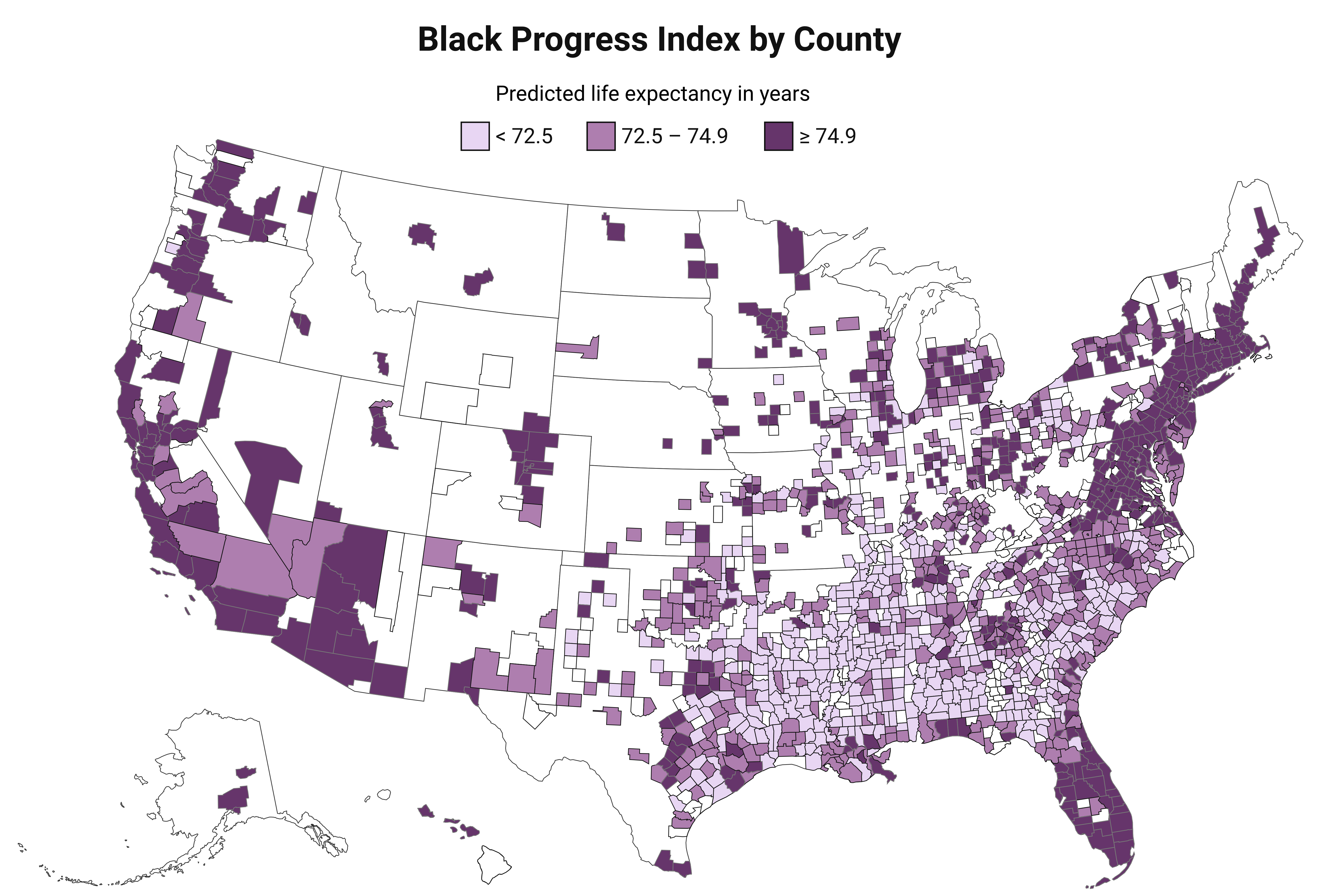
My colleague Jonathan Rothwell and I reported hundreds of places that exceed commonly held expectations in Brookings’s recently released Black Progress Index, an interactive tool and report developed in partnership with the NAACP that provides a means to understand the health and well-being of Black people and the conditions that shape their lives. Instead of comparing Black people to white people, we examine life expectancy differences among the Black population in different places. This method reveals the locales where Black people are thriving.

Courtesy of the Brookings Institution.

Researchers often sloppily compare rates of home ownership, educational attainment, income and mortality without attending to past and present discrimination that intended to create disparities. Consequently, broad national averages void of context policy and local contexts camouflage the very real progress that’s occurring across the country.

Still, in places like Jefferson County, Ohio, the average Black person lives 33 fewer years than Manassas Park, Va. and Weld County, Colo. That gap is roughly equivalent to 100 years of progress in living standards, medical science, and public health.

Black people are not a monolith. They have widely different outcomes in very different places. Local contexts matter as Black people do. Lower life expectancy in counties and metro areas across the country suggests that people are losing battles against racism. But geographic areas where Black people are thriving offer more than hope: People’s civic actions are delivering positive change.

What accounts for such vast differences? Life expectancy, a cumulative measure of health and well-being, summarizes both the biological and non-biological influences on our lives. Because race is a sociological construct and not a biological one, we should assume disparities in life expectancy represent differences in non-biological influences on our lives. Our current life expectancy data suggest that people are breaking down specific social conditions that influence longevity, giving real reason for optimism.

Using a common machine-learning algorithm to select variables and rank their importance, the Index identifies 13 social conditions that predict Black life expectancy. Many are those one might expect, such as income, education, housing, and family composition. Others were more surprising, including the top predictor of high Black life expectancy: larger shares of foreign-born Black residents. One standard deviation above the mean in this variable adds one year to predicted life Black expectancy. For instance, Brooklyn, N.Y. is in the 89th percentile of life expectancy at 78.5. The more than 43% of Black residents of King’s County who are immigrants, places it in the 98th percentile among all counties.

The cause for this interpretation is unclear; it may be a pure composition effect, in that foreign-born Black Americans enjoy better health than the native Black population. Though, this data points to a larger question: Is less exposure to U.S. racism good for your health?

On the other end of the spectrum, a surprising predictor of low Black life expectancy is religious membership. Keeping in mind all the social determinants that showed to be significant in our study are correlational, not causal. Revoking a church membership will not automatically add years to a person’s life. The challenge is understanding why religious adherence is associated with lower life expectancy. Church goers are more likely to be obese and, on the surface, asking “Jesus to take the wheel” may negate any agency we have in influencing our health outcome. We also know that place-based bias that comes out of the wash of housing devaluation hurts the families and institutions, including churches, in those locales. More research is needed to uncover the conditions and behaviors underlying all the variables that strongly influence life expectancy.

The fact that we realize progress and stagnation in Black life expectancy in different places makes clear that people have agency. The gains and losses reflect that. When we take an overly optimistic or pessimistic view of the state of Black America and treat Black people as a monolith, we don’t see localized stories of growth, determination, and thriving.

The diversity of places where Black people are thriving suggests that it has something to do with Black people themselves. In places like Montgomery County, Md., individuals, civil rights groups, organizers, and politicians are dismantling the architecture of inequality that takes away years of life.

That said, we still need to examine and throw away the overly optimistic position on race relations—that the country has moved beyond slavery, Jim Crow racism, and the array of discriminatory policies and their long-term effects. People who hold this perspective contend that America is a level playing field and that with effort, Black people can achieve anything a white person can.

But locales that post life expectancies under 70 perform poorly on environment or institutional indicators like the air and school quality, suggesting that life is harder in some places due to systemically racist forces. In Lowndes County, Ala. where Montgomery is the county seat, Black life expectancy is 68.5. In Greenwood, Miss., it’s 67.3. In Salem, Ore., life expectancy is 64.4.

It’s also worth speculating on seemingly obvious reason why some cities, like Jackson, Miss., don’t post higher rates than 72.6. Jackson has higher homeownership rates than most places (94th percentile) and a higher percentage business ownership (59th percentile). But the recent water crises show how local politics of Mississippi play out in lower investments in the city’s water infrastructure, which plays out in other municipal services that impact life expectancy like education.

“Social reforms move slowly,” wrote W.E.B. Du Bois, suggesting that we must learn from our circumstances in ways that reject intemperance and blame. “[W]hen Right is reinforced by calm but persistent Progress we somehow all feel that in the end it must triumph.”

Society is toiling with the same struggles around racism that Du Bois faced at the turn of the 20th century. Nonetheless, we must take the time to recognize empirical signs of progress and not rush toward unsophisticated, untruthful narratives of hopelessness or blind ignorance that remove or dismiss our agency. A path of progress demands that we have a clear view of the social, political, and economic landscape in which we live. Recognizing progress and defeats will have us see the very real capacity for future change. The assumption—backed with data—that Black people in places with higher life expectancy had a hand in their outcomes should inspire us to seek change in places where discrimination is robbing people of years of life

Source: Life Expectancy Provides Evidence of How Far Black Americans Have Come

US Black Farmworkers Say They Lost Jobs to Foreigners Who Were Paid More

Seems like a clear case of displacement of long-term farmworkers by temporary foreign workers, ironically and disgracefully African Americans replaced by white South Africans:

For more than a quarter-century, Richard Strong worked the fertile farmland of the Mississippi Delta, just as his father and his grandfather did, a family lineage of punishing labor and meager earnings that stretched back to his enslaved ancestors brought from Africa.

He tilled the soil, fertilized crops and irrigated the fields, nurturing an annual bounty of cotton, soybeans and corn for a prominent farming family. “I’ve been around farming all my life,” Mr. Strong said. “It’s all we knew.”

Black families with deep connections to the Delta have historically been the ones to perform fieldwork. That began to change about a decade ago, when the first of dozens of young, white workers flew in from South Africa on special guest worker visas. Mr. Strong and his co-workers trained the men, who by last year were being lured across the globe with wages of more than $11 an hour, compared with the $7.25 an hour that Mr. Strong and other Black local workers were paid.

Growers brought in more South Africans with each passing year, and they are now employed at more than 100 farms across the Delta. Mr. Strong, 50, and several other longtime workers said they were told their services were no longer needed.

“I never did imagine that it would come to the point where they would be hiring foreigners, instead of people like me,” Mr. Strong said.

From the wheat farms in the Midwest to the citrus groves in California’s Central Valley, growers have increasingly turned to foreign workers as aging farmworkers exit the fields and low-skilled workers opt for jobs in construction, hospitality and warehouses, which offer higher pay, year-round work and, sometimes, benefits.

The agricultural guest worker program, known by the shorthand H-2A, was once shunned by farmers here and elsewhere as expensive and bureaucratic. But the continuing farm labor shortages across the country pushed H-2A visas up to 213,394 in the 2020 fiscal year, from 55,384 in 2011.

“Our choice is between importing our food or importing the work force necessary to produce domestically,” said Craig Regelbrugge, a veteran agricultural industry advocate who is an expert on the program. “That’s never been truer than it is today. Virtually all new workers entering into the agriculture work force these days are H-2A workers.”

In the Mississippi Delta, a region of high unemployment and entrenched poverty, the labor mobility that is widening the pool of fieldworkers is having a devastating effect on local workers who are often ill-equipped to compete with the new hires, frequently younger and willing to work longer hours.

The new competition is upending what for many has been a way of life in the rich farmlands of Mississippi. “It’s like being robbed of your heritage,” Mr. Strong said.

In Mississippi, where the legacy of slavery and racism has long pervaded work in the cotton fields, a federal lawsuit filed by Mr. Strong and five other displaced Black farmworkers claims that the new foreign workers were illegally paid at higher rates than local Black workers, who it said had for years been subjected to racial slurs and other demeaning treatment from a white supervisor.

Two additional plaintiffs are preparing to join the suit, which says farmers violated civil rights law by hiring only white workers from South Africa, a country with its own history of racial injustice.

“Black workers have been doing this work for generations,” said Ty Pinkins, a lawyer at the Mississippi Center for Justice, which is representing the Black farmworkers in the lawsuit. “They know the land, they know the seasons, they know the equipment.”

A vast flood plain, the Mississippi Delta boasts some of the country’s richest soil. It also is the poorest pocket of the poorest state. In Indianola, a town of almost 10,000 about 95 miles north of Jackson, the median household income is $28,941.

The hometown of the blues legend B.B. King, Indianola is the seat of Sunflower County, where empty storefronts line forlorn downtowns and children play outside crumbling shacks.

The region, which is more than 70 percent Black, remains rigidly segregated. Black children attend underfunded public schools while white students go to private academies. Black and white families bury their dead in different cemeteries.

The Delta is only one of a number of places where South Africans have been hired for agricultural work in recent years. While Mexicans accounted for the largest share of last year’s H-2A visas, or 197,908 of them, the second-largest number, 5,508, went to South Africans. Their numbers soared 441 percent between 2011 and 2020.

Garold Dungy, who until two years ago ran an agency that recruited foreign farmworkers, including for Pitt Farms, the operation that employed Mr. Strong and the other plaintiffs, said South Africans represented the bulk of his business. They are “the preferred group,” he said, because of their strong work ethic and fluency in English.

Under the program, growers can hire foreign workers for up to 10 months. They must pay them an hourly wage that is set by the Labor Department and varies from state to state, as well as their transportation and housing.

Farmers must also show that they have tried, and failed, to find Americans to perform the work and they must pay domestic workers the same rate they are paying the imported laborers.

According to the Black workers’ lawsuit, Pitt Farms paid the South Africans $9.87 an hour in 2014, a rate that reached $11.83 in 2020. The plaintiffs who worked in the fields were paid the federal minimum wage of $7.25 an hour or $8.25 on weekends, plus occasional bonuses.

Both Walter Pitts, a co-owner of Pitts Farms, and the farm’s lawyer, Timothy Threadgill, declined to discuss the farm’s hiring strategy because of the pending litigation.

The reliance on South Africans may reflect the nature of agriculture and the demographics in the Mississippi Delta, compared with places like California.

“In the Mississippi Delta, row-crop production requires fewer workers but workers who have skills to use machinery and equipment,” said Elizabeth Canales, an agricultural extension economist at Mississippi State University. “We hardly have any Latinos in this remote region. Naturally, it’s easier to hire South Africans where language will not be a barrier, especially because in this area, you have a very small Spanish-speaking population.”

The South Africans arrived in the region willing to work weeks that sometimes stretched to 75 hours or more, grueling schedules that might have been difficult for older local workers to maintain, industry analysts said.

There was initially no public controversy over the program in Indianola. Growers in the region described the South Africans as “good workers,” said Steve Rosenthal, a three-term mayor of Indianola who lost his bid for re-election in October. Until the lawsuit was filed, he did not realize that some Black workers had been let go.

“If you have a man that you’ve trained and worked with for years and he knows how to get stuff done,” he said, “how in good conscience can you bring somebody over and pay him more than a man that’s been with you five, eight, 10 years?”

The Strong family has worked for generations for the Pitts family, which has farmed in the Mississippi Delta for six decades. Richard Strong’s grandfather Henry and grandmother Isadora worked their land. So did his father and his uncle.

Mr. Strong and his brother got hired in the 1990s; he eventually operated not only tractors, but big equipment like combines and cotton pickers. He mixed chemicals to control weeds and pests. He ran irrigation pivots in 19 fields, covering some 3,000 acres. He rose to manager, driving across the farm to verify that everything was in working order.

When he first heard that Africans were coming to work on the farm, about eight years ago, “I didn’t question it. I just went along doing my job,” he said.

But when four white men showed up, they were not the Africans he had expected. Even so, Mr. Strong said, the men, a good 20 years younger than him, were “cool guys.”

He taught the men how to properly plow, how to input GPS settings into the tractors’ navigation systems, how to operate the irrigation system so just the right amount of water was sprinkled on the crops.

Over the next few years, more South Africans came, until more than half the farm’s work force was there on foreign visas.

One of them was Innes Singleton, now 28, who learned about the opportunity to work in Mississippi from a friend in 2012.

He had recently finished secondary school and did not know what to do next.

He arrived in Indianola in early 2013, and is now earning $12 an hour, making in one week what would take a month for him to earn in South Africa, where the unemployment rate now exceeds 30 percent.

“I learned a lot here,” he said, adding that he sometimes had to work up to 110 hours a week. South Africans now do the main work on the farm, he said, and four locals “help us out.”

After the 2019 season, Mr. Strong traveled to Texas to visit his ailing father-in-law. When he returned, the Pitts Farm truck that he drove had disappeared from outside the house he had rented from the grower for about a year. He was told to vacate and was not offered work for the 2020 season.

A year later, others were let go, including his brother, Gregory, who said he had devoted much of his life to Pitt Farms.

“I gave them half my life and ended up with nothing,” he said. “I know everything on that place. I even know the dirt.”

Andrew Johnson, another plaintiff in the lawsuit, is 66 and said he had worked 20 years at the farm.

“I used to work rain or shine or anything,” he said.

But before the 2021 season began, he said, one of the Pitts owners told him “he didn’t need me no more.”

Since the lawsuit was filed, other Black workers have come forward, saying they had labored in the fields and catfish farms of the Delta before unfairly losing their jobs, Mr. Pinkins, the lawyer, said.

In late October, as the harvesting season came to a close, eighteen-wheelers in Indianola rumbled down the highway, loaded with bales of cotton. Driving alongside the farm where he spent 24 years, Mr. Strong scanned the rows of neatly carved earth as far as the eye could see. “I put in all that,” he said, with a certain pride.

Then a tractor passed by, a young South African man at the wheel, and Mr. Strong looked away. “I miss working the land,” he said.

Source: https://www.nytimes.com/2021/11/12/us/black-farmworkers-mississippi-lawsuit.html

USA: The crisis in black university enrolment and graduation

Of note. Curious to know if there is disaggregated data for Canadian university admissions and enrolment to see whether different minority groups have been affected differently post-COVID:

Like so much else related to the COVID pandemic, the disruptions caused to important high school events such as university open houses and access to guidance counsellors has hit African American students thinking of going to college or university especially hard. 

The school shutdowns meant that these students, often the first in their families to even consider going on to higher education, had to fill out unfamiliar forms on kitchen tables. Sometimes, as was the case for those applying to Old Dominion University (ODU) in Virginia, they had the aid of online tutorials or Zoom sessions. Then there was the financial aid process and its complicated forms.

“These students don’t know what they don’t know,” says Dr Don Stansberry, vice president for student engagement and enrollment services at ODU. “This is true for many students, but it is disproportionately true for our black and African American students. 

“I think this is indicative across most college campuses, you see [this year] a drop off in the number of black and African American applicants and their numbers in this year’s intake because they didn’t follow through with the rest of the process, such as financial aid.”

Overall, there were 603,000 fewer students enrolled in colleges and universities in the spring of 2021 as compared with 2020, a decline of 3.5%. Figures released by the Virginia-based National Student Clearinghouse Research Center in early October showed that since the start of the pandemic the numbers of black freshmen have declined by 22.3%, while the overall drop was 12.3%.

Historic under-representation

Even before the COVID-caused decline in blacks going on to higher education grabbed headlines, they were faring poorly in relation to college and university. 

Prior to COVID, 55% of college and university students were white, while blacks made up 9.6% of the students in higher education, almost 4% less than their numbers in the general population. 

In the decade after 2011, the percentage of blacks in the student population declined by almost 11%, reversing a trend that had begun in 1976, which saw the percentage of black students in college and university rise by just under 40%. Over the six years ending in 2017, 55% of blacks dropped out of college as against 33% of whites.

At public colleges and universities, the figures are even more dire. According to a paper prepared by Olivia Sanchez and Meredith Kolodner for the New York-based Hechinger Report, released in early October, at public colleges and universities, a white student is 2.5 times more likely to graduate than a black peer.

Taking account of both public and private colleges and universities, according to figures from the National Center for Education Statistics, in the last cohort to graduate before COVID, 61.3% of white males graduated as compared with almost 35% of black males; the figures for women were 67.3% to 44.8%.

There are a number of reasons for this gap. One of the most often cited is college readiness. A disproportionate number of black students attend under-resourced and poorly equipped high schools that leave them underprepared in reading, writing and maths. 

In 2016, the Center for American Progress (CAP) in Washington DC, reported that more than half (56%) of blacks are placed in remediation classes in contrast to 35% of whites. Citing a number of different studies, CAP says fewer than 10% of students in remedial programmes graduate in the six-year window that is used to define successful completion of four-year degrees.

It is certain that few students placed in remedial courses know of the 2009 study by the Community College Research Center at Teachers College, Columbia University, “Referral, enrolment, and completion in developmental education sequences in community colleges”, that shows that students who were placed directly into regular college courses stood a better chance of graduating than did those placed in remedial courses. 

Yet, they don’t have to. For, as any professor who has ever taught students who have been in remedial courses, being in them has a negative impact on a student’s academic self-perception.

When I asked Dr Wil Del Pilar, the Education Trust’s vice-president of higher education, about how these courses impacted black students in particular, he said: “You took this course in high school. Now all of a sudden you take a math or English placement test, and it places you, say, three levels below the courses you are getting college credit for. This has a significant impact on academic self-perception and self-efficacy.” 

Since taking remedial instead of credit-bearing courses takes extra time and delays a student’s graduation – in addition to making the student ask the self-defeating question, “Am I ever going to complete this credential or degree?” – it creates a financial crisis that is disproportionately experienced by black students, Del Pilar says.

The financial crisis arises from the fact that, while remedial classes do not count as credit hours (course time toward graduation), there is no reduction in tuition fees. 

In other words, a student who is taking three hours of remedial English and three of maths pays the same tuition fees as a student who is taking a full 16-hour load even though the student in remedial courses is taking only 10 credit hours. 

To accumulate the 120-130 credits that most colleges and universities require for graduation, students who take remedial courses either have to take courses during the summer to make up for the missing credits or have to stay in school an extra semester or more. 

In either case, the student has to pay extra tuition fees (and often room and board costs). As well, the student who goes to summer school or stays for extra semesters forfeits a certain amount of income. These extra semesters are one of the reasons blacks graduate on average with US$25,000 more debt than white students.

According to Del Pilar, neither Pell Grants (a federal grant given to the most financially disadvantaged students) nor most other financial aid programmes are geared to students who spend extra semesters in college or university.

“You end up using your eligibility on these courses that don’t earn you credits toward your degree. So, when you get towards the end of your course, your credential or degree, you run out of eligibility for Pell Grants or other types of aid.”

Though it is not directly related to these students’ college or university career, Del Pilar emphasised to me, it is important to understand that America’s racial wealth gap means that more black students live on a financial knife edge than do white students. A US$800 car repair bill, for example, could be too much, causing a student to drop out of school and lose eligibility for aid.

Alienation on campus

As do many Latinx and other minority students, African American students can find being on campus an alienating experience that differs from what their white peers feel. 

While formal segregation is outlawed, de facto segregation exists in many parts of the country; instead of there being separate schools for blacks and whites, housing patterns separate the races and, thus, most district schools, for example. 

Accordingly, a large proportion of blacks attend majority black schools. Save for the historically black colleges and universities (HBCUs) like Howard University in Washington DC and inner-city public universities in places like Newark, New Jersey, New York City and Chicago, most African Americans who go to college find themselves a member of a minority community on campus and, thus, find themselves in a more alienating environment than white freshmen do.  

At the University of San Francisco, for example, 349 of the school’s full-time enrolment of 1,738 is black. 

Even though he chose ODU because he wanted to go to a school that was not majority black, as was his high school in Highland Springs, a small town (population 16,500) that is 73% black, Montae Taylor, who graduated in 2018, told University World News that despite being friends with a number of international students, he still found the school alienating.

In part this was because Taylor and many of his black classmates were the first persons in their families to go to college. The pride they felt was in tension with the fact that their families did not understand how much work is required to succeed in university. Students who are the first in their family to go to a higher education institution commonly report that their families tell them, “If you’re in class only 16 hours a week, then you can get a job and work a full week.” 

“Nobody in our families had been this far in education before. They really don’t understand the work requirement that we’re under or anything of that nature. So, it’s hard to find somebody [in our families] that can really push you and motivate you to excel academically,” says Taylor.

In part, Taylor also felt alienated in class, a condition he told me was shared by his black peers. 

Unlike his white classmates, Taylor and the others in his pre-law courses had trouble negotiating and understanding the texts they were given to read in class. He watched as his white classmates “could just sit there and read a passage one time and right then and there they understood exactly what it meant, exactly what the person was getting at”.

As Taylor spoke, I couldn’t help thinking back on my 30 years of teaching English at college and university, and being impressed with his and the other students’ self-analysis. 

On their own, Taylor and his black classmates realised that to bridge the gap of understanding, they had to engage the texts differently. They had to take account of (what phenomenological psychologists call) their “horizon of expectations”, formed by the totality of their lived experience as young black men in America. 

Then, rather than try to bracket that experience, as if it did not exist, they judge the distance between it and what they had been told in class and knew of the white authors, before engaging in an iterative process that brought them to an understanding of the texts.

“We had to read it, talk about it to each other and have a little debate about it for us to come to a full and complete understanding because we might be looking at it from our point of view, which is a black man’s point of view,” says Taylor, who is now a businessman in Texas and Virginia, and was state president of Virginia’s Youth and College Division of the National Association for the Advancement of Colored People (NAACP).

In 2018, Taylor was one of the key student organisers in establishing a chapter of Brother to Brother at ODU. It differs from other clubs and honour societies on campus that helped students attach to the university. 

“In this programme,” says Stansberry, “black and brown upperclassmen come together to support other black and brown males in their academic journey. They partner with our first-year students and help them navigate the college campus and their own journey.”

In addition to providing ODU’s black students with a place to gather and talk with people who look like them (something which became all the more important, Taylor said, after the election of Donald Trump as US president), Brother to Brother serves two other very important functions. 

According to Dr Johnny W Young, the associate vice president for student engagement and enrollment services at ODU, Brother to Brother provides a place where ODU’s black students can support each other and counteract the negative stereotypes about black men. 

One stereotype that is especially damaging for university students, Young says, is that back where the students come from, excelling academically is not necessarily a point of pride: “It’s sometimes seen, for lack of a better word, as ‘nerdy’.” Equally pernicious is the stereotype that black men are prone to violence and that where they live is violent.

Even if a student does not have direct experience with these stereotypes, they know the stereotypes from the media and, sometimes, from family stories. “Having those young men talk about things they face, that their fathers faced, that their brothers faced growing up as young men of colour,” says Young, “helps them deal with the stereotypes and reject those untrue narratives. Sharing stories can be a source of inspiration for these young men.”

Brother to Brother also serves as the base from which students form study groups. Further, the organisation acts as something of a coach. 

During the summer when Taylor was vice president of ODU chapter, they heard that a large number of black students had not completed the paperwork to return in September. Members of Brother to Brother called these students and asked if they needed help organising themselves for the upcoming school year. 

Taylor found that of the calls he made, around 85% of the students who originally said they were not coming back had changed their minds. 

“Sometimes it was as simple as helping them find the proper resources they needed that would make them feel supported in finishing the process of education,” he said.

In the last year before COVID, there were 194 students in the Brother to Brother programme; approximately one-third of ODU’s enrolment of 23,655 is black. 

According to Dr Young, the students in the Brother to Brother programme had on average a grade point average 1.5% higher than did similar students not engaged with the programme. 

Though ODU’s data does not support making predictive claims and recognising that the group is self-selected, Young was willing to hazard a few statements. 

“We think there are a couple of things going on. First, the Brothers appear to attract young men who want to be leaders, who want to excel. But we also see that some men join who perhaps needed that extra push. Being around young men who want to excel can make you want to do very well. That can rub off on them, for lack of a better word.”

To help all black students celebrate their identity and attach to the university, ODU sponsors an annual Sankofa Dinner. Sankofa comes from Akan Twi and Fante languages of Ghana and means ‘retrieve’ and is symbolised by a bird with its head turned backward; its feet face forward, and it carries a precious egg in its mouth. 

This year’s Sankofa event featured a seven-person panel of graduates among whom was Lieutenant Colonel Alexander Ernest, MD, who graduated in 1999. He was the first African American male to graduate from Eastern Virginia Medical School and is presently chief of urology and director of surgical simulation at the Brooke Army Medical Center in San Antonio, Texas. 

Another panellist was Sade Seaborne, a 2010 graduate who has worked as a technical project lead for the Department of Justice and is now a product manager for the finance company Capital One.

“The attendees,” says Stansberry, “were all African American students but it was an event that was designed to be a chance for them to celebrate their own identity.” 

Other events, like homecoming, fulfil what Stansberry told me was the number one reason that students choose to come to ODU. “One of the things they are most proud of is the diversity we have on campus and the opportunities they have to interact with students that are different from themselves.”

Old Dominion University’s efforts to help black students attach to and thrive at the campus in a city, Norfolk – which is home to the largest naval base in the world and which, at the start of the Civil War, was in Confederate hands – have been successful. 

Whereas on average in public universities white students graduate at a rate 2.5 times that of black students, ODU, which is a public university, has bucked the trend: the graduation rate for African American students who started in 2015 is almost the same as the overall graduation rate. 

Forty-four percent of African American men graduated as against 45% of the school’s overall male population, while the percentage of African American women graduating was 1% less than the overall female rate of 52%.
Source: https://www.universityworldnews.com/post-nl.php?story=20211105110142162

The Black Mortality Gap, and a Document Written in 1910

Important history:

Black Americans die at higher rates than white Americans at nearly every age.

In 2019, the most recent year with available mortality data, there were about 62,000 such earlier deaths — or one out of every five African American deaths.

The age group most affected by the inequality was infants. Black babies were more than twice as likely as white babies to die before their first birthday.

The overall mortality disparity has existed for centuries. Racism drives some of the key social determinants of health, like lower levels of income and generational wealth; less access to healthy food, water and public spaces; environmental damage; overpolicing and disproportionate incarceration; and the stresses of prolonged discrimination.

But the health care system also plays a part in this disparity.

Research shows Black Americans receive less and lower-quality care for conditions like cancer, heart problems, pneumonia, pain management, prenatal and maternal health, and overall preventive health. During the pandemic, this racial longevity gap seemed to grow again after narrowing in recent years.

Some clues to why health care is failing African Americans can be found in a document written over 100 years ago: the Flexner Report.

In the early 1900s, the U.S. medical field was in disarray. Churning students through short academic terms with inadequate clinical facilities, medical schools were flooding the field with unqualified doctors — and pocketing the tuition fees. Dangerous quacks and con artists flourished.

Physicians led by the American Medical Association (A.M.A.) were pushing for reform. Abraham Flexner, an educator, was chosen to perform a nationwide survey of the state of medical schools.

He did not like what he saw.

Published in 1910, the Flexner Report blasted the unregulated state of medical education, urging professional standards to produce a force of “fewer and better doctors.”

Flexner recommended raising students’ pre-medical entry requirements and academic terms. Medical schools should partner with hospitals, invest more in faculty and facilities, and adopt Northern city training models. States should bolster regulation. Specialties should expand. Medicine should be based on science.

Source: The Black Mortality Gap, and a Document Written in 1910