African Migration to the U.S. Soars as Europe Cracks Down – The New York Times

Have seen some other similar commentary from Black Americans as well as tension between Black immigrants and African Americans:

The young men from Guinea had decided it was time to leave their impoverished homeland in West Africa. But instead of seeking a new life in Europe, where so many African migrants have settled, they set out for what has become a far safer bet of late: the United States.

“Getting into the United States is certain compared to European countries, and so I came,” said Sekuba Keita, 30, who was at a migrant center in San Diego on a recent afternoon after an odyssey that took him by plane to Turkey, Colombia, El Salvador and Nicaragua, then by land to the Mexico-U.S. border.

Mr. Keita, who spoke in French, was at a cellphone charging station at the center among dozens more Africans, from Angola, Mauritania, Senegal and elsewhere, who had made the same calculus.

While migrants from African nations still represent a small share of the people crossing the southern border, their numbers have been surging, as smuggling networks in the Americas open new markets and capitalize on intensifying anti-immigrant sentiment in some corners of Europe.

Historically, the number of migrants from Africa’s 54 countries has been so low that U.S. authorities classified them as “other,” a category that has grown exponentially, driven recently, officials say, by fast-rising numbers from the continent.

According to government data obtained by The Times, the number of Africans apprehended at the southern border jumped to 58,462 in the fiscal year 2023 from 13,406 in 2022. The top African countries in 2023 were Mauritania, at 15,263; Senegal, at 13,526; and Angola and Guinea, which each had more than 4,000.

Nonprofits that work on the border said that the trend has continued, with the absolute number and share of migrants from Africa climbing in recent months as potential destinations in Europe narrow.

“You have countries that are less and less welcoming,” said Camille Le Coz, a senior policy analyst at Migration Policy Institute Europe. “When new routes open up, people are going to migrate because economic opportunities at home are insufficient.”

The African migrants continue through Honduras, Guatemala and Mexico until they arrive at the southern U.S. border. Between January and September, nearly 28,000 Africans passed through Honduras, a sixfold increase over the corresponding period in 2022, according to the Honduran government. Guinea, Senegal and Mauritania are among the top 10 countries of those migrants; only a couple dozen people from each of those countries traveled through Honduras in 2020….

Source: African Migration to the U.S. Soars as Europe Cracks Down – The New York Times

54% of African student visa applications denied by the US

Comparable differences to Canada and likely most OECD countries. Advocacy and interest based report:

African students who apply to study at universities and colleges in the United States experience the highest visa refusal rates of all international students applying to study in the US with more than half of all applicants rejected in 2022.

The refusal rate of 54% of student visas in 2022 is up from 44% in 2015, according to a report titled The Interview of a Lifetime: An analysis of visa denials and international student flows to the US, from the Presidents’ Alliance on Higher Education and Immigration, and Shorelight, two US advocacy groups that promote policies in support of immigrant students.

While the refusal rate for African students applying for visas is higher than for students belonging to other geographical categories of visa applicants, it is roughly in line with an across-the-board rise in refusal rates, which suggests that the United States is becoming a less welcoming place to foreign students.

By 2030, just seven years from now, young Africans are expected to constitute 42% of the world’s youth population, and by 2050 are expected to number 1.1 billion.

The trends outlined in The Interview of a Lifetime suggest that the United States is poised to lose out in the competition for students – just at the time that the American colleges and universities will be in the grips of what demographers call the ‘demographic cliff’, the drop each year of some 500,000 students from the cohort born following the 2008 financial crisis – note the report’s authors, Dr Rajika Bhandari and Jill Welch, both senior advisers to the Presidents’ Alliance on Higher Education and Immigration, and Shorelight’s leading managers, Shelley Landry, a senior director of government affairs, and Hilary O’Haire, the executive director of analytics.

Rejection rate on the rise

According to the report, since 2018, the total number of students from Africa enrolled in American colleges and universities has grown from 47,251 to 49,308. Over that same period, however, the rejection rate has grown six percentage points, from 48% to 54%. As a result some 92,051 potentially qualified African students were denied a visa. The authors of The Interview of a Lifetime describe them as 92,051 ‘Missed Opportunity Students’.

In technical terms, these prospective African students failed to qualify for the F-1 Visa. The F-1 Visa category allows foreign students to enter and study full-time in institutions that are certified by the US government and is mandatory for immigrant international students.

Negative public narrative towards immigrants

The report contains evidence that American immigration officials are becoming more apt to refuse student visas overall. Between 2021 and 2022, for example, the refusal rate for South Americans rose from 20% to 30%, while the rise in numbers of Australians and Pacific islanders being denied study visas rose even more starkly: from 8% to about 25%. Rejection rates from Europe and North America (which includes Mexico) have also risen but by only a few percentage points.

Although the report has not identified the specific African countries of origin whose students were heavily affected by the visa denials, the researchers found that since 2018 refusal rates have consistently been higher for Western and Central Africa than for Eastern and Southern Africa.

In 2021, for example, the refusal rate for Western and Central Africa was 57% and 64%, respectively, while for Eastern and Southern Africa the rates were 43% and 10%. Last year, the rates for Western and Central Africa were 71% and 61%; for Eastern and Southern Africa the rates were 48% and 16%, respectively.

“But when Southern Africa is removed from the equation, the visa denial rate jumps to 57%, suggesting that most of the denials were concentrated in other parts of Africa,” noted the report.

At least in terms of approving foreign student visas from Africa, as University World News reported last June, the situation in Canada is much the same. Refugees and Citizenship Canada rejected 59% of the visa applications from English-speaking Africans and 74% from French-speaking Africans seeking to study in Canada’s colleges and universities.

But the question remains as to the reasons behind African students being denied opportunities to study in the US universities compared to their peers from the rest of the world. The report, however, suggested that it might be a reflection of emerging US national policies that are fuelled by a negative public narrative toward immigrants.

While President Joe Biden’s administration is significantly more open to immigration than was that of former US president Donald J Trump, the tenor of the American debate over immigration has not moved much from when Trump described Haiti, El Salvador and African states as “shithole countries”.

Yesterday, for example, the Republican controlled House of Representatives passed the Visa Overstay Enforcement Act of 2023 which imposes new penalties, including fines and/or prison terms of six months on individuals who overstay their visas.

Last June, 31 Republican lawmakers in Washington backed a group of workers in the high-tech industry who are suing the Federal government over changes the administration made to the F-1 visa program that would allow foreign students to remain in the country and work for up to three years after they graduate.

The problem with interviews

Emmanuel Smadja, the chief executive officer and co-founder of MPOWER Financing, a Washington DC-based company that provides educational loans to international students, says the visa denial problem may be systemic.

First-hand accounts from African students suggest that they face challenges securing visa interviews and according to the report, some are having to jump through hoops just to travel to other countries at considerable expense. Outside South Africa, most US visa interviews for students in Sub-Saharan Africa are mainly held in Accra, Lagos and Nairobi.

In their analysis, the authors of the report faulted some of the grounds that are used by the US consular officials to deny African student visas.

The report cited lapses such as students being ill-prepared for the visa interview or failure to demonstrate a strong connection with the US. A few tense minutes of a visa interview should not be used to determine their academic future, as too often African students encounter challenges securing visa interview slots.

Doubts about funding

Drawing insights from MPOWER, Bhandari’s team noted that many African students, mostly from Sub-Saharan Africa, were denied visas even when they are qualified and have funding.

The report highlights the issue of 3,000 students from Sub-Saharan Africa that were accepted for graduate studies at a top US university last year but only 60% were granted visas despite being admitted and having secured the necessary funding.

Further, there are indicators that African students were denied visas for not demonstrating that they had sufficient funds to support their studies in the US. Concerns had also been raised about fraud but the Presidents’ Alliance, a coalition of 450 US university leaders, had been quoted pointing out that in most cases, African students are the victims, but not the perpetrators of the fraud.

In an interview with The PIE News, Farook Lalji of Kenya-based Koala Education Consultants said that “applying for a university abroad means paying visa fees, a deposit to the university, paying for a medical and other related costs” and that the “fear of being denied a visa after all that is a factor in people falling for fake schemes that come with an alleged guarantee of getting a visa”.

He advised students to make sure they were dealing with licensed agents. “If you must deal with a briefcase or suspicious agent, then do not pay until the job is done, just like it happens with other things in life. In this case do not pay until you have obtained all the information about the university and have obtained all necessary documents,” he warned prospective students.

On the issue of visa denial for lack of adequate funds, Bhandari and associates noted that discussion forums of groups that serve African international students are rife with worries about students who have met every admissions and financial requirement and are seemingly well-prepared for the high-stakes visa interviews but are nonetheless denied visas.

Presidents and vice-chancellors concerned

American university presidents and vice-chancellors are concerned by the high rates of visa denials and share perceptions that it is harder for students in certain countries to acquire a visa than in other countries.

“Some higher education officials reported that students from some African nations, for example, are more likely to receive a student visa when applying in a non-African country, such as Australia, to study in the US,” stated the report.

Is a shift in policy possible?

Unfortunately, whereas visa data and enrolment datasets point to current demands for a US education by students from African countries, the report says there are no indicators as to whether the US visa policy will shift in favour of such students in the near future.

Aware of Africa’s emerging demographic trends, some countries such as France and China, are aggressively recruiting African students, while the interest shown by US university presidents and vice-chancellors are being frustrated by visa denials.

In that context, Bhandari and associates raised the issue as to whether the US is missing out on top academic talent from Africa.

Quoting Rebecca Winthrop, the director of the Center for University Education at the Brookings Institution, the Washington-based think tank that conducts research analysis on education and public policy issues, the study team noted that the growth in the world’s labour market will in the years ahead be in Africa.

“As other parts of the world begin to age, Africa will grow its population and today’s children will be the talent tomorrow’s global companies will be recruiting,” stated the report.

In its vision of more recruitment of African students into US universities and colleges, the Presidents’ Alliance and Shorelight are urging the US authorities to issue new guidelines that would reduce visa denials for African students.

For instance, they are recommending that competency in English should not be a reason for refusing a visa to a foreign student who wants to attend for instance a low-level institution, or a community college in the US.

“Consular officers should leave questions of academic choice and qualifications to be decided between the student and the institution, instead focusing on evaluating whether the student meets entry requirements,” stated the report.

The argument is that denial of a visa should not occur based on English-language competency, as it is the purview of the universities and colleges to evaluate language proficiency and to provide English-language training programmes if necessary.

The report criticised visa denials based on the inability to provide proof of multiple years of funding, given that in the US many students and their families pay for their education as they go on with their studies.

“Proof of funding for the entire duration of the academic programme is not reasonable and should not be a requirement for a visa,” stated the report.

Consular officers should ‘stop speculating’

Further, the report recommends that post-graduation work interests should also not be grounds for visa denial. The issue is that, despite the updated US foreign affairs manual that makes it clear that consular officers should stop speculating about international students’ intentions in the future but instead evaluate their intent at the moment of the interview, many African students continue to be denied a visa because of that outdated clause.

The report says clear guidelines should be issued on how to evaluate international student visa applications for forcibly displaced students from their countries’ of origin, not only in the case of the African students, or their counterparts from the Global South, but throughout the world.

Amid efforts to get rid of perceptions of discrimination, the Presidents’ Alliance and Shorelight are urging the US government to provide transparent and clear information to students about visa denials.

“The issue is that when prospective students are denied visas, they are often left to guess what aspects of their application may have led to the denial,” stated the report.

The two bodies have also urged the US Congress to modernise immigration law and, more specifically, to expand the criteria on how to reduce visa denials, taking into account that the US domestic demographic trends and workforce shifts point to the need for an inclusive approach to attract diverse global talent.

But despite such robust appeals, it is not clear as to whether the negative public narrative toward immigrants is about to change in favour of students from Africa.

Source: 54% of African student visa applications denied by the US

Is racism behind denial of visas to African students?

Largely reflects the interests of education institutions and their financial pressures as much as concerns over differential treatment (given that immigration is inherently “discriminatory,” the question is more are their legitimate reasons and evidence to justify that discrimination):

In the five years between 2018 and 30 April 2023, officials at Immigration, Refugees and Citizenship Canada reportedly rejected 59% of the visa applications from English-speaking Africans and 74% from French-speaking Africans seeking to study in Canada’s colleges and universities.

In 2022, the disapproval rates were 66% for applicants from French-speaking African countries and 62% for applicants from English-speaking African countries.

Besides the higher rejection rate for francophone African students, the stats show a massively higher rejection rate for African students compared to students from Western countries. Refusal rates for Great Britain, Australia and the United States were 13%, 13% and 11%, respectively, while for France the refusal rate was 6.7%.

‘A certain rate of racism exists’

Referring to hearings held in 2022 by the House of Commons Standing Committee on Citizenship and Immigration (SCCI) during which Immigration, Refugees and Citizenship Canada (IRCC) admitted there was a problem, Etienne Carbonneau, director of research and support for internationalisation at Université du Québec in Québec City, said: “Let’s put it bluntly, we think there is a certain rate of racism that exists [in IRCC].

“By this I mean negative prejudices against, particularly, French-speaking African populations. When you look at IRCC’s responses, basically, the immigration officers who process the permit application files seem to be saying that they don’t believe the students.”

Both Carbonneau and Daye Diallo, senior economist at the Montreal-based Institut du Québec, underscored that while the high refusal rate of English-speaking Africans can also be attributed to racism at the IRCC, the impact on English universities such as McGill University in Montreal, or those in Ontario or elsewhere in the country, is not as severe.

“In Ontario, it [the rejection rate] is more than 50%. Serious too, but it is higher in Quebec. And because Quebec speaks French, the recruitment pools are more limited. In Ontario there are many students who come from Asia and English-speaking countries,” says Diallo, co-author, with Emna Braham, the institute’s executive director, of the study, “Portrait de l’immigration temporaire: attraction et rétention des étudiants étrangers au Québec”.

“We cannot go to India or China because Indians and Chinese are looking for training in English,” Carbonneau explained. “If I were at McGill University or University of British Columbia, and I saw that it was getting difficult on the Indian side [ie, recruiting from India], I would look to other markets. I don’t have that opportunity [recruiting for a French university].

“The potential for growth is really in French-speaking Africa, but this potential is cut off by the practices of Immigration, Refugees and Citizenship Canada. Presently, some 50% of French speakers worldwide live in African countries; by 2050, the continent will account for 50% of the world’s population growth.”

SCCI report evidence

The report of the Standing Committee on Citizenship and Immigration (SCCI), published in May 2022, titled Differential Treatment in Recruitment and Acceptance Rates of Foreign Students in Quebec and in the Rest of Canada, found evidence of racism both in the internal workings of the department and among IRCC’s visa officers vis-à-vis African applicants for study visas.

This evidence was contained in a report of a survey of IRCC conducted by the polling firm Pollara Strategic Insights following the international protests against the murder of George Floyd by members of the Minneapolis (Minnesota) police department in March of 2020, which sparked the Black Lives Matter protests.

Racialised respondents to the IRCC survey told Pollara that they “considered racism to be a problem in the department”, which, in its response to the report, IRCC acknowledged.

Pollara was told that some immigration officials referred to certain African countries as “the dirty 30”. Nigerians, the investigators were told, were considered “particularly untrustworthy”.

According to the SCCI, IRCC “acknowledged that due to the nature of its mandate to promote a strong and diverse Canada, it must hold itself to the highest possible standards so that the programmes, policies and client services are free from any racial bias”.

IRCC policy

IRCC reiterated this policy in an email that said, in part: “The Government of Canada is committed to the fair and non-discriminatory application of immigration procedures. We continually evaluate data and make concerted efforts to address the results and the differential strategies in order to improve our approaches so that we can overcome these issues.”

The email further explained: “The strategic review of the immigration policies and programmes will enable us to identify and address the issues relating to rejections and the International Student Program will be informed by this exercise.”

Among the steps IRCC has taken is the creation of a task force dedicated to the “elimination of racism in all its forms at IRCC”. This requires IRCC staff, including middle and senior managers, “to take mandatory unconscious bias training which is tracked”, and evaluate “potential bias entry points in policy and programme delivery [ie, deciding on visa applications]”.

As of May 2022, IRCC had “nearly two dozen projects under development to reduce and eliminate racial barriers – with a large focus on … African clients, due to the fact that this region historically faces longer processing times and lower approval rates”.

Nigerian students deemed ‘particularly untrustworthy’

While some IRCC staff considered Nigerians to be ‘particularly untrustworthy’, critics, including the University of Calgary’s Assistant Professor of Artificial Intelligence and Law Gideon Christian, who is also president of African Scholars Initiative, told the House of Commons committee that the 2019 pilot project, Nigerian Student Express (NSE), discriminated against Nigerians.

Pointing to documents he had obtained via an Access to Information and Privacy request, Christian showed that irrespective of whether the NSE improved processing times for Nigerian students by giving them the option to use a secure financial verification system, it discriminated against these students.

The NSE required Nigerians to provide different and more onerous financial data than did students from other countries that were part of the Student Direct Stream (SDS), Christian said.

Unlike students in the other 15 countries included in the SDS, such as China, Vietnam, Senegal, Brazil and Colombia, Nigerians seeking to study in Canada had to produce a bank statement showing that they had the equivalent of CA$30,000 (US$22,600) in their account for at least six months in the last year.

While testifying before the committee, Sean Fraser, minister of immigration, refugees and citizenship of Canada, defended the CA$30,000 figure, saying that it was fair because it did not include living expenses.

“The issue is that we don’t necessarily have financial partners on the ground in Nigeria, so having proof of funds of CA$30,000 is more equitable when you look across the requirements in other countries, where you have not only [the requirement to show] CA$10,000, but also the proof of funds to cover the cost of an international student tuition.”

In his testimony, Christian dismissed Fraser’s claim, noting that a “Nigerian is required to show proof of funds that are three times more than those of other SDS countries, and yet, when this applicant overcomes this high burden of proof, most of the study visa applications from Nigeria are still refused”.

Christian also told the SCCI that since all colleges and universities exempted Nigerians from English-language proficiency tests, “the language proficiency requirement imposed by the visa offices … exudes stereotypes and racism”.

SCCI Recommendation 4

The SCCI’s Recommendation 4 called for IRCC to reconsider the financial reporting requirements imposed on Nigerians and for IRCC to “remove the English-language proficiency required for Nigerian students”.

As with Canada’s English universities, French universities in Quebec recruit international students for a number of reasons. Carbonneau began by noting the importance of universities internationalising their student bodies.

“The career of a researcher who is from Quebec will involve collaborations with people who have been trained abroad and who have worked abroad. The integration of international students into our university programmes means that our Quebec students will have contact with people from other countries. They will be made aware of international issues and the issues of intercultural work and the taking into account of intercultural issues.

“We understand how the presence of international students, particularly at the graduate level, makes it possible to develop links between researchers and students that will be maintained over time.”

Recruiting in French-speaking Africa

International students contribute CA$22 billion (US$16.6 billion) to the Canadian economy and support more than 218,000 jobs, the SCCI heard. The portion of these funds spent in Quebec is part of the third reason Quebec’s universities recruit in French-speaking Africa. The other part is that the 217,660 French African students in the province’s colleges and universities help keep these institutions economically viable.*

The tuition for Quebec residents at the province’s French universities is approximately CA$6,000; international undergraduates payCA$30,000 more. Each international student also contributes some CA$15,000 to the province’s economy in living costs.

Since Quebec universities receive grants on a per student basis from the provincial government, for universities international students mean larger government grants.

According to Carbonneau: “We need students for the vitality of several of our university programmes. Quebec universities are funded per student, so when we have students, we have funding.”

Ontario’s universities, too, it should be noted, are hungry for international student fees. For the 2021-22 academic year, for example, the 22,728 international students at the University of Toronto, for example, paid on average CA$59,320 in tuition and fees, or a total of over CA$1.3 billion.

Recruiting university students from French Africa is also part of the government of Canada’s commitment to ensuring that approximately 72,000 of the nation’s immigrant target of 500,000 are French speaking. This policy was put in place to ensure that the percentage of French-speaking Canadians did not fall below the present 22.8%of the nation’s population of 40 million.

Although Fraser told the SCCI that “international students are excellent candidates for permanent residency” and that Canada has “increased our target efforts overseas to promote and attract francophone students and immigrants to Canada”, the committee heard of a number of roadblocks that prevented French African students from studying in Canada.

At the hearings, Alain Dupuis, executive director of the Fédération des communautés francophones et acadienne du Canada (Canadian Federation of Francophone and Acadian Communities), stated that irrespective of the government’s immigration goals, “we are closing the doors to them”.

Investment certificate roadblock

Denise Amyot, president and CEO of Colleges and Institutes Canada, told the SCCI that one of the main roadblocks is a requirement created, not by IRCC policy, but by its visa officers: the guaranteed investment certificate to demonstrate financial sufficiency and SDS.

While this certificate may have streamlined the application process, it ignored the fact, Amyot told the SCCI, that the banking systems “in certain countries are not as well developed, and students rely more heavily on family networks in ways that may seem atypical from a Canadian cultural lens”.

Referring to the cases for which he knew IRCC’s reason for denying the application for a study visa, Diallo told University World News: “The reason in these situations is that the student does not have enough real estate; he does not have a house in his country of origin.” He then asked, pointedly: “How can an 18 year old own buildings?”

The guaranteed investment certificate is more than a proof of financial resources, Diallo further explained. It serves as a proxy for the applicant’s attachment to his or her home country: ie, as proof that he or she plans to return to their home country.

Similarly, applicants have been denied study visas because they have not shown that they have enough family in their home countries, or that they have not established a travel history that shows that they have left and returned to their home country.

This is a requirement that one brief to the SCCI mocked by asking” “How many kids of the age 15-20 years old from other countries have travelled out of their shores at such a young age? What counts as sufficient travel history? This remains unclear,” says Carbonneau.

For his part, Diallo says: “There are reasons like that that are given. But they are ‘reasons’ which, in our opinion, are not necessary. [For] these reasons, the official can say that he believes the student will not return home. But these are not facts. There are no statistics that say that African students are more likely to stay here illegally when their visas expire.”

Residency roadblocks

Notwithstanding Fraser’s statement that “international students are excellent candidates for permanent residency”, the very document applicants for study visas must fill out puts them in a ‘catch-22 situation’ with regard to what’s called ‘dual intent’, says Shamira Madhany, managing director and deputy executive director at World Education Services, told the parliamentarians studying the issue.

Canada’s Immigration and Refugee Protection Act allows for international students to apply for permanent residency upon completion of their studies if “the officer is satisfied that they will leave Canada by the end of their period authorised for their stay” and wait outside Canada for their permanent residency to be granted.

However, in practice, one witness told SCCI: “If a student has the misfortune to check that box, their chances of getting a visa are nil … The authorities believe that they really do not intend to study in Canada, and they want to stay in Canada.”

According to Carbonneau, this situation is absurd.

“A student who comes to study with us with the intention of immigrating, which is deemed desirable by our government in Quebec [the lone province to issue its own study document accepting the prospective student], is using his studies, a bachelor degree or a masters degree or a doctorate, to integrate into Quebec or Canadian society – and then immigrate.

“For us it is desirable. But for the Government of Canada, I think the second most frequent response is that the application is refused because the Canadian government is not convinced that the student will return to his country after graduation.

“It’s really absurd because on the one hand Canada really needs qualified immigrants. We also need qualified French-speaking immigrants. But, on the other hand, we tell them once they graduate our expectation as a Canadian government is that you return home.”

Reform required

In his appearance before the committee, Fraser admitted the system needed reform but pushed back against critics by saying that Canada “need to prevent a lot of students coming with the purpose of staying permanently by claiming asylum, for example, when we have different streams for people who are coming for purposes other than studying”.

While Recommendation 15 does not expressly refer to the minister’s statement, by implication it rebuked him by calling on IRCC to clarify the dual intent provision of the Immigration and Refugee Protection Act, “so that the intention of settling in Canada does not jeopardise an individual’s chances of getting a study permit”.

Organisations and individuals involved in recruiting in Africa are concerned that Canada’s high rate of refusal of study visa applicants is hurting the country’s reputation in Africa. Amyot told the SCCI that he had heard of students who waited months for decisions only to find out that their study permits had been rejected “often for unclear and unfounded reasons”.

“We live in a world where the competition to attract the best brains is very important. Canada cannot afford to have these difficulties. Canada must work to reduce refusal rates from French-speaking African countries that have students who want to come to Canada,” said Diallo.

“We have a poor image internationally because Canada does not grant visas and the reasons why Canada does not grant visas are not the right reasons.”

Source: Is racism behind denial of visas to African students?

Egypt Spars With Dutch Museum Over Ancient History

Of interest, cultural appropriation dispute and the complexities of history and identities.

I remember I once made the mistake of telling an Egyptian diplomat that I found Egypt and Iran both the most sophisticated societies in the Mid-East, intending it as a compliment (I have lived in both) and she was horrified by the comparison:

A new Dutch museum exhibit declares, “Egypt is a part of Africa,” which might strike most people who have seen a map of the world as an uncontroversial statement.

But the show at the National Museum of Antiquities in Leiden goes beyond geography. It explores the tradition of Black musicians — Beyoncé, Tina Turner, Nas and others — drawing inspiration and pride from the idea that ancient Egypt was an African culture. The exhibit is framed as a useful corrective to centuries of cultural erasure of Africans.

What might sound empowering in the United States and thought-provoking in the Netherlands, however, is anathema to Egypt’s government and many of its people, who have flooded the museum’s Facebook and Google pages with complaints — occasionally racist ones — about what they see as Western appropriation of their history.

Many Egyptians do not see themselves as African at all, identifying much more closely with the predominantly Arab and Muslim nations of the Middle East and North Africa, and many look down on darker-skinned Egyptians and sub-Saharan Africans. And some feel that it is their culture and history that are being erased in the Western quest to correct historical racism.

The exhibit “attacks Egyptians’ civilization and heritage” and “distorts Egyptian identity,” a member of Parliament, Ahmed Belal, said in a speech on May 2, soon after the exhibit opened and around the time similar fireworks erupted over a Netflix docudrama portraying the ancient Greek-Egyptian queen Cleopatra as Black.

Within weeks, perhaps aware of the appeal to its nationalist supporters, Egypt’s government acted. The authority that oversees all things ancient Egypt informed the Leiden museum’s team of archaeologists, including the show’s half-Egyptian curator, that they could no longer excavate in Egypt. Until then, Dutch Egyptologists had been working in the ancient tombs of Sakkara since 1975.

“If you don’t respect our culture or our heritage, then we will not cooperate with you until you do,” said Abdul Rahim Rihan, an Egyptian archaeologist who leads a group called the Campaign to Defend Egyptian Civilization.

Suggestions that ancient Egypt is a cultural ancestor of modern-day Black people are central to some forms of Afrocentrism, a cultural and political movement that arose to push back against often racist, colonialist ideas about supposed inferiority of African civilizations to European ones. Black people, in this telling, could be proud of their roots in the ancient kingdom that built some of the world’s greatest splendors.

But for Egyptians, it all adds up to a wounded sense that, just as Westerners plundered antiquities like the Rosetta Stone from Egypt and hogged the credit for discovering them in centuries past, they are once again seizing control of ancient Egypt from Egyptians themselves.

The museum exhibit, “Kemet: Egypt in Hip-Hop, Jazz, Soul & Funk,” looks at how Afrocentrism has played out in music. Beyoncé and Rihanna have adorned themselves as Nefertiti, the ancient queen of Egypt; Nina Simone said she believed she was Nefertiti reincarnate; and Ms. Turner once sang about being Queen Hatshepsut — an ancient Egyptian pharaoh — in a past life.

The cover art for Nas’s 1999 album “I Am …” sculpts his features into King Tutankhamen’s famous golden mask. Miles Davis, Prince and Erykah Badu have all borrowed inspiration from the pharaohs for lyrics, jewelry and more.

“Kemet,” the ancient Egyptians’ word for their country, even commissioned an audio tour in Dutch, English and Arabic narrated by Typhoon, a Dutch rapper, as well as a new song by the Dutch rapper Nnelg about his connection to ancient Egypt.

Typhoon acknowledges on the tour that the musicians’ perspectives are “not the only way to think about ancient Egypt,” but he goes on to present the exhibit nonetheless as a correction of history.

“Although television programs and films in the Netherlands and in the U.S. often project only a certain image of Egypt to the public, dark-skinned people lived there as well, both in the past and the present,” he says.

The show, whose curator, Daniel Soliman, is half-Egyptian, appended a statement to the exhibit’s description online in response to the “commotion” on social media. It said it was seeking to explain “why ancient Egypt is important to these artists and musicians and from which cultural and intellectual movements the music emerged.”

Representatives for the museum declined to comment beyond the statement. But those defending the show have pointed out that most of the critics have not visited it.

For Egyptians, just how touchy this subject is became clear during the controversy over Netflix’s “Queen Cleopatra” series, when an Egyptian lawyer called for banning the streaming service in Egypt and the government dismissed the show as a “falsification of Egyptian history.”

Part of their anger may also stem from colorism: Some Egyptians tend to identify light skin with the elite, perhaps the result of age-old beauty standards that prize light skin and of centuries of rule by lighter-skinned conquerors from Europe and Turkey.

Egyptians’ fury centers in part on one Afrocentrist idea, by no means embraced by all who subscribe to Afrocentrism, that the Arabs who invaded Egypt in the seventh century displaced the true African Egyptians.

“This is an attack on the Egyptian identity,” said Dr. Rihan, the Egyptian archaeologist. “It’s not about skin color,” he added. When you say things like that,” he said, “you’re taking the Egyptians out of their own history, against all evidence.”

Dr. Soliman began working on excavations in Egypt as a student before joining the museum. He is one of the leaders of the museum-affiliated team that normally spends weeks each year in the village of Sakkara, just south of Cairo, excavating tombs of the ancient Egyptian city of Memphis.

Unlike European- or American-led archaeological digs of the past — witness the photographs of Howard Carter’s famous discovery of King Tut’s tomb — the Leiden archaeological team is careful to highlight the contributions of Egyptian workers, featuring them prominently in photographs and online diaries about each season’s excavations. Those efforts are in keeping with a growing trend in Egyptology toward giving Egyptians, once overlooked in the study of their own country’s history, more prominence in the field.

But that mattered little after word of Dr. Soliman’s exhibit spread.

The Dutch museum appeared slightly stunned by the tone of the social media criticism, noting that, while it welcomed “respectful dialogue,” racist or offensive comments would be removed.

Scholars tend to study ancient Egypt as a part of the Mediterranean world, with cultural and political links to Greece and Rome, as well as with Nubia, which roughly coincides with modern-day Sudan.

Though there is no scientific consensus on ancient Egyptians’ appearance or ethnic ancestry, many classicists say it is inappropriate to talk about race in that era at all, given that the ancients did not classify people as we do now.

Modern-day Egyptians, like the dialect they speak, descend from a family tree of many branches. Greeks, Romans, Arabs, Turks and Albanians all conquered Egypt centuries ago. Circassians arrived as slaves, Levantine Arabs and Western Europeans as businesspeople. Nubians still live in southern Egypt.

But it is Islam and the Arabic language that predominate now, uniting Egypt with the mostly Arab and Muslim Middle East and North Africa rather than with the rest of the continent it sits on.

“Egypt is in a category of its own,” said David Abulafia, a Cambridge University historian who studies the ancient world. “With the lumping of everyone together, nuance has often been lost in the way African history is presented, as a bloc.”

But for Typhoon, the Dutch rapper, Egyptian exceptionalism feeds on discredited European theories that were “used to determine which ancient cultures were deemed important and thus couldn’t belong to Africa,” he says in the audio tour.

Such theories, he says, “separated ancient Egypt from its African context.”

Source: Egypt Spars With Dutch Museum Over Ancient History

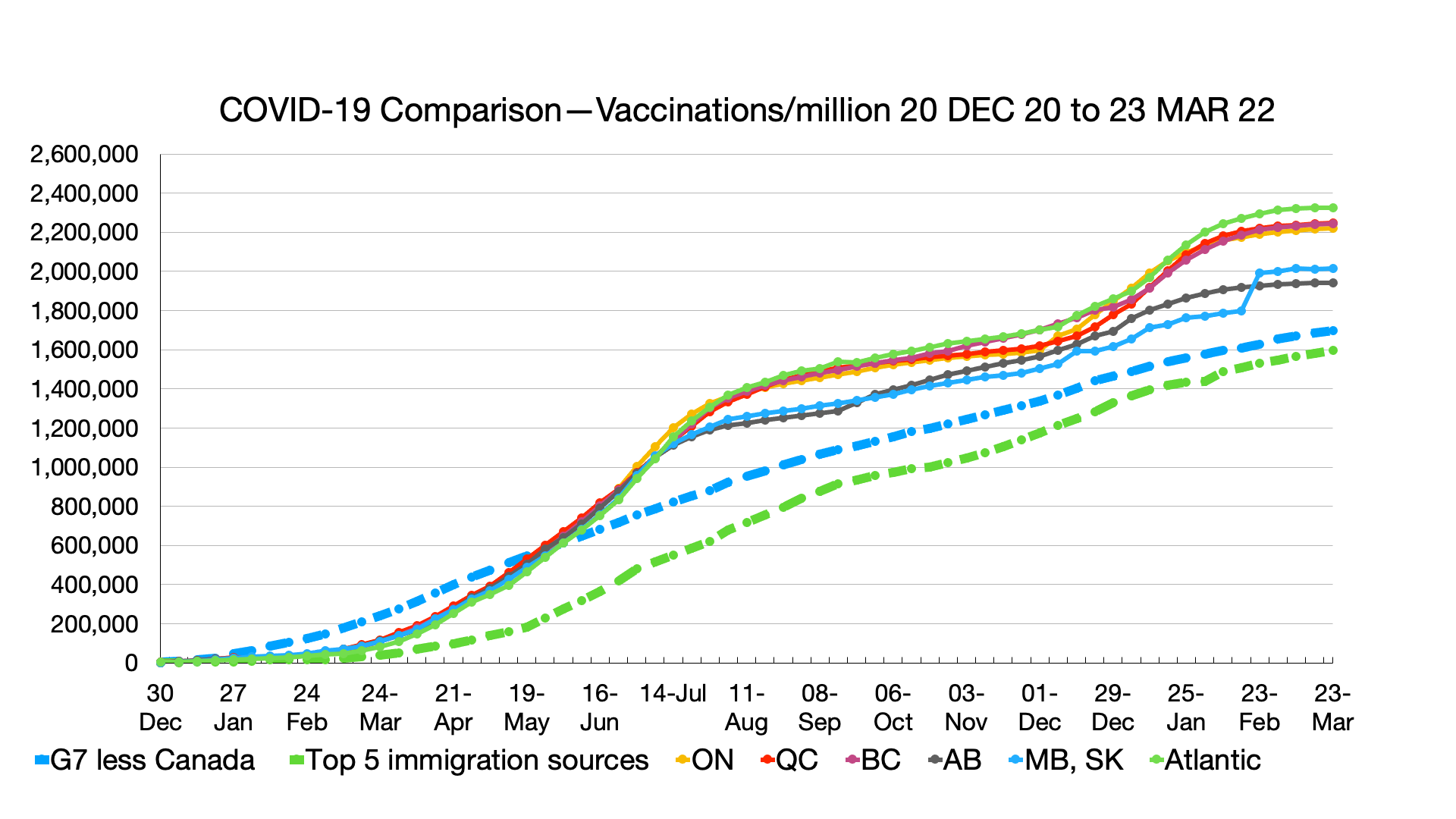
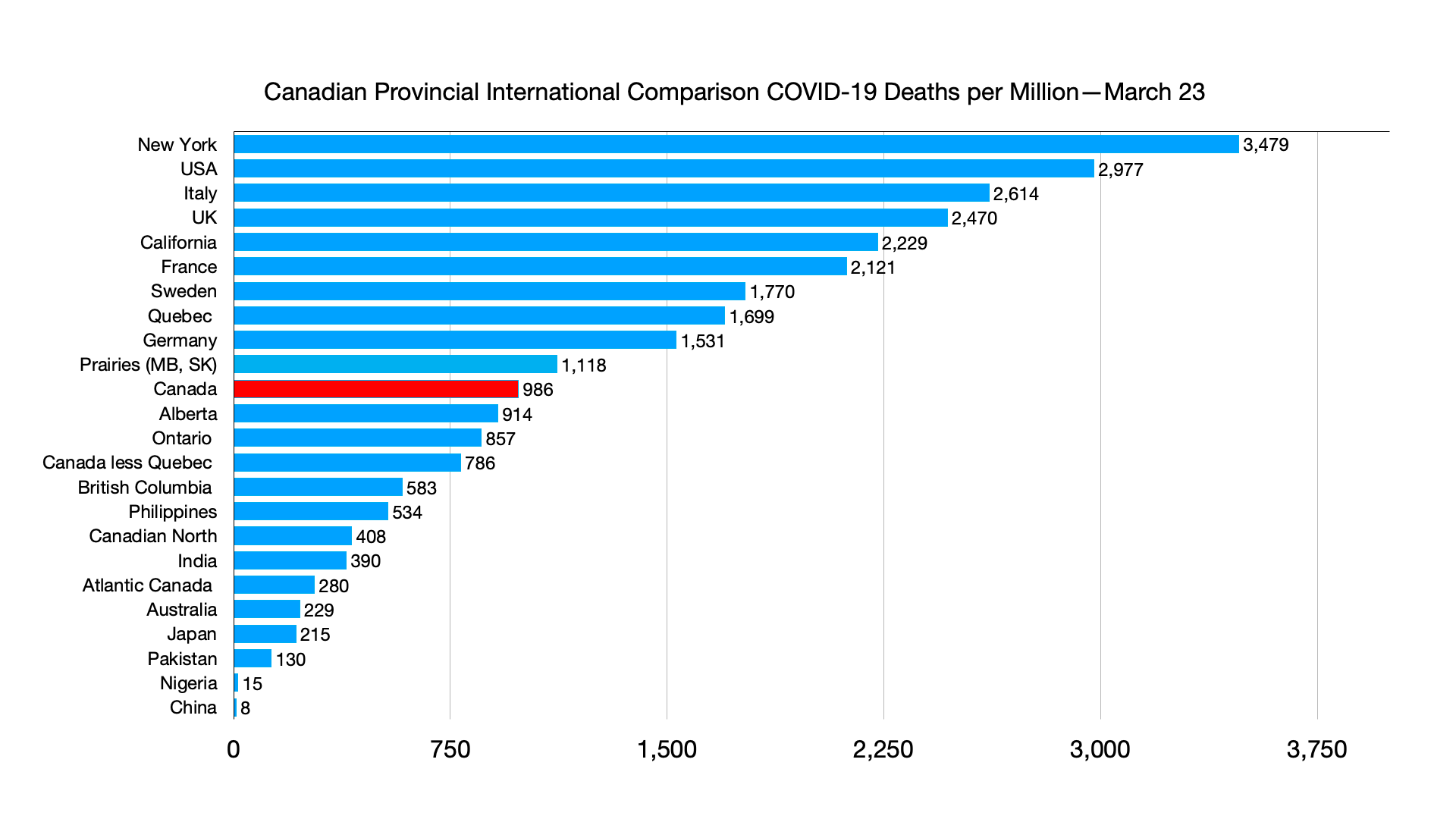
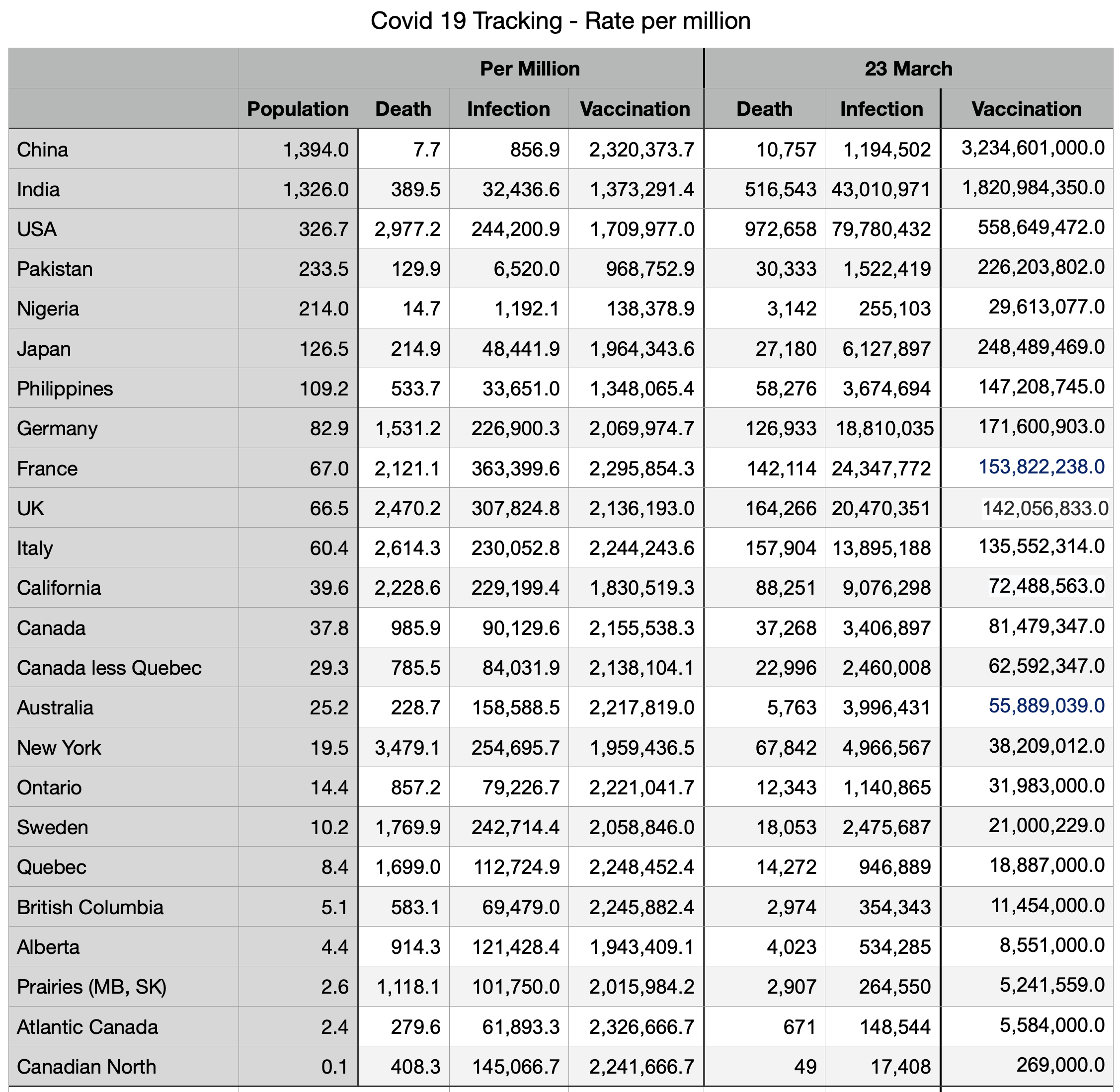
#COVID-19: Comparing provinces with other countries 23 March Update, Vaccinations in African countries

Numbers from China continue to climb with infections up 59 percent and deaths up 21 percent. New omicron variant showing up in increased infections in some countries.

Vaccinations: Some minor shifts but convergence among provinces and countries. Canadians fully vaccinated 82.7 percent, compared to Japan 79.6 percent, UK 73.8 percent and USA 66.1 percent.

Immigration source countries: China fully vaccinated 88.7 percent, India 60.1 percent, Nigeria 4.5 percent, Pakistan 47 percent, Philippines 60.3 percent.

Trendline Charts:

Infections: Limited signs of new omicron variant yet in Canada, with Atlantic Canada infection rates not yet slowing town.

Deaths: No major changes.

Vaccinations: No major relative changes, with Japan ahead of New York and Alberta.

Weekly

Infections: Italy ahead of California.

Deaths: No relative change.

Informative analysis in The Economist:

It is little over a year since the first doses of life-saving vaccines were delivered to Africa under the Covid-19 vaccines Global Access Facility (covax), a scheme aimed at helping poorer countries get inoculated. Yet what should have been a celebration of the region’s fastest-ever vaccine rollout—with 400m doses jabbed into waiting arms—was instead marred by disappointment at how much more could have been achieved.

Listen to this story.

Instead of complaining about not getting vaccines, some countries are now protesting that they are being drowned in a deluge of the stuff and are unable to use it all. Last month Africa cdc appealed to donors to stagger the supply of their shots. “We have not asked them to pause the donations, but to co-ordinate with us so that the new donations arrive in a way so that countries can use them,” said John Nkengasong, the director of Africa cdc.

Increased deliveries are exposing logistical defects in distribution within countries, while weak health-care systems have been unable to jab doses into arms as fast as they get them. Across Africa as a whole just 62% of delivered vaccines have been administered and 29 countries have used less than half of their supplies, says the who. Among the worst laggards are the Democratic Republic of Congo, which has used 15% of its consignments and jabbed less than 2% of its eligible population, and Burundi, which has used less than 2%.

Also hidden in the averages are big gaps in vaccination rates between cities and the countryside. Although continent-wide data are not available, Githinji Gitahi, the chief executive officer of Amref Health Africa, an ngo, says this trend is clear across many countries, including Ghana, Kenya, Rwanda and Tanzania. In Kenya 51% of adults in Nairobi, the capital, had been fully vaccinated by March 16th. But in Mandera county, a poor semi-arid region next to the border with Somalia, only 10% had been fully jabbed.

Part of the reason is logistical. Freezers for storing vaccines are in short supply. But this should be surmountable. Take Uganda. By November just 14% of its eligible population had received their first dose. But in a push supported by donors including the American government, it bumped that rate up to 47% in just six weeks. In Ivory Coast, where many people were nervous about the jab, the government bumped up the vaccination rate from 22% to 36% in the month of December by running radio campaigns to allay people’s fears. These speedy successes suggest that in many places the biggest shortage is not of freezers or nurses, but of zeal on the part of the authorities to go out and get injecting. 

Source: Africa has plenty of covid doses, but it lags in jabs

Paradkar: Voluntourism by charities like WE is based on faulty ideals of feel-good white saviourism

Good commentary:

“People have gotten used to looking at Africans as objects.”

Education advocate Chizoba Imoka had just finished delivering the Hancock Lecture at the University of Toronto two years ago when she crystallized a certain rage that anyone who seeks to decolonize structures will identify with. “What gives people the confidence to think, you know, you have four weeks off and you’re just going to travel to Africa to save Africa?”

The “saving Africa” kind of volunteering occupies a hefty presence on the Canadian imagination. “Raised funds for Africa” wins praise and opens opportunities for students. “Volunteered in Africa” is a resumé builder for professionals. “But they went to Africa!” is evidence of progressiveness, a stalwart defence against accusations of racism.

“Voluntourism” is a topic that deserves scrutiny during a time when the WE Charity and its tentacular affiliates are in the news for all the wrong reasons including allegations of: messy internal finances; complex relationships among its many arms that even confuse its own staff; a non-transparent speaker system; aggressive run-ins with media; and a relationship with the prime minister that has embroiled him in another ethics scandal.

All of this comes under the umbrella of feel-good white saviourism.

This is not to say charities in general are useless; those that support grassroots organizations can make a difference. But jumping up to save others is pointless if it is primarily self-serving.

Me to We’s volunteer travel site is startlingly honest in that it does not couch the western self-centredness of its mission. “Experience a new culture.” “Get ready for a world-changing adventure.” “An unforgettable team-building experience.” “A truly one-of-a-kind family vacation.”

“It’s never really been about us,” Imoka, who keeps one foot in Nigeria and the other in Canada, told me Wednesday from Edmonton. “It’s always been about the people in the West and what their desires are and what their resumés need to look like and the pictures they need to put up on Instagram.”

The idea of westerners flying in for a couple of weeks to fix another country (while taking a once-in-a-lifetime holiday!) is breathtakingly colonial. Would we welcome planeloads of African kids coming to ogle at our lifestyles and save Canadians? White saviourism means only other people need saving, whether they be on their own lands in other continents or forced on to reserves here. It reproduces relationships premised on white supremacy.

“Getting young people to think about the world beyond themselves, that’s a noble idea,” Imoka said, but “the young white people willing to save us still think we’re the way we are because … there is something deficit about us. So we take the surpluses in the West to go fix the deficits in the Global South.”

This shouldn’t require saying but the world doesn’t actually exist in a western vision of it. People in once-rich nations don’t become poor because they suddenly got lazy or just forgot to educate themselves and keep pace with the times.

“It would be much different if you teach them about the history of the world from an anti-colonial perspective,” Imoka said. “They don’t have wells, let’s go build wells — but why don’t they have wells? What has made it impossible for kids in that community not to do so? That critical thinking that takes a lot of work.”

That critical thinking would make clear that what needs to change is not necessarily in Africa — often perceived as a monolith rather than a varied continent — but global policies here, in the West, in Canada.

Got four weeks off and want to help? Go read up on history. As Imoka had said two years ago, “Take the Canadian foreign policy as your case study to understand how the Canadian foreign policy continues to enable colonization.” Maybe write to your member of Parliament. Fight where the Africans cannot — here, in the West.

Imoka was a teenager, too, when she started Unveiling Africa Foundation, which earlier this month launched a seven-weekend African-centred history program to develop young leaders. “It takes a lot of work to be able to ask foundational questions and takes much, much more work to bring it down to teenagers’ level. It’s difficult to get Instagram pictures for that. It’s not pretty work. It’s thankless work.”

Meanwhile people are still dying, and perhaps charities need to supplement policy work with donations. Unless people are emotionally moved, they don’t part with their money. Charities push the direst situations under our noses to snap us out of our daily pillar-to-post rush. To make us feel good about giving.

But saving Africa, on whose pillaging we’ve based our comfort, isn’t about feeling good. It’s about getting to real solutions. It’s about sacrifice. It’s about supporting those doing the hard work of decolonizing in their areas of specialty.

“It takes a lot of talking and learning and planning,” Imoka said. “You need to know the people on the ground that are getting their hands dirty, working to challenge structures, working to hold their political leaders accountable.”

Solidarity could also mean holding our own leaders accountable.

Source: https://www.thestar.com/opinion/star-columnists/2020/07/30/voluntourism-by-charities-like-we-is-based-on-faulty-ideals-of-feel-good-white-saviourism.html

Africa Coming to Terms With a Growing Diaspora’s Dual Citizenship

Of interest:

Earlier this year, Jawar Mohammed, the prominent political activist and media entrepreneur, who had returned home to Ethiopia from the US, looked set to challenge his former ally, prime minister Abiy Ahmed, in the country’s election. But there was immediately uncertainty created over Jawar’s eligibility simply because he had been a US citizen. Ethiopian law does not allow dual nationality and even though he written letters saying he’s renounced his US citizenship that uncertainty remains.

Jawar’s case is one of many that highlights an increasingly common issue for many African countries, who after years of battles with Western imperialism and colonial rule were determined at independence for their citizens to literally pick a side and not be allowed to carry the passports of other countries.

But in the 60 years since independence across the continent, the forces of globalization and transatlantic migration has seen dual nationality come up more frequently as an issue which needs to be addressed across politics and business through to sports.

Back in 1985, Saudi Arabia’s soccer authorities initially refused to hand over the trophy of the Afro-Asian Cup after losing to Cameroon in the finals of the tournament. They claimed Cameroon had fielded an ineligible player who was none other than legendary star Roger Milla, who had traveled to Jeddah on a French passport as he couldn’t also have a Cameroonian one.

Now, Cameroon is considering a revision of its nationality code which was enacted in 1968. The current law stipulates any Cameroonian adult who willfully acquires a foreign nationality automatically loses their Cameroon nationality.

But a new draft bill—a copy of which Quartz Africa has seen—says “a Cameroonian who has acquired another nationality shall retain Cameroon nationality unless it is expressly relinquished by the concerned.” The bill is expected to pass through with little challenge.

Some African governments have been reluctant to legalize dual citizenship, arguing the patriotism of people with dual citizenship could be questioned. But there’s also anecdotal evidence some of these governments are more concerned an influential and economically independent diaspora, able to move freely between countries, could support a challenge to the leadership.

Passport limits

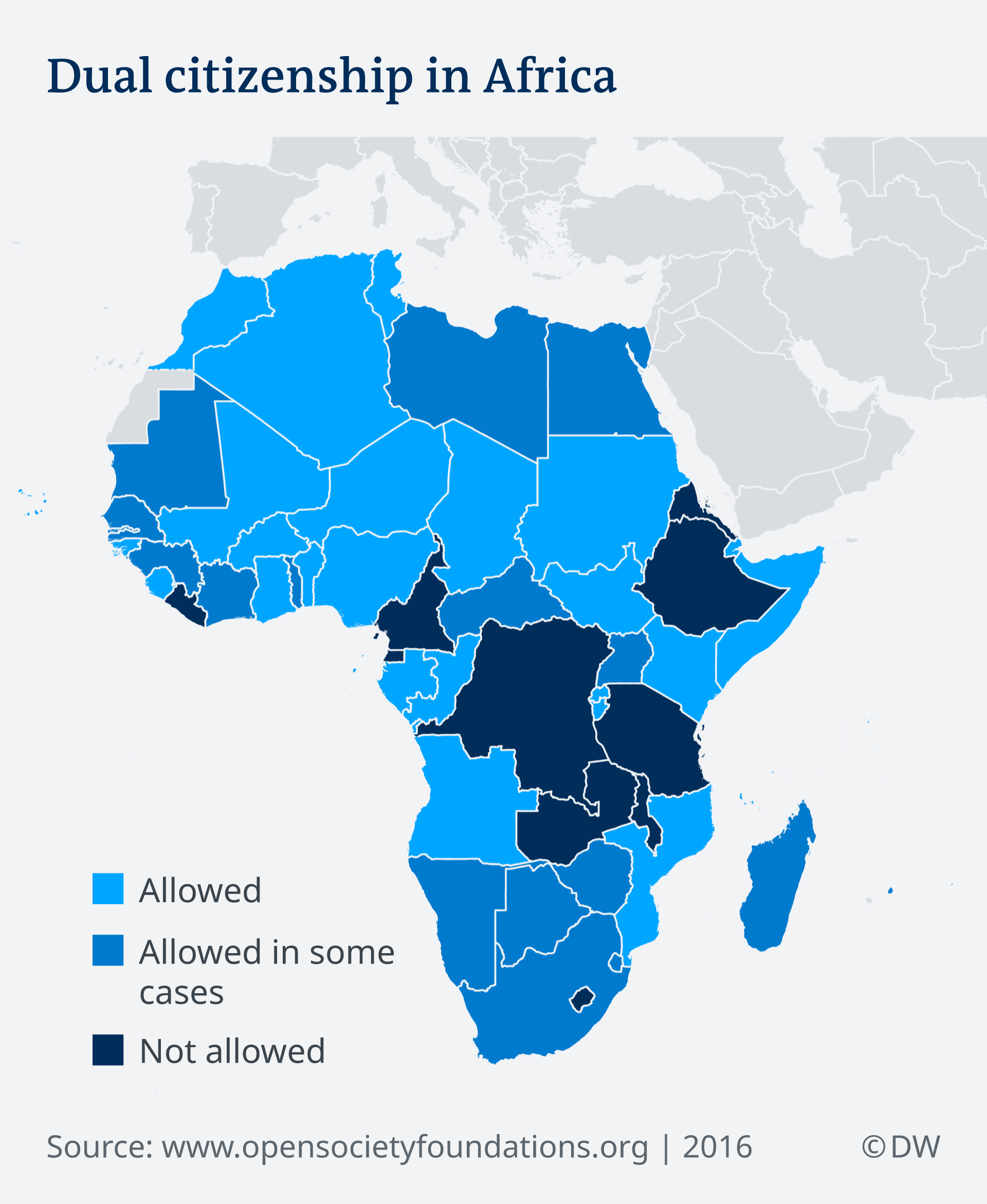
By 2010, a comprehensive study showed that 21 African countries, including DR Congo, Liberia, Algeria and Zimbabwe, prohibited dual citizenship. Meanwhile, 23 others permitted dual citizenship under certain circumstances like if acquired by marriage to a foreign spouse or allowed for citizens from birth only. Other countries did not address the issue of dual citizenship in their laws.

Despite these restrictions it is not unusual among middle class Africans to find people holding dual nationality in countries which don’t allow dual nationality, in part because many countries don’t have comprehensive systems for checking until they vie for office. In 2017, up to two-thirds of the presidential candidates in Somalia’s election held foreign passports while as many as 100 of its 275 legislators also held foreign passports. Eventual winner, now president, Mohamed Farmaajo, also held American citizenship. He had previously worked for the state transportation department in  Buffalo, New York.

Many African countries today have sizable diaspora communities, notably in Europe and North America, with an increasing economic, social and political influence aided by the improvement in communications and travel networks over the last couple of decades.

The World Bank estimates the African diaspora around the world at 30.6 million, but the figure could be even higher when unrecorded African migrants are considered. In 2019, remittance inflow from the African diaspora topped $48 billion. Such remittances in 2010 contributed to 2.6% of the continent’s GDP.

The IMF has estimated the African diaspora save an around $53 billion every year outside of the continent. There is a belief that if it was easier to invest in their countries of origin as dual nationals more of those savings would come to Africa.

Last year, Ethiopia’s parliament passed a bill to allow members of the Ethiopian diaspora, who have taken up nationalities in other countries, to invest, buy shares, and set up lending businesses in the country’s state-dominated financial sector.

Ghana seems to be one of the African countries which has been quick to recognise the potential of its diaspora and the advantage of granting them the possibility to hold dual citizenship. As early as 2000, it passed a law to recognize dual nationality for its citizens. The government of Ghana has since made efforts to attract its Ghanaian origin and other African descendant diaspora to return home, with the Year of Return, Ghana 2019 recording remarkable success.

Practicalities

Many African professionals and businessmen at home and in the diaspora want to pick up foreign passports for very practical reasons—they want to be able to move freely around the globe.

According to the Africa Visa Openness Report 2019, on average, Africans can only travel to 25% of other African countries without a visa. But holders of passports from North America and Europe can travel visa-free to more African countries than Africans.

Henley & Partners, the global citizenship and residency advisory firm which is set to open an office in Lagos, has pointed out that most Nigerians wishing to subscribe to their offerings have no plans to relocate. Instead, they just want to have a passport which makes it easier to travel without the unpredictability of visa applications.

The latest Henley Passport Index shows that two of Africa’s most populated countries, Nigeria and Ethiopia occupy the 97th and 98thpositions respectively on the index. The Nigerian passport offers its holders visa-free travel to just 46 countries mostly in Africa, while the number is 44 for Ethiopia.

Source: Africa Coming to Terms With a Growing Diaspora’s Dual Citizenship

Dual citizenship in Africa: ‘Benefits outweigh disadvantages’

Good overview of African citizenship policies:

Several African countries, such as the Democratic Republic of Congo (DRC), Tanzania and Ethiopia, reject dual nationalities for their citizens. In these countries the fear of people with two citizenships seems to be acute.

There are a number of African heads of state and high-ranking politicians who have dual citizenship themselves or roots in another country. Somali President Mohamed Abdullahi Mohamed is a citizen of Somalia and the United States. Liberia’s former head of state Ellen Johnson-Sirleaf has German and Liberian roots. Moise Katumbi, a leading DRC opposition politician, was an Italian citizen for 17 years. For this reason he was banned from running in the 2018 presidential election.

Pride or politics?

While the DRC does not recognize dual citizenship, an exception is made for children born abroad. They are allowed to keep both nationalities until they come of age at 21. Then they have a year to renounce one of their citizenships. An Ethiopian law of 1930 stipulates that Ethiopians acquiring another nationality will cease to be Ethiopians. Foreigners who want to become Ethiopians need to prove that they’ve already renounced or are able to renounce their original citizenship.

Tanzania also does not allow dual citizenship. In 2007, Tanzanian Foreign Minister Bernard Membe presented a report which recommended an amendment to this law. But the government argued that such a change represented a threat to peace, security and the Tanzanian population’s livelihood.

An infografic showing how African countries deal with dual citizenship

“It’s all a mystery, because the benefits outweigh the so-called disadvantages,” Ahmed Rajab of the Pan-African Institute for Strategic Studies, told DW. “The main benefits are to the economies of these countries,” he said. “Maybe it’s a question of pride. Maybe these countries are so proud of their nationality that they don’t want any of their citizens to acquire another citizenship.” Legalization would not bring about any new problems. On the contrary: “It has been proved in the case of Ghana, for example, or even Kenya, that the country benefits from the inflow of funds from the countries of the citizens who have dual nationality.” Ghana legalized dual citizenship in 2002. Kenya followed suit in 2011.

African leaders do not want to be challenged

Tanzanian analyst Gwandumi Mwakatobe believes there is more to the rejection of dual citizenship than mere pride. Many people often do not know where to get their information from so they believe whatever their president says. Mwakatobe believes that this works to the advantage of African heads of state. People with dual citizenship who live abroad “are exposed to so many things. They know so many issues regarding politics, regarding human rights. And they are very vocal. They criticize their country. They challenge the leaders from their original countries. Many African leaders don’t want to be challenged,” Mwakatobe told DW.

Two hands holding several Malian passports (picture alliance / Godong)Mali is one of the African countries that allow dual nationality

“I think that is a threat,” analyst Ahmed Rajab agrees. African leaders view people with dual citizenship as foreigners and don’t want them to participate in politics. “Because they have ideas on democracy, democratic processes and on how to run politics. It goes against the grain of the Ethiopian political environment, for example,” Rajab said. Dual citizens are banned from local politics in Ethiopia.

‘We are world citizens’

Gwandumi Mwakatobe considers this to be a useless strategy. “There is nothing you can hide in this world today, due to the communication technology. Even in the DR Congo, where they cut the internet, they were still communicating,” he said. The analyst also believes that states will benefit from allowing their citizens to have dual nationality. “We have to put in place good systems, good laws, that can guide us to make sure that we prosper,” he said. Increased business, transport of goods and networking with people abroad are just a few advantages of dual citizenship, Mwakatobe pointed out.

He would like every African country to build a bridge to the diaspora, to ease the way home for people with dual citizenship. “That is very important, because we are all citizens of this world, and not from one nation or the other. The whole world is ours. We are world citizens.”

Source: Dual citizenship in Africa: ‘Benefits outweigh disadvantages’