Fewer immigrants are deciding to become Canadian citizens: Institute for Canadian Citizenship

More coverage:

Abisoye Akinpelu and her children were among the 25 immigrants at a Calgary citizenship ceremony on Saturday, ready to become Canadian citizens.

“I feel so accomplished. It’s a long journey for us and it’s been filled with ups and downs, but it’s worth it,” Akinpelu, who came to Canada from Nigeria, said.

Akinpelu says she enjoys Canada’s multicultural community, and how Canadians from different backgrounds can live peacefully together. Immigration Minister Marc Miller was also at the citizenship ceremony where he said citizenship is not a choice to be made lightly.

“This is the best country in the world to be in. I think you know that … Otherwise, perhaps you wouldn’t have made that choice.”

However, the 2021 and 2016 Census reported fewer immigrants are choosing to become Canadian citizens. According to new data released by the Institute for Canadian Citizenship (ICC), the proportion of people becoming citizens within 10 years of their arrival in Canada has dropped by 40 per cent.

“People are less interested in becoming Canadian. Let that sink in,” Daniel Bernhard, the ICC’s CEO, said. “It’s not because they are not interested or not grateful. It’s in many cases because they are trying to contribute and we’re not allowing them to.”

The numbers indicate citizenship uptake is the lowest among highly educated economic immigrants, and Bernhard said it’s because they are weighing their options before taking the oath.

“Not feeling welcome is not just whether your neighbours are nice to you, or whether your kids have a good place in school, but whether your employer thinks that you have something important to contribute,” Bernhard said.

“The cost-of-living crisis in Canada continues to bite, and (their) skills and experience are not recognized in the labour force here,” Bernhard said, adding that many immigrants may feel frustrated and potentially decide to move on from the idea of becoming Canadian citizens.

As well, a recent poll by Angus Reid found the housing affordability crisis is forcing more newcomers to rethink their place in Canada and consider moving to a different province, or a different country altogether.

Bernhard said the lack of affordability is already having an impact on citizenship uptake, but confirmed the ICC is calling on Ottawa to provide more opportunities for people to celebrate and appreciate the value of citizenship, and to put a cap on virtual citizenship ceremonies.

Source: Fewer immigrants are deciding to become Canadian citizens: Institute for Canadian Citizenship

StatsCan: Recent immigrants report greater difficulty making ends meet and are less satisfied with their amount of free time

Of note (albeit not surprising):

According to the most recent data from the Survey Series on People and their Communities (SSPC), in April 2024, slightly over 3 in 10 Canadians (31%) found it difficult to meet their financial needs in terms of transportation, housing, food, clothing and other necessary expenses in the past 12 months. During this period of higher living costs, Canadians may also need to work more hours to make ends meet. Indeed, about one-third (31%) of Canadians reported having a high level of satisfaction with the amount of free time they had to do the things they like.

Not all individuals are experiencing this period of economic contraction equally. Recent immigrants, for example, often report experiencing income-related challenges, which may affect their level of satisfaction with free time. Canada has admitted record numbers of immigrants in recent years, and to better understand the experiences of recent immigrants, this release presents an analysis using the April 2024 wave of the SSPC: Social Cohesion and Experiences with Discrimination.

Recent immigrants report having greater difficulty meeting their financial needs during the past 12 months

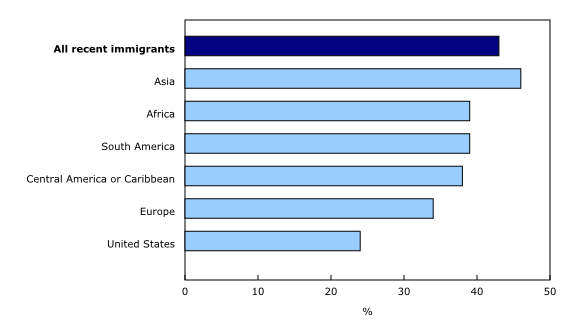
Recent immigrants (defined in this release as those admitted in 2005 or after) often face unique economic challenges in adapting to a new country and were more likely to report having greater difficulty in making ends meet. Specifically, in April 2024, a larger proportion of recent immigrants (43%) reported finding it difficult or very difficult to meet their financial needs over the past 12 months, compared with more established immigrants (29%) and non-immigrants (29%). Similarly, non-permanent residents were more likely to report finding it difficult or very difficult to make ends meet (37%) than non-immigrants.

Not all immigrants share the same economic experiences when arriving in Canada. In April 2024, while newcomers from the United States (24%) and Europe (34%) were the least likely to report experiencing financial difficulty in the past 12 months, newcomers from other regions were more likely to experience hardship during this transition. In general, newcomers arriving from Asia (46%) reported having the highest level of difficulty making ends meet. Some of these differences may be related to category of admission, which was not considered in this study.

Chart 1 
Percentage of recent immigrants (arriving since 2005) who reported having difficulty meeting financial needs over the past 12 months, by region or country of birth, Canada, April 2024

Chart 1: Percentage of recent immigrants (arriving since 2005) who reported having difficulty meeting financial needs over the past 12 months, by region or country of birth, Canada, April 2024

Racialized Canadians, especially racialized immigrants, are more likely to report experiencing financial difficulty 

Previous studies have shown that racialized Canadians may face greater economic uncertainty and, therefore, may have a more difficult time meeting their financial needs than non-racialized Canadians. In April 2024, West Asian (48%), South Asian (43%), Latin American (42%), Black (40%), Arab (38%) and Filipino (35%) Canadians were more likely to report having difficulty meeting their financial needs in the past 12 months than the non-racialized, non-Indigenous population (28%). In contrast, Chinese Canadians (22%) were the least likely to report experiencing financial difficulty in the past 12 months. 

Most of these observed differences are related to also being an immigrant. In April 2024, most Canadian-born racialized people reported having a similar experience as Canadian-born non-racialized people in Canada. For example, 28% of South Asian people born in Canada reported having difficulty making ends meet, the same proportion as the non-racialized, non-Indigenous population. However, nearly half (47%) of South Asian immigrants reported having difficulty making ends meet in the past 12 months. These results highlight the importance of understanding financial difficulty through a lens of intersectional identities, including experiences of immigration. 

Recent immigrants are less likely to report having satisfaction with their amount of free time

Economic challenges may lead to work-life balance conflicts, if workers need to work more hours, and potentially reduced satisfaction with the amount of free time available. As of spring 2024, 40% of Canadians who did not report having difficulty making ends meet also reported having a high level of satisfaction with their amount of free time. However, 12% of people who experienced difficulty making ends meet in the past 12 months reported having a similar level of satisfaction. 

In April 2024, more recent immigrants to Canada reported having lower satisfaction with their amount of free time than immigrants who had arrived earlier and non-immigrants. In fact, 23% of recent immigrants said that that they had a high level of satisfaction with their amount of free time, compared with 33% of more established immigrants and 32% of non-immigrants. About 27% of non-permanent residents reported having high satisfaction with their amount of free time.

Not all newcomer groups experienced similar levels of satisfaction with their amount of free time. For instance, in April 2024, newcomers from Asia were the most likely to report having financial difficulty and were one of the least likely to report having satisfaction with their free time (22%). In contrast, despite being the least likely to report experiencing financial difficulty, recent immigrants from Europe were among the least likely to report having a high level of satisfaction with their free time, at 20%. 

Further, in April 2024, recent immigrants from the United States (32%) were as likely to report having high satisfaction with their amount of free time as non-immigrants. These results indicate that satisfaction with amount of free time may depend on many other factors that were not measured by this study, including work-life balance, cultural perception of free time, family structure and supports, and personal outlook. 

Source: Recent immigrants report greater difficulty making ends meet and are less satisfied with their amount of free time

How many houses does Canada actually need?
Depressing yet accurate need. Striking disconnect between immigration levels and housing availability and needs. Given housing constraints, becomes even harder to justify current and growing immigration levels and surprising that there is so little thinking and questioning regarding the linkage:

Everyone agrees Canada has a major housing shortage. To make homes more affordable for young people, to house incoming waves of immigrants and to restore sanity to markets like Toronto and Vancouver, the country needs more homes.

But exactly how many homes? That proves to be a trickier question than you may think.

Estimates vary hugely because the size of the country’s housing shortfall can be defined in a multitude of ways.

The simplest method is to look at what level of home construction would be required simply to meet new demand and stabilize the market at today’s lofty levels. Even by that conservative standard, Canada is falling short.

In recent years, it has typically completed about 200,000 new homes a year – standalone homes, condos and other types of dwellings. However, immigration and other factors will create about 240,000 new households a year between now and 2024, according to RBC Economics. This suggests that construction needs to quickly rise to levels roughly 20 per cent higher than in recent years simply to give all those new households a place to live.

Yet it only begins to address Canada’s structural shortfall of housing. “Even if we had 240,000 completions a year for the next few years, we would simply be meeting new demand, not reducing the gap that has already built up,” Robert Hogue, assistant chief economist at Royal Bank of Canada, said in an interview.

If you look at what would be needed not just to keep pace with new demand but to address the accumulated shortfall that has accumulated over many years, the numbers swell to truly frightening proportions.

Restoring Canada’s housing affordability by 2030 to the levels that prevailed around 2003 would require an immediate doubling or more of home construction rates, according to a recent study by Canada Mortgage and Housing Corp. In an ideal world, Canada would be completing an unprecedented 400,000 or more new homes a year, according to CMHC’s numbers.

A bit of historical context about Canadian housing trends may help to put this flurry of estimates into perspective.

Last year, construction soared and 272,000 new homes were started across Canada. Economists and housing analysts applauded this achievement since it was the country’s highest annual number of starts since the heyday of the 1970s.

Unfortunately, the figure was not quite as impressive as it appeared at first glance. Canada’s population is now much larger than it was a half-century ago – more than 38 million people compared with only about 23 million in 1975.

If you adjust last year’s housing starts for the vastly increased size of the Canadian population, the big jump in housing construction last year took Canada to only about 60 per cent of the rate of housing starts per capita that it was achieving in the mid 1970s.

And even that comparison doesn’t capture the extent of the shortfall because the average size of households has been steadily shrinking – the result of people marrying later, having fewer children and living longer.

In the early 1940s, the average Canadian household had 4.3 people, according to RBC Economics. By 1981 that had fallen to just under three people. Today it stands at 2.4 people.

This has resulted in a tremendous upward push in the need for housing. To house the three-person households that were common in the 1970s, you would have required roughly 33 homes for 100 people. In contrast, to accommodate the same 100 people today, in households that average only 2.4 people each, you would need more than 41 homes – a major increase even if Canada’s population hadn’t budged at all.

Most analysts agree the combination of shrinking households and years of sluggish construction has resulted in a serious housing deficit – but putting a hard number on the size of that deficit is difficult.

Last year, Jean-François Perrault, chief economist at Bank of Nova Scotia, wrote a noteexploring a couple of methods for estimating the size of Canada’s housing shortfall. Just to be clear: This is the size of the shortfall that would still exist even if Canada were to suddenly speed up construction to the point it was meeting demand from newly formed households.

His first approach was to look at what it would take to keep the ratio of housing units to population stable since 2016, when home prices began a notable upward surge. This method suggests Canada was about 100,000 dwellings short at the time Mr. Perrault wrote his report in early 2021.

However, it ignores the shortfall that had accumulated before 2016. A more wide-ranging approach is to compare Canada with other advanced economies in the Group of Seven and ask what it would take for Canada to achieve the same number of housing units per 1,000 residents as other G7 countries.

To catch up to the United States – a country experiencing housing shortages of its own – Canada would require another 99,000 units, Mr. Perrault estimated in his note. To catch up to the United Kingdom, 250,000 homes. To catch up to the G7 average, a staggering 1.8 million homes.

People can argue which number is most appropriate, Mr. Perrault said in an interview, but “we know there is currently a huge gap and that gap will rise given population growth and recent construction trends.”

One disturbing aspect of those recent construction trends is the discrepancy between housing starts and housing completions. While housing starts have been lacklustre, housing completions have been even worse.

Between the start of 2016 and the end of 2021, Canada started an average of 221,000 homes a year but completed only about 200,000 homes annually. The discrepancy appears to reflect a variety of factors – labour shortages, rising raw material costs and the long lag time between starting a multiunit project and completing it – but whatever the exact cause of the gap, it does drive a wedge between widely reported numbers on housing starts and the actual amount of housing that is being delivered.

Meanwhile, Ottawa has supersized national immigration targets, raising them from around 260,000 people in 2015 to more than 400,000 today. Thanks largely to immigration, Canada’s population is now growing at more than twice the pace of most developed economies, according to Mr. Hogue at RBC.

Given immigration pressures, demographic trends toward smaller home sizes and Canada’s long history of sluggish construction, how many new homes would it take to make housing affordable again? CMHC economists took a crack at answering that question in an ambitious study over the summer.

They defined housing affordability in two ways. The first was as the level of affordability that prevailed in each province in 2003-04. The second was as the level that would require households to devote no more than 40 per cent of their after-tax income to housing.

If nothing else, these definitions help to put a number on the extent of Canada’s affordability challenge.

In Ontario, achieving affordability would mean the average price of a home would have to fall from $871,000 in 2021 to between $499,000 and $551,000 in 2030, depending on which affordability benchmark you use. In British Columbia, restoring affordability would require average prices to fall from $929,000 in 2021 to between $607,000 and $679,000 in 2030.

In contrast, home prices in other provinces already seem to be affordable or at least close to affordable, especially when judged against the common 40-per-cent-of-disposable-income benchmark.

But even taking those more affordable regions into account, bringing the country as a whole back to affordability is a mammoth challenge because of the huge shortfalls in Ontario and British Columbia.

The CMHC study estimates that Canada must build an additional 2.3 million homes between now and 2030, on top of what it is already building, to meet the 40-per-cent-of-income target. Achieving the more ambitious target of restoring the affordability levels of 2003-04 would demand 3.5 million more homes than the business-as-usual scenario.

The bottom line? Canada needs to at least double its current pace of home building to have a serious impact on affordability, according to Aled ab Iorwerth, deputy chief economist at CMHC.

“We need a lot more supply, we need a sea change,” he said.

Source: How many houses does Canada actually need?