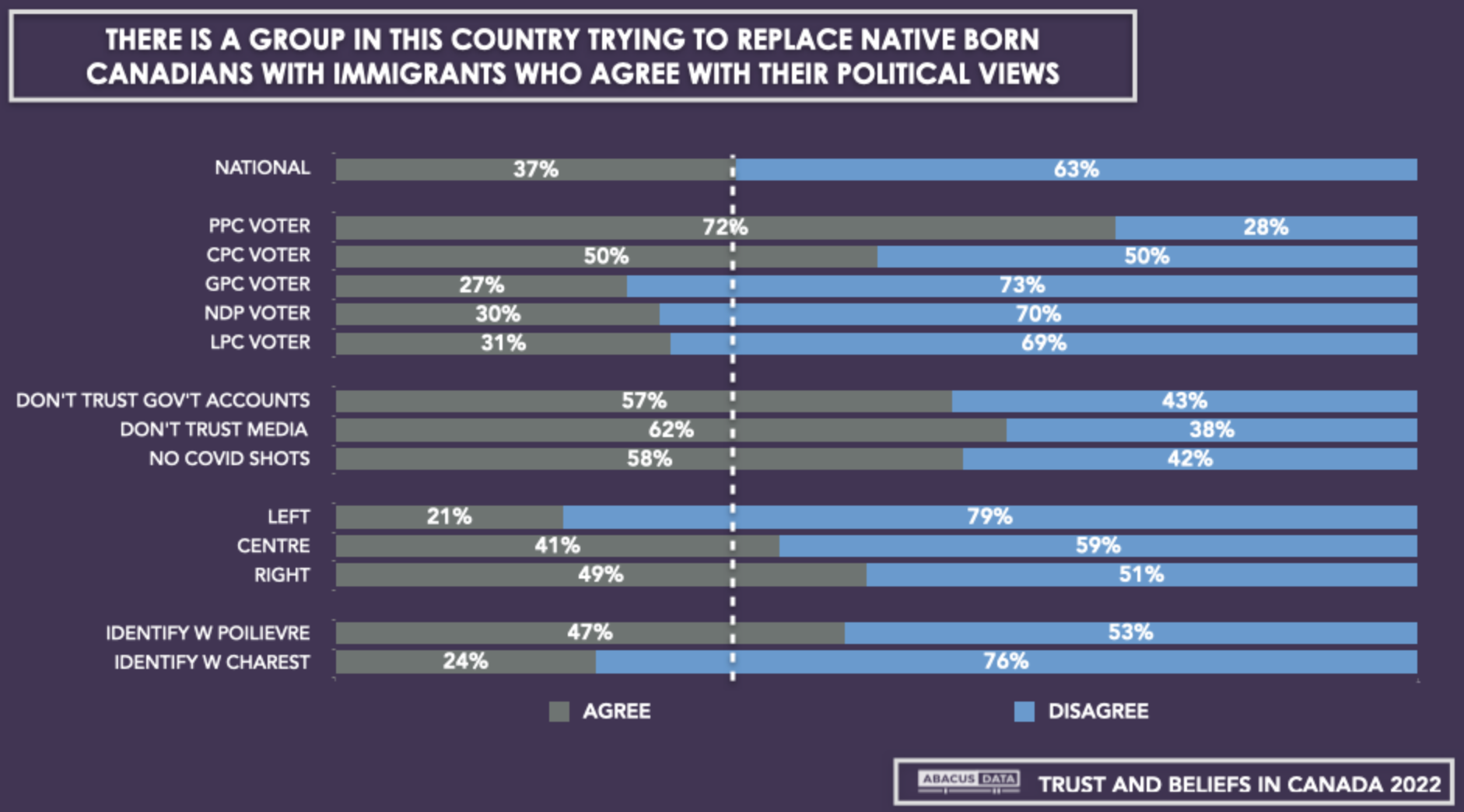
Interesting public opinion research and worrisome. The “great replacement” slide below is the one that most attracted my attention. It does track, to a certain extent, the Focus Canada question, “Too many immigrants do not adapt Canadian values,” 48 percent Fall 2021:
We recently completed nationwide surveying among 1500 Canadians. The focus was on the levels of trust people have in institutional sources of information, and belief in conspiracy theories. This is the second in a series called “Trust & Facts: What Canadians Believe”
• 44% (the equivalent of 13 million adults) believe “big events like wars, recessions and the outcomes of elections are controlled by small groups of people working in secret against us”. Almost as many agree “much of our lives are being controlled by plots hatched in secret places
• 37% (or 11 million) think “there is a group of people in this country who are trying to replace native born Canadians with immigrants who agree with their political views. This is an articulation of what is commonly referred to as replacement theory.
• 20% believe it is definitely or probably true that “the World Economic Forum is a group of global elites with a secretive strategy to impose their ideas on the world.” Another 37% think it is possibly true or aren’t sure either way.
• 13% think it is definitely or probably true that Microsoft founder Bill Gates is using microchips to track people and affect human behaviour. Another 21% say it’s possible, or aren’t really sure.
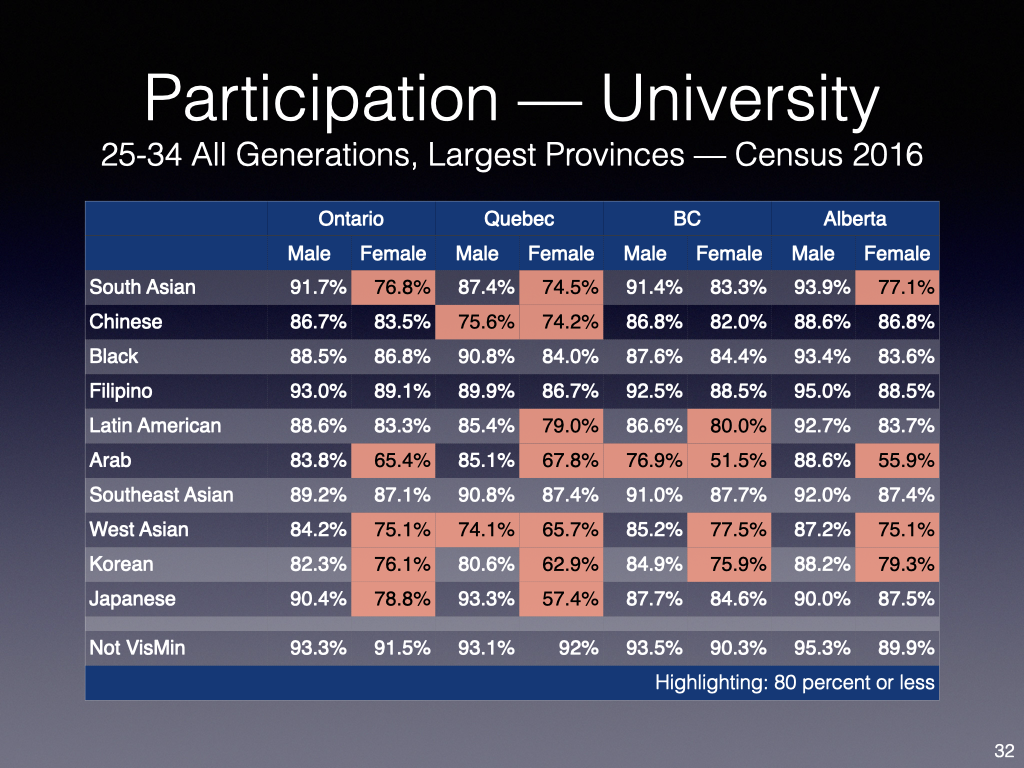
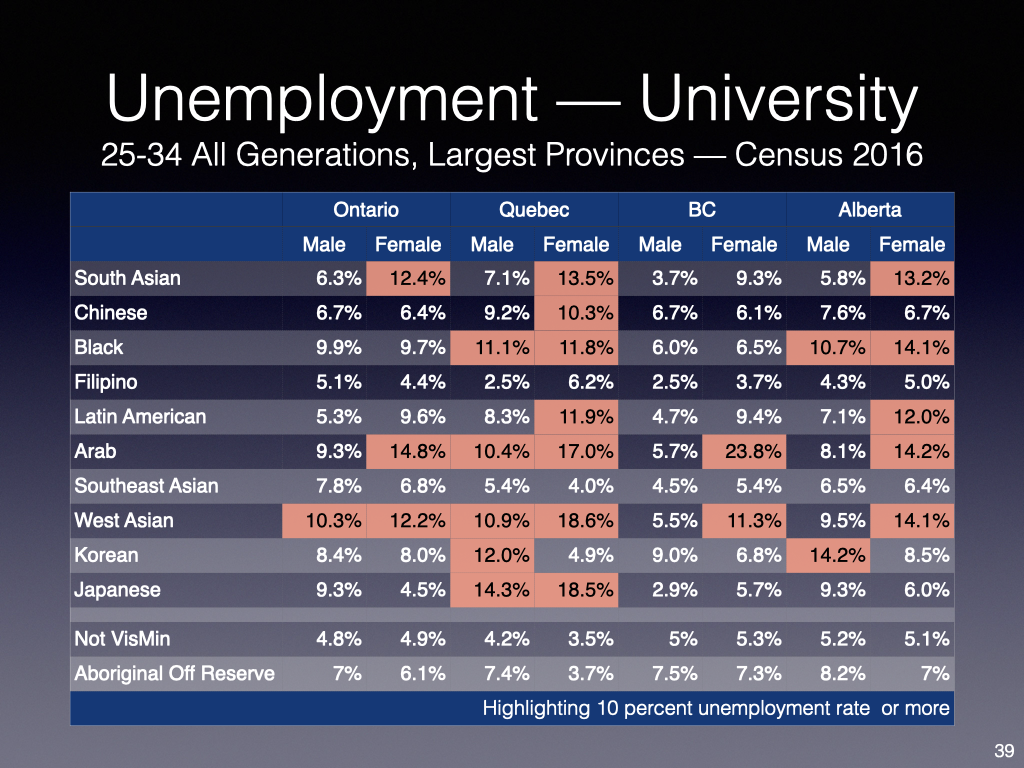
For some context, 2016 census data (not public opinion research) for the younger 25-34 year old cohort. Some of the issues flagged in the study are common to other visible minority groups. Income data is relatively strong for Arab women, lower participation may reflect the impact of family caring, with higher unemployment reflecting in part bias. Regional variations, in particular the relatively poor outcomes for women in Quebec, are notable:
The Canadian Arab Institute released a report last week that attempts to explain why some Arab women aren’t succeeding in Canada’s workforce. It’s compelling reading for anyone invested in the nation’s overall prosperity and success.
The new study titled, “Employment barriers facing Arab Women in Canada”, combines surveys collected by Abacus Data, focus groups and interviews conducted in Ontario, Quebec, and Alberta (provinces with the highest populations of Arab-Canadians). The result is a helpful list of recommendations that would help any newcomer or immigrant trying to navigate the job market.
“Overall, social exclusion describes a state in which individuals are unable to participate fully in economic, social, political and cultural life,” points out the United Nations.
Some Arab-Canadians are having a hard time participating economically, despite the historic presence of these diverse communities in Canada dating as far back as 1882, as chronicled by academic Houda Asal in her book, “Identifying as Arab in Canada: a Century of Immigration History.”
As one of the fastest growing immigrant communities in the country, with seven out of 10 who are first generation immigrants, dreams of success are too often stalled by systemic barriers threatening to “push Arab-Canadians further into poverty and social isolation,” notes the report.
During the fall of 2020, Arab-Canadians had one of the highest unemployment rates in the country at 17.9 per cent, compared to a national unemployment rate of 9 per cent. Fast forward to today, Arab-Canadians continue to be among those with the highest unemployment rates, according to the March 2022 Labour Force Survey.
And Arab women are among the worst off.
“ … why do Arab women have a higher unemployment rate than most non-Arab women?” question the report’s authors. “Our main objective in this study is to understand the knowledge gaps behind the ever-increasing employment barriers facing Arab women and filling these gaps with evidence that inform policy recommendations.”
The researchers approached the question by dividing an individual’s career into different chronological stages. The result is helpful in understanding how those seeking work tend to experience obstacles at various junctures in their journey — information gathering about the local labour market, looking for job opportunities, during the recruitment process, while gaining work experience and being better integrated in the workplace, and in further career development and future growth.
The most significant impediments identified included inadequate employment services, lack of recognition of foreign credentials and opportunities to upgrade, lack of opportunities to gain Canadian experience, language/communication obstacles (not based on proficiency in either of the official languages, but due to a lack of knowledge of industry-specific terms), and discrimination based on one’s identity.
The report’s concluding recommendations would improve the chances of most newcomers and immigrants in finding and retaining employment commensurate with their professional skill-set. These include:
Creating central portals of information about the labour market so it’s easier to access information about the job market.
Encouraging the federal government to work with the provinces to provide information to immigrants about degree equivalency processes before their arrival to Canada so they can better prepare.
Encouraging workplaces to implement standardized performance evaluations to remove concerns about bias in performance reviews and fears of reprisals when individuals report microaggressions or blatant discrimination.
More funding for organizations that provide mentorship and social networking for newcomer and racialized women.
Tailored communication and soft skills training opportunities in industry-specific terms and language.
Measuring the success of employment support services not on whether newcomers or immigrants have secured survival jobs, but whether employment matches the skills of their clients.
These recommendations won’t come as a major surprise to those who have long worked with immigrant and newcomer communities. What should surprise all of us is how long it’s taking to address these hurdles.



 Multicultural Meanderings