John Ivison: Senate amendments to gender diversity bill set to test Trudeau’s feminist principles

Find Ivison overly alarmist here. Requiring companies to have diversity plans but allowing them to set their own targets, with annual reporting, is a reasonable balance between doing virtually nothing and moving the yardstick.

There are likely some changes that may be needed (e.g., size of companies that are covered).

Bu is meritocracy really at risk as Ivison argues? Seem to recall same argument being used each time organizations want to increase diversity:

Are there any limits to how far Justin Trudeau will go to foster diversity and inclusion? We may be about to find out.

While he was in Davos, the prime minister made a big deal about the representation of women on corporate boards.

“Companies should have a formal policy on gender diversity and make the recruitment of women candidates a priority,” he said in his speech to the World Economic Forum.

To this end, the Liberal government has introduced a bill (C-25) to amend the Canada Business Corporations Act, which (among other things) requires companies to place their diversity policy before their shareholders, and if they fail to do so, to explain why (the widely adopted “comply or explain” approach).

Even that level of intervention has some free marketers wondering what business it is of the government to interfere in the running of private corporations.

But the current proposal is tame compared to amendments being proposed by a group of influential senators that will have many executives choking on their Porterhouse steak.

The six senators — Serge Joyal, Frances Lankin, Paul Massicotte, Lucie Moncion, Ratna Omidvar and André Pratte — have written to their colleagues saying they believe the current bill “lacks teeth.”

They would like to add amendments that would force the 270,000 companies incorporated under the CBCA to adopt diversity policies that set numerical goals and timetables on female, indigenous, disabled and visible minority board representation. Companies would have to report their progress not just to their shareholders but, “for the purposes of monitoring,” to the government. Ministers would be required to prepare and publish a report on the data – a clear indication that further corrective action could one day be taken.

“To be clear: our amendment would not set quotas,” the senators say.

Nonetheless, quotas would be set, even if, at this stage, by the companies themselves.

The senators are now rallying their colleagues and if they have the votes, bill C-25 will be sent back to the House of Commons. One source said there appears to be a critical mass of senators in favour of the amendments, which will likely be introduced next week.

At that point, Trudeau will have a decision to make. While the government has not looked kindly on Senate amendments, Trudeau charged senators to use their independent judgment to improve government legislation. He is unlikely to want to shirk what he sees as his moral duty to promote diversity and inclusion.

Carol Hansell, senior partner at the Toronto law firm Hansell LLP, is critical of the bill in its existing form for a number of reasons, principally because it will force companies to hold annual elections of individual directors — the concept of majority voting. She said she believes governance should flow from securities regulation, not corporate statute, which she deems too rigid to respond to changing circumstances.

Hansell thinks the same is true of the diversity issue and that many people would find the imposition of government oversight “objectionable.”

“I think everyone is uncomfortable with quotas. It’s too blunt a tool,” she said.

Even Trudeau shied away from anything that resembled a quota in the legislation. When Economic Development Minister Navdeep Bains introduced the bill, he said it would “contribute to an inclusive economic growth agenda” but would not unduly burden business.

The bill was deemed sufficiently benign by the Conservatives that they supported it – pointing out much of it was based on their economic action plan.

The “comply or explain” model has already been adopted by the Canadian Securities Administrators, covering most of Canada’s publicly traded companies.

The dissenting senators point out the results have been unspectacular over the past few years — 14 per cent of board seats are now occupied by women, up from 11 per cent in 2015.

Only 1.1 per cent of board members are Indigenous, 3.2 per cent have disabilities and 4.3 per cent belong to visible minorities.

As a share of the population, all four groups are under-represented (women and girls make up 50.4 per cent of the Canadian population; three per cent are Indigenous; 19.9 per cent are visible minorities and 13.7 per cent report some kind of disability).

Smart companies are moving toward board representation that more accurately reflects their shareholders and customers.

But we are veering into dangerous territory when we reject the notion of meritocracy as a mechanism that merely re-inforces male privilege.

Change is happening before our eyes, even if it is not as rapid as some might like.

But it is simply not the role of government to dictate who should be running the nation’s businesses.

Source: John Ivison: Senate amendments to gender diversity bill set to test Trudeau’s feminist principles

Refugees crossing into B.C. on the rise, immigrant group says

Numbers small compared to Quebec but likely to increase:

On Nov. 18, 2017, Ribwar Omar, a 38-year-old Iraqi Kurd, arrived in Blaine, Wash., by bus. He stopped at a coffee shop, bought a hot chocolate and then, using the GPS on his phone, he made his way through a forest near the Peace Arch and crossed the border into Canada.

Omar is awaiting a refugee hearing, one of 1,277 new refugee claimants that made their way on foot from Washington state to B.C. in 2017. New numbers released by the Immigrant Services Society of B.C. (ISS) show their group has tracked a 76-per-cent increase in individuals accessing their services that have applied for refugee status, and 90 per cent of those arrive the same way Omar did: by walking across the U.S./Canada border between Blaine and Surrey through Peace Arch Park.

Chris Friesen of the ISS calls it “the underground railroad.”

“We have seen single men, families of 12, 13, people in wheelchairs, pregnant women,” said Friesen, with the majority originating from Afghanistan, Iraq, Mexico, Iran and Colombia.

Friesen and other advocates are concerned that the spike in the number of asylum seekers could increase as the weather warms-up. Last summer, over 7,000 asylum seekers entered Quebec through irregular border crossings.

The reason many asylum seekers are using irregular border crossings — through farmers fields or border parks — is because of the Safe Third Country agreement between Canada and the U.S.

Under the deal, signed during the Harper government regime, refugee claimants are required to request refugee protection in the first safe country they arrive in, unless they qualify for an exception.

“This means that a refugee claimant who came from the United States to Canada through an official border crossing could be detained and deported, or kept in the United States, forcibly impinging their ability to seek asylum in this country,” said Friesen.

Many of the refugee claimants are well-informed about their rights, and will phone the RCMP to be picked up once they arrive in Canada. “The RCMP will drive them to Hornby Street to file their refugee claim,” said Friesen.

“With the numbers that are coming in it is pushing us to the breaking point,” said Friesen, who called the situation “a bloody mess.”

Friesen said ISS is tracking two clear waves of refugee claimants. The first includes those, like Omar, who are able to obtain a legal visitor’s visa to the U.S., and use the United States as a transit point into Canada.

“This is quite new,” said Friesen.

The second stream of new asylum seekers is comprised of individuals who may have been in the U.S. for years, but are vulnerable to the Trump administration’s new policies, including accelerated deportations, the suspension of temporary protection agreements for Haitian and El Salvadoran immigrants, as well as Dreamers.

Friesen said he has been in contact with provincial officials who are planning consultations next month on contingency plans to deal with the continued influx of asylum seekers.

via Refugees crossing into B.C. on the rise, immigrant group says | Vancouver Sun

Le Conseil des arts du Canada partage plus d’argent, selon des critères d’inclusion

More implementation of the diversity and inclusion agenda:

Inclusion de la relève, des arts autochtones et de la diversité. Augmentation générale des « subventions de base » — celles qui assurent, pour un cycle de quatre ans, le fonctionnement des compagnies artistiques. Le Conseil des arts du Canada (CAC) passe aux actes : ses nouvelles valeurs se reflètent dans l’attribution de ses subventions. En dévoilant les premiers bénéficiaires d’une subvention de base depuis qu’il a adopté, en 2015, son nouveau modèle, le CAC incarne sa nouvelle manière, et affirme son désir de moduler le paysage artistique.

Les changements sont nombreux dans la liste des « Bénéficiaires d’une subvention de base », dont Le Devoir a obtenu copie. À travers le pays, 1154 organismes ont reçu une subvention de base, ventilant quelque 117 millions en 2017-2018, comparativement à 92 millions en 2016-2017. Cent dix organismes reçoivent cette subvention pour première fois — soit 10 % des organismes — et accèdent ainsi à une possible pérennité. Environ trois organismes sur cinq voient leurs subventions augmenter pour ce cycle. Les arts autochtones, des artistes de la diversité, des sourds et handicapés, ou des communautés des langues officielles en situation de minorité sont fort encouragés. Quelque 62 % des organismes axés sur ces pratiques ont reçu des subventions à la hausse ; 24 nouveaux organismes en reçoivent pour la première fois.

Le CAC « vient d’attribuer à peu près 60 % de l’argent frais aux organismes », explique Simon Brault, directeur. « En ce moment, il reste encore 57 millions à dépenser d’ici le 31 mars. Ça va avoir beaucoup d’effets. Dans les prochaines semaines vont sortir les résultats par projet — par exemple, ceux du Fonds numérique, très importants sur le plan des investissements. » C’est donc seulement l’automne prochain, après une année entière, qu’un premier bilan pourra se faire de manière éclairée.

« Les compagnies les plus augmentées sont en général les plus pointues dans leur discipline », estime M. Brault, citant la compagnie Marie Chouinard et le Centre canadien d’architecture. « On voit apparaître de nouvelles disciplines : le cirque contemporain, avec le Cirque Éloize, qui entre pour la première fois au fonctionnement, ou des compagnies spécialisées en arts et handicap », telles Corpuscule Danse et Des pieds et des mains. Art Souterrain, qui propose des expositions temporaires en des lieux inusités, comme le métro, est aussi un des nouveaux financés. « De nouvelles pratiques sont soutenues. On fait des choses surprenantes ! » se réjouit le directeur. « Il y a une capacité de renouvellement importante. J’ai hâte de voir ce que va produire ce signal dans le soutien des autres conseils des arts, ce qu’ils vont donner ou pas à ces compagnies, au Québec et à Montréal. Le CAC a eu la chance de vraiment aligner ses investissements avec les principes annoncés. C’est rare qu’un conseil des arts qui reçoit de l’argent frais ces temps-ci, peu importe où dans le monde, décide de le distribuer autrement que de façon égale à tout le monde. Nous, on a choisi une voie différente. »

Pics et plateaux

David Lavoie, coprésident du Conseil québécois du théâtre, a salué « l’avancée des investissements : il y a dix ans, on ne l’imaginait même plus. Oui, il y a des attentes importantes des milieux artistiques, nourries par les crises de la succession, par la pression sur la nécessaire inclusion de la diversité et de la réalité autochtone. Il reste des investissements à venir. Il y a des gagnants ; présentement, on ne semble pas voir grand perdants, mais je pense qu’il est trop tôt pour faire un bilan. Il peut y avoir rééquilibrage des forces ».

Quelque 34 % des organismes n’ont pas reçu d’augmentation. En théâtre, l’Espace Go et le Nouveau Théâtre Expérimental sont de ceux dont les sous stagnent. Isabelle Gingras, directrice administrative de ce dernier, ne se l’explique pas. « On est extrêmement déçu. On revendique la création, la recherche, et ça veut dire parfois que les résultats ne sont pas artistiquement parfaits. Peut-être. Mais vraiment, je ne sais pas pourquoi on n’est pas augmenté. »

À l’inverse, le Théâtre de Quat’Sous voit sa subvention de base augmenter de plus de 100 000 $ par an. « Il y avait dans les critères le souci de représenter davantage la mosaïque culturelle de notre société », note Olivier Kemeid, directeur artistique, parlant de l’inclusion de la diversité. « Dans notre cas, ça n’a pas demandé d’effort particulier, c’est au coeur de notre démarche. Comme rayonner dans la cité, prendre des risques. Alors, on est choyé d’avoir un montant semblable pour les trois prochaines années. »

Au Regroupement québécois de la danse, on demandait plus de temps d’analyse avant de commenter. Les premiers calculs effectués laissent entendre, pour la danse, une augmentation en 2017-2018 de 22 % du financement et de 18 % du nombre d’organismes admis, a avancé Virginie Desloges, responsable des finances.

Alors que Québec attend la version définitive de sa nouvelle politique culturelle, son plan d’action et l’argent qui devrait permettre d’en appliquer les mesures, certains s’inquiètent que la province ne s’appuie trop sur l’investissement supplémentaire du fédéral en arts. « Si le Québec sait si bien tirer son épingle du jeu, c’est aussi parce que c’est la province qui investit le plus en arts, répond M. Brault. Quand je parle avec les ministres de la Culture, je rappelle que si le Québec fléchit dans son investissement, il n’ira pas ensuite chercher la même part au CAC, plus haute que la proportion de sa population. J’espère l’effet contraire : que nos investissements incitent le Québec à maintenir ses choix, et à continuer à investir dans les arts, au lieu de se retirer pour un même montant. »

via Le Conseil des arts du Canada partage plus d’argent, selon des critères d’inclusion | Le Devoir

Extremists use schools to pervert education, says Ofsted head Amanda Spielman | The Times

Increasing muscular language by Ofsted. It would be helpful if she could cite some examples of other religions rather just highlighting legitimate concerns with some Muslim schools:

Religious extremists are “perverting” education by using schools to narrow children’s horizons and cut them off from wider society, the head of Ofsted is warning.

Parents and community leaders see schools as vehicles to “indoctrinate impressionable minds with extremist ideology” in the worst cases, Amanda Spielman says. In a speech today, she will call on head teachers to “tackle those who actively undermine fundamental British values”, facing them down using “muscular liberalism” rather than being afraid of causing offence.

Ms Spielman will also throw her weight behind Neena Lall, the head of St Stephen’s primary school in east London, who has tried to stop girls under eight from wearing the hijab in class and to prevent younger pupils taking part in Ramadan fasting during school hours.

Ms Lall was compared to Adolf Hitler in a video circulated by a group of parents and community leaders. Councillors also protested, accusing the head teacher of undermining the freedom to practise faith and insisting that it was up to parents to decide how to dress and bring up their children. The school, a secular state primary in a largely Pakistani and Bangladeshi community, was forced to reverse the decision.

In an unusual move, Ofsted inspectors arrived at the school yesterday to check on the welfare of staff and pupils and to show solidarity with the head. In a speech to be made today at a Church of England schools conference, Ms Spielman attacks those who opposed the stance taken by St Stephen’s, saying it is a matter of “deep regret” that the school, considered one of the best in the country, has been subjected to “a campaign of abuse by some elements within the community”.

Head teachers must have the right to set uniform policies as they see fit to promote cohesion, Ms Spielman says. “Rather than adopting a passive liberalism, that says ‘anything goes’ for fear of causing offence, school leaders should be promoting a muscular liberalism,” she says. “It means not assuming that the most conservative voices in a particular faith speak for everyone — imagine if people thought the Christian Institute were the sole voice of Anglicanism. And it means schools must not be afraid to call out practices, whatever their justification, that limit young people’s experiences and learning.”

Since starting the job as Ofsted’s chief inspector a year ago, Ms Spielman, 56, has made tackling religious extremism one of her main goals. Her speech is her most outspoken attack yet on religious communities who seek to limit the education and opportunities of youngsters in the name of faith.

“Ofsted inspectors are increasingly brought into contact with those who want to actively pervert the purpose of education. Under the pretext of religious belief, they use education institutions, legal and illegal, to narrow young people’s horizons, to isolate and segregate, and in the worst cases to indoctrinate impressionable minds with extremist ideology. Freedom of belief in the private sphere is paramount, but in our schools it is our responsibility to tackle those who actively undermine fundamental British values or equalities law.”

Ms Spielman has confronted unregistered faith schools when she believes they are not serving communities well. She also took legal action against Al-Hijrah, a state-funded faith school in Birmingham, to stop it segregating girls and boys on religious grounds. Another 25 mixed-faith schools will have to follow suit as a result of the ruling by judges in the Court of Appeal.

The Ofsted chief has challenged primaries that allow girls to wear a hijab or similar headscarf, saying that it could be seen as sexualising those as young as five or six. The practice of head covering is usually associated with modesty only after the onset of puberty. She said that inspectors would question girls seen wearing headscarves in primary schools to establish why they did so. As a result of her stance, she and other inspectors have received threats. Last year she told The Times that security measures had been put in place for herself and some Ofsted staff.

Ofsted says that zealous parents and community leaders dictating school policies is not widespread but happens “enough to be a cause of concern”. Its inspectors have identified at least 170 unregistered faith schools, attended by up to 3,000 children.

via Extremists use schools to pervert education, says Ofsted head Amanda Spielman | News | The Times & The Sunday Times

Senate proposal would force companies to set diversity targets for board of directors

Clear from current data that a nudge needed, with annual reporting to provide accountability:

In an effort to bolster the number of women, Indigenous people and racial minorities sitting on corporate boards, a group of senators is poised to amend government legislation that would force companies to set internal diversity targets.

Independent Ontario Sen. Ratna Omidvar, one of six members of the Red Chamber backing the amendment, said the Liberal government’s current approach in Bill C-25, which would simply encourage companies to boost gender diversity without applying any sort of target, is too timid.

The amendment would compel all publicly traded Canadian companies — roughly 600 on the Toronto Stock Exchange (TSX) — to set targets for increasing underrepresented groups, but would leave it up to each company to decide on what the target should be.

“The bill, as it currently stands, is just a tap on the shoulder, whereas our amendment turns the tap into more of an intentional nudge in the right direction,” Omidvar, an expert in diversity, said in an interview with CBC News. The amendment is expected to be introduced by Independent Sen. Paul Massicotte on Thursday, some 18 months after the bill was first tabled in the House of Commons.

Voluntary approach not good enough: senator

Under the government’s bill, a diversity policy is not mandatory. If a company does not develop one, they would simply have to tell their shareholders why, the so-called “comply or explain” approach adopted by other regulators in Canada.

“For us, that’s too soft a nudge,” Omidvar said. “What we may well get, as a result of this bill, is corporations developing diversity policies and putting them on the shelf and no action.”

Omidvar points to research from the Canadian Securities Administrators (CSA), an umbrella group of provincial securities regulators, which suggests a voluntary approach to diversity has led to little improvement.

Only 14 per cent of board seats are occupied by women, a three-percentage-point progress from 11 per cent in 2015. Forty-five per cent of all publicly listed companies do not have a single woman sitting on their board of directors. As for senior management, only 15 per cent of positions are filled by women, a proportion that has not progressed at all since 2015.

The research found that 1.1 per cent of board members are Indigenous, 3.2 per cent are persons with a disability and 4.3 per cent are members of a visible minority.

CSA also found that only 9 per cent of companies have internal targets for women on their boards, with a mere 2 per cent having targets for women in executive positions.

Omidvar said targets are not “quotas” per se as each company would be able to decide how many diverse candidates should be added to a board, but, at the very at least, they will have to commit to doing more.

Those targets, and a company’s success in meeting them, would then have to be reported to the federal government on an annual basis.

In turn, the minister responsible, the innovation minister, would prepare a public report documenting how well companies in Canada, writ large, have done in adding women and minorities to the seats of power at these companies. The company would also have to disclose progress to shareholders at their annual meetings.

Importantly, the amendment would actually define what exactly “diversity” is as the government’s bill, as currently written, is vague on that question.

If passed, the amended bill would compel companies to replicate definitions used by the federal government, namely that “diverse” candidates would include women, visible minorities, Indigenous people and those with disabilities. Notably, LGBTQ people would be excluded under such a definition.

Innovation Minister Navdeep Bains is unconvinced amendments are necessary and will not support this move to alter his bill.

“The minister has been clear that the act and the forthcoming regulations are an appropriate and balanced approach that will facilitate a conversation on diversity between shareholders and the management and boards,” a spokesperson said in a statement to CBC News.

The spokesperson pointed to the success of the “comply or explain” model in the United Kingdom and Australia, where the number of women on boards stands at more than 20 per cent in both jurisdictions.

“Given this, we believe Bill C-25 is a good bill for corporations, stakeholders, shareholders, and all Canadians, and hope for its quick passage through the Senate,” he said.

Opposition to quotas

There is a reluctance from some in the business community to set hard quotas — as has been done in Norway, for example, where 40 per cent of all seats must be occupied by a woman.

Paul Schneider, a senior executive at the Ontario Teachers’ Pension Plan Board, one of the largest institutional investors in the country, told the Senate committee studying Bill C-25 last month that he’d like to see a culture shift rather than the imposition of quotas.

“To be truly impactful, boards must take ownership of diversity. With a quota, they can abdicate ownership to the government,” he said.

“In the short run, quotas can indeed lead to greater diversity, but we fear that while establishing a quota incents boards to hit a specific number, it may hinder any progress over and above that target … Diversity should be achieved because it is good, sound business, not because it is a rule,” he said.

Omidvar said many companies are naturally sceptical of more regulation. “Generally, this is not particular to this bill, business leaders feel the less encumbered they are, the more capacity they will have to succeed in their business goals … but, as I’ve pointed out, [the amendment] just takes the bill from a tap to a nudge.”

And yet the proposed reporting regulations have the potential to be onerous as the more than 600 companies would have to take stock of how each of their board members (some have more than 20) identify, and then report that information to the government where the data would then be analyzed and catalogued, taking up time, money, and other resources.

Others, including Conservative Sen. Betty Unger, have said appointments should simply be based on who is best for the business.

“People invest in corporations to get a return on their investment, and this is best accomplished by appointing merit-based people to boards … As a woman — and, as you can see, I am not young — I could never feel good about myself if I knew that I got a position simply because I am a woman,” she said at a Nov. 30 committee meeting on the bill.

via Senate proposal would force companies to set diversity targets for board of directors – Politics – CBC News


In immigration debate, what constitutes ‘merit’? – CSMonitor.com

Not a bad overview regarding definitions of merit (Canada uses its points, frequently tweaked, for its definition for economic immigrants), and a reminder, given the different interests at play, that different definitions are needed:

When President Trump talks about immigration in his first State of The Union speech tonight, people are likely to hear him use one phrase in particular: “merit-based immigration.”

As part of his offer to put 1.8 million young, unauthorized immigrant “Dreamers” on a path to citizenship, Mr. Trump also wants to shift legal immigration away from prioritizing family reunification to a system based on individual qualifications. It would be a significant change – if lawmakers could agree on what constitutes “merit.”

The president and his supporters in Congress appear to be defining merit as highly skilled, well-educated immigrants who speak English and can support themselves. But what about strawberry pickers or hotel workers? Those jobs are commonly performed by low-skilled immigrants. And then there’s the brother or sister of a legal resident who comes to America and starts a business, whose family helps him or her adjust to a new culture.

“Nobody has a set definition of ‘merit.’ Everyone uses it for his own purpose,” says Theresa Cardinal Brown, the director of immigration policy at the Bipartisan Policy Center in Washington. The term sounds positive, she says, while a phrase like “chain migration” – or family-based immigration, which the president wants to stop – sounds negative, like a weight.

These terms – and their political shadings – are meant to sway public opinion, Ms. Brown says. And they hide a legitimate question: “When you are talking about a merit-based system in the US context, are you looking to decrease the overall number of immigrants, or are you looking to adjust the criteria of who comes in?”

Today, America’s legal immigration is demand-oriented – it relies on the demand of families in the US to sponsor relatives and American employers to sponsor foreign workers. It also includes a relatively small visa diversity program to allot slots to underrepresented countries (the “visa lottery,” which the president wants to end) and a humanitarian component for refugees and asylum seekers, which the administration is radically scaling back.

The system heavily favors families, which advocates describe as consistent with American values. About two-thirds of the slightly more than 1 million people granted legal status (known as green cards) in 2015 were family-based, according to the Department of Homeland Security (DHS). Only 14 percent were employer-sponsored.

This is a problem, the administration and many Republicans in Congress maintain. Low-skilled immigrants are low taxpayers – a burden on public services, oversaturating the job market, and stagnating wages, in their view. And family-based immigration poses a security threat, says Attorney General Jeff Sessions. In an opinion piece published Jan. 21 in The Washington Times, he cites a report from the Department of Justice and DHS that since Sept. 11, 2001, Immigration and Customs Enforcement has removed more than 1,700 unauthorized immigrants with “national security concerns.”

“The American people have known for more than 30 years that our immigration system is broken. It’s intentionally designed to be blind to merit,” Mr. Sessions said in a speech Friday. “It doesn’t favor education or skills. It just favors anybody who has a relative in America – and not necessarily a close relative.”

Sessions and others in the administration point to countries such as Canada and Australia that have supply-oriented policies. These countries have long used point systems to qualify applicants, assigning them points for education, working age, employment, language, and other skills that determine their likelihood of assimilation and contribution to the economy.

As a result, these countries’ intake is the reverse of the US: About two-thirds of their legal immigrants are employment-based, rather than family-based, writes immigration expert Daniel Griswold in a recent op-ed in The Hill.

But these countries also have family components, and they adjusted their programs when they saw that their criteria did not automatically mean immigrants could easily adjust or work in their fields. Their systems are also more flexible to changing economies, while immigration policy in the US is heavily dependent on a gridlock-plagued Congress.

‘Green cards just for computer engineers’

“I don’t want green cards just for computer engineers,” Sen. Lindsey Graham (R) of South Carolina told reporters during the recent three-day government shutdown. Senator Graham has been in the thick of working on a bipartisan deal for Dreamers. “If you are out there working in the fields, if you are a construction worker, I want some of those people to have a way to stay here. If you are running a business, I want them to have a chance to get a green card.”

He blasted the president’s immigration policy expert, Stephen Miller, for wanting to restrict legal immigration at a time of a worker shortage. Demographers also point to an aging US population and warn about turning into a Russia or Japan without enough immigrants to support their seniors.

Indeed, the president’s immigration framework, released last week, echoes a bill by Sens. Tom Cotton (R) of Arkansas and David Perdue (R) of Georgia that would end “extended-family chain migration” and only sponsor spouses and minor children. The bill would cut in half the number of legal immigrants by eliminating many family-sponsored categories and significantly cutting the cap on such family-based visas.

Evelyn Huron, the director of Caritas Legal Services with Catholic Charities in San Antonio, Texas, says the president’s one-page immigration policy framework is vague. But the apparent emphasis on a merit-based system that rewards high-skilled and more affluent immigrants has her worried.

Even if the path to legal residency in the US narrows for poorer and less-skilled workers, Huron doubts that those workers will stop coming into the country looking for work.

“There are always going to be jobs for unskilled workers,” she says. “Are you going to have less people come? No. More people leave? No. You are just going to have less applying” for legal status.

Getting in the harvest

Take Dixondale Farms in Carrizo Springs, Texas, the largest and oldest onion plant farm in the country.

Bruce Frasier, the fourth-generation president of the family farm about 45 minutes from the US-Mexico border, has seen his workforce shrink by half in his time running the farm. He has been calling for the government to streamline the H-2A visa program – the main tool for foreign agricultural workers to gain seasonal access to the country – for years to supplement his dwindling workforce of legal residents.

“The number of [farm owner H-2A] applications are going up each year because more and more people are realizing they can’t get local [legal] workers, or even illegal workers, to do this,” says Mr. Frasier.

Last summer, with relatively little fanfare, the US Department of Homeland Security raised the cap on H-2B visas for foreign guest workers, a program favored by the hospitality industry, but not on H-2A and H-1B visas, programs favored by the agriculture and technology industries, respectively.

With fewer US residents looking for agricultural work, and an unreliable foreign guest worker program, many farmers – particularly in the interior of the country – turn to illegal workers to make sure they harvest their whole crop in time, Frasier continues.

The US food supply “is going to be harvested eventually by more foreign workers,” he says, because so few US residents want to do the work. “It’s whether you want to grow it in Mexico or want to grow it in the United States.”

Congress has grappled with the merit issue before. The bipartisan 2013 immigration reform bill that passed the Senate and wilted for lack of interest in the GOP-controlled House included a point-based merit system. It also eliminated the diversity visa lottery and restricted family-based immigration.

But that was part of a comprehensive immigration reform bill that not only had a path to citizenship for Dreamers, but also for millions of other unauthorized immigrants who arrived in the US before 2011. What Trump is offering is not this grand bargain, and has drawn many critics on the left – and on the right, including those who object to Dreamer “amnesty,” and his costly $25 billion trust fund for a border wall and other enhancements.

“I am forever looking for that thing that can break through the noise and make progress on a deal,” says Brown. At the end of the day, she says, everybody – but most especially the Dreamers – have to figure out how important it is to get their protections back.

“What is the price that everyone is willing to pay for them to feel safe? That debate is ongoing.”

via In immigration debate, what constitutes ‘merit’? – CSMonitor.com

America Is One of the Least “Generous” Countries on Immigration | Cato @ Liberty

Strange to compare US and other OECD countries with Gulf states which only have guest workers, with no or extremely limited pathway to permanent residency or citizenship. False comparison that undermines their arguments. A two-year time series is also misleading:

During his State of the Union speech, President Trump will tout his plan for draconian restrictions on legal immigrants. Supporters, like House Judiciary Committee Chairman Bob Goodlatte (R-VA), justify the plan by claiming that America is “by far the most generous nation in the world for legal immigration.” Not only is “by far” clearly false, but when you consider its wealth, America is already among the least generous to immigrants around the world.

The United States ranks in the bottom third of wealthy countries in terms of net new immigration as a share of total population from 2015 to 2017 as well as total foreign-born residents as a share of total population, according to figures  from the United Nations. Trump’s plan would make America even more closed than it already is.

The United Nations data contains information on the foreign-born populations in all countries (or semi-independent provinces) around the world.* U.S. immigration is decidedly unimpressive compared to all countries. Although America does have the highest total number of foreign-born residents in the world, a fair comparison requires controlling for the size of its current population. After all, a million new people entering India with a population of 1.3 billion would have very different effects than a million new people entering Estonia with a population of 1.3 million.

With this in mind, it is clear that America is nowhere near “the most generous country in the world” on immigration. Of the 232 jurisdictions that the UN includes, America ranks just 64th overall. Focusing on the rate of new immigrants as a share of total population, the United States had only the 49th highest net immigration rate from 2015 to 2017 (inflows minus outflows of foreign residents divided by total population). This places the United States rank in the 72nd and 79th percentiles in the world, respectively.

This assessment is still misleading, however, because it compares the United States to countries that very few immigrants would want to immigrate to. The United States’ ranking among more prosperous countries is even less inspiring. Of the 50 countries or provinces which had, according to the United Nations, a gross domestic product (GDP) of at least $20,000 per capita in 2015, the United States has the 34th highest share of foreign-born residents as well as the 34th highest net immigration rate (Table 1). This places the United States rank in the 32nd percentile on both measures.

The 50 most prosperous countries have double both the average foreign-born share and average immigration rate of the United States. Those countries at or above the 50th percentile have an average foreign-born share three times the U.S. share and an immigration rate four times as high as the U.S. rate. The United States is far from generous: it is downright stingy to immigrants. Figure 1 provides the net immigration rate from 2015 to 2017 for the United States and the 33 countries that rank higher than it.

Figure 1: Countries With Highest Net Per Capita Immigration From 2015 to 2017 and a Per Capita GDP Above $20,000 in 2015


Sources: United Nations (Foreign Populations); United Nations (Total Populations); United Nations (GDP Per Capita) 

This still considerably overstates America’s generosity because such a large share of America’s foreign-born population is here illegally: almost a quarter. This appears to be one of the highest shares in the world. Many of America’s immigrants are already defying America’s attitude toward them. In other words, U.S. law is not only hostile toward new immigrants. It is hostile toward its existing foreign-born residents.

By almost any reasonable standard, America is already one of the least generous countries in the world toward legal immigrants. If the United States does implement the White House’s immigration framework, it would be moving its nation’s immigration system in the opposite direction of the rest of the world. Other developed economies are opening their borders to more immigrants than ever, while the United States would have sent its immigration rate back to its lowest level since World War II.

America, however, doesn’t need to be “generous” toward immigrants at all. It is in the country’s self-interest not to prohibit foreigners from living and working in America. Allowing people to freely move and work where they want is not charity. It is an expansion of the free market and allows people to contribute to the economic prosperity of the country and expandthe pie for everyone. The president’s plan would make America both less generous and less prosperous.

Table 1: Immigration and Immigrant Population Ranking for Countries with Greater Than $20,000 Per Capita Gross Domestic Product

  Increase in Foreign-Born* From 2015-17 As a Share of Total Population Total Foreign-Born* Residents as a Share of Total Population
  Country Rate Country Share

1

Kuwait

6.5%

United Arab Emirates

90.8%

2

Turks and Caicos

5.3%

Kuwait

79.4%

3

Saudi Arabia

4.5%

Sint Maarten

72.9%

4

United Arab Emirates

3.5%

Turks and Caicos

71.4%

5

British Virgin Islands

2.7%

Qatar

69.4%

6

Sint Maarten

2.5%

British Virgin Islands

66.3%

7

Germany

2.4%

Liechtenstein

66.0%

8

Liechtenstein

2.4%

China, Macao SAR

58.8%

9

Austria

1.9%

Monaco

55.5%

10

Macao SAR

1.8%

Bahrain

52.7%

11

Sweden

1.5%

Andorra

52.6%

12

Singapore

1.4%

Singapore

47.4%

13

Brunei Darussalam

1.4%

Luxembourg

46.6%

14

Australia

1.4%

Cayman Islands

40.6%

15

Qatar

1.4%

Hong Kong SAR

39.8%

16

Bahrain

1.3%

Saudi Arabia

38.6%

17

Ireland

1.2%

Anguilla

38.2%

18

Switzerland

1.1%

Aruba

34.8%


Average

1.1%

Average

30.9%

19

Denmark

1.1%

Bermuda

30.6%

20

Cayman Islands

1.0%

Switzerland

30.1%

21

Norway

1.0%

Australia

29.6%

22

Iceland

0.8%

Brunei Darussalam

26.0%

23

Canada

0.8%

New Caledonia

24.5%

24

Anguilla

0.7%

Israel

24.3%

25

Malta

0.7%

Curaçao

24.3%

26

United Kingdom

0.7%

New Zealand

23.1%

27

Bahamas

0.6%

Canada

21.9%

28

New Caledonia

0.6%

Austria

19.1%

29

Luxembourg

0.6%

Sweden

17.9%

30

Hong Kong SAR

0.6%

Ireland

17.2%

31

New Zealand

0.6%

Cyprus

16.3%

32

Monaco

0.6%

Bahamas

16.0%

33

Finland

0.5%

San Marino

15.9%

34

United States

0.5%

United States

15.6%

35

Curaçao

0.5%

Norway

15.4%

36

Netherlands

0.4%

Germany

14.9%

37

Slovenia

0.3%

United Kingdom

13.5%

38

Aruba

0.2%

Spain

12.8%

39

San Marino

0.2%

Iceland

12.7%

40

Italy

0.2%

France

12.3%

41

Belgium

0.1%

Netherlands

12.1%

42

Spain

0.1%

Slovenia

11.8%

43

Japan

0.1%

Denmark

11.5%

44

Republic of Korea

0.0%

Belgium

11.2%

45

Greenland

0.0%

Greenland

10.7%

46

France

0.0%

Malta

10.6%

47

Cyprus

-0.3%

Italy

9.9%

48

Bermuda

-0.3%

Finland

6.3%

49

Israel

-0.6%

Republic of Korea

2.3%

50

Andorra

-1.3%

Japan

1.8%

Sources: United Nations (Foreign Populations); United Nations (Total Populations); United Nations (GDP Per Capita)

via America Is One of the Least “Generous” Countries on Immigration | Cato @ Liberty

L’ancien chef de La Meute réplique aux propos de Trudeau | Le Devoir

Hard to know what is the best strategy: call them out and risk giving them more oxygen or ignoring them in the hope that their messages will be less heard.

But in general, whether calling people “deplorables” or “nonos” is likely unproductive; better to call out and contest their statements then label people:

Les propos tenus lundi soir à Québec par Justin Trudeau font tiquer La Meute. Le premier ministre, qui a traité les membres du groupe nationaliste identitaire de « nonos », a été copieusement insulté par l’un des adhérents de premier plan de l’organisation, mardi.

Le premier ministre n’a pas manifesté de regret d’avoir déclenché l’escalade verbale qui se lit dans un message publié sur la page Facebook publique du regroupement par Sylvain « Maïkan » Brouillette, qui taxe Justin Trudeau — sans le nommer — de « trou de cul ».

Le membre du groupe aux positions proches de l’extrême droite a affublé le chef libéral de cette épithète sous prétexte qu’il « a fait des associations et des amalgames révoltants » entre La Meute et le drame de la mosquée de Québec survenu le 29 janvier 2017.

Dans le discours qu’il a livré dans la Vieille Capitale lors de la cérémonie de commémoration de l’attentat qui a fait six victimes, Justin Trudeau a pesté contre les « racistes », ces « nonos qui se promènent avec les pattes de chiens sur le t-shirt ».

C’est ce qui lui a valu la réplique de Sylvain « Maïkan » Brouillette — qui, selon ce que rapportait Vice News en décembre dernier, a abandonné son poste de chef de bande pour redevenir simple membre de La Meute. Il a été impossible de déterminer quelle est sa position hiérarchique actuelle.

« Un nono c’est quelqu’un qui voit une patte de chien au lieu de voir l’emblème du Québec surmonté de ses valeurs de démocratie, de làïcité (sic), de liberté et d’égalité », écrit-il dans sa tirade coiffée du titre « C’est quoi un nono ? ».

« Celui qui fait des associations et des amalgames révoltants entre la Meute et le drame de la grande mosquée de Québec est non seulement un nono, mais un trou de cul », peut-on lire sur la page Facebook qui compte près de 17 000 abonnés.

L’auteur du message soutient également qu’« un nono ce n’est pas quelqu’un qui s’affirme pour défendre ses valeurs », mais bien « quelqu’un qui acceuille (sic) en héro (sic) dans son bureau un criminel comme Joshua Boyle ».

Il fait référence à l’audience qu’a accordée Justin Trudeau dans son bureau du parlement à l’ancien otage des talibans en Afghanistan qui a été rapatrié au Canada en octobre dernier, et qui est depuis sous le coup de multiples accusations criminelles.

Il réserve aussi dans cette publication quelques mots à l’intention de Philippe Couillard. Sans le nommer, il accuse le premier ministre du Québec d’être un « nono » — dans son cas, pour avoir comparé « la colonisation du Canada avec l’immigration moderne ».

Dans son allocution devant la foule réunie pour souligner le premier anniversaire de la tragédie, le premier ministre québécois s’est demandé pourquoi certains citoyens se sentaient plus Québécois que d’autres alors que leurs ancêtres sont aussi des immigrants.

« On est tous venus d’ailleurs rejoindre les Premières Nations, il n’y a que la date qui change. Et cette date ne détermine pas notre niveau de citoyenneté », a fait valoir Philippe Couillard, lundi soir, à Québec.

Trudeau ne regrette pas

Du côté d’Ottawa, Justin Trudeau n’a exprimé mardi aucun regret d’avoir eu recours au terme « nonos ». En marge d’une annonce, il a au contraire promis qu’il serait « toujours là pour dénoncer ceux qui ne sont pas en train de bâtir une société meilleure et plus ouverte à tous ».

Il a argué qu’il y avait « encore des gens intolérants à l’intérieur de notre société », et qu’il en allait de sa « responsabilité » comme premier ministre de « dire clairement quand des propos sont haineux, quand des déclarations ou des gestes sont inacceptables dans cette société ».

Le député conservateur Pierre Paul-Hus ne partage pas cette lecture ; selon lui, de tels propos sont indignes de la fonction qu’occupe Justin Trudeau. « Traiter ces gens-là de nonos, je trouve que ce n’est pas des mots qui devraient sortir de la bouche d’un premier ministre », a-t-il dit.

via L’ancien chef de La Meute réplique aux propos de Trudeau | Le Devoir

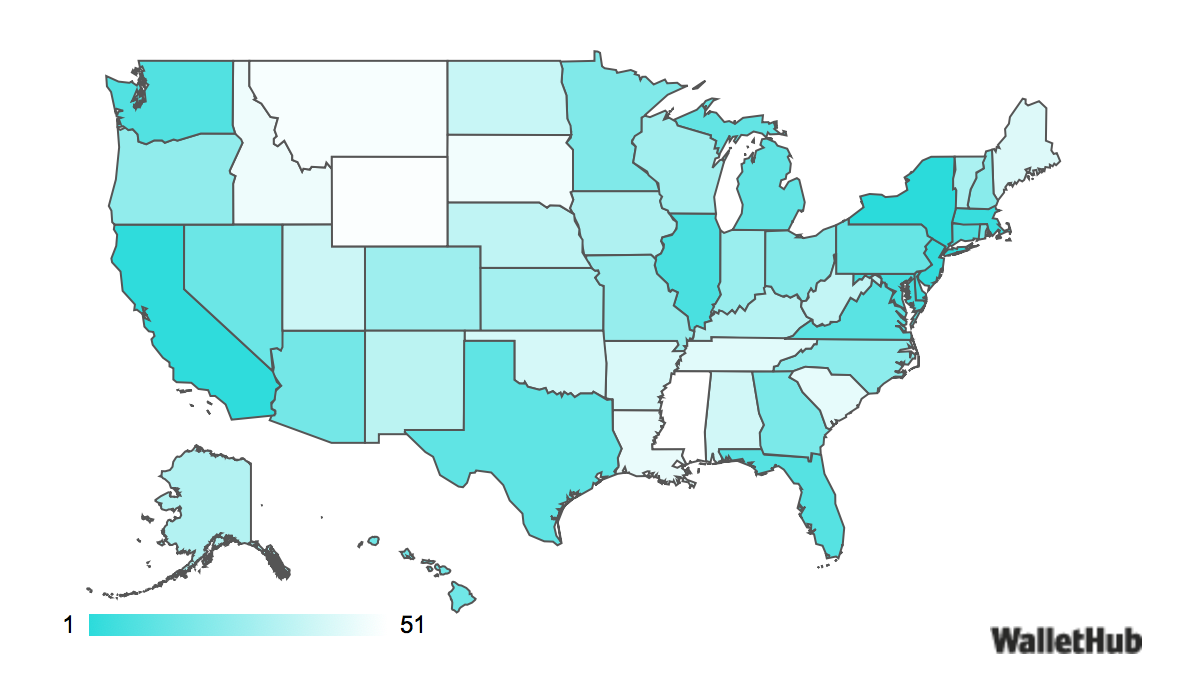
USA: Here’s the economic impact of immigration in each state in 2018

Nice map which has some overlaps with support for immigration (e.g West and East Coast) and opposition to immigration (e.g., Florida and Texas) in terms of states that voted for Trump:

As the national conversation about Dreamers, DACA, and Trump’s Wall continues, WalletHub decided to sit down and map out the economic impact of immigration on the United States. They looked at 19 metrics including median household income of foreign-born populations, immigrant-owned businesses, homeownership rates, and Fortune 500 companies founded by immigrants or their children.

The TL; DR of the report is that the states that traditionally have high levels of immigration (California, New York, New Jersey) also reap the greatest economic benefit.  In California, 27% of residents are foreign-born, which is 17.2 times higher than in West Virginia, the lowest at 1.57%. Unsurprisingly, immigrants make very little economic impact on West Virginia. Check out the full report here to start doling out facts and figures along with the many opinions about immigration.

Source: WalletHub

via Here’s the economic impact of immigration in each state in 2018

Worried about Trump-stoked exodus of immigrants, Canada discourages illegal crossings – LA Times

The government’s outreach in action in LA, and its key messages. Main takeaways from the article: overall message not different from hardliners but “delivered with a nicer Canadian soft sell” and “It’s unclear how effective he was:”

In a private dining room at Zov’s restaurant in Tustin, a Canadian envoy made his pitch to about a dozen immigration attorneys and immigrant rights leaders.
Pablo Rodriguez, a member of Parliament, leaned over from his seat in the middle of the table and asked everyone to spread the word: Please do not cross into Canada illegally.

“Get the facts and make a decision based on the right facts, before leaving your jobs and taking your children out of school and going up there hoping to stay there forever,” Rodriguez said. “Because if you don’t qualify … you will be returned and in this case not to the United States. You will have lost your status and would be returned to your country of origin.”

Worried that anti-immigrant rhetoric and decisions from the Trump administration could drive more people across its border, the Canadian government is trying to nip that in the bud.

Prime Minister Justin Trudeau dispatched Rodriguez to California. The whip for the majority Liberal Party in Parliament, Rodriguez arrived in the U.S. a few days after President Trump announced his decision to end temporary protected status of an estimated 200,000 Salvadorans in the country.

His message was not that different from immigration hardliners in the U.S. But it was delivered with a nicer Canadian soft sell.

Rodriguez was a young boy when he arrived in Canada as a political refugee from Argentina. He said he can empathize with those looking north.

He said that Canada is “an open country” and a nation of immigrants. But, he stressed, immigrating to the country needs to be done legally.

“You can’t just come to Canada and cross the border and stay there the rest of your life,” he said. “We want to avoid a humanitarian crisis along the border.”

The Canadian government, Rodriguez said, wants to avoid a repeat of what happened last summer when thousands of Haitians crossed Canada’s southern border “irregularly” after losing temporary protected status in the U.S.

The influx created a massive backlog of refugee claimants.

Last week was Rodriguez’s fourth outreach visit to the U.S. since the fall.

Rodriguez is one of several lawmakers and dignitaries Canada has sent in recent months to combat misinformation about gaining asylum in Canada. Recently, Canadian representatives traveled to Haitian communities in Miami and a Somalian enclave in Minneapolis.

During the meeting in Orange County, Rodriquez wore an infectious smile and an easygoing demeanor as he engaged in what he called a “friendly conversation” with immigration attorneys and immigrant community leaders.

It’s unclear how effective he was.

Some of those at the meeting said Canada seemed awfully hospitable compared to the countries some immigrants had left behind.

Countries such as Guatemala, El Salvador, Honduras and parts of Mexico are among the most dangerous places in the Western Hemisphere.

“If you are facing certain death in your country … Canada seems like a very excellent option,” said George W. Abbes, an immigration attorney.

Rodriguez said that so far there isn’t any indication that more Latin Americans are crossing the border from the U.S. to Canada.

But the Canadian government wants to be proactive, he said. Rodriguez said officials wanted to counter false reports in Latin American media that suggest migrating to Canada is an easy way to find immigration relief.

“We want to have an honest, transparent conversation,” Rodriguez said. “Canada is a very open country but there are rules.”

via Worried about Trump-stoked exodus of immigrants, Canada discourages illegal crossings