Anti-immigration groups at protest demand apology from Trudeau | Ottawa Citizen

It would be interesting to know more about the background of the Asian Canadians at the protest as, at first blush, these appear to be curious bedfellows (the website listed below is largely unpopulated):

Hundreds of Asian-Canadian protesters, supported by several white, far-right, anti-immigrant groups stormed Parliament Hill on Sunday afternoon to demand an apology from the prime minister.

According to plans for the protest on voteforright.com, members of the Asian-Canadian community feel victimized by a Toronto girl’s false claim in January that an Asian man cut off her hijab and Prime Minister Justin Trudeau’s apparent rush to view the fictitious incident as a hate crime.

Anti-Muslim and anti racist protestors voiced their views on Sunday on Parliament Hill. Anti-Muslim protestors joined with a group of Chinese-Canadians who were upset about the controversial hijab news story in Toronto. Ashley Fraser/Postmedia ASHLEY FRASER/ POSTMEDIA

“As the real victim of the hijab hoax, our Asian community was completely ignored by PM Trudeau,” reads a statement on the website.

A man who identified himself as “Yuanyuan” said, “There are some out-of-town conservative Chinese racists and they are collaborating basically with some white nationalist groups here in Canada. As a Chinese Canadian, I’m pretty ashamed about that. That’s why I’m here.”

The large Asian group, with members coming from Toronto and Vancouver to join members of the Ottawa Chinese-Canadian community, chartered buses for the event.

“We want to oppose them,” Yuanyuan said. “We don’t want them on our Hill saying they get to represent Canadian values. We know that their rhetoric is basically trying to normalize violence against minorities and marginalized folk. It’s not really a discussion about whether or not multiculturalism is good or not. We know that they stand for genocide.”

About 100 anti-racist protesters — while denouncing white supremacy and chanting about how welcome Muslims are — also repeatedly screamed “f-ck the police.”

Providing security for the Asian protesters were several anti-immigration, ultranationalist groups such as Quebec’s La Meute — or Wolf Pack — and the Northern Guard. Several Proud Boys — a far-right men’s group — were also in attendance.

La Meute’s Stéphane Roch said his members — of which there are 42,000 in Quebec — were in Ottawa to support the Chinese community.

Roch called them “real Canadians” who have been in the country for hundreds of years. “The Chinese community are a very good community. Trudeau don’t listen to them.”

“The government has to work for the citizens, not for themselves,” Roch said. “The power has to go to the citizens. They have to listen to us.”

An organizer with the Chinese-Canadian community who asked a reporter to “just call me Monica” said the event was behind schedule and chose not to speak to a reporter from this newspaper.

Several Chinese-Canadian protesters were there with their children, who held signs condemning the “hijab hoax” and “fake news.” The signs urged the government not to “stir up ethnic disputes.” Multiple people approached by a reporter indicated they did not speak English.

But speakers urged respect for “human rights” and asked that all Canadians be treated equally.

Among the sea of protesters were several placards taking aim at Trudeau, not Muslims.

Evan Balgord, a journalist and researcher who is following the rise of the new far-right movement in Canada, said that what was branded as anti-Muslim is being re-purposed as anti-Trudeau rhetoric.

“They always were anti-Trudeau, anti-Liberal government, anti-multiculturalism, anti-M-103 (a motion to condemn Islamophobia in the country) but the anti-Trudeau rhetoric is coming more and more to the front.”

Police escorted members of both groups away from the demonstration and some were banned from the Hill.

RCMP officers made a handful of arrests during the demonstration, but several of those people were released. A large group of Ottawa police escorted both groups on and off the Hill.

via Anti-immigration groups at protest demand apology from Trudeau | Ottawa Citizen

Tony Abbott repeats claim immigration cut will improve quality of life | Australia news | The Guardian

One could have a similar debate here without being xenophobic (“stagnant wages, unaffordable housing and clogged infrastructure”):

Tony Abbott has seized on Peter Dutton’s claim that Australia needs to cut its migration intake and signalled he will renew his push to do so by linking migrant numbers to quality of living issues.

On Monday the former prime minister said he would make the case for cutting migration to improve “stagnant wages, unaffordable housing and clogged infrastructure” in a speech in Sydney on Tuesday.

The speech coincides with Malcolm Turnbull’s trip to the US to meet Donald Trump and picks up on themes from Abbott’s “conservative manifesto” launched in 2017, viewed as a critique of Turnbull government policies.

Abbott told 2GB Radio that the “gossip” regarding Barnaby Joyce and politicians’ private lives was a “very serious distraction” to issues including power prices, wages, housing prices and traffic congestion that the government “should be attending to”.

Asked about Jim Molan’s first Senate speech in which the conservative Liberal called for a reassessment of migration levels, Abbott said the program must be run “in Australia’s national interest”.

“Just at the moment we’ve got stagnant wages, unaffordable housing, clogged infrastructure and there is no doubt the rate of immigration impacts on all of these things.”

Abbott said that immigration had averaged 110,000 a year for most of the life of the Howard government and since 2006 “it’s been running at double that rate”.

“That means every five years we are adding – by immigration alone – a city the size of Adelaide to our population.”

Abbott said the level of immigration was “very, very high”, “absolutely unprecedented by historical standards” and “on a per capita basis, vastly higher than any other developed country”.

According to the parliamentary library, an average of 107,000 permanent migrants and people on humanitarian visas entered Australia a year between 1996 and 2006 compared with 190,000 a year from 2006 to 2016.

However, the average in the Howard government was weighed down by low results in the early years. By 2006-07, 161,217 people came to Australia on permanent or humanitarian visas, almost as high as during the Rudd and Gillard Labor governments and Abbott and Turnbull Coalition governments, when it ranged up to 200,000.

The net overseas migration figures were 114,000 a year between 1996 and 2006, and 220,000 a year from 2007 to 2015.

However, from 2006 onwards, estimates for net overseas migration included people who stayed in Australia for 12 months or more, who were added to the population. This means the figures after 2006 are boosted by temporary migrants who later become permanent residents or citizens.

In his book Choosing Openness, Labor’s shadow assistant treasurer Andrew Leigh noted that, according to an OECD survey of academic studies, migrants had minimal impact on housing prices.

Of the OECD’s 28 studies on immigration and wages, 13 reported no effect, seven a small positive effect, and eight a small negative effect, he said.

Abbott qualified his remarks by saying he was “all in favour of immigration but it has to be the right immigration, under the right circumstances, that’s right for our country, including the recent migrants”.

“I think the current rate of immigration does need to be looked at again – that’s what Peter Dutton seemed to be suggesting on Ray’s program last week.”

On Thursday Dutton said Australia must reduce its intake of migrants “where we believe it’s in our national interest”.

Dutton said it was a “perfectly legitimate argument” that Australia’s cities were “overcrowded” including “gridlocked traffic in the mornings”.

“We have to reduce the numbers where we believe it’s in our national interest,” he said. “It’s come back considerably and if we have to bring it back further, if that’s what required and that’s what’s in our country’s best interests … that is what we will do.”

After the Turnbull government recorded its 27th consecutive Newspoll loss on Monday, Abbott said it was “very dangerous and counterproductive” to get rid of a leader “on the basis of a poll, or the basis of 29 polls”.

“It was the prime minister who made the polls this kind of a test, and really it’s the prime minister who has elevated polling into the be-all and end-all,” he said.

via Tony Abbott repeats claim immigration cut will improve quality of life | Australia news | The Guardian

Hungary′s Orban threatens pro-refugee NGOs, slams Muslim immigration | News | DW | 19.02.2018

Keeps getting worse:

Hungarian Prime Minister Viktor Orban amped up his anti-migrant rhetoric on Sunday as he geared up for national elections on April 8. To that end, Orban’s party has proposed new legislation that would penalize NGOs that assist refugees.

“If they do not stop their dangerous activities, we will simply expel them from the land, no matter how powerful or rich they may be,” he said during his annual State of the Nation address.

The new law would levy a 25 percent tax on all foreign funding for asylum seeker aid organizations, and bar their workers from entering settlement camps near the country’s borders.

Although the prime minister’s Fidesz party does not currently have the two-thirds majority in parliament needed to pass the bill, it will likely make significant gains in April’s vote.

Orban also used his yearly address to suggest that the increase of Muslims in Europe is a harbinger of the fall of Western civilization.

“Dark clouds are gathering over Europe because of immigration,” said Orban, who is hoping to be elected to a third term in April.

“Nations will cease to exist, the West will fall, while Europe won’t even realize that it has been invaded,” he ominously declared. “Christianity is Europe’s last hope.”

Since Europe’s refugee crisis began in 2015, Orban has emerged as one of the most high-profile nationalist voices in the European Union. During the height of the crisis, Hungary enacted some of the most draconian responses to the influx of people fleeing war and famine, such as constructing a razor-wire fence along the border with Serbia.

Orban’s time in office has also coincided with a clampdown on foreign influence in the country. Last spring, a bill was introduced to parliament that could potentially shut-down foreign-funded universities such as Budapest’s Central European University (CEU). Written under the auspices of putting Hungarian universities on a level playing field, many see the legislation as unfairly targeting CEU because it is largely financed by Orban critic George Soros.

via Hungary′s Orban threatens pro-refugee NGOs, slams Muslim immigration | News | DW | 19.02.2018

Montreal prelate fears “second class citizenship” for people of faith

Interesting commentary on some cross faith commonalities:

Last fall, the Canadian province of Quebec passed legislation, Bill 62, that would make it illegal for anyone to receive public services if they did not show their face. Dubbed as a “religious neutrality” law, critics claimed the bill discriminated against Muslims who wear headscarves as a part of their religious practice — and should be cause for concern for all people of faith.

In recent months another controversy has brewed over Canada’s summer jobs program — a popular funding initiative for businesses and organizations to hire students during summer break — when the government of Prime Minister Justin Trudeau announced that in order to receive funding, you must attest to supporting abortion rights in Canada. Last month, a group of Jewish, Catholic, and Muslim leaders joined together in protest of the decision and called on the government to reverse its policy.

In an interview with Crux, Archbishop Christian Lépine of Montreal said he feared both the example of Bill 62 and the Canadian Summer Jobs program are moving the country in the direction of relegating people of faith to “second-class citizens.”

CRUX: Bill 62 — which requires that people who receive public services to show their faces — will most concretely affect Muslims who wear the niqab or a burka if religious accommodations aren’t put into place. What principles of religious liberty do you believe to be at stake here?

Archbishop Christian Lépine: – The clear intention of the law is to affirm freedom of religion and conscience in the name of neutrality of the state. But what is neutrality? Neutrality can be understood — and it’s my understanding of it — that everyone is welcome. You don’t have to hold a particular belief and whatever your belief might be, generally, you are welcome — just as you are, as a person. When neutrality becomes “You’re welcome, but signs of your belief cannot be visible,” is this still freedom? Is this still welcoming? You are welcome, but not in every respect.

If you are a government official or civil servant, you might say that we are serving the goal of neutrality by excluding certain signs. But, in my view, I think neutrality would be better served by saying that everyone, along with their particular signs of belief, is welcome. In which case, pluralism becomes visible; one can see that we’re a pluralistic society. However, if you say we’re a pluralistic society but certain visible signs are not allowed, then pluralism becomes invisible. I don’t believe in a neutrality that excludes people.

Why should Catholics care about this case?

Well, first there is the issue of principle. You can say: “It doesn’t involve us, it’s for others.” But one day, it might be for us.

Another concern is the ripple effect. Laws have a socialization effect, sending signals about what society considers important. If we choose to exclude in the name of neutrality, then, perhaps one day, a person will be waiting in a line to be served — maybe at a drug store or some company — and someone will say: “What are you doing here with your burka or niqab? Go back to your country if you don’t like it here. Get out of the line or remove your sign.” The ripple effect of this law can affect people’s mentality and their capacity to welcome others and their beliefs.

Do you see this as a sign of a diminishing of religious tolerance in Canada?

It is a sign of diminishing freedom of religion and conscience. Some might say it’s not very much, but Pope Francis talks about “polite persecution,” and it could possibly lead to that. I don’t think that is the intention of the law, but if neutrality of the state is used to exclude the public manifestation of certain religious beliefs, somehow, you are moving in the direction of creating second-class citizens.

Do you think Pope Francis has helped build a bridge between interfaith communities in Quebec?

Some, in Quebec, were at work building interfaith bridges before the Second Vatican Council. But after the council, religious leaders and civil society made a conscious effort to do so. Pope Francis certainly helps in this regard with his focus on “a civilization of encounter.” Of course, encounter means encountering those within our own belief system, but it’s also about encountering people of other beliefs and other ways of life.

Speaking of interfaith issues, multiple faith-based groups have come together to protest the government’s changes to Canada’s Summer Jobs program guidelines requiring a pledge of support for abortion rights before receiving federal funding. How did this happen and what’s at stake here?

We need to go back to the United Nations Declaration of Human Rights in 1948, which is the model of our Charter of Rights. Not everyone around the table professed the same religious beliefs, philosophy or convictions. There were Christians, but there were also Muslims, atheists, and a Communist regime at the table. After two years of discussion, they had trouble drafting a common declaration regarding the grounds for respecting human rights. So, they made a decision to shift their focus, moving from their own unique starting positions and focusing, instead, on making a solid affirmation of the inherent dignity of every human person. That became the starting point, with each group with their own religions or philosophies justifying it their own way. It wasn’t about using the Declaration to create a belief system to judge other belief systems or to diminish them. It’s about creating a society which includes different belief systems and respects them. It’s not about imposing your belief system on others.

The Charter of Rights is there to protect pluralism and the diversity of religions, beliefs and ways of thinking. It’s not there so I can take my Charter and use it against the beliefs of others. In that sense, I don’t think you can use the Charter of Rights to say “Your beliefs, your ways of thinking are not mine, so you won’t receive any funding from the government.” Abortion is not in the Charter of Rights, so if you want to respect people who hold various beliefs, and if you want to be democratic, you don’t decide who receives funding or not based on matters related to their beliefs.

You mention that Pope Francis has talked about the “polite” persecution of Christians—do you think this is also an example of that?

In the example of the Summer Jobs Program, I would call it a form of exclusion. It says: “You are a part of society, but there are certain aspects of who you are that you should keep private, and we don’t want them to be part of society.” Our Charter of Rights was not made for that; it was made to prevent us from creating second-class citizens.

via Montreal prelate fears “second class citizenship” for people of faith

You’re Wrong! I’m Right! – Kristof, The New York Times

Good piece. We all need to get outside our bubble:

We live in two Americas.

In one America, a mentally unstable president selected partly by Russia lies daily and stirs up bigotry that tears our social fabric.

In another America, a can-do president tries to make America great again as lying journalists stir up hatred that tears our social fabric.

The one thing we all agree on: Our social fabric is torn. In each America, people who inhabit the other are often perceived as not just obtuse but also dangerous. Half of Democrats and Republicans alike say in polls that they are literally afraid of the other political party.

This is not to equate the two worldviews. I largely subscribe to the first, and I’m a villain in the second. But I do believe that all of us, on both sides, frequently spend more time demonizing the other side than trying to understand it, and we all suffer a cognitive bias that makes us inclined to seek out news sources that confirm our worldview.

A classic study offered free research to ordinary Democrats and Republicans. People on both sides were eager to get intelligent arguments reinforcing their views, and somewhat interested in arguments for the other side that were so silly they could be mocked and caricatured (it’s very satisfying to dismiss rivals as libtards or bigots). Neither Democrats nor Republicans were interested in intelligent arguments challenging their own views.

Decades ago, a media expert at M.I.T. named Nicholas Negroponte foresaw the emergence of a news product that he called “The Daily Me,” with information tailored to a user’s needs. Negroponte was thinking of local weather, sports, particular interests and so on, but what actually arrived with the internet was a highly political version of “The Daily Me.”

There’s not an exact parallel in the way the right and the left seek out like-minded news sources. The right has spawned conspiracy nuts like Alex Jones who believe that the Sandy Hook school shooting was faked, and one study found that the more people watched Fox News, the worse they did on a current events test.

So I’m not advocating that you waste time on Breitbart propaganda any more than I’m saying that it was worth listening to leftists in the 1970s who praised Chairman Mao. But wherever we stand on the spectrum, there are sane, intelligent voices who disagree with us — and too often we plug our ears to them.

Moreover, there’s some experimental evidence that our biased approach to getting news actually makes us dumb. For example, one experiment asked 1,000 people to look at a simple data set and draw conclusions about a skin cream’s effectiveness. Not surprisingly, Democrats and Republicans were about equally good at calculating the math and determining how well it worked.

But when the experiment offered the very same data set and said it referred to the effectiveness of a gun control measure, Democrats and Republicans alike went to pieces. In one version, the numbers showed that a gun control measure worked — and Republicans kept flubbing the math. In another version, the gun control measure was ineffective, and this time the Democrats couldn’t manage the calculations.

The evidence on these biases is complex, studies sometimes haven’t replicated well, and I don’t want to exhibit confirmation bias in my warnings of confirmation bias. Researchers also caution that it’s too glib to say we are all locked in our echo chambers, for most Americans still are regularly challenged by dissonant information.

But what does seem clear is that rigid ideological beliefs impair our cognitive functions. For many years, Philip Tetlock of the University of Pennsylvania has been running experiments measuring the ability of thousands of people to make sound predictions.

The best forecasters, Tetlock finds, are not experts or even intelligence officials with classified information, not liberals and not conservatives, but rather those instinctively empirical, nonideological and willing to change their minds quite nimbly. The poorest marks go to those who are strongly loyal to a worldview.

I wondered whether to write this column, for there are so many urgent — and progressive! — causes on the table that I want to thunder about: Dreamers, guns in American life, White House dismissiveness toward domestic violence, and so on. But the “Daily Me” problem also undermines the capacity of liberals to win these arguments. When we stay within our own tribe, talking mostly to each other, it’s difficult to woo other tribes to achieve our aims.

The ideological blinders may worsen because of our tendency to seek out like-minded people. A 2014 Pew survey found that half of consistent conservatives and 35 percent of consistent liberals say “it’s important to me to live in a place where most people share my political views.”

It should be possible both to believe deeply in the rightness of one’s own cause and to hear out the other side. Civility is not a sign of weakness, but of civilization.

via You’re Wrong! I’m Right! – The New York Times

What Can the U.S. Learn From How Other Countries Handle Immigration? – The New York Times

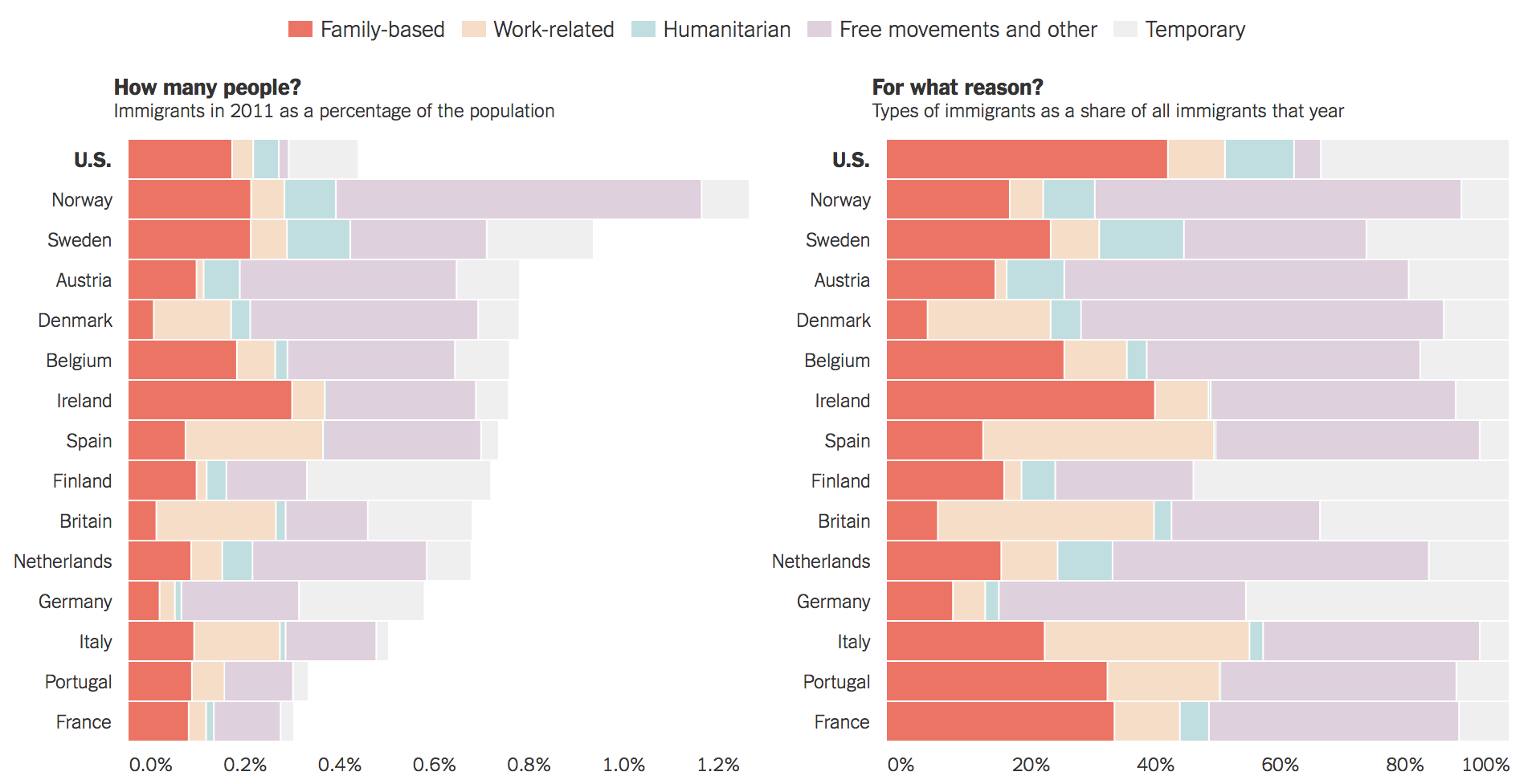
One of the better comparative analyses I have seen, with good charts. If Canada had the same allocation between classes, about 200,000 would be family-class compared to 40,000 economic class  compared to the actual number of 61,000 family and 156,000 economic (2011 data):

Every country regulates immigration in its own imperfect way. Some countries have populations that are 80 percent foreign-born but offer no pathway to permanency. Other countries put up huge barriers to citizenship except for people whose parents were born there.

In the United States, the Senate has struggled, unsuccessfully so far, to pass an immigration reform bill. But the debate has put nearly every category of immigration on the table, from smaller, targeted programs such as Deferred Action for Childhood Arrivals, Temporary Protected Status and the Diversity Immigrant Visa, to big pillars of the immigration system like work-related and family-based migration.

President Trump has called for a shift from what currently makes the American immigration system distinct: its focus on family ties, a framework that accounts for two-thirds of all residency visas, more than any other country. Instead, he and many Republicans would like most visas to be distributed based on employability, with a preference for those who are highly skilled, like doctors, engineers or entrepreneurs.

“In many ways the U.S. immigration system is a relic of the past,” said Justin Gest, a professor at George Mason University who studies comparative immigration policy, referring to how public opinion has changed since 1965, when the family-based system was established. “It is far more generous than I think the spirit of the United States is today.”

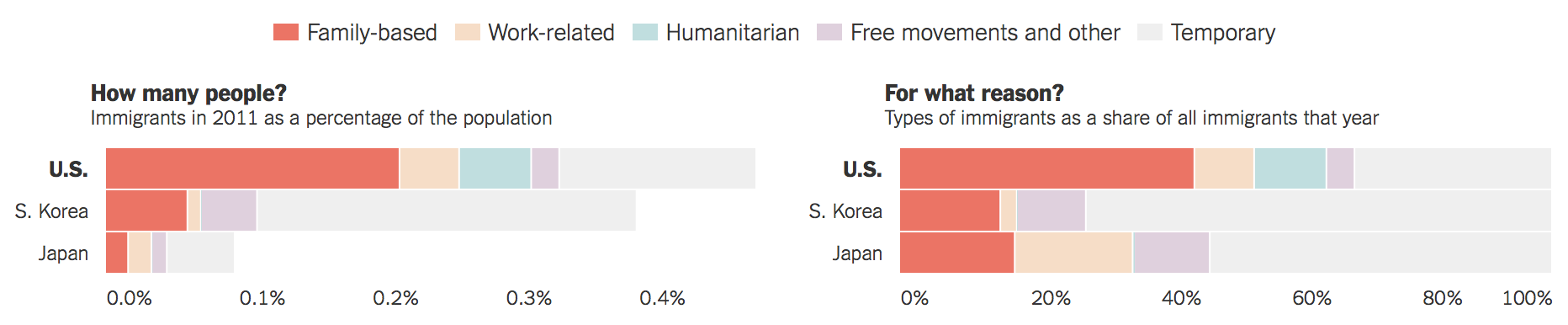
The accompanying chart displays selected countries and the circumstances under which each one welcomes foreigners. It’s based on data from 2011, the latest year available for certain countries like China, and shows temporary migrants (like students and guest workers) and permanent migrants, broken down by the basis for their visa: family ties, employment, humanitarian purposes (as with refugees) or under a free-movement policy (as with the European Union).

Note that the data did not capture undocumented immigrants. Although the United States has good estimates on its undocumented population, data from other countries are spotty and harder to come by.

Simply put, the purpose of an immigration policy is to decide what types of people to allow inside the border. What would it look like if the United States adopted rules more like those of Canada, Japan or Qatar? Compare the policies below.

The Mix if We Looked More Like Canada

In 2011, Canada and Australia relied heavily on immigrants who were admitted based on employability, many of whom were allowed to stay permanently. Both countries used a merit-based point system to determine who qualified, assigning a number of points to criteria such as education, language skills and employment history.

Mr. Trump has said that he would like to emulate the Canadian and Australian systems. But Mr. Gest pointed to a blind spot the size of Ohio — the seventh-most populous state — that could be obscuring how similar the systems already are: undocumented immigrants, who are highly represented in the United States in many low-skill industries like farming and construction.

“If you think of the undocumented as 11 to 12 million temporary low-skilled laborers, then you have a system that looks a little bit more like Canada” in terms of temporary workers, he said. (In fact, Canada and Australia have a much greater proportion of temporary workers than the United States.)

But a merit-based system doesn’t necessarily result in economic payoff, because skills don’t always lead to a job. For example, Canada has struggled to keep its merit-based workers employed since 1967, when the policy was first established.

That’s because some of the very skills and credentials that ushered immigrants into the country were unrecognized once they arrived, so many ended up unemployed or underemployed.

Another reason President Trump might not want to rely too heavily on Canada or Australia as models: Both countries allow in far more immigrants as a percentage of their population. If the United States were to follow their lead, it would involve admitting millions more people.

Or More Like Europe

Historically, most immigrants in Europe have been other Europeans. The European Union allows people to relocate between countries with a level of freedom that is unmatched elsewhere in the world, greatly widening employment pools.

Middle Eastern conflict has created an exception in recent years, spurring a big influx of asylum seekers from war-torn countries. But humanitarian migrants typically make up only a small proportion of Europe’s foreign-born population.

Mercosur, a trade bloc in South America, functions like the E.U., though it allows people to live outside their home countries for only two years at a time, after which they must apply for permission to stay permanently.

It might help to imagine that these partnerships are like Nafta — the policy between the United States, Mexico and Canada that lowers barriers for trade, which President Trump has threatened to eliminate — but instead of goods, the agreements apply to people.

In a system like that, Americans looking for work would be able to expand their searches into Canada and Mexico, but they would also compete against Canadian and Mexican candidates for jobs in the United States.

Or Like Japan and South Korea

South Korea and Japan are so stringent with immigration that they make the United States look lenient. This is partly because of a desire to preserve their cultures, a goal echoed by some conservative groups in the United States.

For example, the Japanese government once offered thousands of dollars to immigrants of Japanese descent to leave the country. And very few people become South Korean citizens without family ties; doing so requires years of residence, an in-person language proficiency test and a written test on customs, history and culture.

On top of stoking racial tensions, these policies have created demographic problems for South Korea and Japan. Both countries’ populations are aging rapidly, social services are underfunded, and many industries face labor shortages.

Some unusual policies, such as Japan’s practice of granting citizenship based on a parent’s Japanese nationality instead of where babies are born, have created situations where three generations of a family may not be Japanese citizens despite having lived in the country all their lives.

Or Like the Gulf States

The Gulf states allow a huge immigrant influx to meet the demand for cheap, low-skilled labor, but almost all of the immigrants are temporary, and they have few rights or protections.

In Qatar, for example, roughly 80 percent of the population is foreign-born. Without them, the skyscrapers of Doha or the 2022 World Cup, for which the government has promised to build more than half a dozen new stadiums, would not be possible. And the Qatari government has been accused of human rights abuses against those workers.

The only way that governments can sustain these heavy immigrant populations is by withholding the generous resources that are granted to ordinary citizens, such as free health care, free college tuition and marriage allowances.

Most Americans would not be comfortable with this approach, said Morris Levy, a political scientist at the University of Southern California who studies public opinion on immigration. “People dislike the idea of a permanent second-class citizen,” he said. “It goes back to a core set of values that people think of as really elemental to being American.”

The Future Is Probably Somewhere in the Middle

Based on the current debate, any solution that Congress agrees on will probably fall somewhere between international models. It could follow some trends that are occurring worldwide.

For example, in many countries, including Canada and Australia, there has been a shift away from exclusively merit-based systems to ones that also consider whether someone has a job offer — something currently done in the United States.

For purposes of immigration, the United States could narrow its definition of family, which is wider than that of any other country, to exclude siblings or adult children who are married.

Although current American policies around family-based migration are the most generous in the world, the results look much different in practice because of limits on the number of visas that can be granted in each category.

“There is a certain mindlessness to family immigration when you take into account eligibility and time,” said Demetrios G. Papademetriou, co-founder of the Migration Policy Institute, a research organization. “Someone qualifies, but it may take 20 years before a visa is open to them.”

“There is a major undisputed advantage to family immigration, chain migration; it’s become apparently a dirty word,” he said. “You have someone here who will show you the ropes, who will take you in that can set up employment for you. When it comes to immigrant integration, family is very important.”

You could envision a merit-based system that incorporates characteristics of our current system. It could grant points to people who have family members in the United States, or who come from countries that are not highly represented in the current population.

In that case, it might be desirable to pay attention to the weight each category is given and to adjust based on economic and social outcomes.

“That is how you keep a point selection system,” Mr. Papademetriou said. “Everything else is just blind faith or politics. Our system that exists today is just politics.”

While the sputtering negotiations are frustrating for many people, especially for those caught up in the system, academics agree that, in general, these decisions should not be rushed.

“Immigration is social engineering,” said Mr. Gest, the George Mason University professor. “You’re building the population of the future.”

via What Can the U.S. Learn From How Other Countries Handle Immigration? – The New York Times

How a broken jury list makes Ontario justice whiter, richer and less like your community

Good in-depth analysis and reporting:

A two-year Toronto Star/Ryerson School of Journalism investigation documenting the racial makeup of jurors in 52 criminal trials since 2016 in Toronto and Brampton reveals flaws in the jury selection process that skews towards property owners, fails to reflect the GTA’s growing diversity and excludes potentially millions of Ontarians from serving their civic duty.

The jury selection list is based on the province’s property assessment rolls, excluding many renters, boarders, students, seniors, spouses who are not named on property titles, transient and low-income people, Indigenous people and those unable to afford property in a red-hot real estate market.

What remains is a prospective juror list disproportionately comprised of white Ontarians able to afford the significant costs of serving in a system that often pays jurors less than minimum wage and does not cover expenses such as travel, parking, meals and child care. It is a particular hardship for hourly workers — Ontario has no law compelling companies to compensate employees for jury duty — the self-employed or those in temporary or contract jobs.

Seventy-one per cent of the 632 documented jurors were white in cities where more than half the population identifies as non-white (In Toronto, 51.4 per cent of residents identify as visible minorities; in Brampton, the figure is 73.3 per cent).

People who identify as Indigenous are not counted as visible minorities by Statistics Canada.

The finding of innocence or guilt by a jury of our peers is a pillar of Canada’s justice system that has been shaken by the recent verdict — delivered by an all-white jury — acquitting white Saskatchewan farmer George Stanley in the second-degree murder of a slain Cree man named Colten Boushie.

Following Stanley’s acquittal, Prime Minister Justin Trudeau said, “as a country we can and must do better,” and justice minister Jody Wilson-Raybould said the government is looking at peremptory challenges, which are used by the defence and prosecution to reject potential jurors without stating a reason. Reports say Stanley’s defence rejected five potential jurors who appeared to be Indigenous.

The Star/Ryerson investigation reporters did not watch jury selection in all 52 trials. The data in this story is based on sitting juries after the selection process, including peremptory challenges.

Beginning in February 2016, reporters attended GTA trials to document juries’ racial composition.

Because the Ministry of the Attorney General does not keep this data, and observers are denied contact with individual jurors, reporters decided upon a visual survey as the most complete possible method to gauge the racial makeup of juries.

Reporters noted jurors’ race based on their physical appearance, using the same categories as police: white, Black, Indigenous and brown, which includes South Asian people. Reporters added the categories Asian and other, which included Latin American, Middle Eastern or mixed-race jurors.

Of the juries documented, only three were composed of 50 per cent visible minority and 50 per cent white jurors. In most cases, white jurors represented the majority with as many as 11 of the 12 positions.

Of the 632 jurors surveyed by reporters, 451 (71 per cent) were white; 45 (7 per cent) were Black; 42 (7 per cent) were brown; 89 (14 per cent) were Asian; and 5 (less than 1 per cent) were listed as other. Reporters were unable to identify a single Indigenous juror.
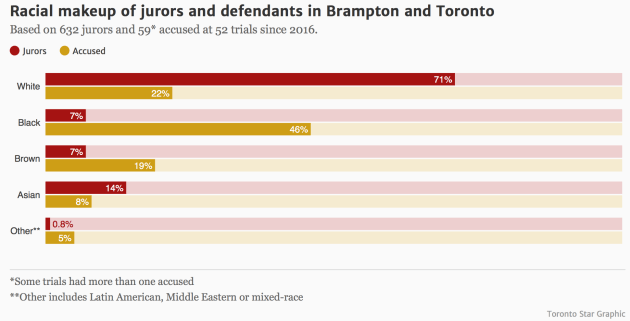
Across the aisle, the visible ethnicity of the accused presented a very different picture: Of the 59 documented accused (some trials had more than one), 27 (46 per cent) were Black; 13 (22 per cent) were white; 11 (19 per cent) were brown; five (8 per cent) were Asian and three were counted as other.

Over the past decade, as the province’s cities grew increasingly diverse, the Ministry of the Attorney General has fielded many complaints and concerns about the Ontario jury system.

In 2013, Former Supreme Court judge Frank Iacobucci, who authored a report on the lack of Indigenous representationon jury rolls on First Nations reserves, recommended that the Ministry of the Attorney General “undertake a prompt and urgent review” of “using the OHIP database.”

That database, which better reflects Ontario’s population, is still not being used.

“There’s obviously a problem here,” says Ottawa defence lawyer Michael J. Spratt. “Trial by jury is a cold comfort when you’re told that you will be tried by a jury of your peers and no one on that jury looks like a peer. We’re unable to drag our courts into the 21st century and perhaps that explains why our jury system is still stuck in the 19th century.”

The first step in jury selection begins with a notice to Canadian citizens 18 years old and over from a database that generates property ownership and enumeration lists. It is managed by the Municipal Property Assessment Corporation (MPAC) and contains 9.5 million names of both property owners and non-owners.

The database is incomplete. But it has been used as the source for the jury pool for decades.

In a written statement, the Ministry of the Attorney General acknowledged the database used for jury selection, “does not capture everyone in the province” and that it is “committed to improving the provincial jury process.”

MPAC officials also concede shortcomings in the database including large groups of Ontarians who don’t own property.

Creating lists of prospective jurors is “not our core business,” said Syd Howes, manager of information services at MPAC. “This is a property assessment database, this is not a people database.”

Among the blind spots: “We don’t have very many resident students in our database,” says Howes. “And you have fairly large populations in nursing homes and retirement homes and again, we wouldn’t have a lot of those names in our system.”

MPAC doesn’t attempt to assess properties on First Nations reserves, since they are not subject to taxation. The Ministry of the Attorney General says those living on First Nations are entered into the pool from “other lists, like Band lists.”

It is unclear how those who don’t own property, such as renters, are captured. MPAC has mailed occupancy questionnaires to residential properties asking for information for non-owners but only about 20 per cent of the forms are returned, says Howes.

“We have no means of identifying when people move. People aren’t required to tell us … We don’t have access to good tenant information.”

The existing data on non-owners can be plagued with errors. After the 2014 election, MPAC reported 1.2 million revisions to the voter’s list, including changes to 20 per cent of its tenant list, according to a 2015 review obtained by the Star.

The faces that do make it into jury boxes across Toronto and Brampton often have one thing in common: they’re white.

In February 2016, reporters recorded a jury of 11 white people and one brown man hearing the case of a 25-year-old Black male. In March 2016, 10 white jurors, one brown and one Asian heard the case of a 40-year-old brown female. In January 2018, 10 white people and two Asians heard evidence in the trial of a 30-year-old Black male.

Harpreet Saini, a criminal lawyer who has been practising in the GTA for more than a decade, is not surprised.

“There is still a disparity between the communities that we serve and the different types of people who are represented in the criminal justice system.”

For Saini, a jury of peers is one that reflects “the place where you live.” That does not mean a jury must be “exactly like you,” but reflects “the diverse interest of your community.”

Anthony Morgan, a Toronto lawyer with Falconers LLP, says it’s time for the government to name the problem and take action.

“We’re never going to get to a place where we can fix this until we outwardly say, yes, there is an underrepresentation of Black people on juries but there is a dramatic overrepresentation of Black folks who stand charged of crimes,” he says.

In a Toronto jury selection pool of 119 people on Wednesday, reporters counted only three Black prospective jurors. The accused is a Black man in his 20s.

In 2016, Toronto lawyer Steven Hinkson represented a 36-year-old Black man charged with drug and weapons offences. Eleven of the 12 jurors were white.

His client had a question: How come there aren’t any Black people on the jury?

“I tried to explain to him, that’s all we had to choose from,” says Hinkson. “Justice has to appear to be fair and equal. If persons who are in the system don’t see themselves reflected in the system they aren’t going to have much faith in the system.”

Hinkson, who rarely sees more than one or two non-whites on a jury, says that jurors, who are not “culturally sensitive to a racialized person’s experience,” are likely to look upon defence witnesses with “undue scrutiny.”

Jurors unfamiliar with a dialect or accent, for example, “may not look upon the testimony as being equal to somebody who doesn’t have an accent or have a negative perception of them as a consequence.”

The trial of Hinkson’s Black client ended in a hung jury.

Hinkson suspects the majority of the jury was aligned against his client with the exception of the lone non-white member who he says was of East or West Indian descent.

“I think the person of colour was the one that saved us. I think that’s because he could relate more to what the defence was saying. The jury was coming back saying there was one member of the jury that was problematic. And you can see dynamics, the body language. It’s clear to my observation that he was the problem in this jury because his views were not what they wanted.”

In the second trial, his client entered into a deal to reduce the charges in exchange for a guilty plea on lesser charges.

Vanessa MacDonnell, a University of Ottawa law professor, says lawyers have a “professional responsibility, and I would say a constitutional obligation, to ensure that they don’t discriminate against people as part of jury selection process.”

She supports a switch to the more comprehensive OHIP database which could be done “without too much difficulty because these are lists (the government) compiled anyway.”

Former Ontario chief justice Patrick Lesage, retired after serving for nearly three decades on the bench, agrees property ownership is an inappropriate starting point for jury selection.

“If that is the case, it should not be the case,” he said. “It should be (representative of) a cross section of the community at large.”

Provincial health cards, he says, “may be the most universal list that exists. I can’t think of anything that each of us is more certain to have than a health card.”

Ottawa defence lawyer Michael Spratt sees the same jury faces all the time — white, middle class and older.

“I don’t care who makes (the juror list) as long as it is complete and as long as it is a full and accurate representation of the community, and that all individuals — whether you are poor, rich, white, Black, homeless or a homeowner — have an equal probability of forming that list,” he says.

Toronto lawyer Brian Eberdt, who is with Lockyer Campbell Posner, predicts 90 per cent of those involved with the criminal justice system would agree jury selection is a problem.

“I think it’s something that all members of the justice system — from defence, Crown, the court, the judges, and the ministry — I think it’s incumbent on all of us to make sure that the impact of race in distorting a jury’s deliberations is kept to a minimum … We’ve got a long way to go.”

Eberdt points to a jury selection in Brampton last year for a trial involving allegations against his Black client.

“In the entire room of several hundred jurors, I think I saw maybe half a dozen Black people. I know for sure that’s not entirely representative of the cultural mix of Brampton. There’s an unfairness to my client in that.”

Tale of two wards

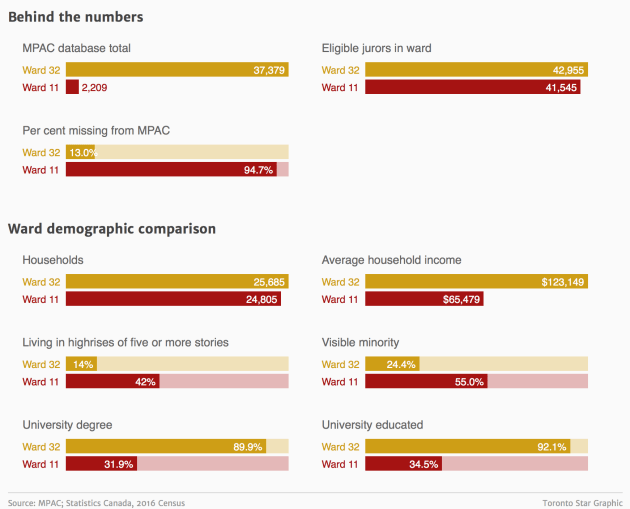
The Toronto Star compared City of Toronto ward demographics for voting-age adults with ward data provided by the Municipal Property Assessment Corporation from its list of eligible voters — the same list that serves as a starting point for the selection of jurors.

Of the 17 wards examined, most in the old city of Toronto, two stand out.

In Ward 32, which includes the tony Beach neighbourhood, a Star analysis found the difference between the number of voting-age adults living there and the total on MPAC’s list was the smallest, with a 13 per cent variation.

In Ward 11, which includes the neighbourhoods of Weston and Mount Dennis and is among the poorest areas of the city, the difference was the largest, with a variation of nearly 95 per cent.
via How a broken jury list makes Ontario justice whiter, richer and less like your community | Toronto Star

Ontario puts moratorium on suspending racialized public servants

Strong step:

The province has put a moratorium on suspending racialized public servants while it reviews how it processes complaints on racial discrimination.

The announcement came a day after more than 20 Black employees, mostly women, brought their concerns directly to Michael Coteau, Ontario’s minister of children and youth services, who is also in charge of the province’s anti-racism initiatives.

At a meeting Jan. 18, past and present public servants said they suffered racial harassment and faced reprisal when making complaints.

Coteau heard stories from Black employees who said their roles were steadily diminished despite years of positive reviews. Others had trained new staff, only to see those new employees be given higher, more lucrative positions. Some said their complaints about racial discrimination were mishandled. A majority of the participants said they had been suspended, demoted or fired while the staffers they had complained about faced no repercussions.

“When I started at the ministry, I was confused for the hired help,” Hentrose Nelson, who has worked in the public service since 2004, told Coteau. Nelson was one of the organizers of the meeting and she spoke about her experience with the complaints and suspension process.

Nelson is also a plaintiff in a lawsuit against provincial Citizenship and Immigration Minister Laura Albanese, alleging systemic racism in the department.

None of the accusations has been tested in court.

Boafoa Kwamena, a spokesperson for the Ontario Public Service — which encompasses over 60,000 employees in the province’s ministries, agencies and Crown corporations — would not comment on specific complaints. She also declined to answer Metro’s questions about what prompted the moratorium or how long it will last, saying in an email this week only that it is in place pending the review of existing policies and procedures.

Where there is a clear case of wrongdoing such as theft or violence against another staff member, the moratorium does not apply as those cases are reviewed by the province’s Public Service Commission.

“Creating a safe, inclusive and respectful environment for everyone in the OPS is a top priority,” Kwamena wrote in an email.

She added that officials are working with the Black OPS Network, an internal employee network, on a three-point plan. It includes an independent third-party review of complex cases; an independent review of the Workplace Discrimination and Harassment Prevention policy with an anti-racism methodology; and developing an anti-racism policy. Attendees of the January meeting also called for these actions.

The review of the complaints process is intended to start by this March. A private sector lawyer will manage the review of complex cases. The OPS has declined to name the lawyer until a contract has been finalized.

“This is really something that we wanted to do for other Black women,” explained Jean-Marie Dixon, who has worked as a lawyer in the civil service.

Dixon says the action employees are taking now is for future generations. She wants to see people who have engaged in racism and discrimination fired as well as more funding and support for Black women going through a grievance, complaint or lawsuit.

Nelson welcomes the news of the moratorium and echoes the hope for more change to come.

“It’s not about our struggle only,” she said in an interview following the announcement. “It’s a systemic beast which we are trying to fight. It’s a huge win.”

via Ontario puts moratorium on suspending racialized public servants | Toronto Star

x

The Effect of Trump’s Immigration Crackdown, In 3 Maps – CityLab

Impressive detailed analysis:

As soon Donald Trump took office, his administration started on his primary promise: A crackdown on undocumented immigrants.

On his command, the Department of Homeland Security (DHS) widened the dragnet—targeting, essentially, anyone without papers, even if they had not committed serious crimes. The emphasis shifted beyond the border region, with federal immigration authorities using workplace and other raids to round up undocumented immigrants. Young people who were previously exempt from deportation through Deferred Action for Childhood Arrivals (DACA) also became vulnerable, after the Trump administration announced the end of the Obama-era program.

So, what has the impact of this aggressive approach been so far? Below are three maps that provide answers. The common theme: Local sanctuary policies that limit cooperation with federal authorities seem to be blunting the force of the administration’s actions. Areas with greater local limitations on federal immigration cooperation have seen, in general, smaller increases in arrests—even if they have large immigrant populations.

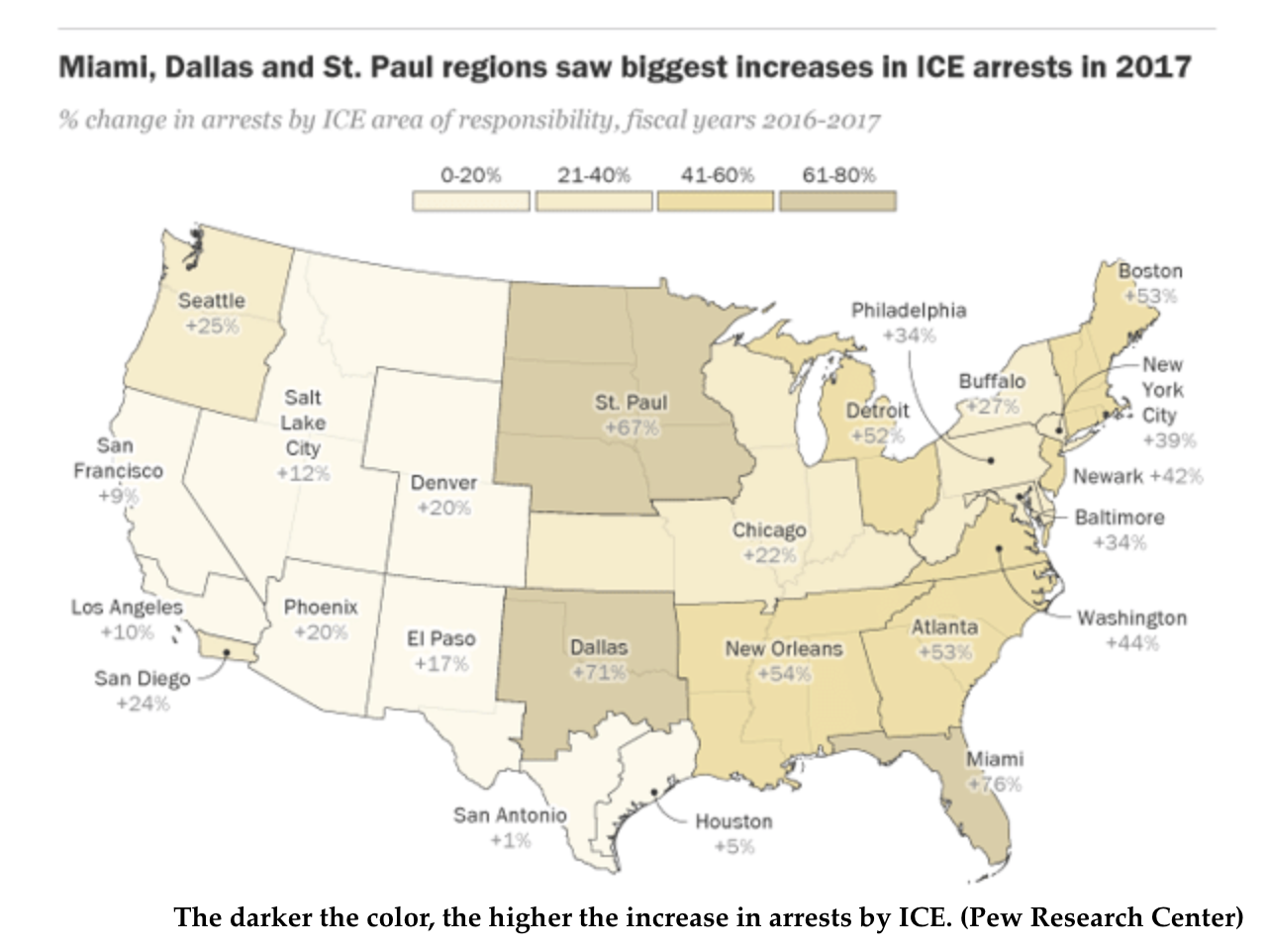
The first map comes from a recent Pew Research Center report, which analyzed the change in immigration arrests between 2016 and 2017. It finds that between January 20, when Trump took office, and September 30, when the fiscal year ended, Immigration and Customs Enforcement (ICE) arrests went up by 42 percent compared to the same period in 2016. The total arrests in 2017 were also 30 percent higher than the previous year.

While these numbers represent significant increases from recent years, they are not nearly as high as in 2009, when twice as many people were arrested. That initial high number in Barack Obama’s first year in office declined over the duration of his presidency, after he shifted policy to focus on deporting particular categories of undocumented immigrants. It’s also important to note that while the Trump administration is arresting more people, it has not yet been able to deport them at Obama-era levels because of immigration court backlog.

Pew’s report breaks down 2017’s increases in arrests by geography, showing where ICE has been most effective. The agency operates out of field offices in some major cities that cover not just that particular city, but wider “areas of responsibility” that sometimes span multiple states. All of these areas saw increases in arrests in 2017, but the Miami field office, which covers all of Florida, saw the most—a striking 76 percent increase compared to 2016. Dallas and St. Paul were next on the list, with 71 and 61 percent increases, respectively. (Dallas had the highest absolute number of arrests of all field offices.) New Orleans, Atlanta, Boston, and Detroit followed with more than 50 percent increases.

Here’s Pew’s map that colors the areas of responsibility based on the increase in arrests between 2016 and 2017:

The darker the color, the higher the increase in arrests by ICE. (Pew Research Center)

While the concentration of undocumented immigrants certainly drives arrest numbers, it doesn’t completely explain why some areas have had much higher jumps in arrests than others. If it did, immigrant-rich areas near the border, like El Paso and Phoenix, and traditional immigration hubs like New York and Los Angeles, would have all seen much higher increases.

What this map suggests is that local policies matter.

Take Miami, for example. The city renounced its sanctuary city statusafter the Trump administration threatened to withdraw federal funding. (Courts have since blocked that threat.) Attorney General Jeff Sessions praised that decision in a visit last year. Via USA Today:

“We cannot continue giving taxpayer money to cities that actively undermine the safety and efficacy of federal law enforcement efforts,” Sessions said during the appearance at PortMiami. “So to all sanctuary jurisdictions across the country, I say: Miami-Dade is doing it, other cities are doing it, and so can you.”

Miami’s decision to get local law enforcement involved likely helped boost arrests in and around that area, which already has a high concentration of immigrants.

The Atlanta metro area has also seen high increases in 2017 for the same reason. Despite former Mayor Kasim Reed’s defense of sanctuary cities, Georgia state law requires cooperation with ICE—and some of the counties around Atlanta have been quite eager to help. The state also has high penalties for driving without a license, which make it more likely for folks without papers to enter the criminal justice system, and then, the deportation pipeline.There is at least some indication that the Trump administration is trying to have the opposite effect, instead targeting those jurisdictions that have more protective local laws. In September 2017, ICE, focused their raids in localities and cities that have sanctuary policies, saying that the agency was “forced to dedicate more resources to conduct at-large arrests in these communities,” because of these policies. Later, ICE’s director also suggested that the politicians from these cities should face criminal charges for harboring undocumented immigrants. But so far, the effect of that laser focus is unclear—it’s certainly not visible in the aggregate data used for the Pew map.

Local politics have also shifted in the last year, in response to the national immigration agenda. The second and third maps show the current county-level sanctuary policies—and how they have changed since Trump took office. Both come from a new report by the Immigrant Legal Resource Center (ILRC), an immigrants’ rights organization that has been tracking how involved localities have been in immigration enforcement.

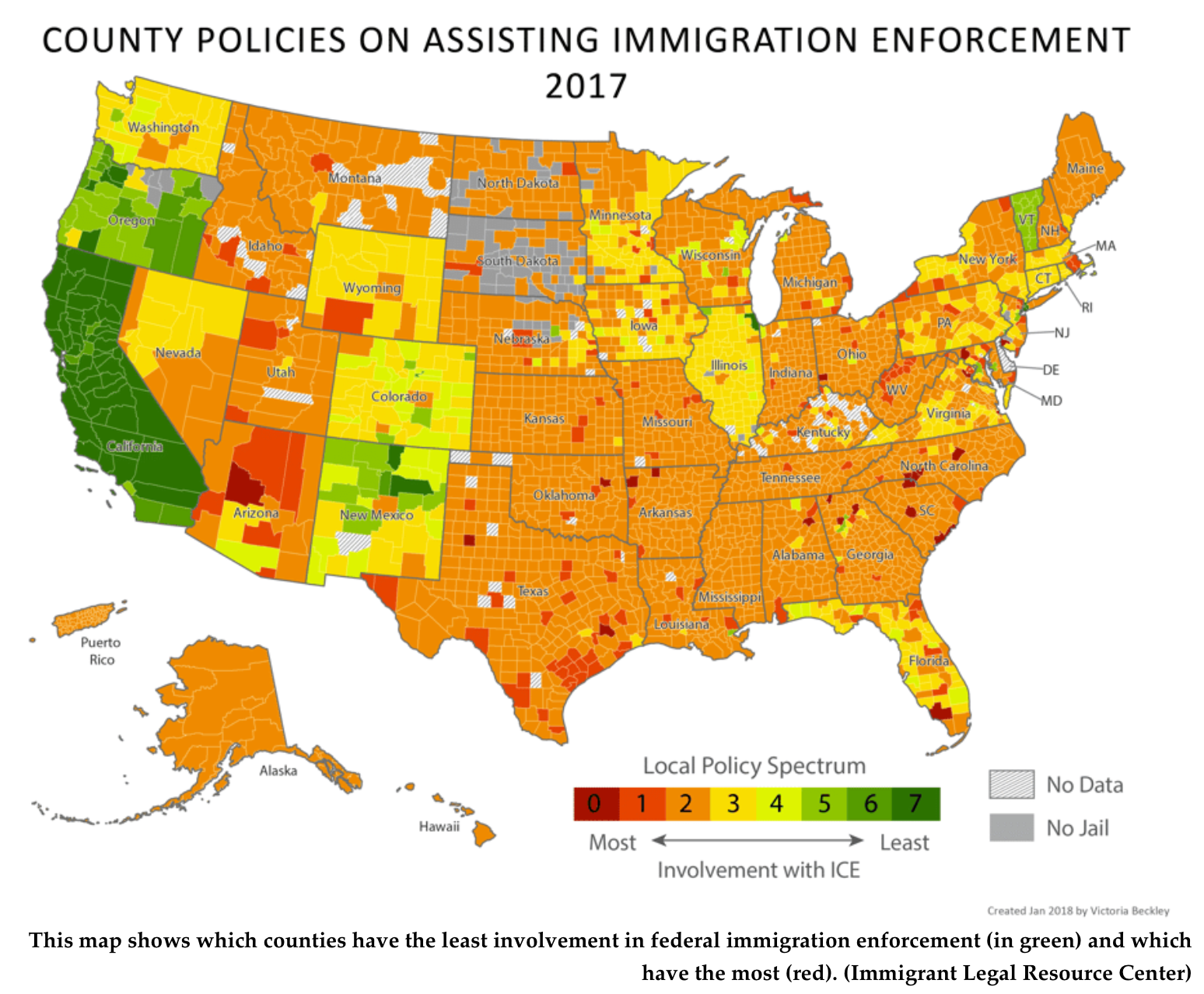
The below map shows the strength of the sanctuary policies in 2017. The places in green are most protective of local immigrant populations—they disentangle policing from federal enforcement. In red are the places that provide the most assistance to federal efforts:
This map shows which counties have the least involvement in federal immigration enforcement (in green) and which have the most (red). (Immigrant Legal Resource Center)
ILRC legal researchers created these rankings based on a seven-point rubric that reflects the spectrum of existing sanctuary policies in 3,000-plus counties. They included policies that limit the use of municipal resources for immigration enforcement, that forbid police from collecting information about immigration status, that ask police to decline ICE’s warrantless requests to detain individuals for extra time, and others. They also looked at whether these localities had agreements with ICE (called 287(g) agreements) to deputize their police officers to do various immigration enforcement duties.ILRC also traced the changes in these policies. And what they noticed was that as the Trump administration doubled down on curbing illegal immigration, some local governments started joining the effort, while others started mounting resistance. According to ILRC’s analysis, 410 localities strengthened sanctuary policies in 2017 (in blue below). Many did so in more than one way. Denver County, Colorado, for example, enacted a law in 2017 that forbids city funds or resources going towards investigation or detention of undocumented immigrants—in the absence of a judicial warrant. It also rules out 287(g) contracts. A quarter of the counties have now put limits on how their police respond to ICE’s “detainer” requests, up from just a handful in 2013. These demands to detain individuals that the federal agency suspects are undocumented for longer than their sentence have been ruled illegal by severalcourts.

Fewer counties went the other way, the report notes (warm colors below). Only around 244 devoted more resources to helping out ICE in 2017. (Note: Local governments with 287(g) agreements have been increasing in the last two years, but in some cases, this move may have been balanced in some other way—by a stop in responding to detainer requests in fear of lawsuits. So counties that entered into new 287(g) agreements on this map below could appear as any color, depending on how weak or strong their original policies were in totality.)

Overall, though, around 74 percent of the counties continue to help ICE out in whatever way it asks, “often without even analyzing whether it is legal to do so,” the report notes.

“There is a great opportunity in 2018 to strengthen and establish new policies that actively protect our immigrant neighbors,” said LenaGraber, staff attorney at the Immigrant Legal Resource Center, in a statement. “And to not spend local resources detaining and deporting our community members.”

via The Effect of Trump’s Immigration Crackdown, In 3 Maps – CityLab

Businesses are floundering while Whitehall dithers on immigration

Interesting commentary from Adam Marshall, director general of the British Chambers of Commerce:

You might not know it, but a crisis is looming on the business parks, industrial estates, construction projects and farms of Britain. As the Brexit process dominates politics – and diverts Westminster’s energy away from virtually every other issue – businesses are struggling to fill vacancies and to find the people they need in order to grow.

In some sectors firms report that labour shortages have reached critical levels. A combination of record employment levels for UK-born people, significant falls in immigration following the devaluation of sterling in 2016, and the total absence of job candidates in some areas is biting hard. British Chambers of Commerce surveys show nearly three-quarters of firms trying to recruit are experiencing difficulties – this is at or near the highest levels since our records began more than 25 years ago.

Pragmatic solutions are needed to this acute and immediate problem. Job vacancies at all levels in the workforce are being left unfilled, damaging not only individual businesses and their growth prospects but also supply chains and the wider economy. While many firms report they are investing long term in the training and development of their workforce, this will take years to have the desired impact, particularly for very highly skilled roles. We cannot afford any gap in the supply of skills and labour. Businesses that have not planned ahead for their future needs will be wishing they had.

Yet, with few exceptions, businesses tell us that breezy Whitehall assumptions about artificial intelligence and automation remain years away from fruition. While some jobs may change or disappear in future, businesses will always need people because they are more flexible and adaptable than robots to the fast pace of change in the workplace. There’s no doubt, in the here and now, that UK firms require continuing access to labour, from Europe and farther afield, to plug the gaps.

Amid all the uncertainty our businesses and communities face, the UK government must act swiftly to define an open and responsive immigration policy. Businesses accept that, in future, there will be some form of registration for European workers, but they are equally clear that they must be able to access skills and talent from the European mainland with minimal costs, barriers and delay after Brexit – irrespective of the final settlement between the UK and the EU.

Taking back control of immigration should not mean pulling up the drawbridge. It means knowing who’s coming in and out, and ensuring that only those who are entitled to work in the UK can do so. Tighter enforcement of the law, with individuals and with rogue employers, alike, is much more important to addressing legitimate public concerns over immigration levels than an expensive, draconian and damaging visa or work permit regime. At the same time, firms across the country must demonstrate, day in and day out, real civic commitment to train and invest in staff here at home. We in business must hold up our side of the deal, too.

Civic-minded businesses aren’t making the case for immigration because they’re seeking cheap labour from abroad. Despite the oft-repeated myths, our research clearly shows that a tiny percentage of businesses consciously recruit outside the UK for reasons of cost. Businesses in the communities I represent are far more likely to try to address skills shortages locally, by investing in their workforce or seeking new employees through word-of-mouth advertising or UK recruitment agencies. Firms in a small number of areas, such as agriculture and personal care, do advertise overseas – but only because they fail to recruit local workers to do the jobs on offer.

These skills gaps won’t disappear after Brexit, but many firms’ production targets will be scaled back, and expansion plans shelved, if the loathed and expensive system used for non-EU recruiting is expanded across the board. The current rationing of non-EU work permits is already a clear and present threat to investment in our business communities, and extending that cumbersome system to European workers would make a difficult situation even worse.

A brave government would either unilaterally keep a preferential approach, or adopt a level playing field that radically reduces costs and administrative burdens across the board, rather than put them up.

In recent months, the Home Office under Amber Rudd has made welcome efforts to open up after years of defensiveness, and talk more to businesses about the UK’s future immigration rules. The migration advisory committee is also taking a clear-eyed look around the country at different communities’ future workforce needs. This enhanced engagement, rather than dictation, is a major step forward. Ministers must now avoid an unwelcome and untimely step backwards to an expensive and bureaucratic immigration system – and make a bold commitment to meet the needs of the economy.

The simple fact is that many businesses can’t afford to wait much longer for a clear UK immigration policy to emerge. This makes it all the more troubling that the planned immigration white paper, meant to cover the short to medium term, is now delayed. As the prime minister herself has repeatedly noted, workers of all skill levels from Europe play a huge role in the success of British businesses and communities. Now it is up to the cabinet as a whole – including Theresa May – to send a clear and swift signal that businesses can access the people and skills needed to remain competitive in a global market.

A failure to act swiftly would hamstring UK firms’ competitiveness, and even send some to the wall. It’s not just about “the best and the brightest” coming to work in the City, our universities and the creative industries. If ministers wish to avoid the sight of unfinished urban buildings, fruit rotting in Herefordshire fields, and care homes and hotels from Bournemouth to Inverness shutting their doors, as well as manufacturers investing in their overseas operations instead of here at home, the time to act is now.

Source: Businesses are floundering while Whitehall dithers on immigration