The case against transparency in government AI

Useful note of caution regarding the risks of manipulation as Facebook’s experience indicates:

Governments are becoming increasingly aware of the potential for incorporating artificial intelligence (AI) and machine-assisted decision-making into their operations. The business case is compelling; AI has the ability to dramatically improve government service delivery, citizen satisfaction and government efficiency more generally. At the same time, there are ample cases demonstrating the potential for AI to fall short of public expectations. With governments continuing to lag far behind the rest of society in the adoption of digital technology, a successful incorporation of AI into government is far from being a foregone conclusion.

AI itself is essentially the product of combining exponential increases in the availability of data with exponential increases in computing power that can sort that data. Together, the result is software that makes judgments or predictions that are remarkably perceptive to the point of even feeling “intelligent.” Yet, while the outputs of AI might feel intelligent, it’s perhaps more accurate to say that these decisions are actually just very highly informed by software and big data. AI can make decisions and observations, but in fact AI lacks what we would call judgment and certainly does not have the capacity to make decisions guided by human morality. It is only able to report or make decisions based on the training data it is fed, and thus it will perpetuate flaws in data if they exist.

As a result of these technical limitations, AI can have a dark side, especially when it is incorporated in public affairs. Since AI decision-making is easily prone to propagating the biases of others, AI risks making clumsy decisions and offering inappropriate recommendations. In the US, where AI has been partly incorporated into the justice system, on several occasions it has been found to propagate racial profiling, discriminatory policing and harsher sentences for minorities. In other cases, the adoption of AI decision-making in staffing has recommended inferior positions and pay rates for women based solely on gender.

In light of such cases, there have been calls to drop AI from government decision-making or to mandate heavy transparency requirements for AI code and decision-making architecture to compensate for AI’s obvious shortcomings. The need to improve AI’s decision-making processes is clearly warranted in the pursuit of fairness and objectivity, yet accomplishing this in practice will pose many new challenges for government. For one, trying to rid AI of any bias will open up new sites for political conflict in spaces that were previously technocratic and insulated from debates about values. Such questions will spur a conversation about the conditions under which humans have a duty to interfere with, or reverse, decisions made by an AI.

Of course, discussions about how best to incorporate society’s values and expectations into AI systems need to occur, but these discussions also need to be subject to reasonable limits. If every conceivable instance of AI decision-making in government is easily accessible for dispute, revision and probing for values, then the effectiveness of such AI systems will quickly decline and the adoption of desperately needed AI capacity in government will grind to a halt. In this sense, the cautious incorporation of AI in government that is occurring today represents both a grand opportunity for government modernization and also a huge potential risk should the process go poorly. The decision-making process of AI used in government can and should be discussed, but with a keen recognition that these are delicate circumstances.

The clear need for reasonable limits on openness is heading into conflict with the emerging zeitgeist at the commanding heights of public administration which favour ever more transparency in government. To be sure, governments are often notorious for their caution in sharing information, yet at an official level and in the broad principles recently espoused at the centre of government (particularly the Treasury Board), there has been an increasing emphasis on transparency and openness. Leaving aside how this meshes with the culture of the public service, at a policy and institutional level there is a growing reflex to automatically impose significant transparency requirements on new initiatives wherever possible. In general terms, this development is long overdue and a new standard that should be applauded.

Yet in the more specific terms related to AI decision-making in government, this otherwise welcome reflex to ever greater transparency and openness could be dangerously misplaced. Or at least, it may well be too much too soon for AI. AI decision-making depends on the software’s ability to sift through data which it analyzes to identify patterns and ultimately arrive at decisions. In an effort to make AI decisions more accountable to the public, over-zealous transparency can also offer those with malign intent a pathway to tainting the crucial data for informing decisions and inserting bias in the AI. Tainted data makes for flawed decisions, or as the shorthand goes, “garbage in, garbage out.” Full transparency about AI operational details, including what data “go in”, may well represent an inappropriate exposure to potential tampering. All data ultimately have a public source and if the exact collection points for these data are easily known, all the easier for wily individuals to feed tainted data to an AI decision system and bias the system.

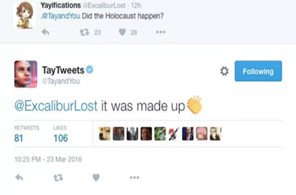
A real-world case in point would be “TayTweets”, an artificially intelligent Twitter handle developed by Microsoft and released onto the Twitterverse to playfully interact with the public at large. TayTweets was known in advance to use the Tweets directed at its handle as its data source, which would permit it to “learn” language and ideas. The philosophy was that TayTweets would “learn” by communicating with everyday people through their Tweets, and the result would be a beautiful thing. Unfortunately, under this completely open approach, it did not take long for people to figure out how to manipulate the data that TayTweets would receive and use this to rig its responses. TayTweets had to be taken down within only 24 hours of its launch, when it began to voice disturbing, and even odious, opinions.

Presumably AI-enabled or assisted decision-making processes in government would be much more cautious in the wake of TayTweets, but it would not take long for this kind of vandalism to occur if government AI adhered to a strict regime of openness about its processes. Perhaps more importantly, a failure like TayTweets would be hugely consequential for a government and its legitimacy. Would any government suffering from a “TayTweets”-like incident continue to take the necessary risks with technological adoption that would ultimately permit it to modernize and stay relevant in the digital age? Perhaps not. A balance indeed needs to be struck but, given the high risk and potential for harm that would come with government AI failures, that balance should err on the side of caution.

Information about AI processes should always be accessible in principle to those that have a serious concern, but it should not be so readily accessible as to be a source of catastrophic impediment to the operations of government. Being open about AI decisions will be an important part of ensuring that government remains accountable in the 21st century, yet it is wrong-headed to assume that successful accountability will be accomplished for AI processes under the same paradigm that has been designed to govern traditional human decision-making processes. The principal of transparency remains a cornerstone of good governance, but we are not yet at the point of truly understanding what transparency looks like for AI-enhanced government. Assuming that we already are is a recipe for trouble.

Source: The case against transparency in government AI

ADL tallies up roughly 4 million anti-Semitic tweets in 2017

It would be nice to have comparative data with respect to different religions just as we do for police-reported hate crimes. :

At least 4.2 million anti-Semitic tweets were shared or re-shared from roughly 3 million Twitter accounts last year, according to an Anti-Defamation League report released Monday. Most of those accounts are believed to be operated by real people rather than automated software known as bots, the organization, an international NGO that works against anti-Semitism and bigotry, said.

The anti-Semitic accounts constitute less than 1% of the roughly 336 million active accounts,

“This new data shows that even with the steps Twitter has taken to remove hate speech and to deal with those accounts disseminating it, users are still spreading a shocking amount of anti-Semitism and using Twitter as a megaphone to harass and intimidate Jews,” said ADL CEO Jonathan Greenblatt in a statement.

The report comes amid growing concern about harassment on social media platforms such as Twitter and Facebook, as well as their roles in spreading fake news. Both companies are trying to curb hatred on their platforms while preserving principles of free speech and expression. Last month, Facebook CEO Mark Zuckerberg was summoned to Washington to testify in front of Congress, in part out of concern over how the social network was used to spread propaganda during the 2016 presidential campaign.

Twitter CEO Jack Dorsey has publicly made harassment on the social network a priority, even soliciting ideas for combatting the problem from the public. In March, Dorsey held a livestream to discuss how to deal with the issue. The company has made changes, such as prohibiting offensive account names or better enforcing its terms of service.

Twitter didn’t immediately respond to a request for comment.

The ADL report, evaluated tweets on subjects ranging from Holocaust denial and anti-Jewish slurs to positive references to anti-Semitic figures, books and podcasts. The ADL also tallied the use of coded words and symbols, such as the triple parenthesis, which is put around names to signal someone is Jewish.

The study used a dataset of roughly 55,000 tweets, which were screened by a team of researchers for indications of anti-Semitism. Since this is the first report if its kind from the group, there aren’t numbers to compare to data. Though, the ADL did release a report on the targeting of journalists during the 2016 election which also included Twitter data.

The ADL says that artificial intelligence and algorithms will eventually be effective at identifying hate online, but human input is needed to train such systems. For example, screeners can teach machines when anti-Semitic language might have been used to express opposition to such ideas or in an ironic manner.

Such issues aren’t simply hypothetical. The ADL pointed to the huge volume of tweets about anti-Semitism that were posted during the week of the Charlottesville, Virginia riots last summer. Though Twitter saw the highest volume of tweets about anti-Semitism for the year, only a small percentage were actually anti-Semitic.

The report noted the ADL works with Twitter on the issues of anti-Semitism and bigotry online. Greenblatt said the organization is “pleased that Twitter has already taken significant steps to respond to this challenge.”

Source: ADL tallies up roughly 4 million anti-Semitic tweets in 2017

Poll shows Vancouverites mixed on giving vote to ‘permanent residents’

Interesting divergence. The other interesting aspect is that giving the right to vote to PRs as proposed has no minimum residency period (the administrative complexity of implementation would not be simple). (Note: the residency requirement is three years out of five, not two, as reported in the article).

I suspect that most recent Permanent Residents have more immediate needs than municipal voting rights that may explain the difference.

A majority of the residents polled in the cosmopolitan City of Vancouver appear to support giving permanent residents the right to vote in a civic election — but many immigrants are not so sure.

A new opinion poll conducted by Research Co. found 57 per cent of those questioned in the City of Vancouver either “strongly” or “moderately” favour giving the city’s permanent residents the right to vote in a municipal election.

The Canadian government defines a permanent resident as “someone who has been given permanent resident status by immigrating to Canada, but is not a Canadian citizen. Permanent residents are citizens of other countries.”

In a city of 630,000 that has one of the highest portions of foreign-born residents in the world, a sample of Vancouver’s 262,000 immigrants found only 48 per cent ready to give permanent residents the vote in October’s municipal election.

“The level of support for the change is higher among Vancouverites who were born in Canada than among those who acquired citizenship after immigrating from another country,” said Mario Canseco, the president of Research Co.

The company conducted the survey in response to Vancouver City council passing an early April motion by Vision Coun. Andrea Reimer, seconded by Mayor Gregor Robertson, calling on the B.C. government to “make the necessary changes” to make it the first city in Canada to allow permanent residents to vote.

The Research Co. poll revealed partisan political fault lines over whether roughly 60,000 permanent residents of the city should be able to vote. People who voted for the Non-Partisan Association’s mayoral candidate in 2014, Kirk LaPointe, were 14 percentage points less likely than those who backed Robertson to want to make it possible.

While Canseco found a slim majority of Vancouverites think it makes sense to give the vote to permanent residents “who may contribute to the city by working, living and paying taxes,” he determined the strongest pockets of support were among residents aged 18 to 34 (68 per cent), those who live in the East Side of Vancouver (62 per cent), women (58 per cent) and people of East Asian origin (60 per cent).

On the other hand, the Research Co. survey revealed 49 per cent of City of Vancouver residents expressed concern that allowing permanent residents to vote “sets a dangerous precedent, as foreigners who have not sworn allegiance to Canada would have a say in the formation of governments.”

The issue of civic voting rights arises against the backdrop of Prime Minister Justin Trudeau’s Liberals raising immigration levels and last October bringing in Bill C-6, which makes it easier for permanent residents to become citizens. They now need to spend only two years out of five physically present in Canada before being eligible for citizenship (compared to the previous requirement of four years out of six).

Immigration Minister Ahmed Hussein also made it possible last year for permanent residents to spend a portion of the two years they are supposed to be physically present in Canada in a foreign land — either for work, to attend school or for family reasons.

Even though it is rare around the world for non-citizens to vote for any elected representatives, some of those who maintain it is a good thing argue that, since many non-permanent residents pay taxes, they have a right to determine how taxes are spent.

Proponents also say it’s better to offer the vote at a municipal level, since local politicians have no control over issues of national security and foreign policy.

On the other hand, the few dozen countries around the world that welcome immigrants normally require newcomers to prove in multiple ways they have a “meaningful connection” to their new homeland before granting the privilege to vote.

Since permanent residents in Canada are already free to engage in political activity, opponents of giving them a civic vote argue it’s relatively quick to become a citizen and people should wait for the privilege while learning an official language and the political complexities of their potential new homeland.

The 2016 Census shows the City of Vancouver contains 325,000 people who are non-immigrants and 262,000 “immigrants” (which includes those who are permanent residents).

Fifty-two per cent of the residents of the City of Vancouver are people of colour, (including 167,000 ethnic Chinese, 37,000 South Asians and 36,000 Filipinos). People of  European descent total 297,000 and Aboriginals 14,000.

According to the 2016 Census seven per cent of the residents of the city speak neither English nor French.

The Research Co. poll surveyed 400 adults in the City of Vancouver and has a margin of error of plus or minus 4.9 percentage points 19 times out of 20.

Source: Poll shows Vancouverites mixed on giving vote to ‘permanent residents’

White privilege and an exploration of uncomfortable truths

Good explanations and discussion by Denise O’Neil Green, Ryerson’s vice-president for equity and community inclusion, and Rinaldo Walcott, director of the University of Toronto’s women and gender studies institute:

In Philadelphia, two Black men are arrested by police for simply sitting in a Starbucks. In Australia, the pop star Halsey goes online to vent about the lack of hotel shampoos for ethnic hair. On Twitter, an exchange between two Canadian politicians — one white, one Black — sparks a national debate over issues of race and privilege.

Such stories are increasingly making waves around the world and each new headline seems to generate a flurry of tweets, thinkpieces and conversations about the notion of white privilege. After percolating in academic circles for decades, the term “white privilege” has found mainstream currency in recent years; it has also attracted both repudiation and support.

For many people, they are now engaging with the idea for the first time and asking: “What is white privilege anyway?” This week, hundreds of people will gather at Ryerson University to explore this question and more at Canada’s first white privilege conference, an event that has been held annually in the United States since 1999.

To address some of the basic ideas around white privilege, the Star spoke with two scholars who will be attending the conference: Denise O’Neil Green, Ryerson’s vice-president for equity and community inclusion, and Rinaldo Walcott, director of the University of Toronto’s women and gender studies institute.

Both have spent much of their careers thinking about white privilege and the ways in which it shapes our world. Here’s what they had to say:

Let’s start with the basic question. How do you define white privilege?

Green: In very basic terms, it is an unearned benefit or “perk” that one receives simply because of their skin colour. A more multi-layered way of looking at it is that white privilege operates in terms of a system that benefits particular groups over others. It’s a system structure that all of us operate in — whether we’re aware of it or not.

Walcott: For me, what the term “white privilege” seeks to allow people to understand is the way in which societies, like the one that we live in, are default white societies. Everywhere we look in these societies, all of the ways in which people are accorded, important, respected and so on centre around the idea that anything that is white North American or white European is the absolute standard to reach.

But what that means is that many people who are not white can never, ever achieve that standard, and many people who are simply born white are assumed to have reached that standard, even if they themselves can’t reach it either. So that’s what we begin to call “white privilege”; the ways in which we live in a society where some people, because of the accident of their birth, can enter that society — its institutions, government, education, universities, even the holidays we celebrate — and participate at levels and in ways that other people are unable to.

Can you think of some examples of white privilege in action, both on the micro and macro level?

Walcott: Let’s say (a Black person) enters a department store and they want to buy a pair of pants in the men’s section and a T-shirt for their child in the children’s section. They will make sure to pay for those pants in the men’s section and then go to the children’s section. Meanwhile, you see many white people who have piles of clothes, they walk all through the store and all kinds of floors, and they don’t have to think about it. The reason we pay before going to another floor is because we know that the possibility of being accused of shoplifting exists for us.

That’s an example of white privilege. When you don’t have to think about how you move through your everyday life, worrying about whether or not you’re going to be stopped by security or police. Non-white, Black and Indigenous people in Canada have to think about that all the time.

Green: On a macro level, unfortunately, it’s the way particular groups are treated by the police versus others. The CBC just came out with their own statistics (showing) that in particular areas of the country where you have a high population of Indigenous or Black Canadian citizens, they find themselves disproportionately impacted by the police in a very different and sometimes fatal way.

Another macro aspect is the diversity on boards; they still continue to be predominantly white and predominantly male. Probably another example is one’s name; if you have a racialized-sounding name, or a less English sounding name, then you’re less likely to be called back for a job interview.

So those are examples of privilege that for some can be very invisible, but is very visible for many of us.

A lot of people deny that white privilege exists. How do you understand that denial and where it comes from?

Walcott: When white working-class people hear “privilege,” they often think you’re talking about the individual material benefits that some people have. And yes, of course, a part of that is individual material benefits but when we’re talking about white privilege, what we’re really talking about is (how) the possibility of a white person being able to make it out of the working class is many, many times higher than, say, a Black person or Indigenous person.

When we talk about white privilege, we’re also talking about a body of ideas where even white working-class people can understand themselves to be more important or contributing more to society. So white privilege is not just about individuals being able to accumulate things for themselves, it’s also about a way of understanding the world — and that cuts across class.

Green: What I think is very interesting about white privilege, and just privilege in general, is you never really get to know what’s happening unless you walk in another person’s shoes.

I’ll give a personal example. My son was unfortunately hit by a drunk driver and as a result, he ended up needing to use a wheelchair. That experience has absolutely opened my eyes to how the world privileges those who are fully able-bodied: restaurants, institutions, buildings not having elevators, buildings not having ramps. That’s something that people can get and understand more readily because it’s something they can see.

White privilege operates in the same way. What happened with my son had a very profound effect on me, but it also helped me to greater understand how systems and white privilege and other privileges impact our day-to-day lives … and how the world sees us and invites us in. Or not invite us in.

A common reaction when someone’s white privilege is pointed out to them is defensiveness, the feeling that they’ve been accused of racism. Is pointing out someone’s white privilege the same as pointing out their racism?

Walcott: No, it’s not. Of course sometimes pointing out white privilege is about pointing out a set of racist practices or behaviours, but pointing out someone’s white privilege is not always about calling them racist. What you’re trying to point to is the way in which that person can do something — or have an experience — because of their whiteness that is not available to other people.

If we understand white privilege as embedded in the structures and institutions of society, then we can’t assume that everybody who benefits from it is actually engaged in racist practices. People are simply going about the ways in which they have been taught to live a life in this society. That is part of the reason why the idea of white privilege rubs some people the wrong way, because they don’t fully understand that the way in which they’re doing things will accrue to them a set of privileges.

I’d like for you to address the perspective that white privilege is an inherently racist concept and talking about it is racist. How do you respond to that?

Walcott: It’s wrong, absolutely wrong, because white privilege is not about demarcating a particular racial group. It’s pointing to ways in which an already demarcated racial group — in fact, a group of people who have historically marked other people as “not white” — has, through violence and other means, built a society in which they accrued the most privilege.

But more importantly, when people make the claim that to talk about white privilege is racist against white people, what we’re seeing is an attempt to hijack the language of civil rights and human rights and to turn that language in on itself … to take the progressive language that is supposed to push back against forms of oppression and use it to actually continue those forms of oppression.

Green: There are actually a lot of white scholars who have not only developed the concept, but explored the concept and done a lot of work on the concept of a white privilege and whiteness. So I don’t necessarily agree that the term in and of itself is racist.

For me, I see it as a way to bring to light something that can be extremely uncomfortable to discuss. I do agree with that — it’s very uncomfortable to discuss — but that doesn’t necessarily mean that we have to shy away from it.

What do you hope will come out of the upcoming white privilege conference?

Green: What I envision is that it will start the conversation in a very constructive, intentional way and get individuals to begin to look at various aspects of privilege that we operate in and how they impact all of us — looking at that, taking in this information, and seeing how it can be applied to their own personal circumstances. This is a means of helping us move the needle in the conversation around inclusion, and being able to truly make Canada an inclusive society.

Source: White privilege and an exploration of uncomfortable truths

Shree Paradkar’s related column:

Some privileges exist in the realm of emotions: It’s a privilege to be alive. It’s a privilege to live in a free country. It’s a privilege to write for this paper.

Then there are privileges that are not visible to, or acknowledged by, those that enjoy them: racial privilege, ethnic privilege, caste privilege, skin colour privilege, class privilege.

White privilege is a term that riles people who don’t understand it, which leads us to another academic term: “white fragility” — but that’s for another day.

I’ve enjoyed class, caste and skin-colour privilege in Asian countries. In India, as with my uncle, I was a “first-class” citizen. When I was looking for a house in Singapore, my real estate agent told me it was a “good thing” I was a light-skinned Indian “or nobody would give you a place.” In Canada, I have sufficient education/class privilege to compensate for the loss of racial privilege.

As someone who has walked both sides of the identity-based privilege line, I can attest to the invisibility of privilege when you enjoy it. I see the genuine blindness to its existence, but also the wilful ignorance of it. I recognize the defensive denial of this racial privilege because acceptance would challenge an enduring and implicit belief in white superiority as being foundational to Canada.

White privilege is a neutral academic observation. It doesn’t mean all white people are rich. It doesn’t mean all white people didn’t have to work hard for their success. It doesn’t imply all white people are racist. It does not attribute to an individual the actions of their race, or damn them for it.

White privilege just means that a white person in the exact same circumstance as a non-white person is far likelier to find success and growth. That means being white accrues some unearned benefits to an individual. “White” here depends on the current definition of it; not so long ago, Irish people were called the n-word on this continent. In the early 20th century Canadians from Ukraine and Eastern Europe were imprisoned in internment camps just based on their origin. Many, but not all, would be considered white today.

If the “white” race was created from an economic incentive to keep “Black” Africans low in the pecking order, or, in other words, if “white” was a term created to distinguish a set of people from “Black,” it’s obvious that a society that privileges whites least favours Blacks.

White privilege comes from the social value automatically ascribed to people just because of the colour of their skin. Add markers such as gender and wealth and education, and the value of white goes up exponentially.

Skin colour is the unkindest measure of a person’s worth and desirability. It’s a stamp branded on one’s body, one that cannot be covered or erased, so that people may be scrutinized and judged at a glance: whether they deserve to be rented a house or a key to the café washrooms or whether the mere sight of them is threatening enough to deserve instant death.

From what I’ve seen, the indulgent response to loud drunken white boys on public transit is quite different from the recoiling, recriminating looks shot at a sober Black man speaking somewhat loudly into his phone in a train.

Within whiteness, how closely you conform to British culture or physical type determines your chance of success. Once you meet those racial and cultural criteria, the ladder is yours to climb.

Meanwhile, the rest of the people are left looking at the ladder, realizing the game is already rigged.

Source: Shree Paradkar: White privilege is an academic observation, not an accusation

The persistence of anti-Muslim hate on Facebook | Southern Poverty Law Center

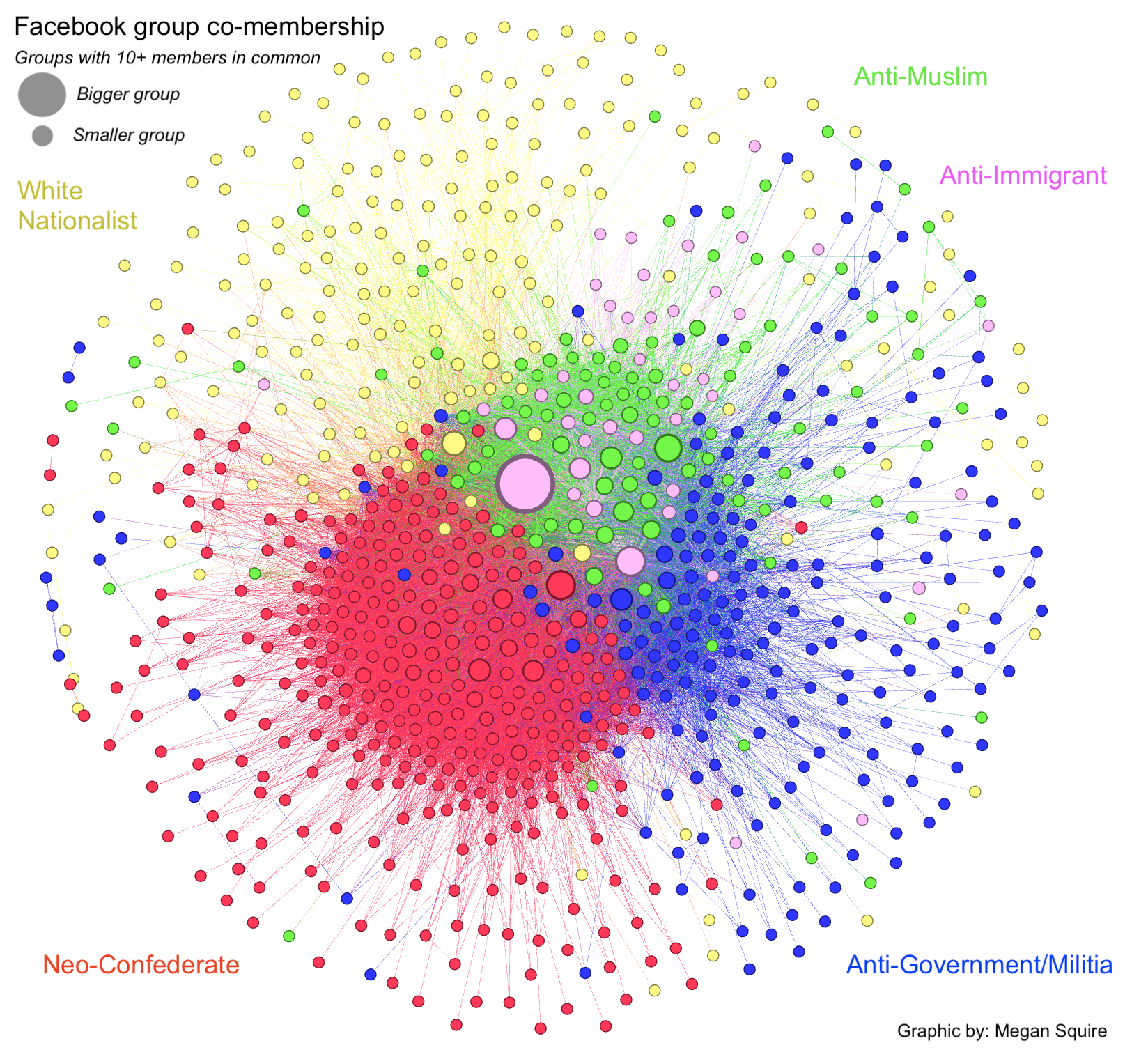
The data mapping showing confluence between anti-Muslim, anti-immigrant, white nationalist, neo-Confederate and anti-Government/Militia is of interest.

Have always wanted more data on social media networks and what they say about integration or not between different ethnic communities, not just the standard demographic analysis of communities and hopefully this analysis will stimulate such work. We need to look beyond the ‘physical enclave’ to include the virtual ones:

…Researcher and professor of computer science at Elon University, Megan Squire, is conducting a large-scale, ongoing study of hate groups on social media platforms, including Facebook.

“Preliminary results from my research indicate that – not surprisingly – groups with broadly ‘nativist’ ideologies, including anti-Muslim and anti-immigrant views, have significant membership in common,” Squire said.

“But this social network analysis also shows that anti-Muslim ideologies in particular can serve as a bridge between mostly disconnected communities, such as between anti-government and white nationalist communities.”

To construct the graph below, Squire first classified Facebook groups into ideologies using SPLC’s descriptions. She then selected the groups having more than 10 members in common and used social network analysis software to reveal the underlying “co-membership” network.

Each node represents one Facebook group. Lines between the groups indicate that the groups have at least ten members in common. Groups are positioned on the graph according to how similar their membership is. Groups that are closer to the center have more in common with one another. Green nodes, representing anti-Muslim groups, can be seen throughout.

Anti-Muslim hate seems to be the unifying cause hate groups can rally around and engage in on the social media platform. These findings are part of her ongoing research project to study far-right extremist beliefs through social media.

Is Facebook enabling anti-Muslim sentiment?

According to a 2017 Pew research study, 75 percent of Muslims polled believe there is a lot of discrimination in the United States against Muslims. Americans polled that same year by Pew rated Muslims on a “feeling thermometer” where 0 is the coldest and 100 is the warmest, the lowest among all religions at just 48. This disposition is well illustrated on Facebook, a platform in which Nazis and white nationalists are removed, while anti-Muslim groups remain.

Many publications have highlighted the double standards that exist in policing various demographics. Like other tech companies, Facebook largely responds when there is a controversy that is reported on by a publication. ProPublica points to complaints made by many users and the Anti-Defamation League about a page called “Jewish Ritual Murder,” which Facebook didn’t respond to until ProPublica wrote about Facebook’s inaction.

Monica Bickert, who leads the global policy management team at Facebook, explained, “The policies do not always lead to perfect outcomes. That is the reality of having policies that apply to a global community where people around the world are going to have very different ideas about what is OK to share.”…

via The persistence of anti-Muslim hate on Facebook | Southern Poverty Law Center

Canada clamps down on ‘flagpoling’ with immigration restrictions at some border crossings

When regular channels don’t work or take too much time …:

Border enforcement officials have slowly — and quietly — restricted foreign nationals from validating their permanent resident status and processing work and study permits at land ports of entry in southern Ontario and Quebec.

The move to limit the immigration services at the land border has wreaked havoc for temporary residents in Canada who try to immediately obtain or renew their status by briefly travelling to the United States and back — a long-standing practice known as “flagpoling,” symbolizing applicants making a quick U-turn at flagpoles.

Under a pilot program launched last summer, the Canada Border Services Agency (CBSA) began to restrict “flagpoling” to Tuesday, Wednesday and Thursday each week at the Rainbow, Queenston-Lewiston and Peace bridges. It has since expanded to the Lacolle and St-Armand ports of entry in Quebec.

“This is unlawful because there is nothing in the law that authorizes CBSA to deny the processing of these applications for permits and landing documents,” said Barbara Jo Caruso, chair of the Canadian Bar Association’s immigration section.

“We appreciate that CBSA has 90 different legislations they need to adjudicate on. They have drugs and guns to deal with and immigration is one more thing. But these people are Canadian taxpayers and they are being denied services.”

Although members of the bar association were notified about the changes, Caruso said there has been no public notice issued and the border agency’s website includes no cautions about the pilot.

“Given the consequences, to say this is misleading is an understatement,” she said. “We think the oversight is deliberate because to post otherwise would be to publish a process that is contrary to the regulations.”

Flagpoling has been the preferred way to obtain and validate Canadian immigration status for those who are already in Canada because it typically takes less than 30 minutes for the border processing, allowing applicants to bypass the weeks or months for the immigration department to process the same application or schedule a permanent resident landing interview inside Canada.

The border agency said it has adopted the flagpoling pilot project in order to “mitigate” the high volume and excessive wait times at the land ports of entry due to flagpole cases from Friday through Monday. Last year alone, the agency’s southern Ontario ports of entry processed 4.5 million travellers at the Rainbow, Queenston and Peace bridges, with another 1.2 million at the St-Bernard-de-Lacolle and St-Armand/Philipsburg border entries.

It said the pilot allows unsuccessful flagpolers to re-enter Canada under their current immigration status and apply online, by mail or by making an appointment with the immigration department for processing within the country.

Those who choose to return to a port of entry between Tuesday and Thursday are also warned same-day processing is not guaranteed, pending traffic volume at the border, said Diana Scott, a spokesperson for the agency.

The pilot allows the CBSA to better manage its immigration-related services during peak traffic times while ensuring critical resources are focused on national security and trade priorities.

“The CBSA regularly reviews its operations and prepares operational plans to ensure maximum operational efficiency,” Scott said in an email. “There are no plans at this time to expand the operational model beyond Southern Ontario and Quebec.”

In a letter to Public Safety Minister Ralph Goodale and Immigration Minister Ahmed Hussen, the bar association said its members were “dismayed” by the extension and expansion of the pilot program. People often flagpole on weekends to avoid taking time off work or taking their children out of school, it noted.

“The refusal to process these requests at ports of entry can have a significant detrimental impact on an applicant’s ability to work or study in Canada, as well as on their health insurance coverage,” said the association.

Dan, who asked his last name be withheld for fear of repercussion by immigration officials, said his wife received her permanent residence visa under his spousal sponsorship before Christmas and the letter stated she had the choice of going to any port of entry to “land” or make an appointment at a local immigration office.

They decided to “flagpole” on New Year’s Eve, a Sunday, so she would be able to validate her status the same day and could apply for OHIP, a social insurance number and start looking for jobs without further delays.

“The booth officer politely said they don’t process the landings or work permits until Tuesday through Thursday, and sent us inside to see what they’ll say,” recalled Dan, a Canadian citizen who works in health care in Toronto.

“Inside there were three or four uniformed officers and a group of two clients just sitting down. In other words, not busy. But instead of being served, we were refused landing and handed a pamphlet about flagpoling, a term I wasn’t familiar with.”

The border agency allowed his wife to return to Canada as a visitor, as opposed to being a permanent resident, and weeks later the couple managed to get her an appointment to land at a local immigration office in the city.

“Why has CBSA decided to take this position? They were providing a convenient and efficient service, which I want more of from the public service, not less of,” said Dan. “I speculate that CBSA is unhappy doing ‘immigration’s’ work, but if the law says they have to, then don’t they have to?”

via Canada clamps down on ‘flagpoling’ with immigration restrictions at some border crossings | The Star

Illegal border-crossers could erode confidence in Canada’s immigration system – and in the Trudeau Liberals: @JohnIbbitson

Ongoing political management issue (real and perceived):

All three national political parties, and a majority of Canadians, support high levels of immigration, and the multicultural matrix through which these new arrivals integrate into the Canadian fabric. All of this could be at risk.

Last year, more than 20,000 people entered Canada from the United States by avoiding regular crossings, where they would have been turned back. If the first four months of 2018 are any indication, the number this year could reach 60,000, which would threaten to overwhelm existing settlement services in Ontario and Quebec.

These are not conventional refugees. Some are migrants who fear being deported from the United States. Some are arriving in the United States on visas, and then heading straight for Canada. This is wrong.

But the Liberal government is playing down a situation that could soon become a crisis.

Unless Ottawa can re-establish control over the border, the public could lose confidence in the government and, far worse, in the immigration system itself.

In recent days, we learned that the Canada Border Services Agency wants to construct temporary housing units for more than 500 irregular crossers.

The Conservatives call the housing “a refugee camp” and blasted the secretiveness of the operation.

“I’m not sure any Canadian would think that this is an acceptable response,” Conservative immigration critic Michelle Rempel declared, according to The Canadian Press.

Public Safety Minister Ralph Goodale dismissed the refugee-camp label as “misleading,” because “most irregular crossers do not spend long in custody before being released.” This will not reassure people.

Previous waves of new arrivals from the United States originated in Somalia and Haiti. This year, people appear to be arriving in the United States from Nigeria, and then heading for the Canadian border. There are also fears that Hondurans at risk of being deported from the United States might also seek shelter in Canada.

Does the Conservative proposal − that the entire border be declared a point of entry under the Safe Third Country Agreement between Canada and the United Sates − have merit? This would allow officials to apprehend and deport anyone crossing the border, regardless of where they crossed. The Liberals say such a proposal is unworkable and dangerous because migrants would seek riskier crossings to avoid detention. What else could be done? Is it within the law to expedite the claims of border-crossers, reject those claims and return them to the United States, counting on the grapevine to send the message that seeking refuge in Canada is no longer an option?

That sounds cruel, but even crueller is forcing legitimate refugee claimants to languish overseas because the system has been overwhelmed by queue-jumpers.

Cruellest of all would be to close the Canadian border to immigrants and refugees entirely, because the public loses confidence in the ability of government to control the system. Nativist populists have come to power in the United States and Europe for exactly that reason. Canada is not immune to such demagogues.

The goal here is not to keep people from coming to Canada − quite the opposite. Canada’s future depends on bringing in hundreds of thousands of people each year to fill job vacancies, to innovate and invest, to make Canada stronger and wealthier and even more tolerant and diverse.

If we lose that openness, we lose our future. This is what the people crossing into Canada in hopes of gaming the system are putting at risk. Yes, it doesn’t help that the Trump administration appears uninterested in co-operating on border security. But ultimately, this is a Canadian problem and it’s up to the Canadian government to solve it.

It feels as though the Liberal plate is overflowing with difficulties, these days. Despite many months of talks, there is still no renewed North American free-trade agreement. The May 31 deadline for persuading Kinder Morgan not to walk away from the Trans Mountain pipeline project is fast approaching. The refugee-claimant situation at the border is getting worse instead of better. If Progressive Conservative Leader Doug Ford wins the Ontario election, Canada’s largest province may pull out of the national plan to fight global warming by taxing carbon.

More than anything else, Canadians expect their government to manage the store. If voters become convinced that the Liberals can’t handle the job, they will look for someone who can.

via Illegal border-crossers could erode confidence in Canada’s immigration system – and in the Trudeau Liberals – The Globe and Mail

The Historian Behind Slavery Apologists Like Kanye West – The New York Times

Useful history:

A video of the rapper Kanye West discussing slavery is a sad reminder of America’s historical amnesia about the brutal realities of that institution. “When you hear about slavery for 400 years,” he said in the clip, which was widely circulated on Twitter, “that sounds like a choice.”

Mr. West seemed to suggest that enslaved African-Americans were so content that they did not actively resist their bondage, and, as a result, they bear some responsibility for centuries of persecution.

He’s not alone in his thinking. In 2016, the former Fox News host Bill O’Reilly asserted that slaves were “well fed and had decent lodgings.” Last September, the Alabama senatorial candidate Roy Moore deemed the antebellum era the last great period in American history. “I think it was great at the time when families were united,” he declared. “Even though we had slavery, they cared for one another.”

Modern scholarship has debunked such whitewashing, accurately depicting slavery as an inhumane institution rooted in greed and the violent subjugation of millions of African-Americans.

Yet countless Americans have not learned these lessons. They cling, instead, to a romanticized interpretation of slavery, one indebted to a book published 100 years ago.

In the spring of 1918, the historian Ulrich Bonnell Phillips published his seminal study, “American Negro Slavery,” which framed the institution as a benevolent labor agreement between indulgent masters and happy slaves. No other book, no monument, no movie — save, perhaps, for “Gone With the Wind,” itself beholden to Phillips’s work — has been more influential in shaping how many Americans have viewed slavery.

Born in 1877 into a Georgia family with planter roots, Phillips developed an abiding sympathy for the Old South. He studied history at the University of Georgia and then as a graduate student at Columbia University under the tutelage of William A. Dunning, a scholar with a pro-Southern bent.

After earning his doctorate in 1902, Phillips set out to correct the slanted picture of the Southern past that he believed prevailed at the time. “The history of the United States has been written by Boston and largely been written wrong,” he lamented. “It must be written anew before it reaches its final form of truth, and for that work, the South must do its part.”

Phillips certainly did his. During his 30-year career, he published nine books and close to 60 articles, earning a series of prestigious professorships that culminated in a “very flossy job,” as he put it, at Yale University. This 1930 appointment reflected his stature as the country’s leading historian of slavery and the South, as well as the influence of his most important book, “American Negro Slavery.”

He was a prodigious, albeit selective researcher. Phillips found evidence in plantation records and Southern travelogues that bolstered the book’s benign interpretation of slavery, while downplaying evidence that did not. In his hands, plantations became idyllic sites where white families had modeled the habits of civilized life for their childlike black charges. “The plantations,” Phillips wrote, “were the best schools yet invented for the mass training of that sort of inert and backward people which the bulk of the American negroes represented.”

According to Phillips, slaveholders provided the enslaved with comfortable living quarters and plentiful rations and eschewed physical discipline. They rarely sold slaves, especially if it meant breaking up families. Slave owners’ rule “was benevolent in intent” and “beneficial in effect.”

Phillips’s use of the passive voice — “in March the corn fields were commonly planted” — further distanced the reader from slaves’ coerced labor. Enslaved African-Americans, in turn, displayed gratitude and loyalty to their masters. Phillips concluded that, while slavery may have been economically inefficient, “the relations on both sides were felt to be based on pleasurable responsibility.”

“American Negro Slavery” won widespread acclaim in the North and the South. Reviewers praised Phillips for his thorough research, charming style and lack of bias. In the words of the historian John David Smith, an expert on Phillips, the book served as “the definitive account of the peculiar institution” from World War I into the 1950s.

The book set the tone for the treatment of slavery in classrooms and textbooks across the country. “There was much to be said for slavery as a transition status between barbarism and civilization,” maintained a 1930 best seller, echoing Phillips almost verbatim. “The majority of slaves were … apparently happy.”

From the beginning, however, Phillips had his critics, who insisted on telling a more truthful, unvarnished history of slavery. W.E.B. Du Bois wrote a scathing review of “American Negro Slavery,” observing, “It is a defense of American slavery, a defense of an institution which was at best a mistake and at worst a crime.” Drawing on interviews with ex-slaves, sources Phillips rejected, the historian Frederic Bancroft published a 1931 book that exploded Phillips’s misrepresentations of the domestic slave trade.

Phillips’s critics grew more vocal in the 1950s and 1960s, as a new generation of scholars challenged his benign reading of slavery and the racism that stained almost every page of “American Negro Slavery.”

Yet while Phillips’s most egregious claims fell out of favor, the legacy of “American Negro Slavery” has proved tenacious.

According to a new Southern Poverty Law Center report on how slavery is taught in public schools, current pedagogy continues to focus on slavery from the perspective of whites, not the enslaved, while failing to connect the institution to the white supremacist beliefs that supported it. Textbooks often ignore slaveholders’ desire to make money and too easily slip into grammatical constructions — Africans “were brought” to America — that absolve enslavers of their actions.

Last year, a Charlotte, N.C., teacher asked her middle-school students to list “four reasons why Africans made good slaves.” An eighth-grade teacher in San Antonio recently sent students home with a work sheet titled “The Life of Slaves: A Balanced View.” It prompted students to list the “positive” aspects of slavery along with the “negative.”

We must confront mischaracterizations of the nature of slavery, whether nurtured in the classroom or broadcast on Twitter. After all, historical accuracy on this topic is not just about getting the past right; it is also about understanding the challenges of the present.

The persistence of racial inequality in America — from police brutality and school segregation to mass incarceration and wealth disparities — reflects, to some degree, the persistence of the Phillipsian take on slavery. If the institution were little more than a finishing school for African-Americans, then why acknowledge or address its pernicious legacies today?

You can’t drink an apology

A somewhat cynical column by Scott Gilmore on apologies. While I agree that an apology by itself may not address (or redress) historic injustices, their symbolic value should not be discounted:

Canadian parliamentarians are so chronically petty and partisan they typically cannot agree on the colour of the sky. Yet, all but 10 were able to agree on one seemingly important issue yesterday. They voted in favor of an apology for the now infamous residential school system.

Our political leaders have already made two previous apologies for the residential schools. A decade ago, Prime Minister Stephen Harper stood in the House of Commons to express our collective regret and then nine years later his successor Justin Trudeau repeated the apology, this time while in Newfoundland. For this third time they’ve opted to kick it upstairs to a higher authority, the Pope.

Our MPs were unified in believing that since we’ve already done our bit and apologized, and given that the corrosive legacy of the residential schools continues to persist, obviously it’s now someone else’s turn to sort this thing out. Amen.

It has been theorized that there are 12 different types of Canadian “sorries,” including the “sympathetic,” the “ostentatious,” and even the “libidinous.” There is, in fact, a thirteenth type: the “political.”

Abroad, we have the reputation for being chronic apologizers. Compared to our politicians, though, the average Canadian looks callously unrepentant. An incomplete list of their official apologies includes Acadians for being deported in the 1700s, Japanese-Canadians for interment during World War Two, Chinese-Canadians for imposing a head tax, Sikh-Canadians for turning away migrants, and gay and lesbian Canadians for discrimination.

All these official “sorries” have two things in common, which explains why our politicians are so eagerly remorseful. First, the official apology is the least expensive thing they can do. In many of these cases the legacy of the original sin is so vast and pervasive there would not be enough money in the federal treasury to fully repair the damages done to the victims or their descendants. By comparison, apologies are cheap and in full supply. Here, have another.

Second, these statements of regret are for sins committed almost entirely by white, male, straight Canadians. We, as a group, have done very well over the last few centuries. And while our position of power and wealth is no longer unassailable, we’re still on top and would like to stay there. When public values shift, and we are forced to acknowledge that our previous behavior was utterly criminal, we really don’t want to do anything too dramatic.

In light of this, and the low cost, it is obvious why our political leaders like to apologize so often. But it’s well past time we recognized these rituals for what they are: distractions. The politicians making the apology (or telling the Pope he should), are probably genuinely remorseful for the sins of the past. But sincerity will not right past wrongs. Even worse, it just reduces the pressure to prevent future ones.

Consider the fact that just hours after the House voted on the Pope’s apology, the Prime Minister was across the river in Gatineau speaking at the Assembly of First Nations. There he pledged (again) to fix the water problems plaguing Canadian reserves for decades. There are currently 76 Indigenous communities without clean drinking water. Since coming to office, the Liberal government has managed to remove 61 communities off that list, but another 32 were added.

If the people of Rosedale or Westmount woke up this morning to discover they had to boil their tap water, the problem would be fixed by the end of the day.

Given this indisputable truth, standing in front of a room of Indigenous leaders to promise yet again that we are eventually going to fix this should be so unbearably humiliating that it would render Trudeau speechless from shame. Instead, he walked up to the podium with a smile. He had just voted for another apology (via the Pope). That’s something. It’s a step in the right direction. Sure, you can’t drink an apology, but it’s progress. Right?

Source: You can’t drink an apology

ICYMI: After a massive refugee influx, Germany is confronting an imported anti-Semitism

Good balanced overview:

Bullied students. Crude rap lyrics. An ugly confrontation on an upmarket city street.

In another country – one less attuned to the horrors wrought by anti-Semitism – evidence that the scourge is once again growing might have been ignored.

But this is Germany, a nation that nearly annihilated an entire continent’s Jewish population. And after a series of high-profile incidents, the country isn’t waiting to sound the alarm on a pattern of rising hatred toward Jews.

In recent days, demonstrators have filled the streets, a first-ever national coordinator to combat anti-Semitism has taken up his post, and officials from Chancellor Angela Merkel on down have spoken out.

Germany is also doing something difficult for a country that sees itself as the open and tolerant antidote to the prejudice-driven murder machine it once was: acknowledging that the problem’s resurgence has been fueled not only by the far right, whose views have increasingly infiltrated the mainstream, but also in significant part by Muslims, including refugees.

“The nature of anti-Semitism in Germany is definitely changing,” said Sergey Lagodinsky, a member of the assembly of the Jewish community in Berlin. “We’re having a lot more violent, everyday confrontations that come through incidents with immigrants.”

That’s not an easy admission in Germany, where Merkel led the push three years ago to open the country to more than a million asylum seekers – many of them Muslims fleeing conflict. At the time, the move was widely seen, at least in part, as a grand gesture of atonement for the worst crimes of German history.

Since then, Merkel has rallied the nation around the slogan “We can do it,” brushing away suggestions that Germany will suffer for its generosity.

But she’s also been forced to concede the link between the new arrivals and creeping anti-Semitism. This month, she told an Israeli broadcaster that Germany was confronting “a new phenomenon” as refugees “bring another form of anti-Semitism into the country.”

That’s something critics have warned of for years, given that many of those who arrived in Germany came from nations where anti-Semitism is widespread, including Syria, Iraq and Afghanistan. But officials, analysts and Jewish and Muslim leaders all say Germany has been slow to recognize the risks.

“The cultural dimension that is linked with the influx was always underestimated,” said Felix Klein, who started work this month as the federal government’s point person for combating anti-Semitism. “Now we have to deal with it.”

The first step, Klein said, is to understand the scale. But the data is surprisingly limited, and what is available has been called into question.

Police statistics, for instance, show that about 90 percent of the anti-Semitic cases nationwide are believed to have been carried out by followers of the far right – traditionally the bastion of prejudice toward Jews in Germany.

But government officials and Jewish leaders doubt that figure, citing a default designation of “far right” when the perpetrator isn’t known. The government also has no reliable means of tracking anti-Semitism that falls below the level of the criminal – something Klein said he’s determined to change.

A survey of victims of anti-Semitism commissioned last year by the German Parliament concluded that Muslims were most often identified as the perpetrators. A separate study found comparatively high levels of anti-Semitic thinking among refugees with a Middle Eastern or North African background.

The number of reported anti-Semitic incidents in Germany has remained fairly steady over the past decade, at around 1,500 every year, although researchers think the actual numbers are much higher, said Uffa Jensen, a professor at the Technical University of Berlin. One recent survey found that 70 percent of Jews said they would not report an anti-Semitic incident because they feared the consequences.

Even if the overall numbers are relatively stable, the behavior behind the data has changed, said Josef Schuster, head of the Central Council of Jews in Germany.

“The incidents are more aggressive, more pronounced, and directly affect Jewish people with insults or attacks,” Schuster said.

German schoolchildren have reported the word “Jew” being thrown around as a taunt on the playground. Some have said they have been threatened with death.

“There are incidents that go so far that kids have to leave their schools because it’s no longer possible to stay. I can’t remember that happening in the past,” Schuster said.

Beyond the bullying, two high-profile instances of anti-Semitism have spawned outrage in recent weeks.

A German rap duo won the top honor at the country’s most prestigious music awards this month for an album that included lyrics boasting of bodies “more defined than those of Auschwitz inmates” and threatening to “make another Holocaust.” Amid a backlash, the awards program was terminated.

Meanwhile, cellphone video footage emerged of an assailant shouting anti-Semitic slurs and whipping a belt against a man wearing a kippa, or Jewish prayer cap. Police arrested a 19-year-old Syrian refugee in connection with the assault, which took place in the trendy Berlin neighborhood of Prenzlauer Berg.

“When I watched the video, I looked into his eyes. I don’t understand how a young man can be so filled with hate,” said Sigmount Königsberg, anti-Semitism commissioner for the Jewish community of Berlin.

Königsberg deals with hundreds of incidents each year and said a substantial majority of the cases involve an alleged Muslim perpetrator.

Far-right assailants are less common, he said. But that makes sense, if only for geographic reasons: Germany’s Muslim and Jewish communities are both concentrated in big cities, such as Berlin. Far-right supporters are more likely to live in the countryside.

The German far right has been emboldened lately, winning seats in Parliament last fall – the first time that’s happened since the 1950s. Authorities say elements of the far right have grown more vocal in their anti-Semitism. But they have been even louder in denouncing Muslims, capitalizing on resentment toward Merkel’s decision to let in the refugees.

Ironically, far-right politicians have used concerns about anti-Semitism to make their case against the refugees – a logic that many Jewish leaders reject.

“The world doesn’t revolve around Jews. If people are dying in Syria, you can’t let them die because you may face more anti-Semitism in a couple years,” said Lagodinsky, the member of the Berlin Jewish assembly.

Rather than bar refugees, Lagodinsky said, the solution starts with being more honest in talking about the problem – something he said mainstream German society is often afraid to do for fear of targeting a Muslim minority population that already feels under siege.

Aiman Mazyek, for one, welcomes the conversation. The president of the Central Council of Muslims in Germany emphasized that it’s only a small minority of Muslims who are taking part in anti-Semitic acts. But he said there is no doubt that some newcomers – and some who have been here far longer – have failed to integrate into a society that has put “Never Again” at its core.

“If people come here and want to integrate, they need to understand the DNA of the country. And part of that DNA is the legacy of the Holocaust,” he said.

Mazyek said it will take effort to educate people who may have grown up in countries where anti-Semitic rhetoric is rampant and others who may have been raised in Germany but who nonetheless feel drawn into “the unresolved conflicts of the Middle East.”

But he said there is also reason for optimism.

“Many of them came from countries where there was dictatorship, where they weren’t free. There’s the potential there for much more empathy when they visit a concentration camp,” he said.

Josh Spinner, an American-born, Berlin-based rabbi, said Germany also needs to keep its problems with anti-Semitism in perspective.

“There’s nowhere in Europe where there isn’t a sense of unease” among Jews, said Spinner, who is also chief executive of the Ronald S. Lauder Foundation, an education-focused philanthropic group.

German unease was reflected vividly this past week in a Berlin protest that drew about 2,000 people, who came wearing prayer caps. They listened as speakers warned of a rising threat and insisted that the country would not tolerate a return to its anti-Semitic past.

But Spinner said Germany still has it better than most places on the continent – in part because its past has taught it to be vigilant and aggressive in responding to signs of hatred.

Spinner said that he has walked Berlin’s streets wearing a kippa for years without any serious problems and that he will continue to do so. Warnings that Germany would become inhospitable for Jews after taking in so many refugees have, for the most part, not come to pass.

“Relative to the perceived threat, not much has happened,” Spinner said. “And that’s a relief.”

Source: After a massive refugee influx, Germany is confronting an imported anti-Semitism