New German immigration laws agreed at government meeting

Significant given the political debates and tensions with the coalition:

Germany’s coalition government announced in the early hours of Tuesday that they had agreed on new immigration laws after several months of back and forth over immigration policy. The new laws will be inspired by the oft-touted Canada model, and would make it more difficult for the poor and uneducated to immigrate to Germany, according to a draft of the deal seen by journalists.

The deal “adheres to the principle of separating asylum and labor migration,” and ensures that those who have a legal right to claim asylum under German law will still be able to do so.

The outline of the proposed law states however, that non-EU citizens without higher education or, preferably, a concrete job offer, will not be able to live in Germany: “We do not want any immigration from unqualified third-country nationals,” the deal states.

Like the Canada model, prospective immigrants would be ranked according to level of education, age, language skills, job offers, and “financial security.”

No special treatment for well-integrated rejected refugees

The agreement was signed by the Social Democrat (SPD) Labor Minister Hubertus Heil and Interior Minister Horst Seehofer of the CSU, the Bavarian sister party of Chancellor Angela Merkel’s Christian Democrats (CDU). Seehofer has been pushing for immigration reform since taking office, going so far as to threaten to resign in June if his demands were not met.

“Skilled workers from abroad are already making an important contribution to the competitiveness of the German economy,” the paper states, noting the need for more highly-qualified employees.

One issue not included in the deal is a special dispensation sought by the SPD for refugees whose asylum applications have been rejected but are already well integrated in German society.

Heil told German news agency DPA that Seehofer had agreed, however, that the government should more closely take care “not to deport any of the wrong people.”

The government will also retain the right to close off immigration for certain job categories as it sees fit.

Source: New German immigration laws agreed at government meeting

USA: Immigrants’ Health Premiums Far Exceed What Plans Pay For Their Care

While not necessarily a perfect analysis as some of the comments indicate, far closer to the truth than the Trump administration political rhetoric. Same likely applies in Canada save for the parents and grandparents category:

President Donald Trump has repeatedly condemned U.S. immigration policy, arguing that many immigrants pose a threat to the nation and drain U.S. resources. But a study released Monday about health insurance challenges the president’s portrayal.

The study in the journal Health Affairs found that immigrants covered by private health insurance and their employers contributed nearly $25 billion more in premiums in 2014 than was spent on their care. Those in the country without legal status contributed nearly $8 billion toward the surplus.

In contrast, U.S.-born enrollees spent nearly $25 billion more than they paid for in premiums.

These findings surface as the Trump administration’s immigration policies — including a plan to tie migrants’ efforts to get permission for permanent residency to their use of federal benefit programs — have come under scrutiny.

Earlier studies also found that immigrants contribute more to Medicare than they receive in benefits, but the authors of this study say it is the first to look at the effect in private insurance plans.

Leah Zallman, assistant professor of medicine at Harvard Medical School and lead author of the study, said her findings allude to the potentially negative consequences that tighter immigration policies could have on the health care industry.

“I think in today’s era … there’s so much concern about immigrants and immigration really sort of draining our resources in the U.S.,” Zallman said. “This really points to the critical role that immigrants have in actually subsidizing and maintaining our current systems.”

Researchers calculated the financial contributions and expenses of enrollees and their employers using two surveys created by the federal government. Plans sold on the federal health law’s insurance exchanges were not included because they “differ from other private insurance in important ways and are unavailable to undocumented people,” the study authors noted.

Anyone born outside of the United States was categorized as an immigrant. However, the surveys did not ask non-citizens with private coverage about their legal status. Researchers used national data on undocumented immigrants to estimate how many people in the study group illegally resided in the country.

In 2014, immigrants and their employers contributed $88.7 billion in private insurance premiums, but spent only $64 billion for care, according to the study’s findings. Of that group, undocumented immigrants alone paid more than $17 billion to private insurers but used only $9.4 billion.

Native-born consumers paid $616 billion in premiums and received nearly $641 billion in insurers’ payments for care. They also consistently outspent immigrants across all age groups. Among enrollees 65 and older, the U.S.-born made a net contribution of nearly $10,000 more toward their care than those born overseas, according to the study.

The researchers reported that, on average, individual immigrants paid $1,123 more for premiums in 2014 than they received in insurance-covered care. U.S. natives instead cost insurers $163 on average.

Leighton Ku, director of the Center for Health Policy Research at George Washington University who was not involved in the study, said several factors contribute to immigrants’ low health care expenses. The group tends to be healthier and younger when they arrive in the United States. Cultural and language differences also hinder them from accessing care.

The study noted that immigrants’ health care expenditures increased the longer they remained in the country. But it added that since their premiums also increased at the same time, they continued to make a net contribution to their private health plans.

The findings come about a week after the Department of Homeland Security proposed redefining how it would determine “public charge,” a term used to describe a person likely to become dependent on the government for assistance. The proposal would make it harder for immigrants to live and work permanently in the U.S. if they receive certain types of federal assistance, such as Medicaid, food stamps and housing subsidies.

Trump has vowed to be tough on immigration standards. During his campaign, he berated U.S. health expenditures on immigrants, arguing that the U.S. spent $11 billion for care to people who were in the country without authorization, the study’s authors note.

But they point out that earlier research shows that immigrants have low rates of health care use and spending, compared with native residents. Their payments to private plans and Medicare in essence prop up care for patients who are U.S.-born, the authors say.

A study Zallman published earlier showed unauthorized immigrants contributed $35.1 billion more to Medicare from 2000 to 2011 than they used in services.

Benedic Ippolito, an economist at the American Enterprise Institute, cautioned using the study’s findings to draw conclusions on a large scale about immigrants and their role in health insurance. An estimated 20 percent of immigrants — including nearly half of the undocumented population — are uninsured, according to the study. Ippolito said the cost of their uncompensated care affects whether immigrants’ financial contributions actually lead to surpluses for health care overall.

“I would be careful about how much I extrapolate these results to a) other parts of the health insurance market and b) even further to what this means for immigration policy,” Ippolito said. “This paper alone does not tell us everything we need to know.”

Ku echoed the uncertainty. He said he is not certain how the Trump administration’s latest actions will affect immigrants enrolled in private insurance. Having a private plan may suggest they are employed with a certain income stability. However, if enough immigrants leave the insurance market, he added, it may have the unintended consequence of making health plans more expensive for everyone else.

“That does have the following implication that to the extent that we do things to suppress immigrants or make it harder for them to purchase insurance then in that case we may do harm to the citizens,” he said.

Source: Immigrants’ Health Premiums Far Exceed What Plans Pay For Their Care

EU citizens lose priority under post-Brexit immigration plans

Hard to know whether this is part of the UK’s negotiating strategy, internal Conservative party politics, or substantive policy proposal. And of course, reciprocity works both ways, with impact on UK expatriates in Europe:

EU citizens will no longer be given priority to live and work in Britain in a radical overhaul of immigration policy after Brexit, Theresa May has said, admitting Britons may in turn have to apply for US-style visas to visit and work in Europe.

The prime minister said the terms of the final deal with the EU could include mobility concessions, but insisted that would be within the control of the British government.

Announcing the policy overnight, May said it “ends freedom of movement once and for all”, and that British tourists and workers would also be likely to face restrictions travelling in the EU, depending on the final outcome of the Brexit talks.

However, when questioned during a morning tour of broadcasters about the difficulties UK citizens might face when travelling to Europe, she would only say it was “part of the negotiations”.

She did rule out Britons having to apply for US-style visa waiver forms to visit the EU after Brexit, saying she expected arrangements to be “reciprocal”.

Under the policy, she said, highly skilled workers who wanted to live and work in Britain would be given priority, while low-skilled immigration would be curbed, though the final terms are expected to be subject to the Brexit negotiations.

Speaking on BBC Radio 4’s Today programme, May said she was not ruling out mobility concessions as part of a future Brexit deal, and that tourism and business travel were a component of the negotiations.

“In any trade deal countries do, there are normally parts of that which are about things like movement of businesspeople, and so forth,” she said. “But if we do a deal like that with the European Union, those elements will be open for trade deals with others as well.”

May said the government wanted British people to fill the vacancies in areas such as hospitality and social care, which rely heavily on EU migrants, effectively ruling out an exemption for certain sectors.

“We’ll ensure we recognise the needs of the economy,” she said. “If you look at these low-skilled areas, we hope there will be the ability to train people here in the UK to take jobs.”

May said the government was already piloting a seasonal scheme for agricultural workers but said she was reluctant to commit to exemptions for other sectors.

“I’m not saying there are suddenly going to be lots of sectors of the economy which are going to have exemptions, which means you no longer have an immigration policy,” she said. “This is reflecting what a lot of people in this country want.”

The regime is likely to be popular with the Tory grassroots, many of whom have been been making their unhappiness felt at the annual party conference over May’s post-Brexit trade proposals.

The announcement came before a speech at fringe event by the former foreign secretary Boris Johnson, a harsh critic of the prime minister’s Brexit plans, which was expected to dominate the third day of the conference in Birmingham.

May said in a statement announcing the policy: “For the first time in decades, it will be this country that controls and chooses who we want to come here. For too long people have felt they have been ignored on immigration and that politicians have not taken their concerns seriously enough.”

May said the system would reduce low-skilled immigration and bring net migration down to “sustainable levels”, a coded reference to the “tens of thousands” manifesto pledge made eight years ago that Conservatives have thus far been unable to meet. “We retain our commitment to that target,” she told Today.

The proposals follow a report from the government’s Migration Advisory Committee, which recommended that visa applications from highly skilled workers be given priority over those from low-skilled workers.

The committee also said that offering concessions on immigration to the EU could be “potentially something of value to offer in the negotiations”, though it did not formally recommend this.

The government has said it intends to publish a white paper next year and a bill the following year, meaning it is highly likely MPs will not get to vote on the legislation before the UK leaves the EU in March.

Downing Street said there would be “routes for short-stay business trips and tourists and for those who want to live and work for longer in the UK” as well as passport e-gates to make travelling faster for short-stay visitors.

In-country security checks would be carried out to make operations faster at passport control, similar to the prior-authorisation system used by the US, and applicants for working visas must meet a minimum salary threshold and have their families sponsored by their future employers.

Adam Marshall, the director general of the British Chambers of Commerce, said: “Ministers must recognise that businesses in every corner of the UK are facing severe skills gaps at every level, and must be able to recruit great people from both here at home and from overseas.

“Immigration policy is not just about the ‘best and brightest’, but straightforward access to the skills needed to help grow our economy.”

The home secretary, Saijd Javid, will announce further details of the policy in a speech timetabled for midday on Tuesday, an hour before Johnson speaks.

Johnson is expected to urge the party to focus on law and order, tax cuts and housebuilding as well as restating his opposition to May’s Chequers proposal.

May said she expected Johnson’s fringe meeting to be “lively”, but was focused elsewhere.

Asked how long she expected to remain Conservative leader, May told Today: “I’m in this for the long term, not just for the Brexit deal but actually for the domestic agenda we are setting out at this conference.”

Source: EU citizens lose priority under post-Brexit immigration plans

Accenture: Is artificial intelligence sexist?

An interesting look at the bias question of AI and some AI and related techniques to reduce bias. While written in terms of gender, the approach (use analytics, bias hunting algorithms, fairness software tools) could be deployed more widely:

Artificial intelligence (AI) is bringing amazing changes to the workplace, and it’s raising a perplexing question: Are those robots sexist?

While it may sound strange that AI could be gender-biased, there’s evidence that it’s happening when organizations aren’t taking the right steps.

In the age of #MeToo and the drive to achieve gender parity in the workplace, it’s critical to understand how and why this occurs and to continue to take steps to address the imbalance. At Accenture, a global professional services company, we have set a goal to have a gender-balanced work force by 2025. There is no shortage of examples that demonstrate how a diverse mindset leads to better results, from reports of crash test dummies that are modelled only on male bodies, to extensive academic studies on the performance improvements at firms with higher female representation. We know that diversity makes our business stronger and more innovative – and it is quite simply the right thing to do.

To make sure that AI is working to support this goal, it’s imperative to know how thought leaders, programmers and developers can use AI to fix the problem.

The issue matters because Canadian workplaces still suffer from gender inequality. Analysis by the Canadian Press earlier this year found that none of Canada’s TSX 60 companies listed a woman as its chief executive officer, and two-thirds did not include even one female among their top earners in their latest fiscal year.

Add to this the reports about behaviour in the workplace that undermines the principles of diversity and inclusion. Of course, AI isn’t the cause, but it can perpetuate the problem unless we focus on solutions. AI can contribute to biased behaviour because the knowledge that goes into its algorithm-based technology came from humans. AI “learns” to make decisions and solve complex problems, but the roots of its knowledge come from whatever we teach it.

There are lots of examples showing that what we put into AI can lead to bias:

  • A team of researchers at the University of Washington studied the top 100 Google image search results for 45 professions. Women were generally under-represented in the searches, as compared with representation data from the Bureau of Labor Statistics. The images of women were also frequently more risqué than how a female worker would actually show up for some jobs, such as construction. Finally, at the time, 27 per cent of American CEOs were women, but only 11 per cent of the Google image results for “CEO” were women (not including Barbie).
  • In a study by Microsoft’s Ece Kamar and Stanford University’s Himabindu Lakkaraju, the researchers acknowledged that the Google images system relies on training data, which could lead to blind spots. For instance, an AI algorithm could see photos of black dogs and white and brown cats – but when shown a photo of a white dog, it may mistake it for a cat.
  • An AI research scientist named Margaret Mitchell trained computers to have human-like reactions to sequences of images. A machine saw a house burning to bits. It described the view as “an amazing view” and “spectacular” – seeing only the contrast and bright colours, not the destruction. This came after the computer was shown a sequence of solely positive images, reflecting a limited viewpoint.
  • Late last year, media reported on Google Translate converting the names of occupations from Turkish, a gender-neutral language, to English. The translator-bots decided, among other things, that a doctor must be a “he,” while any nurse had to be “she.”

These examples come from biased training data, where one or more groups may be under-represented or not represented at all. It’s a problem that can exacerbate gender bias when AI is used for hiring and human resources. Statistical biases can also exist in areas including forecasting, reporting and selection.

The bias can come from inadequate labelling of the populations within the data – for example, there were too few white dogs represented in the database of the machine looking at dogs and cats. Or it can come from machines working with variables that are highly co-related but rely too much on certain types of data; for example, weeding out job candidates because their address is from a women’s dorm on campus, without realizing it was keeping out female applicants.

Gender bias can also come from poor human judgment in what information goes into AI and its algorithms. For example, a job search algorithm may be told by its programmers to concentrate on graduates from certain programs in particular geographic locations, which happen to have few women enrolled.

Ironically, one of the best ways to fix AI gender bias involves deploying AI.

The first step is to use analytics to identify gender bias in AI. A Boston-based firm called Palatine Analytics ran an AI-based study looking at performance reviews at five companies. At first the study found that men and women were equally likely to meet their work goals. A deeper, AI-based analysis found that when men were reviewing other men, they gave them higher scores than they gave to women – which was leading to women getting promoted less frequently than men. Traditional analytics looked only at the scores, while the AI-based research helped analyze who was giving out the marks.

A second method to weed out gender bias is to develop algorithms that can hunt it down. Scientists at Boston University have been working with Microsoft on a concept called word embeddings – sets of data that serve as a kind of computer dictionary used by AI programs. They’ve combed through hundreds of billions of words from public data, keeping legitimate correlations (man is to king as woman is to queen) and altering ones that are biased (man is to computer programmer as woman is to homemaker), to create an unbiased public data set.

The third step is to design software that can root out bias in AI decision-making. Accenture has created an AI Fairness Tool, which looks for patterns in data that feed into its machines, and then tests and retests the algorithms to root out bias. This includes the subtle forms that humans might not see too easily to ensure people are being fairly tested. For example, one startup called Knockri uses video analytics and AI to screen job candidates; another, Textio, has a database of some 240 million job posts, to which it applies AI to root out biased terms.

AI and gender bias may seem like a problem, but it comes with its own solution. It’s our future – developing and deploying the technology properly can take us from #MeToo to a better hashtag: #GettingToEqual.

Toronto Sun Editorial: Birth tourism in Canada needs to be addressed

Doing some further work, based upon more accurate (and higher) numbers than those collected by StatCan and the vital statistics agencies, that will form the basis of an upcoming article in the next month or so.

As the previous government learned during its efforts to qualify birthright citizenship (What the previous government learned about birth tourism), not as simple to address as it may appear:

Canadians on social media recently clued in to a curious blog from Nigeria that encourages the practice of birth tourism.

“Top Tips for Having Your Baby in Canada from Nigeria” is the name of an actual blog post on the popular Nigerian travel site, Naija Nomads, that encourages people to give birth while on a trip to Canada to secure Canadian citizenship for their child.

The author discusses her own experiences giving birth in Canada and why she did it. “Canada offers more benefits for its citizens (immigration policies are better, free health care + college education is cheaper)” and that “Canada is cheaper to have your baby.”

The author offers detailed advice ranging from visa applications to where in the country to plan the birth. “Ontario is where most people have their babies but who knows, Quebec or Nova Scotia might be better for you.”

The blog posted a series of tweets further discussing the issue, but appears to have deleted them after Sun columnist Anthony Furey drew attention to them.

But this incident brings renewed focus on an issue that has become increasingly concerning in Canada.

A Postmedia report from June revealed that the number of babies born at Richmond Hospital in British Columbia now account for about 20% of all deliveries.

“We are reaching a tipping point,” said Liberal MP Joe Peschisolido, who represents the riding of Steveston – Richmond East. “Nurses have told me that this is displacing folks from giving birth in Richmond.”

Peschisolido created an e-petition to back his efforts to get his government’s cabinet to clamp down on the issue.

“In response to birth tourism, Australia and New Zealand changed their laws, granting citizenship to babies only when at least one parent is a citizen or a legal resident,” Postmedia reported.

Canada ought to consider something similar. It’s difficult to blame people like the Nigerian blogger for taking advantage of something that is allowed by law.

The Conservatives recently voted in favour of a policy resolution put forth at their annual convention to end birth tourism.

It was a tight vote and a controversial one. But the integrity of our immigration system matters.

If the issue is also straining our resources, as reports suggest, then that too must be addressed.

Source: EDITORIAL: Birth tourism in Canada needs to be addressed

How Will The Public Charge Rule Impact Employers And Immigrants?

One of the better pieces I have seen on the potential impact of these changes, from a former staffer at the Obama White House:

On September 22, 2018, the Department of Homeland Security (DHS) released a notice of proposed rulemaking that could have a dramatic impact on immigrants, temporary visa holders and U.S. employers. If fully implemented, the “public charge rule,” as it is known, could be the most far-reaching immigration policy change made during Donald Trump’s time in office.

To better understand the proposed rule and its potential impact, I interviewed Doug Rand, who served as assistant director for entrepreneurship at the White House Office of Science and Technology Policy (September 2010 to January 2017) and is president and co-founder of the technology startup Boundless.

Stuart Anderson: Under current law, what does the term public charge mean?

Doug Rand: Congress long ago established that the U.S. government can deny certain green cards and temporary visas to anyone who “is likely at any time to become a public charge” – but without defining precisely what “public charge” means. The law allows immigration officers to “at a minimum consider the alien’s age; health; family status; assets, resources and financial status; and education and skills.” They can also consider a sworn statement of financial support from a sponsoring relative and, in fact, this “affidavit of support” is required for many family-based green card applications.

Anderson: How is public charge currently applied?

Rand: There have been periods of confusion, especially after major immigration and welfare reform bills were passed by Congress in 1996. Even though the new laws did not prohibit immigrants from using public services, such as emergency rooms and school lunch programs, families read the headlines and became worried.

In 1999, to clear things up, immigration officers adopted the guiding principle that a public charge is a foreign national with “the likelihood of . . . becoming primarily dependent on the government for subsistence,” as evidenced by use of a short list of government benefits: cash assistance (“welfare”), Supplementary Security Income (SSI) for the disabled, or assistance for long-term institutional care like a nursing home or mental health institution.

Anderson: How has that affected immigrants and visa applicants so far?

Rand: Very few people have traditionally been denied a green card or temporary visa on public charge grounds for two primary reasons.

First, Congress has already barred most non-citizens from using welfare, SSI, and non-emergency Medicaid, so that’s not an issue.

Second, Congress requires most green card applicants to have a financial sponsor – typically a family member who is a U.S. citizen – who declares their willingness and ability to support their relative and prevent them from becoming dependent on government benefits. So, under current rules, you know you won’t be considered “likely to become a public charge” as long as you have a sponsor who demonstrates income greater than 125% of the federal poverty guidelines (currently $20,575 for most couples without children).

Anderson: What is different in the new DHS proposed rule?

Rand: DHS wants to turn more than a century of precedent on its head. Instead of keeping the current definition of a “public charge” as someone “primarily dependent on the government for subsistence,” DHS would start denying green cards and temporary visas to anyone who is deemed likely at any time in the future to receive any government benefit from a specified list.

Anderson: What would that mean in practice?

Rand: Most press coverage so far has focused on the expanded list of government benefits that would be off-limits for the first time. Basically, you can’t touch food stamps, federal housing and rental assistance, non-emergency Medicaid benefits, or Medicare Part D healthcare subsidies – even if you’re eligible for these programs – without taking on the risk that DHS denies your green card or visa application down the road.

But that’s just the beginning. Remember, immigration officers have to determine whether someone is “likely to become a public charge” at any point in the future, and actual use of government programs is only one of some 15 factors that DHS wants to start scrutinizing.

Any of the following factors could become a “negative factor” that convinces DHS you are likely to become a public charge:

  1. Prior or current use of certain public benefits.
  2. Being older than 61.
  3. Being younger than 18.
  4. Having any medical condition that could interfere with school or work.
  5. Not having sufficient resources to cover such a medical condition.
  6. Not having private health insurance.
  7. Having several children or other dependents.
  8. Having financial liabilities.
  9. Having “bad credit” or a low credit score.
  10. Having no employment history.
  11. Not having a high school diploma or higher education.
  12. Not having “adequate education and skills” to hold a job.
  13. Not speaking English.
  14. Receiving an application fee waiver from DHS.
  15. Having a sworn financial sponsor whom DHS feels is “unlikely” to follow.

The only way to sail above this thicket of new criteria would be to demonstrate a household income above 250% of the federal poverty guidelines. That’s currently $41,150 for a couple with no children and $73,550 for a family of five.

Anderson: How does this rule affect the practices of the Department of State and the Department of Justice?

Rand: For the most part, DHS only decides who gets to stay in the United States, by deciding whether to approve or deny applications for extensions and change of status (i.e., international student to H-1B), or applications for green cards from people who are already here. But it’s clear in this latest rule proposal that DHS wants these heightened public charge standards to also be adopted by the State Department, which decides who gets to come to the United States from abroad. (The State Department has already instructed its consular officers to apply a stricter set of public charge standards since January 2018, but the DHS rule is even more demanding and the ultimate plan is for the two agencies to be in lockstep.)

Then there’s the Department of Justice, which largely decides which permanent residents could be deported on public charge grounds. Historically, if you had a green card, this wasn’t something you had to worry about. But the Trump administration just quietly revealed that the Department of Justice intends to issue its own “parallel rulemaking” on deportability that would mirror the new and expanded DHS standards.

Anderson: How could the rule affect a U.S. employer or a temporary visa holder?

Rand: First, there are the direct effects. A U.S. employer is going to find it more difficult and much less predictable to extend the status of a highly skilled worker on an H-1B visa or to help switch a key recruit from a student visa to an H-1B. Unless the employer is paying the worker more than that newly made-up threshold – 250% of the poverty line – they might not be able to renew their work visa and stay in the United States. Assuming $73,550 for a family of five, that’s potentially going to be some portion of H-1B professionals.

Then there’s the bureaucratic cost. By DHS’s own estimate, its new public charge rule would affect over 500,000 temporary visa applications each year and compliance costs could top $1.3 billion over the next decade. And that’s a huge underestimate if the State Department starts applying the same standards to millions of applicants abroad.

It’s probably going to take longer for employers to get applications approved because a number of applicants may be required to submit an entirely new form (the I-944, or “Declaration of Self-Sufficiency”) and accompanying evidence. USCIS adjudicators and consular officers will have to sift through these new forms to make complex and subjective public charge determinations, which could create delays even for those not subject to the new requirements.

Anderson: Will adjudicators look only at benefits used after the date the final regulation is published?

Rand: Yes, the proposed rule is clear that nobody should be penalized for using public benefits until DHS implements a final regulation and officially puts these benefits off-limits, which won’t happen until next year at the earliest. That’s a really important point for people to understand, that nothing has changed yet.

Anderson: Is there a way for an applicant to know ahead of time if their application is likely to be approved?

Rand: There’s always some uncertainty involved in any application, since immigration officers exercise a fair amount of case-by-case discretion. But the DHS public charge plan would turbo-charge that uncertainty by introducing so many new factors for officers to scrutinize. DHS is demanding that its officers go beyond the usual determination of eligibility for a given green card or visa category and engage in fortune-telling: Is this applicant likely to be financially vulnerable at any point in their natural lives? If so, then deny the application.

Anderson: If a U.S. citizen or lawful permanent resident petitions for their spouse, how could their spouse be denied under the rule and what would be the consequences of that denial?

Rand: We asked ourselves this question at Boundless, since we assist married couples who apply for spousal green cards. We evaluated our own customers as a reasonably representative sample of the marriage green cards issued each year and estimated how many of them would fall below the new income threshold that the public charge rule would impose. Remember, that’s 250% of the federal poverty guidelines, currently over $41,000 for most couples without children.

We found that if this new requirement were strictly enforced by both DHS and the State Department, then the administration could begin denying more than half of all marriage green card applicants each year. That could force nearly 200,000 couples annually to either leave the United States together or live apart indefinitely.

Anderson: How would a parent, adult child or sibling be denied under the rule?

Rand: It’s possible even more parents of U.S. citizens would be denied than spouses. If you look at the list of new criteria DHS wants to impose, a great many parents could be denied on the basis of age, income, medical condition or English proficiency. The Migration Policy Institute used Census data to estimate the impact of the 250% income threshold and found that some 56% of all family-based green card applicants could be denied.

Anderson: What is the role of sponsors under the rule?

Rand: Ironically, the DHS proposal doesn’t directly change the role of a sponsor – whether that’s a U.S. citizen or permanent resident sponsoring a family member, or a U.S. employer sponsoring a worker. However, by heaping new scrutiny on the health, financial condition and other aspects of the applicant, DHS would effectively minimize the role of the sponsor in assuring that the applicant has a high chance of getting their visa or green card approved.

Anderson: Do you expect there will be legal challenges to the rule? When do you expect the rule could take effect?

Rand: Given that just about every other immigration policy executed by this administration has been challenged in court, it would be odd if the public charge rule were an exception. But that won’t happen immediately.

First, after DHS officially publishes this proposed rule, it will be open for public comments for 60 days. After that, DHS has to read through all of the public comments, prepare a response to each substantive concern, and potentially make major changes to its regulatory plan and economic impact analysis. This process usually takes a long time – six months would be light speed, and well over a year isn’t uncommon for a complex regulation like this. Only then would DHS publish the “final rule” and, if it’s not blocked by a federal judge, then it would take effect.

Anderson: What do you think is the biggest problem with the rule?

Rand: When it comes to the public charge standards, the status quo policy has served us well. Congress already decided who’s eligible for public benefits and who isn’t, and established a clear income threshold for sponsors.

The proposed rule is designed to impede and reduce legal immigration. Never in our nation’s history have we said that you have to be comfortably middle class to become an American. We didn’t say that to Alexander Hamilton, or Andrew Carnegie, or the founders of Google and WhatsApp, or countless other immigrants who came here with next to nothing, worked hard and made this country great.
Source: How Will The Public Charge Rule Impact Employers And Immigrants?

Japan’s New Foray into Immigration Policy

Interesting overview on the degree of change:

Japan has traditionally imposed one of the most stringent immigration policies among developed nations. But with aging demographics, its increasingly critical labor shortage is prompting more radical approaches, including relaxing a virtual ban on unskilled workers.

Of the world’s developed economies, Japan has shown the most resistance to accepting immigrants into its labor force. The number of working foreigners in Japan has more than doubled in the past decade to 1.3 million, but that remains below 2 percent of the labor force, compared with 13 percent in Britain and 39 percent in Singapore.

Japan long ago adopted a policy to accept just high-skilled foreign workers, and only as non-immigrants. But chronic labor shortages, especially in construction, shipbuilding, agriculture, healthcare, hospitality, and manufacturing, have caused the Japanese government to liberalize its immigration policy.

In June, the Cabinet announced plans to create a new, five-year permit system, based on the proposal of the Council on Economic and Fiscal Policy, chaired by Prime Minister Shinzo Abe. It is reported that this system would accept 500,000 low-skilled non-Japanese laborers by 2025.

The era of “Abenomics” – referring to the economic policies enacted since 2012 under Abe’s second prime ministership –has seen remarkable developments regarding Japan’s immigration policy. These have occurred against a background of falling birth rates and an aging population, as well as globalization. Japan’s points-based system has been newly revised by the government; and the discussion on immigration has, for the first time, embraced the possibility of accepting unskilled workers, such as foreign domestic helpers and agricultural laborers.

New to the Notion of Immigration

Generally, national immigration policy determines how many foreign workers a country admits, and under what conditions, while labor policies determine what protections are provided after foreigners are admitted. The two aspects influence each other, as well as realize the ideas of “selection,” in terms of immigration, and “integration,” whereby foreign workers are absorbed into the host country’s domestic labor market.

Japan is a relative newcomer to the global debate on migration. One important but as yet unresolved issue is whether the country should accept immigrants who are given open-ended permission to stay (i.e., permanent residency) or accept foreigners only as non-immigrant guest workers who are allowed to stay temporarily.

Until recently, Japan had not taken the policy to accept foreign workers as immigrants. Nowadays, however, it is becoming easier for a foreigner who once entered Japan as a non-immigrant to acquire permanent resident status after a certain period of time.

A second issue for Japan is the qualitative assessment of foreign workers: should it accept only workers with special talents in professional fields, or include unskilled workers as well, to address labor shortages? Japan has tended to promote acceptance of foreign workers in skilled or professional fields, and reject acceptance of non-skilled workers. However, the program that the government is reportedly introducing would open a door for substantial numbers of unskilled workers.

Changes for Skilled and Unskilled Workers

In May 2012, a points-based system for highly skilled professional (HSP) workers was introduced in three fields: advanced academic research, advanced specialty/technology, and advanced business management. Points are assigned according to various criteria, such as education, work history, annual income, age, and research record. A foreigner who earns 70 points or more is recognized as an HSP and thus receives preferential treatment for entrance into and residence in Japan.

In subsequent years, the government has eased HSP requirements. The most significant change has been resetting the annual income minimum requirement at ¥3 million (US$26,773). This requirement is even waived for advanced academic research professionals. One downside to this is that this loosening of requirements may negatively impact HSPs’ work prospects.

Building upon this, the government introduced a faster-track points-based application process in April 2017. Under this system, HSPs who earn 70 points or more can apply for   apply after only one year. Although the government says that this is not a policy to accept immigrants, there is not much difference between giving permanent resident status at the time of entry and giving such status soon after entrance.

The situation is similarly changing for foreigners who are not recognized as skilled or professional workers. Given a rapidly aging workforce, several sectors are experiencing labor shortages. A third of Japan’s construction workers are at least 55 years old and the demand for construction workers is intensifying before the 2020 Tokyo Olympic and Paralympic Games. The increasing number of Japanese citizens over 65 years of age has intensified the need for caregivers for the elderly. Foreign caregiver qualifications are not recognized in Japan and migrant nursing workers must pass a certification course.

Furthermore, foreign domestic helpers are being admitted under the National Strategic Special Zones Act, covering Tokyo, Kanagawa prefecture, Osaka prefecture, and Hyogo prefecture. Revisions to that act in 2017 are likely to open the doors to foreign agricultural workers being allowed to work in Kyoto prefecture, the city of Niigata, Aichi prefecture, and Okinawa prefecture.

There has been much recent debate on the Technical Intern Training Program, which was originally established to transfer skills acquired at Japanese companies to developing countries. But it has been criticized as a backdoor route for Japanese entities to acquire cheap labor from poorer countries. In order to improve the program, the 2016 Technical Intern Training Act was enacted to ensure the proper implementation of the program as was intended.

The Future of Immigration in Japan

The Japanese government is currently moving toward amending the Immigration Control and Refugee Recognition Act. This could lead to major changes in immigration policy; specifically, wider acceptance of unskilled workers. While some stakeholders see unskilled foreign workers as a source of cheap labor, others worry about the cost of educating and managing them, citing cultural and language barriers. Further concerns include “integration” factors, such as welfare costs, as well as public safety and social stability.

The Japanese government is moving toward wider acceptance of unskilled workers.

Although Japan has toughened some aspects of its immigration policy—such as the rules of the Technical Intern Training Program—this will be offset by the possibility of more relaxed requirements for HSPs and greater immigration by unskilled workers. At the same time, it is becoming easier for foreigners who have entered Japan as non-immigrants to acquire permanent resident status.

Recent pushback from the domestic labor market indicates that the government might need to conduct more extensive consultations. It might become necessary to introduce certain labor market tests, such as requiring employers who plan to hire foreign workers to show they have attempted to recruit domestic workers beforehand. In addition, the idea of “integration,” which should be considered within the framework of labor and employment policy, is not being given enough thought currently. In order to avoid negative impacts on the domestic labor market and problems regarding working conditions and foreign worker unemployment, it is necessary to integrate and adjust these policies with a long-term perspective.

Chizuko Hayakawa is a researcher at Saga University. Her research focuses on Japan’s foreign worker policies.  This article was written for AsiaGlobal Online, the website of the Asia Global Institute at Hong Kong University.

Source: Japan’s New Foray into Immigration Policy – Asia Sentinel

Toronto is segregated by race and income. And the numbers are ugly

More good detailed analysis at the census tract level by David Hulchanski that highlights the disparities that more aggregated analysis misses.


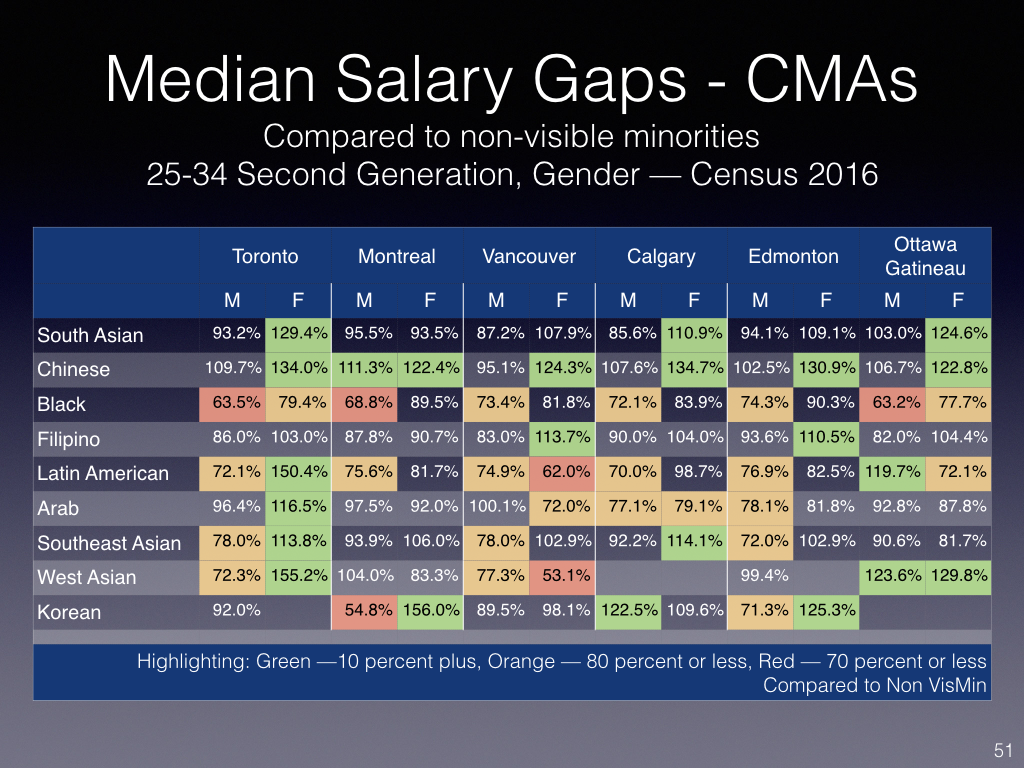
My analysis, focussing on outcomes of second generation visible minorities 25-34 years old shows largely comparable outcomes for most groups, with the exception of Blacks, Latin Americans, Arabs and West Asians. Discrimination certainly plays a part in these disparities but other factors (e.g., time in Canada, area of study etc) also play a part:

In Toronto, the colour of money is mainly white.

New demographic charts show a strikingly segregated city, with visible minorities concentrated in low-income neighbourhoods and white residents dominating affluent areas in numbers far higher than their share of the population.

The new charts come from University of Toronto Prof. David Hulchanski and his research team, known for using census data to illustrate growing income inequality in the city. Their latest effort flags the role of discrimination in that inequality, with lopsided racial breakdowns that surprised the researchers.

“It’s starker than we would expect,” Hulchanski said in an interview.

Hulchanski revealed the new charts last week in the Netherlands at a conference called “Urban poverty and segregation in a globalized world.”

Using the 2016 census, his team calculated that 48 per cent of Toronto’s census tracts are low-income neighbourhoods, where the average individual income is $32,000 before taxes.Fully 68 per cent of residents in these neighbourhoods are visible minorities while 31 per cent are white. (Whites make up 49 per cent of Toronto’s population.)

The main ethno-cultural communities in these low-income neighbourhoods are all overrepresented compared to their share of the city’s population. Black residents, for example, are 9 per cent of the population but make up 13 per cent of residents of low-income neighbourhoods.

High-income neighbourhoods are almost a reverse image. They make up 23 per cent of Toronto’s census tracts, with average individual incomes of $102,000 before tax. Fully 73 per cent of residents in these neighbourhoods are white, far higher than their share of the city’s population. The rest are visible minorities, of whom only 3 per cent are Black.

Whites are also overrepresented in middle-income neighbourhoods, where the average income is $49,000.

“Money buys choice. And people with the most choice are choosing to live in certain areas,” Hulchanski says, explaining the disproportionately high concentration of white residents in high- and middle-income communities.

Choice also partly explains the makeup of low-income neighbourhoods. Some members of ethnic groups prefer to live where their communities are most numerous, giving them easy access to the shops and cultural or religious services that facilitate integration or simply make life more enjoyable.

York University Prof. Carl James, who reviewed Hulchanski’s charts, questions how free the choice actually is for visible minorities.

“We have to think about how the system might have enabled and co-operated in making it possible for some people to access high income neighbourhoods and to stay in those neighbourhoods, or operated to keep others out of those neighbourhoods. It’s not just individual choice. Many other structural things work in relation to choice.”

Studies indicate that discriminatory barriers to good jobs and housing play a determining role.

“Discrimination is not at the same level as in the United States,” Hulchanski says, “but that doesn’t make it any better for those who face that problem here.”

The researchers split the city into high-. and low-income categories by comparing neighbourhoods that were 20 per cent above or below the Toronto Census Metropolitan Area average. Middle-income was within 20 per cent. The team then used census data to see the makeup of those communities.

Evidence of discrimination is reinforced by another chart produced by Hulchanski’s team, showing relatively high levels of education in low-income neighbourhoods. Half of all residents in those areas have a post-secondary degree: 25 per cent from a university and 25 per cent from a community college.

Hulchanski questioned why half the city has average gross incomes of only $32,000 when so many people in those low-income neighbourhoods have relatively high levels of education. “That doesn’t make sense, except for discrimination,” he said.

Another worrying sign for Hulchanski is that 57 per cent of residents in Toronto’s low-income neighbourhoods are immigrants, including established ones who arrived before 2006. Only 31 per cent of residents in high-income areas are immigrants, including 23 per cent who arrived prior to 2006.

The racial segregation of Toronto neighbourhoods is in the context of research, also from Hulchanski’s team, illustrating the growth of low- and high-income neighbourhoods in Toronto, while middle ones steadily disappear.

The polarized income trend dates back to the 1990s, caused by federal and provincial cuts in transfer payments and social assistance, along with tax cuts, rising housing costs and the disappearance of well-paid manufacturing jobs, Hulchanski says.

Government policies caused the income polarization, and only government policies can reverse it, he argues. Hulchanski warns that in Europe, where the trend is less severe, income polarization and ethnic segregation has contributed to the rise of far-right populist movements and outbreaks of violence.

“How long can this continue?” Hulchanski asks. “There is no sign of the trend reversing yet.

“Will there be riots in Toronto? Who knows?”

Source: Toronto is segregated by race and income. And the numbers are ugly

Dina Porat, Netanyahu’s secret agent in his war on the ‘new anti-Semitism’

Knowing both Dina Porat and Yehuda Bauer from my time as Canadian delegate to IRHA, found this story particularly of interest. Agree with Bauer:

A public outcry and a media storm have raged in recent months over a joint declarationissued by the prime ministers of Poland and Israel and read by Israel’s Prime Minister Benjamin Netanyahu last June. The statement praised Polish resistance to the Nazis. It came on the heels of Poland passing a controversial law akin to Holocaust-denial that banned implicating Poles for crimes committed during the Holocaust, an offense punishable by a three-year prison sentence. When Netanyahu read the declaration, many criticized him over reaching a faustian detente with Poland.

Professor Yehuda Bauer, Israel Prize laureate and one of the world’s leading Holocaust scholars, deemed the joint statement “betrayal.”

In an interview on Israeli public radio, Bauer said that Israel had accepted the Polish narrative of the Holocaust. “The Poles have deceived us, they have us wrapped around the finger, and we agreed to this, because the State of Israel finds the economic-political-military relations with Poland more important that such a small business, the Holocaust,” he said.

Senior officials in the Netanyahu government, including Naftali Bennett, Minister of Education and Ayelet Shaked, Minister of Justice, also criticized the declaration.

The statement was drafted far from the public eye with support from a secret delegation of Netanyahu allies and former appointees, Yaakov Nagel and Yossi Ciechanover. According to reports by Israeli media, a meeting between the delegations was held at the Mossad offices. It came about in spite that this kind of historic declaration should be made after deep discussion involving experts and the public.

After the statement was made, Netanyahu revealed that “Professor Dina Porat, the chief historian of Yad Vashem was involved the drafting of the declaration.” However, Yad Vashem had already published their own unprecedented and sharp condemnation of the statement. It said the joint Israeli-Polish declaration contained “historical distortions” and was written without Yad Vashem’s involvement.

Porat would have liked to have some sections corrected, she explained in an interview with Kan radio and reported by Ynet. Yet, taken as a whole, she said “We can definitely live with it,” Porat clarified she was not paid for consulting on the declaration. “I was asked to give personal and discreet advice, I did not act as the chief historian [of Yad Vashem],” she said.

How was it possible that Porat acted behind the backs of both Yad Vashem and the Israeli public? Do political ends (such as bolstering Netanyahu’s attempt to have more embassies moved to Jerusalem) justify the means? Does that include the desecration of the memory of the Holocaust? Prima facie, Porat’s conduct was no fluke but a matter of worldview and priorities.

What is anti-Semitism? Depends on what’s in the Israeli government’s self-interest

“New anti-Semitism,” a vague term promoted by the Israeli government and its partners, regards the BDS movement and criticism of Israeli occupation policies as a form of anti-Semitism. While the Israeli right-wing often mocks the “peace industry,” it has formed its own industry under the assumption that new anti-Semitism is real and spreading. The government calls this fighting the “de-legitimization of Israel.” It is spearheaded by politicians who strive to gain personal capital, organizations on the right and extremist groups. This industry offers lucrative jobs and huge budgets.

While sporadic anti-Semitic elements in the boycott movement do occur and should not be tolerated, it makes no sense to sweepingly label this global, diverse movement as innately “anti-Semitic.” Many Jews in Israel and across the world support a full boycott of the State of Israel, or a boycott of Israeli settlements and those who profit from the occupation.

In spite of strenuous efforts by the Netanyahu government, a boycott of the State of Israel is still considered an integral part of the civil right to freedom of speech and conscience in many countries, even if the local governments oppose the boycott or do not support it. In reality, the Netanyahu government has used the fight against the “new anti-Semitism” to silence criticism of the occupation and its policies in the occupied Palestinian territories, to persecute left-wing and human rights groups, and to shrink the democratic sphere in Israel.

It comes as no surprise that the Netanyahu government’s fight against the boycott movement and the “new anti-Semitism” shifted gears in 2015, against the backdrop of the international nuclear agreement with Iran. A new existential enemy had to be found, around which the public in Israel could be rallied. To manufacture a public consensus as to the current “existential threat,” the Netanyahu government could not rely just on the fringe right wing. In this context, Porat became an important asset to the Netanyahu government by joining the campaign. For example, the Kantor Center at the Tel Aviv University, headed by Porat, publishes an annual report (of which she is the editor) on the status of anti-Semitism throughout the world. These reports pay close attention to the boycott movement and groups which campaign against Israeli policies. The reports also regard the labeling of Israel as “an apartheid state” as a manifestation of anti-Semitism. At ahearing of the Knesset’s Immigration and Absorption Committee in May 2015, Porat stated that “It’s obvious that anti-Israeliness and anti-Zionism are acquiring an increasingly anti-Semitic tone.” This means that in her view, anti-Zionism may amount to anti-Semitism.

When it comes to the “old anti-Semitism,” Porat seems more pragmatic. This was evident not just in her (professed) clandestine participation in the preparation of the joint declaration with the Polish government, but also in her approach to other regimes with a serious anti-Semitism problem. Hungarian Prime Minister Viktor Orban, has been waging a racist and anti-Semitic campaign for years, and has even expressed his personal support of Miklós Horthy, the country’s ruler during WWII who was directly responsible for the extermination of Hungary’s Jews. While the United States Holocaust Memorial Museum in Washington has condemned Orban sharply, and Elie Wiesel returned a medal he had received from the Hungarian government due to its whitewashing of the country’s Nazi past, we have not heard Porat’s criticism of this grave anti-Semitism in Orban’s party and government. In fact, the opposite is true – Orban visited Yad Vashem recently. It comes as no coincidence that Hungary is being coaxed by Netanyahu to transfer its embassy to Jerusalem.

Furthermore, we have not heard Porat’s critique as to Ukrainian legislation which, similarly to the Polish one, bans criticism of Nazi Germany’s Ukrainian henchmen during WWII. Nor have we heard her public voice regarding the integration of a neo-Nazi Militia, Azov, which uses Nazi insignia, into the national Ukrainian security forces. Once again, the converse is true: The Prime Minister of Ukraine visited Yad Vashem in May 2017, and metIsraeli Minister of Defense Avigdor Lieberman to discuss arms deals. By contrast, the Simon Wiesenthal Center has campaigned against the militia’s efforts to recruit new members, and the United States Memorial Museum has strongly condemned the Ukrainian legislation. Nor have we heard Porat’s critique as to the recent visit by Philippine President Rodrigo Duterte, who is responsible for the extrajudicial killing of thousands of suspected drug dealers and addicts. Duterte has also compared himself to Hitler and said he would gladly slaughter three million drug addicts similarly to Hitler’s slaughter of the Jews.

A dangerous stamp of approval

Porat published in Haaretz a response to an article by the Israeli writer Amos Oz, in which he claimed that Israel would not resolve its conflict with the Palestinians by using its military might, but only through negotiation, including with the Hamas terror organization. Porat criticized Oz strongly and cited an excerpt from his book “A Tale of Love and Darkness,” in which the guard from Kibbutz Hulda  says: “It’s not because they are a nation of murderers that we will shoot them (if they show up to shoot us), but only for the simple reason that we too are allowed to live and for the simple reason that we too are allowed to have a country, not just they.” Porat of all people should have known that the logic of this sentence has served to justify crimes against humanity and genocide in Guatemala, Rwanda, Bosnia, South Sudan, Burma and other countries.

Accordingly, we did not hear Porat’s voice when the Chairman of the South Sudanese Parliament, Mr. Anthony Lino Makana, visited Yad Vashem in December 2017, as crimes against humanity were being committed in South Sudan by the government’s security forces and allied militias, and the UN warned that the situation could escalate to a full genocide. Nor did we hear Porat’s voice when the head of the Burmese military regimevisited Yad Vashem in September 2015, although the Burmese security forces under his command are responsible for crimes against humanity and war crimes. Porat should have noted reports by the United States Holocaust Museum, regarding the minority Muslim Rohingya population, as to grave violations of human rights taking place in the country, with a serious threat of genocide. Israel has sold weapons to the above-mentioned states, and visits to Yad Vashem have been a part of the package deal.

Porat is surely not responsible for the decades-long policies of the Israeli government and Yad Vashem. But her stamp of approval to the Netanyahu government’s foreign policy illustrates the danger of politicizing the memory of the Holocaust and the Israeli right-wing’s cynicism. It seems that the more she deals with the “new anti-Semitism” bogeyman, the less she addresses the “old anti-Semitism.” If Porat is really more concerned with support for BDS in Ireland, which has enacted a law banning settlement products, than with Hungary, whose government erects statues honoring those who assisted in the elimination of Jews, and a senior extreme right-wing figure calls for the compilation of a “Jewish list” for national security reasons – She would do wisely in letting someone more qualified assume her position at Yad Vashem. Indeed, Porat has offered her resignation, but reportedly Yad Vashem did not accept it. If she does leave her post, she will be free to advise Netanyahu as personally and publicly as she wishes.

Source: Dina Porat, Netanyahu’s secret agent in his war on the ‘new anti-Semitism’

Trump’s Vow to Cut Red Tape Doesn’t Extend to Legal Immigrants

Interesting take – using regulatory reform language to criticize Trump administration immigration policies:

A Trump administration proposal to make it harder for legal immigrants to remain in the U.S. could cause thousands of them to forgo $2.3 billion worth of food stamps and other government assistance each year.

But even with that apparent taxpayer savings, it still could be the costliest regulation the administration has proposed. That’s because of the paperwork burden it would impose on immigrants and the way the government measures the costs and benefits of regulations.

The Department of Homeland Security measure would make it more difficult for legal immigrants to get green cards authorizing them to permanently remain in the U.S. if they use public aid programs.

The proposal, expected to affect some 383,000 people annually, would boost the odds that U.S. citizenship officers would deem any legal immigrant a “public charge” — someone dependent on the government for assistance — making that person ineligible for legal resident status as a result.

The plan aligns with President Donald Trump’s crackdown on immigration — both legal and illegal — and is in keeping with the wishes of some hard-line advocates worried about a wave of low-skilled immigrants taking advantage of the U.S.

It also dovetails with conservative pushes to rein in federal assistance, because many immigrants would be so worried about risking their shot at green cards that they would forgo federal aid. The Homeland Security Department acknowledges there is a potential “chilling effect” that would discourage immigrants from using public benefits programs.

“Those seeking to immigrate to the United States must show they can support themselves financially,” Homeland Security Secretary Kirstjen Nielsen said. The proposal aims to “promote immigrant self-sufficiency and protect finite resources by ensuring that they are not likely to become burdens on American taxpayers.”

Some 2.5 percent of affected immigrants would opt out of the government programs as a result, according to the administration’s estimates, potentially preventing the payout of some $19.3 billion in aid over the next decade, estimated at a 3 percent discount rate.

Even so, the administration’s analysts say the rule would cost society more than it saves.

Although federal and state governments would dole out less aid, the unspent money would be a loss for the immigrants, making the change a wash for the government analysts calculating the cost and benefits of federal rules across society. Under their accounting practices, the analysts haven’t treated those foregone transfer payments as a benefit since they “do not directly affect total resources available to society.”

Instead, the government’s analysis says the rule would actually impose big costs on society — largely by forcing immigrants to spend hours upon hours completing detailed paperwork instead of working and other activities. For instance, the government anticipates each immigrant subject to the proposed rule would spend, on average, four and a half hours just filling out a single new form tracking their assets and financial status, with the opportunity cost of that time calculated at $47.97 per applicant.

The total possible price tag: $1.1 billion over a decade. The Trump administration’s own analysis estimates that all of that lost time filling out paperwork, the cost of getting credit reports and other effects mean the rule would have a direct net cost of $318 million to $1.1 billion over 10 years, when discounted to reflect 2018 dollars.

If finalized, the rule would become one of the most expensive Trump administration regulations yet, based on a survey of proposed and final rules.

Immigration is one area “where Trump wants to regulate and doesn’t mind imposing costs,” said Amit Narang, a regulatory policy expert at the watchdog Public Citizen.

The Homeland Security Department will receive feedback on the quality of its analysis, including how potential costs and benefits are characterized, as part of a public comment period.

“As noted in the analysis, the estimated savings through transfers is roughly double the cost,” Homeland Security Department spokeswoman Katie Waldman said by email. “The main direct costs of the rule would be associated with paperwork burden imposed on alien applicants for adjustment of status, who have the burden to show that they are not likely to become a public charge.”

Representatives of the White House Office of Management and Budget, which analyzes proposed regulations and their cost, did not respond to requests for comment.

Under federal law, U.S. immigration and citizenship officers vetting green card applicants already weigh factors such as the immigrants’ health, education, skill levels and whether they have taken direct cash benefits from the government. Substantial reliance on cash aid is a strike against them.

But under the new proposal, use of an array of non-cash government benefits — even acquiring prescription drugs through Medicare Part D — would become part of the calculus in determining the immigrants’ admissibility.

Legal immigrants generally can get some public benefits after they have been in the U.S. for five years. By contrast, illegal immigrants who are not authorized to be in the U.S. can’t get them at all.

Ricky Revesz, director of the Institute for Policy Integrity at New York University, said that the administration’s financial analysis of the proposal overlooks plenty of potential costs. For instance, it doesn’t account for the potential that illnesses and health expenses might climb as a result of immigrants rejecting food stamps that help them buy nutritional fare.

There was extensive analysis of the proposal’s paperwork burden, Revesz said during an event Monday at George Washington University’s Regulatory Studies Center. But “there’s virtually no discussion of the negative health consequences and other consequences to people who qualify for these benefits who might decide to forgo them in order to protect their immigration status.”

Source: Trump’s Vow to Cut Red Tape Doesn’t Extend to Legal Immigrants