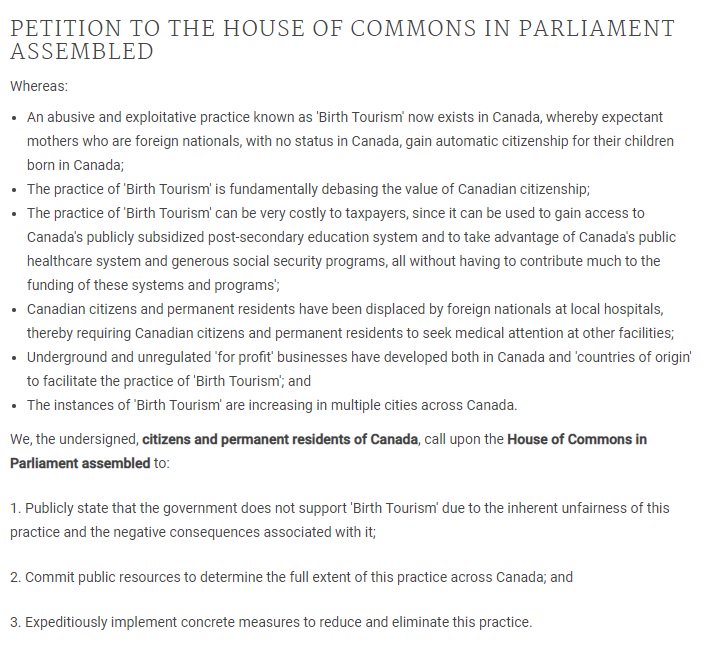
Yet another petition on birth tourism

Likely a political response to the tensions in Richmond, where over 20 percent of live births are to non-resident mothers and positioning given the Conservative party resolution calling to limit birthright citizenship to offspring of Canadian citizens or permanent residents.
Working on an article with more accurate and. spoiler alert, higher numbers which should be out later this month or early November:

Australia: Plans to outsource visa processing are scary, former immigration official says

The risks are real without proper consideration and oversight:

A Department of Home Affairs plan to outsource visa processing will lead to increased automation and “premium” services that could undermine the integrity of the system, a former senior immigration official has warned.

Abul Rizvi, a former departmental deputy secretary, told Guardian Australia the potential for a private provider to create a fast and slow lane for processing had “frightening” long-term implications and the proposed use of applicants’ data for marketing purposes was “appalling”.

Rizvi joins the Community and Public Sector Union (CPSU) and the Federation of Ethnic Communities Councils of Australia in expressing concern about the outsourcing plan, which has not received a final sign-off from the cabinet after months of testing the market for expressions of interest.

In February Guardian Australia reported that departmental briefings to industry had revealed that a successful private bidder could offset the $1bn cost of a new visa processing system by raising revenue through “premium services for high-value applicants”, different access for those able to pay more, and “commercial value-added services”, such as offers from banks, telcos and tourist operators.

Rizvi said he was “very concerned” about the prospect of premium services because “there would inevitably be an incentive for the company to be more facilitative with regard to subjective criteria for applicants who have paid for the fast lane”.

“Any monopoly provider would want to maximise charges for the fast lane and try to drive as many applicants as possible into that lane.”

He said applicants whocould not afford the higher charges were likely to come to Australia on visitor visas and apply for other visas after arrival, exacerbating “integrity problems” caused by the existing backlog of people in Australia because of the department’s “extraordinarily poor administration”.

In July, the home affairs minister, Peter Dutton, boasted about a decline in permanent migration, despite industry warning that the government was “throttling back the rate of migration by stealth” through longer wait times.

Rizvi predicted that outsourced visa processing would lead to tension between the Department of Home Affairs’ increased use of “subjective criteria” for certain visas and the private operator’s desire for increased automation.

“The company or companies that win these tenders will want to automate decision-making as much as possible to minimise costs.”

Rizvi said it was appalling that “extraordinarily personal information” such as an applicant’s relationship status, job, income and health could be used by a commercial firm for marketing purposes.

The chairwoman of the Federation of Ethnic Community Councils of Australia, Mary Patetsos, said it would be “very concerned” about commercialisation of applicant information. She also opposed measures that could lead to an increased cost of visas, particularly for family and partner visas.

“Australia has a long-standing reputation for its impartial, fair and transparent immigration system,” she said. “It should not be put at risk.”

Patetsos warned that premium services “could undermine fairness”. “The opportunity to bring family to Australia to live or visit for extended periods should be available to all Australians – not just the wealthy.”

She said it would be unacceptable for Australian families of limited means to be denied family reunion, which was “integral to successful settlement, social cohesion and wellbeing”.

The deputy national president of the CPSU, Lisa Newman, said a two-tiered visa processing system “will lead to dangerous outcomes”, with the operating company incentivised to to put its profits ahead of the need to assess “gold-plated” visa applicants to the same standards applied to those who could not afford to pay a premium.

“It would also give the company an incentive to further delay processing times for regular customers to try to force them into upgrading.”

She called on the Coalition to abandon the proposal.

The CPSU intends to campaign on the visa outsourcing issue at the next federal election, targeting the immigration minister David Coleman’s seat of Banks, and other electorates with a high number of Australians born overseas, including in western Sydney.

Tender requests went to the market in July and there have been industry briefings in Sydney, Canberra, San Francisco, Singapore and Bengaluru, as well as consultation by the Department of Home Affairs with its workforce.

Groups reportedly keen to bid include a joint venture between Accenture and Australia Post, and a consortium involving Pacific Blue Capital, Qantas Ventures, PwC and Ellerston Capital.

Pacific Blue Capital is run by Malcolm Turnbull’s former employee and friend Scott Briggs. In September, Labor signalled it would pursue the government’s planned outsourcing of the $1bn visa processing system in Senate estimates and called on ministers linked to Briggs to recuse themselves from consideration of the outsourcing proposal.

Source: Plans to outsource visa processing are scary, former immigration official says

‘We Are Facing a Monster’ Right-wing extremism in Germany

Good and thoughtful interview:

DER SPIEGEL: Ms. Knobloch, 73 years after the end of the Holocaust, right-wing extremists in Germany are once again stretching out their right arms in the Hitler salute. Jews are being threatened in public while parliamentary opposition leader Alexander Gauland, of the right-wing Alternative for Germany (AfD) party, recently said that the Nazi period was nothing but a “speck of bird shit” on German history. What is your reaction to the last several months?

Knobloch: These events weigh on us heavily. By “us” I mean the members of all Jewish communities in Germany. I am actually an optimist, something I inherited from my devout father. After the Holocaust, he was convinced Germany would once again have a future. I have thought a lot about my father recently. And I hope the alarming spectacle of the last few months will somehow come to an end like many others have before.

DER SPIEGEL: You don’t sound terribly optimistic.

Knobloch: I never thought it could get so bad again. Recently, I was at a high school with 300 students and told them: Take the responsibility we hand down to you. Be proud of your country. It has achieved a lot and is continuing to achieve. And as I was speaking, I was thinking: What are you even saying? Is it true at all?

DER SPIEGEL: You have your doubts?

Knobloch: There have been worrisome developments earlier. A few years ago, for example, there was a right-wing extremist demonstration in Munich where marchers shouted, “Jews in the gas, Jews out,” and the police didn’t intervene. But it has never been as bad as it is today. For the first time, a party has made it into national parliament whose program can be summarized with the words: Jews Out.

DER SPIEGEL: You are referring to the AfD.

Knobloch: I don’t actually want to even say their name. “Alternative for Germany,” what impudence. But yes, I am referring to the AfD.

DER SPIEGEL: Do you view the AfD as a Nazi party?

Knobloch: What else are you supposed to call a party that disseminates a platform that makes Jewish life impossible? This party is opposed to ritual circumcision and seeks to ban the shechita of animals, through which meat becomes kosher for practicing Jews.

DER SPIEGEL: There are more than a few Jews involved in the AfD. How can the party be anti-Semitic?

Knobloch: Just like a person with Jewish friends can still be an anti-Semite, Jewish party members are in no way a guarantee that a party doesn’t have anti-Semitic tendencies. The simple presence of Jews, in any case, isn’t enough and a group like the one calling itself “Jews in the AfD” is no proof of the lack of anti-Semitism. Particularly since the group isn’t just made up of Jews.

DER SPIEGEL: Among the established parties in Germany, there is a significant degree of uncertainty about how they should confront the AfD. Should they go on the attack? Ignore them? Try to expose them with arguments? They are trying everything and nothing seems to be working.

Knobloch: I like how the single neo-Nazi in the Munich city council is being dealt with. He is simply completely ignored by the other parties. He files inquiries and they simply go unanswered.

DER SPIEGEL: But in Germany’s federal parliament, the Bundestag, every deputy has rights. And with 92 members of parliament, the AfD is the largest opposition party. How can they be ignored?

Knobloch: There needs to be a consensus among all the other parties. The AfD has positioned itself outside of our liberal values. Period. It bothers me that there isn’t even consensus on this point at the moment. What other viewpoint can there possibly be?

DER SPIEGEL: The debate surrounding how to deal with the AfD recently intensified after an extremely emotional plenary speech by former Social Democrat leader Martin Schulz, who linked the right-wing populists with fascism.

Knobloch: I thought Schulz’s reaction was absolutely the correct one. Everybody needs to know who they are voting for when they cast their ballot for the AfD. Our task is to clearly draw the line. If we don’t, we are merely helping normalize the right-wing populists. I wanted to write Martin Schulz a letter, but I never got around to it because of the Jewish holidays. His dedication is admirable.

DER SPIEGEL: Among other things, Schulz said that AfD co-leader Gauland belongs on the “manure heap of history.” Should he be stooping to the level of the right-wing populists?

Knobloch: We can’t always obey the rules of politesse when dealing with a Nazi party. When politicians from the AfD refer to the Nazi period as “a speck of bird shit” in German history and refer to the Holocaust memorial as a monument to shame, then we need to strike back rhetorically. We are facing a monster. We have to fight it before it becomes stronger.

DER SPIEGEL: Following the recent riotsin Chemnitz, German President Frank-Walter Steinmeier harkened to the collapse of the Weimar Republic

Knobloch: That wasn’t an exaggeration. Weimar collapsed because the democrats, who were actually supposed to be the pillars of the system, ducked responsibility. I find it extremely troubling that people today aren’t taking to the streets in large numbers to demonstrate. There are distressing parallels between then and now. You just have to listen to the things politicians from this party say without facing repercussions. It is reminiscent of the rise of the NSDAP (Nazi party). Personally, I feel like it is 1928 again.

DER SPIEGEL: Do you think the AfD should be monitored by the Federal Office for the Protection of the Constitution (BfV), Germany’s domestic intelligence agency?

Knobloch: I find it completely incomprehensible as to why that wasn’t started long ago. I am stunned. If the AfD was being monitored, their representative would perhaps tone themselves down in public instead of inciting the population. Instead, there are rumors that Mr. Maassen …

DER SPIEGEL: … the former head of the BfV Hans-Georg Maassen, who wasrelieved of his duties recently for allegedly pandering to the far right …

Knobloch: … may have given tips to AfD members on how to avoid monitoring from the BfV. If that is true, that would be a catastrophe from my point of view.

DER SPIEGEL: Maassen expressed doubt about the authenticity of a video from Chemnitz that showed migrants being chased down.

Knobloch: Someone in his position should not just say something like that without presenting proof. That is a break with our political culture.

DER SPIEGEL: The rise of the AfD is inseparably connected with the refugee policies of Chancellor Angela Merkel. Do you think it was the correct decision to not seal off the German border in September 2015?

Knobloch: I view the issue through the lens of my own biography. If the U.S. immigration authorities in the late 1930s had approved the visas that my uncle applied for on behalf of his brother, his mother and me, my grandmother would not have had to suffer such a horrific death. She was too old to be accepted into the U.S. There were similar fates people faced that I heard about at the time. That is why I was very much in favor of Germany taking in the people who were living in horrific conditions in the Budapest train station in September 2015. After all, we became a humane country after 1945.

DER SPIEGEL: The Christian Social Union, the Bavarian sister party to Merkel’s Christian Democrats, believes the chancellor’s refugee policies are misguided.

Knobloch: We can’t take on more than we can handle, I agree with that. First and foremost, we have to help those who have had to leave their homes to escape war. When I see the terrible images from Syria, then we can’t hesitate for a moment. But we need a migration law to decide who fits, who can be integrated, who we need on the job market.

DER SPIEGEL: Do you see a connection between Merkel’s refugee policies and increasing anti-Semitism?

Knobloch: I’m wary on that issue. We don’t have an anti-Semitism problem because people from other cultures are coming to us. That would be an extremely simplistic view.

DER SPIEGEL: You don’t see a qualitative difference between European anti-Semitism from the Christian West and Muslim anti-Semitism?

Knobloch: I didn’t say that. Muslim anti-Semitism works primarily by way of the delegitimization of Israel. And there is a specific form of anti-Semitism that has its roots in the Koran. That also has an influence over how anti-Semitism develops in this country.

DER SPIEGEL: What do you mean?

Knobloch: Anti-Semitism used to be the rejection of a certain group of people. Today, it is simply hatred of the Jews.

DER SPIEGEL: Anti-Semitism has radicalized?

Knobloch: Absolutely.

DER SPIEGEL: Is there a recipe for fighting it?

Knobloch: Not enough is being done, that is the frightening thing. We have been calling attention to the problem for years. And there are actually institutions that should be taking action. Political leaders, for example. Security authorities. Educational institutions. All of them should focus on fighting anti-Semitism, especially given our history. But not nearly enough is being done. Those who are blaming the refugees exclusively for anti-Semitism are making it too easy on themselves. These people, if you will, can’t help it. That’s how they were raised.

DER SPIEGEL: Where do you think the largest shortcomings are to be found?

Knobloch: In education. We are way behind there. You can’t fight anti-Semitism by simply talking about anti-Semitism. You fight it by learning to love your own country and by defending its values.

DER SPIEGEL: In a recent op-ed for the Israeli daily Haaretz, you sharply criticized Richard Grenell, the U.S. ambassador to Germany, saying that he has positioned himself as an ally to right-wing populists in Europe. Why did you get involved?

Knobloch: When Mr. Grenell welcomes the rise of anti-establishment populists in a country where the extreme right has won seats in parliament, we Jews feel threatened. The fact that he apparently doesn’t see this connection is appalling. Mr. Grenell uses the same language as the AfD. This cycle of mutual encouragement is a danger to our liberal democracy. In such a situation, I don’t care if he is the U.S. ambassador or whatever else.

DER SPIEGEL: Has Mr. Grenell contacted you at all?

Knobloch: No.

DER SPIEGEL: Would you like to meet with him?

Knobloch: It would depend on the subject matter. I am happy to talk at any time with young people who have adopted different ideas and to try and convince them.

DER SPIEGEL: Mr. Grenell claims to be a great friend of Israel’s.

Knobloch: Friendship is a rather broad term. Many people use it to put themselves in the center of attention because they think it looks good.

DER SPIEGEL: What do you think of the Israel policies of U.S. President Donald Trump?

Knobloch: I have family in Israel: a daughter, several grandchildren and two great-grandchildren. I have a special relationship to the country and advocate for its security wherever I can. The Israeli people want nothing more than peace, I am 100 percent convinced of that. That is why I welcome the fundamental tenets of Trump’s Middle East policy. I wouldn’t, however, have moved the U.S. Embassy to Jerusalem. That is such a sensitive issue that doing so merely makes in more difficult to find the solutions to problems.

DER SPIEGEL: You belong to the last generation of Holocaust survivors. How should the memory be kept alive once all those who witnessed it firsthand are gone.

Knobloch: My hopes are very much pinned on young people who are more interested in the history of their own country than was the case 10 or 15 years ago.

DER SPIEGEL: The Berlin municipal official Sawsan Chebli has proposed making it a requirement for young people to visit a concentration camp memorial. What do you think of the idea?

Knobloch: The only camp where it is still possible to really get a sense for the tragedy is Auschwitz. Such visits, though, can only take place if there has been sufficient preparation. Young people have to know what they are visiting. And if one of them doesn’t want to, you can’t force them.

DER SPIEGEL: What do you have against the so-called “Stolpersteine,” the gold-colored paving stones placed in front of buildings in German cities to commemorate Jews who lived there until they were deported by the Nazis?

Knobloch: I find this type of commemoration to be a catastrophe. People trample on the names of those who were murdered and dogs pee on them. The Munich city council has resolved that commemoration must take place at eye level. I hope that our example is followed elsewhere.

DER SPIEGEL: Jews who live in Israel often can’t understand how Jews can continue to live in the diaspora.

Knobloch: In the diaspora or in Germany?

DER SPIEGEL: Does it make a difference?

Knobloch: Of course it does. Given recent developments, I am being asked such questions more often.

DER SPIEGEL: By whom?

Knobloch: The part of my family that lives in Israel has already come to terms with it. My granddaughter is now grown up, but when she was in the ninth grade, she visited Auschwitz with her class. In Israel, it is a visit everybody makes. Afterwards, she wrote me a six-page letter and asked me how I can live in Germany.

DER SPIEGEL: The attacks on Jews in France triggered something of an exodus of Jews fleeing the country to Israel. Do you think there is a danger of something similar occurring in Germany?

Knobloch: Yes, there is a danger. Members of the Jewish community come to me and tell me that they are afraid. It is equal parts irrational and understandable. I try to give them courage, despite everything. That is part of the optimism that I mentioned earlier.

DER SPIEGEL: Ignatz Bubis, one of your predecessors as president of the Central Council of Jews in Germany, said toward the end of his life that he accomplished “almost nothing.” What are your feelings when you look back on your own life?

Knobloch: He was already quite sick when he said that. I called him and said: How can you say such a thing? I know how much you have accomplished.

DER SPIEGEL: You have a more positive view than Bubis did at the end of his life?

Knobloch: It is a question I ask myself every day, when I see the terrible developments in Chemnitz and elsewhere. But then I always think: I did achieve something. It’s just a gut feeling I have.

DER SPIEGEL: Bubis never wanted to live in Israel, but he wanted to be laid to rest there.

Knobloch: He didn’t want his grave to be vandalized. And given the increasing anti-Semitism, that is a very real danger.

DER SPIEGEL: And where do you want to be buried?

Knobloch: I have our family plot here in Munich.

DER SPIEGEL: Ms. Knobloch, thank you very much for this interview.
Immigration consultant council suspends licence of former Edmonton MLA Carl Benito

Yet another one:

The federal council that regulates immigration consultants has temporarily suspended the licences of former Edmonton MLA Carl Benito and one of his sons, as it awaits the outcome of a Canada Border Services investigation of an alleged large-scale immigration fraud.

At a hearing Tuesday, Cindy Ramkissoon-Shears, an independent chairperson of the Immigration Consultants of Canada Regulatory Council (ICCRC), determined there were reasonable grounds to conclude that allowing Benito and his son Charles to continue practising as consultants may cause harm to the public and could undermine the reputation of the profession.

The temporary suspensions mean the Benitos must have no further involvement with their clients. They must immediately make arrangements for another consultant or lawyer to assume their clients’ files.

Benito and his son did not respond to interview requests from CBC News on Tuesday.

The ICCRC is the national body that, by federal law, regulates all individuals, except lawyers, providing Canadian immigration, citizenship, and international-student advising services.

The council only seeks an interim suspension in exceptional circumstances, following a preliminary investigation, when it considers allegations so serious that allowing the consultant to continue to practise poses a potential risk to the public.

The hearing Tuesday heard evidence the ICCRC had received three complaints about the Benitos’ immigration consulting practice dating back to 2016.

But the council only began its investigation after it learned from CBC News on Aug. 16 that the Canada Border Services Agency (CBSA) had raided Benito’s home and office in late June as part of a major immigration fraud investigation.

Bundles of $100 bills seized

Court documents obtained by CBC News revealed the CBSA seized more than $250,000 in cash — mostly bundles of $100 bills stashed in two floor safes — as part of an investigation into what the agency alleges was a three-year immigration fraud scheme. The agency also seized numerous cash-filled payment envelopes bearing what appear to be the names of clients.

In search-warrant documents, the CBSA alleged that since Nov. 11, 2015, Carl Benito had counselled dozens of Filipino immigrants to improperly extend their stay in Alberta. The agency claimed Benito organized a scheme involving bogus applications for study and work-permit extensions.

The CBSA also alleges it found at least one Filipino immigrant, and possibly several more, working illegally for the Benitos’ consulting business.

The ICCRC had previously determined there was sufficient evidence to hold a hearing for  interim suspensions against Carl and Charles but there was not enough direct evidence to include a third son, Mark, in the proceedings.

During Tuesday’s hearing, Carl Benito’s lawyer, William Macintosh, argued the information contained in the CBSA search-warrant documents did not constitute sufficient evidence because it was essentially hearsay and, in some cases, double hearsay.

But a lawyer acting for the ICCRC said the information in the search-warrant documents, supplemented by similar information contained in the three previous complaints, created credible and compelling grounds to support the suspension of the Benitos.

“In my submission, there are more than reasonable grounds to believe the Benitos have been running a practice, the modus operandi of which was to perpetuate a fraud against the Canadian government,” lawyer Lisa Freeman told the hearing.

Carl Benito did not speak at Tuesday’s hearing. His son, Charles, who was self represented, told the hearing that he had done nothing wrong and was innocent.

None of the Benitos has been criminally charged and none of the allegations from the search-warrant documents has been proven in court. The CBSA has confirmed its investigation is ongoing.

Council investigation delayed

An ICCRC investigator admitted under questioning by Macintosh that the council’s investigation, and potentially a full disciplinary hearing, can’t continue until after the CBSA concludes its investigation.

The investigator conceded the council is wholly dependent on documents from the CBSA for its investigation, and it could take up to a year for the CBSA to conclude its investigation.

In an August interview, the council’s director of professional conduct told CBC News the investigation process can be complicated by the immigration status of individuals who may be critical witnesses in a disciplinary hearing.

Immigration Consultants of Canada Regulatory Council director of professional conduct Michael Huynh says the investigation process can be complicated by the immigration status of people who might be critical witnesses in a disciplinary hearing.

“Because of the nature of the services members provide — that is, the members of the ICCRC — a lot of the complainants sometimes are of precarious status,” Michael Huynh said. “So they might not be willing to, after filing the complaint, testify, in which case it gets a little harder for us to procure the evidence necessary to prove our case.”

Huynh said there are also situations where a complainant may have been “complicit” in the immigration consultant’s activities, which may make them reluctant to testify for fear of compromising their status.

Benito was elected to the Alberta legislature in 2008. He became an immigration consultant after losing the Progressive Conservative nomination in 2012.

On websites and Facebook pages filled with photos of beaming clients, “Kuya Carl” (Brother Carl) claims he can help fellow Filipino immigrants secure residency, study permits, and work permits.

“Carl is simply the best in immigration consulting in Edmonton,” one of his websites reads.

In an article recently published in a local Filipino newspaper, and republished on his immigration firm’s website, Benito claimed he was a victim of “sensationalized” journalism.

“We have several clients who are our direct witnesses on how Triple Maple Leaf Canada and Carl Benito conducts his Consulting Services with utmost transparency and within legal bounds and following the guidelines as set by Immigration Canada,” Benito wrote in the article.

Source: Immigration consultant council suspends licence of former Edmonton MLA Carl Benito

Immigration department changed ‘illegal’ to ‘irregular’ on webpage about asylum seekers as debate flared

Suspect someone finally noticed the inconsistency in language between the website and ministerial remarks:

The immigration department changed a web page about asylum seekers to swap the word “illegal” for “irregular” as a debate was erupting between the federal government and Ontario on the issue, CBC News has learned.

The change in July came 18 months after the web page, titled “Claiming asylum in Canada – what happens?,” was first published — and just one day after federal Immigration Minister Ahmed Hussen suggested the provincial Progressive Conservatives were mistaken in the way they were describing the status of people entering Canada at non-official entry points.

Throughout the web page, which is intended to provide information on Canada’s asylum laws, the words “illegal” and “illegally” were switched to “irregular” or “irregularly” in six separate instances on July 10, 2018.

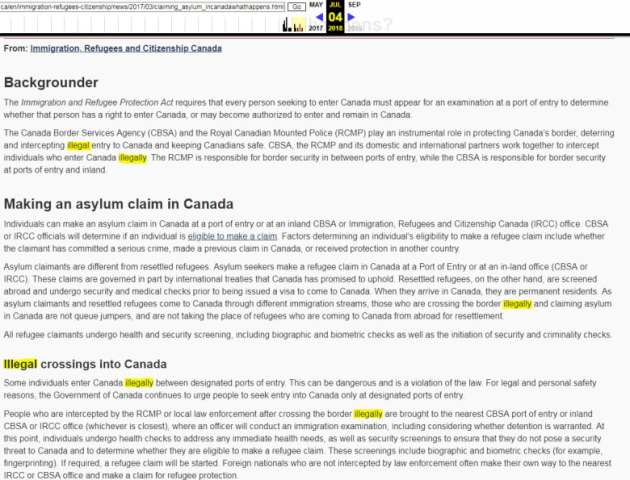
A Wayback Machine snapshot shows that “illegal” was the word of choice on the immigration web page before it was changed 18 months later. (CBC News/Olivia Chandler)

On July 9, Hussen attacked Ontario’s newly-elected premier, Doug Ford, and provincial Social Services Minister Lisa MacLeod, who oversees the immigration file, over their use of the term “illegal border-crossers” when describing asylum seekers crossing at non-official border points.

As Hussen was telling a news conference Ford and MacLeod were wrong to call those border crossings ‘illegal’, his own department was still using that word to describe such crossings on the asylum web page. The next day, the wording was changed to “irregular.”

The change was not ordered by Hussen, said Mathieu Genest, the minister’s spokesperson.

Cached web page reveals change

The Wayback Machine website, an open online library that archives published internet pages, retains a snapshot of the immigration web page as it appeared on July 4, 2018 — when it was still using the word “illegal.” The backgrounder was published originally on March 2, 2017.

The web page lays out the process for seeking asylum or claiming refugee status after crossing the U.S.-Canada border at a designated port of entry, or after arrival at an unofficial crossing point.

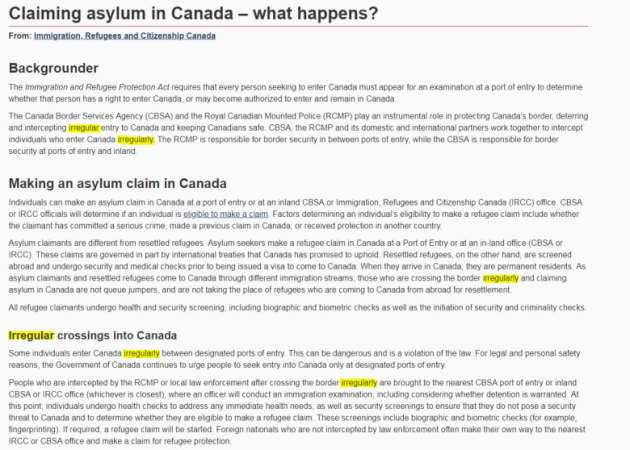
Language used on the immigration department web page – “Claiming asylum in Canada – what happens?” – was modified on June 11, 2018. (CBC News/Olivia Chandler)

“The Canada Border Services Agency (CBSA) and the Royal Canadian Mounted Police (RCMP) play an instrumental role in protecting Canada’s border, deterring and intercepting irregular entry to Canada and keeping Canadians safe. CBSA, the RCMP and its domestic and international partners work together to intercept individuals who enter Canada irregularly,” the website now reads.

“Given significant confusion around the terminology, the department made incremental updates to all pages to minimize mischaracterization of asylum seekers as being in Canada illegally,” said Nancy Caron, spokesperson for Immigration, Refugees and Citizenship Canada, in an email to CBC News.

“‎Until their claim is decided, or if they are found to be a refugee, a person will not be charged with an offence based on how they entered Canada.”

However, the change does not appear to be consistent across the department’s website. Another web page that provides monthly updates on the numbers on asylum claims and interceptions still refers to “illegal entry to Canada” and to the CBSA and RCMP’s efforts to “intercept individuals who enter Canada illegally.”

Conservative immigration critic Michelle Rempel dismissed the changes and said she’s more troubled that the government has not tabled a concrete plan to deal with the problem.

“They need to be focusing on solving this problem that’s being created by tens of thousands of people illegally crossing on the border into Canada after having reached the United States, and the strains that it’s placing on Canada’s social program and, frankly, the backlog it’s creating,” she said.

NDP immigration critic Jenny Kwan — who has pushed all levels of government to stop using the word ‘illegal’ in the context of asylum-seekers — welcome the department’s changes, but noted the government’s decision to do it under the radar.

“I think it’s very significant for that change to have been made, and for it to be acknowledged publicly really through their website. I guess I should say ‘quietly’ through their website, because the government loathed to admit that they are wrong,” she said.

“When we call asylum seekers ‘illegals’ we are denigrating them as people.”

Charged debate

The language surrounding the emotionally-charged political debate over border-crossers has been a source of friction and confusion.

(The CBC’s Language Guide allows for the use of both terms to describe border-crossings outside of official border points, depending on the context. See more below.)

Last March, Hussen was asked by Conservative MP David Tilson at a committee hearing which word he prefers to use to describe the act of crossing the border to claim asylum at an irregular crossing point.

“I have used the word ‘illegal’ and I have used the word ‘irregular,’ and I think both are accurate,” Hussen replied.

Weeks later, the immigration minister had changed his tune.

On July 13, Hussen called MacLeod’s approach to the issue of asylum seekers “not Canadian.”

Federal Immigration Minister Ahmed Hussen and his provincial counterpart from Ontario, Lisa MacLeod fall out over irregular migration at minister’s meeting in Winnipeg. 1:23

“Asylum seekers are processed in a separate queue at the IRB and all the other regular immigration programs are processed by IRCC, and conflating the two knowingly is irresponsible, it’s divisive, it’s fearmongering and it’s not Canadian. And it’s very dangerous,” he said.

MacLeod fired back.

“The minister should sit down, have a nice cup of tea, calm down a little bit, and maybe phone me and apologize for calling me un-Canadian,” she said.

“There is a problem at the border. The border must be enforced.”

Caron said that the department chose to standardize its terminology on the website “to underscore that it is not illegal for someone to enter Canada for the purpose of making an asylum claim at any point along the Canada-U.S. border.”

In late July, MPs held special “emergency” committee hearings that led to heated debates between the Liberals and opposition parties over the government’s handling of border-crossers.

Kwan has made repeated requests for all parties to stop calling asylum seekers “illegal” because it generates negative public opinion.

“The immigration refugee protection act clearly states when a person crosses over to the border directly or indirectly for the purposes of seeking asylum, they are not committing a criminal offence,” she said.

According to the RCMP, authorities intercepted 14,125 border crossers at the border between Jan. 1 and Aug. 31, 2018.

CBC uses the terms “illegal crossing” or “illegal migration” when referring to the act, but does not describe the individual making the crossing as an “illegal migrant” or “illegal border crosser.”

Crossing into Canada outside a formal border point is against the law under the Customs Act.The UN Convention on Refugees acknowledges throughout its statutes that some refugees cross borders illegally and states that they should not be prosecuted for it if they are legitimately seeking asylum.


The CBC Language Guide on border crossings:

Illegal border crossing, irregular border crossing

It’s against the law to enter Canada without the proper papers, and without going through an official port of entry during designated operating hours, according to the federal Customs Act. Asylum seekers are not prosecuted for such illegal crossings, pending a review of their refugee applications, according to the Immigration and Refugee Protection Act. But this does not make the crossing, itself, lawful. The government reserves the right to pursue charges later. Applicable international law uses similar language. For example, the UN Status of Refugees Convention and Protocol specifically refers to such unauthorized border crossings as “illegal entry.” The convention goes on to state that countries “shall not impose penalties” on refugee claimants solely because of “their illegal entry” as long as they “present themselves without delay to the authorities and show good cause for their illegal entry or presence.” For this reason, it’s OK to use terms such as “illegal border crossings” and “unlawful border crossings”.

Some politicians and refugee activists prefer the term “irregular border crossings”. While the word “irregular” is becoming more common, choosing between “illegal” and “irregular” is now also seen by some as a partisan decision. CBC News strives to avoid taking sides in political debates over language. We believe the modifier “illegal” is generally preferable because it is accurate and entrenched, and so, instantly helps our audience understand the story. “Irregular” is less familiar and more bureaucratic, but there’s no ban against using the word as long as a given story’s context makes its meaning clear. Just be sure to explain or define “irregular border crossing” if you use the term (e.g., “refugee claimants entering Canada without going through official border points”). It’s worth noting that “irregular” is a statutory designation found in Section 20.1 of Canada’s 2001 Immigration and Refugee Protection Act. The once-obscure jargon started becoming more widely used by federal officials in 2017.

Illegal migration

Be aware that while the modifier illegal is an entrenched and acceptable way to describe the general act of unlawful movement across borders (e.g., illegal immigration and illegal migration), it’s viewed by many as a poor way to describe people themselves. Instead of using a term such as “illegal immigrant,” therefore, prefer specific detail (e.g., “entering or living in a country illegally”). Another option is to use a neutral modifier that applies to a given set of facts (e.g., undocumented worker). The same principle applies to asylum seekers and refugee claimants. While it’s OK to describe an act as technically unlawful (e.g., an illegal border crossing), we should not call people “illegal border crossers.” Avoid shorthand such as “an illegal” or rounding up “the illegals,” which reduces the identities of human beings to a criminal act they’re accused of

Source: Immigration department changed ‘illegal’ to ‘irregular’ on webpage about asylum seekers as debate flared

US seeks to reduce waivers for immigration fees

Consistent with other restrictive measures (Canada does not offer a waiver to lower income immigrants despite the 5 fold increase in citizenship fees in 2014-15):

United States Citizenship and Immigration Services is proposing changing the eligibility for fee waivers for lower-income immigrants on the path to legal permanent residency and U.S. citizenship.Immigration advocates say the move is like building an “invisible wall.”

USCIS announced the change Friday in the Federal Register. Receiving means-tested public benefits from the states would no longer result in automatic USCIS fee waivers, the proposal states. Instead, fee waivers would only be tied to two criteria: the federal poverty threshold or particular financial hardships.

The change is necessary, USCIS said, because “eligibility for these benefits can vary from state to state, depending on the state’s income level guidelines,” meaning that “individuals who would not otherwise qualify under the poverty-guideline threshold and financial hardship criteria have been granted fee waivers.”

In 2017, USCIS approved 285,009 fee waiver applications, totaling $173 million.

The new proposal restricts waivers only to applicants who are at or below 150 percent of the federal poverty threshold or financial hardship.

“It’s a significant narrowing of those who would be eligible for the fee waiver. Our estimates indicate that this would reduce the total population of those eligible for a fee waiver by two-thirds,” said Jill Marie Bussey, advocacy director for the Catholic Legal Immigration Network. “It’s an extremely troubling proposal for our network.”

CLINIC’s 330 affiliates provide pro bono immigration services to thousands of low-income immigrants across the United States. Bussey said 95 percent of CLINIC’s affiliates assist with fee waiver applications.

In California, where 20 percent of the population is foreign born, the federal poverty threshold to claim state benefits is 200 percent.

For 2018, a four-person family in California is eligible for means-tested state benefits with a household income at or below $50,200. Thus, an immigrant household at that income level and receiving state means-tested benefits are currently eligible for a USCIS fee waiver.

But with the proposed change, that same four-person Californian household would only be eligible for the USCIS fee waiver if household income was at or below $37,650.

USCIS is like the U.S. Postal Service in that most of its funding comes from fees paid for its services, rather than from U.S. taxpayers.

USCIS fees for immigrants to use its services can run into the thousands. The application for a “green card”, formally known as the “application to register permanent residence,” costs $1,140. The application for naturalization to become a U.S. citizen costs $640.

The waiver proposal is an attempt to reverse a change to immigration policy under President Barack Obama. In 2011, USCIS standardized a process of using means-tested benefits as a way to prove eligibility for its fee waivers.

“When this agency waives fees, it’s hurtful to the quality of the agency and it pushes fees off from one population to another. If you can’t get fees from group A, then you have to run up the fees for groups B, C, and D. So there is a reason to be careful with waivers,” said David North, a fellow at the Center for Immigration Studies, a Washington, D.C., think tank advocating for low immigration.

“The change works against and secures some fee money from the near poor while leaving the poor untouched. So this is not a program that rolls back benefits for the really poor people, it rolls back benefits for some of the working poor and the income level above that,” North said.

CLINIC’s Bussey said the proposal is like an “invisible wall,” “a back-door way of limiting family immigration and reunification.” She fears it will suppress naturalization rates

“And that hurts us all. Studies really show that low-income immigrants are able to improve their financial status through naturalization. They have access to better jobs, educational opportunities and resources,” she said. “So limiting access to naturalization through limiting this fee waiver creates a poverty loop.”

North said the fees make sense because U.S. legal status brings “admission to the labor market, for instance, where you can make as much money as you want or can.”

The proposed change is open for comment until Nov. 27. Public comments have to be taken into consideration when finalizing a federal government rule change but may not necessarily be incorporated into its outcome.

Source: US seeks to reduce waivers for immigration fees

Over 100 Million Immigrants Have Come to America Since the Founding

Nice charts and analysis. While I am far from being a libertarian, Cato Institute analysts do some really good work in this area:

America is a nation of immigrants, and throughout its history, it has received nearly 100 million immigrants. I almost wrote that America “welcomed” them, but the fact is that very few of those 100 million were broadly popular with the public when they arrived. They came nonetheless. They thrived, and those immigrants—at least those who stuck it out in the face of harassment and discrimination—and their descendants built the country that we have today.

The term “immigrants” refers to foreigners who come to the United States with the intention to settle permanently. They are distinct from “nonimmigrants” who make temporary visits to the country, such as tourists, students, and guest workers. Figure 1 provides the breakdown of immigrants by the last legal status that the immigrant held. An illegal immigrant who receives legal permanent residency is listed as a legal immigrant, even though he may have entered illegally or lived illegally in the United States at some point. It includes all immigrants since the end of the Revolutionary War in 1783, but does not include slaves imported involuntarily to the United States (the legal slave trade ended in 1808).

Figure 2 breaks down the number of new legal permanent residents admitted annually from 1783 to 2018. The bars show the absolute figures and the line the number as a share of the U.S. population. The government didn’t collect annual statistics prior to 1820, but a general consensus appears to have arrived at about 250,000 immigrants from 1783 to 1819. I estimated the annual figures for the period by assuming a modest jump after the French Revolution in 1789, a significant jump in 1793-94 following the Haitian Revolution, a significant decline during the Napoleonic Wars, and an almost  total elimination during the War of 1812. These assumptions produced period averages similar to those estimated in American Immigration by Maldwyn Allen Jones and which accord with other accounts of the period.

The average number of new legal immigrants per year from 1783 to 2017 was 370,169, and the average immigration rate was 0.4 percent of the population—that’d be the equivalent of 1.3 million people in 2018. For context, the United States is on pace to admit about 1 million new immigrants in 2018 or 0.32 percent of its population.

The estimate for the number of illegal immigrants is much more tentative for obvious reasons. About 11.3 million immigrants without legal status show up in the Census Bureau’s American Community Survey in 2016. Broadly reliable estimates of the illegal population exist back to 1980. While relatively few people immigrated illegally prior to the 1980s, I estimated amounts using the available evidence. Based on estimates of the mortality and emigration rates of illegal immigrants in recent years, we can conclude that about 1.4 million immigrants died without status and 6.4 million illegal immigrants voluntarily emigrated. In addition to these, about 2.4 million were deported. It would be reasonable to increase these figures by 10 to 20 percent, but the overall picture of U.S. immigration in Figure 1 would hold.

America’s tradition of receiving people from around the world is admirable, but as Figure 2 shows, the rate of legal immigration right now is still far lower than its historic highs in the 19th and early 20th century. America can not only easily sustain a much higher rate of legal immigration than what it permits at the moment—it would benefit greatly from a much higher rate.

Source: Over 100 Million Immigrants Have Come to America Since the Founding

UK: Shaun Bailey’s views on multiculturalism are toxic to Londoners and his response is worse

Sigh …

Shaun Bailey, the Conservative candidate for the London mayoralty, is under fire after the Guardian obtained an old Centre for Policy Studies pamphlet in which Bailey said that allowing Hindu and Muslim families time off to celebrate their religious festivals would rob Britain of its community and turn the country into a “crime-ridden cesspool”.

The policy is toxic. No, having days off to accommodate religious festivals doesn’t divide communities and in fact the reverse situation (keeping schools open but having religious absences or parents opting out of mainstream education as a result) does. Added to that, for Bailey, the politics are more toxic still.

There is no plausible path for any Conservative candidate to 50 per cent of the vote plus one – necessary under London’s supplementary vote system – that doesn’t run through London’s affluent Hindu communities in west and north-west London. How is he going to get their votes if he is on the record saying their religious holidays risk turning the country into a “cesspool”?

His campaign’s response is a revealing insight into why Sadiq Khan’s aides believe that Bailey will be an error-prone and vulnerable candidate. Here’s their response to the Guardian in full:

“As a descendant of the Windrush generation, and someone who has worked with diverse communities for over 20 years, Shaun knows full well the challenges faced by BAME communities. Shaun has made it his life’s work to help those from migrant and disadvantaged communities, and to suggest otherwise is ludicrous. As someone who has received racist abuse from the Labour party, who let’s not forget branded the community worker a ‘token ghetto boy’, this is a little rich.”

There are a lot of bad political choices to unpack in a single paragraph, but let’s start with the last sentence. Put yourselves in the shoes of one of Harrow’s Hindu swing voters. You backed Sadiq Khan in 2016 but re-elected Bob Blackman, a Conservative, in 2017. You’ve heard that Bailey thinks that teaching people about Diwali in schools will rob Britain of its community and turn the country into a “cesspool”. Why do you give a flying one about Emma Dent Coad saying something racist about Shaun Bailey? Why is that relevant to your life? That’s not an apology.

But it’s not the only bad decision being made here.

Let’s imagine you are instead an older white voter in Bow. You voted for Ken Livingstone, Boris Johnson and Zac Goldsmith. You were suspicious about Sadiq Khan and you still aren’t wholly sold on him. Why do you care about Bailey being “a descendant of the Windrush generation”? Why’s he focussing on helping migrants? What about your grandkids? Who even is this guy who hasn’t even made it to Westminster who thinks he can become your mayor?

Or perhaps you’re a graduate in, say, Richmond. You backed Boris Johnson but you now have complicated feelings about him thanks to the referendum. You voted Liberal Democrat in Westminster and gave Sadiq Khan your second preference in London as you disliked Zac Goldsmith’s campaign. You think Khan is a decent guy but you aren’t sure what he’s actually done. You aren’t entirely sure what Diwali is about but you like living in a city where different things go on.

I just named three groups without which a Conservative candidate cannot win the London mayoralty and Bailey is appealing to none of them. And among liberal graduates and affluent Hindus he has probably suffered a wound that Khan will seek to widen and deepen over the next two years.

Source: Shaun Bailey’s views on multiculturalism are toxic to Londoners and his response is worse

Sajid Javid is right – the British citizenship test is a bad pub quiz. So what is he going to do about it?

Good comments on the UK citizenship test and the “values” question that apply more broadly than the UK:

Speaking at his party’s conference this week, the home secretary Sajid Javid criticised his own government’s British citizenship test, describing it as like “a pub quiz” that is not fit for its intended purpose.

Javid is not the first to realise this. In 2013, I published what is still the only comprehensive report into the citizenship test, in which I criticised it in those terms – and this was discussed in parliament. So it is pleasing to see my campaign for changing the test has the home secretary on board.

It’s about time. The test is a key part of the immigration system for permanent settlement. Over 2 million tests have been sat since it launched in 2005. Immigrants sit a multiple choice exam with 24 randomly selected questions and must get 18 or more correct to pass the exam. It costs £50 for each attempt – and one person was known to take it 64 times.

The test’s intended purpose is to help confirm that an immigrant has successfully integrated into British society. This might be thought best achieved by checking for any criminal record or tax arrears over an extended residency period (which are also part of the process), but the test is supposed to add something extra beyond this. And here it categorically fails.

If you pour over the roughly 3,000 facts covered by the test questions, including about 280 historical dates spread over 180 pages, it is difficult to see what practical use the citizenship test has. Its handbook does not say how to contact emergency services, register with a GP or report a crime. There is no mention of 999 or of how many MPs sit in the House of Commons. But you must know how many elected representatives sit in the Welsh Assembly, Scottish Parliament and Stormont in Northern Ireland. The handbook requires memorising the height of the London Eye and the age of Big Ben. And while you must know about starting a free school, there is no mention of the national curriculum.

Unsurprisingly, the test is regularly seen as the test for British citizenship that few British citizens can pass, with many migrants seeing it as an opportunity by the Home Office to extract increasingly more expensive fees through a test of random trivia meant to make more fail.

Instead of ensuring new and old citizens were coming together, my research found the test was actually moving them apart – and doing more harm than goodat confirming integration.

In June this year, a House of Lords select committee on citizenship and civic participation agreed with me, endorsing seven of my recommendations, including the need for a new test and an advisory group engaging with the public to close the gap between public expectations and what any such test should cover. While Javid’s remarks acknowledge the citizenship test’s problems that the Lords select committee and I raised, it is unclear what he proposes to do about it. He says the test is not enough, but then promises to bring in “a British values test” as something new.

My concern arises from one difference that I have with the home secretary: I have sat the citizenship test and know it firsthand. If Javid examines the test, he will see that it already does ask immigrants about “the liberal, democratic values that bind our society together”. So if he wants the UK citizenship test to do this, the good news is it already includes it.

It would be a mistake to rush towards launching a new values test or revising the current one without engaging with the public. There are concerns about immigration and how well it is managed that have remained strong for several years. An edict based on guesswork won’t build confidence, especially for those most anxious about immigration levels. One problem shouldn’t lead to something worse.

Now is the time to foster healing for a country divided many different ways beyond the Remain and Leave split. An advisory group, preferably led by a naturalised British citizen who understands the process firsthand, could play an important role in bringing citizens together to discuss what British values we have, what they mean to people and how they can help rebuild a post-Brexit immigration system. Such work could be done over a few months, serving as a useful means for fostering confidence while dispelling immigration myths that might remove some of the toxicity from the debate and move the conversation on.

But it would take courage to make such a new start – and we can only hope such a plan is in mind.

Source: Sajid Javid is right – the British citizenship test is a bad pub quiz. So what is he going to do about it?

FM Klimkin proposes to discuss dual citizenship in Ukraine

Will be interesting to see how this debate progresses:

Ukrainian Foreign Minister Pavlo Klimkin says there is a need for a debate on dual citizenship in Ukraine.

“We all understand that tens or hundreds of thousands of people in Ukraine have passports of neighboring countries. And this is not only ethnic Hungarians. I think we should hold a discussion about the state’s attitude to this large group of our compatriots,” he wrote in an article for European Pravda.

Klimkin believes it is possible to find a solution that will not harm people with dual citizenship, but, on the contrary, free them from the need to conceal it.

“The discussion is not about worsening their situation or branding them as traitors, but rather reasonably resolving the legal limbo, and not only that,” the minister said.

He stresses the problem of dual Ukrainian-Russian citizenship should be considered separately in the context of Russian aggression against Ukraine.

“I personally consider it fundamentally unacceptable. As a matter of fact, the decision on single citizenship in Ukraine was once made, first of all, as a fuse against Russia’s possible influence on the newly declared independent Ukraine. Today, when Moscow is waging armed aggression against us, such motivation is leveled: if Ukraine wants to consider the possibility of limited application of dual citizenship, this should not concern Russia in principle,” Klimkin said.

Source: Klimkin proposes to discuss dual citizenship in Ukraine