[Herald Interview] ‘Multiculturalism is inevitable in Korea’s future’

More on the changing nature of Korean society:

Over 2 million residents now live in Korea, according to government data. This is more than double the figure in 2007 when the number hit 1 million for the first time.

“Multiculturalism is inevitable in Korea’s future,” Kim Do-gyun, president of the Korea Immigration Service Foundation, told The Korea Herald on Tuesday, a day before International Migrants Day.

When the foundation was established in 2004, its chief aim was to provide administrative assistance to the immigration office. But as the immigrant population grew, the foundation broadened its role to supporting foreign immigrants in adapting to and settling in Korean society.

“We have run integration programs for nearly 10 years now with the goal of helping immigrants prepare for their lives here,” he said.

The program includes introduction to language and cultural characteristics, as well as immigrant rights.

Allowing immigrants to make a smooth transition to their new homes is beneficial not only to the immigrants as individuals but to society as a whole, according to Kim.

“Most immigrants are here through marriage or on employment permit,” Kim said.

“They are often at a disadvantage, and unfortunately subject to discrimination at times,” he said. “Support is needed for healthy adaptation and acculturation.”

“If we fail them as a society in helping them settle in Korea or assimilate — should they want to — into our culture, that is one more person isolated from being able to function as a member of our community.”

Kim also spoke against prejudices immigrants face.

“Some 7.5 million Koreans live overseas. That is three times the number of immigrants — 2.5 million — living here,” he said, pointing out that migration was a natural occurrence in a globalized world.

“We have to stop thinking of immigrants in the third person. Because we may well be in their shoes someday.”

Moreover, Korea will have to rely on immigrants for its future labor force, Kim said, given the aging population.

“Politicians refrain from talking about immigrants because the subject is not exactly a vote-winner,” he said. “But what alternative is there for the aging crisis (than immigration)?”

“Our future is multicultural,” he said. “No culture is independent from outside influences. Homogeneity is a myth.”

As for undocumented immigrants, Kim said there should be legal channels through which they could be allowed entry.

“For instance, there are vacancies in jobs unwanted by locals that these illegal immigrants are willing to fill,” he said.

Since assuming office in March, Kim said he has worked on reaching out to immigrant communities and raising awareness about the foundation.

Kim said from his decades of experience in immigration services that immigrants were the ones more eager to learn about Korea and Koreans.

“But Koreans are not as ready to learn about immigrants or understand them,” he said. “This has to be a two-way street. If we are welcoming and open-minded, our new neighbors will find their way soon enough.”

Source: [Herald Interview] ‘Multiculturalism is inevitable in Korea’s future’

Alberta government drops anti-racism focus of community grant

Similar shift as that occurred 2010-11 under then Minister Kenney, when multiculturalism program was reoriented towards integration among all groups with greater emphasis on antisemitism than other forms of racism or discrimination:

Some community organizations are breathing a sigh of relief after a popular anti-racism grant has been saved from provincial budget cuts.

The Alberta government announced on Monday that the Anti-Racism Community Grant will be offered under the new banner of the Multiculturalism, Indigenous and Inclusion Grant program.

The new grant “revitalizes the Anti-Racism Community Grant to support a broader range of projects,” Ministry of Culture, Multiculturalism and Status of Women spokesperson Danielle Murray said.

“By promoting understanding and appreciation of our Indigenous and multicultural society, we will reduce discrimination and create welcoming and inclusive communities so that all Albertans feel their culture is valued.”But the replacement is not quite apples to apples, said Irfan Chaudhry, director of MacEwan University’s office of human rights, diversity and equity, in an interview on CBC Edmonton’s Radio Active on Wednesday.

“I think it’s good to see that there still is funding available around these programs, so I think that’s really promising to see,” Chaudhry said, noting that the funding could be a boost for cultural awareness and harmony.

The coalescing of the specific anti-racism scope of the previous grant — which addressed more systemic issues — with the broader program, is a disappointment, Chaudhry said.

“What made it powerful is it addressed a specific issue. You’re naming racial discrimination as the issue that wants to be addressed from a provincial level — that’s fairly powerful.”

‘Smaller pot’

“Something like this kind of combines everything together and doesn’t really get at some of those critical issues as well,” Chaudhry said.

“And I think this pool of funding which includes multiculturalism, Indigenous programming and inclusion programming — which can address discrimination —  I think the pot’s a little bit smaller. So this is going to be a very competitive grant to get to begin with.”The government has earmarked $1.5 million for the grant program in 2019-20, Murray said, noting that the previous Anti-Racism Community Grant distributed similar funding of approximately $1.56 million in 2018-19.

After the provincial budget was released in October, questions swirled about the future of the anti-racism grant, which was thought to be axed.

Jean Claude Munyezamu, founder and executive director of Soccer Without Boundaries —one of the organizations who received funding from the previous grant — was worried the government was going to discontinue the grant completely.

“I thought it was a really bad idea,” said Munyezamu.

“Anyone who works with newcomers knows that [racism] is becoming worse and worse.”

Munyezamu said the decision to drop the word ‘racism’ from the name of the new grant will bring participants of his organization — which includes Canadian-born-and-raised families as well as newcomers — together.

“I think that this is the better wording,” Munyezamu said. “Sometimes when you tell people ‘racism’ people are afraid. However when you use the word ‘inclusion,’ or something else, then you can come to that word later, once you have the people together.”

The deadline for the Alberta government’s first intake of the Muliticulturalism, Indigenous and Inclusion Grant Program is Jan. 7.

Community organizations that address racism will still be able to apply for projects under the new grant, Murray said.

Source: Alberta government drops anti-racism focus of community grant

UN Rights Official Urges India to Scrap New Citizenship Law

Of note:

The Office of the U.N.’s top human rights official is urging India to scrap its new Citizenship (Amendment) Act, which it says discriminates against Muslims.

Violent protests erupted in the Indian states of Assam and Tripura in the wake of last week’s passage of India’s new citizenship law, killing three people and Injuring many others, including police officers.

The U.N. human rights office says it deplores the government’s brutal crackdown on those protesting the enactment of the law, which it calls fundamentally discriminatory.  The amended legislation grants citizenship rights to six religious minorities fleeing persecution in Afghanistan, Bangladesh and Pakistan.

But human rights spokesman, Jeremy Laurence, says the law does not extend the same protection to Muslims.

“The amended law would appear to undermine the commitment to equality before the law enshrined in India’s constitution and India’s obligations under the International Covenant on Civil and Political Rights and the Convention for the elimination of Racial Discrimination, to which India is a state party,” he said.

Laurence says India’s Citizenship Act could violate these international covenants, which prohibit racial, ethnic or religious discrimination.

“Although India’s broader naturalization laws remain in place, these amendments will have a discriminatory effect on people’s access to nationality.  All migrants, regardless of their migration status, are entitled to respect, protection and fulfillment of their human rights,”  he said.

A Muslim political party along with lawyers and rights groups have challenged the law in India’s Supreme Court, arguing that it violates the country’s secular constitution. The U.N. human rights office says it hopes the justices will consider whether the law is compatible with India’s international human rights obligations.

Source: UN Rights Official Urges India to Scrap New Citizenship Law

Meanwhile, riots and demonstrations continue in parts of India:

Furious protests against a new citizenship bill continued to erupt across India on Monday, provoking a harsh security response and presenting the most widespread challenge to Prime Minister Narendra Modi since he came to power five years ago.

On Sunday, police officers stormed a predominantly Muslim university in New Delhi, the capital, beating up dozens of students and firing tear gas into a library where young people had sought refuge.

The protests have gripped many major Indian cities and are a reaction to the Indian Parliament’s decision last week to pass a contentious measure that would give special treatment to Hindu and other non-Muslim migrants in India. Critics have called the measure blatantly discriminatory and a blow to India’s foundation as a secular democracy.

The legislation is a core piece of a Hindu-centric agenda pursued by Mr. Modi and his Bharatiya Janata Party, and many analysts predicted trouble. India’s large Muslim minority, around 200 million people, has become increasingly fearful, certain that many of Mr. Modi’s recent initiatives are intended to marginalize them.

Inside the federal bureaucracy, Clarke digs up a ‘creeping culture of excessive silos, hierarchies’ in digital attitudes

Reflects basic accountability at both the political and official levels, and that governments, by their very size and broad impact, have to be more cautious given their stewardship role:

What happens when the risk-averse organizational culture of the Government of Canada confronts the freewheeling style of digital culture? A purposeful slow reaction, finds a new book on the topic.

Amanda Clarke is a public administration scholar at Carleton University who specializes in digital government. Opening the Government of Canada: The Federal Bureaucracy in the Digital Age is a result of years of work documenting the Government of Canada’s transition to a digital world. The findings reveal how an organization that is prone to resist change is compelled to deal with global forces propelling innovation.

Opening the Government of Canada documents the digital responsiveness of the federal bureaucracy in the later stages of Stephen Harper’s Conservative government. Clarke consults an abundance of what academics call grey literature, namely media coverage, government tweets and blogs, and completed access to information requests. She gains original insights through interviews with 32 Canadian public servants and a special adviser. Those are buttressed by conversations with seven public servants in the United Kingdom. They narrate a consistent theme: that the Canadian government is cautious and hesitant about digital reform.
Provocative questions are asked at various junctures in the book. On page 69: What happens when closed government gets a Twitter account? On page 95: Who should speak for the government? These jarringly simple questions belie the author’s natural curiosity about how government works. The inquisitiveness is an excellent framing device to generate interest in figuring out the answers.

The book begins by summarizing some statistics about digital media. Among the observations are that managerial philosophies shift as digital disruption grows. Conflict ensues, which at its core is an ideological battle about notions of democratic government. On one side of the philosophical divide are valid reasons for government to operate in silos with a centralized hierarchy. On the other side are those advocating for government transparency and accountability. Readers are encouraged to consider a variety of perspectives in the closed doors versus crowd-sourcing debate.

For my part, whenever I think of digital politics scholarship in Canada, one of the subject experts who immediately comes to mind is political scientist Tamara Small of the University of Guelph. Small’s work barely factors into Opening the Government of Canada, likely because she mostly studies political parties. Yet she has repeatedly shown that most Canadian politicians use social media as a broadcasting medium. That is, instead of two-way engagement, they use social media as a digital megaphone. Politicians and their staff are more likely to raise awareness of content from news releases than they are to get into a digital conversation. Clarke discovers the same tendency in the Government of Canada, where tweets are informational one-way broadcasting (pages 82-83). Moreover, Clarke finds that government departments routinely amplify other government departments’ posts, much like MPs from the same party retweet each other. This example shows that studying how politicians behave (political science) can help inform our analysis of what happens in government (public administration). A key difference is that communicating digitally has become a fundamental aspect of what MPs do whereas it is still a work in progress for the government.

The comparison between politics and public administration is a useful reminder about drawing parallels. In government, there is safety in following what other entities are doing. It is much easier for organizations to transpose existing behaviour to new platforms than it is for them to do something radical. Thus we have the creation of GCTools, which is the government’s own social media platform.

This innovation caused Canada to be a global leader in digital government. Despite spotty uptake, public servants could avail of this safe space to discover skilled experts across government (page 131). GCTools is loosely reminiscent of the government seeking to exert control over other forms of communications, such as the Canada Gazette newspaper or any number of public relations activities. A key difference is that GCTools connects people.

GCTools was developed under the Conservative government, which had a well-deserved reputation for top-down communications management. Chapter 3 documents how the government adapted to changing digital norms earlier in this decade. The developments were slow, reserved, measured, and cautious. In society, the Twitterverse came alive with people busily posting about everything from serious questions about government, to the banalities of their personal lives. Meanwhile, within the Government of Canada, a web of policy frameworks and multi-stage workflow processes were implemented to generate social media content. It is clear that the public service struggled to react to changing societal norms.

The command and control approach of the Harper government seems to have aligned well with government’s natural ethos to run a closed shop. Clarke evokes the environment of permanent campaigning that injected a further dose of caution. Permanent campaigning refers to non-stop electioneering—that is, the official election campaign may be over, but many of the same politicized communications activities persist. A non-stop communications mentality is especially evident during periods of minority government and when the dissolution of Parliament is on the horizon. On page 86, we are informed that communications centralization becomes a virtue to avoid the “nightmare” of public servants freelancing on government social media accounts.

There are other challenges with digital government. Striving for public service neutrality in digital communications is a complex proposition (pages 92-94). Questions about who is running public-facing accounts are warranted, given that many public servants have personal social media profiles. Open data is fine in principle, but releasing datasets as PDFs that inhibit running calculations is unhelpful (page 98). Many public servants are not digital natives. This requires re-training and a conscious effort to recruit digital talent (page 158). Ultimately, fewer barriers to public interaction is less about technology than it is about attitude (page 186).

Reading about public administration can be fraught with information that gets lost in a blur of acronyms, dates, and technical writing. Thankfully, Clarke largely spares her readers from those trappings. The more I read, the more I learned and the more I enjoyed going on a journey inside the public service as it responded to digital demands. That said, for her next book I would encourage less quoting of passages from literature in order to free up more room to quote her interview participants. Another pedantic criticism is the inclusion of the U.K. interviews, which was an unusual decision. As well, the book was published in 2019, and it would be interesting to know how the analysis of 2012 Twitter data stands the test of time. We are told that e-government has become flatter, more nimble and responsive (page 157). There is some brief mention of happenings under the Liberal government, however it is unclear how the e-government trend has permeated post-Harper.

What has changed under Prime Minister Justin Trudeau? In some ways quite a lot. Since 2018, Trudeau has churned through three ministers of digital government. The creation of the portfolio is a telling development. The first two, Scott Brison and Jane Philpott, resigned from cabinet for unrelated reasons not long after taking on the portfolio. When Philpott took the helm, Amanda Clarke published some advice in Policy Options (Feb. 8, 2019) about managing the digital file. She and co-author Jonathan Craft of the University of Toronto recommended courageous leadership, more training, and a willingness to embrace experimental approaches. They urged the minister to integrate digital thinking earlier on in the public policy process. Joyce Murray became the latest minister of digital government in March 2019.

The position was secondary to Brison, Philpott, and Murray serving in their primary role of president of the Treasury Board. The post-election cabinet unveiled in November expanded the number of ministers. A lot of the attention has gone to the unusual title of minister of middle class prosperity—a good example of permanent campaigning at work. Digital government was hived off. Jean-Yves Duclos is now exclusively overseeing the Treasury Board while Murray is exclusively minister of digital government. This is mostly about the prime minister spreading political rewards around. But make no mistake: digital government is a much bigger entity than it was even a few years ago. For evidence, one need look only at how the Government of Canada has upended where its advertising dollars go, with an unequivocal preference for digital.

Yet is it unclear whether anything has changed in other areas. For instance, some internet access was blocked in some government departments in 2015 (page 103). To what extent is that the case today? Smartphones seem to present an obvious workaround. Details like this seem fundamental to assessing whether the Government of Canada is fostering a digital culture.

Looking deeper, digital optimists have reason to be frustrated. The Trudeau Liberals imported a spirit of openness into government in 2015. Part of this was to present a contrast with the Harper Conservatives. The longer the Liberals have been in power, the more the have adopted the characteristics of risk-aversion and information secrecy. The Office of the Information Commissioner of Canada has vocalized frustrations with the government’s lack of commitment to access to information. Digital communications creates efficiencies whereas open government creates headaches. It seems likely that it is “corner of the desk work” (page 112) under the Liberals as it was under the Conservatives.

The concluding chapter makes a number of recommendations best left for readers to discover. Suffice it to say, Clarke finishes off by commenting on what her research about digital attitudes in the Government of Canada has found: “a creeping culture of excessive silos, hierarchies, and risk aversion.” Here’s hoping that Minister Murray and her team find time to read Opening the Government of Canada over the holidays.

Source: Inside the federal bureaucracy, Clarke digs up a ‘creeping culture of excessive silos, hierarchies’ in digital attitudes

Changes in outcomes of immigrants and non-permanent residents, 2017 Text – Selected

The latest. Some encouraging trends:

Immigrants admitted to Canada in 2016 reported a median entry wage of $25,900 in 2017, the highest recorded among immigrants admitted since 1981. Although the entry wages of recent immigrants have increased over the past few years, their income remains lower than that of the overall Canadian population. The Canadian Income Survey estimated the Canadian population’s median wage at $36,100 in 2017.

When immigrants arrive in Canada, they face a number of challenges, such as getting their credentials recognized, being able to speak one of the official languages and acquiring Canadian work experience. However, the longer immigrants live in Canada, the more their income increases and, for some, their income reaches the level of the overall Canadian population.

This analysis uses new data from the Longitudinal Immigration Database (IMDB), which comprises information on permanent and non-permanent (temporary) residents, including asylum claimants. It presents the type of information that can be extracted from the IMDB and its outputs to better understand how the socioeconomic situation of these individuals has evolved.

Recent immigrants have higher entry wages and more work experience prior to admission than before

Over the past 10 years, the median entry wage of immigrants, one year after admission, in 2017 constant dollars, has increased from $20,400 for the 2007 admission year to $25,900 for the 2016 admission year (+27%).

Not all immigrants face the same challenges after admission. Those who had work experience in Canada upon admission reported the highest median entry wages. For the 2016 admission year, income one year after arrival was $39,800 for study and work permit holders, and $38,100 for work permit holders only. These wages are comparable with those of the entire Canadian population. For immigrants who had no experience prior to admission, or who had a study permit only, incomes were $19,900 and $12,500, respectively.

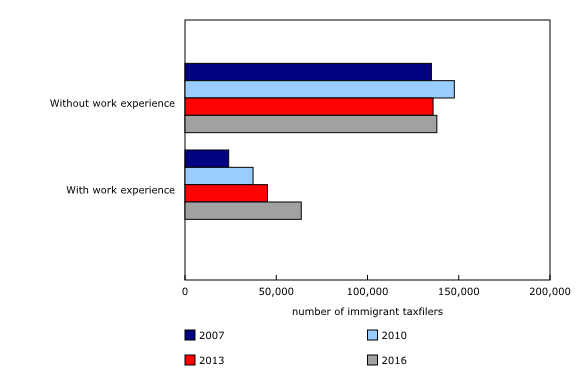
In recent years, an increasing number of non-permanent resident permit holders are transitioning to permanent residence. The observed growth in entry wages can be partly accounted for by differences in income between immigrants with pre-admission work experience in Canada and immigrants without such work experience. From the 2007 admission year to the 2016 admission year, the number of immigrant taxfilers one year after arrival who had work experience in Canada increased by 166%, while the number of immigrants without work experience rose 2%.

Chart 1  Chart 1: Number of immigrant taxfilers one year after admission, by admission year and work experience in Canada prior to admission
Number of immigrant taxfilers one year after admission, by admission year and work experience in Canada prior to admission

Chart 1: Number of immigrant taxfilers one year after admission, by admission year and work experience in Canada prior to admission

Immigrants who hold at least a pre-admission study permit have stronger wage catch-up in the 10 years after admission

Overall, immigrants’ wages increase with the number of years since admission and, for some, their wages eventually reach that of the overall Canadian population ($36,100). For example, the median wage for immigrants admitted in 2007 increased from $20,400 in 2008 to $33,500 in 2017, an increase of 64%.

Wage catch-up factors include pre-admission work experience, which facilitates integration through increased knowledge of official languages and the development of professional networks in Canada, among other things. In 2017, immigrants admitted in 2007 who had held both a study permit and a work permit prior to admission had the highest median wage (up 81% to $63,800), and their wage exceeded that of immigrants who held only a work permit (up 36% to $48,100) and that of Canadians as a whole. The median wage of immigrants admitted in 2007 who held only a pre-admission study permit increased significantly over 10 years (up 163% to $37,600) and now exceeds the median wage of immigrants without pre-admission experience (up 72% to $30,700).

Chart 2  Chart 2: Median wage of immigrants admitted in 2007, 1 year and 10 years after admission, by pre-admission experience
Median wage of immigrants admitted in 2007, 1 year and 10 years after admission, by pre-admission experience

Chart 2: Median wage of immigrants admitted in 2007, 1 year and 10 years after admission, by pre-admission experience

The median wage for asylum claimants increases with length of residence in country

Asylum claimants are individuals who request refugee protection in Canada. Because of their situation, they face many challenges in terms of economic integration. Even after their refugee claim is accepted, asylum claimants have lower median wages than other immigrants with pre-admission experience.

According to a Statistics Canada article on asylum claimants published earlier this year, the number of claimants fluctuated from 2000 to 2018 and reached over 50,000 in 2017 and 2018. Asylum claimants are relatively young. Of those who arrived in 2017, 39% were younger than 25 years of age, while 14% were aged 45 or older.

The median entry wage for asylum claimant taxfilers refers to their income one year after they submitted their refugee claim. Among those who claimed refugee status from 2006 to 2016, the median wage fluctuated between $10,900 and $16,000. As with immigrants, the median wage of asylum claimants increases with each additional year spent in the country. Therefore, the median wage for those who submitted a refugee claim in 2006 was $14,100 in 2007 and $28,600 in 2017.

There are significant differences in income among the top 15 countries of origin for asylum claimants. Among asylum claimants in 2012 who filed taxes in 2017, the highest median wages were reported by claimants from Sri Lanka ($31,600), Somalia ($30,700) and Nigeria ($30,700). Claimants from Afghanistan ($18,200), Iraq ($17,300) and China ($14,300) reported the lowest median wages.

Economic immigrants and their dependants stay more frequently in their province of admission when they have pre-admission work experience

Reasons for immigrating to Canada can influence the likelihood of immigrants to remain in their province of admission over time. For example, family class immigrants come to Canada to be closer to their loved ones, while economic immigrants are selected based on their ability to contribute to the Canadian economy.

In 2017, 86% of immigrant taxfilers admitted in 2012 filed a tax return in their province of admission. The provincial retention rate was highest among family-sponsored immigrants (93%) and slightly lower among refugees (87%). For economic immigrants and their dependants, the retention rate was 82%. However, for these immigrants, the rate was higher among those with a pre-admission work permit only (90%) than among those with no pre-admission experience (81%).

China’s ‘magical reality’ is a growing threat

More on China’s reality distortion or avoidance:

“I was hung … [in] a spreadeagled pose for hour after hour,” said Simon Cheng, a former staff member of the British consulate in Hong Kong, describing how he was tortured after he was detained in August while on a business trip to mainland China. Mr. Cheng said that the police who detained him insisted that he was “a mastermind and British proxy to incite and organize the protests” in Hong Kong.

Beijing has responded to months of demonstrations in Hong Kong not by addressing people’s grievances that their freedoms are being eroded, but instead by claiming that foreign governments were behind the demonstrations.

It’s clear from Mr. Cheng’s account of his abusive interrogations that the police were not interested in the truth, but in inventing a reality that is politically convenient for the Chinese Communist Party.

In her 2016 memoirs How Enemies Are Made, the Chinese disability rights activist and filmmaker Kou Yanding described being secretly detained by the Chinese police for participating in the 2014 Hong Kong Umbrella protests. She said that her interrogators were uninterested in her explanations or her community-based work. Instead, they “not only want to make up stories,” she wrote, they “can even create reality.” As her interrogators reinvented her chance meetings with Chinese dissidents as subversion plots, Ms. Kou felt she was in some kind of “magical realism,” a fiction her captors willed into being.

This “magical” world serves the purpose of passing the buck for failed government policies, rallying the bureaucracy for repression, and shoring up popular support. Official documents recently leaked to The New York Times substantiating the repression in Xinjiang, in western China, quote President Xi Jinping attributing incidents of unrest there to “extremist religious thought,” that “like a drug” makes people “go crazy and … do anything.” The idea that the region’s Turkic Muslims are infected with a “thought virus” – rather than having genuine grievances against an oppressive government – led the government to detain one million of them in “political education” camps, where they are forcibly indoctrinated.

Professor Fu King-wa of Hong Kong University recently traced Chinese government messaging about the Hong Kong protests on the Chinese social media platform Weibo. He concluded that the Chinese authorities had constructed “a separatist or ‘pro-Hong Kong independence’ frame for Hong Kong’s anti-extradition movement.” A month into the protests, the Chinese government unblocked online the previously sensitive term “Hong Kong independence,” and then generated more than 10 per cent of posts that supported this angle. Meanwhile, mainlanders who supported the protests were detained or silenced.

The Chinese government was not merely spreading fake news or disinformation. Rather, it seems to be practising a kind of reality engineering in which it is using its coercive and information machinery to generate enemies, be they Islam, an independence movement or imperialistic plots.

These imaginary enemies come at the expense not only of the countless individuals harmed in the process, but of finding real solutions to the discontent in Xinjiang and Hong Kong. Only in this way, the party seems to believe, can it ensure its legitimacy in the eyes of the Chinese public – convincing people that only the party can defend the country against all threats, even fabricated ones.

But by blaming foreign governments for self-generated problems, China’s leadership seems to be increasingly trapped inside its own propaganda bubble. Under Mr. Xi’s centralized rule, lower level officials are wielding the magic wand of reality engineering, telling the top what it wants to hear. The results have been policies in Xinjiang, where the government has cracked down on Turkic Muslims, and in Hong Kong, that are disastrously misguided, resulting in massive suffering.

While these dynamics are not new – they are similar to those Mao Zedong used during the 1958-62 Great Famine – they seem to have enjoyed a resurgence since Mr. Xi came to power in 2013. The milestone was in 2015, when the government began to broadcast forced confessions of detained human rights lawyers and several foreign nationals on state television, publish lengthy “exposés” to smear them and ensure that such a reality is spread far and wide using social media.

Previously, Chinese authorities tried to keep their oppressive measures muted: The imprisonment of the dissident Liu Xiaobo in 2009 was merely a one-liner in the state newspapers. The idea then was to prevent those promoting democratic ideas from reaching the public. The government’s aim now seems to be to publicly discredit those who speak for rights as foreign agents.

Unlike in Mao’s time, when China was isolated, Mr. Xi’s policies now have global implications. The world should be alarmed by the trajectory of the Chinese government’s worldview. Its mistreatment of Turkic Muslims in Xinjiang, the people of Hong Kong and now foreign diplomatic staff should be a warning for all.

Source: China’s ‘magical reality’ is a growing threat: Maya Wang

How McKinsey Makes Its Own Rules

Seems like our Ambassador to China got out at the right time…

It’s not easy being McKinsey & Company these days.

For most of its 90-odd-year existence, the prestigious management consultancy prided itself on remaining above the fray. McKinsey consultants plied the executive suites of Fortune 500 companies, counseling chief executives with discretion and quietly building a business that, with $10 billion in annual revenues, is now bigger than many of the entities it serves. The substance of the company’s work, and even the identities of its clients, lie concealed under an institutional code of silence. That reticence, enforced by a nondisclosure agreement, bedeviled Pete Buttigieg’s presidential campaign until last Monday, when McKinsey granted him a rare dispensation to reveal the names of his former clients.

On the occasions when McKinsey’s work has been scrutinized of late, it hasn’t reflected well on the firm. Reporting by The New York Times, ProPublica and others over the past 18 months has raised serious questions about how it does business at home and abroad: corruption allegations against companies McKinsey partnered with in South Africa and Mongolia; a federal criminal investigation into the firm’s bankruptcy practice in the United States; attempts to deny that it helped put into effect controversial Trump administration immigration policies; and evidence that McKinsey cherry-picked nonviolent inmates for a pilot project and made it seem that an attempt to curb violence at New York City’s Rikers Island jail complex was working (it wasn’t). McKinsey has denied wrongdoing in each of these instances.

These and other examples of McKinsey’s recent conduct reveal a common dynamic. An examination of these episodes, including thousands of pages of documents and interviews with dozens of current and former McKinsey consultants and clients from multiple projects, suggests McKinsey behaves as if it believes the rules should bend to its way of doing things, not the other way around.

McKinsey’s self-regard has long been uncommonly high. In the firm’s 2010 internal history, a copy of which ProPublica obtained, partners compare the firm to the Marine Corps, the Roman Catholic Church, and the Jesuits: “analytically rigorous, deeply principled seekers of knowledge and truth,” the history’s authors write. One McKinsey partner went a step further, declaring without a hint of irony that the firm’s trait of shared values is more than “even the Catholic Church can promise.”

This attitude works for the firm in corporate consulting, an unregulated field where McKinsey’s reputation leaves it largely free to do things its own way and where its insistence on not being publicly credited has also shielded it from blame for its failures. But as McKinsey has expanded its consulting empire in recent years, it has taken on a growing book of work for government entities, as well as for corporate clients in areas subject to government oversight, such as advising bankrupt companies on restructuring.

In that field, consulting firms confront a web of contracting, disclosure and ethics rules that are designed to dictate and limit their behavior. These rules exist to prevent governments from wasting taxpayer money on underqualified or overpriced contractors and to protect government integrity and avoid conflicts of interests. In recent years, as McKinsey has burrowed deeper into this world, interviews and records show, it has developed a habit of disregarding inconvenient rules and norms to secure, retain and profit from government work.

Consider McKinsey’s imbroglios in South Africa and Mongolia. The firm did not follow the due diligence protocols commonly deployed to avoid running afoul of anti-corruption laws. The result: Its consultants found themselves working alongside dubious local companies that got them entangled in corruption investigations. Only after McKinsey became embroiled in the South Africa corruption scandal did the firm decide it needed to put more stringent safeguards in place.

In the United States, a damning but largely overlooked report issued in July by the Office of Inspector General for the General Services Administration, the hub for federal contracting, depicted McKinsey as ignoring rules and refusing to take no for an answer. The report examined McKinsey’s attempts to renew a major long-running contract in 2016. The firm was asked to provide additional pricing information to satisfy federal contracting rules. Rather than comply, McKinsey went over the contracting officer’s head, lodging complaints with top G.S.A. officials, who refused to exempt the firm from the rules.

Eventually, the firm found a friendly G.S.A. manager who was willing to not only award the contract, but also manipulated the G.S.A.’s pricing tools to increase the value of the contract by tens of millions of dollars. The report concluded the manager “violated requirements governing ethical conduct.”

The pattern repeated itself when McKinsey failed in multiple attempts to win a separate contract around the same time. Stymied, according to the report, McKinsey browbeat the contracting officer, threatening to resubmit the proposal until it got its way. The G.S.A. manager again intervened — for reasons left unexplained by the report — and McKinsey got its contract.

The report’s assessment of McKinsey’s behavior was withering, and it revealed that the firm subsequently used the same friendly manager to help secure contracts at three other federal agencies in 2017 and 2018. “Multiple contracting officers,” the inspector general wrote, told investigators that McKinsey’s requests were “inappropriate” and “a conflict of interest.”

The report recommended that the G.S.A. cancel the contracts, which as of earlier this year had earned McKinsey nearly $1 billion over a 13-year span. In a response to the report, the G.S.A. stated that it would ask McKinsey to renegotiate the contracts to lower the price. “If McKinsey declines” or “renegotiations do not yield a result in the government’s best interest,” the agency wrote, it would cancel them. Neither has happened to date, according to federal contracting records. A McKinsey spokesman said: “We have reviewed the report and the relevant facts, and have found no evidence of any improper conduct by our firm. We are in negotiations with G.S.A. and look forward to completing them soon.” A G.S.A. spokesperson said it is negotiating for “better pricing” and will not award McKinsey any further work under the contracts until those negotiations are concluded.

McKinsey has also taken steps to evade public accountability. As ProPublica reported, a senior partner leading McKinsey’s work at Rikers asked top corrections officials and members of the consulting team to restrict their communications to Wickr, an encrypted messaging app that deletes messages automatically after a few hours or days. That insulated some of McKinsey’s work from government oversight and public records requests. (“Our policies require colleagues to adhere to all relevant laws and regulations,” a McKinsey spokesman said. He neither confirmed nor denied the use of Wickr.)

Speaking more broadly, the McKinsey spokesman said: “We hear the calls for change. We are working hard to address the issues that have been raised.”

McKinsey has so far escaped serious repercussions for its reluctance to follow inconvenient rules. That could change next year.

Consultancies such as McKinsey, which advise companies restructuring under bankruptcy protection, are required to disclose potential conflicts of interest. For the past few years, McKinsey has been locked in a complicated set of court disputes with Jay Alix, the founder of a competing advisory firm, and with the Justice Department’s bankruptcy watchdog over whether McKinsey failed to follow bankruptcy disclosure rules, a subject The Times has covered in depth.

McKinsey has, since then, disclosed a number of new potential conflicts in old bankruptcy cases and paid $32.5 million to creditors and the United States trustee to settle claims over insufficient disclosures. The trustee has said that “McKinsey failed to satisfy its obligations under bankruptcy law and demonstrated a lack of candor.” The firm denies wrongdoing and says it settled “in order to move forward and focus on serving its clients.”

Subsequently, McKinsey has moved, in effect, to rewrite the rules. It drafted a protocol ostensibly meant to clarify what advisers like itself need to disclose. Critics pointed out that McKinsey’s protocol allows such firms to avoid disclosing relationships they deem indirect or “de minimis.”

There remains more to come. Apart from the criminal investigation, a judge in Houston has scheduled a trial in February to decide the merits of Mr. Alix’s allegations. The judge, David R. Jones, has described the trial in apocalyptic tones. It will be, Judge Jones has said, “the ultimate career ender for somebody.” For McKinsey, a trial would mean being called on to defend its work in public — with real accountability and real consequences for its actions. The firm might even benefit in the long run from the sunlight.

Source: How McKinsey Makes Its Own Rules

How to improve Canada’s Parents and Grandparents immigration program in 2020

Interesting proposal by Kareem El-Assal for a Parents and Grandparents Human Capital Pilot:

January has typically marked the opening of the window for immigrants to express their interest in sponsoring family under Canada’s Parents and Grandparents Program, or PGP.

However, given the challenges Canada has had managing the PGP and the recent federal election in October, it remains unknown as to when the PGP intake window will open in 2020 and what the application process will look like.

This provides an opportunity to think of innovative solutions that could help improve the PGP. For instance, the federal government might consider launching a new Parents and Grandparents Human Capital Pilot.

PGP costs and benefits

Canada is keeping its PGP intake target stable at about 21,000 people under its 2019-2021 Immigration Levels Plan.

The PGP accounts for only six per cent of all newcomers to Canada because its economic benefits are not as strong as Canada’s other social immigration streams.

It is more beneficial to Canada’s economy to welcome spouses and other dependents, as well as refugees, who tend to arrive at a younger age and will contribute more in working hours and taxes than the average parent and grandparent. The time these former groups spend working in Canada will help to subsidize the health care they will require later in life, whereas parents and grandparents arrive in Canada at ages when they need health care the most, even though they will have yet to contribute in taxes.

There is, however, an economic justification for welcoming parents and grandparents. They provide child care, which enables their families to save money and earn more income by working extra hours. They also help to supplement the household income by working in Canada themselves. This helps us understand why data from the 2016 Census show that immigrant families tend to have nearly identical homeownership rates (69 per cent) and household incomes as Canadian-born families (CAD 85,000 annually).

We must also take into consideration the PGP’s social benefit: strong families are the bedrock of Canadian society.

Frustration abounds

Given that some 100,000 people tried to access a request to sponsor form in January 2019, vying for just 21,000 PGP spots, pleasing everyone is an impossible task and the PGP process has inevitably become a source of widespread frustration.

The federal government has recognized the limitations of the different approaches that it has tried to process PGP applications. It previously operated a first-come, first-served model where it would review applications in the order in which they were received. By 2011, this had produced a backlog of about 165,000 PGP applications. Processing times were over five years which meant that unfortunately, some parents and grandparents passed away before their application could be reviewed.

To tackle the backlog, Canada announced in 2011 that it would temporarily freeze new PGP applications and increased its PGP intake target from about 15,000 annually to 25,000 people in 2012 and 2013, before reducing it to the current target.

In 2017, the federal government introduced a lottery system for the PGP. Interested sponsors had 30 days to submit an expression of interest and the government then randomly selected candidates and invited them to apply to sponsor family.

While this approach was innovative, it had several limitations. Applicants were uncertain if their family member would ever make it into Canada. There were also applicants who were not serious about sponsoring their parents or grandparents—some of them were randomly selected but they never went ahead and submitted an application, regrettably causing delays for the federal government and more genuine candidates.

The federal government returned to a first-come, first-served approach in January 2019. The government set a date and time when the PGP Interest to Sponsor form would be made available online and accepted the first 27,000 submissions. This approach again proved problematic as more than 100,000 people tried to access the form at the same time and the submission period lasted about 10 minutes before the quota was met. Many could not access the form and others that did could not complete it on time, leading to renewed criticism of the process.

Federal government should not be afraid to innovate

We can expect another revamped version of the PGP in 2020. Since the demand to sponsor will continue to exceed the number of available spots, managing the PGP to everyone’s satisfaction will never be possible. But recent lessons provide us with a roadmap of how the federal government can proceed prudently.

First, dropping the expression of interest approach in favour of a return to an application-based model would solve a key headache for the government. This move would require giving stakeholders advance notice of when the application window will open so they can prepare their documentation. When the window does open, the federal government needs to give sponsors a reasonable amount of time to submit an electronic or paper-based application. To avoid overburdening the system, the federal government can increase efforts to attract genuine candidates by requiring that they pay the sponsorship fee in full upfront.

Second, the federal government can adjust its immigration levels based on the number of applications it receives. This would require more flexibility to, say, welcome up to an additional 10,000 PGP in certain years to ensure a reasonable processing standard (e.g., within three years).

Third, it can continue to promote its Super Visa that enables parents and grandparents to visit Canada multiple times for a period of up to 10 years. The Super Visa has been criticized for requiring these individuals to obtain private health insurance, which may be unaffordable for some families, but it at least provides families with certainty that they will be able to reunite with their loved ones. Moreover, encouraging greater use of the Super Visa would take the pressure off the PGP.

Fourth, the federal government can explore other innovative approaches to managing the PGP. Despite the criticism of its efforts to better handle the PGP in recent years, a key reason why Canada’s immigration system is so successful is the federal government’s willingness to find new solutions to longstanding challenges, such as managing backlogs. The introduction of the Express Entry system in January 2015 is a case in point.

Parents and Grandparents Human Capital Pilot

One innovation for consideration is introducing a human capital-based approach to managing some PGP applications. The federal government could launch an Economic Class pilot whereby parents and grandparents who are younger in age and have higher levels of education, work experience, and English or French proficiency would get first preference. The pilot would complement the existing PGP Family Class stream and the Super Visa.

One of the reasons the pilot would be novel is that candidates under federal Express Entry-managed programs receive fewer points once they hit a certain age (a candidate gets no points for their age once they turn 45).

Under the Parents and Grandparents Human Capital Pilot, the federal government could welcome up to 2,750 principal applicants per year (the maximum number allowed under a pilot). This figure would likely be more in the neighbourhood of 3,500 parents and grandparents per year since a share of principal applicants would be accompanied by their spouses.

This idea may be unpopular since critics could argue the PGP exists to strengthen Canadian society, not its economy. But this pilot could at least expedite processing for individuals who meet its criteria and would reduce the number of applications submitted to the PGP, which would help to improve PGP processing times.

Moreover, it is an idea that would be easier to sell to the Canadian public. Previous federal government research has indicated the PGP has less public support than other immigration streams. This is likely due to the perception the PGP has little economic benefit and is a burden to the health care system.

However, by bringing in parents and grandparents who are younger and possess stronger human capital, the federal government could make the argument that such individuals are more likely to contribute to the labour market as workers and could help subsidize the health care they will eventually need in Canada.

The future of the PGP in 2020 remains uncertain. The only certainty is it will remain difficult for Canada to manage a program with some 100,000 people vying for just 21,000 spots.

Source: How to improve Canada’s Parents and Grandparents immigration program in 2020

New role as Shadow Minister of Multiculturalism

Of interest given how Genuis defines his role and multiculturalism:

I am honoured to be officially taking on the role of Shadow Minister for Multiculturalism within the Conservative caucus. The government appoints a cabinet, responsible for administering the affairs of the nation. The “shadow cabinet” is a parallel structure that exists in the opposition, whereby specific members are tasked with leading the opposition’s response to the government on specific files. Shadow cabinet can also be about preparing to take on similar roles in government, although positions do often shift at that point for a variety of reasons.

My role as Shadow Minister for Multiculturalism involves holding the government to account in terms of their actions related to multicultural policy, and also working to ensure that our caucus is hearing and incorporating the unique experiences and perspectives of minority communities.

The Conservative caucus’s approach to multiculturalism is unique. We recognize and celebrate Canada’s identity as a community of communities. We are a country made up of distinct and different communities of people, who come together as part of a shared national community with common values and objectives. Attachments to the particulars of one’s own religious or ethnic community are good and reasonable, but they also must be transcended in the creation of a greater national community of shared commitments, of intertwining histories, and of unifying solidarity. This unity, in the midst of our diversity, is built on the foundation of freedom, human rights, democracy, and the rule of law. New Canadians come here not principally because of our diversity, but because of the freedom and peace that characterize our country and how we live well together in it.

In this role, I will always emphasize the importance of unity in diversity, and work to build common ground. Our country is quite divided right now – divided in terms of region, politics, religion, culture, and other dimensions. A lot of this division is the result, in my view, of policies pursued in the last four years at the federal level. Albertans feel disconnected from the rest of Canada because of anti-energy bills like C-48 and C-69. Cultural divisions have been exacerbated by a government that fails to effectively manage our immigration system and accuses anyone who disagrees with them of being bigoted.

Other factors have also accentuated division, such as the passage of bill 21 in Quebec and a rise in fringe xenophobic rhetoric. People understandably want to preserve their own culture, but preserving one’s own culture and faith does not require the suppression of someone else’s.

Multiculturalism isn’t just about diversity of appearance and confession – it includes diversity of thought and opinion. I will continue to challenge the government to respect the rights of people who hold different opinions from them and still participate fully in Canadian society.

In the midst of all these challenges, I will always emphasize unity, the importance of finding common ground, and the necessity of protecting fundamental rights and freedoms.

I look forward to taking on this important challenge.

Source: New role as Shadow Minister of Multiculturalism

A Black Metal Festival in Ukraine This Weekend Is the Neo-Nazi Networking Event of the Year

Never knew of this disturbing genre of music but not surprised that the far right has a cultural aspect:

Hundreds of far-right extremists will converge on Ukraine’s capital this weekend for a “militant black metal” music festival that experts say has become a networking hub in the international neo-Nazi scene.

Asgardsrei, which will be held Saturday and Sunday in Kyiv’s Bingo Club, bills itself online as a black metal festival that has “grown into the largest (and certainly the most radical)” in the region.

“2 days, 14 bands, 1,500 places, 0 tolerance,” its website reads.

Researchers say the festival is a showcase for the explicitly neo-Nazi musical genre known as “national Socialist black metal,” or NSBM. The lineup features acts with violent anti-Semitic lyrics, referencing the Holocaust and swastikas, and featuring anti-Jewish slurs. One of the bands, Stutthof, is named after a Nazi concentration camp, while another, the French band Seigneur Voland, has a track titled “Quand les Svastikas étoilaient le Ciel” (“When Swastikas Light Up the Sky”).

Another act, the Greek band Wodulf, has a track with the lyrics: “Standards of Aryan might unfurl in triumph / Immortal loyalty to the swastika.” Footage from last year’s festival shows members of the audience widely giving the Nazi salute during performances.

“The organizers have been very clever in connecting almost the complete European neo-Nazi scene.”

Far-right experts say the festival, now in its fifth year in Kyiv, has become an important networking hub for the transnational white supremacy movement. The festival was organized by individuals linked to Ukraine’s powerful far-right Azov movement, the ultranationalist group that played a major role in the revolution and the war against Russian-backed separatists in the east. It also includes a mixed-martial arts “fight night” by an Azov-affiliated fight club on Friday night.

The festival has previously drawn extremists from groups including the U.S.-based neo-Nazi organization Atomwaffen Division, Germany’s The Third Path party, and Italy’s neofascist CasaPound.

“It’s established itself as the major festival of the national Socialist black metal scene,” said Thorsten Hindrichs, a musicologist at the Johannes Gutenberg University of Mainz who specializes in far-right music subcultures.

He told VICE News that the festival provided an important point of contact for disparate far-right groups in their project “to build a pan-European community of right-wing extremists.”

“The organizers have been very clever in connecting almost the complete European neo-Nazi scene,” Hindrichs added.

Mollie Saltskog, an intelligence analyst at strategic consultancy firm The Soufan Group, said that festival organizers had boasted last year that they had “almost a thousand foreigners” at the event. Among them were members of Atomwaffen Division, including the leader of the group’s Washington State cell, Kaleb James Cole, who spent 18 days in Ukraine as part of 25-day trip through Europe.

“It’s likely that many prominent figures within the transnational white supremacy movement, both in and outside of Ukraine, will participate in the concert and surrounding activities this weekend in Kyiv,” Saltskog told VICE News.

“It’s an opportune moment for members of the transnational movement to meet up, network, forge international connections, and exchange tactics and experiences to bring back home to their own ‘fight.’” Saltskog continued.

Ahead of last year’s festival, she said, Azov had hosted an international conference of far-right ideologues, where they discussed topics such as “Nordic Paganism as Metaphysics.”

Hindrichs said Kyiv had become a “safe space” where events like Asgardsrei could take place without disruption from authorities or protesters. He said the festival’s growing importance on the international far-right scene meant it warranted closer attention from Western security services to monitor the contacts their extremists were potentially making in Kyiv.

“There’s horrifying things going on there,” he said. “It would be a good idea to try to stop people attending.”

A global hub

According to Haaretz, Asgardsrei was founded by Russian neo-Nazi Alexey Levkin, a far-right dissident who came to Ukraine in 2014 to support Azov, which has since actively forged links with like-minded groups elsewhere.

Levkin describes himself as an ideologist “who gives lectures in culture, history, and contemporary political thought” to National Militia — the paramilitary street wing of the sprawling Azov movement, which also has a regiment incorporated into Ukraine’s national army, as well as its own political party, National Corps.

As well as fronting his own band, M8L8TH, which will be performing at Asgardsrei, Levkin is also a key member in Wotanjugend — a Ukraine-based neo-Nazi group that has promoted a Russian-language translation of the Christchurch shooter’s manifesto. Saltskog said Wotanjugend was “originally established in Russia, but uses Ukraine as a base to operate and spread its neo-Nazi ideology and message of hate, under what appears to be the patronage of Azov.”

Levkin told VICE News that “only two or three bands on the line-up could really be considered NSBM” acts — including his own act, M8L8TH.

Levkin denied the festival had become a networking hub for the far-right and explained it was “first and foremost about breaking … taboos.”

“We respect any artists who dare to truly challenge the dominant narrative of the contemporary Western society,” he said.

And when asked if he considered himself a national socialist, he replied: “Yes, sure!”

Researchers said the event highlighted the way Ukraine, through the influence of Azov and affiliated far-right movements, has emerged as a global hub for right-wing extremists since the outbreak of war. In recent years, events like Asgardsrei have drawn foreign radicals to Ukraine to network with Azov-affiliated extremists, where they have documented their presence at far-right subcultural events like concerts and MMA tournaments on social media.

Meanwhile, Azov has pursued an outreach program to cultivate links with far-right groups internationally. Olena Semenyaka, international secretary for Azov’s political party who has strong ties to Levkin, traveled to meet contacts in Germany, Sweden, Italy, Croatia, and Portugal in the past year.

Last week, a far-right Ukrainian group even turned up on the frontlines of the Hong Kong protests, which sparked concerns they could be attempting to learn lessons from the pro-democracy demonstrations to use in violent street protests at home.