Treasury Board reports gains on diversity and equity in public service, but will cuts hamper progress?

Good question:

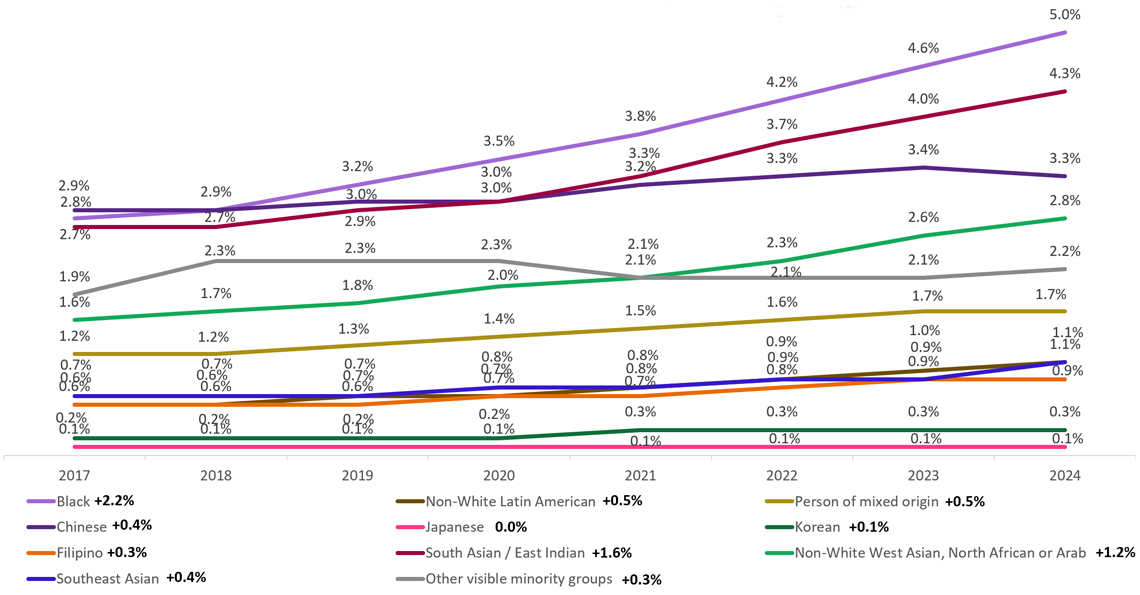
The federal public service continued to increase the number of women, Indigenous people, visible minorities, and people with disabilities in its ranks between 2023 and 2024, according to the latest report on employment equity. But as the federal public service now begins to shrink for the first time in over 10 years, some have raised concerns that job cuts will hamper progress for equity-seeking groups….

Source: Treasury Board reports gains on diversity and equity in public service, but will cuts hamper progress?

TBS publishes some rich infographics and infographics: Employment Equity Demographic Snapshot 2023–2024

Figure 33: Representation trends for members of visible minorities by subgroup – percentage

Text version below:


Is addressing anti-Black racism in Canada still a policy priority?

Suspect it will become a lower priority given more pressing issues but hopefully become more focussed on results and outcomes and more in-depth evaluations on which government programs are more effective:

…Placating the anti-equity backlash has left Canada unable to achieve or sustain the goal of employment equity. The federal government and its institutional post-secondary partners should instead commit to following more transformative paths laid out by Black scholars. These recommendations include: 

  • Redressing anti-Black racism and supporting Black inclusion in universities and colleges by following actions set out in the Scarborough Charter
  • Advancing equitable participation of Black researchers by upholding the SSHRC’s action plan. 
  • Heeding Blackett’s call to meaningfully pursue equity by affirming the quasi-constitutional status of employment equity legislation. This would include focusing attention on removing barriers for Black workers. 

Much Black effort has gone into showing us what policies and actions are needed to address anti-Black racism. The question is do Canadian institutions have the moral fortitude to follow through in the face of mounting anti-EDI backlash? 

Source: Is addressing anti-Black racism in Canada still a policy priority?

ICYMI: Twelve IRCC employees tried to interfere with immigration files, misconduct report finds

Small numbers but good that this breach was caught and acted upon:

Staff at the federal immigration department tried to interfere with applications to enter and stay in Canada, with one asking a colleague whether they would accept money to approve a study permit, a report published Friday on misconduct and wrongdoing found.

The first ever report on misconduct at Immigration, Refugees and Citizenship Canada discloses that in 2023-2024, 12 staff took advantage of their ability to access IRCC’s systems to look at people’s files. 

Some checked or asked about the status of immigration files for family members, friends and acquaintances, or checked their status out of curiosity. 

In some cases IRCC employees tried to get immigration cases fast-tracked, or asked a colleague to make corrections to a file. 

IRCC produced the report to demonstrate its commitment to transparency, and show the actions it had taken to deal with wrongdoing. …

Source: Twelve IRCC employees tried to interfere with immigration files, misconduct report finds

Inside Trump’s Extraordinary Turnaround on Immigration Raids

Another TACO moment, forced by reality and resulting political pressure by the base:

On Wednesday morning, President Trump took a call from Brooke Rollins, his secretary of agriculture, who relayed a growing sense of alarm from the heartland.

Farmers and agriculture groups, she said, were increasingly uneasy about his immigration crackdown. Federal agents had begun to aggressively target work sites in recent weeks, with the goal of sharply bolstering the number of arrests and deportations of undocumented immigrants.

Farmers rely on immigrants to work long hours, Ms. Rollins said. She told the president that farm groups had been warning her that their employees would stop showing up to work out of fear, potentially crippling the agricultural industry.

She wasn’t the first person to try to get this message through to the president, nor was it the first time she had spoken to him about it. But the president was persuaded.

The next morning, he posted a message on his social media platform, Truth Social, that took an uncharacteristically softer tone toward the very immigrants he has spent much of his political career demonizing. Immigrants in the farming and hospitality industries are “very good, long time workers,” he said. “Changes are coming.”

Some influential Trump donors who learned about the post began reaching out to people in the White House, urging Mr. Trump to include the restaurant sector in any directive to spare undocumented workers from enforcement.

Inside the West Wing, top White House officials were caught off guard — and furious at Ms. Rollins. Many of Mr. Trump’s top aides, particularly Stephen Miller, his deputy chief of staff, have urged a hard-line approach, targeting all immigrants without legal status to fulfill the president’s promise of the biggest deportation campaign in American history.

But the decision had been made. Later on Thursday, a senior official with Immigration and Customs Enforcement, Tatum King, sent an email to regional leaders at the agency informing them of new guidance. Agents were to “hold on all work site enforcement investigations/operations on agriculture (including aquaculture and meat packing plants), restaurants and operating hotels.”…

Source: Inside Trump’s Extraordinary Turnaround on Immigration Raids

Canada is making it harder for immigrants to help build much-needed homes — despite the construction industry’s growing reliance on them

Of note:

…Recognizing the need for migrant workers, the federal government in 2024 exempted the construction sector, along with agriculture and health care, from new restrictions that limit most employers to hiring a maximum of 10 per cent of their workforce through the low-wage temporary foreign worker program.

The exempt industries employ the largest number of temporary foreign workers.

In March, Immigration, Refugees and Citizenship Canada under then minister Marc Miller announced that up to 6,000 undocumented construction workers would be given a pathway to gain legal status in Canada, acknowledging that “these undocumented migrants are already living and working in Canada, and are contributing to the sector.”

This announcement came more than two years after the federal government said it would be expanding a small-scale pilot project that offered permanent residence for out-of-status construction workers already working in the sector.

In a statement, the immigration department acknowledged “there are undocumented migrants already living and working in Canada” contributing to the construction sector. It added that “creating a pathway for them to be here legally would ensure that they can continue to work and support Canada’s labour market needs, such as building the homes our communities need.”

Asked whether the pathway is being implemented, the department said the government is still “considering potential approaches to support Canada’s construction industry.”

While migrant workers and newcomers have become essential to keeping construction sites running, they are also disproportionately assigned the most precarious, low-paid and hazardous jobs in the sector. These roles often come with the highest rates of injury and the least protection.

Richard Lyall, president of the Residential Construction Council of Ontario (RESCON), said immigrants will often end up in “informal trades, more of what you call menial tasks,” typically unlicensed jobs assisting other trades. These include work in concrete, tile, bricklaying, stonework, drywalling and painting….

Source: Canada is making it harder for immigrants to help build much-needed homes — despite the construction industry’s growing reliance on them

NYT editorial: Antisemitism Is an Urgent Problem. Too Many People Are Making Excuses.

Good editorial. Applies to Canada as well:

Americans should be able to recognize the nuanced nature of many political debates while also recognizing that antisemitism has become an urgent problem. It is a different problem — and in many ways, a narrower one — than racism. Antisemitism has not produced shocking gaps in income, wealth and life expectancy in today’s America. Yet the new antisemitism has left Jewish Americans at a greater risk of being victimized by a hate crime than any other group. Many Jews live with fears that they never expected to experience in this country.

No political arguments or ideological context can justify that bigotry. The choice is between denouncing it fully and encouraging an even broader explosion of hate.

Source: Antisemitism Is an Urgent Problem. Too Many People Are Making Excuses.

Todd: Canada’s giant immigration industry will have to get used to ‘intense’ public debate

Not sure whether I would use the word “intense” but yes, greater debate, discussion and questioning part of a needed new normal. As I have repeatedly emphasized, debate need not be xenophobic or racist as the concerns relate to issues that affect all, immigrant and non-immigrant alike: housing, healthcare and infrastructure:

When I was asked to address members of the immigration division of the Canadian Bar Association, I expected an audience of maybe 25 to 50 lawyers.

But last Saturday, 400 immigration lawyers showed up at the Victoria Convention Centre to hear what three Canadian journalists and a think-tank member had to say about the media’s impact on migration.

The panel was asked to address immigration lawyers’ fears that heightened media coverage is “sparking intense public debate” and influencing “how immigrants are perceived and how decisions are made.”

In addition to offering our thoughts, panel members learned there are actually more than 1,200 immigration lawyers in the Canadian Bar Association, with their numbers mushrooming in the past 15 years.

I noted there are another 13,000 licensed immigration consultants in Canada, a doubling in just seven years. The lawyers in Victoria let us know, justifiably, that the “consultants” are not as highly trained as lawyers, or as regulated.

On top of these private players employed in the migration sector, Immigration, Refugees and Citizenship Canada has doubled its staff in a decade to more than 13,000 employees.

Altogether, these professionals and workers add up to an army of more than 27,000 immigration specialists (about the same as the number of soldiers and staff employed by Canada’s Department of Defence).

All make their living helping migrants navigate the complexities of becoming a foreign student, temporary worker, reunified family member, investor immigrant or permanent resident of Canada.

In addition, the C.D. Howe Institute maintains another huge cohort that does somewhat the same thing. Unlicensed agents — from the fields of travel, education and labour — also take fees for advising clients on how to get into Canada and stay there.

The institute’s Tingting Zhang and Parisa Mahboubi, therefore, maintain there should be many more licensed consultants — and that the government should offer better aid to the roughly six million people whose applications are each year processed for entry into Canada.

In other words, the 400 lawyers who gathered last week at the Victoria Conference Centre represented just a fragment of the immigration business in Canada. No wonder it’s called one of the country’s biggest industries.

Understandably, the gathered immigration lawyers, the slight majority of whom were women, wanted to do everything they could to help the clients in Canada and around the world who come to them.

Their questions and comments all revolved around the hope that borders be more open and the often-labyrinthine migration process easier.

They also worried about declining support for immigration. A Leger poll this spring found 58 per cent of Canadians believe migration rates are “too high”. Even half of those who have been in the country less than a decade feel that way.

Given the lawyers’ desire to assist their clients, many were wary that in the past two years more journalists have been digging into migration policy and its impact.

That’s in large part because former Prime Minister Justin Trudeau doubled immigration levels and increased the number of guest workers and foreign students by five times. Almost three million non-permanent residents now comprise 7.3 per cent of the population, up from 1.4 per cent in 2015.

The lawyers noted that, after decades in which journalists essentially avoided migration issues, many more articles were being written about such topics as the sudden jump in asylum seekers, tens of thousands of international students not attending school, businesses exploiting temporary workers and population pressures on housing and rents.

Two panelists, Toronto Star immigration reporter Nicholas Keung and Steve D’Souza of CBC’s Fifth Estate, emphasized the value of talking to migrants to develop poignant “human interest” stories. They have also investigated how bosses, fly-by-night colleges and some migrants have taken part in scams.

In response to CBA’s concerns that Canada’s media were producing “stories that have become a lightning rod for public sentiment, shaping how immigrants are perceived and how decisions are made,” the journalists on the panel explained it’s our duty to cover migration stories, and all stories, in a way that is “fair, balanced and accurate.”

Although panelist Daniel Bernhard, of the Institute for Canadian Citizenship, correctly said that some journalism about migration is superficial, I suggested it’s generally a good thing Canada’s long-standing national taboo against reporting on and debating migration policy has eased.

Although some politicians, migration lawyers, consultants and other agents may not always like it, I also said journalists’ goal is to responsibly probe to the truth of a matter and, beyond that, to “let the chips fall where they may.”

Since my Vancouver Sun editors about a dozen years ago asked me to produce more analyses about migration, I have learned covering the beat essentially amounts to writing about the “winners and losers” of migration policy, which in Canada is put together behind closed doors.

Some examples. Applied ethicists point to how it’s one thing for Canadians to worry about a “brain drain” — about losing talented citizens to places like the U.S. and Singapore. The more worrisome flip side, for countries in Africa and East Asia, is that Canada is actively draining away their brainy people, be they physicians or entrepreneurs.

Then there are the 2.8 million temporary workers in Canada, many of them international students paying exorbitant school fees. Some have been winners, getting solid educations and decent jobs in their homelands or permanent residency in Canada. Others have been exploited for their willingness to work for low wages — which has, in turn, been a losing proposition for other low-skill workers in Canada.

The job of tracking migration policies’ winners and losers is endless, including covering the squeeze that rapid population growth and the trans-national migration of foreign capital is putting on those trying to pay Canadian housing costs and rents.

Suffice it to say, journalists’ job is to shine as much light as possible on this vast system, which impacts millions. The ultimate goal is to encourage the creation of policies that best serve the most people, which is one way to advance the common good.

Source: Canada’s giant immigration industry will have to get used to ‘intense’ public debate

Public service shrinks by nearly 10,000, with tax, immigration hit the hardest

Interestingly, core public administration, the basis for employment equity reports, only shrank by some 3,000 (CRA not included in core public administration, meaning that IRCC had the vast majority of cuts). The 2023-24 EE report shows an increase, but as I go through hiring, promotion, and separation data, hiring has started to decrease. Real issues, as others have flagged, with cuts disproportionately affecting younger workers. More to come:

The federal public service shed almost 10,000 people last year, with the Canada Revenue Agency and Immigration, Refugees and Citizenship Canada losing the most employees.

The last time the public service contracted was in 2015, when the number of people employed dropped just slightly from 257,138 to 257,034.

The number of public servants employed by the federal government fell from 367,772 to 357,965 over the last year.

The CRA lost 6,656 employees between 2024 and 2025, dropping from 59,155 to 52,499. The size of the Immigration, Refugees and Citizenship Canada workforce fell from 13,092 to 11,148, a loss of 1,944 employees.

The Public Health Agency of Canada lost 879 employees, Shared Services Canada dropped 608 employees, Health Canada lost 559 and the Canadian Food Inspection Agency lost 453.

Some departments and agencies saw their workforces expand over the past year. The RCMP hired another 911 public servants, Elections Canada hired another 479, National Defence hired an extra 381 and Global Affairs Canada took on another 218.

The data does not include employees on leave without pay, locals employed outside of Canada, RCMP regular force and civilian members, Canadian Armed Forces members, employees of the National Capital Commission and those who work for the Canadian Security Intelligence Service.

Most of those who lost their jobs were “term” employees — people hired for a limited period of time. Between 2024 and 2025, the public service lost almost 8,000 term employees.

The government also dropped almost 3,000 casual employees — people who can’t be employed by any one government department or agency for more than 90 days — and 1,750 students.

The number of permanent federal public service employees increased by about 2,700 last year.

More than three-quarters of the people who left the federal public service last year were under the age of 35.

Of those who lost their jobs, 4,413 were between the ages of 25 and 29, another 3,354 were between the ages of 20 and 24, 563 were aged 30 to 34 and 246 were under 20.

Lori Turnbull, a professor of political science at Dalhousie University, said it’s not surprising that most of the positions eliminated were term positions — short-term positions that don’t have to be renewed.

“These contract positions are often vehicles for entry into the public service,” Turnbull said.

David McLaughlin, executive editor of Canadian Government Executive Media and former president and CEO of the Institute on Governance, said term employees and younger staffers are the easiest people for governments to cut.

“If you’re paying people out, they don’t require big packages, so they are the easiest, cheapest employees to let go,” he said.

But by dropping younger employees whose careers are just beginning, he said, the government risks missing out on the kind of cultural change and innovation the public service badly needs.

“You run the longer-term risk by letting go younger people who may be dedicating their careers and to public service,” he said. “You are simply reinforcing the older sub-performers that may exist in the public service.

“I would not recommend this as an approach to resolving public service spending.”

The government spent $43.3 billion on public servants’ salaries in 2023-24, according to the parliamentary budget officer. It spent a $65.3 billion on all employee compensation, including pensions, overtime and bonuses.

PBO data also indicates that, in 2023, the average salary for a full-time public servant was $98,153.

The Treasury Board of Canada Secretariat said it could not provide an average salary for public servants for 2024 or 2025.

Public service employees have been braced for layoffs since the previous Liberal government launched efforts to refocus federal spending in 2023.

In the 2024 budget, ­the previous government said it expected the public service population to decline by around 5,000 full-time positions over the subsequent four years.

It also said that, starting on April 1, 2025, departments and agencies would be required to cover a portion of increased operating costs with existing resources.

Prime Minister Mark Carney has vowed to cap, not cut, the federal public service, though his government has given little indication of what that might entail. The prime minister also has promised to launch a “comprehensive” review of government spending with the aim of increasing its productivity.

Hundreds of workers in the Canada Revenue Agency, Employment and Social Development Canada and Immigration, Refugees and Citizenship Canada have been laid off recently.

Those organizations also saw their numbers increase during the pandemic years.

Turnbull said that, with the pandemic over and immigration numbers being scaled down, the federal government sees this downsizing as “logical.”

McLaughlin, meanwhile, warned that downsizing only offers “episodic savings” and wondered whether service delivery can keep up with demand.
Source: Public service shrinks by nearly 10,000, with tax, immigration hit the hardest

McWhorter: Viewed From Any Angle, This Station Is a Wonder and an Inspiration

Money quote: “That feeling of hunger to see, to know, that sense of awe and joy — that is what education should foster.”

…Which is why it depresses me endlessly when these goals narrow in the way they so often do today. So many teachers or professors seem to think that during the short time we have students under our influence, our primary job is to instruct them in how to illuminate injustice.

The field of education, for example, is a rich subject — “How many miles to the heart of a child?” asked the lead character in Kurt Weill and Maxwell Anderson’s 1949 musical “Lost in the Stars.” But in “What’s College For?” the author Zachary Karabell describes something sadly familiar these days: a professor focused on telling students how America’s educational apparatus perpetuates class stratification.

The film critic David Denby, in “Great Books,” his volume about Columbia University’s core curriculum, described an instructor whose only apparent interest in Aristotle was in condemning his sexism and racism, rather than exploring the broader scope of his writings. I once sat in on a course about Black film in which the main theme class after class was how each movie exemplified negative stereotypes. The artistry, the richness, the reasons the films were meaningful to Black people were considered of lesser interest. Rachmaninoff’s piano concertos, every word of George Eliot’s “Middlemarch,” William Levi Dawson’s “Negro Symphony” from start to finish — all of these can be laboriously interpreted as demonstrations of the abuse of power. But doing so misses their true value.

I would hate to see anyone put that kind of teaching to use when entering Michigan Central Station — to internalize the idea that upon encountering that magnificence, one’s thoughts should be primarily about injustice. Certainly the Black porters there worked under less than ideal conditions; white passengers often saw them as barely human. (The convention back in the day was to call all Black porters “George,” because who cared what they called themselves?) It’s important to remember these facts. But even amid that bigotry, Black people had the same capacity as white people to see beauty. And they have the same capacity today.

On the way to Michigan Central, I was talking with a Black guy named Anton who had grown up nearby. As the building came into view, rising so majestically into the day’s overcast sky and set diagonally to the main road, I shouted, “Goddamn!” At the very same second, Anton exclaimed “Look at that! There it is, man!”

That feeling of hunger to see, to know, that sense of awe and joy — that is what education should foster.

Source: Viewed From Any Angle, This Station Is a Wonder and an Inspiration

Regg Cohn: It’s the right time to unveil Sir John A. Macdonald’s statue

Good and thoughtful:

….History is a work in progress — it is always being updated and rewritten with the passage of time. That doesn’t mean we can write the central characters out of history, nor does it mean every politician deserves a place of prominence despite his misdeeds.

Truth and reconciliation is also about reckoning. Protesting, perhaps, but not vandalizing or defacing or decapitating.

It is about learning from history — the good, the bad and the grey. And learning how to debate our history, which comes in all shades for peoples of all colours — rather than splashing pink paint or overwriting with graffiti.

Our legislature is “a place for debate and deliberation on issues that matter in our province,” reads a sign placed beside the statue when it was first vandalized and then vanished for five years.

“Though we cannot change the history we have inherited, we can shape the history we wish to leave behind.”

Not a bad placeholder. It took the legislature a long time to look back and figure out a path forward for the Macdonald bronze, one of many debatable statues on the grounds of Queen’s Park.

After all, did not Queen Victoria, whose likeness sits nearby, preside over Britain’s colonial excesses? Where to end?

All three major party leaders have belatedly endorsed the move to liberate Macdonald, as has the new speaker at Queen’s Park, Donna Skelly. That’s a good start.

As a former journalist, Skelly knows well that journalism is often described as the first draft of history. It is subject to many future revisions and rewrites, depending on who is doing the writing.

“I welcome all Ontarians to express their views — peacefully,” she stressed.

History, like statues, cannot be long covered up. Macdonald was an architect of the residential schools system, which led to 150,000 Indigenous children being uprooted from their homes, many subject to abuse and death.

Sol Mamakwa, the sole First Nations MPP in the legislature, was one of those unwilling students in the system. Today, he is among those who oppose the return of Macdonald’s statue, calling for it to be relocated to a museum, out of sight of the legislature.

“It’s a statue of oppression, it is a statue of colonialism, it is a statue of Indian residential schools,” he argues.

Mamakwa is a widely respected NDP parliamentarian who has played a pioneering role in the legislature, not least by advancing the place of Indigenous languages. When he rises to speak in the chamber, a hush falls upon the place.

But when all rise, Mamakwa isn’t always among them. As an Indigenous MPP, he pointedly refuses to stand for the national anthem – which is his absolute right.

My point is that Mamakwa has a world view and an Indigenous view that he comes to honestly and viscerally. Not all Canadians share that view, so his perspective cannot easily be transposed or imposed upon all.

It’s worth noting that Mamakwa’s personal likeness also appears on the grounds of the legislature. An official legislative banner celebrating his role as a trail-blazing politician, holding an eagle’s feather, is placed prominently just a stone’s throw away from the Macdonald bronze.

Imagine if those who opposed Mamakwa’s words and actions were to deface his image on the grounds of the legislature. We would be justly outraged, demanding that police and the legislature’s security officers apprehend the perpetrators.

The legislature and its grounds must remain a place to debate, not deface. For there are views of Macdonald’s place in Canadian history that are also hard to ignore — notably that he played a vital role in founding the country and forging a nation despite the gravitational pull of American influence.

He built a railroad that tied the country together, even as he tore Indigenous nations apart. It is a complicated legacy that demands context but also consultation.

All the more reason to replace the original brass plaque at the base of the Macdonald statue. It hails his historical contributions without contextualizing his depredations.

The old plaque is a sign of the times. Time for an updated draft of Macdonald’s full history from another time — black and white and grey.

Source: It’s the right time to unveil Sir John A. Macdonald’s statue