Study shows virus hit African immigrants hardest in France

As is the case everywhere, those at the lower economic scale, living in worse areas, and with more precarious yet essential work:

Death rates among immigrants from sub-Saharan Africa doubled in France and tripled in the Paris region at the height of France’s coronavirus outbreak, according to a study from the French government’s statistics agency released Tuesday.

The INSEE agency’s findings are the closest France has come yet to acknowledging with numbers the virus’s punishing and disproportionate impact on the country’s Black immigrants and the members of other systemically overlooked minority groups.

The study was the first in France to cross-reference deaths that occurred in March and April, when intensive care units were swamped with COVID-19 patients, with the regions of origin of the people who died. By highlighting dramatic increases in deaths among immigrants born in Africa and Asia, the research helps fill some of the gaps in France’s understanding of its minority communities.

The topic has become an increasingly hot-button issue for French administrators in the wake of Black Lives Matter protests sparked by the death of George Floyd. French researchers hailed the study as an important step but also said it only begins to scratch the surface of how the pandemic is impacting France’s minorities, who often live in crowded, underprivileged neighborhoods.

French Black rights activists have long pushed for more and better ethnic-specific data. Officially, the French republic is colorblind, refusing to categorize or count people by race or ethnicity. For critics, that guiding philosophy has made the state oblivious to discrimination and put minorities at additional risk during the pandemic.

“I’m delighted, and I know colleagues are delighted, because we have been waiting for this data,” Solene Brun, a sociologist specializing in issues of race and inequality, said. “But our enthusiasm is tempered by the fact that this concerns only countries of origin. It’s not looking at Black populations or North African and Asian populations in their entirety.”

Most glaringly, the study shed no light on how the French-born children of immigrants are faring in the pandemic. Still, its findings pointing to high death rates among their foreign-born parents suggest that minorities, especially Black people from Africa, may have disproportionately borne much of the brunt in France.

“They have very clearly been hard hit. That is undeniable,” said Sylvie le Minez, who heads INSEE’s department of demographic studies.

Mounting evidence from the United States and Britain pointing to greater COVID-19 mortality risks for Black residents than whites has increased pressure for French studies. Researchers bemoaned that their hands were tied by French taboos against identifying people by race or ethnicity and by legislation that regulates the scope of research and data collection.

“France doesn’t do ethnic-racial statistics, but we have the country of birth,” Le Minez said. “That is already very, very illuminating.”

INSEE researchers drilled down into data gleaned from France’s civil registry of births, deaths and marriages to look at the birth countries of people who died during the March-April peak of the country’s outbreak. France has reported about 30,000 virus-related deaths in all since the pandemic started.

The research findings were particularly alarming for the Paris region, especially in the densely populated and underprivileged northern reaches of the French capital. Compared to March-April of 2019, Paris-region deaths during the same two months this year shot up by 134% among North African immigrants and by 219% for people born elsewhere in Africa.

The region’s increased March-April mortality in 2020 was less marked among people born in France: 78%.

Skewed death rates were even more pronounced in Seine-Saint-Denis, the northern outskirt of Paris long troubled by poverty and overcrowding. There, deaths increased by 95% among the French-born but by 191% among people born in North Africa and by 368% among those from sub-Saharan Africa.

The study suggested that African immigrants were more exposed to infection because they live in more crowded conditions, make greater use of public transportation to commute to work and are more likely to have been among the key workers who continued at their posts when white-collar workers stayed home during France’s two-month lockdown.

Sociologist Brun said the study, by exposing limits in France’s knowledge about minorities, offered compelling arguments for broader research.

“Once you wedge a foot in the door, it becomes easier to open it,” she said. “What’s precious about this data is that, roughly put, it gives us a glimpse of what we could learn if we agreed to really look at racial inequalities in health. So not just immigrants, but also their descendants and even perhaps their grandkids, that’s to say all those people who are racialized as non-white in France and live with discrimination because of that.”

Source: Study shows virus hit African immigrants hardest in France
Queen’s launching new program to train immigration and citizenship consultants

Interesting back and forth between the lawyers and academics quoted. Although I am not a great fan of consultants compared to lawyers, given the history of poor and, in some cases, fraudulent representation, the program is professionally designed given the people involved:

On Aug. 1, Queen’s University will launch a graduate diploma in immigration and citizenship law. The program will be the only English-language educational pathway to becoming a regulated immigration consultant.

Queen’s developed the program and won a competitive bid with immigration consulting’s national regulator and will be the sole accredited English provider of the program.

Ravi Jain, national chair of the Canadian Bar Association Immigration Law Section, says the program should not exist, arguing it lends credibility to an industry that has been marred by incompetence and misconduct since its inception.

“By continuing to facilitate immigration consultants to be engaged in the practice of immigration law, it does it does actual Queen’s law JD students a disservice,” says Jain, who is certified by the Law Society of Ontario as a specialist in immigration law and is partner at Green and Spiegel LLP, in Toronto.

“This program is a terrible idea. Graduates will claim that they have ‘gone to law school.’ The public will be even further confused. Most think that they are hiring lawyers when they hire immigration consultants,” says Jain. “Immigration consultants have a horrific history in Canada.”

Queen’s Law Dean Mark Walters says the problems known in the industry is one of the reasons his school launched the program.

“We all appreciate that at present, the profession of immigration consultant is not well regulated, and that there have been abuses in the system and concerns legitimately raised. And that’s, in fact, why we’re involved,” Walters says.

Associate Professor at Queen’s Law and expert in immigration and refugee law Sharry Aiken says the federal government decided long ago that there was a place in the immigration administrative process for consultants.

“It’s a profession that’s here to stay. And the key is to ensure that it’s properly regulated and that the people in that profession are professionals and trained as such,” she says. “It’s a massive system and non-lawyers can perform a really important role to ensuring that vulnerable people get proper advice and assistance as they work their way through elaborate administrative system.”

The program at Queen’s comes after the regulation of immigration consultants has gone through three different stages. In 2001, the Supreme Court of Canada case Law Society of British Columbia v. Mangat ruled it was not a breach of the Legal Profession Act for non-lawyer consultants to represent people in immigration hearings in B.C. Since then, the door has been open for the non-lawyer consultants to serve clients looking to relocate to Canada.

The first governing body — the Canadian Society of Immigration Consultants — eventually attracted a parliamentary review in 2010 due to lack of policing and professional and ethical standards. The Immigration Consultants of Canada Regulatory Council followed but problems persisted, and another parliamentary review took place in 2017. The Standing Committee on Citizenship and Immigration produced a report: “Starting Again: Improving Government Oversight of Immigration Consultants.” The report showed misconduct was still prevalent, with international students, live-in caregivers and temporary foreign workers being the most vulnerable to abuse. The committee’s witnesses repeatedly accused the ICCRC of failing to deal with unauthorized practitioners, known as ghost consultants.

The 2017 report produced the College of Immigration and Citizenship Consultants Act, which turned the ICCRC into a new self-regulatory College of Immigration and Citizenship Consultants — instituting a licensing regime, code of conduct, complaints and discipline committees and putting the board of directors under the guidance of the minister of immigration, refugees and citizenship.

While the argument in favour of including consultants in the immigration system involves the need to increase access to justice, Jain says that the immigration bar is uniquely accessible to the public they serve. Jain calls the access to justice argument “absolutely ridiculous.”

“I would ask the dean and others to point me to evidence that there are problems with respect to immigrants and refugees retaining lawyers,” Jain says. “The average income of an immigration lawyer is about $75,000. People go into it out of humanitarian instinct and there’s lots of pro bono work and low-bono work where there are very low fees. So, there’s no evidence of an access problem. None, whatsoever.”

He adds that the issue raises the question of why society deems immigrants and refugees, who are particularly vulnerable, to not need the help of a trained lawyer.

“Why should immigrants and refugees be told that they don’t need a proper lawyer? It’s only the marginalized and the racialized that are told that, in our society. It’s never the other areas of law. And so, I just find that argument to be highly problematic.”

Aiken says that many other areas of law also use paralegals and consultants play “a very important role in access to justice for vulnerable communities.” She adds that the new iteration of the regulatory body, past forms of which have been “plagued with structural deficits” has made positive changes, including an expanded regulatory authority to discipline members and other new enforcement powers.

Before setting up the Queen’s program, Aiken established a National Advisory Committee, which included members of the immigration bar including past chair of the Canadian Bar Association national section for Citizenship and Immigration Robin Seligman and Lobat Sadrehashemi past president of the Canadian Association of Refugee Lawyers.

Source: Queen’s launching new program to train immigration and citizenship consultants

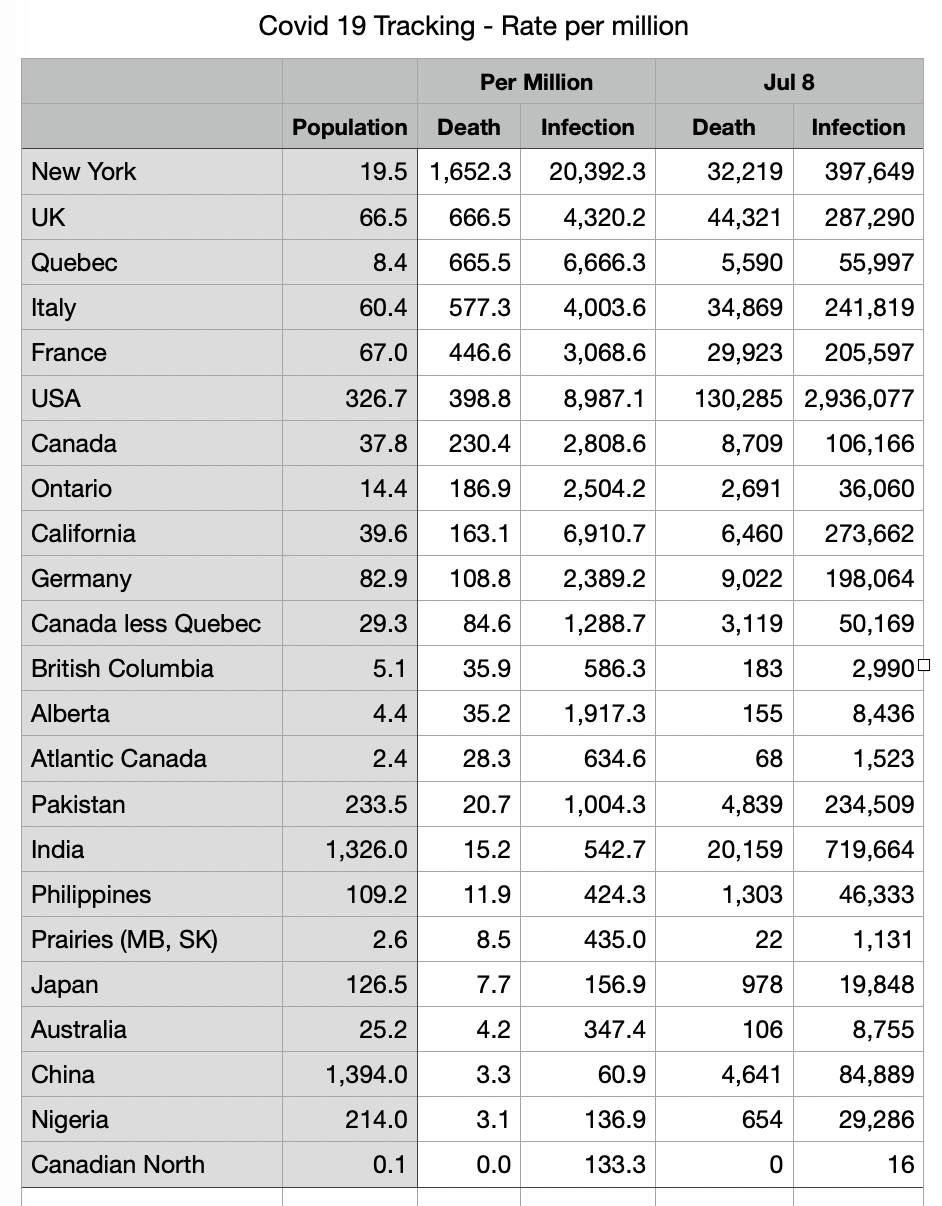
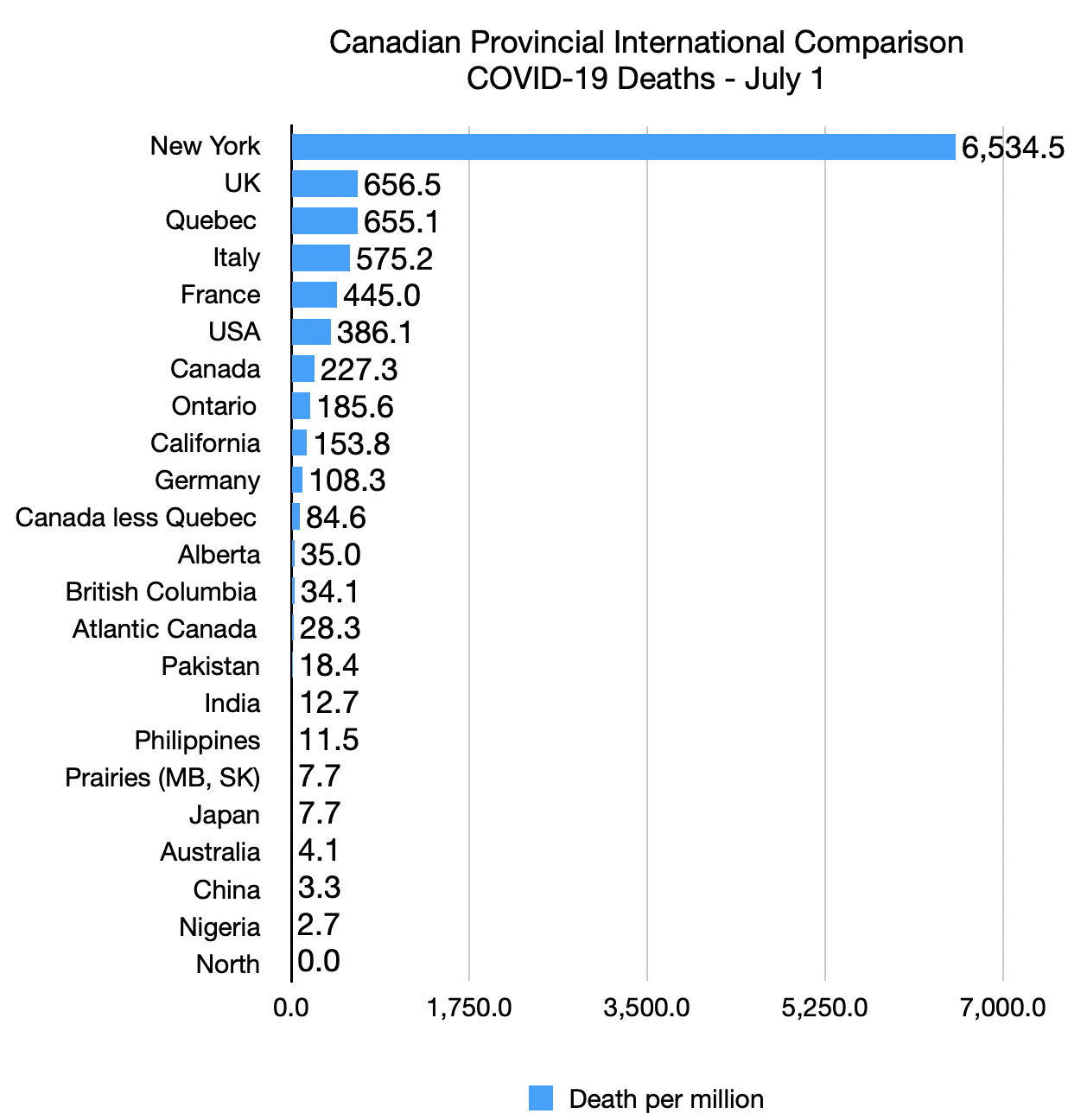
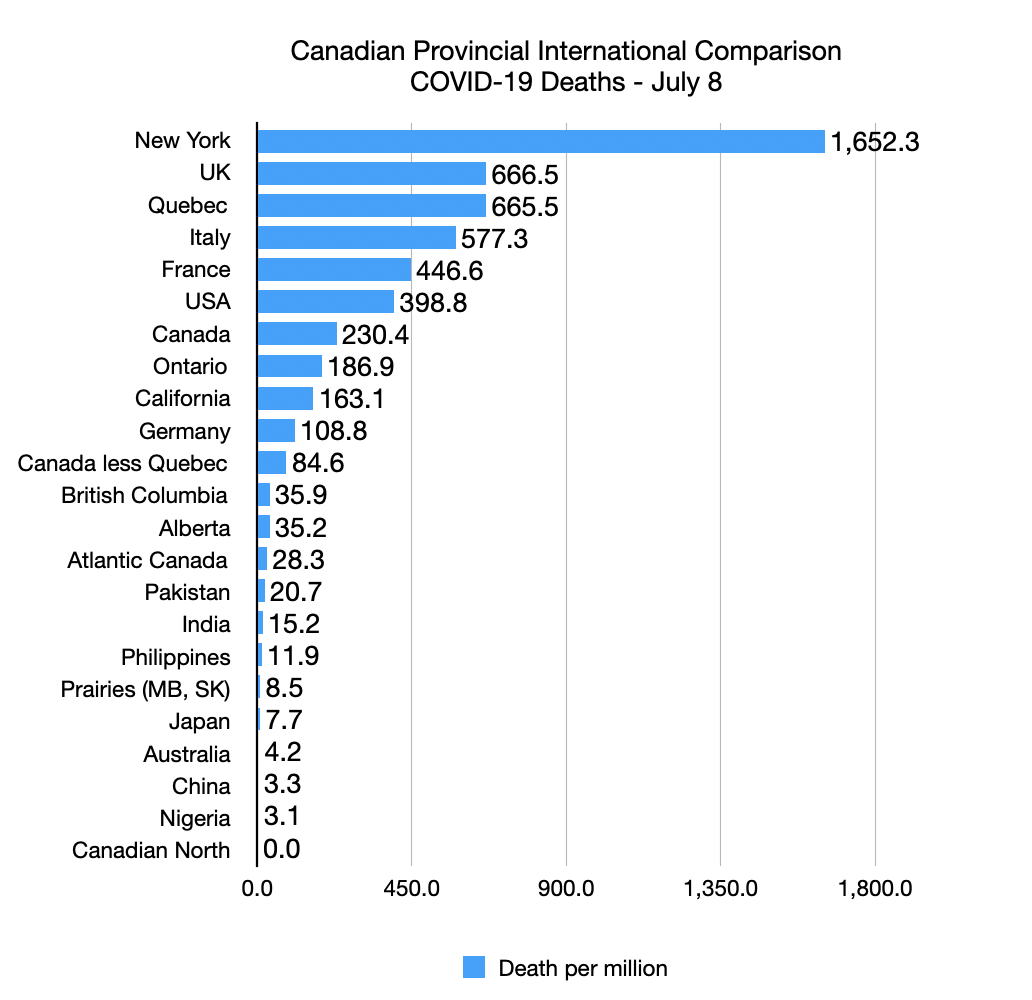
#COVID-19: Comparing provinces with other countries 8 July Update

The latest weekly stats showing no major changes from last week in terms of relative ranking, although the USA can likely be expected to surpass the harder hit European countries in deaths per million given current trends (it already has with respect to deaths).

My apologies for last week’s incorrect data of New York deaths, this week has the correct number:


Denmark: Parliament to discuss proposal to grant citizenship after 10-year stay – The Copenhagen Post

Denmark has some of the more restrictive approaches to granting citizenship that will remain unless in the unlikely event that Parliament and the government agree to make it truly automatic:

A citizen proposal to automatically grant foreigners with Danish citizenship after staying in the country for 10 years has exceeded 50,000 supporters.

Now, the proposal is qualified to be put forward as a motion for resolution and then discussed and voted on in Parliament.

However, the collection of signatures has been challenged by the fact that only citizens with voting rights can support petitions. This means that the ones directly affected by the proposal are excluded from the signature collection process.

‘Tremendous pressure’  
Authors of the proposal emphasised that one needs to receive a residence permit before being granted citizenship, and the rules for getting the permit have been repeatedly tightened in recent years.

According to the proposal, even if foreigners receive a temporary residence permit, there are still too many uncertainties. They are afraid to start a family, buy housing or pursue self-employment as their permission to be in the country may end at any time.

“It’s a tremendous pressure to live under,” the authors said, especially since 2019 when it was decided that language skills, a Danish spouse or children or in-country education cannot improve chances of being granted citizenship.

In the meantime, the number of foreigners permanently residing in the country has been growing over the years.

According to Statistics Denmark, the share of citizens with foreign citizenship has increased from 4.5 percent in 1997 to 9 percent in 2019, which equals 525,898 residents.

Going both ways
The proposal’s suggestion was made by Inge Christoffersen from Aarhus who was willing to help an acquaintance who has spent 15 years in the country but still without citizenship.

In her interview with TV2, she said: “We, who have made the citizen proposal, believe that integration goes both ways. You cannot expect people to integrate unless you give them back a little.”

She also pointed out that the argument regarding foreigners’ criminal activity in Denmark is not valid: “No matter whether you are a citizen or not, you are sanctioned if you break the law. Danish criminals also have citizenship and voting rights, so I do not understand why one focuses so much on crime when it comes to the question of citizenship.”

Source: Parliament to discuss proposal to grant citizenship after 10-year stay – The Copenhagen Post

They were once directed to take applied courses. Now they say ending the discriminatory practice of streaming is ‘long overdue’

Credit due to the Ford government for ending this long standing practice. While likely well-intentioned, like so many good intentions, bias (explicit and implicit) along with implementation, resulted in systemic discrimination and racism;

By the time she reached the end of Grade 8, Toluwanimi Oseivhi had no doubt whatsoever about what stream she would pick for high school. Her marks were excellent, she knew which courses she loved, and her parents who immigrated from Nigeria “definitely” expected her to go to university.

So she picked all academic courses and, to her total shock and bemusement, her teacher told her she had to take applied classes instead.

“She actually changed the forms and put down all applied courses,” said Oseivhi, recalling it was “demoralizing” to be told she was not equipped to handle academic courses despite her efforts and great performance.

“To have that choice made for me, it made me feel small especially as a child of immigrants. But it’s also motivational. It builds your confidence and the desire to do better and prove everyone wrong.”

With her insistence and the advocacy of her parents who were also educators, Oseivhi ended up getting into the academic stream. She graduated high school in 2009, enrolled at the University of Toronto and later got a master’s degree in education from York University.

Oseivhi called the Grade 9 streaming system, which on Monday the Ontario government announced will be cancelled, discriminatory toward students from both poor and racialized communities.

“I do know that it does happen to a lot of Black and brown kids in the system,” she said.

Ontario is the only province in Canada that still divides students into the hands-on “applied” or university/college-track “academic” streams starting in Grade 9, a practice Education Minister Stephen Lecce called systemic and racist. He said the practice needs to end in order to give racialized students “a fair chance at success.”

For years education advocates have called the streaming system into question, pointing out that Black and Indigenous students as well as those from low-income neighbourhoods are overrepresented in the applied stream. Being left out of the academic stream impacts many of these students and limits their options for post-secondary education.

In 2015, People for Education, a Toronto-based advocacy and research group, published a report that was critical of the streaming system. The report indicated that Grade 8 was too early for kids to be deciding on courses that are potentially going to determine their life careers, and recommended delaying such decisions until later in high school.

People for Education’s executive director Annie Kidder told the Star the province’s decision to scrap the streaming system is a step in the right direction, but just one in the process of understanding systemic racism and its different facets. Government needs to look at practices that need to continue to change in order to give children a fair opportunity to excel in their education.

“We need to look at ourselves and understand how unconscious bias can have an impact on other people,” she said, noting society should have the same high expectations of its students regardless of their families’ income or racial backgrounds.

“When you divide students, when you group students apart from each other, it has a disproportionate effect on students who were already disadvantaged.”

Bernisha Thomas knows first hand how being streamed into applied or academic courses “has little to do” with a student’s ability to excel in those subjects. She grew up in Scarborough and at 14 when she finished Grade 8 and it was time to choose her high school courses, she remembers being told that academic was for those going to university while applied was for those going to college and into the workforce.

“I didn’t even know what that meant. I had no idea what I wanted to do,” Thomas said. She said she was a straight-A student and was confused when it was decided for her to go into the applied stream, where she was often sent into the resource class for extra help.

“It made me question myself. It made me think that I was not as smart as I always thought I was heading into high school.”

She said streaming is a form of discrimination because students who are sent into the general/applied track instead of the academic/advanced one are “made to feel like subpar or average, that there’s nothing really special about you.”

Thomas said she ultimately ended up going to Centennial College afterwards, simply because she was made to believe that maybe university would be too hard for her. She took a project management program, where one of her general education diploma teachers once told her she should be in university instead.

“It was the first time since high school that somebody had told me I was good enough and capable enough,” she said.

Years later, it was quite telling to her when her son was at the same stage in Grade 8 to make the choice and the school decided to put him into the applied stream and send him to the resource class for extra help.

“My son never needed extra help,” Thomas said, noting her son just finished his first year in college, studying marketing. He also applied and has been accepted into a joint college and university program at the University of Ontario Institute of Technology.

“I’ve really never seen any change in the school system between when I went and when he went until this week when they announced they’re getting rid of streaming. It’s long overdue.”

When Senator Joe McCarthy Defended Nazis | History

Good long read over a lessor known incident near the end of WW II and how the role of former Senator Joe McCarthy in undermining the truth, not without parallels today:

Annihilate the enemy. That was Adolf Hitler’s standing order to his elite Waffen-SS as the Wehrmacht sought to break the Allies’ tightening grip in late 1944 by crashing through enemy lines in an audacious counteroffensive that would become known as the Battle of the Bulge. The Führer’s edict was enforced in the ice-encrusted fields outside the Belgian city of Malmedy. On the afternoon of December 17, a battle group of the armored First SS Panzer Division ambushed a band of lightly armed U.S. troops. The overwhelmed American GIs’ only option was to raise white flags.

The Nazis accepted their surrender and assembled the American prisoners. Most, they mowed down with machine guns. They used their rifle butts to crush the skulls of others. Those seeking refuge in a café were burned alive or shot. Earlier that day, outside the nearby town of Honsfeld, an American corporal named Johnnie Stegle was randomly selected from a line of captives by an SS soldier who summoned his best English to yell, “Hey, you!” Then he raised a revolver to Stegle’s forehead, killing him instantly. By day’s end, the toll exceeded 150, with 84 murdered at the deadliest of those encounters: the ill-famed Malmedy Massacre.

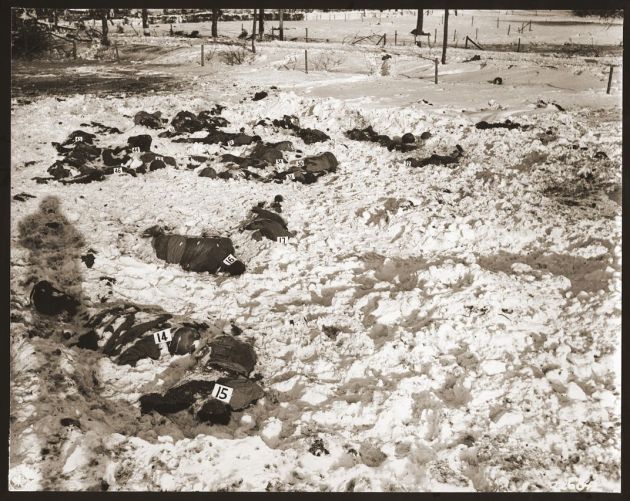
The remains of American prisoners of war murdered in December 1944 near the Belgian city of Malmedy. The bodies were identified by number for use in war crimes trials brought against more than 70 Nazi soldiers by the U.S. military.
The remains of American prisoners of war murdered in December 1944 near the Belgian city of Malmedy. The bodies were identified by number for use in war crimes trials brought against more than 70 Nazi soldiers by the U.S. military. (United States Holocaust Memorial Museum, Courtesy NARA)

The Allies saw Malmedy as a metaphor for Nazi heinousness and American justice. The frozen corpses of slaughtered POWs had been retrieved and carefully autopsied. Intrepid U.S. investigators gathered evidence and conducted in-depth interviews of survivors from both sides. Military prosecutors laid out a vivid portrait not just of this act of barbarity, but of the modus operandi of the SS, the most savage of Hitler’s war-makers.

An alternative telling of the story arose during and after the proceedings, however, that made it the most controversial war-crimes trial in U.S. history. The new version of the incident flipped the script, casting as malefactors the Army investigators, prosecution team and military tribunal. In this story, American interrogators cruelly tortured the German defendants—they were said to have kicked their testicles and wedged burning matches under their fingernails—and the German confessions were coerced. The United States was out for vengeance, this theory held, which shouldn’t have been surprising given that some of the investigators were Jews. Yes, war was brutal, but any atrocities committed that December day in 1944 should be laid at the feet of the Nazi generals who issued the orders, not the troops who followed them. Yes, America had won the war, and it was imposing a classic victor’s justice. The primary advocates of this alternative narrative were the chief defense attorney, the convicted perpetrators and their ex-Nazi supporters, some U.S. peace activists and, most surprising, the junior senator from Wisconsin, Joseph R. McCarthy.

The trial, held from May to July 1946 in the former concentration camp at Dachau, Germany, charged German generals along with rank-and-file soldiers. All but one of the defendants was found guilty; within a decade, all walked free.
The trial, held from May to July 1946 in the former concentration camp at Dachau, Germany, charged German generals along with rank-and-file soldiers. All but one of the defendants was found guilty; within a decade, all walked free. (Ullstein Bild via Getty Images)

Three years after the verdicts, the Army appointed a commission to sort out the conflicting interpretations of the Malmedy prosecutions. That probe spawned more lurid news accounts of alleged coercion of testimony and mistreatment of the German inmates, which led the Army to name yet another review panel. With political pressure building, in March 1949 the Senate convened a special investigatory subcommittee made up of Raymond Baldwin of Connecticut, Estes Kefauver of Tennessee and Lester Hunt of Wyoming. McCarthy, who’d been intensely interested from the start, was granted special authorization by the panel to sit in as an observer.

At the time, McCarthy was less than halfway through his first term in the Senate, and he hadn’t yet launched the reckless crusade against alleged Communists that would turn his name into an “ism.” Relegated to the status of a backbencher after Democrats took control of the Senate in 1949, McCarthy was thirsting for a cause that would let him claim the spotlight. The cause that this ex-Marine and uber-patriot picked—as an apologist for the Nazi perpetrators of the bloodiest slaughter of American soldiers during World War II—would, more than anything he had done previously, define him for his fellow senators and anybody else paying close attention. But so few were paying him heed that no alarms were sounded, and in short order his Malmedy trickery was overshadowed by his campaign against those he branded as un-American, an irony that lends special meaning to this forgotten chapter in the making of Joe McCarthy.

* * *

Source: When Senator Joe McCarthy Defended Nazis | History

Why race-based data collection by police could play a role in reform debate

More debates over data but more focus on what data should be collected, the need for community consultation, and how it can and should be used:

As the Black Lives Matter movement spreads across Canada, the conversation around police accountability and reform has grown, including a rising interest in collecting more race-based data on people who interact with officers.

Adora Nwofor has been on the front lines with Black Lives Matter in Calgary. The activist and comedian says that if we do start collecting more race-based data, it’s important to make sure it helps the people it is supposed to help.

“If you want to collect race-based data, I very, very highly suggest that it is the populations that it affects that are getting that information first and then we are allowed to make suggestions as to what should be happening,” she said.

Earlier this year, Ontario became the first province to mandate all its police officers to identify and document the race of an individual on whom they have used force. This data collection initiative comes against the backdrop of large demonstrations against police violence in Canada, and the renewed focus on the policing of Black and Indigenous communities.

“By collecting disaggregated race data, you can provide a baseline for conversation. You can provide a baseline for creating a dialogue between police and the citizenry,” said Lorne Foster, a professor of public policy and human rights at York University in Toronto.

But not everyone thinks the goal of race data collection makes sense.

“I know for a fact that we’re victims, many people can say it, too.” said Samuel, a Black man from Montréal-Nord whose last name CBC has agreed not to publish because he fears harassment. His recent arrest during a traffic stop went viral after being videotaped.

“[The police] are going to try to show us what they want to show us, and not what we’re supposed to see.”

No charges were laid after Samuel’s traffic stop.

Foster was hired in 2013 by the City of Ottawa to design and study a race-based data collection project for police traffic stops. The project involved officers recording the race of the people they pulled over.

The pilot project was borne out of a human rights case involving a Black man who was stopped by police and alleged that he experienced racial profiling.

The data collected by the Ottawa police starting seven years ago showed that drivers who appeared to be Black or Middle Eastern were stopped at disproportionately higher rates.

The report found that in 2017-2018, “Middle Eastern drivers were stopped 3.18 times more than what you would expect based on their segment of the driving population while Black drivers were stopped 2.3 times more than what you would expect based on their population.”

‘This could be duplicated’

After the results were released, the police service created a multi-year action plan on diversity and inclusion in relation to the findings.

The Ottawa pilot is one of the few such initiatives in the country.

“We really do believe this could be duplicated in other municipalities across Canada,” Foster said.

In Ontario, since Jan. 1, 2020, officers have had to formally report the race of an individual in cases where they draw or fire a handgun, use a weapon other than a firearm on someone or are involved in a physical altercation with an individual that causes serious injuries requiring medical attention.

Officers must choose from a list of seven ethnic categories featured on what’s called a use of force report — a document that is filled out by police after such encounters.

The reports are sent to the Ministry of the Solicitor General, which oversees policing in the province, for analysis.

It’s part of Ontario’s Anti-Racism Act, which mandates race data collection “to identify and monitor systemic racism and racial disparities for the purpose of eliminating systemic racism and advancing racial equity.”

As of Jan. 1 of this year, Ontario police officers must choose from a list of seven ethnic categories when filling out a use of force report. (Ministry of the Solicitor General)

But while race-based data has been shown to help bring about reform, advocates are wary of how it will be used and caution against it as a one-stop solution to racial profiling.

“I think that before we continue to push for getting race-based data, we need to make some changes based on the information we already have,” said Nwofor.

“Quite frankly, I don’t need more race-based information next. I need change next. I need application of ideas from people who know that the police are systematically racist.”

It’s a perspective echoed by Myra Tait, an Indigenous lawyer and an instructor on Indigenous justice issues at the University of Winnipeg. Tait has studied how data and research are used in the justice system. While she sees benefits of race data collection and analysis, she said the process must happen in consultation with those the statistics affect.

“We have a very long history in this country of being studied and researched and having data collected on us, only to twist that around to blame the victim in a sense,” she said. “If you want to collect that data, then you do it with us. And you do it for us.”

Apart from Ontario, there are no provincewide mandates to collect race-based policing data. Some police services have taken on pilot projects to collect the data themselves in the past. Ottawa police are collecting the data for traffic stops, while Toronto and Halifax have collected data on street checks or police carding.

​​​​​​CBC News contacted Ontario’s 46 municipal police forces and the Ontario Provincial Police about how they are collecting and using race-based data.

Examining the data

While all of them have to send their reports to the province for analysis, some of them are also examining the data themselves. The extent of community engagement in the process is not clear in every case.

The Toronto Police Service, however, has put in place a race-based data collection strategy in order to prioritize community input, which has included four town halls, 51 focus groups and engagement with more than 800 residents.

“We asked them questions about our strategy: what they wanted to see from it, what did they think needed to be included in the training,” said Suelyn Knight, unit commander of the equity, inclusion and human rights section of the Toronto Police Service.

“It’s important for people to know that that’s also what’s fuelling our strategy, the voices from  [the] community. And we’ll continue to do that. That was not a one-off.”

The Toronto race data collection initiative comes after controversies over racial profiling by the force, especially with regards to street checks, or police carding, of individuals.

In Nova Scotia, street checks were also controversial, and in fact were outlawed after a race-based data pilot project showed Black people were disproportionately targeted by Halifax police.

The analysis of data in that province is another example of race-based statistics leading to change, but it happened only after the public pressured the release of the data in 2017. Halifax police collected the data for years without making it public, and community consultation was missing from the equation.

Senator Wanda Thomas Bernard of Nova Scotia followed the debate over street checks in Halifax closely. While she sees the benefit from making the data public, she said a cautious approach is needed.

“It’s not just about collecting race-based data in policing, it’s really about what happens with that data,” Bernard said.

“Who owns the data? How is the community informed about this information? How is the information used to inform policies, but also to inform practices?”

The use of force reports currently ask the officer to record the race of people according to the officer’s perception. This raises questions about whether the information will be recorded correctly.

“How does an officer decide or distinguish what race the person is?” said Rob Davis, chief of police in Brantford, in southwestern Ontario.

“My fear is there is room for error or generalizing and may lead to false data and a ripple effect of misrepresentations.”

But it is the perception of the officer that’s important, said Foster, who worked on the Ottawa study.

“It’s not self-identified race that matters. It’s the other identified race that matters,” he said. “In other words, it’s the police that are doing the profiling. So it’s the police who interpret an individual’s race and act on that interpretation.”

Analysis coming next year

The Ontario Ministry of the Solicitor General says that currently, the Anti-Racism Act does not give them “the authority to collect self-identified race for use of force reports.” Police officers are “asked to give their best assessment of an individual’s race, honestly and in good faith. To identify and monitor the prevalence of racial bias or discrimination, it is important to capture perception.”

Ontario will analyze the race-based data every year, with the first release coming in 2021.

CBC News asked all other provinces and territories if they are planning to mandate race-based data collection for their police services. None had a plan like Ontario’s.

Alberta, for instance, said that data collection was up to local police services, but the province was planning to modernize its policing laws to make sure police are “accountable to the communities they protect.”

Saskatchewan does not have a provincial requirement for its police services either, but its police oversight body recently started collecting information on race on its complaint forms.

Others said it was up to the province or territory’s own police services or municipalities to collect the data if they wanted to.

Source: Why race-based data collection by police could play a role in reform debate

Australia: Victorian economy hardest hit by coronavirus fallout as immigration dries up

While Australian approach to immigration is more restrictive than Canada’s, Canada’s economic and immigration recovery may also be longer than expected. But like all projections and estimates, time will tell.

Australia has been one of the more successful countries in addressing COVID-19, with only 311 infections and 4 deaths per million (July 1):

Australia’s second-most populous state was poised to take the biggest economic hit from the COVID-19 pandemic even before a dramatic spike in cases over the past fortnight forced renewed shutdowns in large parts of Melbourne.

The latest business outlook from consultancy Deloitte Access Economics tips Victoria to suffer the biggest fall in gross state product in the 2020-21 financial year, which just began.

Deloitte predicts Victoria’s domestic economy will shrink 1.6 per cent this financial year, also leaving it with the worst economic performance in the nation this calendar year.

“The largest downturn is likely to be felt in Victoria given its current spike in cases, as well as that state’s dependence on migration and on foreign students in an age of lockdowns and closed borders,” Deloitte’s Chris Richardson said in the report.

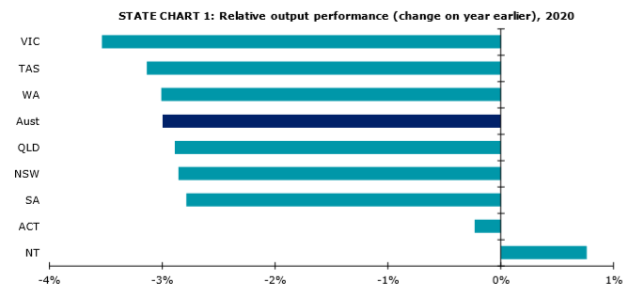
Most state economies are expected to shrink around 3 per cent this year due to the pandemic.
Most state economies are expected to shrink around 3 per cent this year due to the pandemic.(Supplied: Deloitte)

Mr Richardson said Victoria’s economy was particularly vulnerable due to the latest wave of coronavirus cases, which would see the state cut off from the rest of the country, once the border with New South Wales closed from Wednesday.

“Victoria has had the strongest COVID restrictions across the country and now, with the prospect of a second wave returning and the reintroduction of restrictions, the state is likely to see some prolonged misery in particularly hard-hit sectors,” he noted.

Melbourne’s construction sector facing ‘severe setback’

While travel-related sectors, such as tourism and education, and hospitality will be the most immediate casualties, Mr Richardson says the medium-term effects will be felt acutely in the state’s previously booming construction sector.

“Victoria’s construction sector was already showing signs of weakness before COVID hit,” he wrote.

“With high levels of uncertainty, and an unexpected drop in population growth, construction is likely to suffer a severe setback over the coming year.

“Demand for office and apartments in Melbourne, including those projects that are halfway through, are being reconsidered as the density of Melbourne’s CBD is now less attractive across people’s daily lives.”

Mr Richardson added that one silver lining for Victoria’s construction sector was that there was a lot of planned infrastructure investment, something which would also be seen in the second-most pandemic-affected state, New South Wales.

It will particularly target transport projects in Melbourne and Sydney.

However, that investment is not expected to wholly make up for the loss of overseas arrivals.

“Other things equal, keeping tourists, students and migrants away for longer means that Australia’s economy will be some 4 to 5 per cent smaller than it could otherwise be,” Mr Richardson said.

Deloitte observed that New South Wales was similarly affected by the closure of international borders, with the state usually receiving more than a third of migrants who arrive in Australia from overseas.

However, in recent years, New South Wales has been losing existing residents to other Australian states, notably Victoria, a trend which Deloitte expects to have paused during the crisis, especially due to hard border closures.

The state’s comparatively better success in containing the virus so far has Deloitte tipping just a 0.1 per cent fall in New South Wales gross state product this financial year, as domestic activities continue to return to normal.

Some other states are expected to see a rise in their domestic activity — again excluding the large drop in exports, which includes foreign tourism and education — while the two territories are tipped to perform best.

“The lift in LNG-related exports from the Ichthys project will protect the Northern Territory, while its strong public sector base is a very welcome anchor in the storm for the ACT,” Mr Richardson explained.

Even though their domestic economies are expected to take a smaller hit than the bigger states, Deloitte is warning South Australia and Queensland will suffer the nation’s highest unemployment rates, above 9 per cent, while Western Australia and Tasmania will also have a weaker jobs market than Victoria.

Deloitte tips unemployment to be at its lowest in the ACT (5.7 per cent) and New South Wales (7.5 per cent).

COVID-19 infections ‘best’ economic indicator

Overall, Deloitte is forecasting a relatively fast recovery from the pandemic, tipping only a 0.4 per cent decline in GDP nationwide this financial year, following on from a 0.1 per cent fall in 2019-20.

It is predicting robust national economic growth of 5.3 per cent the following financial year, 2021-22.

However, this forecast is based on Australia keeping COVID-19 cases suppressed, a vaccine or good anti-viral treatments being widely available by the middle of next year, and international travel gradually recommencing, starting with trips to New Zealand at the end of this year and expanding to a general reopening of Australia’s borders by the end of next year.

Mr Richardson said a continued and widespread spike in cases would lead to much worse economic outcomes.

“That’s why opening up if virus numbers aren’t under control is risky.

“And, in a volatile environment, it is also why the best leading indicator of how an economy will perform is how that nation is going in its fight against the virus.”

Source: Victorian economy hardest hit by coronavirus fallout as immigration dries up

ICE: Foreign Students Must Leave The U.S. If Their Colleges Go Online-Only This Fall

Yet another Canadian advantage, short-lived should Trump be defeated:

Foreign students attending U.S. colleges that will operate entirely online this fall semester cannot remain in the country to do so, according to new regulations released Monday by U.S. Immigration and Customs Enforcement.

As college students across the United States and around the world contemplate what their upcoming semester might look like, the federal guidance limits options for international students and leaves them with an uncomfortable choice: attend in-person classes during a pandemic or take them online from another country.

And for students enrolled in schools that have already announced plans to operate fully online, there is no choice. Under the new rules, the State Department will not issue them visas, and U.S. Customs and Border Protection will not allow them to enter the country.

“Active students currently in the United States enrolled in such programs must depart the country or take other measures, such as transferring to a school with in-person instruction to remain in lawful status,” read a release from ICE’s Student and Exchange Visitor Program. “If not, they may face immigration consequences including, but not limited to, the initiation of removal proceedings.”

The agency said students already in the country and faced with a fully online course of study may take alternative measures to maintain their nonimmigrant status, “such as a reduced course load or appropriate medical leave.”

The rule applies to holders of F-1 and M-1 nonimmigrant visas, which allow nonimmigrant students to pursue academic and vocational coursework, respectively.

More than 1 million of the country’s higher education students come from overseas, according to the nonprofit Institute of International Education.

Typically, foreign students are limited in how many online courses they can take and are required to do the majority of their learning in the classroom, according to immigration lawyer Fiona McEntee. Once the pandemic struck, students were given flexibility to take more online classes — but only for the spring and summer semesters.

“It’s an unprecedented public health crisis, and I don’t think it’s too much to ask for the allowances that they made to continue, especially given the fact that we clearly, quite clearly do not have a handle on the pandemic here right now, unlike other countries that have,” McEntee said. “This makes no sense.”

McEntee said the decision is especially puzzling given the value of foreign students, which is quantifiable economically.

According to an economic analysis by NAFSA: Association of International Educators, international students studying at U.S. colleges and universities contributed $41 billion and supported 458,290 jobs during the 2018-2019 academic year.

McEntee added that losing foreign students is a huge blow to university budgets, something that will impact domestic students as well. Similarly, the decision to attend classes in person impacts all students present.

“If students can study online successfully from an academic point of view, why are we forcing them to come into a situation where they could put their health at risk and also the health of their classmates at risk?” she asked.

Students attending schools operating as usual will remain bound by existing federal regulations that permit them to take a maximum of one class or three credit hours online.

Students attending schools implementing a hybrid model can take more online classes or credits, though their school must certify “that the program is not entirely online, that the student is not taking an entirely online course load this semester, and that the student is taking the minimum number of online classes required to make normal progress in their degree program.”

The announcement comes as higher education institutions are releasing frameworks for reopening in the fall semester. Schools are preparing to offer in-person instruction, online classes or a mix of both.

Eight percent of colleges are planning to operate online, according to the Chronicle of Higher Education, which is tracking the reopening plans of more than 1,000 U.S. colleges. Sixty percent are planning for in-person instruction, and 23% are proposing a hybrid model, with a combined 8.5% undecided or considering a range of scenarios.

Harvard University is one of the latest institutions to unveil its plans, announcing on Monday that all undergraduate and graduate course instruction for the academic year will be held online. Nevertheless, the university plans to bring 40% of undergraduates, including all freshmen, onto campus.

Harvard President Larry Bacow said in a statement emailed to NPR that the ICE policy is “a blunt, one-size-fits-all approach to a complex problem.”

“We must do all that we can to ensure that our students can continue their studies without fear of being forced to leave the country mid-way through the year, disrupting their academic progress and undermining the commitments—and sacrifices—that many of them have made to advance their education,” the statement said.

School reopening plans may be subject to change because of the evolving nature of the pandemic, especially with daily case totals continuing to break records in parts of the country.

In acknowledgment, the agency instructs schools to update their information in the Student and Exchange Visitor Information System within 10 days of making the switch to online-only classes.

Immigration lawyer McEntee, a former international student herself, said leaving for school can be challenging enough, not to mention during a pandemic and in a landscape of near-constant immigration restrictions. She called the new rule, both in substance and timing, “not right.”

“This is not the America that I think foreign students come to live in,” she said.

The American Council on Education, a higher education lobbying group, also condemned the rule change in a statement issued Monday afternoon. ACE President Ted Mitchell said the guidance “provides confusion and complexity rather than certainty and clarity” and called on ICE to rethink its position.

“At a time when institutions are doing everything they can to help reopen our country, we need flexibility, not a big step in the wrong direction,” he wrote. “ICE should allow any international student with a valid visa to continue their education regardless of whether a student is receiving his or her education online, in person, or through a combination of both, whether in the United States or in their home country, during this unprecedented global health crisis.”

Source: ICE: Foreign Students Must Leave The U.S. If Their Colleges Go Online-Only This Fall

New study provides evidence for “healthy immigrant effect” suggesting immigrants are less likely to ha …

Interesting study and findings, including what appear to be reasonable explanations for these findings. Most health-related studies of immigrants tend to highlight health disparities between immigrants and non-immigrants and the adverse effects of Canadian diets on immigrants over time:

A Canadian study found that immigrants had 30% lower odds of being diagnosed with an anxiety disorder than Canadian-born adults. The study was published in the International Journal of Environmental Research and Public Health.

Anxiety disorders are among the most commonly diagnosed disabilities around the globe. Previous research suggests that the risk for anxiety disorders varies according to demographic, socio-economic, and health-related factors. Interestingly, despite the fact that immigrants face certain hardships and unique disadvantages compared to nonimmigrants, new research has found that immigrants show lower rates of anxiety.

“Our research team is interested in analyzing Canadian Longitudinal Study on Aging data to examine factors which affect mental health,” said Karen Davison, North American Primary Care Research Group Fellow and Health Science Program Chair at Kwantlen Polytechnic University in Surrey, who led the study.

“Given that anxiety disorders have such a high global burden related to disability, we were particularly interested in examining various social, economic, health, and nutrition-related factors and their relationships with the condition. This information could help to improve health practices, programs, and policies for adults.”

Davison and her team conducted a study to explore the relationship between immigrant status and anxiety disorders with a focus on older adults. They further explored nutritional and health-related factors that might mitigate the risk for anxiety disorders among all Canadians.

The researchers analyzed baseline data from the ongoing Canadian Longitudinal Study on Aging, resulting in a sample of 26,991 Canadian residents between the ages of 45-85. The survey measured self-reported lifetime anxiety disorder with the question, “Has a doctor ever told you that you have an anxiety disorder such as a phobia, obsessive-compulsive disorder or a panic disorder?” The study also included various demographic, economic, health, and nutritional measures.

Across the sample, 8.5% of respondents reported being diagnosed with an anxiety disorder at some point in their lifetime. Interestingly, while 9% of Canadian-born respondents reported an anxiety diagnosis, only 6% of immigrants did. When accounting for age and sex, this represented 30% lower odds of being diagnosed with anxiety for immigrants.

The authors offered several explanations for what researchers call the “healthy immigrant effect.” Canada uses a points-based immigration system, which classifies a person’s eligibility to immigrate to Canada according to their skills and qualifications. Those accepted to immigrate generally have a higher education and better work experience, qualities that may lessen their susceptibility to anxiety disorders.

“Another potential explanation … is that potential immigrants with anxiety disorders would find the challenges of relocation too anxiety inducing and would therefore not choose to immigrate,” the authors wrote.

Certain health factors impacted the likelihood of an anxiety disorder diagnosis. Having at least one existing health condition, experiencing chronic pain, being categorized as underweight, having a higher percentage of body fat, or smoking 100 or more cigarettes over one’s lifetime were each associated with increased odds of being diagnosed with anxiety.

Nutritional factors also impacted reports of anxiety. Across the sample, those who consumed two or more fiber sources a day or one or more pastries a day were more likely to be diagnosed with an anxiety disorder. Alternatively, those who consumed 0.5 to 2 sources of pulses and nuts per day or three or more sources of fruit and vegetables per day were less likely to have anxiety. This may be because fruits, vegetables, and nuts contain high levels of zinc, magnesium, and vitamin B, which have been associated with reduced anxiety.

“We believe the main message of this study is that after accounting for many social, economic, health, and nutrition-related factors, a significant relationship was found between fruit and vegetable intakes and having been diagnosed with an anxiety disorder. It is well established that fruit and vegetable intakes are associated with physical health. This study lends to the increasing evidence that shows there are also links with mental health,” Davison told PsyPost.

“In this study we found that lower intakes of calcium rich foods with high vitamin D content are associated with lower odds of anxiety disorders. However, as the number of sources consumed increased, the trends in the odds ratios showed what seemed to be a positive or dose-response type relationship. For future studies we would like to examine supplement sources of calcium and vitamin D which are commonly taken by older adults and their relationship with anxiety disorders. In addition, for future work we plan to examine biomarkers and genomic markers related to calcium and vitamin D which may help us to better understand these relationships.”

“Another finding we would like to highlight is the associations we found with higher percent body fat and anxiety. This relationship may be due to mechanisms related to immune-inflammatory activation. Previous research has shown that individuals with high body fat and mental ill health have increased inflammatory markers, such as C-reactive protein, interleukin-6, and tumour necrosis factor-alpha. The activation of certain immune system cells in response to ongoing chronic inflammation, has been linked with poor mental health. Certainly more research is needed to better understand the possible links between body composition and anxiety,” Davison added.

The authors concluded that their findings offer insight into nutritional, health-rated, and social factors associated with anxiety disorder diagnoses among immigrants and Canadian-born residents of Canada. These insights could help inform treatment for middle age and older adults with anxiety.

The study, “Nutritional Factors, Physical Health and Immigrant Status Are Associated with Anxiety Disorders among Middle-Aged and Older Adults: Findings from Baseline Data of The Canadian Longitudinal Study on Aging (CLSA)”, was authored by Karen M. Davison, Shen (Lamson) Lin, Hongmei Tong, Karen M. Kobayashi, Jose G. Mora-Almanza, and Esme Fuller-Thomson.

Source: New study provides evidence for “healthy immigrant effect” suggesting immigrants are less likely to ha …