Israel: Shaked withdraws bill to revoke Israeli citizenship from terrorists

Of note:

Interior Minister Ayelet Shaked (Yamina) on Sunday backtracked on her plan to pass a bill that would revoke the citizenship of Israeli citizens who commit terrorist acts. The bill Shaked has promoted is based on a bill once put forth by MKs Avi Dichter and Orit Strock.

Shaked retracted the legislation after discussions between her representatives and Justice Ministry officials, who said the bill would not hold up in the High Court of Justice.

The bill stipulated that any Israeli citizen who participates in hostile terrorist activity and receives monetary support from the Palestinian Authority will be stripped of his or her Israeli citizenship. The purpose of the proposed legislation is to prevent the PA from paying Israeli citizens who perpetrate attacks.

Shaked has vowed on several occasions over the course of her tenure as head of the Interior Ministry to pass the bill into law. Officials in her circle, however, as stated, said the Justice Ministry made it clear in recent preliminary discussions that the High Court of Justice would reject the bill as it is currently worded, and that the State Attorney has no intention of defending it once an appeal against it is submitted to the Supreme Court.

Instead of revoking citizenship, Shaked now intends to promote legislation that would revoke pension payments to Israelis who have been convicted of terrorist acts. This, even though a similar law exists and is already partially implemented. Shaked is also exploring the possibility of downgrading the citizenship status of convicted Israeli terrorists, although at this point the legislative process is awaiting a High Court ruling on the matter, which is expected within the next two months.

Strock, who is a member of the Religious Zionism Party, slammed Shaked for withdrawing the legislation, saying the “excuse of oppositionist jurists doesn’t hold water. The person who twice torpedoed the bill in the Knesset without once mentioning oppositionist jurists – can’t now hide behind the ‘jurists.’ The reason this life-saving law isn’t being brought forth is the fact that this government is only surviving right now because of the mouth-to-mouth resuscitation it is receiving from the Ra’am party and [Joint Arab List MK] Ahmad Tibi. Everyone realizes this, even the terrorists, as well as their victims. It’s sad, concerning, and disgraceful.”

Source: Shaked withdraws bill to revoke Israeli citizenship from terrorists

Le Québec «bashing» ou la tolérance à deux vitesses

Sigh. Not to mention the inverse, Canada bashing on the part of some intellectuals…

Le Canada se drape de tolérance envers les minorités — tout en assumant des épisodes de Québec bashing, devenus chroniques dans l’histoire des deux solitudes. Ce paradoxe, commun au monde anglo-saxon, remonte à l’origine même du libéralisme britannique, estime Patrick Moreau, professeur au collège Ahuntsic qui participait, mercredi, à un colloque consacré à « la condescendance francophobe en contexte canadien ».

« Les sociétés anglo-saxonnes en général — et la société canadienne en particulier — se présentent toujours comme très libérales, très à cheval sur les droits individuels et la tolérance, explique M. Moreau, qui collabore par ailleurs à la section Idées du Devoir. En même temps, elles ont souvent, à travers l’histoire, connu des accès d’intolérance. »

Pour le professeur, invité à prendre la parole au congrès de l’Acfas mercredi, « le ver est dans le fruit » depuis la naissance de la tolérance religieuse proclamée au XVIIe siècle par le pouvoir anglican. « L’Angleterre autorisait toutes les sectes protestantes, ce qui était exceptionnel en Europe, à l’époque. En revanche, cette tolérance excluait les catholiques et les athées. Nous sommes tolérants, mais pas à l’égard de toutes et de tous. »

Ce même réflexe s’applique encore aujourd’hui envers le Québec, maintient le professeur Moreau. Le Canada anglais prétend accueillir et célébrer les différences. Sauf certaines, souvent québécoises.

« Dès qu’on nous montre la diversité canadienne, il faut qu’on nous montre une femme voilée, un turban, etc., poursuit le chercheur, en entrevue au Devoir. Comme si la seule différence admissible était en réalité superficielle. Si les Québécois se contentaient d’être une minorité parmi d’autres, arborant la ceinture fléchée lors de la Saint-Jean, le Canada s’en réjouirait et les tolérerait comme il tolère n’importe quel costume de n’importe quelle minorité ethnique ou religieuse. »

Or, le Québec dérange au point de devenir intolérable, soutient M. Moreau, parce que la différence qu’il revendique réfute la suprématie du modèle anglo-saxon.

« Ce qui est inacceptable aux yeux du Canada anglais, c’est cette volonté du Québec de faire société en français et selon des termes politiques qui ne sont pas ceux de la philosophie politique anglo-saxonne. Autrement dit, de revendiquer des droits linguistiques collectifs. […] La laïcité, c’est un peu la même chose, poursuit le professeur Moreau. On refuse, au Canada anglais, de voir la laïcité comme un modèle légitime de gestion de la diversité. On veut à tout prix y voir l’expression d’une intolérance ethnique à l’égard des autres minorités religieuses. »

Un Québec bashing progressiste

Cette discrimination à l’égard des francophones, M. Moreau note qu’elle a évolué au tournant du XXIe siècle. « La francophobie canadienne était, jusque dans les années 2000, plutôt conservatrice. C’était vraiment une francophobie coloniale issue d’un sentiment de supériorité très britannique et protestant à l’égard de Canadiens français, jugés arriérés, et catholiques, en plus. »

Plus récemment, avance le chercheur, « nous sommes passés à un Québec bashing progressiste, c’est-à-dire que nous allons reprocher au Québec d’être intolérant à l’égard des minorités, de créer une discrimination à l’égard des minorités, donc finalement de refuser les normes du multiculturalisme trudeauiste actuel. »

La saga entourant l’Université d’Ottawa et l’usage du mot en « n » dans une salle de cours a jeté une lumière crue sur le paradoxe de la tolérance canadienne envers ses minorités, insiste le professeur de littérature au collège Ahuntsic. « Il y a eu un glissement que je trouve personnellement assez épatant de la part de gens qui se prétendent fondamentalement antiracistes, mais qui vont insulter des professeurs en les traitant de fucking frogs. Bref, en utilisant un vocabulaire qui est très clairement raciste. »

À son avis, le Québec bashing a encore de beaux jours devant lui. Tant mieux, souligne-t-il, puisque sa disparition voudrait dire la fin d’un Québec qui revendique son droit à faire société autrement.

« Le jour où le Québec bashing va disparaître, ce ne sera pas vraiment une bonne nouvelle pour le Québec, avance M. Moreau. Ça voudra dire, je pense, que le Québec aura renoncé à faire société d’une façon différente du Canada. Autrement dit, il aura adopté le modèle dominant du libéralisme canadien. À ce moment-là, il sera devenu acceptable », conclut le professeur.

Source: Le Québec «bashing» ou la tolérance à deux vitesses

Citizenship applications full-year 2021 operational data

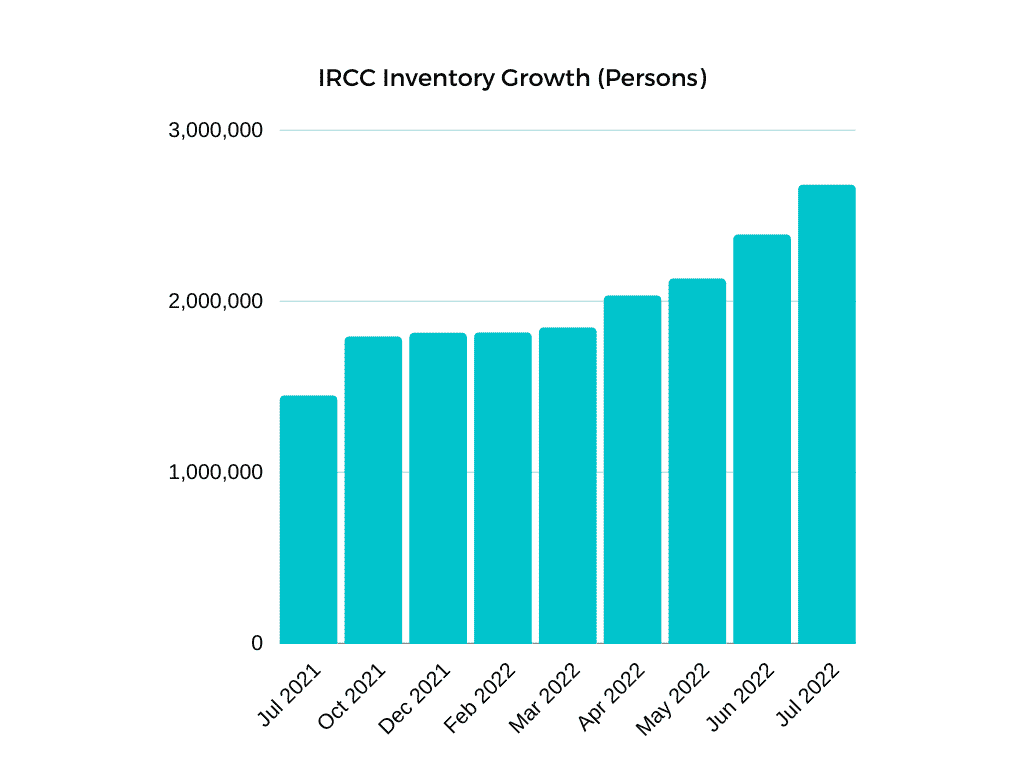
IRCC released the full 2021 data on the number of applications for citizenship. Given the delays in IRCC entering application data in GCMS (for both Permanent Residents and citizenship), this three-month old data reflects an accurate number.

The month-by-month overview:

With the full-year data, I can now update the overview chart of the impact of COVID-19 on the range of immigration-related programs 2021-18 (How the government used the pandemic to sharply increase immigration), showing that applications declined by 10.3 percent compared to new citizens, 37.6 percent.:

The average for applications in 2021 was about 19,000 monthly, with small variations.

Given current processing trends, an average of 31,000 for the first quarter, IRCC should be able to continue chipping away at the backlog of 400,000 (April 11-12) unless applications increase significantly.

Lastly, my standard chart, comparing applications, new citizens and new Permanent Residents:

‘Clearly there are stories we’re not telling’: Study seeks to improve diversity in news sources

Will be interesting to see the results, hopefully with some qualitative analysis of the differences in perspectives covered. One can see some of this shift occurring in the CBC:

For all the prodding, encouragement and reminders, progress to improve the diversity of voices in news stories seems frustratingly slow.

Now a project involving national news agency The Canadian Press and Carleton University’s School of Journalism is hoping to get a better understanding of who gets quoted, and provide a catalyst for change.

CP has teamed with the journalism school to “identify, track and analyze” the choice of interview subjects by its journalists. The goal is to track the diversity of individuals — or lack of, as a news release pointedly notes — based on gender, race and ethnicity and other equity-seeking groups.

Joanna Smith, CP’s Ottawa bureau chief, is the impetus behind the work. The goal, she emphasizes, is not simply to diversify sources. The goal is the better journalism that comes when news coverage is truly representative.

“Over and over again, we are returning to the same sources in TV and journalism, the same largely white, largely male, largely institution-based” people, Smith said. “The idea of broadening the diversity of our sources is really about telling bigger and better and different stories.” 

(Disclosure: Torstar, the parent company of the Toronto Star, is a part owner of The Canadian Press).

Nana aba Duncan, who holds the Carty Chair in Journalism, Diversity and Inclusion Studies at the journalism school, said a journalist’s first choice for an interview is often someone they’ve worked with or someone they know. It’s likely that source is not from an under-represented group.

“Our first thought is what is the easiest and what is the quickest?” Duncan said. “Anything that has to do with change has to be intentional.”

That’s why research is vital to track who is being quoted — and who is being left out. “We absolutely have to do it or else it just doesn’t get done,” said Duncan, a former CBC broadcaster who is part of the project research team.

Duncan says it’s also important how those voices are framed and treated in the story. Are we engaging people for their expertise, such as economics or politics, or only for their race or gender? Where are these voices appearing in the story? Are they making the news or reacting to it?

“You may have an experience in which you are undermined or … your value is just not recognized. That has an effect,” she said. 

Professor Allan Thompson, the head of the journalism school, says the lack of diversity in news articles speaks to the “embedded bias” that exist in newsrooms and journalism.

To him, diversity is about fact-checking and accuracy. “Unless the sourcing reflects society, then it’s not accurate, even if all the words are verbatim,” Thompson said.

“We’re knitting some cloth that is the narrative of our society. If we’re only using one cross-section of voices, then clearly there are stories we’re not telling, there are perspectives on stories that we’re not capturing, and we’re just self-perpetuating our own version of a narrative,” he said.

Shari Graydon, director of Informed Opinions, has been working for years to get more women’s voices into news coverage. (The organization provides a searchable database of more than 2,200 women experts, so there’s no excuse for journalists to exclude them.)

Its online “Gender Gap Tracker” shows the percentage of female sources in online news coverage by major news outlets. It measures all stories, such as those filed by news agencies, rather than those written solely by an outlet’s own journalists alone. Over the last 12 months, sources quoted in stories on the Star’s website have been overwhelmingly male (74 per cent) versus female (26 per cent). 

Graydon said that a diversity of sources in news coverage is a hallmark of good journalism. “I really think awareness is not remotely enough,” she said, urging record-keeping as a precaution against the self-delusion one is doing better than they really are. 

Lasting change requires deliberate action. Journalists have control over the sources they choose to interview. As a start, they should review their last 10 stories. Who was quoted? Going forward, the objective is to cultivate more representative sources and track that work. 

Duncan emphasizes that media outlets must support such efforts. “It’s on the institution saying, ‘We care about this. Here’s what we’re going to do. We’re going to spend money on caring about diversity and being intentional about it,’” she said.

This project, due to unfold over the coming months, promises to improve the diversity of sources used in CP articles, which would benefit all news organizations that rely on its coverage. I’m hopeful it will offer lessons all newsrooms can draw on.

Source: ‘Clearly there are stories we’re not telling’: Study seeks to improve diversity in news sources

Greg Abbott Backs Immigrant School Policy That Helped Turn California Blue

Of note, political virtue signalling for the right, with risks of possible backlash. Proposal is intrinsically deplorable:

In 2001, then-Governor Rick Perry, a Republican, signed what was known as the Texas DREAM Act, providing in-state tuition rates to young undocumented students as long as they were state residents for three years, graduated from a Texas high school, and promised to apply for permanent residency.

Two decades later, immigration politics in Texas have been completely transformed. Governor Greg Abbott is now calling for the Supreme Courtto strike down the 1982 Plyler v. Doe ruling that forces states to pay for the education of undocumented children.

Speaking on a conservative radio show, Abbott said Texas already sued the federal government long ago over having to incur the costs of the education program.

“And the Supreme Court ruled against us on the issue,” Abbott said. “I think we will resurrect that case and challenge this issue again, because the expenses are extraordinary and the times are different than when Plyler v. Doe was issued many decades ago.”

In light of the report that the Supreme Court is set to strike down Roe v. Wade and reverse long-enshrined federal abortion protections, Democrats and activists privately worry that efforts like Abbott’s are not the fantasy they would have seemed just six months ago, but could actually become reality in the near future.

But they argue Abbott’s gambit could backfire, as a similar campaign did after the passage of California’s infamous Proposition 187 in 1994 signed by then-Governor Pete Wilson, a Republican, which denied public services to undocumented immigrants, including public education.

After all, “Prop 187,” which only survived five years, had unintended consequences. Not only did it fail in discouraging immigrants from seeking services, it also helped to create a mobilized Latino electorate that proved to be a major factor in turning California blue.

Mike Madrid, a longtime Republican strategist, worked in California GOP politics and considers Wilson a friend. But he says the fallout from Prop 187 could serve as a warning for Texas Republicans.

“The legacy of 187 was to create a generational voting bloc of Latinos against the Republican Party that would not normally happen,” Madrid said, adding that California was then experiencing the rightward shift Texas is experiencing now. “That changed substantially because of these attacks on the community. Once attacked, Latinos rally.”

In California, the Latino share of the electorate nearly doubled at the time and support for Republicans crumbled, a far cry from the 1980s, when Ronald Reagan garnered 48% of the Hispanic vote. When Bob Dole ran in 1996, he received a paltry 6% of the Latino vote.

Julissa Arce, an activist and author of the new book “You Sound Like a White Girl: The Case for Rejecting Assimilation,” told Newsweek she was once an undocumented student in Texas when she lived in the state from age 11 to 21.

“Thank God no one was questioning how I got there,” she said. But fear was always present. “I never wanted to go talk to my counselor, afraid they might look at my documents.”

Abbott’s rhetoric creates an environment of fear, Arce said, particularly in a state where nearly 53% of public school students are Hispanic.

The end of the state educating undocumented kids would likely include echoes of the chaos of Prop 187, with school administrators having to ask children about the immigration status of their parents, and parents who have both undocumented and U.S.-citizen children pulling their kids from school.

Abbott has tacked to the right during his reelection campaign in an effort to energize his primary voters, often around issues concerning immigration and education. He sent buses of migrants to Washington DC, a message to the Biden administration to deal with a problem he feels it has made worse.

Last week, Abbott slammed the Biden administration for providing baby formula to immigrants in holding facilities, “as American parents scramble amid a nationwide shortage of the product.”

John Wittman, Abbott’s former communications director, told Newsweekthe Texas governor widely publicized moves are an effort to draw attention to the federal government’s shortcomings.

“I think the governor’s point is the federal government continues to fail in its responsibility of dealing with immigration, and Congress has failed for decades, so as a result states have had to deal with the fiscal responsibility of the issue,” he said. “The border and illegal immigration is something Texas has picked up the tab on.”

Arce called Abbott’s announcements “anti-immigrant sentiment and rhetoric” for a reelection campaign, but acknowledged “it feels different because he could really turn this into action as we’ve seen with Roe v. Wade, and this relitigation of things we thought had been settled.”

Source: Greg Abbott Backs Immigrant School Policy That Helped Turn California Blue

Quebec should ‘ideally’ aim for 100000 immigrants per year, says CPQ

Not surprising. Just as in English Canada, some of the biggest boosters of increased levels are from the business community, both large and small:

Quebec should aim to welcome 100,000 immigrants per year, according to the Conseil du patronat (CPQ).

The number is almost twice the threshold set by the Quebec government.

The CPQ made the request in a white paper on immigration made public Monday.

A little over a week ago, the Conseil du patronat, along with employer organizations, had instead suggested a threshold of 80,000 newcomers per year to alleviate labour shortages.

But in its white paper, the CPQ now believes that Quebec should ideally aim for 100,000 immigrants.

According to recent data, there are no less than 240,000 positions to be filled throughout Quebec. The economic community is pushing the Legault government to admit more immigrants.

Despite the government’s current efforts to fill jobs, nearly a quarter of the current vacancies cannot be filled, which represents 300,000 jobs over the next five years, the CPQ calculates.

Immigration is “both unavoidable and fully necessary,” the employers’ organization argues.

Source: Quebec should ‘ideally’ aim for 100000 immigrants per year, says CPQ

“The Finest Immigration Station in the World” – Angel Island

Fascinating history of Angel Island Immigration Station, the west coast equivalent of Ellis Island, but with the important differences noted in this excerpt:

A common shorthand for the Angel Island Immigration Station is “the Ellis Island of the West,” but this false equivalency downplays Angel Island’s brutality. Ellis Island detained twenty percent and deported two percent of its largely European population. Angel Island detained over half and deported one in five of its largely Asian population. An Ellis Island of the West did in fact exist on Angel Island, it was just found on the other side of a wall, upstairs or downstairs, or on the opposite side of a dining room; manifested in differences at the level of a tablecloth, silverware, shower water, or the interrogation table.

The imbalance between the two sites continues into the present. Though Angel Island prominently displays a plaque noting the “Sister Park” status of Ellis Island, the plaque’s language makes clear that Ellis Island is a national park while Angel Island is only a state park. A dedicated ferry takes tourists to Ellis Island and the Statue of Liberty; visitors to Angel Island board a ferry mostly used by passengers seeking recreation, and the private company that operates the only route submitted a petition to suspend all service in December 2020.33

Nonetheless, the preservation and dissemination of Angel Island’s legacy provides an opportunity for what Viet Thanh Nguyen has termed “just memory” when he writes that “any project of the humanities … should also be a project of the inhumanities, how civilizations are built on forgotten barbarism toward others.”

Demonstrating this potential, in 2003 Angel Island’s travelling exhibition Gateway to Gold Mountain opened at the Ellis Island Immigration Museum with a lion dance performed by students from the Chinese Community Center of New Jersey. In doing so, it argued for inclusion of those historically excluded from the wider narrative of American immigration. Local papers described Asian American visitors seeing their own stories in the museum for the first time.

Speaking to the press, Ellis Island’s curator of exhibits and media maintained that the exhibition “enables us to tell the larger story.”

As an antidote to the mythologies of Ellis Island and American immigration, the preservation and dissemination of Angel Island demonstrates that architectures of exclusion existed on both shores and were unequally applied along lines of race and class, with disease labeled as the culprit.

Source: “The Finest Immigration Station in the World” – Architecture

Institute for Canadian Citizenship makes Canoo [Cultural Access Pass] available to Permanent Residents

Significant move, expanding access to Canoo to Permanent Residents during their first 5 years in Canada, not just new citizens within one year of becoming a citizen.

From their announcement:

Thanks to generous donors large and small, 2 million Permanent Residents will now have free VIP access to our country’s best culture and nature attractions from the get-go. There is no better way to prove to immigrants that Canada values and respects them – to make them feel truly and completely at home. 

We also added spectacular new benefits to Canoo, including big discounts with Air Canada, film festival memberships, sports tickets, concerts, shows, classes, kid-friendly activities, volunteering, and so much more. 

Canoo is now a one-stop-shop for becoming Canadian, not just in your passport, but in your heart.

Doyle: Tucker Carlson didn’t shoot anyone, but he’s monetizing white panic

Good column. Unethical business and financial strategy…

They’re lining up to condemn Tucker Carlson of Fox News and understandably so. That shooter, a self-declared white supremacist who killed 10 people in Buffalo, had reportedly posted an online manifesto espousing the Great Replacement theory, and Carlson is the biggest purveyor of that conspiracy belief.

The conspiracy theory is that non-white individuals are being deliberately brought into the United States (and other Western countries) to supplant white voters, in order to further a political agenda. It’s been around for decades, this crackpot theory, but Carlson is the one who mines it with cunning and determination. He’s touched on it often and sometimes been more brazen.

On one of his shows in April, Carlson said: “I know that the left and all the little gatekeepers on Twitter become literally hysterical if you use the term ‘replacement,’ if you suggest the Democratic Party is trying to replace the current electorate, the voters now casting ballots, with new people, more obedient voters from the Third World. But they become hysterical because that’s what’s happening, actually.”

Moral condemnation of Carlson is in order. He knows what he’s doing. (His use of key words is telling, and we note Pierre Poilievre aims anger at various “gatekeepers” while campaigning for the leadership of Canada’s Conservative Party.) But there’s context to take into account. First, Carlson is only the latest in a long list of demagogues in the United States who incite hate based on fear of non-white ethnicities. You don’t need to be a historian to be aware of Huey Long, George Wallace and Pat Buchanan. You don’t need to be a student of U.S. media to know that there is a through-line going back from Alex Jones and Rush Limbaugh to Father Charles Coughlin, the “radio priest” who had an audience of tens of millions in the 1930s, peddling anti-Semitism and fear about immigrants being “foreign invaders.”

The American tolerance of demagogues who incite hate is an anomaly in Western countries. But the matter was settled decades ago when First Amendment rights were solidified by the courts and all kinds of commentary and assertions were allowed to participate in what U.S. Supreme Court Justice Oliver Wendell Holmes Jr. called, “the marketplace of ideas.”

Carlson is an entrepreneur in that marketplace, as is his employer, Fox News, mining white panic and other alarmist ideas for profit. It’s just business and it’s not new.

What is new is the absence of truly mass media and entertainment. Carlson may only have a tiny fraction of the audience that Father Coughlin once had, but he’s stirring up what exists in the dark corners of the internet, mainly unseen. And there is very little to counter what Carlson is stirring up. The remaining remnants of mass-appeal news and entertainment outlets shine their lights on a sunlit America, not its dark subculture corners. Network TV and cable channels cling on to smaller audiences than before, and only live sports seem capable of engaging a mass audience. If there’s no mass audience, then the expectation of a mass revulsion at Tucker Carlson is futile.

A lot of Americans have no idea that Carlson might be connected to the mass shooting in Buffalo. You don’t have to be a TV critic to understand that Fox News now exists in a shattered landscape in which there is simply too much TV – more and more streaming services producing more content than anyone can catch up with, plus network TV, cable and an array of web services. There’s no national narrative, there are only sparks flying occasionally that briefly illuminate very dark spaces.

While Fox News monetizes white fear of change, other outlets monetize escapism. There have been few attempts to dramatize or illustrate the dangers of racist subcultures. One of the few, HBO’s Watchmen, was very powerful but probably had more critical accolades than it had engaged viewers. The same applies to HBO’s Lovecraft Country, and both present structural racism in the context of an alternative reality or the supernatural. The movies of Jordan Peele, Get Out and Us, treat racial paranoia with seriousness, but they are outlier entertainment in a world of Marvel superheroes.

One could take comfort in the fact that Grey’s Anatomy has been going for 18 seasons in part because it looks like the United States; the diversity of characters is striking and over the years it simply became steadily more and more inclusive. Right now, mind you, diversity is the devil that Fox News and Tucker Carlson are warning viewers about. And there’s more money to made from that in a media and entertainment landscape shattered beyond recognition. That’s the important context.

Source: Tucker Carlson didn’t shoot anyone, but he’s monetizing white panic

Diversity of Asian Americans shatters the “model minority myth”

Interesting breakdowns that are comparable to some of the Canadian breakdowns (where we have the advantage of greater desegregation among Asian Canadians (South Asians, Chinese, Korean, Japanese, Southeast Asians and West Asians):

Asian Americans hail from dozens of countries — and their experiences in America are starkly different depending on their origins.

Why it matters: This vast, diverse group is often lumped together under the “model minority myth” — the stereotype that all Asian Americans are well-educated, wealthy and successful.

  • If you look at averages, Asian Americans appear to be richer and better educated than the average American.
  • If you disaggregate the data, the model minority myth crumbles. We see high levels of poverty and below-average levels of educational attainment.

But because that data is seldom disaggregated, “Asian Americans have had to make the case over and over again that they suffer from racism and hostility and violence,” says Ellen Wu, a history professor at Indiana University.

The big picture: The U.S. Asian American population doubled from 2000 to 2019, hitting 22 million. Asians are the fastest-growing group in America — outpacing white, Black and Hispanic Americans and projected to pass 46 million by 2060, according to the Pew Research Center.

  • “They all have very different starting points,” says Neil Ruiz, associate director of race and ethnicity research at the Pew Research Center.
  • Consider, for example, an Indian immigrant who comes to the U.S. via H-1B visa for a high-paying gig at a tech company. That person will have a far easier time building generational wealth than a Burmese refugee coming to America to escape conflict, Ruiz says.

By the numbers: The median income of Asian households in the U.S is $85,800, and 54% have college degrees, per Pew.

  • But only three groups — Indians, Filipinos and Sri Lankans — fall above that household income. And college attainment for many groups is well below the average.

The stakes: “So many groups have been neglected and ignored,” says Quyên Dinh, executive director of the Southeast Asia Resource Action Center.

  • “People are not always convinced that Asian Americans are a legitimate minority group that deserve to be included in affirmative action and diversity initiatives,” says Wu.
  • For example, 30% of Southeast Asians — a region encompassing nations like Cambodia, Vietnam and Laos — don’t have high school degrees.
  • “Because of the model minority myth, these students’ silence in classrooms is misinterpreted as understanding instead of a cry for help,” Dinh says.

What to watch: Activists and experts see a silver lining in the recent spikes in anti-Asian violence. “There is a new spotlight on the Asian American community,” says Dinh.

  • “Awful things have always happened,” Wu says. “But now Asians are collecting the data and recording what’s happening, and Asian journalists are amplifying these stories.”

Source: Diversity of Asian Americans shatters the “model minority myth”