Another related article. Canada could benefit from a greater emphasis on “quality degrees” and institutions given how a large part of the international student population is becoming a source of low skilled and low paid labour:
The government is looking at introducing new restrictions on ‘low quality’ degrees and preventing foreign applicants from bringing family members to the UK with them.
Curbs being considered by Downing Street could see international students barred unless they gain access to a high-ranking university.
The move was briefed after it emerged net immigration hit a new high, 12 years after David Cameron pledged to bring numbers down to the ‘tens of thousands’.
Around 504,000 more people are estimated to have moved to the UK than left in the 12 months to June 2022, up sharply from 173,000 in the year to June 2021.
People arriving on study visas accounted for the largest proportion of long-term immigration of non-EU nationals, at 277,000, or 39% of the total, according to the Office for National Statistics.
There was a significant rise in students coming to the UK after a few years of lower numbers caused by the Covid-19 pandemic.
The ONS said ‘unique’ factors such as visa schemes from Ukrainian and Hong Kong citizens had also contributed to the increase.
In the Autumn Budget published earlier this month, the government said it expected immigration levels to return to pre-pandemic levels once ‘these temporary factors ease over time’.
The prime minister’s spokesperson said he is ‘fully committed’ to reducing immigration and blamed ‘unprecedented and unique circumstances’ for the rise.
They added: ‘We’re considering all options to make sure the immigration system is delivering, and that does include looking at the issue of student dependents and low-quality degrees.’
Home secretary Suella Braverman has previously complained about foreign students ‘bringing in family members who can piggyback onto their student visa’ and ‘propping up, frankly, substandard courses in inadequate institutions’.
The move could potentially meet resistance from within the education department, which would be faced with a funding headache if numbers were restricted.
Overseas students paying higher rates than domestic applicants have become a major funding stream for universities and there is pressure on departmental budgets due to inflation and fiscal tightening from the Treasury.
There could also be friction with the Treasury which will be opposed to any immigration changes which risk stifling growth.
Despite higher levels of migration to the UK since Brexit, the UK is struggling with skills and labour shortages in a number of industries.
Confirmed the UK will enter a recession, chancellor Jeremy Hunt last week insisted that immigration is required to boost growth.
He said: ‘There needs to be a long-term plan if we’re going to bring down migration in a way that doesn’t harm the economy.
‘We are recognising that we will need migration for the years ahead – that will be very important for the economy.’
It already is well entrenched at the federal and provincial levels and candidate nominations and members of legislatures and electoral strategies indicate. Todd’s points are based on municipal elections, where the general absence of parties and more locally-based and less sophisticated data analysis prevails:
In the U.S. polls are run constantly into the political preferences of voters based on ethnicity, in addition to gender, age, religion and other demographics.
Race-based politics has long been established in multi-ethnic cities like Chicago, New York and Miami. American pundits have also analyzed how religion and ethnicity combine, particularly since 1960 when 80 per cent of Catholics of European descent voted for John F. Kennedy.
With people of Hispanic, Black and Asian origins now accounting for more than 80 million Americans, politicians are not the only ones who find it valuable to keep up with scientific polling.
Polls generally show two thirds of Hispanic Americans vote Democrat, while one third lean Republican. Only one in 10 Black voters are Republican and just 26 per cent of Asian-Americans. About one third of people of European descent cast ballots for Democrats, and just over half go Republican.
Canadians are more shy about how ethnicity connects to politics. We don’t often learn about surveys that probe how minority groups tend to think about political issues.
When I’ve asked Canadian politicians if their party conducts private polling on ethnicity, they all say, of course they do: Race-based strategies are crucial to any campaign. But no party has ever handed me their internal data.
Political scientist Shinder Purewal of Kwantlen Polytechnic University has had a similar experience. “I’ve spoken to a number of pollsters and they’re very reluctant to give ethnic numbers, while they’ll give numbers in general.”
One recent exception to this hands-off Canadian approach was a poll by YouGov, which revealed that Indo Canadians lean liberal-left. More than 38 per cent of respondents said last year they would cast a vote for the Liberals — twice the number that planned to go with the Conservatives.
This fall, a Leger poll for Postmedia detailed how ethnic groups would affect October’s tide-shifting elections in the cities of Vancouver and Surrey.
Understanding the hopes and fears of ethnic groups can be a big political deal. In the city of Vancouver, 44 per of the population is of European descent, 20 per cent is of Chinese descent and 14 per cent are of South Asian descent. Indo Canadians are the largest group in Surrey, at 38 per cent compared to 33 per cent who are of European descent.
The Leger poll found the eventual winner in Vancouver, Ken Sim, who highlighted how he would be the city’s first Chinese Canadian mayor, appealed to 21 per cent of those of European ancestry, 15 per cent of South Asian voters and 35 per cent of those with Chinese roots.
Meanwhile, defeated mayor Kennedy Stewart — who was the last of an amazing streak of seven Vancouver mayors in a row of Scottish ancestry — appealed to 12 per cent of European-descent voters, 21 per cent of Indo Canadians and only five per cent of those of Chinese background.
Surrey was a different scenario. There, the three mayoral candidates who received the most votes are of European ancestry: Brenda Locke, Doug McCallum and Gordie Hogg. McCallum, the incumbent, did best in the districts that are overwhelmingly Punjabi, Purewal said.
“That tells you that people are actually paying attention to what politicians have to say, what they stand for,” Purewal said. “Many don’t care what (ethnic) flock you’re from.”
In Vancouver, what issues drew voters to Sim?
Housing affordability came out the top worry when Leger’s respondents named their top three issues: But that concern ran equally across ethnic lines.
Property taxes and spending were Vancouver residents’ third biggest issue, particularly since council had sharply increased both under Stewart’s guidance. Sim promised to be fiscally prudent, which would be important to ethnic Chinese voters, 36 per cent of whom cited taxation as a leading issue compared to 26 per cent overall.
Policing, public safety and crime was the fourth big issue. And Sim’s promise to hire 100 more police officers would have also played well with Chinese Canadian voters, 30 per cent of whom worried about crime compared to 25 per cent in general.
Sim also played down themes that Stewart and his council had pushed hardest — such as climate change, and especially social justice, equity and First Nations reconciliation. These were of low concern to all voters, particularly to those of Chinese background.
Such trends suggest to Purewal that, even while Sim often cited the scourge of anti-Asian racism and campaigned strongly through Chinese-language media outlets, he and his ABC party didn’t win simply because he was Chinese Canadian.
“I would say the vast majority voted for him because they agreed with his plan.”
What of Surrey, B.C.’s second largest city? South Asians in Surrey, many of whom are foreign-born, were significantly more likely to rank housing affordability as a top worry, at 56 per compared to 38 per cent of people descended from Europeans. And Indo Canadians were the least likely to zero in on homelessness.
Even though the Leger poll initially suggested Surrey mayoral candidate Sukh Dhaliwal was the favourite of South Asians, the support did not carry the day for him. Locke and McCallum, who came in a close second, were able to draw votes from both South Asians and those of European descent.
A similar lesson about the value of cross-ethnic appeal can be taken from growing Richmond, B.C.’s fourth most-populous city.
Mayor Malcolm Brodie has been winning elections there for 21 years, despite people of European ancestry now being only 20 per cent of the population, down to 40,000 from 68,000 in 2001. Purewal said Brodie has cultivated the loyalty of a solid portion of the 113,000 Richmond residents of Chinese origin.
Sometimes race-based politics can burst into controversy, as it did this fall in Los Angeles, where a national furor erupted after top Latino politicians were caught in a secret recording making crude, racist remarks about Black rivals and voters. Similar things can happen in Canada.
But for the most part, U.S. and Canadian politicians don’t appear to take advantage of ethnic-based data to manufacture wedge issues: They simply see ethnic differences, as well as similarities, as fundamental factors to understand.
Let’s hope most North Americans politicians try to balance their desire to appeal to voters from specific ethnic groups with a larger commitment to social harmony.
Rishi Sunak faces backlash from Conservative MPs after new figures showed net migration to the UK soaring to a record high, with 504,000 more people arriving in the country than departing over the past year.
“Unprecedented” global events including the lifting of Covid lockdowns, war in Ukraine and the Chinese security clampdown in Hong Kong sent immigration figures soaring.
At 1.1 million, the total number of arrivals in the 12 months to June was the highest since statistics were first gathered in 1964 and far outweighed the 560,000 departures, despite the fact that for the first time since 1991 more EU nationals left the UK than arrived.
Even after allowing for humanitarian schemes for Ukrainians and Afghans, the figures gave additional weight to the observation that Brexit has not reduced overall migration, as many supporters of the Leave campaign hoped.
Instead, the figures suggest that the result of EU withdrawal has been to alter patterns of migration to the UK, with departing Europeans replaced by nationals of countries like India, Nigeria and China who dominate the tables of work and study visas.
More than 20 Conservative MPs are believed to have signed a letter to Mr Sunak demanding action to bring overall migration numbers down.
Organised by Sir John Hayes – the chair of the Common Sense Group of traditionalist Tories and a close ally of home secretary Suella Braverman – the letter calls on ministers to get a tighter grip on the system for work and study visas, as well as clamping down on unauthorised Channel crossings by boat.
Home Office figures showed an 87 per cent increase to 381,459 in the number of work visas issued over a 12-month period, while visas to study rose by 38 per cent to 597,827. Both figures were more than double pre-Brexit levels.
Sir John said the influx of migrants was placing pressure on the UK’s environment, housing and infrastructure and “displacing” homegrown workers from jobs and training.
“The home secretary has been very open and honest and straightforward about the need for robust action to take control of our borders in relation to small boats,” he told The Independent. “There is a similar job to be done to retake control of visas, which I think are out of control now.”
The scale of immigration flew in the face of a promise in the 2019 Conservative election manifesto – endorsed by Mr Sunak since his arrival at 10 Downing Street – to get overall numbers down, said Hayes.
Responding to the ONS figures on Thursday, Ms Braverman said the record number of people arriving in the UK was “thanks to the generosity of the British people” towards Ukrainians, Afghans and Hong Kong holders of BNO (British national overseas) passports.
“The public rightly expect us to control our borders and we remain committed to reducing migration over time in line with our manifesto commitment,” said the home secretary, who in October told the Conservative conference her personal ambition was to reduce net migration below 100,000.
“My priority remains tackling the rise in dangerous and illegal crossings and stopping the abuse of our system.”
Downing Street said Mr Sunak remained committed to reducing net migration but has not set “a specific timeframe” for achieving the goal. The prime minister’s official spokesman blamed “some unprecedented and unique circumstances” for the record figures.
ONS deputy director Jay Lindop said that a significant driver in the figures was migration from non-EU countries by students, who are no longer forced to work remotely by Covid lockdowns.
An estimated 277,000 arrived in the UK over the past year, an increase from 143,000 in the year before.
The numbers also revealed a growing backlog in dealing with asylum claims, with 117,400 awaiting an initial decision, of whom almost 80,000 have been waiting more than six months.
Labour’s shadow home secretary Yvette Cooper said the statistics revealed “serious problems with Conservative mismanagement of the immigration and asylum systems where they have completely failed to get a grip”.
Ministers have failed to tackle the criminal gangs organising Channel crossings and have managed to process the claims of only 2 per cent of the people arriving in small boats over the course of the last year, she said.
“Work visas have also substantially increased as a result of major skills shortages in the UK – yet the Conservatives are not taking any serious action to address skills shortages here at home,” said Ms Cooper.
Maria Stephens, head of campaigns at charity Refugee Action, said that the “snowballing delays in processing asylum claims are destroying lives”.
And Amnesty International called for a “complete overhaul” of the asylum and immigration system, saying that the government should provide safe routes for people seeking to come to Britain.
The organisation’s refugee and migrant rights director, Steve Valdez-Symonds, said: “These figures show the UK’s system for processing asylum claims remains in complete disarray.”
But leading Tory Brexiteer Peter Bone defended the government’s record, telling The Independent: “The fact that we are taking in people from Hong Kong, from Afghanistan and especially from Ukraine is the right thing to do.
“The point is that we are controlling our borders and we are making the decisions, not the EU. Imagine what the figures would have been if we still had free movement of people. That is what Brexit was about – it was never about having no immigration.”
“Student numbers may be rising, but most of them will go back to their home countries. The government’s priority must be stopping the illegal migration by boat across the Channel.”
Really interesting and nuanced study with regional breakdowns:
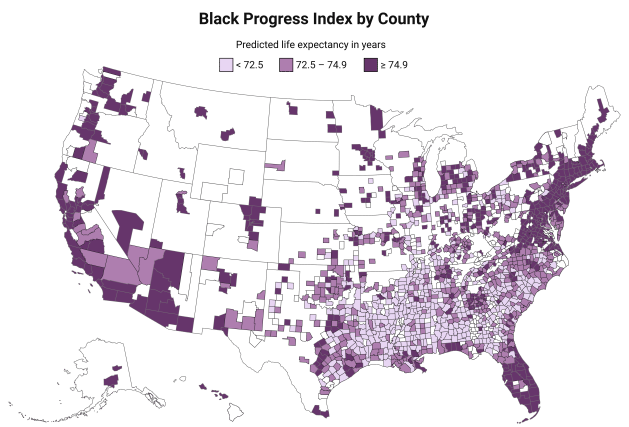
In August 2022, the Centers for Disease Control and Prevention reportedthat over the last two years, Black Americans’ life expectancy declined to about 71 years old, six years lower than their white counterparts. National disparities in life expectancy can represent the permanency of racism, offering little reason for hope.
But in Manassas Park, Va. and Weld County, Colo., the mean-life expectancy for Black residents is 96—a national high among all Black citizens by county. Black people are living in their 80s in larger Democratic jurisdictions like Montgomery County, Maryland and smaller Republican districts like Collier County, Florida.
[time-brightcove not-tgx=”true”]
My colleague Jonathan Rothwell and I reported hundreds of places that exceed commonly held expectations in Brookings’s recently released Black Progress Index, an interactive tool and report developed in partnership with the NAACP that provides a means to understand the health and well-being of Black people and the conditions that shape their lives. Instead of comparing Black people to white people, we examine life expectancy differences among the Black population in different places. This method reveals the locales where Black people are thriving.
Courtesy of the Brookings Institution.
Researchers often sloppily compare rates of home ownership, educational attainment, income and mortality without attending to past and present discrimination that intended to create disparities. Consequently, broad national averages void of context policy and local contexts camouflage the very real progress that’s occurring across the country.
Still, in places like Jefferson County, Ohio, the average Black person lives 33 fewer years than Manassas Park, Va. and Weld County, Colo. That gap is roughly equivalent to 100 years of progress in living standards, medical science, and public health.
Black people are not a monolith. They have widely different outcomes in very different places. Local contexts matter as Black people do. Lower life expectancy in counties and metro areas across the country suggests that people are losing battles against racism. But geographic areas where Black people are thriving offer more than hope: People’s civic actions are delivering positive change.
What accounts for such vast differences? Life expectancy, a cumulative measure of health and well-being, summarizes both the biological and non-biological influences on our lives. Because race is a sociological construct and not a biological one, we should assume disparities in life expectancy represent differences in non-biological influences on our lives. Our current life expectancy data suggest that people are breaking down specific social conditions that influence longevity, giving real reason for optimism.
Using a common machine-learning algorithm to select variables and rank their importance, the Index identifies 13 social conditions that predict Black life expectancy. Many are those one might expect, such as income, education, housing, and family composition. Others were more surprising, including the top predictor of high Black life expectancy: larger shares of foreign-born Black residents. One standard deviation above the mean in this variable adds one year to predicted life Black expectancy. For instance, Brooklyn, N.Y. is in the 89th percentile of life expectancy at 78.5. The more than 43% of Black residents of King’s County who are immigrants, places it in the 98th percentile among all counties.
The cause for this interpretation is unclear; it may be a pure composition effect, in that foreign-born Black Americans enjoy better health than the native Black population. Though, this data points to a larger question: Is less exposure to U.S. racism good for your health?
On the other end of the spectrum, a surprising predictor of low Black life expectancy is religious membership. Keeping in mind all the social determinants that showed to be significant in our study are correlational, not causal. Revoking a church membership will not automatically add years to a person’s life. The challenge is understanding why religious adherence is associated with lower life expectancy. Church goers are more likely to be obese and, on the surface, asking “Jesus to take the wheel” may negate any agency we have in influencing our health outcome. We also know that place-based bias that comes out of the wash of housing devaluation hurts the families and institutions, including churches, in those locales. More research is needed to uncover the conditions and behaviors underlying all the variables that strongly influence life expectancy.
The fact that we realize progress and stagnation in Black life expectancy in different places makes clear that people have agency. The gains and losses reflect that. When we take an overly optimistic or pessimistic view of the state of Black America and treat Black people as a monolith, we don’t see localized stories of growth, determination, and thriving.
The diversity of places where Black people are thriving suggests that it has something to do with Black people themselves. In places like Montgomery County, Md., individuals, civil rights groups, organizers, and politicians are dismantling the architecture of inequality that takes away years of life.
That said, we still need to examine and throw away the overly optimistic position on race relations—that the country has moved beyond slavery, Jim Crow racism, and the array of discriminatory policies and their long-term effects. People who hold this perspective contend that America is a level playing field and that with effort, Black people can achieve anything a white person can.
But locales that post life expectancies under 70 perform poorly on environment or institutional indicators like the air and school quality, suggesting that life is harder in some places due to systemically racist forces. In Lowndes County, Ala. where Montgomery is the county seat, Black life expectancy is 68.5. In Greenwood, Miss., it’s 67.3. In Salem, Ore., life expectancy is 64.4.
It’s also worth speculating on seemingly obvious reason why some cities, like Jackson, Miss., don’t post higher rates than 72.6. Jackson has higher homeownership rates than most places (94th percentile) and a higher percentage business ownership (59th percentile). But the recent water crises show how local politics of Mississippi play out in lower investments in the city’s water infrastructure, which plays out in other municipal services that impact life expectancy like education.
“Social reforms move slowly,” wrote W.E.B. Du Bois, suggesting that we must learn from our circumstances in ways that reject intemperance and blame. “[W]hen Right is reinforced by calm but persistent Progress we somehow all feel that in the end it must triumph.”
Society is toiling with the same struggles around racism that Du Bois faced at the turn of the 20th century. Nonetheless, we must take the time to recognize empirical signs of progress and not rush toward unsophisticated, untruthful narratives of hopelessness or blind ignorance that remove or dismiss our agency. A path of progress demands that we have a clear view of the social, political, and economic landscape in which we live. Recognizing progress and defeats will have us see the very real capacity for future change. The assumption—backed with data—that Black people in places with higher life expectancy had a hand in their outcomes should inspire us to seek change in places where discrimination is robbing people of years of life
Good overview on the IRPP discussions on policy challenges. Striking that neither labour challenges nor immigration were raised by the policy and public administration schools consulted, perhaps because the issues are not considered emerging:
Leadership is a series of strategic choices: picking where to focus your attention and finite resources. Now, consider the meteor shower of complex challenges that is raining down on Canada—from an increasingly precarious geopolitical environment, to worsening climate change, to nagging labour shortages. How do governments decide what to prioritize?
To lend a hand to our beleaguered leaders, the Institute for Research on Public Policy marked its 50th anniversary by asking schools of public policy and public administration: “What emerging issue do you think should be on the radar of decision-makers?”
We visited nine schools in six provinces. Here’s some of what we heard.
Eroding public trust and deepening cleavages
The word “polarization” is tossed around a lot, but that doesn’t quite capture what’s happening. It’s not that Canadians are split into two distinct political or social camps, like our neighbours south of the border. Rather, there are tensions around issues, and a growing antipathy toward or distrust of governments and institutions—think of Hockey Canada, the RCMP, or the passport office.
These cleavages aren’t just between Freedom Convoy supporters and detractors, but are also felt by those who believe themselves estranged from the sites of power and opportunities. This can include racialized and Indigenous people, who see little progress in dismantling the systemic racism that keeps them from access to jobs, health care, and upward income mobility.
Still, regional resentments are a thing. Data collected and analyzed by the IRPP’s co-led Confederation of Tomorrow project suggests that Quebecers feel the rest of the country looks down on them. The project’s “resentment index” noted that people in Saskatchewan and Alberta feel they contribute more than their share to the federation and are most likely to disagree that Quebec does.
Resilient and coherent climate policy
We heard stark messages about how Canadians will need to adapt and become more resilient to storms, droughts, fires, heat events and other calamities. Dealing with these climate disasters requires governments to plan and invest much further into the future.
A core theme that came up repeatedly was the feeling that there is a lack of a coherent pan-Canadian plan for getting to net zero, one that acknowledges that different regions have different realities and incorporates a wide spectrum of views. Meanwhile, the United States is pouring billions into new technologies and clean manufacturing through its Inflation Reduction Act.
“Canada has emissions reductions targets, and they’re good, but what we don’t have is the techno-economic policies that are going to help us make those targets happen,” said Maggie Hanna, president of Alberta-based Common Ground Energy.
Housing
Perhaps some of the most astonishing stories we heard were from a panel convened at Dalhousie University on housing challenges in Nova Scotia.
Lisa Ryan, executive director of the South Shore Open Doors Association, said her organization had recorded 167 people experiencing homelessness in Lunenberg County in September 2022—63 of them children under the age of 16. Families were living in cars and tents, after their long-term rentals suddenly turned into short-term rentals. People move to Halifax in search of housing, only to face long waits and rampant discrimination from landlords.
Housing is a pivotal policy challenge. It can impact economic growth if companies cannot house workers, and it can start a multi-generational spiral of poor health and poor economic outcomes.
Governance and challenges to the federation
The COVID pandemic did much to bring federal, provincial, territorial, and Indigenous governments together. They were able to act fast and decisively and forge strong new personal relationships. There was also incredible creativity—such as the rapid deployment of remote health care services.
But then there’s the ugly truth of the federation’s weaknesses: poor data sharing, overlapping programs and regulations, unequal access to technology and inconsistent channels of communication. As Canada moves forward with trying to create an east-west electricity grid, address labour and supply chain problems, and reform its relationship with Indigenous nations, attention must be paid to the health and mechanics of intergovernmental relationships.
Governments will need to ward against regulatory shortcuts, where the speed of getting things done trumps other core principles such as transparency, coherence, and the respect of Indigenous rights. Collaborating and communicating with Indigenous communities will require a deeper understanding of governance systems.
“A lot of that is happening through women, youth and elders, our knowledge-keepers, where we’re starting to recognize their roles. Those roles were taken away from us, without our consent,” said Danette Starblanket, an executive-in-residence at the Johnson Shoyama Graduate School of Public Policy in Regina.
Travelling the country, what stands out is just how much core policy challenges overlap with one another. Climate resilience is intimately tied up with housing, as poorer Canadians will be most at risk of displacement. Distrust of institutions grows as existing governance structures fail to include different perspectives and communicate transparently. If the country does not invest in both people and technologies along the path to net zero, the negative economic impacts will also affect our ability to fund aspects of our social safety net.
What was also abundantly clear in our conversations is how much willingness there is in the country to work across sectors and across geographic boundaries to come up with good policy and ensure that there is a feeling of common cause and inclusion.
But who will bring Canadians together around these tough questions? This overarching challenge calls for both good governance and strong leadership. The mechanisms that different levels of governments have for connecting with one and other, with experts (including at think tanks and universities) and with the public must be updated and improved if we’re going to address myriad other policy problems. We need leaders who can see the bigger picture of how different systems fit together and do the unglamourous behind-the-scenes work to get us ready for the next challenges that will pop up on the radar.
Jennifer Ditchburn is the president and CEO of the Institute for Research on Public Policy. She’s on Twitter @jenditchburn.
Of note. Good réplique to some of the Quebec debate on language and immigrants:
S’il est légitime d’exiger du gouvernement fédéral de tenir compte des demandes du Québec en matière de langue, il n’y a par contre aucune légitimité à restreindre, comme le fait Mario Beaulieu dans un texte récemment paru en ces pages (cosigné par onze personnes), la qualité de francophone aux seuls locuteurs de français langue maternelle. Selon lui, il faudra s’attendre à un « effondrement du poids des francophones au Québec, de 81,6 % en 2011 à 73,6 % en 2036 ». Il faut en finir une fois pour toutes avec ce « racisme » linguistique. (Le mot « racisme » est ici entre guillemets pour n’en retenir que la notion de hiérarchie.)
Il est complètement ridicule de croire qu’un francophone est une personne qui a dit « môman » avant l’âge de deux ans. Un francophone, c’est aussi un plurilingue dont le français n’est pas la langue maternelle. On ne naît pas francophone, on le devient.
Au Québec, 85 % de l’augmentation de la population provient de l’immigration. Nul besoin d’être lauréat de la médaille Fields pour comprendre que la proportion du groupe non immigrant (et d’origine non immigrante) va décroître avec le temps. Ce qui n’est pas le cas des francophones, si par francophone on entend toute personne qui a appris le français à la maison, sur les bancs d’école ou sur les lieux de travail (ici ou ailleurs). L’objectif de la loi 101 était de faire du français langue maternelle une langue fraternelle, pour qu’on puisse mettre en commun nos mémoires plurielles, nos parcours et nos rêves afin d’y puiser les ressources et l’audace pour faire du Québec une société prospère, pluraliste et égalitaire, et non pas une société où il y aurait deux classes de citoyens.
Le Québec accueille des immigrants depuis des générations. Beaucoup d’entre eux ont appris le français avant la loi 101. Depuis 1977, cette loi a obligé des dizaines de milliers de jeunes immigrants à fréquenter les écoles françaises pendant onze ans. En outre, bon nombre de nos immigrants sont originaires d’anciennes colonies françaises. Ils se chiffrent eux aussi par dizaines de milliers. Comme très peu d’entre eux déclarent le français comme langue maternelle, ils sont pour la plupart disqualifiés comme francophones, même si parmi eux on compte des professeurs de français, des professionnels qui travaillent en français, des écrivains et tant d’autres citoyens venus d’ailleurs, profondément attachés au Québec, pour qui le terme « Québec français » est un pléonasme.
La hiérarchie ainsi créée, entre le français de langue maternelle et le français de langue seconde, ne doit pas être prise à la légère. Elle crée des catégories de citoyens n’ayant pas la même valeur dans la société, situation propice au racisme. Nous savons comment, dans d’autres lieux, mais encore aujourd’hui, la hiérarchisation des cultures s’est substituée à celle fondée sur la race — lorsque celle-ci est devenue une hérésie scientifique —, avec des conséquences néfastes sur les plans politique et social. Au Québec, où langue et culture sont souvent interchangeables, il est temps de remiser cette aberration avant que des esprits moins inoffensifs que des déclinistes et des comptables ne s’en emparent.
L’État québécois est doté de suffisamment de pouvoirs et de ressources pour assurer la pérennité et l’essor de la culture et de la langue françaises. Qu’il les utilise efficacement et judicieusement sans blâmer ni pénaliser les immigrants. Entre 1971 et 2016, l’utilisation du français dans les écoles (maternelles, primaires et secondaires) est passée de 64 % à 90 %, tandis que la proportion d’immigrants francophones dépasse les 60 %, et pourra facilement augmenter si, comme l’indique le démographe Richard Marcoux, on va puiser dans l’énorme bassin francophone africain.
Le français n’est pas près de disparaître. Au Québec, il n’y a que 6 % de la population qui n’a aucune connaissance du français. La complexité de la situation linguistique exige de ceux qui l’analysent qu’on tienne compte de multiples critères et, surtout, qu’on désethnicise enfin la notion de francophone. Il serait honteux que les « voleurs de jobs » de l’après-guerre deviennent maintenant des « voleurs de langue ».
Selon Machiavel, « celui qui contrôle la peur des gens devient le maître de leurs âmes ». Partout en Occident, populistes et démagogues ont réussi à faire croire que les minorités immigrantes représentent une menace pour les modes de vie et l’identité de la majorité afin de s’emparer du pouvoir. Le Québec ne fait malheureusement pas exception.
Good article and discussion, with good comments by Kareem El-Assal and Richard Kurland, particularly liked Aurland’s contrasting IRCC lack of status updates and application tracking with CRA’s client service:
From January to the end of February, Alejandro Ginares woke up daily at 6 a.m. in order to grab a spot in the Immigration, Refugees and Citizenship Canada phone queue.
He went about the business of his day — preparing breakfast, doing dishes and feeding his cat — until eventually, sometimes after eight hours of being on hold, he’d reach the front of the queue and receive a pre-recorded message: “all our agents are busy, try again later.” He’d hang up. If it was early he’d try again. If it was after 3 p.m., when the offices out east close, he’d make dinner, go to bed and start all over again the next day.
While news articles have been filled with stories of longlineups of Canadians stymied while renewing passports, less has been reported on how the pandemic and its knock-on effects have impacted would-be Canadians, whose immigration applications have been left in a backlog that has only increased since the beginning of the pandemic.
In Ginares’s case, he was desperately trying to track down the status of a permanent residency application he’d submitted 15 months before.
Occasionally he’d reach a human being, only to be told that his application was “not in the system.” He was baffled. He had paid the processing fee and had a Canada Post delivery confirmation in hand, certifying that the application had arrived at IRCC. He knew they’d received it. So why wasn’t he in the system?
Ginares eventually reached an agent who promised to help him. A few days later he got a response confirming for certain that his application had not entered the system.
It was then that he realized that IRCC had most likely lost his application.
“It’s awful to be waiting,” he says. “We don’t know if we’re waiting for a purpose or if we’re waiting for nothing.”
Resubmitting his application was risky. It would mean starting all over again. And it would cost another $1,000. He didn’t know what to do.
A geological engineer in Uruguay, Ginares had left his home and family to join his husband, Wendall Seldura, in Canada. The two had met in a cocktail and music bar in Montevideo, Uruguay, in 2017. They’d fallen in love immediately and quickly decided that Canada was the country where they’d spend their future.
Ginares knew that permanent residency processing times can often reach 15 months. But he didn’t think it would take 15 months for the system to even receive his application, or approve a work permit.
Back home, Ginares worked, studied and volunteered. Now he feels like he’s stuck in limbo. “I fight every morning when I wake up to find motivation,” he says.
According to data released by IRCC Oct. 31, 2.2 million people are waiting for approval for temporary residence, permanent residence and Canadian citizenship applications. Like Ginares, 1.2 million have waited beyond the standard time expected for their application.
In permanent residency specifically, there are 603,700 applicants. Only 279,700 of these are being processed within standard times; 54 per cent, or 324,000 applications, are not being processed within the times projected by the agency.
B.C. Health Minister Adrian Dix recently hit headlines when he called on Ottawa to halt the deportation of Claudia Zamorano, a hospital worker whose family is facing deportation because their applications have not yet been processed.
Nathaniel Preston, Ginares’s immigration consultant, says that he is seeing long wait times for all his clients. His colleagues report the same. “You exist but you don’t. You’re technically not supposed to be here. But maybe you could be here, if they approve the visa, or they restore your status,” he says.
Of note. When I last looked at EX breakdowns a number of years ago, there was, as one would expect, greater representation at more junior levels (directors and DGs EX1-3) than at the ADM level (EX4-5):
Less than one in three senior civil servants across the governments of G20 countries are women, new research from Global Government Forum has found.
The latest Women Leaders Index found that only one G20 country – Canada – has reached gender parity in the top five grades of its public service (at 51.1%), and just four more are within 10 percentage points of doing so.
However, there has been improvement – the G20 mean (29.3%) has increased by 1.6 percentage points since our last Index in 2020 and by 6.0 points since our first 10 years ago.
The long-running Women Leaders Index is a league table ranking G20, EU and OECD countries on the proportion of women in senior roles within their national civil services. As well as tracking progress over time, it includes comparisons with women in government, women politicians, and women on private sector boards, alongside interviews with public service leaders in two of the top performing countries – Canada and South Africa.
Those leading the G20 pack behind Canada, are Australia and South Africa – which tie in second place – the UK, Brazil, and Mexico and the European Commission, which tie in fifth place. Mexico has increased the representation of women in civil service leadership positions the most of all G20 nations, by a dramatic 24.3 percentage points over the last decade, while South Africa has made the most improvement in the two years since the last Index – a jump of 7.2 points.
Bringing up the G20 rear are Saudi Arabia, Japan, South Korea, China and Turkey, in which representation of women in the senior civil service is between 2.5% and 11.7%.
Countries including Germany, Italy, France and the US reside in the middle of the G20 ranking, with women accounting for between 32.0% and 38.0% of top roles in each. https://datawrapper.dwcdn.net/rr33B/4/
EU and OECD countries faring better than those in the G20
Though the G20 has traditionally been the main ranking in the Women Leaders Index, it also analyses representation of women in the highest grades of national civil services in EU and OECD countries.
The Index found that overall, EU and OECD countries are doing better on representation of women in senior positions in government departments and agencies – for which the mean proportions are 42.7% and 36.2% respectively – than those in the G20*.
The mean across the European Union’s member states has improved by 0.8 percentage points since 2020, and by 7.5 points since 2012, with nine of the EU’s 27 member states having reached gender parity in the top two tiers of their civil services. Bulgaria tops this ranking, with women accounting for 59.5% of those running government departments, followed by Croatia, Slovenia, Greece, Finland, Latvia, Romania, Lithuania, and Portugal.https://datawrapper.dwcdn.net/GU3A7/4/
Read our Canada perspective from seasoned public service leader Yazmine Laroche, including transferable lessons on how to make progress towards gender parity
Croatia has made the most improvement of all EU nations since 2012 – a rise of 21.1 percentage points, while Bulgaria has made the greatest improvement since the 2020 Index, of 7.8 points.
Latvia, where women account for 56% of the top tiers of its civil service, tops the OECD ranking, while six more – Sweden, Iceland, New Zealand, Greece, Canada and Slovakia – have reached or exceeded gender parity.https://datawrapper.dwcdn.net/wpOb5/2/
Regression in some countries – but public services performing better overall
While most G20, EU and OECD countries have improved the representation of women in the highest grades of their civil services in recent years, some have regressed.
The G20 data shows that in Russia and Argentina there are fewer officials in senior positions now than in 2020, while China, Turkey and South Korea have regressed since 2012.
Six EU countries – Sweden, Poland, Cyprus, Italy, the Czech Republic and Luxembourg – perform worse in terms of representation of women in the top two tiers of the civil service since 2020, while Hungary is worse off now than 10 years ago.
However, on a positive note, when looking at the means across the G20, EU and OECD, it is clear that civil services are doing better on representation of women in leadership roles compared with ministerial cabinet appointments, elected politicians and the boards of publicly-listed private sector companies.
Read our South Africa perspective from Zukiswa Mqolomba, deputy chairperson of the country’s Public Service Commission, on why making real and positive change isn’t just a numbers game
“Many governments have made impressive gains on representation of women in leadership positions in recent years as a result of concerted efforts to make change and should be applauded,” said Mia Hunt, author of the Women Leaders Index report and editor of globalgovernmentforum.com.
“However, while it is widely accepted that civil services with diverse workforces that resemble the populations they serve turn out better policies and better outcomes for citizens, the mean proportion of women in top civil service positions across G20 nations is still less than 30%. Clearly, there is much more work to be done.
“We hope this Index gives the countries that have made progress the recognition they deserve, whilst serving as a wake-up call for those most in need of improvement. Let us see what’s changed when we publish the next in this Women Leaders Index series.”
*Please note that grade definitions vary between the G20, EU and OECD datasets. Caution should be exercised when making comparisons – see methodology here.
Interesting long read, written from an Australian perspective but applicable more broadly including in Canada:
Last week, Christopher Wray, Director of the U.S. Federal Bureau of Investigation (FBI), toldlawmakers that the bureau has national security concerns about TikTok, the popular app that is owned by the Chinese firm ByteDance. “Under Chinese law, Chinese companies are required to essentially — and I’m going to shorthand here — basically do whatever the Chinese government wants them to do in terms of sharing information or serving as a tool of the Chinese government,” Wray said in the House Homeland Security Committee hearing. “That’s plenty of reason by itself to be extremely concerned.”Similar fears have been expressed by officials in other democratic governments. Concerns about rising Chinese influence have been increasingly conveyed through the lens of how technology is developed, governed and distributed. As democratic governments enter a new phase of engagement with China that balances national security worries with needed cooperation, understanding how we might govern Chinese apps in a way that squares such concerns with the needs and interests of Asian diaspora communities is paramount. Australia offers a case study in the potential pitfalls, and a possible path forward.
Introduction
The May 2022 Australian election was a moment of vindication for many. Nine years of conservative rule gave way to a coalition of independents seeking climate action, record Indigenous representation and the most diverse Parliament Australia has ever seen. With nearly 1 in 5 Australians having Asian ancestry, this election was a particular turning point for political representation: where the number of elected Asian-Australians makes up half of the total figure ever elected to Parliament from that ethnic group.
This election, however, came at a point of intense alienation for Asian-Australians. The wave of anti-Asian sentiment during the course of the COVID-19 pandemic meant increased discrimination, hate crime and attacks on the community. And rather than being repudiated by the political establishment, when combined with a historic low point in Australia’s geopolitical relationship with China, this wave of hate alongside increasingly hawkish sentiments has translated into our own brand of Down Under McCarthyism.
Like many other countries, Australia has been grappling with the societal impacts of social media for the past few years. At the coalface of this debate are elections, where issues such as misinformation, foreign interference and content moderation become both more apparent and important. How we navigate these issues becomes more complex when the focus turns to non-Western social media platforms – namely those that originate from China. But calls to ban or boycott these platforms would achieve the exact opposite of their intended aims to protect democracy, as huge proportions of the Australian population would be excluded from our political processes.
In our attempts to reign in ‘foreign’ Big Tech, how might we balance our national security anxieties and interests with the new opportunities for engagement these platforms have given us? It is crucial to separate real concerns over security and the integrity of Australian elections and political discourse from the bigotry and discrimination that has long targeted Asian-Australians.
The Asian Diaspora in Australia
Whilst multiculturalism is regularly touted nowadays as a fundamental national value, the exclusion of Asians from Australian society has deep historical roots.
Prior to the ‘establishment’ of modern Australia, the influx of Chinese migrants from the gold rush meant that distrust and violence against non-white communities was prevalent. After Federation, one of the first pieces of legislation passed from the newly formed government was designed to specifically limit non-British immigration representing the formal start of the White Australia Policy. This policy had a profound impact on Australia’s demographics, decreasing the proportion of Asians from 1.25% of the population at Federation to only 0.21% by the end of World War II. Following WWII, successive governments began dismantling this policy until its full abolishment by the government of then Prime Minister Gough Whitlam with the passage of the Racial Discrimination Act 1975. From 1978, Australia became the second country in the world (after Canada) to implement a national multiculturalism policy; since then, its value to society has been made manifest.
These policy reforms paved the way for waves of migration from Asia. From the refugee crisis in Vietnam and Cambodia, skilled migration from India, and people escaping political turmoil in the Philippines and China, Australia became a primary destination for many in the region. Whilst this has led many in the political establishment to label Australia as ‘the most successful multiculturalnation on Earth’, various voices still see rising diversity as a threat to the national identity.
As of 2021, nearly half of all Aussies have at least one overseas-born parent. From the first census in 1911 that indicated 18% of the population was born overseas, 111 years later it’s risen to 30% of the population (predominantly from Asian countries). But even with these numbers, the path for migrant communities to realize their place in business, civic and political leadership in Australian society still has a long way to go.
Asian-Australians in Politics and Leadership
The legacy of exclusion resulted in severe under-representation of Asian-Australians in politics. Prior to the recent election, 96% of Australian lawmakers were white, trailing behind other similar multicultural, liberal democracies such as the United States, the United Kingdom, Canada and New Zealand.
Representation in core Anglosphere elected officials. Source: BBC
This lack of representation of Asian-Australians extends far beyond politics into all areas of leadership in Australian society, and is known as the ‘bamboo ceiling’. But whilst the private sector also limits Asian-Australian progression, the issue is particularly pronounced in the public service.
Chinese-Australians in particular are broadly under-represented, but are increasingly so in the more ‘sensitive’ departments such as ONI (intelligence), Defence or DFAT (foreign affairs) as opposed to Education or Treasury. One of the main reasons for this are the lengthy periods associated with obtaining security clearances, on average 6 months longer for Chinese-Australians. Greater scrutiny of China links is not just an Australian phenomenon. In the US between 2010-2019, you were nearly twice as likely to get your security clearance denied if you had any familial or financial links to China – prior to this the denial rate was similar to other countries.
Holding an Election Amidst a Tense Trade War
Three elections ago, relations between China and Australia were much better than they are currently. Amid lofty optimism off the back of a finalized free trade agreement, Chinese Paramount Leader and Communist Party (CCP) General Secretary Xi Jinping’s address to a joint sitting of the Australian Parliament and tour of the country would be unthinkable in today’s climate. Instead, years of simmering tension were catalyzed when Australia called for an independent investigation into the origins of COVID-19. An ensuing petty trade war (no lobster and wine!) plummeted relations between the two countries.
The 2022 election saw the Scott Morrison government double down on a hardline national security and anti-China rhetoric, at a point where a wave of anti-Asian hate saw more than 8 in 10 Asian-Australians reporting at least one instance of discrimination. From labeling Richard Marles, the future Minister of Defence, as the Manchurian candidate to billboards from right wing campaigning groups associating Xi Jinping with the Labor Party, this all out offensive was costly, swinging almost all electorates with <10% Chinese ancestry to the Labor party.
While the hawkish positions that at times bordered on racial vilification from the conservatives was clearly miscalculated, their sentiments belie real concerns regarding foreign interference and electoral integrity more broadly. How social media platforms impacts elections, society and democracy has been one of the topical policy conversations over the past few years, and as more non-Western social media platforms gain popularity, there is an even greater need to understand the nuances of platform governance while avoiding the pitfalls of reactionary solutions (i.e. let’s ban it!).
What is WeChat?
At the eye of the storm is a Chinese app called WeChat. Developed by Tencent (one of China’s main technology companies), WeChat is the most popular online platform amongst Chinese migrants, and as of 2020 had around 700,000 daily active users in Australia. Far from just being a social media platform, WeChat also has messaging, calling, mobile payments and ecommerce functions, making it a ‘one stop shop’ for everything online. For Chinese-Australians this app is the public square. WeChat is the dominant source for both Chinese-language (at 86%) and English-language (at 63%) news for this ethnic group.
WeChat has a ‘one app, two systems’ approach, where the international version of WeChat is subjected to less severe censorship and data governance obligations than its Chinese counterpart (called Weixin). The version of the app depends on the device used to register, meaning that many Chinese visitors, students and business travelers remain under the governance framework of Weixin even outside of China’s borders. In September 2021, Tencent updated its terms of service to assure international users of the system’s discretion (and also in response to evolving data storage and localization legislation in China). It gave users a choice to switch registrations over to non-Chinese numbers, however with migration taking as long as 10 days and resulting in decreased functionality, many Australians chose to keep their Weixin accounts. Additionally, WeChat Official Accounts (WOAs), which give accounts functionality akin to a Facebook page and are the preferred choice for politicos, still require registration with a Chinese number.
The Witch Hunt on Chinese Technology
Since mid-2020, from India’s TikTok ban to investigations of Huawei, global scrutiny on Chinese technology firms has been at an all time high. Accusations range from surveillance to censorship to foreign interference, reflecting the decline in relations and trust between China and the rest of the world at large. Some of these accusations are well founded, while others are less so.
Privacy and Surveillance
Concerns over the data practices of Chinese apps, backed up by evidence uncovered by journalists, have become so commonplace that they should be taken as fact. Right after the election, leaked audio from TikTok in the US revealed that user data had been frequently accessed from China. In Australia, a report released around the same time pulls into question where data from the app is actually processed, and the risk this poses for security and privacy. A review into data harvesting of WeChat and other Chinese apps was announced by the Home Affairs Minister shortly after the election.
Censorship
As opposed to Weixin, where a sophisticated system of direct algorithmic censorship ensures CCP control over the online environment, WeChat’s censorship regime is more indirect.
Firstly, it’s well documented that many users of the app self-censor, where users avoid ‘sensitive’ topics around international relations, human rights and COVID-19, and could be a contributing factor to why Chinese-Austrailans rarely share their views online about politics and government – particularly about China.
Further, opaque platform policies (although not dissimilar to other social media platforms) mean that content moderation and censorship decisions are held entirely within the company. From activists to artists, even foreign-registered WeChat accounts have posts and messages actively censored if they touch too closely on sensitive issues.
Finally, many Australian users and politicians who register with a Chinese number to gain access to increased functionality are subjected to the stricter content rules of Weixin. Even then-Prime Minister Scott Morrison had a post removed that criticized a Chinese government official for publishing a doctored image of an Australian soldier holding a knife to an Afghan child (in response to the release of a report alleging war crimes by the Australian military). A note on WeChat said that the post was unable to be viewed as it ‘violated company regulations’.
Misinformation and Foreign Interference
Even though many within the Australian establishment have expressed concern about China’s ability to influence public opinion, proof of whether it has succeeded in impacting public discourse has been limited. Definitively proving the efficacy of state-sponsored disinformation campaigns is extremely challenging, as the network of astroturfing, proxies and shadow organizations used to achieve these goals are intended to be hidden, but incidents overseas reveal the potential risk towards Australian democracy. The 2021 Canadian election saw significant disinformation campaigns against an outspoken Hong Kong-Canadian politician, which contributed to him losing his seat. Kenny Chiu, a Conservative member of the Canadian Parliament and critic of the Chinese regime, faced significant (and falsified) opposition to proposed legislation intended to bring in more transparency requirements.
In reality, the majority of misinformation and disinformation spread on WeChat comes from domestic Australian actors. From statements that Labor will fund school programs to ‘turn students gay’ and ‘refugees flooding in and taking your wealth away’ to misinformation on how to vote, such posts are mostly forwarded between private groups. The confluence of platform design that facilitates these ‘communities of trust’ to form and the segregated nature of these online spaces leaves WeChat very susceptible to information disorder.
Paradoxically, while Chinese disinformation campaigns tend to go after more conservative candidates (due to a higher likelihood of them being China hawks), domestic misinformation tends to target more left-leaning politicians (due to the Chinese diaspora being more likely to engage with socially conservative and economic narratives).
WeChat Use Becomes a Dogwhistle for Patriotism
Early in the election period, Prime Minister Scott Morrison was rocked with a scandal. His WeChat account was sold to a company based in Fuzhou, renamed, losing him the ability to reach 76,000 subscribers. It’s important to note that account transferrals are completely allowed on the app. While foreign politicians are not allowed WOAs, they can still obtain one through registration services that pair foreign accounts with Chinese numbers – a tactic used by many politicians as these types of accounts allow for more desired campaigning features (such as push alerts and being able to broadcast).
As the news broke, many people in the Australian political and media elite quickly jumped into accusation mode. From allegations of hacking to CCP interference, it was galvanizing to both security and political folk alike – time to ditch WeChat. Senator Paterson, a libertarian who chaired the Parliament’s intelligence and security committee, said that the takeover was ‘very likely’ sanctioned by the CCP and amounted to foreign interference, joining the chorus of pundits calling for a ban on WeChat.
Even Gladys Liu, the first Chinese woman to be elected to the Australian House, was quick to renounce WeChat. This is despite the fact that she had expertly used WeChat on two separate occasions to win seats for the Conservative party – once for her predecessor and once for herself. Even as other members of her party continued to push ads on WeChat, Liu’s precautionary actions to publicly display nationalistic loyalty not only hark back to her experiences years before, when her previous links to overseas Chinese organisations were used to insinuate links to the CCP, but also to the persistent ‘otherness’ Asian-Australians face throughout society. It followed another instancewhere in a Senate inquiry on diaspora experiences, a Conservative Senator demanded three Chinese-Australians to unequivocally condemn the CCP, a question which many condemned as racially targeted. For Liu, struggling to hold onto a marginal seat where a quarter of the population speaks Chinese, the decision to not use WeChat was costly.
The Difficult Task of Platform Governance
The aftermath of the US 2016 election, from which evidence emerged of Russian interference via social media, firmly established ‘reigning in Big Tech’ as a common policy goal in many democracies. A few years on, translating this call into tangible action has revealed hard decisions, seemingly intractable tensions and systemic inertia. What the Australian experience has shown is that when the regulatory conversation shifts to try and align the actions of non-Western (i.e. non-American) digital platforms – an additional pitfall of parsing through minority alienation and political posturing must be considered.
The increasing securitization of ‘Chinese influence’ within the Australian policy discourse since 2017 mirrors our increasing frustration around social media regulation. While there are unique challenges WeChat poses from a security and geopolitical lens, attempting to parse out rational policy concerns from irrational and bigoted fears will enable a more nuanced and holistic approach towards platform governance.
For instance:
On susceptibility towards foreign interference – Chinese-Australians trust news that is shared on WOAs the least compared to other sources such as Australian news
On distrusting firm’s intentions – whilst there is evidence that the purported assurances from WeChat around transparency, privacy, accountability and safety are disingenuous, the Facebook Files and other whistleblowers have shown that this hypocrisy also occurs elsewhere
On censorship – content moderation decisions, whether on Facebook or WeChat, both happen at the discretion of these firms and their ‘Community Guidelines’. Whilst there have been some efforts to add a layer of independent governance to these efforts (most notably Facebook’s Oversight Board), key questions remain – how should these quasi-independent transnational governance initiatives fit into our existing state-centric governance model and will privately-led governance initiatives ever manage to account for public interest? Would a ‘Tencent Oversight Board’ be received with the same level of legitimacy? And how might these initiatives be constructed and integrated in a way that ensures buy-in.
What this illustrates is that while security concerns for WeChat are a consideration, many of the fundamental issues WeChat poses are fundamental platform governance policy problems.
A path forward
As our new MPs make their way to Canberra, the responsibility of regulating social media now falls to them. But what the pandemic made clear is that Chinese platforms are a lifesaving communications channel for the Asian-Australian community. Acquiescing to hawkish calls to ‘boycott’ them is not only overly simplistic, but will serve to further alienate huge sections of the Australian public.
Instead, legislators must work towards doubling down on engagement and creating the rules and systems to ensure that this engagement is safe and trustworthy. And whilst it’s a task that won’t be featured in a sensationalized Murdoch hit piece, it will do more to enhance Australian democracy than any media firestorm will. Here are three key recommendations to achieve these goals:
Shift investment towards digital-forward diverse media to combat misinformation
As one of the first countries in the world to establish a public broadcaster catering specifically to culturally diverse communities, Australia has a legacy of diverse communication. Today, Australia has a diverse media market, but there remains a clear skew towards traditional forms such as print and radio. Even as online media outfits begin to proliferate, many of these outfits originate from migrant students sympathetic towards China’s positioning on various issues. An unfamiliarity around using WeChat amongst Australian media and business outlets has left this digital public square without a counterbalance.
Language
Publications/Print
Radio
TV
Online
Chinese
80
many
1
50
Indian
50
36
2
11
Filipino
5
30
1
4
Vietnamese
16
14
2
5
Cultural media market in Australia. Source: Leba – Australia’s largest advertising agency for culturally and linguistically diverse media.
Facilitating plurality within this environment is a complex and active task, and governments should employ multiple levers to increase diversity and representation, particularly within digitally-native media operations. This should include;
Incentivising traditional media outlets to establish a presence amongst foreign-language platforms – including bi-lingual publication
Incentivising the diversification of newsrooms, and ensuring that journalistic standards are upheld
Active funding of new digital media startups that represent diverse and contextual viewpoints
This is particularly important as second-generation communities, who are more digitally literate and have completely different experiences/identities than their migrant parents, become more visible in Australian society. One of the most prominent Facebook groups that provides a forum for the unique experiences of the Asian diaspora – Subtle Asian Traits – with nearly 2 million members was started by a group of Chinese-Australian high school students in Melbourne. Continuing to invest in increasing the diversity of culturally specific media across a wide range of channels is the best way to combat the unique risks around misinformation and information disorder facing minority communities.
Establish avenues to compel platform engagement in governance processes to combat distrust of foreign social media companies
A holistic platform governance regime should combine:
Domestic action that combines a multistakeholder approach with equipping independent regulators with the appropriate powers to ensure proper transparency, oversight and accountability, and
International engagement so that legislation, processes and structures are built through consensus and alignment with international norms
Domestically, hard levers such as mandating researcher access, requiring company and algorithmic audits from independent bodies, and ‘truth in political advertising’ legislation could be considered. In many of the key platform governance policy debates, the focus has been mainly on Meta and Google – however efforts to understand, engage and cooperate with alternative platforms must included to ensure that our regulatory regime applies to all actors.
Internationally, as key geographies seek to establish their sphere of influence (via the EU’s Digital Services Act, the UK’s Online Safety Bill, or U.S President Joe Biden’s principles for tech accountability), ensuring that consensus is achieved will be a significant challenge – particularly as more and more non-American social media platforms begin accumulating larger and larger user bases. It will require diverse coalitions, novel governance frameworks and new institutions. Working towards this new digital compact will require Western democracies to broaden the tent, engage in good faith and center pragmatism, while balancing liberal values – a task that is only possible through dialogue.
Continue using alternative platforms to increase the political participation of diverse communities to combat alienation
Ultimately, alternative social media platforms are an unparalleled way for minority communities to obtain information and realize their democratic rights. This isn’t limited to WeChat, but platforms such as Zalo (Vietnam), Line (Japan), KakaoTalk (Korea) and WhatsApp all have unique usage patterns amongst various diasporic communities in Australia, even if their dynamics are less researched. What is clear is that even with the risks, WeChat not only enables greater political participation but facilitates public service, information delivery and civic engagement.
For political parties, candidates and advocacy organizations – taking a considered approach that assesses and mitigates risks without losing a valuable communication channel should be considered. This may include:
Establishing an internal policy on foreign-owned social media platform usage
Reporting violations to the Australian Electoral Commission or eSafety Commissioner
Keeping a transparent public register of WeChat ads and paid posts during an election period
Conclusion
In her maiden speech to Parliament in 1996, Senator Pauline Hanson warned that Australia was at risk of being ‘swamped by Asians’. Even though these comments were made by a fringe far-right politician, they have become emblematic of how the Asian-Australian identity is viewed as a ‘perpetual foreigner’.
Twenty years later from these vitriolic remarks will bring us to the next Australian election, where lawmakers must not succumb to making the New Red Scare a political tactic. Social media platforms, and their unparalleled ability to connect and engage communities, present an unparalleled opportunity for minority communities to add their part to the Australian story. Driving engagement with the Asian-Australian community via the channels they use whilst tackling the real platform governance issues will ensure that Australia’s democracy is strengthened, and could offer an example to other democracies struggling with similar issues.
Matt Nguyen is the Policy Lead for Digital Governance and Rights at the Tony Blair Institute, where he leads work on the future of news, platform governance and digital rights.
While Lau is trying to be too cute in his commentary, the data undermines claims of white supremacy:
If I get a speeding ticket for exceeding the speed limit by 50 kilometres per hour in a residential zone, I plan to inform the police officer that the institution of policing, the radar guns, and even the posted speed limit are all manifestations of white supremacy. That’s sure to have the ticket withdrawn.
I take my cues from a handful of those in the esteemed social class of public educators. Some context: earlier this fall, the Education Quality and Accountability Office, which is arms-length of the Government of Ontario, released the latest standardized test results. As they have over the past decade, reading and writing scores fluctuated, but math scores continued their steady downward march.
In 2021-22, only 59 per cent of Grade Three students met provincial standards in mathematics, down from 60 per cent in 2018-19 and 67 per cent in 2012-13. Among Grade Six students, only 47 per cent met provincial standards in mathematics, down from 50 per cent in 2018-19 and 57 per cent in 2012-13.
Perhaps in anticipation of such dismal results, in the weeks ahead of the EQAO results release, the Toronto District School Board launched what might be seen as a series of pre-emptive strikes, giving presentations denouncing standardized testing as an example of “white supremacy in K-12 mathematics education.”
A member of the Elementary Teachers’ Federation of Ontario’s executive staff, with similar ideas in mind, wrote in the union’s magazine that standardized testing is “biased towards upper-middle class white test-takers” and suggested that “EQAO tests are culturally and racially biased, promoting a Eurocentric curriculum and way of life that privileges white students.”
That administering standardized tests to measure student achievement is a manifestation of white supremacy is an interesting claim, but a little dubious. In the first place, if white racists are trying to use standardized testing to promote the idea that the white race is somehow superior to others, they’re doing a rather poor job. Students from many different racial backgrounds outperform white students (on average) on these tests.
The Peel District School Board reported last year, for example, that a higher proportion of students from East Asian, Southeast Asian, South Asian, Middle Eastern and multiple racial backgrounds reached the provincial standards in Grade Three mathematics than white students. Data in previous years and from other school boards, such as Toronto and Grand Erie, also show Asian students on average significantly outperforming white students in EQAO mathematics tests.
Survey data cast further doubt on the theory that standardized tests are tainted by white supremacy. In January a poll (conducted by Leger and published by the Fraser Institute) found 84 per cent of parents of children in K-12 schools supported having their children write standardized tests, including 92 per cent of immigrant parents. Unless we’re prepared to conclude that 84 per cent of Canadians and an even higher proportion of immigrants support white racist activities, we may have to conclude the tests are not racist.
On second thought, if I am pulled over for speeding, it may not help to inform the police officer that the resulting ticket is a manifestation of white supremacy. More likely, the police officer would regard me as an idiot. Similarly, reasonable people might regard as inordinately dumb the idea that standardized testing has anything to do with white supremacy.
Matthew Lau is an adjunct scholar with the Fraser Institute.


 Multicultural Meanderings