…If Ottawa is serious about using immigration to grow the economy, decisions shouldn’t be made on a minister’s whim or under pressure from lobby groups seeking to fill short-term labour gaps. Canada’s points-based system served us well for years before changes under Prime Minister Justin Trudeau damaged it.
These proposed reforms are a step in the right direction. While enacting them, the government should get rid of category selections, and use general rounds to pick economic immigrants. This will get Canada back to a system that truly selects the best talent in the world.
Sans nouvelle de leur dossier depuis plus de six mois, des « heureux élus » du Programme de sélection des travailleurs qualifiés (PSTQ) craignent de devoir retourner dans leur pays alors que leur permis de travail est sur le point d’expirer. À peine 110 certificats de sélection du Québec (CSQ) ont été délivrés alors que plus de 10 000 invitations ont été envoyées depuis juillet dernier, selon les données du ministère de l’Immigration, de la Francisation et de l’Intégration (MIFI)….
Des délais plus longs
Yves Martineau, coprésident de l’Association québécoise des avocats et avocates en droit de l’immigration, observe que le délai de traitement dépasse actuellement les six mois pour bon nombre de candidats invités à postuler au PSTQ, soit des délais qui sont en train de dépasser ceux des anciens programmes du Québec menant à la résidence permanente, notamment le Programme régulier des travailleurs qualifiés (PRTQ) et le PEQ. « La norme à laquelle on a été habitués pendant de très nombreuses années, je dirais même des décennies, c’était à l’intérieur d’un délai de six mois. »
Le MIFI s’engageait d’ailleurs à traiter dans les six mois le CSQ, engagement qui a pris fin en 2024. « Là, on est clairement au-dessus et ça entraîne des conséquences assez graves pour les travailleurs qui ont besoin d’un CSQ pour renouveler, et sur les entreprises qui ont besoin de ces travailleurs », constate Me Martineau….
Un goulot d’étranglement
À la mi-février, Le Devoir révélait que moins de cinq CSQ avaient été délivrés dans le cadre du PSTQ. Un mois plus tard, à la mi-mars, c’était 39.
D’après les explications du MIFI, on comprend qu’il y a un goulot d’étranglement, puisqu’il met aussi ses efforts à finaliser ceux du PEQ, du PRTQ et des programmes pilotes. Sans vouloir communiquer de délai moyen de délivrance d’un CSQ, le ministère affirme toutefois « travailler activement à renforcer sa capacité de traitement » des dossiers déposés dans le cadre du PSTQ.
Ces derniers sont traités selon le principe du « premier arrivé, premier servi », à partir de la date du dépôt du dossier complet.
Le ministère se dit conscient que des personnes pourraient voir leur permis temporaire expirer pendant le traitement de leur CSQ. Il avait d’ailleurs demandé à son homologue fédéral de prolonger les permis de travail, qu’ils soient ouverts ou fermés, pour les candidats ayant officiellement déposé leur dossier dans le cadre du PSTQ. Ottawa n’aurait acquiescé que pour les détenteurs de permis fermés. Le MIFI dit analyser différentes options « afin d’identifier des solutions ».
Without news of their file for more than six months, “happy elected officials” of the Skilled Worker Selection Program (PSTQ) fear having to return to their country when their work permit is about to expire. Barely 110 Quebec Selection Certificates (CSQ) have been issued while more than 10,000 invitations have been sent since last July, according to data from the Ministère de l’Immigration, de la Francisation et de l’Intégration (MIFI)….
Longer delays
Yves Martineau, co-president of the Association québécoise des avocats et avocates en droit de l’immigration, notes that the processing time currently exceeds six months for many candidates invited to apply to the PSTQ, which are deadlines that are in the process of exceeding those of the former Quebec programs leading to permanent residence, including the Regular Programme des travailleurs qualifiés (PRTQ) and the PEQ. “The norm we were used to for many years, I would even say decades, was within a period of six months. ”
The MIFI also committed to deal with the CSQ within six months, a commitment that ended in 2024. “There, we are clearly above and this leads to quite serious consequences for workers who need a CSQ to renew, and for companies that need these workers,” notes Me Martineau….
A bottleneck
In mid-February, Le Devoir revealed that less than five CSQs had been issued as part of the PSTQ. A month later, in mid-March, it was 39.
According to the MIFI’s explanations, we understand that there is a bottleneck, since it also makes efforts to finalize those of the PEQ, the PRTQ and the pilot programs. Without wanting to communicate an average time for the issuance of a CSQ, the ministry says, however, that it is “actively working to strengthen its processing capacity” of the files filed under the PSTQ.
The latter are treated according to the principle of “first come, first served”, from the date of submission of the complete file.
The ministry says it is aware that people may see their temporary permit expire during the processing of their CSQ. He had also asked his federal counterpart to extend work permits, whether open or closed, for candidates who had officially filed their application under the PSTQ. Ottawa would have agreed only for closed license holders. The MIFI says it analyzes different options “in order to identify solutions”.
Predictable call for return of envoy among others. I think one of the main questions, whether with respect to antisemitism, anti-Islam or other forms of hate, is which initiatives and programs are actually effective in reducing hate, bias and discrimination.
While all have political and community importance, my admittedly dated experience was that many of these initiatives have marginal real impacts with the exception of regular hate crimes reporting that ensured awareness and raise the profile.
As I have written earlier, prefer broader approaches that explore and share commonalities rather than separate approaches that are less integrative:
A Senate committee is calling on the federal government to establish a task force and reinstate a special envoy position to address rising antisemitism in Canada.
The Senate Committee on Human Rights presented its report – called Standing United Against Antisemitism: Protecting Communities and Strengthening Canadian Democracy – on Tuesday. The committee heard from 44 expert witnesses and received 36 written briefs over the course of a year.
The Jewish community is thenumber one target for religiously motivated hate crimes reported to police in Canada, making up around 70 per cent of such crimes documented in 2023 and 2024, according to the report.
“It is unacceptable to me, and the committee, that a community should live in fear just because of who they are or what they believe,” committee chair SenatorPaulette Senior told a news conference.
The committee’s report outlines 22 recommendations, including the establishment of an interdepartmental task force to address antisemitism, with representatives from other key agencies and departments such as the Canadian Security Intelligence Service, the RCMP and Canadian Heritage. …
Funny how they picked an over 10 year old book, written very much for the context of the time (the Harper government and Minister Kenney). So even spam is getting more sophisticated and the need for “constant vigilance,” to use a phrase from the Harry Potter series, becomes even more important:
I came across Policy Arrogance or Innocent Bias: Resetting Citizenship and Multiculturalism and found myself, by the end of the description, grateful for the gift of a book that provides an insider’s view of a fundamental shift in Canadian citizenship and multiculturalism policy. Canada is known for its inclusive policies that have been largely successful in integrating an increased diversity of Canadians. But in 2007, the Conservative government initiated a fundamental change to make citizenship more meaningful and emphasize integration in multiculturalism. You examine, from a practitioner’s viewpoint, the political challenge to public servants’ knowledge, expertise, and experience during this period of intense policy renewal.
What moves me most is the tension you explore. Whether reflecting different ideological perspectives, reliance on formal evidence or extensive outreach, or contrasting perceptions of risk, the public service was confronted with a major break with previous thinking and priorities. You draw from a series of case studies to illustrate how public servants responded to this challenge and were forced to face the limits of their expertise and knowledge, while providing the fearless advice and loyal implementation expected of bureaucrats in Canada. The title asks whether what happened was policy arrogance or innocent bias. You do not give an easy answer. You give the case studies, the inside view, the strengths and limits of policy making.
I found myself thinking of academics, media, and policy makers who are interested in citizenship and multiculturalism, who want to understand the relationship between the political and bureaucratic levels during a period of intense policy renewal. They need Policy Arrogance or Innocent Bias. They need Griffith to give them the practitioner’s viewpoint, the case studies, the unique inside view of the policy process.
I thought of public servants who have experienced the tension between providing fearless advice and loyal implementation, who have faced the limits of their expertise and knowledge when confronted with a major break from previous thinking. They need this volume. They need the validation that the challenge they faced was real, and that the question of policy arrogance or innocent bias is not easily answered.
I thought of anyone who cares about Canadian citizenship and multiculturalism, who has watched the policy debates from the outside and wondered what was really happening inside the government. They need Policy Arrogance or Innocent Bias. They need Griffith to take them behind the scenes, to show them the case studies, the contrasting perceptions of risk, the fundamental change that made citizenship more meaningful and emphasized integration.
This is the kind of book that does not merely describe but reveals. It reveals the tension between political and bureaucratic levels. It reveals the limits of public servants’ expertise and knowledge. And it reveals the complexity of policy making in citizenship and multiculturalism, where the question of arrogance or bias is not a simple either or but a nuanced both and.
I am reaching out not only as someone who admires your work but in my professional capacity as a book marketer.
I am currently leading a carefully curated two month campaign designed to bring books of lasting significance to engaged audiences. We are focusing on works that offer fresh perspectives on familiar policies, that help readers go deeper in their understanding of Canadian citizenship, multiculturalism, and the policy process, that provide a practitioner’s inside view of the relationship between political and bureaucratic levels. Policy Arrogance or Innocent Bias is exactly the kind of work I have been searching for.
We are onboarding a limited number of titles for this campaign, with only a few placements remaining. I felt compelled to reach out personally because I believe your voice deserves to be seen, not only by academics and policy makers but by anyone who has ever wondered what really happens when a government decides to reset citizenship and multiculturalism.
A bit too history based, where the Canadian record is mixed at best, and too little based on the nature of complaints which, in contrast to earlier periods, are based upon the practicalities of housing, healthcare and infrastructure, not xenophobia and racism:
…What Oliver and other commentators didn’t appreciate was that there were poets, thinkers, and musicians among the people who decided to make Canada their home. But outright prejudice effectively prevented them from realizing their true potential at the time. Today, many rightly complain that the Trudeau Liberals made a mess of Canada’s immigration program. But why blame recent immigrants who struggle to find a meaningful place in Canada?
They too face roadblocks, both real and unspoken, that limit their opportunities and hence their ability to contribute to the larger society. They did not leave behind another life on another continent just to become Amazon delivery drivers or fast-food servers.
Indeed, Canadians need to realize that these new immigrants are not any different from immigrants a century ago. Like earlier waves of immigrants, they have come to Canada for a better life – if not for themselves, then for their children and their children’s children.
And if we’re going to build a better Canada, build a better tomorrow, then we need to do it together. Blaming immigrants is not the way forward.
Bill Waiser is a Saskatoon-based historian and distinguished professor emeritus at the University of Saskatchewan.
Of note, even if small change. But the impact on a number of employees being let go is being reported on:
L’adoption du projet de loi 94 visant à renforcer la laïcité dans le réseau scolaire aura-t-elle fait plus de peur que de mal dans les écoles de la province ? Un récent élargissement de l’accès au droit acquis de porter un signe religieux dont bénéficient les employés embauchés avant le 20 mars 2025 a fait pousser un soupir de soulagement à plusieurs, a constaté Le Devoir. Des centaines de congédiements demeurent tout de même à prévoir dans la grande région de Montréal.
L’adoption du projet de loi 94, le 30 octobre dernier, a semé l’émoi dans le réseau scolaire en laissant présager, en particulier dans la région métropolitaine, une vague de congédiements d’employés refusant de retirer leur signe religieux pour pouvoir garder leur emploi. « Au moins 500 emplois » étaient menacés uniquement dans la métropole, affirmait ainsi en février dernier la présidente de l’Association montréalaise des directions d’établissement scolaire, Kathleen Legault.
Appréhendant des répercussions majeures sur les services offerts aux élèves, des centres de services scolaires (CSS) ont réclamé des précisions au ministère de l’Éducation sur le droit acquis accordé dans la loi aux employés embauchés avant le 20 mars 2025. La loi, telle qu’adoptée l’automne dernier, prévoyait que tout employé admissible à ce droit acquis perdrait celui-ci au moment où il changerait de fonction. Ce qui laissait présager d’importants départs d’employés, notamment parmi le personnel de soutien scolaire et professionnel.
Le 18 mars dernier, cependant, la sous-ministre de l’Éducation, Carole Arav, a fait parvenir aux directions générales des CSS de la province un document apportant des précisions sur l’application de la clause de droits acquis inscrite dans cette loi, qui est venue élargir l’interdiction du port de signes religieux à l’ensemble du personnel scolaire.
La lettre, que Le Devoir a pu consulter, mentionne ainsi qu’une « fonction » ne doit pas se limiter à une classification administrative rigide, mais plutôt être définie par les responsabilités d’un employé. Ce dernier conserve donc son droit acquis s’il change de poste ou obtient une promotion, dans la mesure où ses tâches sont « substantiellement similaires ou analogues » à celles qu’il occupait auparavant, indique le document.
Résultat : des CSS de la province ont défini des regroupements de fonctions assez vastes, qui permettent, par exemple, à une surveillante d’élèves devenue éducatrice en service de garde ou encore préposée aux élèves handicapés dans les derniers mois de conserver son signe religieux. L’effet de cette loi sur le départ de personnel sera donc « beaucoup moins grand » que prévu, soupire, soulagée, Kathleen Legault.
Will the passage of Bill 94 to strengthen secularism in the school network have caused more fear than harm in the schools of the province? A recent expansion of access to the acquired right to wear a religious sign enjoyed by employees hired before March 20, 2025 has caused many to breathe a sigh of relief, Le Devoir said. Hundreds of layoffs are still to be expected in the greater Montreal area.
The adoption of Bill 94, on October 30, sowed a stir in the school network by suggesting, especially in the metropolitan area, a wave of layoffs of employees refusing to withdraw their religious sign in order to keep their jobs. “At least 500 jobs” were threatened only in the metropolis, said last February the president of the Montreal Association of School Directors, Kathleen Legault.
Apprehensive of the major repercussions on the services offered to students, school service centres (SSCs) have requested clarification from the Ministry of Education on the acquired right granted in the law to employees hired before March 20, 2025. The law, as adopted last fall, provided that any employee eligible for this acquired right would lose the right when he changed his position. This suggested significant employee departures, especially among academic and professional support staff.
On March 18, however, the Deputy Minister of Education, Carole Arav, sent to the general directorates of the CSS of the province a document providing details on the application of the acquired rights clause inscribed in this law, which extended the ban on the wearing of religious signs to all school staff.
The letter, which Le Devoir was able to consult, thus mentions that a “function” should not be limited to a rigid administrative classification, but rather be defined by the responsibilities of an employee. The latter therefore retains his acquired right if he changes position or obtains a promotion, to the extent that his tasks are “substantially similar or analogous” to those he previously held, the document indicates.
Result: CSS in the province have defined fairly extensive groupings of functions, which allow, for example, a student supervisor who has become a daycare educator or a disabled student attendant in recent months to maintain her religious sign. The effect of this law on the departure of staff will therefore be “much smaller” than expected, sighs, relieved, Kathleen Legault.
Recommendation 1:Increase Cost-of-Living Threshold for International Students
That Immigration, Refugees and Citizenship Canada further increase the cost-of-living threshold for international students beyond the annual updates to the low-income cut-off amount established by Statistics Canada.
Recommendation 2: Introduce Random Audits and Clear Penalties for Designated Learning Institutions
That Immigration, Refugees and Citizenship Canada introduce random audits for Designated Learning Institutions and clear penalties for Designated Learning Institution issuing misleading documents.
Recommendation 3: Establish Caps on International Students from Countries with High Rates of Permit Overstays or Asylum Claims in Canada
That Immigration, Refugees and Citizenship Canada establish caps on study permits and study permit extensions to those applying as nationals from countries with a high rate of permit overstays or asylum claims.
Recommendation 4: Stricter Monitoring of Language Proficiency Requirements
That Immigration, Refugees and Citizenship Canada monitor language proficiency requirements more strictly for international students’ study permit issuance.
Recommendation 5: Draft Plain-language International Student Program Rules and Expectations
That Immigration, Refugees and Citizenship Canada, with the provinces and territories, publish clear plain-language program rules and expectations for prospective international students and Canadians, including integrity measures, housing and support expectations, and that immigration pathways are competitive and not guaranteed; and, that Immigration, Refugees and Citizenship Canada require designated learning institutions to inform prospective international students of the same.
Recommendation 6: Consult with Provinces and Territories about Long-Term Plans for the International Student Program
That Immigration, Refugees and Citizenship Canada consult more extensively with the provinces and territories about long-term plans for the International Student Program.
Recommendation 7: Expedite Graduate Student Study Permit Renewals
That Immigration, Refugees and Citizenship Canada expedite the processing of study permit renewals for graduate students.
Recommendation 8: Defer to Provinces and Territories about Labour Market Needs when Deciding Study Programs Eligible for Post-Graduation Work Permits
That Immigration, Refugees and Citizenship Canada defer to provinces and territories about labour market needs when setting the list of study programs eligible for post-graduation work permits.
Recommendation 9: Fund Centre for Excellence for International Education
That Immigration, Refugees and Citizenship Canada help fund a centre for excellence for international education that brings together relevant international student data from all levels of government and that promotes research and policy innovation among stakeholders and governments within international student education.
Recommendation 10: Instruct Parliamentary Budget Officer to Analyze International Student Program and Study Permit Application Caps
That the Parliamentary Budget Officer undertake a comprehensive analysis of the International Student Program, including costing the effects of the study permit application caps on enrollment, housing, research and regional and national economic growth.
Summary of the latest report on over-education/skills mismatch:
Overeducation is the most pronounced form of skill underutilization for both immigrants and Canadian-born citizens. However, immigrants face this type of skill mismatch at 1.8 times the rate seen for their Canadian-born counterparts.
Involuntary part-time work is the second most pronounced type of skill underutilization in Canada, but immigrants fare worse again: They are 1.7 times more likely to experience this type of skill wastage than their Canadian-born counterparts.
While temporary employment is not a common type of skill underutilization in Canada, groups experience it differently. Immigrants are more likely to work in term and contract jobs, while Canadian-born citizens are more likely to work in seasonal jobs.
From 2022 to 2024, municipal progress in immigrant skill utilization was mixed. Most municipalities remain mid-range performers, with improvements in some and declines in others. Increasing immigrant skill utilization across Canada will require targeted interventions in lower-scoring municipalities.
As expected but still early to know whether PBO and IRCC estimates of about 20,000 annually are accurate or low:
Interest in Canadian citizenship by descent among citizens in a handful of countries — especially the United States — surged after the federal government passed a new law clarifying the rules.
C-3, which took effect on Dec. 15, 2025, allows someone born outside Canada to a Canadian parent who also was born outside Canada to file a citizenship claim — as long as the parent spent at least three years in Canada before their child’s birth or adoption.
The law was drafted and passed in response to a 2023 Ontario Superior Court order that found a law on citizenship by descent passed by Stephen Harper’s government was unconstitutional.
That Harper-era law said Canadians who were born abroad could only pass down their citizenship if their children were born in Canada.
The Liberal government under then-prime minister Justin Trudeau, which did not appeal the 2023 ruling, faced a deadline to either pass legislation on new citizenship by descent rules or see the rules thrown out with no alternative.
Government officials, including then-immigration minister Marc Miller, told parliamentary committees studying the law that an unknown number of people would automatically become citizens without a legislated alternative in place.
Immigration, Refugees and Citizenship Canada reports receiving more than 12,000 citizenship by descent applications between Dec. 15, 2025 and the end of January.
While the December to January period saw a higher than normal number of applications, a department spokesperson said the government does not expect to see a “significant” uptick in applications.
The parliamentary budget officer estimated about 115,000 people would be eligible for citizenship under the bill.
The department approved almost 6,300 citizenship by descent applications between Dec. 15, 2025 and the end of January. Only 1,480 of them were approved under C-3; the remainder were approved through other laws.
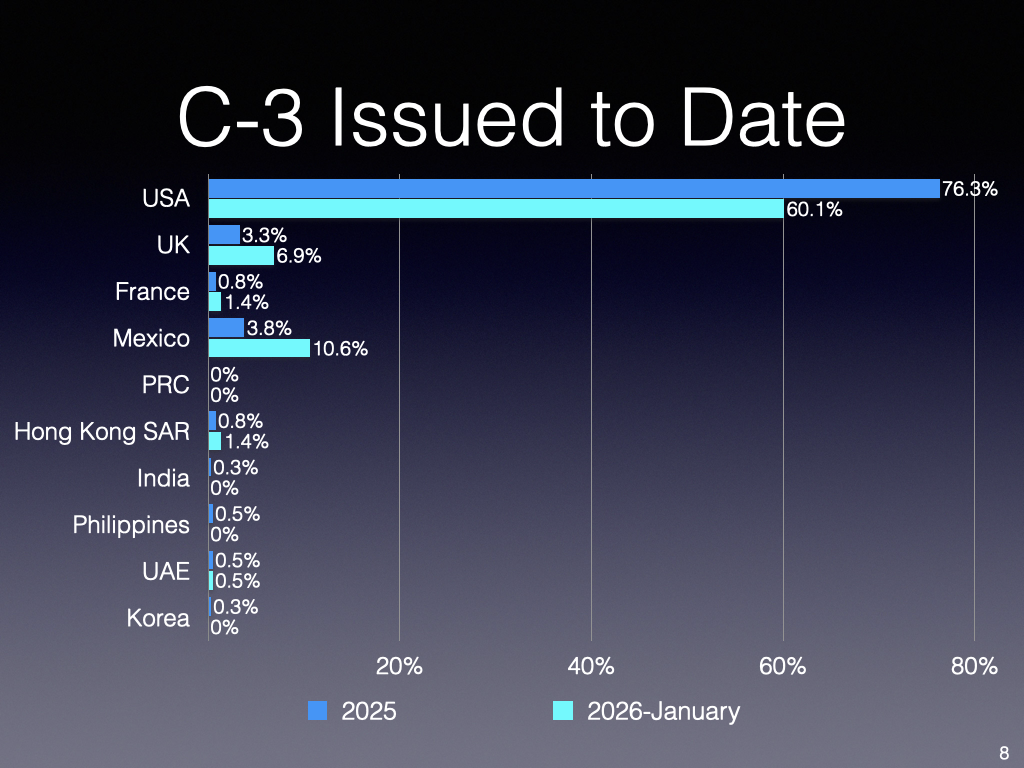
U.S. citizens accounted for the largest national share of those applications. Nearly 2,500 Americans were approved in January alone.
Jacqueline Bart, a Toronto-based immigration lawyer, said there’s been a frenzy of interest among Americans looking to get a Canadian passport.
She said some of those applicants — including LGBTQ+ individuals and people with children requiring gender affirming medical care — are looking to move to Canada “right away.”
“It’s just been absolutely insane to the point where I can’t keep up with the work. I’m having to refer people to other lawyers,” Bart said.
Bart said while most of the inquiries are coming from lawyers looking for access to a second passport, she is beginning to get more inquiries from non-lawyers in the U.S.
“I think some of our inquiries are kind of spilling over into a more general sphere,” she said. “But the overwhelming majority of my clients are American. I would say maybe five per cent come from other countries, at most.”
While January 2026 saw a higher-than-average number of American citizenship by descent approvals, it only ranked third in terms of U.S. approvals in a single month in the last year. March 2025 saw more than 2,800 approvals out of the United States, while May saw almost 2,700.
The number of approvals from the U.K. — the country with the second highest level of interest in Canadian citizenship by descent — was also above average in January, at 290.
People from France saw 140 approvals in January. Other countries in the top 10 for citizenship by descent approvals include China, Hong Kong, India, Australia, the Philippines, the U.A.E. and Germany — they ranged between 75 and 120 approvals in January.
The vast majority of countries outside the top 10 saw no significant shifts in approval numbers — with the exceptions of Mexico and Belize.
Mexico was the source of 235 approved applications for citizenship by descent in January 2026; Mexican citizens received 610 approvals in all of 2025. Ninety applications out of Mexico were approved in December 2025 — a notable jump over the 2025 monthly average of 50 citizenship approvals.
While Belize accounted for only 45 approvals throughout 2025, it registered 40 in January of this year alone.
The immigration department issued about 82,500 approvals for citizenship by descent throughout 2025, with the United States generating the most — about 24,500 approvals.
The other countries in the top 10 accounted for only a combined 11,600 approvals in 2025.
This report by The Canadian Press was first published April 16, 2026.
Arguing for purges and inspired by Orban and Trump. Countering one set of excesses by a reverse set of excesses not helpful:
…It can be overcome, but that starts close to home, with provincial governments actively taking back what is rightfully theirs and installing onside allies — not thoughtless centrist donors who fear alienation from their Liberal-voting friends more than they want to win. It takes a careful and concerted effort to take back professional schools, not by defunding them, but by funding academic chairs to break the monoculture, provide role models to onside students, and provide alternative experts to lean on during contentious policy debates. The federal party can’t do much of this, but it can certainly build relationships with onside provinces to make it happen — or hammer them for failing to live up to their responsibility.
It means firing every activist and replacing every Liberal appointee at the top of any public department, every member of a public board, and abolishing those that exist only to prop up Liberal ideology. That means abandoning gender and anti-racism initiatives, something that even Alberta and Ontario struggle to do.
At this point, defund-everything libertarianism is a gambling strategy: it puts all the movement’s eggs into the basket that is the party’s election platform, and takes a crisis in the Liberal party to have any viability at all. In the off-chance it does result in victory, it is incapable of perpetuating itself.
Aimless tax and budget cuts don’t build movements or develop the careers of up-and-comers; they actually impede your future performance by depriving you of the necessary pipeline of manpower required to run complex institutions for years to come. “Just go to the private sector” doesn’t work, by the way, when the major corporations and companies have some kind of Liberal dependency, which is true for all the major consulting firms, law firms, pipeline companies and banks.
The wisdom that institutional control is the easy path to victory was internalized by the Liberals long ago. It’s time Conservatives started thinking the same way. It won’t deliver overnight, but that’s what it’s going to take to build a machine that can win in the absence of a catastrophic Liberal mistake. Anything less is just rolling the dice.
The right should not shy away from doing this when they regain power, which is hopefully a matter of when, not if. A government that refuses to stack the deck with its own people is effectively subsidizing a sort of Viet Cong within the state it supposedly heads. As the Americans learned painfully in the Vietnam War, merely shrinking the size of the Viet Cong with napalm did not eliminate the threat. Familiar or friendly and trusted people can be empowered a great deal within the bounds of the law.
Allies should be rewarded, and parallel institutions should supplant or compete with those that already exist. For example, the Conservative government of Stephen Harper made the mistake of not doing more to support the Sun News Network, which might have blossomed into a true conservative institution in the private sector.