Un nombre record de demandeurs d’asile passent désormais par les aéroports

Of note:

Les passages par voie terrestre irrégulière, dont le chemin Roxham, ont drastiquement chuté au Québec depuis le resserrement de la frontière. Mais le nombre de demandeurs d’asile qui arrivent par avion ne cesse d’augmenter, au point où 2023 pourrait atteindre un sommet similaire à 2022 si la tendance se maintient.

Le gouvernement fédéral a de nouveau loué des chambres pour les accueillir dans au moins un hôtel, confirment des acteurs de terrain. Pour eux, cette nouvelle hausse démontre que la « fermeture » du chemin Roxham « n’a rien réglé » : les deux ordres de gouvernement n’ont toujours pris aucune mesure pérenne, disent-ils, dans un contexte où l’augmentation des demandeurs d’asile est un phénomène mondial.

Au total, en juin dernier, 4620 demandes d’asile ont été comptabilisées par Immigration, Réfugiés et Citoyenneté (IRCC) ainsi que l’Agence des services frontaliers (ASFC), les deux instances fédérales responsables. C’est à peine 20 de moins que pour le mois de juin 2022, où 4640 demandes avaient été enregistrées.

De celles-là, une majorité est arrivée par avion : ils ont demandé l’asile sur-le-champ à l’aéroport ou encore dans un bureau d’IRCC après un certain temps, selon la ventilation des données disponible.

On compte ainsi environ 31 000 demandeurs d’asile pour les 5 premiers mois de 2023 au Québec. Si le rythme d’ajout de plus de 4000 par mois se poursuit, le niveau de 2022 sera atteint, soit un peu plus de 58 000 au total.

Ces arrivées se font par voies régulières, contrairement aux années précédentes, où jusqu’à deux demandeurs sur trois passait par des voies irrégulières, surtout par le chemin Roxham.

Arrivée par voie régulière ou irrégulière, une personne a le droit de demander l’asile au Canada si elle craint la persécution dans son pays d’origine.

Peu importe le point d’entrée, ces demandeurs d’asile ont aussi souvent des besoins d’hébergement, rappelle des organismes, qui déplorent le manque de « solutions pérennes », dit Eva Gracia-Turgeon, directrice générale du Foyer du monde.

Manque de communication

Un moins un hôtel à Brossard a recommencé à loger des demandeurs d’asile arrivés récemment. Au plus fort des arrivées par le chemin Roxham, Ottawa gérait des lits pour plus de 2500 personnes au Québec. IRCC, responsable de ces hébergements, n’a pas été en mesure de confirmer combien de places ont été remises en disponibilité à l’heure actuelle.

Les demandeurs d’asile cognent déjà par eux-mêmes à la porte des organismes, faute d’obtenir des services sur leur lieu de résidence temporaire.

« À notre grande surprise, l’hôtel a été rouvert par le fédéral, mais on n’a pas été avisés », raconte ainsi Mame Moussa Sy, directeur général à la Maison internationale de la Rive-Sud (MIRS). Cette organisation est située à « littéralement quatre minutes à pieds » de l’hôtel à Brossard.

« On n’a pas été mis au courant par le fédéral, mais on les voit, les gens. On a dû improviser pour commencer à les accompagner. On a parlé à d’autres organismes de la région, aussi », expose M. Sy. Il souhaiterait une meilleure coordination, surtout venant des autorités, déplore-t-il.

Les maisons du Foyer du monde sont, quant à elles, aussi pleines. « On a juste déplacé la problématique. C’est normal qu’il y ait plus de gens qui passent par l’avion, car malheureusement, il n’y a pas d’autres moyens de demander l’asile », note Mme Gracia-Turgeon.

Elle croit aussi que la hausse se fera encore plus sentir dans les prochaines semaines et à l’automne, car son organisme est en quelque sorte en deuxième ligne, après l’hébergement d’urgence. « Pour moi, c’est aussi la preuve que “fermer” Roxham n’était pas une solution », dit-elle.

Les conflits armés et les changements climatiques continuent de pousser des millions de personnes à quitter leur pays d’origine, rappelle la directrice communautaire : « Il faut prévoir pour l’avenir, ce n’est que le début. »

L’hiver dernier, le milieu communautaire lançait un cri du coeur pour un meilleur soutien et une meilleure coordination. Le gouvernement avait alors débloqué 3,5 millions de dollars en aide d’urgence. « Mais c’était un plaster et, depuis, aucune mesure n’a été mise en place par les gouvernements », regrette-t-elle.

« On est dans une mouvance mondiale », observe aussi Stephan Reichhold, directeur de la Table de concertation des organismes au service des personnes réfugiées et immigrantes (TCRI). Il n’est donc pas surpris de cette « reprise » des arrivées. La TCRI souhaite voir plus de services pour tous les demandeurs d’asile, y compris ceux hébergés par le fédéral.

« On a l’impression que c’est toujours à recommencer » en termes de besoins et de recherche de ressources, affirme M. Reichhold.

Ailleurs au pays

Le phénomène est aussi bien visible à Toronto, où des dizaines de personnes ont été contraintes de dormir dans la rue, faute de place dans les refuges de la ville.

L’Ontario a également dépassé le nombre d’arrivées à pareille date l’an dernier, avec 21 480 demandes d’asile entre janvier et juin 2023, contre 11 350 en 2022.

Il faut dire que le système de refuges d’environ 9000 places de Toronto accueille à la fois les personnes itinérantes et celles qui cherchent à obtenir le statut de réfugié. La province voisine ne dispose pas d’un mécanisme comme le Québec avec son Programme régional d’accueil et d’intégration des demandeurs d’asile (PRAIDA), financé surtout avec de l’argent d’Ottawa.

Le nombre de nouvelles personnes hébergées au PRAIDA a légèrement fléchi depuis les modifications à l’Entente sur les tiers pays sûrs, qui ont davantage scellé la frontière. En juin, ce sont 1112 nouvelles personnes qui se sont présentées au PRAIDA, dont la capacité totale est de 1 150 places.

Causes possibles

Les arrivées par avion étaient déjà un phénomène présent depuis 2022, même si peu mis de l’avant dans le discours politique. Alors que le premier ministre François Legault demandait de « fermer » le chemin Roxham à plusieurs reprises l’hiver dernier, Le Devoir avait révélé en mars que la majorité des demandeurs d’asile dans des hébergements gérés par la province étaient arrivés par avion.

La majorité d’entre eux étaient alors des Mexicains, mais depuis, les origines se sont diversifiées. Depuis 2016, ces ressortissants n’ont plus besoin de détenir un visa pour visiter le Canada. Le Mexique continue à être le premier pays d’origine des personnes hébergées par le PRAIDA, mais on compte aussi le Sénégal, le Cameroun, la Colombie et Haïti dans cette liste.

Certains changements pour obtenir un visa de visiteur ont été mis en place récemment, mais IRCC n’a pas pu confirmer au Devoir s’ils étaient liés à cette hausse. Plusieurs voyageurs en provenance de 13 pays qui nécessitaient un visa auparavant peuvent maintenant demander une simple autorisation de voyage électronique, un processus rapide qui ne coûte que 7 $.

Une politique d’intérêt public a aussi été mise en place pour accélérer le traitement des visas de ce type. Elle permet aux agents de dispenser de certaines exigences pour des demandes de visite faites avant le 16 janvier 2022.

Source: Un nombre record de demandeurs d’asile passent désormais par les aéroports

U.S. has welcomed more than 500000 migrants as part of historic expansion of legal immigration under Biden

Significant given the political gridlock on immigration:

The Biden administration has welcomed over half a million migrants under programs designed to reduce illegal border entries or offer a safe haven to refugees, using a 1950s law to launch the largest expansion of legal immigration in modern U.S. history, unpublished government data obtained by CBS News show.

In less than two years, the administration has allowed at least 541,000 migrants to enter the U.S. through the immigration parole authority, which gives federal officials the power to authorize the entry of foreigners who lack visas, according to internal government statistics, court records and public reports.

The unprecedented use of the parole authority has allowed officials to divert migration away from the southern border by offering would-be migrants a legal and safe alternative to journeying to the U.S. with the help of smugglers and entering the country unlawfully. It has also given the administration a faster way to resettle refugees as it attempts to rebuild a resettlement system gutted by drastic Trump-era cuts.

Officials have invoked the parole authority to welcome roughly 168,400 Latin American and Caribbean migrants with U.S. sponsors; 141,200 Ukrainian refugees sponsored by Americans; 133,000 asylum-seekers who waited for an appointment in Mexico; 77,000 Afghan evacuees; and 22,000 Ukrainians processed at the U.S. southern border, the data show.

Taken together, the immigration parole programs created by the Biden administration amount to the most significant expansion of legal immigration in three decades. And to the dismay of Republican critics, the administration has done so unilaterally, without explicit consent from Congress, which has not expanded legal immigration levels since 1990 amid decades of partisan gridlock.

“Unprecedented”

To come live and work in the U.S. legally, immigrants generally must have a visa or approved refugee status. But a lawdating back to 1952 allows officials to use the parole authority to admit those who don’t have visas if doing so furthers an “urgent humanitarian” cause or “significant public benefit.” While it does not make migrants eligible for permanent status or citizenship, parole gives them the ability to live and work in the U.S. legally, typically for one- or two-year increments that can be renewed.

Doris Meissner, a top U.S. immigration official during the Reagan and Clinton administrations, said there’s precedent for using parole to resettle refugees. During the Cold War, Republican and Democratic administrations paroled hundreds of thousands of refugees fleeing communism in Cuba, Eastern Europe and Southeast Asia. But Meissner said the Biden administration’s use of parole is historic.

“At this scale, in this time period, it is unprecedented,” said Meissner, who led the now-defunct Immigration and Naturalization Service from 1993 to 2000.

León Rodríguez, who served as director of U.S. Citizenship and Immigration Services during President Barack Obama’s second term, said the expansive use of parole has become a “necessity” because the Biden administration has recognized it cannot address migration flows through deterrence alone.

“It’s fair to say that the pressures are much greater now, which is why the numerical scope of these parole programs is probably the largest we’ve seen, certainly in a long time,” Rodríguez said.

How the Biden administration has used parole

The Biden administration’s first large-scale use of parole occurred in the summer of 2021, when it invoked the law to resettle tens of thousands of Afghans after a massive airlift from Taliban-controlled Afghanistan.

Then, in early 2022, the administration used the parole authority to process thousands of Ukrainians who had flown to the U.S.-Mexico border in the early days of Russia’s invasion of Ukraine. To discourage future Ukrainian arrivals along the southern border, officials created a program, known as Uniting for Ukraine, to allow Ukrainians to fly directly to the U.S. to receive parole if they have American sponsors.

In October 2022, the administration created another sponsorship-based parole program, based on the Ukrainian model, for Venezuelan migrants, who were crossing the U.S.-Mexico border in record numbers. That program was expanded in January to include migrants from Cuba, Haiti and Nicaragua and deter illegal border crossings by citizens of those crisis-stricken countries.

That same month, the U.S. started allowing migrants in Mexico to use a mobile app, known as CBP One, to request an opportunity to enter the country at a legal port of entry. Those allowed into the U.S. under the process are generally paroled for one or two years and given a hearing in immigration court, where they can request asylum, government officials and lawyers confirmed.

The Biden administration has also used parole on a smaller scale to welcome deported U.S. military veterans, migrant families separated under the Trump administration, at-risk Central American minors with family members in the U.S. and Cubans and Haitians with American relatives.

The number of migrants paroled into the U.S. is expected to increase even further. The program powered by the CBP One app currently allows up to 529,250 migrants to be processed each year, while the sponsorship program for Cubans, Haitians, Nicaraguans and Venezuelans has an annual ceiling of 360,000 arrivals. The Uniting for Ukraine policy has no numerical cap.

Moreover, the Biden administration is also operationalizing another program that will allow migrants from Colombia, El Salvador, Guatemala and Honduras to enter the U.S. under the parole authority if the government has approved visa petitions filed by their U.S. citizen or resident relatives.

A legal dispute

The Biden administration has said the use of parole has allowed the U.S. to resettle at-risk refugees, reunite families and relieve pressure at the U.S.-Mexico border. Officials, for example, have credited the CBP One app and program for Cubans, Haitians, Nicaraguans and Venezuelans — as well as stricter asylum rules — for a dramatic drop in illegal crossings along the southern border in recent weeks.

But the widespread use of parole has garnered strong criticism from Republican lawmakers and state officials, who have accused the Biden administration of abusing the authority and circumventing the limits Congress placed on work and immigrant visas.

In an ongoing lawsuit challenging the policy for Cubans, Haitians, Nicaraguans and Venezuelans with U.S. sponsors, Republican-led states called the initiative an “illegal program” that imposes a financial burden on American communities due to social and medical services costs.

“The Department of Homeland Security, under the false pretense of preventing aliens from unlawfully crossing the border between the ports of entry, has effectively created a new visa program — without the formalities of legislation from Congress,” the states argued.

Senior DHS officials said the administration’s use of parole is lawful because, despite the large-scale nature of the programs, immigration officials still make individual determinations as to whether migrants should receive parole, and some applicants are denied entry. All parolees under security vetting, officials said.

“There are case-by-case adjudications happening. And that is why we very strongly believe that this is well within our statutory authorities and is a use of parole that’s been consistent with how parole has been used in the past,” an official said under condition of anonymity to discuss these matters.

For the past decades, Democratic and Republican administrations have created parole programs; though they were much smaller in scope, like processes for military families and Cuban doctors set up under President George W. Bush. The Trump administration tried to severely curtail the use of parole, but still kept some programs in place.

The DHS officials stressed that the administration believes its parole processes should not be grouped together, since they arose from distinct circumstances. The officials also noted that over the same period when more than half a million people were paroled, the U.S. deported or expelled migrants over 3 million times, mostly under the now-expired pandemic border measure known as Title 42.

“More individuals have been removed or expelled than paroled in the last two years, and the conflation of very different parole processes that serve very different purposes is misleading and wrong,” DHS spokesperson Naree Ketudat said in a statement.

The programs for Afghans and Ukrainians were created in response to emergency situations overseas, the DHS officials said. The parole process for Cubans, Haitians, Nicaraguans and Venezuelans, they added, was set up to discourage unlawful migration and as part of a deal in which Mexico agreed to accept migrants from these countries who enter the U.S. illegally. Unlike those programs, migrants processed under the CBP One process are placed in deportation proceedings in addition to being paroled, the officials noted.

While the DHS officials said they view the programs as “very different” forms of parole, one official acknowledged that “technically it’s the same underlying authority that’s allowing these folks to come.”

“An indeterminate situation”

While advocates for migrants have generally applauded the administration’s use of parole, they have expressed concern about hundreds of thousands of migrants becoming stuck in legal limbo, without a path to permanent legal status. A Republican administration could also terminate their parole grants.

“It is an indeterminate situation for hundreds of thousands of people. But at the same time, it is safety and protection for the moment,” said Meissner, the former top immigration official and now a senior fellow at the Migration Policy Institute, a nonpartisan think tank.

During the Cold War, Congress passed several laws to give those paroled into the country permanent residency. But the odds of the current deeply divided Congress doing so again are slim, even for populations like Afghan evacuees, who have enjoyed bipartisan support.

The senior DHS officials said they expect migrants to leave the U.S. once their parole expires if they have not gained permanent status by applying for programs like asylum or visas for relatives of Americans.

“If they, at the end of the two years, have not found a lawful pathway in the U.S., our expectation is that we will be seeking to remove those individuals,” one official said.

Source: U.S. has welcomed more than 500000 migrants as part of historic expansion of legal immigration under Biden

Petition e-4511 – Opposing self-affirmation of the #citizenship oath “citizenship on a click” – Signatures to date

The chart below breaks down the 1,012 signatures as of 18 July by province, highlighting Ontario over representation and Quebec under representation. British Columbia and Alberta in line with their share of the population but Manitoba and Saskatchewan under represented. These numbers may reflect the various networks involved in the initial launch so will be interesting to see how the regional numbers vary over time.

And if you haven’t yet considered signing the petition, the link is here: https://petitions.ourcommons.ca/en/Petition/Details?Petition=e-4511

Despite end to visa program Ukrainians will still seek refuge in Canada, group says

Of note:

As the war in Ukraine continues, some Ukrainians will still want to seek safe haven in Canada despite the end of a special visa program, according to the head of the Ukrainian Canadian Congress.

The group’s CEO Ihor Michalchyshyn said he knows many Ukrainians who returned to their country after coming to Canada in the early days of the war, but that could change depending on what happens in Ukraine.

“It’s a good opportunity to remind people that the war is still on. People are still moving around, there is a lot of uncertainty. I don’t think anybody knows where they will end up or what they’re going back to.”

Over the weekend, the government allowed a special visa program, the Canada-Ukraine Authorization for Emergency Travel, to expire. The program allowed Ukrainians to apply to come to Canada with limited barriers and allowed them to stay for up to three years, work legally and receive settlement supports.

The government rejected calls to extend that program and will not accept new applications, though anyone who has already applied and been approved will still be able to come to Canada until March 2024.

The government first unveiled the new program in March 2022, just weeks after the invasion. In total, the government received 1.1 million applications, roughly 800,000 of them have been processed and approximately 166,000 people have come to Canada.

The program was initially set to expire in March, but was extended until July 15. During that extension period 140,000 people applied.

Michalchyshyn said there has been a slowdown in the number of new arrivals from Ukraine, but with the war still threatening civilians, many Ukrainians who hold one of the special visas may decide to come.

“There isn’t a city or a region that hasn’t been touched. Every Ukrainian knows somebody who’s fighting or who’s been killed,” he said. “Ultimately, we need Ukraine to win the war and establish a peace for people to have that context and make decisions.

Ukraine had a pre-war population of just over 40 million, but estimates suggest as many as 10 million people have fled the country since the invasion began on top of others who have been internally displaced. The country’s population has been in decline for decades and could continue to shrink in the years ahead.

Michalchyshyn said when the war is over he believes many Ukrainians will return, but some may decide to start new lives here. Canada is currently home to the largest Ukrainian disapora in the world outside of Russia.

“The government of Ukraine is going to do everything it can to encourage people to come back when they feel safe, and there are lots of people going back now,” he said. “It’s a family decision. It’s an individual decision based on circumstances, based on what they see in their future.”

Mary Rose Sabater, a spokesperson for the immigration department, said after the previous extension, they decided now was the time to wind down the program. She said that doesn’t mean Ukrainians can no longer immigrate.

“Ukrainians are still able to come to Canada by applying through Immigration, Refugees and Citizenship Canada’s existing temporary resident programs. In recognition of the continued danger while Russia’s invasion continues, we’re implementing these new measures to ensure continued support to Ukrainians in Canada,” she said.

While it ended the special visa program, the government did announce a new process for Ukrainians with family in Canada to become permanent residents.

Sabater said Canada still wants to help for as long as the war continues.

“The Government of Canada continues to do everything possible to help those fleeing Russia’s invasion, which includes providing a safe haven and peace of mind.”

Andrew Griffith, a fellow with the Canadian Global Affairs Institute and former director general with Citizenship and Immigration, said the Ukrainians who have travelled to Canada are largely younger people with post-secondary educations — the kind of people Canada is usually looking for.

He said balancing the collective good of Ukraine and the individual good for people fleeing the war is part of the balance of any immigration policy, but he said Canada tends not to be overly concerned about what happens to source countries.

“I have never seen any evidence that we consider the interest of the source country in any meaningful way.”

He said the government’s choice to end new applications for the special visa program is a reasonable measure and a sign to those people who have been approved that they need to make a decision.

“It sends a signal to people that if they want to use this pathway, they’ve got a certain limited amount of time to do it.”

Source: Despite end to visa program Ukrainians will still seek refuge in Canada, group says

Ifill: The curse of unserious politicians

Interesting mix of self-awareness in terms of her positions/identity/branding and obliviousness of how some of her critiques (e.g, “ludicrous solutions,” “misinformation”) can also be applied to her along with many politicians, not just the arguably more egregious example of Pierre Poilievre:

I’m back as the award-winning journalist and economist you’ve come to love or hate, but can never dismiss. In my fourth year of this column, I will continue to regale you with news stories and political and policy analysis from an intersectional feminist lens, which also includes analyses of equity and power. I’m not your friendly gender-based analysis plus co-ordinator who is only interested in the check-box exercise of performative policy analysis done by the federal public service. No, policy and politics need to be done differently for the times we are in and beyond.

We are not a homogenous society, and post-pandemic, we need better tools to determine how we’re heterogenous and how to deliver public services to disparate communities. Politics continues to be a white man’s game, and policy decisions continue to be made by people who lead homogenous lives and lifestyles of privilege. If we are not centring the vulnerable and marginalized—i.e. those without power—we’re doing politics and policy wrong. The results of that are growing chasms of inequalities that will upend society and polarize our politics, which one can observe is already happening.

Unfortunately, in these serious times we are besieged by unserious people who have been instrumental in the memeification of politics and political discourse. And this is dangerous.

In his 1976 book, The Selfish Gene, Richard Dawkins defined a meme: “Memes (discrete units of knowledge, gossip, jokes and so on) are to culture what genes are to life. Just as biological evolution is driven by the survival of the fittest genes in the gene pool, cultural evolution may be driven by the most successful memes.” However, an internet meme does not mutate according to evolutionary standards of random change and Darwinian properties; it is made to deliberately be manipulated through the creativity and purpose of the creator. In both instances, the resulting effect would be to go viral.

For the 2018 Ontario provincial election—the one in which the Ontario NDP could not capitalize, and the Ontario Liberals collapsed—much of the success of the Progressive Conservatives had been predicated on the success of Ontario Proud, a meme factory. It was given credit, though without much evidence, by Ontario news media for its alleged success in dethroning Kathleen Wynne’s Liberal party. It did so through the creation of memes and other online content, as reported by the Toronto Star: “It unabashedly promoted Doug Ford’s Progressive Conservatives in last spring’s Ontario election, using social media to create viral videos and memes that mercilessly mocked Wynne before shifting to attack the NDP once polls showed the premier’s party cratering.”

In contrast, its sister organization, Canada Proud, has not been able to scale this effect nationally. The organization wanted to replicate its success for then-Conservative Party leader Andrew Scheer, only we all know how that turned out. More recently, founder of Ontario Proud and Canada Proud, Jeff Ballingall, was the digital director of councilman Brad Bradford’s ignominious run for mayor of Toronto. Ballingall’s candidate ended that run with only 9,254 votes, or 1.3 per cent. In the June 26 election, Bradford made himself into a caricature with his insistence on filming himself holding a Jamaican patty all under the auspices of his digital director.

Unfortunately, meme culture has ushered in the rise of unserious people. People who can’t be taken seriously every time they open their mouths because what they propose are ludicrous solutions to important problems, and thereby wasting our collective time. Typically, their brand of unseriousness is coupled with misinformation and based on irrelevant contextualization, bigotry, and general asininity. Imagine how far we could’ve gotten on climate change policies had we not been held back by unserious people. Imagine how far along we’d be as a society if we didn’t have these time-wasters holding us back. It’s maddening and frustrating.

The most unserious person in Canadian politics is Pierre Poilievre. After revealing himself to be a capable politician, through his victory speech after his Conservative leadership win last fall, one would think he would’ve continued along that trajectory. But unserious people can’t be serious for long. Instead of building political capital, he squandered it by reducing himself to his own meme, much like Bradford. His showing at Calgary’s Stampede, which showcased a new look—one without glasses, pumped up, and photographed alongside homophobes—demonstrated the lengths Conservatives will go to alienate the general voting public. They will then whine and complain about imaginary media bias against them when all Canadians can see throughout social media is their latest bigoted attack. What’s dangerous about this is the platforming and integration of bigotry, misinformation, and general farcical nature of Poilievre’s brand of politics. He’s not here to solve problems, like a serious person committed to the betterment of all in this country. In contrast, he’d rather sully his assumed intellect for the next viral moment like the shallow, unctuous man he’s shown the Canadian public he is.

Source: The curse of unserious politicians

Minorités visibles sur le marché du travail: Des avancées importantes, mais encore du chemin à faire

Notable improvement in terms of employment rates, less positive with respect to incomes but still showing improvement compared to 2016:

Un taux d’emploi comparable

L’étude montre une participation de plus en plus active des personnes noires sur le marché du travail, souligne Luc Cloutier-Villeneuve, analyste en statistique du travail à l’ISQ et auteur de l’étude. Selon lui, il s’agit d’un des éléments les plus frappants. « Les taux d’activité sur le marché de l’emploi chez les universitaires et les détenteurs de formations postsecondaires sont relativement identiques à la population qui n’est pas issue d’une minorité visible », indique l’expert. De fait, tous âges compris, le taux d’emploi atteint le seuil du 78,8 % chez les Noirs, comparé à 77,5 % pour les personnes non issues de minorités visibles. 

Le Québec derrière la Colombie-Britannique

Le Québec présente une meilleure équité entre personnes issues des minorités visibles et personnes blanches que certaines autres provinces du Canada, dont l’Ontario. Les Noirs (78,8 % au Québec, contre 68,8 % en Ontario), les Latino-Américains (76,2 %, contre 71,4 %) et les Arabes (70,8 %, contre 57,4 %) ont tous un taux d’emploi supérieur dans la Belle Province. Toutefois, la Colombie-Britannique est plus paritaire du côté des personnes noires (76,1 %) et arabes (60,6 %). Luc Cloutier-Villeneuve constate que plusieurs changements positifs ont été réalisés depuis le recensement précédent, en 2016, mais la partie est loin d’être gagnée. 

Un écart de revenu qui diminue

Le revenu moyen d’emploi des personnes issues de minorités visibles âgées de 25 ans à 64 ans (43 240 $) est toujours inférieur au revenu moyen d’emploi des personnes blanches (56 250 $), confirme l’étude. Mais cet écart diminue. En 2019, il était de 22 %, alors qu’en 2015, soit quatre ans plus tôt, il atteignait 28 %. Plus précisément, en 2019, le revenu d’emploi moyen allait d’environ 41 800 $ (personnes noires) à 47 700 $ (personnes arabes). 

Différences selon l’âge

La parité varie selon l’âge, indique l’étude de l’ISQ. Chez les personnes de 55 à 64 ans, l’écart est petit, ce qui révélerait une meilleure intégration à la société, soutient Luc Cloutier-Villeneuve. « On sait qu’il y a des variables qui jouent sur l’intégration, que ce soit la langue maternelle, la scolarité, la durée de résidence [au Québec], et l’ordre dans l’arbre généalogique », explique l’expert. 

Connaissance du français, un facteur

Un certain nombre de facteurs peuvent expliquer les écarts constatés dans l’étude, souligne Luc Cloutier-Villeneuve. Parmi eux, l’analyste en statistique mentionne la connaissance du français ou encore la reconnaissance des diplômes. « Ce qui est clair, c’est qu’en termes d’analyse subséquente, ce serait intéressant d’aller creuser ces aspects pour comprendre pourquoi ces écarts persistent. » 

Source: Minorités visibles sur le marché du travail: Des avancées importantes, mais encore du chemin à faire

Globe editorial: Justin Trudeau should listen to Justin Trudeau on temporary foreign workers

Of course, always easier while in opposition but 2014 should be a cautionary tale about Temporary Foreign Workers as well as an example of a government pivot when the Conservatives and Jason Kenney had to reverse course:

Justin Trudeau has some advice for Justin Trudeau.

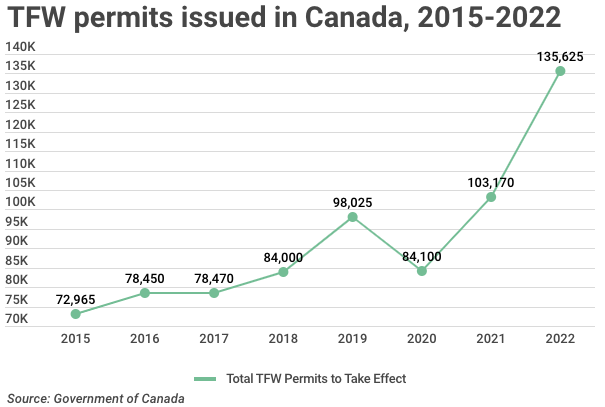
Mr. Trudeau, in 2023, leads a federal government that has overseen a surge in the country’s reliance on low-wage temporary foreign workers. The federal Liberals stoked this increase: they loosened the rules early last year. According to the latest data, reported by The Globe last week, Ottawa has approved the hiring of almost 80,000 low-wage foreign workers in the year after the rules were eased. That’s triple the level of the 12 months before the change.

Source: Justin Trudeau should listen to Justin Trudeau on temporary foreign workers

Language tests used to determine admissibility into Canada are a ‘money-making machine,’ critic says

Language is central to integration and more positive socio-economic outcomes:

Hundreds of thousands of immigrants who enter Canada annually are required to take a language test. But their scores expire within the next two years — one of many problems critics have with the test.

The Canadian government invited 431,645 permanent residents into the country last year — a record high. Most are required to be proficient in either English or French.

Applicants can attempt either of the two tests recognized by Immigration, Refugees and Citizenship Canada (IRCC) — the Canadian English Language Proficiency Index Program (CELPIP) or the International English Language Testing System (IELTS). Both cost more than $250 and the results are only valid for two years. There are also French tests that have the same validity period and cost about the same.

Source: Language tests used to determine admissibility into Canada are a ‘money-making machine,’ critic says

Khan: All women and girls should be allowed play soccer – regardless of their religion

Indeed:

On the eve of the Women’s World Cup, as soccer fans cheer our talented female athletes, let’s not forget the many women and girls worldwide who are being denied the opportunity to play the beautiful game.

Here in Canada in 2007, 11-year-old Asmahan Mansour was set to enter a tournament match in Laval, Que., when a referee barred her from the soccer pitch for wearing a hijabThere had been no issues in previous games; this ref insisted on following a memo from the Quebec Soccer Federation (QSF) forbidding all religious headgear. Asmahan’s teammates, their parents, and coach rallied in her support by forfeiting the match and withdrawing from the tournament in protest – as did four other Ottawa-based teams.

The QSF insisted it was a safety issue. The matter made it all the way to FIFA, which initially upheld the hijab ban, then reversed it in 2012. In the interim, the Canadian Soccer Association allowed the hijab, provided it met safety standards.

In 2013, the QSF banned Sikh turbans, basing the decision on its interpretation of FIFA’s rules. Turbaned children in Quebec could play in their backyards, but not in official matches. The QSF backed down after its suspension by the Canadian Soccer Association, claiming it was all a misunderstanding. Soccer peace ensued; children from all backgrounds can now play “the beautiful game” across Canada. It was admirable to see the pushback against discrimination by ordinary Canadians, who insisted on inclusion and fair play for all children.

Unfortunately, women and girls are denied the opportunity to play the beautiful game elsewhere in the world. Afghanistan comes to mind. And France, where since 2016, the French Football Federation (FFF) has banned any player, coach or referee from wearing the hijab – contrary to FIFA rules. The FFF insists it is in keeping with the official French policy of laïcité, which restricts religious expression in the public sphere. To paraphrase a memorable Seinfeld character, the FFF has declared “No soccer for you!” to hijabi footballers.

This policy has had a painful impact on many aspiring French Muslim female soccer players, who have faced a choice between the sport they love and their faith. In response, Les Hijabeuses, a collective of French female Muslim soccer players, was formed in 2020 with the aim of ensuring that all women can play the sport they love. They’ve launched petitions, gathering support from the broader sports community (including Nike). The members and their allies play soccer together, connect with other French teams and provide training sessions to encourage other young Muslim women to get into the sport. They have gone to court to try to overturn the ban, citing FIFA’s ruling.

Last month, the public rapporteur of France’s highest administrative court (Le Conseil d’État) recommended annulment of the ban, stating that wearing the hijab is neither “proselytism” nor “provocation.” Nor is “neutrality” required for soccer players, since they are not public servants. According to the rapporteur, religious symbols are already present: players cross themselves before entering the pitch. The rapporteur’s recommendation is usually adopted by Le Conseil.

Surprisingly, Le Conseil upheld the ban, in order “to guarantee the smooth running of matches and prevent any confrontation,” while acknowledging this limits freedom of expression and conviction. Without a hint of irony, the FFF welcomed the ruling, stating it would reaffirm “its total commitment to combating all forms of discrimination.” If laïcité was meant to supplant the Catholic Church, it still denies the personal agency of women.

The ban is even more galling given that France is the only European country that excludes hijabis from playing in most competitive domestic sports, and it is unclear whether foreign players with hijabs will be allowed to compete in the 2024 Paris Olympics. Why is France denying Olympic opportunities for its own hijab-clad athletes?

On the eve of the Women’s World Cup, there has been thundering silence from FIFA and national soccer federations regarding the French exclusion. Contrast this to the protests raised against one of the tournament’s sponsors: for the country’s treatment of women’s rights defenders, FIFA’s revoked the sponsorship of Saudi Arabia’s state tourism authority. National soccer federations should mount a united stand against France’s blatant discrimination, with the Canadian Soccer Association taking the lead. FIFA should at least sanction the FFF for violating official FIFA policy.

Listen to Asmahan Mansour’s young Ottawa teammates in 2007: “I like to play soccer, but Azzy is my friend, and I don’t want to play if she’s not going to play,” one said. “If one person can’t play soccer because of her religion, it just wouldn’t be fair. Inside is what matters, not the outside,” said another.

Sheema Khan is the author of Of Hockey and Hijab: Reflections of a Canadian Muslim Woman.

Source: All women and girls should be allowed play soccer – regardless of their religion

How immigration could be impacting the Bank of Canada’s efforts to bring down inflation

Of note:

Demand created from a record influx of immigrants could be one factor keeping inflation higher for longer than anticipated, some economists say, though Bank of Canada governor Tiff Macklem doesn’t appear overly worried about it.

Sticky inflation prompted the Bank of Canada on July 12 to raise interest rates by 25 basis points to five per cent — the highest level since 2001. Though the inflation rate has fallen off its peak of 8.1 per cent last summer to 3.4 per cent in May, prices of more than half the goods in the consumer price index, such as meat, bread, coffee and rent, continue to rise, Macklem said in a press conference following the decision.

The central bank now expects inflation to reach its two per cent target by the middle of 2025, instead of the end of next year as predicted in April.

But even as prices for key goods go up, the economy is proving more resilient than expected and demand momentum and consumption growth has been “surprisingly strong,” the bank said in a statement, pushing it to once again hike rates last week.

An increase in immigration could be one complicating factor keeping inflation higher for longer and stoking demand, Bank of Nova Scotia economist Rebekah Young said.

“There is more risk that inflation may be sticky in months and quarters ahead, versus it coming down faster than we thought and newcomers are a part of that story,” she said. “They are certainly adding to what could be keeping (Macklem) up at night.”

Canada welcomed more than one million immigrants in the past year as the federal government sought to address high job vacancies and labour shortages. Young said the country has traditionally used population growth through immigration as a means to increase workers and enhance supply, especially as “massive surges” of inflation haven’t been something policymakers have worried about for decades. But things have gotten more complicated.

“A lot of things are different now,” she said. “The current juncture that we are in, getting inflation back to two per cent is still fraught with uncertainty.”

Macklem last week said he expects the net-impact of immigration growth on inflation to be “roughly neutral,” though he added it is impacting some parts of the economy more than others.

He said that while newcomers filling job vacancies has been good for company margins, easing inflationary pressures, new entrants are also increasing demand for housing, helping boost rent and home prices. It’s “hard to know exactly” the net effect on the economy, he added, but the main message is that immigration is adding to both demand and supply.

“If you start an economy with excess demand (and) you add both demand and supply, you are still in excess demand,” Macklem said. “What we’re seeing is that the excess demand in the economy is more persistent than we thought and so we’ve raised rates in June and July.”

Douglas Porter, chief economist at the Bank of Montreal, said he agrees with Macklem’s assertion that high immigration adds to both demand and supply. But there’s another element the governor “didn’t talk about much,” he said, and that’s a matter of timing.

“(Strong population growth) does tend to affect things like spending and the housing demand almost instantaneously, whereas the supply side might take a little bit longer to kick in,” he said. “A new worker might enter the labour force relatively quickly, but reaching their full potential might take a little bit of time.”

In the short run, strong population growth tends to “push up the price pressures” a little bit, Porter said, but the impact in the longer run is “broadly neutral.”

Porter assessed economies of 20 nations to better understand the link between population growth and inflation and said he found a “very weak positive relationship.” Most of the impact is on the housing market, since there is a “very clear relationship between strong population growth and home prices,” he said.

Still, Porter also said Canada has fared better than most nations in terms of tackling inflation, meaning there are “larger forces at play here, beyond just population growth.”

Source: How immigration could be impacting the Bank of Canada’s efforts to bring down inflation