While I wouldn’t make the same generalizations about all DEI courses and programs, this case highlights the risk of an overly aggressive and ideological approach, one that the Board and administrators failed to address. No need to “throw the baby out with the bathwater” but clear need to vet and monitor consultants to ensure respectful and balanced approaches:
By now, you have probably heard the tragic story of former Toronto District School Board (TDSB) principal Richard Bilkszto, an esteemed educator with 24 years’ experience. In 2021, he attended two TDSB-mandated diversity, equity and inclusion (DEI) sessions, led by the KOJO Institute, during which the facilitator, Kike Ojo-Thompson, berated him for challenging her statement that Canada was a more racist place than the United States.
“We are here to talk about anti-Black racism, but you in your whiteness think that you can tell me what’s really going on for Black people,” she allegedly said, and then reportedly proceeded to berate him in a second session as a “real life” example of someone supporting white supremacy.
Bilkszto, who himself had spoken out against racism during his career, was devastated. Bilkszto went on stress leave and sought support from Ontario’s Workplace Safety and Insurance Board, which found he had been subject to workplace harassment. When he got back from leave, the board refused to reinstate his contract. He then filed a civil suit against the TDSB, seeking additional damages and an apology.
But Bilkszto never fully recovered from the pain caused by the damage to his reputation and his soul. On July 13, he ended his life. According to a statement authorized by his family, “The stress and effects of these incidents continued to plague Richard. Last week he succumbed to this distress.”
Bilkszto’s heart-rending story made headlines across Canada and around the globe. A petition has been started, demanding an inquiry into his death. The Toronto School Administrators’ Association also requested a review. And on Monday night, Ontario Education Minister Stephen Lecce asked officials to “bring me options to reform professional training and strengthen accountability on school boards so this never happens again.”
Bilkszto’s story resonates so deeply because it is an indictment of the failure of DEI training to achieve one of its stated goals: inclusion. Instead of making space for all voices, Bilkszto was shut down because of his race. Worse yet, in our schools, this type of “training” is now competing for scarce resources with priorities such as safety and academic performance.
Recently in Winnipeg, a school administrator defended his district’s annual spending of nearly $850,000 on DEI programs , saying, “We want our children to be anti-racist because you’re either a racist, or you’re an anti-racist.” In British Columbia, a government official stated that the province’s anti-racism plan for K-12 “is an important part of our work to decolonize our institutions and build a better B.C. for everyone.”
But is this “decolonization” and anti-racism education improving interpersonal relations between teachers and students? In B.C., nine in 10 teachers report experiencing violence or bullying on the job. The aforementioned school district in Manitoba, Louis Riel, saw a 263 per cent increase in unsafe behaviour by students last year.
In Nova Scotia, 87 per cent of teachers say that school violence has increased since 2018 and over half have been victims of violence or threats. And in Toronto, the TDSB is projected to have its most violent year since it started collecting data in 2000.
Meanwhile, student performance is declining. While Canada continues to perform well compared to other OECD countries, between 2000 and 2018, Canada recorded a 14-point decline in standardized reading scores, as well as declines in math and science scores classified as “steadily negative.”
Inequity is rooted in poverty, which has many factors, including race. But correcting for it comes down to resources, not words, applied in the right places.
Instead of hosting DEI sessions to berate their staff, school boards should redirect funds to tutoring low-income students who need extra help. They should fund food programs for kids who are hungry so they can concentrate and learn. Physical education, which has been directly correlated with improving educational scores, should increase. Self-esteem is rooted in achievement, and that should be the goal for every student.
Telling a principal that his whiteness is the problem does not help a single Black kid graduate. What it does do is divide, bully and shame. And sometimes, worse.
Of note. More on the perverse effects of current immigration policy, permanent and temporary, on productivity and per capita GDP:
Between 1990 and 2022, Canada’s population grew by 40.6 per cent. That’s more than most of the world’s highly-developed countries.
Switzerland’s population increased by 30.6 per cent over the same period, or about three-quarters of Canada’s pace, according to data from the World Bank. Norway was up 28.7 per cent. Sweden’s population grew at about half of Canada’s rate, as did the Netherlands and Austria. Taiwan and Denmark’s population growth was a little more than a third of Canada’s. Finland grew at roughly a quarter of Canada’s pace. Germany’s population rose by just 5.9 per cent, or one-seventh the Canadian rate.
These countries have something else in common: According to the International Monetary Fund, they are on the very short list of nations whose per-capita gross domestic product is higher than Canada’s.
In plain English, they’re wealthier than us. If you took the annual economic output of each country and cut it into the same number of slices as it has people, their residents would each get a slightly larger slice of the pie than the average Canadian.
Canada’s higher-than-our-peers population growth – powered by a higher immigration rate – is not why our economic performance in recent decades has left something to be desired. But neither is the country’s higher population growth, and the Liberal government’s plan for ever-rising immigration, some kind of magic solution for goosing Canadian living standards.
If Canada were a country where a calm and rational discussion of immigration was possible, we’d be talking about this. We’d be thinking hard about how the immigration system can best be designed to raise living standards for the average Canadian – not just growing the population and the economy, but growing the economy at a pace considerably faster than the population.
Since 2011, Canada’s GDP has grown at the same pace as the United States, and ahead of the rest of the G7. But Canada’s population has been growing faster than the rest of the G7, masking our economic underperformance.
When you look at GDP per capita rather than GDP – and ask not “is the country bigger?” but “is the average Canadian better off?” – Canada is losing ground.
In 1980, Canada’s GDP per capita was US$4,000 ahead of the average advanced economy, according to TD. By the year 2000, Canada and the others were neck and neck. And today, Canada is behind. Why? Because since 2014, our real GDP per capita has grown by just 0.4 per cent a year, compared with 1.4 per cent in other advanced economies. Unlike those countries, the growth of Canada’s pie is barely keeping pace with the rising number of forks.
A higher-than-average rate of immigration didn’t cause that. Yes, that short list of countries with higher per-capita GDP than Canada is mostly made up of places with lower population growth. But it also includes one country whose growth was only slightly below Canada’s – the U.S., whose population rose by 33.5 per cent between 1990 and 2022 – and another, Australia, which had higher immigration levels and higher population growth for much of the same period.
Canada’s sclerotic economic performance is owing to decades of low productivity growth, caused in large part by low levels of business investment in plant, equipment and technology.
But immigration can be used to boost productivity growth, or to suppress it.
Canada’s immigration system was designed with a clear understanding of that. The core of our immigration system has long been economic immigration. Immigrants in that stream are chosen based on a points system, with applicants with more education and skills going to the head of the line.
To the extent immigration is tilted toward arrivals who are of working age and have more education, skills and earning power than the average Canadian, that boosts Canada’s GDP per capita. High-skills immigrants add more to the pie than the average Canadian – increasing the size of everyone’s slice.
The goals of the economic immigration stream were never perfectly executed, but since 2015, the Liberal federal government has further diminished it.
They somewhat reduced the share of economic immigrants, while raising the share of family-class and refugees. At the same time, the Liberals ramped up admissions of temporary foreign workers, including through a visa student program whose numbers are not limited, and have exploded.
A lot of those temporary workers are filling low-wage jobs in retail and fast food. Employers find it convenient to have an almost bottomless supply of minimum-wage labour, but making sure there are always more than enough people ready to prepare and deliver your burrito, at $15-an-hour or less, is not the right economic imperative for Canada. It doesn’t boost GDP per capita but lowers it.
It also discourages low-wage businesses from raising pay to attract new workers, or making productivity-raising investments that reduce the need for labour. Those approaches would lower inequality and raise productivity – and Canada needs to do both.
And I haven’t even mentioned the impact of immigration on housing.
We need be thinking hard about all of this, and discussing it honestly. Will our politics even allow it? More on that, later this week.
Hurrah! The government, it was reported yesterday, is working on getting some more migrants. To plug a million-strong post-Brexit labour shortage in the hospitality sector, Suella Braverman and Robert Jenrick have been instructed by Downing Street to start talks to open the doors to young French, German, Spanish and Swiss nationals.
If it goes well, the plan is to perhaps invite a few more to help out with farming, fish processing and all sorts of other sectors of the economy that are looking a bit peaky. ‘European baristas and au pairs could return to Britain under government scheme’, read the headline. Just like the good old days, eh?
What’s wrong with, say, Lithuanian au pairs and Polish hospitality workers? It remains a mystery
This seems eminently sensible to me, as I expect it will to many people. It’s a win-win. Brexit, whatever its many-splendoured virtues, has given a bit of a knock to our national supply of handsome, olive-skinned twentysomething Europeans prepared to make flat whites, sling croissants and serve chicken nuggets to the children of overstretched North London liberals. Meanwhile, our own pallid, knock-kneed twentysomethings, who didn’t have the maturity and long-term vision to vote for Brexit, have reportedly been feeling bitter that it has put a dent in their own chances of living and working in Europe.
This is a move that will reverse that and make everyone a bit happier. It’s a much-needed boost to a struggling sector of the labour market; and a sop, reciprocally, to the wanderlust of our own young.
It doesn’t even – calm down back there – need be seen as an example of how a demented national act of self-harm is being quietly, shamefacedly dismantled piece by piece without any of the people responsible admitting it. Rather, we could say, it’s a piece of fine-tuning: it’s an adjustment, of the sort we’re making and were always going to make, as a newly sovereign nation, to fit our interests. It’s an example, indeed, of just what the evangelists of Brexit promised they were going to do – to control our borders and decide for ourselves who we were going to let in (foxy Spanish baristas) and who we were not (drug-peddling Albanian dog-bangers).
But isn’t it wearying that we don’t say that, and that we can’t say that? Isn’t it a demonstration of how hard it is to do actual real-world politics these days that you can’t, simply, say: ‘Here’s a sensible policy that’s a win for all of us.’ It needs to be sold it to the opinion-strong, complexity-intolerant ideologues whose anger the Tory leadership still fears. That is, it’s being hedged around with all sorts of fudges and tripwires to keep it within broad-brush metrics that don’t, in themselves, tell us much about whether a policy is a good one.
There are two things that Braverman and Jenrick, at least in the way that this is reported, seem to be anxious about. The first is finding a way to let lots of young Europeans in in such a way that they don’t affect the net migration figures. The argument – which, as I’ve said, is as respectably a Brexity argument as could be made – was never about ‘keeping migrants out’: it was about taking back control as to which ones to let in.
There are two things that Braverman and Jenrick, at least in the way that this is reported, seem to be anxious about. The first is finding a way to let lots of young Europeans in in such a way that they don’t affect the net migration figures. The argument – which, as I’ve said, is as respectably a Brexity argument as could be made – was never about ‘keeping migrants out’: it was about taking back control as to which ones to let in.
Then there’s the idea that they might, as would seem perfectly sensible, want to open such a reciprocal youth mobility scheme to any of our former EU partners who had youth willing to travel. Thus, our potential pool of available labour would expand and, in turn, so would the number of places to which our own young people might be able to travel in search of work.
That would require us to do a deal with the whole EU – which would certainly be easier, it being a bloc, and might be the only way to do it at all – but heaven forbid it look like we’re backsliding and going cap in hand to Brussels. So instead, we’re told ‘Braverman and Jenrick are said to prefer agreements with individual countries. In particular, they want to negotiate agreements which would result in large numbers of French au pairs and Spanish hospitality workers’. What’s wrong with, say, Lithuanian au pairs and Polish hospitality workers? It remains a mystery.
It puts me in mind, a little, of a running joke from The A-Team. You might remember that B A Baracus – the beefy, gold-festooned, mohawk-sporting character played by Mr T – had an Achilles heel: he’d happily leap from a trench to knock the heads of two armed baddies together like coconuts, but he was terrified of flying.
He’d freak out as soon as someone tried to get him airborne. So when they needed to get him on a plane, they used post-hypnotic suggestion. Hannibal had ‘programmed’ him under hypnosis so that when he heard the word ‘eclipse’ he’d fall instantly fast asleep, and they could load him aboard as cargo. (He’d wake up ornery, but in the right place.) Anyway, of course there’d be a firefight, and someone would shout to him: ‘B A! I’m out of ammo! Gimme clips!’ and zonk, out he’d go right in the middle of the fighting.
Here we are, bullets whizzing around us. We’re in a tight spot. But the Conservative government is in a state of post-hypnotic suggestion. If the words ‘more net migration’ or ‘EU-wide migration deal’ are said out loud, there’s a danger that they’ll pass clean out. So they are going through quite the contortions to avoid using forms of words that even hint at such a thing. I pity the fool.
Of note. Will be interesting to note if any reverberations in Quebec:
The ScottishGovernment is to publish policy proposals on who could become a Scottish citizen if the country becomes independent.
The proposals will be published on Thursday and will highlight how non-Scots can qualify for citizenship.
They will also detail who would automatically be considered a citizen if Scotland leaves the UK.
The proposals are the fifth Building a New Scotland paper, which will also cover proposals on Scottish passports and assistance for Scots travelling, living or working abroad if the nation becomes independent.
Migrants’ rights, freedom of movement and citizenship fees will also be discussed in the paper.
Minister for independence Jamie Hepburn MSP said: “As an independent nation, Scotland would have the opportunity to re-define what it means to be a citizen of this country, building on our inclusive national identity and sense of collective purpose.
“Independence would also enable us to take a fairer and more welcoming approach to citizenship to make it easier for those who have made Scotland their home to settle here permanently, helping to grow our population and support our communities and public services.
“The proposals in this paper explain how we plan to achieve these aims, on the way to re-joining the European Union as an independent nation, and I look forward to setting them out with the First Minister on Thursday.”
The upcoming proposals have been criticised by the Scottish Conservatives, who labelled the plans a waste of taxpayers’ money.
Alexander Stewart MSP, Scottish Conservative depute spokesperson for the constitution, external affairs and culture, said: “These independence plans are a blatant misuse of public money and resources by the SNP – civil servants are supposed to support the government’s agenda, not push the nationalists’ pet project at taxpayers’ expense.
“The SNP are constantly blurring the lines between party and government. It is utterly unacceptable for the SNP to be wasting taxpayers’ money and civil servants’ time on pushing a divisive party political agenda which the Scottish government lacks the authority to pursue unilaterally.
“This is the wrong priority at the worst time, when Humza Yousaf and his ministers should be concentrating on unacceptable NHS waiting times and the cost-of-living crisis.
“Only the Scottish Conservatives are focused on Scotland’s real priorities. The SNP must drop their independence obsession and instead devote every penny towards helping our struggling public services.”
The Scottish Labour party was contacted for comment
Yet our biggest competition comes from the countries ranking behind us. China and South Korea are rapidly rising through the ranks, nearing ever closer to overtaking American innovation. And thanks to our ongoing immigration failures that drive talented immigrants away, Canada is also close in the rearview mirror.
This month, Canada launched a new visa specifically for individuals already holding an American H-1B visa. Less than 48 hours after the launch, 10,000 applicationswere already submitted. H-1B visas are issued to foreign workers who U.S.-based employers sponsor to fill specialty occupations. These workers are educated and highly sought-after, and the demand for them far outpaces visa availability.
Most H-1B visas are issued on a lottery basis, and Canada has often been the second-best destination for companies and individuals failing to secure a spot. However, the new Canadian visa isn’t targeted to these unsuccessful applicants–rather, it aims to entice those who were selected and now work in the U.S.
Although Canada has long benefited from the international appeal of its southern neighbor and from our immigration system’s inability to retain the talent we attract and produce, this new visa is the most overt attempt yet to lure away valuable U.S. employees.
In designing its visa, Canada took the general parameters of the H-1B and made them even more attractive.
Like the American H-1B, the Canadian visa offers employees an initial stay of three years. Unlike the U.S., Canada will offer these workers open work authorization, allowing them to work for nearly any employer anywhere in Canada. While only some spouses of H-1B workers are eligible for work authorization in the U.S, Canada’s program will allow all spouses and dependents to apply for work or study permits.
The Canadian program outshines the H-1B chiefly because it offers a much more accessible route to permanent residence. After just one year of full-time eligible work experience, workers can apply for many permanent residence pathways available to them.
Even when accounting for money sent abroad or home to other relatives, an estimated 85% of migrant worker earnings are reinvested in the local economy. For instance, an employee earning the average H-1B wage of $126,000 may invest over $107,000 in taxes and local expenditure, adding up to nearly $47 billion for the whole population of FY2022 approved beneficiaries. If these individuals instead worked remotely from Canada, that $47 billion would likely be spent there, even if the company headquarters remained below the border.
With the introduction of this new program, however, the employees the U.S. loses will be free to terminate their relationship with the American company that sponsored their H-1B. They will have nearly free choice to work for any employer operating in Canada, whether that company is Canadian, American, Chinese, or other.
The U.S., therefore, is poised to lose not only the taxes and spending of these individuals but also the crucial knowledge they accumulated while working here. Sixty-six percent of H-1B beneficiaries approved in FY 2022 were employed in computer-related occupations. The technology they learned and mastered in the U.S. will fuel innovation in Canada and the companies working within its borders.
The Canadian program aims to recruit only 10,000 H-1B holders this year. Still, that amounts to nearly 12 percent of our annual H-1B cap–or as applied to the above model of income reinvestment, over $1 billion in spending power. Without these specialty workers and their economic and innovative contributions, the U.S. is likely to fall behind.
This visa is set to compound the brain drain already siphoning American-trained talent across our northern border.
While there are many ways to promote innovation, one of the primary weaknesses of the American economy according to the Global Innovation Index is our underwhelming production of STEM graduates. International students in the U.S. are much more likely to study STEM fields, and when the H-1B lottery does not play in their favor or permanent sponsors do not materialize, these students often turn to Canada, further slashing our already subpar numbers. This is already playing out as we recently lost nearly 40,000 foreign graduates through Express Entry alone. The new H-1B visa pathway will only expand that trend.
With this new visa, companies may also choose to offshore employees to Canada more aggressively to bypass the long waits and limited capacity of the U.S. Even entrepreneurs may choose to found their startups in Canada, rather than in the U.S., to facilitate easier access to necessary talent. The next Google or Tesla could begin in Canada. A one-year highway to permanent status seems like a more reliable business foundation than endless waitlists and lotteries with uncertain outcomes. Even so, these possibilities are just the tip of the iceberg in terms of what the U.S. could lose with the launch of Canada’s latest poaching visa.
If we don’t act before Canada entices away even more valuable talent, we are putting our innovative and economic advantage at risk. Much of Canada’s strategy hinges on human capital that we educate, train, and discard thanks to our flawed immigration system. As such, we should respond by creating an immigration system that can rival Canada’s. It must be accessible, affordable, and functional–a far cry from our current reality.
Indicates that IRCC was correct in its caution regarding granting visas, arguably not cautious enough. Cavalier attitude by immigration lawyer, “Good for them. If this is their only way of claiming asylum in a country, then so be it,” is telling:
Almost one-sixth of guests at a major AIDS conference in Montreal last year who received Canadian visas ended up claiming asylum, according to internal data obtained by The Canadian Press.
The documents also show that Immigration, Refugees and Citizenship Canada (IRCC) struggled to work with the International AIDS Society as both tried to avoid a mass refusal of visas.
When the society’s conference got underway in Montreal in July 2022, dozens of delegates from Africa had been denied visas or never received responses to their applications. Some accused Ottawa of racism on stage, saying international gatherings should not return to Canada.
The controversy followed similar incidents at other global summits hosted in Canada in recent years, for which some African delegates could not obtain visas despite receiving invitations on Canadian government letterhead.
Documents obtained through access-to-information laws show that 1,020 visa applications for last summer’s AIDS conference were rejected, representing 36 per cent. Another 10 per cent were not processed by the end of the event.
Canada issued 1,638 visas for the conference, and the documents show that at least 251 people, or about 15 per cent, claimed asylum after entering the country.
Robert Blanshay, a Toronto immigration lawyer, said making an asylum claim by attending a conference or sporting event in Canada is often one of the few ways people can get to safety.
“I’m not surprised at all that the percentage of people from a certain country [who were] issued visitor visas to come would actually not return home and claim refugee status,” he said, adding that the idea sometimes only occurs to people after they reach Canada and hear about others doing so.
“Good for them. If this is their only way of claiming asylum in a country, then so be it.”
Blanshay said Canada already makes it difficult to get a visa for legitimate purposes and to claim asylum.
Visa applications are often denied if an applicant doesn’t prove they have enough reasons to stay in their country of residence, such as a stable job, financial savings and family ties.
Ottawa rejected 83.5 per cent of visa applications by prospective conference attendees from Nepal; 55.8 per cent of those from Nigeria; 53.6 per cent from Pakistan and more than 40 per cent from Cameroon, the Democratic Republic of Congo, Ethiopia and Ghana.
Most problems came from conference itself: IRCC
An internal report last November that assessed the Immigration Department’s handling of the conference suggested “the need to have better co-ordination of high-profile events, ensuring that partners are engaged early on and that they remain in constant, continued and detailed communication.”
The report said there were some shortfalls within the department, such as a system glitch that made it difficult for some applicants to include an event code used to organize event attendees in a database.
But it largely put the blame on the Geneva-based conference organizers. The International AIDS Society did not respond to questions before deadline.
Six weeks ahead of the conference, the document said, organizers provided a list of 6,609 participants but did not include information that was important for identifying their visa applications, including birthdates and application numbers. About two weeks later, the department asked for a list of priority VIPs, and organizers provided 4,200 names. Eventually, the department got the number down to 150 priority attendees.
“Organizers continually questioned refusals, asking for detailed case-specific information,” the report said.
Public servants began following up on cases individually. Meanwhile, despite saying the cutoff for applications would be two weeks before the event’s start date, they continued receiving new requests.
It said it is still monitoring the outcomes of the 251 people who claimed asylum after arriving in Canada for the conference last year.
Among them were 123 people from Uganda, which has some of the world’s most repressive criminal laws against homosexuality. People living in Kenya made 58 claims, while 26 came from people originating from Nigeria.
The federal government will at some point this year allow new citizens to skip the ritual of mass swearing-in ceremonies and instead let them take the citizenship oath alone at home, on a secure website, with no authorized individual overseeing them, simply by ticking a box on their computer screen.
It’s a move Ottawa says will help eliminate a backlog of 358,000 citizenship applications (as of last October), reduce by three months a processing time that can stretch two years – double the published service standard – and spare low-income working people the difficulty of taking an unpaid day off in order to be present at a ceremony.
It’s part of a broader government effort to accommodate a surge in citizenship applications. In a fractious world, a Canadian passport is increasingly desirable. Ottawa says applications more than doubled between fiscal 2017 and fiscal 2022, rising to 243,000 from 113,000.
With immigration surging under the Trudeau government to as high as 500,000 people a year, the demand is only going to keep growing. Immigration, Refugees and Citizenship Canada is hoping to process 300,000 citizenship applications this fiscal year, a 34 per-cent increase over the previous year.
To do that, it has already moved the application process online. And it has made the oath of citizenship an almost entirely virtual experience. Of 15,457 swearing-in ceremonies involving 549,290 applicants since April, 2020, Ottawa says 15,290 were video calls.
And now the government wants to go one step farther and reduce the final step to becoming a Canadian – taking the oath of citizenship – to something akin to agreeing to the terms of service on a smartphone app.
That’s one step too far. While it is obvious that the case can be made to allow some applicants in urgent circumstances to take the oath online, gaining Canadian citizenship is too important to be voided of all ceremony for the sake of convenience.
Ceremonies and rituals matter. They unite communities around various milestones – momentous days on the calendar, births, graduations, marriages, anniversaries and deaths – and in doing so reinforce shared values.
The moment of becoming a new citizen is among those milestones. Arguably, gathering to mark it is as important as the taking of the citizenship oath itself.
For new Canadians, the ceremony signals the end of a long and at times arduous journey from emigration to permanent residency to taking the citizenship test to becoming a full citizen. It’s a chance to celebrate with friends and family. Many who’ve been through it will tell you how much it meant to them to sing the national anthem as a citizen for the first time, in a room surrounded by others like them.
The ceremony is just as important for the host country. An in-person ceremony is a chance for the federal government to show its appreciation for the people who’ve chosen Canada. It also serves as palpable recognition of the immense value that immigration holds for this country, and signals to those already here how welcome the newcomers are.
Above all, the in-person nature of the ceremony reinforces the idea of Canada as a community of people who share the same values – something that won’t happen in the cold isolation of the internet.
Ottawa absurdly hopes that its proposal will reduce the demand for in-person and online ceremonies (which will still be optional), and thereby save it a few dollars.
That is a robotic, unthinking cost-benefit analysis. So is Ottawa’s argument that its plan will cut a few months off the waiting time for taking the oath.
If Ottawa wants to speed up the citizenship process, it should find ways of doing it without eliminating the citizenship ceremony. It is trying to save a small amount of money at the expense of a critical moment of human connection.
Ottawa should instead limit the click-here-to-officially-become-a-Canadian option to specific exceptions. The same goes for the online video option. The government needs to get citizenship judges out of their basements and bring back the in-person ceremony for the vast majority of cases.
Canadian citizenship is precious. So is the willingness of people to seek it out.
These are things that deserve a sense of ceremony and grandeur. They should not be reduced to the equivalent of checking a box to add fries to your order.
Good focus on productivity and per capita GDP but limited concrete policy prescriptions to address productivity and no serious questioning of current levels of permanent and temporary residents:
Canadian and U.S. economic growth is diverging in a surprising away. As BMO chief economist Doug Porter pointed out in a memo last week, Canada’s overall growth is super-charged by immigration. But we have trailed U.S. per capita growth miserably in the past three years. Even though a bigger population will create a larger market here, the growing divergence in per capita incomes is bad news for Canada. Workers, savers and businesses will look elsewhere for better economic opportunities, and we won’t be growing fast enough to adequately serve a larger population demanding more in terms of housing, health care and pensions.
As Porter calculates, Canadian and U.S. annual GDP growth rates for the 12 years before 2020 were almost identical (at 1.72 and 1.66 per cent, respectively). Since the fourth quarter of 2019, however, Canada’s annual growth rate has fallen by a third, to 1.12 per cent, while the U.S. growth rate has stayed virtually the same — at 1.67 per cent — despite the pandemic.
Where the countries diverge is in the sources of their GDP growth. Canada’s comes entirely from population growth, which averaged 1.6 per cent per year over the past three years, including this year’s whopping 3.1 per cent. But GDP per working hour actually fell by 0.2 per cent per year over the last three years.
Despite large-scale illegal immigration at the U.S.-Mexico border, which is reported in U.S. population figures, American population growth was only 0.5 per cent per year since 2020, the lowest it has been in a century. Most U.S. GDP growth came from labour productivity, which grew by 1.4 per cent a year. U.S. GDP per capita, at US$76,400 is already two-fifths greater than Canada’s US$55,300 — with both expressed in “purchasing-power parity” dollars. The current gap in per capita growth rates implies American per capita income will be twice ours in 2050.
That raises two key questions. Will our policy to supercharge immigration lead to better productivity so Canada won’t lag so badly? And do we need other policies to increase the economic gains from immigration?
As leading U.S. immigration expert George Borjas concluded in a 2019 paper, the effect of immigration on productivity is actually uncertain. Continued large-scale immigration will result in lower wages and falling average labour productivity as firms take on workers rather than invest in capital to improve productivity. On the other hand, a larger pool of skilled labour, successful assimilation into the workforce and beneficial long-term fiscal impacts could lead to productivity improvements over time.
Canada has done a remarkable job integrating immigrants, who are now 23 per cent of the population. Sixty per cent of Canada’s immigrants are “economic,” with a focus on skilled-based immigration. Almost 95 per cent are under the age of 65, are likely to work and do help create a larger pool of workers. Within 10 years, landed immigrants have similar incomes and unemployment rates as the rest of the population — even if in their first five years they have double the unemployment rate of the general population.
Immigration is therefore like an investment, with good economic returns in the long run but potential upfront costs providing housing, health care, education and other services to new Canadians. Most immigrants gravitate to big cities where housing prices are highest: 44 per cent settle in Ontario and roughly 15 per cent each in British Columbia and Alberta. With Quebec’s restrictions on immigration, its share has fallen to 15 per cent even though it still has more than a fifth of Canada’s population.
My second question is whether other policies could help us exploit the potential productivity gains from a larger population.
In theory, a larger Canadian market does provide opportunities for businesses to achieve economies of scale in production. In practice, however, barriers to inter-provincial trade and capital and labour mobility make realizing these gains difficult. By relaxing accreditation standards, some provinces are having success bringing in the extra health professionals our ailing Medicare system so badly needs. But far more needs to be done to attract both white-collar and blue-collar workers.
Dumping refugees on Toronto streets is not much help. In cases I know of, Customs and Immigration have been terribly slow to process landed immigrant applications — sometimes to the point of forcing immigrants to reapply. The federal government, whose workforce has swollen by an unbelievable 40 per cent since 2015, needs to improve its own labour productivity and provide better, hassle-free service to more Canadians.
And then there is Canada’s pathetic investment performance. Without an expanding business sector, labour productivity stalls and unit costs rise, hurting competitiveness. As we are unlikely to build homes fast enough to meet the high demand for them in our cities, housing prices seem bound to continue to rise. With recent interest rate hikes and no reform of regulation, it’s not surprising that Statistics Canada reports real residential investment dropped nine per cent May over May, seasonally adjusted, while real non-residential investment in structures has barely changed this past year.
To make a bigger-population growth strategy work, we need to do more than just welcome immigrants at airports. We need to get our act together and speed up workforce integration, reduce barriers to mobility and encourage business investment.
Garry Keller recalls the first images passport staff brought before the then-Conservative government for consideration during the last major passport overhaul.
“We laughed,” Keller recalls. “It looked like a C-minus effort.”
The original concepts featured a Canada goose, a beaver and a maple leaf — ideas the government found uninspired and “lowest-common denominator.”
Keller served as chief of staff to John Baird, who oversaw the passport redesign as foreign minister. Baird and his team sent the department back to the drawing board.
“I think we delivered a passport that was certainly esthetically beautiful in the inside, but also pulled from the historical story of Canada,” Keller said.
When he saw the latest redesign of the Canadian passport unveiled last May, he said it reminded him of those early concept images.
Canadiansmight never know what ideas were considered and rejected before the federal government finalized the reimagined and often lambasted design for the passport.
When a request for earlier proposed versions under the Access to Information Act turned up no result, the Immigration Department said draft artwork for the new passport wasn’t stored for security reasons, since the artwork is considered a security feature in and of itself.
“Due to the classified nature of the passport design during its development, (Government of Canada) restrictions on the storage and communication of classified information and the difficulties of operating during pandemic restrictions, the passport program does not store information concerning drafts of the passport design,” the department said in an emailed response to the information request.
The government doesn’t even own the early drafts or proposals since they were produced by an outside contractor, the department clarified in a later statement.
The department said the esthetic and thematic content in the passport serve solely as a support for what they call “secure line work.”
“Security features and the artwork therefore cannot be dissociated,” the department said.
Experts say the design is sure to have gone through several iterations before the Liberals landed on what critics have called a generic document that rejects the previous historic motif.
The theme was first identified more than 10 years ago and approved in 2020 after much consultation, the Immigration Department said in a statement Friday. Only one theme was approved for consideration and developed into a design, the department said.
“The esthetic design must be completed at the beginning of the process to feed the downstream steps mentioned above,” the statement read.
The final version features new security measures and stylized artwork.
Historic images representing Canada’s past have been replaced with pastel tableaus of Canadian life and fauna on the visa pages.
On one page, children in colourful parkas build a snowman outside a barn while a snowy owl looks on. On another, a boy appears frozen mid-jump off a dock as canoeists paddle by.
Under ultraviolet light, the owl takes flight and the boy splashes into the lake.
The result sparked instant controversy, with Conservative Leader Pierre Poilievre accusing the Liberals of injecting their “woke ideology” into the passport design.
The Royal Canadian Legion expressed disappointment that an image of the Vimy Memorial in France would no longer be featured in the passport, calling it a “poor decision.”
The Terry Fox Hometown Run also expressed regret that Fox’s Marathon of Hope run won’t be honoured in the pages of the passport anymore.
“I think it’s important to say that this is not partisan,” Social Services Minister Karina Gould said at a press conference at the Ottawa International Airport in May, standing before poster boards of the new designs.
“The design of this passport started 10 years ago and this is really about ensuring the security of the document.”
The passport goes through a major overhaul every 10 years or so and changing the artwork — an element deemed a novelty a decade ago — is considered part of the anti-counterfeiting effort.
In 2012, when the historical images were first introduced, they replaced identical visa pages that featured a large red Maple Leaf surrounded by smaller blue maple leaves.
The immigration department said none of the alternative concept images from the 2012 redesign were kept either.
The images in the 2012 passport were part of a governmentwide rebrand that was underway when the Conservatives came to power, said Alex Marland, the Jarislowsky Chair in Trust and Political Leadership at Acadia University.
The Conservatives “were obsessed with co-ordinating government so that it could be communicating variations of the same message in different ways that were very much connected to the party’s messaging,” Marland said in an interview.
While most people would hope government decisions are made in a non-partisan way, the reality is that government is politicized all the time, he said.
This time around, the passport resign was underway at the same time as a polarized debate over certain aspects of Canada’s history.
Many have questioned whether monuments to Canada’s first prime minister, John A. Macdonald, should continue to stand, given his role in the establishment of residential schools.
The Liberal government also tends to take a different approach to projects like the passport, and usually opts to rely heavily on focus groups, Marland said.
“It’s very different than the Harper Conservatives, which (were) far more ideologically focused,” he said.
The government consulted with several federal departments, Indigenous groups, and others, Immigration Minister Sean Fraser said at the presentation of the new design.
“One of the things that we heard is that we want to celebrate our diversity and inclusion, we want to celebrate our natural environment … and try to bake those elements into the design,” he said.
“But to be absolutely clear, we’re extremely proud of Canada’s history.”
For his part, Marland said it would have been in the public interest to release any concept designs that were part of those consultations.
Canadians will soon see the final design, expected to go into circulation this summer.
Of note, an egregious example of DEI training run amok and a cautionary tale regarding engaging American DEI consultants:
In late April, 2021, a Diversity, Equity, and Inclusion (DEI) trainer named Kike Ojo-Thompson presented a lecture to senior Toronto public-school administrators, instructing them on the virulent racism that (Ojo-Thompson believes) afflicts Canadian society. Canada, she said, is a bastion of “white supremacy and colonialism,” in which the horrors unleashed by capitalism and sexism regularly lay waste to the lives of non-white and female Canadians.
Anyone who lives in Canada knows this to be a preposterous claim. But in the wake of the George Floyd protests, which opportunistic DEI entrepreneurs in Canada treated as a gold rush, such lies have been treated as unfalsifiable. The same is true of the (equally preposterous) claim that Canada’s experience with anti-black racism directly mirrors that of the United States. And so it was expected that Ojo-Thompson’s audience would simply nod politely and keep their mouths shut until her jeremiad had concluded.
But one audience member refused to submit: Richard Bilkszto, a long-time principal at the Toronto District School Board who’d also once taught at an inner-city school in upstate New York. Having worked on both sides of the Canada-U.S. border, he told Ojo-Thompson that her generalizations about the two countries seemed misguided; and that denouncing Canada in such a vicious manner would do “an incredible disservice to our learners.”
Bilkszto’s descriptions of Ojo-Thompson’s presentation (a recording of which was verified by at least one Canadian journalist) suggest that she is indeed quite ignorant of both American and Canadian history. Her claim that Canada’s monarchist tradition marks it as more racist than the United States is particularly absurd, given that the British outlawed slavery decades before both Canada’s creation and the U.S. Civil War.
National Post columnist Jamie Sarkonak describes what happened after Bilkszto began speaking up:
“Ojo-Thompson is described to have reacted with vitriol: ‘We are here to talk about anti-Black racism, but you in your whiteness think that you can tell me what’s really going on for Black people?’ Bilkszto replied that racism is very real, and that there’s plenty of room for improvement—but that the facts still show Canada is a fairer place. Another KOJO training facilitator [KOJO Institute is the name of Ojo-Thompson’s company] jumped in, telling Bilkszto that ‘if you want to be an apologist for the U.S. or Canada, this is really not the forum for that.’ Ojo-Thompson concluded the exchange by telling the class that ‘your job in this work as white people is to believe’—not to question—claims of racism.”
This is not a unique story. I have reported for Quillette on other instances in which audience members have been smacked down for raising their voices when confronted with this kind of diatribe. It is part of the pattern of hypocrisy that surrounds the DEI industry more generally: While these consciousness-raising sessions are typically conducted on the conceit of teaching participants to be “brave” and ”disruptive,” the well-paid corporate trainers who lead them often demand a climate of craven subservience.
Ojo-Thompson didn’t confine herself to rebuking Bilkszto in that moment. She also allegedly attacked Bilkszto in a subsequent lecture as exemplifying the forces of white supremacist “resistance.” In Ojo-Thompson’s view, her original treatment of Bilkszto had presented everyone with a valuable template for how they should respond when “accosted by white supremacy.”
For his part, Bilkszto responded by suing the Toronto District School Board (TDSB) for harassment. He also sought a TDSB investigation of Ojo-Thompson’s actions, which the school board refused to conduct. But Ontario’s Workplace Safety and Insurance Board (WSIB) took the incident more seriously, determining that Bilkszto was owed seven weeks of lost pay due to the mental stress he’d endured.
The WSIB judgment, later obtained by the National Post, concluded that Ojo-Thompson’s behaviour “was abusive, egregious and vexatious, and rises to the level of workplace harassment and bullying,” and that she’d intended to “cause reputational damage and to ‘make an example’” of Bilkszto.
I spoke with Bilkszto several times over the last two years, and he would often email me stories about other Canadians who’d been targeted as heretics. He took a leading role in a group of Toronto educators looking to address the problem of ideological extremism, and brought me in once as a guest speaker in late 2021.
Although Bilkszto and I never met (this was still the COVID era, when almost every meet-up was done over Zoom), we quickly bonded over our shared principles, both of us being traditional urban liberals who’d become concerned by the social-justice fanaticism that now suffused the TDSB.
Yet nothing in my own experience allowed me to fully comprehend the pain that Bilkszto was experiencing. A political progressive who’d devoted more than two decades of his life to the TDSB, Bilkszto never fully recovered from being falsely smeared as a supporter of white supremacy in front of his peers.
This month, Bilkszto, aged 60, committed suicide. I don’t know if he left a note. But according to his family, his suicide related to the false accusations of racism he’d endured in April 2021.
Bilkszto was particularly devastated by the fact that some of his TDSB bosses, whom he’d naively expected to defend him (or at least have the courtesy to say nothing at all), eagerly piled on with the public shaming meted out by their external DEI consultant.
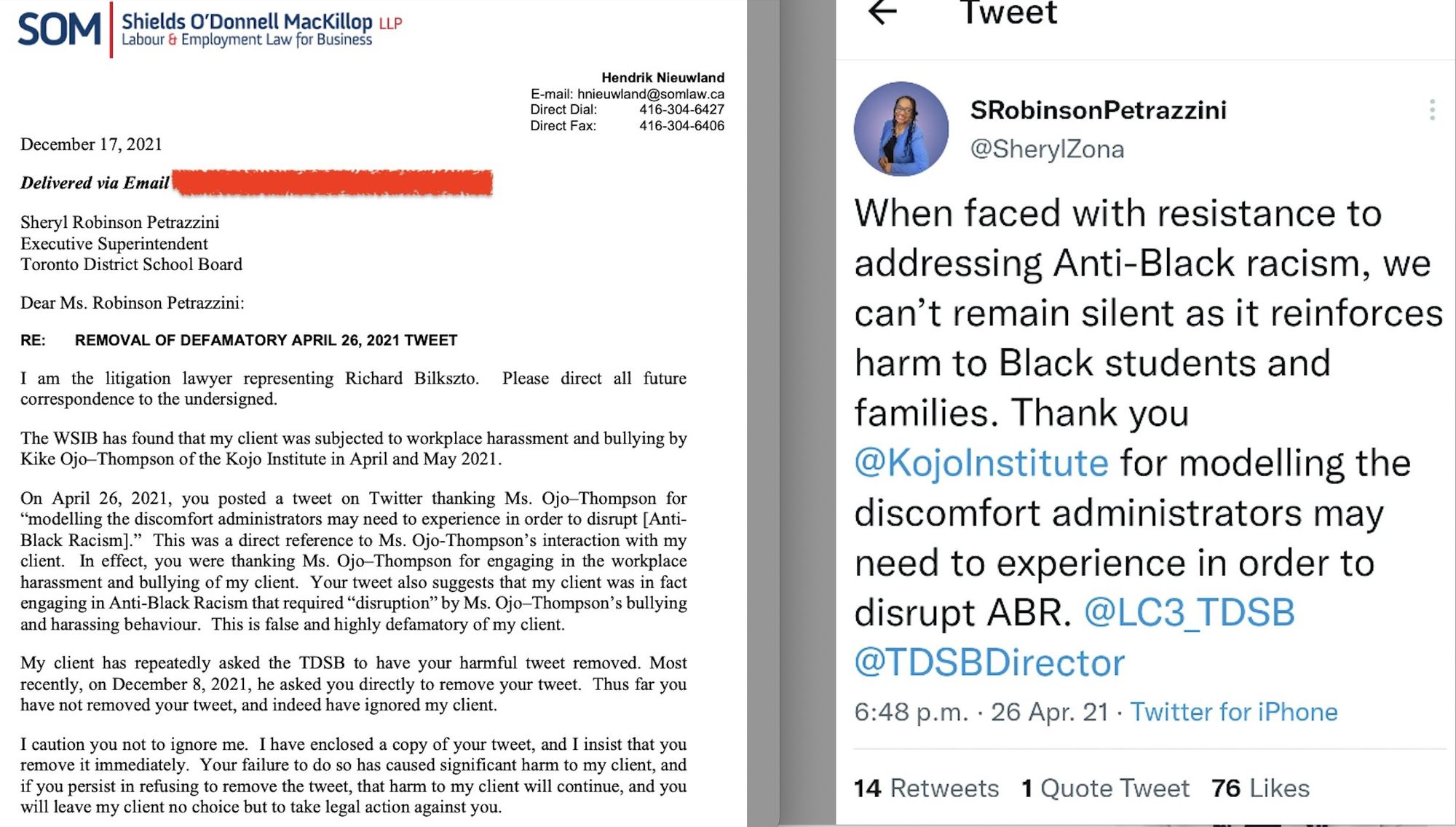
On Twitter, Sheryl Robinson Petrazzini, then the TDSB’s Executive Superintendent, thanked Ojo-Thompson and her KOJO colleague for “modelling the discomfort [that] administrators”—i.e., Bilkszto—“may need to experience in order to disrupt ABR [anti-Black racism].”
For good measure, Robinson Petrazzini also suggested that Bilkszto (whom she did not name, but was the obvious subject of her Tweet) was allied with the forces of “resistance” to anti-racism, and so was abetting “harm to Black students and families.”
Bilkszto personally asked Robinson Petrazzini to delete the Tweet. She did so only eight months later, and only after receiving a letter from Bilkszto’s lawyer warning her that she’d be sued unless she did so.
According to Bilkszto, his other bosses also refused to support him, instead attacking him for his “male white privilege.” And yet, once Bilkszto filed a lawsuit against the TDSB, seeking $785,000 damages for the emotional and reputational harm he’d endured, those same administrators now began claiming that it was Ojo-Thompson who’d gone rogue.
While they’d been perfectly happy to throw Bilkszto under the bus when the stakes were confined to emotional “discomfort,” the TDSB suddenly decided to sue Ojo-Thompson for negligence and breach of contract, demanding that she effectively indemnify the school board for any payout that might become due to Bilkszto. (The TDSB later claimed that it planned to discontinue this suit. But Sakornak reported that it was still a going concern as of June 6.)
I live in Toronto, where my own children have all passed through TDSB schools. Their experience has been a positive one, and I’m happy with the education they’ve received, notwithstanding the sometimes excessive pedagogical focus on race and genderwang. In fact, I have come to sympathize with the teachers—most of them smart hard-working people who find themselves being pressured by their own unions and administrators to adopt militant social-justice postures in their classrooms.
In some school boards, moreover, professional advancement is limited to those who explicitly embrace “anti-racist, high anti-oppressive” leadership principles. So while social-justice puritans comprise a small minority at most schools, they are able to exert disproportionate power in their bid to censure, humiliate, or even oust colleagues, such as Bilkszto, who speak up for the silent majority. In some cases, these ideological enforcers work closely with local race activists and their media allies, so as to harass or censor educators and parents accused of wrongthink.
While the work of anti-racism careerists such as Ojo-Thompson and TDSB Director of Education Colleen Russell-Rawlins is often justified as a righteous crusade against the forces of privilege, it would be difficult to find a more privileged clique of professionals in the field of Canadian public education.
Prior to getting her $300K-per-year TDSB gig, for instance, Russell-Rawlins served as the anti-racism czar at the (even more dysfunctional) neighboring Peel District School Board. Since coming to the TDSB, she’s presided over a series of embarrassing scandals, including an aborted student census that was discovered to be full of overt social-justice propaganda, a revamping of specialty schooling that was found to have been based on a plagiarized research report, and the cancellation of a speaking event by a Nobel-winning ISIS survivor on the grounds that it might be seen as Islamophobic. She’s blithely sailed through all of this without suffering any career repercussions.
The same is true of Robinson Petrazzini, the former $200K/year TDSB superintendent who went on Twitter to spike the football when Bilkszto was humiliated by Ojo-Thompson. Shortly after Bilkszto lawyered up, Robinson Petrazzini became Director of Education at the neighbouring Hamilton-Wentworth District School Board.
As for Ojo-Thompson, she continues to be feted by numerous Canadian organizations and media outlets. In 2022, she served on the board of directors of Parents of Black Children, a Toronto-area lobby group that’s made a name for itself largely by urging school boards to implement the same anti-racism instructional modules that constitute Ojo-Thompson’s own stock-in-trade. (Her partner Rohan served until recently as Workplace Equity Manager with the Peel District School Board, and the two would appear together on stage to talk about “the Impact of Systemic Racism on K-12 Workplace Well-Being.”) The market for the sort of militant anti-racist diatribes that Ojo-Thompson peddles seems inexhaustible within Canada’s corner offices, and I seriously doubt whether even the negative attention resulting from Bilkszto’s death will dent her income.
And in any case, she’s been through this before—for this was not the first time that Ojo-Thompson has encountered “resistance”: A 2021 diversity training session that she delivered to councilors of Sarnia, a small Ontario city on the shores of Lake Huron, reportedly sparked a revolt among some audience members, causing Ojo-Thompson to quit that gig in a huff.
“The undisputed, uncorrected, and unabated hostility demonstrated by some members of Council toward our Principal Consultant Kike Ojo-Thompson was wholly inappropriate,” declaimed the KOJO Institute’s director of client services, Craig Peters. “There were things that were said in that meeting—that we won’t divulge—that led us to believe that it wasn’t in the organization’s best interest to continue.”
When contacted by The Sarnia Journal, Ojo-Thompson added that the comments she’d heard had made her feel unsafe.
“Safety isn’t always physical,” said Ojo-Thompson. “There is emotional and mental harm that can be done.”
No doubt, Richard Bilkszto (1963-2023) would agree.


 Multicultural Meanderings